February 16 – March 27, 27 A.D.  Jesus in the Wilderness – The Year of the Lord’s Favor #13

Week 2 Going where you don’t want to go

It is getting time for the evening meal, and you don’t want to eat at home.  Then comes the classic question, “Where do you want to eat?” with the classic answer, “Anywhere is fine with me.”  This must be very common because all across the country, restaurants have sprung up with names like “Anywhere,” “Anything’s Fine With Me,” “I Don’t Care,” and, of course, “It Doesn’t Matter”1.  When we have a group deciding on a restaurant, and no one has a preference, we then do eliminations: for example, ‘I ate at Applebee’s last week, so not there’ or ‘I don’t feel like Italian food tonight.’  This seems to be more productive.  Sometimes it is easier to know where you don’t want to go.

There is some discussion in the commentaries about whether Jesus fasted for 40 days and then was tempted or if he was tempted the entire 40-day period and then had the final three temptations that Matthew and Luke discuss.

Mark 1:12-13   The Spirit immediately drove him out into the wilderness. And he was in the wilderness forty days, being tempted by Satan. And he was with the wild animals, and the angels were ministering to him.

Our English version seems clear that Jesus was tempted for the entire 40 days, and the Greek version even more so.   Matthew and Luke then record the 3 specific temptations, but Mark does not.  It’s not hard to imagine 40 days of temptations.  We are told to expect trials and temptations.

Beloved, do not be surprised at the fiery trial when it comes upon you to test you, as though something strange were happening to you.  1 Peter 4:12

We are told that this is the norm.  God told Cain that “sin is crouching at the door”.  Peter says, “Be sober-minded; be watchful. Your adversary, the devil, prowls around like a roaring lion, seeking someone to devour.” (1 Peter 5:8).  We are surrounded by trials and temptations — that is the fallen world we live in,

So the Spirit “drove him out into the wilderness”.  The Greek verb is very forceful.  ‘Ekballo’ means to ‘throw out’.  This is the verb used when Jesus drives out the moneychangers in the temple, or when Jesus ‘cast out’ demons, or when Stephen is ‘cast out’ of the city and stoned.    It is the same as when the people in his hometown of Nazareth throw him out of town and then take him to throw him off a cliff.  This was not a friendly suggestion to Jesus by the Spirit to go to the wilderness.  This was no gentle nudge.  The Spirit forced Jesus to go where he did not want to go.

As we have discussed, the wilderness is not a place many would choose to go.  On a trip to Israel in 2016, the bus stopped at the edge of the Judean wilderness, and we were instructed to go off by ourselves for 40 minutes.  It was oppressively hot and dry.  There were no trees, no shade, almost no vegetation, and no signs of water.  40 minutes was long enough.  I could not imagine 40 days.  And in Jesus’ day, it was dangerous.  Mark tells us, “he was with the wild animals.”  That seems an odd detail to throw in a short passage.  That area used to be home to large and small predators.  (We were told the large ones (like lions) were no longer there.)  But this is not a place you choose to be day and night alone. I wonder if Mark was painting the wilderness as an anti-Eden place — Eden was a place of abundant vegetation and fruit of all kinds, the wilderness was desolate.  Eden had abundant water, “there went up a mist from the earth, and watered the whole face of the ground” such that a river flowed out of Eden, but the wilderness was dry.  The animals in Eden came to man without fear, but the animals in the wilderness are “wild.”2  But both were a place of testing and interestingly, Adam and Eve’s temptation was about something to eat, just as the first of Jesus’ temptations by the devil.

No one would choose to go to a place of testing, with an encounter with the devil after 40 hard days.  Jesus was forced there at the beginning of his ministry.  He will be forced to go somewhere else he doesn’t want to go at the end of his ministry.  

Matt. 16:21   From that time Jesus began to show his disciples that he must go to Jerusalem and suffer many things from the elders and chief priests and scribes, and be killed, and on the third day be raised. 

In the garden of Gethsemane, Jesus is “greatly distressed and troubled.” He prays and asks if there is any other way to accomplish God’s plan of redemption.  The way of the cross was not the way anyone, including Jesus, would want to go.  But praying in the garden, Jesus makes a choice that Adam and Eve should have made. 

God asked Adam and Eve, “Will you be obedient to me about the tree?”

“Will you follow my will or your own will?”  Adam and Eve fail at the tree of discerning good and evil.

God asked Jesus, “Will you be obedient to me about the tree?”

And Jesus answered, “Not my will, but your will be done.

  Jesus is obedient about the tree.

“They put him to death by hanging him on a tree”  Acts 10:39

God sent Jesus somewhere he didn’t want to go, as he did other Bible characters.  Jonah didn’t want to go to Nineveh, Moses didn’t want to go back to Egypt, Ananias didn’t want to go pray for Saul.  Abraham left his home, having no idea where he would end up. And then there is Peter.

 Jesus tells Peter, “When you are old, you will stretch out your hands, and another will dress you and carry you where you do not want to go” (John 21:18). Then Jesus gives Peter the same instruction he gave him at the beginning, “Follow me.” I have been to Rome and have seen the spot where, 34 years later, Peter was led, a place where his arms were stretched-out and nailed to a cross. Peter had learned to be obedient, to be faithful to go somewhere he didn’t want to go.  I believe at some point in all of our lives, God will ask us all to go somewhere we do not want to go.  It may be to minister to an enemy or to people who don’t like you; it may be leaving your home to unknown places, or it may be to a place of desolation or testing. It may be to martyrdom. 

Jesus followed God in everything, even to desolation and death.  

The one who restores our soul may lead us through paths of righteousness that look to us like the valley of the shadow of death. There are some dark valleys in this world.  Some of you have walked in the valley. Some of you are walking there now.  There is the valley of pain; there is the valley of depression, the valley of despair, the valley of illness so severe it is the shadow of death, the valley of grief over a loved one.  We all will walk through those valleys — places we don’t want to go.  And on that day, may Jesus remind us:

Yea, though I walk through the valley of the shadow of death, I will fear no evil: for thou art with me; thy rod and thy staff they comfort me. Thou preparest a table before me in the presence of mine enemies: thou anointest my head with oil; my cup runneth over.  Surely goodness and mercy shall follow me all the days of my life: and I will dwell in the house of the LORD forever.

There they are, the most common command in the Bible (“Do not fear.”) and the most common promise in the Bible (“I will be with you.”).  They are inextricably linked.  As God told Joshua before they entered the land:

Be strong and courageous. Do not be frightened, and do not be dismayed, for the LORD your God is with you wherever you go.”    Joshua 1:9

The same promise is given to the disciples right after Jesus tells them to go into all the nations.  Jesus’ last words in the gospel of Matthew:

And behold, I am with you always, to the end of the age.  Matthew 28:20

Jesus willingly went into the wilderness and willingly went to the cross with no fear, knowing God would be with him.  God promises to be with us in the deepest, darkest valleys of death, comforting, healing, and feeding us with cups running over with goodness and mercy. 

Jesus continues to say, ‘Follow me’.  If we follow him, we know he is there with us.  And if we follow Jesus, we are sure to end up going somewhere we would have never thought about going.  But we will never go alone. Are we willing to go where we do not want to go?  Have you been to the wilderness this week?

1. I have heard the “It Doesn’t Matter Family Restaurant” just below Montgomery, Alabama is a great place.

2. Talking about the ‘wild animals’ in Mark, Skip Moen said, “This sinful world into which Jesus enters to accomplish his mission is less like a pristine garden and more like Jurassic Park.”  Yikes!
Step by Step with Jesus #1 – From the Jordan to the Wilderness

So this section is for those who want to “follow with their feet” on our 70-week journey with Jesus.  I hope to be able to track Jesus’s movements over his ministry and give you my best estimate of how far he traveled and, hopefully, some information on the places he went.  We will just have to see how this goes.   I haven’t been able to find anybody who has done this before, so we will just do the best we can.

We did have several weeks of discussion on John the Baptist as a prequel to our 70-week study, and I mentioned that Jesus, prior to his February 16th baptism, would have traveled the 80-mile journey from Galilee to the Jordan River near Jericho.  But our walking time begins now.

In The Year of the Lord’s Favor #12, I gave you this information:

For those of you who have elected to follow Jesus with your feet, there is no way to know how much walking Jesus did during these 40 days.  Depending on which part of the wilderness Jesus went to, he either had an 8-mile hike to the west from the river to the ‘traditional’ area, or 12 miles if he went to the wilderness east of the Jordan (both paths up in elevation 1000-2000 feet).  To better understand Jesus’ experience in these times, try doing your usual exercise routine in isolation.  If the local gym is your usual place, do some trail hiking alone.  Pray for the spirit to lead you (or drive you).  Spend this time alone with God, being aware of any testing coming your way and preparing your heart (and legs) for some Jesus-style walking in the coming year. 

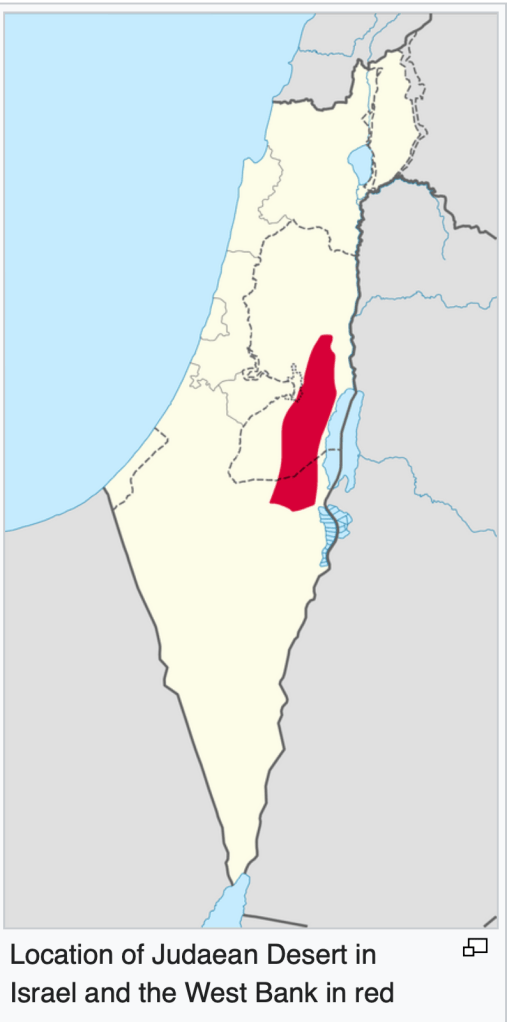
So to get to the wilderness (the traditional area west of the Jordan you see in red here), you have 8-12 miles.  How much did Jesus walk each day these 40 days?  We have no information on this.  So I’ll leave you on your own until near the end of March.  But if you want to be ready to keep up with Jesus later,  I would recommend putting in an average of 2 miles a day.  It is, of course, your choice how you log your miles (treadmill, elliptical, hiking, etc.)  My personal goal is to try to emulate Jesus’ steps as much as possible.  So for the wilderness miles, I hope to get out in whatever wilderness I can find, alone, spending time with the Father.

The Judean Wilderness according to Wikipedia:

“The Judaean Desert lies east of Jerusalem and descends to the Dead Sea. The Judaean Desert stretches from the northeastern Negev to the east of Beit El, and is marked by natural terraces with escarpments. It ends in a steep escarpment dropping to the Dead Sea and the Jordan Valley. The Judaean Desert is characterized by the topography of a plateau that ends in the east in a cliff. It is crossed by numerous wadis flowing from west to east and has many ravines, most of them deep, from 1,201 ft in the west to 600 ft in the east.”

An escarpment is a long steep cliff.  Knowing that the wilderness is full of these will become an important fact to understanding a verse later on.

A wadi (in this area) is a dry ravine with steep sides that has water only with rain and typically causes flash floods.

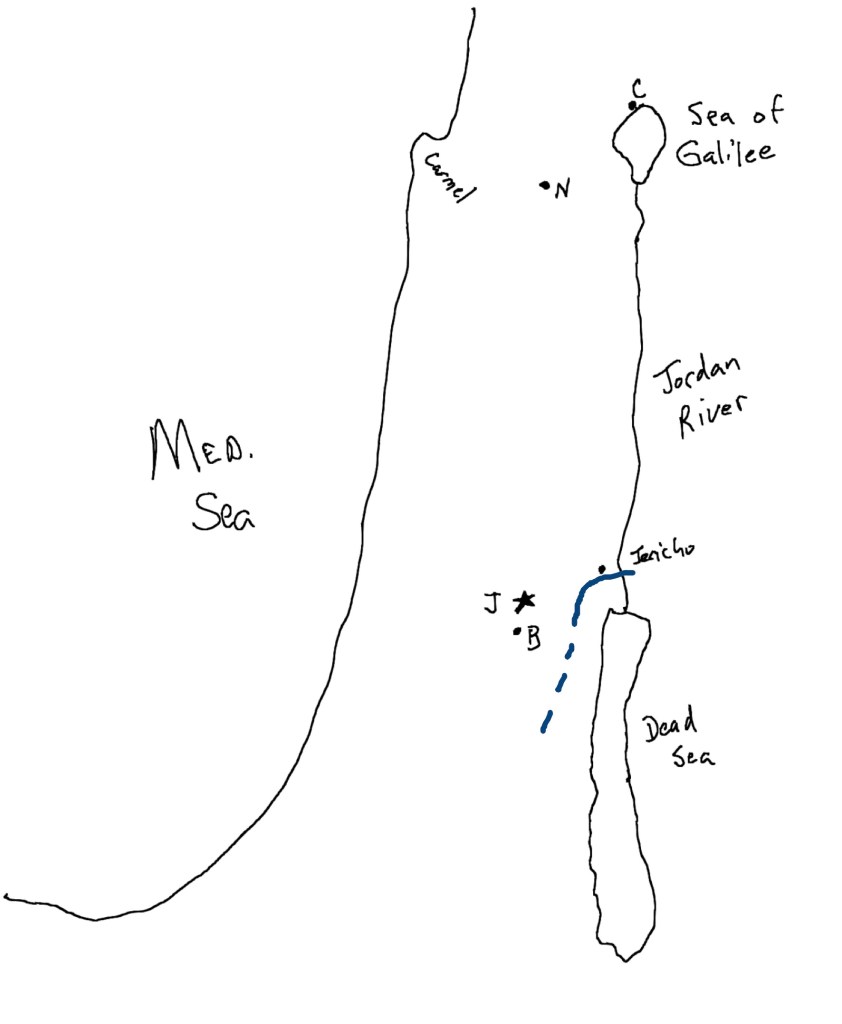
It would be very helpful for your understanding to be able  to draw a rudimentary map of Israel.  Instructions for this are found in “The months before Jesus’ ministry begins.  Winter, 27 AD #2”.  The blue line in my map here represents Jesus’ 8 mile trek into the wilderness from the Jordan River.

Jesus began his trek from the banks of the Jordan River, not far from the Dead Sea, the lowest point on earth.  So he would climb up in elevation from the Jordan at 1250 feet below sea level to the wilderness at 1000 feet above sea level.

On your walk west from the Jordan, you will pass by the city of Jericho, one of the oldest cities in the world with the oldest known defensive wall.  It was the first city taken by Joshua and the children of Israel (Joshua 6).  Jericho was known as the ‘city of palms’ and, in Jesus’ day, was considered an ‘oasis city’ at the edge of the Judean Wilderness, always lush due to the many natural springs.  Herod the Great built a huge palace there with sunken gardens, swimming pools, and a bridge that spanned the gorge of the wadi.  (Herod’s land in Jericho was taken from him by Marc Antony and given to Cleopatra as a gift, so Herod had to lease the land from Cleopatra for his palace.)

Here is a 3 minute youtube video with some good information and pictures. (This does greatly overestimate the water sources, but oases make the best pictures.)

February 16 – March 27, 27 A.D.  Jesus in the Wilderness – The Year of the Lord’s Favor #12

Week 1 –Why the Wilderness?

“Matthew 4: 1-2—Mark 1: 12-13a—Luke 4: 1-2”

After Jesus’ baptism, Mark tells us he “immediately” was driven into the wilderness where he would be 40 days. All 3 gospels add the reason for this trip: “to be tempted by the devil,” and Matthew and Luke also add that he fasted for 40 days.  After 40 days, Matthew and Luke tell us Satan tempted him with three specific temptations.  

Since we are following Jesus in ‘real-time’, we have 40 days to consider all the aspects of this period that only gets a few verses in each Gospel. Here are the questions we will consider over the next 40 days:  Why was Jesus “driven by the Holy Spirit” to the wilderness for 40 days, and why do we need the wilderness?  Testing or tempting, what is the difference?  Why did Jesus fast for such a long period?  What place does a time of isolation and fasting have in my Christian walk?  What did Jesus do out there for 40 days?  Who is this ‘devil’ that is tempting Jesus?

For those of you who have elected to follow Jesus with your feet, there is no way to know how much walking Jesus did during these 40 days.  Depending on which part of the wilderness Jesus went to, he either had an 8-mile hike to the west from the river to the ‘traditional’ area, or 12 miles if he went to the wilderness east of the Jordan (both paths up in elevation 1000-2000 feet).  To better understand Jesus’ experience in these times, try doing your usual exercise routine in isolation.  If the local gym is your usual place, do some trail hiking alone.  Pray for the spirit to lead you (or drive you).  Spend this time alone with God, being aware of any testing coming your way and preparing your heart (and legs) for some Jesus-style walking in the coming year.

The wilderness.

First of all, we need to recognize the significance of 40 days in the wilderness, paralleling Israel’s 40 years in the wilderness.  If you want to read about Israel’s time there, most of that story is in the Bible book titled “In the Wilderness.”  Okay, so in your English Bible, the name of the book is “Numbers,” but in the Hebrew Bible, it is “Ba Midbar” or “In the Wilderness.”   (By the way, “Numbers” sounds like a book my accountant would be interested in, but certainly not me.  “In the Wilderness” sounds like a title I would pull off the shelf.)

Israel was in the wilderness of the Sinai peninsula for 40 years.  If you look at a satellite map of Egypt and the Sinai peninsula, you will be impressed by the tiny line of green vegetation in a narrow strip alongside the Nile, and then everything else is brown.  No vegetation.  No life.  Back in 2016 I hiked up a mountain near the Valley of the Kings in Egypt and saw this for myself.  There is green alongside the Nile and then one step over, it is desert.  From the most lush land with the most fertile soil in the world to a wasteland in one step.  When you lived in Egypt in ancient times, the desert, the wilderness, was where you went to die.  Nothing was there except death.  When Pharaoh kicks the young man Moses out of Egypt for killing an Egyptian, it is a death sentence. No one was expected to survive the wilderness.

The Israelites leaving with Moses understood this. Only the severity of their enslavement and their faith in the provision of God would embolden them enough to step out of Egypt to a land of death.  Remember that God didn’t lead Israel on the more direct route to Canaan.  They could have traveled Northeast along the Mediterranean Sea to the promised land and arrived there easily in a few weeks along a well-traveled route.  But they needed the time in the wilderness. They had lived for generations as slaves, working under great difficulty, but depending on their Egyptian masters to care for their needs of food and shelter.  No one ever thirsted in Egypt.  They didn’t even depend on rain, for the Nile was always there. This country knew no drought until God turned the Nile to blood as a plague. They had much to learn about God’s laws, worship, and how to depend on him.  God’s deliverance got them out of Egypt, they needed the wilderness to get Egypt out of them.

They entered after the miracle of God parting the Sea of Reeds.  They saw Egypt’s army drown there, and then they headed east into the wilderness.  Then, they understand that the wilderness will be a time of testing for them.  They hunger, they thirst, they whine and complain.  “Why did you bring us out here to die?  We had plenty of food to eat and an abundance of water in Egypt.”  God intervened for them repeatedly, giving them water from the rocks, raining food from the sky, sending quail, leading them to oases.  They met God at Sinai and saw his presence in fire and cloud.  He trained them in the law and worship.  He healed their diseases and kept their shoes and clothing from wearing out.  Still, it wasn’t enough.

Deut. 8:2-3  Remember the long way that the LORD your God has made you travel in the wilderness these past forty years, that He might test you by hardships to learn what was in your hearts: whether you would keep His commandments or not. He subjected you to the hardship of hunger and then gave you manna to eat, which neither you nor your fathers had ever known, in order to teach you that man does not live on bread alone, but that man may live on anything that the LORD decrees.

Avivah Gottlieb Zornberg, in Bewilderments: Reflections of the Book of Numbers, says, “The book of Numbers is a narrative of great sadness, in which the midbar, the wilderness, swallows up all the aspirations of a generation—people who experienced the Exodus, the Revelation at Sinai, and the creation of a sanctuary for God.”  Of the hundreds of thousands (or millions) of adults who witnessed the ten plagues, crossed the parted waters of the sea, and witnessed Sinai, only two survived to enter the promised land.  Every other adult died in the desert, a victim of faithlessness, having chosen at Kadesh Oasis to follow the majority report and refuse the promise of God to enter the land there.

God had them go through the wilderness to learn to be separate from Egypt.  He wanted them to see the uncertainty of basic necessities (food, water, shelter, etc.) and learn dependence on him. Sometimes, God has that same lesson for us.  We have to do without to learn to trust him as our provider.  We need times of solitude to learn loneliness to know God as our friend.  We need to know fear to understand that we can cast our cares on him.  We need to be weak to learn of his strength.  Paul said it this way:

But he said to me, “My grace is sufficient for you, for my power is made perfect in weakness.” Therefore I will boast all the more gladly about my weaknesses, so that Christ’s power may rest on me. That is why, for Christ’s sake, I delight in weaknesses, in insults, in hardships, in persecutions, in difficulties. For when I am weak, then I am strong.   2 Cor. 10:9-10

This is one of the reasons Jesus said it is hard for a wealthy person to enter the Kingdom of God.  With enough resources, we can continue to fool ourselves with the illusion of self-sufficiency.  Nebuchadnezzar was the king of Babylon, and for a while, he thought, the king of the world.  He said, “There is great Babylon, which I have built by my vast power to be a royal residence for the glory of my majesty!”  Read Daniel 4 to see how God humbled him in a significant way.  Peter did not recognize his weakness and told Jesus there was no way he would ever deny him.  The Bible is full of these stories.  The first story in the Bible after Creation is about the lie from the serpent that Adam and Eve believed that they could be like God and would no longer need God to tell them what was good and what was bad.  People still buy into the lie of self-sufficiency every day.  We still need the wilderness.

Israel passes through the waters of the sea into the wilderness to be tested. Jesus passes through the waters of the Jordan and is sent into the wilderness to pass the test that Israel failed.  He is showing us how to be the people God designed us to be by becoming totally dependent on him.  We need the wilderness.  Find some time in these 40 days to be alone with God there.  Learn of your weakness so that you may know Him as your strength.  The wilderness may show up in an odd place.  (Read my blog from the past that I reposted yesterday, “The Day of My Fear,” about a wilderness moment I had ten years ago that day.)

The Day of My Fear

Note:  Today I resurrected this post from my old blog as it is the 10 anniversary of this ‘day of my fear’.  Tonight I will celebrate with some dear friends.  God is good,

Psalm 56:4

When I am afraid, I put my trust in you. In God, whose word I praise, in God I trust; I shall not be afraid. What can flesh do to me?

When I am afraid — the Hebrew is “yom eera” which means ‘in the day that I fear’. Have you ever had a day you remember as ‘the day of my fear’? You may have had several of them. You may never have been in enemy territory alone like David in this psalm, but there may have been times when you have feared for your life, or for something more important. The tense of the Hebrew verb, ‘fear’, notes that the action of ‘fearing’ is incomplete. It is recurring and unfinished. It is not one day, but one of several or many.

A year ago this month I found myself lying on a stretcher by myself in a hospital. I was there by choice. I had decided to donate a kidney to a friend. (Actually I am sure that Yehovah decided, and I was merely obedient.) It had been about 9 months from the decision to the day of the transplant, full of many tests and work-ups. Throughout the whole process, I never had any doubts that I was doing what I was called to do. I had never known any fear. I was confident. But on the morning of the surgery, they called me back to a room alone. I had my wife and several friends there to support us that morning, and I expected that they would allow my wife at least to be with me until time to go back to the surgical suite. But they wanted me alone. They gave me one more chance to “back out” saying that if I decided to not go through with it, they would just tell everyone that this morning’s tests revealed I couldn’t be a donor. But I had no doubts and no reservations. So they placed the IV line and left me there. Alone.

In that moment it struck. Fear. My mind started racing. In medical school, I had seen many surgeries go wrong. I had seen a man never wake from an elective surgery. I saw a young woman die on the table during a very simple procedure. I saw a middle-aged man have a severe reaction to anesthesia and never make it to the first incision. Alone in that room, fear washed over me like waves of the ocean for what seemed like forever, but was actually only about 5-10 minutes. And then it ended. Yehovah reached down and brought peace to my quaking mind. He asked me if I trusted him. “I’ve got this” was the message I received. And for the next 15-20 minutes, alone in that room, I had a time of worship. A good friend had sent me an email that morning with his prayers and a link to a music track. I had decided after reading his mail to purchase the song, went to iTunes only to discover that my daughter (who shares my account) had already bought it, so I downloaded it. I still had my phone with me, so I set that song on replay. It was “Oceans — where feet may fail”. The lyrics are below. They say it all. God is good.

In the ‘day that you fear’ I pray that you will have friends praying for you as I did. Remember that the ‘day of fearing’ is recurring and unfinished. You may have many days of fear. I have seen myself in the day of fear, and I would never describe myself as brave. But our God is faithful. For that reason you can be strong and courageous in the midst of that fearful day.

You call me out upon the waters
The great unknown where feet may fail
And there I find You in the mystery
In oceans deep
My faith will stand

And I will call upon Your name
And keep my eyes above the waves
When oceans rise
My soul will rest in Your embrace
For I am Yours and You are mine

Your grace abounds in deepest waters
Your sovereign hand
Will be my guide
Where feet may fail and fear surrounds me
You’ve never failed and You won’t start now

So I will call upon Your name
And keep my eyes above the waves
When oceans rise
My soul will rest in Your embrace
For I am Yours and You are mine

Spirit lead me where my trust is without borders
Let me walk upon the waters
Wherever You would call me
Take me deeper than my feet could ever wander
And my faith will be made stronger
In the presence of my Savior

February 16, 27 A.D. Sabbath (Saturday) In the Jordan River -The Year of the Lord’s Favor #11

February 16, 27 A.D. Sabbath (Saturday) In the Jordan River -The Year of the Lord’s Favor #11

Week 1 The Baptism of Jesus, part 2 –

Matthew 3: 13-17—Mark 1: 9-11—Luke 3: 21-22

In our first discussion (If you missed it: The Year of the Lord’s Favor #1), we discussed how all the prophets, after the exile in Babylon, looked forward to a time when God would come as he promised. Remember this scripture we discussed?

Mal. 3:1 “Behold, I send my messenger, and he will prepare the way before me. And the Lord whom you seek will suddenly come to his temple; and the messenger of the covenant in whom you delight, behold, he is coming, says the LORD of hosts. 

We have seen the messenger come as John the Baptist. He has prepared the way by preaching on the coming Kingdom of Heaven and the need to repent and bring fruit. Then, Jesus showed up and requested baptism by John. Last time, we looked at the why of Jesus’ baptism. Now, we will look at what happened at the time of his baptism.

Matthew 3:16-17 And when Jesus was baptized, immediately he went up from the water, and behold, the heavens were opened to him, and he saw the Spirit of God descending like a dove and coming to rest on him; and behold, a voice from heaven said, “This is my beloved Son, with whom I am well pleased.”

As Jesus emerges from the water, “behold, the heavens were opened to him.” We need to understand what this moment meant to John. At this point, John is sure  400+ years of prayer are being answered because he knows the words of the prophets. Isaiah 64:1 is another of the passages, like Malachi 3:1 above, that looked forward to the time when the Lord would return.  

“Oh that you would rend the heavens and come down, that the mountains might quake at your presence.”  Isaiah 64:1

Isaiah is looking backward to the time when God descended at Sinai, and the mountains quaked, “when you did awesome things” (Isaiah 64:3). He is looking forward to the time when God would come and do extraordinary things again. At this revelation to John, he sees the wish of the people voiced by Isaiah come to pass. He sees the heavens open, and God’s Spirit descends. And Jesus will certainly do awesome things, but the earthquake will only come when his sacrifice for us is complete (Matthew 27:51).

Then John “saw the Spirit of God descending like a dove and coming to rest on him [Jesus].”1 Have you ever watched as a bird lands or feeds their young, that for a moment they hover? The second verse of the Bible, Genesis 1:2, says, “The Spirit of God was hovering over the face of the waters.” That Hebrew word for ‘hovering’ is “merachafet,” which means ‘fluttering’ or, as the rabbis describe it, “even as a dove hovers over its nest,” linking it to the dove that heralds the re-creation of the world after the flood in Genesis 6 (a de-creation and re-creation event). So it is appropriate for John to describe the Spirit of God descending like a dove on Jesus, for his baptism heralds that God is about to do something new again. At this point, John is sure that Jesus is the long-awaited Messiah, as he later relates:

John 1:33   I myself did not know him, but he who sent me to baptize with water said to me, ‘He on whom you see the Spirit descend and remain, this is he who baptizes with the Holy Spirit.’

Then, a voice with a message hyperlinks to three Old Testament scriptures.

1. “This is my son” – This phrase is a reference to the third stanza of Psalm 2. The end of the second stanza of Psalm 2 introduces the Davidic king, the Messiah, who speaks in verse 7:

 “I will tell of the decree: The LORD [Yehovah] said to me [the messiah], “You are my Son; today I have begotten you.” Psalm 2:7

2. “with whom I am well pleased” – This is from another known messianic passage in Isaiah.

 Isaiah 42:1 Behold my servant, whom I uphold, my chosen, in whom my soul delights; I have put my Spirit upon him; he will bring forth justice to the nations.

3. “my beloved son” – Though in the days of Jesus, this was not recognized as a messianic illusion,  looking back, we now readily connect this story to the crucifixion of Jesus. God asked Abraham to be willing to “Take your son, your only son Isaac, whom you love” and sacrifice him. Arriving at the site of the sacrifice, Isaac asks his father. “Where is the lamb? and Abraham answers, “God will provide the lamb.” The willingness of Abraham to give up his beloved son, Issac’s desire to be obedient to his father and lie down on the altar to be bound2, and the divine provision of a lamb to be a substitute sacrifice for Isaac — these three things shout to us a foreshadowing of God providing his beloved son as a substitutionary sacrifice for us. John sees Jesus as that sacrificial lamb as he later says, “Behold, the Lamb of God, who takes away the sin of the world! (John 1:29)  

God had already fulfilled the sign of the Messiah that he had given John at his calling. Then to confirm it, God speaks the words known to refer to the Messiah. There can be no doubt in John’s mind that before him is the long-awaited one.3  

Luke sees this baptism as his anointing to begin his ministry, and Jesus says as much, reading from the Isaiah scroll in Luke 4:18, “The Spirit of the Lord is upon me because he has anointed me…” Remember that ‘Messiah’ (which the Greek translates as ‘Christos’ or Christ) means ‘the anointed one’. Jesus, as the anointed one, must have a time of anointing, and many see his baptism as his anointing for service. Near the end of his ministry, we will speak of another anointing (April 23 of next year).4 

From this point on, readers of the Gospels must be sure of Jesus’ position as the Messiah. John the Baptist is also sure, though he will ask his disciples to seek further evidence when he is imprisoned. Other people in the first century will come to this conclusion slowly over the next year, and sadly, many will reject Jesus as the Messiah.

Today is a good day to remember your baptism. I pray you have entered the waters of repentance with Jesus and have risen as a new creation. This morning, I pray for you. I look over the list of 50 subscribers to this blog and pray that God will open the heavens for you and show you His glory as he did at Sinai, as he did for John on this day, 1997 years ago. I read Isaiah 64:1 and hear the people begging God to “rend the heavens and come down.” God promises he will open the windows of heaven for us if we are his obedient children (See the rest of Malachi chapter 3 that we quoted the first verse of above. And don’t think it is all about tithing — read all of Malachi— you can’t buy God’s favor —it is about obedience.) And if you don’t know Vertical Worship’s song from 2012, “Open Up the Heavens,” then pull it up and let that be your prayer and worship this morning (link below).5 Jesus is still on the mission that he began 1997 years ago on a Sabbath in the river Jordan — a mission to fulfill our righteousness and reconcile us to the Father. “Show us your glory, Lord.”

David

1.    Who saw the heavens open and Spirit descend, and who heard the voice from heaven? John bears witness that he saw it in John 1:32. Other than that, we do not know. Luke tells us that others were baptized before Jesus but did not specify who saw the heavens open and heard the voice. Matthew is not specific.

2.    Despite the Sunday School pictures of Isaac as a young child at the time of this story, he was already a grown man and could have easily overpowered his over 100-year-old father if he wanted to. But Isaac allowed himself to be bound and placed on the altar. The rabbis have emphasized Isaac’s obedience, and this section is often titled “The Binding of Isaac.”

3.    Though John is convinced of Jesus as the Messiah here, we will see him have some questions (doubts?) when Jesus’ ministry does not align with exactly what everyone in that day pictured the Messiah would be.

4.    There is much precedence for multiple anointings in the Old Testament. David was anointed on three occasions (1 Samuel 16:13, 2 Samuel 2:4, and 2 Samuel 5:3).

5.    “Open Up the Heavens” https://www.youtube.com/

February 16, 27 A.D.  Sabbath (Saturday)  In the Jordan River- The Year of the Lord’s Favor #10

Week 1 The Baptism of Jesus

Matthew 3:13-15   Then Jesus came from Galilee to the Jordan to John, to be baptized by him.  John would have prevented him, saying, “I need to be baptized by you, and do you come to me?” But Jesus answered him, “Let it be so now, for thus it is fitting for us to fulfill all righteousness.” Then he consented. 

John said his baptism was for repentance.  People were baptized “confessing their sins” (Matthew 3:6).  So why was Jesus baptized by John?  We know he did not need to confess his sins, for the author of Hebrews tells us that Jesus “in every respect has been tempted as we are, yet without sin.”  No one was more surprised at this request than John himself.  John made very clear that he was subordinate to Jesus, saying that he was not even worthy to untie Jesus’ shoes (the job of a slave).  John tells Jesus, “No way, you be the rabbi, I’ll be your disciple.” But Jesus tells John to accept it that way for now, that he can “fulfill all righteousness”.

I have read many explanations of why Jesus was baptized by John.  Some say it was just for Jesus to give his stamp of approval on John’s ministry and message.  This could be part of it, for Jesus preached the same message as John preached.  Some say it was Jesus being humble, and certainly, Jesus’ humility shows throughout his ministry, even to the point of the humiliation of death on the cross (Phil. 2:8).  Some say he was baptized as a model for us, and certainly Jesus’ way of living is our model of how to follow God. Still, others say that John was calling a nation to repentance, and Jesus was born a Jew, a member of that nation and thus in need of repentance for the corporate sins of his forefathers.1  But John asked Jesus this very question, and how does Jesus answer?

But Jesus answered him, “Let it be so now, for thus it is fitting for us to fulfill all righteousness.”

What righteousness is Jesus fulfilling by being baptized by John?

I think Jesus is doing here what he will do on the cross.  He takes responsibility for sins that he didn’t commit.  Jesus was innocent.  He had no sin, but Paul says in 2 Corinthians 5:21, “God made him who had no sin to be sin for us, so that in him we might become the righteousness of God.  The righteousness Jesus is fulfilling is ours, because we can’t fulfill it on our own.  He has no personal need to repent, but he enters the waters of repentance with us.  Isn’t that what Isaiah predicted he would do?  “Behold, the virgin shall conceive and bear a son, and shall call his name Immanuel” (Is. 7:14).  Immanuel means “God with us”.  We celebrate each year that Jesus came from his place at God’s right hand to be one of us.  He came to experience humanity that he could identify with us.  He came to know our hunger, to know our pain, to know our temptations, to know rejection, to know abuse, to know suffering.  And by becoming a human like us, he shows us how to be a human like God intended us to be.  

“I will be with you.” It it the most common promise in the Bible.  It is the way Matthew begins his gospel, quoting Isaiah.  It is the way Matthew ends his gospel, “And behold, I am with you always, to the end of the age.” (Matthew 28:20).  It is only fitting that this is the way Jesus begins his ministry.  He enters the river with us.  He awaits his turn with those repenting of their sins and being immersed.  He rises up out of the water and looks out at those who have not yet been baptized.  You can almost hear the words now that Jesus will say many times in the coming year.  “Follow me.”   Follow me in repentance.  Follow me in the waters.  Follow me as I rise to minister.  If we follow him, he promises to always be with us.

But Jesus answered him, “Let it be so now, for thus it is fitting for us to fulfill all righteousness.”

Jesus is fulfilling my righteousness, he is fulfilling your righteousness. Hallelujah! What a Savior! Thank you, Jesus.  Let us all now follow him into the waters of repentance as we enter this journey with Jesus.

1. We don’t talk a lot about corporate sins, but recently there has been a movement to accept the guilt of our forefathers for their mistreatment of people groups in the past (specifically the issues of the treatment of Native Americans, slaves, and minorities.)  The Bible is very clear that each person accepts the punishment only for his own sin, not that of his fathers (Deut. 24:16, Jer. 31:29-30).  Children are only guilty of the sins of their fathers if they imitate their fathers, though sometimes we reap the consequences of what was sown in previous generations.  Yet the sins of the past are relevant.  We should acknowledge them and renounce them. But there is no need to repent of sins we didn’t personally commit.  Kevin DeYoung, in his short book (with a long title) Impossible Christianity: Why Following Jesus Does Not Mean You Have to Change the World, Be an Expert in Everything, Accept Spiritual Failure, and Feel Miserable Pretty Much All the Time  said it this way:

“We are not meant to live with a sense of corporate guilt for an ethnic, racial, or biological identity we did not choose and from which we cannot be free. Self-flagellation is not a requirement for spiritual maturity. It is one thing for us to love God and love our neighbors; it is quite another if the call of Christian discipleship means we must, on account of the failures of others, hate ourselves.”

If you have ever felt like it is impossible to measure up as a Christian, read this book.  There is no need to live with constant guilt and remorse.  (That’s part of what makes the baptism that Jesus will bring different than the baptism that John does.) 

The Year of the Lord’s Favor #9 – A note on the timing of Lent and our journey this year

In 2024, Lent begins on Wednesday, Feb. 14 (Ash Wednesday) and concludes on Thursday March 28 (the Thursday before Easter Sunday). The word ‘Lent’ comes from an Old English word meaning ‘spring season’ from the Old Dutch ‘lente’ or the German ‘lenz’ that referred to the ‘lengthening’ of the days in this season from winter to spring.  The observance dates back to around 325 at the council of Nicea when a 40-day time of fasting before Easter was established. The dates for the time of fasting have been altered several times, as have the fasting requirements.  Currently, the most-followed dates are 46 days, as the 6 Sundays in the season are not fast days.  

Depending on which source you read, it may have originally been a time of fasting before a candidate was baptized.1  As baptisms in the church began to be done primarily on Easter Sunday, then a more official fasting period was recognized.  It became a 40-day fast, following the 40-day fasts of Elijah, Moses, and Jesus.  The requirements for the fast have also varied tremendously through the years, originally requiring only 1 meal a day after 3 pm with no meat, fish, or dairy.  Currently, in the Catholic Church, only Ash Wednesday and Good Friday are mandatory fast days.  And now, ‘giving something up’ for Lent has replaced the food fast for most who follow the tradition.

We will talk in the coming months about traditions that are contrary to scripture, and how Jesus said “You leave the commandment of God and hold to the tradition of men.” (Mark 7:8) to the Pharisees.  But not all traditions are contrary to scripture.2  I believe any time that you set aside for God is good.  And there are, as mentioned above, Biblical models for a 40-day fast.  This year, the 40-day fast of Jesus in the wilderness will begin this Saturday, Feb. 17 as his baptism in the Jordan was Feb. 16 in 27 A.D.  In that year, the sacrifice of the Passover lambs would have been April 11 (remember the dates of Passover and Easter vary every year.)   Jesus would have concluded his 40-day fast on March 28, which is, coincidentally this year the conclusion of Lent on the Thursday before Easter.3

While Jesus’ 40-day fast in the wilderness is not a preparation for the Passover/Easter event, this year the dates do overlap.  So this year, whether your church tradition observes Lent or not, we can all observe this time of preparation.  Jesus’ time in the wilderness was a preparation for his year of ministry.  We can follow with him and use this time to prepare to follow him through his ministry in the 4 Gospels.  

This Friday, our study will be on Jesus’ baptism in the Jordan, on the day it happened in 27 A.D.  Then we will follow Jesus into the wilderness for 40 days.  We will take that time to examine the idea of wilderness in the Bible, the ideas of testing and tempting, and the idea of fasting.  Then on March 28, when Jesus’ 40 days ends, we will discuss the 3 temptations as recorded in Matthew and Luke.

1. The Didache, a 1st Century Christian text, recommended that the candidate for baptism and ‘others that were able’ to fast and prepare for the sacrament of baptism. (Didache 7:4)

2. During the time of the Reformation, many theologians pushed hard against any Catholic traditions including Lent.  This is very interestingly like the hard push against anything Jewish in the 300s and following, when at the same Council of Nicea it was forbidden to share a meal with Jews or worship on a Saturday.  John Calvin in Institutes of the Christian Religion (1536) said “Then the superstitious observance of Lent had everywhere prevailed: for both the vulgar imagined that they thereby perform some excellent service to God…”  In both instances, the church, I feel, overreacted and ‘threw the baby out with the bath water.’  They were so against the Jews and later the Catholics that they renounced everything Jewish or Catholic.  And because of this, for hundreds of years, the Church missed out on the Jewish roots of our faith and the rich history of our faith that was maintained by the Catholic Church.  Sorry, Mr. Calvin, I have to disagree with you here.  Now that being said, let’s not make the same mistake of throwing Calvin out with the bath water.  I own a set of Calvin’s commentaries and find his thoughts very useful (sometimes).

3. For those of you who are detail-oriented and count the days, we will have 41 days instead of 40 because this year is a leap year.  Jesus’ calendar in the 1st Century had a ‘leap month’ and this 13th month comes into play in the year Jesus is crucified.  We’ll talk all about how this works when we get there next year.

The months before Jesus’ ministry begins.  Winter, 27 AD  The Year of the Lord’s Favor #8

John’s Baptism

As we approach the baptism of Jesus, it is important to think about how John’s baptism was viewed by his disciples and those who came to hear him.  

There had been 400 years without a prophet giving a word from God.  A messenger had been promised.  And John the Baptist arrives on the scene.  He can’t be easily ignored, wearing camel hair and preaching in the wilderness.  But John is called “the baptist” or “the baptizer”, and it is this activity that makes him stand out the most.  This baptism is something new and different, and many are coming a long way to see what is going on.

Now we don’t think baptism is odd or unusual.  We see it as a normal part of our religion that some do as an infant, some after the time of confirmation, or some at the time of making a personal decision.  But our understanding of baptism is based on the baptism as done in the book of Acts and following.  We are looking backward with our preconceptions of what baptism means in our time.  The people in John’s time had their own preconceptions about baptizing.   How did the people of his day understand John?  What did it mean to them? 

The idea of ritual bathing or immersion goes back to the time when Israel was about to leave Egypt.  They are told to “consecrate” the firstborn before Passover.  According to the Jewish Torah Commentary, the instruction to consecrate people “involves a purificatory rite …[that] requires bathing, laundering of clothes, and abstention from ritual defilement on the part of the initiate.”1 Later, all of Israel is to consecrate themselves before their encounter with God on Sinai, and again before crossing the Jordan.  Priests also are consecrated before any service and washed in the bronze laver in the Tabernacle.

Up on Sinai, God gives Moses instructions for a tabernacle, and God tells him the purpose of the tabernacle is not for God to dwell in it, but for it to be a place God can dwell with man.  Again, this is God’s purpose for man from the beginning.  God has always sought to live in community with us.

God tells Moses that if we are going to dwell together, you have to keep yourselves pure.  He gives rules for two kinds of purity: Moral Purity and Ritual Purity.  Now we understand moral purity pretty well, including the 10 commandments given at Sinai. But ritual purity is more of a mystery for us 21st-century people.  (It is not that hard.)  Every modern culture has standards of purity and defilement.   For example, even though discrimination on the grounds of caste has been outlawed, many Hindus will not touch people of lower caste, and if they do, they must wash to remove the defilement.  Certain sicknesses are taboo to touch in many societies.  And I have witnessed it many times watching people interact with homeless people, refusing to shake hands, touch, hug, etc.  

You wouldn’t want one of my surgeon friends who just pulled a dead dog off the road, gathered up the pieces and buried it, to just walk into the operating room to do surgery without going through a process to become clean again. That would seem crazy to you.  Yet in the mid-1800s, before the idea of germ theory existed, medical residents in a hospital in Vienna would practice surgery on cadavers and then go upstairs and deliver babies without washing their hands.  It was Ignaz Semmelweis who discovered why this hospital had 3 times the maternal death rate of their sister hospital, and he saved countless lives simply by instituting handwashing there.2  Despite the decrease in maternal deaths, there was tremendous resistance to handwashing by the medical community and Semmelweis was ridiculed and eventually fired.  They had no basis to understand it in their culture.  Similarly, our modern culture has no basis to understand ritual washing (unless you read the Bible).  

Becoming ritually unclean was not a sin. It was a normal part of life to encounter bodily fluids and death.  There are just some things you don’t bring into God’s presence. If you followed the rules for cleansing before entering God’s presence, then there was no problem.  Ritual purity is totally separate from breaking moral laws.  And the Jews never believed that the water had any effect of actually washing impurity away, it was an act of obedience. It was a symbolic representation of the cleansing that God did because they were obedient.3

So God established a means for dealing with ritual impurity and with moral impurity (sin).  Dealing with ritual impurity usually involved washing.  Dealing with sin required a sacrifice.  When Israel went into exile in Babylon, they had no temple or altar and could not perform sacrifices.  So washing for ritual impurity became more important.  Philip Birnbaum in “An Encyclopedia of Jewish Concepts” noted that because it had become common to perform tevilah (immersion in a mikvah) before entering the temple, “some religious Jews began to see a greater spiritual significance to ritual purity as it embodied a state of nearness to God, as if one were truly present in the Temple.”4  Over 1000 mikveh (ceremonial bathing sites) have been excavated in Israel, some dating before 100 B.C.E. including many at the entrances to the temple where all Jews (including Jesus) would immerse (tevilah) before entering the temple area, just in case you carried some ritual impurity.

The Jews coming to John’s Baptism had this background of ceremonial bathing in preparation for coming into God’s presence to remove ritual impurity.  Immersion in the mikvah would represent a change of status – from ritually impure to pure.  John is taking this idea of a change of status and applying it to moral impurity. His baptism was “with water for repentance”, a symbol of repentance of a moral wrong.  Again, no one believed the water accomplished cleansing from sin.  It was a physical act demonstrating their inward repentance.  

The place where John was baptizing was very significant.  This is the same place where Israel crossed the Jordan to enter the land of promise.  They were to establish a community in this land where they would have no other gods, where they would love God completely and love their neighbor.  But the Scriptures note over and over again how they failed.  Tim Mackie said, “so John is calling Israel to start over, to go back through the river and come out rededicated to their God, ready for the new thing that God’s about to do.”5

With this understanding of how the Jews viewed John’s baptism, now you can consider how you view your baptism.  How is it the same?  How is it different?  We will consider this as we move along Jesus’ ministry this year.  We will also revisit the idea of ritual purity several times.  Jesus has a lot to say about ritual purity, and his actions regarding ritual purity rules shock his followers over and over.  

1. The Jewish Torah Commentary, Exodus, on Exodus 13:1.

2. The story of Ignaz Semmelweis is a fascinating read.  Probably the best book on this is 

Genius Belabored: Childbed Fever and the Tragic Life of Ignaz Semmelweis, 

by Theodore G. Obenchain (2021).

3. Though the practical benefits of washing after contact with bodily fluid are well known

  to us now, they were certainly not before Louis Pasteur and modern germ theory 

and had no impact on the understanding of people before 1850.

4. Birnbaum, Philip, An Encyclopedia of Jewish Concepts, p. 240, (1979).

5. Tim Mackie, from the Bible Project video, “The Baptism of Jesus”. 

The months before Jesus’ ministry begins.  Winter, 27 AD – The Year of the Lord’s Favor #7

Hey John, is this good news or bad news?   

We have been talking about the message of John the Baptist, which is also the message of Jesus.  “Repent, for the Kingdom of Heaven is at hand.”  Jesus said his purpose was to “preach the good news of the kingdom of God” (Luke 4:43).  But as we saw last time when the religious leaders came to John, the news was not all good.  John challenged their belief that their physical relationship to Abraham guaranteed their standing with God.  He called them ‘sons of a serpent’.1  John continues in Matthew 3:10

Even now the axe is laid to the root of the trees. Every tree therefore that does not bear good fruit is cut down and thrown into the fire.

The removal of trees is a common Old Testament metaphor for God’s judgment on other nations (See Isaiah 10:33-34, and Ezekiel 31).  Jesus will use this same metaphor along with John’s idea of fruit-bearing in Matthew 7:19

Every tree that does not bear good fruit is cut down and thrown into the fire.

John will next describe Jesus as one who is separating people, using another common Old Testament metaphor of separating the wheat from the chaff (See Isaiah 41:15-16, Psalm 1:4, Psalm 35:5).  The wheat is taken into the barn, the chaff is burned with “unquenchable fire” (Matthew 3:12). We have moved beyond a regular farmers fire to the eternal fire, or punishment of the wicked that Jesus mentions three times in Matthew (18:8, 25:41, and 25:46).

What is all of the wrath talk?  Didn’t someone tell John and Jesus that they were in the New Testament?  I was always told that the Old Testament is full of wrath and judgment and the New Testament is full of mercy and grace.  But John speaks wrath much like the prophets of old.  And Jesus, as we have just seen, also does not ignore the wrath of God.  And if you don’t like that ‘wrath-talk’ don’t read the last book in the New Testament.

But in the beginning of Jesus’ ministry, he does focus more on the mercy, love, and grace of God.  For example, when he reads from the Isaiah scroll in his hometown, Nazareth, he intentionally stops in the middle of a verse to leave out the section on wrath.  He reads from the Isaiah scroll (61:1-2) as this is recorded in Luke 4:18-19.

“The Spirit of the Lord is upon me, because he has anointed me to proclaim good news to the poor.  He has sent me to proclaim liberty to the captives and recovering of sight to the blind, to set at liberty those who are oppressed, to proclaim the year of the Lord’s favor.”

But in the scroll that Jesus is reading, in Isaiah 61, verse 2 says:

to proclaim the year of the LORD’S favor, and the day of vengeance of our God;

Jesus stops reading in the middle of a sentence, in the middle of a passage that everyone in the synagogue is familiar with, and just sits down. Everyone is surprised by his faux pas.  Jesus then really shocks them as he tells them:

“Today this Scripture has been fulfilled in your hearing.”

I think this is very significant.  Jesus is announcing this messianic prophecy is coming true…to a point.  Remember that the first-century Jews expected the Messiah to come in with righteousness and vengeance, to overthrow the oppressive government and restore the kingdom to Israel.  Jesus is claiming that the days of the Messiah are here.  This is the “year of the Lord’s favor.”2  This year of the Messiah is all about God’s favor.  Jesus leaves the vengeance out because it is not the time for the wrath of God to be manifest.  That time will come with the Messiah, but not with this coming of the Messiah.

Nevertheless, Jesus does not ignore the wrath of God.  We see it again in the Sermon on the Mount with the house built on the sand. We see it in the woes on Chorazin and Bethsaida in Matthew 11:21-24.  In Luke 19:41-44 he weeps over Jerusalem, knowing that the wrath of God is coming on them in the classic Old Testament method — destruction by a foreign pagan army.  (And Rome did destroy Jerusalem and the temple 40 years later.)

John gives wrath as a warning.  It doesn’t have to be that way.  You could repent.  But if you do not, God’s wrath will come.  So is that bad news?

If you are in a building and someone shouts out a warning to you because the building is on fire, is that bad news?  If you plan on listening to them and leaving the building, then you would gladly thank them for delivering the news.  It is bad news only if you don’t heed the warning and run to the exit.

The Gospel is the good news of the Kingdom of God (unless you decide to ignore it.)

David

  1. This leans heavily on information I learned from Tim Mackie in a Bible Project podcast, “God’s Wrath in the Teaching of Jesus”
  2. The year of the Lord’s favor, the time of the Messiah, I believe to be the year of Jesus’ ministry that we will follow this year in this 70-week study.  Feel free to disagree with me.  If you do, you will be in agreement with almost everyone who went to seminary and was taught his ministry lasted 3 1/2 years.  This is a not new concept, however, as all the church leaders prior to 300 A.D. said his ministry was about a year.  Whether it was a year or three years of ministry, it will be good to go through the time in order, putting the gospels together.  So stay with me and please voice your opinion, especially if it is different.  That is how we learn.

The months before Jesus’ ministry begins.  Winter, 27 AD —The Year of the Lords’ Favor #6

We have discussed the message of John the Baptist, “Repent, for the Kingdom of Heaven is at hand.”  But we are not finished with the message.  There is more.  Before Jesus comes to be baptized by John in a few days (Feb 16), first he has some other visitors.

John was at the Jordan for months in the winter of 27 AD.  And he was attracting crowds.  So some of the religious leaders in the area came to see what was going on.  They felt a responsibility to make sure he was not someone just misleading the people.  So they traveled the 20 miles to where John was baptizing.  They did not exactly get a warm welcome from John.  

Matt. 3:7-10   But when he saw many of the Pharisees and Sadducees coming to his baptism, he said to them, “You brood of vipers! Who warned you to flee from the wrath to come? Bear fruit in keeping with repentance. And do not presume to say to yourselves, ‘We have Abraham as our father,’ for I tell you, God is able from these stones to raise up children for Abraham. Even now the axe is laid to the root of the trees. Every tree therefore that does not bear good fruit is cut down and thrown into the fire.

“You brood of vipers”  Why this greeting?  A brood is the young of a species, and vipers are poisonous snakes.  So ‘You snake babies!’, or ‘You son of a snake!’.  As you read on, you discover that John is saying that they are not ‘sons of Abraham’, but instead ‘sons of a serpent’.  They had the idea that God’s promise to the heirs of Abraham guaranteed their relationship with God.  Today, we look at someone who is acting just like their father and say, “That apple didn’t fall far from the tree”.  John is telling them that their ancestry does not make them a ‘son of Abraham’.   

Romans 9:6-7 For not all who are descended from Israel belong to Israel, and not all are children of Abraham because they are his offspring 

 Not every physical descendant of Abraham is a ‘son of Abraham’.  Abraham’s first two sons were Ishmael and Isaac.  Isaac was a son of the promise, but Ishmael was not. Isaac had twin boys, Jacob and Esau.  Jacob was the son to carry the promise of God, not Esau.  

Galatians 3:7 The real children of Abraham, then, are those who put their faith in God.  

Now according to my genetic analysis from Ancestry.com, I have no Jewish roots.  But Biblically speaking, I am a son of Abraham adopted in, or as Paul says in Romans 11 grafted in.  So John tells these religious leaders that they are not sons of Abraham, but instead sons of a serpent.  It doesn’t take much thinking to figure out which serpent he was referring to.  Anytime you see snakes or serpents in the Bible you must ask yourself if there is a reference to the serpent in Genesis 3.1  

Jesus has a similar encounter with religious authorities in John 8:39 and challenges them in the same way John the Baptist did: “They answered him, “Abraham is our father.” Jesus said to them, “If you were Abraham’s children, you would be doing the works Abraham did,”.  Jesus then tells them who he thinks their father is in John 8:44 “ You are of your father the devil, and your will is to do your father’s desires.”   To Jesus, like John, they are sons of the devil (the Genesis 3 serpent).  

Don’t you find it interesting that the Bible is chiming in on the nature vs nurture debate?  Are we more a product of our nature (our genetics), or are we more a product of our environment (how we were raised)?  I will let you draw your own conclusions, but I think the Bible is clear, when we become adults, we are not a product of where we come from genetically, nor of where we come from environmentally.  We are not a product of where we come from at all, but of where we are going.  We are a product of our actions — We are a product of the path we choose.  In other words, your actions speak louder than your chromosomes.

But John is not done with the religious leaders.  He felt they needed further explanation of his message.  They shouldn’t have.  They spoke Hebrew and understood the full concept of ‘shuv’ — that repentance involved a change of mind and a change of action.  But John felt their actions were lacking, and so he adds, “Bear fruit in keeping with repentance.”  ‘In keeping with’ from the Greek ‘axios’. ‘Axios’ means ‘bringing into balance’ from the Greek root ‘ago’ (to weigh).  Think of a balance scale.  On one side of the scale is repentance. On the other side is a person’s actions, the fruit of their life.  It should balance.2  

This is not works-based righteousness.  This is a life changed by the grace of God that produces fruit.  Jesus tried to explain this to Simon the Pharisee in Luke 7.  Remember the story?  Jesus had been invited to Simon’s home and the meal was interrupted by a woman “who was a sinner” who anointed him with ointment and her tears.  Jesus tells Simon the story of two people who had debts canceled by a lender.  Simon agreed that the one who had the greatest debt canceled would love the lender more.  Jesus explains that because this woman had been forgiven much, she loved much.  (Jesus knows that “love” as a Hebrew verb is emotion and action.)  Lest anyone think this concept of your actions being in measure with your repentance is outdated after the cross, let’s look at Paul describing his message to Agrippa in Acts 26:19-20

“Therefore, O King Agrippa, I was not disobedient to the heavenly vision, but declared first to those in Damascus, then in Jerusalem and throughout all the region of Judea, and also to the Gentiles, that they should repent and turn to God, performing deeds in keeping with their repentance.

“So how do you practically live so that your deeds are in balance with your repentance?”  I’m so glad you asked.  The people listening to this in John’s day wanted to know also.

Luke 3:10-14      And the crowds asked him, “What then shall we do?” And he answered them, “Whoever has two tunics is to share with him who has none, and whoever has food is to do likewise.” Tax collectors also came to be baptized and said to him, “Teacher, what shall we do?”  And he said to them, “Collect no more than you are authorized to do.”  Soldiers also asked him, “And we, what shall we do?” And he said to them, “Do not extort money from anyone by threats or by false accusation, and be content with your wages.”

There is a lot to unpack here, but notice there are three very different groups of people asking him the same question.  But his suggestions of how to respond to each of them deal with money and possessions.  For you see, people in the first century were very different than us.  Back then, in Jesus’ day, people had a problem that we may not understand. They loved money and possessions.  They were a very materialistic culture.  They had to have the latest name-brand tunics, shoes, and insulated drinking mugs.  Okay, maybe they weren’t so different.

If you need further explanation, Jesus will go on a mountain and preach a whole sermon on this (see Matthew 5-7).  Here is an excerpt:

You will recognize them by their fruits. Are grapes gathered from thorn bushes, or figs from thistles? So, every healthy tree bears good fruit, but the diseased tree bears bad fruit.  A healthy tree cannot bear bad fruit, nor can a diseased tree bear good fruit.  Mt 7:16-18

Let me challenge you today to ask God, what one thing can I do this week to help balance my repentance?  Maybe it’s sharing clothing, food, or money.  Maybe it’s being a friend to someone, maybe it’s sharing the good news of the kingdom with someone.   Do not let this week go by without your repentance being an action. Be a son of Abraham.

1. An exception to this is the sea serpent/dragon (Hebrew ‘tannin’) which is a special case with its own symbolism.  The Bible Project has a 22-episode podcast series on the symbolism of the sea dragon in the Bible.  (And you had no idea there was that much about sea/land serpents/dragons/monsters in the Bible. Now say it in your best “pirate” voice, “There be dragons!”)

2. Balance scales were very common in Jesus’ day.  Every vendor in the market had them to weigh out whatever you bought and to weigh out your payment.  Before coins were used,  you weighed out your silver or gold on a scale to balance the known weight. A ‘shekel’ was initially a measure of weight, and then later a coin.