
Week 3 What did Jesus do in the Wilderness? (Part 1)
Matthew 4:1,2 — Luke 4:1-2
And after fasting forty days and forty nights, he was ________. Mathew 4:2
This is not a challenging crossword puzzle clue. Sometimes, I think I am hungry if I miss one meal. Sometimes, I think I am hungry right after a meal. But fasting for 40 days is another level. Some people want to point out that the 40 days is more of a symbolic time in the Bible. But you must pay attention when the Bible says, “40 days and 40 nights.” Using the ‘days and nights’ terminology denotes a specific time. (This will become important when we discuss the sign of Jonah in 2025.)
In his book on fasting, A Hunger for God: Desiring God through Fasting and Prayer, John Piper begins his preface, “Beware of books on fasting.”1 While this may not be the best book marketing slogan, I have to agree. There are thousands of books on fasting. Pretty much every religion has a form of fasting. Then there are political fasts (as in Ghandi’s) and medical fasts. Medical fasting has become much more popular in the past several years, with intermittent fasting for weight control and general health. What happens medically in a fast is much more complicated than we first realized. The interplay of a host of hormones (especially ghrelin and leptin) is beyond our current understanding, as the reactions of those hormones to fasting are not always predictable and are influenced by many other factors, for example, sleep. And while we are talking medicine, despite what the internet says, a 40-day food fast (still consuming water) is not impossible for a healthy person. In South Korea, over 20,000 people have completed a 40-day fasting prayer retreat.2 (That said, consult your physician before doing extreme fasting or any fasting if you have any medical problems.)
But we are talking about religious fasting, as seen in the Old and New Testaments. What does fasting accomplish? How does not eating make a difference from God’s perspective? After Jesus fasts for 40 days, he is tempted by the accuser to use his power to turn stones into bread, and he answers with a verse from Deuteronomy 8:3: “Man shall not live by bread alone but by every word that comes from the mouth of God.” But you can’t eat the Bible like bread if you are hungry. So, how are we to understand this? The idea is that there are more important things in life than material provision, and that includes food. That goes against everything I learned in my college Sociology class.
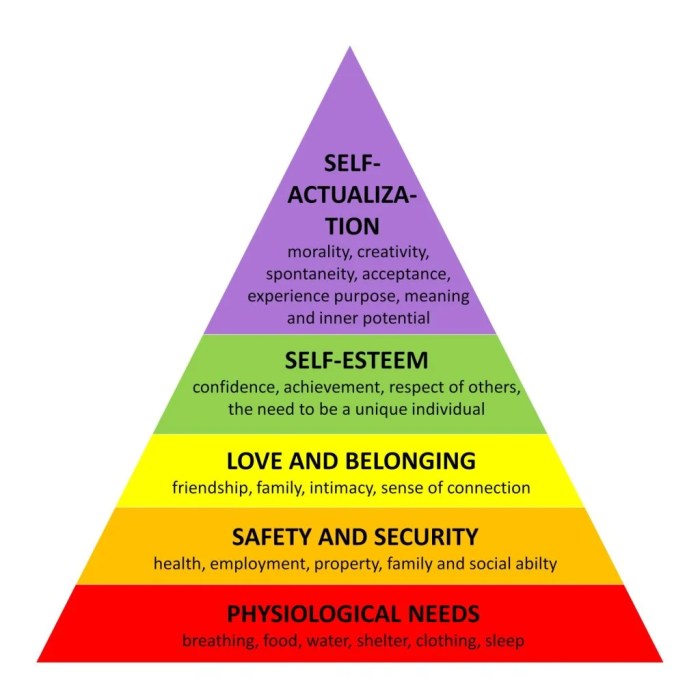
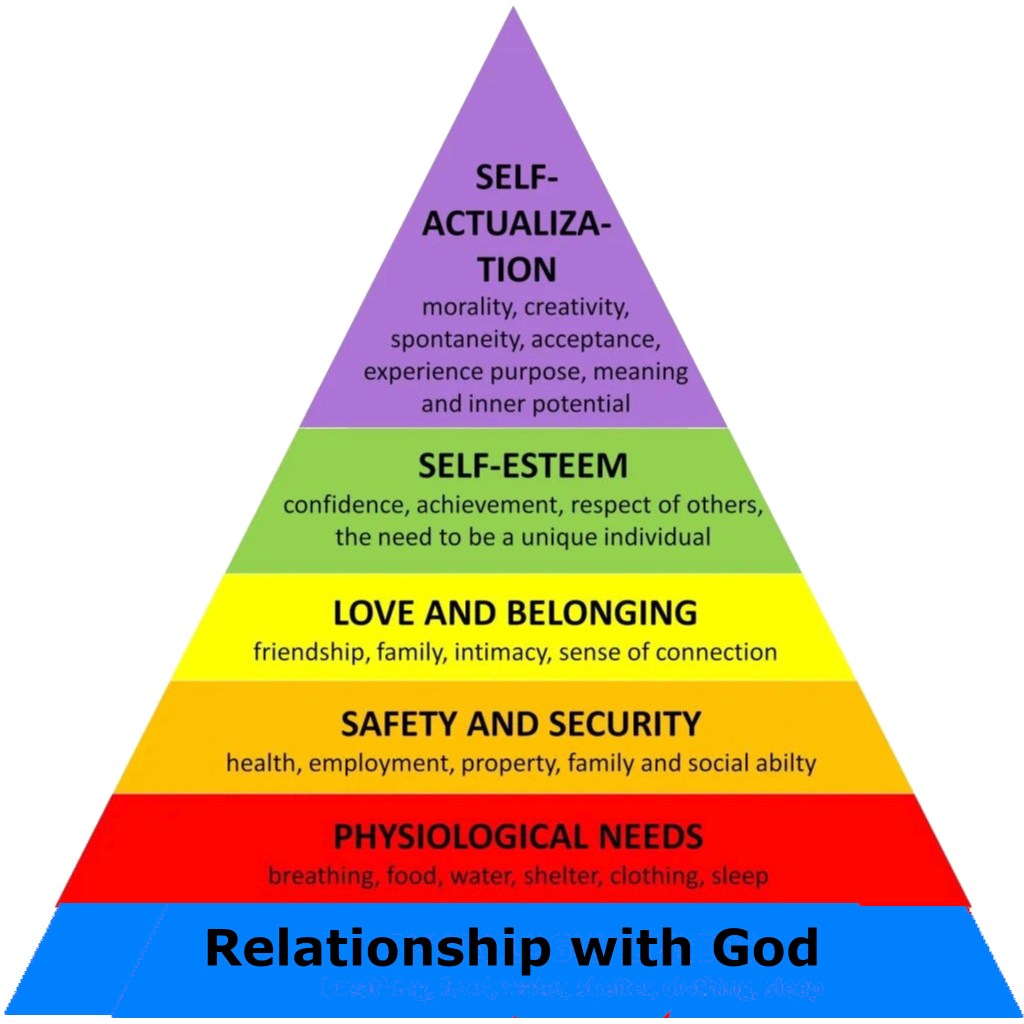
Abraham Maslow is a humanistic psychologist who is most famous for his “Hierarchy of Needs,” which is frequently pictured as a pyramid in which the base physiological needs (food, water, air, shelter, clothing, sleep, etc.) must be met before a human can consider meeting any other needs (Safety, then Love/Belonging, then Esteem, and finally Self-actualization). According to Maslow, it isn’t easy to consider any relationships or intellectual/occupational achievement until you satisfy your basic physiological needs.3 For example, it is hard to think about doing better at your job if you are homeless or hungry. That makes a lot of sense and is something we see frequently in our homeless ministry. But followers of Jesus need to add a new level to Maslow’s pyramid to make it consistent with the Bible.
To Maslow, the physical preservation of life is the most critical need (air, food, water, shelter, clothing, sleep). The Bible is very clear that these things should not be our highest priority, as evidenced by these scriptures:
“Therefore I tell you, do not be anxious about your life, what you will eat or what you will drink, nor about your body, what you will put on. Is not life more than food, and the body more than clothing?… Therefore do not be anxious, saying, ‘What shall we eat?’ or ‘What shall we drink?’ or ‘What shall we wear?’ For the Gentiles seek after all these things, and your heavenly Father knows that you need them all. But seek first the kingdom of God and his righteousness, and all these things will be added to you. Matt. 6:25, 31-33
But I do not account my life of any value nor as precious to myself, if only I may finish my course and the ministry that I received from the Lord Jesus, to testify to the gospel of the grace of God. Acts 20:24
O God, You are my God; Earnestly I seek You;
My soul thirsts for You; My body longs for You
In a dry and weary land Where there is no water.
I have seen You in the sanctuary, Beheld Your power and Your glory.
Because Your love is better than life, My lips will glorify You.
And in your name, I will lift up my hands. Psalm 63:1-4
Jesus is very clear about what we are to seek first, and it is not food or drink or clothing. Paul said life had no value aside from the ministry he had. Even though the psalmist of Psalm 63 is in the wilderness (“a dry and weary land where there is no water”), he said that rather than water, what he thirsts for is God’s covenantal love, which is better than life itself.
What about breathing? Breathing is a particular case. You can’t fast from breathing (not for long). What does the Bible say about breathing?
Genesis tells us that “God formed the man of dust from the ground and breathed into his nostrils the breath of life, and the man became a living creature” (Genesis 2:7). We are just dirt until God breathes life into us. We are lifeless without God’s breath/spirit within us. The Hebrew word ‘ruach’ means ‘spirit,’ ‘ breath,’ or ‘wind.’ See how the Scriptures discuss this presence of God’s Spirit that gives us our life:
…as long as my breath is in me, and the spirit of God is in my nostrils… Job 27:3
Thus says God, the LORD, who created the heavens and stretched them out, who spread out the earth and what comes from it, who gives breath to the people on it and spirit to those who walk in it: Isaiah 42:5
Remember, on that resurrection Sunday evening, Jesus suddenly appears in the room with the disciples and tells them:
“Peace to you! As the Father has sent Me, I also send you.” And when He had said this, He breathed on them, and said to them, “Receive the Holy Spirit. John 20:21-22
If you don’t understand the significance of ‘the breath of God’ in the Bible, you might have found it odd that John mentions Jesus breathing on them. But this breath of God brings life from death and new life to all as in creation, as in Ezekiel 37:9, where the prophet is told to speak, “breathe into these slain [the dry bones] that they may live,” and at Pentecost when the ‘ruach’ (Spirit) comes in like a ‘mighty rushing wind’ (Acts 2:2).
God’s presence is the very air I breathe. I may not live long without air, but I am not genuinely alive without God’s Spirit within me. Several old hymns contain this concept (“Breathe on Me” and “Breathe on me Breath of God”). Michael W. Smith wrote a song in 2001 that you have probably sung many times without realizing it was about the idea of fasting.
This is the air I breathe.
This is the air I breathe.
Your holy presence
Living in me.
This is my daily bread.
This is my daily bread.
Your very word
Spoken to me
And I… I’m desperate for you
And I… I’m lost without you.4
This is more reflective of our hierarchy of needs.
Are you desperate for God? Do you hunger for him? Do you thirst for him? Is your need for God greater than your need for food, water, shelter, clothing, sleep, or air? Maybe you don’t feel that desperation for God right now. This is something I didn’t understand for a long time. And perhaps that’s where you are today. I want to challenge you today to realize that deep need for God more than anything else. It will change your life. How do you begin to understand this? I discovered my desperate need for God only when I began to decide to give up some of these ‘basic needs’ for a time and seek God instead. And this is what I learned by fasting.
Have you ever been at a restaurant, looking forward to that great dish you ordered, and realized that you stuffed yourself so much on the salad and appetizers that you had no hunger for that wonderful main dish? Piper says our hunger for God is underdeveloped because we fill ourselves with desires for other things.5 Mark’s Gospel tells us about Jesus’ explanation of the parable of the seeds scattered among thorns that “the desires for other things enter in and choke the word.”
“It is not the banquet of the wicked that dulls our appetite for heaven, but endless nibbling at the table of the world. It is not the X-rated video, but the prime-time dribble of triviality we drink in every night. For all the ill that Satan can do, when God describes what keeps us from the banquet table of his love, it is a piece of land, a yoke of oxen, and a wife (Luke 14:18-20). The greatest adversary of love to God is not his enemies but his gifts. And the most deadly appetites are not for the poison of evil, but for the simple pleasures of earth. For when these replace an appetite for God himself, the idolatry is scarcely recognizable, and almost incurable. Jesus said some people hear the word of God, and a desire for God is awakened in their hearts. But then, “as they go on their way they are choked with worries and riches and pleasures of this life” (Luke 8: 14).”6
Fasting is a test to help us see which desire controls us and what is more important to us, the Creator or the Creation. We have already noted the parallel between Jesus’ 40-day testing in the wilderness and Israel’s 40-year testing in the wilderness. They both were led there by God and were led to hunger. Israel fails the test by doubting God and even assigning evil motives to God. Jesus passed the test, refusing to go outside God’s will and breaking his fast ahead of God’s plan. How about you? Jesus is in the wilderness. I pray that the Spirit will drive you there for a time to fast, pray, and better know yourself and your Creator.
We will continue this overview of fasting next time.
Please see my Bibliography for recommended books and links to obtain them.
- Piper, John, A Hunger for God: Desiring God through Fasting and Prayer (2013) preface, Kindle Edition.
- Wesley Duewel, Mighty Prevailing Prayer Grand Rapids: (1990), p. 192.
- Maslow later restated his theory and accounted that people did not necessarily move strictly from one tier to another and could simultaneously work on aspects of multiple tiers of the pyramid.
- Smith, Michael W. “Breathe” 2001. Another popular chorus exhibiting this idea of fasting is “As the Deer” by Martin Nystrom in 1984. (Based on Psalm 42).
- Piper. Loc 660, Kindle Edition.
- Ibid. Loc 67.
 Swallow No Camels