Week 8 ——— Jesus Cleanses the Temple
John 2:14-22
Jesus and those traveling with him have just completed a 5-day walk covering 94 miles from Capernaum to Jerusalem. The last part of the journey is all uphill, going up in altitude from near the earth’s lowest point (the Dead Sea) in the Rift Valley to the mountains of Jerusalem, a gain of over 3700 feet. The goal of the pilgrimage was the Temple, and in Jesus’ day, the rebuilding of the second temple under Herod was grand.1 This massive marble structure gilded with gold must have been a sight, especially for those living in the ‘back country’ of Galilee.
Jesus entered the temple area on this day, 1997 years ago. However, his attention is not focused on the massive structure in the center of the courts but on the commotion in the outer courts.
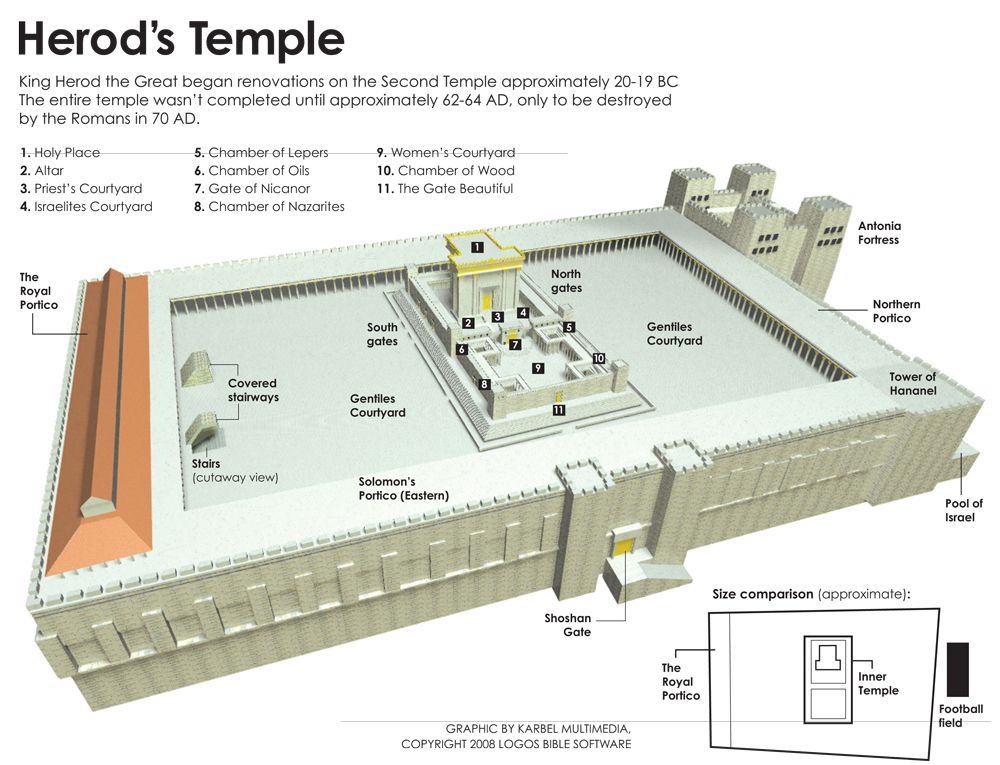
This would happen in the “Gentiles Courtyard.” Note the size of the footprint of the Temple Mount complex (about 37 acres) in comparison to a modern football field.
Again, Jesus is arriving for the Passover and the Feast of Unleavened Bread, as commanded several times in the Bible.
Lev. 23:4-8 These are the appointed feasts of Yehovah, the holy convocations, which you shall proclaim at the time appointed for them. In the first month, on the fourteenth day of the month at twilight, is Yehovah’s Passover. And on the fifteenth day of the same month is the Feast of Unleavened Bread to Yehovah; for seven days you shall eat unleavened bread. On the first day you shall have a holy convocation; you shall not do any ordinary work. But you shall present a food offering to Yehovah for seven days. On the seventh day is a holy convocation; you shall not do any ordinary work.”2
Unleavened bread, in Hebrew, ‘matzah,’ means bread not made with yeast. This is to remember when the children of Israel left Egypt in a hurry and did not have time to make bread that would rise.
Exodus 12:34 So the people took their dough before it was leavened, their kneading bowls being bound up in their cloaks on their shoulders.
Typically, they would keep a small amount of their old yeast bread (their ‘starter’) and mix a small portion in with the new dough. The yeast would spread throughout the entire dough. As the yeast feeds on the sugars in the dough, it creates gas bubbles that cause the dough to rise. Yeast (leaven) is often used in the Bible as a metaphor for sin or corruption. (It is also used in Hellenistic literature as a metaphor for corruption.)
Matthew 16:6-12 “Beware of the leaven [teaching] of the Pharisees.”
Exodus 13:7 Unleavened bread shall be eaten for seven days; no leavened bread shall be seen with you, and no leaven shall be seen with you in all your territory.
Based on this scripture, before the Feast, there was a great effort to remove any trace of leaven from their homes. This was a very serious spring housecleaning. Everything and every surface of the walls and floors were scrubbed. Cooking pots and utensils were boiled in water. This still goes on in modern Israel in Orthodox Jewish homes today. It has become more challenging to rid modern businesses of all the leaven. For example, grocery stores and factories that produce leavened products like bread or beer can’t just destroy their stock and shut down and clean their equipment. So, what they currently do is use an interesting legal loophole. For the past 25 years, the State of Israel has sold the entire stock of food items and related goods to one Muslim man, Hussein Jabar. He pays ~$14,000 to Israel as a down payment. The contract says he owns the products and has ten days to pay the remainder (~300 million dollars) to complete the transaction. This way no Jewish people would own any yeast products. He is also given the keys to the premises. Every year, he fails to pay the remainder by the end of the Feast so he ‘returns’ all the property and receives his down payment back.3
So, every house in Jesus’ day was thoroughly cleaned—all but one. Jesus enters the temple and sees God’s house is full of corruption. So Jesus takes it upon himself to do a little house cleaning. Did you realize that Jesus drives out the money changers and the people selling animals twice in the scriptures? Did you know that the two events are the exact same time of year? Both times are immediately before Passover and the Feast of Unleavened Bread. Jesus is symbolically cleansing the leaven from the temple.
John 2:14-17 “In the temple he found those who were selling oxen and sheep and pigeons, and the money-changers sitting there. And making a whip of cords, he drove them all out of the temple, with the sheep and oxen. And he poured out the coins of the money-changers and overturned their tables. And he told those who sold the pigeons, “Take these things away; do not make my Father’s house a house of trade.” His disciples remembered that it was written, “Zeal for your house will consume me.”
Why are money changers in the temple? The annual Temple Tax began as an offering for atonement, a ransom of the firstborn (all of Israel is God’s firstborn). A census was taken of the people ransomed from Egypt. (The census is where we get our names for the Book of Numbers.)
Exodus 30:12 -15 “When you take the census of the people of Israel, then each shall give a ransom for his life to Yehovah when you number them, that there be no plague among them when you number them. Each one who is numbered in the census shall give this: half a shekel according to the shekel of the sanctuary (the shekel is twenty gerahs), half a shekel as an offering to Yehovah. Everyone who is numbered in the census, from twenty years old and upward, shall give Yehovah’s offering. The rich shall not give more, and the poor shall not give less, than the half shekel, when you give Yehovah’s offering to make atonement for your lives.
It became an annual offering, as seen in 2 Kings 12:5-17 and Nehemiah 10:32-33.
The offering had to be paid in a specific monetary unit: shekels from Tyre. Some have said that was because other coins had ‘graven images,’ but the Tyrian shekel had the image of a god. The real reason was that the Tyrian Shekels were more pure silver. (Roman coinage was only 80% silver, and Tyrian coins were 94% or more.) The money changers referenced in the New Testament Gospels (Matt. 21:12 and parallels) provided Tyrian shekels in exchange for Roman currency, at a cost, of course. The current value of this amount of silver is about 27 dollars.
Then, there were those selling animals for sacrifices. The original reason is that people traveling to Jerusalem would not have to carry the animals long distances but could purchase them after arrival. There was a place originally designated for these purposes outside the temple proper at what is now the Western Wall. Presumably, these businesses were moved inside the temple by Annas (the High Priest before Caiphas) so he could keep an eye on them and ensure he got his cut of the profits. Of course, the animal you brought would not be deemed “without blemish” when inspected, so you would have to purchase another that was deemed ‘perfect’ at a premium cost. The ‘imperfect’ animal would be taken in trade and presumably recycled later as newly deemed ‘perfect.’ It was quite the business model.
John quotes Jesus as saying “Do not make my Father’s house a house of trade.” In the passages in the other gospels, when Jesus replays the driving out of these traders, he quotes Isaiah and Jeremiah, “Is it not written, ‘My house shall be called a house of prayer for all the nations’? But you have made it a den of robbers.” Mark 11:17, quoting from Isaiah 56:7 and Jeremiah 7:11.
The Greek word for ‘robbers’ is ‘lēstai,’ which can mean ‘robber, bandit, or insurrectionist.’ It is the same word used in Matthew 27:38 “Then two robbers were crucified with him, one on the right and one on the left.” But Rome did not use the punishment of crucifixion for robbers or bandits. Primarily, crucifixion was used for Romans who committed treason or non-citizens who committed rebellion or insurrection. Indeed, the charge Pilate gives Jesus is insurrection. So those two beside Jesus at his crucifixion are not robbers but lēstai, insurrectionists. Then, overturning the tables in the temple courtyard is not about robbery but about those rising up against an authority. Then, who is the authority that the guilty is attempting to overthrow? The authority Jesus is defending is God himself, and the rebels are those attempting to usurp God’s authority, the priests and temple rulers.
In 2024, Passover and the Feast of Unleavened Bread begin in less than two weeks. If yeast represents sin, it may be time for all of us to do a little spring cleaning. God’s temple must be kept clean. “Do you not know that you are God’s temple and that God’s Spirit dwells in you?” (1 Cor. 3:16.) Ask Yehovah to look deep into your life, in all the corners and crevices, and remove all that hinders us from being worthy vessels for his service. And if you have given Jesus authority over you, let us pray we never are insurrectionists, attempting to regain that authority over ourselves.
- Some sections of the temple were still under construction and were officially completed between 64 and 66 A.D. The Romans destroyed the Temple just a few years later, in 70 A.D.
- Note that the first day of the Feast of Unleavened Bread and the last day are special Sabbaths. In a week when the first day falls on a day other than the seventh day of the week, there can be three Sabbaths in that week. This will become important next year when we consider the Sabbaths in the week that Jesus is crucified.
- https://www.timesofisrael.com/meet-the-arab-israeli-who-buys-all-of-israels-hametz/
 Swallow No Camels
[…] day, the first day of the seven days of Unleavened Bread. (We discussed unleavened bread in ‘Jesus Cleanses the Temple #25‘.) The first day of Unleavened Bread is a special Sabbath, as well as the last day of […]
LikeLiked by 1 person
[…] For more information about cleansing the temple, see https://swallownocamels.com/2024/04/10/april-10-27-a-d-jesus-cleanses-the-temple-the-year-of-the-lor… […]
LikeLike