May 18-24, 27 A.D.  The Nobleman’s Son- The Year of the Lord’s Favor #33

Week 14 ———  The Nobleman’s Son
John 4:43-54

John 4:43   After the two days he departed for Galilee.  (For Jesus himself had testified that a prophet has no honor in his own hometown.)   So when he came to Galilee, the Galileans welcomed him, having seen all that he had done in Jerusalem at the feast. For they too had gone to the feast.  

So he came again to Cana in Galilee, where he had made the water wine. And at Capernaum there was an official whose son was ill. When this man heard that Jesus had come from Judea to Galilee, he went to him and asked him to come down and heal his son, for he was at the point of death. So Jesus said to him, “Unless you see signs and wonders you will not believe.”  The official said to him, “Sir, come down before my child dies.” 50 Jesus said to him, “Go; your son will live.” The man believed the word that Jesus spoke to him and went on his way.   As he was going down, his servants met him and told him that his son was recovering.   So he asked them the hour when he began to get better, and they said to him, “Yesterday at the seventh hour the fever left him.”   The father knew that was the hour when Jesus had said to him, “Your son will live.” And he himself believed, and all his household.   This was now the second sign that Jesus did when he had come from Judea to Galilee.

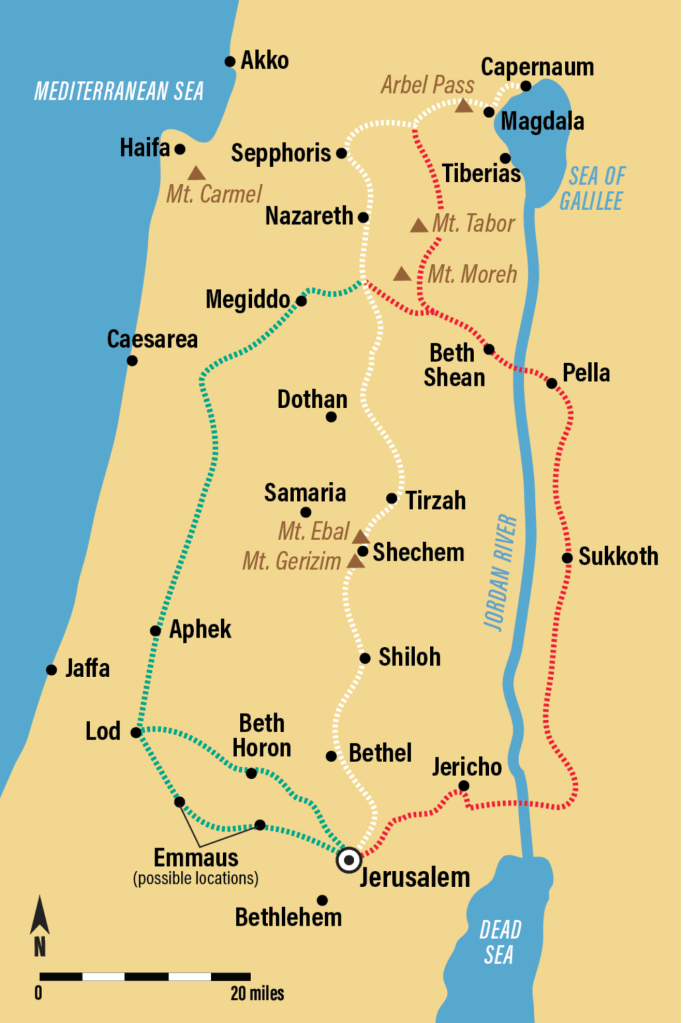
So, after spending two days in Samaria, they continue to Galilee and, as before, pass through his hometown of Nazareth and on through Sepphoris to Cana.  Already, he is not well received in Nazareth, so his path goes through Nazareth, but he does not stop there.  He explained to his disciples that a “prophet has no honor in his hometown.”  (More to come in Nazareth later.)  

In Cana, he is met by an “official,” literally a ‘royal officer.’  This would be some official of Herod Antipas, the Tetrarch. Some have proposed he was Manaen, Herod’s foster brother, who is seen in Acts 13:1 as a member of the church in Antioch. Others suggest it was Chuza, the husband of Joanna, one of the women with Jesus and the disciples in Luke 8:3, who supported his ministry.

The official had heard of Jesus’ prior miracles and knew that he was coming from Judea, so he met him at Cana. He asks Jesus to “come down” to Capernaum (Capernaum is a lower altitude than Cana at the Sea of Galilee—up and down are more important when you are walking 20 miles).  His son is “at the point of death.”  “Asks” here may not express the intensity of the Greek.  This is the same word for ‘beg,’ and the tense is continuous – so “continuously begged Jesus to come down” is appropriate.  Jesus replies “to him” but speaks in the plural “you” twice in his response, so he is talking to everyone there. “Unless you [all] see signs and wonders you [all] will not believe.  “Signs and wonders” is John’s way of saying ‘miracles.’1  But the word for signs is the Greek word for ‘sign-post,’ and it better conveys that these miracles of Jesus are pointing to something.  Leon Morris, in the New International Commentary of the New Testament, says:

Jesus says, “Go; your son will live,” and the man departs. Verse 50 says, “The man believed the word that Jesus spoke to him and went on his way.”  The man only gets Jesus’ word, which is enough for him.  (Did you see that Gideon?)  We are told this happened at the seventh hour.  Remember, John uses the Jewish measure of time, not the Roman one that we are accustomed to, so the seventh hour would be seven hours after sunrise (~6 am), so our 1 pm.  He then begins his 20-mile journey to Capernaum.

He is met by his slaves, who tell him that his son is recovering. He inquires when he began to improve and is told, “Yesterday at the seventh hour.”  That ‘yesterday’ sounds odd to us, but remember that the day for the Jew begins around sunset (~6 pm).  

Jesus says ‘go’ and the man believes and goes.  He shares his belief and his whole household believes.  Note that belief is accompanied by action.  (From a Jewish perspective, belief without action is not belief at all.)  This is a good lesson for us.

  1. The Synoptic Gospels typically use the word “dunamis” for Jesus’ miracles, concentrating on the power of Jesus. (‘Dunamis’ is the basis for our word ‘dynamo’ or ‘dynamite.)
  2. Morris, Leon.  New International Commentary of the New Testament, “John”.

May 18-24, 27 A.D.  The Samaritan Woman at the Well- The Year of the Lord’s Favor #32

Week 14 ———  The Samaritan Woman at the Well
John 4:5-42

Several stories in the Bible begin with a man meeting a woman at a well. This setting is where Rebecca is found as a wife for Isaac, where Jacob meets his future wife Rachel, and where Moses meets Zipporah whom he will marry. All of these stories all end in marriage, but today’s story is different.

You have probably heard several sermons on this story.  I have, and they all pretty much go the same way:  The disgraced, sinful woman encounters Jesus, and he reveals her sin, and she comes to believe in him.

Here is a typical rendering, from ‘Got Questions Ministry’ “What we can learn from the woman at the well”:

“…she was an outcast and looked down upon by her own people. This is evidenced by the fact that she came alone to draw water from the community well when, during biblical times, drawing water and chatting at the well was the social highpoint of a woman’s day. However, this woman was ostracized and marked as immoral, an unmarried woman living openly with the sixth in a series of men. The story of the woman at the well teaches us that God loves us in spite of our bankrupt lives.”

And another traditional view from John Piper, in his sermon titled: ‘God Seeks People to Worship Him in Spirit and Truth’:

“If people are spiritually asleep, you have to shock them, startle them, scandalize them, if you want them to hear what you say. Jesus was especially good at this. When he wants to teach us something about worship, he uses a whore.”

That is the traditional interpretation.   Today I want to challenge that interpretation.

Forever this story has been read with the assumption that this woman was of ill repute.  One of my Hebrew teachers, Eli Lizorkin, wrote a book in 2015, on the gospel of John. In the chapter on John 4 he questions that presupposition.  Then this past week, I read a book by Caryn Reeder that focused on the problems with the traditional approach to this woman (and many other women in scripture.)

So, let’s take a new look at this story.

The location is Sycar, a village near Shechem, where Jacob’s well was. This was one of the first pieces of land in Israel owned by the Hebrews, and it is where Joseph’s bones were brought from Egypt to rest. 

Joshua 24:32   As for the bones of Joseph, which the people of Israel brought up from Egypt, they buried them at Shechem.

A divine appointment.

Jesus is waiting for her when she arrives at the well at an unusual time, noon.  Most people would have already made their daily trip for water in the morning. The suggestion is that she is intentionally avoiding others.  This had led pastors for centuries to say that she was a sinful woman, having been married multiple times and now living with a man out of wedlock.  These pastors describe her as shunned by her village.  This is a reasonable conclusion based on our modern culture.  But this story didn’t happen in our culture.  So let’s place the story back into its original setting.

Why all the marriages?   There are two ways marriages can end in Israel in the first-century culture: divorce or death.

In Jesus’ day, divorce was not uncommon, but only men could file for divorce, and they could do it for pretty much any reason.  This was a subject of much debate by the Pharisees of the day, and they questioned Jesus on his opinion in Matthew 19.1 One of the common reasons for divorce was that the woman could not bear a child.  There was no procedure for women to file for divorce.2  If divorced, a woman did not take anything from the marriage, including anything the husband had given them during the marriage.  They had the right to take the original dowery, but this often didn’t happen.  So many women left with almost nothing and no way to provide for their needs.   

Women in Jesus’ culture typically were married when they were 12 – 15 years old, and husbands were usually 10-15 years older.  With the state of medical care, accidents and illnesses would mean many would not live past their mid-30s.  As in divorce, if her husband died, the wife did not inherit anything from the husband’s estate; it all went to his heirs.  That included the family home.  She again only had the right to her dowery.  Often, this meant she had no place to live.  If she had an adult son, he might be able to care for her. Any younger children belonged to the husband’s family. So frequently, in a divorce or the death of a husband, the wife would lose almost everything, including her home and children.  

“The man you now have is not your husband.”  We jump to the conclusion (based on our prior assumption of her character) that she is living out of wedlock.  If she has had and lost five husbands, no matter the reason, she will unlikely marry again.  A single woman in this culture could not live on her own. Women who cannot marry seek refuge with some male relative who can help support them. She may be living with a relative or another man out of necessity.  We don’t know.3

One other thing has always bothered me about the traditional characterization of this woman.  If she was seen by her community as a ‘horrible non-repentant sinner’, how is it possible that she can run in the village bearing witness to the Messiah, and suddenly everyone follows her back to the well?  That seems unlikely.  If she, instead, was pitied by her community for her misfortune and depression, it is more reasonable that this sudden change of spirits would lead them to take the hike to the well to investigate. 

Given this culture and these uncertainties, you can certainly not jump to the conclusion that she is a sinful woman. How odd is it that sermons on this story seem to always focus on her sin when sin is never mentioned in Jesus’ conversation with the woman?   Jesus doesn’t identify her relationships as sinful, nor does he offer her forgiveness. Jesus does not ask her to repent or change her life. Elsewhere in the Gospel of John, we see Jesus freely discussing sin — the woman caught in adultery is told to “go and sin no more”.  He tells the paralytic, “Your sins are forgiven.”  But the omission of any mention of sin here is striking.4

Remember, this is a shame/honor culture.  If you have read much of the Old Testament, you understand the shame of a woman who is not married and the even worse shame of a woman who can not bear children.  Whether this Samaritan woman is at fault for her prior relationships or not, her position is the same.  She lives in shame in her community, from either their accusations or their pity.  It seems Jesus doesn’t focus on why she is living as she is.  His concern is not who is at fault.  He looks past the blame and sees a hurting woman he can help.

How unlike Jesus we can be.  We are very quick to decide if we are willing to help people based on how much they deserve our help.  We are much more likely to support an innocent victim than we are someone whose bad behavior got them into a mess.  We have seen this over and over in our homeless ministry.  A father loses his job, and his family with three young children finds themselves homeless.  People rush in to help.  We get more offers for help for them than we can handle.  But a young man comes in the same day who made bad decisions and became involved with drugs and lost his home — that rush of offers never comes.  He sees the response that the churches have to the family with kids while he is ignored.  What does he learn about the church?  Some people deserve grace, and some people do not.  That is a poor reflection of Jesus.

People say, “He got what he deserved.”  That is a very common response.  But is it a Christ-like response?   One of my friends said about the young man, “He made his bed, now he has to sleep in it.”  How ironic. The problem is that right now he doesn’t have a bed to sleep in or a place to put one.  He may be at fault, but he is also in need.

We often reserve our mercy and grace for those we deem worthy. But aren’t we grateful that Jesus dispenses grace and mercy freely, even when we don’t deserve it? None of us can earn God’s grace through our actions. Isn’t it a comfort to know that Jesus offers grace unconditionally? I don’t know anyone who wants to stand in front of God at judgment and ask to be given what they deserve.

As we discussed last week, Jesus went out of his way to meet this woman. He drags his disciples down what they feel is a wrong and dangerous path to have this one encounter. They do not see these Samaritans as worthy of their attention or God’s love. But Jesus comes to bring her hope, healing, and salvation.

But first, he has to break through some problematic barriers.   Remember, the Samaritans and Jews are bitter enemies with a long history of strife.  No Jew would share a meal with a Samaritan or drink from a Samaritan’s vessel.  Remember the quote from the Mishna:

Mishna Shebiith 8:10  “He that eats the bread of the Samaritans is like to one that eats the flesh of swine.”

Jesus starts the conversation by asking her for water, breaking any expectations she might have had about this Jew.   He then turns the conversation to ‘living water’, which he can offer her.  She initially does not understand this concept.5  Jesus then reveals himself as a prophet, and she responds by asking him the critical question regarding worship for a Samaritan.  Where is the proper place to worship?  Remember, the Samaritans had been, at times, not allowed to participate in temple worship in Jerusalem.  They had built their temple on Mt Gerizim, which the Jews had destroyed around 130 years before this encounter.  So there is no temple for her to worship in.  And this woman could not go to the Jerusalem temple due to racial strife.  But even if she could, she would have been restricted to the outer court, the “Women’s Court” simply because she was a woman. Women had a lower place in the religious culture of Jesus’ day.  This was not God’s idea.  There is no Biblical command for a court of women in the Tabernacle or the Temple.  It is an invention of the culture of men.  Sadly, some religions still refuse to admit women to certain areas of the church just because they are women.  Further, this woman would have a hard time even going to the local synagogue because of her shame.  

So she asks, where is the proper place to worship?  This is an important question that we still fail to grasp today.  Jesus tells her that salvation comes through the Jews, but now worship can happen anywhere and has no racial restrictions. God is to be worshiped in spirit and truth. Jesus tells her that the day is here, that the location won’t matter, and that she will have full access to God. Can you imagine what this would mean to her?

It is not about where.  Not this mountain or that mountain.  Not this temple or that temple.  Not this church or that church.  It is not about methods.  Not this denomination or that denomination.  Not with this style of music or that.  Worship is our response to the awe and wonder of a mighty God.  The Hebrew word for worship is avad which is also the word for work.  Worship is not simply a state of mind; it is doing the work that God demands. We call the church building a place of worship.  If this is the only place you worship, then you don’t comprehend what Jesus said to this woman.  What Jesus is saying is that place doesn’t matter.  The place of worship is anywhere the spirit is.  Anywhere you go is a place of worship.  Your occupation, your home, your grocery store, your friend’s house – these are all places of worship.  Worship is what we do every day of the week as we walk in obedience to him. We call this a worship service. Do you see that?  Service is the work a servant does. But the community worship we do for one hour on Sunday morning is just a tiny part of our week.  The other 167 hours in the week we worship as we walk with God and do his work.  We do not work to earn salvation. We do the work of God because that is our way to worship every day of our lives.  Jesus said we show our love for him by following his commandments.  Worship is doing justice, loving mercy, and walking humbly with God.  (Micah 6:8)

This is all too good for her to believe, even coming from a prophet.  ‘That’s nice, Mr. Prophet, but only the Messiah can reveal that truth when he comes.’And that is when Jesus tells her he is the Messiah.  She is the first person he reveals himself to.  And now she knows what is too good to be true — it has just become true.  She drops her water jars and runs into town.

Then Jesus speaks with his disciples an often quoted verse:

“Do you not say, ‘There are yet four months, then comes the harvest’? Look, I tell you, lift up your eyes, and see that the fields are white for harvest.”  John 4:35

Do you understand the significance of the placement of this verse right here in this story?   Jesus speaks of a field ready for harvest, and then verse 41 tells us: “And many more believed because of his word.”  The field Jesus is talking about is a field that the disciples would have never considered to be their responsibility to harvest, never considered to be capable of harvest.  This was a field of enemies.  A field full of hated people.  They were people who had polluted their worship and were unclean.  But not to Jesus.  

We can not set limits on God’s view of the harvest.

Do you see the trouble Jesus has gone through to teach the disciples and us this lesson?

God’s original plan was for the Jews to be his kingdom of priests to carry his message to the whole world.  But they were not obedient to this plan.  Their view of God’s kingdom was too small.  Samaritans part of the Kingdom?  No way. We don’t even talk to them, we don’t drink from their water jars, and we don’t allow them to come to our temple.  They are our enemies.  A woman?  Are you serious?  We keep them in the outer courts.7  Now a Samaritan woman who is living in shame?  She is probably a horrible sinner.  She has no place in God’s harvest.

But Jesus says, “Yes!”  Samaritan’s? “Yes!”  Enemies? “Yes!”  Women? “Yes!”  Sinners? “Yes!”

How big is your view of God’s kingdom?  Is it for the poor, is it for the prisoner, is it for the Hamas member, is it for your neighbor who is rude or mean, Is it for the people who are public sinners as well as those who we pity?  This woman dropped everything and ran to tell people about the Messiah.  And here we sit, clutching our water pots.

  1. Note that Jesus in Matthew 19 is not giving an exhaustive teaching on divorce, but answering a specific question.
  2. An exception is that the very wealthy or highly politically connected women could, in certain situations file for divorce.
  3. Caryn Reeder notes in her book, The Samaritan Woman’s Story: Reconsidering John 4 After #ChurchToo, “The characterization of the Samaritan woman as an adulterer or prostitute exemplifies the dehumanizing, reductive sexualization of women in the theology and practice of the church. This pattern of interpretation endlessly repeats: Deborah and Jael, Bathsheba, Mary Magdalene, the woman who anoints Jesus in Luke 7: 36-50. These women (among many others) are categorized and defined on the basis of gender and sexuality.”
  4. And the centuries of male-dominated church leaders’ insistence on proclaiming the sin of this woman is even more striking.
  5. It is interesting to compare this one-on-one conversation with Jesus’ conversation with Nicodemus in the previous chapter.   Nicodemus is a leader of the Jews, a great teacher, and held in high esteem by the community.  She is of the lowest social status.  She is not even given a name.  She encounters Jesus in the middle of the day while Nicodemus comes at night, and Jesus says a lot to him about the light and the dark. They both initially have trouble understanding Jesus’ symbolism (born again, living water.)  But in a surprising twist, Nicodemus says little in his conversation with Jesus, while this woman holds her own.  And this unnamed Samaritan woman becomes the model for us to believe and witness, not the great Pharisee, Nicodemus.
  6. Since the Samaritans only had the first five books of the Bible, their primary prophecy on the Messiah was Deuteronomy 18:18 which refers to a prophet like Moses that will come and speak the very words of God.
  7. “It is frighteningly easy for a woman in the church to absorb a message that she is lesser, inferior, and lacking in some way.”  Lucy Peppiatt, in Recovering Scripture’s Vision for Women.

May 17-24, 27 A.D.  Jesus must go through Samaria- The Year of the Lord’s Favor #31

Week 14 ———  Jesus had to pass through Samaria
John 4:1-4

Recap:
Jesus was baptized on Feb 16 and spent 40 days in the wilderness.  The satan tempted him on March 28.  Then he returned to the area where John was baptizing, and John said, “Behold the Lamb of God that takes away the sins of the world.”  They travel north to Galilee, where he turns the water into wine at Cana.  Then he travels south to Jerusalem for the feast of Passover.  He throws the money changers out of the temple on April 10, has Passover on April 11, and then speaks with Nicodemus on April 12.  He leaves after the week of Unleavened Bread, and his disciples are baptizing in Judea.  When he begins to be noticed by the Pharisees, he decides to head north back to Galilee. 

Why did Jesus have to pass through Samaria?

If you were going north to Galilee in Jesus’s day, you had three choices: The most direct route was to head north and go through Samaria. This is the fastest way, but the Jews rarely used it because travel through Samaria was dangerous. So most chose to go east across the Jordan and then north before crossing the Jordan again near Beth Shean or Jezreel.  The western route was even more difficult.

I want you to take two minutes to watch this clip from “The Chosen.”  I am usually impressed at the series’s effort to try to be culturally and historically accurate.  They portray Jesus’ journey with the disciples as he decides to go through Samaria (much to their surprise.)  There are two minor disagreements with the Scripture in this episode.  First, they have somewhat placed this story out of order — note in the clip that Jesus has already called most of the disciples.  Secondly, they are traveling in the opposite direction from the Biblical account (north from Judea to Galilee in Bible and south from Galilee in the clip).  Nevertheless, I feel that the disciples’ response to Jesus’ decision to take the journey through Samaria is so well done that this has become one of my favorite scenes in the series.

John tells us “he had to pass through Samaria”  without explaining why. We only have one story on this journey: the encounter between Jesus and the Samaritan woman at the well. So, we must assume this is his divine appointment. Next week, we will look at that encounter, but to understand this story, we must understand the conflict between the Jews and the Samaritans. Where did they come from?

The History Lesson

Around 1000 BC, David became king over all of Israel, and when he died, his son, Solomon, became king, and the land reached the peak of its prosperity.  Solomon dies in 931 BC, and there is a struggle for control. His son, Rehoboam, makes very poor decisions, and the kingdom splits.  Ten tribes in the North became known as ‘Israel’ (yes, a little confusing, sorry).  The capital of Israel was established in Samaria, with Jeroboam as their king.  The tribes of Judah and Benjamin in the South became known as ‘Judah’ with their capital remaining in Jerusalem and Rehoboam as their king.  Jeroboam’s first act in the North was establishing areas for worship in Bethel and Dan (so Israel wouldn’t have to travel back to Jerusalem to worship.)

1 Kings 12:26-29    And Jeroboam said in his heart, “Now the kingdom will turn back to the house of David.   If this people go up to offer sacrifices in the temple of the LORD at Jerusalem, then the heart of this people will turn again to their lord, to Rehoboam king of Judah, and they will kill me and return to Rehoboam king of Judah.”   So the king took counsel and made two calves of gold. And he said to the people, “You have gone up to Jerusalem long enough. Behold your gods, O Israel, who brought you up out of the land of Egypt.”    And he set one in Bethel, and the other he put in Dan.

Things started badly for the Northern Kingdom of Israel, and they got worse until God sent Assyria to sack Israel in 722 BC. Assyria’s method of controlling its conquered countries was to export the leaders and a percentage of the population and then bring in people from other conquered nations to cause the people to lose their distinctiveness and be less likely to rebel.

2 Kings 17:24   And the king of Assyria brought people from Babylon, Cuthah, Avva, Hamath, and Sepharvaim, and placed them in the cities of Samaria instead of the people of Israel. And they took possession of Samaria and lived in its cities. 

The Assyrians (in the Annals of Sargon II) claimed to have deported 27,290 people, but it is currently thought that only about 10% of the population of the northern kingdom was deported, and only about 1000 people were brought into the country from beyond.  So, there was less of an influx of foreign people than previously thought.  This is important because one of the reasons the Jews in Judah disliked the Samaritans was that they maintained the Samaritans were people who broke God’s laws about intermarriage; they called them half-breeds. The Samaritans maintained they were descendants from the tribes of Levi, Ephraim, and Manasseh (Joseph), who were not deported to Assyria.  While the Bible mentions the influx of foreigners, I can’t find any Biblical reference to their intermarriage.1  2 Kings 17:29ff discusses the foreign idols placed in the land, but the transplanted people place these, not the people originally from the Northern Kingdom who the Assyrians did not carry away.  “But every nation still made gods of its own and put them in the shrines of the high places that the Samaritans had made, every nation in the cities in which they lived.” (2 Kings 17:29).  There are around 900 Samaritans today, with most living in Nablus which is in the location of the ancient city of Samaria.  Interestingly, genetic studies were done in the past 25 years that support the Samaritans’ claim of their pure ancestry, refuting the once-held claims of the Jews in the Southern Kingdom.  

One hundred thirty-six years after the Northern Kingdom was decimated, Babylon conquered Judah, and Jerusalem and the temple were destroyed. Babylon had a different policy of controlling conquered nations. They exported most people from the land, leaving only a few very poor.  So Judah was exiled in Babylon for 70 years.  Persia conquered Babylon and allowed all those captives to return to their homes.  

When the exiles returned, they began rebuilding the temple. Some of the people who had already lived in the land offered to help, but they were refused.

Ezra 4:1   Now when the adversaries of Judah and Benjamin heard that the returned exiles were building a temple to the LORD, the God of Israel,  they approached Zerubbabel and the heads of fathers’ houses and said to them, “Let us build with you, for we worship your God as you do, and we have been sacrificing to him ever since the days of Esarhaddon king of Assyria who brought us here.”  But Zerubbabel, Jeshua, and the rest of the heads of fathers’ houses in Israel said to them, “You have nothing to do with us in building a house to our God; but we alone will build to the LORD, the God of Israel, las King Cyrus the king of Persia has commanded us.” 

These were likely not Samaritans, as these people say the king of Assyria ‘brought them here.’  They are the imported people from the nations listed in 2 Kings 17:24.  But at this point, the people of Judah have refused to see any difference between the Jews who were not taken and the Gentiles who were brought in.  They lump them all together. (As do many people who discuss this time in history.)

The final separation between the Jews of Judah and the Samaritans comes when Nehemiah discovers that a grandson of the high priest, Eliashib, had married a daughter of Sanballat, the governor of the province of Samaria.  Since Nehemiah saw her as ‘non-Jewish,’ he felt the priesthood had been defiled and drove the high priest out of Jerusalem (Nehemiah 13:28-29). According to the historian Josephus, Sanballat then built a temple on Mount Gerizim where this exiled priest could function.

And then things get even worse.

After Alexander the Great died, his kingdom was divided among three generals.  The Seleucid leader Antiochus Epiphanes persecuted the Jews. He desecrated the temple and altar, leading to a rebellion and the Maccabean Wars in the 2nd century BC. The Jews in Judah asked the Samaritans for help fighting off the Selucids. However, they refused and aligned with the Selucids fighting against Judah. After Judah prevailed, in 108 BC, they went to Mt Gerizim and destroyed the Samaritan’s temple in retribution.  The Samaritans finally struck back in 6 AD and sneaked into the Jerusalem temple at night and scattered human bones around, defiling the temple and ruining the Passover celebration.

A few quotes from literature from that time further reveal the animosity:

The Wisdom of Ben Sirach 50:25-26  (ca. 200 BC)  “There are two nations my soul detests, the third is not a nation at all; the inhabitants of Mt Seir (the Edomites), the Philistines, and the stupid people living at Shechem.

Mishna Shebiith 8:10  “He that eats the bread of the Samaritans is like to one that eats the flesh of swine.”

Finally, there is the story in Luke 9:51-56 where Jesus is again traveling through Samaria to the Feast of Tabernacles.  One of the Samaritan villages would not receive him, because he was a Jew headed to Jerusalem, so James and John ask Jesus “Lord, do you want us to tell fire to come down from heaven and consume them?” (Luke 9:54).  Jesus rebuked them and traveled on.2  The Hatfields and the McCoys had nothing on the Jews and the Samaritans.  

Samaritans were not just social outcasts — they were the enemy, the most hated people on the planet by Jews in Jesus’ day.  When Jesus said, “Love your enemies,” the people they would have pictured as enemies were Samaritans.  (Incidentally, who do you think about if you hear “Love your enemies”?)

Jesus had to pass through Samaria. He had a divine appointment. He will not miss this appointment, even if it means taking a more difficult journey that no one wants to take. He takes the path less taken only to have a meeting with this one woman. The woman we will see next week was isolated, lonely, and ignored by her community. In all of Samaria, he considers this one woman. And that conversation with one woman will lead to many believing in him.

Jesus had the ability to see the one among the many. In the Gospels, he saw a funeral procession with many mourners, yet he focused on one grieving woman. Amidst a crowd, he noticed the one woman in need who touched the hem of his garment. Walking through a busy market, he saw one tax collector and stopped to invite Matthew to follow him. Jesus saw the one who needed him most.  

“The God who sees”

Hagar is an Egyptian who is given to Abraham’s wife, Sarah, as a handmaiden.  She is mistreated and forced into the wilderness.  There, God finds her and gives her comfort and encouragement.  She calls him ‘El Roi’, the God who sees.   If you have ever felt lonely in a crowd, hopeless, or isolated, if you think the whole world is against you — God sees you, loves you, and looks out for you.  Like Hagar, he may not change your circumstances but will change you so you can bear them.

Sometimes, it is easier to see the many instead of the one.

It is easy to see the many and say they need help. It is easy to see the TV advertisement with starving children and say, “Let’s donate to help the children in Africa.”  It is not difficult to drop off some food at the local food pantry to help the hungry in our town, take some clothes to the Salvation Army, or go to a charity dinner to help single mothers. These are all good things, but that is not how Jesus did ministry.  Jesus spent more time talking to individuals than he did preaching to crowds.

Jesus was all about reaching out and making relationships, especially with those left out by society — look at who he worked with:  the hated people like Samaritans, tax collectors, prostitutes, zealots, the poor, and lepers — people no one would put on their dinner invitation list.   Can we just for a moment think about who Jesus ministered to and then look at our lives and see if we are following Jesus?

Did you notice in the clip that the disciples were ahead of Jesus, looking at a map? It is hard to follow someone if you are walking in front of them. The disciples were goal-oriented. They knew their final destination and were headed there with blinders on. They would never consider going to Samaria, calling a tax collector, touching a leper, or making a prostitute a disciple. At the end of the clip, Jesus steps ahead and says again, “Follow me.”

There are so many people left out—so many needs.  And again, we need to, like Jesus, focus on not the many but the one.

Mother Teresa worked for six decades among the desperate and hopeless streets of the extremely poor in Calcutta, India. When asked how she was not overwhelmed by the crowds in need around her, she said,  “I don’t see crowds; I see individuals.”

On my first trip to Guatemala to do medical missions, we woke up early and drove up the side of a volcano to a village where the missionary told people to gather for free medical care. As we wound up that road, we began to pass people standing in a line that stretched for what seemed like miles. I asked our missionary, “What are those people in line for?”  He turned around and grinned and replied, “To see you.”  That day, I was overwhelmed by the crowd of sick children.  Then, I got some of the best advice I had ever received in my medical career.  “You will see hundreds of children today.  The needs will be great, and you will not be able to meet them all.  Do not see the hundreds. See the one.  The only one that matters is the one in front of you at the moment.  Give your all to that one.”  

There is a well-known parable I like to share with people as we depart for mission trips.  A man was walking on the beach early one morning.  He was the only one out that early, except for a boy he could see far in the distance.  As he walked further, he saw the little boy throwing something into the ocean.  As he got closer, he saw that the tide had washed up thousands of starfish on the beach.  They were drying out in the morning sun, but the little boy threw one after another back into the water.  The man said, “Hey, kid, there are thousands of starfish washed up.  Stop wasting your time.   You can’t possibly make a difference.  The little boy picked up another starfish and threw it as far as he could into the ocean and then replied to the man, “It made a difference to that one.”

Do you see the many, or do you see the one?

Later in his ministry, a Bible scholar will ask Jesus a question that Jesus answers by telling the parable of the Good Samaritan. The question was, “Who is my neighbor?”  The answer was “The one who saw to the needs of another.”  It is easy to say everyone is my neighbor.  But you can’t meet “everyone’s” needs.  Who is your neighbor?  Do you know the people who live around you?  Do they have needs?  You can’t meet everyone’s needs, but you can meet someone’s needs.  We need to follow Jesus’ lead and see the one, make relationships, and share the love of God. There are divine appointments out there for each of us.

Let me close this by sharing one of my divine appointments.

It had been a tough week.  That Monday, I saw a very sick 10-day-old baby and sent her by ambulance to Children’s Hospital.  She ended up that evening in the ICU, and I was told she was stable.  She died the following day.  I had tried to reach out to the family and share my condolences and offer support, but the phone number and address we had were not good.  I was on-call that weekend and had finished my hospital rounds on the babies and sick kids by noon.  I was just ready to go home and forget the week.  I stopped for gas on the way home and was headed in to pay (because, of course, the pay-at-the-pump was broken.)  A rough-looking man was sitting on the curb near the door, and I got the message from God that I needed to talk to him.  Begrudgingly, I did.  We talked a bit, and I discovered he had hitchhiked over 400 miles in the past several days.  He was headed to Guntersville, where I was headed.  I offered to take him there.  On the way, I asked him what brought him to our little town.  He teared up and said he was coming for the funeral of his 2-week-old granddaughter, whom he never got to see.  Sure enough, it was the baby I had seen.  So, God enabled me to reach out to this family in a way I could not have imagined.  After leaving their house, I had to repent of my poor attitude, my reluctance to listen, and all the other times I had ignored the Holy Spirit when I was so focused on going where I wanted to go.

Let me challenge you this week to see beyond the many and see the one.  God has a divine appointment for you.  Don’t miss it.

And let me ask you to do one more thing: Please share your own story of your divine appointment. I would love it if several of you posted your story as a comment on this blog. It will bless us all.  

Thanks.  

  1. I could not find any scriptural evidence for the common belief that there was a large amount of intermarriage between the Israelites not taken by Assyria and the imported people. If you know if a reference, please let me know.
  2. Jesus rebukes James and John for their continued animosity towards the Samaritans. Perhaps this is part of the reason Jesus tells the parable of the Good Samaritan in the following chapter in Luke.

May 11-18, 27 A.D.    – The Year of the Lord’s Favor #30

Week 13   Jesus has the Spirit without measure.
John 3:25-30

Last time, we talked about John the Baptist’s attitude. His disciples came to him worried because Jesus’ disciples were baptizing more. John said that is the way it is supposed to be. I am not worthy to untie his sandals. It is not about us. We are here to introduce Jesus. “He must increase, and I must decrease.”  We continue today with John’s discussion with his disciples as he tells them why it is all about Jesus.  There is a lot here to unpack.  What is so special about Jesus?

John 3:31-36   He who comes from above is above all. He who is of the earth belongs to the earth and speaks in an earthly way.  He who comes from heaven is above all.  He bears witness to what he has seen and heard, yet no one receives his testimony. Whoever receives his testimony sets his seal to this, that God is true. For he whom God has sent utters the words of God, for he gives the Spirit without measure. The Father loves the Son and has given all things into his hand.  Whoever believes in the Son has eternal life; whoever does not obey the Son shall not see life, but the wrath of God remains on him.

John says Jesus is above all.  He says it twice for emphasis.  And John is not even aware of all of Jesus’ story.  He knows that Jesus is the expected Messiah, but there is much there that John does not know at this time.   He did not have the advantage Paul had to look back on the whole ministry of Jesus.  Paul expressed these thoughts on the supremacy of Jesus:

Col. 1:15-20   He is the image of the invisible God, the firstborn of all creation. For by him, all things were created, in heaven and on earth, visible and invisible, whether thrones or dominions or rulers or authorities—all things were created through him and for him.   And he is before all things, and in him all things hold together.   And he is the head of the body, the church. He is the beginning, the firstborn from the dead, that in everything he might be preeminent.   For in him all the fullness of God was pleased to dwell, and through him to reconcile to himself all things, whether on earth or in heaven, making peace by the blood of his cross.

John simply said that Jesus is ‘above all’. John contrasts with himself, being ‘of earth’ who can only speak in an ‘earthly way’, while Jesus, who comes from ‘above’, can talk about what he has seen and experienced in the presence of the Father. Sadly, John says that few receive the eyewitness testimony that Jesus brings.  

“For he whom God has sent utters the words of God, for he gives the Spirit without measure.”

Some versions make the pronouns challenging to resolve, but “he whom God has sent” is Jesus.  And Jesus “utters the words of God” because God gives Jesus the “Spirit without measure.”  Why does John say Jesus is given the Spirit with no limit?  To understand this, we must understand what John and the other disciples of Jesus knew about the Holy Spirit.  

But first a Bible trivia question:
When is the first time we see the Holy Spirit in the Bible?   (No peeking.)

The Spirit appears in the third sentence of the Bible.  

“And the Spirit of God was hovering over the face of the waters.”  

That Hebrew word for “hovering” is used in the Old Testament to describe how a bird hovers or flutters.  You have seen a bird ‘hovering’ over their nest as they land there to care for their young.  The Holy Spirit is pictured this way in creation.  The Hebrew word for the Spirit is ‘ruach.’  Ruach can be translated as “Spirit,” “wind,” or “breath.”  Why did the Hebrews devise these multiple uses for the word thousands of years ago?

If you look outside when a storm is coming, you will see the trees moving.  But you know trees are inanimate objects.  They don’t move by themselves.  So then, Hebrew person 4000 years ago, what moves them? It is something you can not see.  There is an invisible energy that animates them. They called it the Ruach.  It is the force of creation.  It animates the trees, and it animates us. 

We are described in Genesis 3:19 as dust.  I remember reading long ago that if our bodies were broken down into their basic chemicals, we were only worth about $1.98.  You’ll be glad to know inflation has made our bodies worth more.   Wired magazine noted in 2003 that your body contains $7.12 worth of phosphorous, $5.95 worth of potassium, and about four dollars worth of other substances for a total of $17.18.1 And now, 21 years later, we could top out over $25.  (If you plan on selling out, note that this does not include the cost of extracting these chemicals.)

But the Bible tells us we are more than dust — we are dust and spirit.

Then Yehovah God formed the man of dust from the ground and breathed into his nostrils the ruach of life, and the man became a living creature.   Genesis 2:7

God took dust and gave it ruach, His breath, his Spirit on loan to us giving us life.  Have you witnessed the birth of a baby?  When a baby emerges from the womb, it is quiet and motionless.  As a pediatrician, I have seen this moment of anxiety many times.  Then, the baby takes that first breath. Lungs that have been filled with fluid for nine months are suddenly filled with air, and there is a cry, and the baby begins to move, arching its back and stretching its arms and legs. To someone thousands of years ago, not versed in modern science, breath is seen as animating.  Have you ever witnessed death?  When someone dies, the final act is that last exhalation of breath.  The breath leaves their body and, with it, life. 

This is how the ancient Hebrews came to use the word, ruach, for wind, spirit, and breath.  Yehovah’s Holy Spirit is the source of all life and is instrumental in all creation.  The second thing we see the Holy Spirit do is enter people to empower them with abilities to perform a specific task.

So here is another Bible trivia question:  Who is the first person filled with the Spirit in the Bible? 

The answer is Joseph, and oddly, the first person to recognize the filling of the Spirit is the Pharaoh of Egypt.

Genesis 41:38  And Pharaoh said to his servants, “Can we find a man like this, in whom is the Spirit of God?

We see an important concept here: the world notices the difference when God’s Spirit is present.  When God’s Holy Spirit comes on a person in power, the world can’t help but notice.

Joseph is given insight that he could not have known by himself.  He is given inspiration from the Holy Spirit.  Divine inspiration.  Don’t you find it interesting that inspiration is a word for breathing?  To inspire is to take in a breath.  The ruach of God is breathed into Joseph, and he is given supernatural insight to interpret Pharaoh’s dream, predicting the years of plenty and the years of famine.

Bezalel is another example of an Old Testament character given the Holy Spirit as a special gifting for a particular purpose.

Exodus 31:1-3   Now the Lord spoke to Moses, saying, “See, I have called by name Bezalel, the son of Uri, the son of Hur, of the tribe of Judah. I have filled him with the Spirit of God in wisdom, in understanding, in knowledge, and in all kinds of craftsmanship…

Bezalel is empowered by the Holy Spirit with the creative ability to produce the elaborate craftsmanship in the Tabernacle, including the ark of the covenant, lamp stands, and other furnishings.

The Spirit also filled the prophets in the Old Testament.

Micah  3:8  But as for me, I am filled with power, with the Spirit of Yehovah, and with justice and might, to declare to Jacob his transgression and to Israel his sin.

This is the same language John the Baptist used to describe Jesus.  Jesus can speak the very words of God because he is given the Holy Spirit without measure.  The prophets had foretold this time when one would come with a different filling of the spirit. 

Isaiah 11:1-2 There shall come forth a shoot from the stump of Jesse, and a branch from his roots shall bear fruit. And the Spirit of Yehovah shall rest upon him, the Spirit of wisdom and understanding, the Spirit of counsel and might, the Spirit of knowledge and the fear of Yehovah.

In this Messianic prophecy, Isaiah saw that God was going to do something different. When we see the Holy Spirit come on people in the Old Testament, it typically comes on for a season, for a specific task. But this Messiah that Isaiah is predicting will have the Spirit rest on him.  He will be not just ‘clothed’ with the Spirit for a specific time or function but filled with the Spirit that would remain on him.  

And Joel saw a time  when the spirit would be poured out on not just a very few, but on everyone,

Joel 2:28-29  And it shall come to pass afterward, that I will pour out my Spirit on all flesh; your sons and your daughters shall prophesy, your old men shall dream dreams, and your young men shall see visions. Even on the male and female servants in those days I will pour out my Spirit.

Joel is saying, listen, isn’t it amazing when God gives his Spirit to a prophet?  It happens once or twice in a hundred years.  Can you imagine what will happen when God pours out his Spirit on everyone?  What a difference that will make in the world.

So we move into the New Testament, where we see the Greek word pneuma. Interestingly, pneuma can also be used for wind, spirit, or breath. (You can see the root of our words pneumatic, pneumonia, pneumothorax, etc.) The Spirit performs the task of creation and empowers people with supernatural abilities, and you also see the Spirit in the word of re-creation.

After hundreds of years of waiting, the Messiah comes, and the Bible makes it clear that the incarnation of Jesus is the work of the Holy Spirit.

Matthew 1:20   “…do not fear to take Mary as your wife, for that which is conceived in her is from the Holy Spirit.”

Several weeks ago, we discussed the Spirit descending on Jesus after his baptism.  Isaiah had pleaded with God to tear open the heavens and come down. 

Isaiah 64:1  Oh, that You would tear open the heavens and come down.

And that is how Mark described the scene: “And when he came up out of the water, immediately he saw the heavens being torn open” (Mark 1:10).  The spirit is described as descending “like a dove” reminiscent of the Holy Spirit ‘hovering” like a bird over creation.  And it comes “to rest on him” just as Isaiah had predicted.  God is doing something new.  The Messiah is given the Holy Spirit without measure. Jesus is being empowered for a mission.  The gospel writers (especially Luke) carefully note the Spirit’s presence with Jesus throughout his ministry.  

Next, we see the Holy Spirit in the work of re-creation, raising Jesus from death to life.  

Romans 1:4  [Jesus] was declared to be the Son of God in power according to the Spirit of holiness by his resurrection from the dead.

And then on the day of his resurrection we have this story:

John 20:19-22   On the evening of that day, the first day of the week, the doors being locked where the disciples were for fear of the Jews, Jesus came and stood among them and said to them, “Peace be with you.” When he had said this, he showed them his hands and his side. Then the disciples were glad when they saw the Lord.  Jesus said to them again, “Peace be with you. As the Father has sent me, even so I am sending you.” And when he had said this, he breathed on them and said to them, “Receive the Holy Spirit.”

Jesus is setting the disciples aside for a mission to lead the church and breathes on them.  Now, that would seem odd for Jesus to do if you don’t understand the concept of the ruach of God.  The breath of God, breathed into man in Genesis, is now breathed into these men as the Holy Spirit empowers them for their mission.  But we are not done. The prophet Joel saw that God was going to give the Holy Spirit to everyone, not just to a few. So we turn to Acts 2, where 120 are gathered.

Acts 2:1-4   When the day of Pentecost arrived, they were all together in one place. And suddenly there came from heaven a sound like a mighty rushing wind, and it filled the entire house where they were sitting. And divided tongues as of fire appeared to them and rested on each one of them. And they were all filled with the Holy Spirit and began to speak in other tongues as the Spirit gave them utterance.

They spoke the words of God because they were filled with the Spirit.  God’s Spirit makes a difference that the world can not ignore.  This is what Joel predicted.  The spirit is poured out on all who believe.  In the Book of Acts and the rest of the New Testament, we see that people believe in God and receive the spirit of God—everyone who believes.  And the Spirit makes a difference in their lives.

In Galatians 5, Paul discusses the work of the Spirit in believers’ lives.

Gal. 5:22-25   But the fruit of the Spirit is love, joy, peace, patience, kindness, goodness, faithfulness, gentleness, self-control; against such things there is no law.   And those who belong to Christ Jesus have crucified the flesh with its passions and desires.

If we live by the Spirit, let us also keep in step with the Spirit.

The spirit can make a difference in our lives if we allow it. We must follow and stay in step.  We all get out of step with the Spirit. I do. That old man rises up, and I say something stupid.  We have to follow the Spirit within us, not ignore it.  We can’t afford to ignore the spirit.  We can’t just continue trying to do what God wants us to do in our own power.  We can not be who God wants us to be if we are not in step with God’s spirit.

Francis Chan calls the Holy Spirit “The Forgotten God”.

“You might think that calling the Holy Spirit the “forgotten God” is a bit extreme. Maybe you agree that the church has focused too much attention elsewhere but feel it is an exaggeration to say we have forgotten about the Spirit. I don’t think so. From my perspective, the Holy Spirit is tragically neglected and, for all practical purposes, forgotten. While no evangelical would deny His existence, I’m willing to bet there are millions of churchgoers across America who cannot confidently say they have experienced His presence or action in their lives over the past year. And many of them do not believe they can. The benchmark of success in church services has become more about attendance than the movement of the Holy Spirit. The “entertainment” model of church was largely adopted in the 1980s and ’90s, and while it alleviated some of our boredom for a couple of hours a week, it filled our churches with self-focused consumers rather than self-sacrificing servants attuned to the Holy Spirit. Perhaps we’re too familiar and comfortable with the current state of the church to feel the weight of the problem. But what if you grew up on a desert island with nothing but the Bible to read? Imagine being rescued after twenty years and then attending a typical evangelical church. Chances are you’d be shocked (for a whole lot of reasons, but that is another story). Having read the Scriptures outside the context of contemporary church culture, you would be convinced that the Holy Spirit is as essential to a believer’s existence as air is to staying alive. You would know that the Spirit led the first Christians to do unexplainable things, to live lives that didn’t make sense to the culture around them, and ultimately to spread the story of God’s grace around the world. There is a big gap between what we read in Scripture about the Holy Spirit and how most believers and churches operate today. In many modern churches, you would be stunned by the apparent absence of the Spirit in any manifest way. And this, I believe, is the crux of the problem. If I were Satan and my ultimate goal was to thwart God’s kingdom and purposes, one of my main strategies would be to get churchgoers to ignore the Holy Spirit. The degree to which this has happened (and I would argue that it is a prolific disease in the body of Christ) is directly connected to the dissatisfaction most of us feel with and in the church. We understand something very important is missing. The feeling is so strong that some have run away from the church and God’s Word completely. I believe that this missing something is actually a missing Someone-namely, the Holy Spirit. Without Him, people operate in their own strength and only accomplish human-size results. The world is not moved by love or actions that are of human creation. And the church is not empowered to live differently from any other gathering of people without the Holy Spirit. But when believers live in the power of the Spirit, the evidence in their lives is supernatural. The church cannot help but be different, and the world cannot help but notice.”2

I was talking with a worship leader in a large church and asked him why the music had to be so loud. (As a pediatrician, I was concerned when the decibel level of our service was consistently over the level that can cause permanent hearing damage, especially to children.)  Why does it have to be jackhammer-level?  He said it gives a lot of energy to the service and gets people excited and involved in the worship.  And I am thinking…isn’t that what the Holy Spirit does?  So, is our entertainment-style worship with rock concert-level music and flashing lights necessary because we no longer involve the Holy Spirit?  

We can create a church service that people can enjoy. We can have professional-quality musicians, lighting, sound systems, great preaching, and wonderful programs. When people leave the service, they may talk about how good the musicians were, how good the preacher was, or how nice the people were, but they won’t leave talking about how good God is. They won’t leave inspired to worship God throughout the week or leave in awe of God. And isn’t that the reason we are here?  

We are living in difficult times.  We need the Holy Spirit to be active in our lives and churches.  We have people around us facing terrible diseases with difficult prognoses.  We have people in our communities dying without Jesus.  We can not afford to be who we were yesterday when God has so much more for us.  We need to be in step with the Spirit.  Will you join me in praying for God to move among us?

  1. Di Justo, Patrick.  Wired Magazine 2003.
  2. Chan, Francis.  Forgotten God (2009). Kindle location 44.