
Week 31 ——— Jesus feeds the Multitude
Matthew 14:1-21 — Mark 6:14–44 — Luke 9:7-17 — John 6:1-15
We will talk about the only miracle Jesus did that is found in all four Gospels, one of the most familiar miracles, the feeding of the 5000. But the context is important. Matthew goes to a lot of trouble to ensure you know what happened before. Jesus had sent the 12 out on their 3-week mission. They have returned, but then Jesus gets some bad news. John the Baptist’s disciples came and found Jesus to let him know John was dead. And you know the story. John was not guilty of any crime but preaching the truth. Herod’s family conspired to have him beheaded at the king’s drunken birthday party.
Matt. 14:1-12 At that time, Herod the tetrarch heard about the fame of Jesus, and he said to his servants, “This is John the Baptist. He has been raised from the dead; that is why these miraculous powers are at work in him.” For Herod had seized John and bound him and put him in prison for the sake of Herodias, his brother Philip’s wife, because John had been saying to him, “It is not lawful for you to have her.” And though he wanted to put him to death, he feared the people, because they held him to be a prophet. But when Herod’s birthday came, the daughter of Herodias danced before the company and pleased Herod, so that he promised with an oath to give her whatever she might ask. Prompted by her mother, she said, “Give me the head of John the Baptist here on a platter.” And the king was sorry, but because of his oaths and his guests, he commanded it to be given. He sent and had John beheaded in the prison, and his head was brought on a platter and given to the girl, and she brought it to her mother. And his disciples came and took the body and buried it, and they went and told Jesus.
A corrupt government kills an innocent man. We shouldn’t be surprised. The kingdoms of this world will do what the kingdoms of this world do—lust, greed, power, revenge…..some things never change.
How does Jesus react? His close cousin has died. He just lost a family member, and not only a family member but also the one who baptized him as his ministry began, the one who was preaching the same sermon he was preaching. Not only has he just found out about this death, but it was a senseless, horrible murder by an evil king. And not only was it murder, but this same evil king may now have his sights set on Jesus. This is a lot. What would you do? Jesus needs some time apart from the crowds.
Matthew 14:13 Now when Jesus heard this, he withdrew from there in a boat to a desolate place by himself. But when the crowds heard it, they followed him on foot from the towns.
You know that the Sea of Galilee is just a big lake. You can see the boats from the land, and the people see where Jesus is headed and follow him along the shore.
Matthew 14:14 When he went ashore, he saw a great crowd…
I can see it now. They get out of the boat. And, of course, it is Simon Peter who jumps out and tells the crowd to disperse because Jesus needs some time alone to mourn. But Jesus does what Jesus always does, “and he had compassion on them and healed their sick.” He pushes aside his grief, has compassion on the crowd, and spends the whole day healing them.
Matthew 14:15-21 Now, when it was evening, the disciples came to him and said, “This is a desolate place, and the day is now over; send the crowds away to go into the villages and buy food for themselves.” But Jesus said, “They need not go away; you give them something to eat.” They said to him, “We have only five loaves here and two fish.” And he said, “Bring them here to me.” Then he ordered the crowds to sit down on the grass and taking the five loaves and the two fish, he looked up to heaven and said a blessing. Then he broke the loaves and gave them to the disciples, who gave them to the crowds. And they all ate and were satisfied. And they took up twelve baskets full of the broken pieces left over. And those who ate were about five thousand men, besides women and children.
As I’ve said before, when you are studying a familiar story, list all the characters in the story and read it slowly from each of their perspectives. So let’s imagine you are one of the disciples; say you are Bob the disciple. Jesus ends up healing all day, and you realize the crowd will get hungry (and Jesus really needs some time off). So you go and tell Jesus — “It’s getting late, we are out in the middle of nowhere, and we have no food. We need to send them home. And Jesus smiles because he is glad you recognized their need (good job, Bob, you were thinking about someone else for a change. Maybe Jesus’ compassion is rubbing off.) And then Jesus says, “They don’t need to leave, Bob. You give them something to eat.” And you are thinking, uh… no, they do need to go because the only food we can find is one boy’s lunch. So you try to talk some sense into Jesus because you don’t even have near enough money to feed half of these people, even if there was a place to buy food. So you bring the five loaves and two fish to Jesus, expecting him to say. “Oh, that is all you have. You are right, Bob; we do need to send them away.“ Except that is not how it goes. Instead, Jesus says, “Great! that little bit is just what we need!” So Jesus told the crowd to sit down, and he took the tiny bit of food, looked up to heaven, said a blessing, broke the bread, and started handing it out to you to go and feed everyone. (And you are thinking Jesus has lost it.) But you start passing out the food to, say, the first dozen people, and you go back, and Jesus somehow has even more, so you take more and keep on giving it away, and every time you give it all away, you go back to Jesus, and there is still more. Jesus has more than enough to take care of everyone. Just imagine this experience!
But I don’t have to use too much imagination here because I have seen Jesus do something similar. Jesus is still doing this.
For several years, I went with a mission group to Guatemala over Thanksgiving. We spent a week doing medical missions in an underserved area of the country. Many we saw had no access to medical care, and we were able to help a lot of people. One difficulty of medical missions in foreign countries is getting permission to bring medications into the country. We would typically need 30-40 large bins of medicine each trip to treat 300-400 patients daily. That had never been a problem because, on one of their first trips, the team had treated a child they later discovered was a relative of the Minister of Health for the country. This official had written a letter that we showed to customs at the airport on each trip, and they gave us a quick look and let us all through. But this year, we showed them the letter, and they tore it up.
We did not know that the Minister of Health had been replaced in a government shake-up before our trip. They confiscated all of our medicine. We felt defeated. We went to the missionary’s home to decide what to do. We prayed. God had brought us there, and people were counting on us. The missionary told us there were four to five bins of medicine in his basement left over from the last trip there six months ago. We went down to see what was there, but we weren’t optimistic because the previous trip’s leftovers were not likely to be what we would need, and it had been six months. There wasn’t much there. Some of the medicine was still in date. There were some chewable vitamins, but they looked off. Mike, our pharmacist, tasted one. That is when we found out multivitamins with iron can rust. We couldn’t use those. I looked to see what medications we had for children. There were four 10-day courses of antibiotics in powder form that were still usable and that we could mix and treat four children. I knew I would see hundreds of children in a day and usually use 20-30 courses of antibiotics for children who have skin infections, pneumonia, or chronic ear infections. We decided to proceed with the clinic as scheduled the following day and treat as many as possible.
So, starting clinic the following day, I knew I had to be very careful only to give antibiotics when it was absolutely necessary. There was only enough for four patients. We arrived to see the usual long line of people already waiting for the doctors. The second and third patients I saw were brothers who both had a chronic draining skin infection for weeks. There was no way to avoid using antibiotics on them. Then, a few patients later, a 6-year-old boy came in, and his mother said he hadn’t been able to hear for a month. Both ears were filled with a raging infection. If we didn’t treat him, he would probably permanently lose his hearing. Now, one antibiotic left. Several patients later, an infant with a severe cough is brought in. Right lower lobe pneumonia. Now, we are just 45 minutes into what is typically a 10-hour clinic with no antibiotics left. Ten minutes later, there is another small child with pneumonia. I write a prescription for them to carry over to the pharmacy tent. It said, “Mike, I think we are out, but this kid really needs an antibiotic. Maybe there is one I missed. If you don’t have anything, let me know, and we will find some way to treat him.” I keep seeing patients expecting Mike to come any minute to tell me what I already knew, that we had nothing. Then I see a child with an infected bite and give him a prescription with the same instructions: “If you don’t have something, come let me know.” That happened several more times, and I wonder if the government released our medicine to us. So, I take a break and walk over to the pharmacy tent. There is Mike and the five medicine bins, and they are still almost full. “What are you giving the kids for an antibiotic?” I asked him. Mike says, “Just write for whatever medicine they need. I keep digging in the bin, and what I need is always there. God was supplying their needs. By the end of the day, I had seen over 150 children and given out 40 courses of antibiotics. We started the day with four, and by the end of the day, there were still four antibiotics. God is good. We saw patients for two more days and never ran out of medication to treat anyone.
There is no problem in this world too big for God to solve. If we seek him, he will give us the resources and tell us to handle it. I say that not because I read it somewhere, not because I want it to be true; it is not just a theological concept to me. I say it because I have seen him do it. I have seen God respond, not just with the medicine in Guatemala, not just with the medical equipment in Ghana1, but over and over in our homeless ministry, supplying needs when we thought there was no way.
But when we tell of these miracles, one person in the room usually asks a question like this: “If God can miraculously make food appear, then why is there hunger in the world? Where is God when people are starving? Why didn’t God stop 9/11? Where was God when 6 million Jews were killed in Nazi Germany?” You need to be able to answer these questions. People who don’t know God will ask you these questions. Are you ready to answer them?
If we ask God a question like, “Why didn’t you stop the holocaust?” If you asked God that question, I believe he would answer your question with a question (Didn’t Jesus frequently do that?) God’s question: Why didn’t you stop it? You had the chance. I can hear the echo of the disciples and Jesus. “These people are hungry. Don’t send them away; you feed them.”
Let’s talk about the history. Are you aware of the Evian Conference of 1938? The League of Nations (the precursor to the United Nations) called a meeting of 32 countries and 24 organizations to solve the problem of the hundreds of thousands of Jewish refugees in Germany. Germany had already stripped them of their citizenship and ability to live there (they could no longer own land or have a job.) The persecution was ramping up, but Hitler wasn’t murdering them (yet). So they met at this beautiful spa in France and discussed the problem for nine days.
Just before the conference, Hitler had sent word that he was all for the idea of all the Jews leaving Germany. He even volunteered to pay to transport all of the Jews out of Europe, even using cruise ships. Here is a translation of what he said:
“I can only hope and expect that the other world, which has such deep sympathy for these criminals [Jews], will at least be generous enough to convert this sympathy into practical aid. We, on our part, are ready to put all these criminals at the disposal of these countries, for all I care, even on luxury ships.”
Unfortunately, before the conference, The United States and Great Britain had made a pact not to discuss the fact that the US would only take a paltry 30,000 Jewish refugees a year if the US didn’t bring up the fact that Great Britain was not going to consider letting any of the Jews go back to Israel (then under British governance.) Anti-semitism ruled the conference just like it was ruling Germany. The Australian delegate said, “As we have no real racial problem, we are not desirous of importing one.” So 32 countries and 24 organizations sat around and talked for nine days and, ultimately, decided to ……. do nothing. Only one of the 32 countries agreed to take more refugees, the tiny Dominican Republic, which agreed to take 100,000. The US refused to increase its 30,000 amount.
Chaim Weizmann (who later became the first president of Israel) said at the time, “The world seemed to be divided into two parts – those places where the Jews could not live and those where they could not go.” Four months later (November 1938), the persecution of the Jews got much worse. Kristallnacht (German for ‘the night of broken glass’), when hundreds of synagogues and over 7000 Jewish businesses were destroyed, and 30,000 Jewish men were arrested and taken to concentration camps. When word got back to the US that children were being orphaned and imprisoned, and under threat of death, two Senators introduced a bill to the US Senate (the Wagner-Rogers bill) to allow 20,000 more endangered children to enter the US above the current visa restrictions. However, the bill was defeated in committee because people feared the refugee children would deprive American children of aid. Most of those children would instead be murdered.
Since the Jews could not leave Germany (or the surrounding countries Germany was beginning to occupy), Hitler decided to implement his “Final Solution,” which started with death squads and then mass killings in concentration camps. The plan was for the slaughter of 11 million Jews across all of Europe. The war stopped Hitler, but only after he had successfully murdered over 6 million men, women, and children.
All of those deaths were needless. If the League of Nations would have acted, they could all have been saved. All died because the countries of the world decided to do nothing. I hear echoes of the disciples again: “Jesus, these people are going to die.” Jesus replies: “Don’t send them away. You help them.” How dare we ask God where he was? He gave us the chance to stop this. We chose to do nothing and let 6 million innocent people die a violent death. The kingdoms of this world are going to do what they do.
So this feeding of the 5000 teaches us how God works. From Jesus, we learn compassion. We see someone hurting, in danger, or hungry, and we have compassion for them. We bring the matter to Jesus. He says great! You take care of that. Bring me whatever you have. But it’s not enough! Just bring me what you have. I will provide the resources for you to join me in taking care of it in ways you can’t even imagine. I can even get the most wicked man on earth to pay for it, to put them on luxury ships.
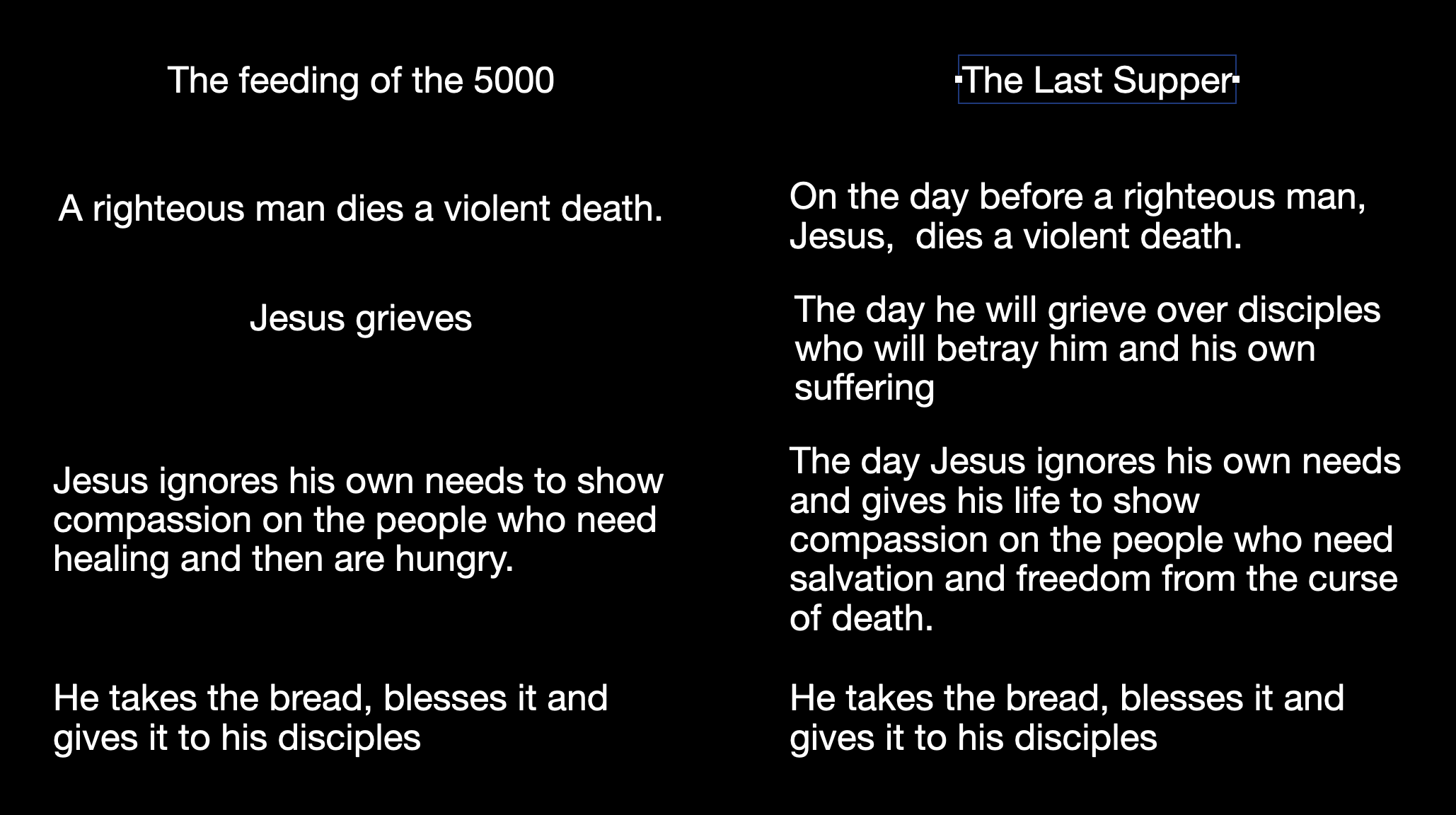
So let’s review— I want to connect some dots to another story you know: A righteous man, John the Baptist, dies a violent death at the hands of an evil King. Jesus grieves over his friend, his cousin, and co-worker. He really needs some time away from the crowds. Instead, he ignores his needs and has compassion for the people who need healing and are hungry. So he takes the bread, blesses it, and gives it to his disciples.
Fast forward seven months to the end of April, the day before Jesus, the righteous man, suffers a violent death. This is the day he will grieve over disciples who will betray him and grieve his suffering to the point of sweating drops of blood. The day Jesus ignores his own needs and gives his life on the cross to show compassion to the people who need salvation and freedom from the curse of death. On that day, in the upper room, he again takes the bread, blesses it, and gives it to his disciples.
Now stay with me because I think we have missed something here. Then Jesus says: “This is my body, which is broken for you.” Despite my grief and the pain and agony I will suffer tomorrow, I choose to act in compassion towards you. Then he says, “Do this in remembrance of me.” And I have always heard this interpreted as ‘do the bread and the cup, the Lord’s Supper, as a way of remembering what Jesus did for us.’ And that is all well and good. But for Jesus, a Jewish teacher, ‘remembering’ is not simply a mental process. Hebrew doesn’t have thinking verbs. Remembering implies doing something. When the Bible says, “And God remembered Noah” (Gen 8:1), the Bible does not say God had forgotten about Noah and the animals who had been in the ark on the flooded earth for 150 days. It means God is going to act. And he does. “God sent a wind, and the waters receded.” In the Bible, remembering is not just thinking about something but doing something about it.
Jesus said, “Do this in remembrance of me.” Do what, Jesus? What is the action we should do?
If we want to honor the memory of Jesus, reenacting the bread and the cup is good. But that is not the climax of Jesus’ story. I believe Jesus had much more in mind for us to do than just reenact the bread and the cup. He said, “This is my body which is broken for you. Do This…”
In the feeding of the 5000, Jesus ignores his own needs to show compassion to the people who need healing and then are hungry. Despite what is going on with you personally, no matter what pain, grief, or suffering you endure, act out of compassion for the crowds who need healing, deliverance from evil, and salvation.
Matthew 16:24 “If anyone would come after me, let him deny himself and take up his cross and follow me.
“My body is going to be broken for you. Do This.”
Paul said it this way:
1 Corinthians 10:16 The cup of blessing that we bless, is it not a participation in the blood of Christ? The bread that we break, is it not a participation in the body of Christ?
We are not students in a classroom; we are not just observers. We must join with Jesus, partner with him, and participate in his sufferings—that is the cup and the bread.
If you read the Gospel of John, you will see Jesus’ last teaching before his crucifixion. John 13-17 are four chapters of teaching Jesus does in the Upper Room at the Last Supper. Jesus makes it very clear to the disciples that they will suffer.
John 15:20 If they persecuted me, they will also persecute you.
John 16:2 They will put you out of the synagogues. Indeed, the hour is coming when whoever kills you will think he is offering service to God.
And all the disciples (but Judas) are persecuted, and all but one die a horrible martyr’s death.
Paul, sitting in prison, says in Philippians, “I have lost everything, but I count everything I used to value as rubbish….. that I may know him and the power of his resurrection, and may share (partner) his sufferings, becoming like him in his death.”
My body is going to be broken for you. Do This.
What did Matthew list as Jesus’ final teaching before the Last Supper?
Matthew 25:34-36 Then the King will say to those on his right, ‘Come, you who are blessed by my Father, inherit the kingdom prepared for you from the foundation of the world. For I was hungry and you gave me food, I was thirsty and you gave me drink, I was a stranger and you welcomed me, I was naked and you clothed me, I was sick and you visited me, I was in prison and you came to me.’
My body is going to be broken for you. Do This.
Paul warns us to take the Lord’s Supper seriously.
1 Corinthians 11:27 Whoever, therefore, eats the bread or drinks the cup of the Lord in an unworthy manner will be guilty concerning the body and blood of the Lord. Let a person examine himself, then, and so eat of the bread and drink of the cup.
For years, we read that in the King James Version, which says, “For he that eateth and drinketh unworthily, eateth and drinketh damnation to himself.” So, people got the idea you had to be worthy. You had to ensure you didn’t have any unconfessed sin. So, examine yourself to see if you are worthy. Let me make that easy for you. No, you are not worthy…on your own. You are only worthy if Jesus makes you worthy by giving you his righteousness. So the Lord’s table is for those who have been made worthy by Jesus, those who know him as savior and lord. Don’t get me wrong; any time is an excellent time to search your heart and see if there is an unconfessed sin in your life. Do that every day, not just before communion. So what is the “unworthy manner”?
In Paul’s time, they were doing the Lord’s Supper as a complete meal, called a “Love Feast.” Paul said (1 Corinthians 11:19, 21), “I hear that there are divisions among you…For in eating, each one goes ahead with his own meal. One goes hungry; another gets drunk.” For in Paul’s day, the wealthiest members of the church in Corinth provided most of the food, which could have been a wonderful expression of Christian love and unity towards the poor of the congregation. But the poor had to finish their work before they could come to the meeting, and the slaves would find it very hard to arrive on time. But the rich did not wait. They ate and drank in their little groups, eating their own dinner, and by the time the poor arrived, there was little to nothing left. “One goes hungry, another gets drunk.” They were not eating in a worthy manner. Instead of following Jesus’ example of putting others’ needs first, they are doing the opposite.
To eat in a worthy manner is to examine yourself and see if you are following Jesus’ example of putting others first. Are you denying yourself? Are you taking up your cross? If you want to do something to honor the memory of what Jesus did for us, he told us how in the Upper Room, right after he washed their feet: “For I have given you an example, that you also should do just as I have done to you” (John 13:15).
The next time you partake of the bread and the cup, remember. And the action of your remembrance is taking the bread of life to those in the world who are hungry, sick, or hurting – to those who need Jesus. Do these things in remembrance of him.
1. See https://swallownocamels.com/2024/07/10/july-9-27-a-d-a-miraculous-catch-of-fish-39/
 Swallow No Camels