
Week 35 ——— Jesus at the Feast of Tabernacles
Luke 9:51-62 John 7:1-52
This is week 35 in our 70-week walk through the ministry of Jesus. The Day of Trumpets and the Day of Atonement have passed. On this day in 27 AD, October 13, on the final day of the Feast of Tabernacles, Jesus stands up in the temple area and says, “If anyone thirsts, let him come to me and drink.” You know this scripture. But do you know the context for that verse? I want you to understand it like the people in Jesus’ day understood it.
John 7:1-9 After this Jesus went about in Galilee. He would not go about in Judea, because the Jews were seeking to kill him. Now, the Jews’ Feast of Booths was at hand. So his brothers said to him, “Leave here and go to Judea, that your disciples also may see the works you are doing. For no one works in secret if he seeks to be known openly. If you do these things, show yourself to the world.” For not even his brothers believed in him. Jesus said to them, “My time has not yet come, but your time is always here. The world cannot hate you, but it hates me because I testify about it that its works are evil. You go up to the feast. I am not going up to this feast, for my time has not yet fully come.” After saying this, he remained in Galilee.
We are now at the halfway point of Jesus’ 70-week ministry, and things continue to heat up. He has had several confrontations with the Pharisees and Sadducees, and they are seeking to kill him. So going to Jerusalem or the surrounding province of Judea, where they have firm control, seems like a bad idea. But it is time for the Feast of Booths (the Feast of Tabernacles), or in Hebrew, Sukkot. This is one of the three appointed times for which attendance in Jerusalem is mandatory. God commanded it way back in Leviticus.
Jesus’ brothers come to him and ask him to join them in departing for the feast. People making the 3-4 day trip down to Jerusalem usually traveled together in families for the feast. There was safety in numbers. You know the story of the robbers on the road and the good Samaritan. Jesus’ brothers were watching his ministry. They saw that many had left Jesus after the feeding of the 5000, and they knew that performing miracles in front of thousands of people at the feast might bring his followers back. John adds, For not even his brothers believed in him. Notice how the Bible uses the phrase: “Believed in him.” These were Jesus’ brothers. They knew Jesus did miracles and wanted others to know, too. They may have felt he was the Messiah. But he was not their Messiah. They had a relationship with Jesus as brothers, but he was not their deliverer, their Lord. Only one relationship with Jesus matters. Jesus can be your friend; he can be your brother. But if he is not your Lord, then he is not your savior.
Spoiler alert: his brothers will believe in him later.
After his resurrection, we know Jesus’ brother, James, became a leader in the church and wrote the Book of James. He comes to have this relation with Jesus and in James 1:2 calls him “our Lord Jesus Christ, the Lord of glory.” Another of Jesus’s brothers wrote the book of Jude, and he begins his epistle, “Jude, a servant of Jesus the Messiah…” That is the only relationship that matters. Jude is the servant of his Lord, Jesus.
Jesus tells his brothers: You go ahead without me; I’m staying here. “My time has not yet come.” You see this phrase or “my hour has not yet come” often in the book of John. It is essential to understand the Biblical concept of ‘The Fullness of Time. ‘ Paul speaks of it in Ephesians:
Ephesians 1:7-10 In Him we have redemption through his blood … making known to us the mystery of his will, according to his purpose, which he set forth in Christ as a plan for the fullness of time, to unite all things in him, things in heaven and things on earth.
God’s plan for the world is on a timetable. What Jesus did on the cross and what will happen in the Last Days are all according to the fullness of time.
The most commonly used Greek words in the NT for ‘time’ are chronos and kairos. Chronos is what we usually think about when we think about time. It is clock and calendar time. This is the time of your watch and your day planner. Kairos is the particular time when God has arranged circumstances to be ripe for action. It is the time of the decision that anointed time when God brings you to a fork in the road. It is ‘the opportune time’. Some versions of the Bible even translate ‘kairos’ to ‘opportunity.’
Do you know where the word ‘opportune’ comes from? Years ago, people living in seaside towns based their lives on the tides. The rise and fall of the tides determined when ships would depart and arrive and thus ruled all commerce and transportation. Ships would come to the entrance of the harbor to enter the port but had to wait until the tide would rise enough to make the harbor deep enough to enter into the harbor. That moment was called ‘ob portu’. ‘Ob’ in Latin means ‘toward,’ and ‘portu‘ means ‘port’ or ‘harbor.’ So they had to wait until the ob portu time. Thus, our phrase ‘opportune time.’
Kairos is where chronos meets God’s opportune moment. Let me use it in a sentence:
Galatians 6:10 So then, as we have opportunity [kairos,] let us do good to everyone, and especially to those who are of the household of faith.
As we have opportunity… We should be like the ship waiting at the harbor’s edge, ready to enter when the opportune moment arrives. This is how we should go through this world, sitting on ready, waiting to do good to someone as soon as the opportunity arises.
Jesus was very aware of kairos. He knew God’s plan had its own timetable. In John 2, when his mother asks him to solve the lack of wine at the wedding, Jesus tells her, “My hour has not come” (John 2:4). Twice, people came to arrest him, including on this occasion at the feast of Tabernacles in John 7, but they could not “Because his hour had not come.” Jesus is on a schedule. It is not his mother’s schedule, nor his brother’s. It is the Father’s timetable. God set up appointed times in the beginning. He will keep his schedule.
God will arrange events so that they only happen at the opportune moment. When the week before Passover arrives, Jesus says, “The hour has come for the Son of Man to be glorified.” (John 12:23) On the night he will be betrayed and arrested, Jesus prays in the garden, “The hour has come; glorify your Son that your Son may glorify you.” (John 17:1). God is making very sure that Jesus will die on the cross at the exact time as the Passover lambs are being slain. God wants us to understand what is happening, so He is painting a picture in history that we can’t miss. (Assuming we study the scripture as He asked us to.)
God has a timetable for history. He will make sure things happen on his schedule. We have discussed the appointed times God set up on the calendar when Israel left Egypt and headed toward the promised land. God appointed seven times on the calendar: four spring feasts and three appointed times in the fall.
The spring appointed times are Passover, Unleavened Bread, Firstfruits, and Pentecost. We have seen how God fulfills these appointed times on the same exact day that he set up over a thousand years before. Jesus dies on Passover and is resurrected on the day of Firstfruits. The Holy Spirit comes on Pentecost. All of these things happened at the same time the Jews had been celebrating for over a thousand years. It is not a coincidence. God is making history happen on His timetable. I think the future fulfillment of the fall feasts will also occur on the day God has determined.
In the past few weeks, we discussed the Day of Trumpets and the Day of Atonement. The Day of Trumpets announces the first day of the festival month. It lets people know that the Day of Atonement is coming, so there are ten days of confession and repentance in preparation for the Day of Atonement when the high priest will enter the holy of holies and make atonement for sin. We talked of how these appointed times will be fulfilled in the future. One day, the final trumpet will sound. There will be a final day of judgment, and Jesus, our High Priest, will be the atonement for our sins before the Father. We don’t know the day or the hour1, but I bet the final trumpet sounds on the Day of Trumpets. That brings us to the final appointed time of the year, The Feast of Tabernacles.
Jesus’ brothers ask him to travel to this feast with them, but Jesus tells them to go ahead without him. Remember, God’s law commands all Jewish males to travel to Jerusalem for this feast. Is Jesus going to break one of God’s laws by failing to go to the feast? Obviously, the answer is no. Jesus will be without sin; he will not break one of God’s commandments. So Jesus sent his family ahead, and he did not travel with the large group of pilgrims headed to Jerusalem.
John 7:10 But after his brothers had gone up to the feast, then he also went up, not publicly but in private.
If Jesus goes with the crowd from Galilee, he will be immediately recognized by everyone, and it will be quite the parade when he arrives in Jerusalem. He will make this journey precisely this way next Spring on the pilgrimage to Passover. But this is not the time yet. Jesus can wait a day to leave but still arrive at the same time as his brothers because he takes the straight route through Samaria instead of the longer route east of the Jordan River that avoids Samaritan territory.
The Feast of Tabernacles was commanded in Leviticus 23 and received by Moses on Mt Sinai.
Leviticus 23:39-40 “On the fifteenth day of the seventh month, when you have gathered in the produce of the land, you shall celebrate the feast of Yehovah seven days. On the first day shall be a solemn rest, and on the eighth day shall be a solemn rest. And you shall take on the first day the fruit of splendid trees, branches of palm trees, and boughs of leafy trees and willows of the brook, and you shall rejoice before Yehovah your God seven days.
So, it is a whole week of celebration beginning on the 15th of the month. The first day is a day of rest. Then, there is an eighth day, which is called “The Last Great Day,” which is also a day of rest. It is a time of rejoicing. What is rejoicing with fruit and tree branches? Now I understand rejoicing with fruit; that’s part of a feast. But rejoicing with tree branches? Let’s read a little further in Leviticus:
Leviticus 23:41-43 You shall celebrate it as a feast to Yehovah for seven days in the year. … You shall dwell in booths for seven days. All native Israelites shall dwell in booths so that your generations may know that I made the people of Israel dwell in booths when I brought them out of the land of Egypt: I am Yehovah your God.”
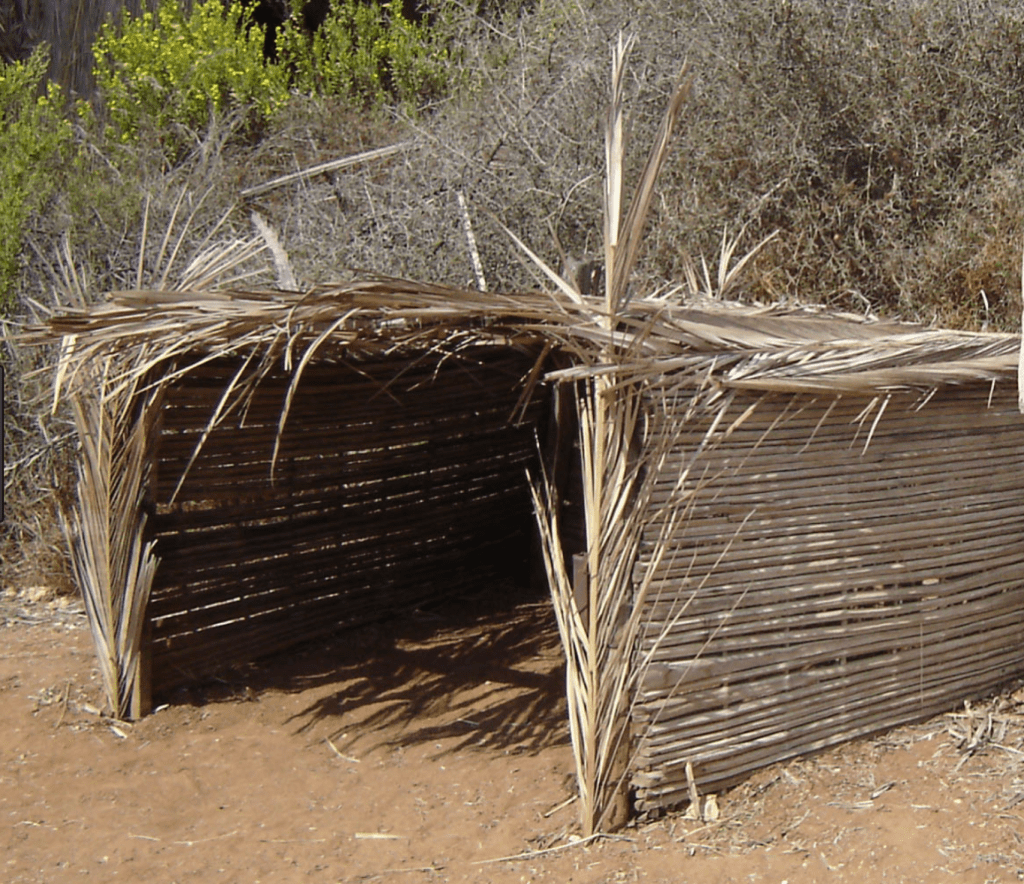
It is a harvest festival where they dwell in ‘booths.’ Here is a picture of a ‘booth’ or ‘tabernacle’ that I saw in a farmer’s field in Egypt. It is a temporary structure built for the harvest time. As the farmers would spend days (and perhaps nights) in their fields to harvest, these temporary structures were constructed to provide a break from the sun or minimal shelter at night. After escaping Egypt, the Israelites dwelled in similar temporary shelters during their time in the wilderness. And to remember that time, the Jews today still stay in temporary shelters during this week.
The ‘booth’ (Hebrew ‘sukkah’) is supposed to be a temporary shelter. It is not that sturdy and offers little protection from the elements. The sky should be visible through the roof. This is to remind them that they should not depend on their own resources for protection but depend on God for their defense. There is a message there for us: We tend to feel protected in our homes, with cameras and security systems, and perhaps weapons to defend ourselves. We need to remind ourselves that God is our refuge and our strength. The Psalmist said:
Psalm 20:7 ”Some trust in chariots and some in horses, but we trust in the name of the Lord our God.”
For our protection, we don’t trust in our weapons or walls but in God, who knows us, sees us, and watches over us.
But this Sukkot, many people were looking for Jesus, and everyone had an opinion of him.
John 7:10-13 The leaders of the Jews were looking for him at the feast and saying, “Where is he?” And there was much muttering about him among the people. While some said, “He is a good man,” others said, “No, he is leading the people astray.” Yet for fear of the Jewish leaders, no one spoke openly of him.
But everyone was scared to speak of him. Everyone knew the religious leaders were looking to kill him.
And Jesus shows up at the feast in Jerusalem and teaches in the temple area. And the temple guards were told to arrest him. But they did not.
John 7:25-27 Some of the people of Jerusalem, therefore, said, “Is not this the man whom they seek to kill? And here he is, speaking openly, and they say nothing to him! Can it be that the authorities really know that this is the Christ? But we know where this man comes from, and when the Christ appears, no one will know where he comes from.”
Jesus showed up at the feast in Jerusalem and taught in the temple area. The temple guards were told to arrest him, but they did not.
John 7:25-26 Some of the people of Jerusalem therefore said, “Is not this the man whom they seek to kill? And here he is, speaking openly, and they say nothing to him! Can it be that the authorities really know that this is the Christ?”
The last day of the feast of Tabernacles (the eighth day) was called ‘The Last Great Day,’ in Hebrew, ‘Hosannah Rabhah.’ Rabhah means ‘great,’ and Hosannah means ‘save us’ or ‘deliver us.’ So this is the day to ask God for deliverance. Deliverance from hunger now and the future deliverance of the Messiah. First, since this was a harvest festival after all the crops were in, there was a time of thanksgiving and then prayer for rain. Following harvest, the ground needed to be plowed and broken up. But with no heavy equipment, it was essential to have the fall rains to soften the ground so it could be tilled. There was a ceremony where a priest would go to the Siloam pool to draw water and come and pour some around the altar as an offering. As he did this, the people waved palm branches (praising God with the branches of trees) and shouted out these two verses:
Isaiah 12:3 With joy you will draw water from the wells of salvation.
Isaiah 44:3 For I will pour water on the thirsty land, and streams on the dry ground; I will pour my Spirit upon your offspring, and my blessing on your descendants.
These were prayers for deliverance today and for the deliverance of the Messiah to come. So picture it. Thousands of people are gathered in the temple. The priest comes to offer water on the altar as a thanksgiving offering for the harvest and for the coming rain that will soften the ground and the future hope of the spirit that will be poured out on the people. It is a grand celebration. Everyone is singing the Hallel Psalms and waving palm branches. This is the setting for John 7:37.
John 7:37-39 On the last day of the feast, the great day, Jesus stood up and cried out, “If anyone thirsts, let him come to me and drink. Whoever believes in me, as the Scripture has said, ‘Out of his heart will flow rivers of living water.’” Now this he said about the Spirit, whom those who believed in him were to receive, for as yet the Spirit had not been given, because Jesus was not yet glorified.
Jesus is saying, “I am the Great Hosannah. I am your salvation. I am the source of living water. And I will give the holy spirit to those who believe in me. That Messiah you are praying for right now — I am here.” Now you know why Jesus said what he said. Jesus is the source of living water. Just as he offered it to the Samaritan women at Jacob’s well, he offers it today.
We talked about the future fulfillment of the seven appointed times. Again, the four spring feasts were all fulfilled by Jesus about 2000 years ago with his death, resurrection, and the gift of the Holy Spirit. The fall appointed times have yet to be fulfilled.
One day, the final trumpet will sound, fulfilling the Day of Trumpets and announcing the Last days. There will be a final day of judgment, and Jesus, our High Priest, will be the atonement for our sins before the Father, fulfilling the Day of Atonement. And the Feast of Tabernacles, a harvest festival, will be fulfilled when God gathers all his family in for a time of rest, praise, and thanksgiving in His tabernacle – a harvest of souls. One day we will enter into our final rest. It will be a grand celebration for those who believe in Him.
1. The Day of Trumpets is the one appointed time that no one can know the day or the hour until it happens. According to scripture, it begins when the new moon is sighted from Jerusalem for the seventh month of the year. If the moon is obscured, then it will be the day following. When the moon is sighted and verified, then the trumpets are blown, and the fires are lit to spread the word (see TAY #52 https://swallownocamels.com/2024/09/24/september-21-27-a-d-yom-teruah-the-year-of-the-lords-favor-52/ )
 Swallow No Camels