
Week 43 ——— The Light of the World
John 10:1–23
The days are getting shorter. Have you noticed it? There is less daylight every day. Today, there will be 4.5 fewer hours of sunlight than in June. Does anyone like that? It could be worse. The further north you live, the less daylight there is. This has to do with the tilt of the Earth’s axis and its position relative to the sun. This photo traces the sun’s path during the day from a very northern latitude, Greenwich, England.
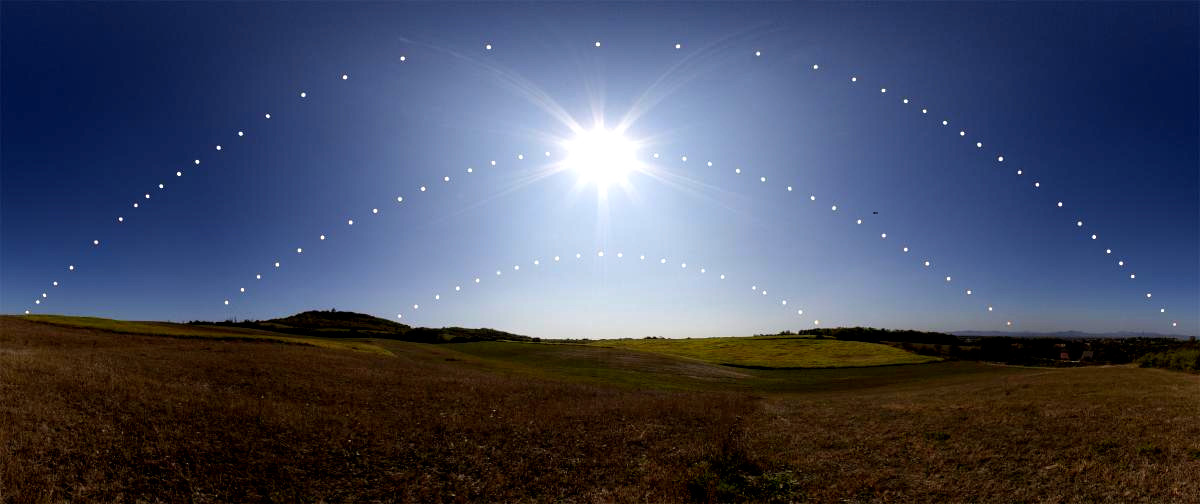
I don’t know how people in northern Alaska survive. The last day they saw any sunlight was November 18th. They will not see the sun again until January 22. It is no wonder people in Arctic communities have higher rates of depression, substance abuse, and suicide. Too much darkness is a very bad thing. If you hate the shorter days, I have some good news for you. It will soon get better. There is an end to the shortening of our days this week. After Saturday, December 21, the days begin to have more and more light.
Some days are darker than others; some days, this world seems filled with darkness. As we continue to follow Jesus in his 70-week ministry, he is in the temple teaching during the celebration of Hanukkah. To understand what Jesus is teaching, we need to know the context of Hanukkah. So, we need to talk about a very dark time in history.
We go back to 336 BC. Alexander the III of Macedonia succeeded his father on the throne at the young age of 20. He went on to conquer most of the world before his death at 32. When Alexander died, his kingdom was divided among four of his generals, who then fought each other for control. The Selucids and the Ptolomys governed the largest two territories. The Seleucid Empire stretched as far east as India. Israel was between the Ptolemaic and Seleucid Empires and was fought over for more than a hundred years before it came under the control of the Seleucid ruler, Antiochus IV, in 175 BC.
He was a brutal dictator who insisted on being called ‘Antiochus Epiphanes.’ Epiphanes is the Greek word for ‘god manifest’ or ‘god in the flesh.’ This evil emperor claimed to be a god in the flesh. He tried to exterminate the Jewish religion. He made it illegal to pronounce God’s name, Yehovah. Thus began the Jewish practice of not saying God’s name aloud. He outlawed Sabbath worship and circumcision. He burned the scriptures. He placed a statue of Zeus in the Jewish temple (that looked remarkably like himself) and sacrificed pigs on the altar. Josephus, a historian in Jesus’ day, describes the punishment for those Jews who refused to worship Antiochus and continued to practice their faith:
“…they were whipped with rods, and their bodies torn to pieces, and were crucified, while they were still alive, and breathed. . . . And if there were any sacred book, or the law found, it was destroyed: and those with whom they were found miserably perished also.”1
Can you imagine if your country was conquered and ruled by such a dictator who made your religion illegal and killed or tortured anyone who worshipped? These were very dark days for the Jews. Tens of thousands of Jews were killed.
But a rebellion arose led by a priest and his son Judah, nicknamed ‘Maccabee’ (the hammer). Against almost unbelievable odds, the Jewish people drove back the army of the Seleucids and freed the country. You can read all about this in the books of 1st and 2nd Maccabees. You won’t find them in your Bible, as they are part of the Apocrypha. They are ancient books that are not the words of God, not scripture, but have helpful historical information.
The Jews drove the Seleucids out, but their temple was a mess. The statue of Antiochus had to be removed, and the altar and the Menorah in the holy place were profaned with the blood of the pig sacrifices. They had to be replaced and rededicated to God before worship could resume. The Menorah, the golden candle stand in the holy place that burns constantly, representing the presence of God, was relit, and the altar was rebuilt. They had missed the 8-day feast of Tabernacles that fall as it had been outlawed, so they celebrated it in the winter. They then decided to keep this 8-day festival to celebrate their deliverance from the oppressive rule of the Antiochus and the Selucids. They called this festival ‘Hanukkah’ and celebrated it as the festival of dedication. They also called it the ‘Festival of Lights,’ as Josephus noted, because the light of God had penetrated the dark days they had under the oppressive rules of the Selucids.
The relighting of the menorah in the temple was celebrated as people lit candles in their homes. Later, a legend developed of how there was only enough sacred oil to burn in the lamp for a single day, but it took 7 days to purify more oil, and the single day’s worth of oil lasted 8 days. Each night of the 8-day Hanukkah festival today, a candle is lit on a 9-branch candle stand. Hanukkah celebrates the victory of the Jews over their oppressors, the dedication of the people who faced death by refusing to worship idols, the rededication of the temple, and the victory of light over darkness. It is the festival of lights.
And it comes in winter, the time of year when darkness seems to prevail. That brings us to another time when the forces of darkness are gaining ground. It is this very week, mid-December, 1997 years ago. It is the winter of 27 AD, and Jesus is preaching and teaching in Jerusalem. But the religious leaders of the day, the elite, those who are wealthy and powerful, are seeking to kill Jesus; the forces of darkness are attempting to extinguish the Light of the World.
The image of light is very important in John’s gospel. This is how it begins:
John 1:1-9 In the beginning was the Word, and the Word was with God, and the Word was God. He was in the beginning with God. All things were made through him, and without him was not anything made that was made. In him was life, and the life was the light of men. The light shines in the darkness, and the darkness can not overcome it.
There was a man sent from God, whose name was John. He came as a witness, to bear witness about the light, that all might believe through him. He was not the light, but came to bear witness about the light. The true light, which gives light to everyone, was coming into the world.
Early in his ministry, Jesus meets with a Pharisee at night and tries to explain. Jesus tells Nicodemus, the Pharisee:
John 3:19 And this is the judgment: the light has come into the world, and people loved the darkness rather than the light because their works were evil.
The Bible consistently emphasizes God’s truth as the light shining in the darkness. In his prophecy of the coming Messiah, the suffering servant of Isaiah, we read:
Isaiah 49:6 For He has said:
“It is too little that you should be My servant
In that I raise up the tribes of Jacob
And restore the survivors of Israel:
I will also make you a light of nations,
That My salvation may reach the ends of the earth.”
If only the Jewish leaders of Jesus’ day had understood this. It would be too small of a mission for the Messiah to bring deliverance only to Israel, so he will also be a light in the darkness for all the nations, to bring salvation to the ends of the earth.
The Gospel of John tells us that it is this celebration, this Festival of Lights, that brings Jesus to Jerusalem despite the danger of contact with the religious elite that is conspiring to kill him.
John 10:22-23 At that time, the Festival of Hanukkah took place at Jerusalem. It was winter, and Jesus was walking in the temple, in the colonnade of Solomon.
During this festival, Jesus chooses to teach using the themes of Hanukkah, just as many pastors will preach this season using the themes of Christmas. Everything in John 8:12 to 10:39 and Luke 10:38-42 happens during the Festival of Hanukkah. The passage begins:
John 8:12 Jesus spoke to them, saying, “I am the light of the world. Whoever follows me will not walk in darkness, but will have the light of life.”
This is when people are lighting candles in their homes each night. As they light the candles, they remember how, after the defeat of the enemy in 165 BC, they had the relighting of the Temple menorah, which represented the return of worship and God’s presence. Jesus claims to be the Light of the world that Isaiah predicted, the Messiah that would bring the light of God’s presence to all the world. He is the light, God’s presence among them. As they remember back to the evil ruler Antiochus, who tried to convince them that he was God in the flesh, Jesus now tells them that he is the true God incarnate, God in the flesh. But he has come not to punish them or destroy them; he has come to bring salvation.
Jesus spends chapters 8 and 9 trying to tell them that he is the Messiah, came from his Father’s throne, and was the light that Isaiah prophesied would come into the world. But the religious leaders could not see it, so in John 10:24 they ask,
“How long will you keep us in suspense? If you are the Christ, tell us plainly.”
John 9:39-41 Jesus said, “For justice, I came into this world, that those who do not see may see, and those who see may become blind.” Some of the Pharisees near him heard these things, and said to him, “Are we also blind?” Jesus said to them, “If you were blind, you would have no guilt; but now that you say, ‘We see,’ your guilt remains.
He had been telling them plainly, but they were blind. And they claimed to be the religious elite, the only ones who understood the scriptures.
My friend Becca lost her vision several years ago. She lives in total darkness. Can you imagine that? ……..There is no light in her day, only darkness, 24/7.
Now, during Hanukkah, Jesus, in this passage in John 9, gives sight to a man who was blind from birth. Before he heals the man, he says:
John 9:5 As long as I am in the world, I am the light of the world.”
I don’t think we understand the importance of this miracle of healing a man born blind. It is a clear statement that he is the coming Messiah.
John 9:34 Never since the world began has it been heard that anyone opened the eyes of a man born blind.
People who had once seen and lost their vision had it restored, but never had anyone born blind been healed and given vision. None of the prophets, no miracle workers, had ever done this. That was something only the Messiah would be able to do. That was something only the Messiah would be able to do. This would prove Jesus was the Messiah. And he did it right before them, and still, they refused to believe it. Read John 9. The Pharisees are really torn up about this. They questioned the man, who was blind, several times. They called the man’s parents in to be asked, “Are you sure this is your son who was blind?” They keep interviewing the man. They still refuse to believe and throw the man out.
This man who knew nothing but constant darkness meets the Light of the World, and light enters his world for the first time during this festival of Lights. And Jesus claims to be the Messiah, the light of the world. But there are many who can’t see.
What did Jesus tell Nicodemus?
John 3:19 And this is the judgment: the light has come into the world, and people loved the darkness rather than the light because their works were evil.
We today live in a world that seems to get darker and darker. We see the enemy seem to get bolder and bolder in promoting sin. What was completely unacceptable in public just years ago is now accepted as normal. Look at how the world has changed. What would have been unthinkable to have on public television 20 years ago is now not just visible but actively promoted as good. Society’s values and morals are eroding at a quickening pace.
And while we know the date that the days here will stop getting shorter and start getting longer (the winter solstice, December 21), we don’t know when our solstice of worldly darkness will come. How much darker will it become? When will the day come when the darkness of this world stops getting worse?
You may be at a time in your life when darkness seems to prevail. Some times are darker than others. This may have been a difficult year or season for you. I know it has for my family. Some of you have walked through some dark valleys this past year. You have faced the death of a loved one, chronic illness with continual pain or loss of energy. For some this has been a dark, dark time. You may want to cry out to God as the Psalmist did…
Psalm 13:1 How long, Yehovah? Will you forget me forever?
How long will you hide your face from me?
How long must I take counsel in my soul
and have sorrow in my heart all the day?
This is the psalmist being honest with God. We should pray to God with such honesty and emotion. If you are upset, frustrated, or disappointed, pray it. God can handle your honesty. Only after we are honest with God can He help us work through our emotions, as He does with this psalmist.vvHow does the psalm end?
Psalm 13:5 But I have trusted in your steadfast love;
my heart shall rejoice in your salvation.
I will sing to Yehovah,
because he has dealt bountifully with me.
God does intervene for the psalmist, and He will for you. No matter how dark the days are, how bad the prognosis is, or how hopeless the situation is, for those who put their trust in Yehovah, there will come a time when your heart will again rejoice. There is coming a day when God will bring deliverance again.
Another psalm says it well.
Psalm 30:5 Weeping my last for the night, but joy comes in the morning.
In the third week of Advent, we light the candle of Joy and think of the joy that comes to the world with the coming of Jesus. No matter how dark the night, the morning will come. When Jesus died on the cross, the world went dark. But joy came on that Sunday morning as he was resurrected. No matter how dark the world seems, God has a plan to bring joy. No matter how dark the valley that you are walking through, God has a plan to restore your joy. I do not know how long the darkness will last. But I know God has promised you joy in the morning.
Remember what Jesus said before he healed the blind man.
John 9:5 As long as I am in the world, I am the light of the world.”
“As long as I am in the world…” What about when Jesus departed the world? What did he tell his disciples?
Mathew. 5:14 “You are the light of the world. A city set on a hill cannot be hidden. Nor do people light a lamp and put it under a basket, but on a stand, and it gives light to all in the house. In the same way, let your light shine before others, so that they may see your good works and give glory to your Father who is in heaven.
We carry the light in this dark world. It is up to us to be the light. How are we that light? People see our good works and give glory to the Father. The way we live each day should be a light in the darkness for those around us. In a dark world, our actions should be a light. In a time when politeness has vanished, we should shine with courtesy. In a time when people all think only of themselves, our generosity should be a beacon pointing to our generous father. In a day when many people are depressed, our joy, despite our circumstances, should reveal our faith. In a world where many are forgotten, the way we reach out to the poor, neglected, or lonely should be a light. Paul said to the Ephesians:
Ephesians 5:8 For at one time you were darkness, but now you are light in the Lord. Walk as children of light.
It is our job to shine light into this dark world. And I think back to that time long ago when Yehovah took his friend, Abraham, out to see the stars.
Genesis 15:5-6 And he brought him outside and said, “Look toward heaven, and number the stars, if you are able to number them.” Then he said to him, “So shall your offspring be.” And he believed Yehovah, and he counted it to him as righteousness.
On a clear night without light pollution, astronomers tell us we can see about 6000 stars. If you count two stars a second, that’s 5 hours of counting. God’s point is that there are more stars than you can count. And that is just the stars that Abraham could see. Our galaxy, the Milky Way, has over 100 billion stars, and there are over 100 billion galaxies. Abraham could see that if he had access to our best equipment now. So that is over 3.1 billion, billion years to count what we can see now (that’s 3 with 18 zeros after it).
God told Abraham — so shall your offspring be. And Paul told us,
Galatians 3:29 If you belong to Christ, then you are Abraham’s offspring, heirs according to promise.
That is why the songwriter Rich Mullins said, “When I think of Abraham, how one star he saw had been lit for me…”1 This comes to my mind every time I look up at the stars. God said, “Abraham, I know you are old and think you are past the age to have children, but look at what I will do… I will give you a family of faith you can’t number.” And one of those stars had my name on it. And one was lit for you.
So it is our responsibility to shine like stars.
Philippians 2:14 Do everything without grumbling or arguing, so that you may become blameless and pure, “children of God without fault in a warped and crooked generation.” Then you will shine among them like stars in the sky as you hold firmly to the word of life.
In a dark world, we are the light of Christ. Why do we light advent candles? We light the candles for the same reason the Menorah was lit in the temple. We light our candles to remind us that God’s presence, his light, has come to conquer the darkness. Next week, many of us will meet on the eve of Christmas and light the Christ candle. The following evening, our Jewish friends will light the central candle on their Hanukkah menorahs. They call it the Shamash – the servant candle that lights all the others. Isaiah’s suffering servant has come into the world, the light of the world. He has given us light in the darkness; now, we carry that light to the world.
This week, I ask you to shine like stars. Why does Paul say don’t grumble or argue? You grumble when you focus on the darkness, and then you become part of the darkness. Like the psalmist, rejoice that God ended darkness through Jesus, the light of the world. Show your joy! Smile! Sing to the Lord! Do good deeds! Be a light shining in this dark world so that our Father in heaven may be glorified and people will want to come to the light.
- Flavius, Josephus. Antiquities of the Jews (XII.5.4).
- Mullins, Rich. From “Sometimes by Step” in the album, “The World as Best as I Remember it” 1991.
 Swallow No Camels