
December 4, 27 A.D.  –  The Good Shepherd—   The Year of the Lord’s Favor #62

Week 42 ——— The Good Shepherd
John 10:1–23 

Last week, we discussed how the Pharisees had made following God hard for the people.  They didn’t like the kind of Messiah Jesus was turning out to be.  Jesus called them idolaters.  He said they were worshiping idols.  And what is an idol?  It is a god that you make up and pretend to be real.  The Pharisees read the scriptures, but instead of worshipping the God of the Bible, they designed their own imaginary god that fit their purposes quite well.   They remade God in their image.  The god they worshiped bore little resemblance to the God of the Bible.  The god they worshiped cared more about laws than people, rituals than righteousness, and tithing spices than the poor.  

You can read the right scriptures but worship the wrong god. 

Let me set the scene of our scripture in John 10, where Jesus continues criticizing the religious leaders of his day. The 70 disciples he sent out have returned with stories of their mission’s success. It is festival time, and despite the danger of being in Jerusalem, where the Pharisees want to kill him, Jesus goes to celebrate.

John 10:22-23   At that time the Feast of Dedication took place at Jerusalem. It was winter, and Jesus was walking in the temple, in the colonnade of Solomon.

I cannot understand why the translators of the Bible go to great lengths to try to hide the fact that this ‘feast’ is Hanukkah.  While very few Christians know what the “Feast of Dedication” is, most everyone knows that Hanukkah is a Jewish holiday.  The word in the gospel of John in Greek is ‘egkania’ which is the word used in Ancient Greek for Hanukkah.  It is a festival celebrating the dedication of the temple, but  only one major version of the Bible translates it clearly  (New Living Translation.)   For many years, the institutional church was antisemitic and tried to divorce itself from its Jewish roots.  But Yehovah, the God of the Bible, chose the Jews to be the conduit of his message.  Our lord and savior, Jesus, was Jewish, and he celebrated Hanukkah.  Next week, we will discuss the history of this holiday and how Jesus used the festival theme to teach a great truth.  So, the teaching we discuss today and next week occurs during this Jewish festival.  It is winter, and Jerusalem can get quite cold.  We saw it snow in Jerusalem on our first trip.  Jesus is teaching in Solomon’s colonnade; it was a roofed outdoor section of the temple grounds, so it was somewhat protected from the elements.  It was huge, about 45 feet wide and 800 feet long.  A common place for public meetings, the early church met here.  

John 10:1-6 “Truly, truly, I say to you, he who does not enter the sheepfold by the door but climbs in by another way, that man is a thief and a robber.   But he who enters by the door is the shepherd of the sheep.   To him the gatekeeper opens. The sheep hear his voice, and he calls his own sheep by name and leads them out.   When he has brought out all his own, he goes before them, and the sheep follow him, for they know his voice.  A stranger they will not follow, but they will flee from him, for they do not know the voice of strangers.”   This figure of speech Jesus used with them, but they did not understand what he was saying to them.

Jesus gives this story about the sheep and the shepherd and the disciple are confused.  Now, we have the benefit of having heard the explanation Jesus gives in the following 11 verses, so we know where Jesus is going.  But the disciples needed clarification.  They shouldn’t have been.  Jesus is calling to mind a familiar metaphor from the scriptures.  Several Old Testament prophets denounced the religious leaders of their day, calling them bad shepherds of the people.  So when Jesus introduced the idea of himself as the good shepherd, they should have gotten it.  They must have missed the class on Ezekiel 34.   That is the background for this teaching of Jesus.  If you, like the disciples, have forgotten that passage, let’s take a look at it.

Ezekiel 34:1-6   The word of Yehovah came to me:  “Son of man, prophesy against the shepherds of Israel; prophesy, and say to them, even to the shepherds, Thus says Yehovah elohim:  Ah, shepherds of Israel who have been feeding yourselves!  Should not shepherds feed the sheep?  You eat the fat, you clothe yourselves with the wool, you slaughter the fat ones, but you do not feed the sheep.  The weak you have not strengthened, the sick you have not healed, the injured you have not bound up, the strayed you have not brought back, the lost you have not sought, and with force and harshness you have ruled them.  So they were scattered, because there was no shepherd, and they became food for all the wild beasts. My sheep were scattered;  they wandered over all the mountains and on every high hill. My sheep were scattered over all the face of the earth, with none to search or seek for them.

A shepherd’s job was to care for the sheep.  These shepherds were just using the sheep.  If they were hungry they would just kill one.  If they needed a sweater they took the wool.  But they didn’t make sure the herd was healthy. They didn’t supply them with green pastures for food.  They didn’t care for the injured.  They just let them wander and become lost.  That’s what sheep do without a shepherd.  They follow another sheep head down, munching on the next clump of grass until they end up miles from the herd.  Sheep need a shepherd.  But Ezekiel said these shepherds of the people were bad shepherds, only caring for themselves.  So what did Ezekiel say God would do?  

Ezekiel 34:11-16   “For thus says Yehovah elohim: Behold, I, I myself will search for my sheep and will seek them out.   As a shepherd seeks out his flock when he is among his sheep that have been scattered, so will I seek out my sheep, and I will rescue them from all places where they have been scattered on a day of clouds and thick darkness.  And I will bring them out from the peoples and gather them from the countries, and will bring them into their own land. And I will feed them on the mountains of Israel, by the ravines, and in all the inhabited places of the country.   I will feed them with good pasture, and on the mountain heights of Israel shall be their grazing land.  There they shall lie down in good grazing land, and on rich pasture they shall feed on the mountains of Israel.    I myself will be the shepherd of my sheep, and I myself will make them lie down, declares the Lord GOD.   I will seek the lost, and I will bring back the strayed, and I will bind up the injured, and I will strengthen the weak, and the fat and the strong I will destroy.1 I will feed them in justice.

Did you see that?  This is the message of Christmas!  These shepherds have failed to care for the people.  So God himself will come and seek them out and rescue them.  What did Jesus tell Zacchaeus? 

Luke 19:10  For the Son of Man is come to seek and to save that which was lost.

David wrote a psalm about what God, as a shepherd, would do for us. You know it.  It  begins,” The Lord is my shepherd…”

Yehovah is my shepherd; I shall not want for anything.
He makes me lie down in green pastures; he restores my soul.

This picture of Yehovah as our shepherd runs throughout the Bible.  And the people of the Bible understood all about shepherding.  From Abraham on, they kept flocks. There was a special bond between a shepherd and his sheep.  The Hebrew term for shepherd of sheep is “ro-eh tzon”.    Tzon is the word for sheep.  Ro’eh is the Hebrew root we translate as shepherd, but that root is used for one who cares for another or is a close friend or companion.   So, a shepherd cares for his sheep as he would love a close friend.  Some of you have pets with whom you share this special bond.  In Leviticus 19:18  “Love your neighbor as yourself,” we see that same root for the neighbor that we are to care for.   The idea is that we should shepherd our neighbors and make sure they have food and shelter and are cared for with love.

Ohad Cohen at the Institute of Biblical Studies says, “The Hebrew context teaches us that a shepherd was not just a responsible overseer, but a caring father figure, tending to his flock out of a deep sense of love. The prophet Isaiah tells us that the shepherd “gathers the lambs in his arms and carries them close to his heart” (Isaiah 40:11). The bond between a shepherd and his animals has all the qualities of a true family.” 

Jesus’ disciples could identify with this shepherd analogy.  But I’m a city boy.   The closest I ever got to caring for sheep was a wool sweater.  I had the chance one day to get up close and personal with a herd of sheep and take a crash course in shepherding.  I was in the Middle East in 2016; we were on a bus driving near Bethlehem, and several shepherds had their flocks near the roadside, so we stopped to visit with them.  We got to hold the little lambs and watch the sheep.

We learned that shepherds kept sheep in some type of enclosure at night.  This could be a low rock wall enclosure in a field, but this is winter, so most shepherds keep their sheep in caves, which are numerous on the hills of Israel.  This provides warmth and safety from predators at night.  That makes you wonder a bit about this verse:

Luke 2:8   And in the same region there were shepherds out in the field, keeping watch over their flock by night.

Why are shepherds out in the field at night instead of safely in a cave or enclosure?  I think it is because these particular shepherds had loaned their cave out to a poor man and his pregnant wife that night.  So when the angels announce the birth of the Messiah to the shepherds, they don’t tell them where to find the baby, but just that the baby will be lying in a feeding trough.  They didn’t need directions if it was their cave….

But usually, sheep were in an enclosure, and the shepherd would sleep in the opening of the cave so the sheep wouldn’t wander off at night and predators would not attack them.    Most caves have multiple openings, so the shepherds would stack rocks to close off all but the one they would guard.  This is where the idea of counting sheep to sleep comes from.  They would call the sheep into the cave, and once all were in, they would lay down to seal the opening with their bodies.  Having counted their sheep as they entered the cave, knowing they were all safe, they were ready for sleep.

If you wanted to hurt a shepherd, you would open their enclosure and let the sheep wander off at night.   If one left, there was a good chance that others would follow.  That’s what sheep do.  The herd would wander off, and a thief could follow and steal the herd.   Otherwise, if you just broke in and tried to grab some, you could only steal what you could carry, so you might cause them to lose a few sheep.  They would not follow the thief. They would only follow the voice of their shepherd.

During our roadside visit with the shepherds,  If any wandered off, the shepherd would make a sound, and they would return.  The sheep were pretty skittish, so I tried to imitate the sound to get one to come close.  I apparently failed because that sheep just gave me the side eye and kept going.  But when the shepherd called out, they turned right around.  Our visit was cut short as it was late afternoon, and the shepherds said it was time to take their flocks home.  We turned to go, but our teacher said to stop and watch.  As the two groups of shepherds headed in different directions, they made their particular call sound, and the flock separated as they followed their own shepherd home.  And several Bible passages came alive for me.  Let’s return to John 10 and Jesus’ explanation.

John 10:7-16   So Jesus again said to them, “Truly, truly, I say to you, I am the door of the sheep. All who came before me are thieves and robbers, but the sheep did not listen to them.   I am the door. If anyone enters by me, he will be saved and will go in and out and find pasture.   The thief comes only to steal and kill and destroy. I came that they may have life and have it abundantly.   I am the good shepherd. The good shepherd lays down his life for the sheep.   He who is a hired hand and not a shepherd, who does not own the sheep, sees the wolf coming and leaves the sheep and flees, and the wolf snatches them and scatters them.   He flees because he is a hired hand and cares nothing for the sheep.  I am the good shepherd.  I know my own and my own know me, just as the Father knows me and I know the Father; and I lay down my life for the sheep.   And I have other sheep that are not of this fold.   I must bring them also, and they will listen to my voice. So there will be one flock, one shepherd.

Who are those who came before him?  It is the current religious elite of Israel —the Pharisees, Sadducees, and scribes.  They claimed they were the door.  If anyone wanted to worship God, they had to go through them.  They had to do it their way.  If they didn’t, then they would be turned aside and not allowed to enter the temple.  The blind man that Jesus will heal this very week will be kicked out of the Temple and excommunicated from their religion because he witnessed to others that Jesus healed him.  It was their way or the highway.  But Jesus says they are not the way.  He is the way, the truth, and the life.  No one comes to the Father except through him.  If anyone tells you there are things you must do, requirements not given by Jesus, do not listen.  He is the way, the only way.

Who are the “other sheep not of this fold”?  Jesus is saying, “It is not just about you, Jews.  You have made it that way, but that is never what God intended.  You were to be a kingdom of priest to the nations.  But you never reached out.  You insisted they become Jewish to worship me.  But I will bring them in.  I will bring in the lost tribes of Israel that were dispersed in 700 BC, I will bring in all the Gentile nations – and they will listen to me and answer when I call.  So, there will be one flock with no divisions.  No Jew and Gentile, no slave and free, one flock.”

What would Jesus say to us today?  When we see many people argue about minor points in the way we worship or, the way we stay pure or, the way we baptize, or the way we reach out.  We embrace our divisions and work to better our individual churches and denominations while God is begging us not to see our denominations as the kingdom but to work toward the good of the Kingdom of God: one flock, one shepherd.  

“And they will listen to my voice.”….. There are so many voices to listen to.  Do you hear his voice?  Do you hear the good shepherd calling out to you?  How do you distinguish the voice of God from all the other voices calling out to you?  I often run into this when talking to people about how they practice their faith.  People aren’t sure if they can hear the voice of God or how they can hear the voice of God.  If you hang around the shepherd long enough, and if you listen, you will learn to recognize the shepherd’s voice.  It takes time to learn the shepherd’s voice.  

The first thing you need to do is to turn off the noise.  We are bombarded by voices constantly throughout the day.  The television may be on 24/7, the radio always on in the car, and now there is the constant ping of your cellphone with an alert of yet another voice clamoring for your attention via text, email, or phone call.  You can’t hear the shepherd if you aren’t listening, and you need to find a time of silence to practice listening.  For many people, God can’t get a word in edgewise.  I don’t believe God is giving any believer the silent treatment.  He wants to call out to us, but I imagine he feels like me when I was in the office trying to talk to a teenager and then realizing he couldn’t hear me because he had his AirPods in his ears listening to music.  He couldn’t hear anyone else because he had the music turned up so loud. 

God wants to call out to us when we wander away, but we aren’t listening.  Take your headphones off.  Turn off the world for a few minutes and talk to and listen to God.   Every believer can hear the voice of God, but very few listen.  Spend time in prayer.  And prayer is not a monologue but a dialog.  Spend time listening and meditating. Begin with just a few minutes a day.  

How do you know it is God’s voice?  You can’t be sure if you don’t know the scriptures. We have these scriptures with the very words of our shepherd recorded in them.  Study and learn them; this is the shepherd’s voice spoken to so many others over the years.  He is the same God as the one who spoke long ago.  He will not contradict himself.  But you have to study the scriptures to have this awareness. 

If you want to read material to help you start your journey to hear the voice of your shepherd, here are three helpful books. Brother Lawrence, a monk in France in the 1600s, wrote the Practice of the Presence of God, a classic. Dallas Willard’s Hearing God was written about 25 years ago, and Mark Batterson’s Whisper is only a few years old.  

But remember the Pharisees in our passage today.  They had studied the right scriptures but worshiped the wrong god.  You can’t just interpret the scriptures any old way you want to.  You can’t read them trying to find something you agree with.  You must be honest with the scriptures, look at the context, and compare what you read to other scriptures.  Discuss them in community, not just by yourself. d We have to be students of the word to be the people of God.

As we pray, study, and listen, the Holy Spirit will begin to speak God’s word.
February 4, 27 A.D.  –  Many or Few? —   The Year of the Lord’s Favor #70

Week 51 — Many or Few?
Luke 13:22-31

Luke 13:22-30   He went on his way through towns and villages, teaching and journeying toward Jerusalem.   And someone said to him, “Lord, will those who are saved be few?” And he said to them, “Strive to enter through the narrow door. For many, I tell you, will seek to enter and will not be able. 

For the past four weeks, Jesus has been traveling in Perea, the land east of the Jordan River. His time is getting shorter. In this chapter of Luke, we learn that Herod is out to get Jesus.

Luke 13:31   At that very hour, some Pharisees came and said to him, “Get away from here, for Herod wants to kill you.”

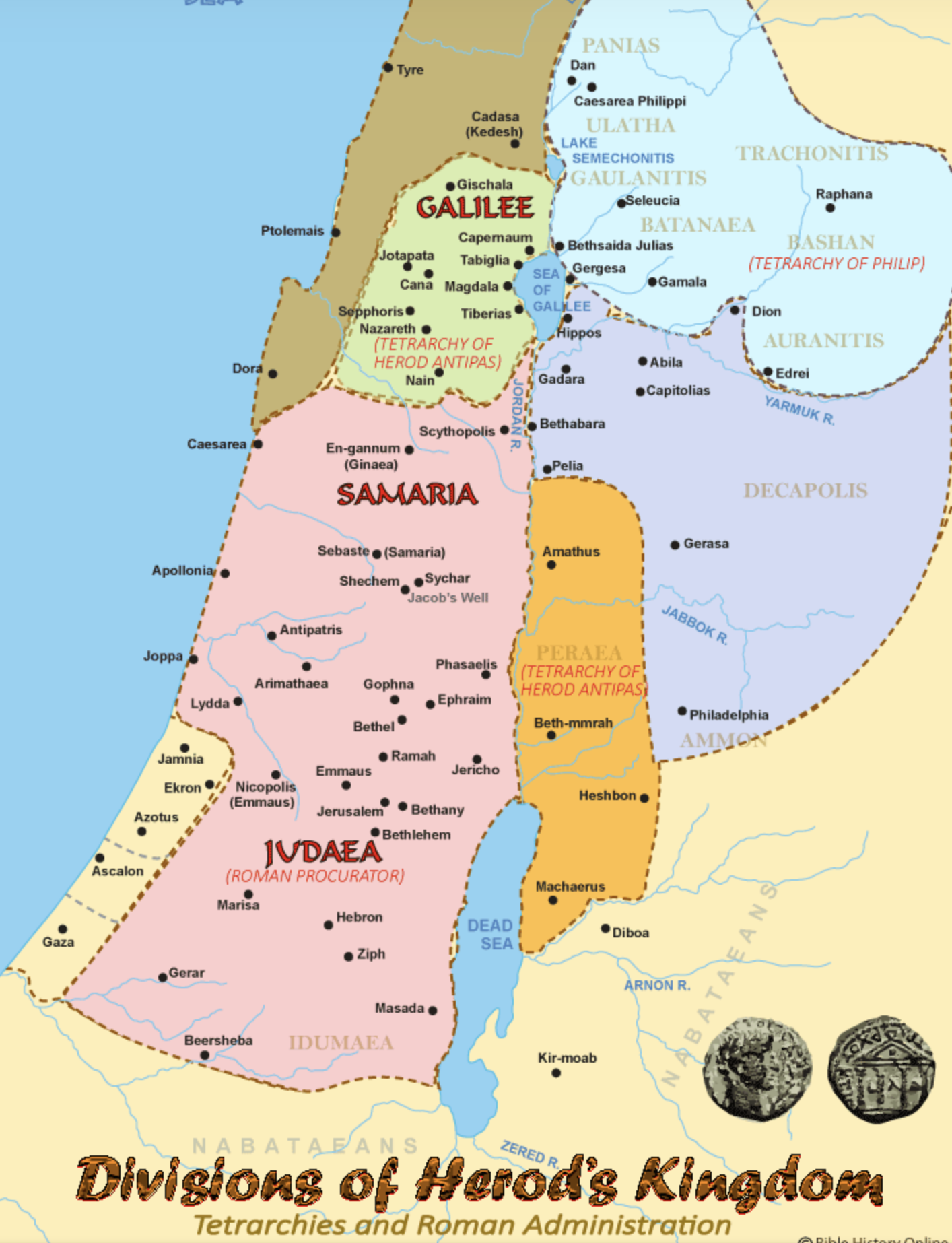
Which Herod are they talking about?  There is Herod “the Great,” the king who tried to kill Jesus after his birth, but that Herod died shortly after this event.  His kingdom was then divided among his sons, who rather confusingly also called themselves ‘Herod.’  (‘Herod’ in Greek is ‘hero.’)   Herod Philip got the territory in blue on the map below, which includes the towns of Bethsaida and Caesarea Philippi.  Herod Archelaus got the territory of Judea and Samaria in the pink, but he only ruled for 9 years.  Caesar deposed him, and the territory was made a Roman Province, with Pontius Pilate in charge of this area.   Herod Antipas (half-brother of Philip) got Galilee and Perea.  This is the Herod that was called out by John the Baptist for marrying his brother Phillip’s wife.  Herod Antipas had John the Baptist imprisoned in his fortress in Macherus in Perea and then had him beheaded.  When Herod Antipas learned of Jesus, some told him that Jesus was John the Baptist, who had been raised from the dead.  

So Jesus has been traveling and teaching for over a month in Herod Antipas’ territory in Perea.  Jesus had likely come further south, closer to Herod’s palace in Macherus, so Jesus was warned to leave the area.  Now, Jesus begins to journey back through Perea, eventually passing through Jericho and returning to Jerusalem.  On his way, someone asked Jesus a question:

“Lord, will those who are saved be few?”

“Will many be saved or few?”     It is a good question.  Jesus began with a very small following, and sometimes crowds of thousands followed him.  Then Jesus will say something the crowds don’t like, and many of them will leave.  Then he will do miracles, and the crowds will gather again.  Will there be many saved or few?  It is an interesting question today.

Remember, in the Bible’s first book, God promised Abraham that his offspring would be as countless as the stars.  

Genesis 15:5  “…number the stars, if you are able to number them.” Then he said to him, “So shall your offspring be.”

In the last book, Revelation, we read this:

Revelation 7:9-10  After this I looked, and behold, a great multitude that no one could number, from every nation, from all tribes and peoples and languages, standing before the throne and before the Lamb, clothed in white robes, with palm branches in their hands, and crying out with a loud voice, “Salvation belongs to our God who sits on the throne, and to the Lamb!” 

A multitude that no one can number- the promise to Abraham being fulfilled.

In the days of the early church, a tiny fraction of the Earth’s population were followers of Jesus.  Today, about one-third of the world’s population, 2.7 billion people, claim the Christian faith. If only 1% of the world’s current population were saved, the resulting assembly of 82 million people would look like an uncountable multitude. Still, compared to all the people who have ever lived (109 billion by some estimates), it would seem to be few.  

So, will it be many or few?  What is the answer?

Or, as some have suggested, will everyone be saved?  Will all 109 billion enter heaven?  In 2011, Rob Bell published a book entitled Love Wins, the premise being that, eventually, everyone will be saved.  He quoted 2 Peter 3:9, that God is not willing that any perish but that all should come to repentance, and interprets that to mean that one day all will repent.  He says that if God wills it, then it must happen. 

Bell refers to Revelation 21:25, which says that the gates of Heaven are never shut. Bell applies that verse to Jesus’ teaching in Matthew 7 about entering through the narrow gate.  However, city gates were closed in those days to keep out an enemy or to be shut at night for safety.  But the point in Revelation is that in the world to come, there is no enemy, and there is no night.  So, gates never have to be closed.  Bell stretches this to say that, eventually, everyone, even if after spending time in hell, will decide to enter those always open gates. 

This is not a new idea.  Theologians, as early as Origen, in the third century, promoted this idea of universalism, that everyone would be saved.  ‘Love Wins.’  It is a pleasant thought, but does this fit with what Jesus said in our passage today?

Luke 13:23-28   And he said to them, “Strive to enter through the narrow door. For many, I tell you, will seek to enter and will not be able.  

Jesus said, “Many will seek to enter and not be able.” And he said that we must ‘strive’ to enter…”  The Greek word for ‘strive’ is ‘agonizomai.’  We are much more Greek than we realize.   Isn’t it interesting how we can see many English words in these Greek words?  There, you see our word ‘agonize.’   Jesus says it is a struggle; it takes tremendous effort.  The only other time we see that same word on Jesus’ lips is in John 18.  There it is translated as ‘fighting.’

John 18:36  Jesus answered, “My kingdom is not of this world. If my kingdom were of this world, my servants would have been fighting, that I might not be delivered over to the Jews. But my kingdom is not from the world.”

We must strive to enter; it is agonizing, a struggle, a battle.

What is this agonizing that Jesus says we must do to enter this narrow door?  And if it is a battle, who is the enemy?  And are we saying this is righteousness by works?   Are we striving to earn our salvation?  Definitely not!  You probably know this verse:   

Romans 6:23   For the wages of sin is death, but the free gift of God is eternal life in Christ Jesus our Lord.

But did you know the word ‘free’ is not in the Greek there?   The Greek word for ‘gift’ is ‘charisma,’ a gift given not on merit but by undeserved favor.  So, the gift is given out of grace.  It is undeserved.  It cannot be earned.  But unfortunately, when we read the word ‘free’, some get the idea that there are no requirements to accept it. But there is a requirement.

To illustrate this in church, I held up a $5 bill and told the congregation I would give it away to anyone who asked. It was free and available to anyone, but accepting it required action.

‘Eternal life in Christ’ is an unearned gift of grace, but to accept it, there is a harsh requirement.  You have to die.  Paul said it this way:

Galatians 2:20  “I have been crucified with Christ.  It is no longer I who live, but Christ who lives in me.”  

You must die to yourself.  You have to decide that you are not the best to make decisions for yourself.  You have to decide that you should not follow your own rules.  You have to determine that you can not be the ruler of your life.  You have to choose to change the way you live by changing who makes your decisions.   We call that repentance.  So you die to your selfishness and turn over your life to God instead, agreeing to live by his rules and follow his ways.  Jesus called this ‘denying yourself.’

Matthew 16:24  “Whoever wants to be my disciple must deny themselves and take up their cross and follow me.” 

The gift of forgiveness and salvation is free, but it is very costly to accept it and become a disciple.

Some people do this when they walk down an aisle and get baptized.  At that moment, they decide to die to themselves and live with a different king over their life, a king they will obey no matter what he asks.  But some people walk down an aisle and want to be saved. They don’t want to go to hell; they want to be in heaven when they die.  They are willing to say that in front of a church and are willing to get sprinkled or dunked in water publicly.  But they may not have understood that there is a prerequisite.  

The prerequisite for accepting the gift is repentance, not just a repentance of specific sins, but a complete change in how you decide your life.   You must repent of the sin of making yourself the God and the King of your life.  There can only be one God, one King, and that is not you. That is the repentance that matters.

And the gift we get differs significantly from the $5 bill I gave away.   Because this is not a gift you can hold in your hand and decide to spend whenever you want; it is not a ticket to a place called heaven that you can redeem when you die.  The gift is ‘eternal life in Christ Jesus our Lord.’  The gift is a relationship, life in Christ.  It is a relationship with Jesus that begins today.  But the relationship is that of a king to his subject.  If Jesus is not your king, then you have no relationship with him.  

Repentance is a struggle, not just a one-time decision.  Oh, one day, you decide to put Jesus in charge of your life.  You repent of trying to run your life your own way.    And God grants forgiveness.  But then your old self that you tried to kill — you find out that the old man dies hard.  So you find yourself ignoring God’s leadership in your life, and you are back to being your own boss and king.  Instead of doing what God wants you to do, you do what you want.  (Paul admits to having this same struggle also.)  And then you have to repent of those things, but more importantly, repent of kicking God off the throne of your life.

That is the struggle; that is where we strive.  And the enemy we strive against is our self, our sins, and our desire to make our own decisions.  This is the same struggle we see in Genesis 3.  Adam and Eve have to decide who gets to make the rules, who decides what is good and what is not good, and who is the king of their life, God or themselves?

That is not us working for our salvation; it is us doing the work that results from our salvation.  For you see, we have no hope of being successful in this without God’s help.  That is why God sent his holy spirit to dwell in us so that we would have his presence with us to enable and empower us to win this battle with ourselves.

Let’s look at the rest of our passage this morning.  

Luke 13:23-28   And he said to them, “Strive to enter through the narrow door. For many, I tell you, will seek to enter and will not be able.  When once the master of the house has risen and shut the door, and you begin to stand outside and to knock at the door, saying, ‘Lord, open to us,’ then he will answer you, ‘I do not know where you come from.’   Then you will begin to say, ‘We ate and drank in your presence, and you taught in our streets.’   But he will say, ‘I tell you, I do not know where you come from.  Depart from me, all you workers of evil!’  In that place, there will be weeping and gnashing of teeth when you see Abraham and Isaac and Jacob and all the prophets in the kingdom of God, but you yourselves cast out.

Sadly, many will want to enter into God’s salvation but will not be able to because they are not willing to repent.  They want to be in heaven with Jesus, but they refuse to let God be king.  They have to be their own king.   If you do not know God as your king, then you don’t know him at all.

Look at the parallel passage in Matthew 7:

Matthew 7:21-23   “Not everyone who says to me, ‘Lord, Lord,’ will enter the kingdom of heaven, but the one who does the will of my Father who is in heaven.  On that day many will say to me, ‘Lord, Lord, did we not prophesy in your name, and cast out demons in your name, and do many mighty works in your name?’   And then will I declare to them, ‘I never knew you; depart from me, you workers of lawlessness.’

Who enters the kingdom of heaven?  Only the ones who do the will of the Father in Heaven.    

Jesus divides all people into one of two groups.  And it is not those who did bad things and those who did good things.  It is not those who were kind and those who were mean.  It is not those who went to church and those who did not.  It is those who do their own will and those who do God’s will.

Again, Jesus tells us that many will not enter the kingdom of heaven.   And look at this group who doesn’t enter.  They prophesied in Jesus’ name.  They spoke inspired words in the name of Jesus.  They cast out demons.  They did mighty, powerful works in the name of Jesus.  

They did many good things, but Jesus said he never knew them.

Doing great things will not impress God.  Doing obedient things will.   If the good things you do are not God’s will, if they are your idea instead of HIs, it doesn’t matter how good you think they are.  

Not everyone who says to me, ‘Lord, Lord,’ will enter the kingdom of heaven, but the one who does the will of my Father who is in heaven.

Do you see why Jesus talked about the kingdom of God more than anything else?  Do you see why the first word he publicly speaks is ‘Repent’?

Repent for the Kingdom of Heaven is at hand.

The only way to enter the kingdom is to repent.  Repent of your rebellion against the king.  Turn your life around and decide to be obedient to the king.  You must place yourself under the king’s reign to be in the kingdom.  If you don’t accept God’s rule over your life, then you have no relation to God.  Either God is your king, or he is a stranger.   There is no in-between.

You see, you can not earn your way into the kingdom with good works.  The people in this scripture passage did powerful, wonderful things but were turned away.  “Depart, for I never knew you.”

God, through the sacrifice of Jesus, can forgive your sins and redeem you from your slavery to sin.  We are raised to new life, a life of continual surrender of our will to Him.  We don’t submit our will to God in order to do exactly what we want to do anyway. We submit to do his will.  And you can’t expect to surrender your life to God and make him king of your life and then not expect him to give you things to do.  Paul has told us that God has prepared a list of things for us to do ahead of time:

Ephesians 2:10   For we are his workmanship, created in Christ Jesus for good works, which God prepared beforehand, that we should walk in them.

So there will be things God wills for us to do.  And if indeed you did submit to the king, you will be obedient to all he asks of you.

You know the parable of the two builders in Matthew 7.   One built his house on the rock, and when the rain, wind, and flood came, it stood.  The other built his house on the sand, and when the storm came, the house fell apart.  This story comes right after this scripture we just read.  It begins in verse 24.  Jesus concludes his most famous sermon with this story.  He tells those listening to him that they are either the ones building off the rock or the ones building on the sand.  What is the difference?

Matthew 7:24-27     “Everyone then who hears these words of mine and does them will be like a wise man who built his house on the rock.   And the rain fell, and the floods came, and the winds blew and beat on that house, but it did not fall, because it had been founded on the rock.   And everyone who hears these words of mine and does not do them will be like a foolish man who built his house on the sand.   And the rain fell, and the floods came, and the winds blew and beat against that house, and it fell, and great was the fall of it.”

They were all hearing Jesus speak on that mountain.  But only some would do what he said.  And that makes all the difference. Hearing without doing so leads to destruction.  

Rob Bell is wrong.  Sadly, not everyone will be saved.  One day, the door will close, people will knock to enter, and God will say, “I never knew you.  I never had a relationship with you.”  One day, God will separate all humanity that has ever lived into a group on the right and a group on the left.  (See Matthew 25:31-46.)  And what does he say the difference will be?

One group gave food to the hungry, drink to the thirsty, welcomed the stranger, clothed the naked, and visited the sick and imprisoned.  The other group did not do these things. And Jesus told them that these things they did for “the least of these” they actually did for him.  Jesus notes that both groups are surprised.  Neither group had any idea that what they were doing was for Jesus. All they had done was to be obedient to share what they had with others who were needy, because that was the will of their King.  

Look back at the passage from Luke 13 above.  Does this sound like the gates or doors of heaven are always open?  No.  There comes a time when the master of the house shuts the door.  And then many people will want to enter but will not be able to enter.

Jesus never answered the question, “Lord, will those who are saved be few?”

He answers this question about the number by saying: Be sure you’re in the number.  The important question is not: How many will be saved?  The critical question is, will you be saved?  Will your family be saved?  Will your friends be saved?  It is too important to make assumptions, for as Jesus has told us, many will be surprised.  I beg you to make sure you know where you and your friends stand.

That narrow door is open.  One day, the door will close.  Whatever the number, be sure you are in that number.

Oh, when the saints go marching in.  Oh, when the saints go marching in.
Oh Lord, I want to be in that number when the saints go marching in.