March 20, 27 A.D.  –  Can You Drink the Cup? — The Year of the Lord’s Favor #77

Week 57 — Can You Drink the Cup?
Matthew 20:17-23

Jesus is on his final tour of Galilee and will soon be taking the long journey back to Jerusalem with all the other pilgrims headed to the Passover feast.   And our itinerant Rabbi Jesus continues to teach all along the way.

Matthew 20:17-23   And as Jesus was going up to Jerusalem, he took the twelve disciples aside, and on the way he said to them,  “See, we are going up to Jerusalem. And the Son of Man will be delivered over to the chief priests and scribes, and they will condemn him to death and deliver him over to the Gentiles to be mocked and flogged and crucified, and he will be raised on the third day.”
  Then the mother of the sons of Zebedee came up to him with her sons, and kneeling before him she asked him for something.   And he said to her, “What do you want?” She said to him, “Say that these two sons of mine are to sit, one at your right hand and one at your left, in your kingdom.”   Jesus answered, “You do not know what you are asking. Are you able to drink the cup that I am to drink?” They said to him, “We are able.” He said to them, “You will drink my cup, but to sit at my right hand and at my left is not mine to grant, but it is for those for whom it has been prepared by my Father.”

So James and John come to Jesus with their mother, who has been traveling with Jesus often.  She is specifically mentioned as being with Mary Magdalene and “many women” who were at the crucifixion, “looking on from a distance” (Matthew 27:55-56).   What are they asking Jesus?    They are seeking a prominent place of honor when Jesus comes into his kingdom.  Is that a ridiculous request?  

Jesus had just told the disciples  a few days ago: 

Matthew 19:28.  Jesus said to them, “Truly, I say to you, in the new world, when the Son of Man will sit on his glorious throne, you who have followed me will also sit on twelve thrones, judging the twelve tribes of Israel.”

Jesus had put them in the position of princes in the kingdom, sitting on thrones, so they were asking to be chief of the princes.  But their timing is horrible.   Look back at what Jesus said just before they made their request:

Matthew 20:18-19   And the Son of Man will be delivered over to the chief priests and scribes, and they will condemn him to death and deliver him over to the Gentiles to be mocked and flogged and crucified, and he will be raised on the third day.”
Then the mother of the sons of Zebedee came up to him…

This is the first time he explicitly mentions being crucified.  It is the Jewish court that will condemn him and hand him over to the Romans to be crucified.  Following what had to be an emotional revelation by Jesus about his impending torture and agonizing death, Matthew says, “Then James and John and his mother ask to have a place of honor in the kingdom.  This is horribly insensitive.  

Jesus: In just a few days, I am going to be tortured and then die the worst death imaginable: crucifixion.”
Then his disciples say,  “OK… well then, can we be in charge when you are gone?

The disciples are having trouble grasping the words they are hearing.  Perhaps it is because, throughout their lives and for hundreds of years in their culture, they have been told that the Messiah will come into power and restore the throne of David to Israel.   They are still hanging on to that traditional understanding of what the Messiah would do.  They can’t really understand Jesus’ words until they let go of the misconceptions they had held for years.  They need to become as little children and drop what they think they already know.  But they hear what they want to hear (‘Oh great! We get to sit on thrones!’) and don’t consider the hard parts.  Some things they will not understand until they face the reality of the crucifixion.

So when they asked to sit on Jesus’ right and left, Jesus answered them,  “You don’t know what you are asking.”  Jesus knew they didn’t understand, but he tried to help them understand. He said, “Are you able to drink the cup that I must drink?”

Now we have to stop. Maybe you, like me, grew up in a church where no one really taught you the actual context of the Old Testament and how the themes of the first two-thirds of the Bible were so important to understanding Jesus’ words. The metaphor of ‘the cup’ is a very important concept in Scripture, and Jesus expects us to have learned this from our study of the Scripture.  

Maybe, like me, you grew up in church and had Sunday School lessons year after year about how strong Sampson was — but no one ever told you that he is in the Bible to be an example of how not to follow God.  Or you heard stories of Noah and all the cute animals on the ark, but no one ever told you how it was a de-creation event and what we should learn from it.   Or you talked about the parting of the Red Sea in Exodus and how the Israelites walked through it but never considered how passing through waters gives you background for your baptism or how the Biblical feasts are fulfilled in Jesus and in our future.  I am afraid we have failed to teach people the importance of studying scripture.   We dilute it into cute stories for children and then never move past that point as adults. 

Jesus assumes we have been obedient and studied the book.  If we haven’t, we can’t possibly understand what he is saying.  If the God of the Universe says, ”Hey David if you want to know more about me, how I suggest you live, and how I can help you, I wrote this book for you.”  And God puts it on my table, and I say, “Well, maybe I’ll find some time to read it later.  I’m in the middle of a Netflix series right now.” or “Sorry, God, I don’t like to read.” God has put a great treasure in our field, and we won’t even go to the trouble to dig it up.

So, there are no cute Bible stories for you today because we need to understand how Jesus used the common Bible metaphor of the cup.  The cup Jesus refers to is the cup of wrath, the cup of judgment.  If we don’t understand that, we can never understand Jesus.

We talked before about how God described himself as being slow to anger.   And we see in the scriptures that God gets most angry with those he has entered into covenant with.  Israel’s covenant with God, and our covenant with God, is described as a marriage, and when we choose to disobey God and follow idols of our own making, it is seen as adultery.  (You get the most angry with the ones you love or are closest to.)  And how is God’s anger revealed in the Old Testament? How does God’s judgment come?  Moses was the first to talk about this in Deuteronomy 31.

Deuteronomy 31:16-18   And Yehovah said to Moses, “Behold, you are about to lie down with your fathers. Then this people will rise and whore after the foreign gods among them in the land that they are entering, and they will forsake me and break my covenant that I have made with them. Then my anger will be kindled against them in that day, and I will forsake them and hide my face from them, and they will be devoured. And many evils and troubles will come upon them, so that they will say in that day, ‘Have not these evils come upon us because our God is not among us?’  And I will surely hide my face in that day because of all the evil that they have done, because they have turned to other gods.

They broke the covenant by worshipping other gods.  They left God.  So God leaves them, and God hides his face.  Hiding his face means that God removes his protection from them.  Without God’s continual protection, they are forced to reap what they have sown.  An enemy, some foreign nation, comes and conquers them.  That’s how Israel ended up in slavery in Egypt, how they were defeated by armies in the conquest of the promised land, how Assyria defeated the Northern Kingdom, how Babylon defeated the Southern Kingdom, and how Israel was defeated by Rome just 40 years after Jesus’ crucifixion and resurrection.  God hides his face, and an enemy conquers Israel.

Psalm 75 adds another common Biblical metaphor for God’s anger — the cup of wrath.

Psalms 75:8  For in the hand of Yehovah, there is a cup with foaming wine, well mixed, and he pours out from it, and all the wicked of the earth shall drain it down to the dregs.

Imagine a large cup in God’s hand.   Over the years, it slowly fills up with God’s judgment for the sins of his people, Israel. It may take a century of sins, but when it is full, God will pour it out on Israel, and they will have to drink it all, all of the building judgment against them.  They will stagger and fall as they suffer his judgment, which comes in the form of defeat by foreign nations.

The prophets rise in Israel to reveal the four parts of God’s judgment on Israel for their refusal to repent.  First, they let them know judgment is coming unless they repent – their sins are filling up the cup with judgment and will be poured out on Israel unless they repent.   

Then, they are told God hides his face, and a surrounding nation, an enemy, becomes the instrument of his judgment.  And they often reveal which nation God has chosen to be his instrument of punishment.  Whether Egypt, Assyria, Babylon, or Rome, God hides his face, removes his protection, and the evil conquering nation will come in to devastate Israel. Third, After the cup has been emptied and all judgment poured out, God will restore a remnant of Israel. 

Finally, justice must be dealt to the nations that served as God’s instruments, for they are not without sin.  They arrogantly believed they were so great that they could conquer God’s people, not understanding that they were only serving as a rod in God’s hand and were only victorious because God allowed them to be.  We see this cycle repeat many times in the Scriptures.

We see this in Isaiah.  The first part of Isaiah, chapters 1-39, reveals his prophecy that Israel will suffer God’s judgment through attacks by Assyria and Babylon.  The second part of Isaiah discusses what happens when the cup has been emptied, and the nation that conquered Israel has to receive the cup.  So, in Isaiah 51, we see that the cup has been emptied on Israel.

 Isaiah 51:22-23  Thus says your Lord, Yehovah, your God who pleads the cause of his people: “Behold, I have taken from your hand the cup of staggering; the bowl of my wrath you shall drink no more; and I will put it into the hand of your tormentors, who have said to you, ‘Bow down, that we may pass over’; and you have made your back like the ground and like the street for them to pass over.”

One hundred years later, we see this happen, just as Isaiah had said. The cup was poured out during the time of the prophets Jeremiah and Ezekiel.

Jeremiah 25:15-18   Thus Yehovah, the God of Israel, said to me: “Take from my hand this cup of the wine of wrath, and make all the nations to whom I send you drink it.  They shall drink and stagger and be crazed because of the sword that I am sending among them.” So I took the cup from the LORD’S hand, and made all the nations to whom the LORD sent me drink it: Jerusalem and the cities of Judah, its kings and officials, to make them a desolation and a waste, a hissing and a curse…

Then follows a list of nations that will soon drink the cup.  

Jeremiah 25:19-26  Pharaoh king of Egypt….all the kings of the land of Uz and all the kings of the land of the Philistines,…Edom, Moab, and the sons of Ammon; Tyre, Sidon, and the kings of the coastland across the sea;….and all the kingdoms of the world that are on the face of the earth.

And that is what happened in the 6th century BC.   The nation of Babylon conquered every nation described in the Bible.  Then, after the cup has been emptied on all the kingdoms, after God has allowed Babylon to be the rod in his hand, the nation that executes his judgment, then, because Babylon is also a nation of evil, 

Jeremiah 25:26. “…And after them the king of Babylon shall drink.

So we see that Israel fell to Babylon initially around 600 BC, Babylon fell to Persia in 539 BC, and then a remnant of Israel returned home. It happened over and over again. The people abandoned God and worshipped idols. The cup of judgment filled until God turned his face, removing his protection. And the cup was poured out in the form of another nation conquering Israel.

This is why we find Jesus bitterly weeping over the city of Jerusalem.  John the Baptist was a prophet who came with the warning to repent, but they did not.   Jesus came as a prophet with a similar message.  But as with many prophets before them, they were killed by the very people they came to warn.

Matthew 23:37-38     “O Jerusalem, Jerusalem, the city that kills the prophets and stones those who are sent to it!  How often would I have gathered your children together as a hen gathers her brood under her wings, and you were not willing!  See, your house is left to you desolate.”

God’s protection will be lifted, and the Romans will decide to destroy the city and the Temple completely, killing over 600,000 and enslaving many more.  But something different is happening this time.   Jesus has come. We, like Israel in Jesus’ day, live in a world of sin.  We are all sinners.  So, our sins are slowly filling up a cup of judgment for us.  And that cup must be poured out.  But in the first century, God came to earth, took the cup of judgment in our place, and came with a cup of salvation.

John 3:17-18 For God did not send his Son into the world to condemn the world, but in order that the world might be saved through him. Whoever believes in him is not condemned, but whoever does not believe is condemned already because he has not believed in the name of the only Son of God.

 God has sent his son into the world to take the judgment for us, to drink the cup of judgment for us.  And I believe if all of Israel had accepted Jesus as God’s son, as their Messiah, then they would not have had the cup of Judgment on them and not been destroyed by Rome.  But they did not believe and thus were condemned.

But Jesus, who knew no sin, took our place on the cross and accepted the cup of judgment for all the world’s sins.  Jesus knows how horrible the cup of suffering will be.  In the garden of Gethsemane, just before he is betrayed and arrested, he prays: 

Matthew 26:39  “My Father, if it be possible, let this cup pass from me; nevertheless, not as I will, but as you will.” 

Jesus is in deep distress, knowing he will have the cup of judgment and suffering poured on him.  He is sweating drops of blood.  Twice, he asks God if there is any other way to accomplish the task.  But he is willing to take the cup of suffering if there is no other way.   

Then, when the guards who were meant to arrest him approached him, Simon rose and struck them with his sword.

John 18:10-11  Then Simon Peter, having a sword, drew it and struck the high priest’s servant and cut off his right ear. (The servant’s name was Malchus.)   So Jesus said to Peter, “Put your sword into its sheath; shall I not drink the cup that the Father has given me?”

The Father has spoken.  Jesus is to drink the cup of judgment in our place.  So when Jesus is tortured and crucified, it is the cup of wrath and judgment being poured out on Jesus.  The cup that had filled over the centuries by the sins of man, by our sins.  The accumulated wrath that should have been poured out on all humanity, for all have sinned and fallen short of the Glory of God.  All of that judgment poured out on Jesus.  

So let me ask you, was God angry at Jesus on the cross?  Did God forsake Jesus?  Did God turn his face from Jesus as he took the cup of wrath for our sins?  The Bible says he did not.  Let me show you. 

Psalm 22 tells the story of the crucifixion, which we can easily see now that we know the details in the gospels.  Jesus calls this Psalm out from the cross.  Remember that there were no chapter numbers until over a thousand years after Jesus.  The way to identify a particular passage in the Bible was by quoting the first line.

Matthew 27:46   My God, my God, why have you forsaken me?
Psalms 22:1   My God, my God, why have you forsaken me?

So, for those at the crucifixion who knew scripture, Jesus turned their minds to Psalm 22 by quoting the first line of the psalm.  Most Jews there had that Psalm memorized, and now they can see the Psalm being acted out before their eyes.  Psalm 22 mentions one who is tortured, scorned, and despised by people.  It says that people mock this man and tell him that if he trusts God, let God deliver him—just as happened to Jesus on the cross. The psalm mentions that people divide his clothes and cast lots for his garment, just as the soldiers did for Jesus’ clothing.

Psalm 22 ends with these words:

Psalm 22:30-31  “…it shall be told of the Lord to the coming generation; they shall come and proclaim his righteousness to a people yet unborn, that he has done it.”

In Hebrew, the final word is ‘עָשָֽׂה’ ‘Asah.’  It can be translated as “it is done.” or, as our English New Testaments say, “It is finished.”

John records Jesus’ last words : 

John 19:30   When Jesus had received the sour wine, he said, “It is finished,” and he bowed his head and gave up his spirit.

Jesus quotes the beginning and end of Psalm 22, and we see in that Psalm a story of the crucifixion—a story of one who was not forsaken but redeemed by the Father. We see it clearly in verse 24:

Psalm 22:24,  “For God has not despised or abhorred the affliction of the afflicted, and he had not hidden his face from him but has heard when he cried to him.

God did not turn his face from the afflicted one, Jesus.  Jesus hung on the cross in our place and received the cup of judgment, the cup of suffering for the sins of the world.  But God had no anger for Jesus, only love. 
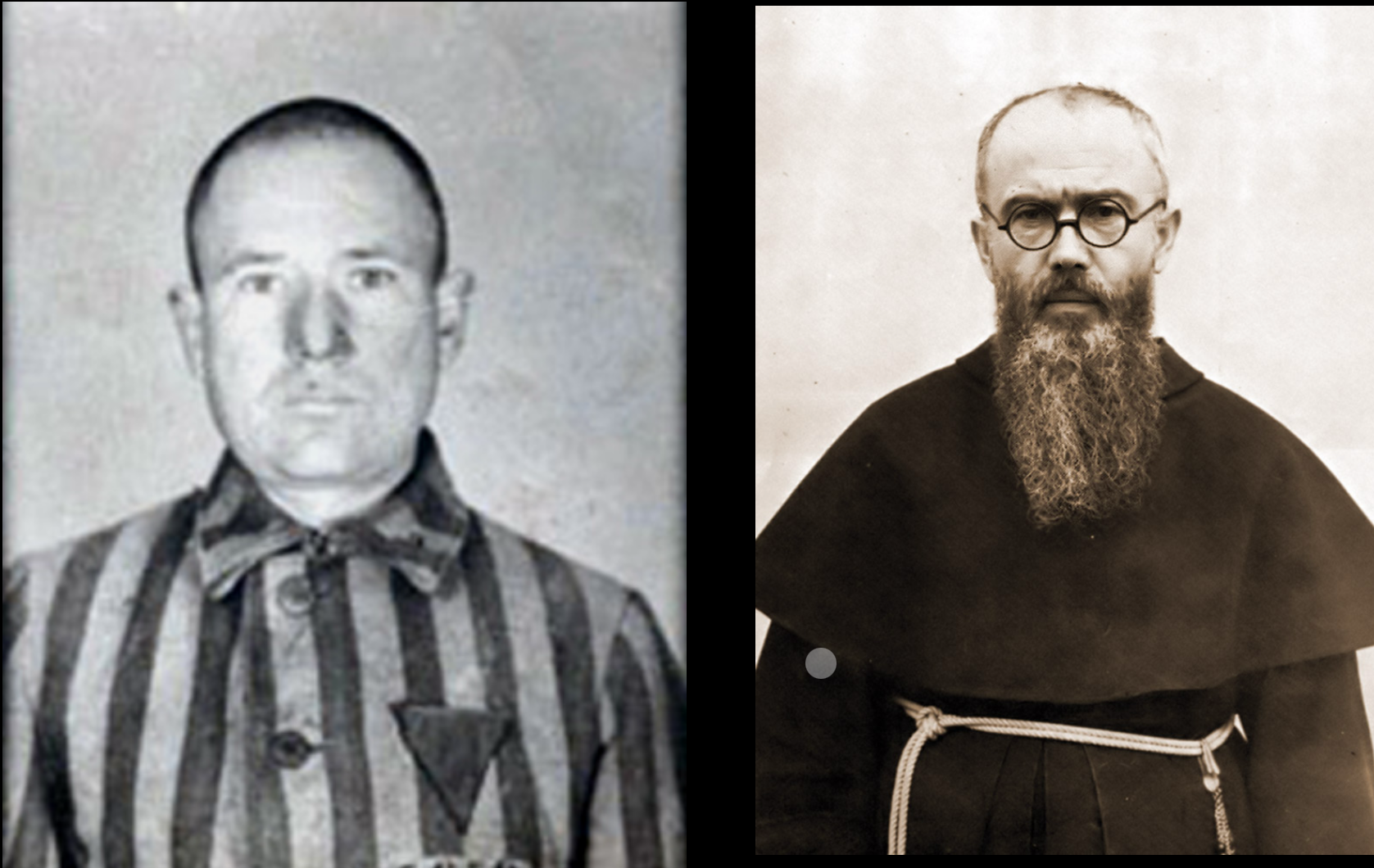
The man pictured above on the left is Franciszek Gajowniczek -He was a Polish soldier captured by Nazi troops and imprisoned in Auschwitz concentration camp.  After one prisoner managed to escape, the commander of the prison ordered that in reprisal, ten prisoners would be chosen at random to die.    Gajowniczek was one of the ten randomly chosen to die. But the man pictured on the right above, Raymund Kolbe, a Polish priest who was also a prisoner, volunteered to die in Gajowniczek’s place.   He was killed by lethal injection on August 14, 1941.   Gajowniczek survived the prison and the war and became a lay missionary. Kolbe took another’s punishment voluntarily. This is an act of love.

Jesus was the innocent one who stepped in our place to receive the cup of Judgment.  He was not guilty of the sins that filled the cup.   So, God was not angry with Jesus. In fact, God looked at Jesus on the cross with great love, that Jesus would lay down his life for the world.  

Remember when we talked about Jesus getting angry at Lazarus’ tomb?  What was Jesus angry about?  He was angry about death, and Jesus came to do battle with death and raise Lazarus from the dead.    And at the cross, Yehovah God has come to do battle with death and remove the sting of death and the victory of sin.  So while God, with one hand, pours out the cup of wrath on Jesus and Jesus suffers the judgment that should be on us, God lovingly holds Jesus close with his other hand.  The true message of the cross is not that of an angry God but that of a loving God willing to suffer in our place.

So Jesus asks James and John:

“Are you able to drink the cup that I must drink?”

They said to him, “We are able.” He said to them, “You will drink my cup, but to sit at my right hand and at my left is not mine to grant, but it is for those for whom it has been prepared by my Father.”

Who will be on Jesus’ right and left?
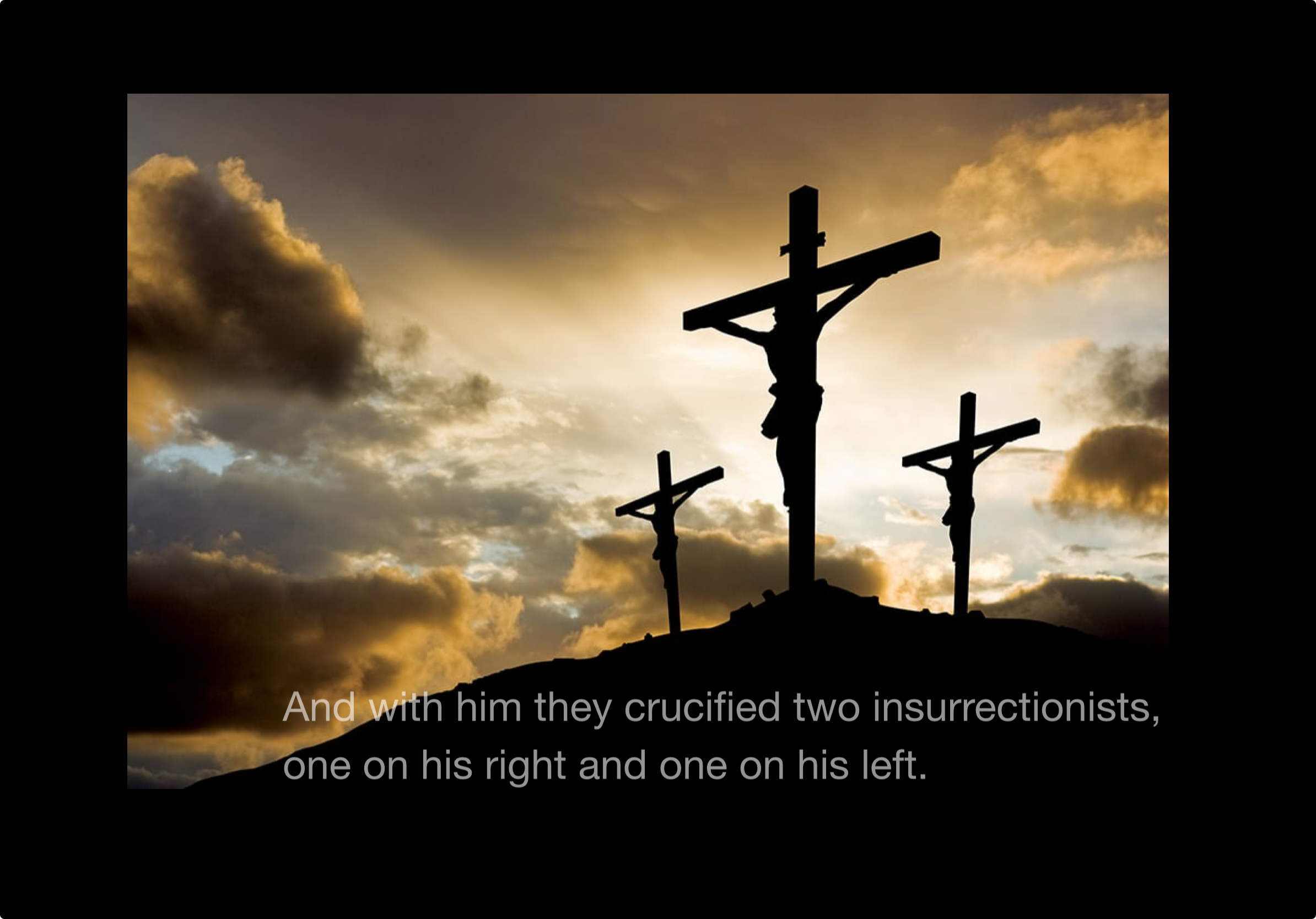
“And with him, they crucified two insurrectionists, one on his right and one on his left.”

With Jesus on his right and left are two guilty of rebellion against Rome.  That is the crime that will eventually cause Rome to destroy Jerusalem.  And they represent us all, for we are all guilty and deserve the cup of suffering and death.   And they represent mankind, for one will accept Jesus as his redeemer.  One will allow Jesus to take the cup of wrath for him.  And the other will not and will have to take the cup of wrath, the punishment for his sins himself.

But those who accept Jesus and his standing in their place do not have to take the cup of judgment.  

Romans 8:1   There is, therefore, now no condemnation for those who are in Christ Jesus.

But as Jesus told James and John, “You will drink my cup.”    You will drink this cup of suffering.  All of the disciples will drink a cup of suffering.  All of them but John will die a martyr’s death.  We learn of James’ death in Acts 12.

Acts 12:1-2   About that time, Herod the King laid violent hands on some who belonged to the church.   He killed James, the brother of John, with the sword.

His brother, John, history tells us, is thrown into a cauldron of boiling oil by Emperor Domitian.  John miraculously escapes, and the emperor exiles him to the island of Patmos.  And thousands of Christians in the first century drank the cup of suffering, tortured and killed by men.

However, the cup of suffering they drink is unlike the one Jesus consumes.  It is not the cup of God’s judgment against man’s sins, but they will take the cup of man’s wrath against God and his followers.   The suffering they receive will be from man alone.

The Greek word ‘martus,’ from which we get our word ‘martyr,’ is not one who dies but is one who is a witness.  The word is most commonly used in Greek for a witness in a trial.  Hundreds of years later, it came to mean those who died for the faith.  But the root of the word is ‘witness.’

God is not calling many of us now to be martyrs in the modern sense of dying for our faith, but he is calling every one of us to be martyrs in the New Testament sense of being a witness to the faith.  You might indeed be asked to die for your faith one day.  Or, if not you, perhaps your child. And if and when that time comes, I pray we will accept that fate joyfully.  But the bigger question today is not “What will you do if God calls you to die for your faith, but it is “What will you do if God calls you to live every day of your life in faithful service for him, never losing your hope, never lagging in your zeal, being a faithful witness to the end,” would you drink from that cup?

Living for Jesus every day means dying to oneself every day.  Jesus said, 

Luke 9:23, “If anyone wants to come after me, let him deny himself and take up his cross daily and follow me.” 

Jesus felt the words when he said take up your cross daily.  Jesus and his disciples had seen men crucified.  This is not an easy thing to hear.  Dietrich Bonhoeffer said: 

“Jesus says that every Christian has his cross waiting for him, a cross destined and appointed by God. Each must endure his allotted share of suffering and rejection. But each has a different share: some God deems worthy of the highest form of suffering, and gives them the grace of martyrdom, while others he does not allow to be tempted above that they are able to bear. But it is the one and the same cross in every case. … ”1

“When Christ calls a man, he bids him come and die.”2

And Jesus asks:  Are you willing to drink from that cup?

Paul, because of his ministry, faced death often.  But he said the only point in his living was

Philippians 3:10   — that I may know him and the power of his resurrection, and may share his sufferings, becoming like him in his death, that by any means possible I may attain the resurrection from the dead.

The King James Version poetically calls this “sharing in the fellowship of his sufferings.”

Are you willing to drink from that cup?

The communion table will soon be before us.  And we do not take it lightly.   Paul says this in 1 Corinthians:

1 Corinthians 11:27   Whoever, therefore, eats the bread or drinks the cup of the Lord in an unworthy manner will be guilty concerning the body and blood of the Lord.  Let a person examine himself, then, and so eat of the bread and drink of the cup.  For anyone who eats and drinks without discerning the body eats and drinks judgment on himself. 

When we take the bread and the cup in the Lord’s Supper, we acknowledge the depth of the sacrifice Jesus made for us, standing in our place to take on himself the cup of judgment for our sins.  And we acknowledge our willingness to join in the fellowship of his suffering, to take ourselves the cup of suffering, to come and die.

Jesus asks the question, “Can you drink the cup that I must drink?”  If we take that seriously, it will radically change our lives.  Jesus asks us if we are willing to suffer for him as he suffered for us.  We can not accept the joy of the resurrection in our lives without accepting the sorrow of his suffering and death in our lives also.  Can you say ‘yes’ to Jesus today when he asks if you are willing to take his cup, the cup of suffering, the cup of blessing, the cup of salvation?

  1. Bonhoeffer, Dietrich. The Cost of Discipleship.
  2. Ibid.

March 20, 27 A.D.  –  The “Other” Good Samaritan — The Year of the Lord’s Favor #76

Week 56 — The “Other” Good Samaritan
Luke 17:12-19

After raising Lazarus from the dead, we discussed last week how the Sanhedrin met, and the high priest Caiaphus concluded that Jesus must die.  But Jesus was on God’s schedule, not Caiaphus’.  Caiaphus would rather arrest Jesus and kill him right now.  Passover is coming up, and it is a time when the population of Jerusalem in Jesus’ day would swell from around 125,000 to over 600,000 as pilgrims came from everywhere for this required feast.  From Caiaphus’ perspective, that would be the absolute worst time to do away with Jesus when all of his followers from Galilee are there.  He is trying to avoid the possible riot that would cause Rome to intervene.    He would rather kill Jesus quietly.

But God determined long ago the day and the hour Jesus would die on the cross. The same day and hour as the final Passover lamb was killed.  God wanted to ensure we don’t miss the picture he is painting in history.  Jesus will be killed as a Passover lamb to defeat the enemy of death, just as the blood of the first Passover lamb prevented the death of the firstborn in Egypt.  That is God’s timing.  That is Jesus’ kairos.

Since it is not quite time for Jesus to die,  he has time to make one last tour to teach and preach in Samaria and Galilee.  John 11:54 tells us that after raising Lazarus, due to the increased pressure on Jesus, he withdraws to a small Village, Ephraim, for a few weeks.  Jesus will then head through Samaria and then through Galilee one last time.  There, he will join the people from Galilee on their pilgrimage to Jerusalem for Passover.

So, at the time of our scripture this morning, Jesus has spent time in Ephraim and passed through the region of Samaria to arrive at the northernmost part of Samaria.  It is just outside a small village near the border with Galilee where our story this morning takes place.  We have talked previously about the racial conflict between the Samaritans and the Jews.  By Jesus’ day, it was 600 years in the making.  J. Daniel Hays, in his book “From Every People and Nation: A Biblical Theory of Race,” said, “The ethnic and cultural boundary between the Jews and the Samaritans was every bit as hostile as the current boundary between Blacks and Whites in the most racist areas of the United States.1. It was as ugly and as frequently violent as the worst times of racial problems in our country.

The first time Jesus passed through Samaria was in May. Most Jews avoided traveling through Samaria altogether, so Jesus shocked his disciples by choosing this route. They would never consider going there. But it is there, on his first journey through Samaria, that Jesus met the Samaritan woman at the well. Remember, Jesus asked her for a drink of water.  

John 4:9   The Samaritan woman said to him, “How is it that you, a Jew, ask for a drink from me, a woman of Samaria?” (For Jews have no dealings with Samaritans.) 

She is shocked that this Jew would even be in Samaria, much less speak to her.  But she is most surprised that he would drink from her vessel.  Can you imagine someone refusing to give water to someone in the heat of the day?  Can you imagine people refusing to drink water from the same vessel as another just because they are a different race?  For those of us in the US who remember the 1960s, it is not hard to imagine.

Jesus traveled through Samaria again in October when they went to Jerusalem for the Feast of Tabernacles. On this second trip through the region, he sent some disciples ahead of him to arrange a place to stay in a village of Samaria. But the Samaritans there refused to let Jews stay. This, too, is not hard for Americans to imagine.  The disciples were angry at being turned away by the Samaritans, and James and John asked Jesus if they could retaliate:

Luke 9:54  And when his disciples James and John saw it, they said, “Lord, do you want us to tell fire to come down from heaven and consume them?”

And how does Jesus react?  

Luke 9:55-56   But he turned and rebuked them.  And they went on to another village.

I wish I knew what Jesus said in his rebuke of them. Did he just give them a look or roll his eyes, or did he launch into a fiery sermon? We don’t know, but we do know that six weeks later, Jesus tells a parable to combat these racist attitudes further.

We all know the parable of the Good Samaritan.  The story is told in answer to the law expert’s two questions, “How can I make sure I get eternal life?” and “Who is my neighbor?”  The story’s surprise is how the Samaritan shows love to people that the current culture says he is supposed to hate. The Samaritan, not the priest or the Levite, is righteous in the story. Jesus tells the law expert if he wants to live life God’s way, he will have to drop any racism and treat those he viewed as enemies as a neighbor to love.  

And now, in Jesus’ last few weeks before his crucifixion, we find him purposely teaching in Samaria for a third time, demonstrating the same lesson.  Jesus is trying to undo 600 years of racial tensions between the Jews and Samaritans.  And later, in the Book of Acts, we discover that the disciples finally understood.   In Acts chapter 8, right after the stoning of Stephen, the persecution of the Christians by Saul and the Jews increased, and Jesus’ followers fled Judea.

Acts 8:4-8   Now those who were scattered went about preaching the word.  Philip went down to the city of Samaria and proclaimed to them the Christ.  And the crowds with one accord paid attention to what was being said by Philip, when they heard him and saw the signs that he did.  For unclean spirits, crying out with a loud voice, came out of many who had them, and many who were paralyzed or lame were healed.  So there was much joy in that city.

And here, near the border of Samaria and Galilee, just outside a village, Jesus meets 10 lepers.

Luke 17:12   And as he entered a village, he was met by ten lepers, who stood at a distance and lifted up their voices, saying, “Jesus, Master, have mercy on us.”

We have discussed before what your English translations say is leprosy.  Remember that the Greek ‘lepra’ is not the disease we identify as leprosy today.  Lepra was a collection of skin diseases that were not medically harmful but did lead to social isolation due to the Levitical purity laws.  A person with lepra was ritually impure.  They were required to live outside the camp or village.  There was no known medical treatment.

So these 10 stayed together outside this small village on the northern border of Samaria and Galilee.  They call out to Jesus from a distance, asking him to have mercy on them.  Jesus doesn’t tell them they are healed but tells them to go and show themselves to the priests.  If a person with lepra was healed, then under Levitical law, they were not allowed to reenter the city until they completed an 8-day process. First, they had to appear at the gates and ask for a priest to inspect them.  If the priest pronounces them healed, they would make the prescribed sacrifices and, after a 7-day waiting period, Would do a ritual bath, or mikvah, in the chamber of lepers in the temple.  Finally, they would present a sacrifice again at the Nicanor Gate in the Temple.  Again, Jesus does not say they are healed, but by telling them to show themselves to the priests, he is letting them know they will be healed and asking them to act in faith like they are already healed. Though they can see nothing has happened, they do as he said.  

Perhaps they had read their Bible. There was precedent for this.  They knew the story of Naaman.

So go back to 2 Kings chapter 5, 850 years before Jesus, when Israel was at war with Syria.  Namaan was a commander in the army of Syria who had contracted lepra.  There was an Israelite girl who had been captured and was one of his wife’s servants.  She told them of a prophet in Israel, Elisha, who could heal him.  So Naaman loaded up a caravan with 75 pounds of silver, 15 pounds of gold, and a rack of nice clothes.  In today’s valuation, that is $500,000 of precious metals.  This man is willing to travel into enemy territory and pay any amount of money to be cured.  So he makes his way to Samaria, very near where Jesus is in our story today, finds Elisha, and knocks on the door.

2 Kings 5:9-10    So Naaman came with his horses and chariots and stood at the door of Elisha’s house.  And Elisha sent a messenger to him, saying, “Go and wash in the Jordan seven times, and your flesh shall be restored, and you shall be clean.”

Elisha doesn’t even come to the door himself but sends a messenger to tell Naaman to go wash in the Jordan. How does Naaman react?   Naaman is beside himself.  Doesn’t Elisha know who he is and how wealthy he is?  He is fit to be tied.

2 Kings 5:11-12   But Naaman was angry and went away, saying, “Behold, I thought that he would surely come out to me and stand and call upon the name of Yehovah his God, and wave his hand over the place and cure the leper.  Are not Abana and Pharpar, the rivers of Damascus, better than all the waters of Israel?  Could I not wash in them and be clean?”  So he turned and went away in a rage.

He was expecting a grand display from the prophet, but all he got was a messenger who told him to jump in the river seven times.  Fortunately, Naaman’s servant persuaded him to try it anyway.  He does, and he is healed.  Then Naaman returns to Elisha’s home to try to persuade him to take some payment, but Elisha refuses.  (Read 2 Kings 5 for the rest of the story.)

This story of Naaman has several similarities to our story of Jesus and the 10 lepers.   They both involve lepers being healed in the same area of Samaria.  In both stories, the healing is not spectacular.  There is no prayer, waving of arms, unique words, or actions.  In both stories, the lepers are not healed instantly, but only when they do as they were told.  So perhaps the ten lepers were aware of this story of Naaman’s healing.

And as they go, they are healed.

Luke 17:15-16   Then one of them, when he saw that he was healed, turned back, praising God with a loud voice; and he fell on his face at Jesus’ feet, giving him thanks. Now he was a Samaritan.   Then Jesus answered, “Were not ten cleansed? Where are the nine?   Was no one found to return and give praise to God except this foreigner?”

One of them, on recognizing that he was healed, like Naaman in 2 Kings, turned around and headed back to the prophet who healed him.  And he, like Naaman, begins praising God.  And then we learn that he, like Naaman, is called a foreigner.   He is a Samaritan.  He, too, is seen by the Jews as the enemy.  

And like Jesus’ parable of the good Samaritan, this Samaritan is the one who acted righteously.  He is the other ‘good Samaritan.’  The Greek word Jesus used here for ‘foreigner’ is ‘allogenes.’   ‘Allo’ means ‘different,’ and ‘genes’ means ‘family group.’  That is where our words ‘genes’ and ‘genetics’ come from.  So it means ‘born to another family’ or born with different genetics.  In Jesus’ day, for many, it had the racist cultural connotation of being ‘born to the wrong family.’   That is the attitude that Jesus came to change. 

Though the word’ allogenes’ is not found anywhere else in the Greek New Testament, everyone in Jesus’ day knew it. It was used in the wording of the barrier placed around the Temple that forbade non-Jews from entering the temple area in Jerusalem.

This is a rendering of Herod’s Temple.  A wall about 4.5 feet tall separated the court of the Gentiles from the main temple area. Only Jews were allowed to pass through the openings in that wall.  No Gentiles could enter the actual temple.  There were signs all along the wall, warning that any Gentile passing through would be killed.  Note also the Chamber of Lepers in the temple where the former lepers who passed inspection by the priests would wait 7 days for their mikvah and final offering.

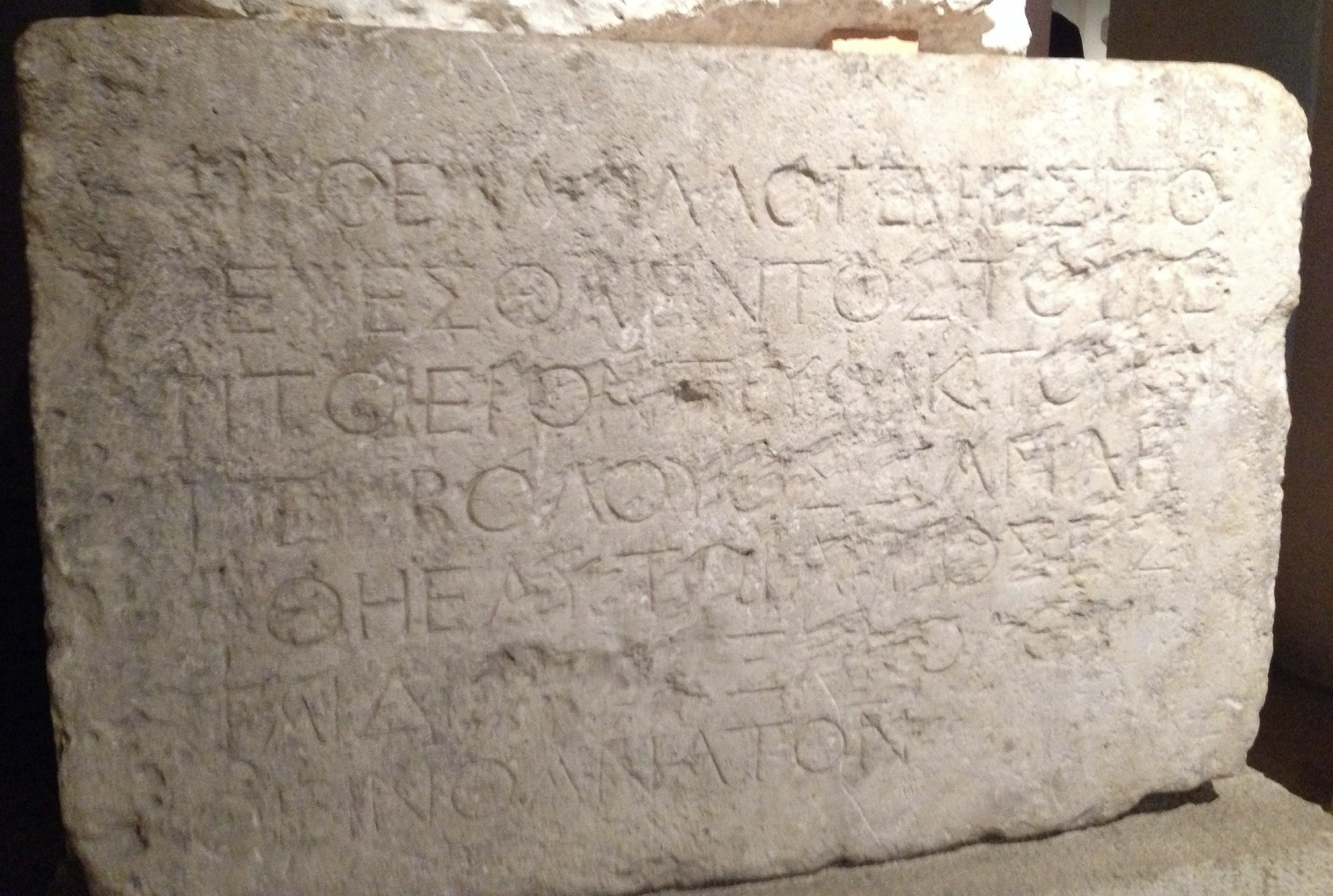
Here is one of the actual warning signs from that dividing wall, which was found intact in 1871 and is now on display in a museum in Istanbul.  Another partial sign is housed in the Israel Museum.

It says, “No foreigner is to enter within this balustrade round the temple and enclosure.  Whoever is caught will be responsible for his ensuing death.”

No foreigner, no allogenes.  This is the word that Jesus uses to describe the Samaritan leper.   Someone born of a different family (than the Jews.)

So you see, this Samaritan could not go with the other 9 to the Temple in Jerusalem to be pronounced clean, for he would not be allowed to enter the area to complete his cleansing.   

This over 4 feet tall dividing wall kept this man and other Samaritans from God.  They could not worship in the place where Yehovah said he would place his name forever because the Priests and Rabbis said they were of the wrong race.  Presumably, he could visit the Samaritan’s temple on Mt Gerazim to see a priest.  But it was not the true temple of God. So he elected instead to show himself to a different priest, Jesus, who would become our high priest.  This is Jesus’ third trip to minister to Samaritans, and he came to break down barriers between people.

And we see this temple barrier wall become a big issue in the Book of Acts.   In Acts chapter 21, some Jews from Asia were in Jerusalem for Pentecost and wanted to attack Paul because he was ministering to ‘foreigners.’ They drag Paul out of the temple and are going to kill him right there, but the Roman troops intervene. They then make some false charges against Paul and manage to have him arrested.  Paul ends up imprisoned for 2 years and then sent to Rome to be judged by Caesar.

 And what was the false charge they brought against Paul that led to all this? They said he brought foreigners past the dividing wall into the temple.  Paul spoke about this wall in his letter to the Ephesians. 

Ephesians 2:11-14   Therefore remember that at one time you Gentiles in the flesh… remember that you were at that time separated from Christ, alienated from the commonwealth of Israel and strangers to the covenants of promise, having no hope and without God in the world.  But now in Christ Jesus you who once were far off have been brought near by the blood of Christ.  For he himself is our peace, who has made us both one and has broken down in his flesh the dividing wall of hostility

Don’t miss that Paul is talking about everyone in this room.  Before Jesus came, we were all allogenes.  We would not have been allowed to enter the Temple.   That was never what God intended.  The Jews were supposed to take God’s message to the nations, but they built a wall to keep everyone else out.  Jesus came to break down these racial barriers, and because of Jesus, anyone can be grafted into God’s family. 

Galatians 3:26-29   For in Christ Jesus you are all sons of God, through faith.  For as many of you as were baptized into Christ have put on Christ.  There is neither Jew nor Greek, there is neither slave nor free, there is no male and female, for you are all one in Christ Jesus.  And if you are Christ’s, then you are Abraham’s offspring, heirs according to promise.

We are adopted into His family.  And once again, in our story today, Jesus has shown a Samaritan, one born of the wrong race, is the one who is righteous in Jesus’ eyes.

Luke 17:15-16   Then one of them, when he saw that he was healed, turned back, npraising God with a loud voice; 16 and ohe fell on his face at Jesus’ feet, giving him thanks. Now he was a Samaritan.   Then Jesus answered, “Were not ten cleansed? Where are the nine?   Was no one found to return and give praise to God except this foreigner?”

While the nine were on their way to Jerusalem, rejoicing over the gift, this Samaritan was praising and thanking the giver. He fell down in worship at Jesus’ feet.

There is a difference between being thankful for the gift and giving thanks and praise to the Giver.

How do you feel when you look at the beauty of creation, when you see a fantastic sunset, a waterfall, or majestic mountains like we saw this past fall in Glacier Bay, Alaska?  Many people were on that ship’s deck with us, looking at the beauty of the mountains and glaciers. Many were just admiring the view. But to some, it was much more; they were moved to admire not just the creation but the creator, the one who made the mountains.  Is it the gift of the giver you admire?

How do you enjoy the great things in life?  How do you appreciate a beautiful view, a great meal, or music?  Do you only see the gift and neglect to thank the giver?  How do you appreciate your health? All 10 men were glad they were healed, but only one was moved beyond appreciation of good health to worship the giver of life.   We don’t worship creation; we worship the creator.  We don’t worship the gift; we worship the giver.

Then Jesus says something very interesting to the Samaritan who used to have a skin disease.

Luke 17:19. And he told him, “Get up and go on your way. Your faith has saved you.”

Now, your version may say:

Luke 17:19. And he said to him, “Rise and go your way; your faith has made you well.”

Well, which is it?  Was he healed from lepra, or was he also saved from sin?  The word translated as “saved you” or “made you well” is ‘sozo.’

Sozo is found in the New Testament 106 times.  Let’s look at the first two instances:

When the angel tells Joseph what to name Jesus:

Matthew 1:21.  She will bear a son, and you shall call his name Jesus, for he will save his people from their sins.”

When the disciples are scared they will die in the boat in a storm:

Matthew 8:25.  And they went and woke him, saying, “Save us, Lord; we are perishing.”

Sozo is the idea of deliverance — from disease, from danger, and from sin.

So, in verse 19, is Jesus talking about physical deliverance from disease or spiritual deliverance from sin and death? Jesus is speaking of spiritual salvation here. As told in verse 14, all 10 have been healed. They all have had physical deliverance from disease. But this Samaritan’s second encounter with Jesus brings more.

This former leper turned back and praised God. He fell on his face before Jesus and thanked him. Like Naaman in the Old Testament, he recognized Yehovah as the source of healing and the one true God.  

Naaman said:
2 Kings 5:11-17  “Behold, I know that there is no God in all the earth but in Israel…from now on your servant will not offer burnt offering or sacrifice to any god but Yehovah.`

This Samaritan praised God for his healing.  He acknowledged his unworthiness by falling on his face at Jesus’ feet.  His actions were that of a repentant heart.  He recognizes Jesus as the source of his healing.  He thanks the giver of the gift.  He didn’t need to raise a hand, walk an aisle, or repeat a sinner’s prayer.  He demonstrated all of that in what he said and did.  And he received much more than physical healing; he received a relationship with the Son of God, the Messiah, that day.  But the nine.  They left jumping for joy and grateful for the gift of healing.  But their happiness was only for the gift, not for the giver. 

We can go through life being joyful for the good times, the beauty, the food, health, and the air we breathe.  Or we can see all of these things and return to Jesus, the creator and sustainer of all, bow down and give him thanks.  In Jesus’ day, children were taught to be thankful for everything.  There were over 100 Jewish blessings a day.  “Blessed are you, Yehovah, king of the universe, who gave me breath this morning.  Blessed are you, Lord our God, who gave me eyes to see today.  Blessed is He who has allowed me to live to this day and see His faithfulness displayed in this answered prayer.  Blessed are you, Yehovah, who have given us food to eat.”

One hundred blessings a day is not a lot.  Your heart will beat over 100,000 times a day.  And each one is a gift from God.  The psalmist said, “How shall I make a return to the Lord for all the good he has done for me?”(Psalm 116:12).  How can we ever thank God enough for how he sustains us and provides for us every minute of every day?  It is that awareness of how much we have received that changes our focus from what we lack to the great abundance we have. 

The LORD is my shepherd I shall not want.

In Ephesians 5:20, Paul says we should ” give thanks always and for everything to God the Father in the name of our Lord Jesus Christ.” Television and social media push us into an endless cycle of discontent, constantly reminding us of what we lack. This attitude of gratitude to God for every gift combats the world’s negativity by recognizing the Giver of the gift. It is a demonstration of faith.  

Have you ever considered how thanking God is related to faith?  

Colossians 2:7 “Let your roots grow down into him, and let your lives be built on him. Then your faith will grow strong in the truth you were taught, and you will overflow with thankfulness.”

When we live in the mode of thankfulness, when we feel the 100 blessings a day in our hearts, then we are keeping our eyes on God.  Then we are worshiping our creator, not the creation, the giver, not the gift.  Remember when Peter was walking on the water and took his eyes off Jesus and looked at the storm with the angry waves? He began to sink. Gratitude keeps our eyes focused on the one who calms us in the storm and increases our faith.  

Thanksgiving is the voice of faith.  Notice what Jesus has done here.  Jesus is so good.  He is determined to strike against hundreds of years of racist attitudes by showing that Samaritans are God’s people, too.  He tells us the story of a ‘Good Samaritan,’ and then he has an actual encounter with a ‘Good Samaritan.’   And he uses these two ‘Good Samaritans’ to teach what he said were the two Greatest Commandments.

The story of the Good Samaritan teaches us the second greatest commandment: “Love your neighbor as yourself.”  The actions of this former leper, this other Good Samaritan, teach us about the greatest commandment –  Jesus quoted it from 

Deuteronomy 6:4-5 Hear, O Israel: Yehovah is our God, Yehovah alone.  You shall love Yehovah, your God, with all your heart, and with all your soul, and with all your might.

Yehovah is God alone; don’t worship anything else. We don’t worship the sun, moon, or stars.  We don’t worship idols.  We don’t worship the beauty of creation, and we don’t worship our health.  We don’t worship the creation; we worship the creator.  Yehovah is God alone.  Like the other Good Samaritan, for every blessing we receive, let us return to Jesus.   Let us bow down before our Creator and thank him constantly for every good gift.

1.  Hays, J. Daniel.  From Every People and Nation: A Biblical Theory of Race. p. 63.

March 11, 27 A.D.  –  God’s Timing – Lazarus Part 3 — The Year of the Lord’s Favor #75

Week 56 — Jesus, Lazarus, and Kairos
John 11:38-53

From Mary and Martha’s perspective, Jesus arrived four days late.  But as the Karen Peck song from 2000 states:  “Isn’t it great, when he’s four days late, he’s still on time.”1

God is always on time.  Many state that God exists outside of time.  There is much I do not understand about God and time.  For example, ‘Daylight savings time’ — I have no idea how missing an hour of sleep saves daylight.  There are things too difficult for me to grasp.  I do not understand eternity, but I take God at His word when he says he is eternal.  I can not grasp the idea of eternal life, but I know the God who promised it to me, and I am confident in his promises.  I know Peter tells us, 

2 Peter 3:8   But do not overlook this one fact, beloved, that with the Lord one day is as a thousand years, and a thousand years as one day.” 

That concept is hard for me to comprehend.  I read Paul tell Timothy in a letter that 

2 Timothy 1:9-10  [God’s] grace was given us in Christ Jesus before the beginning of time, but it has now been revealed through the appearing of our Savior, Christ Jesus  

If we want to see how God interacts with time, we must go back to when time began.  On the fourth day of creation, God created the sun, moon, and stars:

Genesis 1:14   And God said, “Let there be lights in the expanse of the heavens to separate the day from the night. And let them be for signs and for seasons, and for days and years.” 

This verse explains why God created the sun, moon, and stars. They were created for signs, seasons, days and years.   We understand that the sun and moon regulate the days and years.  We have a solar calendar with 24-hour days regulated by the earth’s rotation on its axis and solar years of 365.25 days regulated by the earth’s rotation around the sun; our year is divided into 12 months.   The calendar of the Old Testament also had a solar year and 24-hour days, but it had 12-13 months each year, determined by the moon’s phases.   So, we understand how the heavenly bodies regulate “days and years.”

They are also there for signs.  We see many examples of this in the Bible; for example, the magi from the east say:

 Matthew 2:2   “Where is he who has been born king of the Jews? For we saw his star when it rose and have come to worship him.”   

The sign was a star God placed in the heavens.

So we understand God placed the heavenly bodies for “signs’ and for “days and years,” but how about “seasons”?  We need to take a closer look at this one because I think that translation is not as descriptive as the Hebrew word used there.  The Hebrew word translated as “seasons” is ‘moedim’ which is the Hebrew word for “appointed times” (the singular is ‘moed’). 

Appointed times are times set aside for communing with God.  The Tabernacle is called the “Tent of Moed” and translated as the “Tent of Meeting.”  It is a holy place in that it is a place for a moed, an appointed time.  It is not a permanent place as the tabernacle moves and is set up at different locations.  What makes it holy is not its location but that it is a place set aside to have a time to commune with God.  

When God called Moses to the burning bush on Mount Sinai, he told him to take off his shoes, for he was on holy ground. That ground, that dirt, was holy at that time because it was a place where time was arranged for Moses to commune with God.

God designated one location as holy forever: the site of the temple in Jerusalem. This is the same place where God supplied a lamb for sacrifice in Isaac’s place and where God said He placed his name forever.  

2 Chronicles 7:14. For now I have chosen and consecrated this house that my name may be there forever. My eyes and my heart will be there for all time.”

But if you study the Bible, you see God is more interested in Holy times than in holy places. 

So let’s look at these moedim, these holy appointed times.  The first he set up at the beginning of the world was the Sabbath.  The seventh day was a day God rested.  It is commanded in the Old Testament as a day of rest from the other 6 days of labor and a time to dwell in God’s presence.  Rabbi Abraham Heschel called the Sabbath “God’s Sanctuary in time.”2

Then, there are the seven appointed times of gathering:  Passover, Firstfruits, Unleavened Bread, The Feast of Weeks, The Day of Trumpets, The Day of Atonement, and the Feast of Tabernacles.  They were set apart times to celebrate what God had done for them, like a visual aid to assist in their knowledge of God.   We use the same idea of visual aids with baptism, a visual representation of what God does for us in salvation, and Communion, a special time to celebrate and remember what Jesus did for us on the cross.  When the word ‘moedim’ is used in the Old Testament, it most commonly refers to these seven appointed times.

And then there are also a few other specially appointed times:

Psalm 75:2    At the set time that I appoint; I will judge with equity.

Daniel 11:35  …and some of the wise shall stumble, so that they may be refined, purified, and made white, until the time of the end, for it still awaits the appointed time.

Now, let’s look at these Feasts of Moedim in more detail.  These moedim are arranged in 3 seasons: the spring brings the feast of Passover, which includes Passover, Firstfruits, and Unleavened Bread.  These teach us about God’s deliverance.  The next season is a single feast, The Feast of Weeks, which we call Pentecost.  It falls 50 days after Passover and teaches us about God’s power.  The third season in the fall contains The Day of Trumpets, The Day of Atonement, and the Feast of Tabernacles.  These teach us how to enter God’s rest.

God is firmly committed to his calendar of appointed times. He arranges the major events of the Bible to happen on the same day so that we can clearly see His plan. God has gone to great trouble to ensure that these events happen on the appointed days.

 For years, the Jews celebrated the deliverance of their people from the tenth plague of death by the blood of the Passover lamb, their deliverance from slavery in Egypt, and their journey to the promised land.  Over a thousand years of Passover feasts pointed to a coming messiah who would be the “lamb of God” slain on that very day of preparation for Passover, whose blood would deliver them from the sentence of death we all walked under.   God arranged events so that Jesus would be crucified on that very same day and at the same time as the Passover lambs were being slain, so he would then be resurrected and presented to the Father on the day the Jews had been celebrating for thousands of years as Firstfruits.  

So this season of feasts teaches us about God’s deliverance, from death and slavery to Egypt – with the Passover lamb, and then 1500 years later deliverance from sin and death through Jesus- our Passover lamb

Fifty days after Passover was the Feast of Weeks, Shavuot, celebrating the gift of the harvest of grain and the day when they witnessed God’s awesome power and received the law from God on Mount Sinai.  God came on the mountain in power with a rushing wind and fire. And 50 days after Jesus was crucified, as Jews from around the world had gathered in Jerusalem to celebrate this feast, God again showed his incredible power in a rushing wind and in the fire that appeared over not a mountain but over the people.  These people were the first to receive this outpouring from the Holy Spirit, a gift from God to us also so that we may live in His power.  The gift of the Holy Spirit comes on the same day they celebrated the gift of the law on Sinai for years.

God is painting pictures in history for those who have eyes to see. The Bible is one unified story—the story of God’s redemption through Jesus. So, these four feasts that originated in the Old Testament found fulfillment in the days after Jesus came, but the three fall feasts remain.  

God established the fall feasts with the Day of Trumpets to announce a new time coming, which is a new year, and then the Day of Atonement when God judges individuals and the nation and deals with sin, and then the Feast of Tabernacles, a festival of rest.  These fall feasts have yet to be fulfilled, but one day, the last trumpet will sound, announcing a new time coming, The Great Day of the Lord, with God’s ultimate intervention in history — then there will be a great judgment, the final day of atonement, followed by God’s people gathering to rest with Him. 

These are the moedim, the appointed times on God’s calendar, established in the Hebrew Bible, then fulfilled in the New Testament times and our future.

But Moedim is a Hebrew word, and our New Testament comes to us in Greek. So, the most commonly used Greek words for ‘time’ are chronos and kairos. Chronos is what we usually think about when we say ‘time.’  It is A quantitative measure of time, the time on our clocks and calendars. This is the time on your watch and your day planner.  This is where we get our English words chronicle, chronology, and chronic.

Kairos is a qualitative measure of time.  The special time when God has arranged circumstances to be ripe for action.  God’s appointed time, his moed.   It is the time of decision, that anointed time where God brings you to a fork in the road. It is a time of opportunity.

I have had many moments in my life in which I can see that God has moved in the background, arranging people and events to put me in just the right place at just the correct time.  I have told you before of the time God arranged for me to meet a man who had hitchhiked from Louisiana.  He just happened to be the father of a young woman who had delivered a premature baby the previous week that I had cared for.  I had been trying to contact that mother but didn’t have her correct address or number.  So God put this hitchhiker from Louisiana on the curb of a gas station in my path and told me to approach him and give him a ride.  It was a God-arranged meeting time – a kairos moment.

Now, let’s look at how Jesus understands his time.  Jesus was well aware of the short time he had on earth. His ministry was just over a year long, and he died on the cross as a young man around 30 years old. He was aware of how he must accomplish his tasks right on time, and the gospel of John really points this out.

When Jesus is at the wedding in Cana, and his mother asks him to solve the problem of the lack of wine, Jesus asks her, 

John 2:4   What does this have to do with me? My hour has not yet come.  

When his disciples ask him if he is going to Jerusalem with them for the Feast of Tabernacles, he tells them,

John 7:8   You go up to the feast. I am not going up to this feast, for my time has not yet fully come.

Jesus does go to the feast, departing later, and while he was in Jerusalem teaching, the authorities wanted to arrest him, but we are told, 

John 7:30   At this they tried to seize him, but no one laid a hand on him, because his hour had not yet come.

Jesus is on a timetable.  God chose this time in the timeline of history for Jesus to come, and God has arranged it so that Jesus will die on the cross on a certain day in a certain year.  God established his appointed times when he created the world.  

So when people start trying to accelerate God’s calendar, Jesus has to be careful to stay on God’s schedule.  So you see his hesitation to perform miracles at times.  And you see him sternly warn some people not to tell who healed them.  And then at times, as in John 7:30, when people try to take Jesus too soon, God intervenes and allows Jesus to escape, or Jesus withdraws.  Remember when Jesus fed the 5000, and the crowd was so excited about Jesus that they wanted to make him king right away?  What did Jesus do?  He withdrew and went into hiding a bit.  It was too early then.  There would later be a crowd shouting to make Jesus king, and he will allow it.  But this will be in his final week, riding into Jerusalem on a donkey.  But it had to happen on God’s timing.

When Jesus preached in Nazareth, it was a sermon they didn’t want to hear, 

Luke 4:28  When they heard these things, all in the synagogue were filled with wrath. And they rose up and drove him out of the town and brought him to the brow of the hill on which their town was built, so that they could throw him down the cliff. But passing through their midst, he went away.

It wasn’t his time to die.  This was not God’s schedule, so God just froze everyone in place while Jesus just walked through the middle of the angry crowd untouched.  

So back in December of AD 27, Jesus was staying with Lazarus and his sisters and going to Jerusalem in the daytime. And the religious authorities wanted to arrest him then after healing the blind man.

John 10:39 Again they tried to seize him, but he escaped their grasp.

Jesus conflict with the religious authorities had reached a boiling point.  This is why Jesus left Jerusalem after Hanukkah and went to teach in Perea.  John tells us:

John 10:40    Then Jesus went back across the Jordan to the place where John had been baptizing in the early days.

It was not time for him to be arrested and then crucified, this was not God’s timetable.

Only one thing can make Jesus return to Judea before it is time for him to die.  And that is the story we have been discussing for several weeks.  His good friend Lazarus becomes ill and Mary and Martha send a messenger to Jesus.  As we discussed 2 weeks ago, Lazarus died shortly after the messenger was sent.  By the time he travels a day’s journey to find Jesus, Lazarus is already in the grave.  Jesus tarries 2 days and then tells the disciples he is headed back to Judea.  When Jesus tells the disciples he is headed back to Judea, how do the disciples respond?

John 11:8    “But Rabbi,” they said, “a short while ago the Jews there tried to stone you, and yet you are going back?”

The disciples think Jesus is walking into a death trap if he returns to Judea.  They don’t yet understand God’s timeline.  But they are willing to follow Jesus there, despite the danger.

John 11:16    Then Thomas (also known as Didymus) said to the rest of the disciples, “Let us also go, that we may die with him.”

But it was not Jesus hour yet.  But it is getting close.

John 11:18-19    Now Bethany was less than two miles from Jerusalem, and many Jews had come to Martha and Mary to comfort them in the loss of their brother.

Jesus is about to do an undeniable miracle right in front of the Jewish authorities and a huge crowd of mourners.  This raising of Lazarus will be the straw that breaks the camel’s back.  And all of this introduction and background brings us to our scripture, the rest of the Lazarus story.

John 11:38-53   Jesus, once more deeply moved, came to the tomb. It was a cave with a stone laid across the entrance.
“Take away the stone,” he said.
“But, Lord,” said Martha, the sister of the dead man, “by this time there is a bad odor, for he has been there four days.”
Then Jesus said, “Did I not tell you that if you believe, you will see the glory of God?”
So they took away the stone. Then Jesus looked up and said, “Father, I thank you that you have heard me. I  knew that you always hear me, but I said this for the benefit of the people standing here, that they may believe that you sent me.”
When he had said this, Jesus called in a loud voice, “Lazarus, come out!”
The dead man came out, his hands and feet wrapped with strips of linen, and a cloth around his face.
Jesus said to them, “Take off the grave clothes and let him go.”
Therefore many of the Jews who had come to visit Mary, and had seen what Jesus did, believed in him.  But some of them went to the Pharisees and told them what Jesus had done.
Then the chief priests and the Pharisees called a meeting of the Sanhedrin.
“What are we accomplishing?” they asked. “Here is this man performing many signs.  If we let him go on like this, everyone will believe in him, and then the Romans will come and take away both our temple and our nation.”
Then one of them, named Caiaphas, who was high priest that year, spoke up, “You know nothing at all!   You do not realize that it is better for you that one man die for the people than that the whole nation perish.”
He did not say this on his own, but as high priest that year he prophesied that Jesus would die for the Jewish nation, and not only for that nation but also for the scattered children of God, to bring them together and make them one.  So from that day on they plotted to take his life.

It is now set in motion.  The high priest Caiaphas has concluded Jesus must die.  Caiaphus was appointed High Priest not as God ordained but by the Romans.  The high priesthood had become corrupted and was at this time merely a political appointment and position. It was a position that would give great wealth, so Caiaphas was a man of great wealth, but he was not a righteous man.  Even when Lazarus died and came back to life, he would not be persuaded to believe in Jesus.  Caiaphus had 5 brothers (or brothers-in-law) who would also be high priests, and they were not convinced to follow Jesus even after he returned from the dead.   Wait!  Haven’t we heard this story before?  This is Jesus’ parable of the Rich Man and Lazarus. Remember this wealthy unrighteous man asked to send Lazarus back from the dead to warn his 5 brothers.  He was told they wouldn’t believe him even if Lazarus returned from the dead.   And they did not.  Oh, what you see when you read the Bible and study it closely.

And did you see that in the scripture?  God used Caiaphas to make a prophecy that he really didn’t understand himself.   He decided it was politically expedient to kill Jesus so they would not have an uprising or rebellion that would cause Rome to destroy the Jews and his personal source of wealth and power.   Do you see the irony?  The man who said  “you know nothing at all” did not even understand the words coming out of his own mouth.  God used him despite his corrupt nature.

Since it is not quite time for Jesus to die, Jesus leaves Judea after raising Lazarus .   He has seven weeks left before Passover, his appointed time to die.  So he has time to make one last tour to teach and preach in Samaria and Galilee.

John 11:54 tells us that due to the increased pressure on Jesus, he withdraws to a small Village, Ephraim, for a few weeks.   This town was about 15 miles north-northwest of Jerusalem and just outside Judea in the region of Samaria.  Jesus will then head through Samaria and then through Galilee one last time.   There, he will join the people from Galilee on their pilgrimage to Jerusalem for Passover.  And Jesus arrives with this crowd of pilgrims, spending the night at Martha and Mary’s home in Bethany before the next day, when he will ride a donkey into the city on Palm Sunday.  It is just after this Palm Sunday ride into Jerusalem that Jesus declares his time, his kairos, has come.  John’s gospel that has told us throughout Jesus’ ministry that “the hour has not yet come” now quotes Jesus saying,

John 12:23   The hour has come for the Son of Man to be glorified.
John 12:27-28   “Now my soul is troubled, and what shall I say? ‘Father, save me from this hour’? No, it was for this very reason I came to this hour.  Father, glorify your name!”

This is why Jesus came.  And now the hour has come, Jesus kairos moment.  And a few days later when he sends his disciples into the city to find a place for the last supper, Jesus tells them:

Matthew 26:18  Go into the city to a certain man and say to him, ‘The Teacher says, My kairos is at hand. 

From Mary and Martha’s standpoint, Jesus was 4 days late.  But he was right on time for that kairos moment, and for every kairos moment of his short life on this world.

God is sovereign in this world.  He is still in charge of time.  And I have seen in my life that God has special moments arranged for me.  You can call them godly coincidences, or divine appointments, but in the words of the gospel writers they are kairos moments.  They are special appointed times that God, the King of the Universe has arranged for me.

I have quoted Ephesians 2:10 at least four times in the past year in sermons.  I want to give a larger context for that verse.

Ephesians 2:4-10  But God, being rich in mercy, because of the great love with which he loved us, even when we were dead in our trespasses, made us alive together with Christ—by grace you have been saved— and raised us up with him and seated us with him in the heavenly places in Christ Jesus, so that in the coming ages he might show the immeasurable riches of his grace in kindness toward us in Christ Jesus.  For by grace you have been saved through faith. And this is not your own doing; it is the gift of God, not a result of works, so that no one may boast.  For we are his workmanship, created in Christ Jesus for good works, which God prepared beforehand, that we should walk in them.

Paul had no problem with the idea that our salvation comes through grace by faith, not works, and yet we are created to do good works.  In adjoining sentences he says, yes our works do not save us, but we are saved to do works.

Why are we here?

The great philosophies of the world try to answer this question: “Why are we here?”  What is our purpose for existing?  I did not enjoy my philosophy classes in college.  I just didn’t see much point in studying man’s attempt to understand the universe if that attempt didn’t start and end with God and His word.  But I was required to study it, so let me tell you how philosophies answer this question:  The Existentialists say we are born into a world without a pre-determined purpose, and it’s up to us to create our own meaning.  The Stoics say we should focus on living in accordance with nature and finding meaning in virtue, reason, and self-control.  The Nihilists say life is inherently meaningless and that there is no objective purpose or value.  And those are but three of the many empty answers you get from man’s philosophy.

But my God says we are created in Jesus in order to accomplish something – good works.  And not just any works, but works that were set up by God ahead of time.  God created us in a certain way and gave us certain talents and traits.  It was God who arranged for me one day long ago to meet a new friend from a different town.  A lady who would one day in the future need a kidney donation.  And it was God who arranged my body at the moment of my conception to have just the proper genes and antigens to be the 1/1000 donor for this lady.  And it was God who put that desire in my heart.  It was kairos.  A time set by God to do a work that he created me to do.  And I can look at my life and see many other such times.  Each of us is uniquely qualified to do certain good works, works that God set up in advance.  

We should walk through our lives preparing ourselves for those moments, those special God-ordained moments.  That kairos time that God has arranged for you to do a work you were uniquely created to do.  

So, what is your purpose for living today?  I don’t believe many people want to believe, like the Nihilists, that there is no god, that life is meaningless, and there is no purpose in life. But many people live their lives just like that, just like there is no purpose in life, and they are free to do whatever they want because nothing matters.  But God created us for so much more.  He has ordained our steps and designed us for specific tasks at specific moments.  Yes, we have free will.  We can choose to ignore God, to pretend He doesn’t exist, and we can go our own way and never reach the potential that God created especially for us.  The Army used a recruiting slogan, “Be all that you can be.”  Today I am asking you to be all you were created to be.  Don’t miss your kairos.  Today, the lesson you learn, the scripture you study, the task you practice, or the person you meet may be God’s preparation for a future moment of kairos.  Jesus was aware of his purpose long before his time came.  We may not recognize our moment of kairos until we are in the middle of experiencing it or when we look back on it.  

Why don’t you take some time now to talk with your Father.  A moed. An appointed time to meet with God.   God is waiting to hear your “Yes!”  Yes, Father, I want to be the person you created me to be.  I want to follow your plan for my life so that I may be ready to do the work that you created for me to be able to do.  I want you to tell God that you don’t want to miss your kairos moment and that you want to fully reach the potential that God has placed within you.  This is your time; this is your moment to talk with your Father. 

  1. “Four Days Late” by Karen Peck and New River.  From “A Taste of Grace”.  2000.
  2. Heschel, Abraham Joshua.  The Sabbath.  2005.

March 4, 27 A.D.  –  Jesus Wept — The Year of the Lord’s Favor #74

Week 55 — Jesus Wept
John 11:17-39

Last week, we saw how a messenger found Jesus in Perea and informed him that his friend Lazarus was ill. We then began our discussion of Lazarus’s resurrection. We discussed how Jesus used this time to teach the second Beatitude: Blessed are they that mourn, for they will be comforted. We also discussed Jesus’ statement that Lazarus’ sickness would not end in death because death is never the end for any of us. Today, we continue the story.

John 11:17-39    On his arrival, Jesus found that Lazarus had already been in the tomb for four days.  Now Bethany was less than two miles from Jerusalem, and many Jews had come to Martha and Mary to comfort them in the loss of their brother.  When Martha heard that Jesus was coming, she went out to meet him, but Mary stayed at home.
    “Lord,” Martha said to Jesus, “if you had been here, my brother would not have died.  But I know that even now God will give you whatever you ask.” 
   Jesus said to her, “Your brother will rise again.”
Martha answered, “I know he will rise again in the resurrection at the last day.”
Jesus said to her, “I am the resurrection and the life.  The one who believes in me will live, even though they die; and whoever lives by believing in me will never die.  Do you believe this?”
“Yes, Lord,” she replied, “I believe that you are the Messiah, the Son of God, who is to come into the world.”
After she had said this, she went back and called her sister Mary aside. “The Teacher is here,” she said, “and is asking for you.”   When Mary heard this, she got up quickly and went to him.  Now Jesus had not yet entered the village, but was still at the place where Martha had met him.  When the Jews who had been with Mary in the house, comforting her, noticed how quickly she got up and went out, they followed her, supposing she was going to the tomb to mourn there.
When Mary reached the place where Jesus was and saw him, she fell at his feet and said, “Lord, if you had been here, my brother would not have died.”
When Jesus saw her weeping, and the Jews who had come along with her also weeping, he was deeply moved in spirit and troubled.
“Where have you laid him?” he asked.
“Come and see, Lord,” they replied.
Jesus wept.
Then the Jews said, “See how he loved him!”
But some of them said, “Could not he who opened the eyes of the blind man have kept this man from dying?”
Jesus, once more deeply moved, came to the tomb. It was a cave with a stone laid across the entrance.
“Take away the stone,” he said.

Jesus wept. 

It is often referred to as the shortest verse in the Bible, and it is in many of our modern translations, but not the shortest in the original Greek, where it has 16 letters.  (The shortest verse in the oldest Greek texts is Luke 20:30, with 12 letters.  Remember that verse divisions were not added to the text until the 1500s.)   Nevertheless, this short verse portrays an important picture.  Please close your eyes briefly and try to picture what it says in this verse.  Whether we realize it or not, we all form these pictures as we read. Jesus wept.   What is Jesus doing in your picture?  Did he break down and collapse to the ground?  Did he weep bitter tears?  Did he wail and moan?  Did he sob?  Did anyone rush to comfort him?  Did he have to wipe the tears from his eyes with the corners of his robe?

Mourning differs from culture to culture.  We have talked before about how the Jewish practice was to hire professional mourners at the time of death.  They would ”lead” the family in their weeping by making sharp, ear-piercing cries of grief and playing the flute.   The prophet Jeremiah spoke of them, saying, 

Jeremiah 9:17-18  “Consider and call for the mourning women, that they may come; and send for skillful wailing women, that they may come. Let them make haste and take up a wailing for us, that our eyes may run with tears, and our eyelids gush with water.” 

We see the professional mourners also in Mark:

Mark 5:38-40   They came to the house of the ruler of the synagogue, and Jesus saw a commotion, people weeping and wailing loudly.   And when he had entered, he said to them, “Why are you making a commotion and weeping? The child is not dead but sleeping.”   And they laughed at him. But he put them all outside and took the child’s father and mother and those who were with him and went in where the child was.

You can see the professional mourners at Jairus’s home in The Chosen, Season 3, episode 5.  This was an important part of mourning in Judaism in Jesus’ day.  Professional mourning is still practiced in China and some Asian countries today.

Sometimes, I read a scripture and just want to know more.  Jesus wept.  Did he break down sobbing, did he wail, did he weep bitter tears, or did he just ‘tear up’?  And in this instance, more information is available if you dig deeper.  There are two Greek words for weeping in the New Testament, which differ by large degrees:  klaio, and dakruo. Both of these words, translated as weeping, appeared in our text this morning.

John 11:33-35   When Jesus saw her weeping (klaio), and the Jews who had come along with her also weeping (klaio), he was deeply moved in spirit and troubled.
“Where have you laid him?” he asked.
 “Come and see, Lord,” they replied.
Jesus wept (dakruo).

The word used to describe Jesus’ emotional display is totally different from the one used to describe Mary and the other Jews who wept with her. “Klaio,” the word used for Mary’s weeping and the weeping of the other Jews, means to lament, wail, or weep with deep emotion.  “Dakruo” – the word used in the verse “Jesus wept” means to ‘shed a tear’ or to ‘tear up’  There is a big difference between these two words that both are translated as weep in our English Bibles.

So, if you pictured Jesus falling to the ground and weeping bitter tears, it is because you don’t speak Greek, and our friendly neighborhood translators didn’t bother to distinguish between these different Greek words.

But just because Jesus doesn’t collapse weeping is not to say that Jesus was not profoundly moved by the moment.  In fact, verse 33, preceding, clearly says Jesus was deeply moved in spirit and troubled.  And then, in the verse following Jesus wept, we see it was clear to everyone there that Jesus was emotionally affected:

John 11:36    Then the Jews said, “See how he loved him!”

It is evident to everyone there that Jesus grieved with everyone else at the tomb.  It was clear to them that he must have loved Lazarus, but he did not weep bitterly like the others.  He is described as “deeply moved,” which likely led us to assume his response in tears was to weep bitterly like the others.  Yet the Greek tells us his response is not extreme.  How do we reconcile our Bible telling us Jesus was deeply moved and yet just shed a tear?  Is it because Jesus is not capable of showing intense emotion?   We will see that he certainly can in just a bit.  But we need to look further at what “deeply moved” means.

Twice in this passage, in verse 33 and verse 38, Jesus is described as “deeply moved.”  “Deeply moved” is translated from one Greek word, ‘embrimaomai,’ which means “intense anger.”  It comes from the Greek word that describes the snorting of war horses before a battle. 

 Since most of us have no experience with angry snorting war horses, here is the picture that comes to my mind.  This is a painting I saw in the Palace of Versailles in France of Napoleon on his war horse.

This is embrimaomai.  A warhorse, snorting mad, going into battle.  This is Jesus, deeply moved; he is angry.

I am somewhat frustrated that I looked through over 60 modern translations and couldn’t find one that translated “deeply moved” with the idea of anger.  Yet many commentaries firmly state that Jesus is angry here. (I finally found it in the German Luther translation (redone in 2017), where it said Jesus “was angry in his spirit and shook.”  It is as if our English translators are afraid to show Jesus as being angry.  Well…they need to get over that — Jesus was angry, shaking mad.  And what is Jesus angry about?  He is warhorse-snorting, fighting angry about death.

It was Elisabeth Kübler-Ross, in her 1969 book “On Death and Dying,” who first described what she called the five stages of grief over death.  They describe peoples’ common reactions to death in an attempt to normalize those feelings in a time of emotional upheaval.  They were never meant to be sequential, and many people don’t experience all of these feelings.   In her follow-up book in 2004, she tried to clarify that they are not steps that all go through or should go through.  Indeed, they describe many responses we have to death: denial, anger, bargaining, depression, and acceptance.

But let me tell you, Jesus is at the stage of anger.  Jesus is angry at death because when he created the world, death was not to be a part of it.  Life in the garden was designed to be without death.  Humans were designed to care for the world, walk with God as obedient followers, and have eternal life.  But then Genesis 3 happened.  Man chose to be disobedient, and sin came into the world, and with it, death came into the world.   Jesus looks at sin and death and gets angry because this is not what he intended for his creation. 

Death was not part of God’s plan.  Sin was not part of God’s plan.   But all of us have sinned, and all of us, by sinning, have welcomed death into the world.

 Let me show you how Jesus reacts to death.  Let’s look at Jesus’ stages of grief about death.  

Jesus doesn’t deny death.  He doesn’t get depressed about death.  Oh, he is saddened about the grief of others for sure, but not depressed about death.  And Jesus refuses to bargain with death.   And when Lazarus dies, Jesus doesn’t accept death.  Jesus gets war-horse snorting, angry at the death of Lazarus, and then does battle with death.  Jesus came to the Lazarus’ tomb angry enough to fight a war with death.  And Jesus has victory over death.

These are Jesus’ stages, straight from anger to victory.

Every time in the New Testament, Jesus encounters a corpse, it comes back to life.  He always defeats death.  Death cannot exist in his presence.

Jesus said, “I am the resurrection and the life.”  Note that resurrection is not what Jesus does; it is who he is.   He is the resurrection.  So death can not hold him.  

Now, you and I are not Jesus.  We will have emotional responses to death that may fall into any of these categories.  And sometimes, grief takes a very long time to process.  But you don’t have to live forever in these stages.  You don’t have to dwell in them forever because you know Jesus, the resurrection, and the life.  You know the one who has defeated death.  You don’t have to accept death as final because we know death is not the end.

Paul said it this way:
1 Thessalonians 4:13-14   But we do not want you to be uninformed, brothers, about those who are asleep, that you may not grieve as others do who have no hope.   Since we believe that Jesus died and rose again, even so, through Jesus, God will bring with him those who have fallen asleep.

Because of Jesus, we do not grieve like those without hope.  Everything is different when you realize death it is not the end.  But we all will grieve because knowing the end of the story doesn’t mean you won’t cry at the sad parts.

So Jesus shows intense emotion here, but his emotion is not weeping from grief but intense anger at death.  His tears shed here in sympathy to the grief of his friends are very subdued.

 Contrast that to a time in Jesus’ life, just a few weeks after Lazarus was raised, when he did cry with the intense emotion of klaio, weeping with deep emotion.  And what was the reason that Jesus wept bitterly then?  

It is on the first Palm Sunday, and Jesus is sitting atop a donkey’s colt; people are shouting, “Blessed is the King who comes in the name of the Lord! Peace in heaven and glory in the highest!.” He is riding down the Mount of Olives toward the city.  It is a celebration that is unparalleled in the gospel accounts.  Thousands are waving palm branches and shouting, “Hosannah!”  Amid this celebration, as the crowds descend the Mount of Olives and look across the Kidron valley to see the magnificent walls of Jerusalem and, just beyond them, the Temple, the place where Yehovah said he would place his name forever, Jesus interrupts the celebration.

While the crowd shouting praises, Jesus looks at the city and weeps over it.  And it is not the Greek dakruo, not simply the shedding of a tear, but the agonizing wailing and sobbing of the Greek klaio.

Luke 19:41-42   And when he drew near and saw the city, he wept (klaio) over it, saying, “Would that you, even you, had known on this day the things that make for peace! But now they are hidden from your eyes.”

This Jesus, who teared up when grieving the death of a good friend and seeing his friends grieving over Lazarus, is now moved to wail and weep bitter tears over what?  

Jesus knows that the praise and affirmation He is currently experiencing is short-lived.  In just a few days, another crowd will gather to shout out in his presence.  But it will not be shouts of praise but shouts of condemnation.  “Crucify Him!” they will shout to Pilate.  Just a few days after thousands entering Jerusalem proclaim his as their King, “Blessed is the King who comes in the name of the Lord!”  there will be another crowd shouting.  Pilate will present this same Jesus and say, “Behold your king!” to which the chief priests will answer, and the very authorities responsible for maintaining true worship will answer, “Crucify him; we have no king but Caesar.”

Jesus cries because, as John said, “He was in the world, and the world was made through him, yet the world did not know him.  He came to his own, and his own people did not receive him.  (John 1:10-11) 

Rejection always hurts.  But if it is someone you love, someone you have trusted, someone close to you, it always hurts you much more.  Jesus was rejected by the very people he loved so much that he left heaven to come and suffer and die for.

That is what Jesus says as he enters Jerusalem on Palm Sunday: “Because you did not know the time of your visitation.”  Jesus’ heart is broken, and he weeps, sobbing tears because they rejected him.  Because they refused his offer to repent and enter the kingdom of God.  

Luke 13:34-35   O Jerusalem, Jerusalem, the city that kills the prophets and stones those who are sent to it!  How often would I have gathered your children together as a hen gathers her brood under her wings, and you were not willing!  Behold, your house is forsaken. 

Jesus wanted everyone to accept him and his gift of forgiveness, repentance, and salvation, but most rejected him.

And Jesus knows the horrible consequences of their rejection of him.  The result is condemnation.  As Jesus told Nicodemus, “whoever does not believe is condemned already, because he has not believed in the name of the only Son of God.”  (John 3:18).  

And not only are the individuals condemned, but the entire city of Jerusalem stands condemned.  Let’s look again at Jesus response on that Palm Sunday, 

Luke 19:41-44   And when he drew near and saw the city, he wept (klaio) over it, saying, “Would that you, even you, had known on this day the things that make for peace! But now they are hidden from your eyes. For the days will come upon you, when your enemies will set up a barricade around you and surround you and hem you in on every side and tear you down to the ground, you and your children within you. And they will not leave one stone upon another in you, because you did not know the time of your visitation.”

Jesus knows that it is happening again.
Throughout the Bible, we see the same thing happen repeatedly.  God calls out a covenant people.  He rescues and redeems them. He brings them through the waters. He saves them from their enemies.  He teaches them from the mountain.  He showers love on them.  He asks them to live by the rules of His covenant.  He asks them to have no other Gods.  They must not follow their way but follow him as their king.  And over and over God’s covenant people turn to other Gods and worship idols of their own making: Baal, Astoreth, money, power, prestige, and the greatest idol of all, self.  They crossed the line, and God turned his face from them and let them reap the consequences of their actions.  So they were conquered by foreign countries, be it the Philistines, the Assyrians, the Babylonians, or the Romans.

And Jesus, the prophet, sees it happening again.

And it happens just as he said, for about 40 years after that Palm Sunday, Titus led an army of 50,000 Roman soldiers to encircle Jerusalem.  The siege began at the exact same time of year as Jesus’ entry into Jerusalem, the time of Passover, when thousands of pilgrims entered the city.  The siege lasted 143 days, cutting off supplies and leading to 4 months of mass starvation and death. 

The historian Josephus writes: 
“All hope of escaping was now cut off from the Jews, together with their liberty of going out of the city. Then did the famine widen its progress, and devour the people by whole houses and families; the upper rooms of women and infants that were dying by famine, and the lanes of the city were full of the dead bodies of the elderly; the children also, and the young men wandered about the market places like shadows, all swelled with the famine, and fell down dead wheresoever their misery seized them.”1

Then, the Romans broke through the walls and, killed over 600,000 Jews and took thousands more captive to be sold into slavery in Egypt or used as sport for the lions in the arenas.  And for the city itself, as Jesus predicted, not one stone would be left on another…

Josephus again:
“The Emperor ordered the entire city and the temple to be razed to the ground, leaving only the loftiest of the towers…and the portion of the wall enclosing the city on the west…all the rest of the wall that surrounded the city was so completely razed to the ground as to leave future visitors to the spot no reason to believe that the city had ever been inhabited.”2

And I have seen those massive stones, some the size of large trucks tumbled down on each other lying where the Romans pushed them down.   I have stood at the remaining western wall, praying with those who gather every day, mourning the devastation of that day, and praying for God’s return to this place where he put His name forever.

What drives Jesus to weep bitter tears?  Not for the death of a righteous man, Lazarus.  Not for death does he weep, for he is the victor over death, but he weeps for the unrepentant and for the result of their failure to repent — destruction.  

For thousands of years, the Jewish people had looked forward to the coming of the Messiah.  Prophets had predicted the glory of that time, the time of the visitation when the Messiah finally appeared.  This was supposed to be the most significant moment in Jewish history. But instead, it brought unimaginable judgment and suffering. And THIS is why Jesus wept over Jerusalem.  

What drives Jesus to weep bitter sobbing tears is not illness or death.  It is a lack of belief and a lack of repentance. It is the necessary judgment of a just God on those who refuse his gift of love, who refuse his gift of repentance, who refuse his gift of forgiveness, and who refuse to live under the covenant God established with them.  Oh, but Jesus knew that God would someday redeem this place. He knew God would return to the place where he had placed his name forever. The heavenly city would descend and be God’s city on earth forever. But on that Palm Sunday, Jesus wept because knowing the end of the story doesn’t mean you won’t cry at the sad parts.

And when God turns his face from Israel in the Old Testament and removes his protection from them, and then they are devastated by enemy nations, we may tend to see this as punishment by God.  But this should not be seen as punishment.  It is more like in a marriage relationship where one partner is abusive or sexually unfaithful.  At some point, the relationship is so broken that the other partner decides the only recourse is separation because the marriage covenant is broken. When Israel continues to be unfaithful to God and refuses to change (repent), then their covenant with God is broken, and there is separation.  God turns his face.  And separation from God is destruction.

What does this mean for us today?

We have been grafted into God’s covenant people through the blood of Jesus.  Like his covenant people of old, we have been rescued and redeemed from our enemy of sin and death.    God has showered his love and blessings on us.  As God’s covenant people, we enjoy this closeness to God.  Let us not forget who we are and what God has done for us. We must not follow after other Gods of greed, power, prestige, or self.

 Let us not break God’s heart by breaking our covenant with him.  

 Let us heed the warnings of the prophets.  Let us heed the warnings of Jesus.  He says at the very end of the sermon on the mount, we have to do more than just listen to his words. We have to follow them — obey them.  If we listen and do not do what he says, we are like the man who built his house on the sand.  We are doomed to destruction.  

Jesus shed a few tears, sympathizing with his friend’s grief over death.  But he wept bitter tears over his people who rejected him.  We will all weep bitterly as we face the loss of our loved ones.  But do we share Jesus’ sadness and grief over those who are turning away from God?  Do we weep for those who have wandered from God?  

James 5:19-20   My brothers, if anyone among you wanders from the truth and someone brings him back, let him know that whoever brings back a sinner from his wandering will save his soul from death and will cover a multitude of sins.

This is the work of the church.  As long as someone has breath in their lungs, they have an opportunity to repent. For these people, we join with Jesus and weep.   May our hearts be broken with the things that break the heart of God.

  1. The Works of Flavius Josephus. Translated by. William Whiston, A.M. Auburn and Buffalo. John E. Beardsley. 1895.
  2. Ibid.