
Week 56 — The “Other” Good Samaritan
Luke 17:12-19
After raising Lazarus from the dead, we discussed last week how the Sanhedrin met, and the high priest Caiaphus concluded that Jesus must die. But Jesus was on God’s schedule, not Caiaphus’. Caiaphus would rather arrest Jesus and kill him right now. Passover is coming up, and it is a time when the population of Jerusalem in Jesus’ day would swell from around 125,000 to over 600,000 as pilgrims came from everywhere for this required feast. From Caiaphus’ perspective, that would be the absolute worst time to do away with Jesus when all of his followers from Galilee are there. He is trying to avoid the possible riot that would cause Rome to intervene. He would rather kill Jesus quietly.
But God determined long ago the day and the hour Jesus would die on the cross. The same day and hour as the final Passover lamb was killed. God wanted to ensure we don’t miss the picture he is painting in history. Jesus will be killed as a Passover lamb to defeat the enemy of death, just as the blood of the first Passover lamb prevented the death of the firstborn in Egypt. That is God’s timing. That is Jesus’ kairos.
Since it is not quite time for Jesus to die, he has time to make one last tour to teach and preach in Samaria and Galilee. John 11:54 tells us that after raising Lazarus, due to the increased pressure on Jesus, he withdraws to a small Village, Ephraim, for a few weeks. Jesus will then head through Samaria and then through Galilee one last time. There, he will join the people from Galilee on their pilgrimage to Jerusalem for Passover.
So, at the time of our scripture this morning, Jesus has spent time in Ephraim and passed through the region of Samaria to arrive at the northernmost part of Samaria. It is just outside a small village near the border with Galilee where our story this morning takes place. We have talked previously about the racial conflict between the Samaritans and the Jews. By Jesus’ day, it was 600 years in the making. J. Daniel Hays, in his book “From Every People and Nation: A Biblical Theory of Race,” said, “The ethnic and cultural boundary between the Jews and the Samaritans was every bit as hostile as the current boundary between Blacks and Whites in the most racist areas of the United States.1. It was as ugly and as frequently violent as the worst times of racial problems in our country.
The first time Jesus passed through Samaria was in May. Most Jews avoided traveling through Samaria altogether, so Jesus shocked his disciples by choosing this route. They would never consider going there. But it is there, on his first journey through Samaria, that Jesus met the Samaritan woman at the well. Remember, Jesus asked her for a drink of water.
John 4:9 The Samaritan woman said to him, “How is it that you, a Jew, ask for a drink from me, a woman of Samaria?” (For Jews have no dealings with Samaritans.)
She is shocked that this Jew would even be in Samaria, much less speak to her. But she is most surprised that he would drink from her vessel. Can you imagine someone refusing to give water to someone in the heat of the day? Can you imagine people refusing to drink water from the same vessel as another just because they are a different race? For those of us in the US who remember the 1960s, it is not hard to imagine.

Jesus traveled through Samaria again in October when they went to Jerusalem for the Feast of Tabernacles. On this second trip through the region, he sent some disciples ahead of him to arrange a place to stay in a village of Samaria. But the Samaritans there refused to let Jews stay. This, too, is not hard for Americans to imagine. The disciples were angry at being turned away by the Samaritans, and James and John asked Jesus if they could retaliate:
Luke 9:54 And when his disciples James and John saw it, they said, “Lord, do you want us to tell fire to come down from heaven and consume them?”
And how does Jesus react?
Luke 9:55-56 But he turned and rebuked them. And they went on to another village.
I wish I knew what Jesus said in his rebuke of them. Did he just give them a look or roll his eyes, or did he launch into a fiery sermon? We don’t know, but we do know that six weeks later, Jesus tells a parable to combat these racist attitudes further.
We all know the parable of the Good Samaritan. The story is told in answer to the law expert’s two questions, “How can I make sure I get eternal life?” and “Who is my neighbor?” The story’s surprise is how the Samaritan shows love to people that the current culture says he is supposed to hate. The Samaritan, not the priest or the Levite, is righteous in the story. Jesus tells the law expert if he wants to live life God’s way, he will have to drop any racism and treat those he viewed as enemies as a neighbor to love.
And now, in Jesus’ last few weeks before his crucifixion, we find him purposely teaching in Samaria for a third time, demonstrating the same lesson. Jesus is trying to undo 600 years of racial tensions between the Jews and Samaritans. And later, in the Book of Acts, we discover that the disciples finally understood. In Acts chapter 8, right after the stoning of Stephen, the persecution of the Christians by Saul and the Jews increased, and Jesus’ followers fled Judea.
Acts 8:4-8 Now those who were scattered went about preaching the word. Philip went down to the city of Samaria and proclaimed to them the Christ. And the crowds with one accord paid attention to what was being said by Philip, when they heard him and saw the signs that he did. For unclean spirits, crying out with a loud voice, came out of many who had them, and many who were paralyzed or lame were healed. So there was much joy in that city.
And here, near the border of Samaria and Galilee, just outside a village, Jesus meets 10 lepers.
Luke 17:12 And as he entered a village, he was met by ten lepers, who stood at a distance and lifted up their voices, saying, “Jesus, Master, have mercy on us.”
We have discussed before what your English translations say is leprosy. Remember that the Greek ‘lepra’ is not the disease we identify as leprosy today. Lepra was a collection of skin diseases that were not medically harmful but did lead to social isolation due to the Levitical purity laws. A person with lepra was ritually impure. They were required to live outside the camp or village. There was no known medical treatment.
So these 10 stayed together outside this small village on the northern border of Samaria and Galilee. They call out to Jesus from a distance, asking him to have mercy on them. Jesus doesn’t tell them they are healed but tells them to go and show themselves to the priests. If a person with lepra was healed, then under Levitical law, they were not allowed to reenter the city until they completed an 8-day process. First, they had to appear at the gates and ask for a priest to inspect them. If the priest pronounces them healed, they would make the prescribed sacrifices and, after a 7-day waiting period, Would do a ritual bath, or mikvah, in the chamber of lepers in the temple. Finally, they would present a sacrifice again at the Nicanor Gate in the Temple. Again, Jesus does not say they are healed, but by telling them to show themselves to the priests, he is letting them know they will be healed and asking them to act in faith like they are already healed. Though they can see nothing has happened, they do as he said.
Perhaps they had read their Bible. There was precedent for this. They knew the story of Naaman.
So go back to 2 Kings chapter 5, 850 years before Jesus, when Israel was at war with Syria. Namaan was a commander in the army of Syria who had contracted lepra. There was an Israelite girl who had been captured and was one of his wife’s servants. She told them of a prophet in Israel, Elisha, who could heal him. So Naaman loaded up a caravan with 75 pounds of silver, 15 pounds of gold, and a rack of nice clothes. In today’s valuation, that is $500,000 of precious metals. This man is willing to travel into enemy territory and pay any amount of money to be cured. So he makes his way to Samaria, very near where Jesus is in our story today, finds Elisha, and knocks on the door.
2 Kings 5:9-10 So Naaman came with his horses and chariots and stood at the door of Elisha’s house. And Elisha sent a messenger to him, saying, “Go and wash in the Jordan seven times, and your flesh shall be restored, and you shall be clean.”
Elisha doesn’t even come to the door himself but sends a messenger to tell Naaman to go wash in the Jordan. How does Naaman react? Naaman is beside himself. Doesn’t Elisha know who he is and how wealthy he is? He is fit to be tied.
2 Kings 5:11-12 But Naaman was angry and went away, saying, “Behold, I thought that he would surely come out to me and stand and call upon the name of Yehovah his God, and wave his hand over the place and cure the leper. Are not Abana and Pharpar, the rivers of Damascus, better than all the waters of Israel? Could I not wash in them and be clean?” So he turned and went away in a rage.
He was expecting a grand display from the prophet, but all he got was a messenger who told him to jump in the river seven times. Fortunately, Naaman’s servant persuaded him to try it anyway. He does, and he is healed. Then Naaman returns to Elisha’s home to try to persuade him to take some payment, but Elisha refuses. (Read 2 Kings 5 for the rest of the story.)
This story of Naaman has several similarities to our story of Jesus and the 10 lepers. They both involve lepers being healed in the same area of Samaria. In both stories, the healing is not spectacular. There is no prayer, waving of arms, unique words, or actions. In both stories, the lepers are not healed instantly, but only when they do as they were told. So perhaps the ten lepers were aware of this story of Naaman’s healing.
And as they go, they are healed.
Luke 17:15-16 Then one of them, when he saw that he was healed, turned back, praising God with a loud voice; and he fell on his face at Jesus’ feet, giving him thanks. Now he was a Samaritan. Then Jesus answered, “Were not ten cleansed? Where are the nine? Was no one found to return and give praise to God except this foreigner?”
One of them, on recognizing that he was healed, like Naaman in 2 Kings, turned around and headed back to the prophet who healed him. And he, like Naaman, begins praising God. And then we learn that he, like Naaman, is called a foreigner. He is a Samaritan. He, too, is seen by the Jews as the enemy.
And like Jesus’ parable of the good Samaritan, this Samaritan is the one who acted righteously. He is the other ‘good Samaritan.’ The Greek word Jesus used here for ‘foreigner’ is ‘allogenes.’ ‘Allo’ means ‘different,’ and ‘genes’ means ‘family group.’ That is where our words ‘genes’ and ‘genetics’ come from. So it means ‘born to another family’ or born with different genetics. In Jesus’ day, for many, it had the racist cultural connotation of being ‘born to the wrong family.’ That is the attitude that Jesus came to change.
Though the word’ allogenes’ is not found anywhere else in the Greek New Testament, everyone in Jesus’ day knew it. It was used in the wording of the barrier placed around the Temple that forbade non-Jews from entering the temple area in Jerusalem.

This is a rendering of Herod’s Temple. A wall about 4.5 feet tall separated the court of the Gentiles from the main temple area. Only Jews were allowed to pass through the openings in that wall. No Gentiles could enter the actual temple. There were signs all along the wall, warning that any Gentile passing through would be killed. Note also the Chamber of Lepers in the temple where the former lepers who passed inspection by the priests would wait 7 days for their mikvah and final offering.
Here is one of the actual warning signs from that dividing wall, which was found intact in 1871 and is now on display in a museum in Istanbul. Another partial sign is housed in the Israel Museum.
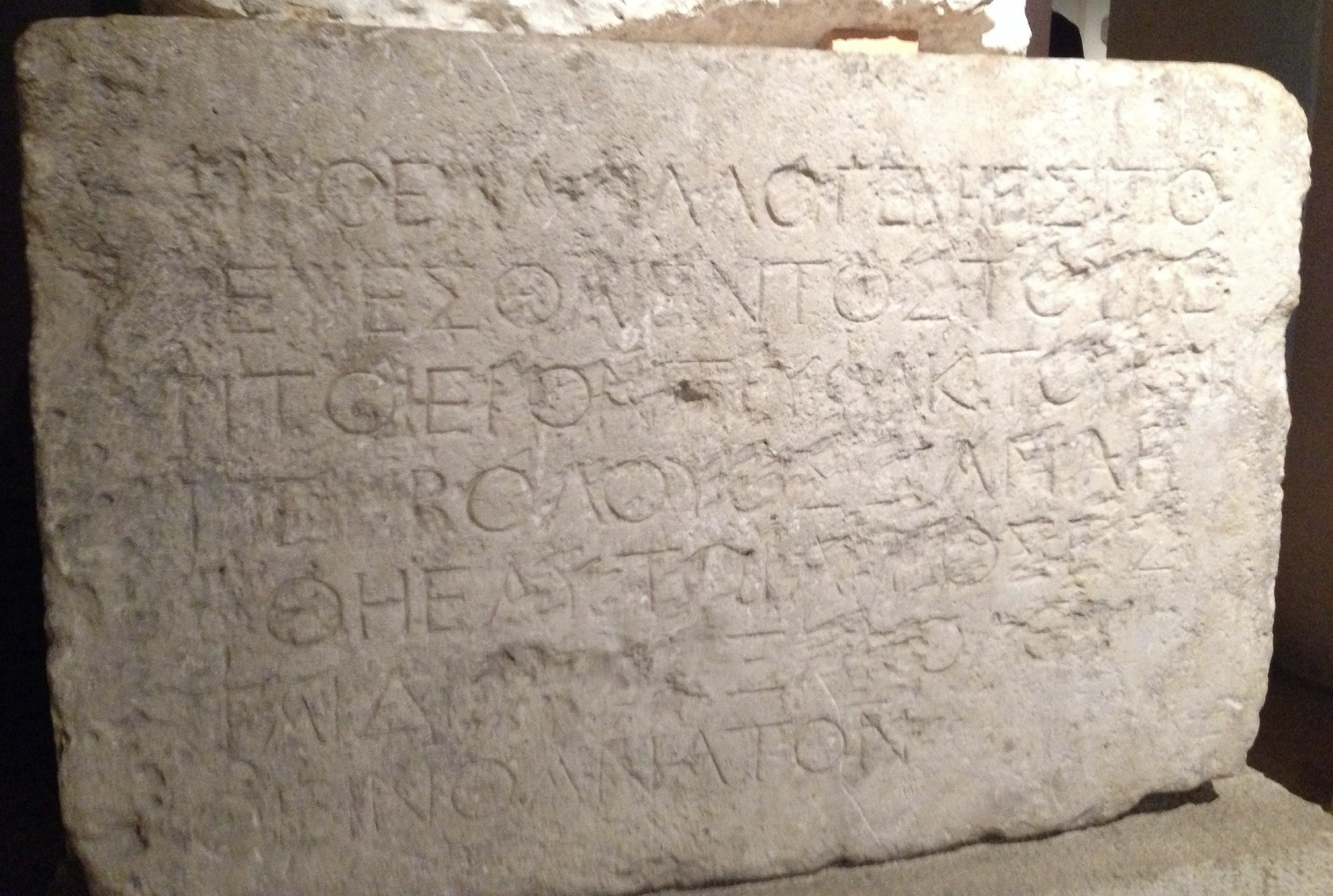
It says, “No foreigner is to enter within this balustrade round the temple and enclosure. Whoever is caught will be responsible for his ensuing death.”
No foreigner, no allogenes. This is the word that Jesus uses to describe the Samaritan leper. Someone born of a different family (than the Jews.)
So you see, this Samaritan could not go with the other 9 to the Temple in Jerusalem to be pronounced clean, for he would not be allowed to enter the area to complete his cleansing.
This over 4 feet tall dividing wall kept this man and other Samaritans from God. They could not worship in the place where Yehovah said he would place his name forever because the Priests and Rabbis said they were of the wrong race. Presumably, he could visit the Samaritan’s temple on Mt Gerazim to see a priest. But it was not the true temple of God. So he elected instead to show himself to a different priest, Jesus, who would become our high priest. This is Jesus’ third trip to minister to Samaritans, and he came to break down barriers between people.
And we see this temple barrier wall become a big issue in the Book of Acts. In Acts chapter 21, some Jews from Asia were in Jerusalem for Pentecost and wanted to attack Paul because he was ministering to ‘foreigners.’ They drag Paul out of the temple and are going to kill him right there, but the Roman troops intervene. They then make some false charges against Paul and manage to have him arrested. Paul ends up imprisoned for 2 years and then sent to Rome to be judged by Caesar.
And what was the false charge they brought against Paul that led to all this? They said he brought foreigners past the dividing wall into the temple. Paul spoke about this wall in his letter to the Ephesians.
Ephesians 2:11-14 Therefore remember that at one time you Gentiles in the flesh… remember that you were at that time separated from Christ, alienated from the commonwealth of Israel and strangers to the covenants of promise, having no hope and without God in the world. But now in Christ Jesus you who once were far off have been brought near by the blood of Christ. For he himself is our peace, who has made us both one and has broken down in his flesh the dividing wall of hostility
Don’t miss that Paul is talking about everyone in this room. Before Jesus came, we were all allogenes. We would not have been allowed to enter the Temple. That was never what God intended. The Jews were supposed to take God’s message to the nations, but they built a wall to keep everyone else out. Jesus came to break down these racial barriers, and because of Jesus, anyone can be grafted into God’s family.
Galatians 3:26-29 For in Christ Jesus you are all sons of God, through faith. For as many of you as were baptized into Christ have put on Christ. There is neither Jew nor Greek, there is neither slave nor free, there is no male and female, for you are all one in Christ Jesus. And if you are Christ’s, then you are Abraham’s offspring, heirs according to promise.
We are adopted into His family. And once again, in our story today, Jesus has shown a Samaritan, one born of the wrong race, is the one who is righteous in Jesus’ eyes.
Luke 17:15-16 Then one of them, when he saw that he was healed, turned back, npraising God with a loud voice; 16 and ohe fell on his face at Jesus’ feet, giving him thanks. Now he was a Samaritan. Then Jesus answered, “Were not ten cleansed? Where are the nine? Was no one found to return and give praise to God except this foreigner?”
While the nine were on their way to Jerusalem, rejoicing over the gift, this Samaritan was praising and thanking the giver. He fell down in worship at Jesus’ feet.
There is a difference between being thankful for the gift and giving thanks and praise to the Giver.
How do you feel when you look at the beauty of creation, when you see a fantastic sunset, a waterfall, or majestic mountains like we saw this past fall in Glacier Bay, Alaska? Many people were on that ship’s deck with us, looking at the beauty of the mountains and glaciers. Many were just admiring the view. But to some, it was much more; they were moved to admire not just the creation but the creator, the one who made the mountains. Is it the gift of the giver you admire?
How do you enjoy the great things in life? How do you appreciate a beautiful view, a great meal, or music? Do you only see the gift and neglect to thank the giver? How do you appreciate your health? All 10 men were glad they were healed, but only one was moved beyond appreciation of good health to worship the giver of life. We don’t worship creation; we worship the creator. We don’t worship the gift; we worship the giver.
Then Jesus says something very interesting to the Samaritan who used to have a skin disease.
Luke 17:19. And he told him, “Get up and go on your way. Your faith has saved you.”
Now, your version may say:
Luke 17:19. And he said to him, “Rise and go your way; your faith has made you well.”
Well, which is it? Was he healed from lepra, or was he also saved from sin? The word translated as “saved you” or “made you well” is ‘sozo.’
Sozo is found in the New Testament 106 times. Let’s look at the first two instances:
When the angel tells Joseph what to name Jesus:
Matthew 1:21. She will bear a son, and you shall call his name Jesus, for he will save his people from their sins.”
When the disciples are scared they will die in the boat in a storm:
Matthew 8:25. And they went and woke him, saying, “Save us, Lord; we are perishing.”
Sozo is the idea of deliverance — from disease, from danger, and from sin.
So, in verse 19, is Jesus talking about physical deliverance from disease or spiritual deliverance from sin and death? Jesus is speaking of spiritual salvation here. As told in verse 14, all 10 have been healed. They all have had physical deliverance from disease. But this Samaritan’s second encounter with Jesus brings more.
This former leper turned back and praised God. He fell on his face before Jesus and thanked him. Like Naaman in the Old Testament, he recognized Yehovah as the source of healing and the one true God.
Naaman said:
2 Kings 5:11-17 “Behold, I know that there is no God in all the earth but in Israel…from now on your servant will not offer burnt offering or sacrifice to any god but Yehovah.`
This Samaritan praised God for his healing. He acknowledged his unworthiness by falling on his face at Jesus’ feet. His actions were that of a repentant heart. He recognizes Jesus as the source of his healing. He thanks the giver of the gift. He didn’t need to raise a hand, walk an aisle, or repeat a sinner’s prayer. He demonstrated all of that in what he said and did. And he received much more than physical healing; he received a relationship with the Son of God, the Messiah, that day. But the nine. They left jumping for joy and grateful for the gift of healing. But their happiness was only for the gift, not for the giver.
We can go through life being joyful for the good times, the beauty, the food, health, and the air we breathe. Or we can see all of these things and return to Jesus, the creator and sustainer of all, bow down and give him thanks. In Jesus’ day, children were taught to be thankful for everything. There were over 100 Jewish blessings a day. “Blessed are you, Yehovah, king of the universe, who gave me breath this morning. Blessed are you, Lord our God, who gave me eyes to see today. Blessed is He who has allowed me to live to this day and see His faithfulness displayed in this answered prayer. Blessed are you, Yehovah, who have given us food to eat.”
One hundred blessings a day is not a lot. Your heart will beat over 100,000 times a day. And each one is a gift from God. The psalmist said, “How shall I make a return to the Lord for all the good he has done for me?”(Psalm 116:12). How can we ever thank God enough for how he sustains us and provides for us every minute of every day? It is that awareness of how much we have received that changes our focus from what we lack to the great abundance we have.
The LORD is my shepherd I shall not want.
In Ephesians 5:20, Paul says we should ” give thanks always and for everything to God the Father in the name of our Lord Jesus Christ.” Television and social media push us into an endless cycle of discontent, constantly reminding us of what we lack. This attitude of gratitude to God for every gift combats the world’s negativity by recognizing the Giver of the gift. It is a demonstration of faith.
Have you ever considered how thanking God is related to faith?
Colossians 2:7 “Let your roots grow down into him, and let your lives be built on him. Then your faith will grow strong in the truth you were taught, and you will overflow with thankfulness.”
When we live in the mode of thankfulness, when we feel the 100 blessings a day in our hearts, then we are keeping our eyes on God. Then we are worshiping our creator, not the creation, the giver, not the gift. Remember when Peter was walking on the water and took his eyes off Jesus and looked at the storm with the angry waves? He began to sink. Gratitude keeps our eyes focused on the one who calms us in the storm and increases our faith.
Thanksgiving is the voice of faith. Notice what Jesus has done here. Jesus is so good. He is determined to strike against hundreds of years of racist attitudes by showing that Samaritans are God’s people, too. He tells us the story of a ‘Good Samaritan,’ and then he has an actual encounter with a ‘Good Samaritan.’ And he uses these two ‘Good Samaritans’ to teach what he said were the two Greatest Commandments.
The story of the Good Samaritan teaches us the second greatest commandment: “Love your neighbor as yourself.” The actions of this former leper, this other Good Samaritan, teach us about the greatest commandment – Jesus quoted it from
Deuteronomy 6:4-5 Hear, O Israel: Yehovah is our God, Yehovah alone. You shall love Yehovah, your God, with all your heart, and with all your soul, and with all your might.
Yehovah is God alone; don’t worship anything else. We don’t worship the sun, moon, or stars. We don’t worship idols. We don’t worship the beauty of creation, and we don’t worship our health. We don’t worship the creation; we worship the creator. Yehovah is God alone. Like the other Good Samaritan, for every blessing we receive, let us return to Jesus. Let us bow down before our Creator and thank him constantly for every good gift.
1. Hays, J. Daniel. From Every People and Nation: A Biblical Theory of Race. p. 63.
 Swallow No Camels