
Week 65 — Why They Didn’t Understand
Mark 16:12-14, Luke 24:36-49, John 20:19-23
Last week, we discussed what Jesus did on the day He was resurrected. He met the two disciples who were on their way home to Emmaus. He opened up the scriptures to them and then opened their eyes when he broke bread with them. That day ends with the two disciples from Emmaus traveling back to Jerusalem to tell the disciples gathered there of their encounter with the risen Jesus. We have descriptions of this in the Gospels of Mark, Luke, and John. Mark’s account is the briefest:
Mark 16:12-14 After these things, he appeared in another form to two of them, as they were walking into the country. And they went back and told the rest, but they did not believe them. Afterward, he appeared to the eleven themselves as they were reclining at the table, and he rebuked them for their unbelief and hardness of heart, because they had not believed those who saw him after he had risen.
Mark mentions the disciples from Emmaus and tells us the disciples “did not believe them.”
How frustrating when you are telling something you are all excited about, and they don’t believe a word you say. And Mary Magdalene is over there in the corner of the room saying, “Same. They didn’t believe me either.” While they are discussing this, Jesus appears in the midst of them and rebukes them “for their unbelief and hardness of heart:
Why did the disciples have such a hard time believing Jesus was alive? To us, 2000 years later, the resurrection seems so obvious. How could they have missed it? Of course, things are always simpler when you are looking back. It is difficult for us to put ourselves in the disciples’ shoes. It is hard for us to imagine their trouble believing in Jesus’ resurrection. Hadn’t Jesus explained this several times?
I think there are three reasons why they couldn’t see what we see now. First, they were overcome with fear. John tells us they were in a room with locked doors “for fear of the Jewish authorities” (John 20:19).1 They are in hiding. The weeklong Feast of Unleavened Bread continues, and the city is still on high alert. They were the core followers of a movement that the authorities had just deemed as blasphemers, insurrectionists, and traitors. Their leader had just been dealt the most severe punishment thinkable. They feel like they barely escaped. Hadn’t Peter almost been discovered to be “one of them” in the courtyard of the high priest? Peter had to lie to avoid being named as one of the conspirators. They are scared.
Do not underestimate the effect that fear has on your thinking. Fear activates the parts of the brain, such as the amygdala, that are designed to ensure self-preservation. And that portion of the brain takes over. Your body’s resources are all diverted to one goal: staying alive. Stress hormones, such as adrenaline and cortisol, are released. Your heart rate, blood pressure, and breathing rate increase to prepare for rapid, strong physical reactions. Your pupils dilate, allowing you to see the threat more clearly. And as these parts of the brain take over, your prefrontal cortex gears down. This is the part of the brain that is responsible for rational thinking and decision-making. You can’t do higher-level thinking when you are ruled by fear.
This system is designed to help you best react to immediate physical threats. You start to step, but you see a snake, so you instinctively jump back. That’s good… unless you are walking on the edge of a cliff when you see the snake. It is not good to let this fear response run loose. You may make terrible decisions you wouldn’t usually make, because your higher-level brain functions are suppressed.
What about people who live in constant fear? We see this with people living in areas of warfare where bombs are dropping around them. But we have a word for the most common scenario of chronic fear: anxiety. Anxiety and stress produce the same fear response and the same effects on your brain. And the incidence of anxiety has increased in the US over the past 5 years. The National Institute of Mental Health data from last year noted that 19% of adults in the US had an anxiety disorder. That is almost 1 out of 5 people living in a state of chronic fear.
Maintaining this fear response over more extended periods is physically harmful to the body. Studies show chronic anxiety causes increased cardiovascular disease, increased gastrointestinal disease, weakened immune function, and physical changes to your brain as your prefrontal cortex shrinks. The part of your brain responsible for higher-level thinking and decision-making loses mass.
Is it any wonder that the most common commandment in the Bible is “Fear not!”? These disciples were scared that the Romans were coming for them next, and they couldn’t see past their fear to think about what Jesus had told them. Jesus said this fear was a faith problem. He calls them hard-hearted.
The second reason I believe the disciples didn’t believe the stories of Jesus’ resurrection is that they didn’t understand Jesus’ mission. Every Jewish person was expected to pray daily for the Messiah to come. They had been praying and waiting for hundreds of years. Over the past year with Jesus, the disciples began to understand that Jesus was the promised Messiah, but their concept of the Messiah was tainted by tradition. They had been taught all their lives that the Messiah was coming to overthrow the enemy, which they naturally assumed was Rome. Toward the end of his ministry, Jesus tried to make it plain to them:
Matthew 17:22-23 As they were gathering in Galilee, Jesus said to them, “The Son of Man is about to be delivered into the hands of men, and they will kill him, and he will be raised on the third day.”
That seems pretty plain, doesn’t it? ‘Men are going to kill me, but I’ll only be dead for 3 days, then I’ll be back.’ But look at the rest of verse 23: “And they were greatly distressed.” ‘You’re going to die? But you can’t die; you’re the Messiah.’ Fear kicks in, and the stress hormones surge, causing their brains to shut down. They didn’t even hear the ‘rise in three days’ part. They sure didn’t process it. Look at another time Jesus tried to tell them in Mark:
Mark 9:30-32 They went on from there and passed through Galilee. And he did not want anyone to know, for he was teaching his disciples, saying to them, “The Son of Man is going to be delivered into the hands of men, and they will kill him. And when he is killed, after three days he will rise.”
Again, look at their response in the following sentence: “But they did not understand the saying, and were afraid to ask him.” They didn’t understand. Knowing what they knew and had always been taught about the Messiah, it didn’t make any sense, and they were afraid to even ask about it. Their thoughts were captive to the erroneous teaching of their leaders. They were unable to see the truth of scripture. They were blinded by tradition and blinded by fear.
They didn’t understand the scriptures about Jesus’ mission because they had the wrong paradigm. A paradigm is a dominant way of understanding or interpreting the world, a framework of assumptions and beliefs that shapes how we perceive and interact with reality. More simply put, it is your worldview that shapes how you interpret everything. For example, some people have the basic political assumption that we need more governmental intervention, more governmental oversight, and regulation. Other people have a completely different assumption that we need less governmental intervention, less oversight, and less regulation. Your evaluation of a particular political candidate will depend on the paradigm you operate under. Two people can examine the same candidate and arrive at totally opposite conclusions due to their differing paradigms.
Have you ever been at a high school basketball game when there is a very close play, and people on one side of the court are completely certain their player was fouled, but the people on the other side are equally certain there was no foul? They both saw the same thing, but they have different basic assumptions. Different paradigms. So they came to different conclusions.
The Jews in Jesus’ day, as well as the Jews today, have the same Old Testament Scriptures that we read, the same ones Jesus explained to the disciples; however, they reach a different conclusion. Why? They have a different starting point, a different point of view. So when Jesus goes through the scriptures with the disciples in Emmaus and the disciples in the room, he is not giving them new scriptures; he is giving them a new paradigm. This is how their eyes were opened.
We can have the same problem. Could it be that there are aspects of Jesus’ mission that we also don’t understand? We must always be vigilant for instances where our preconceived notions influence our thinking. We all have blind spots where our discernment is clouded by tradition. What are yours?
To recap, why did the disciples initially refuse to believe that Jesus was resurrected?
1. They were overcome by fear.
2. They didn’t understand his mission.
And finally,
3. They were overly focused on the natural and blind to the supernatural.
They knew Jesus as a person. Some saw him grow up from an awkward teenager. They saw him on the days he was dirty, and his breath smelled bad. They saw him trip on a rock on the path and spill his drink at the table. Sometimes we struggle to think of Jesus as a human with all the human issues we face, but the people around Jesus had a different problem. It was all too obvious he was human. The problem for them was seeing him as more than human. This was hardest on his brothers, who, at one point, upon hearing him claim to be the Messiah, thought he had lost his mind.
Mark 3:21 And when his family heard it, they went out to seize him, for they were saying, “He is out of his mind.”
I can hear James talking to Jude now.
James: “Hey, older brother has lost it.”
Jude: “Really, what is he doing this time?”
James: “He is running around telling people he is the Messiah.”
Jude: “Seriously?”
James: “Yeah, he’s gone off the deep end now. We had better stop him before he gets in trouble.”
They knew him as their older brother, the one who never got in trouble. As kids, they probably saw him as the brother who thought he was better than them, kind of like how Joseph’s brothers saw him.
“But,” you say, “the disciples saw all of those miracles!” Yes, but look at how they responded. On Thursday, September 18, the disciples witnessed the miraculous feeding of the 5000, a truly supernatural event. Everyone is amazed. The people wanted to make Jesus king right then. Jesus sends the disciples off in a boat without him. That night, they end up in a storm and see someone walking on the water. They were terrified, thinking it was a ghost (there goes the fear again). They find out it is Jesus, and Peter walks on the stormy water. But then Jesus gets in the boat, and the storm immediately stops. That’s pretty amazing. But look at the following verse:
Mark 6.52 for they had not understood about the loaves; their hearts were hardened.
They witnessed the miracle of the loaves being multiplied; they were the ones distributing them. But a few hours later, they have forgotten the supernatural event and are back to thinking only of the natural. This miracle on the water surprised them. You would think that after the bread miracle that day, they would not be so shocked, but they just didn’t understand it. They are said to be “hardhearted”, the same thing Jesus said this about the disciples when he appeared to them in the room after his resurrection. He said this is a faith problem. But wait, there is more…
You have these very supernatural events, and six days later, they are in a different area of the country, and this happens:
Matthew 15:32-33 Then Jesus called his disciples to him and said, “I have compassion on the crowd because they have been with me now three days and have nothing to eat. And I am unwilling to send them away hungry, lest they faint on the way.” And the disciples said to him, “Where are we to get enough bread in such a desolate place to feed so great a crowd?”
It’s just been six days. This guy walks on water, calms a storm, and just 6 days ago made food appear from nowhere. And now these disciples can’t imagine where they could find enough bread to feed these people. Even after what they witnessed, their minds are thinking on a purely natural level, ignoring the possibility of the supernatural.
I get it. We tend to draw firm lines between what we call natural and supernatural. We define them this way: the “natural” realm encompasses what we can understand and explain through science and the laws of nature. In contrast, the “supernatural” refers to events or phenomena that go beyond these natural laws, often involving spiritual or divine realms. My problem with these distinctions is that what we can understand and explain through science is a moving target.
Many phenomena that were once thought to be supernatural have been explained by science. In the past, lightning, earthquakes, weather patterns, and mental illness were all felt to be supernatural events. Until the 17th century, people believed that a supernatural force acted to move blood through the body. William Harvey proved that blood was contained in tubes throughout the body, and the heart served as a pump. What was once deemed supernatural was now considered natural. From there, the idea emerged that science could eventually explain everything, and the realm of the supernatural shrank significantly as the “Age of Enlightenment” began.2 However, as time passes, we come to realize that the more we learn about the human body and the universe, the less we truly understand. We have only begun to discover the complexities of science. And there is so much that science will never be able to explain.
But even the things we can currently explain with science could not have begun to exist by themselves. We know why things fall when you drop them – gravity. And we know gravity keeps planets in orbit. We have also calculated the gravitational constant. But if that number varied by the tiniest fraction (0.000000000000001), then the universe could not exist. If it were that tiny bit smaller, then no planets or stars would have formed and stayed together. If it were just that tiny bit larger, then the Big Bang would be followed by a Big Crunch, where everything would collapse back down to a single point. And that is only one of many such constants that all have to be exactly as they are for us to exist. Our universe is incredibly complex in its design. Science shows that it could not have happened by accident. The natural world only exists because God designed it with incredible precision. We only have a “natural world” because a supernatural God ordained it.
So while we want to categorize things as either natural or supernatural, I see Jesus moving back and forth between them with complete freedom. Notice in this passage in Luke how Jesus casually moves from “the supernatural” to “the natural” in this room with the disciples.
Luke 24:36-42 As they were talking about these things, Jesus himself stood among them, and said to them, “Peace to you!” But they were startled and frightened and thought they saw a spirit. And he said to them, “Why are you troubled, and why do doubts arise in your hearts? See my hands and my feet, that it is I myself. Touch me, and see. For a spirit does not have flesh and bones, as you see that I have.” And when he had said this, he showed them his hands and his feet. And while they still disbelieved for joy and were marveling, he said to them, “Have you anything here to eat?” They gave him a piece of broiled fish, and he took it and ate before them.
Remember that he just vanished from the home in Emmaus. Just disappeared. Then he suddenly materializes in a room with secured doors in Jerusalem. You thought Star Trek transporters were cool? Jesus was doing that two thousand years ago. Then he gives a casual greeting. Peace be unto you. In Hebrew, that’s Shalom Aleikem. That’s still a standard greeting in the Middle East (Jews and Arabs). So Jesus is like, “Hi Guys! Don’t be scared, it’s just me alive again. See these holes in my hands, Yep, still there. No worries. Sure, stick your hand in that hole in my side. Pretty cool, huh? Anyhow, you got any food? I haven’t eaten for days. Oh great, fish!”
The disciples are flabbergasted. To Jesus, everything is just routine. They are blind to the supernatural, and to Jesus, the supernatural is just, well, natural. Death is a mystery to us, but not to Jesus. Resurrection is hard for us to imagine, but not for Jesus. We draw firm lines between the natural and the supernatural. Jesus didn’t. Because he understood nothing was impossible for God. The disciples hadn’t grasped that, and we haven’t either.
So if right now, Jesus suddenly appeared out of nowhere right there in the room with you and said, “Hey, everybody! How’s it going?” How would you react? Do you believe God can do miracles? Do you believe God is still at work in our world today? Then why do we live our lives ignoring the possibility of God working in our midst to do God things? Why do we look at the problems in our lives and think we have to figure them out ourselves and find a way to solve them without God’s help? We are no better than the disciples. We see a problem like their 4000 hungry people, and say, “That problem is just too big to solve.” Like the disciples, the problem only seems big if you see your God as small. Jesus said this is a faith problem.
Let’s finish the story:
Luke 24:44-49 Then he said to them, “These are my words that I spoke to you while I was still with you, that everything written about me in the Law of Moses and the Prophets and the Psalms must be fulfilled.” Then he opened their minds to understand the Scriptures, and said to them, “Thus it is written, that the Christ should suffer and on the third day rise from the dead, and that repentance for the forgiveness of sins should be proclaimed in his name to all nations, beginning from Jerusalem. You are witnesses to these things. And behold, I am sending the promise of my Father upon you. But stay in the city until you are clothed with power from on high.”
So Jesus goes through the scriptures, opening their minds by changing their paradigm. Then he tells them, ‘And by the way, you are going to be witnesses, spreading the need for repentance and the news of forgiveness through me to the whole world. Now that is a big job. So, if you’re going to do that, you’ll need some serious help. You will need God’s power. You can’t just depend on the natural; you have to learn to depend on the supernatural.. So sit tight until God empowers you.’
John gives more details:
John 20:21 Jesus said to them again, “Peace be with you. As the Father has sent me, so I am sending you.”
We could spend hours unpacking what it means for us to be sent to the world in the same ways that Jesus was sent to us. However, we will focus on the one aspect that Jesus emphasized. How is Jesus sending us? The next verse:
John 20:22 And when he had said this, he breathed on them…
Jesus exhales a breath. Is that odd? Every time Jesus does something that seems weird to us, you had better pay attention, because he is teaching an important lesson. Just like the Old Testament prophets, Jesus is a very visual teacher.
John 20:22. And when he had said this, he breathed on them and said to them, “Receive the Holy Spirit.
Now we know these disciples will receive the Spirit on the day of Pentecost, the Feast of Shavuot, and the countdown to that Feast has begun, 50 days from Passover. What Jesus is doing now is demonstrating a lesson about receiving the Spirit.
Jesus isn’t speaking English, and when he says ‘spirit,’ it is ‘ruach,’ the same Hebrew word as ‘breath’ and ‘wind’. Here we have Jesus, God, breathing on man. Pay attention, we’re going back to Genesis again. It is the beginning of creation, without form and void, and what is hovering over the face of the waters?
Genesis 1:2 And the ‘Ruach’ of God was hovering over the face of the waters.
The Spirit of God, the wind, the breath of God. In Genesis 2, we see God take dust and form a person from it. How does he give life to this dust?
Genesis 2:7. Then Yehovah God formed the man of dust from the ground and breathed into his nostrils the breath of life, and the man became a living being.
God breathed life into Adam, and now, God is going to breathe new life into these disciples.
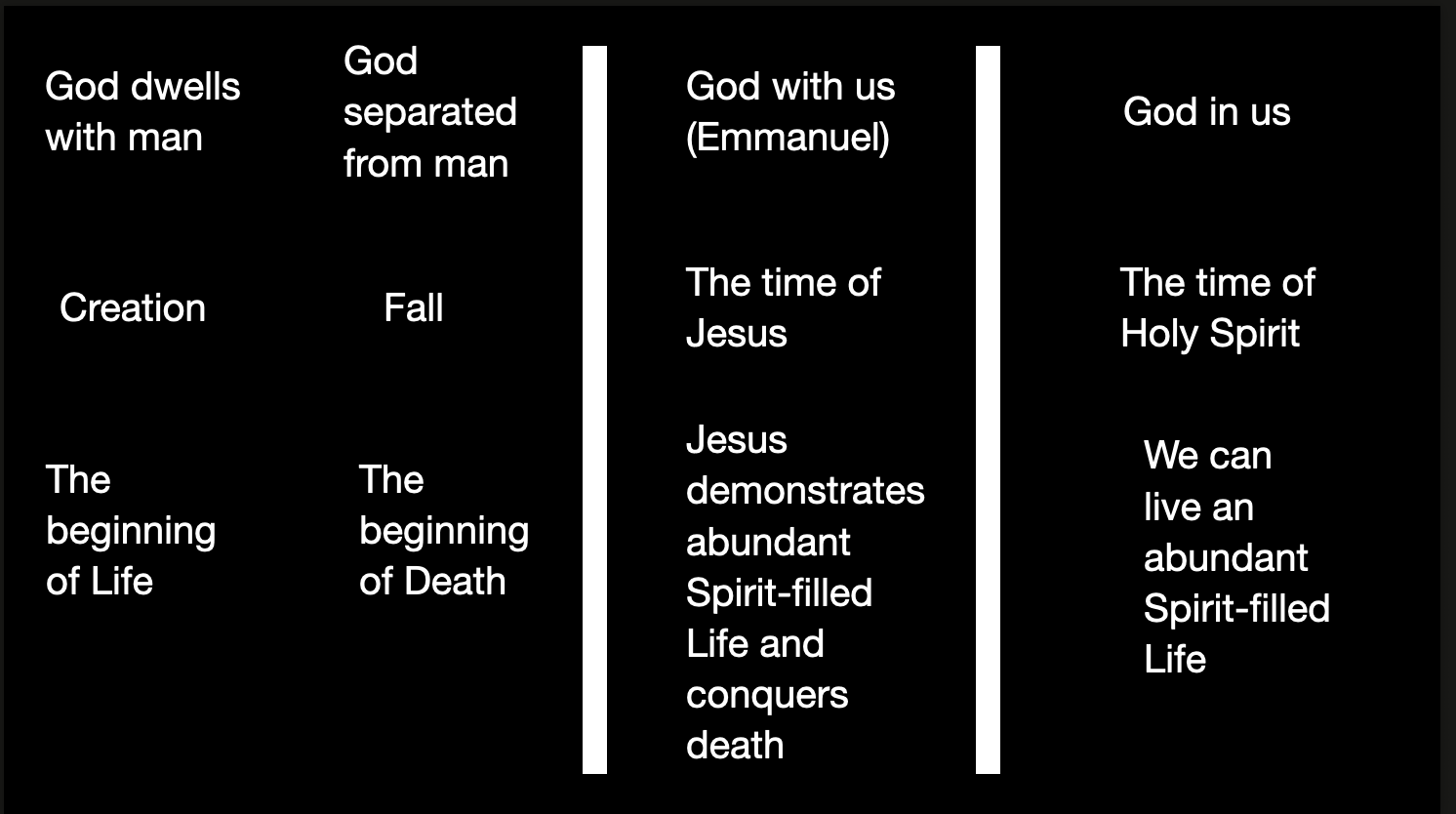
Jesus’ life, death, and resurrection draw a big vertical line in history. There was creation, when life was first made, and God dwelt with man in the Garden. Then came the fall, when sin caused death to become a part of the world, and then God was separated from his people. Now Jesus comes, Emmanuel, God with us, and He demonstrates what life is, then destroys the power of death. Now life reigns again. Everything from here on out is different. God’s plan to redeem his people is happening.
Then, 50 days after Jesus dies on the cross, it is the time of the Holy Spirit. Now it is not God with us but God in us, God’s Holy Spirit within us. God is breathing on humans again — to give them life again. A life where death does not prevail and a life that is abundant. No longer will people be separated from God. No longer will people have to travel to a temple to commune with God, for he will be God with us and in us. We will be the temple of the Holy Spirit.
The Spirit descends on the face of the waters at creation. The Spirit descends on the church in a mighty rushing wind at Pentecost, a time of recreation. God breathes life into Adam, and God breathes abundant life into his church. So, the countdown has begun to the climax of Jesus’ ministry, the culmination of God’s plan to restore fellowship with His creation. Pentecost is coming.
However, if we are to live an abundant, spirit-filled life, then we must overcome the same issues the disciples faced. We have to drop our fear. We can’t be afraid of what God will do. We can’t fear how others will react. We can’t let fear of doing something new or something hard cause us to be disobedient to whatever God calls us to do. We must have the faith to believe that God loves us and will be with us always. He will work everything to good. Fear not!
We have to understand our mission. When I was growing up, I heard many sermons that said every Christian should be knocking on doors and witnessing to people. And I have friends who can talk to anyone, who can do door-to-door evangelism. But I also have friends who are introverts. Talking to people is not their gift. And for years, they had listened to the church tell them they weren’t good Christians if they didn’t go witnessing. Do not be blinded by this traditional teaching.
God has given people a variety of gifts. Some are evangelists, but not all of them. We are sent to build up the Kingdom of God, but it is not just about the number of converts. The Kingdom of God is about following God’s will, and that includes feeding the hungry, housing the homeless, comforting the grieving, loving the unloved, caring for the sick, freeing the oppressed, and giving sight to the blind. And many times it is in doing these things that people are drawn to the Kingdom.
Finally, we have to expect God to work in supernatural ways. We have to expect the supernatural. The disciples were shocked every time Jesus did a miracle. Wow! Look at that miracle! We’ve never seen anything like that before! (Yes, you did! You saw the same miracle 6 days ago.) To be people of faith is to expect God to do God things! We can’t be hard-hearted and live our lives as if God doesn’t exist, and God still doesn’t act in this world.
We can’t go through life trying to solve problems on our own and ignoring God’s help. If we only attempt to do things that we can do by ourselves without God’s help, then we are living faithless, empty lives. If we can do it without God, then where is God’s place? How can God get glory from that?
John 14:12 “Truly, truly, I say to you, whoever believes in me will also do the works that I do; and greater works than these will he do, because I am going to the Father.
Read that again — Whoever believes will do Jesus things, and works greater than His! Every believer is capable of doing Jesus-sized works! But hold that thought… Why does Jesus going to the Father help us do greater works?
John 16:7 It is to your advantage that I go away, for if I do not go away, the Helper will not come to you. But if I go, I will send him to you.
And 50 days after Passover, after Jesus’ crucifixion, is the day of Pentecost, when Jesus sent the Holy Spirit in power. We will do greater works because the Holy Spirit is in us. It took the disciples some time to grasp the concept of greater works. But they did. And we have to also. Why did God put the Holy Spirit within us if we are never going to listen to Him or do the things that require His power?
- The Greek term, “Ioudaios,” is often translated as “Jews,” but typically is understood to be “the Jewish authorities.”
- The starting date for the Age of Enlightenment or Age of Reason is typically given as 1685, when Louis XIV revoked the Edict of Nantes, followed in the next few years by Isaac Newton’s publication of “Principia Mathematica” and John Locke’s “Essay Concerning Human Understanding.”
 Swallow No Camels