
Week 67 — Peter’s Denial and Affirmation
John 21:1-19
Last week, we talked about Thomas, who is unfortunately remembered as “Doubting Thomas.” We saw how Jesus spoke about the concept of doubt, that questioning is not a problem for Jesus, and mental uncertainty is not a sin. Jesus comes not to punish uncertainty but to resolve it. Thomas needed to see Jesus’ hands and side. Jesus obliges. Doubt is only a sin if it leads to disobedience. So while some people see Thomas’ doubting as a failure, Jesus doesn’t.
That brings us to the next resurrection appearance of Jesus in the Gospels, where Jesus responds to an actual failure of one of his disciples. Last week, we saw how Jesus dealt with doubt; now, we see how He deals with failure. It seems no disciple has more highs and lows than Peter. Remember when Jesus took the disciples north to Caesarea Philippi and asked them who people said that he was? And Peter gives the answer that gets the gold star.
Matthew 16:16-17 Simon Peter replied, “You are the Christ, the Son of the living God.” “And Jesus answered him, “Blessed are you, Simon Bar-Jonah! For flesh and blood has not revealed this to you, but my Father who is in heaven.
This is the first open proclamation in the Gospel of Matthew of Jesus as the Messiah, one who has a special relationship with God, the Father. Jesus tells Matthew that this answer is straight from God. However, in the following passage in Matthew, Jesus tells them that he will go to Jerusalem, suffer, and die. And Peter pulls him aside and tells Jesus there is no way that will happen. And Jesus tells Peter he is talking like the snake in the Garden.
Matthew 16:23 (Message) “Peter, get out of my way. Satan, get lost. You have no idea how God works.”
From the best answer to the worst answer. It seems Peter is a jumble of highs and lows, of successes and failures. He is jumping out of the boat to walk on water in one moment, then sinking into the waves and being called out by Jesus for having no faith in the next. Peter’s series of failures climaxes after Jesus’ arrest, when he denies Jesus.
Matthew 26:31-35 “Then Jesus said to them, “You will all fall away because of me this night. For it is written, ‘I will strike the shepherd, and the sheep of the flock will be scattered.’ But after I am raised up, I will go before you to Galilee.” Peter answered him, “Though they all fall away because of you, I will never fall away.” Jesus said to him, “Truly, I tell you, this very night, before the rooster crows, you will deny me three times.” Peter said to him, “Even if I must die with you, I will not deny you!” And all the disciples said the same.”
(A small teaching point. If you find yourself arguing with Jesus, then you are wrong. 100% of the time.)
Then they go to the Mount of Olives, and Jesus tells the disciples to stay awake and watch while he prays. Peter and the others had just told Jesus they would stand with him no matter what, but they couldn’t even stay awake with him. Jesus is then arrested and taken to the home of the high priest for questioning.
Matthew 26:58 “And Peter was following him at a distance, as far as the courtyard of the high priest, and going inside, he sat with the guards to see the end.”
In the 4th chapter of Matthew, Jesus asked these fishermen to follow Him. And they had followed him for months wherever he went. But this is a different type of following. Matthew says Peter is “following at a distance.” There is a significant difference between following Jesus as a disciple and following from a distance.
John adds more detail to this story.
John 18:15-18 “Simon Peter followed Jesus, and so did another disciple. Since that disciple was known to the high priest, he entered with Jesus into the courtyard of the high priest, but Peter stood outside at the door. So the other disciple, who was known to the high priest, went out and spoke to the servant girl who kept watch at the door, and brought Peter in. The servant girl at the door said to Peter, “You also are not one of this man’s disciples, are you?” He said, “I am not.” Now the servants and officers had made a charcoal fire, because it was cold, and they were standing and warming themselves. Peter also was with them, standing and warming himself.”
This is the first of Peter’s three denials that come in this courtyard. John adds some details that seem unnecessary. It was a cold night. They had built a fire in the courtyard to keep warm. He even tells us what kind of fire they had. When you see details like this that seem to be thrown in, you had better pay attention. John, in his Gospel, tells you he doesn’t have room to tell all the things Jesus did.1 So, why would he waste several sentences on these details?
John shifts the scene to the interaction between the high priest and Jesus, and then returns to Peter outside.
John 18:25-27 “Now Simon Peter was standing and warming himself. So they said to him, “You also are not one of his disciples, are you?” He denied it and said, “I am not.” One of the servants of the high priest, a relative of the man whose ear Peter had cut off, asked, “Did I not see you in the garden with him?” Peter again denied it, and at once a rooster crowed.”
In case you forgot, John reminds you that Peter was by the fire, warming himself. It is by this charcoal fire that Peter denies Jesus three times, just as Jesus told Peter he would. Twice, Peter says, “I am not.” We have discussed the seven signs or miracles in the Gospel of John, the seven table meals, and the seven confessions about Jesus. There are seven I am statements of Jesus in John’s Gospel.
I am the bread of life. I am the light of the world. I am the door. I am the good shepherd. I am the resurrection and the life. I am the way, the truth, and the life. I am the true vine.
“I am” is the first answer God gives to Moses when Moses asks for His name.
Exodus 3:13-14 Then Moses said to God, “If I come to the people of Israel and say to them, ‘The God of your fathers has sent me to you,’ and they ask me, ‘What is his name?’ what shall I say to them?” God said to Moses, “I AM WHO I AM.” And he said, “Say this to the people of Israel: ‘I AM has sent me to you.’”
God is the great “I am.” What God is telling Moses here at the burning bush is the explanation of his name. As you know, in biblical times, names often carried meanings that revealed aspects of a person’s character: Abraham meant ‘father of many’, Jacob meant ‘trickster’, and Jesus meant ‘Yehovah is salvation’.
In Hebrew, “I am” is the word “ehyeh” (אֶֽהְיֶ֖ה), which means “I exist.” The explanation of his name is that he is the God who actually exists, different from the idols of Egypt, who only exist in the minds of men. So “I am” is the explanation. He gives his actual name in the next verse.
Exodus 3:15 “God also said to Moses, “Say this to the people of Israel: ‘Yehovah, the God of your fathers, the God of Abraham, the God of Isaac, and the God of Jacob, has sent me to you.’ This is my name forever, and thus I am to be remembered throughout all generations.”
When God says this is my name, the name he gives is Yehovah, not “I am” and not ‘lord.’ And this name, ’Yehovah’, is written in Hebrew in the Old Testament almost 7000 times (actually, 6827). Your English translation says ‘LORD’ in all capital letters because the rabbis who taught the English translators Hebrew taught them the tradition of reading Yehovah as ‘Adonai’, which means ‘lord’. Yehovah (יְהוָ֞ה) is a combination of three Hebrew words, “Hayah, hoveh, and yiheh,” which mean “He was,” “He is,” and “He will be.” God has existed forever, and He is the same yesterday, today, and forever. (see Malachi 3:6 and Hebrews 13:8.)
Because of the association of “I am” with the explanation of God’s name, Yehovah, “I am” statements in the Bible merit special attention. It is no accident that John’s Gospel has Peter denying Jesus by saying “I am not” as he tries to disidentify with Jesus.
Then, in the courtyard around the charcoal fire, after his third denial, Peter hears the rooster crow. And Jesus looks at Peter. That sound signifies the rising of the sun, light dawning on the world, just as Peter sinks into darkness. Can you imagine how Peter felt after this? He has just renounced the one he said he would give up his life for. He just did the very thing he swore he would not do less than 12 hours ago. Luke tells us:
Luke 22:61-62 “And the Lord turned and looked at Peter. And Peter remembered the saying of the Lord, how he had said to him, “Before the rooster crows today, you will deny me three times.” And he went out and wept bitterly.”
Despair. The worst failure imaginable for a disciple. Peter is learning an important lesson we all need to learn. We are not as strong as we think we are.2 We all like to think we know what we would do in certain situations, but we don’t really know until we face them. We are all a lot more like Peter than we’d like to admit.
How does Jesus respond to Peter’s failure? Peter may have surprised himself with this denial, but it didn’t surprise Jesus.
Luke 22:31-32 “Simon, Simon, behold, Satan demanded to have you, that he might sift you like wheat, but I have prayed for you that your faith may not fail. And when you have turned again, strengthen your brothers.”
And when you have returned (when you have repented), strengthen your brothers.
He will strengthen his brothers by being an example of how you can fail miserably and still be used in a mighty way by God. We have a terrible problem in our churches today. We are afraid to talk about our faults and our failings. “How are you?” someone asks. And you answer, “I’m fine.” But you are not fine, at that moment, you are broken.3 But we pretend like we have it all together. We are a collection of people who live in a world that is terribly broken. We are all sinners who are all in various stages of failure. But around others, we pretend we have it all under control.
We need to let the story of Peter strengthen us, and then strengthen one another by sharing our own stories. The Bible instructs us to confess our sins and failures to one another. The place I have seen this the most is at a Celebrate Recovery service—a worship service for people who have drug, alcohol, or other addictions or hang-ups. Every week, you see someone come forward and celebrate that they have been free of drugs or alcohol for a year or 5 years or a month. And the people in the congregation cheer wildly. Then you see someone stand up and confess to everyone there that they have failed. Last week, they slipped up and took that drink or used that drug. And how do the people in the congregation react to this failure? They cheer wildly. They are not celebrating the failure, but celebrating the confession, the first step back towards recovery. They understand that confession and repentance are essential to change. And they are strengthening their brothers with their failure and new commitment.
How does Jesus respond to Peter’s failure? You know you learn as a parent that sometimes, when your child does wrong, sometimes you don’t need to punish them, sometimes you don’t even need to talk with them about what they have done wrong. Sometimes their mistakes cause them so much suffering and anguish that there is no need for you to add to it.
There have been times in my life when God has chastised me for my wrongdoings. The Bible says God chastises those he loves. And the discipline God dispenses to us is instructive. It is to lead us to awareness of our failures and repentance. If we are already aware of our sin and we have grieved it and repented of it, then the chastisement is not necessary.
Peter was grieved. He wept bitterly. And I think he shows his repentance. So Jesus doesn’t need to chastise Peter. So, how does Jesus respond to Peter’s failure? He doesn’t come with accusations. He doesn’t say “I told you so.” He doesn’t say, “Hey, how about that rooster?” How does Jesus respond? He cooks him breakfast. Here is the story:
John 21:1-6 After this, Jesus revealed himself again to the disciples by the Sea of Tiberias, and he revealed himself in this way. Simon Peter, Thomas (called the Twin), Nathanael of Cana in Galilee, the sons of Zebedee, and two others of his disciples were together. Simon Peter said to them, “I am going fishing.” They said to him, “We will go with you.” They went out and got into the boat, but that night they caught nothing.
Just as day was breaking, Jesus stood on the shore; yet the disciples did not know that it was Jesus. Jesus said to them, “Children, do you have any fish?” They answered him, “No.” He said to them, “Cast the net on the right side of the boat, and you will find some.”
John 21:6-11 So they cast it, and now they were not able to haul it in, because of the quantity of fish. ….
When they got out on land, they saw a charcoal fire in place, with fish laid out on it, and bread. Jesus said to them, “Bring some of the fish that you have just caught.” So Simon Peter went aboard and hauled the net ashore, full of large fish, 153 of them. And although there were so many, the net was not torn.
John 21:12-16 Jesus said to them, “Come and have breakfast.” Now none of the disciples dared ask him, “Who are you?” They knew it was the Lord. Jesus came and took the bread and gave it to them, and so with the fish. This was now the third time that Jesus was revealed to the disciples after he was raised from the dead.
When they had finished breakfast, Jesus said to Simon Peter, Simon, son of John, do you love me more than these?” He said to him, “Yes, Lord; you know that I love you.” He said to him, “Feed my lambs.” He said to him a second time, “Simon, son of John, do you love me?” He said to him, “Yes, Lord; you know that I love you.” He said to him, “Tend my sheep.”
John 21:17-19 He said to him the third time, “Simon, son of John, do you love me?” Peter was grieved because he said to him the third time, “Do you love me?” and he said to him, “Lord, you know everything; you know that I love you.” Jesus said to him, “Feed my sheep. Truly, truly, I say to you, when you were young, you used to dress yourself and walk wherever you wanted, but when you are old, you will stretch out your hands, and another will dress you and carry you where you do not want to go.” (This he said to show by what kind of death he was to glorify God.) And after saying this, he said to him, “Follow me.”
When writing a screenplay or novel, as the author of a story, you can craft the narrative so that it includes hints about what will happen later, leaving subtle details like a trail leading to the story’s climax. You can write a scene in a way that allows you to recreate it later. But when you are the author of the universe, the creator, you can arrange the details of life so that they will paint a picture. You can arrange events to occur on specific days or during certain seasons that will help people understand the message you are trying to convey. God often uses details like this to paint a picture for us. Look at what Jesus is doing here to paint a picture for Simon Peter.
At the beginning of his ministry, Andrew is a disciple of John the Baptist, and he brings Simon Peter to meet Jesus. This happened at the end of March, 27 AD. They begin to follow him, off and on. They see miracles in Cana and elsewhere, but are not full-time disciples.4 They are still fishermen who follow Jesus at a distance. Then, in July, we have the story in Luke 5, where Jesus meets them at the Sea of Galilee after they have been fishing all night with no luck, and they catch more fish than they know what to do with. A miracle of fish. At that point, Jesus calls them to be full-time disciples. He says, “Follow Me.” Peter now follows Jesus not at a distance, but closely, day by day; however, his commitment is not yet complete. He thinks he is willing to die for Jesus, and he boldly declares this to him. But Jesus tells him the test will come, and he will fail. Then Jesus is arrested.
When Jesus is on trial, John tells us that Peter follows Jesus from a distance. Then, in the courtyard of the High Priest, Peter denies Jesus three times by the charcoal fire. Jesus is crucified and 3 days later resurrected. They meet again on the Sea of Galilee (Just as before) after a night of unsuccessful fishing. Jesus tells them to drop their nets again, and they catch a vast number of fish. Then Jesus gives Peter a chance to affirm his love three times, at one of all places, a charcoal fire. Then Jesus says (as he did back in July) Follow me. Peter now follows Jesus closely with complete commitment. Jesus tells him, “You will stretch out your hands and go where you do not want to go. You will pass the test the next time; you will be crucified.
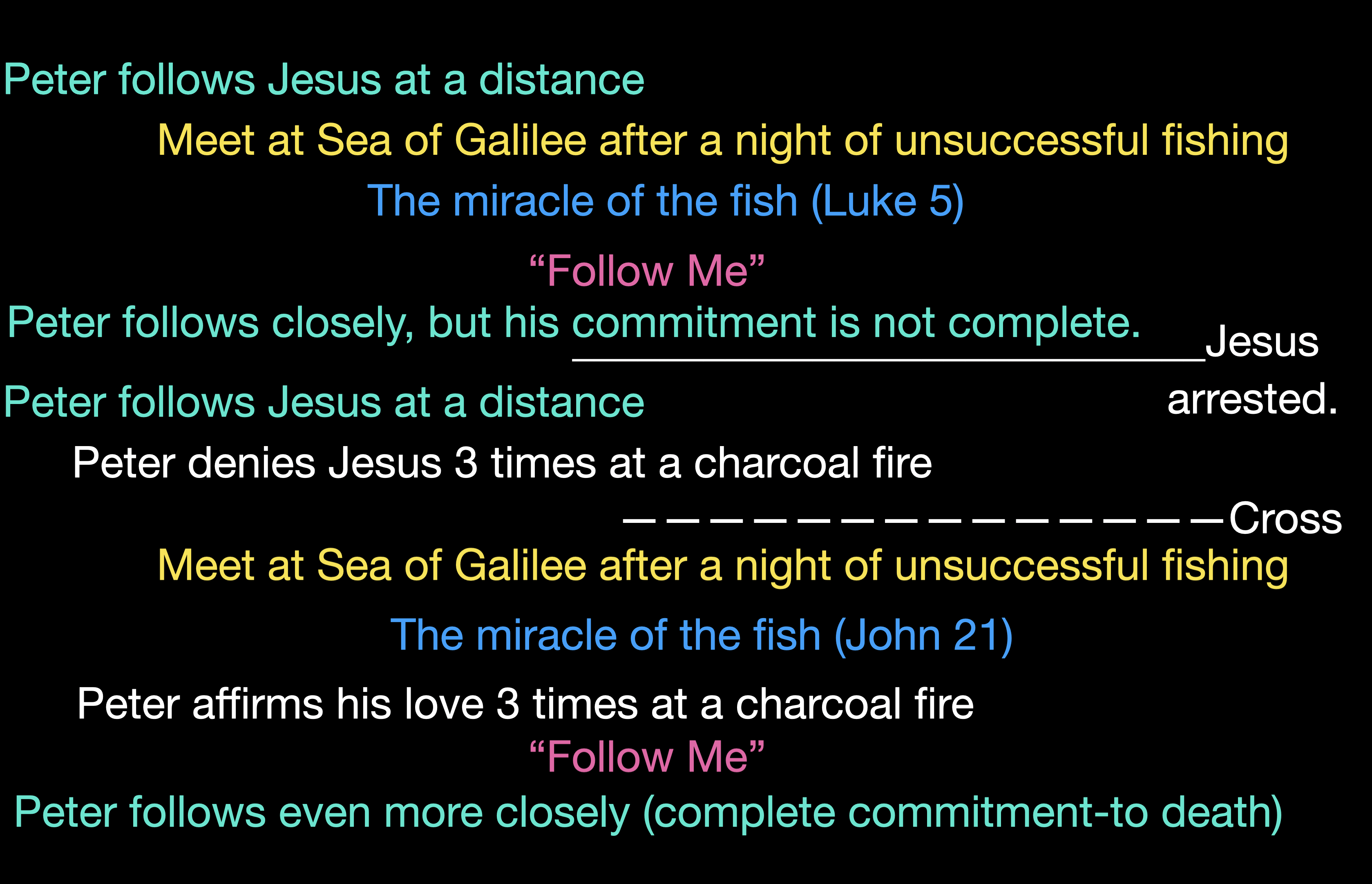
Jesus is replaying the circumstances of Peter’s first call to set up this calling him back. He is replaying some circumstances from Peter’s denial to give him a chance to repent. He brings in the warmth and smell of that charcoal fire — Look Peter, you are getting a second chance, now are you willing to die for me?
Peter is not through making mistakes. Read the book of Acts. He has some mistakes left to make. Me too, Peter. We all continue to make mistakes. And this is not a problem for Jesus if we repent and grow from them.
The story is told of a man who lived near a monastery and passed by it every day, often wondering how the monks there lived, and what went on behind the walls of this ancient building. One day, he spotted the abbot of the monastery in town and asked him what life was like there. The abbot is said to have replied. “We fall down, we get up.”
This is the life we lead. As long as we walk in this sinful world, we repeat this cycle. We fail. We fall down in sin, we repent and then get up and walk again, trying to live the next day closer to the life God wants us to live. This is the cycle we repeat until one day, we fall down in worship, humbling ourselves and laying our crowns before the throne of God.
Proverbs 24:16 For a righteous man falls seven times and rises again.”
Do you ever stay awake at night reliving your past mistakes? Are there things you have done in your life that you wish you could go back in time and do differently? Do you find it hard to escape the memories of your failures?
The Bible excels at highlighting the mistakes of its characters. There is no attempt to hide their faults. Abraham lied about his wife and put her and others in danger to save his own neck. Abraham and Sarah both laugh when God tells them they will have a child in their old age. They treat their Egyptian handmaiden, Hagar, horribly, sexually abusing her and then banishing her to the wilderness with her child to die. And after all that, how does God think of Abraham?
Isaiah 41:8 [God speaking] But you, Israel, my servant, Jacob, whom I have chosen, the offspring of Abraham, my friend;
After all his mistakes and failures, God called Abraham His friend. And here is Paul in his letter to the Romans discussing how God views Abraham:
Romans 4:20-22 No unbelief made him waver concerning the promise of God, but he grew strong in his faith as he gave glory to God, fully convinced that God was able to do what he had promised. That is why his faith was “counted to him as righteousness.”
“No unbelief made him waver.. ” Did you read the book of Genesis, Paul? There is quite a bit in there about Abraham’s wavering. Yes, but that is not how God remembers Abraham. He remembers Abraham as his friend who never wavered in his faith.
Then I turn to Hebrews 11, the Faith All-Star Roster. Look at that line-up. Many on that list lived lives full of failures. After it goes through the Patriarchs of the Bible and Moses, the next on the list is Rahab the Prostitute. The hooker who told lies to save spies. You have David (the adulterer/murderer), Jephthah, who made a rash vow that went really bad, and then you have Samson. A guy whose story is in the Bible for the primary purpose of showing how to do everything the wrong way. Samson’s life is one bad sin after another, one failure after another. But look at how God remembers these, not for their failures, but for their faith. This is the roll call of faith.
It is as if God has remembered their failures no more. Does this surprise you? It is just as He promised in Jeremiah, and this promise is quoted in the book of Hebrews.
Jeremiah 31:34. For I will forgive their iniquity, and I will remember their sin no more.
He has separated their failures from them as far as the east is from the west.5 Think about this for a minute. If Jesus were to walk in that door this morning and you were to ask him, “Hey Jesus, what was going through David’s mind when he decided it would be okay to take another man’s wife and then kill him? Jesus would say, “Hmmm….I have no idea what you are talking about. But David was a great king of Israel and a man after my own heart. What an awesome guy. I can’t wait for you to meet him.
God remembers us for our best day, not our worst days. That is Grace
Do you see what this means? Sometimes I lie awake at night rehashing some mistakes I’ve made and wishing I had a chance to go back and do things differently. But look at Jesus with Peter, after Peter’s complete betrayal. Jesus is not rehashing Peter’s mistakes. He doesn’t even mention them. The all-knowing God, who knows every hair on all of our heads, who sees if any sparrow falls, has forgotten that thing that you can’t seem to forget.
After that denial, Peter felt like a failure. He had utterly failed as a disciple by renouncing his rabbi. Was this fishing trip just a one-time thing, or had Peter decided to return to his occupation of fishing because of his failure as a disciple? We don’t know, but Jesus came to let him know that he was not a failure, but was just one step away from leaving that sin behind and becoming the disciple Jesus called him to be – one who was willing to die for him. We fall down, we get up. Jesus says, Peter, if you love me, then let’s start over.
No one who is still breathing is a failure, for they are also one step away from overcoming that failure and moving forward. Stop worrying about your past mistakes. Everyone who has walked on this planet, except Jesus, has failed many times. And those of us still alive will fail again. We fall down, we get up. Look at your failures, see your sin. Learn from your failures; learn the lesson from your mistakes. Then repent — turn back from whatever attitude or action that put you in that place to commit that sin. Confess and walk away from it. God doesn’t remember it, why should you?
Perhaps you are carrying guilt for the mistakes of your past. You don’t have to walk with that burden anymore. Lay the burden of your past mistakes down here at this altar. You don’t need to carry things that God has already forgotten. Leave them here and walk away.
Today is a great day to let go of past mistakes and failures and start anew.
Psalms 37:23-24 Yehovah makes firm the steps of the one who delights in him, though he may stumble, he will not fall, for Yehovah upholds him with his hand.
Yes, you and I will make mistakes again. We may stumble, but we will not fall, for God is holding our hand the whole time.6
- John 21:25 “Now there are also many other things that Jesus did. Were every one of them to be written, I suppose that the world itself could not contain the books that would be written.”
- Rich Mullins wrote a song by that title with powerful lyrics. You should listen to it.
- Speaking of songs, Matthew West has a song entitled “Truth Be Told” that addresses this topic. Put this one next on your playlist.
- See the explanation of this in June 13, 27 A.D. “Jesus invites Four Fishermen to Join Him for Sabbath” #36]
- Psalm 103:12.
- One more for your playlist: DC Talk’s “What if I Stumble.”
 Swallow No Camels