
Acts #1 — The Ascension
Mark 16:15-19, Luke 24:50-53, Acts1:1-11, Hebrews (many passages)
(Cross-posted in the 70 weeks with Jesus section.)
Luke 24:50-51 And he led them out as far as Bethany, and lifting up his hands, he blessed them. While he blessed them, he parted from them and was carried up into heaven. And they worshiped him and returned to Jerusalem with great joy, and were continually in the temple blessing God.
We love to celebrate the significant happenings in the life of Jesus. We primarily make a big deal of Christmas and Easter, as days to honor Jesus’ birth and resurrection. I can’t imagine any Christian I know forgetting to celebrate either of these. But do you celebrate Jesus’ Day of Ascension? You probably didn’t notice that it just passed us by. This year it was Thursday, May 29. It is always 40 days after Easter. It may never be mentioned if your church does not follow a liturgical calendar. We all know that Jesus ascended back to the Father. But we never seem to talk about it.
Why do we not talk about or celebrate Jesus’ ascension? Well, we mention it a lot. It is part of the creeds recited at each service in many churches. From the Apostles’ Creed: “…he ascended into heaven, and sits at the right hand of God the Father Almighty; from there he shall come to judge the living and the dead.” But I can’t recall hearing a sermon, Sunday School lesson, or reading a book about the ascension.
Three weeks ago, I was looking ahead to this day, when our week-by-week study of Jesus’ ministry came to the ascension. And I realized that I hadn’t ever thought much about the ascension. I had no idea what I could share with you. But let me tell you how good God is. He led me to a book by Patrick Schreiner, “The Ascension of Christ, Recovering a Neglected Doctrine.” This book and the book of Hebrews pointed out to me the importance of the ascension and what Jesus is doing now in the presence of God for us.
Schreiner notes that there are several reasons that we don’t emphasize the ascension. First, there is not much specific information in the Bible about the ascension. Schreiner states: “The ascension narrative account covers a mere seven verses in the Bible, which, if you are counting, is 0.03 percent of all the verses in the Scriptures.”1
While there are very few verses describing the ascension event, there is a good deal of discussion in the Scriptures about the implications of Jesus’ ascension. However, many of those we miss because we don’t understand the importance of the ascension.
The disciples didn’t understand the ascension either at first. They were not expecting Jesus’ ascension. He had told them, but they missed it. For all they knew, Jesus had returned from the dead so he could resume his ministry with them. In Luke’s second book, the Book of Acts, he begins the book the way he finished the Gospel of Luke, with Jesus’ ascension.
Acts 1:1-5 In the first book, O Theophilus, I have dealt with all that Jesus began to do and teach, until the day when he was taken up, after he had given commands through the Holy Spirit to the apostles whom he had chosen. He presented himself alive to them after his suffering by many proofs, appearing to them during forty days and speaking about the kingdom of God.
And while staying with them, he ordered them not to depart from Jerusalem, but to wait for the promise of the Father, which, he said, “you heard from me; for John baptized with water, but you will be baptized with the Holy Spirit not many days from now.”
Jesus tells them plainly that the Holy Spirit is coming in just a few days. The disciples knew the scriptures. They knew that Isaiah, Ezekiel, Joel, and Zechariah all spoke of the new age that would come when the Holy Spirit came.2. So now they expect the new age to begin in just a few days, and they ask him:
Acts 1:6 So when they had come together, they asked him, “Lord, will you at this time restore the kingdom to Israel?”
Despite everything Jesus has taught them, they are still expecting that when the new age comes, the Messiah will restore Israel to national independence and remove the Roman oppressors. They have been hanging on to this idea of a Messiah with a military takeover throughout the past year, at times even discussing what positions of authority they would have when Jesus took over. As he did at Jesus’ arrest, I can see Peter picking up his sword again and saying, “So now’s the time you are going to wipe out Rome and restore Israel’s kingdom?.
And Jesus answers:
Acts 1:7-11 He said to them, “It is not for you to know times or seasons that the Father has fixed by his own authority. But you will receive power when the Holy Spirit has come upon you, and you will be my witnesses in Jerusalem and in all Judea and Samaria, and to the end of the earth.” And when he had said these things, as they were looking on, he was lifted up, and a cloud took him out of their sight. And while they were gazing into heaven as he went, behold, two men stood by them in white robes, and said, “Men of Galilee, why do you stand looking into heaven? This Jesus, who was taken up from you into heaven, will come in the same way as you saw him go into heaven.
Jesus says the Father’s timing for the last days is not their concern. It is not for them to know the Father’s timing or worry about that. Instead, their focus should be on their task as witnesses. The kingdom of God that they are to proclaim to the world is his message of grace and forgiveness. That is what is important. Talk about a Mike Drop moment – Boom! Impressive statement, impressive exit.
Let me say that a little louder for my friends on the internet. Stop wasting time arguing, debating, and trying to figure out the Father’s timing on the last days. Jesus says that it is none of your business. God has given us this incredible gift of the Holy Spirit. And we have God’s power through the Holy Spirit so that we can be powerful witnesses to God’s message of grace. Let’s do that.
So the next time someone wants you to watch this 1-hour video on how the end times are being fulfilled, whip out Acts 1:7-9 and tell them God said I don’t have time to waste trying to figure out things that are not for me to know. I need to spend that hour with the Holy Spirit, being God’s witness to the world.
So Jesus blows their mind with his pronouncement, then blows their mind with his sudden departure. This was not at all what they expected. (That was a recurring theme for the disciples with Jesus the whole year.). So they are just staring up at the clouds, with that dumb, clueless look on their faces. Just staring at the cloud….Until God sends a couple of angels:
Acts 1:10-11 And while they were gazing into heaven as he went, behold, two men stood by them in white robes, and said, “Men of Galilee, why do you stand looking into heaven? This Jesus, who was taken up from you into heaven, will come in the same way as you saw him go into heaven.”
“Stop staring at the sky. He’ll come back, but not today. Go do what he told you to do.”
We don’t realize the importance of the ascension, so we find ourselves asking questions. Perhaps you’ve thought about some of these:
Why did Jesus have to go?
Wouldn’t it have been better if Jesus had just stayed on earth?
Why did he have to leave for the Holy Spirit to come?
What is Jesus doing up there anyway?
Are any of these your questions?
We talk all the time about what Jesus has done on earth (his life, death, and resurrection), and we like to talk about what he will do when he comes back, but we rarely talk about what Jesus is doing right now. I think we would better understand the ascension if we realized how it fits into the big story of the Bible.
But the problem is that many people don’t have a firm grip on the Bible’s story. We talk a lot about heaven and earth, and some people get the idea that one day, we will leave Earth and go to heaven. But the Bible does not really view heaven and earth as two distinct, separate geographic locations. We need to think in terms of “God’s space” and “our space” and how they were the same in the beginning in Genesis 1-2.
It helps to picture this, and I think the people at the Bible Project have done the best job illustrating this concept. So please take 6 minutes and learn much as you see their video.
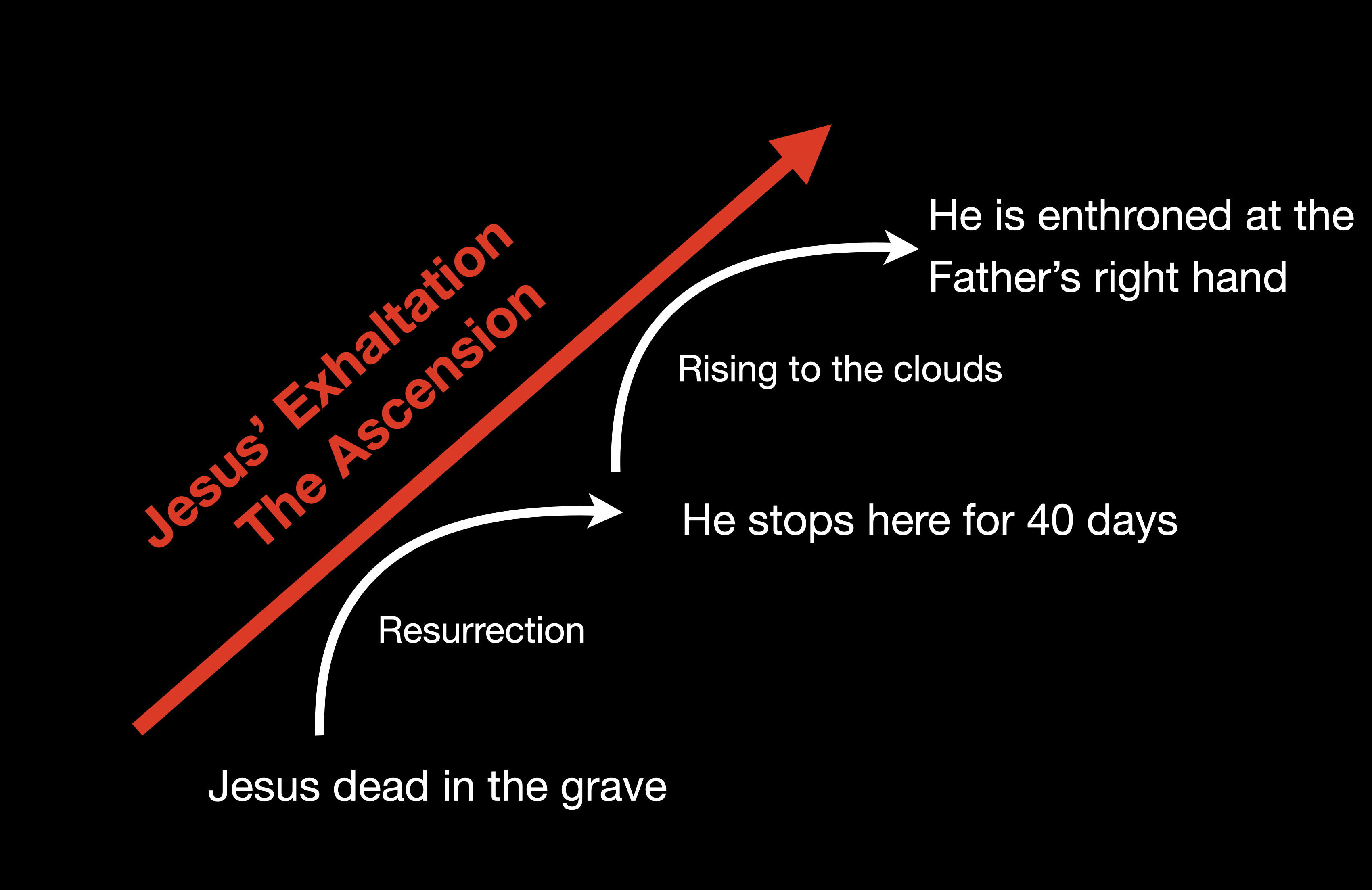
The Bible discusses the ascension almost as part of the resurrection. Jesus was dead, then he rose from the grave in bodily form, but a glorified body (It was recognizable but not so easily. He was able to pass through walls or appear instantly.). But it is still a human body, bearing the scars of his crucifixion. He rises from the dead, then stops off here, like a short layover for 40 days for some unfinished business. He wants to ensure the disciples accept his return to life by seeing him. He needs to make sure their guilt over denying him does not keep them from doing the work, and then he needs to give them final instructions on their ministry and the need to wait on the gift of the Spirit.
Then he ascends in his glorified human body to sit at the right hand of the Father. So we have Jesus, in his human body, in God’s space. The New Testament writers often speak of Jesus’ exaltation: his resurrection, rising to heaven, and enthronement as one process, the ascension. Jesus has opened the door for us to be with God again one day.
Jesus tried to explain this to Nicodemus:
John 3:13-15 No one has ascended into heaven except the one who descended from heaven, the Son of Man. And as Moses lifted up the serpent in the wilderness, so must the Son of Man be lifted up, that whoever believes in him may have eternal life.
No one ascends to God’s space except Jesus. The only way we go is if we go with him. There is no other way. The Son of Man must be lifted up — This encompasses the crucifixion, the resurrection, and the ascension. Jesus was lifted up on the cross, lifted up from the grave, and then lifted up into the skies. Because of this, we may have “eternal life,” which is life in God’s space.
And what is Jesus doing there? Jesus is at the right hand of God, acting as our high priest. In the Bible, priests served God and God’s people by mediating between God and man before God’s altar, where God’s space and our space meet. The book of Hebrews is full of statements of how Jesus is fulfilling the priestly role in God’s space now. I will discuss three of these priestly roles Jesus is doing now: He intercedes for us; He presents a sacrifice for us, and He provides a blessing to us.
Hebrews 7:25 Consequently, he is able to save to the uttermost those who draw near to God through him, since he always lives to make intercession for them.
What does Jesus’ intercession look like? You have heard Romans 8:31, “If God is for us, who can be against us?” But did you realize that verse was talking about Jesus’ intercessory role?
Romans 8:31-34 “What then shall we say to these things? If God is for us, who can be against us? He who did not spare his own Son but gave him up for us all, how will he not also with him graciously give us all things? Who shall bring any charge against God’s elect? It is God who justifies. Who is to condemn? Christ Jesus is the one who died—more than that, who was raised—who is at the right hand of God, who indeed is interceding for us.
Who can be against us? Who can be our accuser? Remember in the book of Job, when the Satan (the accuser) comes to bring a charge against Job? Paul tells us no one can bring a charge against those in Christ. Let the accuser come. He has no charges to bring against us because Jesus has taken them all away on the cross. Jesus is at God’s throne, so no one can come to accuse. If Jesus is for us, then no one can come against us. He is always making intercession for us, speaking to the Father on our behalf.
As Jesus in His final days prayed for Peter:
Luke 22:31 Simon, Simon, behold, Satan demanded to have you, that he might sift you like wheat, but I have prayed for you that your faith may not fail.
Jesus is in heaven, praying for you that your faith will not fail. And Jesus understands your temptation. Look at this passage in Hebrews 4:14-16. First verse 14:
Hebrews 4:14 Since then we have a great high priest who has passed through the heavens, Jesus, the Son of God, let us hold fast our confession.
The fact that Jesus is present as our high priest in the throne room of God should encourage us.
Hebrews 4:15 For we do not have a high priest who is unable to sympathize with our weaknesses, but one who in every respect has been tempted as we are, yet without sin.
Humanity is represented in heaven right now, because Jesus is there in his human body, his glorified human body. Jesus did not give up his humanity, so he can better represent us there. He understands us. He has been where you are, experiencing all the temptations, all the weaknesses. Jesus knows us. He gets us. And he speaks to the Father on our behalf.
Hebrews 4:16 Let us then with confidence draw near to the throne of grace, that we may receive mercy and find grace to help in time of need.
So then, we can come to God’s throne when we are in need with confidence. We don’t approach God’s throne as a lowly subject fearful of the King’s response, but we come sure in the grace of our Lord Jesus, confident that he has paved the way to the throne with intercession.
Remember a few weeks ago we talked about the difference in the 2 fig trees (April 27, 28 A.D. – Jesus rides in a parade, rearranges furniture, and kills a tree.— The Year of the Lord’s Favor #80). Jesus tells a parable in Luke 13:6-9 of a fig tree that should have fruit but does not for three years. The owner wants to dig it up and discard it, but it is given another chance. Then, in his final week, Jesus sees a tree that should have fruit, but does not, and it dies. Why does this tree wither, but the other gets another chance? Because the tree in the parable has an intercessor, someone to speak for it and ask for another chance. Jesus is our intercessor, sitting by the Father, seeking mercy and forgiveness for us.
We often ask our friends to pray for us, to intercede for us. And that is a good thing. But sometimes we may forget to pray for each other. Jesus is at the Father’s right hand, praying for you. He is lifting you up by name. He is speaking to the Father, calling you his brother or sister. He is praying, O Father, help her see the truth of this scripture. Father, help her understand how she should respond. Oh, what a Savior!
Secondly, Jesus, our High Priest, provides a sacrifice for us.
Hebrews 5:1 “For every high priest chosen from among men is appointed to act on behalf of men in relation to God, to offer gifts and sacrifices for sins.”
Just as the altar stands between the holy place and the people, the priest stands between the people and God. He offers a sacrifice to God on behalf of the people and then offers a blessing from God to the people. And once a year, and only once a year, on Yom Kippur, the Day of Atonement, the High Priest would make an offering and prepare himself, then ascend the 12 steps leading up to the thick curtain that separated the holy place from the Holy of Holies. This curtain or veil was embroidered with cherubim, signifying the priest was entering God’s space. He would take the blood of the offering to present to God by sprinkling it on the mercy seat.
Every year, this would be repeated to make atonement for the sins of all the people. But it was not a perfect system. The priests were also sinners and had to make offerings for their sins constantly. But they looked forward to a time when there would be a great high priest who could ascend to God’s space without sin.
David asked in Psalm 24:
Psalm 24:3-4 “Who shall ascend the hill of the LORD? And who shall stand in his holy place?
He who has clean hands and a pure heart, who does not lift up his soul to what is false and does not swear deceitfully.”
And this would be fulfilled in Jesus. He was without sin, he had clean hands and a pure heart. He is the only one worthy to ascend to God’s space and stand in God’s presence. And because we are covered with his righteousness, we will stand in God’s presence.
Hebrews 9:11-14 “But when Christ appeared as a high priest of the good things that have come, then through the greater and more perfect tent (not made with hands, that is, not of this creation) he entered once for all into the holy places, not by means of the blood of goats and calves but by means of his own blood, thus securing an eternal redemption. For if the blood of goats and bulls, and the sprinkling of defiled persons with the ashes of a heifer, sanctify for the purification of the flesh, how much more will the blood of Christ, who through the eternal Spirit offered himself without blemish to God, purify our conscience from dead works to serve the living God.”
The sacrifice Jesus makes for us is himself, a perfect sacrifice. Though the high priest would enter the holy of holies only once a year, priests in Israel would make many sacrifices every day. Besides the offerings that people brought, twice a day, every day, a lamb was sacrificed, called the tamid offering, for the sins of the people. Tamid means “continual” or “constant.” Their sacrifices were never complete.
Hebrews 10:11-14 And every priest stands daily at his service, offering repeatedly the same sacrifices, which can never take away sins. But when Christ had offered for all time a single sacrifice for sins, he sat down at the right hand of God, waiting from that time until his enemies should be made a footstool for his feet. For by a single offering he has perfected for all time those who are being sanctified.
Unlike the earthly high priest who had to make sacrifices daily, Jesus’ perfect sacrifice is once for all. His crucified body, still bearing the scars, is always before the Father as our perfect sacrifice. No other blood sacrifices are needed.
The third aspect of the work of the high priest that Jesus is fulfilling for us is blessing. In the Old Testament, when the high priest completed his sacrifices, he left the tent of meeting, lifted up his hands, and blessed the people. We see this initiated with Moses and Aaron:
Leviticus 9:23 And Moses and Aaron went into the tent of meeting, and when they came out they blessed the people, and the glory of Yehovah appeared to all the people.
And the book of Numbers gives us the blessing they would use.
Numbers 6:22-27 Yehovah spoke to Moses, saying, “Speak to Aaron and his sons, saying, Thus you shall bless the people of Israel: you shall say to them,
‘Yehovah bless you and keep you;
Yehovah make his face to shine upon you and be gracious to you;
Yehovah lift up his countenance upon you and give you peace.’
So shall they put my name upon the people of Israel, and I will bless them.”
Aaron and the priests were to place God’s name, Yehovah, on them and bless them. The blessing is the presence of God among them, shining his face on them, regarding them, and giving them peace. Peace is shalom, wholeness, peace with God and man.
And what blessing does our High Priest, Jesus, grant us from the heavens? Jesus enters God’s presence and then, as priests of old did, sends us the blessing of God’s presence. But this blessing of presence comes not as the priests of old placing God’s name on them. This blessing of presence comes by placing God himself in us, in the person of the Holy Spirit, sent in the name of Jesus, Yeshua, to dwell with us. This presence of God within us will enlighten us and give us shalom.
John 14:25-27 “These things I have spoken to you while I am still with you. But the Helper, the Holy Spirit, whom the Father will send in my name, will teach you all things and bring to your remembrance all that I have said to you. Peace I leave with you; my peace I give to you.
John 16:7 Nevertheless, I tell you the truth: it is to your advantage that I go away, for if I do not go away, the Helper will not come to you. But if I go, I will send him to you.
Like the High Priests of old, Jesus had to present himself as the sacrifice before the Father in God’s space, the heavenly temple. After presenting the sacrifice, He gave the blessing of the Holy Spirit. That is why Jesus had to ascend before the Spirit could be sent down.
With his ascension, the door was opened from God’s space to our space. He has not only made our eventual ascension possible but also opened the door for God to come in a more tangible way into our space. Individuals in the Old Testament were temporarily clothed with the Holy Spirit to do specific deeds: leaders like Saul and David, craftsmen like Bezalel, and prophets like Ezekiel and Daniel. But when Jesus enters God’s space in his glorified human body, He opens the door for God’s spirit to come upon all believers, not just temporarily, but to live with us. He cleanses us from sin so we can be fit vessels of God’s Holy Spirit.
What about those who think it would be better if Jesus had stayed on earth? Wouldn’t it be great for Jesus to be right here now? We could ask him questions, get his advice, and watch him work. Yes, but remember when Jesus was here in 28 AD, he was limited in his human form. He could only be in one place at a time. And this is a big world. He was only able to minister to a relative few. But now that same spirit of Jesus, the Holy Spirit, is with every believer, every day, every hour. He is available to answer our questions and give us advice. Oh, we need to learn to listen to his voice and open our eyes to see him at work all around us.
So we have seen that Jesus had to ascend to God’s space to complete his work of salvation, to continue his work of intercession, and to convey his blessing of the Holy Spirit from God’s space to ours.
The ascension is Jesus’ enthronement. He sits on the throne at the Father’s right hand to do all these things and then one day to come again, to establish his complete rule by making God’s space and Man’s space one again. And so shall we ever be with the Lord.
- Schreiner, Patrick. The Ascension of Christ: Recovering a Neglected Doctrine (Snapshots). Page 7.
- Isaiah 32:15-20, 44:3-5, Ezekiel 11:19, 36:26, Joel 2:28-3:1, Zechariah 12:8-10
An addendum on the Gospel of Mark ending that contains the ascension:
There are two Gospel passages that tell about Jesus’ ascension. However, most scholars agree that the passage in Mark is not part of the original document of Mark’s Gospel, but was appended by some unknown person over two hundred years later. The early church fathers, before 300 AD, did not have Mark 16:9-20 in their copies of Mark. Church historian Eusebius, in 320, had access to many manuscripts of Mark, and he remarked that this passage was missing in almost all manuscripts. Ending the Book of Mark at 16:8 is a rather abrupt conclusion, and apparently someone ‘borrowed’ material from other gospel writers to make a more thorough conclusion.
This is one of just a few passages that scholars agree have been appended to the scriptures. You may find them enclosed in brackets or with a footnote in modern versions of the Bible. None of them are important variations, theologically speaking.
I cannot find any source that discusses where the verses on drinking poison and picking up serpents came from. There is a verse in Luke 10:19, and Paul was inadvertently bitten by a viper with no ill effects, but nothing else I can find. (If you know of something, please let me know.). In the Tyndale Commentary, Alan Cole says this: “It would be unwise, however, to build a theological position upon these verses alone; and this no responsible Christian group has ever done.”
And I sat in the furthest back pew (there were only 5), one evening at a small church near Kingston, Georgia, who did just that. They had that verse from Mark inscribed around the tops of the walls at the front of the church. There was a lot of music, several snakes were handled, but no one took the Coke bottle with clear liquid on the altar. While I can’t agree with their theology or practice, I admired their resolve. May we be so bold as to do what Jesus asks us to do.
 Swallow No Camels