
July 1 – Asking the Right Question About Pentecost — Acts #4
Acts 2:1-13
Acts 2:1-13 When the day of Pentecost arrived, they were all together in one place. And suddenly there came from heaven a sound like a mighty rushing wind, filling the entire house where they were sitting. And divided tongues as of fire appeared to them and rested on each one of them. And they were all filled with the Holy Spirit and began to speak in other tongues as the Spirit gave them utterance.
Now there were dwelling in Jerusalem Jews, devout men from every nation under heaven. And at this sound the multitude came together, and they were bewildered, because each one was hearing them speak in his own language. And they were amazed and astonished, saying, “Are not all these who are speaking Galileans? And how is it that we hear, each of us in his own native language? Parthians and Medes and Elamites and residents of Mesopotamia, Judea and Cappadocia, Pontus and Asia, Phrygia and Pamphylia, Egypt and the parts of Libya belonging to Cyrene, and visitors from Rome, both Jews and proselytes, Cretans and Arabians—we hear them telling in our own tongues the mighty works of God. And all were amazed and perplexed, saying to one another, “What does this mean?” But others mocking said, “They are filled with new wine.”
We are continuing to discuss what happened at Pentecost. As I said last week, it is a turning point in history. As we journey through the Book of Acts, we will consider the implications of this watershed moment. On that day, when God chose to send the blessing of His presence, the Holy Spirit, to dwell in His followers, He came in an undeniable fashion. We have discussed the sound of the wind and the fire, and how they paralleled the manifestation of God’s presence at Sinai and the dedication of the tabernacle and the temple. No one there thought it was just another day. Something amazing happened. So today I want to consider what happened next. How did the people respond to this incredible event?
First, Luke says they were “amazed and astonished”. We tend to use these words interchangeably today. The Greek word we translate as ‘amazed’ describes people who have witnessed something so extraordinary that they are filled with wonder and awe. It was a common reaction to Jesus’ miracles. The word translated as ‘astonished’ carries more the idea of shock that something totally unexpected happened. So, you could say the reaction was one of “shock and awe.”
Then, after Luke describes the nations the people came from, the scripture again tells how the people responded. This time, it divides the people into two groups with different responses. The first group has a similar reaction:
Acts 2:12 And all were amazed and perplexed, saying to one another, “What does this mean?”
Again, the word ‘amazed’ (awed, filled with wonder) and now ‘perplexed’, a different Greek word that means you can’t understand what has happened. It is too difficult to unravel. Because they are bewildered and puzzled, they ask, “What does this mean?”
Perhaps you can relate to these people witnessing a religious service unlike any they have ever seen before. Has this happened to you? I was 15 years old and had been attending a youth group at a small Methodist Church for about six months. It was like any other small Methodist Church in the southern US in the 1970s—traditional service with hymns and preaching. Occasionally, someone in the congregation said “Amen” during the sermon, and everyone turned around to see who said it. The youth group was singing the “new” worship songs like “Pass it On,” “Jesus is the Answer,” or “For Those Tears I Died.” Yeah, we were the cool Jesus people. To be honest, like almost every other 9th-grade boy who attended youth group, I was primarily there because I had a crush on a girl.
One Sunday night, the youth choir sang, and then the preacher stood up and began preaching. It was then that it happened. A man in the second row stood up in the middle of the sermon and started speaking in tongues. I had the “shock and awe” response. And then after he finished, someone else stood up and translated what the first man said. And I am still in ‘’shock” mode. Then one of the youth on my pew stood up and started speaking in tongues. And it was, you guessed it, the girl (my secret crush). From that point on, I honestly have no memory of what happened next. I was undone. I had never heard of anything like this. I am sure I had read about tongues in the Bible before, but I had never heard anyone discuss it, much less suggest that it might still happen. I didn’t know how to process what I had just witnessed. “Awed and Puzzled”? Yes, that was me. And that lasted for weeks. I understand that the pastor addressed the issue in that service and the following weeks, and the church moved in a more charismatic direction; however, I never returned. I was just too overwhelmed. I had the question in my mind, “What does this mean?” but I didn’t stick around for the answer.
So all are shocked and awed by the fire and the wind, and hearing the people in their own language. And then one group doesn’t understand what is going on, so they ask the question, “What does this mean?” Then the other group:
Acts 2:13 But others, mocking, said, “They are filled with new wine.”
They are mocking. They are poking fun at God’s miracle. They laugh and say these people are drunk. They see something that does not fit into their paradigm, and they react with scorn. Remember, all of these people there in the Temple that day consider themselves devout Jews. Some have traveled for weeks to attend this religious festival. They are in the Temple at 9 in the morning for worship. You have got to be serious about God if you show up for a worship service before 9 am. Yet some are scoffers.
So why are these devout Jews mocking? God shows up in a way they never expected and in a way they could not explain, and their reaction is bitter. Something different happened in church. I can hear them now…”Woah! We’ve never done it that way. That’s not worship, because that is not the way I do it.” “Next thing you know, they’ll be raising their hands and using TV screens in the church.” If God should show up in a way different from what you already know or have expected, be careful not to jump to mocking.
Galatians 6:7 (Amplified version) Do not be deceived, God is not mocked [He will not allow Himself to be ridiculed, nor treated with contempt, nor allow His precepts to be scornfully set aside]; for whatever a man sows, this and this only is what he will reap.
You reap what you sow. You don’t want to plant seeds of mockery.
This crowd of Jewish worshipers reacts in two distinctly different ways. How would we react? It is hard to say, but we can say how we react when we read about it. We live in a world of reason. We like to rationalize and explain things. So often, most of the questions we ask when we read this story are about what exactly happened and how it happened. We ask questions like:
What were they saying?
Was it unintelligible babbling, or were they speaking different languages they didn’t know?
Were the people all hearing it in their own language, no matter what they said?
Were they all saying the same thing?
If so, what were they saying?
How long did this go on?
Was it just the apostles or the 120 disciples?
Were the men and women both speaking?
Were you wondering about any of these questions?
I found many commentaries and articles that went on and on about answers to these questions. But I’m not going to try to answer any of these questions, because I really think all of these are the wrong questions to ask at this point. Of those two groups, the ones who were receptive to the message, the ones who weren’t mocking, asked the right question: “What does this mean?” That is the question we should be asking. Remember when Jesus healed the man who was born blind?
John 9:1-3 As he passed by, he saw a man blind from birth. And his disciples asked him, “Rabbi, who sinned, this man or his parents, that he was born blind?” Jesus answered, “It was not that this man sinned, or his parents, but that the works of God might be displayed in him.”
The disciples asked, “Whose fault is this? Blindness from birth must be the result of sin.” Jesus said that was the wrong question. The right question is, “How is God going to use this man’s blindness for good?” I don’t believe it is God’s will that anyone be born blind. God designed a world without sickness or blindness. Blindness is the result of living in a broken world. God is going to use this man’s blindness for good to show his work and bring glory to himself.
This is how we should view the world. War occurs, disasters happen, peace comes and goes, health issues emerge, friends pass away, babies are born, people help you, and others disappoint you. In all these moments, we shouldn’t ask the wrong questions. We shouldn’t ask whose fault it is. The correct questions are, “What does this mean for the kingdom of God?” or “What is God doing here?’
After the Spirit descends, Peter stands with the eleven and delivers a sermon. In this sermon, he shares what they don’t know. He explains that this is the fulfillment of the prophecy they’ve read for years, what Joel predicted would happen in the last days. The Spirit would be poured out on everyone—men, women, slaves, and free. Everyone who calls on the name of the Lord will be saved. Jesus is the promised Messiah. Peter discusses Jesus’ ministry, His crucifixion, and His resurrection. This is what they didn’t know. But God is doing something else that they would immediately recognize. All of them were Jews, very familiar with their scriptures. There is something else happening here that is so obvious that Peter doesn’t need to mention it. But it may not be obvious to us, because the Old Testament scriptures don’t hold as much importance in our minds as they did to these people. So let’s walk through it.
Remember the big story of the Bible: God created the world, and everything was good. Mankind introduced sin and death, which caused a separation between God and His people. Everything after Genesis 3 focuses on how God is correcting all the wrongs and fixing what was broken to restore His relationship with His people so that they can dwell together again.
Peter explains in his Pentecost sermon that through Jesus’ life, death, resurrection, and ascension, God is repairing what went wrong in Genesis 3. Jesus overcomes both sin and death, then sends the Holy Spirit so God can dwell with humans again, even while we still live in a broken world. Now look at what else is happening that Peter doesn’t mention. While Jesus is fixing what went wrong in Genesis 3 through the actions of the Spirit on that Pentecost, God is also fixing what went wrong in Genesis 11.
First, let’s go back to our scripture. Luke tells us :
Acts 2:1 When the day of Pentecost arrived, they were all together in one place.
Then skip down to verse 5, where he adds some detail about who was there:
Acts 2:5 Now there were dwelling in Jerusalem Jews, devout men from every nation under heaven.
Then, in verse 9, he lists all the places they came from.
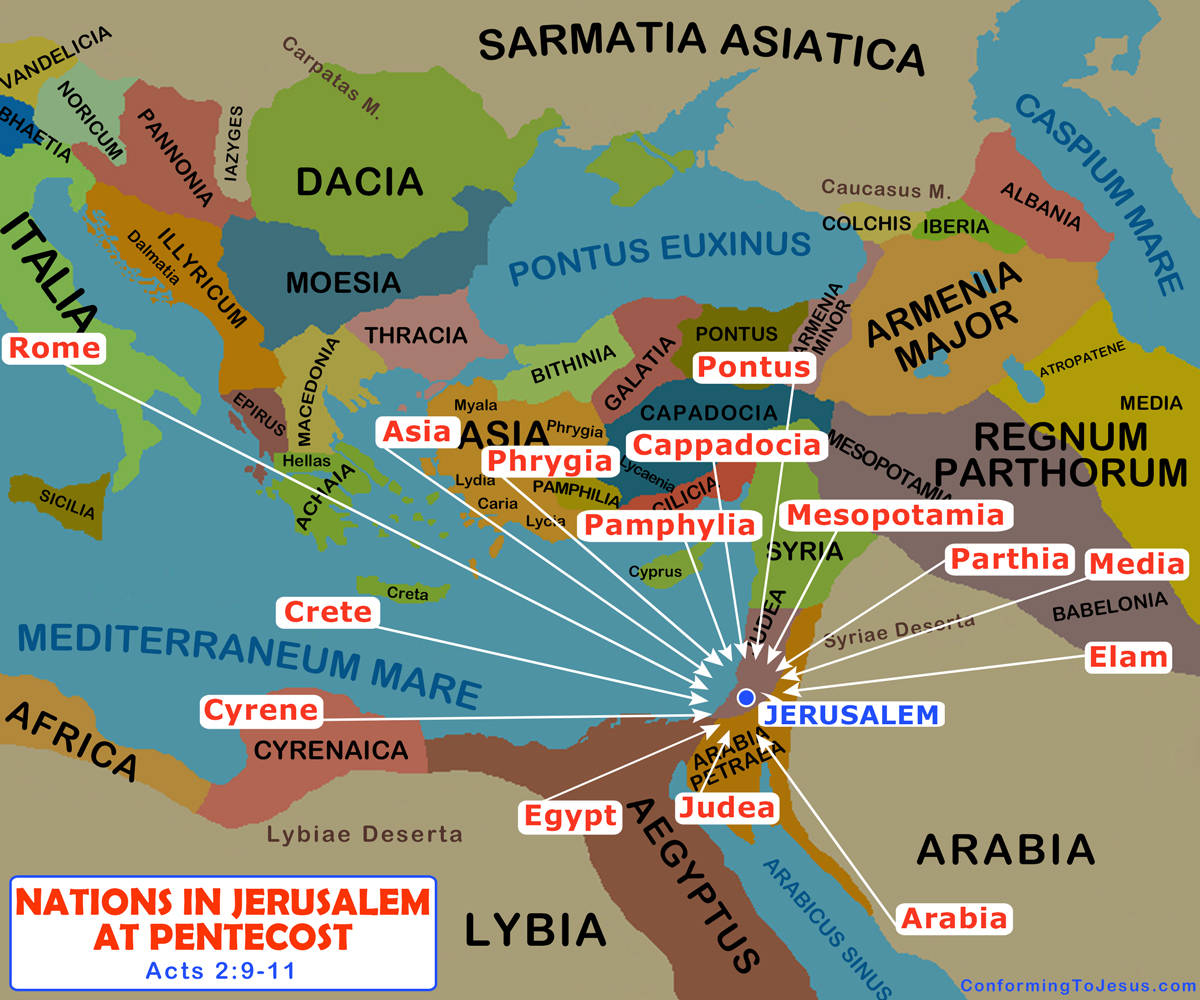
Acts 2:9-11 Parthians and Medes and Elamites and residents of Mesopotamia, Judea and Cappadocia, Pontus and Asia, Phrygia and Pamphylia, Egypt and the parts of Libya belonging to Cyrene, and visitors from Rome, both Jews and proselytes, Cretans and Arabians…
Here is a map of the places that Luke mentions; it is most of the known world at the time. Devout Jews had traveled from all these places to gather in one place in Jerusalem. Why does Luke go into such detail about who is there? Because if you know your Bible, you know there is another place in the Bible where you can find a very similar list of nations. It is way back in the Bible in Genesis 10 where the scriptures show how Noah’s sons and their descendants scattered to follow God’s command to be fruitful and fill the earth.
Here is the area listed in Genesis 10 where all the people after Noah scattered to. And three times in Genesis 10, it says these were all separated into their lands by their languages.
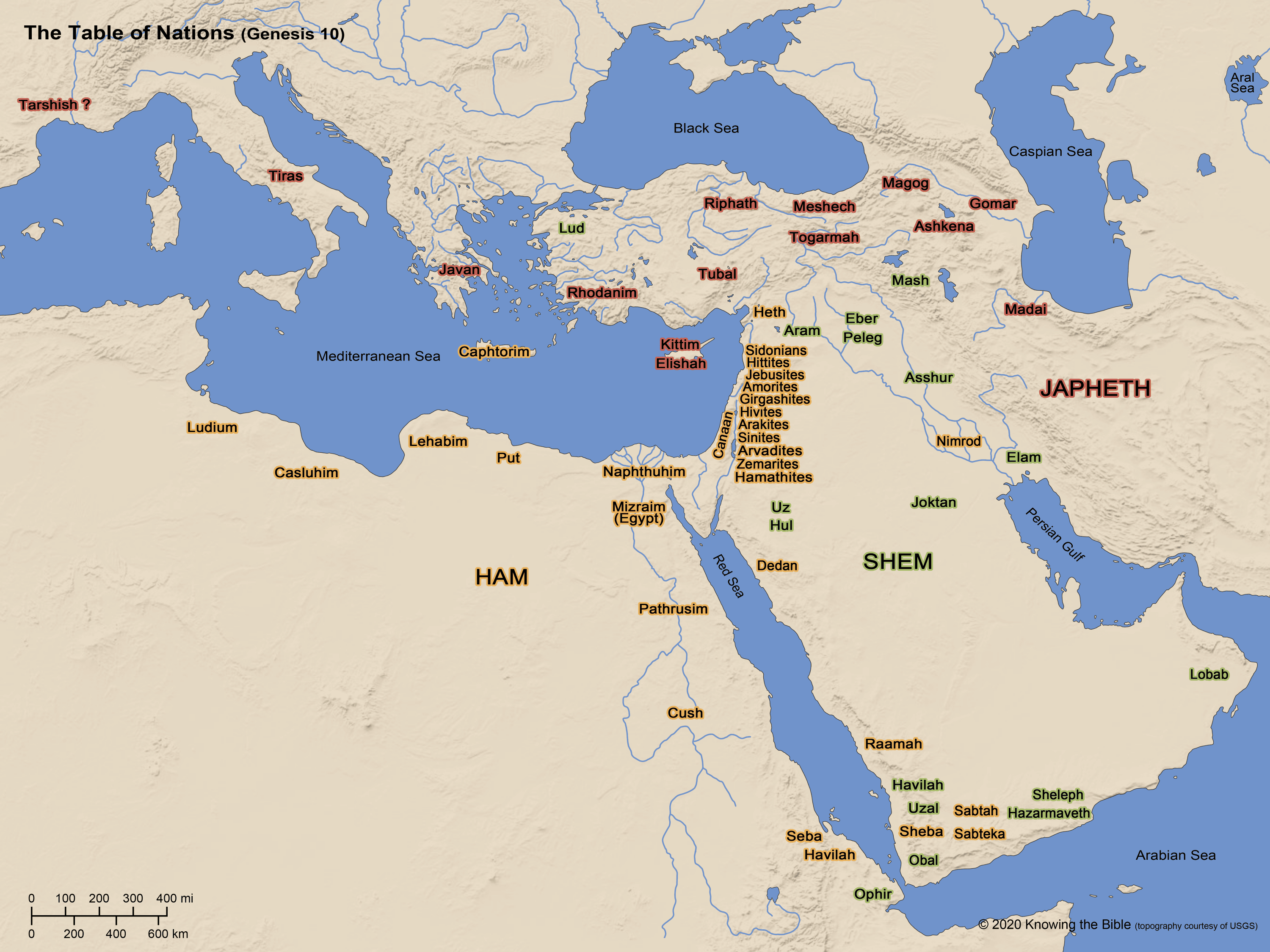
Now, don’t be confused, because this list of nations in Genesis 10 describes the results of what happened in Genesis 11. In our culture, we like our books to be in chronological order. First things first. However, in Old Testament times, they weren’t as concerned with chronology, and therefore, you will see them present events out of chronological order for various reasons. For example, Numbers 9 clearly happens exactly 1 month before Numbers 1. Genesis 11 (the story of the tower of Babel) is the event that leads to the scattering of people to all the nations listed in Genesis 10.
Luke takes the time to list all the countries from which people came on Pentecost because he wants you to recall the other list in Genesis. He wants you to see the connection between what happened in Genesis and what is happening at Pentecost. Let’s back up and look at the pattern of events in the first 10 Chapters of the Bible.
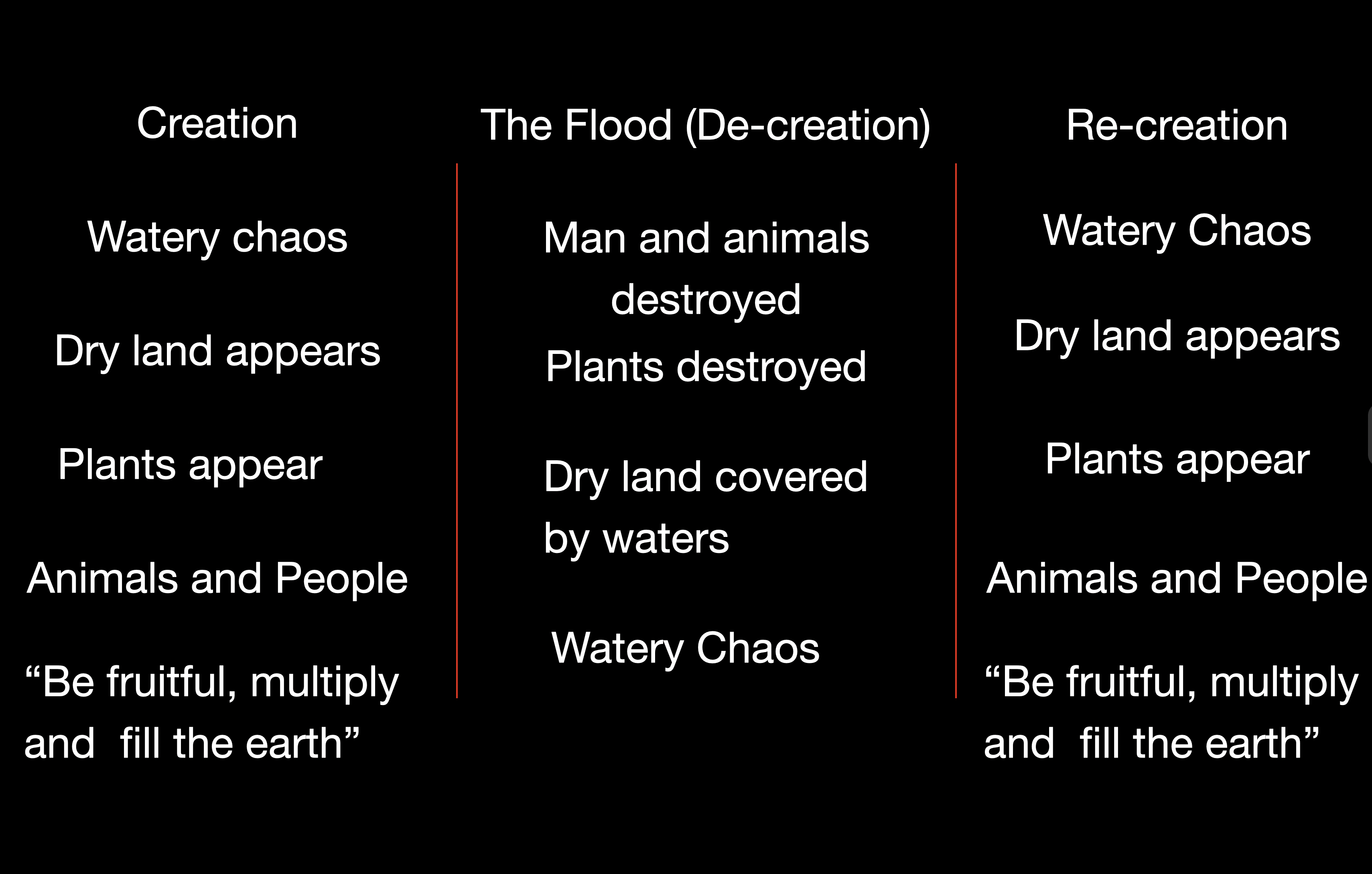
Creation. The spirit hovers over the chaos waters. God makes dry land appear, then plants to grow, and populates the world with animals, and then places man. He tells man to be fruitful, multiply, and fill the land. After the fall, things go downhill very fast. So in Genesis chapter 6:
Genesis 6:5-6 Yehovah saw that the wickedness of man was great in the earth, and that every intention of the thoughts of his heart was only evil continually. And Yehovah regretted that he had made man on the earth, and it grieved him to his heart.
“Every intention of the heart was only evil continuously.” That’s bad. How does God respond?
Genesis 6:7-8 So Yehovah said, “I will blot out man whom I have created from the face of the land, man and animals and creeping things and birds of the heavens, for I am sorry that I have made them.” But Noah found favor in the eyes of Yehovah.
But Noah found favor. It is the Hebrew word ‘chen’, which means ‘grace’. Noah found grace.
So God causes a flood. We are meant to see the flood as a de-creation event. It is creation backwards. Man is destroyed, animals and plants are destroyed, and the chaotic waters again cover the land. It is creation in reverse. Only a remnant is saved through grace on an ark.
Then, like a re-creation event, you start with everything in a watery chaos, and then the waters recede, revealing dry land. The emergence of plants follows this, and then animals and humans are placed back on the land, on Mount Ararat. And God tells them again to be fruitful and fill the land.
But just like after the first creation, things go downhill quickly. Sin abounds. And instead of filling the land, they rebel and choose to stay in one place, and build a city and a tower to make themselves great, to reach up to heaven and be great like God. You know this story:
Genesis 11:1-4 Now the whole earth had one language and the same words. And as people migrated from the east, they found a plain in the land of Shinar and settled there. And they said to one another, “Come, let us make bricks, and burn them thoroughly.” And they had brick for stone, and bitumen for mortar. Then they said, “Come, let us build ourselves a city and a tower with its top in the heavens, and let us make a name for ourselves, lest we be dispersed over the face of the whole earth.”
Let US make bricks, build OURSELVES a city and a tower. Let US make a name for OURSELVES. God has no place in the actions of the people building this great city and tower. He is forgotten or ignored. What God says doesn’t matter. We can decide for ourselves what is right and wrong. It is all about me! God had commanded them to multiply and fill the earth, but they had forgotten this instruction; instead, they wanted to remain where they were.
They wanted to reach up to heaven. That doesn’t sound like it has to be a bad thing. After all, God’s goal is to dwell with humanity again, as He did in the Garden. But they didn’t want to do it God’s way; they wanted to do it on their own, in their own way. They thought they could reach up to heaven all by themselves. They could do it without God. Just as in Genesis 3, humanity is attempting to exceed its limits. “Let us build a tower with its top in the heavens” sounds a lot like what the serpent said, “And you will be like God.” “Let us make a name for ourselves.” Then all people will honor us and give us praise and glory. This is Genesis 3 all over again on a larger scale.
This is similar to Adam and Eve’s desire in Genesis 3. Knowing the difference between good and evil is not a bad thing. It is really important to understand the difference. That is one of our most important jobs as parents: to teach our children right from wrong. But the problem in Genesis 3 is that they didn’t want God to tell them or teach them; they wanted to reach out and take it for themselves. No thanks, God, we don’t need you to instruct us; we’ll decide right and wrong on our own. They could accomplish this without God. They could be Gods themselves—their own gods. That’s like a 2-year-old screaming at his parents, “But that’s not fair! I want to make my own rules!” God wants them to learn to judge right and wrong.
However, it must be His own definition of right and wrong. This first sin in Eden still plagues us today. We think we can legislate morality. But we are not at liberty to alter God’s definition of right and wrong when we feel like it. We can’t change right and wrong by voting on it. It doesn’t matter what Congress, the president, or the Supreme Court says. There is only one that determines right and wrong, and it is not a court that calls itself ‘supreme’, but it is the Supreme Being, Yehovah God, King of the universe. He is the sole judge of right and wrong.
We live in a great country and have enjoyed a long time of success and prosperity. The danger with greatness is that you may forget how you got there. Moses warned the people in Deuteronomy that when they became prosperous in the land, they would forget God. They would forget God’s rules and decide they can make their own rules and be their own God. We need to pray for repentance and revival in our country.
Adam and Eve decide they can’t live by God’s rules. They reject him as king, so God intervenes. They are forced to leave the garden. Now look how God intervened in Genesis 11:
Genesis 11:5-7 And Yehovah came down to see the city and the tower, which the children of man had built. And Yehovah said, “Behold, they are one people, and they have all one language, and this is only the beginning of what they will do. And nothing that they propose to do will now be impossible for them. Come, let us go down and there confuse their language, so that they may not understand one another’s speech.”
I like how it says, “Yehovah came down to see the city and the tower…” This is how fruitless their godless attempts were. They are trying to reach up to heaven, and yet God has to come down to reach them. God says their unity is a bad thing. Being united is only good if we are united under God. The people of Babel were united for themselves. So God intervenes. He divided their languages, which forces them to abandon their construction project as they can no longer communicate with each other. They naturally separate into their various language groups and begin to fulfil God’s plan to fill the earth.
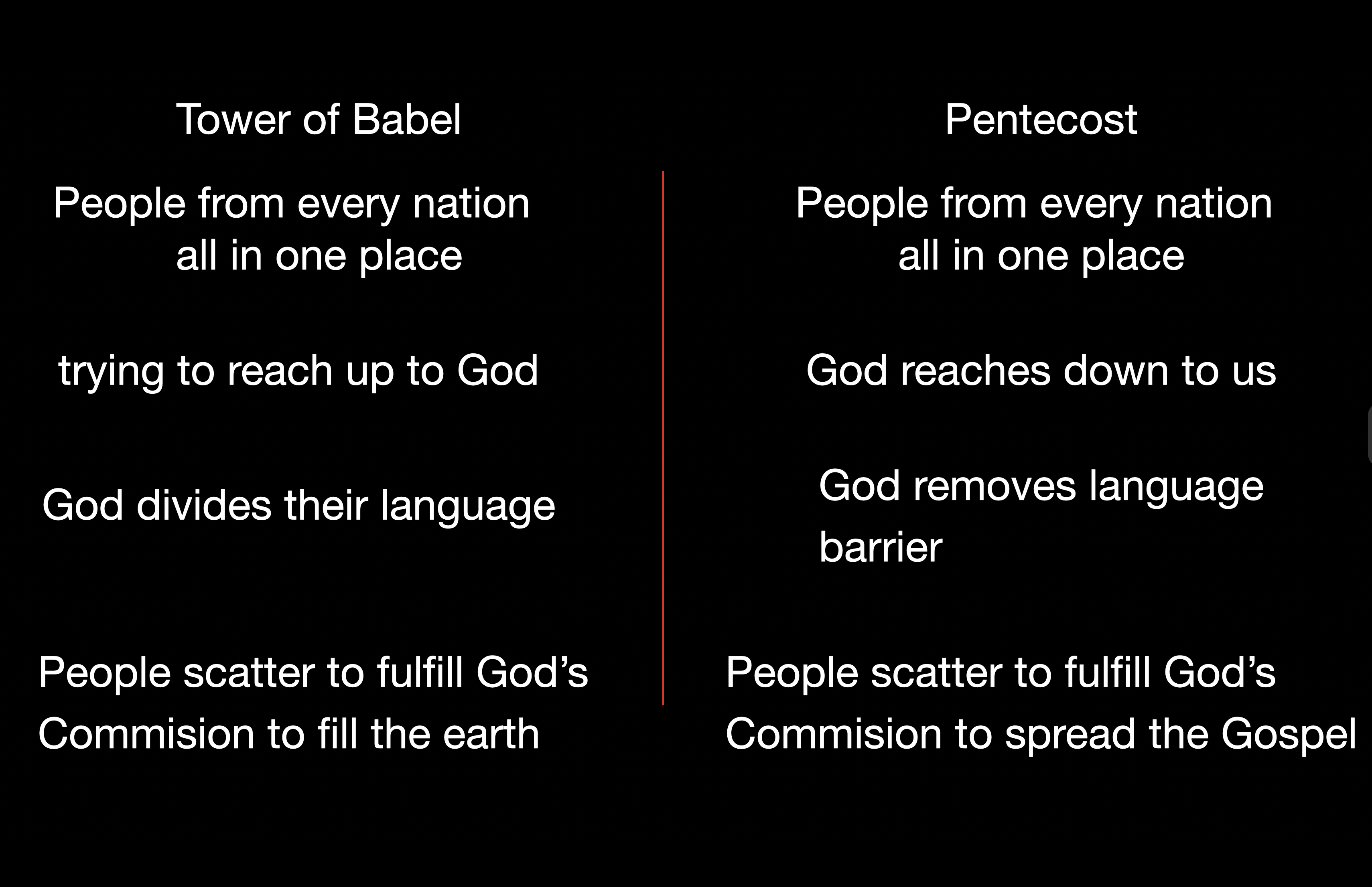
At Pentecost, God is repairing what went wrong in Babel. At Babel, there were people from every nation all in one place. They were trying to reach up to God’s space. But that is impossible. We can’t make our way to heaven on our own. Then God divides their languages to end their communication and thus bring an end to their sinful project. This causes people to scatter in order to fulfill God’s command to fill the earth.
At Pentecost, Luke tells us that they were devout men from every nation, all gathered together in one place. And God reaches down to them by sending His Holy Spirit to abide with them. He removes the barrier of different languages so they can communicate. And the communication is not man’s words, to glorify man, but God’s words to bring glory to God. Then the people go back to all the nations, where they will fulfill God’s Great Commission to disciple others by sharing the good news of Jesus. God is again intervening in the world to redeem what went wrong.
The more you study the Bible, the more you see these patterns. The Bible is a collection of books intricately designed because God wants you to see how he consistently deals with His people. The more we study His Word, the better we will recognize these patterns as well as God’s actions in our world today. And that is important. These people in Acts 2 asked, “What does this mean?” I am afraid that we often look at the events of the world around us, just as the disciples looked at the man born blind. They were asking the wrong questions, “Whose fault is this? Why was he born blind?”
Another war breaks out, more disasters occur, peace comes and goes, health problems develop, friends die, babies are born, people come to your aid, and others fail you. Throughout these times, we should not ask, “Whose fault is this?” or “Why did this happen?” The right question is, “What does this mean for the kingdom of God?” or “What is God doing here?” Look for God moving every day, all around you. Don’t live like the people in Babel, ignoring God or pretending He doesn’t exist.
I can’t tell you exactly what you would have heard if you were there on that Pentecost Sunday in the Temple in Jerusalem. I can’t describe what the fire looked like or exactly what the noise sounded like. I can’t tell you what the disciples said that everyone heard in their own language. But that’s okay, because that is not what is important. I can answer the question that those receptive to the disciples’ speaking asked. “What does this mean?”
It means God’s plan to reunite His Spirit with humans is happening, just as Joel predicted. It means we, like the disciples, can experience the presence of God living in us through the same Holy Spirit that descended upon them like fire. God is multiplying his presence in this world; the Kingdom of God is now. The problem at Babel is now solved. We can, through the Holy Spirit, be united under God..
After the Flood, God made a promise. He put a bow in the sky and said
Genesis 9:11 Never again shall there be a flood to destroy the earth.
God would never again cover the earth with the waters to destroy. However, God did promise that He would cover the earth again. With what?
Isaiah 11:9 For the earth shall be full of the knowledge of Yehovah as the waters cover the sea.”
And the same Holy Spirit that came down on the disciples is in you. And we have that same Commission they had. Every time we gather together in one place in our churches, as they did on that Pentecost morning, we worship as they worshiped. And we should see the Holy Spirit in each other, manifested through the fruits of the Spirit. And then when we walk out these doors, we will scatter to different parts of our world with the same goal. To disciple all we come in contact with. Let us flood the earth with the love, mercy, and grace of our God.
 Swallow No Camels