August 26, 2025 –  The Priests’ Response — Acts #10

September 2, 2025 –  The Priests’ Response — Acts #10
Acts 4:13-22

Recap:  John and Peter were on their way to the 3 pm Temple service, and healed a man who had been paralyzed from birth and begged at the gate.  He followed them into the Temple, and there was an uproar over his healing.  Peter and John explained (in a several-hour sermon) that Jesus healed him and was the Messiah.  The High Priest had them arrested and jailed overnight.  The next morning, they questioned Peter and John, who again told them that Jesus, whom they killed, was resurrected and is the Messiah, and he is responsible for the healing.  

Acts 4:13-22  Now when they saw the boldness of Peter and John, and perceived that they were uneducated, common men, they were astonished. And they recognized that they had been with Jesus. But seeing the man who was healed standing beside them, they had nothing to say in opposition. But when they had commanded them to leave the council, they conferred with one another, saying, “What shall we do with these men? For that a notable sign has been performed through them is evident to all the inhabitants of Jerusalem, and we cannot deny it. But in order that it may spread no further among the people, let us warn them to speak no more to anyone in this name.” So they called them and charged them not to speak or teach at all in the name of Jesus. But Peter and John answered them, “Whether it is right in the sight of God to listen to you rather than to God, you must judge, for we cannot but speak of what we have seen and heard.” And when they had further threatened them, they let them go, finding no way to punish them, because of the people, for all were praising God for what had happened. For the man on whom this sign of healing was performed was more than forty years old.

Here are Peter and John standing before the elite, most respected people in the city of Jerusalem: the High Priest, the former High Priest, and the who’s who of priests in the land.  And they are just poor country fishermen. They were Galileans, so they spoke with that accent that these elite priests in Jerusalem thought was so unrefined. They didn’t go to the rabbinical schools.  They dressed simply.   And here they are defending their actions in the most prestigious court in the Temple.  Just for a moment, imagine yourself in your best dress overalls, defending yourself before the highest court in the land in your thick Southern accent.  Now you know the situation.

Peter and John should be intimidated.  But everyone there was struck by their boldness.  Surprisingly, they are holding their own and perhaps outdoing these experts of the law, the best-trained biblical scholars there are.  How is this possible? How can these simple fishermen have such a good command of scripture and speak so well?  The answer is back in verse 8 :

Acts 4:8  “Then Peter, filled with the Holy Spirit, said to them…”

They speak through the power of the Holy Spirit.  The same power is available to us today.  

These experts are having the same problem with Peter and John as they had with Jesus, who embarrassed them on multiple occasions when they tried to trap him.  His knowledge of Scripture was way beyond what they would have expected, and they said about him:

 John 7:15  How is it that this man [Jesus] has learning, when he has never studied?

And like Jesus, the disciples supported their teaching with miracles. 

So these chief priests were stuck.  Peter and John had broken no law that they could be punished for, and even if they had, the public support was high for them after this healing.  They couldn’t deny the miracle, as the man was standing before them.  So they brought them back in and threatened them not to talk about Jesus anymore.  (Note that healing is okay, as long as they don’t mention Jesus.)

But there is something else going on here that you don’t need to miss.  And it is not so simple to see because the most important thing to note in this proceeding is something the chief priests don’t do.  What is missing from this discussion?  Peter has just made this statement to them:

Acts 4:19-20  …let it be known to all of you and to all the people of Israel that by the name of Jesus Christ of Nazareth, whom you crucified, whom God raised from the dead—by him this man is standing before you well.

They don’t once refute the apostles’ claim that Jesus was resurrected.  They never argue that point. If they could have, they would have shut down the apostles in a hurry. But they could not.  No one is denying the fact that Jesus rose from the dead.  Too many people had seen Jesus alive after the crucifixion.   It was like the healed man standing before them.  Jesus’ resurrection was a very inconvenient fact for them, but for us it is the hope of glory.  

So these officials are between a rock and a hard place.  They can’t deny that this man has had a miraculous healing.  They can’t deny that Jesus came back to life.  But they can’t allow this Jewish sect that claims Jesus is the Messiah to continue, because it is growing fast.  Now there are 5000 followers in the city.  And this is a city of only 30-40,000.  That is already 12-14% of the population.  Five thousand is a large group, especially if those 5000 are committed and vocal.

In 1950, over 90% of the US identified as Christian. But we all know that number has fallen dramatically.  In the US today, about 65% say they are Christian.  But in that same study, only 45% say that religion is very important to them.1 So there are 20% of people in the US who claim to be Christian but say that it’s not really important.  Can you be a follower of Jesus and think that religion doesn’t matter?

I almost wish we didn’t use the word ‘Christian’.  I prefer “disciple (or follower) of Jesus.”  The word “Christian” is only in the Bible 3 times, whereas the word “disciple” is in the New Testament over 250 times (269). Here’s the problem: “Christian” doesn’t mean the same thing today as it did.  Now people identify as ‘Christian’, saying that if they have to choose a religion, that is the one they would choose.  “If I have to check a box on a census, I don’t want to check ‘none’ for religion, and it is not Buddhist or Hindu, so I’ll check Christian.” They don’t mean they are true followers of Jesus the Messiah. They don’t mean they are trying to live their lives like Jesus. But here is the hard statistic.  Based on responses to questions about daily prayer time, Bible reading, and worship attendance, studies from the Barna group estimate that only 4% of the population of the US are actually living their life in an attempt to follow Jesus.  So while 65 out of 100 Americans claim to be Christian, only 4 of those are attempting to live as Jesus commanded.  The church has an identity problem.

As John Mark Comer has said, in his book Practicing the Way, we have created a culture where you can be called a Christian but not be a disciple of Jesus.2   As if being a disciple of Jesus is some kind of optional bonus track you might choose to take as a Christian.  Comer says that he has Catholic friends who divide people into “Catholics” and “Practicing Catholics”, where the first is more of a cultural identification, like being a New Yorker or a Southerner.  And “Practicing Catholic” is more of a measure of genuine spiritual devotion.  I personally have heard the term “cafeteria Catholic,” meaning they pick and choose which aspects of the Catholic faith they want to keep and ignore the rest.

The Bible doesn’t speak this way.  If you are a disciple of Jesus, you are an apprentice.  A disciple is seeking every day to imitate Jesus, to live as Jesus would live if he were here today.  A disciple seeks every day not to do whatever they want or what they feel is best, but to do the will of the Father.  There are no part-time, occasional disciples of Jesus in the scriptures.  You cannot pick and choose which parts of following Jesus you want.  For example you can’t just say, “Well, I like the idea of heaven instead of hell, and I like the healing Jesus does, and the love others stuff is good, but that “putting others ahead of me” idea – that is a little much.  And trials and tribulation, the “suffering like Jesus”; I’m out on those.  But there are no cafeteria disciples.  You can’t pick and choose.  In fact, the whole idea of making Jesus your Lord is that you don’t choose anymore; you follow whatever He chooses for you.   With Jesus, it is all or none. 

And in the Bible, there is no category for people who want to identify as Christian without making a radical change in the way they live their lives.  In the scriptures, you are either a disciple or you are the crowd.  There is no middle ground.  That is a recurring theme throughout the Bible: that you must choose.  Just as we saw last week, Jesus is a stone in your path.  He will either be a cornerstone upon which you build your life, or he will be a stumbling block.  It is one or the other, and it has always been that way.  Joshua said it over 3000 years ago:

Joshua 24:14-15  Now fear Yehovah and serve him with all faithfulness. Throw away the gods your ancestors worshiped beyond the Euphrates River and in Egypt, and serve Yehovah. But if serving Yehovah seems undesirable to you, then choose for yourselves this day whom you will serve, whether the gods your ancestors served beyond the Euphrates, or the gods of the Amorites, in whose land you are living. But as for me and my household, we will serve Yehovah.

If you choose to serve Yehovah and be a disciple of Jesus, you have made a commitment to obey His commands.  And in Jesus’ last words before ascending to heaven, he commands us to be his witnesses to all the world.  He asks us to be a priesthood of believers, taking his gospel everywhere we go.

Let’s look at a little more information from that Barna poll:

They asked millennials who identified as Christians (millennials are those born between 1980 and 2000) a set of questions:  Ninety-six percent of millennial Christians said, “Part of my faith means being a witness about Jesus.” Ninety-four percent said, “The best thing that could ever happen to someone is for them to come to know Jesus.”  (So far, so good.). But a full 47 percent—nearly half—also said, “It is wrong to share one’s personal beliefs with someone of a different faith in hopes that they will one day share the same faith.”3 So we want everyone to know about Jesus, and we know that is our job, but half of these Christians (age 25-45) say we shouldn’t share our faith.  How does that make any sense?

We live in a society now where, especially with younger people, faith is seen as a private matter. If you ever mention it in public, be careful not to promote a specific faith, as you might offend someone.  It is acceptable for the president of the US to say “and may God bless America” at the end of a speech.  But it would not be acceptable for the president to specify which God he is asking to bless America, for then he might offend someone. It is becoming less acceptable for anyone to talk about their faith in public.  Is faith a private matter?  As Joshua noted, each individual must choose which god they will follow, so it is a private decision.  But the Bible is very clear that our faith is to be anything except private.

We all know that Jesus said the greatest commandment was: 

Matthew 22:37  And he said to him, “You shall love the Lord your God with all your heart and with all your soul and with all your mind.”

And most people know that Jesus was quoting from the book of Deuteronomy:

Deuteronomy 6:4-5  Hear, O Israel: Yehovah our God, Yehovah is one. You shall love Yehovah your God with all your heart and with all your soul and with all your might.

And we know that in Jesus’ day, this was the first verse of Scripture that a parent would teach his child.  When Jesus was a little boy, this was the first verse he memorized.  It is the first part of the Shema, the prayer Jesus and all the disciples would have prayed together 2-3 times a day, as did all other devout Jews.  It is no wonder Jesus chose it as the greatest commandment.  

But do you know what follows that first verse that Jesus quoted?  What is the next part of the prayer Jesus prayed every day?

Deuteronomy 6:4-7 Hear, O Israel: Yehovah our God, Yehovah is one. You shall love Yehovah your God with all your heart and with all your soul and with all your might. And these words that I command you today shall be on your heart. You shall teach them diligently to your children, and shall talk of them when you sit in your house, and when you walk by the way, and when you lie down, and when you rise.

“These words shall be on your heart.”  We are to know these words by heart, but we are not to keep them locked in there.  “Teach them diligently to your children”. Parents are commanded to teach their children God’s word.  Not just to send them off to school or Sunday School or youth group, but to personally teach their children.  The word of God should be discussed not just for an hour on Sunday, but at all times, whether you’re sitting at home, walking, traveling, lying down, or waking up. That is all day long.   Our speech during all our waking hours should be filled with God’s words.  How much of your daily conversations are about scripture?

But if you live your faith publicly and openly today, then you are likely to have someone say, “It’s not right to tell me what is right or wrong.  I can decide that for myself.  No one has the right to tell me what to believe.”  But as John Mark Comer said, “Everyone is preaching a ‘gospel.”4  The gospel is “good news”, something we want to share with others.  Everyone is spreading some good news that they think you should believe.   Whether it is the gospel of intermittent fasting, the benefit of Pilates, or their views on immigration, wars in the Middle East or Ukraine, your favorite football team, or whatever.   Everyone wants to spread their news, and it seems it is ok socially to talk about many of these in public, except the Gospel of Jesus.

Peter said this to those priests:

Acts 4:19-20  But Peter and John answered them, “Whether it is right in the sight of God to listen to you rather than to God, you must judge, for we cannot but speak of what we have seen and heard.

We have to speak what we have seen and heard because it is better to be obedient to God than to be obedient to you.  I would agree that everyone must decide what to believe and who to follow for themselves.  But if I truly believe that Jesus is the way, the truth, and the life; if I believe that there is no one comes to God except through Jesus, then as Peter said, “…we have to tell others, just as God commanded us to.”

But in our culture, if you do this, you may be seen as intrusive.  I would like for you to see a different person’s perspective on this. It is the well-known magician Penn Jillette of Penn and Teller.  (They are now celebrating 50 years of shows in Las Vegas.)  Mr. Jillette has always been very vocal that he is an atheist. About 15 years ago, he shared this story on his podcast about someone who spoke to him after one of their shows.

If you believe there is a heaven and hell, and if you think Jesus is the only way, then he said, “How much do you have to hate someone,” not to bother to tell them.  Are you going to stand by and just let them get hit by a truck and not try to help them?  Jesus tasked us to take the gospel into all the world. Are we willing to even take it down the street we live on? Jillette said one good man living a good life would not convince him.  I wonder if there were many more living a bolder Christian life in front of him, then what impact would that have? 

If you asked Penn Jillette, he might tell you that it seems most Christians are ashamed of their gospel, which is why they don’t talk about it.   Jesus anticipated this, and here is what Jesus said about it:

Mark 8:34-38 “And calling the crowd to him with his disciples, he said to them, ‘If anyone would come after me, let him deny himself and take up his cross and follow me. For whoever would save his life will lose it, but whoever loses his life for my sake and the gospel’s will save it. For what does it profit a man to gain the whole world and forfeit his soul? For what can a man give in return for his soul? For whoever is ashamed of me and of my words in this adulterous and sinful generation, of him will the Son of Man also be ashamed when he comes in the glory of his Father with the holy angels.

Jesus is making a radical statement.  “Taking up the cross” may seem to be a metaphor in our day, but it certainly was not in Jesus’ day.  Jesus is not speaking figuratively here.  He is talking about each one of them dying a horrible death as the cost of following Him.  And by losing their lives, he says, they will save their souls on the last day.  And note who Jesus is talking to.  He was talking to the disciples, but before he said this, he called the crowd to him.  This call to die is a call to every follower, not just the 12.

If we choose to follow Jesus, we have chosen to be disciples, striving every day to live life as Jesus did, to be obedient to his direction, to dwell in his Word, and to share his gospel.  There is no other way to be a follower of Jesus.  It is all or none.  In the coming weeks, we will talk more about how we can be faithful witnesses in our skeptical world.  But it is not preaching on a street corner.  It is not bashing other people for their sins. It is about living life in a way that allows people to see a difference.  

People should be asking you, Why do you care so much about others? Why do you donate your time to help the poor or homeless? Why do you give up your hard-earned money to the church and to charities? Why are you always looking for ways to help other people? Why do you invite people into your home?  Why are you always so cheerful? Why do you read that Bible every day? Why are you handing out those little Jesus figures?   If people don’t see a difference in our lives, then we can not be a witness to them.  When they ask those questions, we have an opportunity to explain where that kind of living comes from.  We can answer that we are this way because of the grace Jesus has shown us, because Jesus loves us even when we don’t deserve it, because Jesus is our Lord, because He died for us, and because he asked me to do these things.  

As we noted, today, there are a lot of people who call themselves Christians, but they aren’t following Jesus.  There will come a day when we will no longer have this false category of Christians who do not choose to live their life for Jesus.  What will it take for that to happen?  It will take the same thing that is about to happen in the book of Acts.   Persecution is coming.

This story today in Acts 4 is the beginning of persecution.  These priests don’t like what Peter and John are doing, but they feel limited in what they can do about it.  But over the following four chapters of Acts, they will become more and more bold until at the end of chapter seven, they stone one of these followers to death for his witness.  We are just seeing the beginning of this rise of persecution that will end in scattering these 5000 followers.  When persecution comes, those who are members in name only will disappear, but those who are truly disciples will respond differently.  Next week, we will see how these early disciples responded to this initial hint of persecution.

1.  “How Religious are Americans?”  Gallup. March 28, 2024
2.  Comer, John Mark.  Practicing the Way.  Be With Jesus, Become Like Him, Do as He Did.  2024. page 32.
3.  “Almost Half of Practicing Christian Millennials Say Evangelism Is Wrong,” Barna, February 5, 2019,
4.  Comer, page 150.
August 19 –  Arm Wrestling and Cornerstones — Acts #9

August 19 –  Arm Wrestling and Cornerstones — Acts #9
Acts 4:1-12

So, ‘cornerstone’ you can see in the Bible, but ‘arm wrestling’?  We are going to look at two common visual concepts that run as themes throughout the Bible.  If you understand where these themes come from, it will make it more meaningful for you when you encounter cornerstones in the Bible, or a contest to see whose arm is the mightiest. 

One of my goals in this blog is not just to share what God is teaching me from the scriptures, but also to help you read and understand the Bible better yourself. When you are reading the Bible, you need to pay attention to references from the Old Testament.  If you don’t know the context for the Old Testament verse being quoted in the New Testament, then you should stop reading and go back and read the Old Testament passage that the verse comes from.  Because the writers of the New Testament assume you already know this.  And with over 300 direct quotes of the Old Testament in the New Testament and over 1000 allusions to Old Testament characters and events, you can’t read a chapter in the New Testament without running into 3-4 OT verses or allusions.  Today, we are going to look at two examples of this as we see Peter’s response to the court.

To recap where we were in Acts, Peter and John encounter a paralyzed man, and Jesus heals him.  It causes a commotion in the temple courtyard, prompting Peter to preach and explain that Jesus is the Messiah.  And we pick up the story there:

Acts 4:1-4   And as they were speaking to the people, the priests and the captain of the temple and the Sadducees came upon them, greatly annoyed because they were teaching the people and proclaiming in Jesus the resurrection from the dead. And they arrested them and put them in custody until the next day, for it was already evening. But many of those who had heard the word believed, and the number of the men came to about five thousand.

Peter and John are preaching and are interrupted by the temple officials, who are all “greatly annoyed”.  Who is ”greatly annoyed” and why?  The captain of the temple is the number two man in charge of the temple (behind the High Priest). He is the commander of the temple police and is responsible for maintaining order in the temple.  He sees this crowd gathering and considers a potential riot. That is why he is annoyed.

The Sadducees, a group of wealthy priests, are upset because Peter and John are preaching about resurrection.  They don’t believe in a resurrection from the dead, and you would think they were living in the US in our day, because they have no tolerance for anyone who has an opinion that is different from theirs. These Sadducees see Peter and John as heretics.   So they will do everything they can to silence them, berate them, vilify them, and probably unfriend them and block them on Facebook.  (Don’t be a Sadducee.  It’s okay for people to have different opinions and still be friends, even if they’re on the same team.  We talked about this last week.  Remember, Peter is dead wrong on his theology about the Gentiles, but that doesn’t mean God can’t use him in a mighty way.)

The other priests are annoyed because these disciples keep talking about Jesus.  They thought they had put an end to Jesus a month ago, but these guys just won’t shut up.  

None of these people has a problem with the paralyzed man being healed.  Another beggar off the Temple gates is a good thing, but don’t give credit to that Jesus.  They have to do something.  So they arrested Peter and John and put them in custody.  Our culture sees incarceration as a form of punishment for a crime.  But historians tell us that neither the Jews nor the Romans at this time officially used imprisonment as punishment for a crime.  It was merely a place to hold someone until the time of the trial.  (Though the holding period could become extended and be an ‘unofficial punishment’ — ask Paul or John the Baptist).

Luke tells us it was already evening, so it was too late for a trial that day; it would have to wait until tomorrow.  Do you remember when this story began?  It was approaching 3 in the afternoon, for Peter and John were heading into the temple for the afternoon service.  It is now 6 pm.  These officials interrupted Peter and John after 2-3 hours of preaching.  (And you thought a 30-minute sermon was a long one.)  

Acts 4:5-7   On the next day, their rulers and elders and scribes gathered together in Jerusalem, with Annas the high priest and Caiaphas and John and Alexander, and all who were of the high-priestly family. And when they had set them in the midst, they inquired, “By what power or by what name did you do this?” 

So they all gathered the next morning to question Peter and John.  Again, what they are really concerned about is the message they were preaching and giving Jesus credit for the healing. 

Acts 4:8-10   Then Peter, filled with the Holy Spirit, said to them, “Rulers of the people and elders, if we are being examined today concerning a good deed done to a crippled man, by what means this man has been healed, let it be known to all of you and to all the people of Israel that by the name of Jesus Christ of Nazareth, whom you crucified, whom God raised from the dead—by him this man is standing before you well. 

Did you notice?  The paralyzed man is “standing” before them.  The authorities had brought him in as a witness to what Peter and John were preaching, but Peter used him as a witness to their “good deed.”  So if you want to know who is responsible for doing this great deed, know that it is Jesus who you crucified.  Peter knows they can’t refute the fact that this man was healed, so he uses the opportunity to give Jesus credit again.  But Peter doesn’t stop there:

Acts 4:11-12   This Jesus is the stone that was rejected by you, the builders, which has become the cornerstone. And there is salvation in no one else, for there is no other name under heaven given among men by which we must be saved.

Peter brings in an Old Testament illustration everyone there would recognize – the cornerstone.  Now, if you are reading this scripture at home, you can keep reading and have a pretty good idea of what Peter is talking about.  But Peter is speaking under the direction of the Holy Spirit, and there is a lot more there, so we need to stop and figure it out.

This was a point these religious leaders would not have missed.  They knew the scripture Peter was referring to.  It was a psalm that every devout Jew would know.  This psalm is one of the Hallel Psalms (113-118), sung by pilgrims on their way to Jerusalem for the annual festivals.  This particular psalm was quoted as part of a liturgy on entering the temple gates, and it was sung at the end of the Passover meal every year.  Every Jewish child in Peter’s day knew this psalm just as every child today knows the words to “Jingle Bells” that they sing one season every year.  But do you know the psalm he is quoting?  This Psalm is quoted 24 times in the New Testament.  So let’s take a good look at Psalm 118.

Again, one of my goals today is to help you know how to read and understand the Bible. So I want to show you two things in Psalm 118 that are themes all through the Bible. Understanding the source of the theme will also help you grasp the verses that use it.  So we will look at ‘God’s mighty right hand’ and then the idea of the cornerstone.

Psalm 118 begins and ends with the same statement:

Psalm 118:1  Oh give thanks to Yehovah, for he is good; for his steadfast love endures forever! 
Psalm 118:29  Oh give thanks to Yehovah, for he is good; for his steadfast love endures forever!

The psalm begins by recounting times of trouble and then celebrates God’s deliverance from them.

Psalm 118:13-16  I was pushed back and about to fall, but Yehovah helped me.  Yehovah is my strength and my defense; he has become my salvation.  Shouts of joy and victory resound in the tents of the righteous: “Yehovah’s right hand has done mighty things!
Yehovah’s right hand is lifted high; 
Yehovah’s right hand has done mighty things!”

Things were looking bad for the nation, but God stepped in and delivered them.  So there is celebration in the dwellings of the righteous, and the celebration is about what God’s right hand has done.  What is this emphasis on God’s right hand?  All through the Old Testament, you will read about God’s strong arm or mighty right hand.  Do you know where that comes from?  If you have been to Egypt, you would know.

In September, I will be back in Egypt for my fourth trip there.  When people ask me why I want to go to Egypt, I could talk about the incredible pyramids and temples there, the thousands of years of history you can see there, or the great food.  But the main reason I want to go to Egypt is to help me understand the Bible.  

When God’s chosen people, Israel, were not yet a nation, when they were just a family, just 70 of them went down to Egypt during a famine, and they ended up staying there for 400 years.  And it was in those 400 years that they grew into a nation of hundreds of thousands.  In Egypt, they were constantly exposed to cultural and religious motifs that ended up being used in their own Bible.  They used visual imagery and concepts about the world and God that everyone had learned from 400 years in Egypt.  Since most of us don’t come from families that spent 400 years in Egypt, we didn’t grow up knowing these things.

Egyptians carved their history and religious beliefs into the walls of their temples. Their temples are covered with engravings top to bottom. They didn’t have books, so their temples were their Bibles.  The Israelites knew of the many gods of Egypt inscribed on those walls.  They saw how the leader of their country, Pharaoh, was depicted as a god.  And when they were enslaved, they would have been commanded to attend the festivals and stand outside the Temple as the Egyptian Gods were paraded into the Temple.  All they knew about organized religion came from Egypt.

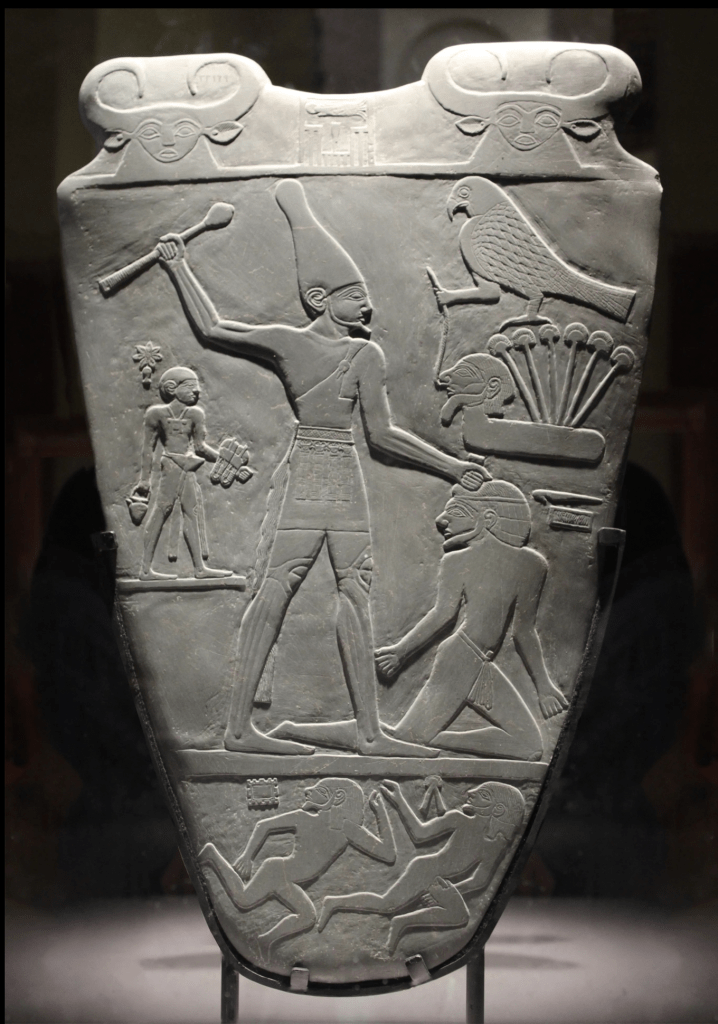
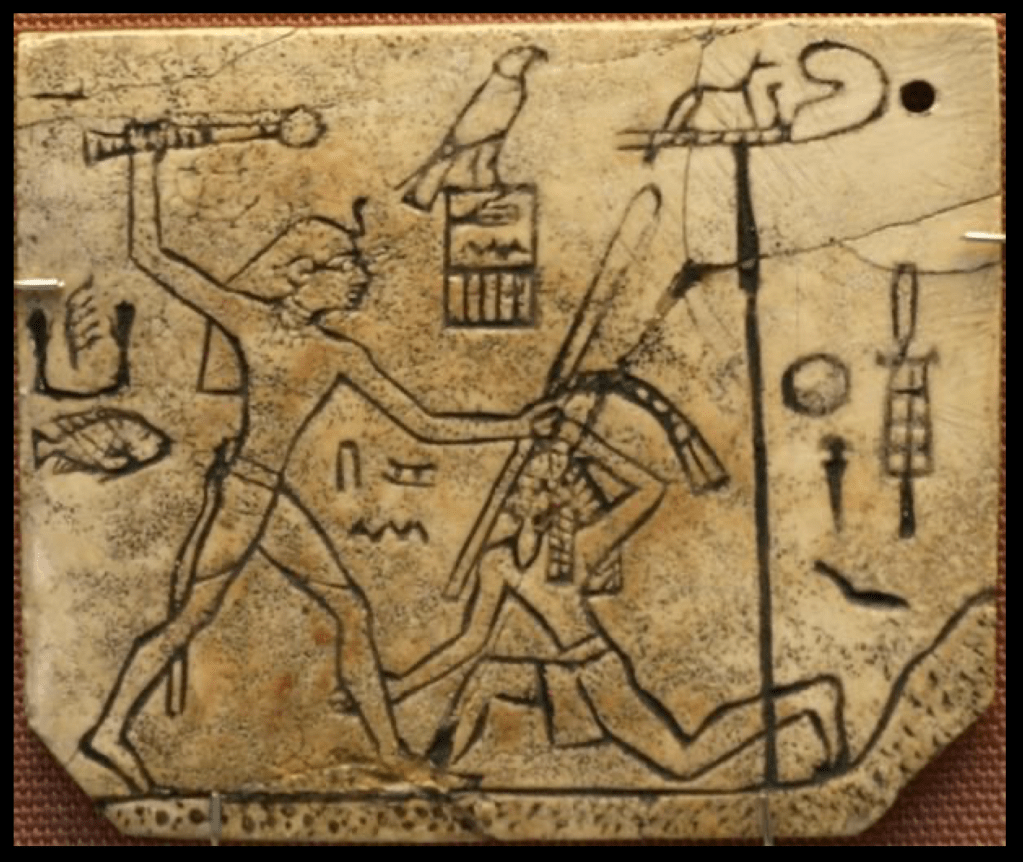
Looking at these texts and carved temples, we see that Egyptian pharaohs were frequently depicted in the same pose.  Back in the 1980s, a group called the Bangles told us how to “Walk like an Egyptian,” but if you want to look like a pharaoh, here is how you do it.  Left foot out, left arm outstretched, right arm ready to strike down your enemies. This iconic pose symbolized the pharaoh’s role as the supreme, divine ruler of Egypt.  This is the god pose.  We still have this picture in our mind of a mighty hero in this exact pose today.

Football season has begun.  You will see this pose a lot.

This is the Narmer Tablet that dates to 3100 BC.  For 400 years, Egypt held the children of Israel in slavery and told them that Pharaoh was the most powerful god.  Everywhere they look, they see images of Pharaoh as the greatest.  So when God sends Moses to speak to this person who proclaims himself the most powerful person in the world, this is what God says:

Exodus 6:1  Then Yehovah said to Moses, “Now you will see what I will do to Pharaoh: Because of my mighty hand he will let them go; because of my mighty hand he will drive them out of his country.”
Exodus 6:6  Say therefore to the people of Israel, ‘I am Yehovah, and I will bring you out from under the burdens of the Egyptians, and I will deliver you from slavery to them, and I will redeem you with an outstretched arm and with great acts of judgment.

God says, “Hey Pharaoh, you think you are something with your outstretched arm and your mighty right hand?  Just wait until you see what I do with my outstretched arm and my mighty right hand.”

Thus began a contest between the God of the Israelites and the gods of Egypt.  Whose god will be victorious?  All the Egyptians knew that Pharaoh was the greatest.  They thought this God of the Israelites couldn’t be much of a god, for he was God only of a bunch of slaves. But you know how that story ends.  God rains down 10 plagues, each one targeting a specific god of Egypt, the last one targeting the family of Pharaoh himself.  And then the final victory comes when Pharaoh and his army drown in the sea.

Following Pharaoh and Egypt’s defeat, numerous references in the Old Testament emerge, describing God as having a strong hand and outstretched arm.  Almost all of these refer to God’s deliverance of His people from Egypt or his future deliverance from another enemy.   For thousands of years, Egypt was the most powerful nation in the world.  And every time you see this description of God’s arm and hand, God is reminding them that He is greater.

Here are a few examples:

Deuteronomy 4:33-34  Did any people ever hear the voice of a god speaking out of the midst of the fire, as you have heard, and still live? Or has any god ever attempted to go and take a nation for himself from the midst of another nation, by trials, by signs, by wonders, and by war, by a mighty hand and an outstretched arm, and by great deeds of terror, all of which the LORD your God did for you in Egypt before your eyes?

Deuteronomy 5:15   You shall remember that you were a slave in the land of Egypt, and Yehovah your God brought you out from there with a mighty hand and an outstretched arm. Therefore, Yehovah your God commanded you to keep the Sabbath day.

Deuteronomy 11:1-2   You shall therefore love Yehovah your God and keep his charge, his statutes, his rules, and his commandments always. And consider today (since I am not speaking to your children who have not known or seen it), consider the discipline of Yehovah your God, his greatness, his mighty hand and his outstretched arm.

Jeremiah 32:21  You brought your people Israel out of the land of Egypt with signs and wonders, with a strong hand and outstretched arm, and with great terror.

And then, when the people in Isaiah’s day were under attack by a foreign nation and they were questioning why God hadn’t delivered them, they were told:

Isaiah 59:1-2  Surely the arm of Yehovah is not too short to save, nor his ear too dull to hear.  But your iniquities have separated you from your God; your sins have hidden his face from you, so that he will not hear.

God’s arm is not too short to save.  That is not the problem.  He is still God with the outstretched arm and the mighty right hand.  The problem is you.  God can not hear your requests for help because your sins have “hidden His face”.  Your sins have come between you and God.

And then, in the New Testament, when Mary is pregnant with Jesus, she sings a song of praise to God. She praises him for his deliverance of her people in the past, as she looks to the coming deliverance through Jesus. She says:

Luke 1:49-55   For he who is mighty has done great things for me, and holy is his name.  And his mercy is for those who fear him from generation to generation.  He has shown strength with his arm; he has scattered the proud in the thoughts of their hearts;  He has brought down the mighty from their thrones and exalted those of humble estate; He has filled the hungry with good things, and the rich he has sent away empty.  He has helped his servant Israel, in remembrance of his mercy, as he spoke to our fathers, to Abraham and to his offspring forever.

The God of the Bible has not changed.  The God of the Old Testament is still the God of the New Testament.  His arm has not shortened.  His strength has not faded.  He has saved his people in the past; he continues to save his people.   But those who stand against God will find the same fate as Pharaoh, the man who thought he was God.

Back to Psalm 118.  It continues with the portion sung as the pilgrims headed to Jerusalem for Passover approach the city and God’s Temple. You can see their progression in the psalm.  As they near the gates of the city:

Psalm 118:19-20  Open to me the gates of righteousness, that I may enter through them and give thanks to Yehovah. This is the gate of Yehovah; the righteous shall enter through it.

As they see the great stones of the temple:

Psalm 118:21-22  I thank you that you have answered me and have become my salvation.  The stone that the builders rejected has become the cornerstone.

As they enter the temple, there is a very familiar verse.

Psalm 118:25-26   Save us, [Hosannah] we pray, Yehovah, Yehovah, we pray, give us success! Blessed is he who comes in the name of Yehovah! We bless you from the house of Yehovah.

And finally, they arrive at the altar for the festival sacrifice:

Psalm 118:27  Bind the festival sacrifice with cords, up to the horns of the altar!

And then the psalm ends as it started:

Psalm 118:29  Oh give thanks to Yehovah, for he is good; for his steadfast love endures forever!

But let’s back up to verses 21-22 about the cornerstone.

Psalm 118:21-22  I thank you that you have answered me and have become my salvation.  The stone that the builders rejected has become the cornerstone.

We all know what a cornerstone is. However, most of the ones we see today are decorative.  But when a foundation is being laid, you have to get that first corner block laid straight.  It determines how the rest of the building will be.  How did people before the days of Jesus interpret this?  Who did they see as this cornerstone?

Because the people sing this psalm during the festivals to celebrate God delivering them from Egypt or later from other enemies, some see the nation of Israel as the one rejected by the other nations, but chosen by God. And some say it is David himself. He was chosen to be the king, even though others, including his father, would not have chosen him.  He was rejected by the current king, Saul, and Saul tried to kill him.  But God delivered David from Saul and his other enemies.  Then David becomes the first king of an everlasting dynasty.  He becomes the cornerstone of the kingdom.  For 1000 years, this Psalm was interpreted as talking about Israel or David as the cornerstone.

Then Jesus comes and applies this psalm to his day.  In the week of Jesus’ crucifixion, Psalm 118 is on everyone’s mind.  They have sung it as they traveled on the way to Jerusalem for Passover.  They sang it to Jesus as he entered the city on the donkey, “Hosannah!  Blessed is He who comes in the name of the Lord!” (Psalm 118:25-26).   And then Jesus in the temple that week tells the story of a vineyard owner who leased his farm to others.  He sent servants to collect his payment, and they refused to pay what they owed, and they abused them or killed them.  So the vineyard owner sent his son, thinking they would respect his son.  But they kill him.  And then Jesus asks the priests and scribes:

Mark 12:10-11  Have you not read this Scripture: ‘The stone that the builders rejected has become the cornerstone; this was the Lord’s doing, and it is marvelous in our eyes’?’

Jesus asks the religious leaders in the Temple if they have ever read Psalm 118.  (Of course, they had.  Every child had this memorized and had been singing it all week.)  But they understood what Jesus was saying.  Jesus claimed to be the son of the vineyard owner in his parable and the cornerstone of the Temple from Psalm 118.  The scribes and the priests are the builders who rejected him.  Jesus is adding a new layer of interpretation to Psalm 118.  He would be the cornerstone of a new Temple of followers.  

Then in Acts 4, Peter picks up this same Psalm to let the religious leaders know that this Jesus, who brought healing to this paralyzed man, is the cornerstone that they rejected, but chosen by God to be the beginning of a new deliverance, a new salvation.  

So who is the cornerstone of Psalm 118?  Is it Israel, is it David, or is it Jesus?  The answer is yes, and this is an important concept.  God is consistent in how he deals with his people.  His character does not change.  That is just who God is.  So you will see him do that over and over again.  So you see multiple layers of meaning.  Israel was seen to be a type of cornerstone, upon which God would build his kingdom.  But Israel didn’t fulfill his plan to take his message to the nations.  David was seen to be a type of cornerstone, as the beginning of a line of kings.  But David could not be the messiah.  He, like us, was a man of many sins.  But Jesus comes as a descendant in the line of David to be the true cornerstone.  

Israel was a type of cornerstone.  David was a type of cornerstone.  Jesus is the cornerstone.

So Paul tells the Gentiles in Ephesus:

Ephesians 2:19-22  So then you are … built on the foundation of the apostles and prophets, Christ Jesus himself being the cornerstone, in whom the whole structure, being joined together, grows into a holy temple in the Lord. In him you also are being built together into a dwelling place for God by the Spirit.”

God is making a new temple with Jesus as the cornerstone, and you are a stone in that temple, a dwelling place for God’s Holy Spirit.  And we know this is the meaning Peter intended when he spoke to these religious leaders in Acts 4, because Peter comes back to this same scripture when he is writing his first letter from Rome to the churches in Asia Minor.  

1 Peter 2:4-6  As you come to Jesus, a living stone rejected by men but in the sight of God chosen and precious, you yourselves like living stones are being built up as a spiritual house, to be a holy priesthood, to offer spiritual sacrifices acceptable to God through Jesus Christ.
For it stands in Scripture: “Behold, I am laying in Zion a stone, a cornerstone chosen and precious, and whoever believes in him will not be put to shame.

Jesus is the cornerstone.   But Peter is not through with the imagery.  There is one more aspect of the cornerstone imagery that we must discuss, and Peter has picked up this other aspect of the Biblical cornerstone motif that he got from the prophet Isaiah.  So Peter continues:

1 Peter 2:7-8  So the honor is for you who believe. But for those who do not believe, “The stone that the builders rejected has become the cornerstone,” and “A stone of stumbling, and a rock of offense.” They stumble because they disobey the word, as they were destined to do.

Peter is quoting Isaiah 8:14, where God says he can also be a “stone of stumbling.”  

Isaiah 8:14-15  And he will become a sanctuary and a stone of offense and a rock of stumbling to both houses of Israel, a trap and a snare to the inhabitants of Jerusalem. And many shall stumble on it. They shall fall and be broken; they shall be snared and taken.

The Bible says the stone God has placed for us can be either a cornerstone that we may build upon or a rock that we will stumble over and fall. Isaiah comes back to this in chapter 28, speaking against the leaders of Israel who, in times of threat of war, turned to Egypt for help instead of turning to God:

Isaiah 28:16-18  “So this is what the Sovereign Yehovah says: 
“See, I lay a stone in Zion, a tested stone, a precious cornerstone for a sure foundation; the one who relies on it will never be stricken with panic.” …“Your covenant with death [Egypt] will be annulled; your agreement with the realm of the dead will not stand.”

They abandoned God as their refuge in a time of need.  Instead of having faith that God would deliver them as he said, and depending on him as their cornerstone, they panicked and sought help from Egypt.  God tells them a deal with Egypt is a deal with death and the grave.  God is the only one who can deliver them.  There is no other god, there is no other with a mighty right hand and outstretched arm.  There are no other gods. That is why Peter, after mentioning the cornerstone, says this:

Acts 4:12  And there is salvation in no one else, for there is no other name under heaven given among men by which we must be saved.

There is no other.  Jesus is a stone in your path.  Either He can be the cornerstone on which you build a good faith, upon which you are built as part of the Temple of God, or He can be the stone upon which you stumble.  The point is that everyone has to decide what they are going to do with Jesus.  He will not be ignored.  You either accept the gospel, accept Jesus, or you reject him.  This is the message for us also.  Will we humble ourselves and worship the only God who delivers us with an outstretched arm and a mighty right hand?   

Bottom Line:  There are some important themes and motifs that are used in our Scriptures.  You can’t read a several-thousand-year-old document and be lazy.  It won’t work.  And this document, our Bible, is inspired by the Holy Spirit of God.  Its treasures are deep and profound.  You need to go slowly and research the context and culture.  You need to know it well enough, through years of study, that you begin to recognize these recurrent themes.  I beg you to study it to understand better how God would have us live.

August 12 –  Peter’s Sermon to the Jews in the Temple — Acts #8

August 12 –  Peter’s Sermon to the Jews in the Temple — Acts #8
Acts 3:11-28

Last week, we discussed the beggar at the gate and the miraculous healing he received.  We reviewed the two things God wants from us:  obedience and compassion.  People saw this man leaping about and recognized him as the paralyzed beggar they had seen for years at the gate of the temple.  There was quite a commotion in the Temple courtyard with people wondering how he was healed and some wondering what kind of people Peter and John were to do this miracle.  Now, let’s look at Peter’s message to the people in the Temple that day. 

Acts 3:11-16,19   While he clung to Peter and John, all the people, utterly astounded, ran together to them in the portico called Solomon’s. And when Peter saw it, he addressed the people: “Men of Israel, why do you wonder at this, or why do you stare at us, as though by our own power or piety we have made him walk? The God of Abraham, the God of Isaac, and the God of Jacob, the God of our fathers, glorified his servant Jesus, whom you delivered over and denied in the presence of Pilate, when he had decided to release him.

But you denied the Holy and Righteous One, and asked for a murderer to be granted to you, and you killed the Author of life, whom God raised from the dead. To this we are witnesses. And his name—by faith in his name—has made this man strong whom you see and know, and the faith that is through Jesus has given the man this perfect health in the presence of you all.
Repent therefore, and turn back, that your sins may be blotted out, that times of refreshing may come from the presence of the Lord.

 The message is essentially the same as the one Peter preached after the events of Pentecost.  Jesus, the Holy One of God, came to us, and you killed him. God has raised him from the dead.  But you acted in ignorance, so repent and turn back.  

But I want to focus for now on his audience.  Who is Peter talking to? “Men of Israel.” Peter is in the Temple Courtyard at Solomon’s Portico.  This is in the outside area of the Temple Courtyard, where Gentiles could gather.  This is the time for the afternoon prayer service and sacrifice.  There are likely some Gentiles there who worship God, but Peter says explicitly, “men of Israel.” He is not addressing Gentiles – anyone who was not born Jewish or had not converted to Judaism. 

So if you had been in the temple courtyard that afternoon, and you were not Jewish, then Peter was not talking to you.  Peter, and every other follower of Jesus, at this point, were convinced that you had to become Jewish to become a full disciple of Jesus.  At this early stage, the followers of Jesus had not even considered the possibility that Gentiles could be a part of their group. Jesus doesn’t address this directly in his ministry.  He does, at two different times in Matthew, identify the target of his and his disciples’ mission as being only “the lost sheep of the house of Israel.”  The first time is when Jesus is sending out the disciples two by two:

Matthew 10:5-6   These twelve Jesus sent out, instructing them, “Go nowhere among the Gentiles and enter no town of the Samaritans, but go rather to the lost sheep of the house of Israel.

What did Jesus mean when he said they were to only go to the ‘lost sheep of Israel’?

“Lost” is an important church word.  We all know what we mean when we talk about ministering to the lost.   And it is much the same way that Jesus uses the word.  The shepherd’s job was to guard and protect all of the sheep.  A good shepherd was constantly counting his sheep to ensure that none of them had wandered off the path.   Sheep would just keep moving ahead, eating, and be far from the herd in no time.  A lone sheep would not survive for long.  There were always predators. 

Jesus told a parable about a good shepherd who left his 99 sheep in a safe place to go searching for the one who was lost.  Why are the sheep of Israel lost?  They have wandered away from the correct path.  As we discussed last week, the Pharisees and the leaders of the Temple had focused on religious display and performance and ritual purity and forgotten what God really wanted.  (What does God really want from us: obedience and compassion for others.)  

The religious leaders had been bad shepherds, leading people to destruction instead of safety.  This theme of bad shepherds is a recurring theme in the Bible.  In their day, Jeremiah and Ezekiel both preached against the shepherds that have ignored the sheep only to enrich themselves.  And in Ezekiel, God says, because the leaders of your people have been such bad shepherds, He himself will one day come and be the good shepherd who will care for the sheep.

Ezekiel 34:11-16   For thus says the Lord Yehovah: Behold, I, I myself will search for my sheep and will seek them out…“I will feed them with good pasture, and on the mountain heights of Israel shall be their grazing land. There they shall lie down in good grazing land, and on rich pasture they shall feed on the mountains of Israel.  I myself will be the shepherd of my sheep, and I myself will make them lie down, declares the Lord Yehovah. I will seek the lost, and I will bring back the strayed, and I will bind up the injured, and I will strengthen the weak, and the fat and the strong I will destroy. I will feed them in justice.”

And so in the fullness of time, God came in the person of Jesus to be that shepherd for his people.  And one night, Jesus met with Nicodemus and told him:

Luke 19:9   For the Son of Man came to seek and to save the lost.  

He is using words that Nicodemus would instantly recognize as coming from Ezekiel.  He is God incarnate, come to rescue his lost sheep as prophesied.  And Jesus says this more clearly later:

John 10:11  I am the good shepherd. The good shepherd lays down his life for the sheep.

This analogy runs throughout the Bible.  The 23rd Psalm begins: “The Lord is my Shepherd, so I want for nothing. He makes me lie down in green pastures.”  You have to connect David’s psalm to Ezekiel’s prophecy.  But the shepherds in Israel have led the people in the wrong direction.  Jesus has to come and be the shepherd and set them on the right path, so he deemphasizes ritual purity and showy religious practices, and he emphasizes obedience and compassion.   

But then we have this statement by Jesus:

Matthew 15:24  “I was sent only to the lost sheep of the house of Israel.”

This verse, ripped out of its context, makes it sound like Jesus did not come for lost Gentiles.  But we looked at the context last October.   Jesus had a tough week, and so he traveled 20 miles north out of Galilee into Syria to get away from the crowds.  Mark tells us he didn’t want anyone to know he was there.  But this Gentile woman with a sick child hears of him and begs Jesus to heal her daughter.  Jesus at first appears dismissive to her, and that is when he says, “I was sent only to the lost sheep of the house of Israel.”  And when she persists, he says:

Matthew 15:26   It is not right to take the children’s bread and throw it to the dogs.

That seems out of character for Jesus until you realize what he is doing.  He is showing the disciples their own prejudice.  Sometimes we can see better in others what we cannot see in ourselves.  The woman does not give up and says even the dogs get the crumbs from the table.  Then, in a dramatic turnaround, Jesus praises the woman for her faith and heals her daughter.  This becomes a huge turning point in Jesus’ ministry. He then heads back south but passes right through Galilee without stopping and heads straight for Gentile territory, where he preaches and heals many over several days, and then miraculously feeds 4000 people.  He is literally and figuratively taking the bread to the Gentiles.

God had a plan from the beginning.  After the rebellion in the garden and the descent of people into sin, God chose a man, Abraham, to build a people who would turn back to Him.  The Jewish race was formed from Abraham and his descendants.  And while this work of redemption of God started with the Jews, it was never supposed to end there.  When God first called Abraham, he made that clear: 

Genesis 12:1-3   Now Yehovah said to Abram, “Go from your country and your kindred and your father’s house to the land that I will show you. And I will make of you a great nation, and I will bless you and make your name great, so that you will be a blessing. I will bless those who bless you, and him who dishonors you I will curse, and in you all the families of the earth shall be blessed.”

All the families of the earth will be blessed through you.  God will use this family to bless the world.  God repeats this call when he redeems the descendants of Abraham from slavery in Egypt.  On the safety of the other side of the Red Sea, God tells them:

Exodus 19:4-6   You yourselves have seen what I did to the Egyptians, and how I bore you on eagles’ wings and brought you to myself. Now therefore, if you will indeed obey my voice and keep my covenant, you shall be my treasured possession among all peoples, for all the earth is mine; and you shall be to me a kingdom of priests and a holy nation.

They were to be a kingdom of priests and a holy nation.  That is, a nation with a special relationship to God so that they can act as intermediaries, as priests, to spread the word of God to the rest of the world.  Unfortunately, they never fully grasped this task.  There were a few Gentiles who followed the God of Israel, and we see ‘God-fearers’ in the New Testament (Gentiles who rejected the polytheism of their cultures; they stopped worshiping false gods and embraced the God of Israel and followed some of His precepts.) 

But the only way they maintained that a Gentile could become a full-fledged follower of God was to convert to Judaism, which involved understanding and agreeing to abide by the commandments, immersion, sacrifice, and (for males) circumcision. Instead of serving as priests to the world, bringing people to God, they claimed that the only way to reach Father God was through them.  That is what all Jews were taught.  That is what Peter learned as a child and what he still believes in Acts 3.   

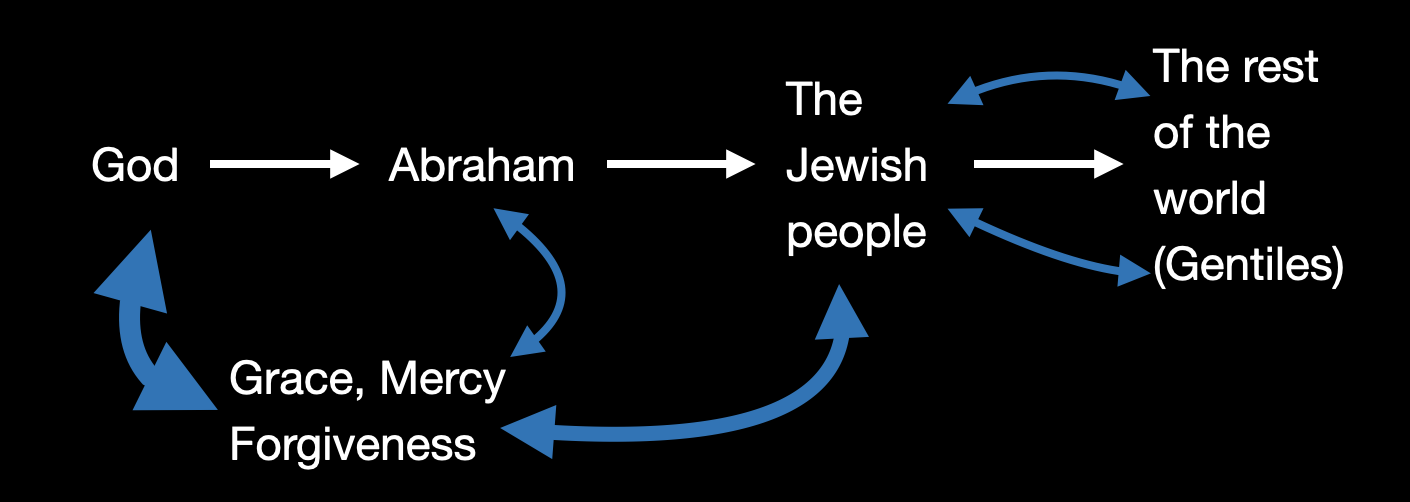
God reaches out to Abraham and establishes a covenant with him out of his grace, mercy, and forgiveness.  Then Abraham’s descendants, the Jewish people, are able to join in this Abrahamic covenant with God.  Then they are to reach out to the rest of the world – the Gentiles.  The Gentiles must then join the Jewish people to take part in that covenantal relationship with God.   This had been the understanding of God’s plan that Peter was taught as a child.

But what did God actually intend? 

God reaches out to Abraham and establishes a covenant with him out of his grace, mercy, and forgiveness.  Then Abraham’s descendants, the Jewish people, are able to join in this Abrahamic covenant with God.  (All this is just as before.) But then the Jewish people are to reach out to the rest of the world – the Gentiles.  The Gentiles can join in a covenant with God of mercy, grace, and forgiveness just as the Jews can.  They don’t have to become Jewish to be in covenant with God.  But now God’s Grace, Mercy, and Forgiveness have a name.  And that name is Jesus.

What Peter and these in Acts 3 understood was this: “To come to God, you must come through us; you must become one of us.”  But Jesus had said this: “No one comes to the Father except through me.  I am the way, and the truth, and the life.”  (John 14:6)

Jesus had tried to show them this even early in his ministry. Just after the Sermon on the Mount, he encounters a Roman Centurion who asks him to heal his servant.  And Jesus says of this gentile: 

Matthew 8:10   Truly, I tell you, with no one in Israel have I found such faith. 

I have not seen any Jew with as much faith as this Gentile.   And Jesus continues:

Matthew 8:11-12   I tell you, many will come from the east and the west and recline at the table with Abraham, Isaac, and Jacob in the kingdom of heaven, while the sons of the kingdom will be thrown into the outer darkness. In that place, there will be weeping and gnashing of teeth.

Many will come from the east and west… These other nations will celebrate with the Father in heaven, while some Jews will not be allowed in.  This is radical talk for a people that always assumed you had to become Jewish to come to God.

And Jesus tries to show them this truth as he ministers to other Gentiles and Samaritans.  You can see a gradual movement of Jesus in his year with the disciples toward ministry to the Gentiles that culminates in his Great Commission to go and disciple all nations. He says this in his final words:

Acts 1:8   But you will receive power when the Holy Spirit has come upon you, and you will be my witnesses in Jerusalem and in all Judea and Samaria, and to the end of the earth.

But God’s people had never fully understood God’s plan that God came to the Jews first so that they could be the conduit to spread his gospel to the nations.  And instead of inviting others in, they have been building walls to keep them out.

Every Resurrection Day, we talk about the veil of the temple that was torn from top to bottom when Jesus was crucified.  The heavy curtain that separated the holy place in the Temple from the Holiest place where God’s spirit would rest on the mercy seat in the previous temple.  The veil was there to keep people from entering into God’s presence.  Only the high priest could go through there, and he could only do so once a year.   

Every year, we talk about how the tearing of that veil opened up the way for people to have access to the Father through Jesus.  But that was not the only separation in the Temple that needed to come down.  I showed you the picture last week of the model of Herod’s Temple.  We talked about these massive 30-foot-tall brass doors that it took 20 men to open.  They set aside this area of the temple as the women’s court.  Females could go no further.  

Was that God’s plan or man’s plan?  God never gave any instructions for a woman’s court.   You do not find a woman’s court in the plans for the Tabernacle that Moses received on the mountain.  Women and men were both allowed to access the common area of the tabernacle.  There is no mention of a woman’s court in Solomon’s temple or in the temple rebuilt after returning from Babylon.  It was added when Herod began rebuilding the temple in 20 BC.  Why was that boundary added?  It was man’s idea, not God’s.  

Then there was a 15-foot area around the temple enclosed by a 4.5-foot-tall wall called the Soreg.  This is the barrier that the Gentiles could not pass under penalty of death.  Again, there was no mandate from God to build this wall.  It is the invention of the temple leadership to keep certain people away from God.  Originally, Gentiles were able to bring sacrifices to the tabernacle (see Numbers 15:14-16).  And Solomon invited Gentiles to pray in the common areas of the temple.  But in the 2nd century BC, Gentiles began to be excluded.  

And in Jesus’ day, Gentiles getting too close to the temple faced death.  All of Jesus’ followers had grown up their whole life being taught that this wall was necessary.  It was important.  This is a rule you don’t break.  If you do, then you will die.  God is only for the Jews.  And in Acts 3, Peter is preaching just outside this wall and calling people to repentance, but he is only calling Jews to repentance.  He doesn’t understand yet.

When Jesus was crucified, the veil was torn; the separation that symbolized the isolation of God’s presence was removed.  Because of Jesus’ work on the cross, God can truly dwell with people.  But Jesus was not satisfied with just tearing down the veil of the temple.  These other walls must come down.  These walls that people built to keep others from God, to keep the women out, to keep the Gentiles out.  God never intended this, and they must fall.  But the only way to tear down these walls would be to tear down the temple block by block, as Jesus said in Mark 13:

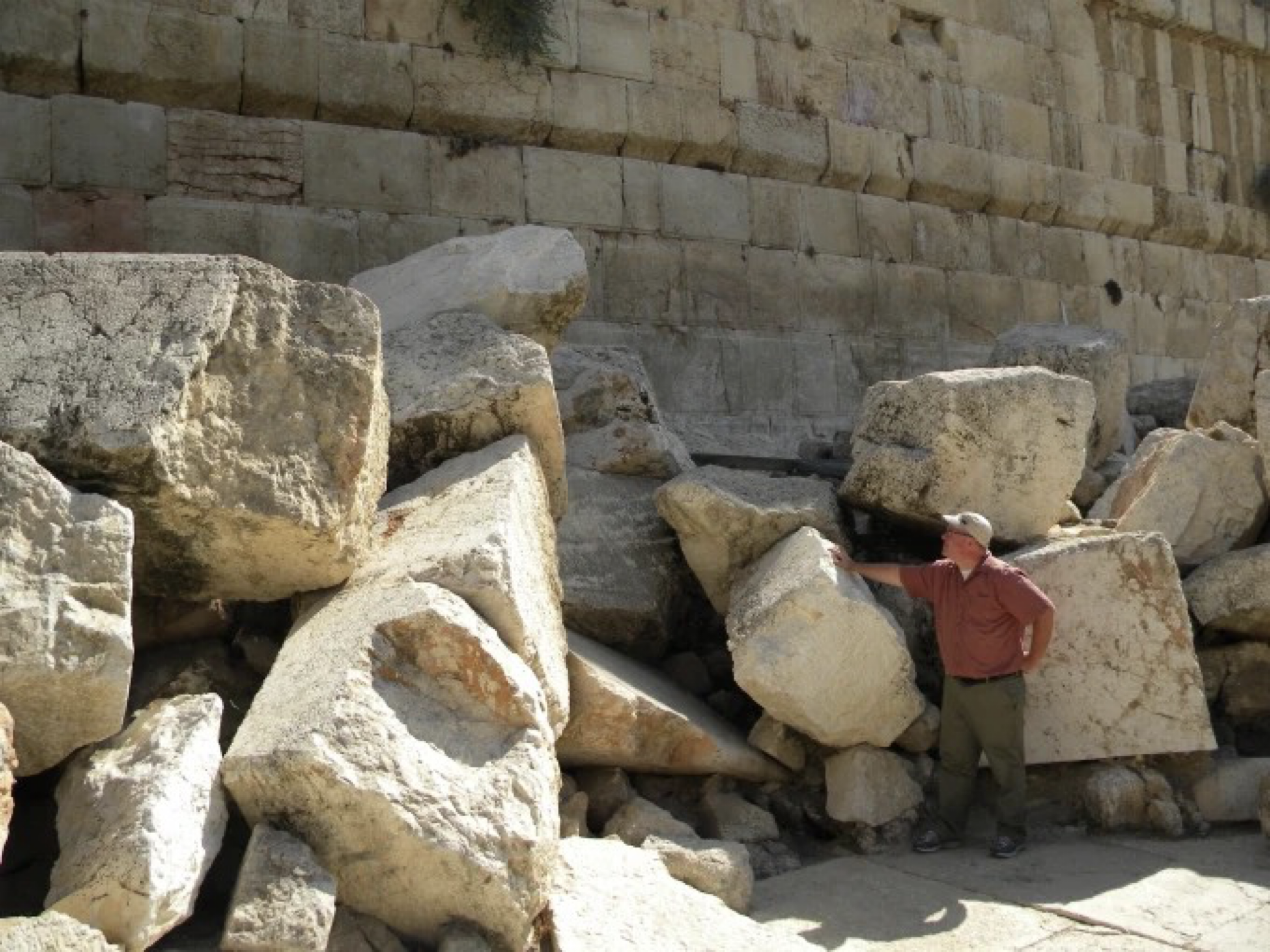
Mark 13:1-2   And as he came out of the temple, one of his disciples said to him, “Look, Teacher, what wonderful stones and what wonderful buildings!” And Jesus said to him, “Do you see these great buildings? There will not be left here one stone upon another that will not be thrown down.”

And so it was.  Just 40 years later, in 70 AD, the temple was dismantled stone by stone, with Roman soldiers using pry bars to lever the huge stones off the temple mount.  You can see these stones still lying where they fell almost 2000 years ago.

And Paul addresses some Gentiles in Ephesus:  

Ephesians 2:11-16. Therefore, remember that at one time you Gentiles in the flesh…remember that you were at that time separated from Christ, alienated from the commonwealth of Israel and strangers to the covenants of promise, having no hope and without God in the world. But now in Christ Jesus, you who once were far off have been brought near by the blood of Christ. For he himself is our peace, who has made us both one and has broken down in his flesh the dividing wall of hostility that he might create in himself one new man in place of the two, so making peace, and might reconcile us both to God in one body through the cross.

It took drastic measures for God to defeat sin and death.  It took Jesus dying on a cross and being resurrected.  It took drastic measures for God to set his people back on the right path of worship, obedience, and compassion.  It took the destruction of the Temple that bore His name, built in the place where He said He would place His name forever.  It took the formation of a new Temple, but not one of stone.  His followers would become His temple.  He would dwell with them.

But in Acts 3, Peter is still blind to God’s truth about the Gentiles.   And so was the rabbi called Saul, until he met Jesus on the road to Damascus.  Paul says that on that road, Jesus came to him to let him know he was sending him to the Gentiles “to open their eyes, so that they may turn from darkness to light and from the power of Satan to God, that they may receive forgiveness of sins and a place among those who are sanctified by faith in me.” (Acts 26:17-18).  

So Paul understood.  He said in Romans 1:16 that the Gospel is “the power of God for salvation to everyone who believes, to the Jew first and also to the Gentile.”  This is the story of salvation in the Bible.  God chose Abraham to establish a family that would serve as priests, bringing God’s blessing to the world. However, they continually failed in this mission. They distorted his teachings and became a religion that was inward-focused, caring only for themselves and not spreading the good news of God to the nations. So God sent his Son to be the Jew that would reboot this mission, get them back on the right track as a kingdom of priests to the nations.

But at this point, Peter, John, and the early followers of Jesus are busy trying to persuade just the Jewish people to accept the fact that the Messiah has come.  That Jesus is the one they have long awaited.  So Peter tells the Jews in his sermon:

Acts 3:19-26   Repent therefore, and turn back, that your sins may be blotted out, that times of refreshing may come from the presence of the Lord, and that he may send the Christ appointed for you, Jesus, whom heaven must receive until the time for restoring all the things about which God spoke by the mouth of his holy prophets long ago. Moses said, ‘The Lord God will raise up for you a prophet like me from your brothers. You shall listen to him in whatever he tells you. And it shall be that every soul who does not listen to that prophet shall be destroyed from the people.’

Compare Acts 3:19 in the King James Version and the English Standard Version:

Acts 3:19 (KJV)  Repent ye therefore, and be converted, that your sins may be blotted out…
Acts 3:19 (ESV)  Repent therefore, and turn back, that your sins may be blotted out…

(The KJV and the NKJV are pretty much the only versions that use the word ‘converted.’)  The way we understand the word “convert” in the KJV has led to some misunderstandings. We define ‘convert’ as either (1) to change from one form to another, or  (2) to change one’s religion or other beliefs.

We read this in the King James Version and get the idea that Peter is trying to convince these Jews to convert from Judaism to Christianity, to change religions.  But if you asked Peter if he had changed religions, he would think you were very confused.  He would say, “Of course I haven’t changed religions.  I am still very much Jewish.  The difference for me is that I have found the Messiah that my people have prayed for for hundreds of years.”  As we noted earlier, Peter is still attending Temple services, praying Jewish prayers, and following Jewish cultural laws.  He is now following these laws as interpreted by the one he considers the ultimate Jewish rabbi, Jesus.  

So, I think ‘converted’ is a poor translation of the Greek word ‘epistrepho’, which means to turn towards, to turn about, to turn back, or return.   It is about changing direction, and its counterpart, the Hebrew word shuv, is frequently used in the Old Testament as turning away from sin and turning towards God. But there is a conversion that must occur when one comes to accept Jesus.  There is a change that must take place when we turn from sin and turn to God.  

2 Corinthians 5:17   Therefore, if anyone is in Christ, he is a new creation. The old has passed away; behold, the new has come.  

Paul says the ‘old man’ must die. 

Galatians 2:20   I have been crucified with Christ. It is no longer I who live, but Christ who lives in me.

Our old self, who was motivated by self-interest, who made our own decisions, and who lived by our rules, must be symbolically crucified and buried with Christ so that the new life that proclaims Jesus as Lord, that submits our will to his, that lives by his rules and in his interest.  Gentiles do not convert to Judaism, and Jews do not need to abandon their heritage.  They both need to recognize Jesus as the Messiah who came as the Old Testament predicted.  

Peter and the other followers of Jesus in Acts 3 see themselves as Jews.  They view themselves as a sect of Judaism that followed Jesus as the Messiah.  And followers of Jesus continued to be viewed as a sect of Judaism throughout most of the first century at least.   One day, we will discuss when what the New Testament called “followers of the Way” ceased to be viewed as a Jewish sect and began to be viewed as a separate religion.  

But we must not forget, as Paul notes in Romans 11, we are part of God’s family because we have been grafted into the Jewish root.  We do not become Jewish, but the root of our faith and life is the Jewish heritage that supports us, from Abraham to Jesus.  Abraham is our Father.  The Old Testament is our story, and we need to read the Bible as one unified story about the creation and redemption of God’s people and God’s world. 

One day, Peter will learn that Gentiles are part of this story, but it will take a dramatic lesson involving a vision from God and a devout Gentile centurion that we will see in Acts 10.  But one more lesson for us now.  Even though Peter, at this point, is dead wrong on his theology about Gentiles, it does not stop God from doing great things through him.  Peter is in on many miracles in these early chapters of Acts.  The church is growing amazingly fast.  Thousands are being added.  

Perhaps we can learn from this that God can do much through us, even if we don’t understand everything. Even if we have some theology completely wrong, God can use us for his kingdom.  And perhaps we can show more grace to our brothers and sisters in Christ, who we feel don’t have everything right.  I confess I have at times been too judgmental of others’ theology.  I need to learn to show grace like Jesus shows grace, while also realizing that I could be the one who doesn’t have it just right.  But even if we get some things wrong, Jesus can do great things through us.   Having everything theologically correct is important.  We should study the scriptures for ourselves intently.  But that is not the most important thing. After all, what does Jesus really want from us?  Obedience and Compassion to others. 

August 5 –  The Beggar at the Gate — Acts #7

August 5 –  The Beggar at the Gate — Acts #7
Acts 3:1-10

Acts 3:1-10   Now Peter and John were going up to the temple at the hour of prayer, the ninth hour. And a man lame from birth was being carried, whom they laid daily at the gate of the temple that is called the Beautiful Gate to ask alms of those entering the temple. Seeing Peter and John about to go into the temple, he asked to receive alms. And Peter directed his gaze at him, as did John, and said, “Look at us.” And he fixed his attention on them, expecting to receive something from them. But Peter said, “I have no silver and gold, but what I do have I give to you. In the name of Jesus Christ of Nazareth, rise up and walk!” And he took him by the right hand and raised him up, and immediately his feet and ankles were made strong. And leaping up, he stood and began to walk, and entered the temple with them, walking and leaping and praising God. And all the people saw him walking and praising God, and recognized him as the one who sat at the Beautiful Gate of the temple, asking for alms. And they were filled with wonder and amazement at what had happened to him.

Peter and John are going to the Temple for the 3 pm service of prayer and sacrifice.  And they encounter a man who has been paralyzed since birth.  

There is much discussion among theologians about exactly where this man was begging.  Luke tells us that it was at the gate to the temple called the “Beautiful Gate.” A gate is an excellent location if you were a beggar.   It’s a place where many people would have to pass by.  But no other sources except the scriptures use the term “the gate called Beautiful”.   There are eight gates by which to enter the 36-acre Temple Mount, and then several more to enter the inner courts of the Temple.

Many place the “Beautiful Gate” as one of the inner gates.  The historian Josephus describes a magnificent gate made of fine Corinthian brass and plated with gold and silver, so heavy it took 20 men to move the doors.  But experts differ on whether this inner gate was the entrance to the court of women or the gate from the court of women to the court of Israel.

But the scripture we read this morning lets us know that neither of these gates within the temple could be correct.   Because this was no ordinary man, he was lame from birth.  His legs had shriveled from disuse and were twisted and disfigured.  He was not allowed to go into the temple like other men could because he had a defect.

In Leviticus 21, there are requirements for a priest who could make offerings at the altar or enter the holy place:

Leviticus 21:16-19   And Yehovah spoke to Moses, saying, ‘Speak to Aaron, saying, None of your offspring throughout their generations who has a blemish may approach to offer the bread of his God. For no one who has a blemish shall draw near, a man blind or lame, or one who has a mutilated face or a limb too long, or a man who has an injured foot or an injured hand…

And the list goes on.  But the first mentioned is the blind and lame.  Now these ‘blemished’ priests could do other priestly duties, but they could not approach the altar or the holy place.  Just as the sacrifices had to be unblemished, so too did those offering them.  That rule only applied to priests, but by Jesus’ day, many laws for purity intended for priests were made requirements of all people.  For example, in the Mishnah, a record of the Pharisees’ rulings, Mishnah Kelim 1.8 discusses that people with discharges of impurity could not enter the Temple Mount at all.1  

And we know those with the disease lepra could not enter the temple area.  And many add that people who were lame or blind were not allowed to enter the Temple Mount.2  (And the Rabbis’ scriptural basis for this comes from this passage in Leviticus and a rather odd interpretation of 2 Samuel 5:8)3.

So this lame man was likely placed daily at one of the primary entrances to the Temple Mount.  The primary entrance at the southern side of the Temple Mount was a massive double gate with elaborately carved arched ceilings in a tunnel that led up to the Temple Mount.  (Portions of these beautiful carved ceilings can still be seen today.)  It was the gate with the most traffic, so it was the best place to beg.  And this was as close as this lame man would ever get to the temple itself.  As he had no hope for healing, he had no hope of ever going inside.  So he is left begging at the gate, never able to go in and see the riches and grandeur inside.

Does this remind you of a story Jesus told?  I am thinking of the story of the “Rich Man and Lazarus.”  Lazarus was the beggar at the rich man’s gate, and it makes me wonder if the people in Jesus’s day didn’t see something in that story we miss.  Whenever Jesus’ listeners went to the temple, they would pass by many poor beggars at the gate who were never allowed inside to see the opulence of the Temple.  They may have seen this story as yet another condemnation of the wealthy religious officials who oversaw the Temple. 

There is another story in Matthew 21 that brings attention to the blind and lame who were not allowed in the Temple. After Jesus’ triumphant entry into Jerusalem, he turns over the tables of the money changers and drives out the animals.  This is in Matthew 21

Matthew 21:12-13   And Jesus entered the temple and drove out all who sold and bought in the temple, and he overturned the tables of the money-changers and the seats of those who sold pigeons. He said to them, “It is written, ‘My house shall be called a house of prayer,’ but you make it a den of robbers.”

However, there is more to this story that we didn’t have time to talk about in April when we discussed it.  There is something else going on that caused Jesus to be fed up with the poor state of religion that day.  And there is something else that happens before the chief priests and scribes get mad at Jesus.  Let’s read the rest of the story in the following two verses:

Matthew 21:14-15. And the blind and the lame came to him in the temple, and he healed them. But when the chief priests and the scribes saw the wonderful things that he did, and the children crying out in the temple, “Hosanna to the Son of David!” they were indignant…

And the blind and lame came to him in the Temple, and he healed them.   Jesus has the nerve to invite these unclean, blind, and lame people into the temple.  And he rewards their law-breaking with healing for which he is praised. At this point, the priests and scribes become furious.  But they are not the only ones angry.  Jesus was angry.  And now we can see why Jesus was so angry that day, and why he was moved to drastic action.  

Jesus is angry because they are taking advantage of the poor with their businesses in the Temple and because they leave the beggars outside the gate of the Temple, not only offering them no assistance, but also refusing them the opportunity to participate in worship.  It was the responsibility of the Temple to care for these people.  There were offerings designated for them.  They should never have to beg.  But instead of distributing these funds to those in need, the Temple officials devised ways to make themselves even richer while these beggars starve.

So on the day of his triumphant entry, Jesus enters the temple and passes by the blind and lame beggars who are starving because the temple rulers are hoarding the money donated in the temple and not using it to care for the poor.  Jesus sees this as he enters the temple, and the next thing he sees is the money changers and the animal merchants cheating the people, again enriching the temple rulers at the expense of the poor.  And Jesus is not going to stand for it.  He disrupts the money changers and drives out the animals, and then he invites the deaf and blind into the temple, where he heals them. 

About a year ago, we discussed what makes God angry.  Do you remember the first time in the Bible that God is described as angry?  It is when he tries to get Moses to lead his people out of Egypt.  At the burning bush, God told Moses that he saw his people, Israel, in their affliction, how the Egyptians were abusing them, how the Egyptians were killing their children, and God had compassion on them.  But five times, Moses refuses to go and lead the people, even though they are his people.  Even though Moses was one who, as a baby, was rescued from the Egyptians’ plan to kill all male children.  It is Moses’s lack of compassion for his own people and his refusal to help the afflicted that angers God.  

We discussed the New Testament story where Jesus was about to heal the man with the withered hand, enabling him to work and provide for his family instead of being a beggar.  But the Pharisees only see this poor man as a chance to trap Jesus if he heals on the Sabbath.  Jesus became furious with the Pharisees because of their lack of compassion for this man, more interested in their petty rules than in this man’s well-being.

 And on this day, He sees them taking advantage of the poor, refusing compassion to the blind and lame, and using His Temple to do these things.  They have turned his Temple into a den of criminals.  This is why the Temple is going to fall.  This is why God uses the Roman army as a tool in his hand to knock down every stone. God will not stand by and watch his people refuse to help the poor, the needy, the ill, the sick, while they are inside the walls pretending to worship.

With this background, let’s look at today’s story again. Peter and John approach this lame man who is begging.  He sees them.  Alms!  Alms!  It comes from the Greek word for mercy.  Now they could have passed by him just like everyone else had passed by him so many times.   He has been there every day for 40 years.  Perhaps they had passed by him before.  But not today.  Today, they “directed their gaze at him”.   This man was right in front of their eyes, but was unseen by most, overlooked, and ignored. 

It is a wonderful thing to be seen, to be noticed. There are plenty of people in this world who feel invisible, overlooked by everyone.  In moments of distress, we’ve all felt like no one understands what we are going through, that no one truly sees our dilemma. But know that God sees you. When Hagar was mistreated and abused and fled to the wilderness, God sent an angel to her to tell her that he saw her in her distress and that he was looking out for her.  She called him El Roi, “the God who sees me.”   God saw the affliction of his people in Egypt and delivered them.  God saw us in the hopelessness of our sin and sent Jesus to deliver us. No matter how invisible you think you are to the rest of the world, know that God is still El-Roi. He sees you and desires to heal you, to deliver you.

And if we are his children, we need to learn to see as God sees.  We need to seek out those the world has tossed aside, those deemed unfit—those seen as unproductive or damaged.  We need to see the forgotten at the gate.  If Jesus has given us a new heart and God’s Holy Spirit lives in us, we cannot just pass by those in need.

Peter and John looked at this man.  And they asked him to “Look at us.”   Where had the man’s attention been?   Was he searching the crowd for someone who appeared wealthy enough to give him some money?  Was he just hoping to make eye contact with someone to garner some sympathy?  Or was he just so defeated that his gaze never left the ground?  But he looks at Peter and John.  And you can almost feel his relief that finally someone has noticed him and will contribute so he can eat today.  

And Peter says, “I don’t have any money.”  Now you can almost feel his disappointment.  Just my luck, he thinks to himself, the one person who pays me any attention, and they are broke.  But look at what Peter actually says.  In the Greek construction, it is:  “Silver and gold do not exist through me.”  Peter is saying, “What you are begging for is of no importance to me.  It doesn’t exist through me.” Peter has his priorities right!  This paralyzed beggar doesn’t see it yet, but what does exist through Peter?  God’s Holy Spirit exists through Peter, so Jesus exists through Peter.  Peter is Jesus’ hands and feet and voice in a world full of beggars, and this beggar is about to see Jesus through Peter.  But I get ahead of myself.  

At this point, the beggar realized he wasn’t going to get what he was hoping for: money to buy food.  He has been begging his whole life.  40 years.  He had long ago given up hope that he would be healed.  He had long ago given up hope that he would ever be able to work and make his own money.  He had long ago given up hope that he would ever see the inner courts of the temple and be able to worship there.  Everyone who passed him by daily lived in a different world than he did.  His world had been upside down since he was born.

A few months ago, he had heard about this man called Jesus, a healer.  He had even heard that he had healed some people who were lame like him in the Temple.  He had hoped to have a chance to encounter Jesus, but he had missed him.  And then he heard Jesus was dead.  Now he is a man with no hope.  

But then it happened. Peter continues, Silver and God do not exist through me, but I am going to show you who does exist through me.  You are about to see the power of who exists through me. “In the name of Jesus Christ of Nazareth, rise up and walk!”  At the mention of this name, Jesus Messiah, Peter reached out his hand to the beggar.  And somehow, the man raised himself upright for the first time in his life.  Never had he ever stood.  And now, yes, not only could he stand, but he could walk.  And he could leap.  And his world turns right-side up for the first time in his life.

These two men, Peter and John, continued into the temple, but he sure wasn’t going to let them get away.  He was healed, and for the first time in his life, he too could enter the temple.  He stayed right with them.   And everyone he passed was shocked.  They had seen him for years with his misshapen, shriveled limbs, and how he was leaping and dancing about.  He was creating a scene.  And a crowd followed them to Solomon’s Porch in the Temple.  They were asking how it happened, and some people were praising the two men who healed him.   And the man Peter begins to preach to them right there. And next week, we will discuss Peter’s sermon and the response, but there is so much we need to see here.   

We don’t use the word ‘lame’ much to refer to people anymore.  You have probably heard it more often in the context of horses being lame.  But it is a slang use of ‘lame’ that has become more common in the past 50 years.  “That was a lame joke.”  What we have to see, before we move on, is that this story in Acts 3 is the story of “A Lame Man and a Lame Religion”.  A man who could not walk and a religion that does not work.  A man with useless legs and a religion that is useless.  We have to see where these first-century religious leaders went wrong so we can avoid making the same mistake.

Before Peter and John showed up, it was just another day in the temple.  Business as usual.  They were going about their usual schedule of worship and prayer services.  They were doing all the required sacrifices.   They were probably commenting on the great job the choir did on the psalms that morning.  And didn’t the high priest look especially nice today?  And we’ve got a pretty good crowd for a hot summer day, don’t we?  Business as usual.  Hey, look at us; we are doing God’s work here.  

But just outside the gates were those who needed mercy, those who needed compassion, those who needed healing. Those who needed to be seen.  This is not new.  God has dealt with this before.  Let’s go back 700 years before our story today—the time of Isaiah.  Let’s look at Isaiah chapter 1.  There is a verse there you will recognize. 

Isaiah 1:18  Come now, let us reason together, says the LORD: though your sins are like scarlet, they shall be as white as snow; though they are red like crimson, they shall become like wool.

But do you know the context for that verse?  Let’s back up to verse 11, and we will use The Message version:

Isaiah 1:11-18   “Why this frenzy of sacrifices?”  GOD’S asking.
“Don’t you think I’ve had my fill of burnt sacrifices, rams and plump grain-fed calves?
Don’t you think I’ve had my fill of blood from bulls, lambs, and goats?
When you come before me, Whoever gave you the idea of acting like this,
Running here and there, doing this and that— all this sheer commotion in the place provided for worship?
“Quit your worship charades. I can’t stand your trivial religious games:
Monthly conferences, weekly Sabbaths, special meetings
meetings, meetings, meetings—I can’t stand one more!  Meetings for this, meetings for that. I hate them!
You’ve worn me out! I’m sick of your religion, religion, religion,
while you go right on sinning.  When you put on your next prayer-performance,
I’ll be looking the other way. No matter how long or loud or often you pray, I’ll not be listening
And do you know why? Because you’ve been tearing people to pieces, and your hands are bloody.
Go home and wash up. Clean up your act. Sweep your lives clean of your evildoings
so I don’t have to look at them any longer. Say no to wrong.  Learn to do good.
Work for justice. Help the down-and-out. Stand up for the homeless. Go to bat for the defenseless.

And then comes the verse we know….

“Come. Sit down. Let’s argue this out.” This is GOD’S Message:
“If your sins are blood-red, they’ll be snow-white.
If they’re red like crimson, they’ll be like wool.

There is a great sin they need to be cleansed of.  You see, the same thing is going on in 700 BC as is going on in Jesus’ day.   They are going through the motions of worship.  They are busy with sacrifices, busy with offerings, busy with praises, busy with prayers.  But God is sick of their worship services, because they are not busy with obedience.  They are not busy with compassion.  

Last week, we discussed what God really wants from us, and I asked the question, “What does God really want?”  The answer: obedience.  Today, from our story of the lame man in Acts 3 and now from Isaiah 1, we see what else God wants from us: compassion.  God wants us to have compassion for those who are poor, homeless, sick, and defenseless.

Why was God sick of their worship?   It is because they have a lack of obedience and a lack of compassion.  Look at verses 15-17 again and see the call to obedience and the call to compassion:

Go home and wash up. Clean up your act. Sweep your lives clean of your evildoings
so I don’t have to look at them any longer. Say no to wrong.  Learn to do good.
Work for justice. Help the down-and-out. Stand up for the homeless. Go to bat for the defenseless.

Do you see that this is the same problem Jesus had with the temple leaders in his day?  God is serious about obedience and compassion.  This is the reason that Northern Israel was destroyed by Assyria in 721 BC. This is the reason that Judea was destroyed by Babylon in 586 BC. This is the reason that the temple in Jerusalem was destroyed by Rome in 70 AD. And every day up until the Temple was leveled to the ground, they were performing useless sacrifices and praying useless prayers — pretending to worship a God that would not listen to their prayers or pay attention to their worship.

It does not matter how we worship.  God does not care if it is contemporary or traditional.  God does not care if worship is in a vast, beautiful sanctuary or a tiny shack.  He does not care if there are 10 people there or 10,000.  God’s primary concern is not how good the music is, or how great the preacher is, or how nice everyone dresses.  He doesn’t care if worship lasts 30 minutes or 4 hours. What God really wants from your church is not what happens on the printed ‘order of worship’ and not what happens within the four walls of your sanctuary.

What does God really want from us?  Obedience and compassion for others. This is what Jesus said.  He tried to make it clear to us.  Remember, they asked him what the most important verse in the Bible was, and what was the greatest commandment?

Matthew 22:37  You shall love the Lord your God with all your heart and with all your soul and with all your mind.

And what is God’s love language?  Jesus said:

John 14:15  If you love me, you will keep my commandments.

We reveal our love to God by our obedience to him.  And the second most important commandment?

Matthew 22:39 (quoted from Leviticus 19:18) Love your neighbor as yourself.

So, what does God want from us? First of all, God wants our obedience, and secondly, he wants us to have compassion.  This is the message that runs all through the Bible.

This man was laid by the gate for 40 years.  He saw thousands of people pass by.  But Peter and John that day didn’t just pass by.  And they didn’t just take a second to drop a coin in his bowl.  They had an encounter with him and became the hands and feet of Jesus to him.  They let the Holy Spirit within them be known to him.   It was Jesus who existed through them that day, not silver or gold.

How many people do you pass by?    How many do we not even see?  We worship the God Hagar called “El-Roi,” the God who sees.   If the Holy Spirit is within us, we should see as God sees.  And God became blind to their worship because they were blind to the poor around them.

I pray God will open our eyes to the beggars at our gate, that we may meet their needs and invite them in to relationship with us and into worship with us.   I pray that our compassion would take the form not just of a few dollars in their pocket but in the gift of the presence of God in their lives.  Because, like the beggar at the gate, they think what they need most is money, and we can fill that need.  But we can give them more.  We can give them Jesus through our love and compassion.

This week, I challenge you to follow the example of Peter and John.  Do not be a passerby.   See the needs around you and then reach out to fill the needs.  Be obedient.  Be compassionate.  That is what God really wants.

1.  The Mishnah is a collection of oral teachings of religious scholars that was finally composed in written form in 220 AD, though the teachings themselves dated much earlier. (The Temple was destroyed in 70 AD.)
2.  Razafiarivony, Davidson.  “Exclusion of the Blind and Lame from the Temple” in The American Journal of Biblical Theology.  Vol 19.  August 26, 2018.
3.   2 Samuel 5 has the story of King David conquering the city of Jerusalem.  The inhabitants (Jebusites) taunted David by telling him the city was so well fortified that they let the blind and lame guard the walls.  David says in 2 Samuel 5:8, “Whoever would strike the Jebusites, let him get up the water shaft to attack ‘the lame and the blind,’ who are hated by David’s soul.”  And the narrator adds, “Therefore it is said, ‘The blind and the lame shall not come into the house.’” Indeed, David did not hate men because they were blind and lame, but because they were Jebusites.  And we know David went out of his way to show great care for Mephiboseth, a descendant of Saul who was lame and lived in David’s house.  Nevertheless, that verse was used as proof that the blind and lame should not enter the temple.