
August 12 – Peter’s Sermon to the Jews in the Temple — Acts #8
Acts 3:11-28
Last week, we discussed the beggar at the gate and the miraculous healing he received. We reviewed the two things God wants from us: obedience and compassion. People saw this man leaping about and recognized him as the paralyzed beggar they had seen for years at the gate of the temple. There was quite a commotion in the Temple courtyard with people wondering how he was healed and some wondering what kind of people Peter and John were to do this miracle. Now, let’s look at Peter’s message to the people in the Temple that day.
Acts 3:11-16,19 While he clung to Peter and John, all the people, utterly astounded, ran together to them in the portico called Solomon’s. And when Peter saw it, he addressed the people: “Men of Israel, why do you wonder at this, or why do you stare at us, as though by our own power or piety we have made him walk? The God of Abraham, the God of Isaac, and the God of Jacob, the God of our fathers, glorified his servant Jesus, whom you delivered over and denied in the presence of Pilate, when he had decided to release him.
But you denied the Holy and Righteous One, and asked for a murderer to be granted to you, and you killed the Author of life, whom God raised from the dead. To this we are witnesses. And his name—by faith in his name—has made this man strong whom you see and know, and the faith that is through Jesus has given the man this perfect health in the presence of you all.
Repent therefore, and turn back, that your sins may be blotted out, that times of refreshing may come from the presence of the Lord.
The message is essentially the same as the one Peter preached after the events of Pentecost. Jesus, the Holy One of God, came to us, and you killed him. God has raised him from the dead. But you acted in ignorance, so repent and turn back.
But I want to focus for now on his audience. Who is Peter talking to? “Men of Israel.” Peter is in the Temple Courtyard at Solomon’s Portico. This is in the outside area of the Temple Courtyard, where Gentiles could gather. This is the time for the afternoon prayer service and sacrifice. There are likely some Gentiles there who worship God, but Peter says explicitly, “men of Israel.” He is not addressing Gentiles – anyone who was not born Jewish or had not converted to Judaism.
So if you had been in the temple courtyard that afternoon, and you were not Jewish, then Peter was not talking to you. Peter, and every other follower of Jesus, at this point, were convinced that you had to become Jewish to become a full disciple of Jesus. At this early stage, the followers of Jesus had not even considered the possibility that Gentiles could be a part of their group. Jesus doesn’t address this directly in his ministry. He does, at two different times in Matthew, identify the target of his and his disciples’ mission as being only “the lost sheep of the house of Israel.” The first time is when Jesus is sending out the disciples two by two:
Matthew 10:5-6 These twelve Jesus sent out, instructing them, “Go nowhere among the Gentiles and enter no town of the Samaritans, but go rather to the lost sheep of the house of Israel.
What did Jesus mean when he said they were to only go to the ‘lost sheep of Israel’?
“Lost” is an important church word. We all know what we mean when we talk about ministering to the lost. And it is much the same way that Jesus uses the word. The shepherd’s job was to guard and protect all of the sheep. A good shepherd was constantly counting his sheep to ensure that none of them had wandered off the path. Sheep would just keep moving ahead, eating, and be far from the herd in no time. A lone sheep would not survive for long. There were always predators.
Jesus told a parable about a good shepherd who left his 99 sheep in a safe place to go searching for the one who was lost. Why are the sheep of Israel lost? They have wandered away from the correct path. As we discussed last week, the Pharisees and the leaders of the Temple had focused on religious display and performance and ritual purity and forgotten what God really wanted. (What does God really want from us: obedience and compassion for others.)
The religious leaders had been bad shepherds, leading people to destruction instead of safety. This theme of bad shepherds is a recurring theme in the Bible. In their day, Jeremiah and Ezekiel both preached against the shepherds that have ignored the sheep only to enrich themselves. And in Ezekiel, God says, because the leaders of your people have been such bad shepherds, He himself will one day come and be the good shepherd who will care for the sheep.
Ezekiel 34:11-16 For thus says the Lord Yehovah: Behold, I, I myself will search for my sheep and will seek them out…“I will feed them with good pasture, and on the mountain heights of Israel shall be their grazing land. There they shall lie down in good grazing land, and on rich pasture they shall feed on the mountains of Israel. I myself will be the shepherd of my sheep, and I myself will make them lie down, declares the Lord Yehovah. I will seek the lost, and I will bring back the strayed, and I will bind up the injured, and I will strengthen the weak, and the fat and the strong I will destroy. I will feed them in justice.”
And so in the fullness of time, God came in the person of Jesus to be that shepherd for his people. And one night, Jesus met with Nicodemus and told him:
Luke 19:9 For the Son of Man came to seek and to save the lost.
He is using words that Nicodemus would instantly recognize as coming from Ezekiel. He is God incarnate, come to rescue his lost sheep as prophesied. And Jesus says this more clearly later:
John 10:11 I am the good shepherd. The good shepherd lays down his life for the sheep.
This analogy runs throughout the Bible. The 23rd Psalm begins: “The Lord is my Shepherd, so I want for nothing. He makes me lie down in green pastures.” You have to connect David’s psalm to Ezekiel’s prophecy. But the shepherds in Israel have led the people in the wrong direction. Jesus has to come and be the shepherd and set them on the right path, so he deemphasizes ritual purity and showy religious practices, and he emphasizes obedience and compassion.
But then we have this statement by Jesus:
Matthew 15:24 “I was sent only to the lost sheep of the house of Israel.”
This verse, ripped out of its context, makes it sound like Jesus did not come for lost Gentiles. But we looked at the context last October. Jesus had a tough week, and so he traveled 20 miles north out of Galilee into Syria to get away from the crowds. Mark tells us he didn’t want anyone to know he was there. But this Gentile woman with a sick child hears of him and begs Jesus to heal her daughter. Jesus at first appears dismissive to her, and that is when he says, “I was sent only to the lost sheep of the house of Israel.” And when she persists, he says:
Matthew 15:26 It is not right to take the children’s bread and throw it to the dogs.
That seems out of character for Jesus until you realize what he is doing. He is showing the disciples their own prejudice. Sometimes we can see better in others what we cannot see in ourselves. The woman does not give up and says even the dogs get the crumbs from the table. Then, in a dramatic turnaround, Jesus praises the woman for her faith and heals her daughter. This becomes a huge turning point in Jesus’ ministry. He then heads back south but passes right through Galilee without stopping and heads straight for Gentile territory, where he preaches and heals many over several days, and then miraculously feeds 4000 people. He is literally and figuratively taking the bread to the Gentiles.
God had a plan from the beginning. After the rebellion in the garden and the descent of people into sin, God chose a man, Abraham, to build a people who would turn back to Him. The Jewish race was formed from Abraham and his descendants. And while this work of redemption of God started with the Jews, it was never supposed to end there. When God first called Abraham, he made that clear:
Genesis 12:1-3 Now Yehovah said to Abram, “Go from your country and your kindred and your father’s house to the land that I will show you. And I will make of you a great nation, and I will bless you and make your name great, so that you will be a blessing. I will bless those who bless you, and him who dishonors you I will curse, and in you all the families of the earth shall be blessed.”
All the families of the earth will be blessed through you. God will use this family to bless the world. God repeats this call when he redeems the descendants of Abraham from slavery in Egypt. On the safety of the other side of the Red Sea, God tells them:
Exodus 19:4-6 You yourselves have seen what I did to the Egyptians, and how I bore you on eagles’ wings and brought you to myself. Now therefore, if you will indeed obey my voice and keep my covenant, you shall be my treasured possession among all peoples, for all the earth is mine; and you shall be to me a kingdom of priests and a holy nation.
They were to be a kingdom of priests and a holy nation. That is, a nation with a special relationship to God so that they can act as intermediaries, as priests, to spread the word of God to the rest of the world. Unfortunately, they never fully grasped this task. There were a few Gentiles who followed the God of Israel, and we see ‘God-fearers’ in the New Testament (Gentiles who rejected the polytheism of their cultures; they stopped worshiping false gods and embraced the God of Israel and followed some of His precepts.)
But the only way they maintained that a Gentile could become a full-fledged follower of God was to convert to Judaism, which involved understanding and agreeing to abide by the commandments, immersion, sacrifice, and (for males) circumcision. Instead of serving as priests to the world, bringing people to God, they claimed that the only way to reach Father God was through them. That is what all Jews were taught. That is what Peter learned as a child and what he still believes in Acts 3.
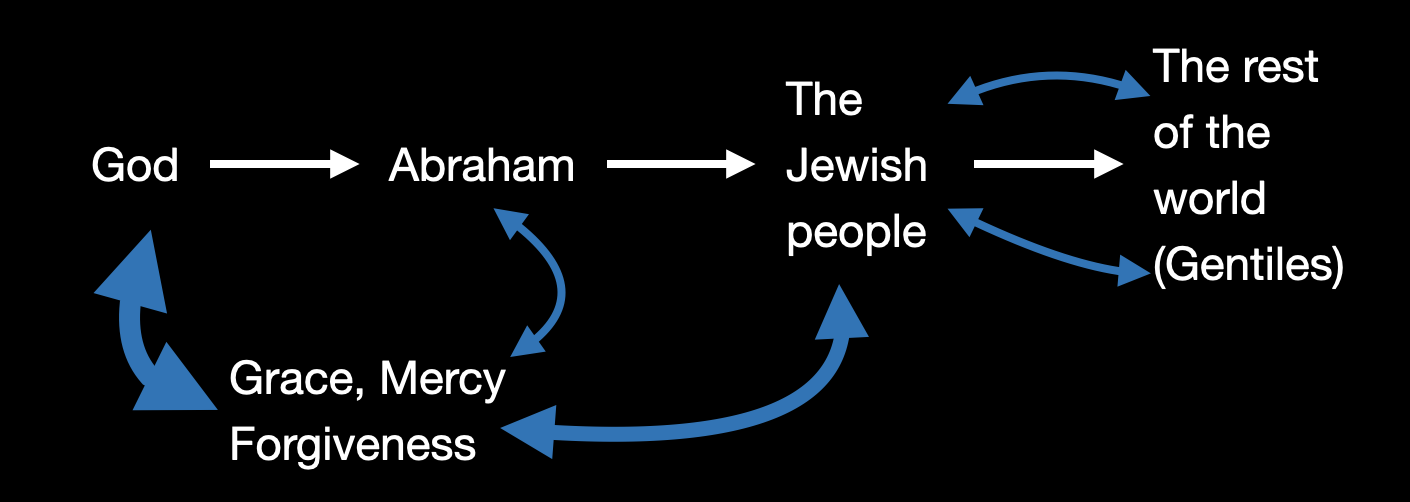
God reaches out to Abraham and establishes a covenant with him out of his grace, mercy, and forgiveness. Then Abraham’s descendants, the Jewish people, are able to join in this Abrahamic covenant with God. Then they are to reach out to the rest of the world – the Gentiles. The Gentiles must then join the Jewish people to take part in that covenantal relationship with God. This had been the understanding of God’s plan that Peter was taught as a child.
But what did God actually intend?

God reaches out to Abraham and establishes a covenant with him out of his grace, mercy, and forgiveness. Then Abraham’s descendants, the Jewish people, are able to join in this Abrahamic covenant with God. (All this is just as before.) But then the Jewish people are to reach out to the rest of the world – the Gentiles. The Gentiles can join in a covenant with God of mercy, grace, and forgiveness just as the Jews can. They don’t have to become Jewish to be in covenant with God. But now God’s Grace, Mercy, and Forgiveness have a name. And that name is Jesus.
What Peter and these in Acts 3 understood was this: “To come to God, you must come through us; you must become one of us.” But Jesus had said this: “No one comes to the Father except through me. I am the way, and the truth, and the life.” (John 14:6)
Jesus had tried to show them this even early in his ministry. Just after the Sermon on the Mount, he encounters a Roman Centurion who asks him to heal his servant. And Jesus says of this gentile:
Matthew 8:10 Truly, I tell you, with no one in Israel have I found such faith.
I have not seen any Jew with as much faith as this Gentile. And Jesus continues:
Matthew 8:11-12 I tell you, many will come from the east and the west and recline at the table with Abraham, Isaac, and Jacob in the kingdom of heaven, while the sons of the kingdom will be thrown into the outer darkness. In that place, there will be weeping and gnashing of teeth.
Many will come from the east and west… These other nations will celebrate with the Father in heaven, while some Jews will not be allowed in. This is radical talk for a people that always assumed you had to become Jewish to come to God.
And Jesus tries to show them this truth as he ministers to other Gentiles and Samaritans. You can see a gradual movement of Jesus in his year with the disciples toward ministry to the Gentiles that culminates in his Great Commission to go and disciple all nations. He says this in his final words:
Acts 1:8 But you will receive power when the Holy Spirit has come upon you, and you will be my witnesses in Jerusalem and in all Judea and Samaria, and to the end of the earth.
But God’s people had never fully understood God’s plan that God came to the Jews first so that they could be the conduit to spread his gospel to the nations. And instead of inviting others in, they have been building walls to keep them out.
Every Resurrection Day, we talk about the veil of the temple that was torn from top to bottom when Jesus was crucified. The heavy curtain that separated the holy place in the Temple from the Holiest place where God’s spirit would rest on the mercy seat in the previous temple. The veil was there to keep people from entering into God’s presence. Only the high priest could go through there, and he could only do so once a year.
Every year, we talk about how the tearing of that veil opened up the way for people to have access to the Father through Jesus. But that was not the only separation in the Temple that needed to come down. I showed you the picture last week of the model of Herod’s Temple. We talked about these massive 30-foot-tall brass doors that it took 20 men to open. They set aside this area of the temple as the women’s court. Females could go no further.
Was that God’s plan or man’s plan? God never gave any instructions for a woman’s court. You do not find a woman’s court in the plans for the Tabernacle that Moses received on the mountain. Women and men were both allowed to access the common area of the tabernacle. There is no mention of a woman’s court in Solomon’s temple or in the temple rebuilt after returning from Babylon. It was added when Herod began rebuilding the temple in 20 BC. Why was that boundary added? It was man’s idea, not God’s.
Then there was a 15-foot area around the temple enclosed by a 4.5-foot-tall wall called the Soreg. This is the barrier that the Gentiles could not pass under penalty of death. Again, there was no mandate from God to build this wall. It is the invention of the temple leadership to keep certain people away from God. Originally, Gentiles were able to bring sacrifices to the tabernacle (see Numbers 15:14-16). And Solomon invited Gentiles to pray in the common areas of the temple. But in the 2nd century BC, Gentiles began to be excluded.
And in Jesus’ day, Gentiles getting too close to the temple faced death. All of Jesus’ followers had grown up their whole life being taught that this wall was necessary. It was important. This is a rule you don’t break. If you do, then you will die. God is only for the Jews. And in Acts 3, Peter is preaching just outside this wall and calling people to repentance, but he is only calling Jews to repentance. He doesn’t understand yet.
When Jesus was crucified, the veil was torn; the separation that symbolized the isolation of God’s presence was removed. Because of Jesus’ work on the cross, God can truly dwell with people. But Jesus was not satisfied with just tearing down the veil of the temple. These other walls must come down. These walls that people built to keep others from God, to keep the women out, to keep the Gentiles out. God never intended this, and they must fall. But the only way to tear down these walls would be to tear down the temple block by block, as Jesus said in Mark 13:
Mark 13:1-2 And as he came out of the temple, one of his disciples said to him, “Look, Teacher, what wonderful stones and what wonderful buildings!” And Jesus said to him, “Do you see these great buildings? There will not be left here one stone upon another that will not be thrown down.”
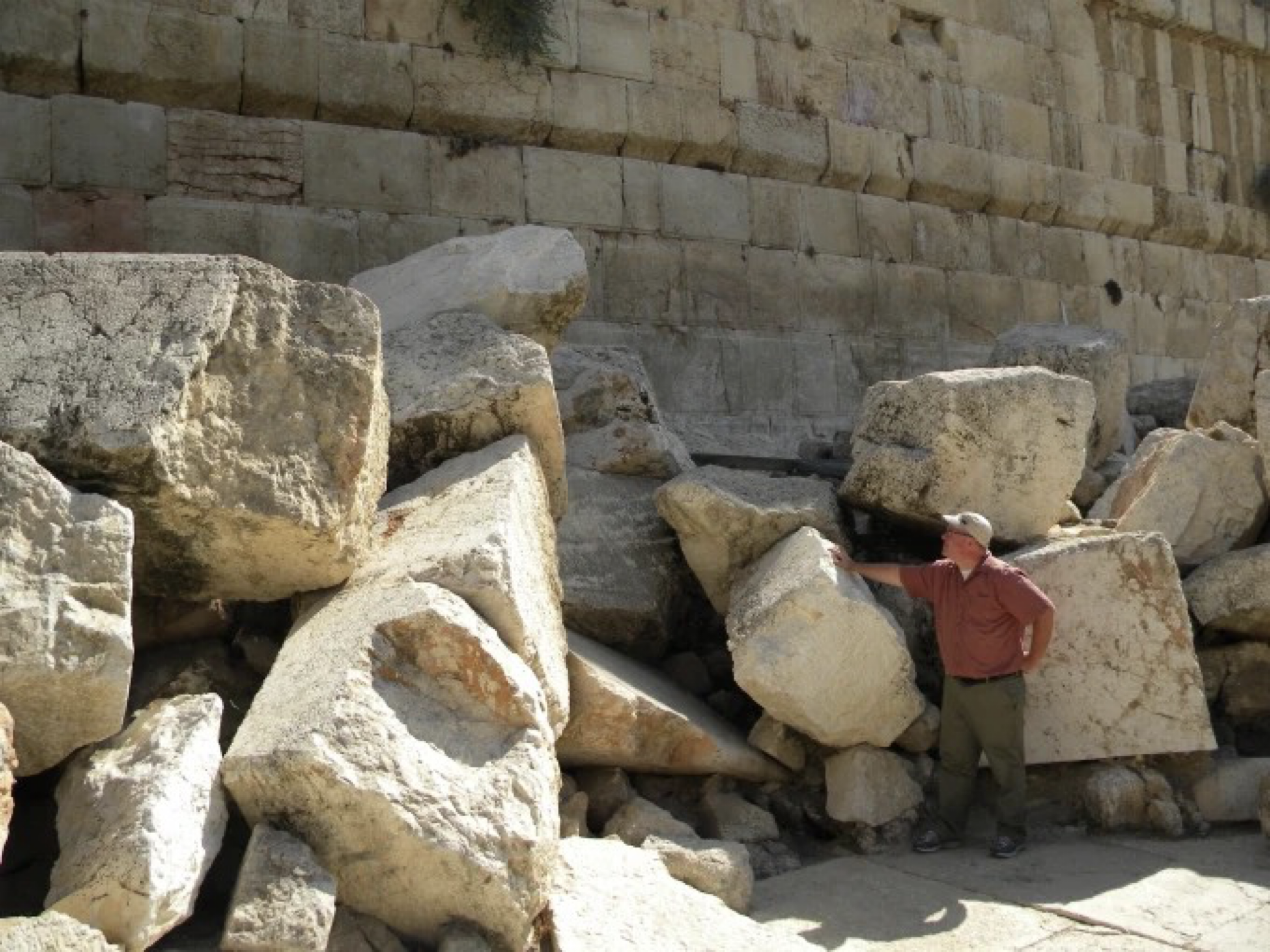
And so it was. Just 40 years later, in 70 AD, the temple was dismantled stone by stone, with Roman soldiers using pry bars to lever the huge stones off the temple mount. You can see these stones still lying where they fell almost 2000 years ago.
And Paul addresses some Gentiles in Ephesus:
Ephesians 2:11-16. Therefore, remember that at one time you Gentiles in the flesh…remember that you were at that time separated from Christ, alienated from the commonwealth of Israel and strangers to the covenants of promise, having no hope and without God in the world. But now in Christ Jesus, you who once were far off have been brought near by the blood of Christ. For he himself is our peace, who has made us both one and has broken down in his flesh the dividing wall of hostility that he might create in himself one new man in place of the two, so making peace, and might reconcile us both to God in one body through the cross.
It took drastic measures for God to defeat sin and death. It took Jesus dying on a cross and being resurrected. It took drastic measures for God to set his people back on the right path of worship, obedience, and compassion. It took the destruction of the Temple that bore His name, built in the place where He said He would place His name forever. It took the formation of a new Temple, but not one of stone. His followers would become His temple. He would dwell with them.
But in Acts 3, Peter is still blind to God’s truth about the Gentiles. And so was the rabbi called Saul, until he met Jesus on the road to Damascus. Paul says that on that road, Jesus came to him to let him know he was sending him to the Gentiles “to open their eyes, so that they may turn from darkness to light and from the power of Satan to God, that they may receive forgiveness of sins and a place among those who are sanctified by faith in me.” (Acts 26:17-18).
So Paul understood. He said in Romans 1:16 that the Gospel is “the power of God for salvation to everyone who believes, to the Jew first and also to the Gentile.” This is the story of salvation in the Bible. God chose Abraham to establish a family that would serve as priests, bringing God’s blessing to the world. However, they continually failed in this mission. They distorted his teachings and became a religion that was inward-focused, caring only for themselves and not spreading the good news of God to the nations. So God sent his Son to be the Jew that would reboot this mission, get them back on the right track as a kingdom of priests to the nations.
But at this point, Peter, John, and the early followers of Jesus are busy trying to persuade just the Jewish people to accept the fact that the Messiah has come. That Jesus is the one they have long awaited. So Peter tells the Jews in his sermon:
Acts 3:19-26 Repent therefore, and turn back, that your sins may be blotted out, that times of refreshing may come from the presence of the Lord, and that he may send the Christ appointed for you, Jesus, whom heaven must receive until the time for restoring all the things about which God spoke by the mouth of his holy prophets long ago. Moses said, ‘The Lord God will raise up for you a prophet like me from your brothers. You shall listen to him in whatever he tells you. And it shall be that every soul who does not listen to that prophet shall be destroyed from the people.’
Compare Acts 3:19 in the King James Version and the English Standard Version:
Acts 3:19 (KJV) Repent ye therefore, and be converted, that your sins may be blotted out…
Acts 3:19 (ESV) Repent therefore, and turn back, that your sins may be blotted out…
(The KJV and the NKJV are pretty much the only versions that use the word ‘converted.’) The way we understand the word “convert” in the KJV has led to some misunderstandings. We define ‘convert’ as either (1) to change from one form to another, or (2) to change one’s religion or other beliefs.
We read this in the King James Version and get the idea that Peter is trying to convince these Jews to convert from Judaism to Christianity, to change religions. But if you asked Peter if he had changed religions, he would think you were very confused. He would say, “Of course I haven’t changed religions. I am still very much Jewish. The difference for me is that I have found the Messiah that my people have prayed for for hundreds of years.” As we noted earlier, Peter is still attending Temple services, praying Jewish prayers, and following Jewish cultural laws. He is now following these laws as interpreted by the one he considers the ultimate Jewish rabbi, Jesus.
So, I think ‘converted’ is a poor translation of the Greek word ‘epistrepho’, which means to turn towards, to turn about, to turn back, or return. It is about changing direction, and its counterpart, the Hebrew word shuv, is frequently used in the Old Testament as turning away from sin and turning towards God. But there is a conversion that must occur when one comes to accept Jesus. There is a change that must take place when we turn from sin and turn to God.
2 Corinthians 5:17 Therefore, if anyone is in Christ, he is a new creation. The old has passed away; behold, the new has come.
Paul says the ‘old man’ must die.
Galatians 2:20 I have been crucified with Christ. It is no longer I who live, but Christ who lives in me.
Our old self, who was motivated by self-interest, who made our own decisions, and who lived by our rules, must be symbolically crucified and buried with Christ so that the new life that proclaims Jesus as Lord, that submits our will to his, that lives by his rules and in his interest. Gentiles do not convert to Judaism, and Jews do not need to abandon their heritage. They both need to recognize Jesus as the Messiah who came as the Old Testament predicted.
Peter and the other followers of Jesus in Acts 3 see themselves as Jews. They view themselves as a sect of Judaism that followed Jesus as the Messiah. And followers of Jesus continued to be viewed as a sect of Judaism throughout most of the first century at least. One day, we will discuss when what the New Testament called “followers of the Way” ceased to be viewed as a Jewish sect and began to be viewed as a separate religion.
But we must not forget, as Paul notes in Romans 11, we are part of God’s family because we have been grafted into the Jewish root. We do not become Jewish, but the root of our faith and life is the Jewish heritage that supports us, from Abraham to Jesus. Abraham is our Father. The Old Testament is our story, and we need to read the Bible as one unified story about the creation and redemption of God’s people and God’s world.
One day, Peter will learn that Gentiles are part of this story, but it will take a dramatic lesson involving a vision from God and a devout Gentile centurion that we will see in Acts 10. But one more lesson for us now. Even though Peter, at this point, is dead wrong on his theology about Gentiles, it does not stop God from doing great things through him. Peter is in on many miracles in these early chapters of Acts. The church is growing amazingly fast. Thousands are being added.
Perhaps we can learn from this that God can do much through us, even if we don’t understand everything. Even if we have some theology completely wrong, God can use us for his kingdom. And perhaps we can show more grace to our brothers and sisters in Christ, who we feel don’t have everything right. I confess I have at times been too judgmental of others’ theology. I need to learn to show grace like Jesus shows grace, while also realizing that I could be the one who doesn’t have it just right. But even if we get some things wrong, Jesus can do great things through us. Having everything theologically correct is important. We should study the scriptures for ourselves intently. But that is not the most important thing. After all, what does Jesus really want from us? Obedience and Compassion to others.
 Swallow No Camels