
October 23, 2025 –  Time to Serve— Acts #17

October 23, 2025 –  Time to Serve— Acts #17
Acts 6:1–7

Acts 6:1-7   Now in these days, when the disciples were increasing in number, a complaint by the Hellenists arose against the Hebrews because their widows were being neglected in the daily distribution. And the twelve summoned the full number of the disciples and said, “It is not right that we should give up preaching the word of God to serve tables. Therefore, brothers, pick out from among you seven men of good repute, full of the Spirit and of wisdom, whom we will appoint to this duty. But we will devote ourselves to prayer and to the ministry of the word.” And what they said pleased the whole gathering, and they chose Stephen, a man full of faith and of the Holy Spirit, and Philip, and Prochorus, and Nicanor, and Timon, and Parmenas, and Nicolaus, a proselyte of Antioch. These they set before the apostles, and they prayed and laid their hands on them.

And the word of God continued to increase, and the number of the disciples multiplied greatly in Jerusalem, and a great many of the priests became obedient to the faith.

As we have seen so far in Acts, the early church was known for many things — bold preaching, miracles of healing, and rapid growth — but one of its most beautiful qualities was its heart to serve.  They didn’t just preach the gospel; they lived it.  They didn’t just talk about love; they showed it in action.  When widows were hungry, they fed them.  When needs arose, they met them, giving of what they had and, if necessary, selling land they owned to provide for those in need.

But we read in Acts 6 today about that spirit of service being tested.  As the church grew, some widows — the Greek-speaking Hellenists — were being overlooked in the daily distribution of food.  It wasn’t intentional. There are natural divisions in the church at this point based on their language.  Most in the Jerusalem area spoke Aramaic or Hebrew and used the Hebrew Scriptures in their synagogues.  Others were from regions outside Judea and in their community spoke Greek, like most of the rest of the world.  They would typically use the Septuagint in their synagogues, the Greek translation of the Old Testament done by Jewish scholars in the 2nd and 3rd centuries BC. 

There was a natural division, of course, based on language.  And the needs of those in your same-language community would be more well-known than the needs of others you have less contact with.  So some of the Greek-speaking widows were not receiving the help they needed.  Once the need was made known, the church rushed to fill it.  Before the apostles in the book of Acts ever said a word about serving widows, the call to serve had already been written into the story of God’s people in the Bible.  From the beginning, God’s law commanded care for the poor, the widow, the orphan, and the foreigner:

Deuteronomy 10:17-19  For Yehovah your God is God of gods and Lord of lords, the great, the mighty, and the awesome God, who is not partial and takes no bribe. He executes justice for the fatherless and the widow, and loves the sojourner, giving him food and clothing. Love the sojourner, therefore, for you were sojourners in the land of Egypt.

Since their departure from Egypt, God has been teaching the children of Israel who He is and how He wants them to behave.   In fact, if you want to know how God wants you to act, then study God’s character, for we are to imitate Him.  The more we understand who God is, the better we know how God wants us to act.  Yehovah says, “This is who I am.  You see how I act.  If I am your Father, then grow up and act like me.”   He tells them, “Look, I am not like the gods of Egypt, where you were slaves.  You could bribe those gods; they didn’t care about justice.  They cared only for themselves.  Do not imitate them, but imitate me.

This is the heart of the God we serve — a God who stoops low to care for the vulnerable.  And they specifically list three sets of people here.  The fatherless and the widow, you understand.   Orphaned children obviously need the care of the community. So too did widows, for in their culture the widow had no means of support.  And then the sojourner.  That Hebrew word, ‘ger,’ meant the “newcomer, the foreigner, the alien, or the immigrant.”  These people, just joining them, had no land and thus no means to care for themselves.  Like the widow and the orphan, they needed the community’s love and support.

This is the Abu Simbel temple near the southern border of Egypt, carved into the side of a mountain just beside the Nile.  These four colossal statues are of Ramses II. They are over 70 feet tall.  Every depiction of Pharaoh and their gods is huge.  Why are they so big? 

Look here at the base of one of these statues of Ramses.  The person standing there gives you an idea of the proportions.  Now look at the figures carved under the feet of Ramses.
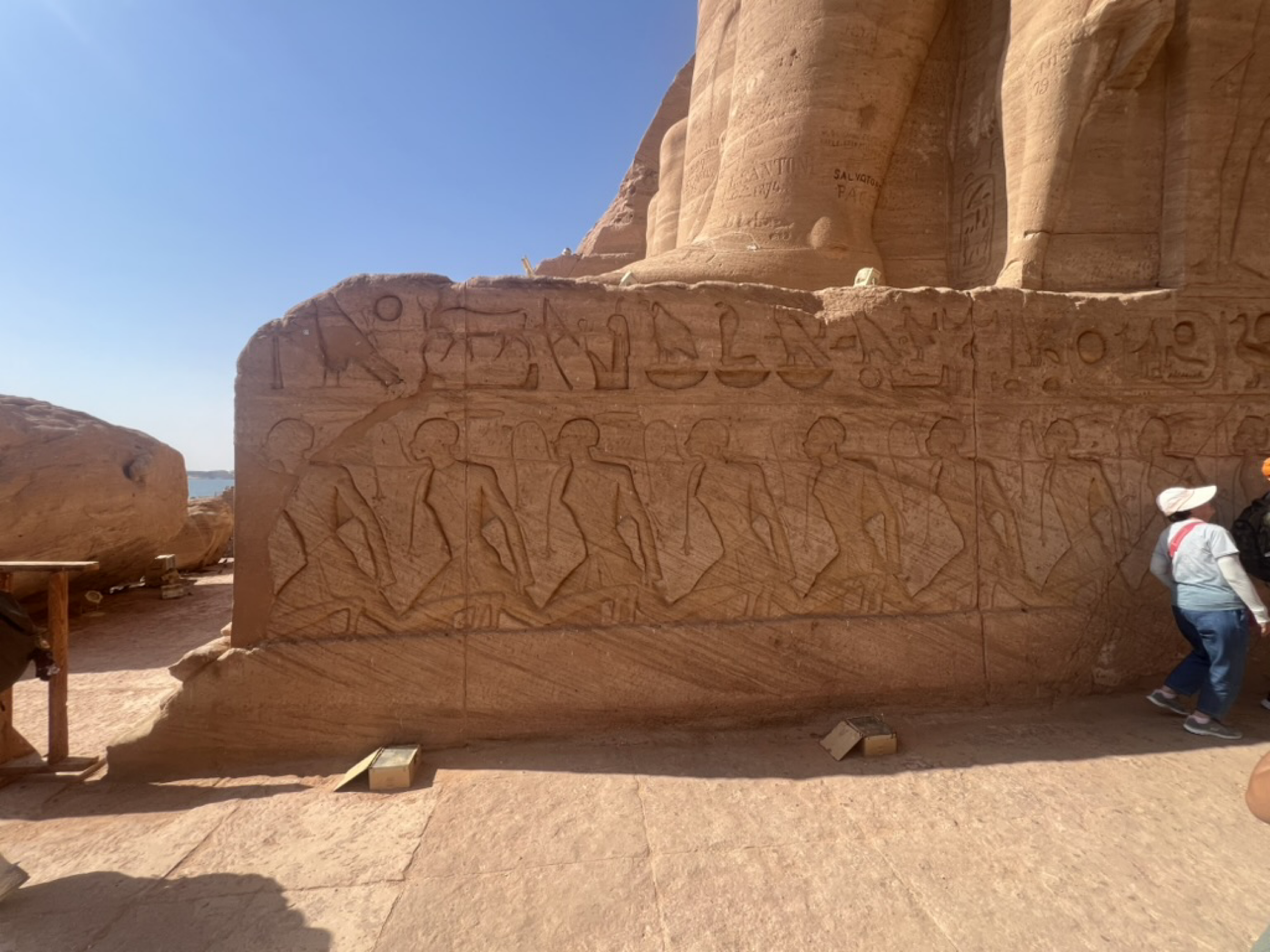
These are the people whom he has conquered and enslaved.  They are on their knees with their hands bound behind their back, humbled in submission to the great Ramses.  They are literally under his feet.  His enemy has been trampled and subjugated.   And they are tiny compared to the pharaoh, just as you are when you pass by under Pharaoh’s feet. 

The reason that all of the depictions of gods in Egypt were big was to make you look small.  You are nothing compared to them.   You are like a pitiful slave.  But Yehovah says that He is not like these gods of Egypt.  He stoops low to care for the most vulnerable of his people.  And He is trying to teach this lesson to the children of Israel.  He says, “You were immigrants in Egypt. You spoke a different language and worshiped a different God.  And they treated you poorly.  You were slaves there.  Don’t let me find you treating others like this.   Don’t imitate the pharaoh and the gods of Egypt.  Imitate me.  You are my children.”

Exodus 22:22-24  You shall not mistreat any widow or fatherless child. If you do mistreat them, and they cry out to me, I will surely hear their cry, and my wrath will burn, and I will kill you with the sword, and your wives shall become widows and your children fatherless.

This is the lesson they are taught just after escaping from Egypt.  God is serious about how widows, orphans, and immigrants are treated.  God says, ‘If you mistreat them, I will destroy you.’  But Israel doesn’t learn this lesson very well.  Here are the words of Isaiah  7-800 years later:

Isaiah 10:1-3  (Message)  Doom to you who legislate evil, who make laws that make victims—
 Laws that make misery for the poor, that rob my destitute people of dignity, exploiting defenseless widows, taking advantage of homeless children.
 What will you have to say on Judgment Day, when Doomsday arrives out of the blue? Who will you get to help you?

God cares for those that society abuses and tosses aside. This is the heart of the God we serve — a God who stoops low to care for the vulnerable.  He hears the cry of the oppressed, He defends the weak, and He calls His people to do the same.

The mistreatment of these poor is listed as a primary reason that God called down the enemy to destroy them, just as he told them he would in Exodus.  First, Assyria came from the north and wiped out the Northern tribes.  Then, Babylon came as an instrument of God to destroy their country and take the southern tribes into exile for 70 years.    God is so serious about this that he brought destruction on his chosen people. 

Pharaoh would never humble himself to help an ordinary person.  However, in contrast, our God did this:

Philippians 2:6-7  Jesus, though he was in the form of God, did not count equality with God a thing to be grasped, but emptied himself, by taking the form of a servant, being born in the likeness of men.

Jesus left his throne in God’s heaven, where there was no pain or hunger or sickness.  A place where he was worshipped constantly.  And he left all that behind to enter our cruel world and take the form of a servant.  No idol god of any nation would ever do that.   No other king would give up his throne to come to take on the task that Jesus did.

And Jesus spent his entire ministry serving others.  And he tried to teach his disciples that whoever would be greatest must be the servant of all.  They were slow to grasp this lesson, so on the night before he went to the cross, at his final meal with them.  He takes on the task of the lowest servant and washes their feet.

Matthew 20:28  The Son of Man came not to be served but to serve, and to give his life as a ransom for many.

So the passage we just read in Philippians continues with this verse. 

Philippians 2:8  And being found in human form, he humbled himself by becoming obedient to the point of death, even death on a cross.

He humbled himself.  He lowered himself to the point of suffering and death for us.  You see, Pharaoh made himself look big so he could make everyone else look small.  Our God became small, to make us big.   He came to lift us up and make us bigger—more than we were.  And Paul says this is the lesson that Israel had trouble learning and that we must learn.  The verse that precedes this passage :

Philippians 2:4-5  Let each of you look not only to his own interests, but also to the interests of others. Have this mind among yourselves, which is yours in Christ Jesus,

Have this mind in you.  This is the mind of Christ.  Think like Jesus.  See others the way Jesus sees them.  And be willing to lower yourself, to humble yourself, to make yourself small, to lift others up.  This is who God is. This is the gospel message.

Now back to our story…

Acts 6:2   And the twelve summoned the full number of the disciples and said, “It is not right that we should give up preaching the word of God to serve tables.

Now, don’t read this wrong.  They weren’t saying serving tables was unimportant — they were saying it was so important that it needed to be done by people called and equipped by God, especially for this job.  Look at the qualifications for this position.  They aren’t looking for good businessmen, strong backs, or good organizational skills.

Acts 6:3  “Therefore, brothers, pick out from among you seven men of good repute, full of the Spirit and of wisdom, whom we will appoint to this duty.”

They looked for people full of the Holy Spirit.  Why? Because even simple acts of service are sacred work when done in Jesus’ name.  Every meal served, every visit made, every hand extended in compassion is more than just a good deed.  Because God, through the Holy Spirit, is present in those acts of mercy and love, they carry much more meaning.

What we learn from this passage is this:  Serving others isn’t a distraction from the gospel — it’s a demonstration of it.  Every time we love someone in need, we preach a silent sermon about who Jesus is.  The Holy Spirit in us makes an impact in our service way beyond any physical act we can do.  

Stephen was one of the seven chosen.  We will talk about him next week.  He didn’t see himself as “just serving tables.”  He saw himself as serving Christ. And we will see how God used him mightily, both as a servant and a powerful witness. When you serve others, you are not doing small work — you are doing kingdom work. You’re showing the world what the love of Christ looks like in action.

So what is the most important job in the Kingdom of God?  Is it the prophet – the preacher?  Is it the administrator?  Is it the worker of miracles, the healer?  How about the teacher?  What is the highest calling in the Kingdom of God?  Paul answered that question in 1 Corinthians 12.

1 Corinthians 12:27-31 “Now you are the body of Christ and individually members of it. And God has appointed in the church first apostles, second prophets, third teachers, then miracles, then gifts of healing, helping, administrating, and various kinds of tongues. Are all apostles? Are all prophets? Are all teachers? Do all work miracles? Do all possess gifts of healing? Do all speak with tongues? Do all interpret? But earnestly desire the higher gifts.”

Earnestly desire the higher gifts.   But what are the higher gifts?   Don’t misunderstand his statement about “first apostles, second prophets, third teachers….”  Theologians will be quick to say that this is not a listing of importance.   So what are the higher gifts that we are to desire?  The next verse says: 

1 Corinthians 12:31  And I will show you a still more excellent way.

And what does Paul show us next?  That is the last verse of the twelfth chapter.  So the more excellent way is found in the thirteenth chapter of Corinthians. 

1 Corinthians 13:1-2  If I speak in the tongues of men and of angels, but have not love, I am a noisy gong or a clanging cymbal. And if I have prophetic powers, and understand all mysteries and all knowledge, and if I have all faith, so as to remove mountains, but have not love, I am nothing.

This is the Love chapter.   The more excellent way is the way of love.  

1 Corinthians 13:8  Love never ends. As for prophecies, they will pass away; as for tongues, they will cease; as for knowledge, it will pass away. 

Prophecy or knowledge or tongues or any gift or ministry without love is empty.  All the other gifts and ministries will come to an end.  But the love that is behind them, the love that comes to us from God and flows out of us through God, will never cease.  All gifts and all work done in the kingdom are essential, but the most important job is to love. 

1 Corinthians 13:13  So now faith, hope, and love abide, these three; but the greatest of these is love.

It is greater than faith. It is greater than hope.  Again, if we understand who God is, then we know how God wants us to behave.  God is love.  His love is limitless and is for all people. So that should be who we are, people who love others radically.  People who like their God are willing to sacrifice themselves to love others.  But again, back to our story.

Once the seven men were chosen, the apostles prayed over them and set them apart for service.  And look at what happened next: 

Acts 6:7 “ And the word of God continued to increase, and the number of the disciples multiplied greatly in Jerusalem, and a great many of the priests became obedient to the faith.”

That’s not a coincidence.  When the church began serving one another well, the gospel began to spread further.  Why? Because the love of God is powerful, spreading like a wildfire.  When people see the church caring for each other — across cultural lines, across differences — it gives credibility to the message we preach.  Do we want our church to grow?  Then we must learn this lesson.  Service in love, across cultural and language differences.  Jesus said,

John 13:35   By this all people will know that you are my disciples, if you have love for one another.

The church grew not just through preaching, but through serving.   If we want to see revival in our day, it won’t come just through louder preaching —it will come through deeper compassion.  It’s often the acts of love that open the door for the words of truth.  When a church rolls up its sleeves, when believers feed the hungry, comfort the hurting, and serve the forgotten — that’s when the light of Christ shines the brightest.

Acts 6 shows us what happens when a church takes service seriously: needs are met, unity is restored, and the gospel moves forward.  Serving others is not optional for a follower of Christ — it’s the very heartbeat of our faith.  It’s how the world sees Jesus in us.   So, ask yourself today: How can I serve others in Jesus’ name?  How can I reach out to those in our community who are forgotten, who suffer from injustice, who are poor and needy, who are the sojourners?

1 John 3:16-18   This is how we know what love is: Jesus Christ laid down his life for us. And we ought to lay down our lives for our brothers and sisters. If anyone has material possessions and sees a brother or sister in need but has no pity on them, how can the love of God be in that person? Dear children, let us not love with words or speech but with actions and in truth.

October 13, 2025 –  This Is How I Fight My Battles — Acts #16

October 13, 2025 –  This Is How I Fight My Battles — Acts #16
Acts 5:33-42

Today, we will conclude our story in Acts 5.  Remember that the apostles are all placed in prison overnight for disobeying a specific order from the highest court in Israel.   But God decided that they didn’t need to stay there overnight.  He sent an angel to release them so they could return to the temple and resume preaching that same message.  As the choir just sang, “If you need freedom or saving, He’s a prison-shaking Savior.  If you got chains, He’s a chain breaker.”

Acts 5:33-42  When they heard this, they were enraged and wanted to kill them. But a Pharisee in the council named Gamaliel, a teacher of the law held in honor by all the people, stood up and gave orders to put the men outside for a little while. And he said to them, “Men of Israel, take care what you are about to do with these men. For before these days Theudas rose up, claiming to be somebody, and a number of men, about four hundred, joined him. He was killed, and all who followed him were dispersed and came to nothing. After him Judas the Galilean rose up in the days of the census and drew away some of the people after him. He too perished, and all who followed him were scattered. So in the present case I tell you, keep away from these men and let them alone, for if this plan or this undertaking is of man, it will fail; but if it is of God, you will not be able to overthrow them. You might even be found opposing God!” So they took his advice, and when they had called in the apostles, they beat them and charged them not to speak in the name of Jesus, and let them go. Then they left the presence of the council, rejoicing that they were counted worthy to suffer dishonor for the name. And every day, in the temple and from house to house, they did not cease teaching and preaching that the Christ is Jesus.

First, let’s discuss the principal players in this section of the story.  They are meeting in the council of the highest court, the Sanhedrin.  Remember that the high court of priests was composed of two religious groups, the Sadducees and the Pharisees.  These two groups differed in their religious beliefs, their social standing, and the focus of their religious practice.   

Social/Political Standing- 
Sadducees were the aristocrats; they were generally wealthy.  They were politically involved and often allied with the Romans.  Pharisees were a lay movement popular among the ordinary people and the middle class. 

Religious Beliefs
Sadducees accepted the first five books of the Torah.  They rejected the Oral Torah (the laws added by the Pharisees).  They did not believe in supernatural beings (angels or demons) and dismissed the idea of an afterlife and the resurrection of the dead.

Pharisees accepted the authority of the entire written Torah (our whole OT) and the Oral Torah (the laws they believed were handed down to Moses but not written in the Scriptures.  Laws that their predecessors continued to refine over time.  They believed in angels, demons, and other spiritual beings as well as in the afterlife and the resurrection of the dead.  

Religious focus
The Sadducees’ religious focus was on the temple and the rituals there (and of course, the collection of temple taxes, contributions, and other sources of revenue).  The Pharisees focused on righteousness, as defined by keeping all of the commandments (written and oral).

The Sadducees were against Jesus from the beginning.  His teaching emphasized the resurrection that they completely rejected.  And Jesus threatened their political power, and then he threatened their authority and their pocketbooks when he cleansed the temple of the money changers.

We often overemphasize the conflict between the Pharisees and Jesus.  Initially, they were curious about Jesus and his beliefs, and their debate with him was not aggressive but rather their usual learning style.  Jesus certainly had more in common with the Pharisees than the Sadducees.  He often ate in their homes.  Nicodemus was a Pharisee, as was Paul.  At one point, Pharisees warned him of a plot on his life.  Later, as his rejection of the Oral Law became clearer, some of them (not all) joined the Sadducees in their opposition to Jesus.

In the days of Jesus and Acts, the Sadducees had a greater representation on the Sanhedrin, and they controlled the high priesthood.  But they needed the support of the Pharisees there to maintain social stability.

Knowing this, let’s look back at the story we have been working through in Acts.  The apostles are continuing to preach their primary story of Jesus being the Messiah and God raising him from the dead.  You can now understand why the Sadducees on the court are particularly angry about this, for they say resurrection is impossible.  That is why 

Acts 5:33  When they heard this, they were enraged and wanted to kill them.

We looked at this word translated here, “enraged,” back in July.   The Greek is diaprio, which literally means “sawn in half.”  This is an abbreviated version of what we see in Acts 7:54, which in Greek is “diapriō kardia autos” and is translated in the ESV “enraged,” but in the King James Version more literally “cut to the heart.”  This is extreme anger, bordering on rage or madness.  These apostles have, according to the Sadducees, “filled Jerusalem with your doctrine [of resurrection from the dead]” and they are thus way beyond just angry to the point of planning how to kill them.

These religious leaders think they stand on righteous ground when they desire to kill the apostles.  They feel like they are defending the true religion against some new heresy.  They believe these apostles are deceiving people and leading them astray.  They must be stopped to protect the true faith. They feel that it is their duty to defend the faith.  They are defending God himself.  

Enter Gamaliel.  
Gamaliel was no obscure figure. He was the most respected Pharisee of his day, later known as “Gamaliel the Elder.” According to Acts 22:3, the apostle Paul himself studied under him. Jewish tradition holds Gamaliel in high esteem—wise, balanced, and respected by all. Here, in Acts 5, Gamaliel demonstrates that wisdom. He commands the council to pause and consider what they are doing (always good advice).:

Acts 5:35  “Men of Israel, take care what you are about to do with these men.”

He reminds them of two failed movements—Theudas and Judas the Galilean—both of which at first received considerable support but fizzled out after their leaders died. Then comes his key insight:

Acts 5:38-39  “If this plan or undertaking is of man, it will fail; but if it is of God, you will not be able to overthrow them. You might even be found opposing God!”

In other words, you don’t need to defend God. If this movement isn’t from Him, it will collapse. If it is from Him, nothing can stop it. That’s faith. That’s confidence in the sovereignty of God. And it stands in stark contrast to the anxious defensiveness that we see in the Sadducees and that so often characterizes religious people—even today.

Let’s be honest: most of us are more like the Sanhedrin than Gamaliel. When Christianity is criticized, when society moves away from biblical values, or when our beliefs are mocked, we feel a surge of indignation. We want to “strike back”—with words, with politics, sometimes even with hostility.

The church has a long history of poorly reacting to perceived threats against religion.  Let me give you just a few examples:

The Crusades (11th–13th centuries): After centuries of Islamic military expansion and the conquest of the Holy Land by the muslims, Pope Urban II called for the First Crusade in 1095, asking knights to come to the aid of the church to defend it’s honor, to expell the Muslims from the Holy land, and in doing so, to get remission of all their sins.  They did liberate Jerusalem, but along the way, crusading armies responded with violent sieges and massacres of thousands of people, including entire Jewish communities in the Rhineland, seeing the Jewish “enemies of God” as a more immediate threat than Muslims in the Holy Land.  Many Jews were given the option of forcibly converting or dying.  This established a violent pattern that was repeated in later crusades and pogroms. The Crusades are part of our sad history, reflecting an aggressive and militarized response to a perceived religious threat.

The Counter-Reformation (16th–17th centuries): The Catholic Church responded to the rise of Protestantism with a Counter-Reformation. This involved theological reforms, but also violent persecution in Catholic-dominated territories. Protestants were labeled heretics and subjected to torture, as in the Spanish Inquisition. Many were hanged or burned at the stake for their views. The French Wars of Religion involved decades of brutal civil war and included the St. Bartholomew’s Day Massacre in 1572, in which Catholics slaughtered thousands of Protestants.  All in the name of “defending the faith.”

Lest you think it was only the Catholic Church responding with violence, John Calvin participated in the trial of a theologian, Michael Servetus, who was burned at the stake; Martin Luther endorsed the brutal drowning of Anabaptists and the burning of heretics.  He wrote pamphlets that encouraged the violent suppression of a revolt in Germany, and also wrote a pamphlet supporting the persecution of the Jews, including burning their homes and synagogues.  Again, all in the name of defending true religion.

Witch hunts (15th–18th centuries): In both Protestant and Catholic areas of Europe and in the US, hysteria and fear of witchcraft led to the persecution and execution of tens of thousands of people, most of them women. Theologians often conflated magic with heresy, justifying the punishment of witches as a way to defend Christianity against perceived Satanic threats.

How about in our times?   
One morning in December 1994, my wife was in a grocery store just across the street in Brookline, Massachusetts, when John Salvi opened fire in an abortion clinic on Beacon Street, killing two people and wounding five others.  This, Salvi said, in defense of the Catholic Church.

And you know of the actions of the Westboro Baptist Church that have held protests at military funerals as well as at the funerals of gay victims of crimes.  On May 14, 2008, two days after the 2008 Sichuan earthquake, which claimed the lives of at least 70,000 people, WBC issued a press release thanking God for the heavy loss of life in China, and praying “for many more earthquakes to kill many more thousands of impudent and ungrateful Chinese.”

And you know of Jerry Falwell, who in 1980 proclaimed that the AIDS epidemic was a divine punishment for homosexuality.  John Hagee commented on Hurricane Katrina in 2005, stating he believed New Orleans was being punished for its “level of sin.”  The day after a devastating earthquake hit Haiti in 2010, televangelist Pat Robertson claimed the disaster was the result of a “pact with the devil.”  And then, after the events of 9/11, Jerry Falwell, Pat Robertson, and other conservative figures suggested that the attacks were divine judgment for America’s supposed moral failings, including the acceptance of abortion and homosexuality. 

And this is just a tiny sample of centuries of hostility and hate, all in the name of protecting religion, defending the church, or standing up for God.  This is the same attitude driving this Jewish court in our story. 

So how are we to respond?  How do you react when you feel someone is attacking your religion or your church, or Jesus himself?   Aren’t you responsible for speaking up when people are berating your God and your faith?  You can’t just sit back and let it go on, can you?  Someone has to fight that battle, don’t they?

Seven years ago, a song came out of Overcomers Church in Dallas, Texas, with a great message, though I have to admit that I initially found it annoyingly repetitive. The lyrics are:  “This is how  I fight my battles.  It may look like I’m surrounded, but I’m surrounded by you.  This is how I fight my battles, right here at your table. Your blood and your body have overcome.  Grace, Grace, Grace.  This is how I fight my battles.”   

There is a great story in 2 Chronicles 20:19-23.  The armies of Ammon, Moab, and Mount Seir have come to attack Judah.  King Jehoshaphat set up his army to stand against them.  And who did he put on the front lines?  Who did he put right at the front of his army?  Not his infantry.  He appointed Levites and singers to go out before the army, praising God with loud voices.  And God defeated those armies, with the soldiers of Judah never having to fight.   This is how we fight our battles.  We fight our battles with praise to the Lord.   

In Second Kings 6, the prophet Elisha and his servant are under attack by the armies of Aram, and the servant is scared because they are surrounded.  

2 Kings 6:15-17  When the servant of the man of God rose early in the morning and went out, behold, an army with horses and chariots was all around the city. And the servant said, “Alas, my master! What shall we do?” He said, “Do not be afraid, for those who are with us are more than those who are with them.” Then Elisha prayed and said, “O Yehovah, please open his eyes that he may see.” So Yehovah opened the eyes of the young man, and he saw, and behold, the mountain was full of horses and chariots of fire all around Elisha.”

Those who are with us are more than those who are with them.  It may look like I’m surrounded, but I’m surrounded by you.   This is how we fight our battles.

The Israelites are escaping Egypt.  They have a body of water in front of them that they cannot cross, with the Egyptian army coming toward them.

Exodus 14:10-14  When Pharaoh drew near, the people of Israel lifted up their eyes, and behold, the Egyptians were marching after them, and they feared greatly. And the people of Israel cried out to Yehovah. They said to Moses, “Is it because there are no graves in Egypt that you have taken us away to die in the wilderness? What have you done to us in bringing us out of Egypt? Is not this what we said to you in Egypt: ‘Leave us alone that we may serve the Egyptians’? For it would have been better for us to serve the Egyptians than to die in the wilderness.” And Moses said to the people, “Fear not, stand firm, and see the salvation of Yehovah, which he will work for you today. For the Egyptians whom you see today, you shall never see again. Yehovah will fight for you, and you have only to be silent.

And the Israelites pass through the water on dry land and the Egyptians drown. Stand firm, be silent, Yehovah will fight for you. This is how we fight our battles.

And one night in the Garden of Gethsemane, Jesus is taken prisoner by the temple guards.  And Peter takes a sword and attacks those arresting Jesus. 

Matthew 26:52-54  Then Jesus said to him, “Put your sword back into its place. For all who take the sword will perish by the sword. Do you think that I cannot appeal to my Father, and he will at once send me more than twelve legions of angels? But how then should the Scriptures be fulfilled, that it must be so?”

A few hours later, Jesus stands before those who can sentence him to death.

Matthew 27:12-14  But when he was accused by the chief priests and elders, he gave no answer. Then Pilate said to him, “Do you not hear how many things they testify against you?” But he gave him no answer, not even to a single charge, so that the governor was greatly amazed.

Silence before those who berate and accuse you.   This is how I fight my battles.

Why was Jesus silent?  Because He knew the truth didn’t need to win an argument. He didn’t need to win a court trial or a debate.  He was there to win a battle with sin and death.  A battle that he would win not by winning, but by dying on a cross, and by lying 3 days in a grave, and then by rising from the dead.  This is how I fight my battles: in silence before my accusers, then with the thundering power of an almighty God who can conquer death.  God’s truth does not need a verbal defense.  His truth will be evident in His will being done despite any opposition.

And the entire story of Scripture shows this: God’s truth has never needed human defense. It only needs faithful witnesses.

We need to study scripture and learn the lessons there.  When we feel attacked, we don’t act in fear and panic.  We don’t rush to the offensive or the defensive.  We stand still in silence and see Yehovah fight for us.  We don’t need to win debates on Facebook or in public.  We don’t need to win arguments; we need to win hearts.  And that comes through the body and the blood of Jesus, the love and mercy and grace of the Father, not through our words or our swords.  This is how we fight our battles.

If we feel like we need to defend God, then we don’t understand who God is.   Ancient people believed that their gods needed human support in the form of sacrifices — animal or even human—to live. We saw in Egypt how they felt they needed to bring their Gods food to eat and people to serve them.  Yehovah, however, makes abundantly clear in the Bible that He is not like that. He does not need our sacrifices or offerings, and He doesn’t need us to defend His honor.  He is self-sufficient.

And we do not need to defend the gospel message.  Charles Spurgeon said it best: “The Gospel is like a caged lion. It does not need to be defended. It just needs to be let out of its cage.”If you look up every use of the word “defend” in the Bible, you will see that it is God who is our defender.  We are not to defend ourselves, and we are not to defend Him.   This is an essential message to a world where Christians are constantly talking about defending “our” rights.  

But the Scripture does call us to defend somebody.  Not God and not our rights or ourselves.  We are called to defend the fatherless, widows, oppressed, afflicted, poor, and foreigners.

Proverbs 31:9  Speak up and judge fairly; defend the rights of the poor and needy.
Isaiah 1:17  Learn to do right; seek justice. Defend the oppressed. Take up the cause of the fatherless; plead the case of the widow.
Deuteronomy 10:18  He defends the cause of the fatherless and the widow and loves the foreigner residing among you, giving them food and clothing.

What if Christians focused their energy on these things and defended the purity of the gospel message? The faith that Jesus initiated would suddenly become much more attractive. And remember, God doesn’t need us to defend Him. He wants us to represent Him!  There’s a big difference.

These apostles were sentenced by this court and flogged, chained to a post, and beaten with whips.  Then they were released, and how did they respond? 

Acts 5:41  Then they left the presence of the council, rejoicing that they were counted worthy to suffer dishonor for the name.

Their backs are bleeding with deep wounds, and in intense pain, they rejoice.  They had seen their Lord just months ago, punished in this same manner.   They celebrate they they are worthy to suffer like him.   This is how we fight our battles.  Did this stop the spreading of God’s message?  No, because as Gamaliel said, “if it is of God, you will not be able to stop it. Chapter 5 ends with this verse:

Acts 5:42 “And every day, in the temple and from house to house, they did not cease teaching and preaching that the Christ is Jesus.

This is how we fight our battles.

October 7, 2025 –  The Central Message of Acts — Acts #15

October 7, 2025 –  The Central Message of Acts — Acts #15
Acts 5:17-33

As we continue our study in the Book of Acts, I want to use this story in chapter 5 to highlight the central purpose of the book.  What is the primary lesson we should learn from the book of Acts?

Acts 5:17-33  But the high priest rose up, and all who were with him (that is, the party of the Sadducees), and filled with jealousy, they arrested the apostles and put them in the public prison. But during the night, an angel of the Lord opened the prison doors and brought them out, and said, “Go and stand in the temple and speak to the people all the words of this Life.”
And when they heard this, they entered the temple at daybreak and began to teach. Now, when the high priest came and those who were with him, they called together the council, all the senate of the people of Israel, and sent to the prison to have them brought. But when the officers came, they did not find them in the prison, so they returned and reported, “We found the prison securely locked and the guards standing at the doors, but when we opened them we found no one inside.” Now, when the captain of the temple and the chief priests heard these words, they were greatly perplexed about them, wondering what this would come to. And someone came and told them, “Look! The men whom you put in prison are standing in the temple and teaching the people.” Then the captain with the officers went and brought them, but not by force, for they were afraid of being stoned by the people.
And when they had brought them, they set them before the council. And the high priest questioned them, saying, “We strictly charged you not to teach in this name, yet here you have filled Jerusalem with your teaching, and you intend to bring this man’s blood upon us.” But Peter and the apostles answered, “We must obey God rather than men. The God of our fathers raised Jesus, whom you killed by hanging him on a tree. God exalted him at his right hand as Leader and Savior, to give repentance to Israel and forgiveness of sins. And we are witnesses to these things, and so is the Holy Spirit, whom God has given to those who obey him.”
When they heard this, they were enraged and wanted to kill them.

This is the story of the second time the apostles were imprisoned before being brought before the Sanhedrin, the highest court in Jerusalem.  Remember that incarceration in these times is not punishment, but merely holding them for trial.  But this is different.  This is a real trial, for the apostles are now in violation of a direct order of this court and face severe punishment.  While it was only Peter and John the first time, now all the apostles are before the Sanhedrin.  And as we will see next week, this trial will end with the apostles being flogged.  Typically, that meant being chained to a pole and receiving 39 lashes with a whip.

First, they were warned not to speak, but they continued to preach in the Temple.  Then they were imprisoned this second time for speaking this message, but they were miraculously set free.  And what did they do next?  They went right back to the same area and did exactly what the Sanhedrin warned them not to do, but what the angel told them to do.  

Then they are brought right back into the priestly court, where they preach the same message to their accusers again.  To these same people who just months ago tortured and killed their rabbi for the same reason.  The apostles know this will likely end in at least a beating for them, if not a death sentence.  This leads us to the main lesson we can learn from the book of Acts.  What made these ordinary men so uncommon?  What made these simple disciples so powerful?  What made these once frightened men so bold, unafraid of the authorities who could sentence them to death?   If we don’t learn anything else from the Book of Acts, we have to understand this.  So I ask you, “What is the primary lesson we should learn from the Book of Acts?”

This primary lesson of the Book of Acts is evident in several passages that I want you to keep in mind as we continue through the book.  The first part is Acts 1:7-8:

Acts 1:7-8  But you will receive power when the Holy Spirit has come upon you, and you will be my witnesses in Jerusalem and in all Judea and Samaria, and to the end of the earth.

The Holy Spirit comes and gives us power, and we become witnesses.

And the second part of the central message of Acts is found in a phrase that we see repeated all through the book:

Acts 6:7  And the word of God continued to increase, and the number of the disciples multiplied greatly.
Acts 12:24  But the word of God increased and multiplied.
Acts 19:20  So the word of the Lord continued to increase and prevail mightily.

Throughout the book of Acts, we see this repeated over and over.  So it must be important.  The Word of God increased.  Now, by combining these ideas, we arrive at the primary lesson in the Book of Acts.

“The Holy Spirit comes to dwell with people of faith, enabling them to fully express the Word of God in their lives and share it with others.”

This is my one-sentence book report on Acts.  This is the theme of the book.  These are not the same men who cowered in the storm and hid in the upper room after Jesus’ crucifixion.  They are living lives without fear.  They are living lives of obedience to God, expressing godly characteristics that we call the fruits of the Spirit.  They have been forever changed.  

This is God’s doing. This is the result of salvation.  This is the work of the Holy Spirit in our lives.  Let me illustrate that.

Let’s imagine for a moment that God decided to bring salvation to one of those trees outside.  Ok, it is an analogy, but bear with me. If God brought salvation to that pine tree outside, then it would be changed.  It wouldn’t look the same as before.  It wouldn’t have pine needles and grow pine cones.   It would have different leaves and bear different fruit.  It would bear the kind of fruit God told it to, doing whatever God’s word said for that tree to do, because salvation has come to that tree.  No one would look at that tree and think it was just an ordinary tree. Everyone would immediately recognize that it is completely different.  No one looks at an apple tree and believes it is a pine tree.   It has now become the tree that God intended it to be.  That’s what salvation does.  Your life changes radically so that everyone can see that you are different from what you were, and you become who God intended you to be, producing the fruit of salvation that He intended.

When salvation comes, the Holy Spirit in you empowers you to live your life in obedience to God’s Word.   You may not have noticed this, but it is challenging to live life and follow God’s Word entirely on your own.  The temptations are so….tempting.  You can’t live that life under your own power.  That’s why Paul said, “All have sinned and fallen short of the glory of God” (Romans 3:23). We can’t do it on our own.  So we get help from God to live that way.  The Holy Spirit comes upon us to dwell in us and help us become obedient to God’s word.  And when you live that way, people notice you are different.  You are as different as a pine tree and an apple tree.

So through the power of the Holy Spirit, you live in such a way that you express the Word of God in your life.  Later on, we can discuss other expressions of the Holy Spirit in believers, such as how He gives us words to speak, divine insight, tongues, or prophecy, for example.  

But none of these things is the primary role for the Holy Spirit in our lives.  Job #1 for the Holy Spirit:  Help us live our lives in obedience to the Word of God so that we will be the person God created us to be. This is what the Holy Spirit does in your life.  That is why Paul said in his letter to the church in Galatia: 

Galatians 5:22-23  But the fruit of the Spirit is love, joy, peace, patience, kindness, goodness, faithfulness, gentleness, self-control.

The Holy Spirit within us changes us, making us as different as a pine tree and an apple tree.  We become obedient to God’s word, and this is what we look like.  This is the kind of fruit we bear.  This is what people see when they look at us.

Look at this list and ask yourself, “Am I allowing God’s Spirit to lead me to be the person that produces this fruit?  Do I need to surrender to the Holy Spirit in my life to make me more of this type of person?”

Now, Paul had another list of fruits in Galatians 5.  He listed the fruit that people bear when they are not who God wants them to be.  

Galatians 5:19-20  These are the fruits of the flesh: sexual immorality, impurity, sensuality, idolatry, sorcery, enmity, strife, jealousy, fits of anger, rivalries, dissensions, divisions, envy, drunkenness…

That is the fruit you bear before salvation, before the holy spirit comes to live in you.  If someone consistently bears this kind of fruit, then they are not listening to the Holy Spirit.  They look more like a pine tree than the apple tree God wanted them to be.  

This is why we have the Book of Acts in our Bible: to show us how the Holy Spirit transformed these first-century disciples, enabling them to live lives consistent with the Word of God and then spread this message to the world.  Look back at those verses from which we derived the central message of Acts again.   You will receive power from the Holy Spirit.  It will change you, and then you will be witnesses.  And then all through the book of Acts, this phrase:  “The Word of God increased.”   But how does the word of God increase?  

God’s word is full of life.  God spoke life into existence in Genesis 1.  In the first book of the Bible, we see that God’s word creates biological life.  Then in the Gospels, we see God’s word grant eternal life.  God’s word is life.  Remember that after the feeding of the 5,000, Jesus began teaching more difficult things, and many of His followers deserted Him.  Jesus asked the disciples if they would leave him also, and Peter replied:

John 6:68  Simon Peter answered him, “Lord, to whom shall we go? You have the words of eternal life.”

God’s word is the word of life.  God’s word is alive, and being alive, it grows and multiplies.  The author of Hebrews said it this way:

Hebrews 4:12  For the word of God is living and active, sharper than any two-edged sword, piercing to the division of soul and of spirit, of joints and of marrow, and discerning the thoughts and intentions of the heart.

In Egypt last week, we saw walls that were a hundred feet high, filled with hieroglyphs.  Each symbol was meticulously carved into solid rock by hand.  Thousands and thousands of man-hours setting words into stone.  Some of these words were placed there 4000-5000 years ago.  But these words are dead.  They speak of a mythology whereby a pharaoh might conquer death and attain eternal life. 

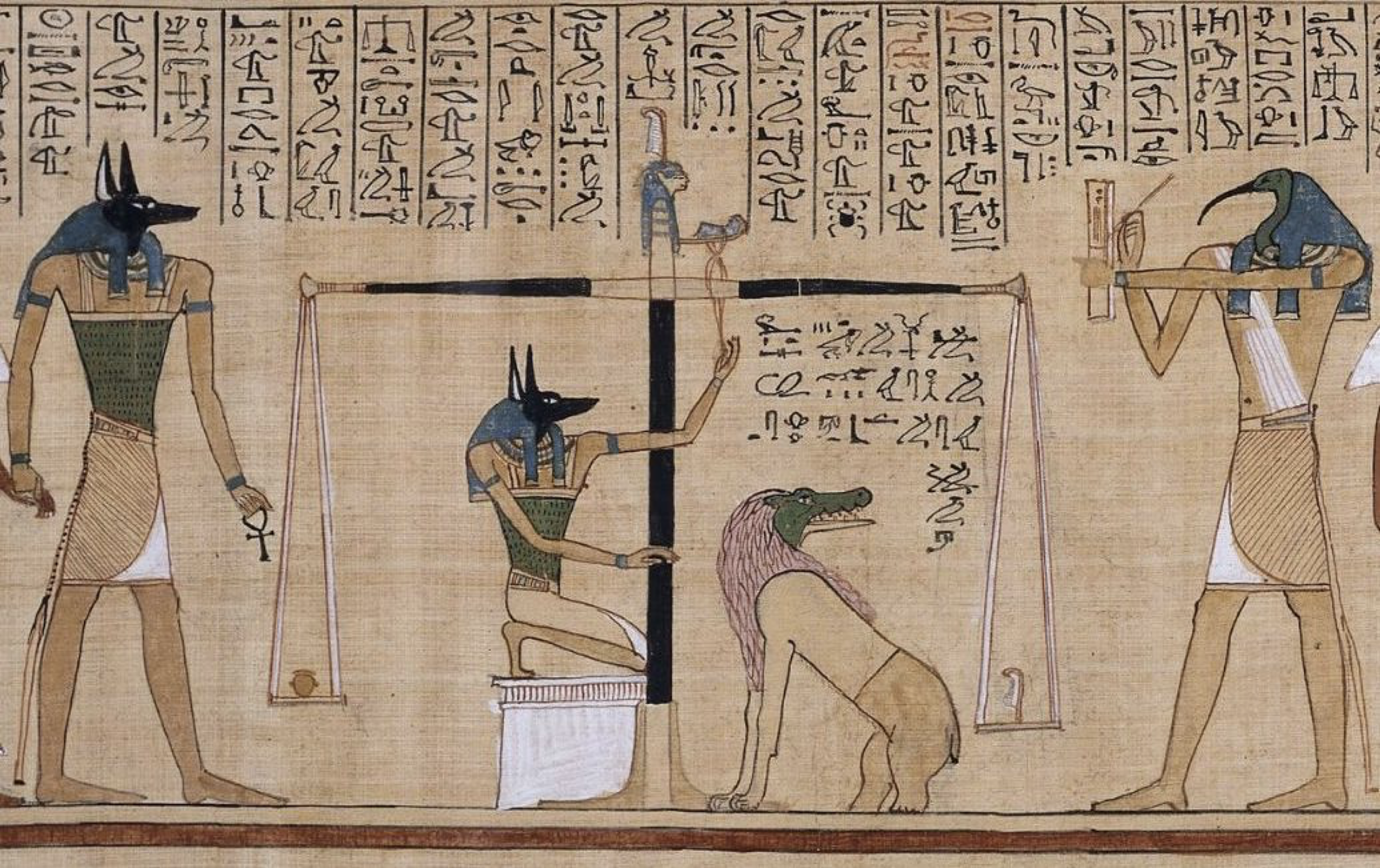
Here are words from what they call the ‘Book of the Dead.’  They thought these were words of life.  But each of these Egyptian gods was created from their imagination, dreamed up to explain the wonders of the world and to justify the rule of a supreme leader, a pharaoh who would attain a life after death and lead them to have a chance at life after death.  But we read in Exodus how Yehovah defeated these Egyptian deities.  Each of the 10 plagues in Egypt was directed at one of the major Egyptian gods.  The deliverance of the Israelites from Egypt demonstrates how all these stories in stone are nothing but myths.  These idols are not real. These stories are fiction.  No matter how hard they try to preserve Pharaoh’s body in elaborate tombs, filling them with every item he may need in the next world,  Pharaoh can not conquer death for them.  For thousands of years, these Egyptians sought a way to eternal life.  But their stories, the words on these temples, are dead.  They have no answer for death and do not bring life.  Yehovah showed that He and He alone had the words of life.  And like Egypt, many other cultures have sought ways to eternal life. 

There are people today who are seeking alternative means of eternal life.  Significant scientific research is being conducted to extend the human lifespan, and some scientists believe that immortality may be within our grasp.  I have a friend who is part of a group of scientists studying apoptosis, the mechanism by which the body causes damaged cells to die.  In some forms of cancer, the damaged cell avoids this process and continues to grow and reproduce.  Some believe that if we can learn to control this process, we could not only cause cancer cells to die but also allow normal cells to continue growing and reproducing indefinitely, resulting in no decrease in function as one ages.

Imagine skin that does not thin and lose its elasticity, remaining youthful; bones that do not lose density and compress; and vision that does not deteriorate with age.  Imagine a world with no cancer.  It sounds good, but the word of God tells me that. Immortality is not something we can achieve on our own.  We can not avoid death.  Sin has brought death into the world, and science is no match for sin.  Botox may hide wrinkles, but it can not cover sin and death.  God alone has the answer for death.  His words alone can bring life, for His word is life.  And there will be a time when aging is no more, and cancer is no more, and life is eternal.  God is preparing that future for you, not science. 

So God’s word is living.  It brings life, sustains life, and has the answer to death.  But how does God’s word increase?  God’s word increases each time it enters the heart of a new believer and each time a believer grows in faith through His word.  It is impossible to overestimate the importance of God’s word to us.  Through the Holy Spirit, it is supposed to live in us: 

Colossians 3:16  Let the word of Christ dwell in you richly, teaching and admonishing one another in all wisdom, singing psalms and hymns and spiritual songs, with thankfulness in your hearts to God.

The word is supposed to dwell in us, take up residence in us.  As it lives in us, it grows and multiplies, contagiously spreading to others.

When I was 8 years old, I joined the Rome Boys’ Club Choir.  We traveled all over the country for 10-14 days each summer in Greyhound buses.  We would pull up to a Boy’s Club in some town and watch out the window of the bus as cars arrived in the parking lot.  The local Boys’ Club would have arranged for families to house us for the night.   We would wait for our name to be called, then grab our suitcase and go to spend the night in pairs with our assigned family.  (Can you imagine doing this today?)  You always hoped that you would be chosen to go with the family that drove up in the really nice car.

I stayed in a lot of homes, some really amazing places, a few mansions, and a few that were pretty rough.   But we were almost always welcomed with great hospitality.  People went out of their way to ensure we had everything we needed and arrived at the concert on time.   Some people went above and beyond in their hospitality, hosting parties after our concert for us or arranging for us to go swimming, ride go-karts, or do other activities.

However, there was one place I recall where I felt like we were an imposition.  It was a nice enough house.  But they barely spoke to us.  They showed us our bedroom and went to the other side of the house.  They had someone they knew drive us to the concert and pick us up.  We never saw them until the next morning.  I guess they thought we would eat at the concert, so they didn’t offer us any food, and we had no supper that night.  Thankfully, my mom had packed more snacks in my suitcase than I could eat in several weeks, so we were okay. But everything they did let us know that they wished we weren’t there.  We saw them the next morning when they came to our door and said our ride was there. And we were happy to leave. That was a very uncomfortable stay.

How about you?  Have you ever stayed as a guest in a home where you didn’t feel welcome?   It’s pretty miserable.  

If you know my wife, you know that she is the model of hospitality.  She goes out of her way to make sure anyone staying with us feels at home.  There are fresh flowers in the room, and she looks after every detail.  We often have people staying in our garage apartment.  There is a family currently with us who came in town for a funeral and have stayed with us for several weeks to help settle things.  We had 20 college girls at the house Friday night for dinner who were in town for a volleyball tournament.  Hospitality is a ministry.

It is one of the best ways to show love to people who aren’t friends … yet.  You share love and grace with them through your hospitality.  They see the Word of God living in you because you bear the fruits of the Spirit in your life.  And the word of God will flow from you to them as you speak and act out the Word in your life.  Later in our study of Acts, we will take a deeper look at what the Bible says about hospitality, because God has a great deal to say about it.  However, I have a question to ask you for now.  If God’s word is supposed to dwell in us, to live with us, then let me ask you, “What kind of host or hostess have you been to this guest in your house?”

Does God’s word feel welcome in your life, or are you like the family that opened the door to their house for me but didn’t offer to feed me and didn’t even speak to me?    

God’s word dwells in us to have a relationship with us.  We are instructed in how to live.  God’s word should make a difference in the way we see others and the way we treat others. The whole 3rd chapter of Colossians teaches us how to treat others and how to live.   When God’s word dwells richly in us, we become who we are supposed to be, conduits of God’s love and mercy and grace.  We overflow with God’s goodness.  We like these disciples to become different, and we cannot help but share the grace that God has so richly poured out on us.

Through the power of the Holy Spirit, as we live our lives as God directs, showing evidence of our salvation through the fruits of the Spirit evident in our lives, we become living witnesses to God’s grace and mercy without needing to say a word.  

We need to be very sensitive to the working of the Spirit of God in us, watching for him to reveal things we need to change and paths we need to walk.  We need to leverage all the gifts God has given us to increase the Word of God in our lives and in the lives of those around us.

We have to be more involved in participatory ministries.  I want to share a passage from a book that helped shift my perspective on ministry.  It is from Shane Claiborne’s “The Irresistible Revolution.”

“It is much more comfortable to depersonalize the poor so we don’t feel responsible for the catastrophic human failure that results in someone sleeping on the street while people have spare bedrooms in their homes. We can volunteer in a social program or distribute excess food and clothing through organizations, and never have to open up our homes, our beds, our dinner tables. When we get to heaven, we will be separated into those sheep and goats Jesus talks about in Matthew 25 based on how we cared for the least among us. I’m just not convinced that Jesus is going to say, “When I was hungry, you gave a check to the United Way and they fed me,” or, “When I was naked, you donated clothes to the Salvation Army and they clothed me.”
Jesus is not seeking distant acts of charity. He seeks concrete acts of love: “you fed me…you visited me in prison…you welcomed me into your home…you clothed me.” With new government funds and faith-based initiatives, the social-work model can easily entangle the church in the efficiency of brokering services and resources in a web of “clients” and “providers” and struggling to retain God’s vision of rebirth, in which we are all family. Faith-based nonprofits can too easily be the mirror image of secular organizations, maintaining the same hierarchies of power and separation between rich and poor.
They can too easily merely facilitate the exchange of goods and services, putting plenty of professionals in the middle to guarantee that the rich do not have to face the poor and that power does not shift.
 Rich and poor are kept in separate worlds, and inequality is carefully managed but not dismantled. When the church becomes a place of brokerage rather than an organic community, she ceases to be alive. She ceases to be something we are, the living bride of Christ. The church becomes a distribution center, a place where the poor come to get stuff and the rich come to dump stuff. Both go away satisfied (the rich feel good, the poor get clothed and fed), but no one leaves transformed. No radical new community is formed.And Jesus did not set up a program but modeled a way of living that incarnated the reign of God, a community in which people are reconciled and our debts are forgiven just as we forgive our debtors (all economic words). That reign did not spread through organizational establishments or structural systems. It spread like disease—through touch, through breath, through life. It spread through people infected by love.”

Claiborn, Shane “The Irrestible Revolution”

The Word of God increases when we live our lives in such a way as to make God’s word alive in our actions.  We establish relationships with others, and God’s word flows through us in how we act and what we do.  We see this in our homeless ministry.  We offer a variety of classes for our neighbors without homes, but it is not in these classes that people change.  We give them food and a warm place to stay, but that alone doesn’t cause people to change.  It is when we sit down at the table for a meal with a few of our neighbors and get to know them, allowing them to get to know us.  That is when God does his work.  That is where lives change.  Because when you allow people to get to know you, then they can see the Holy Spirit living in you, and the Word of God living through you, and then the Word will increase. “1

Ministry must be relational.  That is always God’s plan.  Donating money to a good cause is a commendable act, but it is not a substitute for a ministry.  It is giving back to God some of what He gave to you.   To do ministry, you have to be hands-on, making relationships with others.  This is what we see in the Book of Acts: God’s Holy Spirit transforming people so that they can extend love to others, who will see the fruit of the Spirit in them. As a result, God’s word will increase as they, too, accept His word into their lives.

These disciples are examples of lives changed through the Holy Spirit.  They can not stop doing what God tells them to do.  Despite threats of beatings or death, they can’t stop being who God wants them to be.  It is because they are different now.  This is who they are now.  This is the lesson for us in the Book of Acts. This is what we must do.   Let us strive to listen to God’s holy Spirit in our lives and let God lead us to be who we are meant to be.  

I challenge you to take a hard look inward at your own life.  Are you listening to the Holy Spirit in your life as you should?  Is God’s Spirit dwelling richly in you, or have you just set Him in the corner and ignored him?  Have you welcomed God into your life with great hospitality, or have you just tolerated His presence there?  

Let me be the first to confess that I don’t always listen to the Holy Spirit as I should.  Instead, I sometimes hear my mouth saying things that aren’t consistent with the fruit of God’s Spirit.  There are times when my sweet wife, my ezer kenigdo, has to remind me that patience is a fruit of the Spirit.  So let me be the first to publicly ask you to pray for me, that God would help me to listen better and obey, that I might be who God wants me to be.  Will you pray for me?  I pray that we are all filled to overflowing with the Holy Spirit and filled to overflowing with His Word, so that His presence and His Word flow out to our community.