
October 23, 2025 – Time to Serve— Acts #17
Acts 6:1–7
Acts 6:1-7 Now in these days, when the disciples were increasing in number, a complaint by the Hellenists arose against the Hebrews because their widows were being neglected in the daily distribution. And the twelve summoned the full number of the disciples and said, “It is not right that we should give up preaching the word of God to serve tables. Therefore, brothers, pick out from among you seven men of good repute, full of the Spirit and of wisdom, whom we will appoint to this duty. But we will devote ourselves to prayer and to the ministry of the word.” And what they said pleased the whole gathering, and they chose Stephen, a man full of faith and of the Holy Spirit, and Philip, and Prochorus, and Nicanor, and Timon, and Parmenas, and Nicolaus, a proselyte of Antioch. These they set before the apostles, and they prayed and laid their hands on them.
And the word of God continued to increase, and the number of the disciples multiplied greatly in Jerusalem, and a great many of the priests became obedient to the faith.
As we have seen so far in Acts, the early church was known for many things — bold preaching, miracles of healing, and rapid growth — but one of its most beautiful qualities was its heart to serve. They didn’t just preach the gospel; they lived it. They didn’t just talk about love; they showed it in action. When widows were hungry, they fed them. When needs arose, they met them, giving of what they had and, if necessary, selling land they owned to provide for those in need.
But we read in Acts 6 today about that spirit of service being tested. As the church grew, some widows — the Greek-speaking Hellenists — were being overlooked in the daily distribution of food. It wasn’t intentional. There are natural divisions in the church at this point based on their language. Most in the Jerusalem area spoke Aramaic or Hebrew and used the Hebrew Scriptures in their synagogues. Others were from regions outside Judea and in their community spoke Greek, like most of the rest of the world. They would typically use the Septuagint in their synagogues, the Greek translation of the Old Testament done by Jewish scholars in the 2nd and 3rd centuries BC.
There was a natural division, of course, based on language. And the needs of those in your same-language community would be more well-known than the needs of others you have less contact with. So some of the Greek-speaking widows were not receiving the help they needed. Once the need was made known, the church rushed to fill it. Before the apostles in the book of Acts ever said a word about serving widows, the call to serve had already been written into the story of God’s people in the Bible. From the beginning, God’s law commanded care for the poor, the widow, the orphan, and the foreigner:
Deuteronomy 10:17-19 For Yehovah your God is God of gods and Lord of lords, the great, the mighty, and the awesome God, who is not partial and takes no bribe. He executes justice for the fatherless and the widow, and loves the sojourner, giving him food and clothing. Love the sojourner, therefore, for you were sojourners in the land of Egypt.
Since their departure from Egypt, God has been teaching the children of Israel who He is and how He wants them to behave. In fact, if you want to know how God wants you to act, then study God’s character, for we are to imitate Him. The more we understand who God is, the better we know how God wants us to act. Yehovah says, “This is who I am. You see how I act. If I am your Father, then grow up and act like me.” He tells them, “Look, I am not like the gods of Egypt, where you were slaves. You could bribe those gods; they didn’t care about justice. They cared only for themselves. Do not imitate them, but imitate me.
This is the heart of the God we serve — a God who stoops low to care for the vulnerable. And they specifically list three sets of people here. The fatherless and the widow, you understand. Orphaned children obviously need the care of the community. So too did widows, for in their culture the widow had no means of support. And then the sojourner. That Hebrew word, ‘ger,’ meant the “newcomer, the foreigner, the alien, or the immigrant.” These people, just joining them, had no land and thus no means to care for themselves. Like the widow and the orphan, they needed the community’s love and support.
This is the Abu Simbel temple near the southern border of Egypt, carved into the side of a mountain just beside the Nile. These four colossal statues are of Ramses II. They are over 70 feet tall. Every depiction of Pharaoh and their gods is huge. Why are they so big?
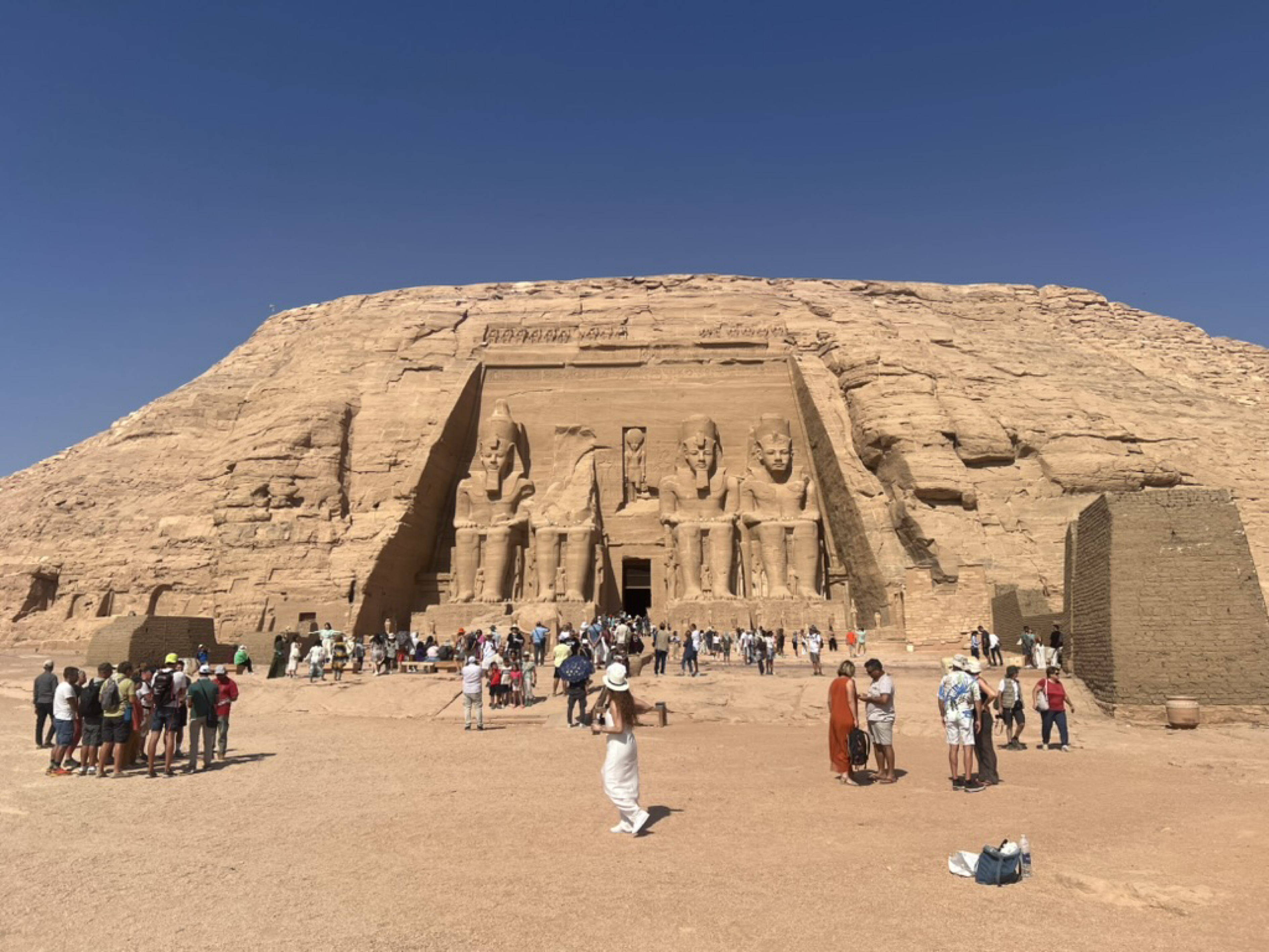
Look here at the base of one of these statues of Ramses. The person standing there gives you an idea of the proportions. Now look at the figures carved under the feet of Ramses.
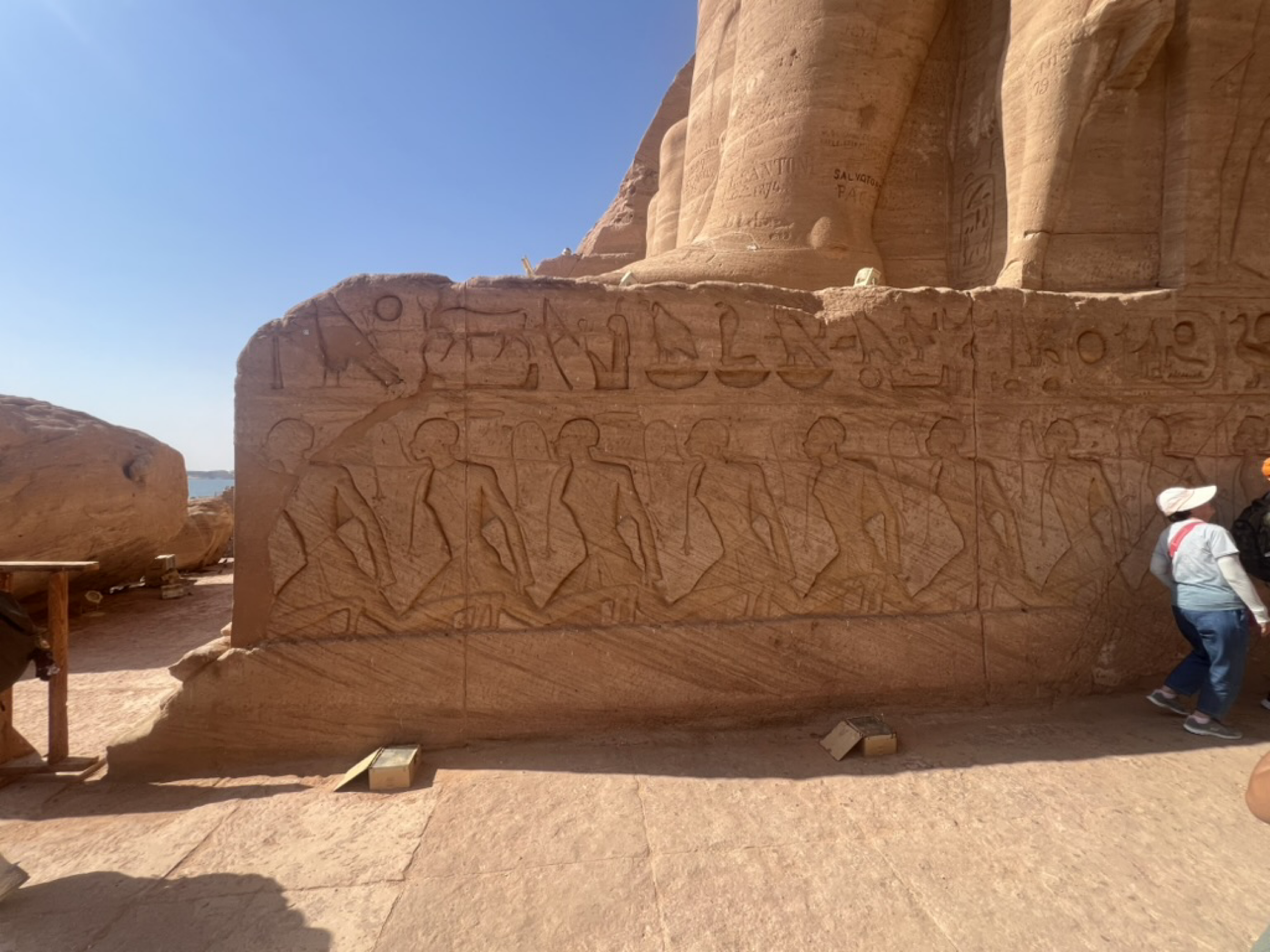
These are the people whom he has conquered and enslaved. They are on their knees with their hands bound behind their back, humbled in submission to the great Ramses. They are literally under his feet. His enemy has been trampled and subjugated. And they are tiny compared to the pharaoh, just as you are when you pass by under Pharaoh’s feet.
The reason that all of the depictions of gods in Egypt were big was to make you look small. You are nothing compared to them. You are like a pitiful slave. But Yehovah says that He is not like these gods of Egypt. He stoops low to care for the most vulnerable of his people. And He is trying to teach this lesson to the children of Israel. He says, “You were immigrants in Egypt. You spoke a different language and worshiped a different God. And they treated you poorly. You were slaves there. Don’t let me find you treating others like this. Don’t imitate the pharaoh and the gods of Egypt. Imitate me. You are my children.”
Exodus 22:22-24 You shall not mistreat any widow or fatherless child. If you do mistreat them, and they cry out to me, I will surely hear their cry, and my wrath will burn, and I will kill you with the sword, and your wives shall become widows and your children fatherless.
This is the lesson they are taught just after escaping from Egypt. God is serious about how widows, orphans, and immigrants are treated. God says, ‘If you mistreat them, I will destroy you.’ But Israel doesn’t learn this lesson very well. Here are the words of Isaiah 7-800 years later:
Isaiah 10:1-3 (Message) Doom to you who legislate evil, who make laws that make victims—
Laws that make misery for the poor, that rob my destitute people of dignity, exploiting defenseless widows, taking advantage of homeless children.
What will you have to say on Judgment Day, when Doomsday arrives out of the blue? Who will you get to help you?
God cares for those that society abuses and tosses aside. This is the heart of the God we serve — a God who stoops low to care for the vulnerable. He hears the cry of the oppressed, He defends the weak, and He calls His people to do the same.
The mistreatment of these poor is listed as a primary reason that God called down the enemy to destroy them, just as he told them he would in Exodus. First, Assyria came from the north and wiped out the Northern tribes. Then, Babylon came as an instrument of God to destroy their country and take the southern tribes into exile for 70 years. God is so serious about this that he brought destruction on his chosen people.
Pharaoh would never humble himself to help an ordinary person. However, in contrast, our God did this:
Philippians 2:6-7 Jesus, though he was in the form of God, did not count equality with God a thing to be grasped, but emptied himself, by taking the form of a servant, being born in the likeness of men.
Jesus left his throne in God’s heaven, where there was no pain or hunger or sickness. A place where he was worshipped constantly. And he left all that behind to enter our cruel world and take the form of a servant. No idol god of any nation would ever do that. No other king would give up his throne to come to take on the task that Jesus did.
And Jesus spent his entire ministry serving others. And he tried to teach his disciples that whoever would be greatest must be the servant of all. They were slow to grasp this lesson, so on the night before he went to the cross, at his final meal with them. He takes on the task of the lowest servant and washes their feet.
Matthew 20:28 The Son of Man came not to be served but to serve, and to give his life as a ransom for many.
So the passage we just read in Philippians continues with this verse.
Philippians 2:8 And being found in human form, he humbled himself by becoming obedient to the point of death, even death on a cross.
He humbled himself. He lowered himself to the point of suffering and death for us. You see, Pharaoh made himself look big so he could make everyone else look small. Our God became small, to make us big. He came to lift us up and make us bigger—more than we were. And Paul says this is the lesson that Israel had trouble learning and that we must learn. The verse that precedes this passage :
Philippians 2:4-5 Let each of you look not only to his own interests, but also to the interests of others. Have this mind among yourselves, which is yours in Christ Jesus,
Have this mind in you. This is the mind of Christ. Think like Jesus. See others the way Jesus sees them. And be willing to lower yourself, to humble yourself, to make yourself small, to lift others up. This is who God is. This is the gospel message.
Now back to our story…
Acts 6:2 And the twelve summoned the full number of the disciples and said, “It is not right that we should give up preaching the word of God to serve tables.
Now, don’t read this wrong. They weren’t saying serving tables was unimportant — they were saying it was so important that it needed to be done by people called and equipped by God, especially for this job. Look at the qualifications for this position. They aren’t looking for good businessmen, strong backs, or good organizational skills.
Acts 6:3 “Therefore, brothers, pick out from among you seven men of good repute, full of the Spirit and of wisdom, whom we will appoint to this duty.”
They looked for people full of the Holy Spirit. Why? Because even simple acts of service are sacred work when done in Jesus’ name. Every meal served, every visit made, every hand extended in compassion is more than just a good deed. Because God, through the Holy Spirit, is present in those acts of mercy and love, they carry much more meaning.
What we learn from this passage is this: Serving others isn’t a distraction from the gospel — it’s a demonstration of it. Every time we love someone in need, we preach a silent sermon about who Jesus is. The Holy Spirit in us makes an impact in our service way beyond any physical act we can do.
Stephen was one of the seven chosen. We will talk about him next week. He didn’t see himself as “just serving tables.” He saw himself as serving Christ. And we will see how God used him mightily, both as a servant and a powerful witness. When you serve others, you are not doing small work — you are doing kingdom work. You’re showing the world what the love of Christ looks like in action.
So what is the most important job in the Kingdom of God? Is it the prophet – the preacher? Is it the administrator? Is it the worker of miracles, the healer? How about the teacher? What is the highest calling in the Kingdom of God? Paul answered that question in 1 Corinthians 12.
1 Corinthians 12:27-31 “Now you are the body of Christ and individually members of it. And God has appointed in the church first apostles, second prophets, third teachers, then miracles, then gifts of healing, helping, administrating, and various kinds of tongues. Are all apostles? Are all prophets? Are all teachers? Do all work miracles? Do all possess gifts of healing? Do all speak with tongues? Do all interpret? But earnestly desire the higher gifts.”
Earnestly desire the higher gifts. But what are the higher gifts? Don’t misunderstand his statement about “first apostles, second prophets, third teachers….” Theologians will be quick to say that this is not a listing of importance. So what are the higher gifts that we are to desire? The next verse says:
1 Corinthians 12:31 And I will show you a still more excellent way.
And what does Paul show us next? That is the last verse of the twelfth chapter. So the more excellent way is found in the thirteenth chapter of Corinthians.
1 Corinthians 13:1-2 If I speak in the tongues of men and of angels, but have not love, I am a noisy gong or a clanging cymbal. And if I have prophetic powers, and understand all mysteries and all knowledge, and if I have all faith, so as to remove mountains, but have not love, I am nothing.
This is the Love chapter. The more excellent way is the way of love.
1 Corinthians 13:8 Love never ends. As for prophecies, they will pass away; as for tongues, they will cease; as for knowledge, it will pass away.
Prophecy or knowledge or tongues or any gift or ministry without love is empty. All the other gifts and ministries will come to an end. But the love that is behind them, the love that comes to us from God and flows out of us through God, will never cease. All gifts and all work done in the kingdom are essential, but the most important job is to love.
1 Corinthians 13:13 So now faith, hope, and love abide, these three; but the greatest of these is love.
It is greater than faith. It is greater than hope. Again, if we understand who God is, then we know how God wants us to behave. God is love. His love is limitless and is for all people. So that should be who we are, people who love others radically. People who like their God are willing to sacrifice themselves to love others. But again, back to our story.
Once the seven men were chosen, the apostles prayed over them and set them apart for service. And look at what happened next:
Acts 6:7 “ And the word of God continued to increase, and the number of the disciples multiplied greatly in Jerusalem, and a great many of the priests became obedient to the faith.”
That’s not a coincidence. When the church began serving one another well, the gospel began to spread further. Why? Because the love of God is powerful, spreading like a wildfire. When people see the church caring for each other — across cultural lines, across differences — it gives credibility to the message we preach. Do we want our church to grow? Then we must learn this lesson. Service in love, across cultural and language differences. Jesus said,
John 13:35 By this all people will know that you are my disciples, if you have love for one another.
The church grew not just through preaching, but through serving. If we want to see revival in our day, it won’t come just through louder preaching —it will come through deeper compassion. It’s often the acts of love that open the door for the words of truth. When a church rolls up its sleeves, when believers feed the hungry, comfort the hurting, and serve the forgotten — that’s when the light of Christ shines the brightest.
Acts 6 shows us what happens when a church takes service seriously: needs are met, unity is restored, and the gospel moves forward. Serving others is not optional for a follower of Christ — it’s the very heartbeat of our faith. It’s how the world sees Jesus in us. So, ask yourself today: How can I serve others in Jesus’ name? How can I reach out to those in our community who are forgotten, who suffer from injustice, who are poor and needy, who are the sojourners?
1 John 3:16-18 This is how we know what love is: Jesus Christ laid down his life for us. And we ought to lay down our lives for our brothers and sisters. If anyone has material possessions and sees a brother or sister in need but has no pity on them, how can the love of God be in that person? Dear children, let us not love with words or speech but with actions and in truth.
 Swallow No Camels