
November 18, 2025 – The Turning Point in Acts— Acts #21
Acts 8:1-8
Today, we come to a significant turning point in the book of Acts.
Acts 8:1-3 And there arose on that day a great persecution against the church in Jerusalem, and they were all scattered throughout the regions of Judea and Samaria, except the apostles. Devout men buried Stephen and made great lamentation over him. But Saul was ravaging the church, and entering house after house, he dragged off men and women and committed them to prison.
Have you ever been in an earthquake? Now I have felt some tremors a few times, but I have never been where the ground is actually shaking. I remember watching a man being interviewed on a newscast years ago after a large quake in California. He had recently moved there, and it was his first major quake. He said, “I had no idea what to do. My first instinct was to run back inside my house. Your home is supposed to be your safe place. But everything in the house was shaking, and pictures were falling off the walls. I just froze.
You may have never been in an earthquake, but you know that feeling. When things are uncertain, you want to return home, to your safe place. We humans love our comfort zones, familiar routines, stable jobs, and predictable communities because what is familiar feels secure. We like to know what’s happening in advance. We want to do things we know we are successful at. We prefer doing things we have done before instead of trying something new.
Max Lucado wrote a book entitled “A Heart Like Jesus.” In that book, Lucado asks us to imagine what it would be like if, for one day, Jesus became you. He wakes up in your bed, wears your clothes, and takes on your schedule, responsibilities, and friends. “Jesus lives your life with his heart. His priorities govern your actions. His passions drive your decisions. His love directs your behavior.” Lucado asks, “Would your friends notice the difference? Would your schedule change? What if you lived by Jesus’ heart and not your own?”1
Lucado says, “God loves you just the way you are, but He refuses to leave you that way. He wants you to be just like Jesus.” We sing that song, “Just As I Am,” and that is how we come to God. But Lucado is right, God has no intention of letting us stay the way we were.
And I see this throughout the Bible; I see God constantly calling people to go to places they have never been before, to do things they have never done before, and to strive to become more than they were. He told a man who had never seen an ocean or felt a raindrop to build a giant boat. He told Abraham to leave his homeplace and go to a land he had never seen before. He told Moses to return to the country he had fled in fear and to tell the most powerful ruler in the world to set all his slaves free.
God told prophet after prophet to deliver bad news to a king. Jesus told a group of young men to leave their jobs and follow him, and then later said to them that people would hate them and persecute them. You can not read the Bible and come away with the idea that God wants us to be safe and comfortable, or that it is okay to do nothing and remain the same person you were.
God’s primary interest is not your comfort and safety. Oh, He believes in a time of rest. He built a whole day of it into a week, and he is serious about it. He wants us to rest in Him, not in ourselves. We like our lives to be calm, peaceful, easy-going, and free from disruption. But we live in a world that is not calm, peaceful, or easygoing. It is often more like an earthquake.
And so it happens to all of us sometimes, the ground shakes beneath us. Life is a series of disruptions. Something happens to upset our safe, calm existence. It could be a death in the family, a sudden or chronic illness, the loss of a job, or a change in the world. And all of a sudden, our life is filled with uncertainty and fear.
That’s precisely what happens to the early church in Acts 8. Up until this point, everything in Acts has been happening in Jerusalem, this small city on the map below. It is so small that the dot on the map is too small to see.

There in Jerusalem, there is powerful preaching, miracles, generosity, and a caring community. Thousands are being saved. Imagine, for a moment, you are a leader in a church like that: thousands of people joining and coming to Jesus in a few months, everyone being cared for, miracles happening. It’s everything a pastor or church leader dreams of. If you have all that, you may feel that it is enough. Things are going well. We just need to keep doing what we are doing.
But in God’s eyes, the tremendous growth in Jerusalem was great, but it wasn’t enough because it was just a tiny dot. A little bit that you can barely see in a world full of people who need the Gospel. God sees a bigger picture than we do. We look at our corner of the county. See your tiny dot on the map, and then see the whole world like God sees it.
John 3:16 For God so loved the world, that he gave his only Son, that whoever believes in him should not perish but have eternal life.
God so loved the world. It is not, “God so loved our tiny dot…” Not just the people in Jerusalem, Jesus also taught the disciples that He came because God loved the Samaritans. And later the church in Acts would realize that God so loved not just the Jews, but the people in Asia Minor, and Greece, and even those horrible Romans. God loves the world, and he wanted the early church to love the world too. It was not enough that they loved the other Jews in Jerusalem who were just like them. Things were good there, a growing, caring church. But God wanted more. He wants us not just to love each other and the people around us who are mostly like us. God wants us to love the whole world, not just the small corner we can see.
To really appreciate Acts 8, we need to remember what’s come before. The story of Acts so far has been a spiritual rollercoaster — full of ups and downs, triumphs and trials, good news and bad news. So let’s recap the Book of Acts.
Jesus had died on a cross, which looked bad, but 3 days later he rose from the dead, which was really good. Jesus stayed 40 days teaching his disciples, and then left them, going up to heaven, which was kind of sad. But it was good because He said the Holy Spirit would come. And that day the Spirit came was a really good day. And then the day that Peter and John healed the lame man in the Temple was great, until they were arrested and put in jail. That was bad. But they were released, and that was good, but they threatened them not to speak anymore about Jesus, which was bad. Then we read about everyone sharing with those who had needs. That was good. But then the story of Ananias and Sapphira, which wasn’t good.
Then miracles were being done, and over 5000 followers had joined the disciples. Things were going good…until the apostles were arrested (that was bad). But it was good because an angel set them free, though then, after the court hearing, they were beaten with whips. Then we read of Stephen, full of the Holy Spirit, preaching and doing miracles. That was good, until he was killed. And after that, things got really bad.
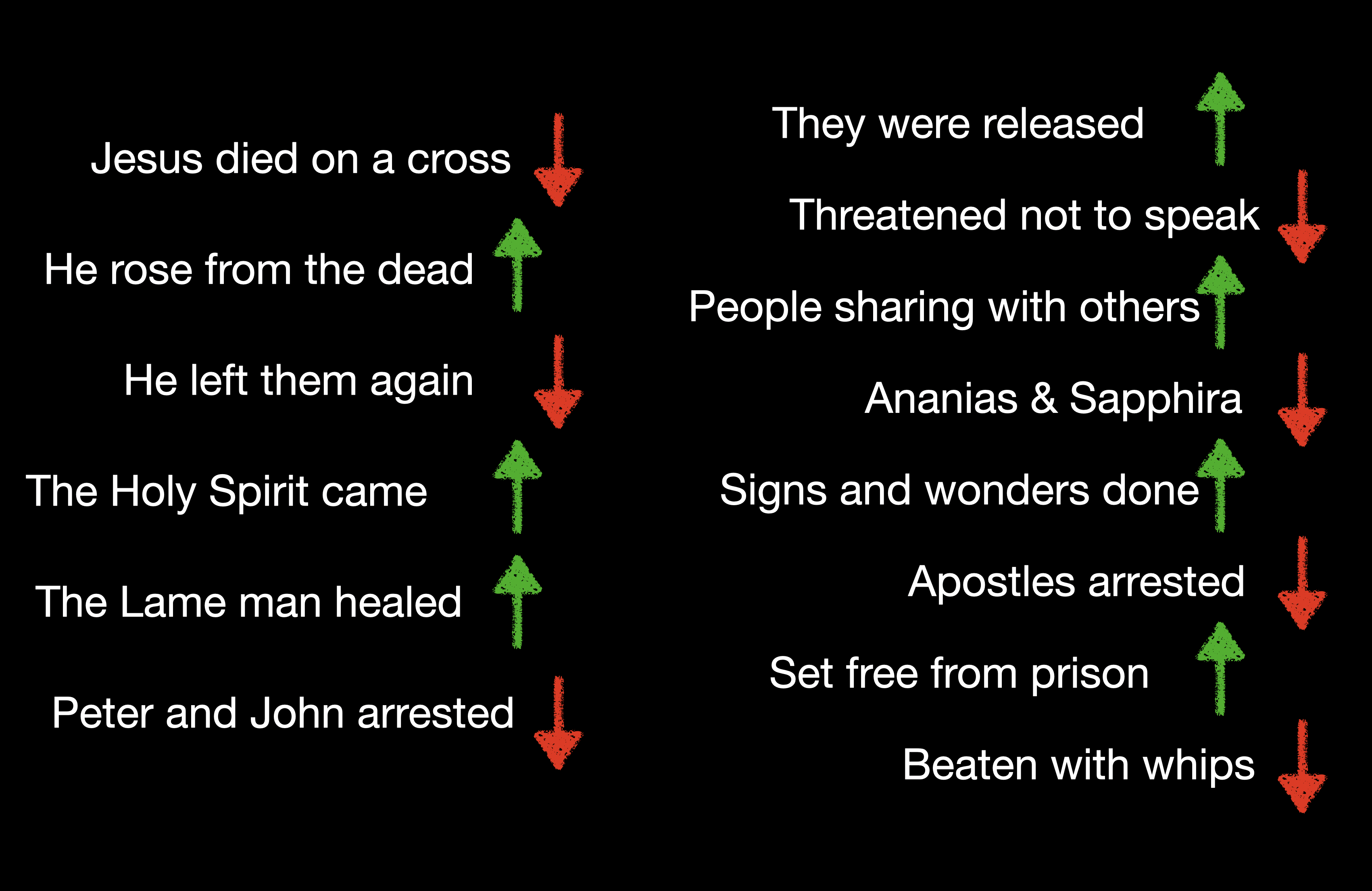
This is a defining moment. For the first time, the church experiences organized, targeted persecution. The honeymoon period is over for these early followers of Jesus. This is bad.
Acts 8:1,3 And Saul approved of his execution. And there arose on that day a great persecution against the church in Jerusalem, and they were all scattered throughout the regions of Judea and Samaria, except the apostles. …But Saul was ravaging the church, and entering house after house, he dragged off men and women and committed them to prison.
This is not just a young man who just watched the clothes while others stoned Stephen. This zealous rabbi voted in the council to kill Stephen and then went on a rampage, going into homes and dragging off men and women. Imagine the fear and confusion. Families are split apart. Homes raided. The fellowship they’ve built in Jerusalem — shattered. They are scared to do or say anything. They are scared to death. This is bad news.
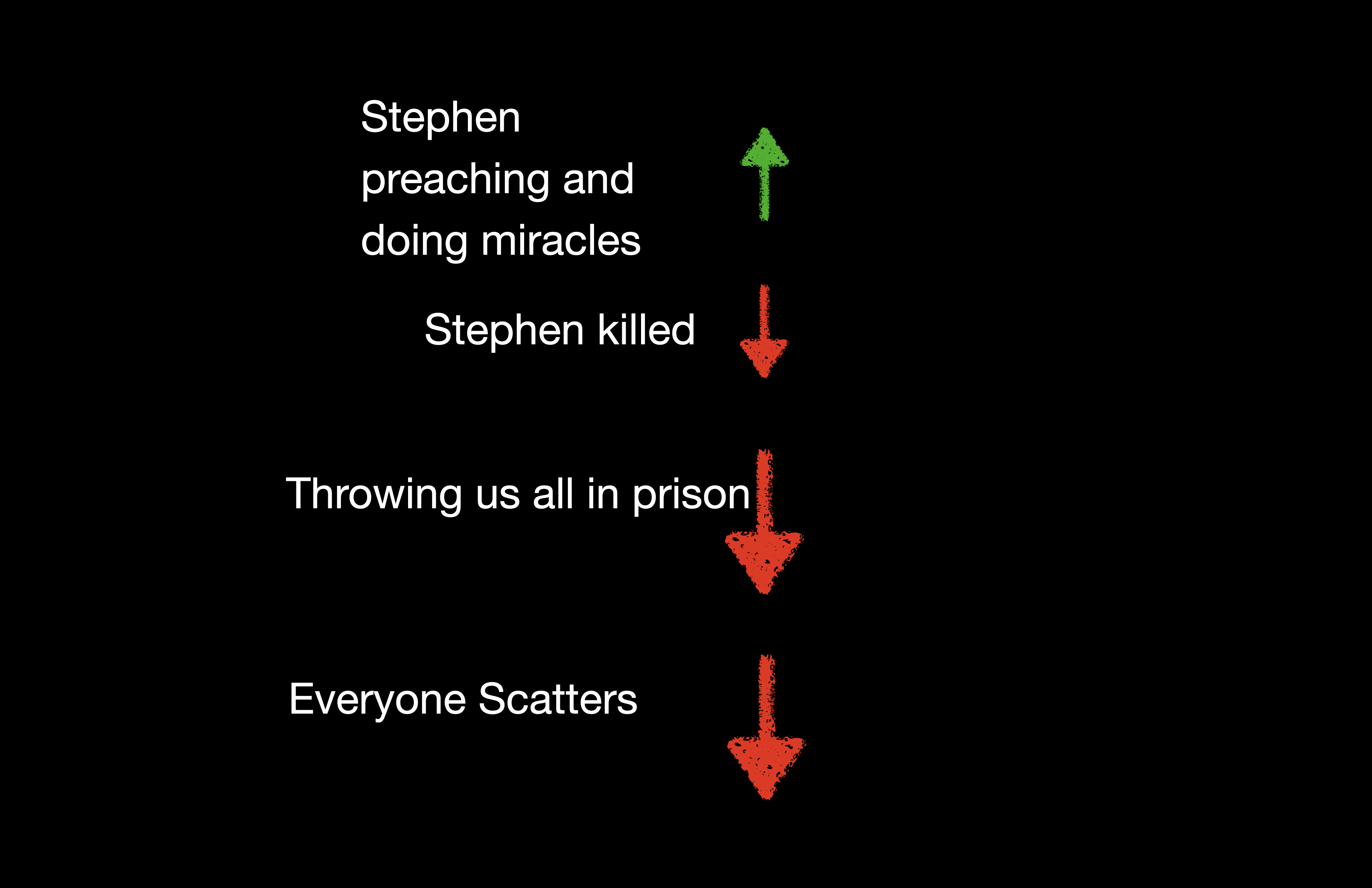
By the time we reach Acts 8, the church has experienced incredible highs and devastating lows. Every time there’s a victory, opposition follows. Just when things seem to be going good, here comes trouble. The book of Acts has so far been a rollercoaster of highs and lows, but now, in Acts 8, it seems to be plummeting toward destruction.
Do you see this in your life also? A rollercoaster of highs and lows, good and bad? Just when things seem to be going good, here comes trouble. How do you respond when things go wrong? Disappointment? Depression? Fear? Hopelessness? Do you want to question God? Why did you let them put the apostles in prison? Why did you let them kill Stephen? Why did my friend get cancer? Why do evil people prosper? Why is there so much trouble in the world?
This persecution should not have been surprising to them or us. Jesus said:
John 15:18, 20 If the world hates you, know that it has hated me before it hated you…
If they persecuted me, they will also persecute you.”
And remember, He also said this:
Matthew 5:11-12 Blessed are you when others revile you and persecute you and utter all kinds of evil against you …
Oh, but as we discussed before, “Blessed” is the Greek “makarios,” which really means “happy are you” or “how fortunate you are,” so let’s read it that way…
Matthew 5:11-12 How wonderful it is for you when others revile you and persecute you and utter all kinds of evil against you falsely on my account. Rejoice and be glad, for your reward is great in heaven, for so they persecuted the prophets who were before you.
Jesus says that when you are persecuted, you are the lucky ones! Do you think the followers in Jerusalem saw it that way? Saul is dragging them out of their houses and throwing them in prison. And do you think they are celebrating their good fortune? How does this make sense?
To understand how you are lucky or happy when persecuted, you have to be able to see things from God’s view and not your own. We need to look through God’s eyes. We need to see the bigger picture again. There are three reasons that persecution is good.
1. Persecution helps the believer mature and grow in Christ.
Romans 5:3-5 Not only that, but we rejoice in our sufferings, knowing that suffering produces endurance, and endurance produces character, and character produces hope, and hope does not put us to shame, because God’s love has been poured into our hearts through the Holy Spirit who has been given to us.
We need suffering to grow. It is only when we experience failure, disappointment, persecution, and defeat that we are able to understand that we are not enough. We learn to depend on our Father instead of ourselves. We mature as followers of Jesus.
2. Persecution purifies the church.
It is sad, but there are always those in the church who are not faithful followers but wolves in sheep’s clothing. But when trouble comes, when persecution comes, their truth is revealed. We see this in 1 John, and Jesus speaks of it in his parable of the soils.
Matthew 13:20-21 As for what was sown on rocky ground, this is the one who hears the word and immediately receives it with joy, yet he has no root in himself, but endures for a while, and when tribulation or persecution arises on account of the word, immediately he falls away.
When persecution comes, some will leave the church. They were never really a member anyway. We have not had persecution in our time. So, from what Jesus said, you would expect the church to have a lot of people who aren’t really committed to Jesus. They are there with joy, but have never given their life to Christ. And if persecution does come, they will fall away.
3. Persecution causes the church to grow
Now this doesn’t seem to make a lot of sense. If Paul is going from house to house in Acts 8, dragging people out to put them in prison, that seems it would have a negative effect on the group of followers in Jerusalem. But look what happens:
Acts 8:4 Now those who were scattered went about preaching the word.
Verse 4 is a hinge in the book of Acts. The word “scattered” here — diaspeirō in Greek — is the same word used for scattering seed. It’s not a random dispersal; it’s purposeful planting. The devil tried to stamp out the fire in Jerusalem, but all he did was scatter the embers — and they caught flame in new places. Everywhere these believers went, they carried the gospel. They didn’t have a denomination, a mission-sending agency, a church building, a program, or a budget. What they had was the message of Jesus, and that was enough.
Acts 8:5 Philip went down to the city of Samaria and proclaimed to them the Christ.
Philip, one of the seven deacons appointed back in Acts 6, goes to Samaria! Remember how the disciples first responded when Jesus took them through Samaria? They couldn’t believe he was actually going there. They hated the Samaritans. They called them half-breed Jews. They wouldn’t even talk to them. Jews and Samaritans had centuries of hostility, but the gospel breaks that barrier wide open. That’s a remarkable scene, See how the Holy Spirit has changed these followers to be more like Jesus?
Philip is crossing cultural and religious boundaries. What began with Stephen’s death in Jerusalem leads to joy in Samaria. The chapter that opened with mourning ends with rejoicing.
The story that began with persecution ends with proclamation. The bad news becomes the vehicle for the good news. This is the power of the gospel. And they went further…
Acts 11:19 Now those who were scattered because of the persecution that arose over Stephen traveled as far as Phoenicia and Cyprus and Antioch, speaking the word to no one except Jews.
At the beginning of Acts 4, the entire church, the gathering of followers of Jesus, is all in one city. All in that one little dot. But because of the persecution, they scatter like seed and are planted here.
So what is the lesson we learn from this passage in Acts 8?
Application 1: God’s Good News Often Moves Through Bad News
This is a pattern we see all through Scripture. Joseph was sold into slavery so he could save his family. Moses fled Egypt before leading God’s people out of it. The cross looked like defeat until resurrection morning. Acts 8 continues that pattern — what looks like a disaster becomes divine strategy. Maybe you’ve seen that in your own life. You lose a job and end up finding a deeper purpose. A relationship breaks down, and you discover how faithful God really is. A closed door becomes the very thing that pushes you toward your calling.
Romans 8:28 And we know that for those who love God all things work together for good, for those who are called according to his purpose.
Listen, God did not want this persecution. God loved Stephen. He did not want Stephen to be stoned. But God gave men free will, and men choose evil. But God takes the evil that man has done and makes it work for good. God has a way of turning scattering into sowing — pain into purpose, loss into mission. So when you get bad news, a bad diagnosis, a financial bad turn, or some tragedy, if you are a follower of Jesus, know that God, who loves you, will take that tragedy and work it for good.
Application 2: Comfort Can Become the Enemy of God’s Purpose
The church in Jerusalem had everything — community, teaching, worship, generosity, and miracles. But all of that was happening inside one city. And we have to admit, many of our churches today fall into the same pattern. We have programs, fellowship, music, structure — often much more of these than mission. We love being together, but we can easily become so inward-focused that we forget why we exist.
Sometimes, God allows discomfort — in a church, in a ministry, even in a nation — to push His people outward again. The early church didn’t plan a missions strategy. Persecution became their mission strategy. God used shaking to send them out.
Application 3: Wherever God Scatters You, Carry the Gospel
Acts 8:4 Now those who were scattered went about preaching the word.
Notice that Acts 8:4 doesn’t say “the apostles” went preaching — it says “those who were scattered.” Ordinary believers. Shopkeepers, craftsmen, mothers, widows, servants. They didn’t have seminary training, but they had stories of grace. They didn’t have pulpits, but they had conversations. They didn’t have missionary boards, but they had neighbors. Every believer was a messenger. And wherever they went, the gospel went too.
Maybe God has “scattered” you in a way you didn’t expect — a new job, a new city, a new season of life. Don’t see it as random. See it as God planting you where the gospel can take root. If you find yourself in an oncology waiting room, find a way to be the gospel there, and maybe even use words. Stuck in an elevator, waiting in a long line, wherever. And if you are somewhere uncomfortable, be alert for opportunities to share. Sometimes God shakes our comfort so He can share His comfort through us.
I don’t go to the movie theater much anymore. (Even though I love paying $25 for some popcorn and a soda.) But at a movie, I sit in my seat and watch, and when it is over, then I walk out of the theater and go about my life as if nothing has happened. Once a week, we come to our seats at church and watch. And when it’s over, then what? Is this like a movie, or have we had an encounter with the God of the Universe who wants us to leave this place changed, to leave this place with a mission? We are not saved to sit. We are saved to serve. We can’t fulfill God’s plan for our lives in this building.
Jesus’ great commission was not “Go to church on Sunday and then go home (after you go out and eat lunch). It was “Go into all the world and do something that will likely make you uncomfortable.”
The passage ends in verse 8: “So there was much joy in that city.” The church’s pain became someone else’s joy. Their scattering became someone else’s salvation. That’s the rhythm of the gospel — out of suffering comes life, out of loss comes joy, out of persecution comes expansion. So when life shakes beneath your feet — when bad news comes — don’t assume God has abandoned you. He might take this opportunity to move you into the next chapter of His plan. The ground may be shaking, but God is sowing. What feels like bad news may be the start of very good news indeed.
- Lucado, Max. A Heart Like Jesus: Lessons for Living a Christ-Like Life. Kindle Edition. Location 33.
 Swallow No Camels