December 30, 2025 –  Looking Back to Move Ahead—

December 30, 2025 –  Looking Back to Move Ahead—
A New Year’s Eve Message

A family anticipates the birth of a child.  High School and College Students anticipate graduation.  A patient anticipates test results. Just last week, children around the world had trouble sleeping due to the anticipation of Christmas morning.  And in just a few days, 1 million people will gather in Times Square, New York, in anticipation of a lighted ball sliding down a pole.1

Anticipation carries excitement—but also tension—joy—but also uncertainty.  And Scripture tells us plainly: God’s people are an anticipating people.  From Genesis to Revelation, the Bible is not a story of instant fulfillment.  It is the story of men and women who lived in the space between promise and completion, between the now and the not yet —trusting that God would finish what He had begun.  Anticipation is closely tied to hope.  And Hope is the subject of our first week of Advent.   But the Bible does not use the word ‘hope’ the same way we do.

When we use the word “hope,” sometimes we mean“wishful thinking.”  “I hope my team wins the game.”  “I hope I win the lottery.”  And in these instances, this hope may be a reasonable expectation or not.  One of my grandchildren said last week, “I hope it snows for Christmas.”  She can wish, but living in Northwest Georgia, it’s unlikely to happen.  A farmer plants seeds in the spring and optimistically hopes for a good crop.   My friend can say he hopes Georgia wins the playoff game this weekend.  And based on their record and recent performance, it is certainly much more likely to happen than for Kate to see her snow.  But there is a difference in the way the Bible uses the word.  Biblical hope is not wishful thinking or optimistic thinking. Biblical hope is a confidence that something will happen.  It is not a likelihood, but a sure thing, because it is rooted in the character of God.

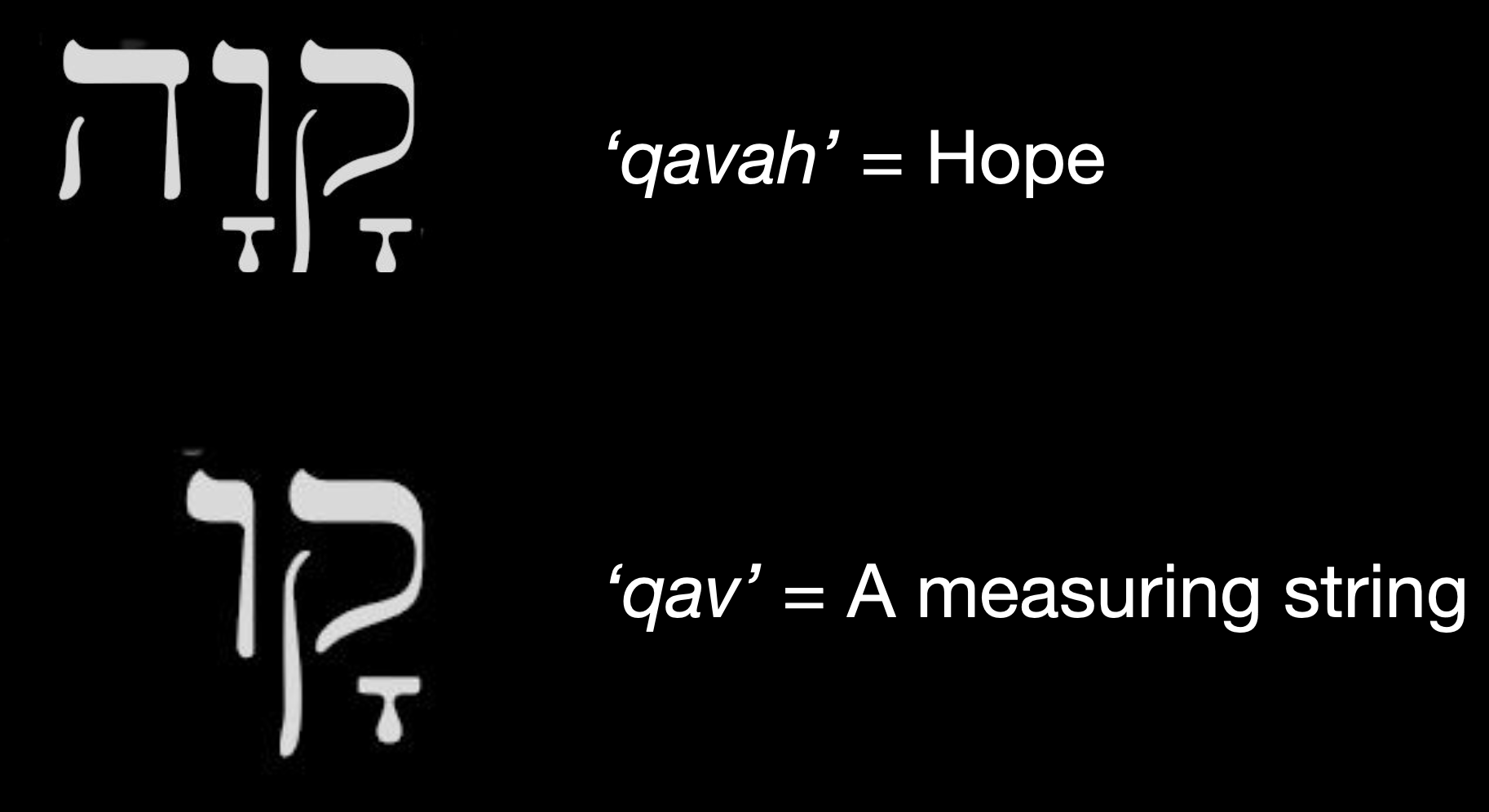
The primary Hebrew word translated as “hope” in the Bible is qavah.  This word has a fascinating history.  It is a verb derived from the noun ‘qav’.  A qav is a measuring string.  Today, any craftsman carries a measuring tape, but in Old Testament times and in Jesus’ day, they used a string called a qav.   In Isaiah 44, the prophet is speaking about someone making an idol of wood, and he says, 

Isaiah 44:13   The carpenter stretches a qav; he marks it out with a pencil.

We see this used still today.  If you sew, you may have used a measuring tape.  In Biblical Hebrew, this is a qav.  And the ancient Hebrews made a verb ‘qavah’ out of this noun.  But how do you get hope from a measuring string?   Think about this qav. It won’t give an accurate measurement if it is not stretched out.  The carpenter stretches out the string to measure. The seamstress stretches out the measuring tape.  It must be under tension to be effective.  

So the noun, qav, is a string stretched to tension to measure, and the verb they made out of it, ‘qavah’, is all about the tension produced in the process of waiting in hope.  Hope in the Hebrew sense is all about that tension.  Hope is living in the tension that exists between what is promised and the completion of that promise, between the now and the not yet.  The tension of the time when you know something will happen, and when it does happen.  
Abraham was promised a son, but there was that time of tension when all he had was the promise, and he wondered if he would ever have a son.  Israel was promised a Messiah, but it had to wait over 400 years.  We are promised the return of Jesus, and we live today in the tension of knowing that promise, even as 2000 years have passed and it has not yet been fulfilled.  Again, our hope is not in something that might come true; it is a surety, for God’s promises always come true.

This is the essence of faith, holding onto the promises of God in the time between.  Hope is the tension. Faith is not letting go.

Hebrews 11:1 Now faith is the assurance of things hoped for, the evidence of things not yet seen.”

The scripture says faith is the evidence of things that haven’t happened yet.  But if you are the prosecuting attorney, how do you provide evidence of something that is yet to happen?  Faith in God’s trustworthiness, faith in God’s promises, that is the proof of what will happen.  God is always faithful to his promises; He is infallible.  And that is all the evidence we need.  

And it is not ‘blind faith.’  It is not as if our faith in God is just a mental decision to believe something we can’t see.  We don’t just choose to have faith.   Faith is itself evidence-based.  This is the field of apologetics, which covers the evidence for the Bible and Jesus.  If you are interested, I can recommend several good books on this subject.  But the evidence before us is the Bible.  These people who lived and experienced God in their lives present to us the evidence of thousands of years of God’s promises being fulfilled.  The proof is all through this book. And Biblical history is increasingly confirmed each year. 

For years, many historians doubted some of the Bible’s stories, saying that, since they had found no historical proof, they must not be true.  They questioned the existence of a King of Israel named David.  That was completely laid to rest when mention of David was found on a 9th-century stone tablet in 1993.  Historians all agreed that the Hittite empire, often mentioned in the Bible, never existed, as there was no archaeological evidence.  But they had to walk this back and change their books when they found the remains of their large capital city in Turkey.   More and more evidence comes every year.  You can visit museums to see many artifacts that confirm the Bible narrative.  

But we don’t need all of those proofs.   What does Jesus tell Thomas after he shows Thomas his hands and feet? 

John 20:29   “Blessed are those who have not seen and yet have believed.”

“To not see and yet to believe.”  I don’t have to see Jesus’ scars on his hands and feet.  God doesn’t have to perform some sign for me to believe, for he has already done that over and over in the past, in the lives of so many in the Bible and in my life. “To not see and yet to believe” is to live in the tension of that hope in God’s promises that have not come to completion yet, but still believing, not because you can see, but because you have seen enough in the past to know that God is trustworthy.  What you have seen in the past is the basis for your faith.  Where does Paul say faith comes from?

Romans 10:17   So then faith cometh by hearing, and hearing by the word of God.

Paul says, “Faith comes by hearing.”  But remember, Paul is a Jewish Rabbi.  When Paul says ‘hearing’, he has in mind the Hebrew word for hearing, “shema”, which we talked about a few weeks ago.  Shema means hearing and obeying; they cannot be separated.  So Paul is really saying…

Romans 10:17   So then faith cometh by listening and obeying, and this by hearing the word of God.

And Paul is living in a day when God’s message was still primarily transmitted orally.  Very few people had the opportunity to read scripture.  Their primary encounter with God’s word was the spoken word. Now we live in a day when the scriptures are readily available to most people worldwide.  Sadly, some people still only hear the word once a week, even though they have the luxury of reading it every day. God has given us the great gift of his abundant word in many ways. So if Paul were writing this letter today, he might say,

Romans 10:17   So then faith cometh by reading and obeying, and this by reading the word of God.

Here I am talking about the past when everyone else is thinking about the new year approaching.  Are you looking ahead to what this new year will bring?  Many of you will make New Year’s resolutions.  And most who do will quickly break them. I read that fewer than 8% of New Year’s resolutions are kept.  But we like to set goals.  We are told to ask ourselves, “Where would you like to be in 5 years?  How much weight do you want to lose in the coming year?  How much money do you want to put in a savings account by the end of the year?”  We make goals looking to the future.  We are very future-oriented.
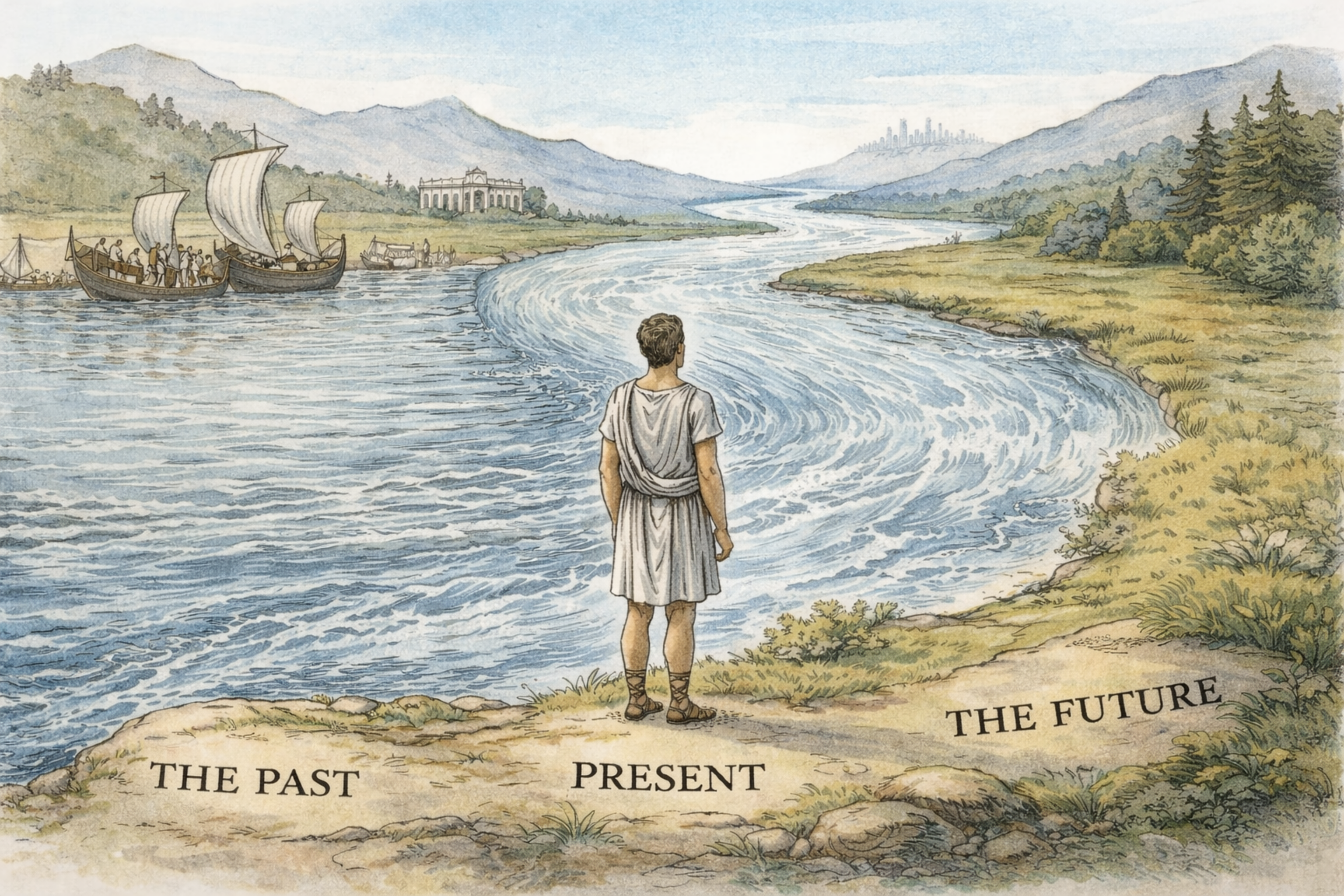
It comes from our view of time that we learned from the ancient Greeks.  The Greeks saw time as a river.  People stand somewhere along the bank, and where they stand is the present.  What has already happened is downstream in the past behind you.  The future is upstream, yet to pass by us, but it is already there, headed our way.  If you have this view of time, you will be very confused when you read the Bible, because this is not the way the authors of the Bible thought about time.  Take this verse in Job.

Job 19:25   For I know that my Redeemer lives,  And at the last, he will stand upon the earth.

A great verse.  A very poetic way of saying, “I know the living God who will redeem me.  And in the future, he will come back for me.” But the Hebrew word for the future, the last days, is “אַחֲרוֹן” (acharon), which means “what is behind you.”  For Hebrew thinkers, the future is behind you, which is the opposite of how we think: that the future is ahead of us.

The best way I have seen this explained is by a 20th-century German theologian, H. W. Wolff. Wolff says that the Hebrew concept of time is like a man rowing a boat.2  How many of you have ever rowed a rowboat?  In a conventional rowboat, you sit facing the rear of the boat.   And this is the direction you move.   You can see where you have been, but you can’t see where you are going. So in the Hebrew view of time, you have a full view of the past, but you can’t see the future, for it is all ‘acharon’ behind you.
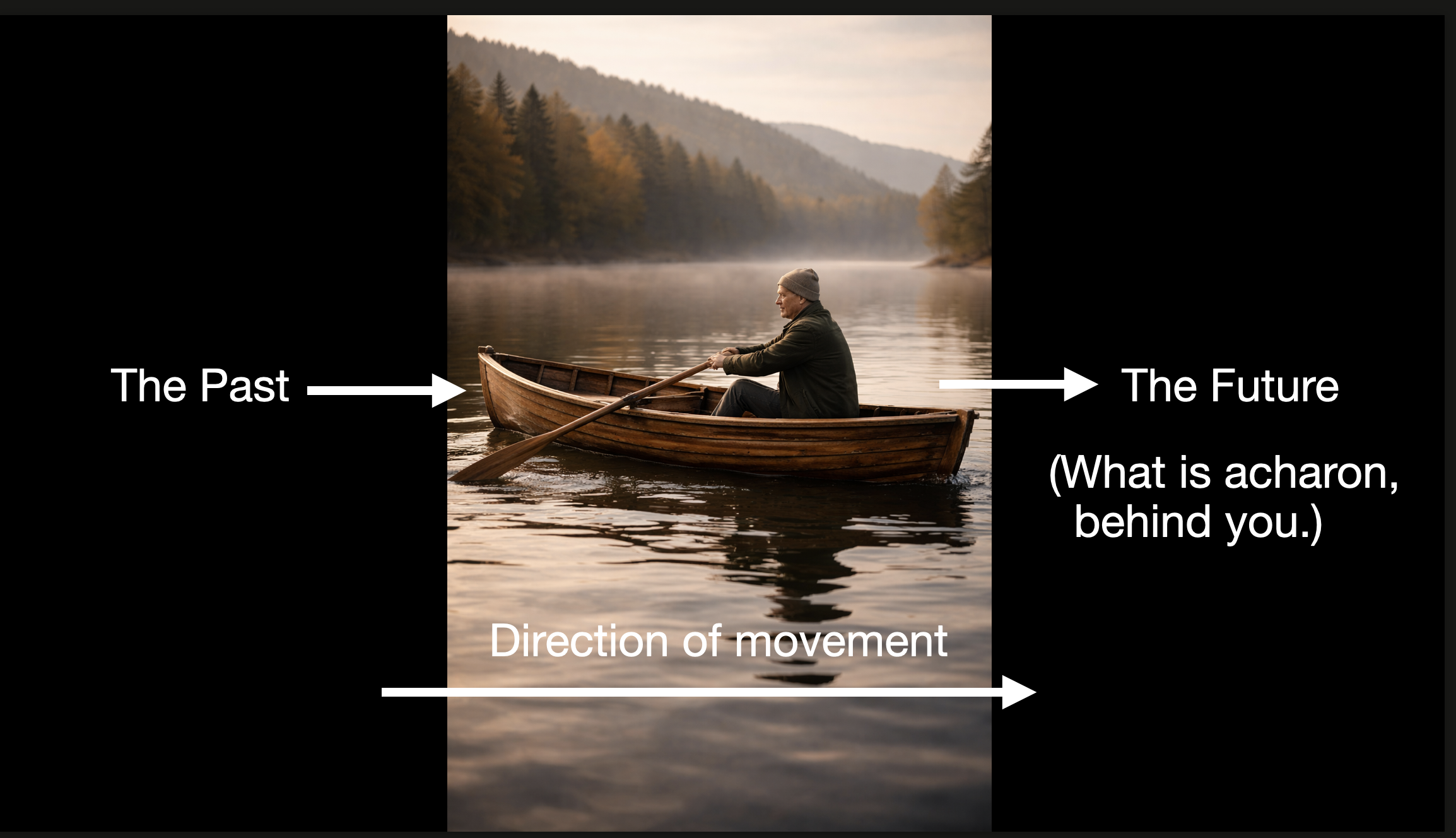
So how do you maintain a steady course in a rowboat if you can’t see where you are going?  I was taught that you focus on a point straight to the rear of the boat.  As long as you keep that point directly behind the boat, you will travel in a straight line.  So in the Hebrew worldview, you focus on a point in the past to direct your course into the future.

There is much truth here.  We can not see into the future.  We can only see the past.  Perhaps this is why so many New Year’s resolutions fail.  We cannot see what lies ahead, but we plan to reach this goal in an unknown future. We set goals where we can’t see.  They become just wishful thinking.  Perhaps we would do better if we operated using God’s view of time.  

We can see the past.  We have records of the past.  We can see how we have behaved and how God acts. Instead of making goals based on an unknown future, we should, like the man in the rowboat, focus on a point in the past and use that to guide us. Find a worthy example in your Bible or in your own life and set that as your goal for the day.

God has given us many instructions on how to act, and he has, in scripture, given us many examples of men acting correctly and incorrectly, along with the consequences of each.  If we look back to God and focus on Him, we can set a course that leads us to where He wants us to be.

Do you see the significant difference between this Hebrew view of time and the Greek view?  In the Greek view, you are on the banks of the river.  You really have no impact on the river itself.  You are just an observer. Things happen and pass you by, and the future is fixed and coming downstream towards you.  But in the Hebrew view, you are in the water.   Like life, you can see the past but not the future.  And you are not just a passive observer; you are active.  You affect your path.  You choose your direction.

Now, let’s tie this back into hope.  Unfortunately, our English Bible translations often render the Biblical word for hope as ‘wait’ instead, as in this verse in Psalm 27.

Psalms 27:14   Wait for the LORD; be strong, and let your heart take courage; wait for the LORD!

That word ‘wait’ is “qavah,” our word for hope.   And if we translate it as ‘wait for the Lord,’ we get the idea that we sit or stand passively, waiting.  But if that is the case, then why do we need to be strong and take courage?  God is expecting us not just to stand there and wait, but to be active, doing something.

So it is not wait’ but ‘hope’.  And that preposition ‘for’ is the Hebrew ‘el’, which does not mean ‘for’ or ‘in’, but means ‘towards.’  But the translators said that “Hope towards the Lord” or “Wait towards the Lord” is not proper English.  So they made it “wait in the Lord,” “wait for the Lord,” or “wait on the Lord.”  Again, stand there and do nothing while God does everything.

That’s nice, but it is not the correct translation of “el,” and it is not how God typically works. Only a few remarkable times does God instruct people to do nothing while he works (before he parted the sea for the children of Israel to walk through is one of the few exceptions). But God calls people to act.  Abraham, go.  Moses, hold up your staff.  Gideon go into battle.  God wants to partner with us. So I would understand that verse this way:

Psalms 27:14   Hope towards Yehovah; be strong, and let your heart take courage; hope towards Yehovah!

Let’s look at a similar verse:

Psalms 37:34  Wait for the LORD and keep his way, and he will exalt you to inherit the land;

Here we see the same beginning, which I would translate as “hope towards Yehovah.” And the psalmist says, ” Don’t just stand there, but keep his way, follow his path, do as he commands.  Hope is a proclamation of our faith in Him that causes us to draw near to Him in obedience. And how does God respond when we hope towards Him?  One more verse in Psalms:

Psalm 40:1   I waited patiently for the LORD; He inclined to me and heard my cry.

“Waited patiently” is a translation of the Hebrew ‘qavah qavahti’, literally “I hope hoped.”  The repetition is for emphasis, so you could say, “I hoped hopefully.”  And how does God respond to our hope?   Remember the qav, the measuring line that must be stretched out to work?  And remember how qavah, the word for hope, is like that stretched-out line?  If we hope towards God, if we are willing to live in faith in the tension of his promises, then God will stretch out towards us.  (“Incline” is from the Hebrew ‘natah’, which is a verb that means “to stretch out, spread out, extend, incline, bend,” We see this in Jesus’ most famous parable, the Prodigal Son.  Do you remember when the wayward son finally came to his senses and decided to go home? 

Luke 15:20 And he arose and came to his father.

And how did his father, who is symbolic of God, respond? 

Luke 15:20  But while he was still a long way off, his father saw him and felt compassion, and ran and embraced him and kissed him.

When the child walks in the direction of the father, the father runs in the direction of the son.  This is what God does.  If we can hope towards God, being faithful in obedience to Him, stretching out towards him, then He will stretch out to us.   Skip Moen says, “God never tires of our desire to come to Him. More often than not, we stop moving toward Him. We become believers in the divine rather than pilgrims to the divine.”2

Do you want to experience hope to the Lord?   Are you tired of making New Year’s resolutions that you will soon break?  Then choose the Biblical method.  Don’t make a goal for yourself in the future that you cannot see.   Instead, look to the word of God that you can see.   See how he acts in the past and how he wants us to act.  Let that be the fixed point we focus on.  Choose to follow that path.  This is how the author of Hebrews said this:

Hebrews 12:1-2   And let us run with perseverance the race marked out for us, fixing our eyes on Jesus, the pioneer and perfecter of faith.
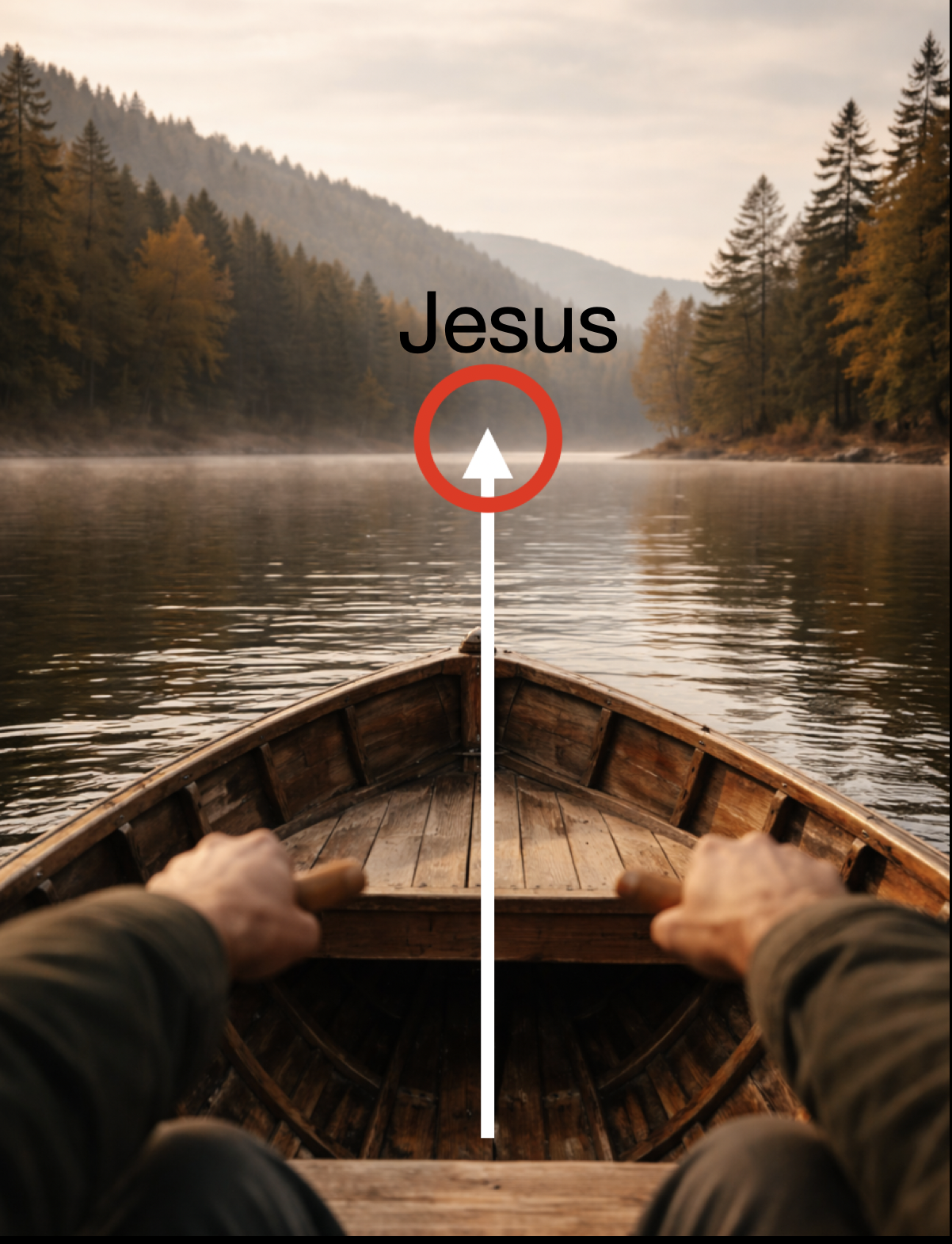
Jesus is your fixed point to focus on that you use to set your course.  Look to the example of Jesus to guide your behavior.  “Do this in remembrance of me” is not just about partaking in communion or the Lord’s Supper.   Everything we do should be because we are remembering what Jesus did.

And don’t look at a year ahead.  The only day that we can be obedient is today.  Did he say, “Give us this year our yearly bread”?   His mercies are new every morning.  Jesus said, “Take up your cross daily.”

So do you want to lean into God this year and live in an active hope in the tension of his promises?   Then I ask you to join me.  I will be reading through the Bible, looking back to move forward.  And I am not asking you to commit to reading through the Bible in a year.  I am asking you to read through a portion on January 1.  And on January 2, I ask you to consider reading through a portion that day.  One day at a time.  And if you miss a day, it is past; you can’t go back and live it again.  But you pick up the next day in your obedience. If you are interested, let me know, and I’ll put you on the daily text stream.

Romans 15:13 Now may the God of hope fill you with all joy and peace in believing, so that you will abound in hope by the power of the Holy Spirit.

  1. January 1 was chosen by the Romans as the beginning of the new year in the calendar popularized by Julias Ceasar (the Julian Calendar), as that was the day the Roman Consuls began their year to align with new leadership and the lunar cycle closest to the solstice. January became the name of the month after the two-faced Roman god, Janus, who looks backward to the past and forward to the future.  A correction to this calendar in 1582 became the calendar we use today, as instituted by Pope Gregory XIII.  The change caused the day following October 4, 1582, to be October 15th, not the fifth.  Of course, God had long ago established his own calendar in Exodus 12, with the month of Aviv in the spring as the first month, and the 10th of that month as the day the Passover lamb was killed.  There is no subsequent passage in the Bible that commands altering the calendar God established. 
  2. Wolff, Hans Walter (1974) “The Concept of Time in the Old Testament,” Concordia Theological Monthly: Vol.45, Article 6.
  3. Moen, Skip. From “The Details” Skipmoen.com August 16, 2009.
December 17, 2025 –  Unlikely Choices and Impossible Tasks— Acts #25

December 17, 2025 –  Unlikely Choices and Impossible Tasks— Acts #25
Acts 9:10-19

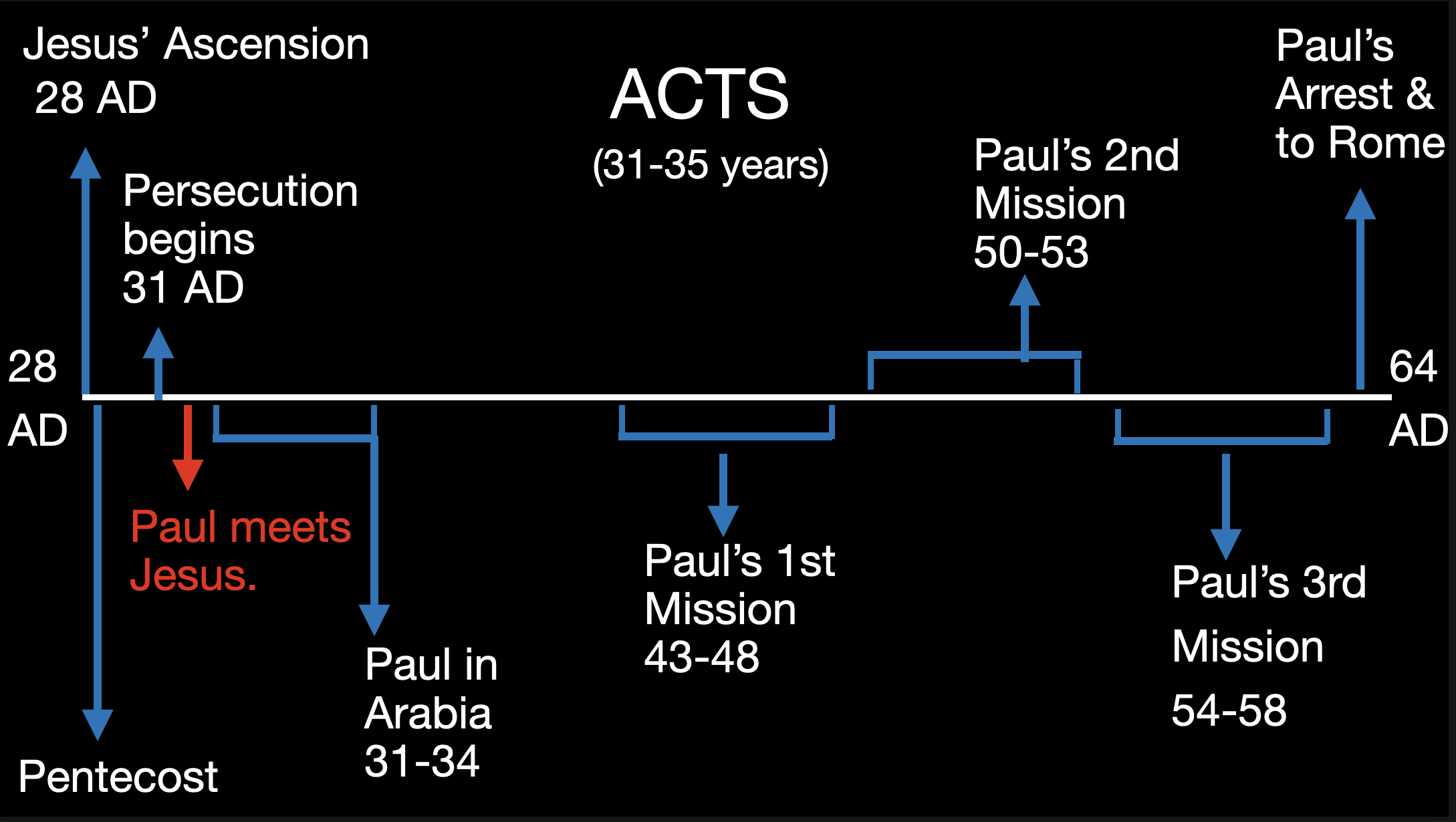
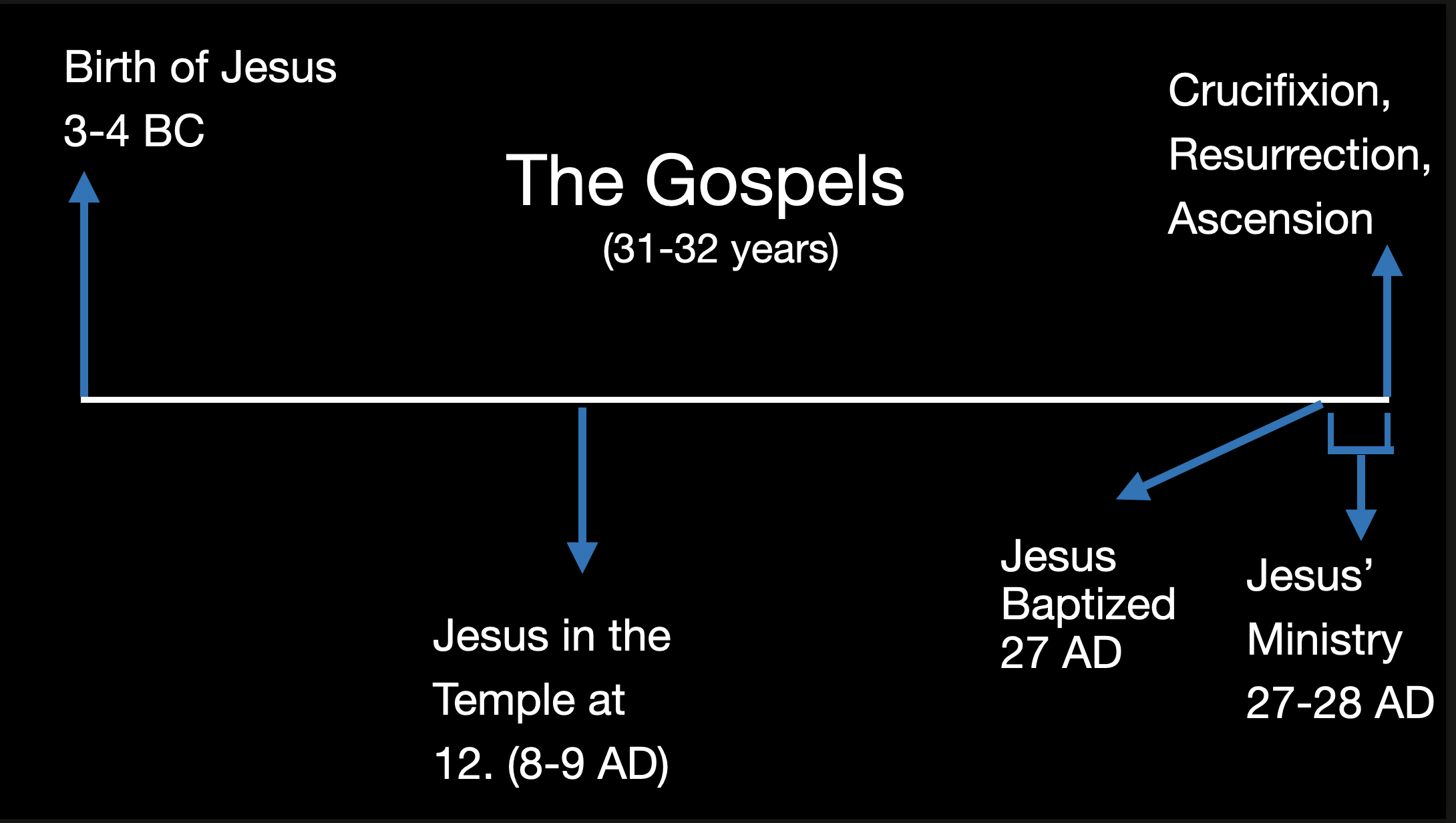
Before we continue in Acts, I want to talk about the timeline.  (You will not find universal agreement on the actual dates, but it is the division of time I want you to see here.)   The Gospels begin with the story of John the Baptist’s and Jesus’ birth around 4 BC and end with his crucifixion, resurrection, and ascension in 28 AD, covering 31-32 years.  But other than the birth narrative and the visit to the temple at 12 years old, everything else in the Gospels happens in this 1 1/2 year or 70-week period.  When we covered the ministry of Jesus, we went pretty much week by week, following him through the Gospels in real time.

The Timeline for Acts is also around 30-35 years, but the action is not concentrated at a single point.  Acts begins with the Ascension of Jesus and Pentecost, which would have been in June of 28 AD. So we have covered the first 8.5 chapters of Acts in the past 6 months, but that encompasses 2-3 years.  By the 9th chapter of Acts, it is now 2-3 years since Jesus’s crucifixion, resurrection, and the events of Pentecost.  The church has grown in numbers, and persecution has begun.  The rest of Acts covers the 3 years Paul spent in Arabia and his three missionary journeys.

Again, today, in Acts 9, we are at the red arrow above.  Saul met Jesus near Damascus and had been in the city for 3 days.

Acts 9:10-19   Now there was a disciple at Damascus named Ananias. Yehovah said to him in a vision, “Ananias.” And he said, “Here I am, Lord.” And Yehovah said to him, “Rise and go to the street called Straight, and at the house of Judas look for a man of Tarsus named Saul, for behold, he is praying, and he has seen in a vision a man named Ananias come in and lay his hands on him so that he might regain his sight.” But Ananias answered, “Lord, I have heard from many about this man, how much evil he has done to your saints at Jerusalem. And here he has authority from the chief priests to bind all who call on your name.” But Yehovah said to him, “Go, for he is a chosen instrument of mine to carry my name before the Gentiles and kings and the children of Israel. For I will show him how much he must suffer for the sake of my name.” So Ananias departed and entered the house. And laying his hands on him he said, “Brother Saul, Yehovah Jesus who appeared to you on the road by which you came has sent me so that you may regain your sight and be filled with the Holy Spirit.” And immediately something like scales fell from his eyes, and he regained his sight. Then he rose and was baptized; and taking food, he was strengthened.

“Now there was a disciple named Ananias.” (Acts 9:10)   Where did this disciple come from?  Saul is on his way to Damascus to find the followers of Jesus who escaped from Jerusalem.  But Ananias is not one of this group, for in his conversation with Jesus, he says this:

Acts 9:13   But Ananias answered, “Lord, I have heard from many about this man, how much evil he has done to your saints at Jerusalem.

He may be a new follower of Jesus through the gospel spread by these escapees from Jerusalem, but it is more likely he has been a follower of Jesus in Damascus for some time.   Saul says in his personal account of the story in Acts 22:

Acts 22:12   And one Ananias, a devout man according to the law, well spoken of by all the Jews who lived there…

Notice that Ananias is considered a devout man by all the Jews in Damascus.  And we have already seen that he was a disciple of Jesus.  Don’t miss that followers of Jesus can worship alongside Jews in the synagogue.  And these Jews consider the Christians devout, because the Christians are keeping the law.  Again, these followers were not changing religions when they went from the Judaism they grew up in to a belief that their Jewish Messiah had come in Jesus. 

So somehow, Ananias became a follower of Jesus some time ago.  But Jesus never went to Damascus.  Damascus is a long way from anywhere Jesus went.  The closest Jesus came was Caesarea Philippi (about 40 miles away), and there was no public ministry by Jesus there that we have recorded.  

But the message spread through people whose names have never been recorded.  Someone shared the gospel of Jesus with Ananias, and now God has chosen him to correct Saul’s vision problem.  We are not told he is a leader in the church.  He has no title.  He is just an ordinary guy worshiping with all the Jews in the synagogue every Sabbath.  And they all speak well of him.  He is a man of character, well respected by all. 

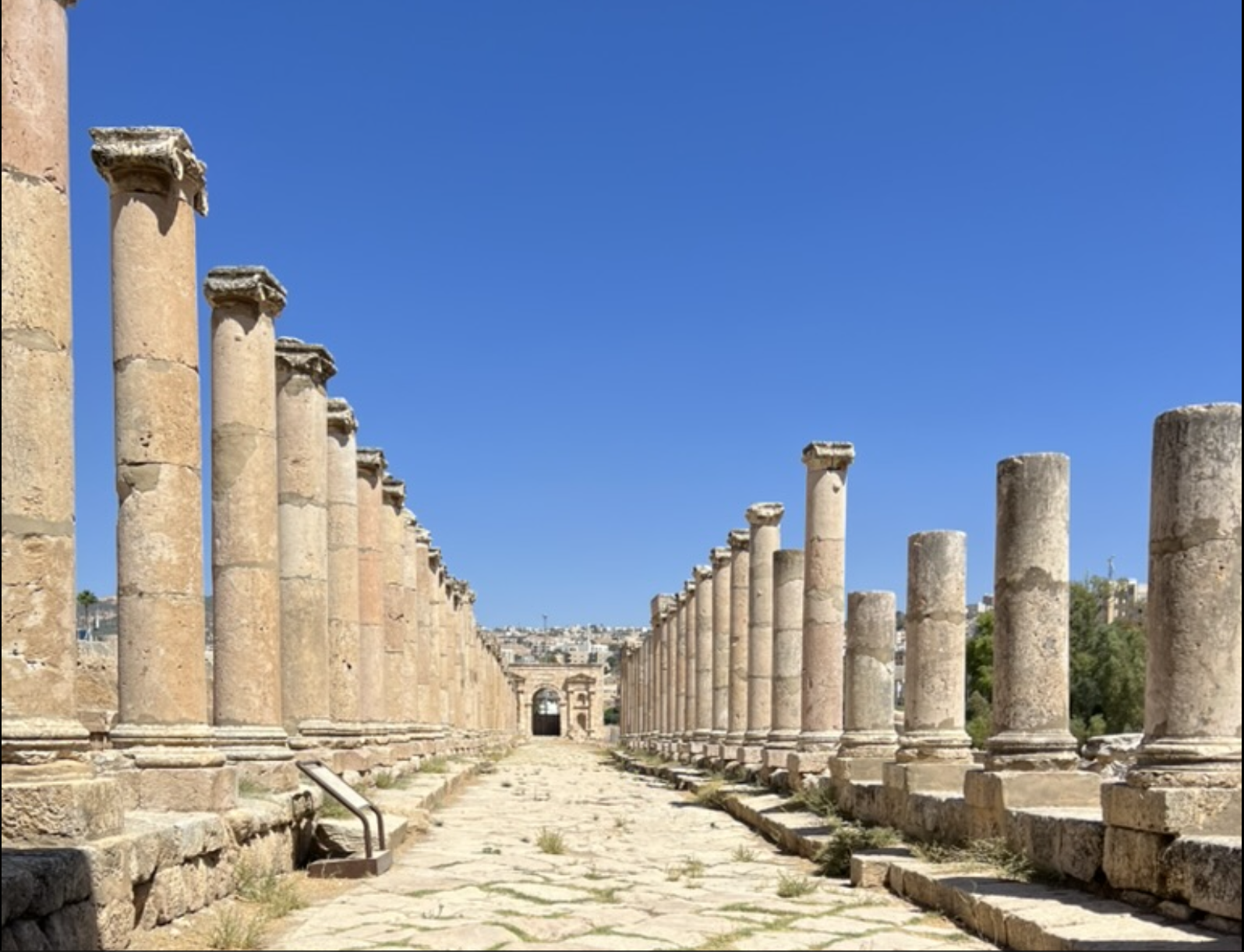
God calls this ordinary man, Ananias, to do a task.   Go to Judas’ house on Straight Street to see a man for me.  The “street called straight” would be the major east-west street in the center of the city, called the decumanus maximus.  (The major North-South street is called the cardo.) You can see this street in the old town of Damascus today.  But in Ananias’ day, it would have looked more like this colonaded Roman decumanus (Straight Street) in Jerash, Jordan.

In Saul’s day, there would have been houses and shops all along these streets.  So God tells Ananias to go to the home of Judas to see a man named Saul, who has been praying, and who God had shown in a vision that you are coming.  God has really set the table for Ananias.  Have you had a witnessing experience like this: God performed a miracle to get someone’s attention, told you that you personally were coming to help them, and then told you exactly where to go?  I wonder if it wouldn’t happen more if we made a practice of listening for God’s voice.  

But this is no ordinary person that Ananias is being sent to.  Imagine Ananias’ surprise: “His name is Saul?   Saul from Tarsus?    Wait a minute!   You mean the guy who put all the Jesus followers in prison in Jerusalem, the guy who chased some of them all the way up here to tie them up and take them back there to be beaten or worse?    And you want me to go see him?” Well, to cut to the end, Ananias does go; he lays hands on Saul, and his blindness is healed, and Saul is given his call to be a minister.

Two things I want us to see in this story.  First, that God uses ordinary people like Ananias to do his work. Secondly, that God works through very unexpected ways, seeing the potential in people that we often do not see.  And I want to illustrate that by comparing this story in Acts to a very similar story in 1 Samuel. So let’s take a look at 1 Samuel 16:1-13.  Remember 2 weeks ago when we talked about King Saul?  He disobeyed God so often that God fired him as king.  So God tells Samuel to anoint someone else to be king.

1 Samuel 16:1-13   Yehovah said to Samuel, “How long will you grieve over Saul, since I have rejected him from being king over Israel?  Fill your horn with oil, and go. I will send you to Jesse the Bethlehemite, for I have provided for myself a king among his sons.” And Samuel said, “How can I go? If Saul hears it, he will kill me.” And Yehovah said, “Take a heifer with you and say, ‘I have come to sacrifice to Yehovah.’ And invite Jesse to the sacrifice, and I will show you what you shall do. And you shall anoint for me him whom I declare to you.

Samuel did what Yehovah commanded and came to Bethlehem. The elders of the city came to meet him trembling and said, “Do you come peaceably?” And he said, “Peaceably; I have come to sacrifice to Yehovah. Consecrate yourselves, and come with me to the sacrifice.” And he consecrated Jesse and his sons and invited them to the sacrifice.

When they came, he looked on Eliab and thought, “Surely Yehovah’s anointed is before him.” But Yehovah said to Samuel, “Do not look on his appearance or on the height of his stature, because I have rejected him. For Yehovah sees not as man sees: man looks on the outward appearance, but Yehovah looks on the heart.” Then Jesse called Abinadab and made him pass before Samuel. And he said, “Neither has Yehovah chosen this one.” Then Jesse made Shammah pass by. And he said, “Neither has Yehovah chosen this one.” And Jesse made seven of his sons pass before Samuel. And Samuel said to Jesse, “Yehovah has not chosen these.”

Then Samuel said to Jesse, “Are all your sons here?” And he said, “There remains yet the youngest, but behold, he is keeping the sheep.” And Samuel said to Jesse, “Send and get him, for we will not sit down till he comes here.” And he sent and brought him in. Now he was ruddy and had beautiful eyes and was handsome. And Yehovah said, “Arise, anoint him, for this is he.” Then Samuel took the horn of oil and anointed him in the midst of his brothers. And the Spirit of Yehovah rushed upon David from that day forward. And Samuel rose up and went to Ramah.

In both stories, God chooses one of his followers to anoint someone who will become a great leader.  He chose the prophet Samuel to anoint David and an ordinary man, Ananias, to anoint Saul.  Notice that both of these choices for future leaders are people who would not have been chosen by popular vote at the time.  David was the youngest son of an unremarkable family in a tiny town.  He had no political experience, no political connections, and no political aspirations.  His family was not wealthy.  Anyone alive then would tell you there was no good reason to choose this shepherd boy as king.  Yet he was God’s choice.  David had the one requirement God seeks – obedience. 

Because anything else, God can provide.  You don’t have the wealth?  God can take care of that.  You have no experience?  God has already supplied you in ways you don’t even realize, and he will continue to give you what you need.  You don’t have the right connections?  God knows everyone you need to know.  Rest assured that the creator and sustainer of this universe is quite capable of supplying all your needs.

Philippians 4:19 “And my God will supply every need of yours according to his riches in glory in Christ Jesus.”

But as we discussed several weeks ago, there is one thing God can not supply — your obedience.  God’s plan for our lives will fail if we are not obedient.  Notice I said his plan for your life will fail if you fail him.  But God will see to it that His plan is carried out.  He will give you another chance, or he will find someone else who is willing to work with him.   

Over and over in the Bible, God chooses people to do a task for which they are not fully equipped.   David does not have the prerequisites to become a king.  At the burning bush, Moses gives God all the reasons he is a poor choice.  Moses provides all his excuses, and God answers him, “I will be with you, and I will empower you.”  None of the young men Jesus chose to be disciples would have been selected by any other rabbi of the day.   Poor untrained fishermen, rash impetuous Peter, a tax collector hated by everyone, a zealot?

As with Ananias, God isn’t looking for anyone exceptional.  He doesn’t choose the wisest or the richest or the smartest.   And Saul of Tarsus … he was the one in charge of hunting down and punishing any followers of Jesus.  If you were choosing someone to be the greatest missionary of the first century and the writer of 1/4 of the New Testament, he would have been the unanimous last choice.  What do we learn from this?  Don’t judge people as you see them.  What did God tell Samuel when Samuel thought he had found the best choice for king among Jesse’s boys? 

1 Samuel 16:7   Do not look on his appearance or on the height of his stature, because I have rejected him. For Yehovah sees not as man sees: man looks on the outward appearance, but Yehovah looks on the heart.

We have to learn not to trust our own perception of people, because we tend to see only the surface, while God looks at the heart.  In the same way, we are not to trust our own judgment of right and wrong, because our vision is limited.

The first sin in the Bible was when Adam and Eve decided that the fruit looked okay to them.   They said, “I don’t see anything wrong with this fruit.”  But the sin was that they were not to decide what is right or wrong.  Only God can determine what is good and what is evil.  The minute we begin asking ourselves if something is good or bad, we have sinned.  The correct question to ask is, “Does God say this is good or bad?”  And it is the same with judging people.  It is not up to Samuel to decide which of Jesse’s sons would make a great king.  That is for God to choose, because he is God and we are not.  Isaiah said it this way:

Isaiah 55:8-9  “For my thoughts are not your thoughts, neither are your ways my ways, declares Yehovah.  For as the heavens are higher than the earth, so are my ways higher than your ways and my thoughts than your thoughts.

God is brighter than any of us.  And the level that he thinks about things is as much higher than our level of thinking as the sky is higher than the ground.  We are stuck thinking earthly, while God thinks heavenly.  So we should not be surprised when God does things very differently from the way we would.

This was a problem for the religious leaders in Jerusalem with Jesus.  No one would choose a country boy from the podunk town of Nazareth to be the Messiah.  He was not from the right family.  He had no formal rabbinic training. He did not follow all of their traditions.  He didn’t even spend much time in Jerusalem, but mainly stayed in the sticks up in Galilee.  He was nobody’s choice.  But God chose to send him specifically this way.  And part of the reason is that God wanted to show us what really matters.  

Search the Scriptures.  You will see God using unconventional methods and people no one would choose to get the job done over and over.   Say it is 1400 BC, and you want to take the most heavily defended fortified city in the world?  Not a single General in the Pentagon would come up with this strategy:   Take no weapons but trumpets and walk around the city seven times, and shout.   But that was how God had the Israelites take Jericho.

God wants Israel to defeat the army of Midian. How does he accomplish that?  First, He chose this unknown guy as a leader for the people.  A person you would have never selected because he is so scared of the Midianites that he’s hiding underground to thresh his wheat.  And then God looks at the Midianite army with over 130,000 soldiers, and then at Gideon’s army with his 32,000 soldiers, and He says, “Okay, Gideon, they outnumber you 4 to 1.  You clearly have too many soldiers, so send most of them home.”  “Okay, now you have 300 soldiers against their 130,000; they outnumber us over 400 to 1. That is much better, God says, I like those odds.

The children of Israel escape from Egypt, but Pharaoh decides to pursue them.   The Israelites are trapped by a body of water behind them, and the Egyptian army is charging at them with hundreds of chariots and the finest weapons of the day, while they have no weapons at all.  And God says, “Now we have the Egyptians right where we want them.”  Why does God consistently want to accomplish his mission with the odds stacked so high against his people? Paul answered this question in one of his letters to the Corinthians:

1 Corinthians 1:26-2:1 (NIV)   Brothers and sisters, think of what you were when you were called. Not many of you were wise by human standards; not many were influential; not many were of noble birth. But God chose the foolish things of the world to shame the wise; God chose the weak things of the world to shame the strong. God chose the lowly things of this world and the despised things—and the things that are not—to nullify the things that are, so that….

“So that…”  Wait a minute.  Slow down here.  We don’t often get explanations of why God does things.  (That is probably because we are not able to understand the explanations, much like my parents telling 3-year-old me why I shouldn’t cross the street by myself.)  So here comes the why:

…so that no one may boast before him. It is because of him that you are in Christ Jesus, who has become for us wisdom from God—that is, our righteousness, holiness, and redemption. Therefore, as it is written: “Let the one who boasts boast in the Lord.”

God does this so that no one can boast, saying, “Look what I did.”  Do you think any of Gideon’s 300 soldiers went home after that battle and bragged to their wives about how they fought so well and defeated the 130,000 Midianites?  Nobody would believe them.  God fixed it so everyone would know He won the battle.  He defeated the Egyptians in the Sea of Reeds.  Everyone left those situations praising God and boasting of God’s power and his victory.  Salvation – whether it is deliverance from the enemies of this world or deliverance from the enemy of sin and death, salvation has always been about what God does; it is not of our works, lest any man should boast.  Paul repeats it:

Ephesians 2:8-9   For by grace you have been saved through faith. And this is not your own doing; it is the gift of God, not a result of works, so that no one may boast.

See, soldiers of Gideon, it was by God’s grace you were saved.  Hey Israelites strolling through dry ground between walls of water, guess what?   God did this, and you didn’t do anything to deserve it; he did it out of his chesed (his loyal covenant love and grace).  Hey church member, you can’t earn your salvation either.  Your obedience is your way of telling God you love Him.

I sat in a deacon’s meeting one day and listened to a discussion about whether our church should join with other local churches to form a mission to the poor and marginalized of our county.  And the debate went as you would expect, with men raising reasonable questions, such as: “Do we have the financial resources to participate in this?”  “Do we have the people who will volunteer to fill the roles needed?”  “Is this something we are capable of doing?”  “How long a commitment would we be making?”  There were 20 minutes spent analyzing the situation as a CEO would consider the pros and cons of opening a new business location, or as a general would consider the options for fighting a battle.  I asked the question that I thought was the only important one: “But does God want this to be done?”

But the discussion soon returned to the logistics. Someone actually said, “Well, if God wanted us to do it, He would have already given us the resources to do it.”   And in the end, it was decided that we would not participate in the project.  Without this large church’s support, the plan for that mission fell apart. And I believe that day, God’s plan was temporarily delayed by our disobedience.  But God wanted this mission to happen, so he found another church that would do it.   And it became a very successful outreach to many poor and marginalized in our community for many years.  The idea that was missed in that meeting was that God calls and then, as you go about being obedient, He equips you for the task, supplying your every need.  

If we only attempt to do the things we currently have the resources for, we have no faith.  If we only attempt tasks we are capable of doing, there is no need for God to join us.  We complete the task, but there is no growth in our faith, no growth in our relationship with God.  If we are called to attempt impossible tasks, then we leave room for God to join with us.  We do the task under his power, not our own. With resources He supplies from His riches.  That experience deepens our faith in God and strengthens our relationship with God.  Of course, God could do all these things without us.  He could have rescued the Israelites without Moses; He didn’t need Moses’s staff to part the sea or win a battle.  But he chooses to call us alongside him to do the work because he wants our relationship with him to grow.  

We looked at two stories of two different Sauls.  Acts 9 of Saul and Ananias, and 1 Samuel 16, of King Saul and Samuel.  The Hebrew word Shaul is a verb meaning ‘to ask’. As a name, it means ‘one who is asked’.  Saul in the Old Testament was asked to be king of Israel.  He was asked to be a king who was obedient to God, who would lead the people in the way God directed.  Saul in the New Testament, was asked by God to be a leader, a missionary to Jews, Gentiles, and kings.  Two Sauls, one a colossal failure and the other recorded in the Bible as one of God’s best servants, and the difference is obedience.

And these two stories illustrate the unlikely people God chooses to do his work.  We see them as unlikely because we don’t see them as God sees them.  The people in Acts 9, including Ananias, looked at Saul and saw a threat.  A man who could cause them harm.  What did God see when he looked at Saul?   A man who wanted to fight for God.  A man who was not comfortable just complaining about a problem but was willing to give 100% to solve a problem. A man of high commitment and zeal.  Sure, Saul was wrong, but in God’s thinking, what a fantastic missionary a man like this could be if he turned toward the truth.  We need to see people with God’s eyes. 

Where we see threats and danger, God sees purpose and commitment.  Where we see Insignificance, God sees potential.  Where we see impossibility, God sees opportunity to grow our faith.  And where we see broken pasts, God sees redeemed futures.

Let us seek to see the world through God’s eyes, not our own.  Let us see people as God sees them, looking for the potential within them.  And let us always be open to respond obediently to God’s call on us to do things that are beyond our ability, for then we partner with Him and grow in Him. 

December 10, 2025 –  Shalom, and the War You Didn’t Realize You Were Fighting— Acts #24

December 10, 2025 –  Shalom, and the War You Didn’t Realize You Were Fighting— Acts #24
Acts 9:1-9

Words in Hebrew have very rich meanings. Last time, we discussed the Hebrew word ‘shema’Shema means listen, but more than listen, it means listen and obey.  Obedience is not optional.  If you did not obey, then you did not hear.  Jesus said, “He who has ears to hear, let him hear.” You will find a version of this 15 times in the New Testament. That isn’t just a poetic phrase Jesus threw out there.  He isn’t speaking English.  It is about shema.  Jesus is talking about obedience.   “If you hear what I am saying, then be obedient.”

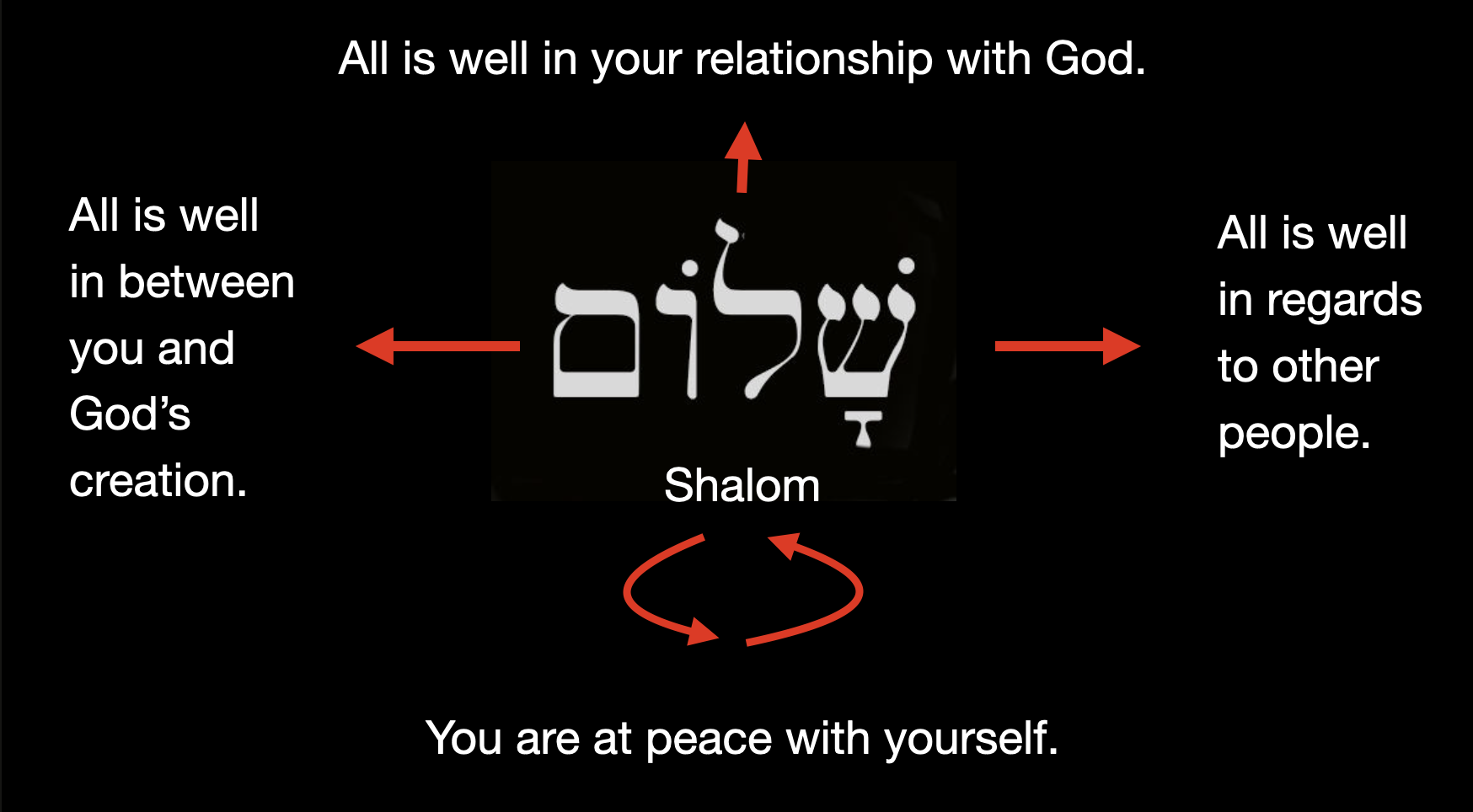
Today, we look at the word Shalom.  It begins with the same letter, ש (shin).  It means peace.  And peace is the candle that many of you lit this past week for Advent.  But like the Hebrew word shema, this word has a richer meaning.  Shalom means more than our concept of peace.  It carries the idea of wholeness, that all is well, that all is well with you, and with your relationship with your neighbor, and in your relationship with God.

  In Acts 8, Shalom was disturbed due to this great persecution of the followers of Jesus.

Acts 8:3  But Saul was ravaging the church, and entering house after house, he dragged off men and women and committed them to prison.

All was not well.   And when this persecution hit hard, as we discussed the last few weeks, the people scattered.  Philip ended up in Samaria.  Some went further north up to Damascus in Syria.  That brings us to chapter 9.

Acts 9:1-9   But Saul, still breathing threats and murder against the disciples of the Lord, went to the high priest and asked him for letters to the synagogues at Damascus, so that if he found any belonging to the Way, men or women, he might bring them bound to Jerusalem. Now, as he went on his way, he approached Damascus, and suddenly a light from heaven shone around him. And falling to the ground, he heard a voice saying to him, “Saul, Saul, why are you persecuting me?  And he said, “Who are you, Lord?” And he said, “I am Jesus, whom you are persecuting. But rise and enter the city, and you will be told what you are to do.” The men who were traveling with him stood speechless, hearing the voice but seeing no one. Saul rose from the ground, and although his eyes were opened, he saw nothing. So they led him by the hand and brought him into Damascus. And for three days he was without sight, and neither ate nor drank.

We have all heard news reports of rare incidents in which police mistakenly raid the wrong house.   Imagine waking up in the middle of the night to the sound of your front door being bashed open, a flash-bang grenade going off in your living room, and then a heavily armed SWAT team entering your home.  Unfortunately, it happens.  Sometimes the tip the police received was incorrect, or the address was incomplete, or a simple error was made. The police did not mean to raid the wrong house.  They had warrants signed by a judge granting them authority to enter the home at that address.  They were well-trained.  They were putting forth their best effort in the raid.  They were highly motivated to apprehend the suspect and protect the public. But they were utterly wrong.

That is what is happening with Saul in Acts 9.  Saul has papers from the high priest authorizing him to go into homes, arrest people, and bring them back to Jerusalem.  Saul is one of the best-trained scholars of scripture alive in his day.  He is giving 100% effort to rid the country of these Jesus followers, to protect the public from heresy.  He is highly motivated, going into homes and dragging out the followers of this splinter group.  And he is entirely wrong.  

In Saul’s mind, he is a soldier defending God’s honor. He is cleaning up Israel. He is protecting the faith. If anyone asked Saul, “Why are you doing this?” he would have said, “Because I love God!”  But he is 100% wrong.  Because sincerity does not make you right, commitment does not equal correctness, and power does not equal purity.   Legal process does not equal morality, nor does strength of conviction make you holy.   Passion without truth is dangerous.  

God has to intervene.  So he throws his own flashbang grenade at Saul’s feet, knocking him to the ground and blinding him.   And the voice from heaven asks Saul, “Saul, Saul, why are you persecuting me?”  Not why are you persecuting these people, or why are you persecuting these followers, but why are you persecuting me?  Then Saul asks an essential question: “Who are you, Lord?”

At this point, Paul is aware he is not dealing with humanity.  This blinding flash of light was nothing any human could produce.  Is he dealing with an angel, or God himself?  So he asks, “Who are you, Lord?  (Lord being the equivalent of us saying a very respectful “sir”.)  The voice responds: “I am Jesus, whom you are persecuting.”  This is a lot for Saul.  First, the voice is Jesus, whom he had been told was dead, crucified as a criminal, a blasphemer.  But instead, Jesus is very much alive.  And Jesus wields the power of God.  And Saul finds that he is not rescuing people from a heresy, but waging war against God himself.  So God gives Saul a three-day timeout.  Three days to consider all of this.  Three days when he can not see.  And he fasts from food and drink.  And you can bet blind Saul prayed, and prayed hard.

Saul thought he was waging war with these heretics who had disturbed the peace of Jerusalem.  But it was Saul who was disturbing the shalom of God by waging this war.  This story is an example of a great paradox of the message of Jesus.  As many of you read in our Advent reading this past week, the prophets say that the Messiah will come as the Prince of Peace.

Isaiah 9:6   For unto us a child is born, to us a son is given; and the government shall be upon his shoulder: and his name shall be called Wonderful, Counsellor, Mighty God, Everlasting Father, Prince of Peace.”

The Messiah is the ‘Prince of Peace.’  And the first to hear the news of Jesus’ birth were the shepherds in the field with their sheep, who heard it from the angels.  We sing it in the hymn, “It Came Upon the Midnight Clear”:

“It Came Upon the Midnight Clear, 
That glorious song of old.
From angels bending near the earth,
To touch their harps of gold;
“Peace on the earth, goodwill to men, 
From Heav’n’s all-gracious King.”

Isaiah said He is the ‘Prince of Peace’.  The angels sang that he comes to bring peace on earth.  But then how do we reconcile what Jesus says here:

Matthew 10:34-36   Do not think that I have come to bring peace to the earth. I have not come to bring peace, but a sword. For I have come to set a man against his father, and a daughter against her mother, and a daughter-in-law against her mother-in-law. And a person’s enemies will be those of his own household.

 How do we reconcile these two passages?  The peace that Jesus brings is first and foremost peace with God.  True shalom with God.  Before Jesus, we had no peace with God.  Paul says it this way:

Romans 8:7-8  “For the mind that is set on the flesh is hostile to God, for it does not submit to God’s law; indeed, it cannot. Those who are in the flesh cannot please God.  

When you are in your sin, there is hostility towards God.  You are living on the king’s land, but you do not follow the king’s rules.  You are a rebel.  You are waging war with God.  The only way to end your rebellion is to ask for forgiveness, which God freely grants through Jesus. And then to begin to live a different life that is not in rebellion to the king’s rule, but to follow him in obedience.  As Paul says in the preceding verse:  

Romans 8:6 “For to set the mind on the flesh is death, but to set the mind on the Spirit is life and peace.

You can choose peace with God (shalom) or hostility towards God.  There is no middle ground.  See this again in James:  

James 4:4 (NLT)  Don’t you realize that friendship with the world makes you an enemy of God? I say it again: If you want to be a friend of the world, you make yourself an enemy of God. 

You have to choose.  Jesus told his disciples that peace with God can be theirs:

John 14:27 (NLT)   I am leaving you with a gift—peace of mind and heart.  And the peace I give is a gift the world cannot give.  So don’t be troubled or afraid.

And the Bible is consistent.  For though the carol said “it came upon the midnight clear,” “Peace on the earth, goodwill to men, from Heaven’s all-gracious King.”  That is not what the angels said.  Here is what the angels actually said:

Luke 2:14 “Glory to God in the highest, and on earth peace among those with whom he is pleased! 

Wait, there is a catch to that peace with God the angels sang about.  The only ones who get peace are those with whom God is pleased.  Those who are in right relationship with him.  Those who follow his son Jesus in salvation and obedience.  They have peace, shalom, with God. Everyone else is still at war with God.  So let’s see that in a carol that gets it right, “Hark! the Herald Angels Sing”.  

Hark! The herald angels sing,  
Glory to the newborn King!  
Peace on earth, and mercy mild, 
God and sinners reconciled.

Peace on earth is tied to this:  God and sinners reconciled.  There is no peace for us with God until we are reconciled to him through the forgiveness of our sins and the promise we make to follow him as our Lord and live in obedience to him.  

Now look what happens with Saul.  Saul discovers on the Damascus Road that he and his SWAT teams are raiding the wrong house.  He is an enemy of God.  Once Saul stops fighting Jesus, he begins an incredible journey of reconciliation.  After he is reconciled to God, he will eventually seek fellowship with the same followers he persecuted.  And he will become a leader in this fellowship, a missionary of reconciliation.

Paul calls peace a fruit of the Holy Spirit living within us, and he says:

Romans 12:18 If possible, so far as it depends on you, live peaceably with all.

But none of that can happen until his heart is made right with God.  Jesus tried to make this clear to his disciples in John 16:

John 16:33  I have said these things to you, that in me you may have peace…

You may have shalom, peace with God.  You are at peace with God when you are in a right relationship with Him. But that is not the end of the verse.  Keep reading to see the paradox.

John 16:33  I have said these things to you, that in me you may have peace.  In the world, you will have tribulation.

If you don’t understand shalom, if you don’t understand the kind of peace Jesus is talking about, then this verse makes no sense.  “Which is it, Jesus, peace or tribulation?”  But when you have peace with God, you are then at war with the world.  You will have tribulation.  And now, finish the verse to see the best news.  

John 16:33  I have said these things to you, that in me you may have peace. In the world, you will have tribulation.  But take heart; I have overcome the world.

Your enemy, the world, has already been defeated.  The way of this world, what the Bible calls the way of the flesh, was defeated on the cross of Jesus.  Sin, which kept us enemies of God, was defeated, so now we can be friends with God.  And then death was defeated.  Jesus has overcome.  The outcome of the war has been decided.  But the battle still rages within us as long as we persist in disobedience. 

Peace can be ours now if we seek Him and obey Him.  And complete peace, complete shalom, will exist in this world one day.   The Prince of Peace will reign over all, and there will be no more enemies.  Come, Lord Jesus, come.  

Saul’s transformation begins with two simple questions: the first, “Who are You, Lord?”  This is the most critical question.  Who is Jesus to Saul at this moment of the blinding light?  He is no one to Saul, just a teacher whom the Romans killed.  But it is in this moment that Saul realizes who Jesus really is, the living Son of God.  And this makes all the difference for Saul.

Then the second question:  “What do you want me to do?” Now that Saul knows who Jesus is, he wants to listen to Jesus and obey him.  This is shema, hear and obey.  And that leads to peace with God.   Shema leads to shalom.  You have to shema (listen and obey) before you find shalom, peace with God.  Peace with God requires listening and obeying.  In Acts 8, Saul’s relationship with God is like a child pulling on a rope in a tug-of-war against his father.  He pulls with all his strength until he is exhausted. It is hopeless.  Finally, the father smiles at the child.  And the child puts the rope aside, and the father embraces the child. The child’s peace didn’t come from winning the battle—it came from surrendering into the father’s arms.   It is here in Acts 9 that Saul drops the rope and surrenders to Jesus. So must we.

It was Christmas Day, and Henry Wadsworth Longfellow was listening to the church bells ring out, representing the angels’ proclamation of peace on earth, goodwill to men.  But Longfellow had no peace.  It is 1863.  He recently lost his wife in a tragic accident.  And his son, Charles, was away fighting in our country’s brutal Civil War. And in the midst of this turmoil, he pens these words:

I heard the bells on Christmas Day
, Their old, familiar carols play,
And wild and sweet
The words repeat
Of peace on earth, goodwill to men!

And thought how, as the day had come,
The belfries of all Christendom
Had rolled along
The unbroken song
Of peace on earth, goodwill to men!

Till ringing, singing on its way,
The world revolved from night to day,
A voice, a chime,
A chant sublime
Of peace on earth, goodwill to men!

Then from each black, accursed mouth
The cannon thundered in the South,
And with the sound
The carols drowned
Of peace on earth, goodwill to men!

It was as if an earthquake rent
the hearthstones of a continent,
and made forlorn
the households born
of peace on earth, goodwill to men!

And in despair I bowed my head;
“There is no peace on earth,” I said;
“For hate is strong,
And mocks the song
Of peace on earth, goodwill to men!”

Then pealed the bells more loud and deep:
“God is not dead, nor doth He sleep;
The Wrong shall fail,
The Right prevail,
With peace on earth, goodwill to men.”

God is not dead, nor doth he sleep.  Jesus is indeed the Prince of Peace.  Jesus wants us to have that shalom with him, that right relationship that comes with His forgiveness and salvation.  The peace that comes by shema — listening to the voice of God and being obedient.  

This Christmas season, I want you to consider your peace with God.  How is that relationship?  Could it use more communication?  Could it use more obedience?  We earnestly seek the peace of God in our lives, even as we yearn for the day when God’s peace will reign supreme in this world.  We look forward to that day when God redeems the earth, that day when all is well.

December 3, 2025 –  Philip follows the Holy Spirit – Shema— Acts #23

December 3, 2025 –  Philip follows the Holy Spirit – Shema— Acts #23
Acts 8:26-40

Are you ready to be a disciple?

Shema – it means “listen” in Hebrew, but it means much more than “listen”.  Because in the Jewish culture of the Old Testament, listening implies obedience.  There is no concept of listening to God without being obedient.  It is just wrong; it is a sin.

This word is so important. It is the title and the first word of the prayer every Jewish person has prayed several times a day for thousands of years.  The prayer is a collection of passages from Deuteronomy.  And this is the first prayer Mary and Joseph taught Jesus as a small boy.  And he prayed this prayer every day.  And this concept of shema is critical to a follower of Jesus. 

We continue our story of Philip in Acts 8, and in this story, Philip shows us what it looks like to listen for God’s voice and obey without delay.  Through him, God brings salvation to a man who was seeking truth but didn’t yet know where to find it.

Acts 8:26-40   Now an angel of the Lord said to Philip, “Rise and go toward the south to the road that goes down from Jerusalem to Gaza.” This is a desert place. And he rose and went. And there was an Ethiopian, a eunuch, a court official of Candace, queen of the Ethiopians, who was in charge of all her treasure. He had come to Jerusalem to worship and was returning, seated in his chariot, and he was reading the prophet Isaiah.
And the Spirit said to Philip, “Go over and join this chariot.” So Philip ran to him and heard him reading Isaiah the prophet and asked, “Do you understand what you are reading?” And he said, “How can I, unless someone guides me?” And he invited Philip to come up and sit with him.
Now the passage of the Scripture that he was reading was this: “Like a sheep he was led to the slaughter and like a lamb before its shearer is silent, so he opens not his mouth.
In his humiliation justice was denied him. Who can describe his generation? For his life is taken away from the earth.”
And the eunuch said to Philip, “About whom, I ask you, does the prophet say this, about himself or about someone else?” Then Philip opened his mouth, and beginning with this Scripture he told him the good news about Jesus. And as they were going along the road they came to some water, and the eunuch said, “See, here is water! What prevents me from being baptized?” 
And he commanded the chariot to stop, and they both went down into the water, Philip and the eunuch, and he baptized him. And when they came up out of the water, the Spirit of the Lord carried Philip away, and the eunuch saw him no more, and went on his way rejoicing. But Philip found himself at Azotus, and as he passed through he preached the gospel to all the towns until he came to Caesarea.”

Philip was in Samaria experiencing revival.  Things were going great!  People were coming to know Jesus as their Messiah.  Lives were being changed.  Miracles were happening.  People were being healed.  Crowds were eager to hear the Gospel.  It was the perfect situation for a church leader.  Then God says, “Go south to the desert road.”  Everything is going great, so go to the desert.  How does that make sense?  Leave the crowds?  Leave success?  Leave the work God is blessing? For a desert road?   No preacher today with any sense would leave a place of great success and go to a deserted land.  (You notice preachers rarely get called to leave a big, successful church and go to a tiny, struggling church in the middle of nowhere.) That desert road led to Gaza.  Now that is a place that you probably wouldn’t want to go today.  It wasn’t much better in Philip’s day.  But God had an assignment for Philip, and Philip didn’t argue… he listened and obeyed.

Many of God’s most significant assignments begin with an interruption in routine and a disruption in comfort. Abraham is minding his own business at home, and God calls him to leave everything he knows.  Moses is tending sheep, just as he has done every day for the past 40 years.  He has a good life in Midian. He has no thoughts of ever returning to the country he was kicked out of.  But God interrupts his life and gives him a difficult task. Mary is engaged to be married.  It was an exciting time in her life. She was planning a wedding, getting everything ready to set up a household with Joseph.  And then God interrupts her in a significant way.

God’s task assignments often come with few details.  Now this can be frustrating at times.  We like to know the whole plan, including all the details, before we set out on a project.  We want to know how long it will last, how much it will cost, and what equipment we will need. But God only gave Philip step 1:   Rise and go toward the south to the road that goes down from Jerusalem to Gaza.    No mention of why.  No mention of what he would do there. But this is the way God usually works.  He rarely gives anyone the big picture up front.

We often miss this when we read the scripture in the psalms:

Psalm 119:105   Your word is a lamp to my feet… 

What is a lamp to my feet?  They didn’t have flashlights in those days.  They used oil lamps held by a string near their feet.  It provided just enough light for the next step.  They couldn’t see any further ahead.  And this is typically how God reveals his plans or tasks for us.  Just one step at a time.  That requires trust.  That requires faith.  

God sends a messenger to Philip.  (That is literally what the word translated ‘angel’ in our English Bibles means.  Both ‘angelos’ in Greek and ‘malach’ in Hebrew mean messenger.)  A few verses later in this passage, it says, “And the Spirit said to Philip…”  I am not sure that there is a big difference in these two statements of the delivery of God’s message to Philip.  In Jewish thought, there is little distinction, as seen in Acts 23:9.

Acts 23:9   Then a great clamor arose, and some of the scribes of the Pharisees’ party stood up and contended sharply, “We find nothing wrong in this man. What if a spirit or an angel spoke to him?”

God very rarely speaks through messengers who take human form.  And contrary to every painting you have ever seen, angels do not have wings.   Angels in human form are the least frequent way God sends messages.  He occasionally speaks through dreams or visions, but the most common way God speaks is through scripture. When you read the Bible, it is God’s word to you.  It is God speaking to you.  And we pray to converse with God.  Mark Batterson says that God most frequently speaks in whispers.  In his book, “Whisper”, Batterson notes that to hear someone whisper, you have to draw close to them.  God speaks to those who draw close.  And God speaks to those who listen.

But the question is: Do we give God a chance to speak to us?  

Do we allow God to speak in our prayer time?  Are we listening, not just talking?  Prayer is meant to be a conversation, not a monologue.  

When we read Scripture, do we allow time for God to speak? Tim Makie of the Bible Project frequently refers to the Bible as meditation literature.  It is not meant to be read like a cookie recipe.  It is not meant to be read like a newspaper or a history book.  It is intended to be read slowly and meditated upon.  Often God has something to whisper to you when you read scripture.  (That is when I most often hear God speak to me.)

Do we make space for God to speak to us?  If every moment of our life is filled with noise, we will miss the whisper of God.  Have you ever wondered why printed books have margins?  They could save a lot of paper if they just used all the space on the page instead of leaving an inch on all sides.  But pages printed to the edge are harder to read.  Your eyes can’t track the lines as well.  The margins are necessary.   And we need margin in our lives.  We fill every moment with constant input, from others or from a television or radio.  There is no blank time, no margin.  It is in quietness that the Spirit often whispers.

God speaks — but do we pause long enough to hear Him?

God speaks to the obedient.   You may not hear God speak because you weren’t obedient to the last request.  If Philip had not been obedient to God’s order to go to the desert, He would not have been in a position for the next instruction.  Only after he has followed God to the desert can he see the chariot, the Ethiopian, and the scroll.  You have to be obedient in the small things that you may not understand to be in a position to do the task God has for you.

But Philip follows God’s instruction to travel to the desert road.  Then he sees a man from south of Egypt, the land called Cush in the Old Testament.  (Currently known as northern Sudan.  This man is an official in the court of the Kandake (the queen mother).  (“The king of Ethiopia was venerated as the child of the sun and regarded as too sacred a personage to discharge the secular functions of royalty; these were performed on his behalf by the queen-mother, who bore the dynastic title Kandakē.”  NICNT  FF Bruce 

He has apparently been to the recent Jewish festival of Pentecost.  He is what they called a God-fearer.  He believes there is a god named Yehovah, and he is convinced of His power, but he has not fully committed. Today, we would call him a seeker.   He may have witnessed, or at least heard about, the commotion in the temple courtyard at Pentecost, and may have heard some talk about Jesus.  But he is going home confused.

God’s plan is good.  His timing is flawless.  Look at this: This person, who has been seeking God but not understanding everything, is alone on the road (he has time on his hands) and trying to read scripture about the Messiah.  He wants to understand it, but he needs help.  So God arranged Philip to be there at that moment.   It is a perfect plan.  But it all hinges on one thing—the obedience of Philip.

God’s great plan will fail if Philip does not follow it.  What happens is Philip says no?  If Philip says, “No way God is calling me to go down that desert road.  That road to Gaza is dangerous.  I am needed here in Samaria.  I am leading a massive movement here.  I am too important to the work being done here to waste that time on the road.  Notice that from Samaria, Philip will travel 50-70 miles on foot.  It will be a 3-4 day journey each way.  This will take Philip away from his work in Samaria for more than a week. And why?  He does not know any details.  The only answer he has to the question of why is obedience.

So what happens to that Ethiopian if Philip is not obedient?  Even if Philip quits on God, God is not going to quit on that Ethiopian.  God is not going to abandon a seeker.  What does God do when people fail to follow and mess up his plan?  Well, fortunately, there is a book that tells us precisely what  God does and how he deals with people.  So let’s look in the Old Testament to see two ways God accomplishes his plan when we are disobedient. 

1.  He gives the disobedient person another chance to follow.  Our example is Jonah.  God had a great plan for turning Nineveh, the capital of the nation of Assyria, to him.  It was up to Jonah to go and preach.  But Jonah was disobedient and got on a boat headed in the opposite direction.  Did God give up on Ninevah?  Did God give up on Jonah?  No.  God created a storm, and God ordained the sailors’ lots to tell them Jonah was the problem.  And then God rescued Jonah from drowning with a great fish.  And then God asks Jonah again, “So how about now, Jonah?  What do you think about going to Nineveh today?

God went to a lot of trouble to encourage Jonah to be obedient, to give him another chance.  God is forgiving of Jonah’s disobedience.  He shows Jonah great mercy.  Do you remember why Jonah didn’t want to go to Nineveh in the first place?  Because he knew God was merciful and forgiving.  Jonah knew that God would give the Ninevites a chance to repent.   And Jonah didn’t really want the Ninevites to have an opportunity for repentance.  They were his enemy.  But Jonah finally obeys and goes, and God shows mercy on the people of Nineveh.  And the end of the 4-chapter book teaches much about mercy to all people. But what would God have done if Jonah had not finally decided to be obedient? 

2.  If God’s chosen person for a task refuses to be obedient, then God chooses another person to do the task.  For an example of this, we look at King Saul in the Old Testament in 1 Samuel 13-16.  God chose Saul to be king over Israel and lead his people faithfully.  But Saul repeatedly disobeyed God’s commands.  I’ll briefly mention two specific examples: He was impatient and did not wait for the priest Samuel to perform the sacrifices before battle, so he offered them himself.  He was not a priest and was not authorized to make any sacrifices.  Secondly, he refused to carry out God’s instructions concerning the Amalekites.   The Amalekites were the nation that refused the children of Israel passage through their land, forcing them to take a considerable detour.  So Saul was to conquer the Amalekites, and everything in the city belonged to God.  No man of Saul’s army was to take any plunder from the attack.  And Saul conquered the Amalekites but allowed his people to take cattle and sheep from the land, even though God had forbidden it.  So after a long history of Saul’s disobedience, God tells the prophet, Samuel, this:

1 Samuel 15:10-11   The word of Yehovah came to Samuel: “I regret that I have made Saul king, for he has turned back from following me and has not performed my commandments.

God has watched Saul, his chosen person, be disobedient so many times that God regrets giving him the job of king.  God has given him chance after chance, but Saul refuses to be obedient. So Samuel goes to Saul, who tells him, “Look, I destroyed the Amalekites just as God said to do.”  And Samuel asks Saul, “Then what are all these sheep and cattle doing here?”  “Oh,” Saul says, “we took the best of the sheep and cattle from the Amalakites to sacrifice them to God.”   So Samuel says:

1 Samuel 15:22-23   And Samuel said, “Has Yehovah as great delight in burnt offerings and sacrifices, as in obeying the voice of Yehovah? Behold, to obey is better than sacrifice, and to listen than the fat of rams.  For rebellion is as the sin of divination, and presumption is as iniquity and idolatry. Because you have rejected the word of Yehovah, he has also rejected you from being king.

In other words, “You’re fired.”  God will appoint someone else to do the job of king, because you can not be obedient.  God then sent Samuel to Bethlehem to anoint a new king, David, a young shepherd boy, whose best qualification for kingship is his obedience.

Look at what Samuel said.  Listen and obey — shema.  What Saul did would be like someone today doing something in disobedience to God to make a lot of money and then excusing their behavior by saying, “Well, I’m going to give some of that money to the church.”  God doesn’t need your money.  He wants you to obey his voice.  He wants you to listen and obey.  You can not obey if you don’t listen.

Thankfully, Philip in Acts 8 listened and was obedient.  He went without hesitation to the desert road. Had he hesitated, he would have missed that divine appointment.  But he was able to explain the scriptures of Isaiah to the Ethiopian who accepted Jesus and asked to be baptized. There are people around us who are spiritually hungry — often quietly.  Like the Ethiopian, they may have status, authority, wealth, education, or influence.  But what they really need is understanding.  There are many people you encounter who look like they have it all together, but they are quietly asking:  How do I make sense of life?  Is this Jesus stuff real?  What am I missing?  God wants to position obedient disciples alongside searching souls, but the disciples must listen and be obedient to the call.  Sometimes all you have to do is walk across the room.  

Do you hear God’s message to you?

Some people say they have never heard God speak.  Maybe you haven’t heard God’s voice, but you have seen its evidence.  God’s initial word, spoken to the cosmos in Genesis 1, is still echoing through the universe.  He said, “Let there be light”, and “let there be stars”, and in our universe, we now have evidence that stars are still being formed.  God’s word is not finished.

Does God still speak?   I can testify that God is still speaking.  You may never experience an angel, a divine messenger.  Most people in the Bible never did either.  But He speaks through his word and through others, and through whispers.   The real question is:  Are you listening? Or is God’s voice crowded out by other voices?   We also see in this passage that God honors those who seek him.  I challenge you to seek God this next week earnestly.  Spend some time in the quiet.  Spend time meditating on His word.  Listen for his whispers.  And be obedient.  As Samuel said, 

1 Samuel 3:10.  Speak, Lord, for your servant is listening.