February 23, 2026 –  Don’t Waste the Healing — Acts #30

February 23, 2026 –  Don’t waste the healing — Acts #30
Acts 9:26–30 

Today, we discuss the purpose of healing in God’s story.  Now, it may seem obvious that the purpose of healing is to remove disease, restore physical function, and relieve discomfort.  But the scriptures are clear that God has an even higher purpose when He heals.  And if we focus only on the healing itself, we miss the most important thing.  

Acts 9:32-35   Now as Peter went here and there among them all, he came down also to the saints who lived at Lydda.

So Peter is traveling west of Jerusalem and along the coast, through Joppa and on to Caesarea.  (You should be able to draw from memory a quick map of Israel, at least with the Sea of Galilee, Jordan River, and Dead Sea, along with a few major cities.)  Note the following on the map below:  Lydda is the Old Testament town of Lod. Joppa is the port from which Jonah sailed when he was running from God (modern-day Tel Aviv).  Note the town of Gaza, for you are, of course, very familiar with the Gaza Strip.  And the New Testament port of Caesarea, from which Saul departed on a boat back to his hometown of Tarsus.  
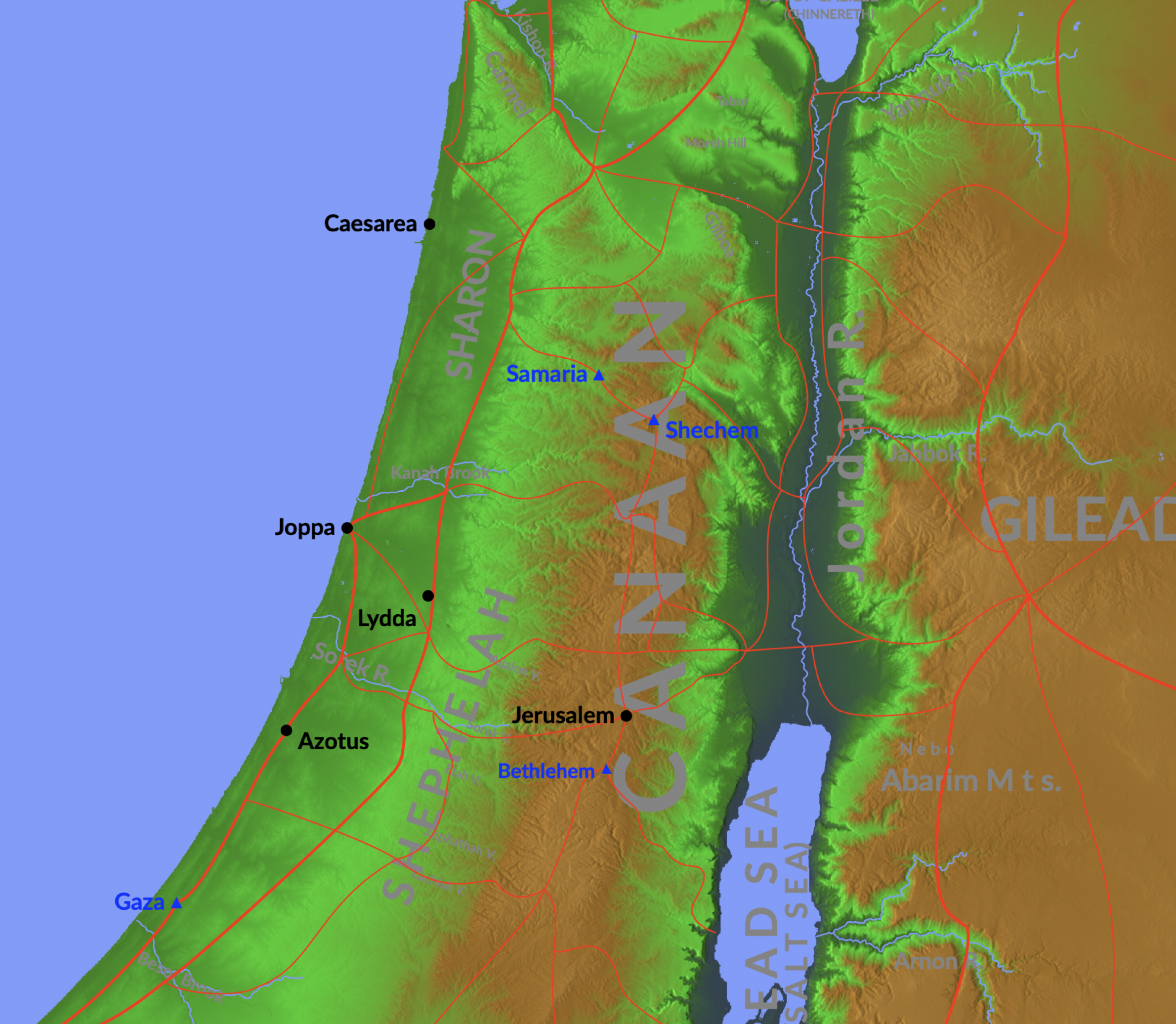
Peter is traveling from Jerusalem to Lydda and then to Joppa in our scripture today.  He is following the path Philip took earlier.  We read about that in Acts 8.

Acts 8:40  But Philip found himself at Azotus, and as he passed through, he preached the gospel to all the towns until he came to Caesarea.

Peter is back in the same area, teaching the new followers and spreading the good news of Jesus.  And in the book of Acts, Luke tells us two stories of healing:  a man who had been paralyzed for years and a girl who had died.  Luke, whom Paul calls “the beloved physician” (Col. 4:14), focuses more on healing in his Gospel and the book of Acts than in other New Testament books, and frequently provides more detailed descriptions of physical problems.  But in our scripture today in Acts 9, we will see more than just two miraculous healings. Because here, Luke pulls the curtain back a little and shows us not just that God heals, but why God heals—and what healing is meant to accomplish.  

These are powerful miracles. But Luke’s focus is not on the person being healed, or on Peter, or even on the physical healing itself. Luke keeps pointing us to one truth:  Healing is a signpost. It points to the glory of Christ and invites people to believe.

Acts 9:32-35   Now as Peter went here and there among them all, he came down also to the saints who lived at Lydda. There, he found a man named Aeneas, bedridden for eight years, who was paralyzed. And Peter said to him, “Aeneas, Jesus Christ heals you; rise and make your bed.” And immediately he rose. And all the residents of Lydda and Sharon saw him, and they turned to the Lord. 

Aeneas has been bedridden and paralyzed for eight years. Eight years is a long time.  Long enough to endure many unsuccessful treatments.  Long enough for hope to disappear.  Long enough for people to stop expecting any change.   But then Peter comes in and says something very specific:

Acts 9:34  And Peter said to him, “Aeneas, Jesus Christ heals you; rise and make your bed.”

“Make your bed,” may seem an odd thing for Peter to say.    He is saying, “Your time of lying in a bed all day is over. You don’t need that now.  Roll up your bedding and resume life.”  Now, what was the result of this healing?  Verse 34 ends with this:  “And immediately he rose.”  But this is not the end of the story; it is only the beginning.  Keep reading.

Acts 9:35  And all the residents of Lydda and Sharon saw him, and they turned to the Lord.1

Luke does not say, “They admired Peter,” or “They were impressed.”  He says they turned to the Lord.  The healing was real. The healing was compassionate.  God wants to heal his children.  But the primary reason for the healing was evangelistic — it revealed the living power of Jesus.  That is the reason for the healing.

The miracle is not the end of the story, but only the beginning.  The healing was not the destination; it was but a doorway to faith.  Next, we meet Tabitha.

Acts 9:36  “Now there was in Joppa a disciple named Tabitha, which, translated, means Dorcas. She was full of good works and acts of charity.

She isn’t introduced by illness. She’s introduced by her life:  “She was always doing good and helping the poor.”  What a great way to describe someone, Dr. Luke.

I was in the third year of Medical School and had just started seeing patients in Grady Hospital.  My first rotation was in the surgery department.  Morning rounds went like this: The medical students and interns gathered several hours before rounds to examine the patients and collect all labs.  And the whole group traveled from room to room, a parade of white coats.  If it were your assigned patient, you would present the patient to the team like this:

“This is a 67-year-old male who presented to this hospital with right lower quadrant abdominal pain.  He is status post appendectomy 2 days ago. He is afebrile with stable vital signs and a well-healing incision.  Labs are significant for…. “  You had better have memorized all the facts, vital signs, and lab results, for if they asked you and you didn’t know, they would then ask you why you didn’t want this patient to get good care.  It could be brutal for the students.  But then, later in the year, I did my first rotation in pediatrics.

We had this wonderful Pediatrician who was the attending doctor for our team.  He had been a private practice pediatrician for 25 years and was now teaching at Egleston Hospital.  I remember the first day on rounds well.  One of my friends had the first patient and began the presentation outside the patient’s room just as we had done in surgery.  “This is a seven-year-old female who presented with fever and diffuse bruising 2 days ago…” He went on to describe the pertinent labs and her current therapy.  When he was done, our attending doctor calmly asked, “What is her name?”  Who in her family is with her?  Does she have any brothers or sisters?  What is her favorite color?  Do you think she is scared?”

My friend just stood there silently.  And our attending said, “Remember, you are treating a little girl, not a disease.  She is definitely scared, and you can’t offer her any comfort if you don’t take the time to get to know her.  Her parents need to know that you care, or you will not be giving her good care.”  So Dr. Luke was not from the surgery department at Grady Hospital.  He tells us something about Tabitha.  She did many good works to help the poor in her town and became well known for them.  With that in mind, let’s get back to the story.

Acts 9:36-39  Now there was in Joppa a disciple named Tabitha, which, translated, means Dorcas. She was full of good works and acts of charity. In those days, she became ill and died, and when they had washed her, they laid her in an upper room. Since Lydda was near Joppa, the disciples, hearing that Peter was there, sent two men to him, urging him, “Please come to us without delay.” So Peter rose and went with them. And when he arrived, they took him to the upper room. All the widows stood beside him, weeping and showing tunics and other garments that Dorcas made while she was with them.

You get this touching picture of the people she had helped, likely poor people who loved Tabitha, wearing the clothes she made for them.  It always leaves a hole in the world when someone dies who was a force in this world for Jesus.  My mind, like yours, goes to many funerals I have attended for people whose Christian walk made an amazing difference in the lives of others.   And here in Joppa, they aren’t just mourning a person; they are mourning love, kindness, practical mercy. Tabitha’s life had already been a testimony.  But at the time of her death, she was just getting started.

Acts 9:40-41   But Peter put them all outside, and knelt down and prayed; and turning to the body he said, “Tabitha, arise.” And she opened her eyes, and when she saw Peter she sat up. And he gave her his hand and raised her up. Then, calling the saints and widows, he presented her alive.

A miracle of resurrection, very similar to what we saw when Jesus raised Jairus’s daughter back in Luke 8.  Remember, He sent everyone out of the room except Peter, James, and John.  Jesus took her by the hand and said almost the same thing Peter said to the girl in Acts 9.  Here we see  Peter walking in the footsteps of Jesus.  But again, this resurrection is not the end of the story but is only the beginning.  Then we see the results.

Acts 9:42  And it became known throughout all Joppa, and many believed in the Lord.

This is the result. There it is again.  Not just amazement.  Not just a celebration, but the birth of faith.  The healings in Lydda and Joppa did not end with healthier people — they ended with new believers.  God used healing to reveal His mercy, His power, and His Son.

Tabitha had already brought glory to God through quiet, faithful service. Her healing would now amplify that witness.  Sometimes God is glorified by a life that displays compassion.  Sometimes God is glorified by a miracle that displays power.  But this is the result.  God is made known to people, and God is glorified.   Throughout scripture, God uses healing as a means to reveal Himself to people.  

After delivering Israel from Egypt, God heals the bitter waters of Marah, and He tells them:

Exodus 15:26   If you will diligently listen to the voice of Yehovah your God, and do that which is right in his eyes, and give ear to his commandments and keep all his statutes, I will put none of the diseases on you that I put on the Egyptians, for I am Yehovah, your healer.

I am your healer.  The healing isn’t just practical — it’s revelatory.  God is showing Israel who He is.   Healing becomes a means of self-disclosure.

And do you remember Naaman, the Aramean military leader who had leprosy?   He comes to Elisha, who tells him to wash in the Jordan River.   And when he is healed, Naaman says:

2 Kings 5:15  “And he said, “Behold, I know that there is no God in all the earth but in Israel.”

The healing leads to confession.  It leads to worship.  It glorifies the God of Israel before a Gentile military leader.  And Naaman returns to his country with knowledge of God.  His healing brings the knowledge of God and glory to God.  That is the point. There are so many stories in the Scriptures that illustrate this point.  Just one more.  When Jesus is told that his friend Lazarus is very sick, He says:

John 11:4   This illness does not lead to death. It is for the glory of God, so that the Son of God may be glorified through it.

That is one of the clearest purpose statements in Scripture.  Jesus even delays coming, allowing Lazarus to be dead for 4 days — not out of indifference, but so that a greater glory might be displayed.   When Lazarus walks out of the tomb, many believe in Jesus.  And it becomes the final straw that leads the religious leaders to pursue Jesus’ death.    

When we discuss the Lazarus story, someone always asks, “I wonder what happened to Lazarus after that?”   The scriptures don’t say it, but you have to know that everywhere Lazarus went, he was a billboard pointing to the power and the glory of God.  Yes, Jesus wanted to heal his friend.  He did not want his friend to die.  But his mission here on earth was to bring glory to the Father, and this resurrection and his own crucifixion and resurrection brought glory to God.

We can’t miss this important point.  We pray for healing as if that is what we need.  Every time we meet, we pray for healing.  We text each other prayer requests for people to be healed.  And Yehovah is a God of great compassion.  He desires our healing.  In fact, He created this world to be a place with no illness or disease.  But sin cursed the world.  So we all suffer.  We all need healing. 

We have celebrated many healings in our congregation in the past several years.  As a doctor, I can tell you many instances of when I saw miraculous healing of a deadly disease or an advanced cancer.  And there have been times I have seen God’s people pray fervently in large numbers for a healing that did not happen.  It can be frustrating to see some healed and others not.  But we have to remember that healing is never the endpoint.  As in these stories in the Scripture, healing is good; healing is out of God’s compassionate heart.  But healing is for so much more than the relief of our physical problems or pain.  It is to bring glory to God.  It is to bring others to the knowledge of the God who heals.

Don’t waste the healing.  There is such a danger that we become so focused on physical needs or so fascinated by physical healing that we forget the most important part.  To bring glory to God, to make him known to others.  That is our purpose.

So what are people seeing in us?  In Lydda and Joppa, people saw something they could not explain — and it led them to Jesus.  We may not be called to raise the dead.  But we are called to tell others about the one who can raise the dead.   We can bring glory to God for the healings we see, to let people know it is not just about the healing.  It is about the God behind the healing.   We are called to live and serve in ways that point beyond ourselves. 

1 Corinthians 10:31  “So, whether you eat or drink, or whatever you do, do all to the glory of God.
Colossians 3:17  “And whatever you do, in word or deed, do everything in the name of the Lord Jesus, giving thanks to God the Father through him.

When God answers prayer… give Him glory.
When God brings restoration… name His kindness.
When God works in your life… tell the story in a way that leads people to Christ.
Because in the end, the purpose of every act of divine healing is this:
That people would see the power and compassion of Jesus — and turn to the Lord.

1.  Sharon is the Hebrew word for “field”, and usually refers to the area of fertile land on the coast extending just south of Mount Carmel to south of Joppa.  In Song of Solomon 2:1, the King James version translated the Hebrew phrase as “Rose of Sharon,” leaving out the definite article – it is actually “rose of the sharon” (field).  Translations before the King James had translated the Hebrew more literally as “rose of the field.”
February 10, 2026 –  Persecution and Peace — Acts #29

February 10, 2026 –  Persecution and Peace — Acts #29
Acts 9:26–30 

So let’s review where we are in Acts 9:  Saul was persecuting the followers of Jesus until he encountered Jesus himself on the road to Damascus.  Then he spends 3 years in Arabia to hear the word from God and to practice sharing Jesus with others.  He returns to Damascus, but the Jewish leaders and the governor seek to kill him, and he escapes being lowered in a basket out of the city.  He returns to Jerusalem, but the Jesus followers there are scared of him.  Barnabas serves as a mediator to bring Saul to the apostles, and Saul is welcomed.  That leads us to our scripture this morning:

Acts 9:28-30   So he [Saul] went in and out among them at Jerusalem, preaching boldly in the name of the Lord. And he spoke and disputed against the Hellenists. But they were seeking to kill him. And when the brothers learned this, they brought him down to Caesarea and sent him off to Tarsus.”

So Barnabas got the Jesus followers and Saul together, but it didn’t take long for Saul to get in trouble with the “Helenists” in the city.  Why did they get so upset with Saul?  These “Helenists” are Jews who grew up outside of Israel in the Greek/Roman culture and speak Greek.1  This is the same group that Stephen was speaking to in Acts 6.  This is the group that went to the Sanhedrin and accused Stephen of blasphemy, which led to his stoning.  And once again, they get angry.  Imagine how they feel.  Here is Saul, one of the members of that Sanhedrin who voted to stone Stephen, now saying the very things to them that Stephen said about Jesus.  They see this as ultimate betrayal.  So now they are seeking to kill Saul.  Notice it is the Greek-speaking Jews who are after Paul and not the Jewish leaders, not the Temple authorities.   But Jerusalem is too hot for Saul, so the apostles arrange to send him to the coastal city of Caesarea to catch a boat to his hometown of Tarsus

And this is where we will leave Saul for a bit, after once again having to flee for his life.  Then Acts continues with a surprising verse:

Acts 9:31  So the church throughout all Judea and Galilee and Samaria had peace and was being built up. And walking in the fear of the Lord and in the comfort of the Holy Spirit, it multiplied.

Slow down a minute. After this death threat and yet another escape for Saul, you don’t expect the next verse to talk about a time of peace. But now, there was a time of relative peace for the followers of Jesus, and their number multiplied.  Why had the persecution from the Jewish leaders died down at this time?

I think there are 3 primary reasons. First, because the followers of Jesus were scattered.   

They had all been centered in Jerusalem since the miracle at Pentecost.  They had grown to such a large number (at least 8-10,000) that the Jewish rulers felt threatened.  They were all gathering in the Temple grounds to meet, and there they were preaching about Jesus.  They were right in the faces of these Jewish leaders and were seen as a threat.

When Stephen was stoned to death for blasphemy, they all feared for their lives, and most of them left Jerusalem.  Once the crowd was gone and the rest into hiding, the pressure was relieved.  Those in charge of the temple no longer saw them, so they no longer felt threatened.  Less visibility equals less friction.  Out of sight, out of mind.  They didn’t care so much about small gatherings of believers in the countryside.  Well, there was one in their group who cared very much.

Saul still cared.  He asked for letters to hunt them down all over and have them bound and carried back to Jerusalem for punishment.  So the second reason that persecution died down was what happened to Saul.  When Saul met Jesus and discontinued his attack on Jesus’ followers and then disappeared, the persecution died down.  When he returns three years later, His trouble comes not from the Jewish leaders but from Greek-speaking Jews in Jerusalem.  Without Saul’s driving force on the persecution of Jesus’ followers, the religious authorities in Jerusalem just didn’t seem nearly as concerned about it.

We see what a lightning rod Saul was, first against Jesus, and now for Jesus.  Saul was the powerful driving force behind the persecution. Now you can better understand what Jesus did on the road to Damascus.   With this change, Jesus brought the persecution of his followers to a standstill and, at the same time, created the most dynamic missionary for his movement.  One man coming to Jesus makes a world of difference.

Finally, the third reason for the pause in persecution is that Jewish leaders had other problems brewing.   Something happened in Rome around that time that had a significant effect on matters.  Caligula became emperor of Rome in 37 AD and began a reign marked by cruelty, megalomania, and insanity.  He declared himself god above all other gods. In 40 AD, Caligula issued an order to place a statue of himself in the Jewish Temple’s Holy of Holies.

As you would expect, resistance by the Jews was swift and intense, with mass protests, strikes, and other forms of passive resistance. At one point, the historian Josephus notes that “tens of thousands” of Jews gathered in Tiberias for a 40-day protest.2 The governor of Judea at the time, knowing it would cause war, deliberately delayed the placement of Caligula’s statue.  He was successful in postponing the placement until Caligula was assassinated in Rome in 41 AD, killed by members of his own Senate who judged him to be insane.   

This immediate threat from Rome far overshadowed the troubles of the Jesus followers, so there was a pause in the persecution.  It would, however, soon be back.  In 44 AD, James, one of Jesus’ twelve disciples, was beheaded by Herod Agrippa I.  Peter will be back in prison again, and Saul will suffer all kinds of persecution.   This is but a brief, temporary time of peace. But I want you to consider how this ebb and flow of persecution affected Jesus’ movement.  

After Stephen was stoned, persecution ramped up tremendously.  Under Saul’s leadership, followers of Jesus were being taken bound to the temple courts to be whipped, beaten, and imprisoned.  Their homes were raided.  And so many fled to other parts of the country.

But when they fled, they took Jesus with them.  The towns they settled in became new centers for the Jesus movement to spread.  And their numbers increased dramatically.  Persecution, meant to destroy the movement, actually had the opposite effect, causing it to spread throughout the country and grow tremendously.   

God did not cause the persecution of the early followers.  He did not want his people to be terrorized, beaten, and imprisoned.  Evil men in high places made that decision.  God did not cause it, but he used it.  He took a bad situation, persecution, and made it work for good.

We see this pattern all through the Bible.  Take, for example, the story of Joseph.  You know the story of Joseph and his 11 brothers.   They were all jealous of Joseph.  It seemed their father showed more favor to Joseph than to any of them.  And their jealousy led to the day when they considered killing him, but instead sold their brother into slavery.  And you know how he ended up in Egypt and, through a series of amazing events, came to hold a position of authority, second only to the Pharaoh.  And you know how his brothers, because of the famine, came to Egypt for grain.  And you know the end of the story, in the final chapter of the book of Genesis.  Joseph’s father dies, and his brothers fear that Joseph, the second most powerful man in the most powerful country in the world, will finally seek his revenge on them for selling him into slavery.  And what does Joseph say?

Genesis 50:20   As for you, you meant evil against me, but God meant it for good, to bring it about that many people should be kept alive, as they are today.

Or:  What you intended for evil, God intended for good.  

But let me ask you, when Joseph was thrown into a pit and sold into slavery, did he think that was good?  When he was falsely accused and thrown in prison, did he think that was good?  And let me ask you a better question.  Did God think those things were good?

God by no means wanted Joseph’s brothers to treat him poorly.  God did not want Joseph’s brothers to succumb to sin.   He didn’t want Potiphar’s wife to entice Joseph and then falsely accuse him and have him thrown in prison.  God didn’t do that or approve of it. But hear this:  In the end, the circumstances don’t matter.  No matter what evil threw at Joseph, evil didn’t have the last word.  God did not stop people from doing evil; he rarely does that.  But what He always does is to take the evil meant against his people and turn it to good.  

It is the same in our passage in Acts.  What these evil men (including Saul) meant for evil purposes, this persecution of the followers of Jesus, God turns it around and causes the persecution not to diminish the group, but to cause it to spread and increase.  God was saddened by the response of those who would persecute his people.   It breaks his heart when his people turn against each other.  But again, the circumstances do not matter, because God always has the last word.   His will will be done.  He will work it all out to accomplish His purposes.  That brings us back to our scripture this morning.

Acts 9:31  So the church throughout all Judea and Galilee and Samaria had peace and was being built up. And walking in the fear of the Lord and in the comfort of the Holy Spirit, it multiplied.

So we come to this time of peace in our scripture this morning, when the followers of Jesus are not under persecution, and they can worship freely.  It was the storm of persecution that led to the church’s spread and growth.  So what happens during this time of peace?  Again, the church grows. 

The circumstances are irrelevant.  Whether it is persecution or peace, God’s people grow.   This world is full of evil people doing evil things.  The Scriptures say that the whole earth is being defiled by sin.  Look at how Isaiah describes it:

Isaiah 24:4-6   The earth mourns and withers; the world languishes and withers; the highest people of the earth languish. The earth lies defiled under its inhabitants, for they have transgressed the laws, violated the statutes, broken the everlasting covenant. Therefore, a curse devours the earth….

Isaiah says that our entire planet, which God created as good, suffers and mourns under the weight of sin.  It is full of evil and evil people.  Sin has cursed our world.  So it does not operate as God created it.  There were no natural disasters in the Garden of Eden.  There were no tornadoes, no tsunamis, no hurricanes.  But our world today is not like the garden God made for us.  It is broken.  So you have to expect what we call “natural disasters” to happen. 

Jesus spoke of 2 disasters that had recently occurred.  We find that in Luke 13:

Luke 13:1-5   There were some present at that very time who told him about the Galileans whose blood Pilate had mingled with their sacrifices. And he answered them, “Do you think that these Galileans were worse sinners than all the other Galileans, because they suffered in this way? No, I tell you, but unless you repent, you will all likewise perish. Or those eighteen on whom the tower in Siloam fell and killed them: do you think that they were worse offenders than all the others who lived in Jerusalem? No, I tell you; but unless you repent, you will all likewise perish.

Jesus tells of 2 disasters.  Evil Pilate killing people on the very grounds of the Temple, and a tower that fell in Siloam and killed 18 people.  And for both, he asks them if those who suffered did so because they were worse sinners.  Because people in Jesus’ day felt that God caused or allowed bad things to happen to bad people.  If something bad happened, then you must have sinned.  Remember Job?  Remember the disciples asking Jesus whose sin caused the man to be born blind?    

Sadly, people still think this way.  I have heard people say that if they follow God’s commandments, then God will protect them from disaster.  But Jesus tells us that is not the way God works.  Evil and disaster happen because God gave humanity free choice, and all of us chose sin.  And what is really important is not the disaster of the tower nor Pilate’s slaughter.  What is really important is that we choose to repent of the disaster that we have all brought on our own lives, the disaster of our own sin.   But who the tower falls on is not determined by who is good and who is bad – because we are all bad.  None of us is good.  We all sin and fall short.

Isaiah tells us that natural disasters are only natural in that they are the natural result of sin on the earth.  So don’t blame God when storms or tornadoes or floods come, when towers fall, or evil men commit murder.  That is not the way He meant for the world to be.  And praise Him, one day He will redeem and restore this world to the way He meant for it to be.  But until then, we have to understand that we live in a defiled world full of catastrophes.  And it is the fault of humanity, not God.

But again, hear the good news:  If you belong to Jesus, then learn the lesson of Acts 9.  Learn the lesson of Joseph: Again, the circumstances are irrelevant.   Because each of us lives in a broken world, we all have to expect some bad things to happen.  Things that God never intended to exist in this world.  Things like car accidents, sickness, cancer, theft, child abuse, and murder.  That is not the world God created, but the one we defiled.   But none of those things matter in the long run.  As we see in Joseph’s life and in Acts here, when bad times come, God works them for good.  When peaceful times come, God works for good as well.  God uses times of storm and times of calm.  What sinful people and this defiled world intend for evil, God intends for good.  

And we need that ebb and flow in our own lives.  There are seasons of pressure when we are moved, and there are seasons of calm when we are allowed to grow.  

Anyone doing bodybuilding or weight training will tell you that this is the cornerstone of resistance training.  You push a muscle to its limits, increase the weight, and apply pressure to it. Then you rest it, and it grows.  We now know that what is happening in the muscle is the formation of microtears in the muscle fibers, which the body recognizes as a signal to rebuild stronger to protect against further tears.  You can not achieve results if you don’t put stress on the muscle.  Working out with light weights that do not stress the muscle will not give results.  Similarly, you also can’t see results unless you allow the muscle to recover.  Overtraining, by not allowing time to rest, will also lead to poor results.   You need times of pressure and times of rest.

We need this similar ebb and flow of pressure and peace to develop into the people God wants us to be.  Situations of pressure lead us to see the need for growth, and times of peace give us time to grow.  We see this in the life of Jesus.  There were times when he was in the midst of crowds and times of confrontation.  And he often retreated and withdrew from the crowds for times of peace, for times of prayer.  Times of intense teaching and healing were often followed by times of solitude.  

Even creation echoes this pattern.  There is the growing season, and there is time to let the ground rest.   There is spring, and there is winter.   And God established this pattern for us to live with 6 days to work and one day to rest, to Sabbath. We need both times.  Too much pressure can crush us. Too much peace can soften us.  We will experience times of pressure and times of peace in our lives, and God will use both for our good.

So what season are you in?  A time of testing or pressure, or a time of peace and rest?  If you are in a season of pressure, God may be refining you, pruning some aspect of your life.  Or he may be redirecting you. It may be time for some change.  If you are in a season of peace, that is not the time to coast.  It is the time to deepen your prayer life, redouble your efforts to study the word, and strengthen your faith.  

Whether life comes at you with times of pressure or times of peace, the question to ask is not “Why is this happening?” but instead, “How, Jesus, do you want to refine me in this season?”   

Again, the circumstances life throws at us can be very difficult, but know this: your circumstances do not get the last word; God does.   Or as our friend, whom we left in Tarsus, would say, 

Romans 8:28 “And we know that for those who love God all things work together for good, for those who are called according to his purpose.”

Or as Joseph would say, “What you intended for evil, God intended for good.”

God is at work in your life every day, taking whatever circumstances life gives you and ultimately causing them to work for your good.  We rejoice today, knowing we have a good, good Father who only gives us good gifts. 

1.  Please see note regarding the term “Helenists” in Acts #28.
2.  Josephus, Antiquities of the Jews 18.1.1.

February 3, 2026 –  But Barnabus…— Acts #28

February 3, 2026 –  But Barnabus…— Acts #28
Acts 9:26–30 

We last left Saul in Acts 9, traveling to Arabia to spend some time with God in the wilderness.   His teachers had misled him in interpreting scripture into believing that Jesus was a fraud, and he needed to receive the truth directly from God. So he went to the place where God speaks, the wilderness, and spent 3 years in Arabia, 

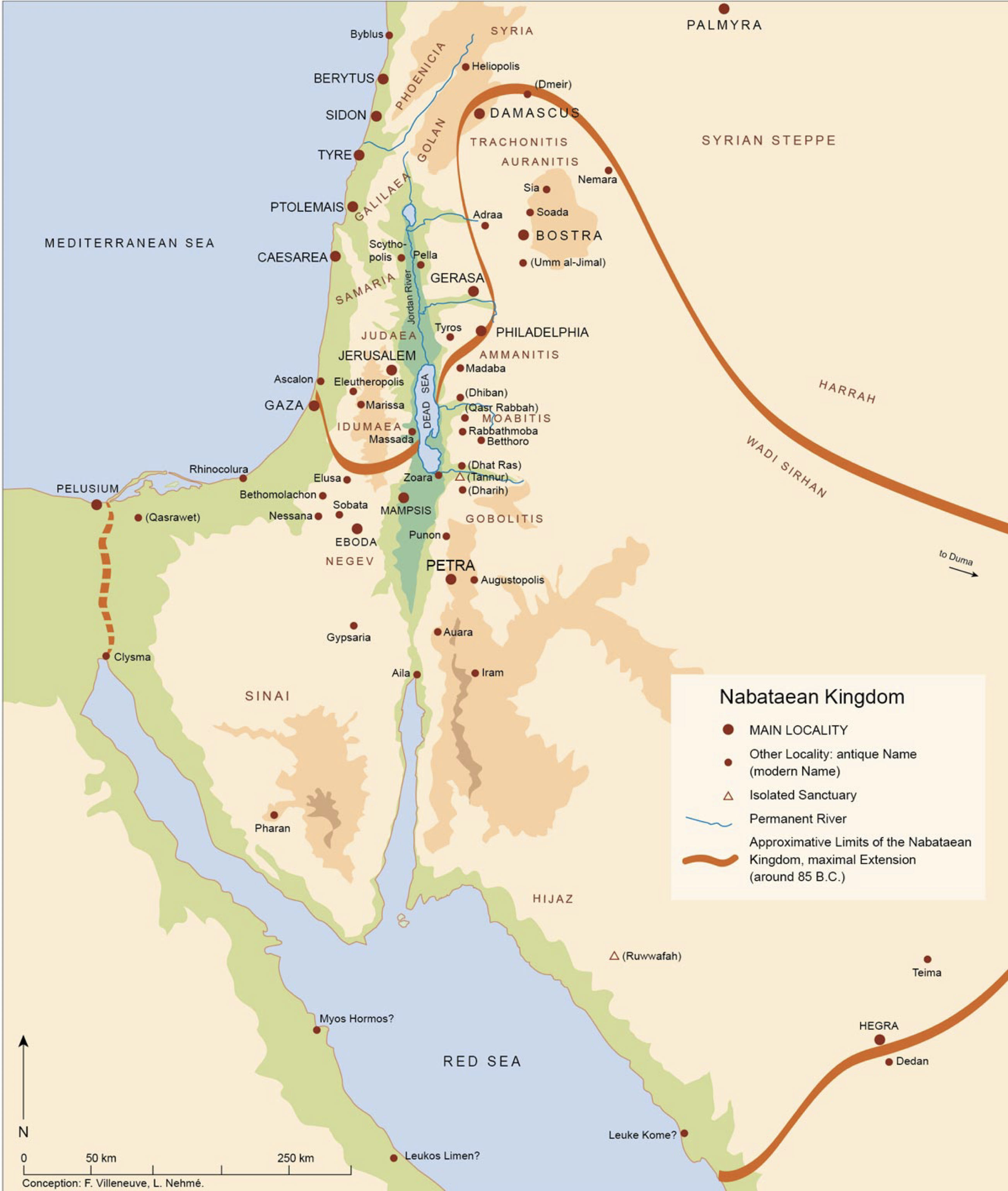
In Saul’s day, Arabia referred to the entire region east of Egypt, including the Sinai Peninsula, and west of Israel. Though we have no idea what his itinerary was, I think he likely went to the same mountain of speaking that Moses and Elijah went to, Mount Sinai.

All of Arabia was under the control of the Nabateans, as far north as Damascus. They were descendants of Ishmael and initially nomadic.  They arrived in this region and displaced the Edomites, descendants of Esau.  While in Arabia, Saul likely also spent time in the capital and economic center of Nabataea, Petra.  There, he could practice his trade of leatherwork and tent making as he sought God’s truth in preparation for his work of spreading the Gospels.  

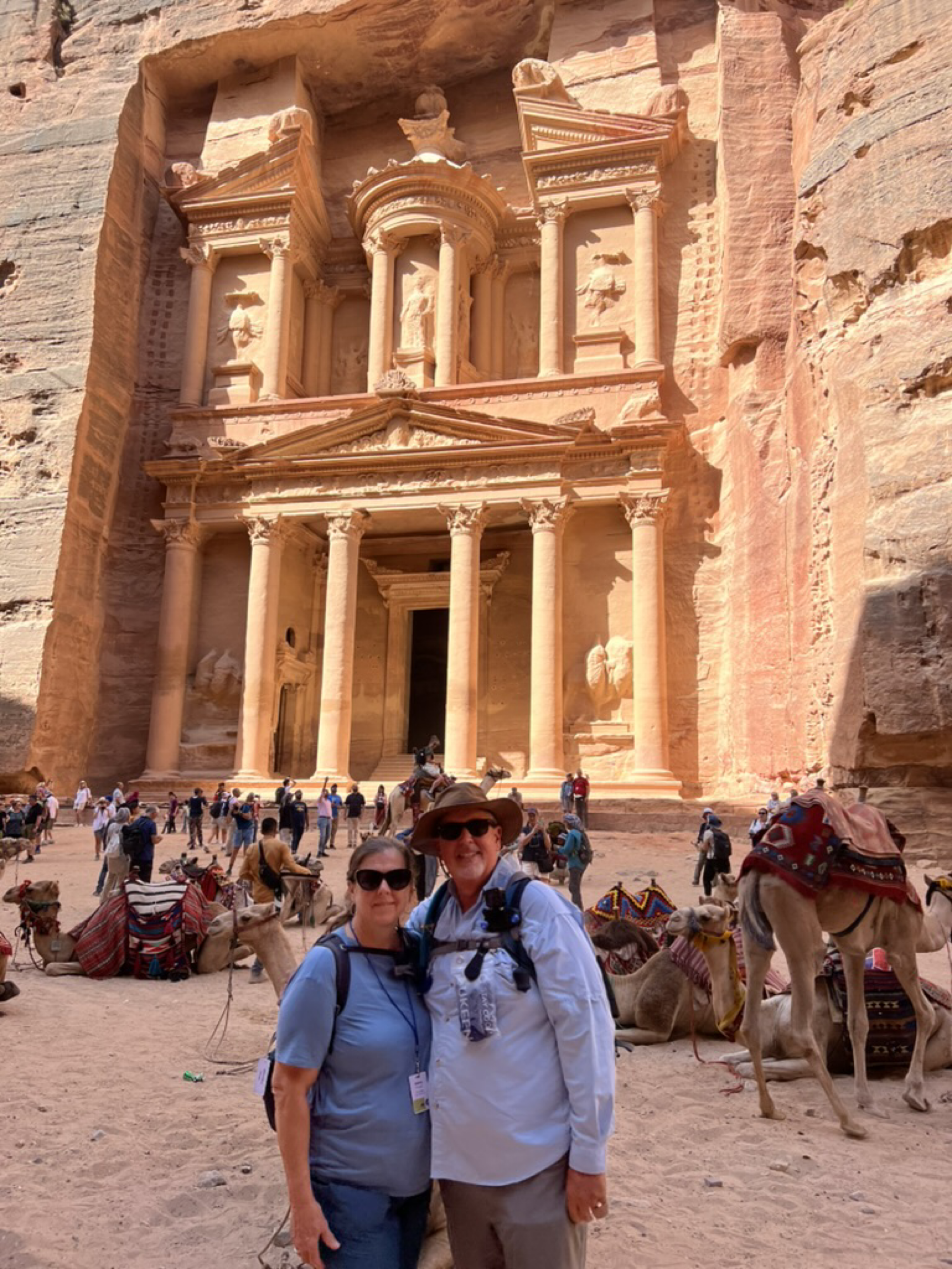
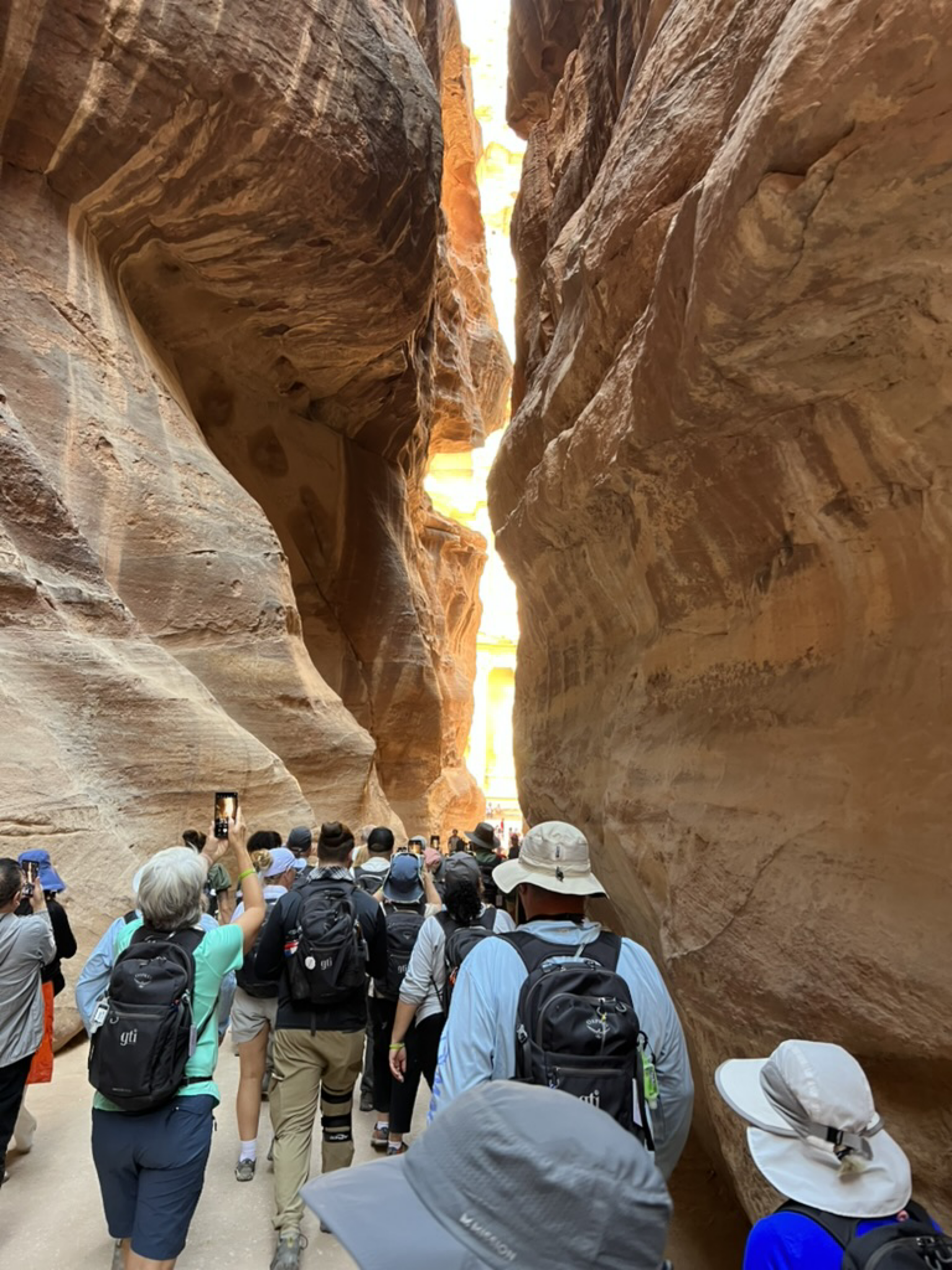
You have probably seen pictures of Petra, a city carved into the desert cliffs.  You enter the city through a narrow passage known as the Siq. This 3/4 mile winding gorge is as narrow as 10 feet in some places, with cliff walls extending as high as 500 feet.

You reach the end, and it opens up on Petra’s most famous building, the Treasury.  A building carved into the sandstone cliffs.  (You may have seen this building in one of the Indiana Jones movies.)

And Petra was an excellent place for Saul to begin his mission.  As God told Ananias:

Acts 9:15  Go, for he [Saul] is a chosen instrument of mine to carry my name before the Gentiles and kings and the children of Israel.

Saul’s mission was to the Gentiles, kings, and the children of Israel.  Petra was at the crossroads of trade routes from the east to Egypt and became a very wealthy city.  This resulted in a highly diverse population, many of whose members had Jewish ancestry.  So it became a place where Saul could practice his witness to Gentiles, but Gentiles who had some knowledge of Jewish scripture and ways.  And because it was the capital city, Saul might have the opportunity to encounter the king there.  So Saul spent 3 years away from Israel in Arabia.

Acts 9:23-25   But after 3 years, Paul returned to Damascus, where he first met Jesus.“When many days had passed, the Jews plotted to kill him, but their plot became known to Saul. They were watching the gates day and night to kill him, but his disciples took him by night and let him down through an opening in the wall, lowering him in a basket.

Not quite the reception he had hoped for.  Some Jewish leaders conspired against him, but in 2 Corinthians, Paul provides more detail on this plot.  It originated with the governor of Damascus.

2 Corinthians 11:32-33   At Damascus, the governor under King Aretas was guarding the city of Damascus in order to seize me, but I was let down in a basket through a window in the wall and escaped his hands.

Now, why did the governor of Damascus want to arrest Saul?  Scripture tells us that he was under King Aretas.   Aretas reigned over the area of Damascus, but his capital was in Petra.  This suggests that Saul encountered difficulties with the King while in Petra.

Paul was smuggled out of the city by lowering him in a “basket” (or net).  And now he travels to Jerusalem.  Since it has been three years since he left his Pharisee friends, he hopes he will not be a wanted man there and that he will find acceptance among other Jesus followers in Jerusalem.  But would the followers of Jesus accept him?

Acts 9:26-30    And when he had come to Jerusalem, he attempted to join the disciples. And they were all afraid of him, for they did not believe that he was a disciple. But Barnabas took him and brought him to the apostles and declared to them how on the road he had seen the Lord, who spoke to him, and how at Damascus he had preached boldly in the name of Jesus. So he went in and out among them at Jerusalem, preaching boldly in the name of the Lord. And he spoke and disputed with the Hellenists. But they were seeking to kill him. And when the brothers learned this, they brought him down to Caesarea and sent him off to Tarsus.

Their initial reaction was fear of him.  They thought he was pretending to be a follower of Jesus to infiltrate their group.  The last they heard of Saul, he was putting their friends to death. So let’s see:  He wasn’t welcome in Damascus, not by his former friends in the Sanhedrin, and now not even among the followers of Jesus.   It looked like Saul had no place to call home now.  But the next two words are very important…”but Barnabas.”

Barnabus plays a crucial role here.  Everyone was too afraid to get close enough to Saul to see if he was a genuine follower.   They were scared.  But Barnabus was willing to take the risk to approach Saul.  And because he did, see what Luke tells us happened next.  Saul can preach boldly about Jesus in Jerusalem because Barnabas took a chance on him. Let’s look at this character Barnabus and see what made him different than these other followers who were too scared to reach out to Saul. 

First, notice that Luke doesn’t single out a few scared disciples. He says, “They were all afraid of him.”  Fear had consensus.  That is usually the case.  But there was Barnabus.  Do you think Barnabus was scared, too?  Of course, he was.  But the difference was that when everyone else stepped back in fear, Barnabus stepped forward in faith.  He was not being naive.  He was not being reckless.  But he had the faith that God could really change people, even an enemy like Saul.  

What would God have done without Barnabas, who was able to convince the apostles to accept Saul?  What would have happened to Saul’s mission if Barnabas hadn’t taken that risk?  What would God have done?  As we discussed over a month ago, whatever God wills to happen will happen.  If Barnabas had not stepped up, God’s plan for Barnabas would have been thwarted, but not God’s plan for the world.  As we saw before, as with Jonah, he may have given Barnabas another chance, or, as with King Saul, he may have found someone else who would be obedient.  God loves to give us second chances to do the right thing, but he will not allow one man’s disobedience to derail his plans.

By approaching Saul, Barnabas was risking his safety, his reputation, and his standing with the apostles if Saul was not sincere.  And Barnabas had no guarantee that Saul had changed.  He had been gone for 3 years, and the last time they saw him, he was hunting them.  If Saul was lying, then Barnabas risked looking foolish and endangering himself and the others.  Faith often includes the possibility of being wrong. But Barnabas chooses to trust God’s work over his own fear.  This is the risk faith requires.   But this is who Barnabus has always been.  

Let’s take a quick look at what we know about Barnabus from the Book of Acts.  We first meet him in chapter 4.

Acts 4:36   Thus Joseph, who was also called by the apostles Barnabas (which means son of encouragement), a Levite, a native of Cyprus,

So his actual name was Joseph.  Barnabus was a nickname that our translation says means “son of encouragement.”  It is a Hebrew name, Bar-Nabba, meaning “son of a prophet.”  A prophet is not so much someone who foretells, but one who proclaims God’s message. And God’s message is good news; it is encouragement.   And he is from the land of Cyprus. Cyprus is an island country in the eastern Mediterranean Sea off the coast of Turkey and Syria.  It had a thriving Jewish population due to trade, but was primarily composed of Gentiles. Then the next verse tells us:

Acts 4:36-37 “Thus Joseph, who was also called by the apostles Barnabas (which means son of encouragement), a Levite, a native of Cyprus, sold a field that belonged to him and brought the money and laid it at the apostles’ feet.”

We meet Barnabus in Jerusalem; he is the first to sell land and give the proceeds to support the poor among them.  Barnabus was willing to take a financial risk.  He stepped up in faith when there were others in need.  This is just who he was.

Let’s jump ahead in Acts, a few chapters, after the stoning of Stephen, to see more of Barnabus.  The persecution in Jerusalem had caused some followers to spread far, but there was a problem in Antioch.

Acts 11:19-22   Now those who were scattered because of the persecution that arose over Stephen traveled as far as Phoenicia and Cyprus and Antioch, speaking the word to no one except Jews. But there were some of them, men of Cyprus and Cyrene, who on coming to Antioch spoke to the Hellenists also, preaching the Lord Jesus. And the hand of the Lord was with them, and a great number who believed turned to the Lord. The report of this came to the ears of the church in Jerusalem, and they sent Barnabas to Antioch.

Initially, the message of Jesus, the Messiah, was only shared with other Jews.  But in Antioch, they witnessed to the “Helenists also”, that is, the Greeks, people who were not Jewish.1  Word reaches Jerusalem that non-Jews are following Jesus.  And they didn’t know what to do about that.  Others had always been able to join with them in the Jewish faith, even at the time of the Exodus, but that involved a formal procedure and questioning.  They had to agree to follow Jewish laws regarding the Sabbath, food, and ritual purity.  These apostles had always considered their belief in Jesus as a continuation of their Jewish faith.  What should they do with these Gentiles who wanted to join them?  What should they expect from these Greek followers?  Do they need to go through the age-old process to become a part of the Jewish faith?

Someone needed to go to Antioch to assess the situation and help decide what they should do.  And Barnabus is the obvious choice.  Some of the Jews sharing Jesus with the Greeks were from Cyprus and Cyrene, both places with a large Gentile population.  Barnabus was from Cyprus.  And Barnabus’s experience in dealing with Saul might come in handy.  Luke tells us what happened then:

Acts 11:23-24   When he came and saw the grace of God, he was glad, and he exhorted them all to remain faithful to the Lord with steadfast purpose, for he was a good man, full of the Holy Spirit and of faith. And a great many people were added to the Lord.

Barnabus goes to Antioch and, as he did with Saul, sees past the problems and sees the potential of the people there.  Then Barnabus does a really good thing.  Who would be best to help this young group of Jesus followers, with a mixture of Gentiles and Jews?  Saul, of course, trained as a Jewish Rabbi, but was called to preach the gospel of Jesus to the Gentiles.  Acts 11:25-26   So Barnabas went to Tarsus to look for Saul, and when he had found him, he brought him to Antioch. For a whole year, they met with the church and taught a large number of people.

Note that Barnabus stays here for a year with them.  He moves to Antioch for a year to help Saul.  He is a man of commitment.  There is one more scene in the life of Barnabus I’d like us to take a look at.  

In Acts 15, the Jesus followers are still struggling with the same question of what to do with these Gentiles who are accepting Jesus.  Should they make them stop eating pork?  Should they have to follow all the rules of the Rabbis?   They hold a major conference in Jerusalem and reach a compromise decision.  We will talk more about that when we get there.  But then, following this conference, they sent Saul and Barnabus out as missionaries to the Gentiles with this word.

Acts 15:36-38  And after some days Paul said to Barnabas, “Let us return and visit the brothers in every city where we proclaimed the word of the Lord, and see how they are.” Now Barnabas wanted to take with them John, called Mark. But Paul thought best not to take with them one who had withdrawn from them in Pamphylia and had not gone with them to the work.  

Saul/Paul wants to revisit all the areas they have been in before to assess them.  Barnabus agreed, but he wanted to take John Mark with them. John Mark was actually a cousin of Barnabas.  Paul disagreed because of an earlier event.  John Mark was on their previous missionary journey, and at one point, Luke tells us:

Acts 13:13   “Now Paul and his companions set sail from Paphos and came to Perga in Pamphylia. And John left them and returned to Jerusalem,”   

Luke doesn’t tell us why John Mark left them and returned home, but apparently, Paul was very unhappy about it.

Acts 15:36-39“And after some days Paul said to Barnabas, ‘Let us return and visit the brothers in every city where we proclaimed the word of the Lord, and see how they are.” Now Barnabas wanted to take with them John, called Mark. But Paul thought best not to take with them one who had withdrawn from them in Pamphylia and had not gone with them to the work. And there arose a sharp disagreement, so that they separated from each other.”

They had a sharp disagreement.   They had words.  Barnabus wanted to give John Mark another chance.  Again, it was his cousin, but this is what Barnabus would do for anyone.  He doesn’t regard John Mark as a deserter, a failure, or a problem.  Again, as with his encounter with Saul, he doesn’t see the problem; he sees the potential.  He looks past the mistake to see the grace.  This is Barnabas’ character.  So look what God does here.

Acts 15:39-41“Barnabas took Mark with him and sailed away to Cyprus, but Paul chose Silas and departed, having been commended by the brothers to the grace of the Lord. And he went through Syria and Cilicia, strengthening the churches.God takes this disagreement between two preachers and, instead of causing the failure of their mission, increases it twofold.   That is what God always does.  He transforms our failures into multiplied successes.  So we end up with not one but two missionary journeys.

We later find that Barnabas was correct about John Mark.  He went on to do much and authored our Gospel of Mark.  And he and Paul reconciled.  Paul writes in his letter to Timothy:

2 Timothy 4:9-11   Do your best to come to me soon. … Luke alone is with me. Get Mark and bring him with you, for he is very useful to me for ministry.”

And again, we have Barnabus to thank for this.  Because he thought young John Mark needed another chance, Barnabus saw that God was not finished with John Mark.  Again, he saw grace, not guilt, potential, not problem. 

But before we close this section, I want to go back to that passage in Acts 15 where Paul and Barnabas have their disagreement.

Acts 15:39 “And there arose a sharp disagreement, so that they separated from each other.

The Greek word we see translated as “sharp disagreement” is “paroxysmos”.   The Theological Dictionary of the New Testament says it means: “to spur,” “to stir to anger,” “to be provoked, incensed.”  Provocation is usually seen as a negative thing.  We see the verb form of this word in Ephesians 6:4. 

Ephesians 6:4 “Fathers, do not provoke your children to anger, but bring them up in the discipline and instruction of the Lord.

But again, the noun form is only in the Bible twice.  First, here, describing the “sharp disagreement” between Paul and Barnabus, and the second time in the book of Hebrews.  The book of Hebrews does not identify its author, but most scholars believe the author was Barnabas.  And here is the other verse with paroxysmos:

Hebrews 10:24-25 “And let us consider how to stir up one another to love and good works, not neglecting to meet together, as is the habit of some, but encouraging one another, and all the more as you see the Day drawing near.

Let us consider how to paroxysmos one another.  Let us consider how to provoke one another to love and good works. This is so something that would come from the pen of our Barnabas, our son of encouragement.  Leave it to him to take a word that is usually negative and make it positive.   You may want to call him an optimist, seeing only the good, but Barnabas had the ability to see all the good from God.  I call that faith.  As he did with other followers, with Paul, and with John Mark, he was always seeking ways to encourage others to reach their potential in Jesus.  He refused to allow someone’s past actions to dictate their future.  He was always ready to see God’s grace and forgiveness in action in the lives of others.  

I don’t know about you, but I think the world needs more Barnabases.  I think we all need to develop the Barnabus within us. When everyone else steps back in fear, we need someone who will step forward in faith. When people view someone as a failure, we need someone who will see them as someone God can use.

Who is today’s Saul?  Who is today’s John Mark?  People need someone to believe in them.  Our young people need someone willing to see their possibilities and provoke them to reach their potential in Christ.  

The world is full of people who have made mistakes and failed in life, who need someone to see beyond their past and help them consider their future.  Shirley and I have seen many who have come through our homeless program or have served jail sentences who just need one person who will believe in them, give them another chance, and stand by them.  We all have our faults.  We all need the gift of grace from God, and we need the gift of grace from each other.  I want us all to pray and ask God to help us be the Barnabas in someone’s life.  

This is what Barnabus would say to us today:

Hebrews 10:24-25 “And let us consider how to stir up one another to love and good works, not neglecting to meet together, as is the habit of some, but encouraging one another, and all the more as you see the Day drawing near.

Let this be our prayer.  Father, fill us with your Holy Spirit that we may be like Barnabus.  Urge us to consider how we can provoke one another to love and good works.  

  1. The text clearly means non-Jewish people (Gentiles), but this same term is also used in Acts 9.29 to mean Greek-speaking Jews. This is likely a manuscript problem as noted in the Tyndale Commentary: “Luke must mean Gentiles, but the text is uncertain. Instead of ‘Greeks’, the majority of the MSS (including Codex Vaticanus) have ‘Hellenists’, the word used in 6:1 and 9:29 to designate Greek-speaking Jews.”

January 11, 2026 –  The Place of Speaking— Acts #27

January 11, 2026 –  The Place of Speaking— Acts #27
Acts 9:1–30 

We discussed last week how Saul went into the Jewish synagogue to convince them that Jesus was the Messiah, the Son of God.  But he didn’t get the response he wanted.  Rather than being convinced, they became confused.  And they started to get agitated.  It wasn’t as easy as Saul thought it would be. Let’s pick up in Acts where we left off with the following two verses:

Acts 9:22  But Saul became more and more capable, and was causing confusion among the Jews who lived in Damascus by proving that Jesus is the Christ. 

Acts 9:23 Now, after some days had passed, the Jews plotted together to kill him…

“After some days had passed….”   Now I read that today, and I wonder how many days?  Maybe a week or two?  What you might miss is that Luke, telling the story of the early Jesus followers, skips 3 years here. There are 3 years between Acts 9:22 and 23. Now, if Luke’s purpose in the book were to tell the life story of this man Saul, he would have included material between these 2 verses.   While Saul is an essential figure in Acts, it is not a biography.  So Luke skips that part of Saul’s life.   But we need to understand that these were crucial years for Saul.

 Since people are not responding, as he intended, Saul needs to back up and consider things. And thankfully, Saul tells us what happened in these three years in his letter to the Galatians:

Galatians 1:11-14   For I would have you know, brothers, that the gospel that was preached by me is not man’s gospel. For I did not receive it from any man, nor was I taught it, but I received it through a revelation of Jesus Christ. For you have heard of my former life in Judaism, how I persecuted the church of God violently and tried to destroy it. And I was advancing in Judaism beyond many of my own age among my people, so extremely zealous was I for the traditions of my fathers.

Saul needed some time.  He met Jesus a week ago on the road to Damascus.  He had a call on his life to share Jesus with everyone.  But how could he share what he had just discovered himself?   He had studied these scriptures for so long, and he now realized they led to Jesus, but he needed some time to work through this.  His old framework for understanding scripture needed to be dismantled and rebuilt in the light of Jesus. 

Saul tells us how he came to understand the gospel he was preaching to the Jesus followers in Galatia.  It wasn’t man’s gospel.  Before meeting Jesus on the Damascus Road, Saul had done a lot of preaching of man’s gospel.  He had been trained by the best men, the greatest rabbis. And Saul says, I was the star student.  I absorbed everything they taught me like a sponge.   I was at the top of the class in knowing the gospel of man.  Saul says, I was the expert in the traditions of my fathers.  But that was the wrong gospel.  It was man’s version, not God’s.

He tells the group of Jesus followers in Galatia that the gospel that he taught them, the story of Jesus, was not something some man taught him.  He didn’t sit in a classroom taking notes on Jesus.  He didn’t go to a Bible Study.  He didn’t sit and listen to some preacher tell him about Jesus.  He got it directly from Jesus himself.  He didn’t seek out men in Damascus to teach him.  He didn’t go to Jerusalem, where Jesus’ disciples were, to discuss it with them.  So what did he do? He went away into Arabia.    He said he received this message straight from Jesus.  

Jesus came to Saul on that road with a blinding light and told Saul that he had it all wrong.  Saul was out hunting down these Jesus followers and taking them back to be punished in Jerusalem, and he thought he was fighting for God.  But Jesus said, “You are not fighting for God; you are fighting against God. You are persecuting me.”

Saul gets this wake-up call from Jesus, but let me tell you, that one experience with Jesus is not enough for Saul.  That gospel of man that he had been preaching had to be thrown out, and Saul had to start back from scratch.  He needed to understand the real gospel, and Saul was not about to trust that some man was going to give him the correct answer.  He has already made that mistake once.  No, he wants to learn the truth from the one who is the truth.  No more intermediary.  He has to get the story straight, direct from God himself.  So Saul goes to Arabia.

Arabia in the first century included much of what we call Saudi Arabia today, but it extended west to the Sinai Peninsula and north to the latitude of the Sea of Galilee.  We don’t know where exactly Paul went in Arabia.  He could have gone as far as Mount Sinai here and may have spent time in the city of Petra here, but wherever he went, he would have spent a lot of time in the wilderness, for most of Arabia is a desert wilderness.

Saul has a lot to work through.  He needed to work through his own forgiveness before he could proclaim forgiveness to others.  He was carrying a lot of guilt.  He had voted to have Jesus’ followers stoned. He watched as Stephen was killed for proclaiming Jesus.  He was hunting them down like animals.  He had to come to grips with his own forgiveness.  

He had lived his entire life under Levitical law, with all its requirements and sacrifices, seeking atonement for his sins, yet knowing that there was no offering in the Scriptures for intentional sin.  Under Levitical law, if you sinned purposely, there was no offering that could be given.  You had to depend on grace.  If you thought that the Jews only relied on the law and didn’t understand grace, you need to reread the Old Testament. 

They knew they had no hope outside God’s grace.  Sacrificial offerings were never enough.  Now that Saul has found the truth of Jesus’ offering for sin, Saul wondered, “Could there be atonement for purposeful sins?”  Does Jesus’ sacrifice for us cover even that?  Saul had to work this out and then find forgiveness for his personal campaign of terror against Jesus.  Saul was a man undone.  He needed more revelation from Jesus himself. 

And where do you go when you want to hear directly from God?  Sure, God can speak to us anywhere, but let me ask you, “Where do you go when you want to hear from God?”  If you are familiar with the Bible, like Saul, then you know where to go – you go to the wilderness. The wilderness is where God speaks.

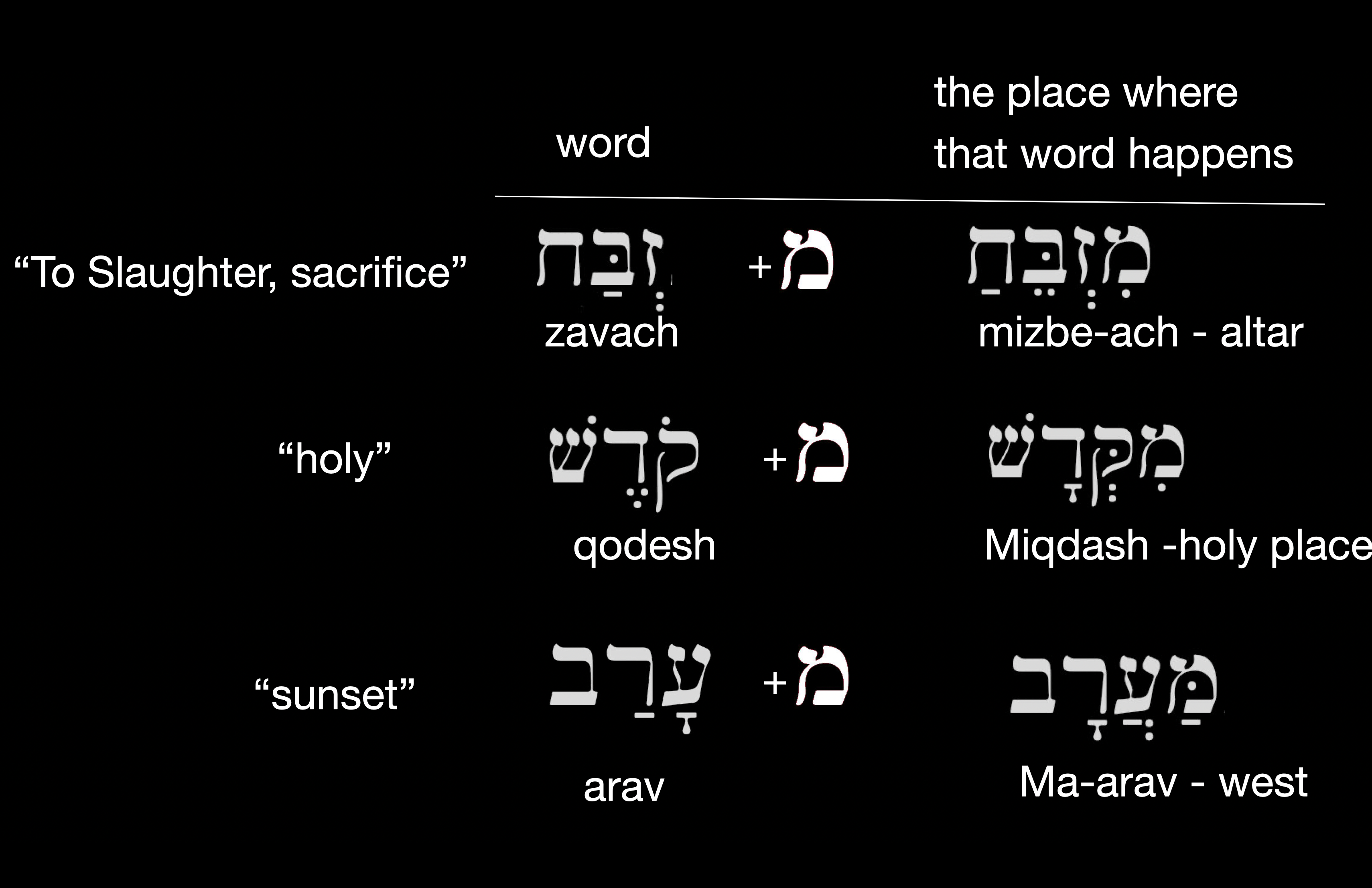
I have mentioned before that Hebrew is a language of few words.  Very commonly, the names of places are not unique, but are derived from the activity that happens at that place. For example, in Hebrew, the verb “to slaughter” or “to sacrifice” is ‘zavach’.  The word for the place where sacrifices happen, the altar, is “mizbeach”—same consonants with the ‘mem’ or our letter ‘m’ as a prefix.    

Another example: the word for “holy” is ‘qodesh’.  You add the mem (m) to the beginning, and you get miqdash, the place that is holy, or sanctuary. And one more: take the Hebrew word for ‘sunset’, ‘arav’.  Again, add the mem and you to the place where sunset happens. ‘ma’a rav’, the Hebrew word for “west”, because that is where the sunset occurs.    The psalmist says God will separate our sins from us as far as the east is from the ma’arav.  (Psalm 103:12)

And I have shown you all that to show you this:  The Hebrew verb “to speak” is ‘dibber.’  Again, add the mem to create the Hebrew word for the place where speaking happens, ‘midbar.’  And ‘midbar’ is the Hebrew word for the wilderness.  So, literally, in the Hebrew Bible, the place where speaking happens is the wilderness. 

And that is odd, because the wilderness is a place of barrenness, emptiness, loneliness.  There is no one there.  This is the place where the language of the Bible says that speaking occurs.  But if there is no one there, who speaks in the wilderness?  I can not overstate the importance of this concept in Scripture.  The wilderness is where God speaks.  Let me give you a few examples.

Moses – Moses entered the wilderness not by choice.  He was adopted to be a prince in Pharaoh’s court but was kicked out of Egypt for murder.   In the Egyptians’ minds, it was a death sentence.  For them, the wilderness was where you went to die.  There was nothing there.   No food, no water. 

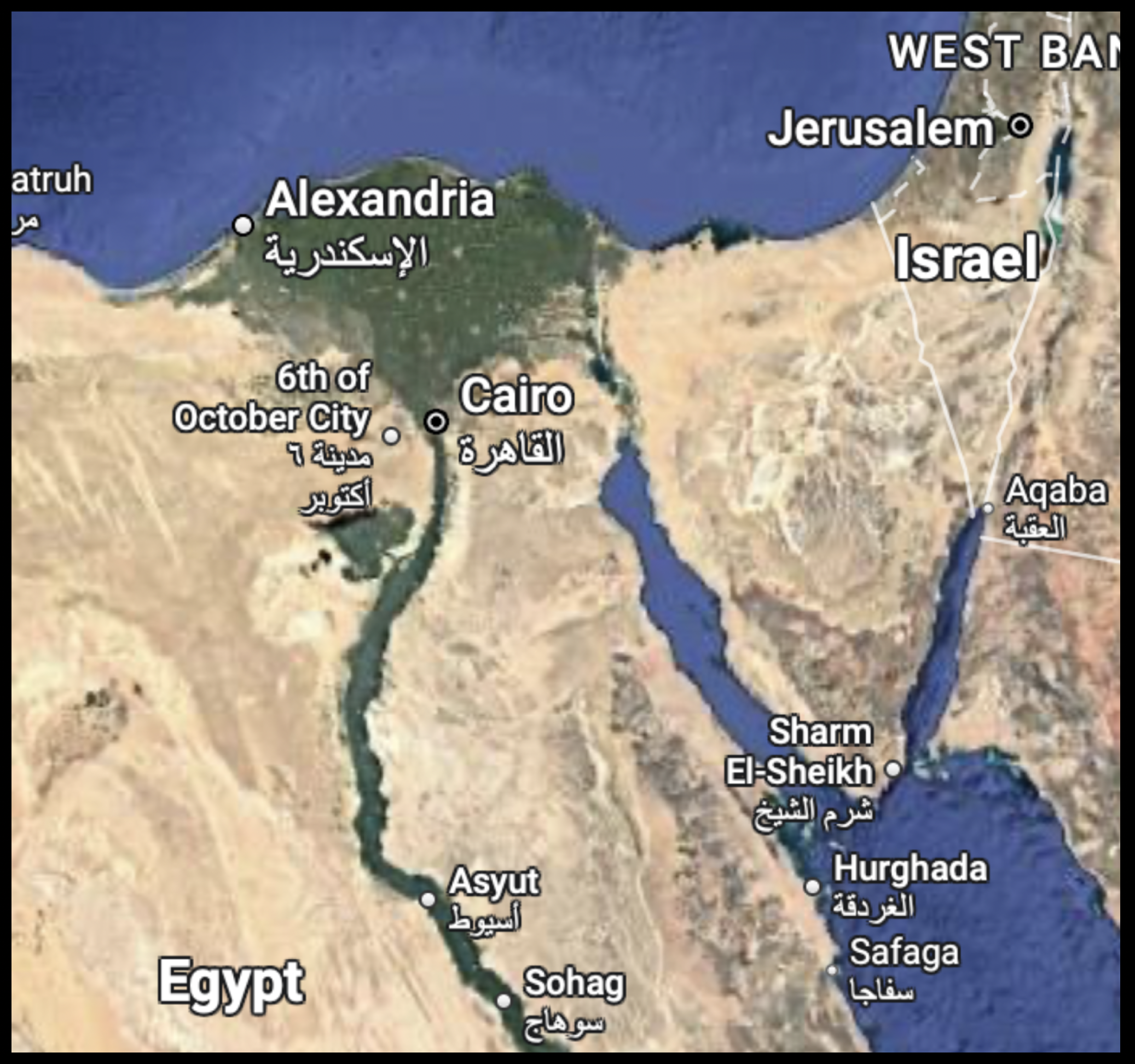
Look at this Google Earth view of Egypt.  Notice the thin ribbon of green in a sea of brown.  The green is the fertile land surrounding the Nile, the most fertile land in the world.  But take one step past the waters of the Nile, and you are in the wilderness, where nothing grows, where there is only death.  Aside from the delta, Egypt is a narrow ribbon of green, with the rest desert.  Let me give you another view.

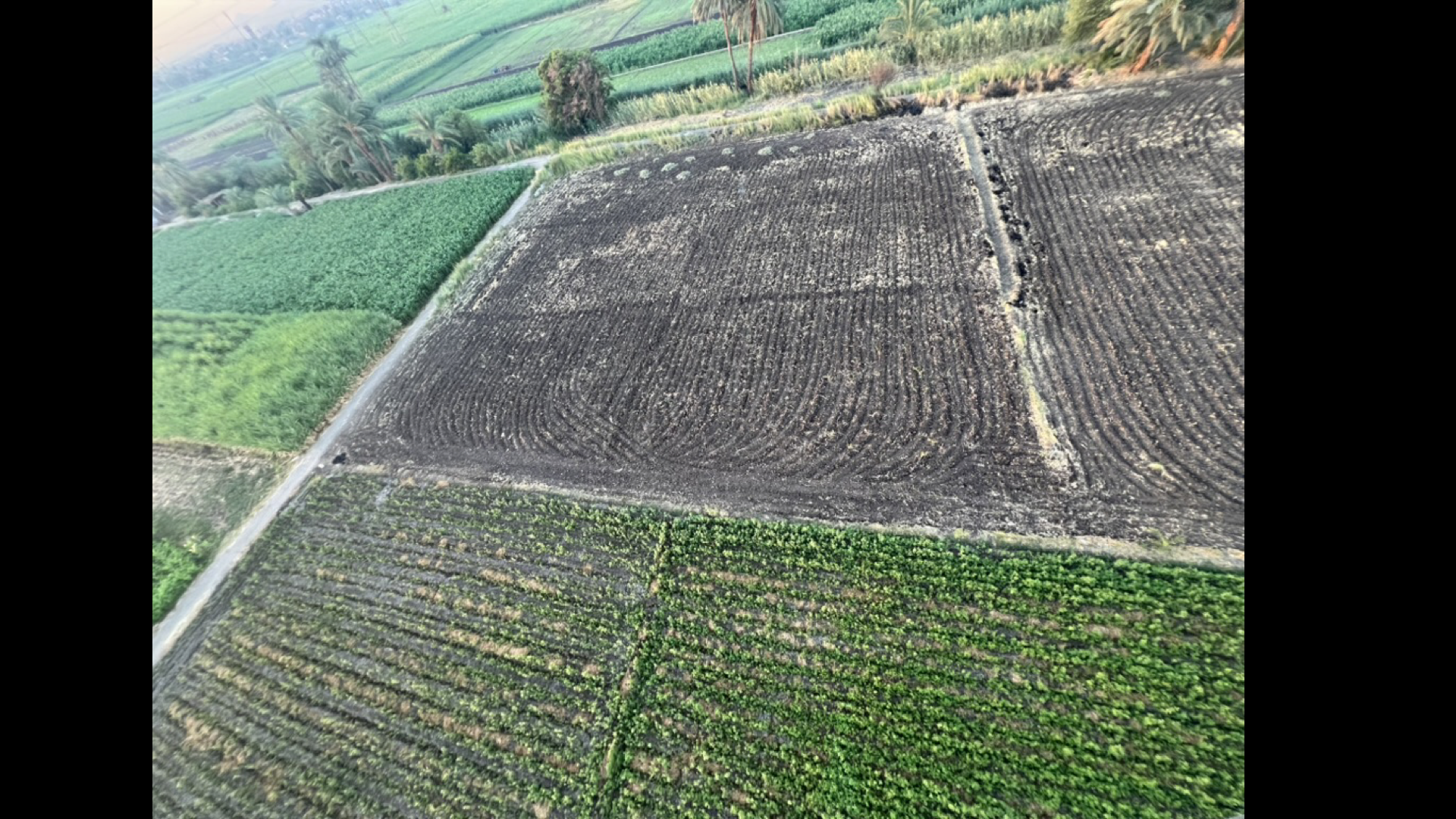
This is from about 200 feet in the air.  Egypt has the richest farmland in the world.  Thousands of years of Nile flooding, bringing rich deposits of silt, have created topsoil layers several feet thick.  This view was from last fall in one of these:

And we floated in a basket out over the ribbon of green that accompanies the Nile.

These particular fields were corn or sorghum.   The fertility of this land is fantastic.  But go up a little higher, and you can see where the green ends.

You can see a sharply demarcated line that divides rich farmland from desert and wilderness.   A place with no water, where nothing grows, a place where you die.  Who would ever leave this lush land and go to this land of death?  To be banished to the wilderness is to be sent to die.  But Moses doesn’t die; he survives and thrives. He spends 40 years in the wilderness, the same wilderness Saul entered.  It was a time of deep introspection that Moses needed.  And after 40 years, when Moses is ready, he encounters God in a burning bush on the mountain, Sinai.

Moses’ time in the wilderness became a season of preparation, where his own past in Egypt and his 40 years of shepherding would serve him as he led Israel through that same wilderness for 40 years. What started as a death sentence —a time of punishment for Moses —became a path to his purpose—a training ground for the mission God had prepared for him.  In the wilderness, God spoke to Moses.

Elijah — Elijah fled to the wilderness after his battle with the prophets of Baal on Mt Carmel.  You know the story.   God sends Elijah to King Ahaz to tell him there will be a drought and famine due to the nation’s worship of the false god, Baal.  God takes care of Elijah during the famine, first by ravens bringing him food and later through a widow whose jar of flour and oil never run out.  Then there is a confrontation between the prophets of Baal and Elijah on Mt Carmel.  Both are to build an altar, and whichever god brings down fire on their altar would be the true god.  So Yehovah brings down the fire, and in judgment, Elijah slaughters the prophets of Baal. 

Then Queen Jezebel is angry at Elijah for killing her prophets and swears to kill him.  Elijah flees to escape Jezebel.   After this great victory, he is depressed.  He feels he is the only prophet of Yehovah left in the world.  He flees to the wilderness, where he just wants to die.  He ends up at Sinai, the same mountain where God spoke to Moses.  And Elijah sits alone in a cave on the mountain.  Loneliness is hard.  But the wilderness of loneliness can be a gift because in those times, God can speak.

And in this lonely wilderness, God speaks to Elijah, telling him he is not alone.  God restores his strength and comforts him. There, you remember, God didn’t appear in the wind, earthquake, or fire, but in a “still small voice,” revealing Himself not in overwhelming power but in gentle presence, speaking to Elijah, giving him new tasks, and assuring him that he is not alone.  There are 7,000 faithful Israelites who remain.  In the wilderness, God speaks and restores Elijah’s hope. 

And there is David, who flees to the wilderness as a fugitive from King Saul, who hunts him relentlessly.  There are times when David thinks he has come to the wilderness to die.  But there he learns to trust deeply in God to provide for him.  And it is there that David learns to listen to God speak, in the land of speaking.  And there he sings out to God in psalms like this:

Psalm 63:1-4   O God, You are my God;  Earnestly I seek You;
My soul thirsts for You;     My body longs for You
In a dry and weary land    Where there is no water. 
I have seen You in the sanctuary, 
 Beheld Your power and Your glory. 
Because Your love is better than life,   My lips will glorify You. 
I will praise you as long as I live,
And in your name, I will lift up my hands.

David grew closer to God in the trials of the wilderness, the place where God speaks.

And then there is Jesus, who, after his baptism, was “driven to the wilderness” by the Spirit.  He spends 40 days in prayer and fasting to the Father in preparation for his ministry.  But Jesus’ story reminds us that in this land of speaking, there may be more than the voice of God.  For in the wilderness, where there are no other people or distractions, there are two voices one may listen to: our Father God, and the accuser, the satan.  Jesus gains insight and instruction from the Father, but he is also tempted by the accuser.  In the wilderness, there is a voice to heed and a voice to reject.  

So we see that Biblical characters end up in the wilderness for different reasons.   Moses is sent there as a death sentence.  Elijah flees in depression and loneliness.  David flees from an unjust king, and Jesus is driven by the Spirit.  I didn’t mention the first person in the Bible who is seen in the wilderness.

It is Hagar, the slave that the Pharaoh of Egypt gave to Abraham and Sarah; tradition tells us she was a princess in Pharaoh’s court.  But Sarah and Abraham mistreat her sexually, and Hagar bears them a son, and then they kick her out of their home into the wilderness to die.  Twice, Hagar is in the wilderness, but there God sees her and speaks to her. 

And look at this parallel:  400 years after Hagar. Moses, a prince in Pharaoh’s court, is kicked out of his home into the wilderness to die, and there Moses hears God speak to him.  This slave turned prince of Egypt was kicked out to the wilderness to die because he took a life. Again, that was 400 years after Hagar, a princess of Egypt, turned slave, kicked out to the wilderness to die because she brought life into the world.

These two people with exactly opposite circumstances both end up in the wilderness, where they are expected to die, but where God speaks to them. These mirror-image stories illustrate an important point:  No matter your circumstances, find your way to the wilderness, for that is where God speaks.

Where do you go to hear God speak?   Don’t tell me you go to YouTube.  God doesn’t have a channel there.   Don’t tell me you listen to Christian music or watch a church service on TV, or attend a small country church.   Saul would ask you to be very careful listening to the gospel of men.

All of those can be good things. But again, Saul would tell you that you need to hear from God Himself to avoid being off track by listening to the traditions of men.  There are some great Christian books and Christian Music out there.  But some contain some really odd ideas about God.  There are some great teachers and preachers out there, but again, you have to be careful you aren’t just getting Man’s Gospel.  Remember what Paul said:

Acts 17:11  “Now the Berean Jews were of more noble character than those in Thessalonica, for they received the message with great eagerness and examined the Scriptures every day to see if what Paul said was true.”

If not for Jesus stopping Saul in his tracks on the Damascus Road, Saul would have wasted his whole life.  Saul was giving 100% for God, but he was 100% wrong. That is what he got for following man’s gospel and traditions instead of the real gospel of Jesus.   So Saul went to Arabia, to the wilderness, because he knew that was where God spoke.  And he wasn’t about to be fooled by another person.  So Saul encouraged all his listeners to follow his example and that of these Berean Jews.  Saul said, “Listen eagerly to what I say, but don’t take my word for it.  Never just accept what any man says.  Study the scriptures yourself every day to make sure you are getting it straight from God.”

Do you want to commune with God?  Do you want to hear God speak?  Then find a lonely, quiet place, open his Word, and pray and listen. It may be on a hike in the woods.  It might be in your backyard.  It might be in a quiet room of your house at 4 am. God desperately wants a relationship with you.  He wants that so much that he sent His son to pay the penalty, the debt we owe for our sins.  God wants to speak to you, but he can’t be heard over the noise that we constantly surround ourselves with.  We all need to go to some form of wilderness to hear God speak.  Go with me to the wilderness — God is waiting for you there.

January 6, 2025 –  What Saul Does Next— Acts #26

December 3, 2025 –  What Saul Does Next— Acts #26
Acts 9:1–30 

Saul had his experience with Jesus on the road to Damascus.  He continued into Damascus, where, after 3 days, God sent Ananias so that Saul could regain his vision and be filled with the Holy Spirit.  So what does Saul do next?

Acts 9:19-22   For some days he was with the disciples at Damascus. And immediately he proclaimed Jesus in the synagogues, saying, “He is the Son of God.” And all who heard him were amazed and said, “Is not this the man who made havoc in Jerusalem of those who called upon this name? And has he not come here for this purpose, to bring them bound before the chief priests?” But Saul increased all the more in strength, and confounded the Jews who lived in Damascus by proving that Jesus was the Christ.

Saul wasted no time in spreading the message of Jesus.  He “immediately” talked about Jesus in the Jewish synagogues, making it clear that He was not just some great teacher, but he was the Messiah that they had prayed for, the Son of God.  And how did the synagogue’s congregation respond? 

“All who heard him were amazed.”  Remember, as you read your Bible, to slow down.  If you really want to understand what is going on, you have to look at the story from the point of view of all the characters.  Saul comes walking into this synagogue.  Some of the Jews there (likely a minority) believe that Jesus is the Messiah.  Some do not.  Yet they have been meeting together without problems.  They all continued to see themselves as Jews and did not see this difference of opinion as incompatible with worshipping the same God. 

In Jesus’ day, different Jewish sects worshipped together and had been doing so for years.  For example, the Pharisees and Sadducees had very different theological ideas.  The Sadducees did not believe in an afterlife, but the Pharisees did.  The Sadducees believed only the first 5 books of the Bible, while the Pharisees included the rest of what we call the Old Testament as their authoritative scripture. 

They had what we would call significant differences, but they worshipped the same God, and they worshipped together.   Can you imagine that?   Now, we feel like we can’t worship with someone who immerses if we sprinkle or vice versa.  “Oh, they believe in eternal security; we can’t worship there.”  Or “They sing with guitars” or “they sing with those ancient hymn books”.  Or they get out too late, or you name it.  We tend to find numerous reasons why we can’t worship with other Jesus followers.  

It wasn’t such a big deal in Jesus and Saul’s day, and even into the early centuries of Christianity.  But now we have several hundred main denominations, and some say there are 45,000 total denominations.  I think that number is a bit high, but there are indeed too many.   This number multiplied greatly after the Protestant Reformation due to differing interpretations of Scripture. 

There is an old story of a man stranded alone on a deserted island. After many years, a ship sails close by the island, and the man is rescued. The ship’s captain comes ashore, notices the three huts that the man built, and asks, “Tell me about these huts.” The man replies, “The first hut is my home, and the second hut is my church.” The captain asks, “What is the third hut?” The man replies, “Oh, that is where I used to go to church before I got mad.”

Timothy Tennent, who served for 15 years as president of Asbury Theological Seminary and is now on the faculty of Beeson Divinity School at Samford University, says we should see God’s church not as a business but as a family, with Jesus as its head.  As with any family, it can be a group that exhibits both diversity and unity.  We all have differences, but we are united because we are family. And we should come together to focus on Jesus, what we have in common.  Tennent says, “We must learn to think of ourselves as members of a massive global Christian movement that is looking more and more like John’s vision in Revelation 7:9, which encompasses people from every nation, tribe, people, and language.” 1

Despite their differences, the Jews in the first century were united in their belief in the one true God and in worship at the one temple. There was only one place in the world where sacrifices could be made on an altar.  There was one place that they were commanded to travel to for the festivals. That single location helped to unite them, for there was nowhere else in the world to worship as they were commanded.  Now we have churches on every corner.  We no longer have unity in a location, and it seems as if we have forgotten our unity in the one true God.  We sacrifice our unity in Jesus for petty beliefs or, sometimes even worse, for traditions.  We forget that there is still only one temple.

Only one temple?   Let’s take a deeper look at that.  One problem with our English translations is that the word ‘you’ can be used either singularly or in plural.  For example, you are sitting in a room with fellow workers when your boss comes in and says, “I need you to finish this report by 5 PM.”  He walks out, and your co-worker across the table gets up to leave and says to you, “Well, David, you better get on it then.”  But  you say, “Hey, he meant for all of us to work on the report.”  Did he mean you singular or you plural?  There is a difference.  Take the following verse:

1 Corinthians 6:19   Or do you not know that your body is a temple of the Holy Spirit within you, which you have from God, and that you are not your own?”

Is Saul talking to one person or to a group of people?  Now, if these are singular ‘you’s’ then Saul is saying that each individual is God’s Temple and God’s Spirit dwells in each one of us individually.  Fortunately, unlike English, in both Greek and Hebrew, there are different words for the singular and plural forms of ‘you’, so we know they are all plural here.  So it should read this way:

1 Corinthians 3:16   Do you all not know that all of you together are God’s temple and that God’s Spirit dwells in you all?

We all together are God’s temple.  God dwells in us collectively as a community of believers and as the universal church. (I need to add that there is a verse where Saul talks about God’s spirit dwelling on individual believers, but his main emphasis is about the spirit dwelling on us as a community.) God dwells with us as a church just as he chose to dwell among the children of Israel on their journey to the promised land.  Remember, he told Moses:

Exodus 25:8   And let them make me a sanctuary, that I may dwell in their midst.”

This has been God’s goal since Adam and Eve sinned and put a wall of separation between them and God, and were put out of the Garden.  God desires to live with us, to tabernacle with us.  John tells us that:

John 1:14   And the Word became flesh and dwelt among us…

Jesus came to dwell among us for a time.  And since Jesus removed the wall of sin that separated us from God, we can now, together, be the temple where God dwells.  He dwells with us now through His Holy Spirit and will one day make that complete when there is no more separation, no more sin, no more death.  Or as Saul writes:

1 Thessalonians 4:17   Then we which are alive and remain shall be caught up together with them in the clouds, to meet the Lord in the air: and so shall we ever be with the Lord.

Saul again, in his letter to the Ephesians, talks even more clearly about how we, together, are God’s temple:

Ephesians 2:19-22   So then you are no longer strangers and aliens, but you are fellow citizens with the saints and members of the household of God, built on the foundation of the apostles and prophets, Christ Jesus himself being the cornerstone, in whom the whole structure, being joined together, grows into a holy temple in the Lord. In him you also are being built together into a dwelling place for God by the Spirit.

All of us are joined together on the cornerstone of Jesus to be the one holy temple, the one dwelling place for God by the Spirit.   We, together as the followers of Jesus, are God’s dwelling place.   We need to be united in this one temple just as the Jews in Saul’s day were united in one temple.  For the world we live in is changing, and you can probably see that it will become increasingly challenging to be a Jesus follower. 

The percentage of believers is dropping rapidly in the US, even in the Bible Belt.  In many areas of the country, it is already unpopular to be a follower of Jesus.  We need to band together as a family with Jesus as our head.  There is one God, and there is one Church.  We have to learn to work together in partnership with other churches in our community, because we are all on the same team.

And in this synagogue in Damascus, Jews who follow Jesus and those who do not continue to meet together.  Then Saul walks in.  And everyone there knew why he was there.  He is there bringing letters from the council in Jerusalem to have these Jesus followers arrested.  He has come to arrest and carry back to Jerusalem some of the members of their congregation.  But he doesn’t arrest anyone.  In fact, he starts talking about how this Jesus is the “Son of God.”

It is just the opposite of the message they expected to hear.  So they were ‘amazed.’  Other translations say ‘astonished’ or ‘astounded.’ They are shocked and confused.  You could have knocked them over with a feather.  This expert in their religion comes with the authority of the religious leaders, but he starts speaking the message that they said was blasphemy.   Saul is speaking the exact words for which they thought he came to arrest people for saying.  What happened?

Saul’s entire way of understanding scripture has flipped upside down in the past week.  He had studied the Scriptures his whole life and memorized them.  He was sure of what they meant.  He would have bet his life on it.  Remember that Saul was there when Stephen was stoned.  Remember that Stephen gave a long review of the scriptures before he was killed.  Saul had heard Stephen’s sermon in Acts 7 explaining how the scriptures show the rejection of God’s prophets leads to the rejection of Jesus.  

Saul was there and heard it all. But it did not affect him, for he had already decided Stephen was a blasphemer.  He shuts his ears to the story of God dealing with Abraham and all of their forefathers that Stephen had used to explain God’s purpose and their rejection of God’s plan.  Don’t you know that the words of Stephen rang in Saul’s ears after he encountered Jesus, for Saul had rejected Stephen just as his peers had denied Jesus, and his forefathers had rejected the prophets before them.

Stephen and Saul studied the same scripture, the same history, but came to different conclusions.  Saul did not lack education; he lacked perspective.  And what made the difference in Saul’s upside-down interpretation of the Scriptures?  He met Jesus.  And then he considered the scriptures with the knowledge of Jesus.  And he saw the truth of the scriptures he had missed all his life.  He had the best education, he trained under the best, but he had misunderstood.  If you ignore the idea of a Messiah when you read the Scriptures, you can not possibly understand.

And now here is that same Saul who had voted to have Stephen stoned for blasphemy, using that same scripture and the same explanation Stephen used.  Can you imagine their confusion?  Luke tells us they were “confounded.”   Let’s do a word study.  For those of you who like word studies, this will be great. If you don’t, then just bear with me for a few minutes.

Acts 9:22   But Saul increased all the more in strength, and confounded the Jews who lived in Damascus by proving that Jesus was the Christ.

The Greek word translated as “confounded”  is ‘syncheō’, derived from two Greek words: “syn”, which means ‘together’, and ‘cheō’, which means ‘to pour.’  Literally, it means “to pour together.”  This is the Greek word that the Septuagint (LXX), the Greek translation of the Hebrew Bible that was around in Jesus and Saul’s day, uses for the Hebrew ‘balal’, which means ‘to mix’, as in grain sacrifices, where flour is mixed with oil.  

Exodus 29:40   And with the first lamb a tenth measure of fine flour mingled with a fourth of a hin of beaten oil, and a fourth of a hin of wine for a drink offering.

It is the idea of taking something simple and pure, and pouring or mixing something into it, and it is now different.  We have a very similar word in English.  Confusion, which comes from the Latin confundere, which also means “to pour together, mix, mingle, disorder.”  And now you can see how we moved from there in English to our phrase “mixed up” for confusion, and then even further to “agitated” or “stirred up.”

The first time we see the word ‘balal’ (‘syncheō’ in Greek) in the Bible is in Genesis 11.

Genesis 11:7   Come, let us go down, and there confuse their language, so that they may not understand one another’s speech.

‘Confuse’ is our Greek word ‘syncheo’.  What God did at Babel was to take their single, simple language and mix it with other languages, as one would add oil to flour when making a cake.  And by making this mixture, the people are confused.  That is the idea behind the word.

We also see the Greek syncheō in the mirror of this Babel story that we have covered in Acts 2.  There, at Pentecost, God reversed the act at Babel.  There, he removed the language differences so that everyone could understand.

Acts 2:6  And at this sound the multitude came together, and they were bewildered, because each one was hearing them speak in his own language.

But this sudden ability to understand all these foreign languages leaves the people syncheo (bewildered), literally mixed up, for the world as they knew it suddenly changed.   What they thought was impossible just happened to them.  And this is the same word translated as ‘confounded’ in our passage today:

Acts 9:22   But Saul increased all the more in strength, and confounded the Jews who lived in Damascus by proving that Jesus was the Christ.

So when Saul comes in, they are expecting him to carry off these Jesus followers in chains, but he comes in and says he is a Jesus follower and tries to convince them they should be also.  It is no wonder they are “mixed up.”  Well, people don’t like to be ‘confused,’ so if it is unresolved, they move from mixed up to a more intense state, stirred up or agitated. And this crowd in Damascus will get so agitated that it reaches the point of violence, but we will talk about that later.

And the verse says, “Saul increased all the more in strength.”  What does that mean?  Saul is not going to the gym or working out with weights.  I think the NET Bible translates this well as it says, “But Saul became more and more capable…”.

Over time, Saul grew better at presenting the scriptures as they pointed to Jesus.  But he quickly discovered that it wasn’t going to be as easy as he thought.  The people are just mixed up and becoming stirred up.  This was not what he wanted.  So Saul is about to change strategies.  

He can’t stay in Damascus, as things aren’t going well for him there. He is not leading people to understand how the scriptures point to Jesus, but he is leading them into confusion.   He sure can’t return to Jerusalem, where they are punishing the followers of Jesus.  So he goes where every prophet goes to get instruction from God. He goes to the wilderness, to Arabia.  Next week, we will talk about Saul spending the next three years in Arabia.

But let me review the two points I want you to take home from today’s passage.

  1.   The community of Jesus followers joins together to be the place where God dwells.  We are where the Spirit dwells in our community and are responsible for being that light where we live.  And the universal church is God’s Temple in our world, the city on the hill where the light of Jesus will spread to the world.  We worship one God, and we are one Temple.  We should act that way.  We have to learn to get along and work together.
  2. (And this is the big one.)  To understand the Bible, you must grasp its big picture and see how it all leads to Jesus.   Saul and Stephen read the same scriptures but came to different conclusions until Saul had a dramatic event that changed his perspective and enabled him to interpret the Scriptures correctly.  That event was coming face-to-face with Jesus.  Without Jesus, we can not correctly understand God’s Word.

This is why it is so essential to understand the big picture of what God is doing in the story of the Bible.  Can you imagine taking one piece of a 1000-piece puzzle, studying it, and trying to understand which piece it represents if you aren’t able to see the big picture the puzzle forms?  But that is precisely what we are doing when we study a small piece of the Bible without knowing the big picture.

You should be able to tell someone the story of the Bible in less than two minutes. The Bible is a big book, and many people find it hard to understand.  But the basic story is not complicated.   God created the universe we live in. And he made people. He made this world a place where we can live with him.  But Adam and Eve decided they didn’t want to live by God’s rules for the world he built.  So they rebelled, we call that sin. 

And since they didn’t want to live by God’s rules, they had to leave.  That is the first three chapters of Genesis.  The rest of the Bible is the story of God designing a way to reunite Himself with His people, because He wanted to dwell with them.  So he tried to give them instructions for how to live, but they continued to rebel.  The only way we could learn to be obedient was for God to place his own Spirit upon us.  But our guilt and sin were in the way.  Someone had to pay the price of the penalty for this sinful rebellion.

And only a man who had never rebelled could pay the price.  But none could be found.  All people sinned and fell short.  So God sent His son to be the one human who would not rebel or sin.  And He would pay the price for all of our rebellion.  And so Jesus came and demonstrated a life of following God, and then he died on a cross as payment for our sins.  And as proof of God’s acceptance of this sacrifice, God raised him from the dead. 

And if we accept that payment, and agree to follow Jesus’ instructions and His way of living, then our debt is paid, and the wall that separated us from God is removed, and now God’s spirit can dwell with us, and He will empower us to live that life we couldn’t before.  And the final part of God’s plan is to one day remove all sin, and all of the consequences of sin, all the pain and death.  And then we will dwell with God forever, just as He designed it in the beginning.

That is the story of the Bible in less than 2 minutes.  That is the story of this entire universe.  That is what the rabbi Saul didn’t understand.  Though he had studied the scriptures all his life, he missed the main point…. he missed Jesus because he didn’t see the big picture of the Bible.  But then one day, he met Jesus, and the light bulb came on for him.  Suddenly, he began to understand the story of the Bible. 

So many people say they don’t understand the Bible.  And I agree, sometimes it is hard.  We are reading a book that is thousands of years old, speaking of vastly different cultures and times.  It takes a little work to read ancient literature and understand what they were thinking and doing.  But I am a firm believer that God rewards people who take the time to read His book.

I believe that God gives insight to those who earnestly seek and ask.  But it is meant to be read in community.  That is why we gather together to study.  That is why many of us are reading 3-4 chapters daily and discussing them.  We are all pilgrims on a path to God.  Let us all walk together.

  1. Tennent, Timothy. Theology in the Context of World Christianity. 2007.