July 15 –  Pentecost! So What Shall We Do? — Acts #5

July 15 –  Pentecost! So What Shall We Do? — Acts #5
Acts 2:37-41

Pentecost.  The Holy Spirit comes in wind and fire.  There is a miracle of understanding languages that is a reversal of God’s intervention at the Tower of Babel.  Last week, we examined the response of those who asked the question, “What does this mean?”  Peter answers with a sermon that reveals God’s plan for redemption and the gift of the Holy Spirit through Jesus.  He tells them that prophecy has been fulfilled in the past year and even that very morning.  Today, we examine the response of the people to Peter’s message as they pose another critical question.

A huge crowd from all over the world has gathered for Shavuot, one of the three festivals in Jerusalem that everyone must attend.  So, most of these people are the same ones who attended the required Passover feast 50 days ago.  It was the same crowd in the city almost two months ago, during Jesus’ final week.  Many of them were there when Jesus rode into the city on a donkey, when he overturned the tables of the money changers, when he challenged the religious leaders, and when he was crucified.  

Peter summarizes the story of Jesus, then tells those assembled at the Temple for Shavuot that this Jesus, whom you crucified, has been raised to life by God and is your Messiah.  And they were there for this.  These were the very same people who had either shouted “Crucify Him!” to Pilate or had kept silent as the disciples did. So, how did they respond to Peter’s sermon?

Acts 2:37-41   Now when they heard this they were cut to the heart, and said to Peter and the rest of the apostles, “Brothers, what shall we do?” And Peter said to them, “Repent and be baptized every one of you in the name of Jesus Christ for the forgiveness of your sins, and you will receive the gift of the Holy Spirit. For the promise is for you and for your children and for all who are far off, everyone whom the Lord our God calls to himself.” And with many other words he bore witness and continued to exhort them, saying, “Save yourselves from this crooked generation.” So those who received his word were baptized, and there were added that day about three thousand souls.

These 3000 people were “cut to the heart,” which means they were deeply emotionally moved.  The Greek phrase here, “katanyssomai kardia,” literally means “stabbed in the heart.”  That is a picturesque way of stating an intense emotional response.  Obviously, the Holy Spirit did not stop moving after the miracle of the languages.  He is moving in the hearts of these people, giving them the gift of remorse that leads to repentance.  

There are two other instances where the phrase “cut to the heart” appears in some English translations.  One example is found in Acts 5. This is a great story that we will explore in a few months.  The apostles are preaching in the outer courts of the Temple, and the High Priest has them put into prison.  An angel of the Lord comes at night and opens the prison door for them, telling them to return to the Temple in the morning and continue preaching.  Unaware of the escape, the next morning, the High Priest gathers a council of judgment and sends someone to bring the apostles from prison.  It is then discovered that they escaped during the night. Then someone comes and tells the High Priest, “Hey! You know those men you put in prison yesterday for preaching in the Temple?  Guess where they are?  They’re back in the temple, preaching again this morning.”

The High Priest is not amused.  So they bring the apostles to the council, and Peter says, Thanks for the hospitality yesterday, but ‘We should obey God and not men.”  (Acts 5:29).  Peter presents the gospel to these religious leaders and says, “The God of our fathers raised Jesus, whom you killed by hanging him on a tree.”  This is the same message that drove 3000 to repentance on Pentecost: ‘You killed Jesus, but God raised him from the dead, and he is on a throne by the Father now.’  And how do you think these religious leaders responded?

Acts 5:33  (KJV)  “When they heard that, they were cut to the heart, and took counsel to slay them.”

There is our phrase again, “cut to the heart.”  They were deeply emotionally moved, but the emotion is different here.  It is not remorse but anger and rage.  We see this same reaction again in Acts 7 after Stephen delivers a sermon to this same council.

Acts 7:54  (KJV)  “When they heard these things, they were cut to the heart.”

They are enraged to the point that they want to kill Stephen.  And this time they do.  They take Stephen outside the city and stone him to death.  

In these two verses, “cut to the heart” is translated from a different Greek phrase, “diapriō kardia autos”, which means literally ‘to saw your own heart in two pieces.’  (Greek is indeed a very picturesque language.)  Metaphorically, it means being filled with murderous rage.  Our English biblical phrase, ‘Cut to the heart,’ can be derived from one of two Greek phrases that express two different extreme emotional responses.:
Stabbed in the heart – which is a response of remorse, I’m sorry, what can I do?
Saw your own heart in two, which is an intense negative emotion — rage –  I will kill you.1

Last week, we explored how we perceive events in the world and the importance of asking, “What does this mean?” to ensure we understand how God is at work in the world around us.  So Peter preached a gospel sermon, and 3000 were cut to the heart and believed and were baptized.  And then they ask an even more critical question:  “What shall we do?” It is not enough to understand what God is doing in the world.  Our reaction to God must include action.  We must do something. As James said:

James 1:22“  But be doers of the word, and not hearers only, deceiving yourselves.”

Remember that the Hebrew word to hear, “shema,” includes the idea of obedience. (James is Jewish.)  It means hear and obey.  There is no such thing as hearing that is not followed by action.  We must always ask both questions: “What does this mean?” and “What should we do?”  We must not only understand, but also react.  Jesus did not call anyone to be a passive follower.  It is inherent in the word ‘follow’ that there is action.  If I teach you about scripture, if I share what God has taught and is teaching me, and if I somehow, through the grace of God, do a good job of teaching, but you are not encouraged and incited to do something for the Kingdom of God, then I am a complete failure.  To be confronted with the gospel, there are only three ways to react:
1.  Cut to the heart and spurred to action for Jesus.
2.  Cut to the heart and be enraged at Jesus.
3.  Be indifferent about Jesus.

Now let me ask you….Which of the last two bothers Jesus the most?  To answer that, we need to take a detour into the book of Revelation.  (If you have a red-letter Bible, you will note that this letter to the assembly in Laodicea is the words of Jesus.)

Revelation 3:14-22   And to the angel of the church in Laodicea write: ‘The words of the Amen, the faithful and true witness, the beginning of God’s creation. ‘I know your works: you are neither cold nor hot. Would that you were either cold or hot! So, because you are lukewarm, and neither hot nor cold, I will spit you out of my mouth.

“Because you are lukewarm…I will spit you out of my mouth.”  The ESV, like most other versions, has toned this down somewhat to avoid offending anyone, but here, Jesus means to offend.  The word for ‘spit’ is ‘emeō,’ from which we get our medical word ‘emesis’, which means vomit.  What is going on in Laodicea makes Jesus sick and want to throw up.  Of the seven churches listed here, this is the only one for which Jesus has nothing good to say.  To understand this reference to hot, cold, or lukewarm, you need to know a little about this area of Asia Minor.  

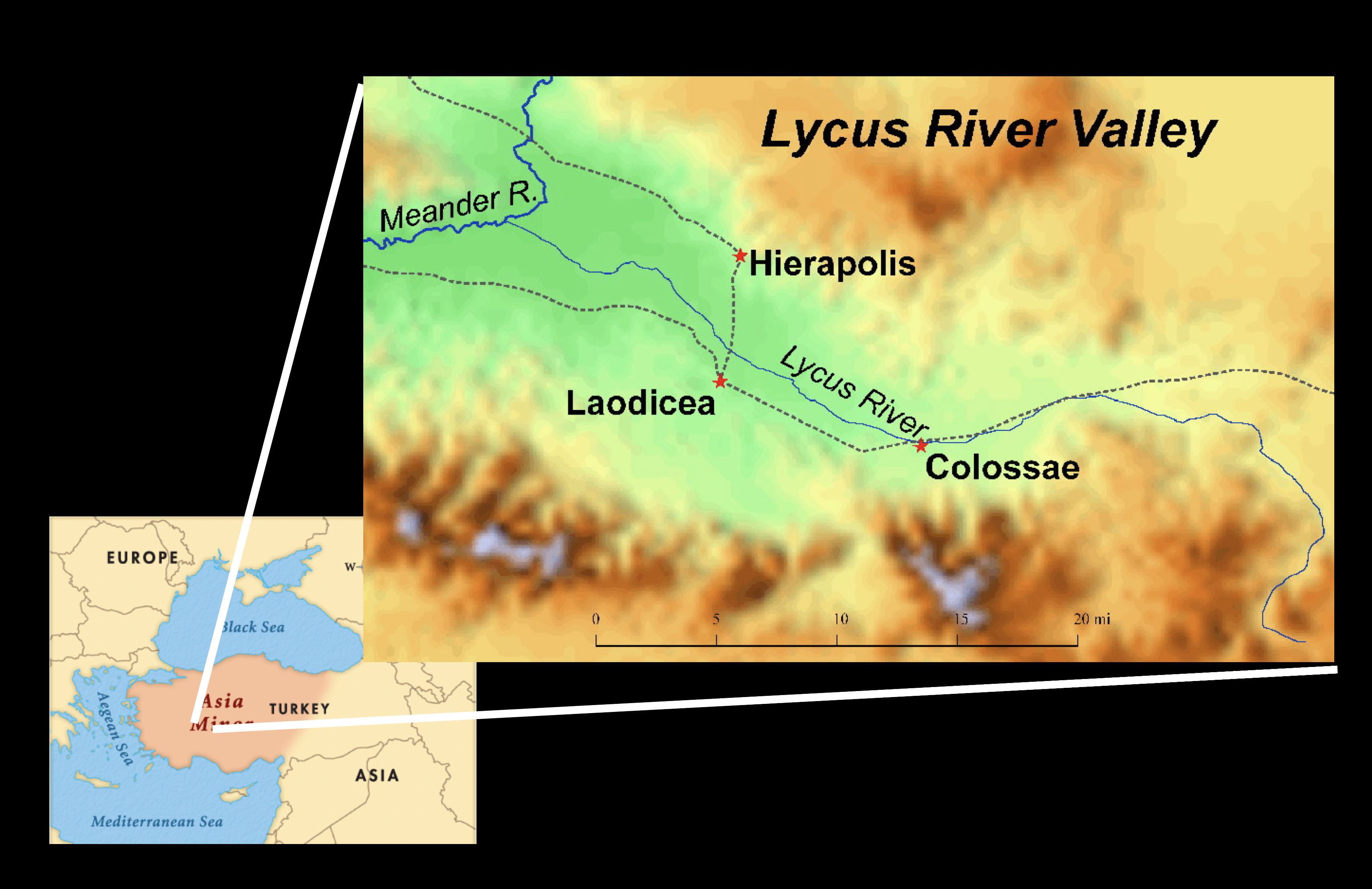
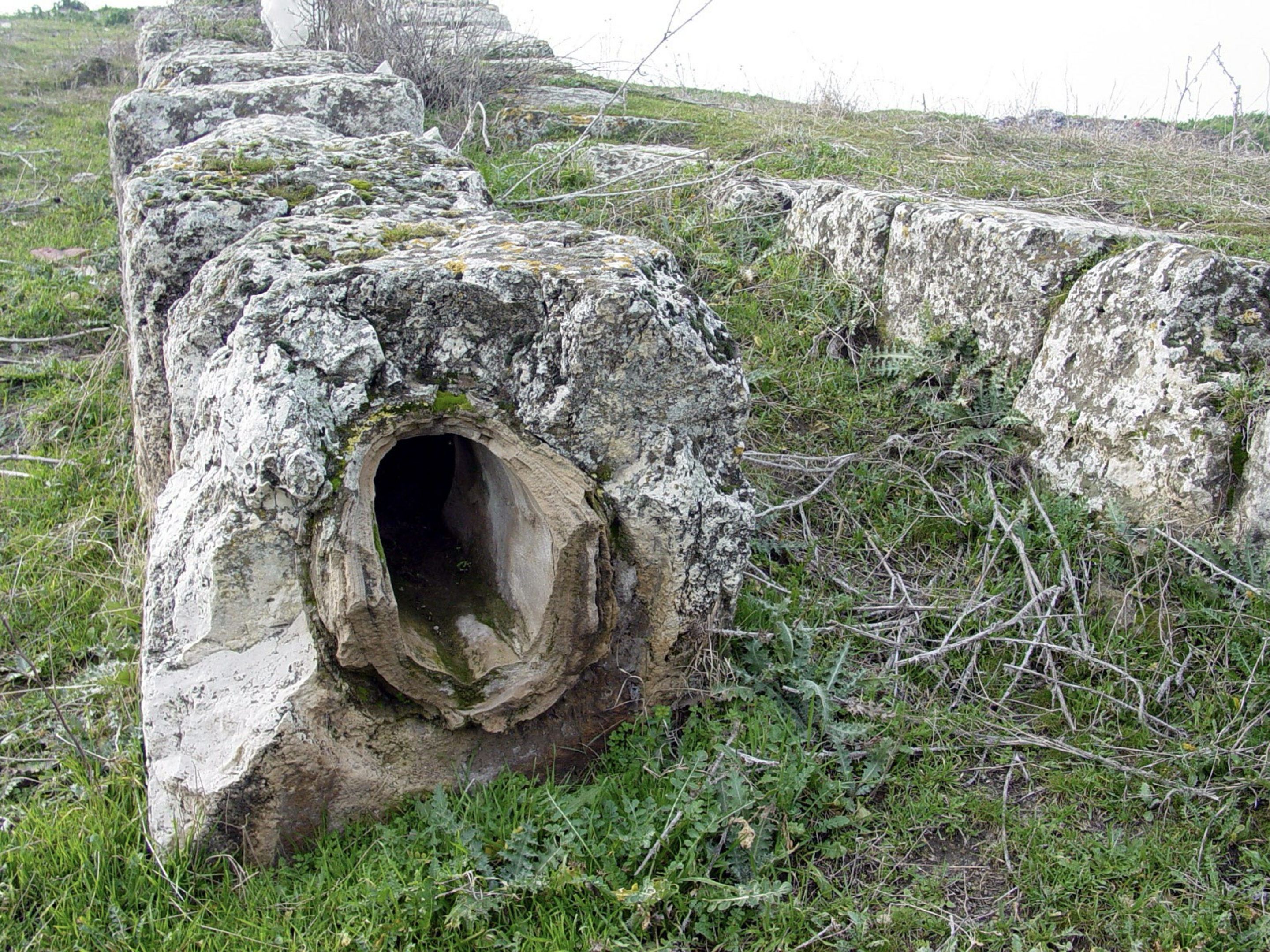
Laodicea is situated in the fertile Lycus River valley, in our modern-day Turkey.  Six miles to the north lies the city of Hieropolis, renowned for its medicinal hot springs, which feature a spa dating back to around 200 BC.  Eight miles to the east lies Colossae, famous for its refreshing, pure, and cold natural spring water.  In contrast, Laodicea had no water source in the city.  An aqueduct, cut from stone, transported water from Denizli, 5 miles south. 

Here is a section of that 5-mile-long aqueduct. Each stone is hollowed out, cut, and fitted together to pipe the water to the city.  

By the time the water arrived at Laodicea, it had become lukewarm and had also absorbed a high mineral content from the stone, making it unappealing.  It did not have the refreshing quality of the waters of Colossae nor the healing properties of the waters of Hieropolis.   It was neither cold nor hot, but lukewarm.  Robert Mounce, in the NICNT, “Thus the church in Laodicea was providing neither refreshment for the spiritually weary, nor healing for the spiritually sick. It was totally ineffective, and thus distasteful to its Lord.”2  This group heard the gospel, but they did not do the gospel.

Revelation 3:17  For you say, I am rich, I have prospered, and I need nothing, not realizing that you are wretched, pitiable, poor, blind, and naked.”

Laodicea was a very wealthy city.  They were known for their medical school, prosperous banking establishments, the production of an eye salve that was exported worldwide, and a thriving textile industry.  Knowing this, now look at what else Jesus says….not realizing that instead of healthy, you are wretched & pitiable, you think you are rich but you are poor, you are known for healing eyes, but you are blind, and you say you produce finest clothes, but you are naked.

They think they have it all.  They think they don’t need any help from anyone.  A massive earthquake devastated Laodicea in 60 AD. The government of Rome offered to help them rebuild, but they refused the help.  They are proud, self-sufficient people.  They didn’t need Nero’s help then, and this “church” apparently didn’t need Jesus’ help either. They think they have it all, but they have abandoned Jesus to get it.  So they have nothing.

They are a church that neither provided healing nor spiritual refreshment.  They had heard the gospel, but how did they react?  They were not cut to the heart in a good way or a bad way.  They were able to hear a story that should cut you to the heart, and remain unaffected.

Revelation 3:18-19   I counsel you to buy from me gold refined by fire, so that you may be rich, and white garments so that you may clothe yourself and the shame of your nakedness may not be seen, and salve to anoint your eyes, so that you may see. Those whom I love, I reprove and discipline, so be zealous and repent.”

Then we have that verse you have heard so many times before:

Revelation 3:20   Behold, I stand at the door and knock. If anyone hears my voice and opens the door, I will come in to him and eat with him, and he with me.

You probably have a picture in your mind of that verse that may look something like this: Jesus is knocking on the door and asking to come into the ‘door of your heart.’  Salvation awaits the one who opens the door to Jesus.  Did you realize this verse was explicitly written to these self-sufficient, wretched, pitiful, naked, poor, blind people in Laodicea?  But wait a minute?  Are the people in this church in Laodicea unsaved?  They can’t all be lost, can they? Didn’t Jesus call them a church?

Well, not exactly…… We have a translation problem.  The term Jesus uses for the “church at Laodicea” is the Greek word ‘ekklesia.’  It comes from the Greek root verb ‘kaléō’, which means “to call.”   So ‘ekklesia’ means “those called out”.   As followers of Jesus, we believe he has called us out. (See Paul’s explanation in 2 Corinthians 6:17-7:1).  So an ekklesia can be a church.  But it is not always a church.  

In Acts 19, Paul got into trouble with the local silversmiths in Ephesus.  Paul was preaching that idols made of metal were not gods, and this hurt the silversmiths’ business.  So they want to throw Paul and his bunch out of town.  There is a great disturbance in the city.  Now look for the word we translate as ‘church’ as seen in Acts 19.

Acts 19:32-35  Now some cried out one thing, some another, for the ekklesia was in confusion, and most of them did not know why they had come together. Some of the crowd prompted Alexander, whom the Jews had put forward. And Alexander, motioning with his hand, wanted to make a defense to the crowd. But when they recognized that he was a Jew, for about two hours they all cried out with one voice, “Great is Artemis of the Ephesians!”
And when the town clerk had quieted the crowd, he said, “Men of Ephesus, who is there who does not know that the city of the Ephesians is temple keeper of the great Artemis, and of the sacred stone that fell from the sky?”

The Bible refers to this gathering as an ekklesia.  But this is not a church.  This is a town hall meeting. (It is a very rowdy one, as when a Jewish man tried to speak, he was shouted down for two hours, the crowd chanting “Great is Artemis of the Ephesians!”.  But this assembly is run by the local town clerk, who concludes the meeting this way:

Acts 19:38-39   If therefore Demetrius and the craftsmen with him have a complaint against anyone, the courts are open, and there are proconsuls. Let them bring charges against one another. But if you seek anything further, it shall be settled in the regular ekklesia.

If the silversmiths have a legal complaint against Paul, then they can use the courts.  If there is anything else, we will address it at the next regular town meeting.   

So in the Bible, ekklesia doesn’t have to mean church.  It is any gathering of people.  When Jesus dictates a letter to the ekklesia at Laodicea, he is writing to a gathering of people.  He is not necessarily saying they are a church.  I think that Jesus says they are pretending to be a church but are lost and in need of repentance. This is one of 7 letters Jesus dictates to gatherings in this section of Revelation.   This one to Laodicea is the only one where he has nothing good to say.  They are “wretched, pitiable, poor, blind, and naked.”  Jesus wants them to be clothed in the white garments of his righteousness.  So he stands at the door and knocks.

We took this detour into Revelation because we are looking at the ways people respond to the gospel.

Peter preaches, and some are “cut to the heart”.  Others respond to preaching and are “cut to the heart”. Then you have this group in Laodicea.  They call themselves a ‘church’ and claim to be following Jesus, but they have heard the gospel message and were not ‘cut to the heart’.  They were unaffected.  They are apathetic.  They are going about their lives, enjoying their health and wealth, unaware that they are bound for destruction.  They are living in a prosperous city.  They have it all. They are so satisfied that they have no real need for Jesus.  But Jesus tells them they are poor.  That is the Greek ‘ptochos.’  They are wretched beggars with no resources.

We see these same three reactions today.  Some hear the gospel and are convicted.  They realize they are spiritually and morally bankrupt without Jesus.  They need Jesus, and they respond with remorse that leads to repentance and salvation.  Some hear and have other emotions.  They may mock and poke fun like the people at Pentecost who said the disciples were just drunk.  They may relentlessly poke fun at Christians and the gospel in public on TV or social media.  In some countries today,  People get angry and kill those spreading the gospel message.  It is hard to know the exact numbers, but even the most conservative sources say that at least 10,000 Christians are killed every year for their faith – over 25 martyred a day.

And then some respond with apathy.    They react to the gospel with no intense emotion at all.  They are unaffected.  And this is becoming the largest group of people.  God is meaningless to them.  They don’t care.  They are doing just fine without God, thank you.  Oh, they may want the name of God.  They may even call themselves a Christian and their gathering a church.  But they are so unaffected by the gospel that they meet and never do the gospel.

Our country just celebrated its 249th birthday this month.  We are blessed to live in this land.  2/3 of the people living in the US claim to be Christians.  However, I am concerned that many who make that claim do so in the same manner as the Laodiceans.  They want the title of Christian, but not the job.  They want to be in God’s kingdom, but they don’t want to live by the King’s rules. They mistreat people whom the King loves. They disregard his precepts.  They say they can make their own decisions about right and wrong.  And they make Jesus want to throw up.  They are resistant to the truth of the gospel and resistant to the influence of the Holy Spirit.  They think they have it all, but they don’t realize that they are spiritually and morally bankrupt.   

Jesus said, “Blessed are the poor in spirit, for theirs is the kingdom of heaven.”  (Matthew 5:3). He uses the same word for poor as he did for the Laodiceans.  He said that the fortunate ones are those who realize their own spiritual poverty.  To humble yourself before God and ask for forgiveness, you first have to admit your problem, that you are a sinner, and you can not atone for your sins yourself.  You have to realize that you are bankrupt, that you have zero resources to alleviate your spiritual need before you can acknowledge your desperate need for Jesus.  Only those who recognize this can enter the kingdom of heaven.

This is why it is hard for a rich man to enter the kingdom of heaven.  Like the rich Laodiceans, they don’t see the need.  They are comfortable as they are.  If they need anything, they will buy it themselves.  And many today, like the Laodiceans, claim to be part of the church, but have never opened the door to Jesus.  They hear the Word, but they do not do the Word.

We all live in Laodicea.  Compared to the rest of the world, the people in the US are wealthy.  Over half of the people in the world live on less per day than each of us spends on gas to drive to our church this week.  We live in the land of the self-sufficient.  There is a mission field in our backyard.  And while you are very unlikely to experience a violent response to the gospel, you are likely to get what Jesus said was a worse response – apathy. This is the reaction of the comfortable.  And the Gospel is meant to comfort the afflicted and afflict the comfortable.

From Pentecost, we learn that it is essential to examine the world around us and ask, “What does this mean?”  And then we look at ourselves and ask, “What should we do?”  We should ask ourselves these two questions every day.  Now that we have examined the possible responses to Pentecost, next time we will explore the details of what they did and how they lived.

1.   Interestingly, we still use a similar metaphor today.  Some of you may have heard it in a hit song from 1986 by Jon Bon Jovi, which begins with the lyrics: “Shot through the heart and you’re to blame.  Darling, you give love a bad name.”   Shot through the heart = Deeply hurt in a relationship.
2.   Mounce, Robert.  New International Commentary of the New Testament. “Revelations”.

July 1 –  Asking the Right Question About Pentecost — Acts #4

July 1 –  Asking the Right Question About Pentecost — Acts #4
Acts 2:1-13

Acts 2:1-13   When the day of Pentecost arrived, they were all together in one place. And suddenly there came from heaven a sound like a mighty rushing wind, filling the entire house where they were sitting. And divided tongues as of fire appeared to them and rested on each one of them. And they were all filled with the Holy Spirit and began to speak in other tongues as the Spirit gave them utterance.
Now there were dwelling in Jerusalem Jews, devout men from every nation under heaven. And at this sound the multitude came together, and they were bewildered, because each one was hearing them speak in his own language. And they were amazed and astonished, saying, “Are not all these who are speaking Galileans? And how is it that we hear, each of us in his own native language? Parthians and Medes and Elamites and residents of Mesopotamia, Judea and Cappadocia, Pontus and Asia, Phrygia and Pamphylia, Egypt and the parts of Libya belonging to Cyrene, and visitors from Rome, both Jews and proselytes, Cretans and Arabians—we hear them telling in our own tongues the mighty works of God.  And all were amazed and perplexed, saying to one another, “What does this mean?” But others mocking said, “They are filled with new wine.”

We are continuing to discuss what happened at Pentecost. As I said last week, it is a turning point in history. As we journey through the Book of Acts, we will consider the implications of this watershed moment.  On that day, when God chose to send the blessing of His presence, the Holy Spirit, to dwell in His followers, He came in an undeniable fashion.  We have discussed the sound of the wind and the fire, and how they paralleled the manifestation of God’s presence at Sinai and the dedication of the tabernacle and the temple.  No one there thought it was just another day.  Something amazing happened.  So today I want to consider what happened next.  How did the people respond to this incredible event?

First, Luke says they were “amazed and astonished”.  We tend to use these words interchangeably today.  The Greek word we translate as ‘amazed’ describes people who have witnessed something so extraordinary that they are filled with wonder and awe.  It was a common reaction to Jesus’ miracles.  The word translated as ‘astonished’ carries more the idea of shock that something totally unexpected happened.  So, you could say the reaction was one of “shock and awe.”

Then, after Luke describes the nations the people came from, the scripture again tells how the people responded.  This time, it divides the people into two groups with different responses.  The first group has a similar reaction:

Acts 2:12   And all were amazed and perplexed, saying to one another, “What does this mean?”

Again, the word ‘amazed’ (awed, filled with wonder) and now ‘perplexed’, a different Greek word that means you can’t understand what has happened.  It is too difficult to unravel. Because they are bewildered and puzzled, they ask, “What does this mean?”

Perhaps you can relate to these people witnessing a religious service unlike any they have ever seen before.  Has this happened to you?   I was 15 years old and had been attending a youth group at a small Methodist Church for about six months.  It was like any other small Methodist Church in the southern US in the 1970s—traditional service with hymns and preaching.  Occasionally, someone in the congregation said “Amen” during the sermon, and everyone turned around to see who said it.  The youth group was singing the “new” worship songs like “Pass it On,” “Jesus is the Answer,” or “For Those Tears I Died.”   Yeah, we were the cool Jesus people.  To be honest, like almost every other 9th-grade boy who attended youth group, I was primarily there because I had a crush on a girl.

One Sunday night, the youth choir sang, and then the preacher stood up and began preaching. It was then that it happened.  A man in the second row stood up in the middle of the sermon and started speaking in tongues.  I had the “shock and awe” response.  And then after he finished, someone else stood up and translated what the first man said.  And I am still in ‘’shock” mode.  Then one of the youth on my pew stood up and started speaking in tongues. And it was, you guessed it, the girl (my secret crush).  From that point on, I honestly have no memory of what happened next. I was undone.  I had never heard of anything like this.  I am sure I had read about tongues in the Bible before, but I had never heard anyone discuss it, much less suggest that it might still happen.  I didn’t know how to process what I had just witnessed.  “Awed and Puzzled”?  Yes, that was me.  And that lasted for weeks.  I understand that the pastor addressed the issue in that service and the following weeks, and the church moved in a more charismatic direction; however, I never returned.  I was just too overwhelmed.  I had the question in my mind, “What does this mean?” but I didn’t stick around for the answer.

So all are shocked and awed by the fire and the wind, and hearing the people in their own language.  And then one group doesn’t understand what is going on, so they ask the question, “What does this mean?”  Then the other group: 

Acts 2:13   But others, mocking, said, “They are filled with new wine.”

They are mocking.  They are poking fun at God’s miracle.  They laugh and say these people are drunk.  They see something that does not fit into their paradigm, and they react with scorn.  Remember, all of these people there in the Temple that day consider themselves devout Jews.  Some have traveled for weeks to attend this religious festival.  They are in the Temple at 9 in the morning for worship.  You have got to be serious about God if you show up for a worship service before 9 am.  Yet some are scoffers.

So why are these devout Jews mocking?  God shows up in a way they never expected and in a way they could not explain, and their reaction is bitter.  Something different happened in church.  I can hear them now…”Woah!  We’ve never done it that way.  That’s not worship, because that is not the way I do it.”   “Next thing you know, they’ll be raising their hands and using TV screens in the church.” If God should show up in a way different from what you already know or have expected, be careful not to jump to mocking.

Galatians 6:7  (Amplified version)    Do not be deceived, God is not mocked [He will not allow Himself to be ridiculed, nor treated with contempt, nor allow His precepts to be scornfully set aside]; for whatever a man sows, this and this only is what he will reap.

You reap what you sow.  You don’t want to plant seeds of mockery.

This crowd of Jewish worshipers reacts in two distinctly different ways.  How would we react?   It is hard to say, but we can say how we react when we read about it.  We live in a world of reason.  We like to rationalize and explain things.  So often, most of the questions we ask when we read this story are about what exactly happened and how it happened.  We ask questions like:
What were they saying?
Was it unintelligible babbling, or were they speaking different languages they didn’t know?
Were the people all hearing it in their own language, no matter what they said?
Were they all saying the same thing?
If so, what were they saying?
How long did this go on?
Was it just the apostles or the 120 disciples?
Were the men and women both speaking?
Were you wondering about any of these questions?

I found many commentaries and articles that went on and on about answers to these questions.  But I’m not going to try to answer any of these questions, because I really think all of these are the wrong questions to ask at this point. Of those two groups, the ones who were receptive to the message, the ones who weren’t mocking, asked the right question: “What does this mean?” That is the question we should be asking. Remember when Jesus healed the man who was born blind?

John 9:1-3   As he passed by, he saw a man blind from birth. And his disciples asked him, “Rabbi, who sinned, this man or his parents, that he was born blind?” Jesus answered, “It was not that this man sinned, or his parents, but that the works of God might be displayed in him.”

The disciples asked, “Whose fault is this? Blindness from birth must be the result of sin.” Jesus said that was the wrong question. The right question is, “How is God going to use this man’s blindness for good?” I don’t believe it is God’s will that anyone be born blind. God designed a world without sickness or blindness. Blindness is the result of living in a broken world. God is going to use this man’s blindness for good to show his work and bring glory to himself.

This is how we should view the world. War occurs, disasters happen, peace comes and goes, health issues emerge, friends pass away, babies are born, people help you, and others disappoint you. In all these moments, we shouldn’t ask the wrong questions. We shouldn’t ask whose fault it is. The correct questions are, “What does this mean for the kingdom of God?” or “What is God doing here?’

After the Spirit descends, Peter stands with the eleven and delivers a sermon. In this sermon, he shares what they don’t know. He explains that this is the fulfillment of the prophecy they’ve read for years, what Joel predicted would happen in the last days. The Spirit would be poured out on everyone—men, women, slaves, and free. Everyone who calls on the name of the Lord will be saved. Jesus is the promised Messiah. Peter discusses Jesus’ ministry, His crucifixion, and His resurrection. This is what they didn’t know.   But God is doing something else that they would immediately recognize. All of them were Jews, very familiar with their scriptures. There is something else happening here that is so obvious that Peter doesn’t need to mention it.  But it may not be obvious to us, because the Old Testament scriptures don’t hold as much importance in our minds as they did to these people.  So let’s walk through it.

Remember the big story of the Bible: God created the world, and everything was good. Mankind introduced sin and death, which caused a separation between God and His people. Everything after Genesis 3 focuses on how God is correcting all the wrongs and fixing what was broken to restore His relationship with His people so that they can dwell together again.  

Peter explains in his Pentecost sermon that through Jesus’ life, death, resurrection, and ascension, God is repairing what went wrong in Genesis 3. Jesus overcomes both sin and death, then sends the Holy Spirit so God can dwell with humans again, even while we still live in a broken world.  Now look at what else is happening that Peter doesn’t mention. While Jesus is fixing what went wrong in Genesis 3 through the actions of the Spirit on that Pentecost, God is also fixing what went wrong in Genesis 11.  

First, let’s go back to our scripture.  Luke tells us :

Acts 2:1   When the day of Pentecost arrived, they were all together in one place.

Then skip down to verse 5, where he adds some detail about who was there:

Acts 2:5   Now there were dwelling in Jerusalem Jews, devout men from every nation under heaven.

Then, in verse 9, he lists all the places they came from.

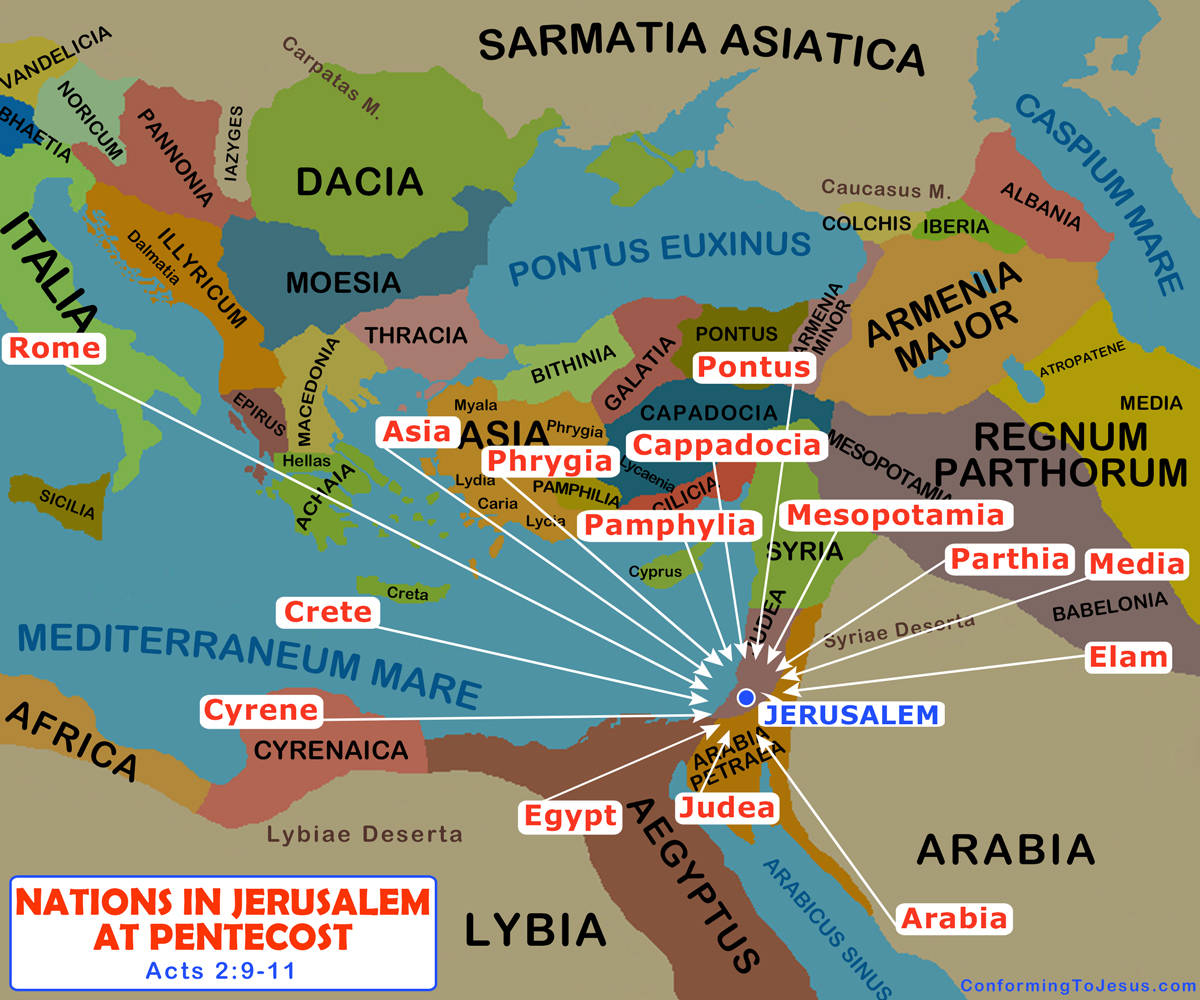
Acts 2:9-11   Parthians and Medes and Elamites and residents of Mesopotamia, Judea and Cappadocia, Pontus and Asia, Phrygia and Pamphylia, Egypt and the parts of Libya belonging to Cyrene, and visitors from Rome, both Jews and proselytes, Cretans and Arabians…

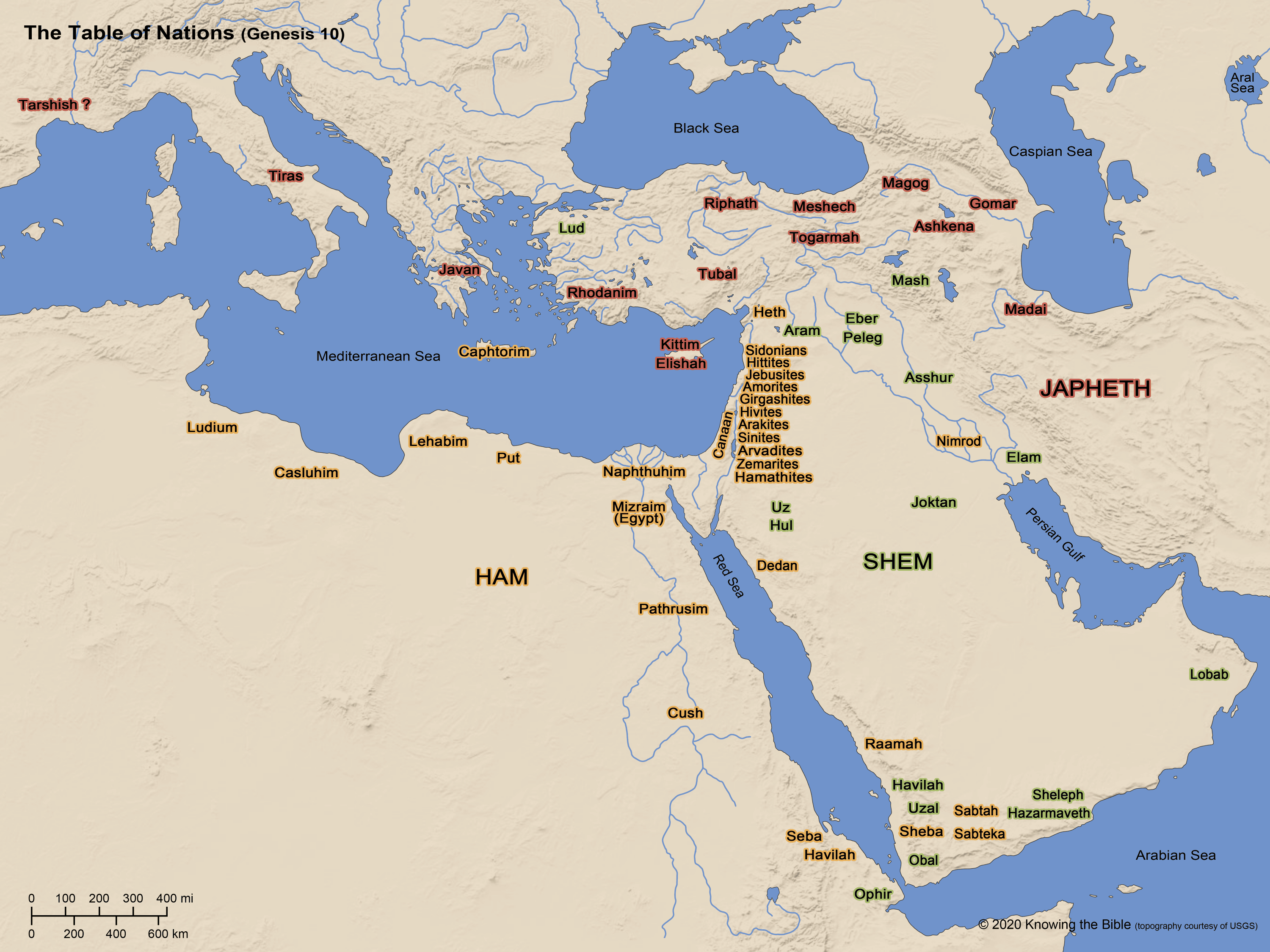
Here is a map of the places that Luke mentions; it is most of the known world at the time.  Devout Jews had traveled from all these places to gather in one place in Jerusalem.  Why does Luke go into such detail about who is there?  Because if you know your Bible, you know there is another place in the Bible where you can find a very similar list of nations.   It is way back in the Bible in Genesis 10 where the scriptures show how Noah’s sons and their descendants scattered to follow God’s command to be fruitful and fill the earth.  

Here is the area listed in Genesis 10 where all the people after Noah scattered to.  And three times in Genesis 10, it says these were all separated into their lands by their languages.

Now, don’t be confused, because this list of nations in Genesis 10 describes the results of what happened in Genesis 11.  In our culture, we like our books to be in chronological order.   First things first.  However, in Old Testament times, they weren’t as concerned with chronology, and therefore, you will see them present events out of chronological order for various reasons.  For example, Numbers 9 clearly happens exactly 1 month before Numbers 1.  Genesis 11 (the story of the tower of Babel) is the event that leads to the scattering of people to all the nations listed in Genesis 10.

Luke takes the time to list all the countries from which people came on Pentecost because he wants you to recall the other list in Genesis.  He wants you to see the connection between what happened in Genesis and what is happening at Pentecost.  Let’s back up and look at the pattern of events in the first 10 Chapters of the Bible.

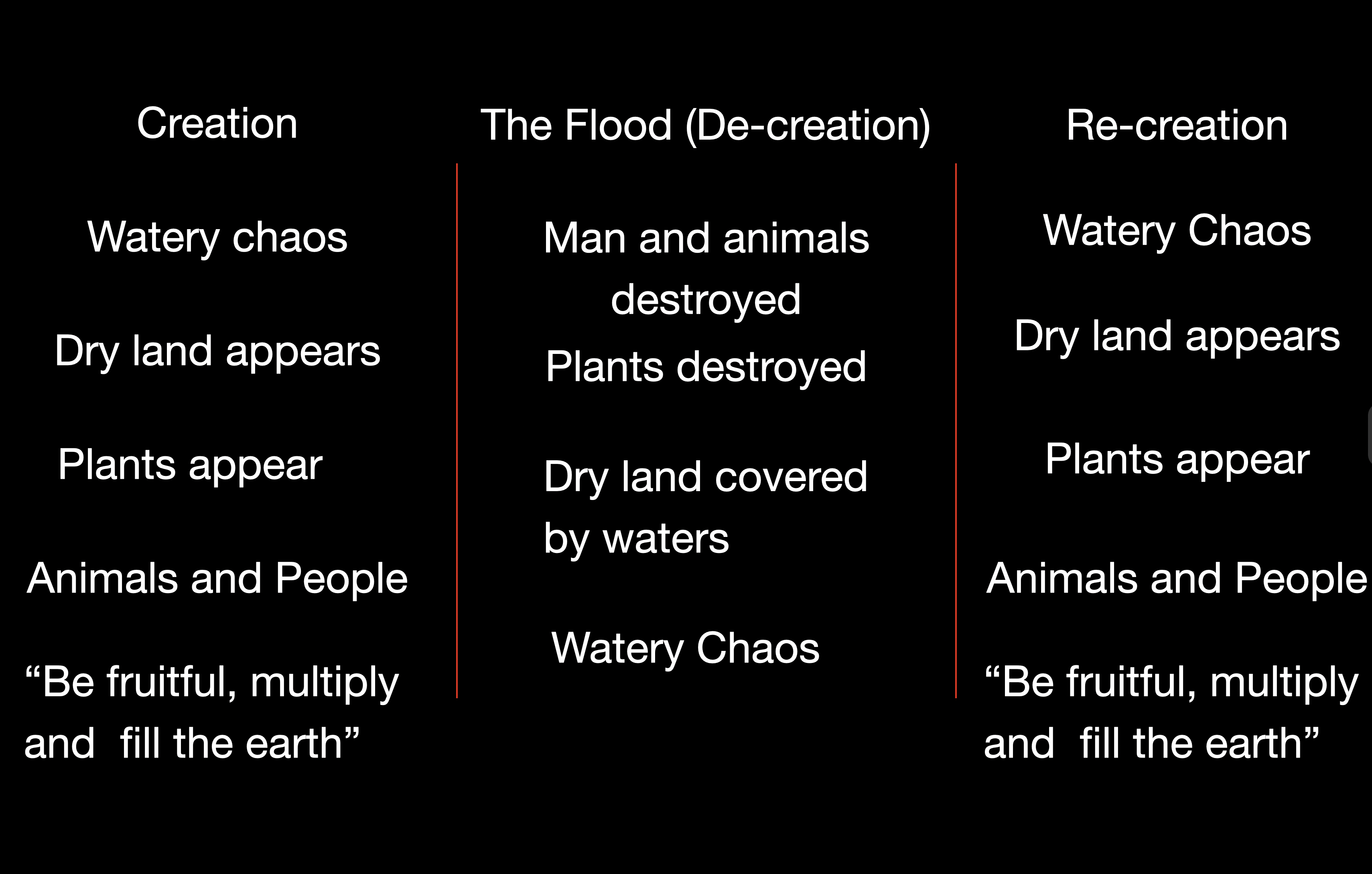
Creation.  The spirit hovers over the chaos waters.   God makes dry land appear, then plants to grow, and populates the world with animals, and then places man.  He tells man to be fruitful, multiply, and fill the land.  After the fall, things go downhill very fast.  So in Genesis chapter 6:

Genesis 6:5-6   Yehovah saw that the wickedness of man was great in the earth, and that every intention of the thoughts of his heart was only evil continually. And Yehovah regretted that he had made man on the earth, and it grieved him to his heart.

“Every intention of the heart was only evil continuously.”  That’s bad.  How does God respond?

Genesis 6:7-8   So Yehovah said, “I will blot out man whom I have created from the face of the land, man and animals and creeping things and birds of the heavens, for I am sorry that I have made them.” But Noah found favor in the eyes of Yehovah.

But Noah found favor.  It is the Hebrew word ‘chen’, which means ‘grace’.  Noah found grace.

So God causes a flood.  We are meant to see the flood as a de-creation event.  It is creation backwards.  Man is destroyed, animals and plants are destroyed, and the chaotic waters again cover the land.  It is creation in reverse.  Only a remnant is saved through grace on an ark.  

Then, like a re-creation event, you start with everything in a watery chaos, and then the waters recede, revealing dry land. The emergence of plants follows this, and then animals and humans are placed back on the land, on Mount Ararat.  And God tells them again to be fruitful and fill the land.  

But just like after the first creation, things go downhill quickly.  Sin abounds.  And instead of filling the land, they rebel and choose to stay in one place, and build a city and a tower to make themselves great, to reach up to heaven and be great like God. You know this story:

Genesis 11:1-4    Now the whole earth had one language and the same words. And as people migrated from the east, they found a plain in the land of Shinar and settled there. And they said to one another, “Come, let us make bricks, and burn them thoroughly.” And they had brick for stone, and bitumen for mortar. Then they said, “Come, let us build ourselves a city and a tower with its top in the heavens, and let us make a name for ourselves, lest we be dispersed over the face of the whole earth.”

Let US make bricks, build OURSELVES a city and a tower.   Let US make a name for OURSELVES.   God has no place in the actions of the people building this great city and tower.   He is forgotten or ignored.  What God says doesn’t matter.  We can decide for ourselves what is right and wrong.   It is all about me!  God had commanded them to multiply and fill the earth, but they had forgotten this instruction; instead, they wanted to remain where they were.

They wanted to reach up to heaven.  That doesn’t sound like it has to be a bad thing.  After all, God’s goal is to dwell with humanity again, as He did in the Garden.  But they didn’t want to do it God’s way; they wanted to do it on their own, in their own way.  They thought they could reach up to heaven all by themselves.   They could do it without God. Just as in Genesis 3, humanity is attempting to exceed its limits. “Let us build a tower with its top in the heavens” sounds a lot like what the serpent said, “And you will be like God.”  “Let us make a name for ourselves.”  Then all people will honor us and give us praise and glory. This is Genesis 3 all over again on a larger scale.  

This is similar to Adam and Eve’s desire in Genesis 3.  Knowing the difference between good and evil is not a bad thing. It is really important to understand the difference.  That is one of our most important jobs as parents: to teach our children right from wrong.  But the problem in Genesis 3 is that they didn’t want God to tell them or teach them; they wanted to reach out and take it for themselves.  No thanks, God, we don’t need you to instruct us; we’ll decide right and wrong on our own.  They could accomplish this without God. They could be Gods themselves—their own gods.  That’s like a 2-year-old screaming at his parents, “But that’s not fair! I want to make my own rules!”  God wants them to learn to judge right and wrong.

However, it must be His own definition of right and wrong.  This first sin in Eden still plagues us today.  We think we can legislate morality.  But we are not at liberty to alter God’s definition of right and wrong when we feel like it.  We can’t change right and wrong by voting on it.  It doesn’t matter what Congress, the president, or the Supreme Court says.  There is only one that determines right and wrong, and it is not a court that calls itself ‘supreme’, but it is the Supreme Being, Yehovah God, King of the universe.  He is the sole judge of right and wrong.

We live in a great country and have enjoyed a long time of success and prosperity.  The danger with greatness is that you may forget how you got there.  Moses warned the people in Deuteronomy that when they became prosperous in the land, they would forget God.  They would forget God’s rules and decide they can make their own rules and be their own God.  We need to pray for repentance and revival in our country.  

Adam and Eve decide they can’t live by God’s rules.  They reject him as king, so God intervenes.  They are forced to leave the garden.  Now look how God intervened in Genesis 11: 

Genesis 11:5-7   And Yehovah came down to see the city and the tower, which the children of man had built. And Yehovah said, “Behold, they are one people, and they have all one language, and this is only the beginning of what they will do. And nothing that they propose to do will now be impossible for them. Come, let us go down and there confuse their language, so that they may not understand one another’s speech.”

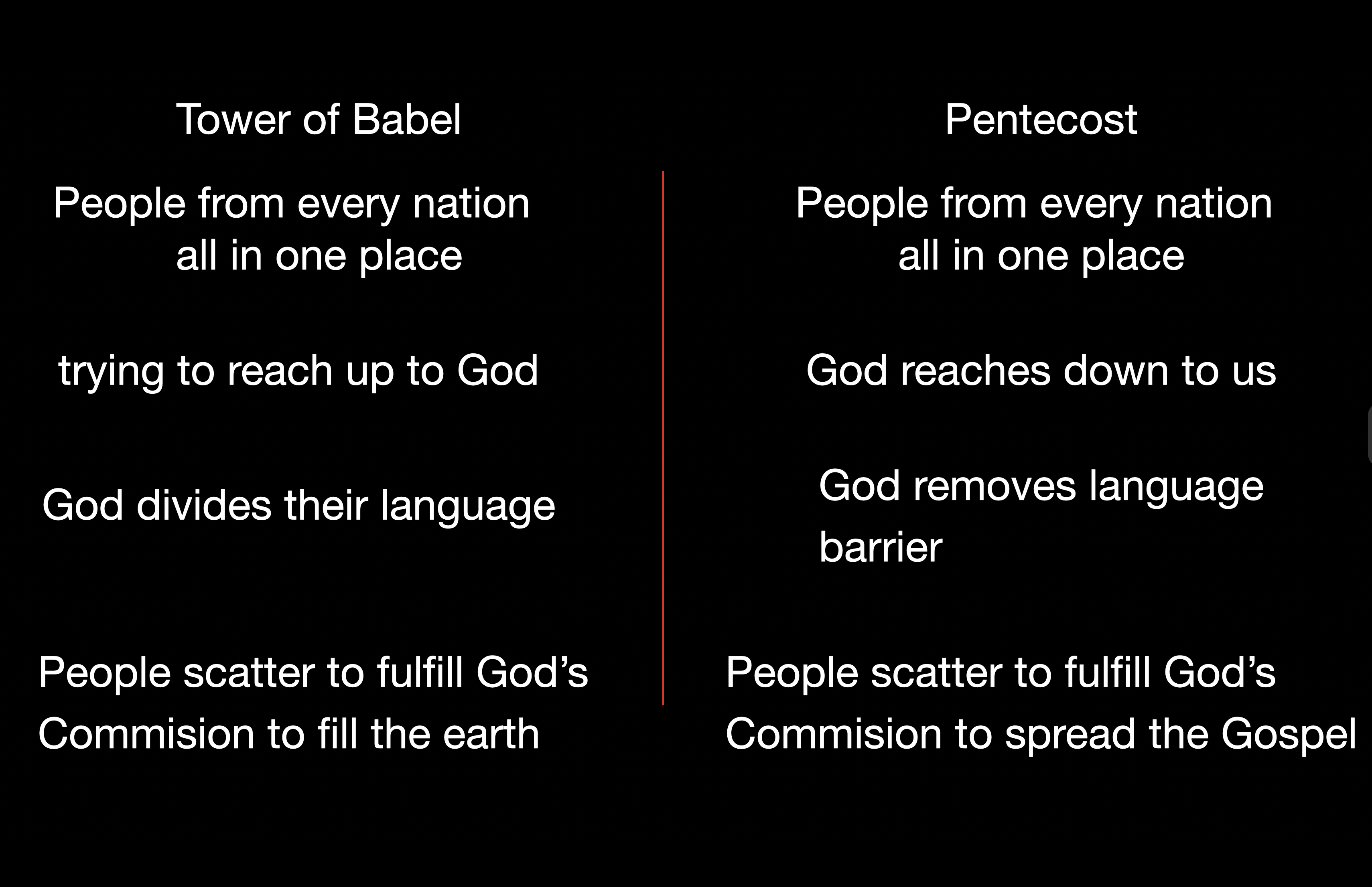
I like how it says, “Yehovah came down to see the city and the tower…”  This is how fruitless their godless attempts were.  They are trying to reach up to heaven, and yet God has to come down to reach them.  God says their unity is a bad thing.  Being united is only good if we are united under God.  The people of Babel were united for themselves.  So God intervenes.  He divided their languages, which forces them to abandon their construction project as they can no longer communicate with each other.  They naturally separate into their various language groups and begin to fulfil God’s plan to fill the earth. 

At Pentecost, God is repairing what went wrong in Babel.  At Babel, there were people from every nation all in one place.  They were trying to reach up to God’s space. But that is impossible.  We can’t make our way to heaven on our own.  Then God divides their languages to end their communication and thus bring an end to their sinful project.  This causes people to scatter in order to fulfill God’s command to fill the earth.

At Pentecost, Luke tells us that they were devout men from every nation, all gathered together in one place.  And God reaches down to them by sending His Holy Spirit to abide with them. He removes the barrier of different languages so they can communicate.  And the communication is not man’s words, to glorify man, but God’s words to bring glory to God. Then the people go back to all the nations, where they will fulfill God’s Great Commission to disciple others by sharing the good news of Jesus.  God is again intervening in the world to redeem what went wrong.  

The more you study the Bible, the more you see these patterns.  The Bible is a collection of books intricately designed because God wants you to see how he consistently deals with His people.  The more we study His Word, the better we will recognize these patterns as well as God’s actions in our world today. And that is important.  These people in Acts 2 asked, “What does this mean?”  I am afraid that we often look at the events of the world around us, just as the disciples looked at the man born blind.  They were asking the wrong questions, “Whose fault is this?  Why was he born blind?”

Another war breaks out, more disasters occur, peace comes and goes, health problems develop, friends die, babies are born, people come to your aid, and others fail you. Throughout these times, we should not ask, “Whose fault is this?” or “Why did this happen?” The right question is, “What does this mean for the kingdom of God?” or “What is God doing here?”  Look for God moving every day, all around you.  Don’t live like the people in Babel, ignoring God or pretending He doesn’t exist.

I can’t tell you exactly what you would have heard if you were there on that Pentecost Sunday in the Temple in Jerusalem.  I can’t describe what the fire looked like or exactly what the noise sounded like.  I can’t tell you what the disciples said that everyone heard in their own language.  But that’s okay, because that is not what is important.  I can answer the question that those receptive to the disciples’ speaking asked.  “What does this mean?”

It means God’s plan to reunite His Spirit with humans is happening, just as Joel predicted.  It means we, like the disciples, can experience the presence of God living in us through the same Holy Spirit that descended upon them like fire. God is multiplying his presence in this world; the Kingdom of God is now.  The problem at Babel is now solved.  We can, through the Holy Spirit, be united under God..

After the Flood, God made a promise.  He put a bow in the sky and said

Genesis 9:11 Never again shall there be a flood to destroy the earth.

God would never again cover the earth with the waters to destroy. However, God did promise that He would cover the earth again.   With what?

Isaiah 11:9   For the earth shall be full of the knowledge of Yehovah as the waters cover the sea.”

And the same Holy Spirit that came down on the disciples is in you.  And we have that same Commission they had.  Every time we gather together in one place in our churches, as they did on that Pentecost morning, we worship as they worshiped.  And we should see the Holy Spirit in each other, manifested through the fruits of the Spirit.  And then when we walk out these doors, we will scatter to different parts of our world with the same goal.  To disciple all we come in contact with.  Let us flood the earth with the love, mercy, and grace of our God.  

June 17  –  The Decision to Replace Judas — Acts #3

Acts #3 — The Decision to Replace Judas
Acts 1:15-26

Last week, we completed our 70-week study of Jesus’ ministry.  We will continue the Bible’s story with the Book of Acts, Luke’s second volume.  We have already covered the ascension and the coming of the Holy Spirit at Pentecost in Acts chapters 1 and 2.   There is one other story in Acts 1 that we will cover today, and it happens just before Pentecost.  

One thing I don’t want you to miss as we study the book of Acts is that the coming of the Holy Spirit is a turning point in the Bible and the history of the world.  Part of what we will concentrate on is the significant difference the Holy Spirit makes in God’s people.  The Holy Spirit is essential to living the abundant life Jesus discussed.  After that Pentecost, God’s Spirit is now not just in one person, Jesus, but in over 3000 people who are scattering throughout the known world.  And the number of people carrying God’s Holy Spirit continues to multiply today.  

Jesus said: 

John 14:12   “Truly, truly, I say to you, whoever believes in me will also do the works that I do; and greater works than these will he do, because I am going to the Father. 

You are going to hear this verse a lot.  It confuses many people because they first wonder how anyone could do anything greater than Jesus did.  Secondly, they don’t see how Jesus going to the Father has anything to do with his disciples doing greater works.  But remember our discussion of Jesus’ ascension.  Jesus performs the duties of our high priest.  He enters the holy place and offers the sacrifice for our sins to the Father, and then he gives the blessing from the Father – God’s very presence in the form of the Holy Spirit. Greater works than these will be done because God’s presence in our world has been multiplied. This is the difference the Holy Spirit makes.

Before this, in the time of history after the fall and before Jesus, the manifestation of God’s presence to His people was very limited.  He appeared to Noah.  He appeared to Abraham and his descendants at times.   He appeared to all of Israel at Mount Sinai and on several occasions. The Old Testament contains the stories of how God occasionally clothed people with the Holy Spirit.   But these visitations of God’s presence were very few, with at times hundreds of years between.

Moses expressed the desire that all people have God’s Holy Spirit. 

Numbers 11:29    Would that all the Yehovah’s people were prophets, that Yehovah would put his Spirit on them!

And then Jesus came, God in flesh.  And Jesus appeared to many thousands at one time on several occasions.  But think throughout history, how many people living in the world never had the opportunity to witness firsthand a specific manifestation of God.  Jesus came to change that.   Because the Holy Spirit was sent in Jesus’ name, all who believe and follow Jesus will have an encounter with God personally.  And now God’s power is available to work in every follower.  This is the difference the Holy Spirit in us makes.

But just before the Holy Spirit comes, we have this story in Acts 1:

Acts 1:15, 21-26   In those days Peter stood up among the brothers (the company of persons was in all about 120) and said, “Brothers, the Scripture had to be fulfilled, which the Holy Spirit spoke beforehand by the mouth of David concerning Judas…    
So one of the men who have accompanied us during all the time that the Lord Jesus went in and out among us, beginning from the baptism of John until the day when he was taken up from us—one of these men must become with us a witness to his resurrection.”
And they put forward two, Joseph called Barsabbas, who was also called Justus, and Matthias. And they prayed and said, “You, Lord, who know the hearts of all, show which one of these two you have chosen to take the place in this ministry and apostleship from which Judas turned aside to go to his own place.” And they cast lots for them, and the lot fell on Matthias, and he was numbered with the eleven apostles.

Why must there be a replacement for Judas?  Are eleven apostles not enough?  Jesus chose twelve disciples and told them: 

Matthew 19:28  “Truly, I say to you, in the new world, when the Son of Man will sit on his glorious throne, you who have followed me will also sit on twelve thrones, judging the twelve tribes of Israel.”

Twelve thrones must be filled.  In his complete rebellion, Judas has disqualified himself.  So, a replacement must be chosen. Note that later, when James, the son of Zebedee, is martyred by Herod Agrippa in Acts 12, there is no need to replace him.  We will see James on that throne later.  But they must replace Judas.

So this is a monumental decision.  And how do they choose the person to take this position?  First, they discussed the qualifications.  They must have been there for the entire ministry of Jesus, from his baptism in the Jordan to his resurrection.  They wanted an eyewitness.   So they narrowed it down to two individuals, and they “cast lots.”  Did they draw straws, flip a coin, or roll the dice?  We don’t know, but it was something along those lines.  Does it bother you that the decision of who will sit on a throne of judgment in Heaven was left to something like a coin toss?

Let’s say that one day you decide to hire a financial investor to help you handle your money.  You interview several people and you ask them about their investment strategies.  How will you choose where to invest my money?   One of them says, “When deciding how to invest other people’s money, I usually just flip a coin to choose which investment to take.  Sometimes I roll the dice and sometimes just close my eyes and point.”  I am going to guess that this guy would not be your first choice.  After all, no reasonable person would ever make a major life decision by flipping a coin or rolling the dice.  That is ridiculous… isn’t it?  

Yet in Acts 1, the disciples choose someone to sit on a throne and be a judge in the New World by casting lots.  Casting lots to make big decisions was standard practice in many of the cultures seen in the Old Testament.  When Jonah was running from God and the ship was in a storm, the pagan sailors cast lots to see whose God was angry at whom. 

Jonah 1:7   “And they said to one another, ‘Come, let us cast lots, that we may know on whose account this evil has come upon us.” So they cast lots, and the lot fell on Jonah.”

This was standard practice for many religions in the day. But it wasn’t just in the pagan cultures.   In Israel, when they decided to divide the promised land and determine which tribe got which property, they did it by casting lots. On the Day of Atonement each year, the High Priest would cast lots to see which of the two goats would become the scapegoat and which would be sacrificed.  The Book of Exodus gives instructions for two stones, named the Urim and Thumim, to be worn in a pouch in the High Priest’s breastplate.  They were often used to cast lots as a way to determine God’s will.

Once, in Samuel, the Israelites were at war with the Philistines, and Saul determined to attack them.  The people followed his decision, but the High Priest said they should ask God.  This was a life-or-death decision.   So they asked God, but He did not answer.  They reasoned that God refused to answer because someone in the camp had sinned.  To determine who had sinned, they again consulted the Urim and the Thumin, the High Priest’s “holy dice.”  

Here is the story:

1 Samuel 14:36-42  Then Saul said, “Let us go down after the Philistines by night and plunder them until the morning light; let us not leave a man of them.” And they said, “Do whatever seems good to you.” But the priest said, “Let us draw near to God here.” And Saul inquired of God, “Shall I go down after the Philistines? Will you give them into the hand of Israel?” But he did not answer him that day. And Saul said, “Come here, all you leaders of the people, and know and see how this sin has arisen today. For as the LORD lives who saves Israel, though it be in Jonathan my son, he shall surely die.” But there was not a man among all the people who answered him.
Then he said to all Israel, “You shall be on one side, and I and Jonathan my son will be on the other side.” And the people said to Saul, “Do what seems good to you.” Therefore Saul said, “O LORD God of Israel, why have you not answered your servant this day? If this guilt is in me or in Jonathan my son, O LORD, God of Israel, give Urim. But if this guilt is in your people Israel, give Thummim.” And Jonathan and Saul were taken, but the people escaped. Then Saul said, “Cast the lot between me and my son Jonathan.” And Jonathan was taken.”

So God answered them through the holy dice, the Urim and the Thumim, and revealed that Jonathan sinned by breaking their fast.  Again, it may seem strange to you that these life or death situations are left to the roll of two stones.  You might want to stop Saul and say, “But rolling the dice is random! That is no way to decide!”  And everyone there would think you were the heretic.  Casting lots is only odd if you think the result of tossing the stones is left to chance.  And no one in Israel thought the answer was left to chance.  God would control the result to give His answer.  This is stated very clearly in Proverbs:

Proverbs 16:33  The lot is cast into the lap, but its every decision is from the LORD.

This proverb says the dice are rolled in your lap, but the result is not random.  God intervenes and controls the result.  We still use this idea when we say “your lot in life.”   And perhaps you’ve heard of the “lottery.” But our view is that the lottery is just random, a one-in-a-million chance to win.  But this is different.  

The writer of this proverb and all those who cast lots had a very high view of God’s sovereignty — God’s control over the world.   We can all agree that God has control over His creation.  He is not some cosmic watchmaker who created the world, wound it as one would wind a watch, and then left it to run on its own.  We can all agree that we see God intervening in the world in the Bible.  But how much control does God maintain over this world and your life?  

This is a highly complex question, and many theologians, much smarter than I, reach different conclusions and use scripture to support their positions. 

My Calvinist friends believe God is completely sovereign over every aspect of life.  Not a leaf falls to the ground nor an airplane falls out of the sky that is not determined by His will.  Moreover, they maintain that God has willed (predestined) that some individuals will be saved and some will not.  And those individuals do not have a choice.  They say Judas was destined by God to betray Jesus.  God determined that Judas would do this.  Nothing else could happen.  There is no other way Judas’ story could end.   

That is not what I see in the scriptures.  I certainly believe that God is sovereign, but that he created people with free will.  People have the option to make decisions contrary to God’s will.  Even though God wants everyone to be saved, people can freely choose to reject God. 

1 Timothy 2:4   [God] desires all people to be saved and to come to the knowledge of the truth.”

Judas had a choice.  He didn’t have to betray Jesus.  They were going to arrest Jesus anyway.  Judas just made it easier.  Everyone has a choice.  God can make his plan happen without forcing people to sin.  God is so good that He can accomplish his will despite some people’s choices.  God often intervenes in the world to cause everything to work toward good.  When people choose evil and cause harm to come to others, God is in the business of taking that bad situation and causing it to work for good.   But God’s perfect will is not done on earth now due to humanity’s bad choices.  

One day, God’s will is going to be completely done on earth as it is now being done in heaven.  That is what we pray for in the Lord’s Prayer:  “Thy Kingdom come.  Thy will be done on earth as it is in heaven.”

These two ways of approaching the idea of sovereignty are much more complex than this.  So please search the scriptures for yourself and seek the guidance of the Holy Spirit.  I believe God loves us and does everything He can to encourage us to make the best decisions.  I think that applies to all people, as the Bible says.   I believe God wanted Judas to be saved.  When I read the Bible, I see God constantly intervening in people’s lives to lead them to where he would have them to be.   I don’t think our lives are random any more than the result of casting lots was random. 

But the Bible clearly says that prayerfully casting lots presumed that God determined the result.  It was His will, not just random chance.  So why are we not doing that today?  Is it because we believe God no longer has the power to control the roll of the dice?  Is it because we don’t think God cares enough about our decisions to give us the correct answer?  Is it because we are enlightened in our modern world and believe we are so intelligent that we don’t need God’s help to make good decisions?  

Though we see many instances of casting lots throughout the Old Testament and again here after Jesus’ ascension, there is not one example of casting lots in the Bible after this point in Acts chapter 1.2  Why? There are many times in the New Testament stories about the apostles making difficult and sometimes life-or-death decisions, but never after this episode in Acts 1 do we see them consulting God’s answer by casting lots.  

Why?  Because the next event in the Bible is the coming of the holy spirit.  This is what Jesus’ ministry was leading up to: victory over sin and death and the blessing of the Holy Spirit. These things are part of God’s plan to dwell with his people again.  And now that the Holy Spirit is within us, there is no need to cast lots again.  So, how does the church in Acts make decisions?

Acts 13:2   While they were worshiping the Lord and fasting, the Holy Spirit said, “Set apart for me Barnabas and Saul for the work to which I have called them.”

God speaks to them through the Holy Spirit.  “The Holy Spirit spoke while they were worshiping and fasting. Do you want to hear from the Holy Spirit?  Here is your first clue: worship and fast.   We do not hear because we don’t listen.  We have not trained ourselves to listen to God. We are too busy doing other things. Can you hear from the Holy Spirit while watching TV or surfing the internet? Absolutely. God can speak at any time. However, while you are watching TV or surfing the internet, when the Spirit speaks, His message to you might be, “Stop watching TV!” or “Get off the internet!”  But if you really want to hear God’s Spirit, you should follow his direction to worship, fast, and pray. Remember, Paul told Timothy:

2 Timothy 1:6   Fan into flame the gift of God, which is in you through the laying on of my hands,”

Fan the flame.  Encourage the Spirit by being obedient.  Cultivate a relationship with the Spirit within you. You won’t hear from the Spirit if you are constantly dumping buckets of water on the fire.  Here is another example of the Spirit’s direction:

Acts 16:6   And they went through the region of Phrygia and Galatia, having been forbidden by the Holy Spirit to speak the word in Asia.

Paul thought heading west to Ephesus was the right move, but the Spirit said NO! You can’t go there now.    “There is a way that seems right to a man”….. “Lean not on your own understanding.  In all your ways acknowledge him, and he will direct your paths.“

And we know the Holy Spirit sometimes speaks through visions:

Acts 16:9-10   And a vision appeared to Paul in the night: a man of Macedonia was standing there, urging him and saying, “Come over to Macedonia and help us.” And when Paul had seen the vision, immediately we sought to go on into Macedonia, concluding that God had called us to preach the gospel to them.”

And in Acts 15, the apostles met in Jerusalem to solve the church’s most significant question in the first century.  What about Gentiles who want to follow the Jewish Messiah?  Must they become Jewish first?   Must they be circumcised?  Must they stop eating shrimp?  

They came to that meeting with very different opinions on the matter.  And they meet and discuss this, and then they come to an agreement.  How did they decide?  Here is their report:

Acts 15:28   For it has seemed good to the Holy Spirit and to us to lay on you no greater burden than these requirements…

“It seemed good to the Holy Spirit and to us.”  The voice of the Holy Spirit came to them, and they agreed with the Spirit.   Now let me ask you, “Is this how you make decisions?”  

God loves you and wants the best for you, and he has placed His Spirit within you to guide you.  Oh, that we would listen.

The Holy Spirit is speaking to your heart, to lead you in the path God wants you to take. God is not just sitting back watching.  He is bringing people into our lives for a reason.  He is challenging you so you can grow and comforting you so that you may know peace in the storm.  If we can only open our eyes to the work of God in this world, then we will see all the times that God intervenes and directs our path, all of those bad situations we avoided, and all of the accidents we didn’t have.  We would see that really few things in our lives are coincidences, and very little is left to chance.

I recently reenrolled in Hebrew classes.  I started 10 years ago and had to stop after a few years because my Pediatric practice was leaving me with too little time.  In the past 2 weeks, I have been reviewing vocabulary words and came across this Hebrew word, miqreh, which means “chance or accident.”  I remember coming across this word years ago, and knowing the Scripture’s high view of God’s sovereignty, I wondered where it was found in the Bible and how it was used.  But I never found the time to look it up then.  But now I had the time. You only see this word 10 times in the whole Hebrew Bible.  Here is one verse:

Ruth 2:3   So she set out and went and gleaned in the field after the reapers, and she happened to come to the part of the field belonging to Boaz, who was of the clan of Elimelech.

The Book of Ruth is short, but it is packed full of wisdom. The story occurs during the period of the Judges, a bleak time of Israel’s failure and rebellion.   A famine forces Naomi, her husband, and her two sons to leave Israel and live in Moab.  Her husband dies there, and Naomi’s two sons marry women from Moab.  One of those women is Ruth.  Later, both sons die, and Naomi is left with her two daughters-in-law. Three widows left together.   Naomi returns to her country, Israel, and Ruth agrees to go, even though it means leaving her homeland.  Life is hard for the two widows.  They live in poverty, gathering the remnants of the grain harvest left in the field. 

Ruth just “happened” to come, of all the fields around Bethlehem, to the one who belonged to a relative of Naomi.  However, how the writer of Ruth has crafted the story makes it evident that this is no accident.  The writer emphasizes God’s involvement in the story all along.  God takes the horrible circumstance of the death of the three men and works the story for the good.   Ruth thought she ended up at Boaz’s field by accident.  Too often, we are like Ruth and chalk up the work of God to good luck.   Boaz becomes the kinsman-redeemer who rescues Naomi and Ruth from poverty.  Boaz and Ruth have a son, Obed, who becomes the grandfather of David and the ancestor of Jesus.  God has taken something bad and made good out of it.  And it was not an accident or coincidence.

God is just as active in our lives as he was in Ruth’s.  There are many fewer coincidences in life than we might realize.  I love how Oswald Chambers says it in his devotional, “My Utmost for His Highest”:

“God engineers our circumstances as He did those of His Son; all we have to do is to follow where He places us. The majority of us are busy trying to place ourselves.”3  

God is intimately involved and moving in our lives on a daily basis.  Just yesterday, Shirley shared with a friend at lunch about one such incident. 

We were leaving New York City, where we had been for a week.  Meriel had won a drama competition and was invited to participate in a trial run of a new Dreamworks play that they were demonstrating for some Disney executives.  We were at the airport past security when Shirley realized her purse was left at the hotel.  The purse that had our car keys for the car parked in Atlanta.  We decided it was worth the trip back, and Shirley insisted that Meriel and I take the flight that was leaving soon. She changed her flight to the next one and then took a taxi back to pick up her purse.  

She got on the plane, and a woman sat down beside her.  God ordained this meeting.  This woman was going through a terrible situation, and she needed help.  She needed some godly counseling.  And she “happened” to sit by my wife, a pastoral counselor, for a several-hour flight.   God went to a lot of trouble to set this up.  This was no more an accident than Ruth gleaning wheat in Boaz’s field.  And I could tell you many stories where God moved us and our circumstances for the cause of Christ.  God is active in our world and is working good all around us.

God is powerfully sovereign, constantly moving in the world he created.  Despite the popular Christian song, I don’t think God has to tell the sun to rise every morning.  He designed a beautiful universe where gravity and other forces keep the sun and the moon in their orbits for billions of years with no need to make adjustments.  God can intervene in the sun’s orbit if he desires it (see Job 9:7 and Joshua 10).  But he initially set things up so well that it doesn’t need regular adjustment.   He doesn’t need to push each leaf off the trees in the fall.  In his design for this world, leaves fall when it is their season.  And the sun and the leaves are obedient to the laws God set up for them in the beginning.  But people are not leaves or planets.  We have free will.  We are not always obedient.  We are capable of making decisions that run counter to God’s will.   So unlike the sun’s rising, God must constantly intervene in our lives to work things for good.  If we sin and choose a wrong path, God, out of his love, mercy, and grace, intervenes to urge us back on track.   He brings people into our lives to encourage us to return.  God’s love for us is so great that he continually adjusts our world to help us do the next right thing.

God promised that this time would come: 

Isaiah 42:16   And I will lead the blind in a way that they do not know, in paths that they have not known I will guide them.  I will turn the darkness before them into light, the rough places into level ground.  These are the things I do,  And I do not forsake them.

This is what God does.  His Holy Spirit constantly goes before us, leveling the ground in ways we do not see.  

We are often blind to God working in our lives.  Think about your past week.   Like Ruth, you might see something that happened as a chance encounter or an accidental meeting, but it was God-directed and meant for your good.  We need to have the attitude of the lot casters who said…

Proverbs 16:33  The lot is cast into the lap, but its every decision is from the LORD.

Here is the attitude we need:

Proverbs 16:9   The heart of man plans his way, but Yehovah establishes his steps.

When you walk out your door today or when you wake up tomorrow morning, you may have plans for your journey, but expect the Holy Spirit to intervene.  Remember when we discussed the Great Commission and Jesus said:   “As you go about living life, disciple people.”

Let me encourage you again to view every person that comes into your life, every “chance encounter”, as if God has purposely brought you together.  What would you say to someone, and how would you act differently if you knew God had specifically arranged for them to meet you that day?  I believe God directs our lives, so we have many daily opportunities to influence people for God’s Kingdom. This is how we fulfill the Great Commission.  Much more good is done for God’s kingdom through the encounters of his people just doing life than all the preachers and missionaries put together.   We need to be more aware that God is placing people in our path and looking for opportunities to display Jesus.

So you can get rid of your ‘Holy Dice.’  You don’t need them.  We have the Holy Spirit within us.  We must live lives of worship, prayer, and fasting, fanning the flame of God’s spirit in us.  As we go through the book of Acts in the following months, we will see how the Holy Spirit made a difference in the lives of the early church.  Let us decide to imitate their response to the coming of the Holy Spirit.  Ask God to open your eyes to see Him working all around you. Ask God to give you ears to hear.  God is speaking.  Are you listening?

  1. This is where our word comes from for the land we own.  Our “building lot” is 1.3 acres.  
  2. It is interesting that Luke begins his Gospel and the Book of Acts with a casting of lots. In Luke 1:9, we learn that Zechariah was chosen by lot to offer incense in the Temple when the angel came to announce he would have a son.
  3. Chambers, Oswald.  My Utmost for His Highest. 1924.

June 10  – The Ascension — Acts #1

Acts #1 — The Ascension
Mark 16:15-19, Luke 24:50-53, Acts1:1-11, Hebrews (many passages)
(Cross-posted in the 70 weeks with Jesus section.)

Luke 24:50-51   And he led them out as far as Bethany, and lifting up his hands, he blessed them.  While he blessed them, he parted from them and was carried up into heaven.  And they worshiped him and returned to Jerusalem with great joy, and were continually in the temple blessing God.

We love to celebrate the significant happenings in the life of Jesus.  We primarily make a big deal of Christmas and Easter, as days to honor Jesus’ birth and resurrection.  I can’t imagine any Christian I know forgetting to celebrate either of these.  But do you celebrate Jesus’ Day of Ascension?  You probably didn’t notice that it just passed us by.  This year it was  Thursday, May 29.  It is always 40 days after Easter.  It may never be mentioned if your church does not follow a liturgical calendar.   We all know that Jesus ascended back to the Father.  But we never seem to talk about it.  

Why do we not talk about or celebrate Jesus’ ascension?  Well, we mention it a lot.  It is part of the creeds recited at each service in many churches.  From the Apostles’ Creed: “…he ascended into heaven, and sits at the right hand of God the Father Almighty; from there he shall come to judge the living and the dead.”  But I can’t recall hearing a sermon, Sunday School lesson, or reading a book about the ascension.  

Three weeks ago, I was looking ahead to this day, when our week-by-week study of Jesus’ ministry came to the ascension.  And I realized that I hadn’t ever thought much about the ascension.  I had no idea what I could share with you.  But let me tell you how good God is.  He led me to a book by Patrick Schreiner, “The Ascension of Christ, Recovering a Neglected Doctrine.”  This book and the book of Hebrews pointed out to me the importance of the ascension and what Jesus is doing now in the presence of God for us.

Schreiner notes that there are several reasons that we don’t emphasize the ascension. First, there is not much specific information in the Bible about the ascension.  Schreiner states: “The ascension narrative account covers a mere seven verses in the Bible, which, if you are counting, is 0.03 percent of all the verses in the Scriptures.”1

While there are very few verses describing the ascension event, there is a good deal of discussion in the Scriptures about the implications of Jesus’ ascension.  However, many of those we miss because we don’t understand the importance of the ascension.

The disciples didn’t understand the ascension either at first.  They were not expecting Jesus’ ascension.   He had told them, but they missed it.  For all they knew, Jesus had returned from the dead so he could resume his ministry with them.  In Luke’s second book, the Book of Acts, he begins the book the way he finished the Gospel of Luke, with Jesus’ ascension.

Acts 1:1-5  In the first book, O Theophilus, I have dealt with all that Jesus began to do and teach, until the day when he was taken up, after he had given commands through the Holy Spirit to the apostles whom he had chosen.  He presented himself alive to them after his suffering by many proofs, appearing to them during forty days and speaking about the kingdom of God.
And while staying with them, he ordered them not to depart from Jerusalem, but to wait for the promise of the Father, which, he said, “you heard from me; for John baptized with water, but you will be baptized with the Holy Spirit not many days from now.”

Jesus tells them plainly that the Holy Spirit is coming in just a few days.  The disciples knew the scriptures.  They knew that Isaiah, Ezekiel, Joel, and Zechariah all spoke of the new age that would come when the Holy Spirit came.2. So now they expect the new age to begin in just a few days, and they ask him:

Acts 1:6   So when they had come together, they asked him, “Lord, will you at this time restore the kingdom to Israel?”

Despite everything Jesus has taught them, they are still expecting that when the new age comes, the Messiah will restore Israel to national independence and remove the Roman oppressors. They have been hanging on to this idea of a Messiah with a military takeover throughout the past year, at times even discussing what positions of authority they would have when Jesus took over.  As he did at Jesus’ arrest, I can see Peter picking up his sword again and saying, “So now’s the time you are going to wipe out Rome and restore Israel’s kingdom?.

And Jesus answers:

Acts 1:7-11   He said to them, “It is not for you to know times or seasons that the Father has fixed by his own authority. But you will receive power when the Holy Spirit has come upon you, and you will be my witnesses in Jerusalem and in all Judea and Samaria, and to the end of the earth.” And when he had said these things, as they were looking on, he was lifted up, and a cloud took him out of their sight. And while they were gazing into heaven as he went, behold, two men stood by them in white robes, and said, “Men of Galilee, why do you stand looking into heaven? This Jesus, who was taken up from you into heaven, will come in the same way as you saw him go into heaven.

Jesus says the Father’s timing for the last days is not their concern.  It is not for them to know the Father’s timing or worry about that.  Instead, their focus should be on their task as witnesses.  The kingdom of God that they are to proclaim to the world is his message of grace and forgiveness.  That is what is important.  Talk about a Mike Drop moment – Boom!  Impressive statement, impressive exit.

Let me say that a little louder for my friends on the internet.   Stop wasting time arguing, debating, and trying to figure out the Father’s timing on the last days. Jesus says that it is none of your business.  God has given us this incredible gift of the Holy Spirit.  And we have God’s power through the Holy Spirit so that we can be powerful witnesses to God’s message of grace.  Let’s do that.

So the next time someone wants you to watch this 1-hour video on how the end times are being fulfilled, whip out Acts 1:7-9 and tell them God said I don’t have time to waste trying to figure out things that are not for me to know.  I need to spend that hour with the Holy Spirit, being God’s witness to the world.

So Jesus blows their mind with his pronouncement, then blows their mind with his sudden departure.  This was not at all what they expected.  (That was a recurring theme for the disciples with Jesus the whole year.). So they are just staring up at the clouds, with that dumb, clueless look on their faces.   Just staring at the cloud….Until God sends a couple of angels:

Acts 1:10-11  And while they were gazing into heaven as he went, behold, two men stood by them in white robes, and said, “Men of Galilee, why do you stand looking into heaven? This Jesus, who was taken up from you into heaven, will come in the same way as you saw him go into heaven.”

“Stop staring at the sky.  He’ll come back, but not today.  Go do what he told you to do.”

We don’t realize the importance of the ascension, so we find ourselves asking questions.  Perhaps you’ve thought about some of these:
Why did Jesus have to go?
Wouldn’t it have been better if Jesus had just stayed on earth?
Why did he have to leave for the Holy Spirit to come?
What is Jesus doing up there anyway?   
Are any of these your questions?

We talk all the time about what Jesus has done on earth (his life, death, and resurrection), and we like to talk about what he will do when he comes back, but we rarely talk about what Jesus is doing right now.  I think we would better understand the ascension if we realized how it fits into the big story of the Bible.

But the problem is that many people don’t have a firm grip on the Bible’s story. We talk a lot about heaven and earth, and some people get the idea that one day, we will leave Earth and go to heaven. But the Bible does not really view heaven and earth as two distinct, separate geographic locations. We need to think in terms of “God’s space” and “our space” and how they were the same in the beginning in Genesis 1-2.  

It helps to picture this, and I think the people at the Bible Project have done the best job illustrating this concept.  So please take 6 minutes and learn much as you see their video.

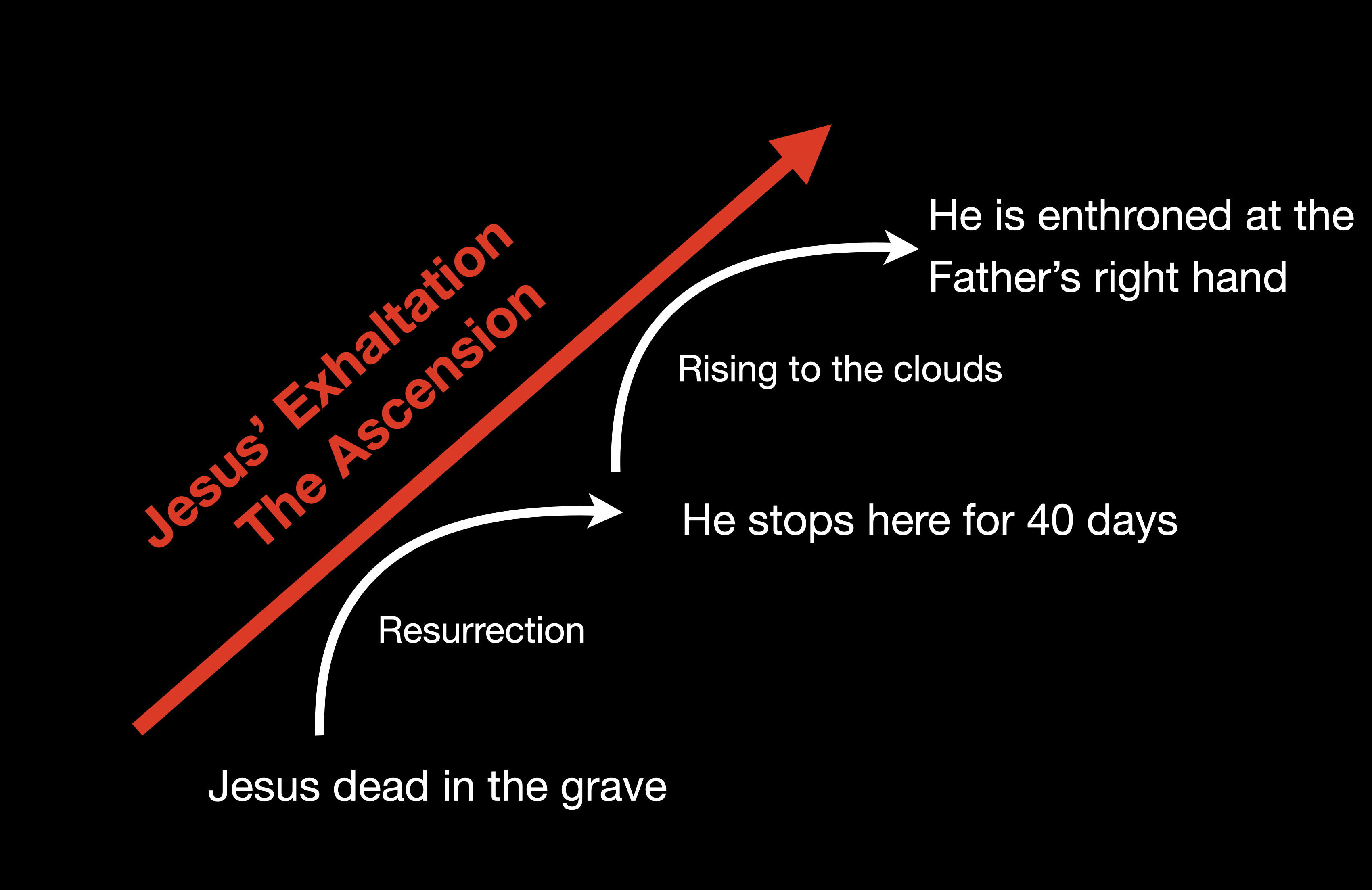
The Bible discusses the ascension almost as part of the resurrection.  Jesus was dead, then he rose from the grave in bodily form, but a glorified body (It was recognizable but not so easily.  He was able to pass through walls or appear instantly.).  But it is still a human body, bearing the scars of his crucifixion.  He rises from the dead, then stops off here, like a short layover for 40 days for some unfinished business.  He wants to ensure the disciples accept his return to life by seeing him.  He needs to make sure their guilt over denying him does not keep them from doing the work, and then he needs to give them final instructions on their ministry and the need to wait on the gift of the Spirit.

Then he ascends in his glorified human body to sit at the right hand of the Father.  So we have Jesus, in his human body, in God’s space.  The New Testament writers often speak of Jesus’ exaltation: his resurrection, rising to heaven, and enthronement as one process, the ascension.  Jesus has opened the door for us to be with God again one day.

Jesus tried to explain this to Nicodemus:

John 3:13-15   No one has ascended into heaven except the one who descended from heaven, the Son of Man.  And as Moses lifted up the serpent in the wilderness, so must the Son of Man be lifted up, that whoever believes in him may have eternal life.

No one ascends to God’s space except Jesus.  The only way we go is if we go with him.  There is no other way.  The Son of Man must be lifted up — This encompasses the crucifixion, the resurrection, and the ascension.  Jesus was lifted up on the cross, lifted up from the grave, and then lifted up into the skies.  Because of this, we may have “eternal life,” which is life in God’s space.

And what is Jesus doing there?  Jesus is at the right hand of God, acting as our high priest.  In the Bible, priests served God and God’s people by mediating between God and man before God’s altar, where God’s space and our space meet.  The book of Hebrews is full of statements of how Jesus is fulfilling the priestly role in God’s space now.  I will discuss three of these priestly roles Jesus is doing now:  He intercedes for us; He presents a sacrifice for us, and He provides a blessing to us.

Hebrews 7:25  Consequently, he is able to save to the uttermost those who draw near to God through him, since he always lives to make intercession for them.

What does Jesus’ intercession look like? You have heard Romans 8:31, “If God is for us, who can be against us?” But did you realize that verse was talking about Jesus’ intercessory role?

Romans 8:31-34   “What then shall we say to these things? If God is for us, who can be against us? He who did not spare his own Son but gave him up for us all, how will he not also with him graciously give us all things? Who shall bring any charge against God’s elect? It is God who justifies. Who is to condemn? Christ Jesus is the one who died—more than that, who was raised—who is at the right hand of God, who indeed is interceding for us.

Who can be against us?  Who can be our accuser?  Remember in the book of Job, when the Satan (the accuser) comes to bring a charge against Job?  Paul tells us no one can bring a charge against those in Christ.  Let the accuser come.  He has no charges to bring against us because Jesus has taken them all away on the cross.  Jesus is at God’s throne, so no one can come to accuse.  If Jesus is for us, then no one can come against us.  He is always making intercession for us, speaking to the Father on our behalf.   

As Jesus in His final days prayed for Peter:

Luke 22:31   Simon, Simon, behold, Satan demanded to have you, that he might sift you like wheat, but I have prayed for you that your faith may not fail.

Jesus is in heaven, praying for you that your faith will not fail.   And Jesus understands your temptation.  Look at this passage in Hebrews 4:14-16.  First verse 14:

Hebrews 4:14  Since then we have a great high priest who has passed through the heavens, Jesus, the Son of God, let us hold fast our confession. 

The fact that Jesus is present as our high priest in the throne room of God should encourage us.

Hebrews 4:15  For we do not have a high priest who is unable to sympathize with our weaknesses, but one who in every respect has been tempted as we are, yet without sin.

Humanity is represented in heaven right now, because Jesus is there in his human body, his glorified human body.   Jesus did not give up his humanity, so he can better represent us there.  He understands us.  He has been where you are, experiencing all the temptations, all the weaknesses.  Jesus knows us.  He gets us.  And he speaks to the Father on our behalf.

Hebrews 4:16   Let us then with confidence draw near to the throne of grace, that we may receive mercy and find grace to help in time of need.

So then, we can come to God’s throne when we are in need with confidence. We don’t approach God’s throne as a lowly subject fearful of the King’s response, but we come sure in the grace of our Lord Jesus, confident that he has paved the way to the throne with intercession.

Remember a few weeks ago we talked about the difference in the 2 fig trees (April 27, 28 A.D.  – Jesus rides in a parade, rearranges furniture, and kills a tree.— The Year of the Lord’s Favor #80). Jesus tells a parable in Luke 13:6-9 of a fig tree that should have fruit but does not for three years. The owner wants to dig it up and discard it, but it is given another chance.   Then, in his final week, Jesus sees a tree that should have fruit, but does not, and it dies.  Why does this tree wither, but the other gets another chance?   Because the tree in the parable has an intercessor, someone to speak for it and ask for another chance.  Jesus is our intercessor, sitting by the Father, seeking mercy and forgiveness for us.

We often ask our friends to pray for us, to intercede for us.  And that is a good thing.  But sometimes we may forget to pray for each other.   Jesus is at the Father’s right hand, praying for you.  He is lifting you up by name.  He is speaking to the Father, calling you his brother or sister.  He is praying, O Father, help her see the truth of this scripture.  Father, help her understand how she should respond.  Oh, what a Savior!

Secondly, Jesus, our High Priest, provides a sacrifice for us.

Hebrews 5:1 “For every high priest chosen from among men is appointed to act on behalf of men in relation to God, to offer gifts and sacrifices for sins.”

Just as the altar stands between the holy place and the people, the priest stands between the people and God.  He offers a sacrifice to God on behalf of the people and then offers a blessing from God to the people.  And once a year, and only once a year, on Yom Kippur, the Day of Atonement, the High Priest would make an offering and prepare himself, then ascend the 12 steps leading up to the thick curtain that separated the holy place from the Holy of Holies.  This curtain or veil was embroidered with cherubim, signifying the priest was entering God’s space.  He would take the blood of the offering to present to God by sprinkling it on the mercy seat.  

Every year, this would be repeated to make atonement for the sins of all the people.  But it was not a perfect system.  The priests were also sinners and had to make offerings for their sins constantly.  But they looked forward to a time when there would be a great high priest who could ascend to God’s space without sin.

David asked in Psalm 24:

Psalm 24:3-4  “Who shall ascend the hill of the LORD? And who shall stand in his holy place?
He who has clean hands and a pure heart, who does not lift up his soul to what is false and does not swear deceitfully.”

And this would be fulfilled in Jesus.  He was without sin, he had clean hands and a pure heart.  He is the only one worthy to ascend to God’s space and stand in God’s presence.  And because we are covered with his righteousness, we will stand in God’s presence.

Hebrews 9:11-14   “But when Christ appeared as a high priest of the good things that have come, then through the greater and more perfect tent (not made with hands, that is, not of this creation) he entered once for all into the holy places, not by means of the blood of goats and calves but by means of his own blood, thus securing an eternal redemption. For if the blood of goats and bulls, and the sprinkling of defiled persons with the ashes of a heifer, sanctify for the purification of the flesh, how much more will the blood of Christ, who through the eternal Spirit offered himself without blemish to God, purify our conscience from dead works to serve the living God.”

The sacrifice Jesus makes for us is himself, a perfect sacrifice. Though the high priest would enter the holy of holies only once a year,  priests in Israel would make many sacrifices every day.  Besides the offerings that people brought, twice a day, every day, a lamb was sacrificed, called the tamid offering, for the sins of the people.  Tamid means “continual” or “constant.”  Their sacrifices were never complete.

Hebrews 10:11-14   And every priest stands daily at his service, offering repeatedly the same sacrifices, which can never take away sins. But when Christ had offered for all time a single sacrifice for sins, he sat down at the right hand of God, waiting from that time until his enemies should be made a footstool for his feet. For by a single offering he has perfected for all time those who are being sanctified.

Unlike the earthly high priest who had to make sacrifices daily, Jesus’ perfect sacrifice is once for all.  His crucified body, still bearing the scars, is always before the Father as our perfect sacrifice.  No other blood sacrifices are needed.

The third aspect of the work of the high priest that Jesus is fulfilling for us is blessing. In the Old Testament, when the high priest completed his sacrifices, he left the tent of meeting, lifted up his hands, and blessed the people.  We see this initiated with Moses and Aaron:

Leviticus 9:23   And Moses and Aaron went into the tent of meeting, and when they came out they blessed the people, and the glory of Yehovah appeared to all the people.

And the book of Numbers gives us the blessing they would use.

Numbers 6:22-27   Yehovah spoke to Moses, saying, “Speak to Aaron and his sons, saying, Thus you shall bless the people of Israel: you shall say to them,
‘Yehovah bless you and keep you;
Yehovah make his face to shine upon you and be gracious to you;
Yehovah lift up his countenance upon you and give you peace.’
So shall they put my name upon the people of Israel, and I will bless them.”

Aaron and the priests were to place God’s name, Yehovah, on them and bless them.  The blessing is the presence of God among them, shining his face on them, regarding them, and giving them peace.  Peace is shalom, wholeness, peace with God and man.

And what blessing does our High Priest, Jesus, grant us from the heavens?  Jesus enters God’s presence and then, as priests of old did, sends us the blessing of God’s presence.  But this blessing of presence comes not as the priests of old placing God’s name on them.  This blessing of presence comes by placing God himself in us, in the person of the Holy Spirit, sent in the name of Jesus, Yeshua, to dwell with us.  This presence of God within us will enlighten us and give us shalom.

John 14:25-27  “These things I have spoken to you while I am still with you.  But the Helper, the Holy Spirit, whom the Father will send in my name, will teach you all things and bring to your remembrance all that I have said to you.  Peace I leave with you; my peace I give to you.

John 16:7   Nevertheless, I tell you the truth: it is to your advantage that I go away, for if I do not go away, the Helper will not come to you. But if I go, I will send him to you.

Like the High Priests of old, Jesus had to present himself as the sacrifice before the Father in God’s space, the heavenly temple. After presenting the sacrifice, He gave the blessing of the Holy Spirit. That is why Jesus had to ascend before the Spirit could be sent down.

With his ascension, the door was opened from God’s space to our space. He has not only made our eventual ascension possible but also opened the door for God to come in a more tangible way into our space.  Individuals in the Old Testament were temporarily clothed with the Holy Spirit to do specific deeds: leaders like Saul and David, craftsmen like Bezalel, and prophets like Ezekiel and Daniel. But when Jesus enters God’s space in his glorified human body, He opens the door for God’s spirit to come upon all believers, not just temporarily, but to live with us. He cleanses us from sin so we can be fit vessels of God’s Holy Spirit.  

What about those who think it would be better if Jesus had stayed on earth?  Wouldn’t it be great for Jesus to be right here now?  We could ask him questions, get his advice, and watch him work.  Yes, but remember when Jesus was here in 28 AD, he was limited in his human form.  He could only be in one place at a time.  And this is a big world.  He was only able to minister to a relative few.  But now that same spirit of Jesus, the Holy Spirit, is with every believer, every day, every hour.  He is available to answer our questions and give us advice.  Oh, we need to learn to listen to his voice and open our eyes to see him at work all around us.

So we have seen that Jesus had to ascend to God’s space to complete his work of salvation, to continue his work of intercession, and to convey his blessing of the Holy Spirit from God’s space to ours.

The ascension is Jesus’ enthronement.  He sits on the throne at the Father’s right hand to do all these things and then one day to come again, to establish his complete rule by making God’s space and Man’s space one again.  And so shall we ever be with the Lord.

  1. Schreiner, Patrick.  The Ascension of Christ: Recovering a Neglected Doctrine (Snapshots).   Page 7.
  2. Isaiah 32:15-20, 44:3-5, Ezekiel 11:19, 36:26, Joel 2:28-3:1, Zechariah 12:8-10

An addendum on the Gospel of Mark ending that contains the ascension:
There are two Gospel passages that tell about Jesus’ ascension.  However, most scholars agree that the passage in Mark is not part of the original document of Mark’s Gospel, but was appended by some unknown person over two hundred years later.  The early church fathers, before 300 AD, did not have Mark 16:9-20 in their copies of Mark.  Church historian Eusebius, in 320, had access to many manuscripts of Mark, and he remarked that this passage was missing in almost all manuscripts.  Ending the Book of Mark at 16:8 is a rather abrupt conclusion, and apparently someone ‘borrowed’ material from other gospel writers to make a more thorough conclusion.  

This is one of just a few passages that scholars agree have been appended to the scriptures.  You may find them enclosed in brackets or with a footnote in modern versions of the Bible.  None of them are important variations, theologically speaking.  

I cannot find any source that discusses where the verses on drinking poison and picking up serpents came from.  There is a verse in Luke 10:19, and Paul was inadvertently bitten by a viper with no ill effects, but nothing else I can find.  (If you know of something, please let me know.). In the Tyndale Commentary, Alan Cole says this: “It would be unwise, however, to build a theological position upon these verses alone; and this no responsible Christian group has ever done.”

And I sat in the furthest back pew (there were only 5), one evening at a small church near Kingston, Georgia, who did just that.  They had that verse from Mark inscribed around the tops of the walls at the front of the church.  There was a lot of music, several snakes were handled, but no one took the Coke bottle with clear liquid on the altar.  While I can’t agree with their theology or practice, I admired their resolve.  May we be so bold as to do what Jesus asks us to do.

June 15  – Shavuot (Pentecost) — Acts #2

Acts #2 — Shavuot (Pentecost)
Acts 2:1-13
(Cross-posted in the 70 weeks with Jesus section.)

We have reached week 70 in our study. We began in January, looking at John the Baptist as the forerunner to Jesus. The 70-week study of Jesus’ ministry started on February 16th, with Jesus’ baptism. We have followed Jesus week by week as he traveled about, teaching, healing, and discipling his small group. 

As I was looking back this week, I asked many people this question: “What is the climax of Jesus’ ministry?”  Most said the climax was the crucifixion or the resurrection, which are good answers.  But to decide on the climax of the story, let’s review the plot, the story of the Bible, which is all about Jesus.

God created a world and people and said it was good.  And God and his people lived together in the same space we call the Garden of Eden.  But sin came in Genesis 3 and broke the fellowship between God and his people.  Sin and death entered the world.  And the rest of the Bible is the story of how God is working to restore his relationship with his people, to reunite heaven and earth.   

In Exodus, God tells Moses to build a tabernacle, “So I can dwell with them.” God establishes his presence in this small people group, leading them with a pillar of fire and cloud.  Later, Temples were built as places where God’s and man’s space could overlap. But even with constant sacrifice, sin is not completely dealt with. People continue to be rebellious.  

So Jesus comes, Emmanuel, God with us.  And for a short time, God is present with us in the person of Jesus.  Through Jesus’ crucifixion and resurrection, sin and death are defeated so that we have the possibility of eternal life with God.  And then in his ascension to the Father and his enthronement at the Father’s right hand, He serves as our High Priest and from there sends us the blessing of the Father, which is God’s presence with all of us.  In Jesus, God is fulfilling his goal of communion with us by sending the Holy Spirit to live in us.  And we have become temples, filled with God’s presence, where God’s space and man’s space overlap.   Is this the climax?

God is not finished, because the day is coming when Jesus will return to complete his work.  He is coming again to bring a complete end to sin and death and to restore God’s kingdom over all, and heaven and earth will be one again.  That is the day that the prayer you constantly pray will be answered.   “Thy kingdom come. Thy will be done on earth as it is in heaven.”  This is the climax of Jesus’ ministry – when he returns and God has completed his redemption of the world.

But today we are talking about the arrival of the Holy Spirit.  Just before he ascended, Jesus told the disciples the Holy Spirit was coming in a few days.  They were to wait in Jerusalem until then.  And what did they do while they were waiting?

Luke 24:50-53   While he blessed them, he parted from them and was carried up into heaven. And they worshiped him and returned to Jerusalem with great joy, and were continually in the temple blessing God.”

First, they worshipped right there.  Then they returned to Jerusalem.   And how did they spend their time there?  They were continually blessing God.  And where were they meeting to bless God?  The Jewish Temple.   What does it mean to bless God?   Blessing is from the root word to ‘bend the knee.’   We praise and thank God for who he is and what he has done.  And Jesus, as a young boy, was taught the traditional Jewish blessings.  It seemed that there was a blessing for everything. 100 blessings a day.

When we wake up: “Blessed are you, O Lord our God, King of the Universe, who has given me today the breath of life.” When we have food: “Blessed are you, O Lord our God, King of the Universe, who brings forth bread from the earth.” And when we go to bed:  “Blessed is He who brings sleep to my eyes and slumber to my eyelids.”

Blessing God — this is how we worship God every day, everywhere.

Worshipping While Waiting.  Do you like to wait?  I have to confess that I am not good at waiting. I can, at times, be annoyingly impatient, especially when driving. The light turns green, and suddenly, the three seconds it takes the car in front of me to go seem an eternity.  Am I the only one like this?  The disciples took advantage of this time of waiting to bless God.

So, this past week, I experimented with finding reasons to thank or bless God anytime I found myself waiting, worshiping in waiting. At 5:45 a.m. on Tuesday morning, driving from Georgia to Alabama, at the four red lights in a row (with no other cars present), I am blessing God.  “Blessed are you, our Lord, King of the universe, who has made such a beautiful day.  Blessed are you, Yehovah, who has created coffee so I can be fully awake.”

Later that trip, I got behind a large truck doing 15 mph up the mountain in Crossville. (This happens almost every time.) But this time, instead of complaining to myself about the delay, I am blessing God.  “Blessed are you, our Lord, king of the Universe, who has given me a chance to see this amazing view off the mountain.”  Let me tell you, it was a much better drive.

The disciples didn’t know exactly when the Spirit would come.  Jesus told them the Father’s timing was not for them to know.  

Why is God waiting 10 days?  What is He waiting for?  When you study the scriptures, you find God is very intentional with his timing.  The Old Testament often speaks of the “fullness of time.”  Jesus says over and over in his Gospels, “My hour has not yet come,” until he prays in Gethsemane, and then says, “The hour has come.”  God makes sure that Jesus is crucified as the Passover lambs are being slain, and he is resurrected on the day of the Feast of FirstFruits.  So it should not come as a surprise that God is setting up the coming of the blessing of the Holy Spirit at a special time.

Pentecost is from the Greek pentekostos, meaning “50″, because it is 50 days from Passover.  By the time of Jesus, the Jews had been celebrating that day for over a thousand years.  In the Hebrew Scriptures, it is called Shavuot, which translates into ‘sevens’ or ‘weeks.’   Leviticus 23 commanded them to count seven ‘sevens’ or seven weeks and then one day.  Then there was a special offering with grain and animals, as well as a special reading and convocation.  (Leviticus 23:15-21).   This was one of the three feasts that the scripture required all males to attend and make an offering.  (Deuteronomy 16:16).  So, as in Passover, the city is packed with over a hundred thousand Jews from all over the known world who have made their way to Jerusalem for this special day, bringing offerings of thanksgiving for God’s blessings.  

Isn’t it interesting that God tells them to count up 50 days?   The scriptures specify the day that the Passover falls as the 14th day of the 1st month.  But the Bible never says that Shavuot is on the 6th day of the third month.  It simply says to count the days.  For 50 days, they have a special grain offering in the Temple and would make a ceremony of counting the days.  It is all about anticipation.  Something great is coming.  

Shavuot is a harvest celebration.  As Passover and Firstfruits celebrate the barley harvest, Shavuot, 50 days later, celebrates the wheat harvest. But they are both more than harvest celebrations.  Passover celebrates the night they were spared the death of the firstborn, and they escaped bondage in Egypt.   Shavuot also commemorates the giving of the law on Mt Sinai, which Exodus tells us happened 50 days after the first Passover.

We talked about how seven is the number of completeness throughout the Bible.  If seven is completeness, the eighth in the series is the beginning of something new.  In Genesis, God set up the week of seven days; the eighth day is the start of a new week.  We have seen many examples of sevens in the Gospel of John.  Jesus has seven table meals in John’s Gospel with people; the eighth is after the resurrection.  There are seven confessions people make about Jesus, and then the eighth one, after the resurrection, is the one that is new and different.  For the first time, He is recognized as God.  The eighth of something is new.  So we count 7 weeks, seven sevens — complete completeness, then the next day is something radically new —Pentecost.  God is doing a new thing.   To the Jews in Jesus’ day, the new thing was the giving of the law.

And that encounter with God at Mount Sinai was dramatic and powerful.  The mountain is filled with fire and smoke and noise, with the whole mountain shaking violently.  The people were filled with fear and refused to go up the mountain as God had invited them, so they sent Moses for them.   We have discussed this powerful manifestation of God seen here, and how it is repeated at the dedication of the tabernacle with the cloud and fire consuming the sacrifice and God’s glory filling the space. 

This same overwhelming presence of God was seen again at the dedication of Solomon’s temple.  Again, fire came down from heaven, consuming the sacrifice, and again, God’s glory filled the Temple. But the people continued to rebel, and you remember that God punished his people for their sin by allowing the foreign nation of Babylon to conquer them.  

Ezekiel, the prophet, saw in a vision the presence of God leaving Solomon’s Temple.  Then the temple and the city of Jerusalem were destroyed, and all the people taken captive.  Seventy years later, when they returned to the land of Israel, they rebuilt the temple and had this grand dedication service.  But unlike the dedication of the tabernacle, unlike the dedication of Solomon’s temple, this time, God did not show up.  There was no fire, no wind, no cloud, and no sound.  God did not return because the sins that led to their exile still remained.  They had not repented.

But God revealed to Ezekiel that though God had abandoned this Temple, He had not abandoned His people.  One day, he would return to His temple.   And all the prophets in the Old Testament looked forward to this time when God would return.  As the final prophet in the Old Testament, Malachi said:

Malachi 3:1    Behold, I send my messenger, and he will prepare the way before me. And the Lord whom you seek will suddenly return to his temple;

And they waited, and they waited… 400 years they waited.   Until that messenger that Malachi spoke of came… John the Baptist – the one crying in the wilderness to prepare the way of the Lord.  And then, about 16 months later, God finally returns to the temple.

God comes to the temple in the form of Jesus.  He comes riding on a donkey as King David and Solomon did.  And he enters the temple on that Palm Sunday.  But he comes not to be praised, but to judge.  That is when he overturns the tables of the crooked money changers and drives out the corrupt animal salesmen.  He comes with harsh words of judgment for the religious leaders of the day.  And they kill him.  And he is resurrected, but he does not return to the temple again.  He is coming back to the temple just as Ezekiel and the other Old Testament prophets foresaw, but not yet.  Just look at the picture God is painting in history:

For 400 years, the children of Israel were held in slavery in Egypt.  400 years of waiting for redemption.  And Passover comes, and they are delivered from slavery, passing through the sea and traveling 50 days to Mount Sinai, where God’s presence shows up in mighty form.  Then you skip forward in history, and after the last prophet spoke in the Old Testament, for 400 years, they waited for God to return to His Temple. For 400 years, they waited for redemption. And Passover comes again, and through the death of Jesus on the cross, deliverance comes from slavery to sin. And then 50 days later, God’s presence comes in a mighty way to his temple. It is Pentecost. Could God make this any clearer?  He is about to intervene in history again, like he did at Sinai.

Let’s see what happened when God’s presence came on that first day of Shavuot, when God came on Sinai. But first, we have to realize that things of God are hard for the writers of the Bible to describe.  They are trying to represent in words something we don’t have the words to explain or the context to understand.   When Ezekiel sees God leaving the temple, he tries to give us a picture of what he is seeing, God’s throne chariot, but it is indescribable.  So he talks about wheels inside wheels that move in any direction, made of jewels, and multi-faced animals, and well, it is nothing I can picture.  

God is so much greater, so different that we cannot adequately describe his appearance.  So descriptions of God’s appearance or the descriptions of Heaven (God’s space) in Revelation are … well… just bizarre.  The Bible writers do the best they can, but it is like trying to explain a rocket ship to a caveman, or to explain colors to someone who has been blind from birth.  With that in mind, let’s look at how God’s presence at Sinai is described.  

Exodus 20:18   Now, when all the people saw the thunder and the flashes of lightning and the sound of the trumpet and the mountain smoking, the people were afraid and trembled.

Our translators are trying to translate what it says in Hebrew, but they are having problems. Did they ” see” the thunder?  In Hebrew, it actually says,  “When all people saw the voice.” That Hebrew word appears over 500 times in the Bible and is almost always translated as voice, except in Exodus. They use “thunder” to try to describe God’s voice.

Look what Job says about God’s voice:

Job 37:2-4   Listen! Listen to the roar of his voice, to the rumbling that comes from his mouth.
He unleashes his lightning beneath the whole heaven and sends it to the ends of the earth.
After that comes the sound of his roar; He thunders with his majestic voice.
When his voice resounds, He holds nothing back.

So the people “saw the voice of God” and  then “flashes of lightning.”  “Flashes of lightning” is one Hebrew word, “lappidim,” which is always translated as “torches” except in this verse.    This is not lightning.  There is another Hebrew word for lighting (barak) used 21 times in the Bible.  These are pieces of fire that are moving or, as the modern Tyndale commentary says, “fireballs”, like in Abraham’s vision of God.1  Or as Jerry Lee Lewis would say, “Great balls of fire.”2

Many times in the Bible, the voice of God is visualized as flames of fire.  Here is one example in the Psalms

Psalm 29:7   The voice of the LORD flashes forth flames of fire.
  The voice of the LORD shakes the wilderness.

So when God’s mighty presence comes at Mount Sinai, it is hard to describe, but the people see the voice of God like fireballs, and it thunders and roars. Over 1000 years later, on the same day of the year, at the celebration of that Sinai moment, God’s presence comes again on the Temple Mount.  And how does Luke describe it?

Acts 2:1-3 “When the day of Pentecost arrived, they were all together in one place. And suddenly there came from heaven a sound like a mighty rushing wind, and it filled the entire house where they were sitting. And divided tongues as of fire appeared to them and rested on each one of them.”

Notice he doesn’t feel the wind but hears the sound of a “mighty rushing wind”.  In Greek, a “violent” wind.  Have you ever been close to a tornado?  One day, my family huddled in our hall when one passed by.  The sound has been described as a freight train, a thundering, rumbling, howling sound.  It is a frightening sound.

A flame comes and divides itself into tongues of fire.  Tongue in Greek can mean the actual muscle in your mouth or, more commonly, ‘tongue’ is a language.  (We still use the term, “native tongue.”). A few verses later, when it says the disciples speak in “other tongues,” it is, of course, not saying they had different muscles in their mouth, but they spoke different languages.3  As in Sinai, fire divides into pieces, ‘tongues’ or ‘balls’ of fire.  God’s presence is being manifested in much the same way as it was at Sinai. 4 Again, Luke is trying to describe God’s presence, and like the writer of Exodus, he does the best he can.

What we can see is that the day the Old Testament prophets had looked forward to has arrived. God’s presence has finally returned to the Temple after over 400 years of waiting. But where do the flames come from to rest? Not on the Temple building, as when God came to the Tabernacle and Solomon’s temple, but on the disciples’ heads.  The temple that God returned to was not the physical building there, not Herod’s Temple.  They waited over 400 years for God to return to His Temple, and he has.  But the temple is us. 

1 Corinthians 3:16   Do you not know that you are God’s temple and that God’s Spirit dwells in you? 

Jeremiah had seen this coming. 

Jeremiah 31:33   For this is the covenant that I will make with the house of Israel after those days, declares the LORD: I will put my law within them, and I will write it on their hearts.  And I will be their God, and they shall be my people.

Who is there in the temple on that Pentecost?   Jews from all over the world gathered for the required feast—the whole house of Israel.  At the first Shavuot, God gave them the law on stone tablets.  But Jeremiah saw the day coming, a new Shavuot with a new covenant: “I will put my law within them.”  The word they translate as “law” is the Hebrew word ‘Torah.’  And Torah can mean law, or the first five books of the Bible, but it literally means “God’s instructions for living.”   If we listen to and follow the Holy Spirit, God’s Spirit within us will teach us how to live.

Ezekiel 36:26-27 “And I will give you a new heart, and a new spirit I will put within you. And I will remove the heart of stone from your flesh and give you a heart of flesh. And I will put my Spirit within you, and cause you to walk in my statutes and be careful to obey my rules.”

Again, the Holy Spirit within us will “cause us to follow God’s instructions”.   The Spirit will show us how to live and follow God’s rules.  And just after this passage is the vision God gave Ezekiel of the spirit coming.  There was a valley full of dried-up bones.  And God asked Ezekiel, “Can these bones come back to life?”  It sure didn’t look like it.  They were dead and dried up and lying in the sand.  But God said, “I will cause breath to enter you and you shall live.”   And the breath came into them, and they stood and came to life.   

And God tells Ezekiel the meaning of the vision.  The bones are the house of Israel, which is dried up without hope.  But God is going to breathe life into them.  Remember that the Hebrew word for breath is Ruach, the same word for wind or spirit.  In Genesis 1, the Spirit is hovering over the face of the waters.   Then God takes the dust and breathes life into the dust.  God places his breath, his spirit, in us.   Breath is life. 

When a baby is born, it appears lifeless at first, which can be scary. Then, it is stimulated and takes its first breath, and with that first breath come signs of life: movement and crying.  If you have ever witnessed a death, there is that last breath, a final exhale of breath from their lungs.  You can see how long ago people understood breath as life. Breath enters, and there is life; breath leaves, and there is death.  That is why they used the same word for breath, wind, and spirit (in Hebrew ‘ruach’ and in Greek ‘pneuma’). God tells us it is His Spirit, His Ruach, that gives us life.

People look at the Church in the world and see decreasing attendance in worship and decreasing membership, and they say the Church is dying.  I don’t believe that.  Because life is not measured in numbers, numerical growth does not determine life.  It is the spirit that gives life.  If we can learn to accept the presence of the Holy Spirit of God in our lives, then we live.  But so many don’t even consider the presence of God’s spirit in them.

Paul tells his apprentice Timothy:

2 Timothy 1:6   Fan into flame the gift of God, which is in you through the laying on of my hands,”

We need to be fanning the flame in ourselves.  When you invite God into your life, He comes as the Holy Spirit, that fireball from God.  We need to feed that fire by listening to the Spirit, agreeing with the Spirit, and following the Spirit.

Paul repeatedly tells us not to ignore God’s Spirit in our lives.

1 Thessalonians 5:19  Do not quench the Spirit.”
Ephesians 4:30   Do not grieve the Holy Spirit of God.

The Holy Spirit is within us to instruct us, lead us, and make our character more like Jesus so that we will look like him.  The spirit within us causes us to produce this fruit.

Galatians 5:22-23 “But the fruit of the Spirit is love, joy, peace, patience, kindness, goodness, faithfulness, gentleness, self-control;”

This is what a disciple of Jesus looks like.  This is the effect of God’s Holy Spirit in a person.  

Maybe, like me, you look at this list of nine attributes and realize you aren’t listening to the Spirit as much as you should.  Today is a good day to begin being a better listener and follower.

Let me add one more connection between that first Pentecost, that first Shavuot at Mount Sinai, and the Pentecost in Acts 2.  Do you remember when Moses was up on the mountain receiving the Ten Commandments from God? What was going on with the people of Israel?   They have given up on Moses and made a golden calf to worship.   And God sent a plague on the people, and those who were guilty were affected and were then slain by the Levites.  And 3000 died that day (Exodus 32:28).

After the Holy Spirit comes on Pentecost, Peter preaches a sermon. Many decide to follow Jesus and are baptized. How many?

Acts 2:41 “So those who received his word were baptized, and there were added that day about three thousand souls.”

God is redeeming here what was lost before.  God is still in the business of redeeming that which was lost.  And those 3000 Jews from all over the known world who just got baptized will head back to their home countries the next day.   Do you see what God just did there?  3000 missionaries spreading the Gospel to the world, all sent in one day.

And there is a world beyond our doors that is broken and lost.  And God, through His Holy Spirit in us, desires that no one perish, but all come to repentance.  Remember Jesus telling his disciples (John 14.12) that they would do greater works than he did because he was going to the Father? Jesus goes to the Father so he can send us the blessing of the Holy Spirit.  The Spirit of Christ lives in us.  We need to be doing great things.

  1. Cole, R. Alan.  Tyndale Complete Commentary, Exodus.  
  2. The phrase “Great Balls of Fire!” became popular in the southern United States in the mid-1800s, according to “Phrase Finder” (internet website) based on the references in Exodus, as the presence of God indicated by fire.  The phrase became more popular in the South after being quoted multiple times by Scarlett O’Hara in “Gone with the Wind” (1939).  But the best-known use of the phrase was in the song popularized by Jerry Lee Lewis in 1957, “Great Balls of Fire.” Lyrics and music by Otis Blackwell and Earl Burroughs.
  3. Notice that what happens at Pentecost, with all of the people able to understand each other as if they all had the same language, is the reversal of what happened at the Tower of Babel in Genesis.  Those people were arrogantly trying to build their own way to heaven.  At Pentecost, God is making a way for heaven to come to people.
  4. Where did this happen?  Tradition from the 5th century says it was at the Upper Room, where they also had the Last Supper.  But a look at the Scripture makes that less likely.   It is happening on the day of the Feastival of Shavuot, a one-day festival.   The scripture tells us they were in the Temple “continually.”  Peter mentions the time in his sermon after the Spirit comes as 9:00 am.  The temple services typically began with the first Tamid offering at 9 am.  And this service is one of the three times that the Scriptures say is required attendance. They would not have missed the service that is the highlight of the one-day celebration.  And the Scriptures mention that 3000 responded to Peter’s sermon and were baptized.  This had to happen in or near the temple grounds to have a place large enough for a crowd this large to hear them speak, and then to have a place to baptize that many.  There were over 50 mikveh near the Temple Mount, for people to immerse themselves in before entry into the Temple.