
January 28, 27 A.D.  –  What About The Lost? —   The Year of the Lord’s Favor #69

Week 50 — What About The Lost?
Luke 15:1-32

Have you ever lost something that was very important to you?  So crucial that you dropped anything else you were doing to search for it?  So important that you would tear the house apart if that were required to find it?

Jesus continues to teach in the area east of Jordan, and today, we will discuss a set of three parables that Jesus tells of lost things: the lost sheep, the lost coin, and the lost son.   The last one, often called the “parable of the prodigal son,” is one of Jesus’ best-known parables.  But first, the parable of the lost coin.

Luke 15:3  So he told them this parable: “What man of you, having a hundred sheep…

Stop.  Luke says, “So he told them this parable…”  Luke gave us the reason for Jesus’ story.  We must back up a few verses to see why he told these stories together.  What is the context of these parables?  If you ignore the context, you may make some false assumptions about Jesus’ primary purpose.  And we can’t ignore the context here because Luke makes it obvious.

Luke 15:1-2   Now the tax collectors and sinners were all drawing near to hear him.  And the Pharisees and the scribes grumbled, saying, “This man receives sinners and eats with them.”

This is a familiar setting.  The Scribes and Pharisees are grumbling because Jesus is hanging around the ‘wrong people.’  As we discussed a few weeks ago, it mattered who you ate with.  As we said then, dinner invitations were a social investment.  But Jesus just ignored the usual social rules about this.  When he called Matthew, he threw a big party for all the tax collectors.  The religious leaders would never set foot in such a sinner’s house.  Jesus didn’t seem to understand social boundaries.

The Scribes and Pharisees are grumbling.  What does the Bible mean by grumbling?   Read the words.  The words are important.

The root for grumble, ‘gonguzo,’ means murmuring to yourself or muttering.  It is an expression of disagreement, but not out loud, just under your breath.  Let’s see that in a Bible passage:  

John 6:41-43   So the Jewish leaders grumbled about him, because he said, “I am the bread that came down from heaven.”   They said, “Is not this Jesus, the son of Joseph, whose father and mother we know? How does he now say, ‘I have come down from heaven’?”   Jesus answered them, “Do not grumble among yourselves.”

But in our verse today, Luke uses a different form of the word ‘grumbled,’ in Greek, ‘diagongguzo’.  Whereas ‘gonguzo’ is private muttering or grumbling to yourself, ’diagongguzo’ means a crowd of people all grumbling out loud.   They are shouting out their murmurs.

This word appears only twice in the New Testament. The other instance is when Jesus eats at the house of the tax collector Zacchaeus.

Luke 19:7  And when they saw it, they all grumbled, “He has gone in to be the guest of a man who is a sinner.”

Notice that this word is used both times to protest Jesus’ spending time with the ‘wrong people.’   It is also used several times in the Greek Old Testament (the LXX) when the children of Israel grumbled against Moses.  

Exodus 15:24 And the people grumbled against Moses, saying, “What shall we drink?”

They just left the Red Sea and have traveled 3 days out into the desert.  The water there was bitter, and they could not drink it.  So they grumble.  But just 3 days before this, God took an entire body of water and split it open so the whole nation could walk across not on mud but on dry ground.  Then God waited until the Egyptians were in the middle and let the waters collapse on them and drown them.  Just 3 days ago, they saw one of the most incredible miracles in the history of the world.  And now they grumble because they have nothing to drink.  Somehow, they don’t think the God who can split a whole body of water at will could ever control the small amount of water they need to drink. Seriously?  That is the idea of grumbling.  You grumble when you don’t have the faith to believe in God’s ability to deliver.

Luke uses the same word, ‘grumble,’ for the Scribes and Pharisees. This is important. It is the whole reason Jesus tells these three parables. And every time this word is used in the Bible, it is used in the same situation.

Just as in the example of the bitter water, people who grumble like this don’t have the faith to believe that God can deliver, that God can save.  The children of Israel should have immediately thought: “Well, no drinkable water, not a problem for our God.  We know he can provide. He just demonstrated his power over water 3 days ago.  But they had no faith.  

The Pharisees lack faith in God’s ability to deliver the tax collectors and sinners. They ignore ‘those people’ because they feel they are beyond hope. In their minds, saving them is beyond what God can do. That is why Jesus tells these three parables.

Luke 15:3-7   So he told them this parable: “What man of you, having a hundred sheep, if he has lost one of them, does not leave the ninety-nine in the open country, and go after the one that is lost, until he finds it?   And when he has found it, he lays it on his shoulders, rejoicing.  And when he comes home, he calls together his friends and his neighbors, saying to them, ‘Rejoice with me, for I have found my sheep that was lost.’  Just so, I tell you, there will be more joy in heaven over one sinner who repents than over ninety-nine righteous persons who need no repentance.

If you know your Bible, you realize Jesus is stomping on the toes of the religious leaders here.  Suppose one of you religious leaders had a lost sheep.  Wouldn’t you go after it and seek until you found it?

Jesus has preached this sermon before.  Remember back in mid-December when we discussed Jesus calling himself the good shepherd?  That sermon was based on Ezekiel 34, where the prophet was speaking against the religious leaders of his day, calling them bad shepherds who didn’t even really care for the sheep but just used them.  Here is Ezekiel’s accusation of the religious leaders of his day:

Ezekiel 34:4  The weak you have not strengthened, the sick you have not healed, the injured you have not bound up, the strayed you have not brought back, the lost you have not sought, and with force and harshness you have ruled them. 

And Jesus asks in the parable, “Suppose one of you religious leaders lost one of your sheep.  Wouldn’t you go after it to bring it back?  That is Jesus’ point.  It was their job as religious leaders to care for the sheep.  But like those of Ezekiel’s day, these leaders were not good shepherds either.  No, they would not seek out the lost.  If people chose to live lives of sin, the leaders just took their names off the flock’s membership role.  They don’t belong.  These shepherds didn’t seek them out; they purposely avoided them.  There was no grace; there was no mercy.  It is as we discussed last week.  You don’t take away a fruitless branch from a vine; you lift it up.  These people are bad shepherds, and it made Jesus sad.

Matthew 9:36  When he saw the crowds, he had compassion for them, because they were harassed and helpless, like sheep without a shepherd.

And Ezekiel tells us that because the shepherds didn’t care for the sheep and seek out the lost, one day, God himself would come and seek them out. 

Ezekiel 34:11-12   “For thus says Yehovah elohim: Behold, I, I myself will search for my sheep and will seek them out.   As a shepherd seeks out his flock when he is among his sheep that have been scattered, so will I seek out my sheep, and I will rescue them from all places where they have been scattered on a day of clouds and thick darkness.

 And here is Jesus in the first century, doing just that, seeking out the lost sheep that the current shepherds in Israel have ignored and abandoned.

You know that Jesus said, “For the Son of Man is come to seek and to save that which was  lost.”  Do you know when Jesus said this?  It is in Luke 19:10 at the house of the tax collector, Zacchaeus.  Yes, the one that the religious leaders grumbled about Jesus’ going to.  They said, “That tax collector is hopeless; God can not save him.”   Jesus has dinner with him, and Zacchaeus says he will return all the funds he took dishonestly from people and then give away half of everything he owns.  Zacchaeus repents, begins to bear fruit, and has entered the kingdom of God.  He was written off as a hopeless sinner by the religious leaders of the day, but God himself, Jesus, came down to seek out the lost sheep. 

So the good shepherd in Jesus’ parable sought earnestly for the lost sheep and carried it home.  Then the shepherd went around the whole town to invite them over for a massive party with lots of food for the entire village to celebrate.  

Oh, we could stop there, but we have two more parables.  So we’ll fly through this second one to have time for the last one.  Jesus follows with a story about a lost coin.

Luke 15:8   “Or what woman, having ten silver coins, if she loses one coin, does not light a lamp and sweep the house and seek diligently until she finds it?  And when she has found it, she calls together her friends and neighbors, saying, ‘Rejoice with me, for I have found the coin that I had lost.’  Just so I tell you, there is joy before the angels of God over one sinner who repents.”

So this woman had ten drachmas (about 10 days’ wages).  Realize that in Jesus’ day, most purchases were done through bartering.  Not many people kept coins.  This would be a family’s emergency fund.  And she has lost not one out of a hundred, like the sheep, but one out of 10, making the search more urgent.   And she seeks diligently, and after finding it, she prepares a big celebration also.

Luke 15:11   And he said, “There was a man who had two sons.

(Note that we have moved from one sheep out of a hundred to one coin out of ten and now two sons.)

 And the younger of them said to his father, ‘Father, give me the share of property that is coming to me.’ And he divided his property between them.   

We need some context here to understand what a crazy request this is.  We are not nearly as shocked by this as Jesus intended.  The father would not grant his children his property until his death or immediately before it.  The older brother, the firstborn, would typically receive a double share, so the older would get 2/3 and the younger 1/3.  But what this son does is beyond shameful.  He is basically telling his father that he wants him to die.  He cares nothing for his father and the family.  He wants his portion of the inheritance now.

This is evident in the Greek, where it says, “And he divided his property between them.” The Greek is literally “he divided his ‘bios’ between them.”   ‘Bios’ is the Greek word from which  we get our word ‘biology.’  Bios is not property; bios is life.  “He divided his life between them.” Everything the father had worked for all his life —all his property, even his authority over the family, his good name.  It is like he has died.  (Note that the older son does not object but willingly receives his 2/3 portion divided between them.)  The older son has now become the ruler of the household.

Not many days later, the younger son gathered all he had and took a journey into a far country.

So the younger son sells his third of the land and animals that his father worked his life to produce. He takes the money and goes to ‘a far country.’  We are supposed to realize that he has gone to Decapolis, the land east of the Sea of Galilee ruled by Gentiles—a pagan land.  

And there he spent everything on reckless living….  

We aren’t told exactly what “reckless living” means here, but the Greek word for it is the same one used in I Peter, which is translated as “debauchery.”

1 Peter 4:3-4   For the time that is past suffices for doing what the Gentiles want to do, living in sensuality, passions, drunkenness, orgies, drinking parties, and lawless idolatry.   With respect to this they are surprised when you do not join them in the same flood of debauchery, and they malign you; 

Apparently, the older brother was aware of his younger brother’s actions, later telling his father that his brother “has devoured your property with prostitutes.”   

And when he had spent everything, a severe famine arose in that country, and he began to be in need.   So he went and hired himself out to one of the citizens of that country, who sent him into his fields to feed pigs. And he was longing to be fed with the pods that the pigs ate, and no one gave him anything.

This young man hit rock bottom, so hungry that he wanted to eat the pig’s slop.  Then verse 17 tells us, “he came to his senses.”  Some people have to hit rock bottom to come to their senses.  Notice that, unlike the parable of the lost sheep or the lost coin, the father doesn’t seek out the young man.  He lets him leave and lets him hit rock bottom.

This is hard.  Some of you know how difficult it is to watch someone destroy themself.  And we, of course, try to rescue them.   I have seen families rescue the same child over and over, intervening to keep them out of jail and not let them suffer for their poor decisions.  We know a man who lost everything he owned and became homeless, trying to pay off his children’s debts from a drug habit.  Oh, the pain of parents placed in this situation, finally having to choose to let them go.  How many times have we seen that it is only when they hit bottom that they come to their senses?  We have gotten phone calls from people begging to help them get out of jail, and then we had to decide that they were where they needed to be until they decided to change their lives.  How many people have we met who have finally gotten straight with God only after some time in a dismal jail cell or a mandated drug program?   

This father didn’t lose his son when he walked off the property with 1/3 of everything.  That son was lost long before that, having no regard for his father, his family, or his God.  The father didn’t give up on him; the father let him go so he could wait for him to return, having faith that God, who loves his son even more than he did, would bring him home.  The father didn’t grumble, but he had the faith to believe God could deliver even this prodigal son.

But he comes to his senses and decides he would be better off being a slave in his father’s household than where he is now.  So he prepares what he will say, hoping his father will take him in as just a slave.  And as he approaches his old home.  He sees his father running down the road.  The commentaries tell us that adult men in this day never ran.  It was too undignified.  But what will make a man run?  Love for your child will make you run.  Grace will make you run. It was mercy running down that road.  And the son starts his prepared speech, 

‘Father, I have sinned against heaven and before you. I am no longer worthy to be called your son.’

But he didn’t get to finish because the father heard all he needed to hear.  His son was not just physically back home, but he was not lost anymore.  And, like the previous two stories, it’s party time.  Kill the fatted calf— enough food for everyone to celebrate with us.  But Jesus isn’t through with the story.  He is finally just getting to the part that matters to him.

The party is already in full swing when the older son arrives from the field.   He hears the music and the dancing and asks a servant what the celebration is about.  And then he is enraged.  He never got a fatted calf party.  And he was the good son.  He was the leader of the family.  (And since he already has his inheritance, it was technically his fatted calf anyway.)  

The older brother had written off his brother. He couldn’t even call him his brother (he says to his father, “That son of yours.”)  This is important. The older son was responsible for seeking his brother, but he had written him off as a hopeless cause beyond repentance.

He was entitled, angry, jealous, and judgmental.  

Who is the main character of this story? Not the prodigal, the younger brother.  Not the father.  The main character is the older brother.  Why is Jesus telling this story?  Because the Pharisees were grumbling –  they did not believe God had the power to save the sinners they had written off.  They were the entitled religious elite, and they were angry that Jesus would waste time on the sinners.  They were judgmental and jealous that this riff-raff was seeing all of Jesus’ miracles.

He is the Pharisee in the story.  

It is not the story of the Prodigal son, but it is the story of the lost son.   And the lost son is not the one who wandered away; he is found.  The lost son is the one who stayed.  As Tim Keller said in “The Prodigal God,”

“Neither son loved the father for himself. They both were using the father for their own self-centered ends rather than loving, enjoying, and serving him for his own sake. This means that you can rebel against God and be alienated from him either by breaking his rules or by keeping all of them diligently. It’s a shocking message: Careful obedience to God’s law may serve as a strategy for rebelling against God.” … “The targets of this story are not “wayward sinners” but religious people who do everything the Bible requires. Jesus is pleading not so much with immoral outsiders as with moral insiders. He wants to show them their blindness, narrowness, and self-righteousness and how these things are destroying both their own souls and the lives of the people around them.”

The minute we look at a group of people and start judging them as undeserving of mercy, of beyond hope, of beyond God’s grace and forgiveness, we have become the older brother; we have become the Pharisees.  Just as it was the older brother’s responsibility to seek out his brother, just as it was the religious leaders’ responsibility to seek out the lost sheep, it is our responsibility to seek out the lost sheep of our day.  

I will leave it to you to figure out who the “tax collectors and sinners” are today.  Who is that group of people that some people in the name of religion have decided are beyond hope, beyond grace, beyond mercy?  And instead of demonizing those who seek hope and compassion for these groups of people, we ought to applaud them.

But listen carefully because this is where so many have gone horribly wrong in the past 25 years. Jesus never compromised on sin.  The younger son had to repent.  Simon the Zealot had to leave his anger and merciless ways behind to become a disciple of Jesus.  The tax collectors, Matthew and Zacchaeus, had to leave their dishonest dealings behind to become disciples.  The prostitutes and all the other sinners had to repent and leave their lives of sin behind to become disciples of Jesus.  It is the first word of Jesus’ primary message, “Repent, for the kingdom of heaven is at hand.”  Repentance is a requirement for entering the kingdom.  We aren’t supposed to rewrite the Bible and leave out a section to allow someone to become a disciple of Jesus.  The Bible doesn’t need to change – people do.

But just as important, Jesus had no such requirements for his social invitations.  In fact, he went very much out of his way to spend most of his time with “those” people.  When we restrict our social circle to only those “acceptable people,” then welcome to the world of Pharisees and older brothers.  We are called to imitate Jesus.  Our goal is to become more like him.  Unfortunately, we often find it’s easier to imitate the Pharisees.  Jesus is trying to tell the Pharisees that no group of people is beyond salvation.

So ignore the grumblers out there who don’t have the faith to believe God can save, put your feet where your faith is, and go out and do some seeking.  Demonstrate mercy and kindness in love.  Have lunch with a homeless person.  Invite a marginalized person over to your home to eat.  Develop a friendship with someone who would never show up in church.  Be like Jesus.
January 20, 27 A.D.  –  The Bad News First, then the Good —   The Year of the Lord’s Favor #68

Week 49 —Fruitless
Matthew 20:1-16, Luke 13:1-9 

Jesus is still teaching in the area east of the Jordan, and in our passage today, someone interrupted him to tell him some bad news.

Luke 13:1-6   There were some present at that very time who told him about the Galileans whose blood Pilate had mingled with their sacrifices.  And he answered them, “Do you think that these Galileans were worse sinners than all the other Galileans because they suffered in this way?   No, I tell you; but unless you repent, you will all likewise perish.   Or those eighteen on whom the tower in Siloam fell and killed them: do you think that they were worse offenders than all the others who lived in Jerusalem?   No, I tell you, but unless you repent, you will all likewise perish.”

Sometimes, you read something in the Bible and ask yourself, “Why is that in there?”

But you can’t get away from it — the news is full of stories of natural disasters of fire and flood or news of senseless beatings and horrible murders by evil people.  The people in Jesus’ day didn’t have to deal with our 24-hour news networks or a phone that interrupted their day with ‘breaking news.’  But bad news has always traveled fast.  In this passage, someone tells Jesus about Pontius Pilate ordering his soldiers to attack some Jews from Galilee.  

How do you react to bad news?  How does Jesus respond?

We don’t know precisely what the situation was about this slaughter of these people.  Apparently, Pilate ordered his soldiers to kill some people from Galilee while they were performing sacrifices, so this would have happened in the Temple courtyard.  We don’t have any other confirmation of this account, but the historian Josephus records several incidents in which Pilate put down potential rebellions with overwhelming force.  Let me tell you just a couple.  Jerusalem was growing in population and faced a water shortage.  Pilate had an aqueduct constructed to bring water into Jerusalem, but he took money from the temple treasury to build it.  Money that had been dedicated to God.  A large crowd of people gathered to protest the misappropriation of God’s money, and Pilate had his soldiers dress in Jewish clothing, blend in with the crowd, and, at his signal, begin beating them to death.  Josephus records a similar incident when Pilate brought Roman standards with the likeness of Caesar into Jerusalem, which the Jewish law did not allow.  Again, the people protested, and Pilate had many of them killed.  Pilate was finally removed from office by the emperor when he overreacted to another disturbance and slaughtered a group of Samaritans.  So, this account is certainly consistent with Pilate’s previous actions.  

But why did Luke include this story in his account of the gospel?

First, what was the person’s motive for bringing this account to Jesus?  How did they hope Jesus would react?  I can see the fellow now.  “Look, Jesus, Pilate killed all these people who were from where you grew up!  He slaughtered them while they were worshipping in the Temple!  Can you believe it?  He is so evil.”  He is certainly expecting Jesus to agree with him that Pilate is an evil man and deserves God’s wrath.  “See, the Roman Empire is evil.  Perhaps we should rebel.”

But how does Jesus reply? 

And he answered them, “Do you think that these Galileans were worse sinners than all the other Galileans because they suffered in this way?

Remember that people in Jesus’ day believed that misfortune was due to sin.  If bad things happen to you, then it is likely that you have some sin you need to confess.  Some people still believe that today.  Obviously, these people have not read the Book of Job.  When the disciples see a man who was born blind in John 9, they ask Jesus a question.

John 9:1-3   As he passed by, he saw a man blind from birth.  And his disciples asked him, “Rabbi, who sinned, this man or his parents, that he was born blind?”  Jesus answered, “It was not that this man sinned, or his parents, but that the works of God might be displayed in him. 

Jesus refutes the idea that misfortune is due to sin.  And he says God didn’t allow these Galieans to be killed by Pilate because they were sinners.

And he answered them, “Do you think that these Galileans were worse sinners than all the other Galileans because they suffered in this way?   No, I tell you; but unless you repent, you will all likewise perish.

Then he gives them another example:

Or those eighteen on whom the tower in Siloam fell and killed them: do you think that they were worse offenders than all the others who lived in Jerusalem?   No, I tell you, but unless you repent, you will all likewise perish.”

This is not at all the expected response. Jesus contradicts the current idea that misfortune is due to sin. He ignores the perfect opportunity to talk about how evil Pilate is. Instead of condemning Pilate or the Roman Empire, he calls on everyone standing there with him to repent of their sins, or they will perish.

You can’t watch 30 minutes of news without being horrified.  Just this week, a gang member of MS-13 got a plea deal to avoid maximum punishment for killing at least seven people, including two teenage girls who were beaten with baseball bats and machetes.  When you hear news like this, how do you respond?    You want those people to be punished.  You are sickened by the magnitude of their sin.  So why doesn’t Jesus jump on the anti-Pilate bandwagon?

It is easy to join everyone else in condemning someone for an evil act. But Jesus doesn’t go there. He has more important things to discuss. He realizes that he only has 12 weeks left to teach everything he needs to, for in three months, he will be killed.  He can’t waste any time.

These people want him to condemn Pilate.  Jesus will talk to Pilate on the day he is crucified.  But Pilate is not here now.  But there are people in front of him now that he can teach.  There is no sense in wasting time fussing about Pilate.  That doesn’t help Pilate or these people.  But it is a chance to tell the people before him that they also need repentance.   Jesus is still preaching the same message he started with.  The same message John the Baptist preached.  “Repent, for the kingdom of heaven is at hand.”  

Then Jesus tells us this parable:

Luke 13:6-9   And he told this parable: “A man had a fig tree planted in his vineyard, and he came seeking fruit on it and found none.   And he said to the vinedresser, ‘Look, for three years now, I have come seeking fruit on this fig tree, and I find none.  Cut it down. Why should it use up the ground?’   And he answered him, ‘Sir, let it alone this year also until I dig around it and put on manure.   Then, if it should bear fruit next year, well and good; but if not, you can cut it down.’”

Wait a minute, what does this have to do with what we were talking about?

We have horrible news about an evil politician murdering innocents and an awful accident in which a building fell on people, and then Jesus tells us we need to repent or we will perish.  Then he jumps to a story about a fig tree not bearing fruit.    Are you having trouble following this conversation?

It makes sense if you realize that repentance and bearing fruit are closely related in Jesus’ mind.  Don’t miss this critical connection.   It goes back to John the Baptist.   John’s message became Jesus’ message: 

Matthew 3:1-2     In those days John the Baptist came preaching in the wilderness of Judea, “Repent, for the kingdom of heaven is at hand.”

And the second part of John’s message:

Matthew 3:8   Bear fruit in keeping with repentance.

John said that the decision to repent was not enough.  You had to bring fruits worthy of repentance.  By this, he meant living in a way that demonstrates a change of heart and a decision to turn away from sin. It’s a way of showing that you have repented of your sins and are living a life consistent with that repentance.   This is an idea we see all through the prophets.  Repentance must be associated with a change in the way you live.  Repentance must be accompanied by fruit.

Jesus tells them to repent, which means they must bear fruit worthy of their repentance. Now, do you see why he tells this story?  The fig tree is not bearing fruit as it should. What do we do?  What should God do with these people who say they have repented but have not changed how they live?

In this parable, we see a debate between mercy and judgment.  Both are attributes of God’s character.  He is a God of justice and judgment.  He is also a God of mercy.  Here, those attributes meet.  

This fig tree should be bearing fruit, but it is not.  It is a waste of the owner’s resources.  But the vinedresser, who had planted and cared for the tree for these years, asks for mercy.   Mercy is granted, even to the point of showing the tree special care with fertilizer and soil preparation.  But note that mercy has a limit.  Justice must come.  Judgment must come.  In a year, if the tree is not fruitful, it will be taken away.   Jesus must convince these people before him that they have to repent and bear fruit worthy of repentance.  Their life must change.  God is granting them mercy, giving them another year to bear fruit, but mercy has a limit.

Now, I want to contrast that with another parable Jesus tells in John 15 about producing fruit.

John 15:1 “I am the true vine, and my Father is the vinedresser.  Every branch in me that does not bear fruit he takes away, and every branch that does bear fruit he prunes that it may bear more fruit.  Already you are clean because of the word that I have spoken to you.   Abide in me, and I in you. As the branch cannot bear fruit by itself unless it abides in the vine, neither can you unless you abide in me.   I am the vine; you are the branches. Whoever abides in me and I in him, he it is that bears much fruit, for apart from me, you can do nothing.   If anyone does not abide in me, he is thrown away like a branch and withers, and the branches are gathered, thrown into the fire, and burned.   If you abide in me, and my words abide in you, ask whatever you wish, and it will be done for you.  By this, my Father is glorified, that you bear much fruit and so prove to be my disciples.  As the Father has loved me, so have I loved you. Abide in my love.   If you keep my commandments, you will abide in my love, just as I have kept my Father’s commandments and abide in his love.   These things I have spoken to you, that my joy may be in you, and that your joy may be full.”

You have heard this before.  But there are a whole lot of branches and fruit and abiding and not abiding there.   If you slow down, pay attention, and read the words, it may bother you a bit…..It bothered me a lot.  Let’s take a close look at this parable.  First, it is a stated allegory. Jesus is the vine, and the Father is the vinedresser, the gardener.1. People are the branches on the vine. Now that we know the players let’s see what happens to whom.

The branches represent people divided into two groups: those who abide in Jesus and those who do not.  To ‘abide’ means ‘to live in.’  If you abide in Jesus, He is your source of life; you get your life from him, so you stay connected to him.  You get 100% of your nourishment from him. If you tear off a branch from a plant, will it produce fruit?  If taken off the plant, the branch can never bear fruit; it will wither and die.  Remember, the branches are people who either remain in Jesus and live or who are cut off from Jesus and die.

So now, let’s examine the branches that stay, those who abide in Jesus and are not torn off.    

Some produce fruit, and some do not.  What does the Gardener (God the Father) do to those who produce fruit?  He prunes them.  He removes those things in them that make them less fruitful.

Do you have a garden?  If you grow tomato plants, you are familiar with the idea of suckers.  Tomato suckers are small shoots or leaves that grow from the junction of a tomato plant’s stem and branch.   Gardeners debate removing these.  But a plant has only so much energy to grow.  If you leave the suckers, they will grow into another branch, and you will have a bushier plant.  But the energy used to grow more branches will not be used to grow tomatoes, so you get a bushier plant with fewer tomatoes.  

Pruning is cutting off the parts of a plant that make it less productive, sometimes the old parts to stimulate new growth.  You always prune during the dormant season.  I will never forget when we hired someone to help with our yard.  There was a wonderful camellia bush that we loved, and this particular year, it had tons of buds on it… until our hired person decided it was time to prune it.  You never prune a plant in that stage.  He cut every bud off.  Not only were there no blooms that year, but it was several years until the bush recovered enough to produce them again.   When the plant is dormant and not doing anything, you prune it.  I think that applies to us also.  If we become dormant in our Christian walk, we need pruning and removal of those things that make us less fruitful…. but let’s move on.

So, there are two types of branches that abide in Jesus.  Those who do produce fruit and those who do not.  Those that bear fruit are pruned to produce more fruit.  What about those that do not produce fruit.?

John 15:2  Every branch in me [Jesus] that does not bear fruit he [The Father] takes away.

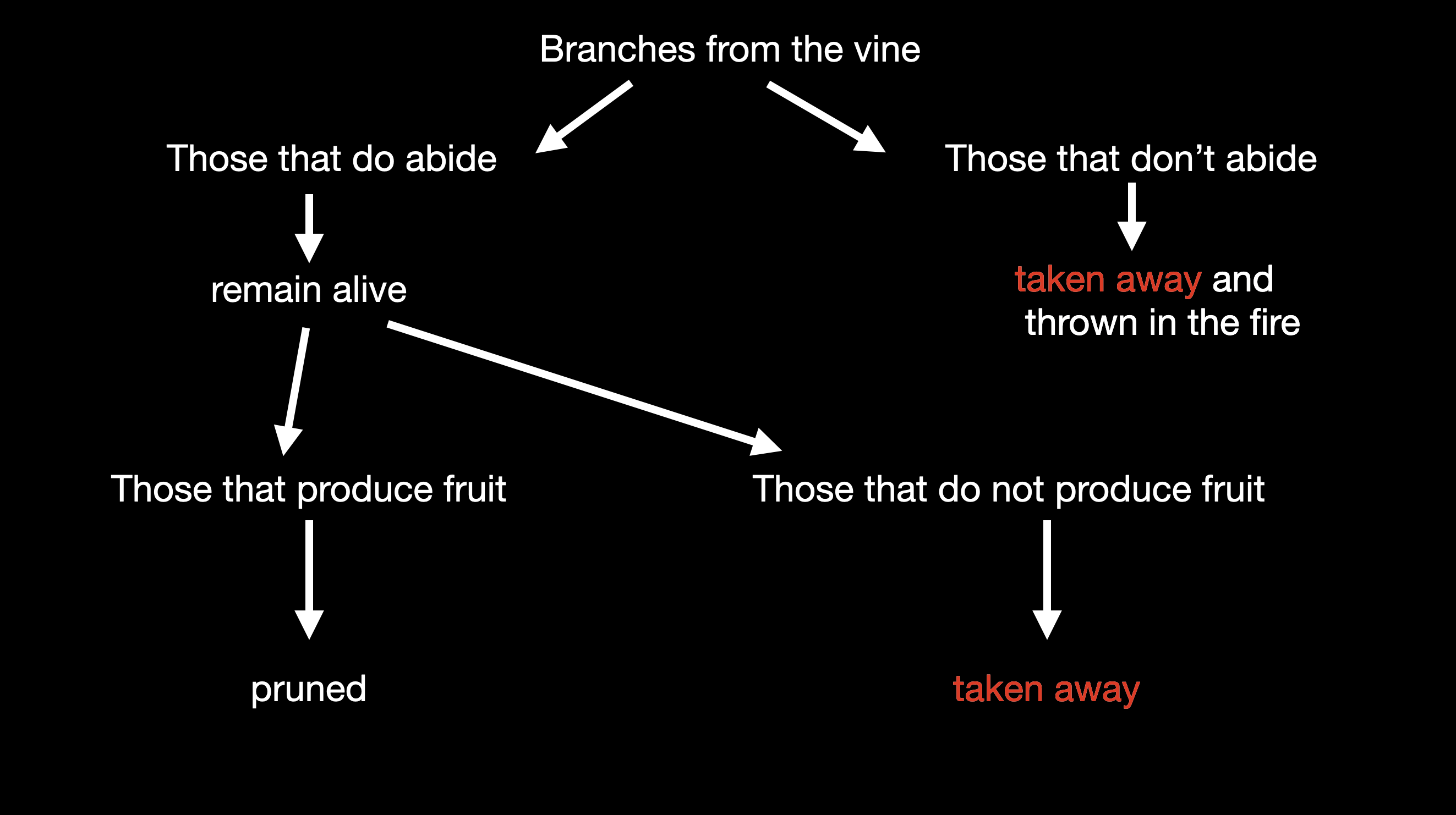
So let me put this on a flow chart for you:

Now you can see what bothers me about this parable.  Those who do abide in Christ but are not producing fruit get the same treatment as those who do not abide in Jesus.  They are both taken away.  That doesn’t seem to fit with the previous parable of the Fig tree.  The owner would have the tree dug up, but a grace period was given.  The tree would be shown extra care for a year.  If it then didn’t produce, then it would be removed.  There seems to be no grace or mercy in this vine parable.  If you see a fruitless branch, you take it away.  Are we missing something?

Let’s look at that verse more closely.  The “takes away” is translated from the Greek “airo”.   Strong’s Dictionary of the Bible has this entry for ‘airo’.  

142. airo, ah´-ee-ro; a primary root; to lift up; by implication, to take up or away; 

This Greek word is where we get the word “air,” which is also used in many English words, such as aerobatics, aerodynamics, and aeroplane (British spelling). All these words have the concept of “lifting up.”

So, the primary definition is to lift up.  The gardener ‘lifts up’ the unfruitful vine.  Does that make any sense to you?   Well, it didn’t to the translators, so instead of putting ‘lift up,’ they decided to use the secondary definition of ‘lift up and take away.’  These translators had never been to a small farm in the Middle East and saw how they grew grapes in Jesus’ day.

You know what modern vineyards look like. The vines are carefully set on elevated supports.   This makes them more fruitful and also easier to harvest. This is a grapevine from my trip to Jordan last year. Many farmers there still grow grapes as they did 2000 years ago, not on elevated trellises but on the ground.

There is one problem with growing grapes on the ground.  The vine tends to put down more roots where it touches the soil.  If the plant puts down roots, it is not spending its energy producing grapes but producing roots.  This makes the branch unproductive.  So when the gardener in Jordan sees this happening, he does exactly what they would have done in Jesus’ day.  They lift up the vine off the ground and put a rock under it.  Then, it will not produce roots but produce fruit.

John 15:2  Every branch in me that does not bear fruit he lifts up.

Remember, in the unfruitful fig tree parable, the owner would dig it up, but the vinedresser, who had cared for that plant for years, wanted to give it another chance.  He would show it special care and see if he can get it to produce.  There is grace.  There is mercy.  If we correctly translate the parable of the vine, we see the same care and mercy.  If the Father sees you are unfaithful, he doesn’t take you away; He lifts you up. 

This has implications for how we treat each other.  Someone leaves the fellowship; they stop coming to church and start putting down roots elsewhere.  The last thing we should do is cut them off or remove them.  We should lift them up.  Lift them up in prayer, lift them up with encouragement, and lift up their spirits with kindness and love.  When our friends stumble in their faith, we should lift them up.

God is looking for fruit.  John the Baptist said,  Repent and bring forth fruits worthy of repentance.  What are these fruits we should be producing?  The crowds before John the Baptist asked the same question.  

Luke 3:10-14   And the crowds asked him, “What then shall we do?” And he answered them, “Whoever has two tunics is to share with him who has none, and whoever has food is to do likewise.”  Tax collectors also came to be baptized and said to him, “Teacher, what shall we do?”   And he said to them, “Collect no more than you are authorized to do.”   Soldiers also asked him, “And we, what shall we do?” And he said to them, “Do not extort money from anyone by threats or by false accusation, and be content with your wages.”

Share from your abundance.  Do the right thing.  If you are a child of God, then act like it.  Imitate your father.  Paul gave us a list to go along with this:

Galatians 5:22-23   But the fruit of the Spirit is love, joy, peace, patience, kindness, goodness, faithfulness, gentleness, self-control;

Jesus wants us to produce fruit, and he will show us grace if we fail to do so.  But as in the fig tree parable, a limit is imposed.  The fig tree has one more year to produce fruit.  If it didn’t, then it would be dug up.

Believing in Jesus and trusting in him is the starting point, not the ending point. If the privilege of being God’s people does not lead to productivity, it leads to judgment. 

Jesus realizes his time is short. He will be crucified in 12 weeks. So, every moment, he finds ways to teach, encourage people, spread the word of the kingdom, and live his life producing as much fruit as he can. 

I want to close by leaving you with a quote from an excellent book by John Piper that had a significant impact on me.  The book is titled “Don’t Waste Your Life,” I first read it 30 years ago, but it is still timely.  Much like Jesus being told of Pilate’s horrible attack on the Galileans, John Piper tells of two women, both about 80 years old, who were serving as missionaries in Africa.  The brakes failed in their car, and they went over a cliff and died instantly.   Piper asked,  “Was that a tragedy?“  “No,” he says, 

“I will tell you what a tragedy is. I will show you how to waste your life. Consider a story from the February 1998 edition of Reader’s Digest, which tells about a couple who “took early retirement from their jobs in the Northeast five years ago when he was 59 and she was 51. Now they live in Punta Gorda, Florida, where they cruise on their 30 foot trawler, play softball and collect shells.” [Piper says,] At first, when I read it I thought it might be a joke. A spoof on the American Dream. But it wasn’t. Tragically, this was the dream: Come to the end of your life—your one and only precious, God-given life—and let the last great work of your life, before you give an account to your Creator, be this: playing softball and collecting shells. Picture them before Christ at the great day of judgment: “Look, Lord. See my shells.” That is a tragedy. And people today are spending billions of dollars to persuade you to embrace that tragic dream. Over against that, I put my protest: Don’t buy it. Don’t waste your life.”2

Jesus had only three months before his crucifixion. He couldn’t waste time complaining about politics or current events; he had fruit to produce.  None of us knows how much time we have left.   Every day is a chance to repent of yesterday’s mistakes and bring fruit worthy of that repentance. In a world filled with bad news, I have good news today.   This day, God has given us a gift.  He has granted us the grace and mercy of another day of life.   As Piper says, please don’t waste it.  Make this day fruitful, lifting up praise to Jesus, lifting up our friends, and lifting up the Kingdom of God.

  1. Not all parables are allegories.  An early church father, Origen of Alexandria, who lived around 200 AD, is called the “father of allegorical interpretation.”  He felt all parables were allegories and had secret allegorical meanings.  Augustine, who lived 200 years later, is also known for making almost every story in the Bible an allegory.  Augustine said the Samaritan in the story of the Good Samaritan is Jesus; the thieves are the devil, the priest and the Levite are the Old Testament, the inn is the church, the innkeeper is Paul, and the money he is given is Paul’s counsel of celibacy.   Sometimes, when viewing all of Jesus’ stories as allegories, we may lose Jesus’ intended meaning.  In this instance, the story loses the purpose Jesus told it for — to answer the question of, “Who is my neighbor?”
  2. Piper, John. Don’t Waste Your Life . 1994.  Crossway.  Location 546, Kindle Edition.

January 12, 27 A.D.  –  Guess Who’s Coming to Dinner? —   The Year of the Lord’s Favor #67

Week 48 —Guess who’s coming to dinner 
Matthew 20:1-16 

After Hanukkah, Jesus left Jerusalem and traveled east of the Jordan, spending the winter in the region of Perea.

It seems every few months, we hear of a political leader or religious leader of some denomination who is caught in some moral failure.  They may have had illicit sexual relations or have embezzled funds or whatever.  That doesn’t mean all politicians or all preachers are wicked.  You don’t judge all the pastors in churches of America by the failures of a few.

But wait a minute, isn’t that exactly how we tend to judge the Pharisees in the New Testament?  

If I say Pharisees, the first word that comes to many people’s minds is “hypocrite.”  We are often quick to over-generalize and lump them all together, but not all Pharisees were the same.  Some leaders of the Pharisees had worked their way into high positions, some even on the Sanhedrin, the Jewish Supreme Court.  These mostly stayed in Jerusalem, lived in the finest homes, and became wealthy.  These are the ones who most often find themselves in conflict with Jesus.  Understand that not all Pharisees were trying to kill Jesus, but mostly just the powerful ones in Jerusalem.1  And Jesus spent 90% of his ministry away from Jerusalem in the countryside.  Many Pharisees lived in small villages, and while they were financially stable, they were certainly not rich.  They were highly respected in their communities.   And they weren’t trying to kill Jesus; they were confused by him, and they were just trying to understand him and figure out who he was.

In Israel, in Jesus’ day, every child wanted to grow up and become a Pharisee. It was the most highly respected vocation. It was like kids in our day who aspired to grow up and be president (but kids don’t say that anymore.)  Children today want to grow up and be professional athletes or entertainers.   But if you were a child living in Israel in the first century, you wanted to become a Rabbi.  So, you would study hard in school and memorize much scripture.  You would try hard in every aspect of your life to follow every commandment.  From childhood, you would be indoctrinated in the theology of ritual cleanliness and proper sacrifices.  Hundreds of years of tradition were passed down to you on how to live as God wanted you to live. 

But only a few were chosen.  Only the brightest children would continue school past 13 years of age.  The rest would learn a trade.   If you made the cut and did well in school, perhaps you would find a rabbi who would allow you to be his disciple.  Your family would be so proud.  You would then study even harder and carefully follow all of the laws and ways of the Pharisees.  Then, one day, you would become a rabbi and gather your own disciples.   You would be in charge of the spiritual development of not only these young men but also your community.  You would take this responsibility seriously.  You would continue constantly studying and discussing the scriptures with your fellow rabbis and disciples.  You would keep ritually pure at all times.  You could quote all the written law, the oral law, and the sayings of the ancestors.  By this point, you felt that you knew all you needed to know about being a true child of God.  You had arrived.

And then this Jesus shows up.  He seems to be a prophet, but he doesn’t fit the mold you were taught.  He seems to ignore some aspects of ritual purity that you were taught were so important.  Oh, he keeps the ones written in the scripture, but he seems to ignore the ones passed down as oral law from your father and grandfathers.  He says things that challenge your teachings.  You would think he would have studied under a prominent rabbi, but he didn’t study under anyone; he just set out to gather disciples on his own.  And he is not too picky about who he chooses.   He has poor fishermen, a zealot, and even a tax collector among his disciples.  None of them had proper schooling.  He even has women following him.  Can you imagine that?  It is almost like he is making a mockery of your profession.

And yet….he heals people.  People no one else can heal.  You have never healed anyone.   He casts out demons.  You have never done that.  It is said he walked on water.  Where does that power come from if not from God?  Some of the leaders in Jerusalem say his power comes from the Satan, but that is hard for you to accept because he helps so many people and does so much good, and the adversary does not do those things.  And though he has no official rabbinic authority, he speaks with great authority.   He knows the scriptures and quotes references from scripture that back up everything he says.  But he interprets scripture in ways different from what you’ve been taught, and what he says seems to make so much sense to you.  You are simultaneously curious to know more about him but also scared of what he may do.  Some say he has claimed to be the Messiah.  Your leaders in Jerusalem have decided that he is a blasphemer, a false Messiah.  And you know that every time we have someone rise up and claim to be the Messiah and gather a large following like this, it brings enormous trouble from Rome.  Whole towns have been burned to the ground because of a rebellion started by such a person.2  That scares you most of all.

So don’t assume all Pharisees are alike. Many live outside Jerusalem in Galilee and Perea and are not angry at Jesus. They don’t want to kill him, but they are very confused by him.  

The Gospel of Luke records three instances of Jesus being invited to dinner with Pharisees.   In Roman times, people were very strategic with their dinner invitations.  Hosting dinner in Roman times was a social investment. It was a chance to increase your social standing by having important people dining in your home.   By having them as your guests, they would be expected to reciprocate and invite you for dinner in return.  You don’t invite enemies to eat with you.  You don’t invite people you don’t like.  You don’t invite people who can not return the favor or raise your social standing.  So, Jesus would never be invited to dinner with the Pharisees in Jerusalem.  They have already decided he must go.

But these Pharisees in small towns in Galilee in Luke 7 and Perea in Luke 11 and Luke 14 did invite Jesus over.   Jesus obviously can’t return the invitation.  He has no home.  So why did they invite him over?    If you assume all of the Pharisees are out to get Jesus, then you would guess that they were trying to trap him.  The Bible is clear that some did try to trap him, but this was always done in public because the point would be to make him look bad in front of a crowd.  A private dinner would not be a good place for this.  Pharisees gathered together frequently to discuss scripture and how to interpret it.  How can they best live out God’s law in their time under Roman oppression?   They wanted to see exactly who Jesus was away from the crowds.  They wanted time to ask him questions.   So, let’s look at one of those dinners with the Pharisees in Luke 14.

Luke 14:1-6   One Sabbath, when he went to dine at the house of a ruler of the Pharisees, they were watching him carefully.  And behold, there was a man before him who had dropsy.   And Jesus responded to the lawyers and Pharisees, saying, “Is it lawful to heal on the Sabbath, or not?”   But they remained silent. Then he took him and healed him and sent him away.   And he said to them, “Which of you, having a son or an ox that has fallen into a well on a Sabbath day, will not immediately pull him out?”   And they could not reply to these things.

Besides Jesus, these Pharisees also invited a man with a chronic disease.3  It was the Sabbath.  This was a set-up.  They wanted to see if Jesus would heal him.  Again, the Bible doesn’t say they were trying to “trap him” as it does three times in Matthew 22.  They were “watching him carefully.”  

Healing on the Sabbath was not against the Sabbath rules in the Scripture.  The Old Testament rules of what is allowed and not allowed on the Sabbath are not very specific.  Here is what is specifically regarded as work:

Plowing, reaping, binding, threshing, winnowing, grinding, sifting, kneading, baking, gathering wood, kindling fire, sewing, tearing, and carrying burdens (essentially any activity related to harvesting or construction of the tabernacle or preparing food, as well as tasks requiring physical labor or creating a fire)

So, in defining what is work and what is not, there were many grey areas, and the scribes and Pharisees often discussed whether something was work or not.  Together, they looked at the scripture and came to a conclusion so they could provide guidelines for their community.   For example, is walking work?  Walking 20 miles (a day’s journey) would certainly seem to qualify as work, but what about walking next door or in your home?  They had to draw the line somewhere.  So this was debated, and a strict distance was determined.   You can walk 2000 cubits, a little over half a mile.  Walking further than this was considered work and breaking the Sabbath.

The Scriptures listed carrying burdens as a violation.  But could you carry food to the table for dinner on the Sabbath?  This was debated (and you can read some of these debates recorded in the Mishna), and it was determined that you could carry things inside your house, but you could not carry things outside of your house.  So today, an orthodox Jew can not carry a handkerchief in his pocket while walking to the synagogue on Shabbat, but when he arrives home, he can carry furniture up and down the stairs without breaking the law.

This seems odd to us, but someone had to help define work so the people would not accidentally break the Sabbath laws but could still function.  It was an important job for the experts in the law.

During the Maccabean War, around 160 years before Jesus (the victory that we celebrate at Hanukkah), the Macedonians attacked a strictly observant Jewish village on the Sabbath.  The people of this village viewed warfare as work and refused to defend themselves.  Not surprisingly, all of them were killed.  The next day, the priest determined that self-defense was allowable on the Sabbath.4

Healing was also debated. There is a principle called “Pikuach Nefesh,” which means “preservation of life” and takes precedence over all other commandments, including those of the Sabbath.  You were allowed to break almost any other law if it was required to save a life. Saving a life imminently in danger was not only allowed but was required.  The Mishna says, “If any person saves a single life, Judaism considers that he has saved the whole world” (Mishnah, Sanhedrin 4.5). 

But healing outside of immediate life-saving measures was not so clear. In Jesus’ day, the question of healing was highly debated. Some sages said it was allowed on the Sabbath, and others said it was only allowed if it was immediately life-saving. We have records of this debate hundreds of years before and hundreds of years after Jesus.  

Jesus likely performed most of his healings on days other than the Sabbath. Mark 1:32 shows evidence of this: The people waited until sunset (when the Sabbath was over) to come to Jesus for healing.

Mark 1:32   That evening at sundown they brought to him all who were sick or oppressed by demons.

In Luke 13, Jesus heals a woman who had a disfiguring back problem on the Sabbath and says:

Luke 13:15-16   Does not each of you on the Sabbath untie his ox or his donkey from the manger and lead it away to water it? And ought not this woman, a daughter of Abraham whom Satan bound for eighteen years, be loosed from this bond on the Sabbath day?

Here, he is using the Jewish principle of “tzar baalei hayim,”  or the prevention of suffering to living things. 

Jesus is in line with the school of Rabbis who accept healing on the Sabbath. Scripture records instances when Pharisees opposed him for this view. However, the debate among the Rabbis raged on for hundreds of years and was not settled until around 200 AD.5

Luke 14:1-6   One Sabbath, when he went to dine at the house of a ruler of the Pharisees, they were watching him carefully.  And behold, there was a man before him who had dropsy.   And Jesus responded to the lawyers and Pharisees, saying, “Is it lawful to heal on the Sabbath, or not?”   But they remained silent. Then he took him and healed him and sent him away. 

Jesus tries to engage them in the question of healing on the Sabbath.  They don’t want to commit to the discussion and remain silent.   They set this up to see what he would do.   Jesus states his opinion by healing the man.  He then gives them an argument they can’t refute.

And he said to them, “Which of you, having a son or an ox that has fallen into a well on a Sabbath day, will not immediately pull him out?”   And they could not reply to these things.

Of course, they would all immediately retrieve their son or animal from a well. But that would be work. Jesus asked hard questions. Again, they have debated whether healing is okay on the Sabbath for hundreds of years.   And Jesus seems so sure of himself.  He speaks as though he has immediate access to the wisdom and heart of God.   They really don’t know how to respond to that.  They are silent.  So Jesus moves on.

Luke 14:7   Now he told a parable to those who were invited, when he noticed how they chose the places of honor, saying to them….

Luke then provides us with some irony. Remember that the passage began with, “They were watching him carefully,” and now Jesus is speaking after he notices their behavior. The tables have turned. Who is watching who?

Luke 14:8-11   “When you are invited by someone to a wedding feast, do not sit down in a place of honor, lest someone more distinguished than you be invited by him, and he who invited you both will come and say to you, ‘Give your place to this person,’ and then you will begin with shame to take the lowest place.  But when you are invited, go and sit in the lowest place, so that when your host comes he may say to you, ‘Friend, move up higher.’ Then you will be honored in the presence of all who sit at table with you.   For everyone who exalts himself will be humbled, and he who humbles himself will be exalted.”

What is Jesus communicating to these Pharisees and experts of the law?   He has observed their self-seeking behavior and starts with some social advice on how to avoid embarrassment.  Honor must be given, not assumed, pursued, or taken.  But then, his last sentence hints at a worldview where honor is based on a completely different measure.  In Jesus’ view, it is humility that is highly valued.

This flies in the face of the standard of dinner invitations of the day.  Again, Jesus has an entirely different worldview.   The greatest deed is doing good to someone who can not possibly repay you.   Note that there will be repayment, but it will not come now.  You will be blessed.  There is our Beatitude word, ‘Makarios’  — as in Blessed are the pure in heart….  It doesn’t mean you will receive a blessing, but it means you will be happy, fulfilled, and in a state of bliss.  You forfeit the possibility of the reward of a return dinner invitation, but you gain happiness and fulfillment from living as God would have you live.  And note there will be a reward. Not in this world but in the next.  “You will be repaid at the resurrection of the just.”  Jesus says there is a reward for doing good to those you cannot repay: ‘in as much as you have done it unto them, you have done it unto me.’  Do you want to have Jesus over for dinner?  Invite the poor, the invalid, the forgotten to your home to eat.  Jesus will one day thank you for having him over for dinner.

Then, one of the Pharisees present hears Jesus give a blessing that speaks of the resurrection and the world to come. He riffs on that and offers a blessing of his own. Or maybe, sensing the tension in the room, he is trying to change the subject quickly.

Luke 14:15   When one of those who reclined at table with him heard these things, he said to him, “Blessed is everyone who will eat bread in the kingdom of God!”

Who could disagree with that?  It is a true statement.  Those who join God in the kingdom and dine in the great messianic banquet will be most blessed.  Jesus could just say, “Amen,” and let it go.  But they are at a dinner, and Jesus is just talking about who gets invited to banquets.  Jesus knows these religious experts are making a dangerous assumption about the banquet God throws in the last days.  They are assuming they know who will be invited to God’s banquet.  Why, of course, they will be there; they are the children of Abraham.

Jesus is in the same area that John the Baptist preached and baptized.   Remember what John said when the religious elite came out to see him there:

Matthew 3:7-9     But when he saw many of the Pharisees and Sadducees coming to his baptism, he said to them, “You brood of vipers! Who warned you to flee from the wrath to come?  Bear fruit in keeping with repentance.  And do not presume to say to yourselves, ‘We have Abraham as our father,’ for I tell you, God is able from these stones to raise up children for Abraham.

John told them they needed to repent and be baptized.  It wasn’t enough that they were Jewish.  

Sometimes, we just assume people around us have a good relationship with God.  After all, they go to church, say the right things, own a Bible, and come from a good Christian family.  However, these people John called out were the religious leaders of the day, the most observant people in the country.  John said don’t presume.    Do you know where your friends and family members stand?  We don’t talk enough with each other about things that matter.

Well, Jesus is not going to let this opportunity pass.  The conversation at this dinner has been about who gets invited to dinner, and then someone brings up the dinner of the last day.  So Jesus gives a parable about who will be invited and who will attend that great banquet at the end of days. 

But we need a little context.  The Old Testament is full of references to the Messianic Banquet.   Here is one from Isaiah:

Isaiah 25:6-9   On this mountain, Yehovah of hosts will make for all peoples a feast of rich food, a feast of well-aged wine, of rich food full of marrow, of aged wine well refined.   And he will swallow up on this mountain the covering that is cast over all peoples, the veil that is spread over all nations.  He will swallow up death forever, and Yehovah Elohim will wipe away tears from all faces, and the reproach of his people he will take away from all the earth, for Yehovah has spoken.  It will be said on that day,   “Behold, this is our God; we have waited for him, that he might save us.  This is Yehovah; we have waited for him; let us be glad and rejoice in his salvation.”

A feast of rich food.  For those in Isaiah’s day, well-aged wine and bone marrow were on the menu of kings.  I have never had either one, but the chefs on the Food Network love that bone marrow.  The point is that when God throws a feast, it is the best of the best.  (I am sure there will be prime rib and Diet Coke just for my wife.)

And as the people swallow the food, God will swallow up the veil over all the nations – the veil of death.  They dine and rejoice in their salvation.  God has spoken, and God is victorious over death and reproach. This is the banquet the man at the Pharisee’s dinner referred to.  But Jesus needs to say a little about who will be there.

Luke 14:15-24   But Jesus said to him, “A man once gave a great banquet and invited many.  And at the time for the banquet, he sent his servant to say to those who had been invited, ‘Come, for everything is now ready.’   But they all alike began to make excuses. The first said to him, ‘I have bought a field, and I must go out and see it. Please have me excused.’   And another said, ‘I have bought five yoke of oxen, and I go to examine them. Please have me excused.’   And another said, ‘I have married a wife, and therefore I cannot come.’

  So the servant came and reported these things to his master. Then the master of the house became angry and said to his servant, ‘Go out quickly to the streets and lanes of the city and bring in the poor and crippled and blind and lame.’   And the servant said, ‘Sir, what you commanded has been done, and still there is room.’   And the master said to the servant, ‘Go out to the highways and hedges and compel people to come in, that my house may be filled.   For I tell you, none of those men who were invited shall taste my banquet.’”

A man gives a banquet, much like the banquet they are currently at.  He invited all the right people, and they agreed to come.  This initial RSVP was essential in those days.  Your choice of meat for the meal would depend on the number of guests coming.  You wouldn’t slaughter a cow for four people.  Whatever is prepared has to be eaten that day.  There is no refrigerator for leftovers.   But when the preparations for the meal are complete, the servant is sent out with the announcement to come now, for the banquet is ready.  

But in Jesus’ story, it says, “they all began to make excuses.”  All of them.  Jesus gives three examples.  They are flimsy and clearly fabricated excuses.   ‘I have bought a field and must go out and see it.’  This is not believable.  No one bought a field they had not inspected.  This would be like a guest calling you at the last minute before dinner and saying they could not come because they had just bought a house they had not seen yet.  The second man bought five yoke of oxen and needed to check them out.  When a team of oxen was sold, there would be a field to test them to ensure they were healthy and could pull evenly together.  That would be like your dinner guest calling to say, “I just bought five cars, and I need to see what color they are and if they can start.”  The third excuse is equally weak.  ‘I have married a wife, and therefore I can’t come.’  But they didn’t just get married.  You would have never scheduled a banquet at the same time as a wedding celebration in your town.  And you aren’t asking him to leave the country or go to war; he would be absent for only a few hours.  Jesus has them give excuses that are not reasonable.  They are just not interested in the host or his banquet.  Their land, oxen, and other people are more important than keeping their commitment to the host. 

So the food is already cooked, and his expected guests are more preoccupied with their possessions and family relations.  What does the host do?  He sends his servant out into the “streets and lanes” to the poor area of town.  Still not filling the banquet hall, he sends his servant out of town to the Gentiles to invite them to the banquet.   The host has broken all ties with the social system of status and reciprocity.  He has followed Jesus’ advice in verses 12-14.  No one is too unclean to attend this banquet.   

It is not evident when you read the parable in English, but the last line is different and key to understanding Jesus. The host in Jesus’ parable has been speaking to a single person, his servant, but in the last line, the ‘you’ is plural. That changes how you read it. I think when Jesus speaks, he tells the parable, looks up, and delivers the last line to everyone in the room.

Luke 14:24   For I tell all of you, none of those men who were invited shall taste my banquet. 

Jesus is telling them that the Messianic banquet is his banquet.

God is preparing a banquet for the end of time.  It will be a feast, a festival of celebration of salvation.  This is the great Messianic Banquet, and God has sent his suffering servant out to issue invitations to the banquet.  Many who were invited first refused to come, so Jesus extended the invitation to the unexpected – to us.  God wants his house to be full.   He is not willing that any perish but that all come to repentance.  But Jesus tells us repeatedly that those you expect to see are not there.  Those who are very sure they will attend will not be allowed in.  

The story of the Pharisee’s dinner ends right there.  We aren’t told how this group of Pharisees reacted to Jesus’ parable.  And I think Luke did that on purpose.  What is most important to know is not how they reacted but how do you react.   The day of that banquet approaches.  Everyone is invited, but not all will choose to attend.  I hope to see you there.

  1. I found 27 instances in scripture when people desired to kill Jesus.  All but two of these happened in Jerusalem.  The exceptions are after the healing of the man with the withered hand (Matthew 12:14, Mark 3.6, Luke 6:11) and after his message in the synagogue in Nazareth  (Luke 4:28).  
  2. The capital of the region of Galilee, Sepphoris, was destroyed and its 30,000 residents either crucified or sold into slavery in 4 BC, about the time of Jesus’ birth.  This was Rome’s reaction to an uprising by Judas the son of Ezekias.  Sepphoris was only 3.7 miles northwest of Nazareth and it is likely that Jesus and his father and brothers worked in Herod’s rebuilding of the city that continued throughout Jesus’ time here.
  3. “Dropsy” was the symptom of generalized swelling or edema that we now know is most commonly due to congestive heart failure or chronic kidney disease.
  4. See 2 Maccabees  2:31ff.
  5. It was Samuel of Nehardea who finally gave the final opinion on healing on the Sabbath with an interpretation of Leviticus 18:5 “You shall therefore keep my statutes and my judgments; which if a man does, he shall live in them.”  Simon “revealed” the hidden meaning that the Jewish people can only observe the Torah if they stay alive.  So, acts of healing should not be restricted on the Sabbath so that the people will be well enough to keep the Torah law.  (from The Jewish Chronicle, February 19, 2015.)

January 7, 27 A.D.  –  Payroll Accounting —   The Year of the Lord’s Favor #66

Week 47 ——— Payroll Accounting
Matthew 20:1-16 

The holidays are over.  In 27 AD, when the holidays of Hanukkah had ended, Jesus went to the area east of the Jordan, where he spent the winter.  He is teaching to the people there, many of whom had been John the Baptist’s followers.  While there, he tells this story:

Matthew 20:1-16  “For the kingdom of heaven is like a master of a house who went out early in the morning to hire laborers for his vineyard.  After agreeing with the laborers for a denarius a day, he sent them into his vineyard.  And going out about the third hour he saw others standing idle in the marketplace,  and to them he said, ‘You go into the vineyard too, and whatever is right I will give you.’  So they went. Going out again about the sixth hour and the ninth hour, he did the same.  And about the eleventh hour he went out and found others standing. And he said to them, ‘Why do you stand here idle all day?’  They said to him, ‘Because no one has hired us.’ He said to them, ‘You go into the vineyard too.’  And when evening came, the owner of the vineyard said to his foreman, ‘Call the laborers and pay them their wages, beginning with the last, up to the first.’  And when those hired about the eleventh hour came, each of them received a denarius.   Now when those hired first came, they thought they would receive more, but each of them also received a denarius.   And on receiving it they grumbled at the master of the house,   saying, ‘These last worked only one hour, and you have made them equal to us who have borne the burden of the day and the scorching heat.’   But he replied to one of them, ‘Friend, I am doing you no wrong. Did you not agree with me for a denarius?   Take what belongs to you and go. I choose to give to this last worker as I give to you.  Am I not allowed to do what I choose with what belongs to me? Or do you begrudge my generosity?’

Most people in Jesus’ day were self-employed.  They were paid daily for their work, the items they made, or the crops they sold.  But those who had no land to farm owned no flocks of sheep, or didn’t own a boat or nets to fish were day laborers.  They would gather in the town square and hope that someone came by to hire them for the day.  Most lived day-to-day.  If they found no work for a few days, they didn’t eat.

Often, slaves had it better than day laborers.  Slaves didn’t have to worry if they would have consistent work.  They had guaranteed housing and food.  Day laborers had no job security and lived on the edge of poverty daily.  Slaves were treated better because their owners had a financial investment to care for.  In contrast, day laborers were sometimes overworked or abused.  The Old Testament has several verses that protect the rights of day laborers.1

Leviticus 19:13   “You shall not oppress your neighbor or rob him.  The wages of a hired worker shall not remain with you all night until the morning.

Deuteronomy 24:14-15   “You shall not oppress a hired worker who is poor and needy, whether he is one of your brothers or one of the sojourners who are in your land within your towns.  You shall give him his wages on the same day, before the sun sets (for he is poor and counts on it), lest he cry against you to Yehovah, and you be guilty of sin.

So a man goes out to hire workers at 6:00 am and agrees to pay a day’s wages for a day’s work.  A day’s wage then was a denarius, a silver coin about the size of our dime.  A routine day’s work was 12 hours, from 6 am to 6 pm.  He then goes out again at 9 am, at noon, at 3 pm, and then at 5 pm and hires additional workers.  At 6 pm, quitting time, he has his manager pay the workers.  The ones last hired got a denarius, a full day’s wage, even though they only worked an hour.  The others waiting in line to get paid see this and expect to get more since they worked more hours.  But the ones hired at 6 am, who worked 12 hours, got the same pay as the ones who worked one hour.  They worked 12 times as long but received the same pay.

That’s not fair!

Those of you who have raised small children read the above sentence in the voice of an irate screaming child.  It is a common complaint.  But as adults, we also constantly compare ourselves with others, looking at the level of accomplishment and fairness, what we ‘deserve.’  We cry injustice if we get less than we think we deserve.  Equal pay for equal work is a part of our labor justice system.  This vineyard owner would find himself in court in our day of labor unions and employment laws.  Jesus’ parable is hard to reconcile.  This story used to bother me.  Does it bother you?   Put yourself in the story and imagine how you would feel.  

Jesus’ story begins:
Matthew 20:1  “For the kingdom of heaven is like a master of a house who went out early in the morning to hire laborers for his vineyard.

This story is about the kingdom of heaven.  If you believe the kingdom of heaven is all about going to heaven when you die, that will affect how you understand this parable.  Then the vineyard owner is God, and the pay, the denarius, is salvation.  And everyone who accepts the vineyard owner’s invitation receives the same reward – salvation.

Except, that is not how Jesus talks about the kingdom of God.  We looked at this last January (See #5).   We tend to define kingdoms by geographic boundaries.  But in Jesus’ day, kingdoms were determined by the area where the king reigns.  If a group of people places themselves under the rule of a king, they are part of his kingdom.  If they refuse to follow the edicts of a king, then the king does not reign over them, so they are not part of the kingdom. Or as Dallas Williard states: “The Kingdom of God is the range of God’s effective will, where what he wants done is done.”2  That is why Jesus can say the kingdom is already here.  If you decide to follow the rules of the king, not some other leader, and not your own rules, then you are part of the kingdom.  You are not part of the kingdom if you rebel against the king by refusing to follow his edicts.

This parable is not about going to heaven but about being part of God’s kingdom, following God’s will, and doing things His way. Jesus is trying to show the disciples how to follow God’s will in how they treat others. It is not an allegory of future hope but a story of how real people treat each other now.

The disciples needed to hear this parable.  Just before this parable in Matthew, Jesus had talked about how hard it was for a rich person to enter the kingdom of heaven.   So Peter says, “Well, we gave up everything to follow you, so what do we get?”  Later, the disciples are debating who gets the best seat in the world to come and who gets the best reward.  They are thinking, “What’s in it for me?”  They need to hear this message.

We must address the critical question: “Why does the owner pay everyone the same?”  He says, “Am I not allowed to do what I choose with what belongs to me? Or do you begrudge my generosity?”

“Or do you begrudge my generosity?” is an interesting translation.  The literal translation from the Greek is, “Or is your eye bad because I am generous?”  Does that make sense to you?  We will need some cultural context to understand the concluding statement of the parable.  Let’s look at another teaching of Jesus that uses this same context:

Luke 11:34-36   Your eye is the lamp of your body. When your eye is healthy, your whole body is full of light, but when it is bad, your body is full of darkness.  Therefore be careful lest the light in you be darkness.   If then your whole body is full of light, having no part dark, it will be wholly bright, as when a lamp with its rays gives you light.”

“The eye is the lamp of the body.”  Well, of course, Jesus assumes everyone knows this.   Everyone in Jesus’ day knew this, but we don’t know what he is saying.

This requires some context.  This is the way our vision works.  Photons reflecting off an object from a light source enter the pupil, and our lens focuses that image on our retina.  Nerve impulses from the retina go to the brain, where we interpret the image.  This is a relatively new science because until only 600 years ago, it was commonly thought that it happened just the opposite way.  They thought rays exited your eye to settle on an object.  These rays enable vision and can affect the object, much like the sun’s rays affect objects.  Touch some black metal left out in the sun on a hot day.  Just as the sun’s rays make the metal hot, rays from our eyes were felt to affect things we see.   Again, this was common knowledge for over a thousand years before Jesus was born and continued to be over 1000 years after Jesus.

This idea that we can affect an object that we look at led to the concept of the “Evil Eye” — what you focus your vision on, and thereby emit rays upon, can affect the person you view.  If you look at someone with hostility — we have a word for that — glare — at someone, you could hurt them.   Fear of the evil eye and measures to ward off its harmful glance are well documented throughout the ancient world.

The eye was also thought to be directly linked to your mind, the place of thought, desire, and emotion. They thought your eyes expressed the innermost feelings and desires of your heart.  They assumed you could judge someone’s character by looking at their eyes.  We still use this language.  We talk about someone with ‘kind eyes,’ or we are suspicious of someone with ‘beady eyes.’  Therefore, a ‘good eye’ revealed morally good and generous intentions, while an ‘evil eye’ exposed an evil heart with wicked intentions of envy, greed, and jealousy. Envy, in turn, was associated with unwillingness to share one’s possessions with others.  Don’t miss this connection of a ‘bad’ or ‘evil eye’ with greed and envy.

Plutarch, a Greek philosopher and historian who lived just after Jesus (46 AD – 119 AD), wrote:
“When those possessed by envy … let their gaze fall upon a person, their eyes, which are close to the mind and draw from it the evil influence of the passion, then assail that person with poisoned arrows”1

In Roman times, to give the evil eye was in Latin ‘Invidia’ (from which we get our word envy).  It meant to look too closely or in a hostile manner to cause harm.  The way to prevent these ill effects from others looking at you was to wear some amulet or charm.  These were called ‘fascinum’  (from which we get our word ‘fascinate,’ which means to draw someone’s attention, enchant or bewitch).  These charms were first worn to distract someone.  They would look at the charm instead of you, and thus, you avoid harm.  Later, the charms were felt to have some magic power to combat the evil eye.

Babies were especially susceptible to the effects of the evil eye, and so many babies wore necklaces with these charms.  If you ever go to Greece, the market will be full of charms for sale to ward off the evil eye.  In Greece, where blue eyes are rare, blue-eyed people were most thought to be able to give the evil eye.  So blue became the color of resistance to the evil eye.

While at the market in Greece, do not stare at people. They will get very uncomfortable. I made the mistake of looking at a cute baby too long. The mother became upset about my blue eyes on her baby, and she spat three times, which I later learned was a way of protecting her baby from the evil eye.

We also see some remnants of that in the southeastern US.  Many porches and doors are painted a shade of ‘haint blue’.  This originates from the Gullah in Georgia and South Carolina, who brought the idea from Africa that this color might ward off evil spirits.

So now that we know the context of the bad eye or evil eye, we can better understand the words of the vineyard owner in the parable:  “Or is your eye bad because I am generous?”

Just because I am generous, are you envious of what your neighbors received and now wish them harm?

But the question remains: Why did the owner choose to pay them the same? This bothered me for years. Then, God arranged a situation to teach me the answer.

We met a young man through our homeless ministry, who I’ll call Tom.  Tom came to us in bad shape.  He had a problem with alcohol and drugs, couldn’t hold a job, and lost everything.  He worked hard to put his life back together, had a steady job, and finally got his driver’s license back.  Tom came to my wife and asked her if she knew anyone who needed some work done.  He needed $60 to pay for car insurance.  We had just moved our camper to a different lot, which needed some work, perhaps a few hours.  My first thought was, “We don’t have enough work for him to do for $60?  I have enough work to pay him $30 or $40.” And my wife responds, “But $60 is what he needs”. 

She understood the parable that I was having trouble with.  I wondered how I could find enough work to pay Tom the $60 so I could pay him what it was worth.  The vineyard owner didn’t pay people what they earned; he paid them what they needed.

All of the workers in the vineyard had the same need — a day’s wage to feed their families. The owner paid the men not what they earned but what they needed.  Isn’t that what God does?  He lavishes generous grace on us.  He does not give us what we deserve but what we need.  None of us will ever do enough to earn the salvation we need.

This final statement in this parable is really about the 10th commandment.
Just because I am generous, are you envious of what your neighbors received and now wish them harm?

“Exodus 20:17  “You shall not covet your neighbor’s house; you shall not covet your neighbor’s wife, or his male servant, or his female servant, or his ox, or his donkey, or anything that is your neighbor’s.”

Thou shalt not covet.  This is very different than the other nine of the Ten Commandments.  You won’t find it in any other legal system because it is not enforceable.  No legal system can enforce a law about what you are thinking unless that system is governed by a God who knows your thoughts.   And envy is a real temptation for everyone.  You see someone with nicer clothes, a nicer car, or a bigger house.  Your friend who takes better vacations.  Their gardens are more productive, and their children are better behaved.  Things seem to come easy for them.

Our entire marketing system is built on the idea of coveting, jealousy, and envy, which has flourished exponentially in social media marketing. If you want to sell clothing, find beautiful people to wear your clothes. We call them influencers.  

Luke 12:15  “Take care, and be on your guard against all covetousness, for one’s life does not consist in the abundance of his possessions.”

We learn from this parable that the opposite of coveting and envy is generosity.  “Or is your eye bad because I am generous?”  The vineyard owner is generous.  He could have paid the one-hour workers what they earned, but he gave them 12 times more.  He gave them what they needed.  The 12-hour workers were jealous.  They envied the one-hour workers who didn’t have to work all day and received the same as them. 

We fight this battle constantly with envy, jealousy, and desire.  If you watch an hour of television, you will see 10-20 minutes of marketing designed to make you want something you do not have, to entice you to covet.  You can’t go online without some influencer doing the same.   How do you combat these feelings?  Let me give you four things to consider to help you avoid the temptation to covet.

  1. Know the danger of coveting and its relation to jealousy and envy.
          The Bible is very clear: Coveting is idolatry.

.Ephesians 5:5 For you may be sure of this, that everyone who is sexually immoral or impure, or who is covetous (that is, an idolater), has no inheritance in the kingdom of Christ and God.

Colossians 3:5  Put to death therefore what is earthly in you: sexual immorality, impurity, passion, evil desire, and covetousness, which is idolatry.

How is coveting idolatry?  You want something more than you want God.  You set something material above God.  Paul said this:

Colossians 3:2 Set your minds on things that are above, not on things that are on earth. For you have died, and your life is hidden with Christ in God.

People who covet often find themselves willing to break any of God’s rules to obtain the object of their deisire. It is the oldest sin.    Eve sees the fruit on the tree.  She desires it.  Her desire overwhelms her obedience to God’s law.  She takes it.  David sees Bathsheba.  He desires her.  His desire overwhelms his obedience to God’s law.  He takes her. See —Desire — Take    That sequence of coveting tracks throughout the Bible and human history. We must understand the danger.

2. Count your blessings

We talked recently about the Jewish habit of saying 100 blessings a day.  Keep your mind on what God has given you, not what you do not have.  There were hundreds of trees with fruit in the garden.  Adam and Eve could eat from any of them.  Instead of enjoying what they had, they desired the forbidden one.  And remember, that tree was in the middle of the Garden. They passed by it every day.  They couldn’t avoid it.   So we, too, can not avoid seeing those things we are tempted to covet.  But as Paul said, don’t set your mind on those things.  Take your eyes off that tree and enjoy all the others.  Walk around the garden, thanking God for all of the other trees.   Thank you, God, for the pear trees.  Thank you for the orange trees.  Thank you for the peach trees. Count your blessings.

Gratitude is counting your blessings.  Envy is counting someone else’s blessings.

3.  Be content with what you already have.  

1 Timothy 6:6-10   But godliness with contentment is great gain, for we brought nothing into the world, and we cannot take anything out of the world.   But if we have food and clothing, with these we will be content.   But those who desire to be rich fall into temptation, into a snare, into many senseless and harmful desires that plunge people into ruin and destruction.   For the love of money is a root of all kinds of evils. It is through this craving that some have wandered away from the faith and pierced themselves with many pangs.

The wealthiest people in the world are not the happiest.  History shows us that many of them are the most miserable.  The apostle Paul said he had learned the secret of enjoying life.

Philippians 4:11-13  …for I have learned in whatever situation I am to be content.  I know how to be brought low, and I know how to abound. In any and every circumstance, I have learned the secret of facing plenty and hunger, abundance and need.   I can do all things through him who strengthens me.

This is the most misquoted verse in the New Testament, “I can do all things through him who strengthens me.” This verse is often the mantra of athletes trying to win a competition.  I can make that field goal.  I can run faster than these guys. But the ‘all things’ Paul says he can do is be content in any circumstance.  I can be happy if I’m rich or even if I am poor.  I am fine if the bank account is full or empty.  I can be ok with winning or losing (are you listening Mr. Athlete?)  I can do all things. Be content with what you have.

4.   Love your neighbor as yourself. 

If you admire something someone else has, don’t rush to envy and jealousy; rush to prayer, thanking God for blessing the neighbor you love.  If you love your neighbor, you are as grateful for the blessings God has given them as you are for the blessings He has given you. Thank you, Yehovah, for blessing my neighbor.  You are a good God who gives generously.  Don’t be like the 12-hour workers in the parable.  Rejoice in your neighbor’s good fortune.   Life is not a competition.  The one who dies with the most toys is not the winner.  

 Love you, neighbor; rejoice with those who rejoice.  

Jesus told this parable for a reason. The disciples asked Jesus, “What’s in it for me?”  and “Can I sit on your right hand in glory?”  They needed to start thinking differently if they were going to be in Jesus’ kingdom. We also need to change our way of thinking. We are surrounded daily by pressure to desire what is not ours. We must see that danger and avoid the ancient sin of seeing, desiring, and taking.  

God, I ask your Holy Spirit to speak loudly when we are faced with desire for things of the world.  Instill in us a desire for you, Yehovah, above anything else.  And may we treat others as you treat us, with generosity, giving to all what they need and not what they deserve.

  1. Bailey, Kenneth E.  Poet and Peasant and Through Peasant Eyes.  
  2. Willard, Dallas.  The Divine Conspiracy: Rediscovering Our Hidden Life In God.

December 29, 27 A.D.  –  Teach Us To Pray Again—   The Year of the Lord’s Favor #65

Week 46 ——— Teach Us To Pray Again
Luke 11:1-13  John 10:40-42 

John 10:40-42  He went away again across the Jordan to the place where John had been baptizing at first, and there he remained.  And many came to him. And they said, “John did no sign, but everything that John said about this man was true.”  And many believed in him there.

For Jesus, in 27 AD, Hanukkah has ended, and winter has begun.  So Jesus leaves Jerusalem and his friends’ home in Bethany.  He will return to Mary and Martha’s house in a few months when he hears of Lazarus’ death.  He heads east along the Jericho road past the town of Jericho and across the Jordan to where John the Baptist did most of his ministry.  This is where John baptized Jesus and began Jesus’ ministry back in February.  John had many followers in the area who now came to Jesus. John had told them he was not the Messiah and didn’t perform miracles. Instead, he pointed to Jesus. Herod killed John only four months ago, so Jesus attracted a crowd of many followers and stayed there for the winter.

I won’t forget the day my wife and I made this journey from Jerusalem to the area east of the Jordan River in 1981.  It was snowing that morning in Jerusalem, and two hours later, we passed through this place where, just a few miles south, people were sunbathing at the Dead Sea.  Good choice, Jesus.  This is a much better place to winter than in Jerusalem or Galilee.  

Jesus will preach some of the same messages he taught in Galilee. Today’s passage is very similar to passages in the Sermon on the Mount that Jesus gave five and a half months before. He was found praying, and when he finished, the people asked him to teach them how to pray. Jesus gives them a prayer to pray (“The Lord’s Prayer”), and then he teaches them more about prayer. 

 Luke 11:1-4   Now Jesus was praying in a certain place, and when he finished, one of his disciples said to him, “Lord, teach us to pray, as John taught his disciples.” 2 And he said to them, “When you pray, say:/
“Father, hallowed be your name.
Your kingdom come.
 Give us each day our daily bread,
 and forgive us our sins,
for we ourselves forgive everyone who is indebted to us.
And lead us not into temptation.”

There was something about the way Jesus prayed.  Remember, these people were all Jewish.  A practicing Jewish person in Jesus’ day prayed a lot.  They prayed specific prayers, the Amidah and the Shema, several times daily.  However, there was something about how Jesus prayed that was very different.   I think we get a glimpse of it in the garden.  He knows what lies ahead for him, the pain and the suffering, and asks God if there is any other way.  This is not a reverent prayer carefully crafted to impress a listener.  He isn’t praying formally in the King James language.  He prays with intense emotion.  He sweats drops of blood.  He is pouring his heart out to his father.  He prays, “Father, I know your plan and don’t like it.  If there is any other way, then let this cup of suffering pass from me.”

But this kind of praying is not new. It is similar to the emotional prayers in the Psalms. Let’s examine a few passages in the book of Psalms and pay attention to the emotion in the prayers.

Psalm 13  How long, Yehovah?  How long will you forget about me while I drown in sadness.  You have forgotten me…..

Psalm 22:1-2   My God, my God, why have you forsaken me?   Why are you so far from saving me, from the words of my groaning?   O my God, I cry by day, but you do not answer, and by night, but I find no rest.

Psalm 88:13-18  (Message)    I’m standing my ground, GOD, shouting for help, at my prayers every morning, on my knees each daybreak.  Why, GOD, do you turn a deaf ear?  Why do you make yourself scarce?  For as long as I remember I’ve been hurting;  I’ve taken the worst you can hand out, and I’ve had it.  Your wildfire anger has blazed through my life; I’m bleeding, black and blue.  You’ve attacked me fiercely from every side, raining down blows till I’m nearly dead.  You made lover and neighbor alike dump me; the only friend I have left is Darkness.

Psalm 6 (The Passion Translation)  Please deal gently with me; show me mercy, for I’m sick and frail. I’m fading away with weakness. Heal me, for I’m falling apart. How long until you take away this pain in my body and in my soul? Lord, I’m trembling in fear! Turn to me and deliver my life because I know you love and desire to have me as your very own. I’m exhausted and worn-out with my weeping. I endure weary, sleepless nights filled with moaning, soaking my pillow with my tears. My eyes of faith won’t focus anymore, for sorrow fills my heart. There are so many enemies who come against me! Go away! Leave me, all you workers of wickedness! For the Lord has turned to listen to my thunderous cry. Yes! The Lord my healer has heard all my pleading and has taken hold of my prayers and answered them all.

Do you pray to God from your honest emotions as the psalmists did?  I think Jesus prayed the same way.  These disciples in Luke 11 heard Jesus’ praying and saw his connection to God, and they wanted that same relationship.  Perhaps their prayer life had devolved into rote repetition of prescribed prayers. Possibly, they had lost their passion for God, their love for life.  Maybe they had forgotten how to be honest with God.  They see something in Jesus they want in their life, something in the way he prays, revealing a closeness to the Father they desire.  

My wife and I attended an Amy Grant / Vince Gill Christmas Concert a few weeks ago. Let me tell you, I wore out an Amy Grant Christmas Cassette Tape back in the day, so to me, her music stirs a lot of memories.  I have never been a country music fan, so most of what I knew of Vince Gill was him being on tour with the Eagles.  But I heard a song at that concert that I had never heard before.  You’ve probably heard it because it won a Grammy award 3 years ago.  Vince Gill wrote that song about his wife, Amy, expressing this same feeling of watching someone pray.

All my life I’ve known of Jesus
But that connection never came
And when my world was torn to pieces
I still couldn’t call his name
But when my Amy prays
When my Amy prays
That’s when I see his face

In an interview, Vince Gill said this was the most honest song he had ever written. He talked freely about leaving the church for years after his brother died. He saw that his relationship with God was nothing like his wife’s. He feels closest to God, not in church, not hearing beautiful praise music, not seeing a fantastic sunset, but when he hears Amy pray.  

That is what these people experienced in Luke 11 when they heard Jesus pray.  So they say, “We want what you have; please teach us how to pray like that.”  Who is that person for you?  Is there someone that when you hear them pray, you feel close to God, and you want that same thing?   Do people look at your life or listen to your prayers and see the closeness of your relation to God?”

So Jesus teaches them the same prayer he taught his disciples in Galilee earlier, and then he gives them further instructions about prayer in a short parable.  

Luke 11:5-13   And he said to them, “Which of you who has a friend will go to him at midnight and say to him, ‘Friend, lend me three loaves, for a friend of mine has arrived on a journey, and I have nothing to set before him’;  and he will answer from within, ‘Do not bother me; the door is now shut, and my children are with me in bed. I cannot get up and give you anything’?  

Jesus’ short parable begins, “Which of you?”  —  It could be translated as, “Can you imagine this situation?”  So, put yourself in the story:  

A visitor has shown up at your house very late, near midnight.  The visitor has had an unexpectedly prolonged trip.  No one plans to travel after dark in this land.  This is not the desert where people travel at night to avoid the heat.  This is winter in Israel.  There were no streetlights or headlights on the donkeys or flashlights.  They carried oil lamps hung by strings and carried out in front of them, hanging down near their feet.  But not much light would be put out by these lamps, only enough to see one foot in front of you.   There is only enough light to see the next step.  (That reminds me of a verse: Psalm 119:105  Thy word is a lamp unto my feet and a light unto my path.  This is how God’s word leads us,  one step at a time.  You can’t see far ahead.  But that’s a message for another time.) 

So, no one traveled after dark on purpose.  This must have been an arduous journey, perhaps with some unexpected problems that caused delays.  The traveler arrives very late, exhausted and hungry.  He comes to your small Middle Eastern village, where hospitality is a form of righteousness. By arriving at your home, he has become the guest of the whole community.  It would shame the entire village if a visitor were not cared for in the best manner.  It is hard for us to understand that sense of community responsibility like they had in these tiny villages where the houses are all adjoining.1

You have a few scraps of bread left over, but it would be an insult to a guest to offer him scraps, anything less than an unbroken loaf.   But your village, like most small villages in the first century, has one central oven where everyone worked together to bake their bread, typically in large batches.  So everyone knew who had just baked a supply of bread and would have enough for guests.

Those of you who have traveled in the Middle East have experienced this kind of meal.  They typically have round, flat loaves of bread the size of a dinner plate or larger.  The bread is not your meal but is the fork or spoon for your meal.  Bread is never served alone but always dipped in something.  With the bread, you will have dishes of various dips, vegetables, oils, and olives, and you will use the bread as your utensil to eat.  

Let me show you. This picture shows a baker at a restaurant near Jerash in Jordan. He is outside baking bread the way it has been done for thousands of years—in a clay oven. He forms the dough into a round disc, much like in a pizza kitchen. He then places the dough on a dome-shaped animal skin and presses it into the sides of the clay oven, where it sticks until it is baked.  

So your guest arrives hungry from his long journey, and you know who has bread you can serve him. You knock on his door and keep knocking until he awakens. The whole family typically slept in the same room.   And Jesus, in his parable, asks you, “Can you imagine that a friend in this situation would say, “‘Do not bother me; the door is now shut, and my children are with me in bed. I cannot get up and give you anything.   Of course, the answer is “No.” No one could ever imagine a friend unwilling to help.  The door being shut and the children asleep are ridiculous excuses that no one would ever use.   It is unthinkable that anyone in Jesus’ day would refuse to share what they have with a neighbor, especially for a visitor.  It would bring shame not only to the neighbor but also to the whole community. 

So Jesus continues:

Luke 11:8   I tell you, though he will not get up and give him anything because he is his friend, yet because of his impudence, he will rise and give him whatever he needs.  

I don’t like the ESV’s choice of the word ‘impudence.’  It’s not much better than the KJV’s choice of “because of his importunity.”  I don’t know about you, but I have never heard anyone use either of those words.  I want you not just to read the words of the Bible but to study the message of the Bible.  So you can’t just skip over words that aren’t clear or things you don’t understand.  So, how can you best understand what Jesus is saying here?  I can point you to a reference with a 22-page discussion of this Greek word, but you won’t read that.  So what do you do?  You could look up the word in the dictionary, and that may help some, but there is another helpful way.

Take out your internet browser and search for “Luke 11:8 Bible Hub”. The search will suggest biblehub.com as one of the top results.  

 Click on the link to biblehub.com, and you will get that verse in about 25 translations.  And you will see that some say  “because of his persistence,” or “boldness,” or “shameless persistence,” and my favorite, “shameless audacity” (thanks, NIV).  If you don’t know the original languages, you must learn to do this as you study the Bible.  Looking at these multiple translations gives you a better idea of the flavor and scope of that Greek word.   It is more than just persistence, but ‘shameless persistence.’  Do you see what Jesus is saying?  This is not some half-hearted request.  This is someone not afraid to bang on the door at midnight until he gets an answer.  This is someone who won’t stop knocking.   And because he won’t stop, he gets an answer.   You see this same idea in Jesus’ story of the persistent widow.  This is how you pray.

Jesus continues his teaching on prayer:

Luke 11:9 And I tell you, ask, and it will be given to you; seek and you will find; knock, and it will be opened to you.

He continues the idea of persistence, but unfortunately, many translations don’t make that clear.  So go back to biblehub.com and look at verse 9 in some different translations.

Luke 11:9    (New Living Translation)  And so I tell you, keep on asking, and you will receive what you ask for. Keep on seeking, and you will find. Keep on knocking, and the door will be opened to you.

Luke 11:9    (Amplified Bible)  So I say to you, ask and keep on asking, and it will be given to you; seek and keep on seeking, and you will find; knock and keep on knocking, and the door will be opened to you.

Luke 11:9    (Holman Christian Standard Bible)  So I say to you, keep asking, and it will be given to you. Keep searching, and you will find. Keep knocking, and the door will be opened to you.

These three are much more faithful to the Greek form of the verb.  This verb is not about a one-time action but a continuing action.  Is this how we pray?  Are we persistent?  Do we keep asking?  Do we keep seeking?  A friend told me, “Well, I prayed about it twice, and God didn’t answer.”  Really.  The Bible is full of examples of persistent prayer.  Daniel prayed 3 times daily for 21 days before he got an answer.  Hannah prayed for years to have a son, as did Zechariah and his wife.

Our prayers are weak and anemic compared to this standard. We must pray persistently and boldly.  

The writer of Hebrews says it this way: 

Hebrews 4.16   Let us therefore come boldly unto the throne of grace, that we may obtain mercy, and find grace to help in time of need.

Come to God’s throne with shameless audacity  — Jesus says to bang on God’s door at midnight.

Luke 11:10-12    For everyone who keeps on asking receives, and the one who keeps on seeking finds, and to the one who keeps on knocking it will be opened.   What father among you, if his son asks for a fish, will instead of a fish give him a serpent; or if he asks for an egg, will give him a scorpion?

No earthly father will give his son something that will cause him harm.  How much more so that your heavenly father will only give gifts that will benefit us?    So pray boldly and persistently for what you need.  

Now, what if the son asks the father for a snake?  (I’m not sure about your kids, but I had one that asked for a snake. She didn’t get it, by the way.)  The assumption is that the serpent would not be a good gift – the son is not asking for a pet but for food, and being Jewish can’t eat a snake.  Sometimes, we pray for things that might not be good for us.  I believe the great theologian Garth Brooks said something about that in the song “Unanswered Prayers,” with the lyrics, “Sometimes I thank God for unanswered prayers. Remember when you’re talkin’ to the man upstairs.  And just because He doesn’t answer, doesn’t mean He don’t care. ‘Cause some of God’s greatest gifts are unanswered prayers.  God loves us, and our heavenly Father will not give us something that will harm us.  Now, he may give us gifts we don’t want.  There will be times of trial and testing, but this is for our good, not for our harm.

When Jesus teaches the Lord’s prayer in the sermon on the mount, he precedes it with this:

Matthew 6:7   And when you pray, do not heap up empty phrases as the Gentiles do, for they think that they will be heard for their many words.  Do not be like them, for your Father knows what you need before you ask him.  

What are those “empty phrases?”  The prayers prayed by the non-Jewish religions often involved strict formal invocations and magical incantations where the correct repetition of words mattered more than the heart of the one who prayed.  Roman prayers to their gods had to have exactly the right words with the proper pronunciation, rhythm, and inflection, or they didn’t count.   Sometimes, our prayers are just empty phrases.  Do you say the Lord’s Prayer, or do you pray the Lord’s Prayer?  Those phrases are all important.  Each time you repeat them, they should be a cry from your heart.  You won’t fool God.  Don’t speak it to him if you don’t mean it.

But if God knows what we need before we ask, then why do we ask? Let me tell you a story.  You know the story of blind Bartimaeus.  (Of course, ‘Bartimaeus’ is not his name.  ‘Bar’ in Hebrew means “son of,” so Bar-Timeaus  is the “son of Timaeus.”)

Mark 10:46-52   And they came to Jericho. As he was leaving Jericho with his disciples and a great crowd, Bartimaeus, a blind beggar, the son of Timaeus, was sitting by the roadside. And when he heard that it was Jesus of Nazareth, he began to cry out and say, “Jesus, Son of David, have mercy on me!”   And many rebuked him, telling him to be silent. But he cried out all the more, “Son of David, have mercy on me!”   And Jesus stopped and said, “Call him.” And they called the blind man, saying to him, “Take heart. Get up; he is calling you.”   And throwing off his cloak, he sprang up and came to Jesus.   And Jesus said to him, “What do you want me to do for you?” And the blind man said to him, “Rabbi, let me recover my sight.”  And Jesus said to him, “Go your way; your faith has made you well.” And immediately he recovered his sight and followed him on the way.

This is how prayer works.  Jesus knew this man was blind.  It was no secret.  Everyone there knew him. They didn’t know his name, for he was just a beggar, but everyone knew he was the ‘son of Timaeus;’ everyone knew he was blind.  Jesus heard him the first time, but he waited to respond.  Why does Jesus wait?  Because he wanted to teach a lesson about faith.  Because he wanted to give him more than his sight.  Jesus knew what he wanted, but he also knew what he needed.  The man wanted to be able to see.  Jesus knew he needed more than that.  He needed a faith lesson, as did the crowd around him. So he lets him ask; he lets him shout it out over the protests of the others;  he lets him be bold and persistent.

Sometimes, we are like the lame beggar at the temple gate in Acts 3, begging for a few coins.  Why is he begging for coins?   Can’t you see?   He needs them to buy food.  And he can’t work because he can’t even stand up or walk.  He thinks he needs coins because he can’t even imagine God can do so much more – completely heal him.  And Peter tells this lame beggar (in his best King James English), “Silver and gold have I none, but such as I have give I thee.”  Or, in today’s English: ‘I don’t have any money, but I’ve got something better.   In the name of Jesus, get up and walk!’  Sometimes, our prayers to God are too small.

This son of Timaeus comes boldly with his requests.  He is persistent – he won’t quit even when the crowd rebukes him.  And Jesus gives him more than he asks for — he becomes a follower of Jesus.

But don’t think you can pray for whatever you want, and God will deliver it to you.  That is never promised in the Bible.  Some people read the Bible and understand that it promises to give us whatever we desire.  Isn’t that what is said in Psalms?

Psalm 37:4  Delight yourself in Yehovah and he will give you the desires of your heart. 

This does not mean God will give you whatever you desire.    If your joy comes from God, you will desire what God desires.  This is a prayer asking God to change your desires.  “God, please place in my heart the desires you want me to have.  Help me to desire the things you desire.”

People have forever read the Bible and made it say what they wanted it to say.  They remember John 15:7 as saying, “Ask whatever you wish, and it will be done for you.”  This makes it sound like God is some genie in a lamp.  But there is more in that verse; there is a caveat.  “If you abide in me, and my words abide in you, then you can ask whatever you wish, and it will be done for you.”  If you are living in Christ and by the Word of God, then you will ask for things that are in keeping with the character of Christ.

John 14:14  If you ask me anything in my name, I will do it.   That doesn’t mean adding the phrase “in Jesus’ name I pray.”  It is not a magic incantation like the Romans used, where you say the proper words and force God to do what you want.   Praying in Jesus’ name means praying in his character, praying for what Jesus would pray for.  

James sums it up this way:

James 4:2-3  You do not have, because you do not ask.  You ask and do not receive because you ask wrongly to spend it on your passions.

So ask, and keep on asking, keep on seeking, keep on knocking. But desire what God desires; form your wants to be God’s wants for you. Your loving heavenly Father desires to give you good gifts. Many verses say God will provide us with what we need—yes, what we need, not what we want. Jesus tells us what we need at the end of this passage in Luke 11, which is not what they expected.

Luke 11:11-13   What father among you, if his son asks for a fish, will instead of a fish give him a serpent; or if he asks for an egg, will give him a scorpion?   If you then, who are evil, know how to give good gifts to your children, how much more will the heavenly Father give the Holy Spirit to those who ask him!”

There are many things we may think we need.  What Jesus says we need is the Holy Spirit within us.   The Spirit enables us to know the truth, avoid sin, pray as we should, and love others.  We need to pray for an outpouring of the Holy Spirit.  We need to pray for God to help us listen to His Spirit, not our thoughts.  Jesus tells us, this is how we pray; this is what we pray for

So, do what the people in Luke 11 did.  Study Jesus’ prayers and pray as Jesus did.   Again, look back at Jesus’ prayer in the garden.  Pray boldly, pray with shameless audacity, but pray with Jesus, “Nevertheless, not my will, God, but your will be done.”

December 24, 27 A.D.  –  One Thing is Necessary —   The Year of the Lord’s Favor #64

For the past year, we have been tracing the gospel story of Jesus week by week as it happened 1997 years ago. It is midwinter in 27 AD, the 45th week of Jesus’ 70-week ministry. Our passage for today comes from Luke 10,

Luke 10:38-42   Now as they went on their way, Jesus entered a village. And a woman named Martha welcomed him into her house.   And she had a sister called Mary, who sat at the Lord’s feet and listened to his teaching.   But Martha was distracted with much serving. And she went up to him and said, “Lord, do you not care that my sister has left me to serve alone? Tell her then to help me.”   But the Lord answered her, “Martha, Martha, you are anxious and troubled about many things, but one thing is necessary.  Mary has chosen the good portion, which will not be taken away from her.”

This is a familiar story, Martha is busy preparing and serving food while Mary sits with the others, talking to Jesus.  You’ve probably heard several sermons about this passage.   But do you know the context of this passage?  Do you know the setting?  It is important.

The Gospel of John tells us Jesus is in Jerusalem to celebrate the festival of Hanukkah. Hanukkah celebrates the deliverance of the Jews in 165 BC.  Just over 150 years before Jesus’ birth, the Jews were under the rule of the Seleucid Empire, which had tried to eliminate Jewish culture and insisted they worship the emperor and Zeus.  They burned their Bible scrolls; they refused to let them go to their synagogues or even say God’s name out loud.  They tortured and killed tens of thousands of Jews. But the Jews refused to bow down to idols and revolted.  Against unbelievable odds, the Jews prevailed and restored true worship.  Every year, they celebrate their deliverance from this evil kingdom, much like we celebrate July 4th.  So Jesus is in Jerusalem to celebrate the 8-day holiday of Hanukkah.  During the day, Jesus taught in the Temple courtyard using the themes of Hanukkah.  He explained how he is the Good Shepherd and the Light of the World.  In the evenings, since he has no home, he stays with friends in the nearby town of Bethany.

So this passage is very timely for us.  It is a scene we will all recreate in the next 24 hours.  Friends and family have gathered in the winter for a big holiday dinner. So welcome to Hanukkah dinner at the house of Lazarus.

Holiday dinners are special.  Like our holiday dinners, the meals on Jewish holidays are often elaborate.  A Jewish friend of mine joked that almost all Jewish celebrations, whether Passover, Purim, or Hanukkah, follow the same 3-part description.  “These people tried to wipe the Jews from the face of the earth.  God delivered us.  Let’s eat!”  You probably have certain food traditions for your Christmas Eve or Christmas meals.  At Hanukkah, the classic food today is potato latkes (fried potato cakes) and fried doughnuts (typically jelly filled.)   Lots of fried food, in keeping with the Hanukkah theme of the miracle of the oil.  The first night of Hanukkah is tomorrow night, by the way.  Light a candle, fry some potatoes and doughnuts, and take a moment to thank God for rescuing our Jewish ancestors and Jesus’ great-great-great-great grandparents from another holocaust.

Holiday dinners can be stressful.  You want everything just right.  After all, the holiday only comes once a year, and getting the whole family together seems harder and harder.   Just imagine how stressful it would be to host a holiday dinner and find out Jesus is on the guest list.  Now you have some idea what Martha felt in this story in Luke.  Martha wants everything to be perfect.  She wants to be the perfect hostess with the perfect meal in the perfect home.

I am reminded of the story of the family who had invited the new pastor over for dinner.  Of course, they wanted to make a good impression and wanted everything to be just right.  So they work hard to clean the house and prepare the perfect meal.  But everything goes wrong.  The plumbing backs up, and the house smells awful. The vacuum cleaner explodes, sending dust all over everything.  In their rush to clean that up, the rolls burn to a crisp.  Then the doorbell rings.  They finally sit down for dinner with the pastor, and the mother asks little Johnny to say the blessing.  He looks panicked like he has never prayed before.  She quickly says, “Just pray like you have heard Daddy and Mommy pray.”  So little Johnny closes his eyes, bows his head, and says, “Dear Lord, why in Heaven did we ever invite these people over for dinner?”

Martha’s sister Mary is sitting listening to Jesus teach and enjoying the fellowship of Jesus and the disciples while Martha does a lot of work.  However, Mary is not chided for her laziness; in fact, Jesus says Mary has chosen the good portion.  What is the good portion Mary chose?   What was Mary doing that Jesus said was more important than helping Martha?

Martha is anxious and troubled over many things, but one thing is necessary.  What were the many things that caused Martha distress? The passage tells us that Martha was distracted by “much serving.”  Now, don’t get the idea that the Bible speaks against hospitality.  On the contrary, hospitality in the Bible is a form of righteousness. If anything, we underestimate the importance of hospitality in scripture.  Martha is serving; she is doing a good thing,   But she is distracted.   The Greek word we translate as ‘distracted’ comes from two root words that literally mean ‘pulled’ ‘in every direction.’  Have you ever felt that way in the holidays? Martha is anxious and troubled, pulled in many directions, but one thing is necessary.

What is the one thing?   Mary is sitting down with her family and friends, listening to Jesus’ teaching.  Picture the story in your mind.  She is at the table, in her home, with friends and family, talking about scripture and the teaching of God.  She is fulfilling what Jesus said was the greatest commandment, Deuteronomy 6:4 and following — the Schema.

Shema Israel, Adonai elohenu, Adonai echad,    Ve’ahavta et Adonai eloeikah,
b’khol levavkah,     uve’khol naphshekah,     uve’khol m’odekah.

“Hear, O Israel: The LORD our God, the LORD is one.  You shall love the LORD your God with all your heart and with all your soul and with all your might.  And these words that I command you today shall be on your heart.   You shall teach them diligently to your children, and shall talk of them when you sit in your house, and when you walk by the way, and when you lie down, and when you rise.

I’m afraid we remember the first sentence of that passage but not the rest.  Jesus only quoted the first verse to the rich young ruler because he knew that any Jewish child could quote the whole passage.  We know that this is the first scripture Jesus and any other Jewish child would memorize, the scripture Jesus and every other Jew would have quoted at least twice every day in prayer to His Father.

But we stop with the first verse and ignore the rest.  “And these words that I command you today shall be on your heart.”  We should memorize them and take them to heart.  “You shall teach them diligently to your children and shall talk of them when you sit in your house, and when you walk by the way, and when you lie down, and when you rise.”  I am afraid we have become distracted by many things and neglected this one thing that is necessary.  I fear the conversation of God is not frequently heard in our homes, at our tables, or in the education of our children.

But Martha was pulled in many directions, handling all the details of the perfect meal and doing many things but not the “one thing.”  She didn’t notice that the important thing was not what was on the table but who was around the table. The “one thing” is following the greatest commandment and spending time with Jesus, discussing His word in your home with your family and friends, teaching it to your children.  

Have you noticed who is not mentioned in this story?  It is Mary and Martha’s brother Lazarus.   John 11:5 says, “Now Jesus loved Martha and her sister and Lazarus.”  We know something about this dinner that  Martha didn’t know.  In just over 2 months, Lazarus will be dead.  In just over 4 months, Jesus will be crucified.  If Martha had known this, would it have changed how she behaved that day?  You never know if this is your last holiday dinner with a friend or family member.  

The holidays are here.  We will all recreate this scene in our homes in the coming days.  Will we find time to do the one thing Jesus said was the best portion?  The first and greatest commandment — the one thing.  Love God with all that is within you and gather people in your home to teach the Word; discuss them when you sit in your house, when you walk by the way, and when you lie down, and when you rise.  Oh, Martha, you are doing many good things, but one thing is necessary.

Today we celebrate that over 2000 years ago, Jesus left the splendor of Heaven to be born into a poor family in a borrowed cave.  He came to show us how to live, and he came to show us how to die, giving up his very life for our salvation.   Our love for God should be so central to who we are that our conversations in our homes are centered on the word of God. As we gather in our homes in the next few days and the days to come, let’s ensure we don’t leave out the one thing. 

December 12, 27 A.D.  –  The Light of the World—   The Year of the Lord’s Favor #63

Week 43 ——— The Light of the World
John 10:1–23 

The days are getting shorter.  Have you noticed it?  There is less daylight every day.   Today, there will be 4.5 fewer hours of sunlight than in June. Does anyone like that?  It could be worse.  The further north you live, the less daylight there is.  This has to do with the tilt of the Earth’s axis and its position relative to the sun.  This photo traces the sun’s path during the day from a very northern latitude, Greenwich, England.  

In mid-summer, the sun takes this highest arc.  On the winter solstice, it takes the lower path.  During the three years we lived in Boston, we really missed the hours of sunlight we have here.  They lose 6 hours of daylight in winter.  I didn’t understand how much this affected us until we moved there, and it seemed like the sunshine abandoned us for months of gray skies with no light.   Seasonal affective disorder is a real medical diagnosis.  As the hours of sunlight decrease, your brain chemistry changes.  You produce more melatonin and less serotonin.  Most people have at least some chemically induced depression.  We need the light.  The first thing God created was light.

I don’t know how people in northern Alaska survive.  The last day they saw any sunlight was November 18th.  They will not see the sun again until January 22.  It is no wonder people in Arctic communities have higher rates of depression, substance abuse, and suicide.  Too much darkness is a very bad thing.  If you hate the shorter days, I have some good news for you.  It will soon get better.  There is an end to the shortening of our days this week.  After Saturday, December 21, the days begin to have more and more light.

Some days are darker than others; some days, this world seems filled with darkness.  As we continue to follow Jesus in his 70-week ministry, he is in the temple teaching during the celebration of Hanukkah.  To understand what Jesus is teaching, we need to know the context of Hanukkah.  So, we need to talk about a very dark time in history.

We go back to 336 BC.  Alexander the III of Macedonia succeeded his father on the throne at the young age of 20.  He went on to conquer most of the world before his death at 32.  When Alexander died, his kingdom was divided among four of his generals, who then fought each other for control.  The Selucids and the Ptolomys governed the largest two territories.  The Seleucid Empire stretched as far east as India.  Israel was between the Ptolemaic and Seleucid Empires and was fought over for more than a hundred years before it came under the control of the Seleucid ruler, Antiochus IV, in 175 BC.

He was a brutal dictator who insisted on being called ‘Antiochus Epiphanes.’   Epiphanes is the Greek word for ‘god manifest’ or ‘god in the flesh.’  This evil emperor claimed to be a god in the flesh.  He tried to exterminate the Jewish religion.  He made it illegal to pronounce God’s name, Yehovah. Thus began the Jewish practice of not saying God’s name aloud. He outlawed Sabbath worship and circumcision.   He burned the scriptures.  He placed a statue of Zeus in the Jewish temple (that looked remarkably like himself) and sacrificed pigs on the altar.  Josephus, a historian in Jesus’ day, describes the punishment for those Jews who refused to worship Antiochus and continued to practice their faith:

“…they were whipped with rods, and their bodies torn to pieces, and were crucified, while they were still alive, and breathed. . . . And if there were any sacred book, or the law found, it was destroyed: and those with whom they were found miserably perished also.”1

Can you imagine if your country was conquered and ruled by such a dictator who made your religion illegal and killed or tortured anyone who worshipped?  These were very dark days for the Jews.  Tens of thousands of Jews were killed.  

But a rebellion arose led by a priest and his son Judah, nicknamed ‘Maccabee’ (the hammer).  Against almost unbelievable odds, the Jewish people drove back the army of the Seleucids and freed the country.  You can read all about this in the books of 1st and 2nd Maccabees.  You won’t find them in your Bible, as they are part of the Apocrypha.  They are ancient books that are not the words of God, not scripture, but have helpful historical information.  

The Jews drove the Seleucids out, but their temple was a mess.  The statue of Antiochus had to be removed, and the altar and the Menorah in the holy place were profaned with the blood of the pig sacrifices.  They had to be replaced and rededicated to God before worship could resume.  The Menorah, the golden candle stand in the holy place that burns constantly, representing the presence of God, was relit, and the altar was rebuilt.  They had missed the 8-day feast of Tabernacles that fall as it had been outlawed, so they celebrated it in the winter.  They then decided to keep this 8-day festival to celebrate their deliverance from the oppressive rule of the Antiochus and the Selucids.  They called this festival ‘Hanukkah’ and celebrated it as the festival of dedication.  They also called it the ‘Festival of Lights,’ as Josephus noted, because the light of God had penetrated the dark days they had under the oppressive rules of the Selucids.

 The relighting of the menorah in the temple was celebrated as people lit candles in their homes.  Later, a legend developed of how there was only enough sacred oil to burn in the lamp for a single day, but it took 7 days to purify more oil, and the single day’s worth of oil lasted 8 days.  Each night of the 8-day Hanukkah festival today, a candle is lit on a 9-branch candle stand.  Hanukkah celebrates the victory of the Jews over their oppressors, the dedication of the people who faced death by refusing to worship idols, the rededication of the temple, and the victory of light over darkness.  It is the festival of lights.

And it comes in winter, the time of year when darkness seems to prevail.  That brings us to another time when the forces of darkness are gaining ground.   It is this very week, mid-December, 1997 years ago.  It is the winter of 27 AD, and Jesus is preaching and teaching in Jerusalem.  But the religious leaders of the day, the elite, those who are wealthy and powerful, are seeking to kill Jesus; the forces of darkness are attempting to extinguish the Light of the World.

The image of light is very important in John’s gospel.  This is how it begins:

John 1:1-9   In the beginning was the Word, and the Word was with God, and the Word was God.  He was in the beginning with God.  All things were made through him, and without him was not anything made that was made.  In him was life, and the life was the light of men.  The light shines in the darkness, and the darkness can not overcome it.
There was a man sent from God, whose name was John. He came as a witness, to bear witness about the light, that all might believe through him.  He was not the light, but came to bear witness about the light.  The true light, which gives light to everyone, was coming into the world. 

Early in his ministry, Jesus meets with a Pharisee at night and tries to explain.  Jesus tells Nicodemus, the Pharisee:

John 3:19  And this is the judgment: the light has come into the world, and people loved the darkness rather than the light because their works were evil. 

The Bible consistently emphasizes God’s truth as the light shining in the darkness. In his prophecy of the coming Messiah, the suffering servant of Isaiah, we read:

Isaiah 49:6   For He has said:
“It is too little that you should be My servant
In that I raise up the tribes of Jacob
And restore the survivors of Israel:
I will also make you a light of nations,
That My salvation may reach the ends of the earth.”

If only the Jewish leaders of Jesus’ day had understood this.  It would be too small of a mission for the Messiah to bring deliverance only to Israel, so he will also be a light in the darkness for all the nations, to bring salvation to the ends of the earth.

The Gospel of John tells us that it is this celebration, this Festival of Lights, that brings Jesus to Jerusalem despite the danger of contact with the religious elite that is conspiring to kill him.  

John 10:22-23  At that time, the Festival of Hanukkah took place at Jerusalem. It was winter, and Jesus was walking in the temple, in the colonnade of Solomon.

During this festival, Jesus chooses to teach using the themes of Hanukkah, just as many pastors will preach this season using the themes of Christmas.  Everything in John 8:12 to 10:39 and Luke 10:38-42 happens during the Festival of Hanukkah.  The passage begins:

John 8:12   Jesus spoke to them, saying, “I am the light of the world. Whoever follows me will not walk in darkness, but will have the light of life.”

This is when people are lighting candles in their homes each night.  As they light the candles, they remember how, after the defeat of the enemy in 165 BC, they had the relighting of the Temple menorah, which represented the return of worship and God’s presence. Jesus claims to be the Light of the world that Isaiah predicted, the Messiah that would bring the light of God’s presence to all the world.  He is the light, God’s presence among them.  As they remember back to the evil ruler Antiochus, who tried to convince them that he was God in the flesh, Jesus now tells them that he is the true God incarnate, God in the flesh.  But he has come not to punish them or destroy them; he has come to bring salvation.

Jesus spends chapters 8 and 9 trying to tell them that he is the Messiah, came from his Father’s throne, and was the light that Isaiah prophesied would come into the world. But the religious leaders could not see it, so in John 10:24 they ask,  

“How long will you keep us in suspense? If you are the Christ, tell us plainly.”

John 9:39-41 Jesus said, “For justice, I came into this world, that those who do not see may see, and those who see may become blind.” Some of the Pharisees near him heard these things, and said to him, “Are we also blind?” Jesus said to them, “If you were blind, you would have no guilt; but now that you say, ‘We see,’ your guilt remains.

He had been telling them plainly,  but they were blind.  And they claimed to be the religious elite, the only ones who understood the scriptures.

My friend Becca lost her vision several years ago.  She lives in total darkness.  Can you imagine that?  ……..There is no light in her day, only darkness,  24/7.

Now, during Hanukkah, Jesus, in this passage in John 9, gives sight to a man who was blind from birth.  Before he heals the man, he says:      

John 9:5  As long as I am in the world, I am the light of the world.” 

I don’t think we understand the importance of this miracle of healing a man born blind.  It is a clear statement that he is the coming Messiah.  

John 9:34   Never since the world began has it been heard that anyone opened the eyes of a man born blind.

People who had once seen and lost their vision had it restored, but never had anyone born blind been healed and given vision.  None of the prophets, no miracle workers, had ever done this.  That was something only the Messiah would be able to do.  That was something only the Messiah would be able to do.  This would prove Jesus was the Messiah.  And he did it right before them, and still, they refused to believe it.   Read John 9.  The Pharisees are really torn up about this.  They questioned the man, who was blind, several times.   They called the man’s parents in to be asked,  “Are you sure this is your son who was blind?” They keep interviewing the man.  They still refuse to believe and throw the man out.

This man who knew nothing but constant darkness meets the Light of the World, and light enters his world for the first time during this festival of Lights.  And Jesus claims to be the Messiah, the light of the world.  But there are many who can’t see.  

What did Jesus tell Nicodemus?

John 3:19  And this is the judgment: the light has come into the world, and people loved the darkness rather than the light because their works were evil. 

We today live in a world that seems to get darker and darker.  We see the enemy seem to get bolder and bolder in promoting sin.  What was completely unacceptable in public just years ago is now accepted as normal.  Look at how the world has changed.  What would have been unthinkable to have on public television 20 years ago is now not just visible but actively promoted as good. Society’s values and morals are eroding at a quickening pace. 

And while we know the date that the days here will stop getting shorter and start getting longer (the winter solstice, December 21), we don’t know when our solstice of worldly darkness will come. How much darker will it become?  When will the day come when the darkness of this world stops getting worse?   

You may be at a time in your life when darkness seems to prevail.  Some times are darker than others.  This may have been a difficult year or season for you.   I know it has for my family.  Some of you have walked through some dark valleys this past year.  You have faced the death of a loved one, chronic illness with continual pain or loss of energy.   For some this has been a dark, dark time.    You may want to cry out to God as the Psalmist did…

Psalm 13:1    How long, Yehovah? Will you forget me forever?
How long will you hide your face from me?
  How long must I take counsel in my soul
and have sorrow in my heart all the day?

This is the psalmist being honest with God. We should pray to God with such honesty and emotion. If you are upset, frustrated, or disappointed, pray it. God can handle your honesty. Only after we are honest with God can He help us work through our emotions, as He does with this psalmist.vvHow does the psalm end?

Psalm 13:5    But I have trusted in your steadfast love;
my heart shall rejoice in your salvation.
I will sing to Yehovah,
because he has dealt bountifully with me.

God does intervene for the psalmist, and He will for you.  No matter how dark the days are, how bad the prognosis is, or how hopeless the situation is, for those who put their trust in Yehovah, there will come a time when your heart will again rejoice.  There is coming a day when God will bring deliverance again.

Another psalm says it well.  

Psalm 30:5  Weeping my last for the night, but joy comes in the morning.  

In the third week of Advent, we light the candle of Joy and think of the joy that comes to the world with the coming of Jesus.  No matter how dark the night, the morning will come.  When Jesus died on the cross, the world went dark. But joy came on that Sunday morning as he was resurrected.  No matter how dark the world seems, God has a plan to bring joy.  No matter how dark the valley that you are walking through, God has a plan to restore your joy.  I do not know how long the darkness will last. But I know God has promised you joy in the morning. 

Remember what Jesus said before he healed the blind man.  

John 9:5  As long as I am in the world, I am the light of the world.” 

“As long as I am in the world…” What about when Jesus departed the world? What did he tell his disciples?

Mathew. 5:14   “You are the light of the world. A city set on a hill cannot be hidden.  Nor do people light a lamp and put it under a basket, but on a stand, and it gives light to all in the house.   In the same way, let your light shine before others, so that they may see your good works and give glory to your Father who is in heaven.

We carry the light in this dark world.  It is up to us to be the light.  How are we that light?  People see our good works and give glory to the Father.   The way we live each day should be a light in the darkness for those around us.  In a dark world, our actions should be a light.  In a time when politeness has vanished, we should shine with courtesy.  In a time when people all think only of themselves, our generosity should be a beacon pointing to our generous father.  In a day when many people are depressed, our joy, despite our circumstances, should reveal our faith.  In a world where many are forgotten, the way we reach out to the poor, neglected, or lonely should be a light.   Paul said to the Ephesians:

Ephesians 5:8   For at one time you were darkness, but now you are light in the Lord.   Walk as children of light.   

It is our job to shine light into this dark world. And I think back to that time long ago when Yehovah took his friend, Abraham, out to see the stars.  

Genesis 15:5-6  And he brought him outside and said, “Look toward heaven, and number the stars, if you are able to number them.”  Then he said to him, “So shall your offspring be.”   And he believed Yehovah, and he counted it to him as righteousness.

On a clear night without light pollution, astronomers tell us we can see about 6000 stars.  If you count two stars a second, that’s 5 hours of counting.  God’s point is that there are more stars than you can count.  And that is just the stars that Abraham could see.   Our galaxy, the Milky Way, has over 100 billion stars, and there are over 100 billion galaxies.  Abraham could see that if he had access to our best equipment now.  So that is over 3.1 billion, billion years to count what we can see now (that’s 3 with 18 zeros after it).

God told Abraham — so shall your offspring be.     And Paul told us, 

Galatians 3:29    If you belong to Christ, then you are Abraham’s offspring, heirs according to promise.

That is why the songwriter Rich Mullins said,  “When I think of Abraham, how one star he saw had been lit for me…”1  This comes to my mind every time I look up at the stars.  God said, “Abraham, I know you are old and think you are past the age to have children, but look at what I will do… I will give you a family of faith you can’t number.”  And one of those stars had my name on it.  And one was lit for you.

So it is our responsibility to shine like stars.

Philippians 2:14   Do everything without grumbling or arguing, so that you may become blameless and pure, “children of God without fault in a warped and crooked generation.”   Then you will shine among them like stars in the sky as you hold firmly to the word of life.

In a dark world, we are the light of Christ.  Why do we light advent candles?   We light the candles for the same reason the Menorah was lit in the temple.  We light our candles to remind us that God’s presence, his light, has come to conquer the darkness.  Next week, many of us will meet on the eve of Christmas and light the Christ candle.  The following evening, our Jewish friends will light the central candle on their Hanukkah menorahs.  They call it the Shamash – the servant candle that lights all the others.  Isaiah’s suffering servant has come into the world, the light of the world.  He has given us light in the darkness; now, we carry that light to the world.

This week, I ask you to shine like stars.  Why does Paul say don’t grumble or argue?  You grumble when you focus on the darkness, and then you become part of the darkness.  Like the psalmist, rejoice that God ended darkness through Jesus, the light of the world.  Show your joy!  Smile! Sing to the Lord!  Do good deeds!  Be a light shining in this dark world so that our Father in heaven may be glorified and people will want to come to the light.

  1. Flavius, Josephus.  Antiquities of the Jews (XII.5.4).
  2. Mullins, Rich.  From “Sometimes by Step” in the album, “The World as Best as I Remember it” 1991.

December 1, 27 A.D.  –  The Hope of Christmas- Justice —   The Year of the Lord’s Favor #61

Week 42 ——— The Hope of Christmas- Justice
Matthew 12:14-41

Jesus’ disciples will return from their two-month mission next week, and we will resume our chronological study. As this is the first week of Advent, and the theme is the hope of the coming Messiah and prophecies, let me begin with an Isaiah prophecy.

Isaiah 42:1-4
Behold my servant, whom I uphold,  my chosen, in whom my soul delights;
I have put my Spirit upon him; he will bring forth justice to the nations.
He will not cry aloud or lift up his voice, or make it heard in the street;
a bruised reed he will not break, and a faintly burning wick he will not quench; he will faithfully bring forth justice.
He will not grow faint or be discouraged till he has established justice in the earth; and the coastlands wait for his law.

This is one of Isaiah’s servant poems, predicting the coming Messiah, who will come as a suffering servant. Matthew quotes it in chapter 12 of his gospel. Today, we will examine the setting of this passage in Matthew and then see Jesus give his own prophecy.

In Matthew, this is quoted after Jesus heals the man with the withered hand.  Remember, the Pharisees were upset because Jesus healed this man on the Sabbath.  This poor man had been reduced to being a beggar since he could not work, and Jesus healed him, giving him his life back.  Rather than see the joy of the miracle, the Pharisees could only see fault in Jesus for breaking their laws they added to God’s law.  

Matthew 12:14  But the Pharisees went out and conspired against him, how to destroy him.

They did not care at all for the man who was healed.  These intensely religious men. who saw themselves as keepers of the faith determined that it was their responsibility to murder this Jesus because he was threatening their religious system.  Rather than confront them now, Jesus withdraws and tells people not to talk about him publicly.  It was not the time for this confrontation.  That time will come soon.  Then Matthew quotes Isaiah.

Matthew 12:18-21  
“Behold, my servant whom I have chosen, my beloved with whom my soul is well pleased.
I will put my Spirit upon him, and he will proclaim justice to the Gentiles.
He will not quarrel or cry aloud, nor will anyone hear his voice in the streets; a bruised reed he will not break, and a smoldering wick he will not quench, until he brings justice to victory; and in his name the Gentiles will hope.”

Look at the first two sentences.  What does this remind you of?   When was Jesus chosen and the words spoken, “my beloved whom my soul is well pleased”?  When did the Spirit descend on Jesus like a dove?  At his baptism.  And what will this servant of the Most High do?    Proclaim Justice to the Gentiles.  Though Jesus made it clear his mission was first to the Jews, he spent a lot of time doing something that no other Rabbi in his day would ever in a million years consider doing – ministering to the Gentiles.  Jesus went to the Decapolis; he went to the region of Tyre and Sidon, and he went to the Samaritans, whom the Jews considered part of the Gentiles.

This was God’s plan from the beginning.  The Jews were to be the nation of priests who would take the message of the love and mercy of God to all the world.  But they kept God all to themselves, and instead of promoting the kingdom of God, they promoted their own little kingdom with their own rules.   Gentiles didn’t fit in their little kingdom.   The Pharisees had told the people Gentiles were unclean, so they should not eat or talk with them.   So God sent Jesus to the world to be the Jew who would finally fulfill the plan to spread the kingdom of God to everyone.  And Jesus came and spent most of his time with the people that the religious leaders of the day considered unclean – both Jew and Gentile.  And how did Isaiah prophesy that the Messiah would do this?   He will proclaim Justice.

Isaiah uses the Hebrew word ‘mishpat’ for ‘justice.’  This Hebrew word can be translated as either ‘justice’ or ‘judgment.’  So it could be said in Isaiah, “He will bring forth judgment to the nations.”    Which is it?  It makes a big difference.  For thousands of years, the Rabbis taught it should be read:  “He will bring forth judgment to the nations.”  Oh, is it about time those other nations got judged.  They need to be judged.  They are not righteous like us.   

But does that reading fit the context of Isaiah’s prophecy?  Look at the last line of Isaiah’s poem quoted in Matthew:  “And in his name, the Gentiles will hope.”   This ‘justice’ that the servant will bring to the nations (the Gentiles) does not inspire fear but hope!  You don’t hope for judgment; you hope for justice.  This is not about God punishing the nations but about God bringing his system of justice to the nation.  This is not bad news but good news for the nations.

We see ‘justice’ as part of a legal system, but in the Bible, justice (mishpat) is the way of righteousness.  It is the way we live, the way we treat each other, the way we respect and love each other.  It is the way God designed us to live.  It is a life of righteousness.  It is the abundant life Jesus came to give us.  This scripture is about God restoring the world to how he created it.  No one is mean or offensive; all are treated fairly, and there is no discrimination.  Justice is the way of love.  This is heaven on earth.  This is God’s justice, not a legal system, but life in the garden.  And this is the story of the Bible, God restoring the world to living as he intended.   When everyone follows the rules of the king, then life in the Kingdom is good.  

This is what Jesus came to bring.   This is our hope.  Hope that this broken world can be made whole again.  Heaven on earth.

However, the Pharisees had already classified Jesus as a threat to their power structure and way of life.   They have already decided to kill him.   If he is the Messiah, then he is the Messiah they don’t want.  You see, they are doing just fine right now.  They have great jobs, are the most respected people in the country, and are wealthy.  They don’t need some Messiah coming in and messing up their world.  But that is precisely what the Messiah came to do.  It’s good news to the poor, to the oppressed, to the captives, and the blind.  But not good news to the Pharisees.  What do you do when Jesus is not the Messiah you expected him to be?    You can reject him, or you can change your expectations.

Back to Matthew 12.  Jesus healed the man with the withered hand, and then Matthew quotes this passage in Isaiah.  Then Jesus heals a man who was blind and mute, and the Pharisees claim he is casting out demons using the power of demons.  Everyone knows the Pharisees are out to get him and are speaking evil against him.  But the Pharisees come to Jesus and say  

“Teacher, we wish to see a sign from you.” 

Oh, you say you’re the Messiah.  We are not so sure.  We need you to prove it.  All this healing and preaching you have done — that is not enough.  Just do one more thing.  Give us a sign.

And Jesus answers: “An evil and adulterous generation seeks for a sign.”  If calling them evil adulterers seems harsh, then perhaps you have forgotten that these are the guys everyone knows want to kill him.

Let’s put ourselves in Jesus’ sandals.  How many of you woke up in the morning knowing someone was trying to kill you?  Well, imagine there are some powerful, influential people in your state, and they are hatching plans to kill you, and everyone knows it, and then you run into them at church, and they smile and say, “Hi, how are you today?”

These are people that Jesus knows want him dead, and they have the power to do it, and they come to him in public and say, ‘Hey teacher….we’ve heard you preach, can you show us a sign?’  So Jesus responds: An evil and adulterous generation seeks for a sign,

You could read this verse out of context, and you might get the idea that it is evil to ask for a sign (context matters).  It is the people who are plotting to kill an innocent man who happens to be the Messiah who are evil.

Why does Jesus call them Adulterers?  The Old Testament pictures those who worship idols as committing adultery.  Those who forsook their promise to Yehovah and went off to worship idols were called adulterers.  Jesus says they are worshipping idols.   Now, this is important.  Have you ever read this passage and asked yourself, “What idol are the Pharisees worshipping?”  They aren’t bowing down to some golden calf or wooden statue they made with their own hands.  But Jesus says the Pharisees are rejecting Him and following an idol of their own making.  

Jesus wasn’t behaving the way they thought the Messiah should act.  Over hundreds of years, they had developed this concept of the Messiah that would come and pat them on the back for being so good.   ”Hey, Pharisees, good job!  Wow, I am impressed.  Now excuse me while I go bring some much-deserved judgment on all these other people.”  This was the way they read the Scriptures.  This was their tradition. Over hundreds of years, their tradition had remade God in their own image, and that was their idol.  

The Pharisees thought they were worshipping the god of the Bible, but they had remade the god of the Bible into the god they wanted Him to be.  The god they worshipped cared more about laws than people.  The god they worshipped wanted good rituals more than goodness of heart.  The god they worshipped cared more about tithing spices than caring for the poor.  They used the right scripture but worshipped the wrong god!  If you worship the wrong god, a god that doesn’t exist — that is idolatry.  How could this have happened?  

Jesus tells them in Matthew 22:29.  They didn’t understand the scriptures.  They read them from the lens of their tradition.  They made them say what they wanted them to say and ignored the parts that didn’t fit their agenda.  

Do you see how dangerous this is?   They think they are worshipping the true God; they read the Bible.  But Jesus says they are idolaters.  The Pharisees’ image of the Messiah was built on hundreds of years of tradition by the best religious minds. And they studied the sayings of their fathers of religion, discussed them, and rigorously practiced them. But they were so wrong.  As church leaders, they led all the people down the wrong road.  Jesus tells them they are in error because they haven’t studied the scriptures.   And these are the experts on the scripture!   If our picture of God is built on tradition and the hundreds of years of theological teaching and not on our personal study of the scriptures, then we may be the blind guides, those who are evil and adulterous.  This is why Paul said reading the Bible for yourself is so important.  

Does this same thing happen today?  Is there anyone out there who follows a tradition of religion just because it works well for them or because it fits their agenda?  Of course, there is.  There are thousands of people promoting religious systems that they think are worshipping Yehovah, the God of the Bible, but they are just worshipping an idol of their own making.  And like the Pharisees, they are leading people astray.  People flock to a religious system that works well for them, makes economic sense for them, and gives them their god’s approval.  “Hey, you are doing great; now let me go judge those other guys.”

How can this happen?  How can it continue to happen?  Because people don’t really understand the scriptures.  They just listen to someone tickle their ears with a message that fits what they want to hear, and they never go home and study the Scriptures for themselves.  

What if Jesus is not who you think he is?

You are trying to follow Jesus, but the way that Jesus works in your life is not how you want him to.  You don’t like how Jesus is behaving in your life.  You have a friend with cancer, and you pray earnestly for God to heal them – and he doesn’t.  And you don’t get that job, or your health fails you.  And we think God’s #1 priority is to heal all our family and friends and work things out. (Doesn’t he work it all out for our good?  Isn’t that what it says in Romans 8.28?) 

If you worship a God who is more interested in your bank account balance than the beggar on the street, then you aren’t worshiping the God of the Bible.  If you worship a god who is more interested in your happiness than your holiness, then you are worshipping an idol.  If you worship a god who will make sure you never suffer or have hard times, then you aren’t worshipping the god Jesus worshipped in the garden before he was tortured and crucified.

Back to our passage:
Matthew 12:39-40  But he answered them, “An evil and adulterous generation seeks for a sign, but no sign will be given to it except the sign of the prophet Jonah.   For just as Jonah was three days and three nights in the belly of the great fish, so will the Son of Man be three days and three nights in the heart of the earth.”

Jesus says, “You want a sign… You really don’t want one.  And you don’t get a sign, no, wait a minute, I’ll give you a sign all right.  Here is your sign:  As Jonah was 3 days and 3 nights in a great fish, so will the Son of Man be 3 days and 3 nights in the ground.”

So Jesus gives them a sign, a prophecy. He uses the familiar story of the prophet Jonah, which is a very interesting choice. Let’s review that story and how it relates to what is happening in Matthew.

God calls Jonah to go preach destruction (judgment) on Nineveh (Assyria).  So what does Jonah do?  He goes in the other direction.  He hops on a boat headed as far away from Nineveh as possible.  Why was Jonah so determined not to go preach to the Assyrians?  We skip ahead to the end of the story and read:

Jonah 4:2   And he prayed to Yehovah and said, “Yehovah, is not this what I said when I was yet in my country? That is why I made haste to flee to Tarshish; for I knew that you are a gracious God and merciful, slow to anger and abounding in steadfast love, and relenting from disaster.”

He didn’t want the Assyrians to have God’s grace. Jonah, God’s representative on earth, the religious leader and prophet, refused to think the Assyrians deserved God’s mercy and grace.  He wanted to see them suffer.  He wanted God to rain down judgment on them.

Look back at the context in Matthew.  The Pharisees got upset at Jesus because he was healing people—the man with the withered hand, the man who was blind and couldn’t speak.  The bottom line is they are like Jonah.  They were more interested in maintaining their power structure and didn’t think the man with the withered hand nor the blind, mute man deserved God’s grace and mercy.  They were lowlifes, the dregs of society.  They didn’t even keep the purity laws; they didn’t contribute money to their coffers.  They were not worthy of God’s grace; they deserved his judgment (not his justice.)

So, back to the story of Jonah.  You know it.  The boat Jonah boards ends up in a vicious storm, and Jonah is finally thrown overboard.   So Jonah is going to die in the ocean.  He sinks down, but God provides a great fish.  Jonah prays in the belly of the fish, quoting a psalm of grace   — see the irony.  This Jonah, who didn’t want grace and forgiveness for the people of Nineveh, is all about grace for himself.

God again says to go to Nineveh, and Jonah decides it is probably best.  He then preaches what we would call not the best sermon.  Imagine if your preacher stood up on Sunday morning, walked up to the pulpit, and said,  “40 days and this city will be destroyed.”  Then he just walked off.  No explanation.  No Invitation Hymn.  There is no call for repentance. ‘Wow, Jonah, how much time did you spend in sermon preparation last week?   This message is five whole words in Hebrew.  But then, to everyone’s amazement, Nineveh repents.  Proof that you don’t need a good preacher, even the jerk of a prophet, Jonah can be a conduit for God’s Word.  God works despite us sometimes.

Ninevah repents, and how does Jonah respond?  He is angry. “I knew it.”  God didn’t behave the way Jonah wanted him to act. He wanted God to come and give them judgment, but God gave them grace (justice).  If you want to read about two characters who are miserable failures at following God, read about Jonah and Sampson and then try to wrap your head around the idea that despite their horrible disobedience and selfishness, God keeps forgiving them and giving them another chance. And God uses these losers in a mighty way.   

But Jesus isn’t comparing himself to Jonah; he is just keying in on one section: the odd ‘death’ Jonah experiences and God’s grace in delivering him from death. This is the Bible school story of the fish—three days and three nights immortalized in crayon pictures forever.

It is easy to see that Jesus is not comparing himself to Jonah.  Who in his day are the religious leaders who can’t find mercy for the people?  Who thinks they are so much better than others and that the others do not deserve God’s grace?  It is the Pharisees.   But the key is the sign.  

They want Jesus to give them a sign.  These people, who everyone knows, want to kill him.  So Jesus gives them a sign, alright.

Matthew 12:40   For just as Jonah was three days and three nights in the belly of the great fish, so will the Son of Man be three days and three nights in the heart of the earth.

For people who see what is going on, Jesus says, “Look, let’s not play games. We all know you are plotting to kill me.  So here is your sign, but it is not the one you want.  Congratulations, I’m going to let you kill me.  But you will do the absolute worst job of killing someone in the history of killing people.  You want to do away with me permanently, but you do the most temporary killing ever.  You will only kill me for three days, and then I will be unkilled.   I will be alive again.  I will defeat the death you deal me and, in doing so, defeat death for everyone.  So there.

(3 days and 3 nights… that is pretty specific.  We’ll come back to that in April.)

And then Jesus tells them:

Matthew 12:41  The men of Nineveh will rise up at the judgment with this generation and condemn it, for they repented at the preaching of Jonah, and behold, something greater than Jonah is here.  

I don’t have to condemn you, Pharisees.  Everyone else will condemn you. The people of Nineveh who repented will rise at judgment and condemn you.  They better understood God’s mercy and grace from a selfish jerk of a prophet Jonah’s five-word sermon than you do, and you had the scriptures, the prophets, and God himself walking among you.  You had God among you, but you were so wrapped up in your vision of how you think God should behave that you hated God when he was right in your face, and you killed him.  I came to you, but you wanted a different god.

What will the people of Nineveh say about us?  We have more than the Pharisees had.  We all have multiple personal copies of the scriptures and the Holy Spirit within us.  If we ignore our study of the Scriptures and the Holy Spirit, the people of Nineveh will rise at judgment and condemn us.

Let’s be honest with ourselves.  There has been a time in our lives when Jesus didn’t do what we wanted him to do.  The problem he didn’t fix, the friend or family member he didn’t heal, the trouble that comes.  And it ticks us off when he doesn’t behave like we want him to.  And we want him to do that one thing, just to let my friend live or heal my family member— do this one sign for me, Jesus— but in our frustration over this, we neglect the sign Jesus has already given.  So Jesus says, hey, the sign of Jonah.  Remember, I let these guys torture and kill me- and I did it because I love you.  And I want you to have forgiveness and have a right relationship with God.  And I died, and after 3 days and 3 nights, I came back to life.  And I did that for you.  And yet you want more.  So what we are saying when we want Jesus to do that one other thing, to prove his love for us, is that what he did on the cross just wasn’t enough.  

You may have signed up for a version of Christianity where Jesus solves all your problems, where Jesus fixes your bank account, where you never suffer, and where you are never sick.  That is not the religion of Jesus.  That is a different god of your own making.

That is not the hope that the prophets predicted. 

The hope that we celebrate on this first Sunday of Advent is the hope of justice.  Of a righteous way of living. Of an abundant life ruled by the prince of peace.  A hope for justice for the poor and the forgotten, a hope for mercy and grace for everyone. A hope of life lived as God intended it from the beginning in the Garden.   This is the hope of the world — that Jesus is bringing justice to victory.  This is the hope of Christmas.

November 28, 27 A.D.  –  Good Samaritan, Bad Questions —   The Year of the Lord’s Favor #60

Week 41 ——— Good Samaritan, Bad Questions
Luke 10:25-37 

Jesus’ disciples will be on their two-month mission for a few more weeks. So, we continue to examine some of his teachings. Today, we discuss his most well-known parable, The Good Samaritan.

We talked about parables back in August when we discussed the parable of the four soils.  To review, remember, that was a parable about parables.  As you read the gospels, one-third of Jesus’s teaching is in parables. “Why parables, Jesus? Why don’t you just say what you mean?”

A parable is an ordinary life story told to make a point or teach a lesson.  One definition says a parable is “an allusive narrative which is told for an ulterior motive.  The well-known situation in the story disarms the listener, who is then hit with the lesson.  Soren Kierkegaard (a Danish theologian) said it this way: Parables are a form of indirect communication intended to deceive the hearer into the truth.

It is a way to tell a truth to someone who otherwise might not listen.  We see this in the parable of Nathan in 2 Samuel 12.  David has committed adultery with Bathsheba and murdered her husband.  But David is king and accountable to no one but God.  So Nathan tells David the story of a poor man with only one lamb.  Then, a wealthy man with many herds of sheep takes the poor man’s lamb from him, leaving him with nothing.  The king then becomes angry and says this wealthy man deserves to die. Nathan responds, “You are that man!”  Nathan told a story with an ulterior motive, and it worked.

So when you read a parable, you have to be on the lookout for what truth Jesus’ is trying to convey that someone may not want to hear.  And usually, there is a reason Jesus tells a parable.  There is a background story.   So, let’s start with the background story for the parable of the Good Samaritan.

Luke 10:25-29   And behold, a lawyer stood up to put him to the test, saying, “Teacher, what shall I do to inherit eternal life?”   He said to him, “What is written in the Law? How do you read it?”   And he answered, “You shall love the Lord your God with all your heart and with all your soul and with all your strength and with all your mind, and your neighbor as yourself.”   And he said to him, “You have answered correctly; do this, and you will live.”

It is a lawyer who comes to Jesus.  This is an expert not in civil law but in Scripture, in the Mosiac Law.  They are typically priests who are not currently functioning in the temple.   He asks Jesus a question, 

“Teacher, what shall I do to inherit eternal life?”

How would you answer that question?   Here is the standard answer I get:

  1. Confess that you are a sinner
  2. Repent of your sins.
  3. Accept Jesus as your Lord and Savior

Don’t forget that this is not how Jesus answered the question. Jesus frequently answers with a question (actually, two questions). 

What is written in the Law, and how do you follow it?

  1. What is in the law?  (He is asking the expert in the law.)
  2. How do you read it?     How do you understand it?    There is a difference between reading and understanding.  My son, Andrew, has a degree in Math and a PhD in Economics.  Now, I can read papers he has written, but understanding them is another thing.  But there is an even more significant difference here.  In Hebrew, understanding is not just a mental process.  To understand is to do.

And he answered, “You shall love the Lord your God with all your heart and with all your soul and with all your strength and with all your mind, and your neighbor as yourself.”

Now, we have heard this answer before.  In the week Jesus will be crucified, scribes come and ask Jesus what the greatest commandment is, and Jesus gives this answer.   He is quoting Deuteronomy 6:4  and Leviticus 19:18.

And he said to him, “You have answered correctly; do this, and you will live.”

And Jesus says, “Great answer!”  So it seems the lawyer and Jesus agree, but then we get to verse 29.

Luke 10:29   But he, desiring to justify himself, said to Jesus, “And who is my neighbor?” 

Why does he need to justify himself?  Didn’t they just agree with each other?   As we read, we see they are not on the same page.  The lawyer has the correct answer, but he has the wrong question.  Why are they not in agreement?  The answer is in the tense of the Greek verb, to do.  The Lawyer asks, ‘What shall I do?’  That verb tense suggests a single limited action — What one thing can I do once and be done?

Amy Jill Levine, in her book Short Stories by Jesus: “The lawyer is thinking of something to check off his to-do list: recite a prayer, offer a sacrifice, drop off a box of macaroni for a food drive, put a 20 in the collection plate. If he is efficient, he can inherit eternal life before lunch.”1

The lawyer asks, “What one thing can I do right now to ensure I have eternal life?

The lawyer’s question seeks a “one and done” answer.  It is a bad question, so Jesus changed it for him.  Jesus says, “Do this, and you will live.”  That “do” Jesus uses is a different tense in Greek.  Whereas the Lawyer’s question is what is the one thing I can do, Jesus’s comment is, ‘Keep doing these things.’  Continually do these things.  Jesus’ imperative “do” focuses not on a single action but on a continuing relationship.

Whereas the lawyer asked about “eternal life,” Jesus reframes what is at stake by urging, “Do this and live.”   The lawyer wants to make sure he will be there in Jesus’ kingdom to come.  But Jesus says if you keep doing those two commandments, you will experience the fullness of life starting right now.  Abundant life with Jesus is forever, but it is not just the length of life but the quality of life you live.  

So, there is a big difference in what the lawyer and Jesus are saying.

We make the same mistake.  Again, if someone goes to any seminary campus and stops a preacher student on the sidewalk and asks,  What is the one thing I can do today to have eternal life?  He gets the answer: Confess your sins and Repent.  Accept Jesus as your lord and savior.  Get baptized.  Check the box. You are done.  You have punched your ticket.  You have your “Get out of Hell Free” card.  

But Jesus tells him there is no one-and-done answer.  The key to living an abundant life is living the way God wants us to live.  It is continually following God step by step. It is about a relationship.

The lawyer realizes that Jesus changed his question on two crucial points.   So, his follow-up question is an attempt to clarify.  “Who is my neighbor?”  But if you ask, “Who is my neighbor?” you ask, “Who is not my neighbor?”  If you ask, “Who am I supposed to love?” you are also asking, “Who do I not have to love? Who is undeserving of my love?  Who can I mark off my list?”

So when Jesus hears that the expert doesn’t understand, he says, “I’m going to need to tell a story.”

Luke 10:30-37  Jesus replied, “A man was going down from Jerusalem to Jericho, and he fell among robbers, who stripped him and beat him and departed, leaving him half dead.   Now by chance a priest was going down that road, and when he saw him he passed by on the other side.   So likewise a Levite, when he came to the place and saw him, passed by on the other side.   But a Samaritan, as he journeyed, came to where he was, and when he saw him, he had compassion.   He went to him and bound up his wounds, pouring on oil and wine. Then he set him on his own animal and brought him to an inn and took care of him.

And the next day he took out two denarii and gave them to the innkeeper, saying, ‘Take care of him, and whatever more you spend, I will repay you when I come back.’   Which of these three, do you think, proved to be a neighbor to the man who fell among the robbers?”  He said, “The one who showed him mercy.” And Jesus said to him, “You go, and do likewise.”

First, see how Jesus described the man who falls victim to the robbers.  He is “A man” (generic, no identifier).  There were two ways to identify someone in Jesus’ day:  by how they dressed and by their speech (their language  or accent.)  In the story, Jesus removes both.  So this could be anybody in need.  It could be a Jew, it could be a Roman. There is no way to tell.  There is no way to see if this man fits into a category of people that you would consider helping.  And this is very important.

Then, a priest and a Levite pass by. Priests and Levites were both groups of people descended from Levi. Priests made the sacrifices in the temple at the altar and the incense altar. Levites also worked in the temple, but they were guards, craftsmen, singers, or performed some other supporting function.

They pass by on “the other side.”  Now, Jesus’ audience knew something you don’t know.  They knew the path from Jerusalem to Jericho. It is a journey you don’t take alone, as thieves and bandits hide on the trail.   You have heard it called the ‘Jericho Road,’ but it is nothing like a road.  I have seen it.  It is a path, and there is no “other side.”  They probably snickered when Jesus said, “the other side.”  

Why were the priest and the Levite not willing to help? I have heard people talk about their worries about uncleanness, but this was not a problem with uncleanness. A statute in the Mishna says, “A priest may contract uncleanness because of a neglected corpse.”

The Talmud states,  “As long as there are no other people to look after the burial of a corpse, the duty is incumbent on the first Jew that passes by, without exception, to perform the burial” (Nazir 43b; Jerusalem Talmud, Nazir 56a). Judaism still takes this mandate seriously. That is why Jews stood vigil at Ground Zero until every corpse was recovered. Burying the dead is one of the most important commandments in Judaism, for it is one of the few acts that cannot be repaid by the person who benefits from it.

Similarly, there is the law of Pikuach Nefesh —  saving a life.  You can break almost any command in the Scripture to save a life (laws of ritual purity, Sabbath rest rules, or food rules.)  Saving a life overrules most other commandments.  They can’t tell if he is dead or alive, but either way, God’s law commands them to help him.  But they pass by, struggling to climb over rocks off the trail to avoid helping him.

Let me reference another story from Amy Jill Levine’s book Short Stories by Jesus. This book is an excellent resource for understanding Jesus’ parables.

The best explanation she said she had heard for the refusal of the priest and the Levite to come to the aid of the man in the ditch comes from Martin Luther King Jr.  The last sermon he preached on the Sunday before he was assassinated was about the Good Samaritan.  “I’m going to tell you what my imagination tells me. It’s possible these men were afraid. . . . And so the first question that the priest [and] the Levite asked was, ‘If I stop to help this man, what will happen to me?’ . . . But then the Good Samaritan came by, and he reversed the question: ‘If I do not stop to help this man, what will happen to him?’” In that sermon, King announced that he was going to Memphis to support the sanitation workers who were being treated as less than human by the city of Memphis.  King said, “I can not ask, “What will happen to me if I go to Memphis?’  I have to ask, “If I do not stop to help the sanitation workers, what will happen to them?” King then went to Memphis, where on Wednesday, he gave his “I Have a Dream speech,” and the following day, he was assassinated. There are bandits on the road.  But our decisions in this life must not be made out of fear, but out of love.2

Jesus continues, “But a Samaritan….”  Suddenly, his listeners are shocked!  It was like saying a dirty word.

We discussed the Samaritans when we talked about Jesus meeting the woman at the well in Samaria.  Simply put, the Samaritans were the people from the Northern Kingdom of Israel who were rejected by the Jews in Judea.  They were not allowed to participate in rebuilding the temple, so they built their own temple on Mt Gerazim.  There were conflicts between the Samaritans and the Jews to the point that in Jesus’ day, they were bitter enemies.  Jesus chooses an enemy to be the hero of his story.  And this makes his point. Neighbor means all, even enemies.

Luke 10:35-37  Which of these three, do you think, proved to be a neighbor to the man who fell among the robbers?”  He said, “The one who showed him mercy.” And Jesus said to him, “You go, and do likewise.”

The lawyer can’t even bring himself to say the word ‘Samaritan’ (a curse word).  He did not have a category for a ‘good’ Samaritan. It would be like a modern-day Israelite saying ‘the good Hamas member’ or you saying ‘the good Taliban’ or ‘the good Nazi.’ Jesus’ point is, ‘If we can’t love those we disagree with, then we don’t have a clue what it means to follow me.’

This brings us back to another of Jesus’ messages from the Sermon on the Mount.

Matthew 5:43-45   “You have heard that it was said, ‘You shall love your neighbor and hate your enemy.’   But I say to you, Love your enemies and pray for those who persecute you, so that you may be sons of your Father who is in heaven. For he makes his sun rise on the evil and on the good, and sends rain on the just and on the unjust. 

We have discussed several of these “you have heard it said” statements in the past two weeks. Jesus takes an Old Testament teaching and explains God’s wisdom and heart behind it. While it is natural to hate your enemy, Jesus asks us to be like our heavenly Father, who loves all, regardless of their attitude toward him or his laws.

And Jesus concludes with the lawyer, “You go, and do likewise.”  This is the same tense of “do” Jesus used before.  You go and continually do what this Samaritan did.  Day after day, keep doing this, following the path God laid before you.  Again, it is not a one-and-done but a lifetime of being the kind of person God wants us to be.

Jesus didn’t make up this story out of thin air.  Last week, we discussed how Jesus’ story about making an offering when you are fighting with a brother came from Genesis 4, the Bible story of Cain and Abel.  This parable of the Good Samaritan is also straight out of the Old Testament.  Jesus knew the Scriptures.  He knew they contained the wisdom of the Father.  So, he retells these stories in parable form.  Let’s look at the Old Testament real-life story of loving your enemy that inspired the parable of the good Samaritan.

First, the background:
Solomon died in 931 BC, and the kingdom was divided into the northern section, called “Israel,” and the southern section, called “Judah.” Jerusalem is the capital of the south, and Samaria is the capital of the north. At times, they were allies; at times, they were enemies. In 2 Chronicles 28, they were enemies.

2 Chronicles 28:1-4   Ahaz was twenty years old when he began to reign, and he reigned sixteen years in Jerusalem. And he did not do what was right in the eyes of Yehovah, as his father David had done, but he walked in the ways of the kings of Israel. He even made metal images for the Baals, and he made offerings in the Valley of the Son of Hinnom and burned his sons as an offering, according to the abominations of the nations whom Yehovah drove out before the people of Israel.  And he sacrificed and made offerings on the high places and on the hills and under every green tree.

In other words, this king of Judah, Ahaz, was evil.

2 Chronicles 28:5-7   Therefore Yehovah his God gave him into the hand of the king of Syria, who defeated him and took captive a great number of his people and brought them to Damascus. He was also given into the hand of the king of Israel, who struck him with great force.  For Pekah the son of Remaliah [king of Syria] killed 120,000 from Judah in one day, all of them men of valor, because they had forsaken Yehovah, the God of their fathers.  

Because the king of Judah was so wicked, God let the Syrian army attack and took many of them as slaves back to Syria. After Syria wipes out Judah, while they are defenseless, Pekah, the king of the Northern Kingdom of Israel, decides it is a good time to attack Judah also.  They killed over 120 thousand in one day and took 200 thousand captive to become slaves.

2 Chronicles 28:8-11   The men of Israel took captive 200,000 of their relatives, women, sons, and daughters. They also took much spoil from them and brought the spoil to Samaria.   But a prophet of Yehovah was there, whose name was Oded, and he went out to meet the army that came to Samaria and said to them, “Behold, because Yehovah, the God of your fathers, was angry with Judah, he gave them into your hand, but you have killed them in a rage that has reached up to heaven.   And now you intend to subjugate the people of Judah and Jerusalem, male and female, as your slaves. Have you not sins of your own against Yehovah your God?   Now hear me, and send back the captives from your relatives whom you have taken, for the fierce wrath of Yehovah is upon you.”

The prophet Oded calls out the men of the Northern kingdom for their cruelty against their brothers from the South.   The prophet said God is about to pour his wrath on you for the way you treated your neighbors to the South.  So look at how they reacted:

2 Chronicles 28:15 And the men who have been mentioned by name rose and took the captives, and with the spoil they clothed all who were naked among them. They clothed them, gave them sandals, provided them with food and drink, and anointed them, and carrying all the feeble among them on donkeys, they brought them to their kinsfolk at Jericho, the city of palm trees. Then they returned to Samaria.

Look at the story’s details and notice they are the exact details of Jesus’s story. The Samaritan clothed the man who was naked. The Samaritan anointed him with oil and wine as a healing balm. The good Samaritan puts the man on his own donkey. He took him to Jericho. The people in 2 Chronicles were from Samaria, what will be the territory of the Samaritans.  This has all happened before.  Jesus takes an event from the Old Testament Scripture, an unusual story where the people at war choose to love their enemies.  Jesus sees the wisdom of God in this story and then uses it to teach a lesson from the law to the expert in the law. 

So the Lawyer asked, “Who is my neighbor?” But Jesus turned his question around again.  His parable doesn’t answer the question of what people fall into the neighbor category because Jesus says there is no category.  All people are neighbors.  All people are worthy of your love and help.  Even enemies should be shown love and care.

.The critical question in this passage is not, “Who is my neighbor?” but “Am I a neighbor?”   Am I treating everyone I pass by as worthy of love and care?  That person on the side of the road who needs help, do I look at them and consider whether they are worthy of you stopping to help them?  Do I categorize people as worthy or unworthy of my help?  It is not about who they are but about who I am.  Am I like my heavenly father who shows love to all?  

  1. Levine, Amy-Jill. Short Stories by Jesus (p. 84). HarperOne. Kindle Edition. 
  2. Ibid, (p. 102). 

27 A.D.  –  Don’t Be Offendable —   The Year of the Lord’s Favor #59

Week 40 ———  Don’t Be Offendable
Matthew 5:21-26

Last week, we talked about murder and anger and how, in God’s view, they are very much alike because both come from the same place in the heart. We looked at these verses:   

Matthew 5:21-26  “You have heard that it was said to those of old, ‘You shall not murder; and whoever murders will be liable to judgment.’  But I say to you that everyone who is angry with his brother will be liable to judgment; whoever insults his brother will be liable to the council; and whoever says, ‘You fool!’ will be liable to the hell of fire.

My men’s Bible study group discussed this, and some very interesting questions were raised. My friend Ken suggested a book that opened my eyes to this subject: Unoffendable by Brant Hansen. So, I want to dive deeper into this discussion.

If you read the footnote in the previous entry (TAY #58), you would know that a few versions of the Bible include the phrase “everyone who is angry with his brother without cause…”.  “Without cause”  was added over 200 years after the gospel was originally written.  The earliest manuscripts do not have that phrase, so most modern versions of Matthew do not contain it (other than the King James or New King James Version.)  It is easy to understand why someone hand-copying the Bible decided to add this phrase. 

‘Of course, some anger is good,’ someone thought.  So, someone around 200 AD decided to help us by telling us what he thought Jesus meant to say.  So he added “without cause,” perhaps in the margin of the text.  Then, the next guy copying the Bible assumes the previous copyist accidentally left it out, so he writes it in the verse just like it was always there.   (You can prove several instances of similar additions to the text from just such a process.)

After all, it is okay to be angry when you have a good cause, right?  And righteous anger is not bad, in fact, it is essential that we get angry at some things, isn’t it?  Christians are supposed to have righteous indignation, aren’t they?  I have heard these statements all my life.  But are they true?

What do you think? We could vote on it.  Who says righteous anger is a good thing?  All for, all opposed.   Wait a minute!  That is serpent thinking.  We don’t get to vote on right and wrong.  It is not our job to discern good and evil. That kind of thinking will get you kicked out of the garden.  God is the only judge.  Only God can decide.

In our scripture passage, Jesus took murder and said what’s behind the murder — it is anger. What is behind the anger?    Why do we get angry?  Because we were offended.  Someone did something or said something that offended us.  Aren’t Christians supposed to be offended by some things?

So look through the Bible — Do you see ‘righteous indignation’ or ‘righteous anger’?  Is there a command to be offended?

Well, you say, we have an excellent example of righteous anger by Jesus when he threw the money changers out of the temple.  Was Jesus right to be angry then?   If so, then righteous anger is a good thing.  Or is it?  Yes, Jesus was right to be angry, but there is a big difference.  Jesus has the right to judge because he is God.  Let me let you in on a little secret.  You are not God, and you have no right to judge anyone.  You aren’t supposed to eat the fruit of that tree.

Looking closely in the Bible, you will find many examples of righteous anger.   But all of them are God getting angry.  Because God is the only one who can express righteous anger because he is the only righteous judge.   That’s why we like righteous anger so much — we enjoy being right and pretending we are righteous, taking the moral high ground.

There are plenty of examples of Bible characters acting out of anger in the Bible, but they are examples of what not to do.  Samson often acted out of anger, but Samson’s whole story is an example of how not to act and how God can use people who are moral failures.1   David got furious with Nabal because he didn’t pay David what was due.  David was ready to send 400 men with swords to kill him.  But that story is not in the Bible as an example of how to act.  God doesn’t want you to imitate David in his anger, nor does he want you to imitate David when he committed adultery or when he killed Uriah.  Righteous anger is only for God.   The Bible is clear that for everyone who is not God, all anger is sin.  That is why you will find anger in the various lists of sins in the Bible.

Let’s look at Paul’s what not to do list:

Colossians 3:5,8,9    Put to death, therefore, what is earthly in you:  sexual immorality, impurity, passion, evil desire, and covetousness, which is idolatry….now you must put them all away: anger, wrath, malice, slander, and obscene talk from your mouth.  Do not lie to one another…

In case you have wondered, there is also no such thing as ‘righteous slander,’ ‘righteous sexual immorality,’ or ‘righteous idolatry.’  But we have created this category of ‘righteous indignation’ or ‘righteous anger’ because we want it to exist despite it not being in the Bible.

So, how do you respond when someone offends you, and you feel the urge to become angry?

First, how does the world tell you to respond?  How does the world tell you to handle your anger?  “Count to 10”, that’s what I was told.  I’m not sure it handled my anger, but it’s more like I delayed it.  Perhaps for some people, taking the time to count to ten helps deal with their anger, but for others, it is like the last 10 seconds on the countdown timer on a bomb.  It is undoubtedly going to explode when the ten count is up.  Other suggestions are to “meditate,” “center yourself,” go scream somewhere, or hit a pillow or punching bag.  Of course, in our capitalistic country, someone has figured out how to profit from anger reactions.  I was not aware of “Rage Rooms.”  These businesses are springing up everywhere.  The closest one to me is about an hour away.  (I could count to ten many times driving that far.)   You pay to enter a room with multiple glass objects or electronics and a baseball bat to break them.  The one near me is called “Smash and Dash.”  They supply windshields to break, and you can do “Group Rages.”  They also offer ax throwing (hopefully not in the group rage.)  They do birthday parties and there is currently a post-election special going on if you are angry about that.  

So what does the Bible say to do when someone offends you?  How do you respond to evil acts against you?  Right after Paul’s “what-not-to-do-list” in Colossians, he has a to-do list.

Colossians 3:12-17   Put on then, as god’s chosen ones, holy and beloved, compassionate hearts, kindness, humility, meekness, and patience, 

Paul says, “Put on then…”  The Greek uses the word for getting dressed. Paul tells us to wear these clothes.  This is the way you get dressed in the morning if you are God’s people: with compassionate hearts (looking for the needs of others above your own), kindness (goodness, treating others well), humility (modesty, not thinking you are the most important), meekness  (willingness to submit to God’s rule over your life), and patience (the ability to endure difficult people and situations without giving into anger or giving up hope.  If you are starting the day like this, and these are the characteristics you wear, then it will be hard for someone to offend you.

Back to Paul’s discussion:

Colossians 3:12-17   Put on then, as God’s chosen ones, holy and beloved, compassionate hearts, kindness, humility, meekness, and patience,   bearing with one another and, if one has a complaint against another…

Okay, here we go. Paul says if you have an honest complaint against someone, they did you wrong, insulted you, cheated you, cut you off in traffic, or lied to you. These are all things that could result in you taking offense and becoming angry.

So what do you do, Paul?

“…bearing with one another and, if one has a complaint against another, forgiving each other; as the Lord has forgiven you, so you also must forgive.”

Paul’s answer to the question of how to respond when someone does something that might offend you is to forgive them—forgiving each other.  You have probably recently prayed that prayer Jesus taught us to pray.  “Forgive us as we forgive those who trespass against us.”  We pray, “God, please forgive me the same way you see me forgive others.”  Jesus didn’t tell us to pray: “Father, get angry with us as we get angry with those who trespass against us.”  

Here is the concept we see through the Bible that I somehow missed applying to my life because I had heard all my life that anger can be good.  When you are wronged, when people are rude or careless –  you have two choices.  You can be offended, or you can forgive.    But Paul doesn’t hedge at all.  You must forgive.  Not if they apologize, or if they make it right, or if you feel like it.  You must.  When I mess up, I know how I want God to react to me.  I want forgiveness from God.  But I have not always held myself to that same standard.  I thought it was ok to be offended.  It is not.  

Now, the whole passage, because it is so good:

Colossians 3:12-17   Put on then, as god’s chosen ones, holy and beloved, compassionate hearts, kindness, humility, meekness, and patience,   bearing with one another and, if one has a complaint against another, forgiving each other; as the Lord has forgiven you, so you also must forgive.   And above all these, put on love, which binds everything together in perfect harmony.   And let the peace of Christ rule in your hearts, to which indeed you were called in one body. And be thankful.   Let the word of Christ dwell in you richly, teaching and admonishing one another in all wisdom, singing psalms and hymns and spiritual songs, with thankfulness in your hearts to God.   And whatever you do, in word or deed, do everything in the name of the Lord Jesus, giving thanks to God the Father through him.

This is abundant life.  This is the way of love.  This is how God wants us to live.  And look, if you choose to respond with forgiveness rather than be offended, you get peace.  Being offended is not peaceful.  Being offended is stressful.  That is not how God wants us to live.  

We live in a fallen world.  People are going to do you wrong.  Jesus said don’t murder them; don’t even get angry with them.  And Paul is saying, if the Holy Spirit abides in you, don’t even be offended by them.  You choose to be offended.  You don’t have to be offended.  Put on those clothes of compassion, kindness, humility, meekness, and patience.  Then, when someone acts against you, don’t choose to be offended; don’t choose to be angry; choose to forgive them.

Hansen points out in Unoffendable we live in a world today where being offended has almost become a national pastime.  We have invented new and easy ways to be constantly offended.  We have 24-hour news.  They will give you a constant running flow of things to offend you.   How about social media?  It won’t take more than a few seconds of scrolling on Facebook to be offended by something.  Christians should be the least offendable people in the world.  Instead, I am afraid we have become known as the easiest people to find offense.   

But instead of going through the day finding things to be offended about, try deciding at the beginning of the day not to be offendable.  Decide today you are going to put on those Colossians 3 clothes.  Then, no matter what someone does, I will react with forgiveness.  But what if someone really deserves it?  What if someone mistreats us or wants to harm us?  Isn’t anger right then?  Amazingly, Jesus says no!  Those are the very people and situations that Jesus specifically tells us to forgive.  Forgiving means surrendering your claim to be offended, angry, or resentful.

Forgiveness is hard,  but the Bible says to forgive.  So the question people asked in Jesus day was, “Well, how many times do I have to forgive someone?    The rabbis debated this and mostly agreed on the following (found in the Mishna).

“If a man commits an offense once they forgive him, a second time they forgive him, a third time they forgive him, the fourth time they do not forgive him.”2 

“He who begs forgiveness from his neighbor must not do so more than three times.”3

In Jesus’ day, this was the accepted norm: You should forgive someone three times. The disciples grew up learning this rule. But Peter heard Jesus talk over and over about forgiveness that seemed to be above the three-strike rule he learned as a child. So Peter asked Jesus how many times he should forgive someone. And Peter (likely trying to impress Jesus) suggested way more than three… seven times! 

Matthew 18:21-22   Then Peter came up and said to him, “Lord, how often will my brother sin against me, and I forgive him?  As many as seven times?”  Jesus said to him, “I do not say to you seven times, but seventy-seven times.

Jesus answers 77.  And this is not a math exercise.  75…76… almost there…  (That would be like me counting to 10 – not dealing with it but postponing it.)   Jesus didn’t choose that number randomly.  He wants you to recall something in Scripture.  “Seventy-seven” is only in the Scripture one other time.  And Jesus wants you to remember the other story….

In Genesis, five generations down from Cain (the murderer) is a man named Lamech.

Genesis 4:23-24   Lamech said to his wives: 
“Adah and Zillah, hear my voice;  you wives of Lamech, listen to what I say:  I have killed a man for wounding me, a young man for striking me.  If Cain’s revenge is sevenfold,  then Lamech’s is seventy-sevenfold.”

Lamech is the biblical poster child for revenge and retaliation.   He certainly did not abide by the “eye for eye” idea.  You hit me, I’ll kill you.   I revenge to the extreme.  Jesus’ point is to forgive to the extreme, like Lamech revenged to the extreme.  Jesus said our forgiveness should be way our of proportion to someone’s actions against us.  Jesus’ followers should be known for their extravagant forgiveness.

Follow Jesus’ example.  Everyone wants to follow Jesus’ example of throwing out the moneychangers in the temple.  Sorry, you can’t follow that one.  You aren’t God.  You don’t have the role of judge.  That is way above all of our pay grades.

Follow Jesus’ response to the offensive people of the day.  Jesus surrounded himself with people that the world considered offensive, but Jesus was not offended by anyone.  The Pharisees were all offended by the woman caught in the act of adultery; Jesus was not offended.  He said, “I don’t condemn you.” The man possessed by a demon starts shouting out in synagogue.  Jesus is not offended by him, and he heals him of his possession.

The most offensive people in the Jewish world in Jesus’ day were Roman soldiers.  Jesus shows him compassion and heals his son.  The lepers that everyone found ultimately offensive – Jesus touched and healed them. 

One day, a pharisee named Simon asked Jesus to dinner.  A woman comes in, a known prostitute, and anoints Jesus’ feet.  The Pharisees were shocked and offended.  

Luke 7:39  Now, when the Pharisee who had invited him saw this, he said to himself, “If this man were a prophet, he would have known who and what sort of woman this is who is touching him, for she is a sinner.”

Jesus knew, but he did not take offense. Because Simon jumped straight to offense rather than forgiveness, Jesus needed to teach him something—something Simon may not want to hear. And we know that when Jesus wants to teach something to someone who doesn’t want to hear it, he tells a parable.

Luke 7:41-47  “A certain moneylender had two debtors. One owed five hundred denarii and the other fifty. When they could not pay, he canceled the debt of both. Now, which of them will love him more?”   Simon answered, “The one, I suppose, for whom he canceled the larger debt.” And he said to him, “You have judged rightly.”   Then, turning toward the woman, he said to Simon, “Do you see this woman? I entered your house; you gave me no water for my feet, but she has wet my feet with her tears and wiped them with her hair.   You gave me no kiss, but from the time I came in she has not ceased to kiss my feet.  You did not anoint my head with oil, but she has anointed my feet with ointment.   Therefore I tell you, her sins, which are many, are forgiven—for she loved much. But he who is forgiven little, loves little.”

Let me follow Jesus’ example and end in a story that Hansen tells in Unoffendable

Tony Campolo writes about her in his book The Kingdom of God Is a Party. He was in a diner in Honolulu, very late one night—three thirty in the morning, actually—when he couldn’t sleep from jet lag. It was just him, his donut and coffee, and the guy behind the counter, when suddenly, a group of prostitutes came in. They sat down on either side of Tony, and they were very crude and very loud. He was about to leave. But then he overheard one of them saying tomorrow was her birthday, her thirty-ninth. Another woman made fun of her for bringing it up. “What do you want, Agnes, a party? You want a cake? You want us to sing ‘Happy Birthday’?” Agnes said no, she didn’t. She’d never had a party, or a birthday cake, so why start now? When I heard that, I made a decision. I sat and waited until the women had left. Then I called over the fat guy behind the counter, and I asked him, “Do they come in here every night?” “Yeah!” he answered. “The one right next to me, does she come here every night?” “Yeah!” he said. “That’s Agnes. Yeah, she comes in here every night. Why d’ya wanta know?” “Because I heard her say that tomorrow is her birthday,” I told him. “What do you say you and I do something about that? What do you think about us throwing a birthday party for her—right here—tomorrow night?”1 The guy behind the counter—his name was Harry—loved the idea, and so did his wife, who did the cooking in back. In fact, he wanted to make the birthday cake.

Tony told him he’d be there earlier the next morning, in time to decorate. And he decorated, complete with crepe paper streamers and a sign that read, “Happy Birthday, Agnes!” Apparently, word of the party got out, because the place was filled with prostitutes before Agnes’s arrival. When she came in at three thirty with a friend, the whole place erupted, “Happy birthday!” She was stunned. Mouth agape. “Flabbergasted,” Tony writes. Her friend had to steady her. And when they began to sing, she began to cry. Harry lit the candles, and as she blew out the cake, she was in tears. She didn’t want to cut it. Instead, she asked if she could keep it a little while. She wondered if that would be okay. Harry said she could. Then she said, “I want to take the cake home, okay? I’ll be right back, honest!” She left. Everyone was stunned silent. Tony said he didn’t know what else to do, so he broke the silence with, “What do you say we pray?” Looking back on it now, it seems more than strange for a sociologist to be leading a prayer meeting with a bunch of prostitutes in a diner in Honolulu at 3:30 in the morning. But then it just felt like the right thing to do. I prayed for Agnes. I prayed for her salvation. I prayed that her life would be changed and that God would be good to her. When I finished, Harry leaned over the counter and with a trace of hostility in his voice, he said, “Hey! You never told me you were a preacher. What kind of church do you belong to?” In one of those moments when just the right words came, I answered, “I belong to a church that throws birthday parties for whores at 3:30 in the morning.” Harry waited a moment and then almost sneered as he answered, “No you don’t. There’s no church like that. If there was, I’d join it. I’d join a church like that!” You know what? I have a new rule: I won’t join a church that doesn’t do that. Because that’s the Jesus I recognize, the One who mends the brokenhearted and is never, ever scandalized by sinners  

  1.   A great book on how Sampson is a Bible example of how not to act is Brad Grey’s Make Your Mark.
  2. Second-Century Rabbi Jose ben Jehuda.
  3. Third-Century Rabbi Jose ben Hanina.