April 6-10, 27 A.D.  SBS #4   From Capernaum to Jerusalem

Week 8 ———  Headed to Jerusalem for the Feast of Unleavened Bread — 98 miles

John 2:13

The Gospel of John tells us that Jesus stayed in Capernaum for only a few days. He had just done a 32-mile walk from Cana on April 2 -3, then was in Capernaum on April 4 and 5 for the Sabbath, and then left on April 6, which would have been the first day of the week in 27 A.D.  

It is a long journey to Jerusalem.  It is a mandatory journey for all male Jews three times a year (Passover, Shavuot, and the Feast of Tabernacles).1  Luke tells us, “Every year his parents went to Jerusalem for the Feast of Passover” (Luke 2:41).  That is followed by the story of Jesus’ parents traveling a day’s journey (about 16-20 miles) and then noticing Jesus was missing.  They travel back to Jerusalem and, after 3 days of searching for him, find him in the Temple, amazing the teachers.

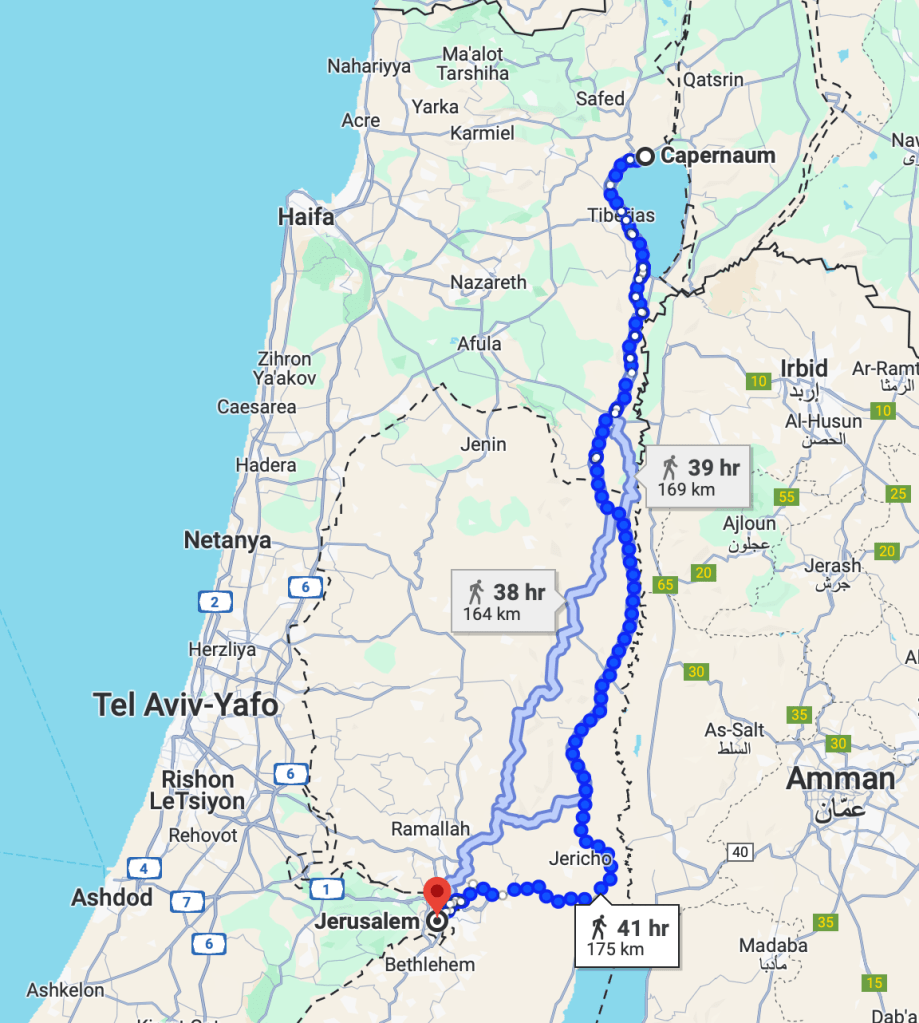
Google Maps says that it is a 41-hour walk from Capernaum to Jerusalem.  Good luck with that today.  The roads may be better, but the number of checkpoints makes that unlikely.  Google has you hugging the Sea of Galilee to the west, then continuing on the western side of the Jordan through Jericho, then turning west to Jerusalem.

 The Google Map 2024 path for walking from Capernaum to Jerusalem.

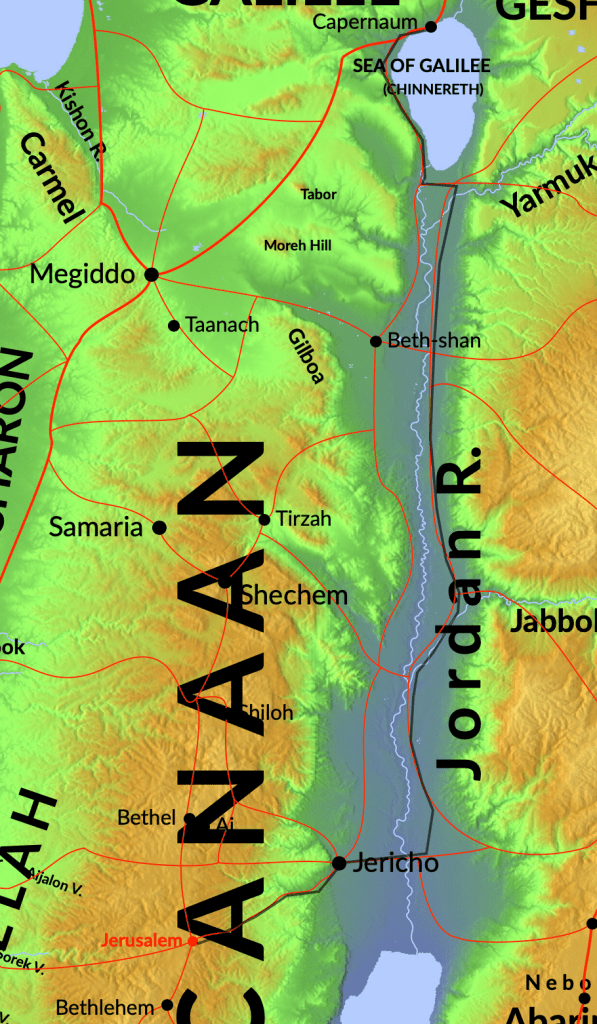
  Jesus’ path may have been similar, though he would likely have traveled south on the eastern side of the Jordan.  Traveling on the western side of the Jordan or through the center of the country would have taken him through the land of the Samaritans, and most pilgrims would never have traveled that way (we will talk about that later.)

 This is the likely path from Capernaum to Jerusalem using ancient and Roman roads (avoiding Samaria), a total of 98 miles.

In Jesus’ day, large crowds would be headed together from Galilee to Jerusalem, typically taking 4-5 days.  It was a festive journey.  Traditionally, they would sing the shiray hammaloth Hebrew for Songs of Ascent.  Why were they called ‘ascent’? 2 

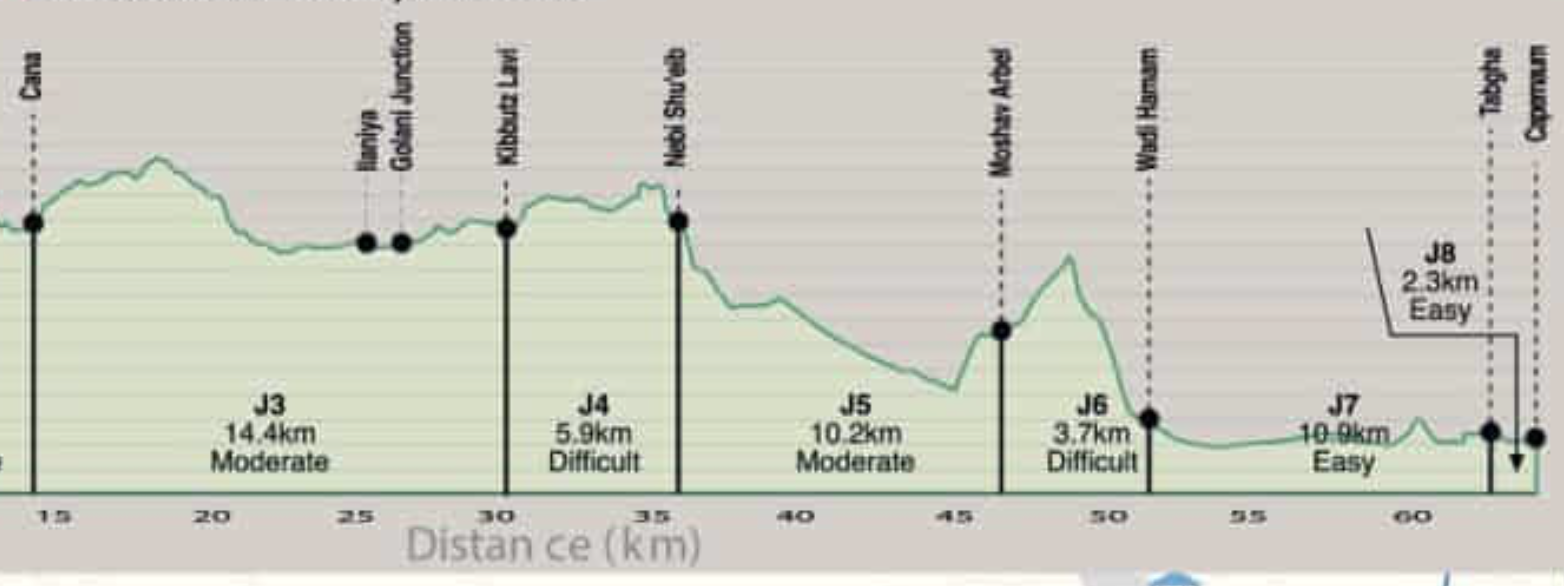
This shows the altitude changes on this path.  Note that the final portion of the journey ascends from 333 meters below sea level (-1092 feet) to 809 meters above sea level (+2654 feet), which is a change of 1142 meters or 3746 feet.

Jesus left on the first day of the week (our Sunday) and arrived in Jerusalem on Thursday. As with most pilgrims, he immediately went to the temple when he arrived. But Jesus is not like most pilgrims.  He comes into the outer courts of the temple and sees the people selling animals and exchanging money, and, well, you know what happens next (more about that later this week).

  1. Deuteronomy 16:16   “Three times a year—on the Feast of Unleavened Bread, on the Feast of Weeks, and on the Feast of Booths—all your males shall appear before the Lord your God in the place that he will choose. They shall not appear before the Lord empty-handed.”  There is some documentation in the first century that it was not as strictly followed at that time.  The Mishnah says, “The following are things which no measure is subscribed… appearing before the Lord.”  (Peah 1:1).  It is felt, though, that the most observant Jews (including Mary and Joseph) would observe the commandment as stated in Deuteronomy.
    2.   Let me recommend a great book that examines these Songs of Ascent: A Long Obedience in the Same Direction by Eugene Peterson. This book gives you the flavor of the Psalms sung on the journey. Peterson paraphrased these Psalms, which led him to paraphrase the book of Psalms and then the entire Message Bible.

April 2-4, 27 A.D.  From Cana to Capernaum  Step by Step with Jesus #3

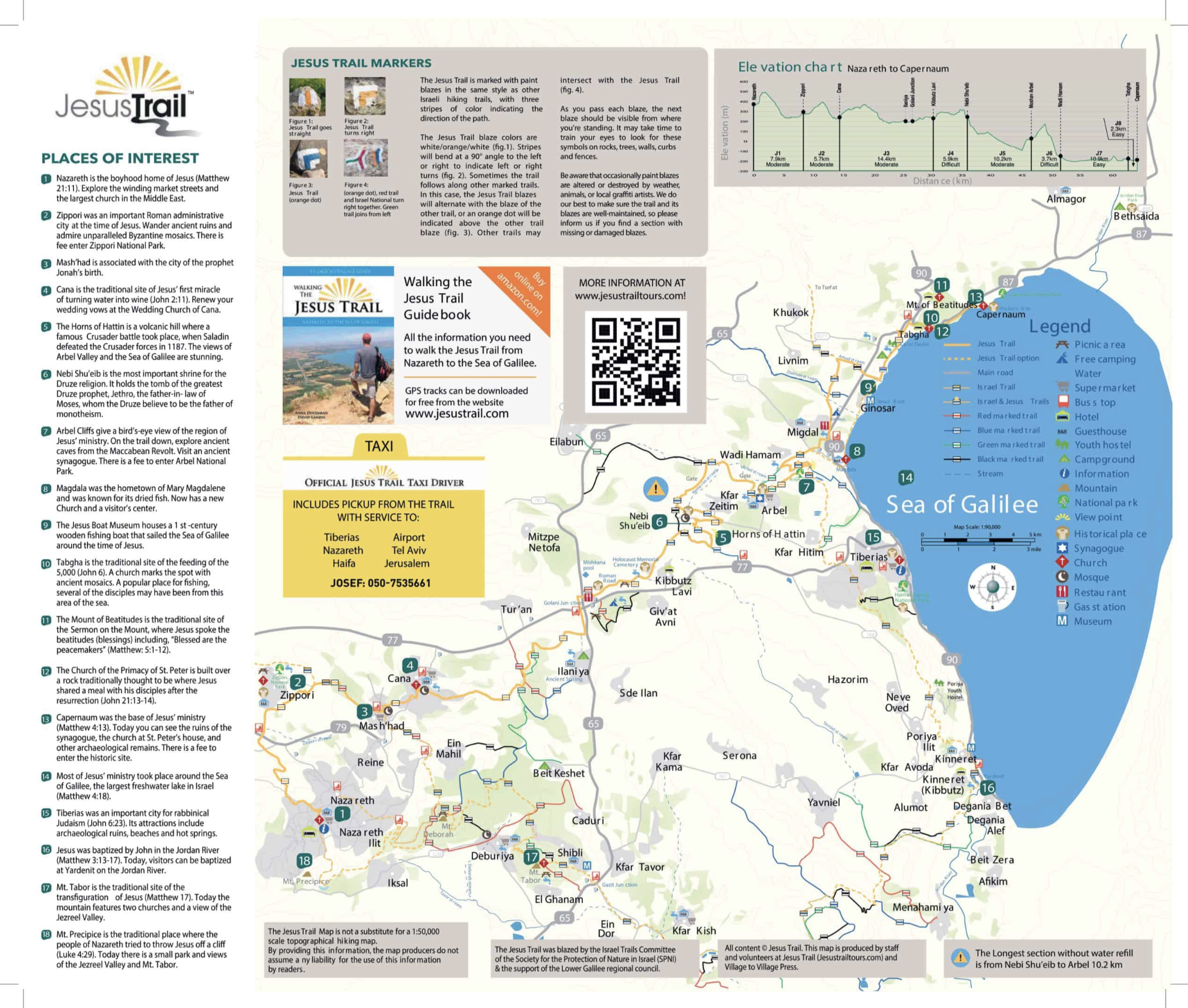
Jesus will leave Cana after the miracle of water to wine.  It is about 32 miles from Cana to Capernaum.  If you go to Israel, you can hike this as part of “The Jesus Trail,” from Nazareth (about 8-10 miles from Cana) through Cana to Capernaum.  The trail is well marked, and a guidebook is available with directions, sites you will visit on the way, and suggestions for overnights, eating, and where to get water.  

Jesus would have likely made this trip in 2-3 days, depending on how soon they left the wedding. They would want to be in Capernaum early on Friday to have time to prepare for the Sabbath, which begins at sundown on Friday evening. There is about a 700-foot elevation drop from Cana to Capernaum, but there are plenty of ups and downs.

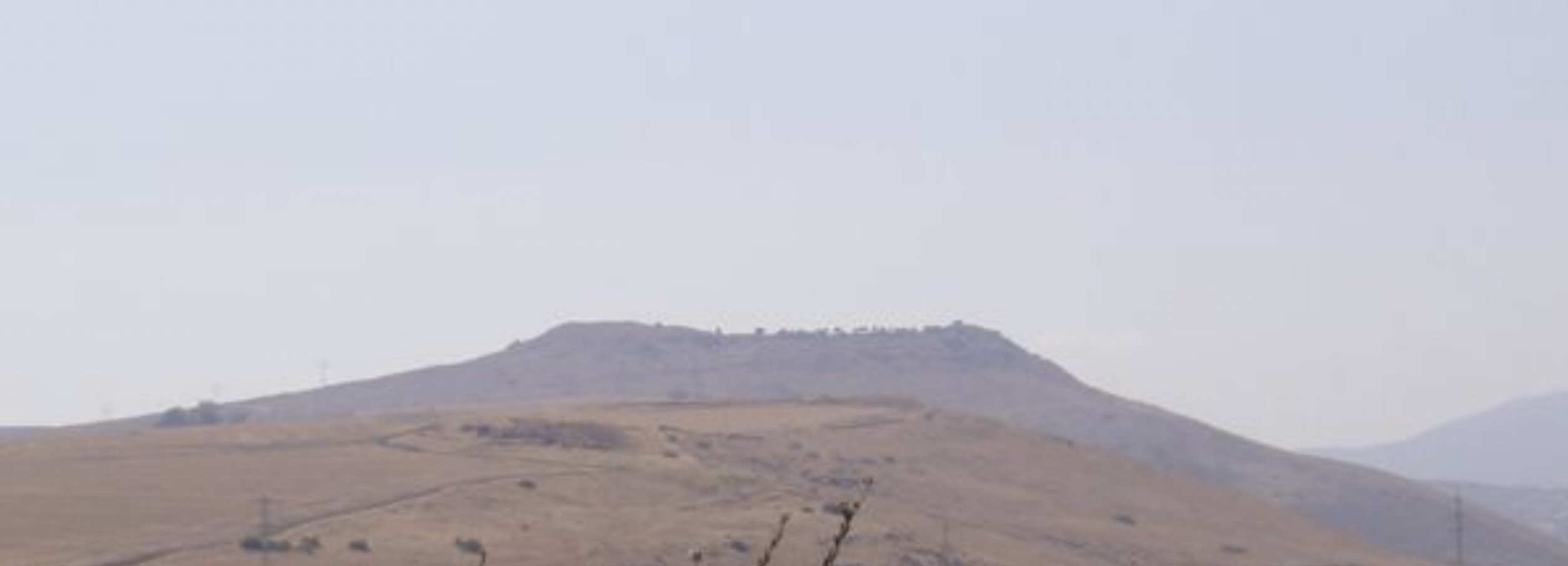
You will pass over the “Horns of Hattin,” an extinct volcano with two peaks (horns) that are volcanic plugs. This is the site of the “Battle of Hattin” in 1187 A.D., in which the Crusader forces that controlled the land after the First Crusade were devastated by the Muslim troops led by Saladin. This marked the end of the Crusaders’ control of the land. You will then descend before you climb again to Mount Arbel. The Horns of Hattin

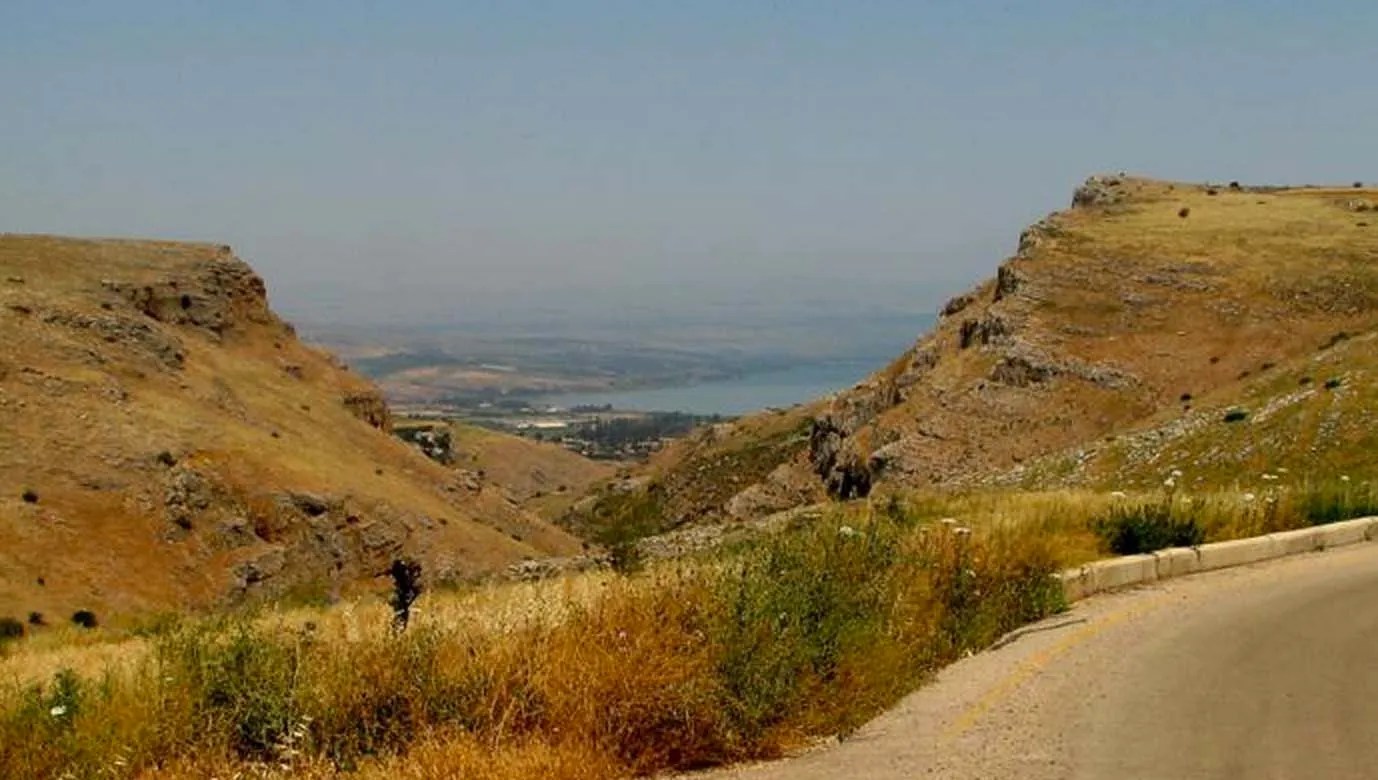
Arbel is a volcanic peak that was split in half by an earthquake. Here is a view from the west of Arbel, between the halves, with the Sea of Galilee in the background.

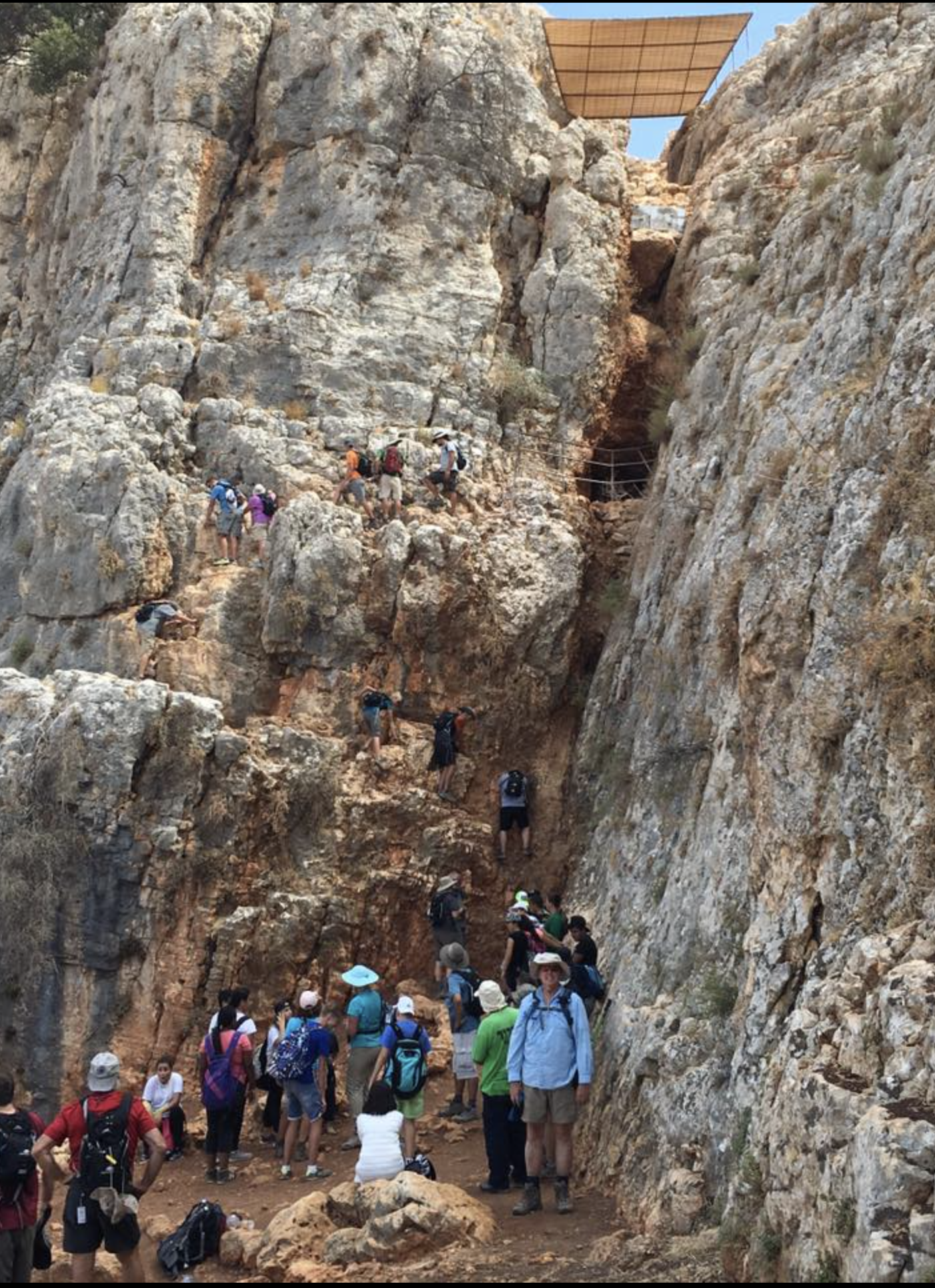
And here we are going up, then coming down.

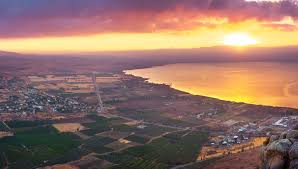
From Arbel, it is an easy hike down to the Sea of Galilee and then around the top of the sea to Capernaum (at the ‘cap’ of the Sea.)

April 1, 27 A.D.  The Wedding at Cana – The Year of the Lord’s Favor #24

Week 7 ———  The Wedding at Cana

John 2:1-11

John 2:1-11   “On the third day, there was a wedding at Cana in Galilee, and the mother of Jesus was there. Jesus also was invited to the wedding with his disciples. When the wine ran out, the mother of Jesus said to him, “They have no wine.” And Jesus said to her, “Woman, what does this have to do with me? My hour has not yet come.” His mother said to the servants, “Do whatever he tells you.”

 Now there were six stone water jars there for the Jewish rites of purification, each holding twenty or thirty gallons.  Jesus said to the servants, “Fill the jars with water.” And they filled them up to the brim.   And he said to them, “Now draw some out and take it to the master of the feast.” So they took it.   When the master of the feast tasted the water now become wine and did not know where it came from (though the servants who had drawn the water knew), the master of the feast called the bridegroom and said to him, “Everyone serves the good wine first, and when people have drunk freely, then the poor wine. But you have kept the good wine until now.” This, the first of his signs, Jesus did at Cana in Galilee and manifested his glory. And his disciples believed in him.”

“And the third day” is a puzzling phrase unless you understand how the Israelites named the days of the week.  Only the 7th day got a name, ‘Shabbat’ (Sabbath), which means “come to a stop, cease, rest.”  The other days of the week are just named after their order.  The first day is our Sunday; the second day is Monday.  So the “third day” is Tuesday.   According to Jewish tradition, Tuesday is the best day for a wedding.  The reason is that Tuesday is ‘doubly blest’ — the only day of creation in which the Bible states “and God saw that it was good” twice.  (Seriously, that is the reason.)  So we know the wedding was most likely on a Monday night.  Wait a minute,” you say, “didn’t you just say the third day was Tuesday?”  Ah, but this is a Jewish marriage.  And Jewish culture counts the days beginning at sunset, so our Monday night is the beginning of their third day.  Why do they count the day starting at sunset?  It all goes back to Genesis (doesn’t most everything?).  “And there was evening and there was morning, the first day” (Genesis 1:5).  So Jesus is there for the Monday night wedding. Wedding celebrations usually lasted seven days, but Jesus didn’t hang around for the entire celebration.

How long did he stay?  Long enough for them to run out of wine.  Jesus departs the wedding with his family (mother and brothers) sometime between Tuesday morning and Thursday morning.  It is about 32 miles from Cana to Capernaum and “down” to Capernaum, a drop of about 700 feet.  The journey would take two days, and they would want to arrive in Capernaum early enough on Friday to have time to prepare for the Sabbath.  They are returning to Jesus’ home base of Capernaum (likely staying at Peter’s house [or Peter’s mother-in-law’s house]) before they undertake the long journey to Jerusalem for Passover on the day after Shabbat.  So they likely left Cana either Tuesday or Wednesday morning.

Running out of wine at a wedding celebration is a major social faux pas by the bride’s family. People will be coming and going for the seven-day celebration, and in this culture, you do not have a joyful celebration without wine.  We can only guess why Mary relates this information to Jesus.  Has he been in a habit of performing miracles for social reasons before?  I doubt it.  Is Jesus’ family part of hosting this wedding?  Possibly.  We just don’t know.  But Jesus’ response to Mary makes it clear he feels like she has asked for his help.  In English, Jesus’ reply to Mary sounds harsh, but it is not.  He uses the same term when he tells Mary, “Woman, behold your son,” about John at the crucifixion. 

Jesus says, “My hour has not yet come.”  You will see this phrase several more times in John’s Gospel.  (John 7:6, 7:30, and 8:20). when the time has come for Jesus to go to the cross, Jesus says, “The hour has come for the Son of Man to be glorified.”  Jesus is on a schedule. He has tasks to complete before he allows the Jewish authorities to put him to death.  There is a plan, and it is the Father’s plan. 

As I have said before, whenever the Bible gives you an unexpected detail, it is almost always very important to the message.  Why do we get so much information about the water jars?  They were the expensive kind, stone, not clay.  Stone has to be carved from a solid piece of rock.  And they were big and heavy.  These are not jars you carry around with you.  They would have been 26-32 inches high and 16-20 inches in diameter.  Stone jars were used for ritual purification as they were non-porous and could be cleaned well.  A clay vessel that became contaminated (unclean) would be shattered and thrown away.  Why would one home have so many of these jars?  Some have suggested that it could be the home of a priest or pharisee, who would be more interested in ritual purification.  We do know that some priestly families lived in Cana.

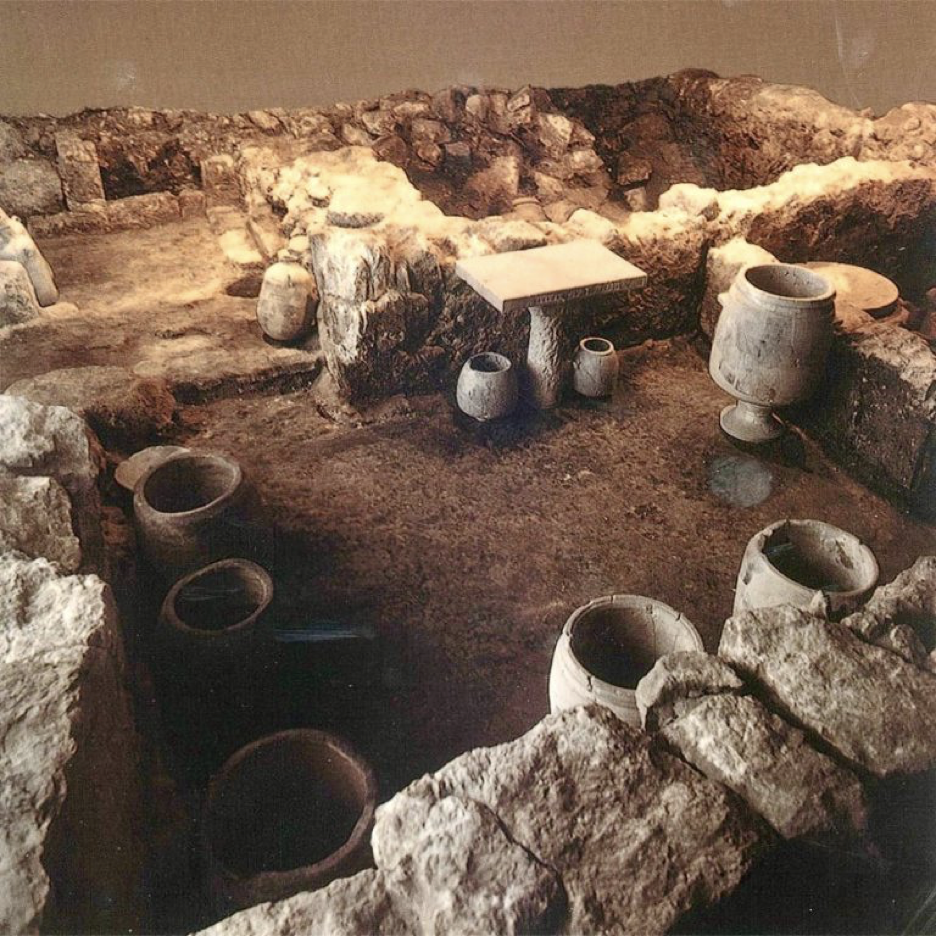
Some people make a lot about the number of jars.  Six can be a significant number. As seven is seen as the number of completion, six can be seen as the number of incompletion or imperfectness.1 If that were the case when Jesus performed his miracle, it wouldn’t have remained six.  Sometimes, the number is six because there were six stone jars.  And we presume John is present here as an eye-witness.  (We are told that disciples were present.  Andrew, John, and Peter have been with Jesus for a few days, though he won’t officially call them as disciples for a while. Perhaps Philip and Nathaniel are also here, but none are mentioned by name.)  Exactly six stone jars of this size were found in the remains of the kitchen of a first-century house in the Jewish quarter of Jerusalem that was excavated in 1970.  The house was burned in the fire started by the Romans during the siege of Jerusalem in 70 A.D.  It was located in the section of Jerusalem where the priests lived.  It is now a museum called ‘The Burnt House Museum’ (pictures below.)

So what is the significance of Jesus using water jars that were for ritual purification?  These would be for ‘netilat yadayim’ or ‘washing hands with a cup.’2  Halakha required hand washing before and after meals, before prayers, upon waking in the morning, and after using the toilet.  Note that this was for ritual purity (though there was obviously some benefit we now realize for germ control.)  As we move through the gospel, Jesus will have much to say about ritual purity.  He will also demonstrate his ability to overcome ritual impurity through his contagious holiness.  Two types of impurity are discussed in the Bible: ritual and moral.  We understand moral impurity, which is sin.  Ritual impurity was unavoidable and was not sinful (unless you came into the tabernacle/temple without going through the purity procedures.)  Jesus will show that he is the answer for both ritual impurity and moral impurity.  Here, he replaces the waters of ritual purification with wine.  In his last supper, he reveals that his wine represents his blood. He is foreshadowing a new method for complete purification through his blood.  Revelation 7:14 says, “They have washed their robes and made them white in the blood of the Lamb.”

The author says in 2:11 that “this is the first of his signs.”  This gospel has seven signs that climax in the raising of Lazarus from the dead.3 The purpose of the signs is to reveal his glory, which is in keeping with the prologue to the gospel in chapter 1:14

“And the Word became flesh and dwelt among us, and we have seen his glory, glory as of the only Son from the Father, full of grace and truth.”

May we seek this day to glorify our God.  There are a lot of empty jars out there.

Six stone jars as used for purification (and two smaller jars), as found in first century house of a priest (from the “Burnt House Museum” Jerusalem).

  1. Saint Augustine of Hippo (354-430 A.D.), who was never known to miss a chance to see ‘deeper meanings,’ said the six jars represented the six ages.  (From Augustine’s “Tractates on John (9.6)”)  If I were to go down a rabbit hole on this (and yes, I have been known to do just this), I would say there were six disciples there (though I am not sure who the sixth would be) and that filling the six vessels with Jesus’ new wine would be symbolic of filling the disciples with the new wine of the gospel.  I would contrast that to Jeremiah 13:12-14, where people are visualized as jars being filled with wine and sentenced to destruction.  Jesus is filling the disciples with his gospel of the kingdom that, instead of destruction, leads to blessing.  But I will resist the urge to go down that rabbit hole, so pretend you didn’t just read this (But do read the Jeremiah passage and tell me what you think.)
  2. The other form of ritual washing is ‘tevilah,’ which is total body immersion in a mikvah.
  3. Here are the seven signs in John:  water into wine (John 2:1–11), healing a royal official’s son (John 4:46–54), healing a disabled man (John 5:1–15), feeding 5,000 (John 6:1–14), walking on water (John 6:16–21), healing a man born blind (John 9:1–12), and raising Lazarus from the dead (John 11:1–43).

March 29, 27 A.D.  Behold the Lamb – The Year of the Lord’s Favor #22

Week 7 ———- John 1:35-42

It was on the first day of the Hebrew month of Aviv, 14 days before Passover in 27 A.D.  That corresponds to our March 29, 1997 years ago. John the Baptist looked at Jesus who had just come from his time in the wilderness, a time of testing and temptation and said ‘Behold the Lamb of God that takes away the sin of the world.”  

I will take you on a journey through the Bible so you will know what John knew.  We are familiar with his words, but do we know why he said them?

We have to go back to the beginning when God created everything.  He made this world and created a special place where he could dwell with us.  It was a garden in Eden.  And it was wonderful.  Adam walked in the garden with God. God loved the man and the woman. And there was no sickness, and there was no death.  But there was a tree.   And God told Adam to be obedient to me about the tree.  That fruit is not for you.  If you eat it, there will be death.

Genesis 2:17  “but you must not eat from the tree of the knowledge of good and evil, for when you eat from it you will certainly die.

But Adam and Eve were tempted to eat of that tree, to disobey God’s rules, and when they did, everything changed.  Sin drove a wedge between man and God.  They had to leave the garden, and death did come.  One day, they would die.  And they did die.  The Bible tells us Adam lived for so many years and then died.  Seth lived for so many years, and he died, and Enosh lived for so many years, and then he died.  Please don’t get all caught up in how many years they lived.  The big thing is that they all died.  That was not what God intended. Death was not supposed to be a part of the world. Death was a final separation from God.  There needed to be an answer for sin and death.

Romans 5:12   “Therefore, just as sin came into the world through one man, and death through sin, and so death spread to all men because all sinned

Death began when Adam and Eve sinned. Death entered the world then and became a part of it. But death did not spread to all because one man sinned, but because we all sin. You will die because you have sinned.  

Romans 6.23 For the wages of sin is death 

And I said that everything changed, but not everything changed. God still, despite sin, loved his children deeply and longed to be reunited with them. So, after these first three chapters of the Bible, the following 1186 chapters are all about how God pursues mankind and how God manages to destroy the barriers of sin and death so that God and man can dwell together again.

God calls Abraham and tells him to obey me, and I will build a great nation from you.  And that nation will be a nation of priests who will carry my message to the whole world.  But Abraham says My wife and I are very old and have no children.  How can we have descendants?  But God says, “I’ve got that.”

But Abraham is not always obedient; he gives up on God’s promise and has a child with his wife’s maid.  But God says no, I will give you and Sarah a child.  And Isaac is born… the child of promise.  

God says, ‘ If I am to build a nation from Abraham, from this one man, I have to know, and he has to know: ‘Is he faithful now?’  So there is a test. God asks Abraham to sacrifice his beloved son on a mountain. Will Abraham believe that God can fulfill his promise even if Isaac dies? Will Abraham believe God can conquer death?

Abraham and Isaac set out.  Abraham is about 100 years old, and Isaac is about 30.  And they came to Mt Moriah.

Genesis 22:6  And Abraham took the wood of the burnt offering and laid it on Isaac, his son. 

It is a heavy load. This is to be a whole burnt offering and must be completely consumed. It will take a lot of wood. So Isaac struggles up the mountain carrying the wood, and Abraham carries the fire and the knife.

Isaac asks, “Behold, the fire and the wood, but where is the lamb for a burnt offering?” (Genesis 22:7).  Abraham replies, “God will provide for himself the lamb” (Genesis 22:8).

At the top of Mount Moriah, Isaac realizes that he is the sacrifice. 

Genesis 22:9  And they came to the place which God had told him of; and Abraham built an altar there, and laid the wood in order, and bound Isaac his son, and laid him on the altar upon the wood.

I had always missed something important here. My Jewish friend taught me that the heading for this story in his Bible is “The Binding of Isaac.”  In Hebrew, it is the Akedah. They emphasize the binding because Isaac, as a young man of 30, could have resisted. He could have overpowered his father. But he submits voluntarily to be tied up with ropes and placed on the altar—a willing sacrifice.

Abraham raises the knife. When it seems all is lost for Isaac, God provides a substitute: a male lamb appears. There is a lamb to take the place of sacrifice for Isaac.

Fast forward to when Abraham’s descendants end up in Egypt, and they become slaves for 400 years.  And they are harshly treated.  And they cry out to God for help.

Exodus 3:7-8   Then the LORD said, “I have surely seen the affliction of my people who are in Egypt and have heard their cry because of their taskmasters. I know their sufferings, and I have come down to deliver them out of the hand of the Egyptians and to bring them up out of that land to a good and bropiad land, a land flowing with milk and honey

So God sent Moses, and there were nine horrible plagues, but the pharaoh would not let God’s people go.  So, there is one more plague.   

Exodus 11:4-5   So Moses said, “Thus says the LORD: ‘About midnight I will go out in the midst of Egypt, and every firstborn in the land of Egypt shall die, from the firstborn of Pharaoh who sits on his throne, even to the firstborn of the slave girl who is behind the handmill, and all the firstborn of the cattle.

Someone must pay the price for sin.  The wages of sin is death.  The firstborn must die.

But God will spare the firstborn of the Israelites.  There will be a substitute as there was for Isaac.  There will be a lamb. And Exodus 12:5 says, “Your lamb shall be without blemish, a male a year old.” Every family will take a lamb, slaughter it, cook it, and eat it.

Exodus 12:13  But the blood on your doorposts will serve as a sign, marking the houses where you are staying. When I see the blood, I will pass over you. This plague of death will not touch you when I strike the land of Egypt.

This is not an offering for sin; it is a substitution for death.  A family eats it, and none is left.

So they escape Egypt and come to Mount Sinai, where God gives them instructions for a tabernacle so that he can dwell with them. Again, after the first three chapters of the Bible, God is working to restore the relationship with man that he had in the garden. But they are still sinning, so God gives them a means to atone for their sins.  Because their sins are continual, they need a continual sacrifice of sin. So, God establishes the tamid sacrifice.  (Tamid is Hebrew for ‘continual.’)    Again, it is a one-year-old lamb without blemish or spot, 

The tamid lamb would be placed on the altar at 9:00 in the morning, and it will burn on the altar along with all the other sacrifices until 3:00 pm when it is completely consumed.  And so that there be a lamb there continually, another lamb shall be sacrificed and placed on the altar at 3:00 pm and burn until the next morning, when it will start over.

Ever-present sacrificial lamb before the father. for sin

And so it was, every day.   A lamb was placed at 9:00 am and 3:00 pm.  And the people would gather at 9 and 3 for the sacrifice.  They would say the Shmah prayer and the 18 benedictions.

This happened every day for over a thousand years, so there was an ever-present sacrifice before the Father for sins.

In addition to this twice-a-day tamid offering for sin, once a year, at the time of the Passover celebration, beginning at 9 a.m. until 3 p.m., every family would bring a lamb to the temple, slaughter it, take it home, and roast it. It was to be eaten to remember the Passover when a lamb was slain as a substitute for death.  

Because there had to be a solution to the problems of sin and death

But the prophet Isaiah foresaw a time that God would do something different:

Isaiah 43:18-19 “Remember not the former things, nor consider the things of old.
Behold, I am doing a new thing; now it springs forth, do you not perceive it?
I will make a way in the wilderness and rivers in the desert.

And Isaiah tells us that this one would be the new Passover and the new sacrifice:

Isaiah 53:3,5-6       He was despised and rejected by men, a man of sorrows, and acquainted with grief;
But he was pierced for our transgressions; he was crushed for our iniquities;
upon him was the chastisement that brought us peace, and with his wounds, we are healed.
All we like sheep have gone astray; we have turned—every one—to his own way;
and the LORD has laid on him the iniquity of us all.


There is one coming, this new Passover, this new sacrifice. God will provide the lamb.

But after Isaiah predicted this new thing God would do, for the next 600 years, the people of Israel said, as Isaac had said, “Where is the Lamb?” 

The nation hits its lowest point, and Babylon attacks them.  The city and the temple are destroyed, and they are taken into captivity for 70 years.  And the people ask, “Where is the lamb that will bring us redemption?”

They finally return and rebuild the temple, but it is only a shadow of its former self. They make an offering, but God does not show up. And the people ask, “Where is the lamb who will do this new thing?”

They are conquered by the nations who burn their bible scrolls, desecrate their temple, and refuse to let them say the name of their God. And the people ask, “Where is the lamb that will restore us?”

Then they are conquered by the Romans, who are brutal, bring more persecution, bring more death, and crucify whole villages of their neighbors. And the people ask, “Where is the lamb?  Where is the way in the wilderness?”

  They rebuild the temple, and it is beautiful on the outside, but inside, it is corrupt and controlled by priests who swindle money from the poor to gain personal power and wealth. And the people ask, “Where is the lamb?”

And Jesus walked out of the wilderness, back to where John the Baptist was preaching near the Jordan River.  John looked at Jesus, who had just come from his time in the wilderness, a time of testing and temptation, and said, ‘Behold the Lamb of God that takes away the sin of the world.‘   God has provided the lamb.

Jesus spends the next year teaching and demonstrating how to live as a member of the Kingdom of God. When his year is up, he heads to Jerusalem to fulfill his role as the Lamb who takes away the sins of the world. It is the time of the Passover celebration when everyone comes to Jerusalem to sacrifice a spotless lamb to celebrate God’s delivery from death. And he gives himself up.  And as Isaiah foresaw, He is beaten repeatedly, scourged, abused, and he did not say a word.

Is. 53:7    He was oppressed, and he was afflicted, yet he opened not his mouth;
like a lamb that is led to the slaughter, and like a sheep that before its shearers is silent,
so he opened not his mouth.

After his beating, Pilate presented Jesus and said, “Behold the man!” (John 19:5). Pilate did not know what John the Baptist knew.

And Abraham took the wood of the burnt offering and laid it on Isaac his son.  
And Yehovah took the wood of the cross and laid it on Jesus his Son.

And Isaac carried the wood for the sacrifice up the hill.
And Jesus carried the wood for the cross up the hill.

And Isaac was bound by ropes and laid on the wood.
And Jesus was bound by nails, laid on the wood.

And the innocent lamb took Isaac’s place.
And the innocent lamb took our place.

We stood guilty before God of sins, knowing that the wages of our sins were death.  We deserved the penalty of death.  But Jesus is the innocent, spotless lamb who takes our place, 

It was our sin he took on; it was our punishment of death. He deserved none of it.  But he did it because he loves us.  He would do anything for us.  He would do anything to be able to reunite us – to restore the fellowship of man with God in the garden as he first designed it.

And in the very spot on the same mountain where Abraham laid Isaac on the altar, God provided the lamb. On that very same spot, at 9 a.m., the people gather and pray, and as they have done every year for over 1000 years, the yearling lamb without blemish is being placed on the altar, where it will be until 3 p.m.

But this day is different because it is the day of Passover, and after the 9 am lamb is placed, they begin the slaughter of the Passover lambs. Each family brings a 1-year-old lamb to the temple to that spot on the mountain where God provided the lamb and the sacrifice of the Passover lambs begins.  But this day is very different Because at that same time, 9 am when the Tamid is offered for sin, when the Passover lambs are being slain to remember the salvation from death,  Jesus is placed on the cross, where he stays until 3 pm. 

And John the Baptist points from the grave and shouts, “Behold the Lamb of God who takes away the sins of the world.”

At 3 pm, the Tamid lamb for sin has been consumed, and the last Passover lamb has been slain, 

And Jesus says, “It is finished.” In Hebrew, that is one word, “Asah.” That is the last word of Psalm 22, the Psalm that tells the story of the crucifixion.  “Asah” means “I have done it.”

At the exact moment when Jesus’ work is complete on the cross, He says, “It is finished,” and the veil of the temple is torn.  The curtain that separates God’s presence from the people is ripped from top to bottom. There is no longer a dividing wall between us and God’s presence. The barrier was sin. Jesus conquered sin on the cross.  Now, there is a way for God to be reunited with man.  And for the first time since God commanded the continual sacrifice in Leviticus — for the first time in over a thousand years, there is no need for the twice-a-day tamid sacrifice of the lambs because Jesus’ sacrifice is the perfect sacrifice. 

Sin has been defeated once and for all.

Sin is defeated, but what about death?   Death, that final separation, must be addressed.

And Jesus, who did not deserve to die, is placed in the Grave.  But the prophets had also predicted the defeat of death.

Isaiah 25:8  He will swallow up death forever; and Yehovah God will wipe away tears from all faces, and the reproach of his people he will take away from all the earth, for Yehovah has spoken.

Hosea 13:14   I shall ransom them from the power of the grave; I shall redeem them from Death.  Oh, death, where is your victory? Oh, grave, where is your sting? 

Three days later, the stone rolled away from where he was buried to reveal an empty tomb. The angel tells Mary, “He is not here, for he has risen.” The news spreads.

And I can almost see old Nicodemus when someone tells him that Jesus’ grave is empty

and he finally understands what Jesus was trying to say to him.

Nicodemus, For God, so loved the world… This is how much God loved the world. This is how much God wanted to restore the relationship with mankind that was tarnished by separation by sin and death. This is what God was willing to do.

For God so loved the world that he gave his only Son, that whoever believes in him should not perish but have everlasting life.

So when we hear John the Baptist’s words, ”Behold the Lamb of God that takes away the sin of the world,” we remember that Jesus is the Lamb of God who conquered both sin and death.

1 Peter 1:18-19  But you were ransomed with the precious blood of Christ, like that of a lamb without blemish or spot.

1 Corinthians 5:7   For Christ, our Passover lamb, has been sacrificed.

This explains our communion, our Lord’s Supper.  Why do we remember what Jesus did by eating bread that represents his body and juice that represents his blood?  Because the Passover lamb was eaten, and his blood is our ransom from sin.  Because sin and death are both defeated 

1 Cor. 15:57   But thanks be to God, who gives us the victory through our Lord Jesus Christ.

March 30, 27 A.D.  Jesus with Andrew, John, and Simon – The Year of the Lord’s Favor #23

Week 7 ———  What are you looking for?
John 1:35-42

(You may notice we skipped #22, which covers John 1:35. It will be released tomorrow, as it coincides with our Resurrection Day message.)

John 1:35-42   The next day, again, John was standing with two of his disciples, and he looked at Jesus as he walked by and said, “Behold, the Lamb of God!” The two disciples heard him say this, and they followed Jesus. Jesus turned and saw them following and said to them, “What are you seeking?” And they said to him, “Rabbi” (which means Teacher), “Where are you staying?” He said to them, “Come and you will see.” So they came and saw where he was staying, and they stayed with him that day, for it was about the tenth hour.  One of the two who heard John speak and followed Jesus was Andrew, Simon Peter’s brother.  He first found his own brother Simon and said to him, “We have found the Messiah” (which means Christ). He brought him to Jesus. Jesus looked at him and said, “You are Simon the son of John? You shall be called Cephas” (which means Peter).

Sometimes, we don’t know what we are looking for. When you reach a… certain age… you may find yourself walking in a room because you know you are looking for something—but you temporarily forget what you are looking for. (It is even more embarrassing when the keys you forgot you were looking for are in your hand or those glasses you forgot you were looking for are on top of your head.)

Jesus asked the disciples, “What are you looking for?”  Was he asking for him or for them?  Was he asking so he would know, or was he asking them to consider for themselves so they would really know what they were looking for?  I think he wanted them to consider what they were seeking.  It is an important question.  What are you looking for from Jesus?

I don’t think Andrew and John really knew what they were looking for.  John the Baptist had just pointed Jesus out as “The Lamb that takes away the sins of the world.”  Perhaps they wanted Jesus to explain how he would be that Lamb.  Perhaps they wanted him to ask them to be his disciples.  Maybe they didn’t know exactly what they wanted, but they knew the answers to all the essential questions were in this ‘lamb of God.’  

Their reply, “Where are you staying?” is an answer to Jesus question.  They want more time with Jesus.  They want a relationship with Him.  Just this week, one of my friends had the opportunity to spend an afternoon with someone whom I can only describe as his pastor-hero. This world-famous pastor, author of around 50 books, leads one of the largest churches in the US.  My friend was asked to submit a few questions to ask this celebrity pastor.  In talking with him about it, it was clear that my friend didn’t want answers to questions as much as he just wanted to make a new friend.  He wasn’t seeking answers so much as seeking a relationship.  

John says it was the tenth hour. It is important to know that John counts time differently than the other gospels. Matthew, Mark, and Luke (the synoptic gospels) count time using the Jewish method of dividing the daylight hours into 12 hours from sunrise to sunset (6 am to 6 pm). So, in this method, the tenth hour of the day would be 4 pm.  However, John uses the Roman method, which counts the hours from midnight (or from noon).  So the tenth hour in John would be 10 am, which makes the phrase “stayed with him that day” a more reasonable description.

Jesus invites them to come with him and see where he is staying.  Andrew takes a detour to locate his brother, Simon, telling him, “We have found the anointed one (Hebrew ‘Messiah’ / Greek ‘Christos’ / English ‘Christ’).  Peter joins the two and meets Jesus who tells Peter he will in the future be called ‘Cephas’.  ‘Cephas’ is a transliteration of the Aramaic word for ‘rock.’  Peter is the English version of the Greek ‘petros’ (meaning rock).  The Hebrew word for ‘rock’ is ‘evan’.  We are not told why Simon will be called ‘Peter,’ Evan,’ or ‘Rocky’ in the future.  (We will talk about this one day in the future.)  

This brings up the question of what language Jesus spoke.  It is almost undisputed that Jesus spoke Hebrew, Greek, and Aramaic, but what was his primary language?  It matters because knowing a speaker/author’s primary language influences understanding of their work.  For years, theologians (including the Pope) have maintained that Jesus spoke Aramaic.  The Jews adopted that language during their captivity in Babylon.  Parts of the book of Ezra and much of Daniel are written in Aramaic.  On returning from exile, Nehemiah complained that the Jews did not speak their original language. (Neh. 13:23)  So Ezra established Hebrew Torah readings, prayers, and songs, many of which are still used today.  

Recent evidence makes it more likely Jews in Jesus’ day spoke Hebrew more than Aramaic.  The Dead Sea Scrolls material, written between 200 BC and 100 AD, is almost exclusively Hebrew, both scripture and commentary.  Of the 215 different types of Jewish coins that have been discovered (dating from 200 BC to 200 AD), all but one had a Hebrew inscription.   Personal letters from that period have been discovered in Hebrew.  And the Book of Matthew was undoubtedly initially written in Hebrew.  It is clearly from a Hebrew mindset, with many Hebrew idioms and expressions, and there are many word connections and puns that do not work in other languages.  Finally, there is John 19:19-20.

Pilate also wrote an inscription and put it on the cross. It read, “Jesus of Nazareth, the King of the Jews.” Many of the Jews read this inscription, for the place where Jesus was crucified was near the city, and it was written in Aramaic, in Latin, and in Greek. (John 19:19-20)

The word translated “Aramaic” by the ESV is the Greek “Hebraisti.”  Scholars have long asserted that this word can mean either Hebrew or Aramaic and because they once believed that Hebrew was a dead language, it had to mean ‘Aramaic.’  Scholars are not quick to give up their traditional beliefs, but with more and more information proving that Hebrew wasn’t a dead language in the first century, this view is changing.

Jesus asks this question many times in the gospels. He asks the blind man what he wants.  

What are you looking for from Jesus?  Some people have questions and want answers.

Some want a ‘get-out-of-hell-free card’. Some want Jesus to take all of their problems away. First, I think we should seek a relationship.  That is what God wants.  He designed creation so that we would have a place to fellowship with him, and He is moving events so that we will have that Eden experience again with Him.  Secondly, I want from Jesus what he wants for me.  I dare not trust my own desires.  I trust that this God, Yehovah, who loves me, will only give me good gifts.  He knows my needs better than I do.  

So these two teenagers, Andrew and John, joined by the oldest of the future disciples, Peter, spend the day with Jesus. And it changed them forever. Note that they are not called to be disciples of Jesus at this point. That will happen months later. But it certainly explains how when Jesus sees Simon and Andrew again, fishing in the Sea of Galilee, they are willing to drop their nets and immediately follow this teacher they knew from before. 

Today, let’s you and I spend a day with Jesus.  If we do, we will never be the same.

(Bono said his hit “I still haven’t found what I’m looking for” was really a gospel song, but more about doubt than faith. If you haven’t heard the version he does with a gospel choir from Harlem, you need to. https://www.youtube.com/watch?v=M8Wt3dhF4fU )

Step by Step with Jesus #2 — A Course Correction

If you read the accompanying resource and make it all the way to the end of this post, you are a certified Bible Nerd.  If you just want the details on following Jesus’ steps, skip to the last 2 paragraphs.

As I explained earlier, I am attempting to map Jesus’ journeys throughout this year of ministry.  I was aware that there would be some difficulty determining some locations and routes, but since I have been unable to find anyone who has attempted this, I had no real idea how hard it would be.  I certainly didn’t expect to have trouble the very first day. 

I had always accepted the traditional location of Jesus’ baptism by John the Baptist.  John 1:28 says, “These things took place in Bethany beyond the Jordan where John was baptizing.  I had read that it states “Bethany beyond the Jordan” to differentiate from the ‘Bethany’ near Jerusalem that is listed many times in the gospels.  “Beyond the Jordan” is assumed to mean “on the other side of the Jordan” from Jerusalem, so on the east bank.  Currently, we know of no places named ‘Bethany’ anywhere near the Jordan.  Both Origen and Chrysostom (early ‘church fathers’) favored a location called Bethbara, on the Jordan about 6 miles southeast of Jericho. But none of the earliest manuscripts of John support the spelling of ‘Bethbara.’  

I  have been to the traditional Baptismal site several times.  There are ruins of church structures dating back to 500 AD at that site to commemorate the baptism of Jesus.  But when I began to calculate Jesus’ journey from that area to the Galilee, I ran into a problem.  On March 30, Andrew and John, disciples of John the Baptist, spent the day with Jesus, where he was ‘dwelling.’  The following day, March 31, Jesus “decided to go to Galilee” and then has conversations with Philip and Nathaniel in the Galilee.  The next day he was at a wedding in Cana of Galilee.  

The problem is that even to get to the most southern aspect of the Galilee would be 48-50 miles at least.  Jesus was a miracle worker, but I doubt this one day 50-mile hike is one of them.  So then I began searching to see what other locations John may have been baptizing at that could be near “Bethany.”  I won’t bore you with the missteps I took, but I did find a resource that explains the problem well and does an excellent summary of the possibilities.  Bethany Beyond the Jordan (John 1:28) Topography, Theology and History in the Fourth Gospel, by Rainer Reisner,1  Jesus returns to this location ‘across the Jordan’ in John 10:40.  Looking at when Lazarus died and when Jesus arrives in Bethany near Jerusalem (by which time Lazarus has been dead four days) also makes the location near Jericho in the south unreasonable.  So Reisner locates Jesus’ baptism in the north, in the region of Batanaea (see map below) with Batanaea being a variant of the Greek that our current English versions translate as ‘Bethany’.  I believe Reisner makes a strong case for this location.  Read his article.  It is available online and not too difficult to follow, but the ability to read a little Greek is helpful. 

Also, there is the possibility that since this is the spring season, the Jordan might be at flood stage, making baptism in the Jordan dangerous.  Joshua 3:15 says”now the Jordan overflows all its banks throughout the time of harvest.”  (We know that he was referring to the barley harvest, which begins just after Passover because Joshua 4:19 says, “The people came up out of the Jordan on the tenth day of the first month.”  The 14th of the first month is Passover.  So baptism in the traditional location (which is very close to the location of the crossing in Jordan) is very unlikely. We know that John the Baptist baptizes in several locations, using springs for baptism at some times.  John 3:23 says, “John also was baptizing at Aenon near Salim because water was plentiful there.”  Aenon near Salim most likely means “the springs near Salem.”  These springs still exist and currently feed many ponds in the area that are used for fish hatcheries by a local kibbutz.

So now I have to revise my previous articles that refer to the baptismal site in the south. Jesus’ time in the wilderness would be not in the Judean wilderness but in the wilderness east of the Sea of Galilee, in the region of Batanea.  And his journey from the place John was baptizing to Galilee on March 31 (in John 1:29-34) would be between 2-7 miles.  He would then travel around 14-15 miles to Cana for the wedding on April 1.  

So for those of you following with your feet, it makes more sense now and is certainly more doable.  I’m sure we will run into other issues determining these 2000 year old locations, but for now, happy walking!

  1. “Bethany Beyond the Jordan (John 1:28) Topography, Theology and History in the Fourth Gospel” by Rainer Reisner. Available at: https://www.google.com/url?sa=t&source=web&rct=j&opi=89978449&url=https://tyndalebulletin.org/api/v1/articles/30556-bethany-beyond-the-jordan-john-1-28-topography-theology-and-history-in-the-fourth-gospel.pdf&ved=2ahUKEwjqyez4lpKFAxUB18kDHdmRBzEQFnoECBIQAQ&usg=AOvVaw0KvtX1aUZskL6fmZI-vCJ2

March 28, 27 A.D.  Jesus in the Wilderness – The Year of the Lord’s Favor #21

Week 6 ———  The Temptations

Matthew 4:3-11— Mark 1:13b  —  Luke 4:3-13

Jesus has endured 40 days in the wilderness, and now the adversary comes to him with three temptations.  

Matthew 4:2-4   And after fasting for days and forty nights, he was hungry. And the tempter came and said to him, “If you are the Son of God, command these stones to become loaves of bread.” But he answered, “It is written, ‘Man shall not live by bread alone, but by every word that comes from the mouth of God.’”

The accuser comes to Jesus in his time of greatest weakness.  He has fasted for 40 days.  But God has not yet proclaimed an end to Jesus’ fast.  Notice the accuser begins, “IF you are the Son of God.”  Jesus had just heard the voice of God himself proclaim him as the Son 40 days ago 

Matthew 3:16-17 And when Jesus was baptized, immediately he went up from the water, and behold, the heavens were opened to him, and he saw the Spirit of God descending like a dove and coming to rest on him; and behold, a voice from heaven said, “This is my beloved Son, with whom I am well pleased.”

First, the accuser will question your identity.  “If you are really saved, you would not have had that bad thought or done that bad thing.”  “If you were really a child of God, then your life wouldn’t be so hard or in such a mess.”  If he tried to place doubt in Jesus’ mind about his identity, rest assured you will face the same temptation at some point.  

Then the enemy will try to get you to question God’s goodness.  This strategy has been the accuser’s method from the beginning.  In the garden, “He said to the woman, “Did God actually say, ‘You shall not eat of any tree in the garden’?”  By exaggerating God’s prohibition from one tree to all, he places doubt in her mind and questions God’s goodness.  She questioned whether God was holding back something good for her.  This was Israel in the wilderness.  They were led into a place with no food, a forced fast.  Soon, they were doubting God’s goodness, asking why God brought them out of Egypt, where there was plenty of food, to a place where they would starve. This was also Jesus’ temptation.  You can almost hear the accuser saying, “Come on, 40 days of fasting is sure to be enough. You can end this fast now.  Aren’t you hungry?”  The temptation facing Adam and Eve, Israel, and Jesus is this: ‘surely your appetites are a better indication of what you need than God’s word.’  And that is the temptation we constantly face.  Will we seek to satisfy our appetites, our lusts for food, money, possessions, pleasure, power, etc?  Or will we strive to be obedient to our Father and seek first the Kingdom of God?

This was a real temptation for Jesus.  He was hungry, and he had the ability to make bread appear (even without stones) as he did in the miracle of feeding the 5000 or the 4000.  But he answers:

“It is written, ‘Man shall not live by bread alone, but by every word that comes from the mouth of God.’”

He quotes Deuteronomy 8:3, where Moses explains to Israel why obedience in fasting is essential:

“And he humbled you and let you hunger and fed you with manna, which you did not know, nor did your fathers know, that he might make you know that man does not live by bread alone, but man lives by every word that comes from the mouth of the LORD.”

Our appetites should not be what controls our behavior.  Our behavior should be modeled after God’s word.  

Matt. 4:5-6   “Then the devil took him to the holy city and set him on the pinnacle of the temple and said to him, “If you are the Son of God, throw yourself down, for it is written, ‘He will command his angels concerning you,’ and ‘On their hands they will bear you up, lest you strike your foot against a stone.’”

One of the secrets to understanding this temptation is a knowledge of the geography of the wilderness Jesus was in.  The Judean Wilderness is full of cliffs and wadis.  Yet somehow (whether in Spirit or physically), the accuser transports Jesus to the pinnacle of the temple.  Why was this area, with many steep cliffs, not a suitable setting for the temptation?   The difference is that in the temple in the city of Jerusalem, many people would see it.  Remember that Jesus keeps his miracles mostly in isolation in the beginning.  He tells people he heals not to tell anyone.  Other than the required feasts, he stays away from Jerusalem.  Then, in the final weeks of his ministry, Jesus purposely arranges to do an undeniable miracle in front of a crowd at Jerusalem’s doorstep.  Jesus delayed answering Mary and Martha’s plea to come and heal Lazarus, delaying his arrival until Lazarus was dead for four days.  (The thought in that day was that the spirit remained with the body for three days.  Waiting an extra day makes the miracle even more undeniable.)  Jesus forces this into the public where the religious authorities can not ignore it because “his hour has come.”  And it is this miracle that forces the Sanhedrin to decide that Jesus must die.  Had Jesus demonstrated such a public miracle before his ministry even started, he would have lost his opportunity to have that year with his disciples to teach and demonstrate the Kingdom of God to them.  That explains the ‘where’ of the temptation.

For the temptation itself, the accuser quotes Psalm 91, a Psalm about the Messiah. It promises protection, rescue, and deliverance.  But we have already discussed that putting God to the test is sinful.  Jesus’ answer from Deuteronomy references Israel testing God when they were thirsty.  Again, they doubted God’s goodness, saying he brought them there to kill them with thirst.  We easily see how jumping off a high place is a test. How is Israel testing God?

if you are thirsty and there is no water, you have two choices.  You can say:

  1. “It is okay, God is over all.  He love me and will provide for me as he always has. We got hungry and he dropped bread out of the sky for us.  He will find us water”

or 

2.     Why did you bring us here to die, Moses?  We had plenty of water in Egypt. (Here they sound like my kids when they were little on a long car trip, “I’m thirsty, I’m starving to death, I’m hot, when are we going to get there?”

Again they doubted God’s goodness, saying he brought them there to kill them with thirst.  The Bible calls that murmuring. Just before this, Israel had witnessed the beginning of the recurring miracle of bread from heaven.  And yet they doubt. 

 How many signs do you need to remember that God is good?  Apparently, ten miraculous plagues, the parting of a sea, the destruction of the Egyptian army, and raining food from the sky were not enough.  How many signs do we need that God is good?  Like the children of Israel in the wilderness, we tend to groan and complain about any hardship we face.  Bad weather, the high price of gasoline, the waits at the doctor’s office, an interruption in internet or cell phone or TV service — how quickly we forget our blessings and God’s faithfulness and murmur over trivial first-world problems.  How quick we are to test God.  

This was a real temptation for Jesus.  He was the Son of God but had lived his life in obscurity.  How easy it would have been to show people all at once who he was and the power and wealth he possessed.  But that was not God’s plan.  He was to live a simple life.  For though the cattle on a thousand hills were his, he lived a life of the poor.  Though he is the power and the glory, he lived and died as the powerless and the humiliated.  At his arrest in the garden, when his disciple attacks with a sword, Jesus rebukes him, saying:

“Do you think that I cannot appeal to my Father, and he will at once send me more than twelve legions of angels?  But how then should the Scriptures be fulfilled, that it must be so?”  Matthew 26:53-54.

It is the same temptation again: doubting God’s goodness and provision, being disobedient, abandoning God’s plan. 

The third temptation:

Matthew 4:8-10   Again, the devil took him to a very high mountain and showed him all the kingdoms of the world and their glory. And he said to him, “All these I will give you if you will fall down and worship me.”  Then Jesus said to him, “Be gone, Satan! For it is written, “‘You shall worship the Lord your God and him only shall you serve.’”

This may be the hardest one for us to identify with.  “I would never be a Satan worshiper!” we would proclaim.  It seems this temptation is no real temptation at all.  Or is it?

First, let’s deal with the satan’s promise of power and glory, all the kingdoms of the world.  Was it his to give?  Russel Moore, in his book Tempted and Tried, says this:

“Again, the Devil’s words were partly true. Because the original human rulers capitulated their dominion to the snake, Satan is now “the god of this world” (2 Cor. 4: 4) and “the prince of the power of the air” (Eph. 2: 2). The kingdoms of the world are under his sway right now because, in sin, “the whole world lies in the power of the evil one” (1 John 5: 19). But this reign of death is illegitimate and parasitic. The cosmos itself is bucking in revolt against this dark power, groaning for the true heirs, “the sons of God” to be revealed in resurrection (Rom. 8: 19–21). Satan’s power is twofold. He incites human sin by governing people through “the passions of our flesh, carrying out the desires of the body and the mind” (Eph. 2: 3). And he stands as accuser over humanity, keeping us in captivity through fear of death and the coming judgment (Heb. 2: 14–15; Rev. 12: 10).” 1

Indeed, these kingdoms are all the accusers (temporarily) to give.  But they would all be handed over to Jesus one day (Rev. 11:15 “The kingdom of the world has become the kingdom of our Lord and of his Christ, and he shall reign forever and ever.”).  Jesus was the Christ- the anointed one- anointed to be King.  Moore points out:

“Satan was not just trying to tempt Jesus; he was attempting to adopt Jesus. Satan, in all three temptations, is assuming the role of a father—first in provision, then in protection, and now in the granting of an inheritance. Satan didn’t just want to be Jesus’ lord; he wanted to be his father.”2

Jesus responds again with a verse from Deuteronomy.  He prefaces it with a command for the accuser to leave him.  He will use these exact words near the end of his ministry, speaking to Peter after Peter said Jesus should not suffer and die (Matthew 16:23).  (Peter’s statement is similar to this third temptation.)  The issue is worship.  

We think of worship as singing songs or praying, but worship is ascribing worth or value.  Billy Graham said, “Give me five minutes with a person’s checkbook, and I will tell you where their heart is.”  We could say the same about your calendar or day planner.  What you value is where you spend your money and time.  There is a lot more worshipping of the kingdoms of this world than we would all like to admit.  We could all use a little more practice repeating Jesus’ phrase, “Be gone, accuser, You should worship the Lord your God and him only shall you serve.”

You may never have a one-on-one confrontation with the satan, but you will undoubtedly face many temptations. Remember, your desires are waiting to lure and entice you.  Sin is crouching at your door.  Like Jesus, you will likely face the hardest temptations when you are at your weakest.  But Jesus, who was “tempted in all ways like as we are,” is interceding for you.  He is praying for you. Be ready for the battle.  Put on your spiritual armor.  The victory is the Lord’s.

  1. Tempted and Tried. By Russell Moore. p139.
  2. Ibid. p 136.

Just a heads up! The gospel accounts of Jesus’ ministry get busy for the next five days. So look for a blog entry each day today through Tuesday. I have some tough news for those of you following Jesus with your feet. In a few days, Jesus will make the trek from the Jordan River where John was to Cana of Galilee.  It will help if you have ever run or walked a marathon.  It will be even more helpful if you have done two on consecutive days.  I’ll post an optional entry in the “Step by Step with Jesus” section of the page this weekend with information on the difficulty of determining the site of John’s ministry and Jesus’ journey to Galilee, and what he saw along the way.

February 16 – March 27, 27 A.D.  Jesus in the Wilderness – The Year of the Lord’s Favor #20

Week 6 ———  The Devil You Say (an incredibly brief introduction)

Matthew 4:3-11— Mark 1:13b  —  Luke 4:3-13

Jesus is on day 39 of 40 days of being tempted in the wilderness.  Then, we will come to the three detailed temptations we find in Matthew and Luke.  So, it is time to introduce the next character, the devil.

First, let me remind you of another Hebrew word you already know.  (You know many:  Amen, Hallelujah, Hosanna, Messiah, Gehenna, Rabbi, manna, etc.)  This word is ‘satan’ and is defined as “accuser, or slanderer.”  It is used in Psalm 71:13 “May my satans be put to shame.”  Here, your English version translates the Hebrew word to English, and it reads:  “May my accusers be put to shame.”  This word is not a name.  In Hebrew, whenever it is used to refer to an individual, it is preceded by a definite article “the,” so it is always “the satan.”  It is a title, not a name.  

The Greek word for “accuser or slanderer” is ‘diabolos.’  It was the Greek word used to translate the Hebrew word “the satan” when the Older Testament was translated into Greek.  Sometimes, the Greek and English versions use the Hebrew word ‘satan’ instead of translating it to ‘diabolos’ or ‘the devil,’ and when they do, our English translations leave out the definite article “the.”  The word ‘satan’ is also capitalized in the King James English translation because all titles were capitalized in the 1600s.1  So without a preceding ‘the’ and with the capitalization, ‘satan’ came to be thought of as a proper name.

In Mark 8:33, Jesus says to Peter, “Get behind me, Satan!”   Now, I hope you don’t think Jesus was saying that Peter was actually the enemy, the devil.  Peter was acting as an accuser, saying that God’s plan was not a good one.  But 43 out of 45 translations I checked use the Hebrew word ‘satan’ (usually capitalized) rather than translate it to ‘accuser.’2

But what about “Lucifer”?  Isn’t that the name of the evil one?  No, not at all.  “Lucifer” is from a very unfortunate translation of the Bible done in 405 A.D. by Jerome, the Latin Vulgate.  He mistranslated Isaiah 14:12, which actually refers to the city of Babylon and the ‘morning star’ (the planet Venus).  If you want to read how this happened and how this is also responsible for our understanding of the devil having horns, pointy ears, and goat legs, I included the source in the note below.3

Why is all of this important? This is ‘according to David,’ so feel free to disagree. (If you do, please let me know—as the rabbi said, “How can we learn if we never disagree?”) Names are important. Remembering someone’s name gives them honor.

You know that Egypt has many massive temples and monuments. You may not appreciate that they are covered with unique hieroglyphs carved in stone—whole stories of a pharaoh’s life.  If you are the pharaoh and commissioning a temple, you put your name all over it —stories of how wonderful you are, stories of your victories in battle, stories of how you saved Egypt.  In some places you can see where someone has scratched off the pharaoh’s name from the stone inscription.

The pharaoh Akhenaten tried to change Egyptian religion to worship only one god (the sun god).  After his death, Egypt reverted to polytheism, and there was an effort to erase that whole era from Egypt’s history.  Most of the cartouches with his name have been chiseled out. By removing his name, they dishonor him.  To remember and proclaim someone’s name brings them honor.  We still do this today.  We name buildings, bridges, and roads after people to honor them.  Those who are killed are remembered by name.  The satan, the accuser, does not deserve any honor.  He has no name.

There is a name above all names; there is one who deserves all the honor.

Philippians.2:9-10   “Therefore, God has highly exalted him and bestowed on him the name that is above every name, so that at the name of Jesus every knee should bow, in heaven and on earth and under the earth, and every tongue confess that Jesus Christ is Lord, to the glory of God the Father.”

Whether you say it as the Hebrew ‘Yeshua,’ as Jesus’ mother did, or ‘Iesous’ (Greek), or ‘Isa’ (Arabic), or ‘Yesu’ (Swahili), it all brings glory where it is due.

So why don’t we say the Father’s name?  He gave his name to Moses in Exodus 3:15, at the burning bush:

Exodus 3:15   God also said to Moses, “Say this to the people of Israel: The Lord, the God of your fathers, the God of Abraham, the God of Isaac, and the God of Jacob, has sent me to you.’ This is my name forever, and thus I am to be remembered throughout all generations.

“This is my name.” What is the name, “the LORD?” That’s not a name; that is a title. When I read that verse in my Hebrew Bible, there is no ‘the’ there, and the word is not ‘lord,’ but God’s name.  Our English translations of the Bible substitute ‘the LORD’ (in all capital letters) whenever the Hebrew text has God’s actual name listed, which is 6824 times.  Almost all commentaries will say we don’t know the exact vowels in God’s name because they were omitted from the Hebrew text.  Indeed, the middle vowel is not listed in the standard Masoretic Hebrew text, which makes the word unpronounceable.  (Hebrew words require a vowel between middle consonants. Interestingly, the traditionally accepted pronouncement of the name is “Yahweh,” but that is also not a valid Hebrew word for the same reason.)  The reason given for the missing vowel is that rabbis said that God’s name is too holy to pronounce.  Before the time of persecution by the Greeks, however, in which public reading of the Torah was outlawed, as well as saying God’s name aloud, God’s name was used frequently and in everyday language, such as in greetings. Recent research has found over 7000 instances where scribes accidentally left in place the ‘missing’ middle vowel in copies of Hebrew texts, with the pronunciation being ‘Yehovah.’ (As expected, no instances of the vowels of ‘Yahweh’ have been found.)4

Plenty of passages in the Older Testament invite people to praise the name of God and talk about how blessed his name is.  Certainly, this is inconsistent with keeping his name a secret.  How sad that when Yehovah gave Moses his name, he said that this is how he will be remembered, but we have essentially erased his name from our Bibles.  (I will translate God’s name as “Yehovah” instead of using “the LORD.”)

Psalm 34:3 “Oh, magnify Yehovah with me, and let us exalt his name together!”

Nehemiah 9:5    “Stand up and bless Yehovah your God from everlasting to everlasting.  Blessed be your glorious name, which is exalted above all blessing and praise.

So why does the satan have no name?   

Job 18:5,17 “Indeed, the light of the wicked is put out…His memory perishes from the earth, and he has no name in the street.”

The wicked will not be remembered or honored.  Their memory will perish.

We first encounter this accuser in the Garden of Eden, where he is in rebellion against God and tempts Adam and Eve to join him in rebellion. He is described there as a serpent or snake. He and the demons are seen as former members of God’s throne room, part of the heavenly council.  (In Isaiah chapter 6, the prophet sees the throne room and describes the council there as ‘seraphim,’ which is Hebrew for ‘snakes.’)  These demons and the devil are the forces at work in this world, corrupting on a grand and personal scale.  They are at work seeking to destroy God’s good creation and forcing it back into chaos.   

I really don’t want to get into the question of “Why is there evil in the world?”  There are thousands of books on this subject with numerous explanations.  Let me say this:

When God created the world, it was all good. There was nothing bad. But then there was rebellion by members of God’s heavenly council and by man. And then, not everything was good. There was evil. I prefer to think of good and evil as relational concepts. God created a world with opposites: up and down, light and dark, hot and cold, and good and evil. 

‘Up’ and ‘down’ are not things but are relational.  People living on the other side of the earth define ‘up’ as being in the opposite direction as we do.  How do you measure darkness?  You can measure light with a light meter.  There are no darkness meters.   Darkness is not so much a thing as it is the absence of light.  Darkness can only be measured in the presence or lack of light.  A hole exists only as the absence of dirt in the ground. But it can not be separated from the idea of dirt.  It is a relational concept.  Evil is not a thing that can be defined except in relation to good.  Evil is the absence of good.  Since evil is a relational concept, it is anti-God, a movement away from or counter to God.

We are not cosmological dualists;5 we don’t believe there are two gods, one good and one evil.6   The fallen former members of God’s heavenly council are entirely subordinate to God.  The satan has to ask God’s permission to test Job (and Peter, see Luke 22:31.)  The demons have no choice but to obey Jesus.  The accuser is called the “ruler of this world” (John 12:31), but only because God has granted him that position for a brief time.  God is ultimately in charge: “The Most High rules the kingdom of men and gives it to whom he will.” (Daniel 4:17).  The accuser’s reign is limited by God in its range, power, and time. 

Do not dismiss, however, the concept of spiritual battle in this world.  It is just as real as everything you can see with your eyes. The satan and the demons are in constant work to drag everyone and everything away from God and into chaos.  We are told to be watchful and alert because:

“Your adversary the devil prowls around like a roaring lion, seeking someone to devour.”  1 Peter 5:8

We are warned to put on spiritual armor to protect us in this battle:

“Put on the whole armor of God, that you may be able to stand against the schemes of the devil.  For we do not wrestle against flesh and blood, but against the rulers, against the authorities, against the cosmic powers over this present darkness, against the spiritual forces of evil in the heavenly places. Therefore take up the whole armor of God, that you may be able to withstand in the evil day, and having done all, to stand firm.”  Ephesians 6:11-13

So be aware of the battle, be prepared for the battle, but be assured that the final battle has already been won.

Jesus saw his mission as an attack on the forces of evil in this world.  1 John 3:8 says, “…The reason the Son of God appeared was to destroy the works of the devil.”  This is as prophesied: 

Genesis 3:15 “I will put enmity between you and the woman, and between your offspring and her offspring; he shall bruise your head, and you shall bruise his heel.”

And Jesus defeated the satan and the forces of evil on the cross.

“And you, who were dead in your trespasses and the uncircumcision of your flesh, God made alive together with him, having forgiven us all our trespasses, by canceling the record of debt that stood against us with its legal demands. This he set aside, nailing it to the cross. He disarmed the rulers and authorities and put them to open shame, by triumphing over them in him.” 2 Col. 2:13-15.

So when the accuser, the satan, comes to God’s court as the prosecuting attorney against you, he opens his briefcase to pull out a list of all the charges against you, and it is empty.  All sins have been forgiven; all debts have been paid.  He has no evidence to present against you.  He is ‘disarmed,’  Col. 2:15

But for Jesus in 27 A.D., after 40 days in the wilderness, the battle is ahead of him.  The Accuser comes at him with multiple ways to get Jesus to step off the path God has for him.  We will discuss the three temptations next time.

1.  “By the 17th century, the practice had extended to titles (Sir, Lady), forms of address (Father, Mistris), and personified nouns (Nature). Emphasized words and phrases would also attract a capital.”  The Cambridge Encyclopedia of the English Language (David Crystal), p67.

2. Young’s Literal Translation and  the Weymouth Translation translate as ‘adversary.’  Note that by modern English rules, a title would be capitalized here because it is in the form of a direct address.  (My English teacher said that both of the following are correct:  “The pastor came to visit.” and “Thanks for calling, Pastor.”  The second occurrence is capitalized because it is a direct address.)

3.   “The Lucifer Myth”  by Roy Blizzard.  https://www.biblescholars.org/2013/05/the-lucifer-myth.html

4.  If you want to understand more about the pronunciation of God’s name and why it is not spoken aloud by most Jews today, this book by Dr. Nehemia Gordon, a Hebrew scholar, and a Karaite Jew, is essential.  Shattering the Conspiracy of Silence. 2012.

5.  Cosmological Dualism is the belief that good and evil are two equal and opposing forces that balance the universe.  

6.  The ancient Persians worshipped many gods until Zoroaster had a vision (sometime between 900-1200 B.C.) that there were two gods, a good god and an evil god (a dualism).  Isaiah 45 is a prophecy that there will be a ruler named Cyrus. Cyrus was the ruler of Persia who conquered Babylon 140 years later.  In this prophecy, God has a message for Cyrus of Persia to tell him there is only one god.

February 16 – March 27, 27 A.D.  Jesus in the Wilderness – The Year of the Lord’s Favor #19

Week 5 ———  Temptation

Matthew 4:1,2  —  Luke 4:1-2

Jesus is still in the wilderness.  If it seems like he has been there a long time, he has.   We are on Day 32/40 in the wilderness, and if it seems like a long time to you, remember Jesus hasn’t eaten since Feb 16.  But he is there for a purpose.  He is preparing for his year-long ministry that will end in crucifixion and resurrection.  As we near the end of our 40 days in the wilderness and approach the three recorded temptations of Jesus by the devil, it’s time to discuss the idea of temptation further. 

We have already covered how both ‘tempt’ and ‘test’ come from the same Hebrew and Greek words and how you have to understand the context to use the proper word. We also discussed how the meaning of our English words has changed over time. We will use the modern idea that a temptation is a test in which the giver of the test wants you to fail and actively encourages you to fail.

“Let no one say when he is tempted, “I am being tempted by God,” for God cannot be tempted with evil, and he himself tempts no one.”  James 1:13

We also briefly discussed how God can’t be tempted — God is never wrong, so how could he be enticed to do wrong?  We also discussed how God tempts no one.  Do not doubt the goodness of God as the Israelites did.  God is always good, and because he loves us, he is always for our good.  It would be outside his character to want or entice us to fail.  So, if temptation does not come from God, where does it come from?”

“But each person is tempted when he is lured and enticed by his own desire.  James 1:14

‘Lured’ and ‘enticed’ are both about baiting a trap or hunting.  And who is the hunter?  Who is the tempter?  Not the devil, not other people, but your own desire.  We cannot escape our desires; they are always with us.  And they are not the same for everyone. We are all lured by different things.  The same things that tempt one person may not tempt another.  Some desires we know are in our DNA.  The genes that predispose people to alcoholism have been identified.  Also, for some forms of gluttony.  But genetic predisposition is not an excuse to sin. You can’t say, “Well, that is just how I was made,” because desire is not sin.  Being tempted is not sinful.  Choosing to follow those desires is sinful.  So, the blame is primarily on our own desire. Now, other people or the devil may encourage us, but following our desires is our downfall.

“Then desire when it has conceived gives birth to sin, and sin when it is fully grown brings forth death.”   James 1:15

If you do not keep your desires in check, if you nurture them and allow them to grow, you may follow them off the path of obedience.  Giving in to our desires is sinful.  God told Cain that “sin is crouching at the door” (who is hunting now?), and all we have to do is open the door of our desire, and sin is waiting to pounce on us. Notice how desire is pictured as a living thing being born, growing, and leading to death.  They start small – a social drink, an innocent flirtation, an eye looking in the wrong direction – then it is a slow fade down the path to destruction.  

Did Jesus have desire?  He was fully human, and we are told he was tempted “like as we are.” So, he had to have desires.  And he was tempted, “but without sin”.  He never let his desires run loose.  He learned to fill himself with a different kind of desire.

“But I say, walk by the Spirit, and you will not gratify the desires of the flesh. For the desires of the flesh are against the Spirit, and the desires of the Spirit are against the flesh, for these are opposed to each other, to keep you from doing the things you want to do.”  Gal. 5:16

Notice that those ‘desires of the flesh’ are still there in a person who is walking ‘by the Spirit.’  They are just not gratified.  We need to choose to continue to follow a new set of desires. The more we seek to gratify the desires of the Spirit, the further we will get from following our fleshly desires.  

“Delight yourself in the LORD, and he will give you the desires of your heart.”  Ps 37:4

This is an often misunderstood verse.  No one has ever misunderstood it more than Oprah Winfrey.  Ms. Winfrey shared in 2004 that this was her favorite verse, and I will quote her: “’LORD’ has a wide range: compassion, love, forgiveness, kindness. So you delight yourself in those virtues where the character of the Lord is revealed.” She said, “If you focus on being a force for good, then good will come.”  (A very ‘karma-like’ statement.)  She ignores that ‘LORD’ is God’s actual name (Yehovah) and applies it in her very universalist ‘all gods are god’ manner.   The usual misunderstanding of this verse is not much better, thinking the verse is saying that ‘if we enjoy God, he will give us whatever we desire.’  But the word used for ‘desires’ here is the Hebrew “mishala” which comes from the root ‘shaal’ which means ‘to ask’ and is frequently used in the OT in asking God for guidance.1  First, we must ‘delight in Yehovah’ or, as the JPS puts it, “Seek the favor [delight] of the lord.” How do we seek the delight of Yehovah? How does a nine-year-old seek the favor of her mother?  By being obedient, cleaning her room, being nice to her brother, and talking respectfully.  If we are obedient, he will give us that “desires transplant” we desperately need.

This brings me to the worst advice I have ever heard anyone give. It was a young pastor counseling a member facing a difficult decision.   The pastor said,  “Just follow your heart.”  Why is that bad advice?  

In the culture of the Bible, the heart is seen as the place of our emotions, decisions, thinking, desires, and choices.  (Modern medicine tells us all these things happen in the brain, but our culture still refers to the actions of the heart in a similar fashion to ancient civilizations.)

“The heart is deceitful above all things, and desperately sick”  Jer. 17:9.

“For out of the heart come evil thoughts, murder, adultery, sexual immorality, theft, false witness, and slander.”  Matthew 15:19.

Our hearts cannot be trusted.  Our hearts are so damaged that surgical repair is insufficient. We require a heart transplant.  Fortunately, God has that covered, and Ezekiel foresaw that long ago.

“And I will give you a new heart, and a new spirit I will put within you. And I will remove the heart of stone from your flesh and give you a heart of flesh. And I will put my Spirit within you, and cause you to walk in my statutes and be careful to obey my rules.”   Ezekiel 36:26-27

So God will give us a new spirit and heart with new desires.  But we still exist in a fallen world.  We can still choose to follow the wrong desires and the wrong path.  One day, our redemption will be complete, this fallen world will be no more, and this struggle will end.

So please don’t advise anyone to“follow their heart.”  Perhaps we should still be wearing tassels like Jesus did.  We still need that reminder.

If you watch “The Chosen,” you can’t miss the tassels hanging on the corners of Jesus’ and the disciple’s (and any other Jews’) clothing.  One episode (Season 3, Episode 5) features the story in the scripture where a woman is healed by touching the tassels on Jesus’ garment (the story is in Mark 5:21-34.)  Why do Jesus and his disciples (and other devout Jewish people in “The Chosen” wear tassels?  They are commanded in the Torah for this reason:

“And it shall be a tassel for you to look at and remember all the commandments of the LORD, to do them, not to follow after your own heart and your own eyes, which you are inclined to whore after.”  Numbers 15:39

These tassels brush against your leg every step you take.  Should you decide to wander off the path of righteousness, they remind you to be obedient to God, to fix your eye on Him, and not to be led astray by the desires of your heart.  Now, let’s look at another essential passage about temptation:

“No temptation has overtaken you but such as is common to man; and God is faithful, who will not allow you to be tempted beyond what you are able,…”  1 Corinthians 10:13.

If you stop the verse here, you get the good news that God will not tempt us beyond our ability.  From this, many incorrectly state, “God will not put on us more than we can bear.”  But the scripture makes it clear that God will purposely put more on us than we can bear. 

“We do not want you to be uninformed, brothers and sisters, about the troubles we experienced in the province of Asia. We were under great pressure, far beyond our ability to endure, so that we despaired of life itself. Indeed, we felt we had received the sentence of death. But this happened that we might not rely on ourselves but on God, who raises the dead. He has delivered us from such a deadly peril, and he will deliver us again. On him we have set our hope that he will continue to deliver us, as you help us by your prayers. Then many will give thanks on our behalf for the gracious favor granted us in answer to the prayers of many.”   2 Cor. 1:8-10 

  Why does God put us in situations that are “far beyond our ability to endure”?

If He only allowed what we could bear on our own, then we would have no need for God to help us.  “Never mind, God, I don’t need your help. I got this,” we might stupidly say.  No, he puts more on us than we can bear so that we will learn to put our trust and faith in him.  Life is much more than we can handle at times.  We need to learn to seek his help.   So the verse doesn’t end there.  

Let’s read a little more of that verse:

“No temptation has overtaken you but such as is common to man; and God is faithful, who will not allow you to be tempted beyond what you are able, but with the temptation will provide the way of escape,…”

If the verse stops there, we get the idea that God will rescue us no matter how hard things are. He will allow us to escape the awful trial or temptation. He will open a door for a way out of the dark valley.

But the verse doesn’t end there…..

“No temptation has overtaken you but such as is common to man; and God is faithful, who will not allow you to be tempted beyond what you are able, but with the temptation will provide the way of escape also, that you may be able to endure it.”  1 Corinthians 10:13

God’s escape plan is not the removal of the temptation but reinforcement to resist the temptation.  When walking through the valley of the shadow of death, God does not send a helicopter to airlift you out of your trouble.  Instead, he joins you in the valley and walks with you so you can endure it. (See Psalm 23)  Why?  Because if we don’t endure it, we will not get the full benefit of the trial.

“Count it all joy, my brothers, when you meet trials of various kinds, for you know that the testing of your faith produces steadfastness. And let steadfastness have its full effect, that you may be perfect and complete, lacking in nothing.”  James 1:2.

You are going to need God’s help when you are tempted.  If you try to fight temptations yourself, you will get into trouble.  Jesus is there interceding for us so that we may not fall prey to temptation (Hebrews 2:18).  Like his example, we can refute temptation by our knowledge of scripture.  Why do we memorize scripture?  Psalm 119:11 says we hide the Word in our hearts so we may not sin against God.  And we can be accountable for others.  We need friends who are willing to challenge us when we wander.  (As Leonard Smart said, “Everyone needs a Nathan.”2)  And finally, the best way to avoid temptation is to flee when you see it.  

So flee youthful passions and pursue righteousness, faith, love, and peace, along with those who call on the Lord from a pure heart. (2 Tim. 2:22)

We must run away from temptation as Joseph did from Potiphar’s wife (Genesis 39:7-12).   But Paul tells us to run away from sin and toward righteousness, faith, love, and peace.  We need to fill our lives with the things of God so that we will not feel the need to fill our lives with other things.

Remember to seek joy in all your tests and temptations today. The Bible says to “flee idolatry,” “resist evil,” and “endure tests.”  Get your verbs in the right place:  Don’t flee tests, don’t endure idolatry, etc.

Please see my Bibliography for recommended books and links to obtain them.

1.  Theological Wordbook of the Old Testament. p. 891. (1999).

2. 11: Indispensable Relationships You Can’t Be Without. Sweet, Leonard. (2012)

February 16 – March 27, 27 A.D.  Jesus in the Wilderness – The Year of the Lord’s Favor #18

Week 4 —— Testing

Matthew 4:1,2  —  Luke 4:1-2

So last time, we delved into the meanings of ‘tempt’ and ‘test,’ how the definitions of those words have changed over time, and how we must be careful, or we will get some pretty wrong ideas reading scripture.  Don’t miss the fact that any event can be a test and a temptation.  God placed the tree in the garden as a test.  The Accuser used it for temptation.  God tests us for our good so that we can grow in our faith; he never tempts us.  We are tempted by our own desires and by evil forces to entice us to sin, and those temptations may come into play during testing.  Now that we understand the words, let’s look at the concept of testing in the Bible.

Any 6th grader will tell you that teachers give tests to punish students.  Unfortunately, many Jesus followers feel the same way about God’s tests.  Why do we have tests?  I had a science teacher in high school who gave tests at least weekly.  She said, “I can’t help you know what you need to know if I don’t know what you don’t know.”  I am not sure I appreciated that idea then, so imagine my surprise when I heard those words coming out of my mouth one day while teaching Harvard medical students how to examine babies.1

Testing is an integral part of many stories in the Old Testament.  The tree in the Garden is a test for Adam and Eve.  It is revealed to the reader of Genesis (but not Abraham) that he is undergoing a test with his son, Isaac. Judges 2:22 tells us that God tests Israel’s obedience by not driving out the Canaanites who are still in the land.  

James tells us the purpose of tests:

Count it all joy, my brothers, when you meet trials of various kinds, for you know that the testing of your faith produces steadfastness. And let steadfastness have its full effect, that you may be perfect and complete, lacking in nothing.  James 1:2-4

The former 6th grader in me has a little trouble with James’ attitude towards trials or tests.  But, let’s be honest, most 6th graders don’t think the goal of going to school is to learn — their real goal is to have fun. This is the secret to understanding what James is saying.  What is the goal of living on this earth? If you are a citizen of the United States of America, your Declaration of Independence says that all men are “endowed by their Creator with certain unalienable Rights, that among these are Life, Liberty and the pursuit of Happiness.”  So, the Continental Congress says that God gave us the right to pursue happiness.  (How very ‘6th-grader’ of them.)   If Paul of Tarsus had been sitting in the Pennsylvania State House in 1776, he might have had a different opinion about our God-given pursuit.2

But one thing I do: forgetting what lies behind and straining forward to what lies ahead, I press on toward the goal for the prize of the upward call of God in Christ Jesus.  Philippians 3:13-14

The goal is Jesus —conformity to Jesus, thereby bringing glory to God (see Eph.4:22-24, Rom. 8:29, Phil. 3:21).   Paul would argue with Thomas Jefferson and John Adams (and I’d like to see that debate).  God gave us a goal to pursue — it is not happiness but holiness.  I am afraid this is not well understood.  My wife does marriage counseling, and it is not unusual for a spouse considering divorce to say to her, “But I know God wants me to be happy…”  It is about this time I would reveal myself as a terrible counselor because I would interrupt them and ask them to open a Bible and show me where God values our happiness over our obedience.

God wants us to be joyful; indeed, joy is not optional — it is commanded over and over in the Bible.  (For example, see Matt. 5:12, Rom 12:12,15, 2 Cor 13:11, 1 Thess 5:16, and Philippians 2:18, 3:1, and 4:4.)  But how do we have joy in the midst of pain, trials, or suffering?  We have joy not based on the changing circumstances of our lives but on the unchanging goodness of God.  Author David Mathis says, “Not that we’re dull to the multifaceted pains of life in this age, but in Christ we have access to subterranean joy that is simultaneous with, and deeper than, the greatest of our sorrows — we are “sorrowful, yet always rejoicing” (2 Corinthians 6:10).3 Our joy in Christ will only grow as we conform more to him.  Holiness is the goal, joy is found on that path, and testing is a part of the path.  And testing brings joy because we know it brings us closer to our goal.

So now we know why we are tested and why we get joy from being tested. Jesus adds more about testing in the prayer he taught his disciples.

Matthew 6:13  And lead us not into temptation, but deliver us from evil.

So we have our usual Greek word ‘peirasmos’ that you remember can be translated as ‘test’ or ‘temptation.’  As noted in the previous blog entry, the King James Version almost always translated it as ‘temptation.’  That is because ‘tempt’ in the early 1600s had the definition ‘to prove or put to the test’ and not the idea of enticing someone to do wrong.  We will learn next time that James 1:13 tells us that God doesn’t tempt anyone.  So Jesus is well aware that God will not lead anyone into temptation. So why does he have us pray and ask God not to do something that the Bible says God never does?

 The idea of ‘periasmos’ here must be a test, not a temptation.  So the King James Version is correct if you read it with the King James era definition of ‘temptation.’  If you read it with a modern-day definition of ‘temptation,’ then you are saying God is responsible for tempting us. So it should read:

Matthew 6:13  And lead us not into a test,…

So, of course, when they released the New King James Version in 1982 with contemporary English, they changed that to the modern ‘test’ and not ‘temptation,’ right?  No, they left it the same.  All the modern translations of the Bible continue to translate it as ‘temptation’ — except a very few, one of which is the Good News Translation: “Do not bring us to hard testing”(for why they do this, see the footnote).4  

The Hebrew version of Matthew5 says, “Do not lead us into the hands of a test.”  This is also the phrasing seen in the Peshitta, an ancient Aramaic version of the New Testament still used in the East.  The Talmud, the teaching of the ancient Rabbis, has this prayer which is still prayed by Orthodox Jews daily: “Do not bring me into the hands of a test, or into the hands of shame.”  Now, whether Jesus is borrowing this phrase from a traditional Jewish prayer (which he does a good bit) or the Rabbis got it from him, I don’t know.  But I know God isn’t leading me into an enticement to sin.

So Jesus is telling us to pray and ask God to hold back from testing us today.  This idea is seen elsewhere in the Bible as in Proverbs 30:7-9, where Agur urges God not to test him with riches “lest I be full and deny you” or with poverty “lest I be poor and steal and then profane the name of my God.” 

When Jesus teaches us to pray that we not be tested, he speaks from the experience of recently enduring a 40-day test in the wilderness. He knows how difficult testing can be.  He will later sweat drops of blood in an agonizing test in a garden. Jesus understands the harshness of tests, and he has compassion for us.  Most of the tests we face are ones we stumble into while walking in the wrong direction.  God rarely leads us to tests, and according to Jesus, it is good to ask God not to lead us there. (Of course, asking God not to lead you anywhere presumes that you are someone who is following his directions already.  He won’t lead you anywhere if you are not following him.)

 So you can say the ‘Lord’s Prayer’ the way you always have but know that you are talking about testing, not tempting.

Now, we must discuss the idea that it is sinful to test God.  I was talking with a friend about God testing us and how it is not okay to test God, and my friend asked me, “Then why was it alright for Gideon to test God with the fleece?  (If you don’t know the story, read Judges 6.)  First, don’t read every story and get the idea that just because a hero in the Bible did it, it is good for you.  No, God did not intend for you to have multiple wives like Jacob, to commit adultery or murder like David, or to be a complete lecherous, reprobate jerk of a bully like Sampson.6  There are a lot of examples in the Bible of how not to act and what not to do.  God had already been very clear with Gideon, so Gideon’s fleece was a lack of faith and a hesitance in obedience. 

Ex. 17:2-3 Therefore the people quarreled with Moses and said, “Give us water to drink.” And Moses said to them, “Why do you quarrel with me? Why do you test the LORD? But the people thirsted there for water, and the people grumbled against Moses and said, “Why did you bring us up out of Egypt, to kill us and our children and our livestock with thirst?”

God led Israel specifically to this place without water so they could become thirsty in this wilderness.  This was a test for them.  How would they react?  Would they endure the thirst, knowing that God would not let them die of thirst because he has promised to bring them to the promised land?  They fail.  Like Gideon’s fleece, this is a lack of faith.  They even question God’s goodness, saying he brought them there to kill them.  Their experience parallels Jesus’ first two temptations, which we will discuss more fully in a few weeks.

The Spirit leads Jesus to a wilderness where there is no food.  The first temptation is to create bread from stones, acting independently of the Father and outside God’s will to be fasting.  Jesus refused to believe God led him there to die.  He passes where Israel failed.  The second temptation is for Jesus to jump off the pinnacle of the temple and expect God to rescue him.  Once again, Jesus doesn’t act outside of the Father’s will.  There were plenty of cliffs in the wilderness to do this test, but he was taken to this very public place for a reason.

Many would have seen this undeniable miracle at this location, and that was not God’s timing of how the Messiah was to be revealed. Jesus’ ministry was initially to be very low-key in Galilee to allow time to teach the disciples before the authorities in Jerusalem dealt with him.   In the last two weeks of his ministry, Jesus does a miracle in front of a group of people just outside of Jerusalem.  He purposely makes sure the miracle is undeniable (he waits until Lazarus is four days dead), and this leads the religious leaders in Jerusalem to seek his death.  Had he done such a public miracle in Jerusalem in front of the religious leaders, his ministry would have been cut short before it began.  Jesus waits until “his hour has come” and then orchestrates his own demise.

I do nothing on my own authority, but speak just as the Father taught me.  John 8:28 

Jesus always submitted to the Father’s will.   His answer to the devil at the second temptation is, “Again it is written, ‘You shall not put the Lord your God to the test.’” In other words, stay in the Father’s will and not ‘jump’ ahead of God.  God sets a path before us.  To stray from the path is a lack of trust in God. 

 Finally, there is a verse where it seems God is inviting you to test him.

Bring the full tithe into the storehouse, that there may be food in my house. And thereby put me to the test, says the LORD of hosts, if I will not open the windows of heaven for you and pour down for you a blessing until there is no more need.  Malachi 3:10

Some people have explained that God makes an exception to his rule of testing because it’s about tithing, and tithing is ‘special.’  That’s convenient, but I don’t think that’s right.  Remember the occasions when it was sinful to test God; it was because you were demonstrating a lack of faith or a departure from God’s set path for you.  But in Malachi, if we participate in the test, we give as God commanded, demonstrating faith. So that is obedience, not sin.  We are being faithful, and God is proving his faithfulness to us by opening up the windows of heaven.  Every day we live, God demonstrates his faithfulness to us.  You know that because of those verses in Lamentations that you memorized (and didn’t even know you knew.)  It is one of the reasons I love the old hymns.

“It is of the LORD’S mercies that we are not consumed, because his compassions fail not.  They are new every morning: great is thy faithfulness.”   Lamentations 3:22-23 (KJV)  

Great is Thy faithfulness, O God my Father;
there is no shadow of turning with Thee;  (James 1:17)
Thou changest not, Thy compassions, they fail not;
as Thou hast been, Thou forever wilt be.

Great is Thy faithfulness!
Morning by morning, new mercies I see;
all I have needed Thy hand hath provided:
Great is Thy faithfulness, Lord, unto me!7

This is the secret to passing tests— remember this verse (or remember these lyrics).

Israel is escaping from Egypt, and they are camping out on the shore of a sea. Then, the Egyptians come after them.  And God gives them a test.  He doesn’t tell them to attack the Egyptians; he tells them just to stand firm where they are. He doesn’t ask them to fight that vast army of chariots of the Egyptians, He doesn’t ask them to part the waters, just stand firm.  They had a choice: they could run for their lives or stand there, believing God would be faithful to what he said and watch God fight for them.  They passed.

Later, Israel was in the desert with no food or water. Should they worry, complain, and yell at Moses? No, because God is good. God’s Faithfulness is Great. He has promised to bring them to a new land. He will not let them starve. 

Abraham’s great test would be whether he would be willing to give up his only son. Would Abraham have the faith to believe that God is good, that God is faithful, and that God would keep his promise to raise up a great nation through his son, even if he were sacrificed?

In the Garden, before he goes off to pray alone, Jesus tells his disciples,  “Pray, for we all face a great test”…  one he knew the disciples would fail. One Jesus passes. Would Jesus have enough trust in God’s faithfulness to suffer and die? Would he believe God’s promise not to forsake him but to resurrect him? 

God may never lead you into a test. But if you are like me, you will stumble into enough on your own.  When you do, when things are brutal or bleak, don’t grumble and complain, don’t jump ahead of God, and don’t run away.  Just stand firm and believe that God is Good. You don’t have to fight the enemy, and you don’t have to part the waters because God is Faithful. He loves you and promises to work all things for your good. 

Please see my Bibliography for recommended books and links to obtain them.

  1. Let me take a moment to thank Mrs. Puckett, Mrs. Holder, Mr. Dempsey, Mrs. Clements, and Mr. Ehman, who instilled in me a love for science and would be very surprised to know that the smart-mouthed kid became a medical doctor.
  2. Of course, Paul would not claim citizenship here anyway.  “But our citizenship is in heaven, and from it we await a Savior, the Lord Jesus Christ” (Philippians 3:20).
  3. David Mathis, “Joy Is Not Optional: Why Your Happiness Matters to God” February 3, 2016, www.desiringgod.org
  4. So why do most modern translations continue to use “Lead us not into temptation” even though our current understanding of ‘temptation’ is different and leads to contradiction?  In 2017, the Pope suggested changing it from ‘temptation,’ and it caused quite a stir.  It seems people become very defensive of the traditional wording of the prayer they have said all their lives.  Even when faced with sound reasoning and facts, people don’t want to let go of what they have always been taught.  Jesus had this same problem with the Pharisees, refusing to let go of their traditional interpretations, even when God himself tried to teach them better.  He said, “So for the sake of your tradition you have made void the word of God”  (Matthew 15:6).  Please don’t let your traditions trump scripture.
  5. Hebrew Gospel of Matthew, George Howard, 1995.  We have multiple copies of Matthew in Hebrew. None are Matthew’s autograph, of course.  The one quoted here is Shem Tov’s Hebrew Matthew, translated by George Howard.
  6. Contrary to what you learned in your 5-year-old Sunday School Class, you should not want to grow up to be like Sampson.  If you want to read a great book explaining how God can use this mess of a man, here it is:  Make Your Mark: Getting Right What Samson Got Wrong, by Brad Gray.  (2014).
  7. “Great is Thy Faithfulness” lyrics by Thomas H. Chisholm, music by William Runyan 1923.