November 18, 2025 –  The Turning Point in Acts— Acts #21

November 18, 2025 –  The Turning Point in Acts— Acts #21
Acts 8:1-8

Today, we come to a significant turning point in the book of Acts.  

Acts 8:1-3  And there arose on that day a great persecution against the church in Jerusalem, and they were all scattered throughout the regions of Judea and Samaria, except the apostles. Devout men buried Stephen and made great lamentation over him. But Saul was ravaging the church, and entering house after house, he dragged off men and women and committed them to prison.

Have you ever been in an earthquake?  Now I have felt some tremors a few times, but I have never been where the ground is actually shaking.  I remember watching a man being interviewed on a newscast years ago after a large quake in California.  He had recently moved there, and it was his first major quake.  He said, “I had no idea what to do.  My first instinct was to run back inside my house.  Your home is supposed to be your safe place.  But everything in the house was shaking, and pictures were falling off the walls.  I just froze.

You may have never been in an earthquake, but you know that feeling.  When things are uncertain, you want to return home, to your safe place.  We humans love our comfort zones, familiar routines, stable jobs, and predictable communities because what is familiar feels secure.  We like to know what’s happening in advance.  We want to do things we know we are successful at.  We prefer doing things we have done before instead of trying something new.  

Max Lucado wrote a book entitled “A Heart Like Jesus.” In that book, Lucado asks us to imagine what it would be like if, for one day, Jesus became you.  He wakes up in your bed, wears your clothes, and takes on your schedule, responsibilities, and friends.  “Jesus lives your life with his heart. His priorities govern your actions.  His passions drive your decisions.  His love directs your behavior.”  Lucado asks, “Would your friends notice the difference?  Would your schedule change?    What if you lived by Jesus’ heart and not your own?”1

Lucado says,  “God loves you just the way you are, but He refuses to leave you that way.  He wants you to be just like Jesus.”   We sing that song, “Just As I Am,” and that is how we come to God.  But Lucado is right, God has no intention of letting us stay the way we were.  

And I see this throughout the Bible; I see God constantly calling people to go to places they have never been before, to do things they have never done before, and to strive to become more than they were.  He told a man who had never seen an ocean or felt a raindrop to build a giant boat.  He told Abraham to leave his homeplace and go to a land he had never seen before.  He told Moses to return to the country he had fled in fear and to tell the most powerful ruler in the world to set all his slaves free.

God told prophet after prophet to deliver bad news to a king.  Jesus told a group of young men to leave their jobs and follow him, and then later said to them that people would hate them and persecute them.   You can not read the Bible and come away with the idea that God wants us to be safe and comfortable, or that it is okay to do nothing and remain the same person you were.

God’s primary interest is not your comfort and safety.   Oh, He believes in a time of rest.  He built a whole day of it into a week, and he is serious about it.  He wants us to rest in Him, not in ourselves.  We like our lives to be calm, peaceful, easy-going, and free from disruption.   But we live in a world that is not calm, peaceful, or easygoing.  It is often more like an earthquake.

And so it happens to all of us sometimes, the ground shakes beneath us. Life is a series of disruptions.   Something happens to upset our safe, calm existence.  It could be a death in the family, a sudden or chronic illness, the loss of a job, or a change in the world.  And all of a sudden, our life is filled with uncertainty and fear.

That’s precisely what happens to the early church in Acts 8. Up until this point, everything in Acts has been happening in Jerusalem, this small city on the map below.  It is so small that the dot on the map is too small to see. 

There in Jerusalem, there is powerful preaching, miracles, generosity, and a caring community.  Thousands are being saved.   Imagine, for a moment, you are a leader in a church like that: thousands of people joining and coming to Jesus in a few months, everyone being cared for, miracles happening.   It’s everything a pastor or church leader dreams of.   If you have all that, you may feel that it is enough.  Things are going well. We just need to keep doing what we are doing.

But in God’s eyes, the tremendous growth in Jerusalem was great, but it wasn’t enough because it was just a tiny dot.   A little bit that you can barely see in a world full of people who need the Gospel.   God sees a bigger picture than we do.  We look at our corner of the county.  See your tiny dot on the map, and then see the whole world like God sees it. 

John 3:16   For  God so loved the world, that he gave his only Son, that whoever believes in him should not perish but have eternal life.

God so loved the world.  It is not, “God so loved our tiny dot…” Not just the people in Jerusalem, Jesus also taught the disciples that He came because God loved the Samaritans.  And later the church in Acts would realize that God so loved not just the Jews, but the people in Asia Minor, and Greece, and even those horrible Romans.  God loves the world, and he wanted the early church to love the world too.  It was not enough that they loved the other Jews in Jerusalem who were just like them.  Things were good there, a growing, caring church.   But God wanted more.  He wants us not just to love each other and the people around us who are mostly like us.   God wants us to love the whole world, not just the small corner we can see.

To really appreciate Acts 8, we need to remember what’s come before. The story of Acts so far has been a spiritual rollercoaster — full of ups and downs, triumphs and trials, good news and bad news.  So let’s recap the Book of Acts.  

Jesus had died on a cross, which looked bad, but 3 days later he rose from the dead, which was really good. Jesus stayed 40 days teaching his disciples, and then left them, going up to heaven, which was kind of sad. But it was good because He said the Holy Spirit would come.  And that day the Spirit came was a really good day.   And then the day that Peter and John healed the lame man in the Temple was great, until they were arrested and put in jail.  That was bad.  But they were released, and that was good, but they threatened them not to speak anymore about Jesus, which was bad.  Then we read about everyone sharing with those who had needs.   That was good.  But then the story of Ananias and Sapphira, which wasn’t good.  

Then miracles were being done, and over 5000 followers had joined the disciples.  Things were going good…until the apostles were arrested (that was bad).  But it was good because an angel set them free, though then, after the court hearing, they were beaten with whips.  Then we read of Stephen, full of the Holy Spirit, preaching and doing miracles.   That was good, until he was killed.  And after that, things got really bad.
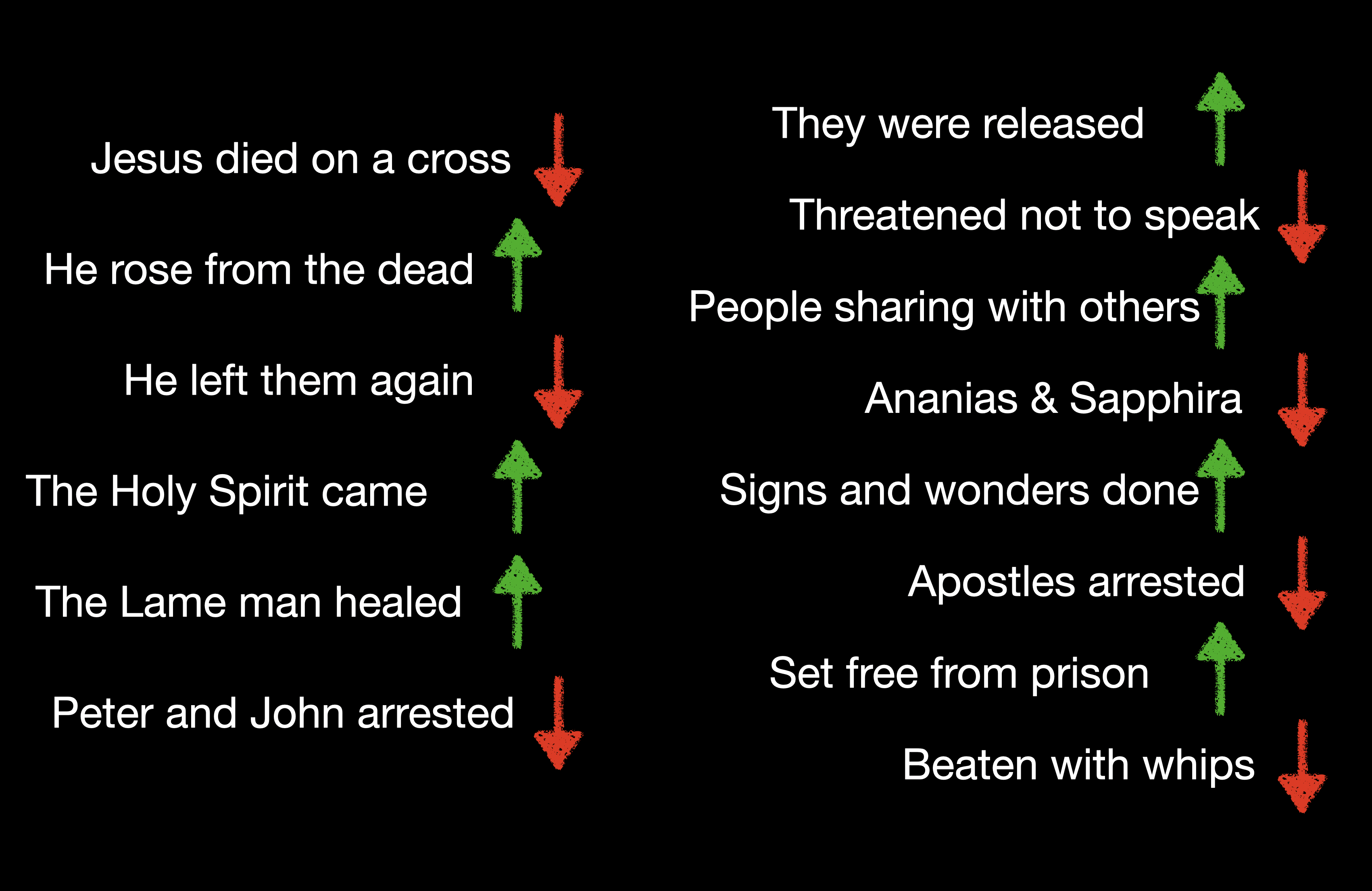
  This is a defining moment. For the first time, the church experiences organized, targeted persecution. The honeymoon period is over for these early followers of Jesus.  This is bad.   

Acts 8:1,3  And Saul approved of his execution.   And there arose on that day a great persecution against the church in Jerusalem, and they were all scattered throughout the regions of Judea and Samaria, except the apostles. …But Saul was ravaging the church, and entering house after house, he dragged off men and women and committed them to prison.

This is not just a young man who just watched the clothes while others stoned Stephen.  This zealous rabbi voted in the council to kill Stephen and then went on a rampage, going into homes and dragging off men and women.  Imagine the fear and confusion. Families are split apart. Homes raided. The fellowship they’ve built in Jerusalem — shattered.   They are scared to do or say anything.  They are scared to death.  This is bad news.
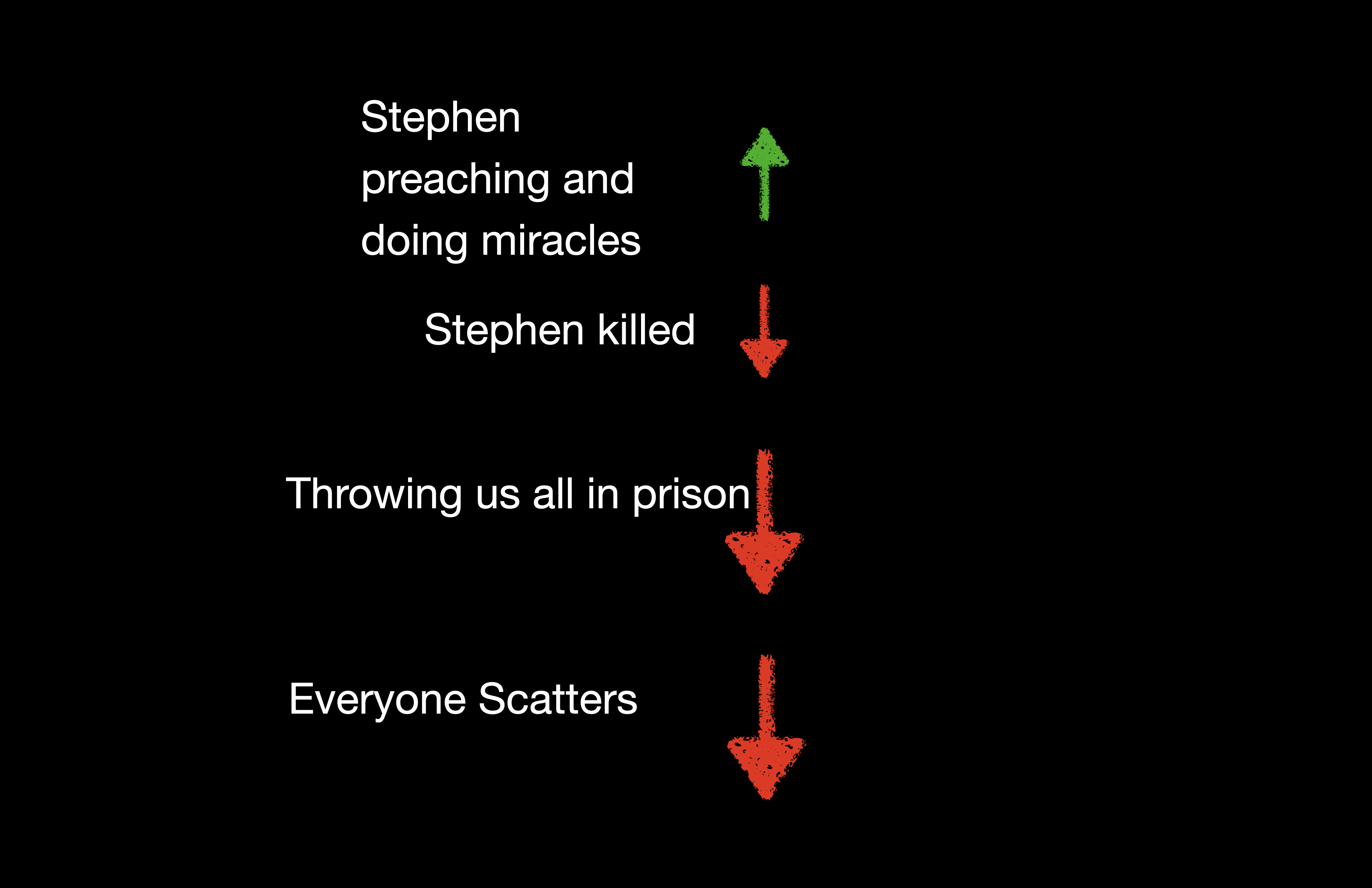
By the time we reach Acts 8, the church has experienced incredible highs and devastating lows.   Every time there’s a victory, opposition follows.  Just when things seem to be going good, here comes trouble.  The book of Acts has so far been a rollercoaster of highs and lows, but now, in Acts 8, it seems to be plummeting toward destruction.

Do you see this in your life also?  A rollercoaster of highs and lows, good and bad?  Just when things seem to be going good, here comes trouble.  How do you respond when things go wrong?  Disappointment?  Depression?  Fear?  Hopelessness?  Do you want to question God?  Why did you let them put the apostles in prison?  Why did you let them kill Stephen?  Why did my friend get cancer?  Why do evil people prosper?  Why is there so much trouble in the world?

This persecution should not have been surprising to them or us.  Jesus said:

John 15:18, 20   If the world hates you, know that it has hated me before it hated you…
If they persecuted me, they will also persecute you.”

And remember, He also said this:

Matthew 5:11-12   Blessed are you when others revile you and persecute you and utter all kinds of evil against you …

Oh, but as we discussed before, “Blessed” is the Greek “makarios,” which really means “happy are you” or “how fortunate you are,” so let’s read it that way…

Matthew 5:11-12   How wonderful it is for you when others revile you and persecute you and utter all kinds of evil against you falsely on my account. Rejoice and be glad, for your reward is great in heaven, for so they persecuted the prophets who were before you.

Jesus says that when you are persecuted, you are the lucky ones!  Do you think the followers in Jerusalem saw it that way?  Saul is dragging them out of their houses and throwing them in prison.  And do you think they are celebrating their good fortune?  How does this make sense?

To understand how you are lucky or happy when persecuted, you have to be able to see things from God’s view and not your own.  We need to look through God’s eyes.  We need to see the bigger picture again.   There are three reasons that persecution is good. 

1.  Persecution helps the believer mature and grow in Christ.

Romans 5:3-5   Not only that, but we rejoice in our sufferings, knowing that suffering produces endurance, and endurance produces character, and character produces hope, and hope does not put us to shame, because God’s love has been poured into our hearts through the Holy Spirit who has been given to us.

We need suffering to grow.  It is only when we experience failure, disappointment, persecution, and defeat that we are able to understand that we are not enough.  We learn to depend on our Father instead of ourselves.  We mature as followers of Jesus.

2.  Persecution purifies the church.

It is sad, but there are always those in the church who are not faithful followers but wolves in sheep’s clothing.  But when trouble comes, when persecution comes, their truth is revealed.   We see this in 1 John, and Jesus speaks of it in his parable of the soils.  

Matthew 13:20-21   As for what was sown on rocky ground, this is the one who hears the word and immediately receives it with joy, yet he has no root in himself, but endures for a while, and when tribulation or persecution arises on account of the word, immediately he falls away.

When persecution comes, some will leave the church.  They were never really a member anyway.  We have not had persecution in our time.  So, from what Jesus said, you would expect the church to have a lot of people who aren’t really committed to Jesus.  They are there with joy, but have never given their life to Christ.  And if persecution does come, they will fall away.

3.  Persecution causes the church to grow

Now this doesn’t seem to make a lot of sense.  If Paul is going from house to house in Acts 8, dragging people out to put them in prison, that seems it would have a negative effect on the group of followers in Jerusalem.  But look what happens:

Acts 8:4   Now those who were scattered went about preaching the word.

Verse 4 is a hinge in the book of Acts.  The word “scattered” here — diaspeirō in Greek — is the same word used for scattering seed. It’s not a random dispersal; it’s purposeful planting.  The devil tried to stamp out the fire in Jerusalem, but all he did was scatter the embers — and they caught flame in new places.  Everywhere these believers went, they carried the gospel. They didn’t have a denomination, a mission-sending agency, a church building, a program, or a budget. What they had was the message of Jesus, and that was enough.

Acts 8:5    Philip went down to the city of Samaria and proclaimed to them the Christ.

Philip, one of the seven deacons appointed back in Acts 6, goes to Samaria! Remember how the disciples first responded when Jesus took them through Samaria? They couldn’t believe he was actually going there.   They hated the Samaritans.  They called them half-breed Jews.  They wouldn’t even talk to them.  Jews and Samaritans had centuries of hostility, but the gospel breaks that barrier wide open.  That’s a remarkable scene,  See how the Holy Spirit has changed these followers to be more like Jesus?

Philip is crossing cultural and religious boundaries.   What began with Stephen’s death in Jerusalem leads to joy in Samaria.  The chapter that opened with mourning ends with rejoicing.
The story that began with persecution ends with proclamation.  The bad news becomes the vehicle for the good news.  This is the power of the gospel. And they went further…

Acts 11:19   Now those who were scattered because of the persecution that arose over Stephen traveled as far as Phoenicia and Cyprus and Antioch, speaking the word to no one except Jews.

At the beginning of Acts 4, the entire church, the gathering of followers of Jesus, is all in one city.  All in that one little dot.  But because of the persecution, they scatter like seed and are planted here.

So what is the lesson we learn from this passage in Acts 8?

Application 1: God’s Good News Often Moves Through Bad News
This is a pattern we see all through Scripture. Joseph was sold into slavery so he could save his family. Moses fled Egypt before leading God’s people out of it. The cross looked like defeat until resurrection morning.  Acts 8 continues that pattern — what looks like a disaster becomes divine strategy.  Maybe you’ve seen that in your own life. You lose a job and end up finding a deeper purpose. A relationship breaks down, and you discover how faithful God really is. A closed door becomes the very thing that pushes you toward your calling.

Romans 8:28  And we know that for those who love God all things work together for good, for those who are called according to his purpose.

Listen, God did not want this persecution.  God loved Stephen.  He did not want Stephen to be stoned.  But God gave men free will, and men choose evil.  But God takes the evil that man has done and makes it work for good.  God has a way of turning scattering into sowing — pain into purpose, loss into mission.  So when you get bad news, a bad diagnosis, a financial bad turn, or some tragedy, if you are a follower of Jesus, know that God, who loves you, will take that tragedy and work it for good.

Application 2: Comfort Can Become the Enemy of God’s Purpose

The church in Jerusalem had everything — community, teaching, worship, generosity, and miracles. But all of that was happening inside one city.  And we have to admit, many of our churches today fall into the same pattern. We have programs, fellowship, music, structure — often much more of these than mission. We love being together, but we can easily become so inward-focused that we forget why we exist.

Sometimes, God allows discomfort — in a church, in a ministry, even in a nation — to push His people outward again.  The early church didn’t plan a missions strategy.  Persecution became their mission strategy. God used shaking to send them out.

Application 3: Wherever God Scatters You, Carry the Gospel

Acts 8:4   Now those who were scattered went about preaching the word.

Notice that Acts 8:4 doesn’t say “the apostles” went preaching — it says “those who were scattered.” Ordinary believers. Shopkeepers, craftsmen, mothers, widows, servants. They didn’t have seminary training, but they had stories of grace.  They didn’t have pulpits, but they had conversations.  They didn’t have missionary boards, but they had neighbors. Every believer was a messenger. And wherever they went, the gospel went too.

Maybe God has “scattered” you in a way you didn’t expect — a new job, a new city, a new season of life. Don’t see it as random. See it as God planting you where the gospel can take root.  If you find yourself in an oncology waiting room, find a way to be the gospel there, and maybe even use words.  Stuck in an elevator, waiting in a long line, wherever.  And if you are somewhere uncomfortable, be alert for opportunities to share.  Sometimes God shakes our comfort so He can share His comfort through us.

I don’t go to the movie theater much anymore.  (Even though I love paying $25 for some popcorn and a soda.)  But at a movie, I sit in my seat and watch, and when it is over, then I walk out of the theater and go about my life as if nothing has happened.  Once a week, we come to our seats at church and watch.  And when it’s over, then what?  Is this like a movie, or have we had an encounter with the God of the Universe who wants us to leave this place changed, to leave this place with a mission?  We are not saved to sit.  We are saved to serve.  We can’t fulfill God’s plan for our lives in this building.  

Jesus’ great commission was not “Go to church on Sunday and then go home (after you go out and eat lunch).   It was “Go into all the world and do something that will likely make you uncomfortable.”   

The passage ends in verse 8: “So there was much joy in that city.”   The church’s pain became someone else’s joy.  Their scattering became someone else’s salvation.   That’s the rhythm of the gospel — out of suffering comes life, out of loss comes joy, out of persecution comes expansion.  So when life shakes beneath your feet — when bad news comes — don’t assume God has abandoned you. He might take this opportunity to move you into the next chapter of His plan.  The ground may be shaking, but God is sowing.  What feels like bad news may be the start of very good news indeed.

  1. Lucado, Max. A Heart Like Jesus: Lessons for Living a Christ-Like Life. Kindle Edition. Location 33.

October 7, 2025 –  The Central Message of Acts — Acts #15

October 7, 2025 –  The Central Message of Acts — Acts #15
Acts 5:17-33

As we continue our study in the Book of Acts, I want to use this story in chapter 5 to highlight the central purpose of the book.  What is the primary lesson we should learn from the book of Acts?

Acts 5:17-33  But the high priest rose up, and all who were with him (that is, the party of the Sadducees), and filled with jealousy, they arrested the apostles and put them in the public prison. But during the night, an angel of the Lord opened the prison doors and brought them out, and said, “Go and stand in the temple and speak to the people all the words of this Life.”
And when they heard this, they entered the temple at daybreak and began to teach. Now, when the high priest came and those who were with him, they called together the council, all the senate of the people of Israel, and sent to the prison to have them brought. But when the officers came, they did not find them in the prison, so they returned and reported, “We found the prison securely locked and the guards standing at the doors, but when we opened them we found no one inside.” Now, when the captain of the temple and the chief priests heard these words, they were greatly perplexed about them, wondering what this would come to. And someone came and told them, “Look! The men whom you put in prison are standing in the temple and teaching the people.” Then the captain with the officers went and brought them, but not by force, for they were afraid of being stoned by the people.
And when they had brought them, they set them before the council. And the high priest questioned them, saying, “We strictly charged you not to teach in this name, yet here you have filled Jerusalem with your teaching, and you intend to bring this man’s blood upon us.” But Peter and the apostles answered, “We must obey God rather than men. The God of our fathers raised Jesus, whom you killed by hanging him on a tree. God exalted him at his right hand as Leader and Savior, to give repentance to Israel and forgiveness of sins. And we are witnesses to these things, and so is the Holy Spirit, whom God has given to those who obey him.”
When they heard this, they were enraged and wanted to kill them.

This is the story of the second time the apostles were imprisoned before being brought before the Sanhedrin, the highest court in Jerusalem.  Remember that incarceration in these times is not punishment, but merely holding them for trial.  But this is different.  This is a real trial, for the apostles are now in violation of a direct order of this court and face severe punishment.  While it was only Peter and John the first time, now all the apostles are before the Sanhedrin.  And as we will see next week, this trial will end with the apostles being flogged.  Typically, that meant being chained to a pole and receiving 39 lashes with a whip.

First, they were warned not to speak, but they continued to preach in the Temple.  Then they were imprisoned this second time for speaking this message, but they were miraculously set free.  And what did they do next?  They went right back to the same area and did exactly what the Sanhedrin warned them not to do, but what the angel told them to do.  

Then they are brought right back into the priestly court, where they preach the same message to their accusers again.  To these same people who just months ago tortured and killed their rabbi for the same reason.  The apostles know this will likely end in at least a beating for them, if not a death sentence.  This leads us to the main lesson we can learn from the book of Acts.  What made these ordinary men so uncommon?  What made these simple disciples so powerful?  What made these once frightened men so bold, unafraid of the authorities who could sentence them to death?   If we don’t learn anything else from the Book of Acts, we have to understand this.  So I ask you, “What is the primary lesson we should learn from the Book of Acts?”

This primary lesson of the Book of Acts is evident in several passages that I want you to keep in mind as we continue through the book.  The first part is Acts 1:7-8:

Acts 1:7-8  But you will receive power when the Holy Spirit has come upon you, and you will be my witnesses in Jerusalem and in all Judea and Samaria, and to the end of the earth.

The Holy Spirit comes and gives us power, and we become witnesses.

And the second part of the central message of Acts is found in a phrase that we see repeated all through the book:

Acts 6:7  And the word of God continued to increase, and the number of the disciples multiplied greatly.
Acts 12:24  But the word of God increased and multiplied.
Acts 19:20  So the word of the Lord continued to increase and prevail mightily.

Throughout the book of Acts, we see this repeated over and over.  So it must be important.  The Word of God increased.  Now, by combining these ideas, we arrive at the primary lesson in the Book of Acts.

“The Holy Spirit comes to dwell with people of faith, enabling them to fully express the Word of God in their lives and share it with others.”

This is my one-sentence book report on Acts.  This is the theme of the book.  These are not the same men who cowered in the storm and hid in the upper room after Jesus’ crucifixion.  They are living lives without fear.  They are living lives of obedience to God, expressing godly characteristics that we call the fruits of the Spirit.  They have been forever changed.  

This is God’s doing. This is the result of salvation.  This is the work of the Holy Spirit in our lives.  Let me illustrate that.

Let’s imagine for a moment that God decided to bring salvation to one of those trees outside.  Ok, it is an analogy, but bear with me. If God brought salvation to that pine tree outside, then it would be changed.  It wouldn’t look the same as before.  It wouldn’t have pine needles and grow pine cones.   It would have different leaves and bear different fruit.  It would bear the kind of fruit God told it to, doing whatever God’s word said for that tree to do, because salvation has come to that tree.  No one would look at that tree and think it was just an ordinary tree. Everyone would immediately recognize that it is completely different.  No one looks at an apple tree and believes it is a pine tree.   It has now become the tree that God intended it to be.  That’s what salvation does.  Your life changes radically so that everyone can see that you are different from what you were, and you become who God intended you to be, producing the fruit of salvation that He intended.

When salvation comes, the Holy Spirit in you empowers you to live your life in obedience to God’s Word.   You may not have noticed this, but it is challenging to live life and follow God’s Word entirely on your own.  The temptations are so….tempting.  You can’t live that life under your own power.  That’s why Paul said, “All have sinned and fallen short of the glory of God” (Romans 3:23). We can’t do it on our own.  So we get help from God to live that way.  The Holy Spirit comes upon us to dwell in us and help us become obedient to God’s word.  And when you live that way, people notice you are different.  You are as different as a pine tree and an apple tree.

So through the power of the Holy Spirit, you live in such a way that you express the Word of God in your life.  Later on, we can discuss other expressions of the Holy Spirit in believers, such as how He gives us words to speak, divine insight, tongues, or prophecy, for example.  

But none of these things is the primary role for the Holy Spirit in our lives.  Job #1 for the Holy Spirit:  Help us live our lives in obedience to the Word of God so that we will be the person God created us to be. This is what the Holy Spirit does in your life.  That is why Paul said in his letter to the church in Galatia: 

Galatians 5:22-23  But the fruit of the Spirit is love, joy, peace, patience, kindness, goodness, faithfulness, gentleness, self-control.

The Holy Spirit within us changes us, making us as different as a pine tree and an apple tree.  We become obedient to God’s word, and this is what we look like.  This is the kind of fruit we bear.  This is what people see when they look at us.

Look at this list and ask yourself, “Am I allowing God’s Spirit to lead me to be the person that produces this fruit?  Do I need to surrender to the Holy Spirit in my life to make me more of this type of person?”

Now, Paul had another list of fruits in Galatians 5.  He listed the fruit that people bear when they are not who God wants them to be.  

Galatians 5:19-20  These are the fruits of the flesh: sexual immorality, impurity, sensuality, idolatry, sorcery, enmity, strife, jealousy, fits of anger, rivalries, dissensions, divisions, envy, drunkenness…

That is the fruit you bear before salvation, before the holy spirit comes to live in you.  If someone consistently bears this kind of fruit, then they are not listening to the Holy Spirit.  They look more like a pine tree than the apple tree God wanted them to be.  

This is why we have the Book of Acts in our Bible: to show us how the Holy Spirit transformed these first-century disciples, enabling them to live lives consistent with the Word of God and then spread this message to the world.  Look back at those verses from which we derived the central message of Acts again.   You will receive power from the Holy Spirit.  It will change you, and then you will be witnesses.  And then all through the book of Acts, this phrase:  “The Word of God increased.”   But how does the word of God increase?  

God’s word is full of life.  God spoke life into existence in Genesis 1.  In the first book of the Bible, we see that God’s word creates biological life.  Then in the Gospels, we see God’s word grant eternal life.  God’s word is life.  Remember that after the feeding of the 5,000, Jesus began teaching more difficult things, and many of His followers deserted Him.  Jesus asked the disciples if they would leave him also, and Peter replied:

John 6:68  Simon Peter answered him, “Lord, to whom shall we go? You have the words of eternal life.”

God’s word is the word of life.  God’s word is alive, and being alive, it grows and multiplies.  The author of Hebrews said it this way:

Hebrews 4:12  For the word of God is living and active, sharper than any two-edged sword, piercing to the division of soul and of spirit, of joints and of marrow, and discerning the thoughts and intentions of the heart.

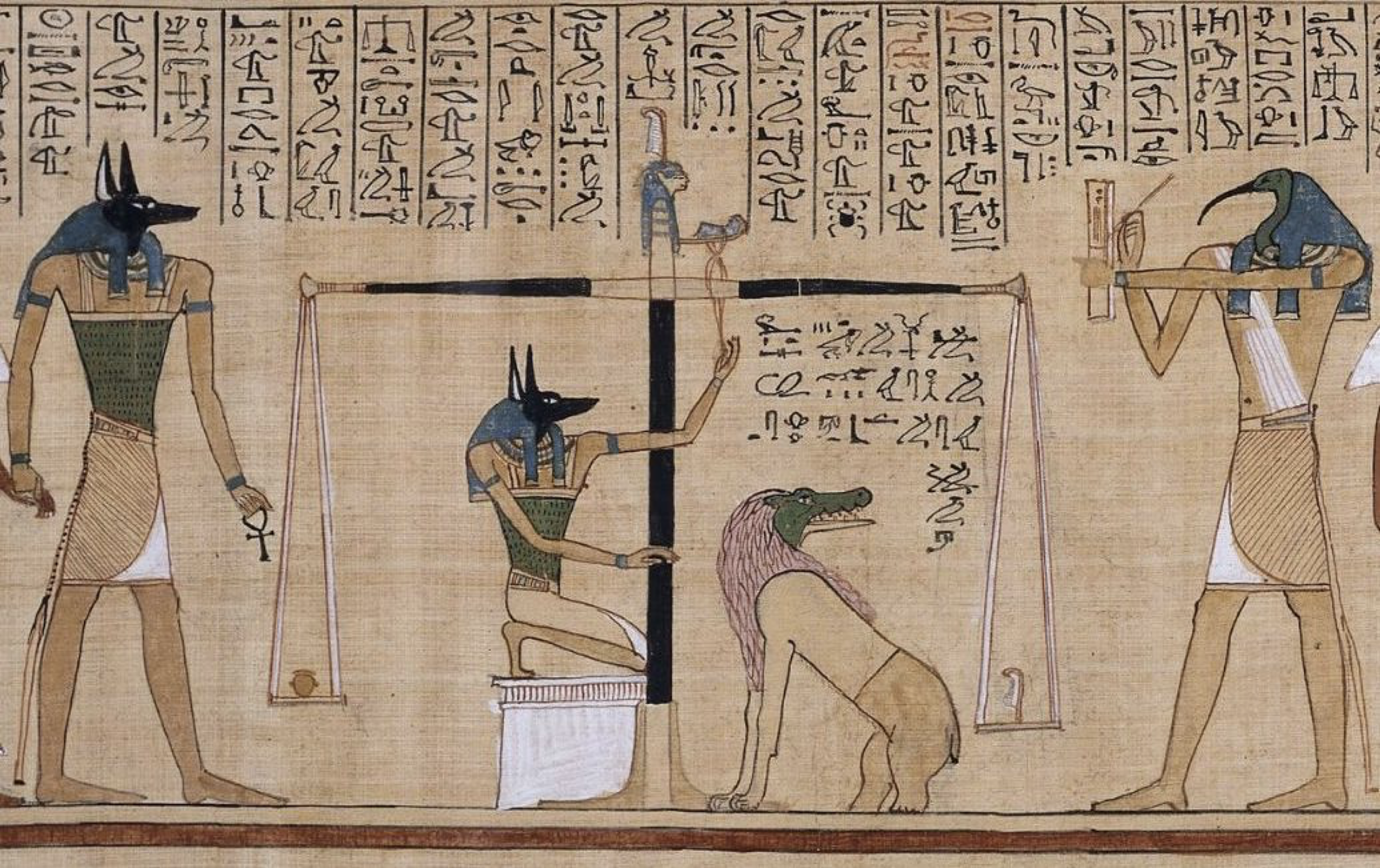
In Egypt last week, we saw walls that were a hundred feet high, filled with hieroglyphs.  Each symbol was meticulously carved into solid rock by hand.  Thousands and thousands of man-hours setting words into stone.  Some of these words were placed there 4000-5000 years ago.  But these words are dead.  They speak of a mythology whereby a pharaoh might conquer death and attain eternal life. 

Here are words from what they call the ‘Book of the Dead.’  They thought these were words of life.  But each of these Egyptian gods was created from their imagination, dreamed up to explain the wonders of the world and to justify the rule of a supreme leader, a pharaoh who would attain a life after death and lead them to have a chance at life after death.  But we read in Exodus how Yehovah defeated these Egyptian deities.  Each of the 10 plagues in Egypt was directed at one of the major Egyptian gods.  The deliverance of the Israelites from Egypt demonstrates how all these stories in stone are nothing but myths.  These idols are not real. These stories are fiction.  No matter how hard they try to preserve Pharaoh’s body in elaborate tombs, filling them with every item he may need in the next world,  Pharaoh can not conquer death for them.  For thousands of years, these Egyptians sought a way to eternal life.  But their stories, the words on these temples, are dead.  They have no answer for death and do not bring life.  Yehovah showed that He and He alone had the words of life.  And like Egypt, many other cultures have sought ways to eternal life. 

There are people today who are seeking alternative means of eternal life.  Significant scientific research is being conducted to extend the human lifespan, and some scientists believe that immortality may be within our grasp.  I have a friend who is part of a group of scientists studying apoptosis, the mechanism by which the body causes damaged cells to die.  In some forms of cancer, the damaged cell avoids this process and continues to grow and reproduce.  Some believe that if we can learn to control this process, we could not only cause cancer cells to die but also allow normal cells to continue growing and reproducing indefinitely, resulting in no decrease in function as one ages.

Imagine skin that does not thin and lose its elasticity, remaining youthful; bones that do not lose density and compress; and vision that does not deteriorate with age.  Imagine a world with no cancer.  It sounds good, but the word of God tells me that. Immortality is not something we can achieve on our own.  We can not avoid death.  Sin has brought death into the world, and science is no match for sin.  Botox may hide wrinkles, but it can not cover sin and death.  God alone has the answer for death.  His words alone can bring life, for His word is life.  And there will be a time when aging is no more, and cancer is no more, and life is eternal.  God is preparing that future for you, not science. 

So God’s word is living.  It brings life, sustains life, and has the answer to death.  But how does God’s word increase?  God’s word increases each time it enters the heart of a new believer and each time a believer grows in faith through His word.  It is impossible to overestimate the importance of God’s word to us.  Through the Holy Spirit, it is supposed to live in us: 

Colossians 3:16  Let the word of Christ dwell in you richly, teaching and admonishing one another in all wisdom, singing psalms and hymns and spiritual songs, with thankfulness in your hearts to God.

The word is supposed to dwell in us, take up residence in us.  As it lives in us, it grows and multiplies, contagiously spreading to others.

When I was 8 years old, I joined the Rome Boys’ Club Choir.  We traveled all over the country for 10-14 days each summer in Greyhound buses.  We would pull up to a Boy’s Club in some town and watch out the window of the bus as cars arrived in the parking lot.  The local Boys’ Club would have arranged for families to house us for the night.   We would wait for our name to be called, then grab our suitcase and go to spend the night in pairs with our assigned family.  (Can you imagine doing this today?)  You always hoped that you would be chosen to go with the family that drove up in the really nice car.

I stayed in a lot of homes, some really amazing places, a few mansions, and a few that were pretty rough.   But we were almost always welcomed with great hospitality.  People went out of their way to ensure we had everything we needed and arrived at the concert on time.   Some people went above and beyond in their hospitality, hosting parties after our concert for us or arranging for us to go swimming, ride go-karts, or do other activities.

However, there was one place I recall where I felt like we were an imposition.  It was a nice enough house.  But they barely spoke to us.  They showed us our bedroom and went to the other side of the house.  They had someone they knew drive us to the concert and pick us up.  We never saw them until the next morning.  I guess they thought we would eat at the concert, so they didn’t offer us any food, and we had no supper that night.  Thankfully, my mom had packed more snacks in my suitcase than I could eat in several weeks, so we were okay. But everything they did let us know that they wished we weren’t there.  We saw them the next morning when they came to our door and said our ride was there. And we were happy to leave. That was a very uncomfortable stay.

How about you?  Have you ever stayed as a guest in a home where you didn’t feel welcome?   It’s pretty miserable.  

If you know my wife, you know that she is the model of hospitality.  She goes out of her way to make sure anyone staying with us feels at home.  There are fresh flowers in the room, and she looks after every detail.  We often have people staying in our garage apartment.  There is a family currently with us who came in town for a funeral and have stayed with us for several weeks to help settle things.  We had 20 college girls at the house Friday night for dinner who were in town for a volleyball tournament.  Hospitality is a ministry.

It is one of the best ways to show love to people who aren’t friends … yet.  You share love and grace with them through your hospitality.  They see the Word of God living in you because you bear the fruits of the Spirit in your life.  And the word of God will flow from you to them as you speak and act out the Word in your life.  Later in our study of Acts, we will take a deeper look at what the Bible says about hospitality, because God has a great deal to say about it.  However, I have a question to ask you for now.  If God’s word is supposed to dwell in us, to live with us, then let me ask you, “What kind of host or hostess have you been to this guest in your house?”

Does God’s word feel welcome in your life, or are you like the family that opened the door to their house for me but didn’t offer to feed me and didn’t even speak to me?    

God’s word dwells in us to have a relationship with us.  We are instructed in how to live.  God’s word should make a difference in the way we see others and the way we treat others. The whole 3rd chapter of Colossians teaches us how to treat others and how to live.   When God’s word dwells richly in us, we become who we are supposed to be, conduits of God’s love and mercy and grace.  We overflow with God’s goodness.  We like these disciples to become different, and we cannot help but share the grace that God has so richly poured out on us.

Through the power of the Holy Spirit, as we live our lives as God directs, showing evidence of our salvation through the fruits of the Spirit evident in our lives, we become living witnesses to God’s grace and mercy without needing to say a word.  

We need to be very sensitive to the working of the Spirit of God in us, watching for him to reveal things we need to change and paths we need to walk.  We need to leverage all the gifts God has given us to increase the Word of God in our lives and in the lives of those around us.

We have to be more involved in participatory ministries.  I want to share a passage from a book that helped shift my perspective on ministry.  It is from Shane Claiborne’s “The Irresistible Revolution.”

“It is much more comfortable to depersonalize the poor so we don’t feel responsible for the catastrophic human failure that results in someone sleeping on the street while people have spare bedrooms in their homes. We can volunteer in a social program or distribute excess food and clothing through organizations, and never have to open up our homes, our beds, our dinner tables. When we get to heaven, we will be separated into those sheep and goats Jesus talks about in Matthew 25 based on how we cared for the least among us. I’m just not convinced that Jesus is going to say, “When I was hungry, you gave a check to the United Way and they fed me,” or, “When I was naked, you donated clothes to the Salvation Army and they clothed me.”
Jesus is not seeking distant acts of charity. He seeks concrete acts of love: “you fed me…you visited me in prison…you welcomed me into your home…you clothed me.” With new government funds and faith-based initiatives, the social-work model can easily entangle the church in the efficiency of brokering services and resources in a web of “clients” and “providers” and struggling to retain God’s vision of rebirth, in which we are all family. Faith-based nonprofits can too easily be the mirror image of secular organizations, maintaining the same hierarchies of power and separation between rich and poor.
They can too easily merely facilitate the exchange of goods and services, putting plenty of professionals in the middle to guarantee that the rich do not have to face the poor and that power does not shift.
 Rich and poor are kept in separate worlds, and inequality is carefully managed but not dismantled. When the church becomes a place of brokerage rather than an organic community, she ceases to be alive. She ceases to be something we are, the living bride of Christ. The church becomes a distribution center, a place where the poor come to get stuff and the rich come to dump stuff. Both go away satisfied (the rich feel good, the poor get clothed and fed), but no one leaves transformed. No radical new community is formed.And Jesus did not set up a program but modeled a way of living that incarnated the reign of God, a community in which people are reconciled and our debts are forgiven just as we forgive our debtors (all economic words). That reign did not spread through organizational establishments or structural systems. It spread like disease—through touch, through breath, through life. It spread through people infected by love.”

Claiborn, Shane “The Irrestible Revolution”

The Word of God increases when we live our lives in such a way as to make God’s word alive in our actions.  We establish relationships with others, and God’s word flows through us in how we act and what we do.  We see this in our homeless ministry.  We offer a variety of classes for our neighbors without homes, but it is not in these classes that people change.  We give them food and a warm place to stay, but that alone doesn’t cause people to change.  It is when we sit down at the table for a meal with a few of our neighbors and get to know them, allowing them to get to know us.  That is when God does his work.  That is where lives change.  Because when you allow people to get to know you, then they can see the Holy Spirit living in you, and the Word of God living through you, and then the Word will increase. “1

Ministry must be relational.  That is always God’s plan.  Donating money to a good cause is a commendable act, but it is not a substitute for a ministry.  It is giving back to God some of what He gave to you.   To do ministry, you have to be hands-on, making relationships with others.  This is what we see in the Book of Acts: God’s Holy Spirit transforming people so that they can extend love to others, who will see the fruit of the Spirit in them. As a result, God’s word will increase as they, too, accept His word into their lives.

These disciples are examples of lives changed through the Holy Spirit.  They can not stop doing what God tells them to do.  Despite threats of beatings or death, they can’t stop being who God wants them to be.  It is because they are different now.  This is who they are now.  This is the lesson for us in the Book of Acts. This is what we must do.   Let us strive to listen to God’s holy Spirit in our lives and let God lead us to be who we are meant to be.  

I challenge you to take a hard look inward at your own life.  Are you listening to the Holy Spirit in your life as you should?  Is God’s Spirit dwelling richly in you, or have you just set Him in the corner and ignored him?  Have you welcomed God into your life with great hospitality, or have you just tolerated His presence there?  

Let me be the first to confess that I don’t always listen to the Holy Spirit as I should.  Instead, I sometimes hear my mouth saying things that aren’t consistent with the fruit of God’s Spirit.  There are times when my sweet wife, my ezer kenigdo, has to remind me that patience is a fruit of the Spirit.  So let me be the first to publicly ask you to pray for me, that God would help me to listen better and obey, that I might be who God wants me to be.  Will you pray for me?  I pray that we are all filled to overflowing with the Holy Spirit and filled to overflowing with His Word, so that His presence and His Word flow out to our community.