
December 17, 2025 – Unlikely Choices and Impossible Tasks— Acts #25
Acts 9:10-19
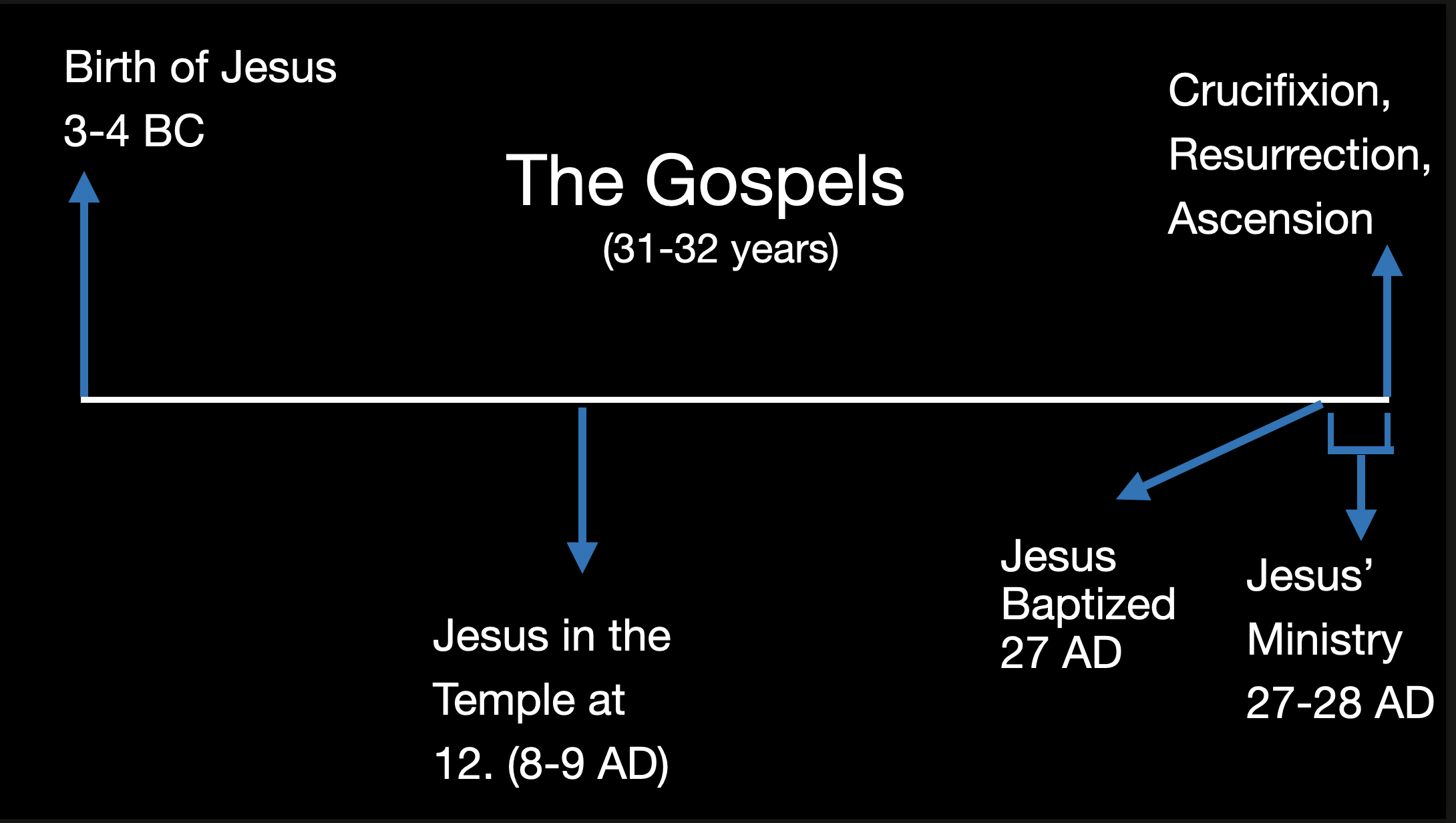
Before we continue in Acts, I want to talk about the timeline. (You will not find universal agreement on the actual dates, but it is the division of time I want you to see here.) The Gospels begin with the story of John the Baptist’s and Jesus’ birth around 4 BC and end with his crucifixion, resurrection, and ascension in 28 AD, covering 31-32 years. But other than the birth narrative and the visit to the temple at 12 years old, everything else in the Gospels happens in this 1 1/2 year or 70-week period. When we covered the ministry of Jesus, we went pretty much week by week, following him through the Gospels in real time.
The Timeline for Acts is also around 30-35 years, but the action is not concentrated at a single point. Acts begins with the Ascension of Jesus and Pentecost, which would have been in June of 28 AD. So we have covered the first 8.5 chapters of Acts in the past 6 months, but that encompasses 2-3 years. By the 9th chapter of Acts, it is now 2-3 years since Jesus’s crucifixion, resurrection, and the events of Pentecost. The church has grown in numbers, and persecution has begun. The rest of Acts covers the 3 years Paul spent in Arabia and his three missionary journeys.
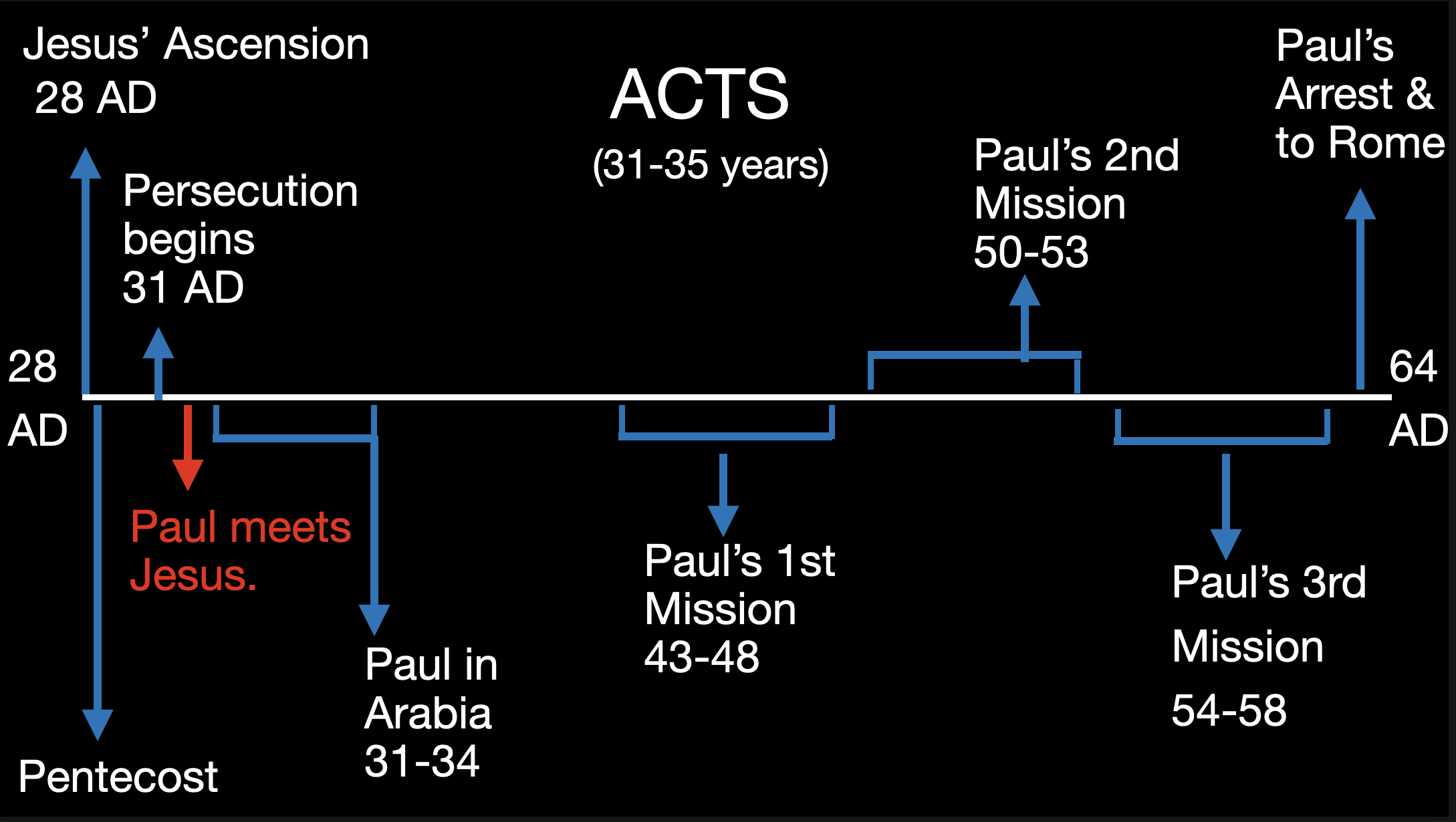
Again, today, in Acts 9, we are at the red arrow above. Saul met Jesus near Damascus and had been in the city for 3 days.
Acts 9:10-19 Now there was a disciple at Damascus named Ananias. Yehovah said to him in a vision, “Ananias.” And he said, “Here I am, Lord.” And Yehovah said to him, “Rise and go to the street called Straight, and at the house of Judas look for a man of Tarsus named Saul, for behold, he is praying, and he has seen in a vision a man named Ananias come in and lay his hands on him so that he might regain his sight.” But Ananias answered, “Lord, I have heard from many about this man, how much evil he has done to your saints at Jerusalem. And here he has authority from the chief priests to bind all who call on your name.” But Yehovah said to him, “Go, for he is a chosen instrument of mine to carry my name before the Gentiles and kings and the children of Israel. For I will show him how much he must suffer for the sake of my name.” So Ananias departed and entered the house. And laying his hands on him he said, “Brother Saul, Yehovah Jesus who appeared to you on the road by which you came has sent me so that you may regain your sight and be filled with the Holy Spirit.” And immediately something like scales fell from his eyes, and he regained his sight. Then he rose and was baptized; and taking food, he was strengthened.
“Now there was a disciple named Ananias.” (Acts 9:10) Where did this disciple come from? Saul is on his way to Damascus to find the followers of Jesus who escaped from Jerusalem. But Ananias is not one of this group, for in his conversation with Jesus, he says this:
Acts 9:13 But Ananias answered, “Lord, I have heard from many about this man, how much evil he has done to your saints at Jerusalem.
He may be a new follower of Jesus through the gospel spread by these escapees from Jerusalem, but it is more likely he has been a follower of Jesus in Damascus for some time. Saul says in his personal account of the story in Acts 22:
Acts 22:12 And one Ananias, a devout man according to the law, well spoken of by all the Jews who lived there…
Notice that Ananias is considered a devout man by all the Jews in Damascus. And we have already seen that he was a disciple of Jesus. Don’t miss that followers of Jesus can worship alongside Jews in the synagogue. And these Jews consider the Christians devout, because the Christians are keeping the law. Again, these followers were not changing religions when they went from the Judaism they grew up in to a belief that their Jewish Messiah had come in Jesus.
So somehow, Ananias became a follower of Jesus some time ago. But Jesus never went to Damascus. Damascus is a long way from anywhere Jesus went. The closest Jesus came was Caesarea Philippi (about 40 miles away), and there was no public ministry by Jesus there that we have recorded.
But the message spread through people whose names have never been recorded. Someone shared the gospel of Jesus with Ananias, and now God has chosen him to correct Saul’s vision problem. We are not told he is a leader in the church. He has no title. He is just an ordinary guy worshiping with all the Jews in the synagogue every Sabbath. And they all speak well of him. He is a man of character, well respected by all.
God calls this ordinary man, Ananias, to do a task. Go to Judas’ house on Straight Street to see a man for me. The “street called straight” would be the major east-west street in the center of the city, called the decumanus maximus. (The major North-South street is called the cardo.) You can see this street in the old town of Damascus today. But in Ananias’ day, it would have looked more like this colonaded Roman decumanus (Straight Street) in Jerash, Jordan.
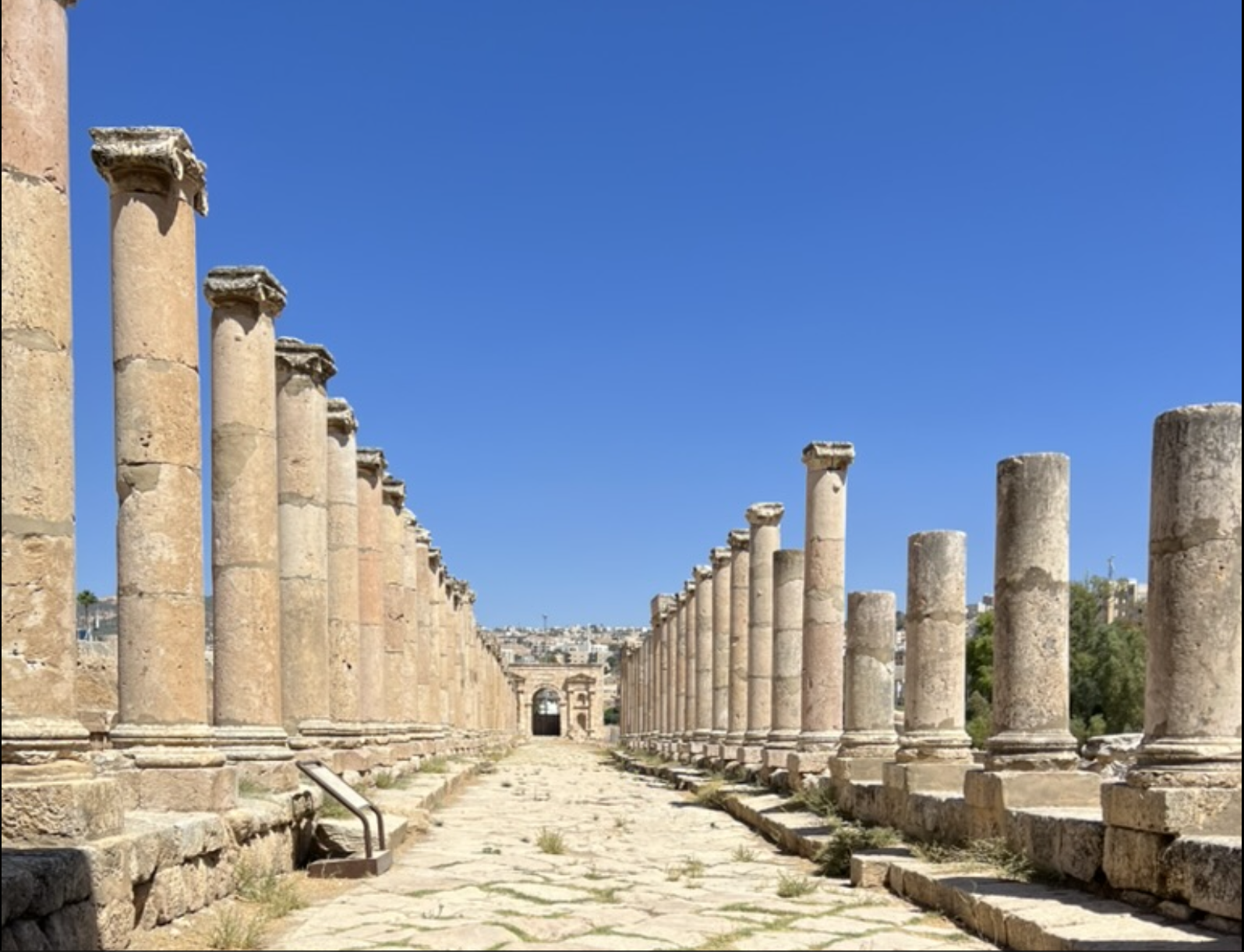
In Saul’s day, there would have been houses and shops all along these streets. So God tells Ananias to go to the home of Judas to see a man named Saul, who has been praying, and who God had shown in a vision that you are coming. God has really set the table for Ananias. Have you had a witnessing experience like this: God performed a miracle to get someone’s attention, told you that you personally were coming to help them, and then told you exactly where to go? I wonder if it wouldn’t happen more if we made a practice of listening for God’s voice.
But this is no ordinary person that Ananias is being sent to. Imagine Ananias’ surprise: “His name is Saul? Saul from Tarsus? Wait a minute! You mean the guy who put all the Jesus followers in prison in Jerusalem, the guy who chased some of them all the way up here to tie them up and take them back there to be beaten or worse? And you want me to go see him?” Well, to cut to the end, Ananias does go; he lays hands on Saul, and his blindness is healed, and Saul is given his call to be a minister.
Two things I want us to see in this story. First, that God uses ordinary people like Ananias to do his work. Secondly, that God works through very unexpected ways, seeing the potential in people that we often do not see. And I want to illustrate that by comparing this story in Acts to a very similar story in 1 Samuel. So let’s take a look at 1 Samuel 16:1-13. Remember 2 weeks ago when we talked about King Saul? He disobeyed God so often that God fired him as king. So God tells Samuel to anoint someone else to be king.
1 Samuel 16:1-13 Yehovah said to Samuel, “How long will you grieve over Saul, since I have rejected him from being king over Israel? Fill your horn with oil, and go. I will send you to Jesse the Bethlehemite, for I have provided for myself a king among his sons.” And Samuel said, “How can I go? If Saul hears it, he will kill me.” And Yehovah said, “Take a heifer with you and say, ‘I have come to sacrifice to Yehovah.’ And invite Jesse to the sacrifice, and I will show you what you shall do. And you shall anoint for me him whom I declare to you.
Samuel did what Yehovah commanded and came to Bethlehem. The elders of the city came to meet him trembling and said, “Do you come peaceably?” And he said, “Peaceably; I have come to sacrifice to Yehovah. Consecrate yourselves, and come with me to the sacrifice.” And he consecrated Jesse and his sons and invited them to the sacrifice.
When they came, he looked on Eliab and thought, “Surely Yehovah’s anointed is before him.” But Yehovah said to Samuel, “Do not look on his appearance or on the height of his stature, because I have rejected him. For Yehovah sees not as man sees: man looks on the outward appearance, but Yehovah looks on the heart.” Then Jesse called Abinadab and made him pass before Samuel. And he said, “Neither has Yehovah chosen this one.” Then Jesse made Shammah pass by. And he said, “Neither has Yehovah chosen this one.” And Jesse made seven of his sons pass before Samuel. And Samuel said to Jesse, “Yehovah has not chosen these.”
Then Samuel said to Jesse, “Are all your sons here?” And he said, “There remains yet the youngest, but behold, he is keeping the sheep.” And Samuel said to Jesse, “Send and get him, for we will not sit down till he comes here.” And he sent and brought him in. Now he was ruddy and had beautiful eyes and was handsome. And Yehovah said, “Arise, anoint him, for this is he.” Then Samuel took the horn of oil and anointed him in the midst of his brothers. And the Spirit of Yehovah rushed upon David from that day forward. And Samuel rose up and went to Ramah.
In both stories, God chooses one of his followers to anoint someone who will become a great leader. He chose the prophet Samuel to anoint David and an ordinary man, Ananias, to anoint Saul. Notice that both of these choices for future leaders are people who would not have been chosen by popular vote at the time. David was the youngest son of an unremarkable family in a tiny town. He had no political experience, no political connections, and no political aspirations. His family was not wealthy. Anyone alive then would tell you there was no good reason to choose this shepherd boy as king. Yet he was God’s choice. David had the one requirement God seeks – obedience.
Because anything else, God can provide. You don’t have the wealth? God can take care of that. You have no experience? God has already supplied you in ways you don’t even realize, and he will continue to give you what you need. You don’t have the right connections? God knows everyone you need to know. Rest assured that the creator and sustainer of this universe is quite capable of supplying all your needs.
Philippians 4:19 “And my God will supply every need of yours according to his riches in glory in Christ Jesus.”
But as we discussed several weeks ago, there is one thing God can not supply — your obedience. God’s plan for our lives will fail if we are not obedient. Notice I said his plan for your life will fail if you fail him. But God will see to it that His plan is carried out. He will give you another chance, or he will find someone else who is willing to work with him.
Over and over in the Bible, God chooses people to do a task for which they are not fully equipped. David does not have the prerequisites to become a king. At the burning bush, Moses gives God all the reasons he is a poor choice. Moses provides all his excuses, and God answers him, “I will be with you, and I will empower you.” None of the young men Jesus chose to be disciples would have been selected by any other rabbi of the day. Poor untrained fishermen, rash impetuous Peter, a tax collector hated by everyone, a zealot?
As with Ananias, God isn’t looking for anyone exceptional. He doesn’t choose the wisest or the richest or the smartest. And Saul of Tarsus … he was the one in charge of hunting down and punishing any followers of Jesus. If you were choosing someone to be the greatest missionary of the first century and the writer of 1/4 of the New Testament, he would have been the unanimous last choice. What do we learn from this? Don’t judge people as you see them. What did God tell Samuel when Samuel thought he had found the best choice for king among Jesse’s boys?
1 Samuel 16:7 Do not look on his appearance or on the height of his stature, because I have rejected him. For Yehovah sees not as man sees: man looks on the outward appearance, but Yehovah looks on the heart.
We have to learn not to trust our own perception of people, because we tend to see only the surface, while God looks at the heart. In the same way, we are not to trust our own judgment of right and wrong, because our vision is limited.
The first sin in the Bible was when Adam and Eve decided that the fruit looked okay to them. They said, “I don’t see anything wrong with this fruit.” But the sin was that they were not to decide what is right or wrong. Only God can determine what is good and what is evil. The minute we begin asking ourselves if something is good or bad, we have sinned. The correct question to ask is, “Does God say this is good or bad?” And it is the same with judging people. It is not up to Samuel to decide which of Jesse’s sons would make a great king. That is for God to choose, because he is God and we are not. Isaiah said it this way:
Isaiah 55:8-9 “For my thoughts are not your thoughts, neither are your ways my ways, declares Yehovah. For as the heavens are higher than the earth, so are my ways higher than your ways and my thoughts than your thoughts.
God is brighter than any of us. And the level that he thinks about things is as much higher than our level of thinking as the sky is higher than the ground. We are stuck thinking earthly, while God thinks heavenly. So we should not be surprised when God does things very differently from the way we would.
This was a problem for the religious leaders in Jerusalem with Jesus. No one would choose a country boy from the podunk town of Nazareth to be the Messiah. He was not from the right family. He had no formal rabbinic training. He did not follow all of their traditions. He didn’t even spend much time in Jerusalem, but mainly stayed in the sticks up in Galilee. He was nobody’s choice. But God chose to send him specifically this way. And part of the reason is that God wanted to show us what really matters.
Search the Scriptures. You will see God using unconventional methods and people no one would choose to get the job done over and over. Say it is 1400 BC, and you want to take the most heavily defended fortified city in the world? Not a single General in the Pentagon would come up with this strategy: Take no weapons but trumpets and walk around the city seven times, and shout. But that was how God had the Israelites take Jericho.
God wants Israel to defeat the army of Midian. How does he accomplish that? First, He chose this unknown guy as a leader for the people. A person you would have never selected because he is so scared of the Midianites that he’s hiding underground to thresh his wheat. And then God looks at the Midianite army with over 130,000 soldiers, and then at Gideon’s army with his 32,000 soldiers, and He says, “Okay, Gideon, they outnumber you 4 to 1. You clearly have too many soldiers, so send most of them home.” “Okay, now you have 300 soldiers against their 130,000; they outnumber us over 400 to 1. That is much better, God says, I like those odds.
The children of Israel escape from Egypt, but Pharaoh decides to pursue them. The Israelites are trapped by a body of water behind them, and the Egyptian army is charging at them with hundreds of chariots and the finest weapons of the day, while they have no weapons at all. And God says, “Now we have the Egyptians right where we want them.” Why does God consistently want to accomplish his mission with the odds stacked so high against his people? Paul answered this question in one of his letters to the Corinthians:
1 Corinthians 1:26-2:1 (NIV) Brothers and sisters, think of what you were when you were called. Not many of you were wise by human standards; not many were influential; not many were of noble birth. But God chose the foolish things of the world to shame the wise; God chose the weak things of the world to shame the strong. God chose the lowly things of this world and the despised things—and the things that are not—to nullify the things that are, so that….
“So that…” Wait a minute. Slow down here. We don’t often get explanations of why God does things. (That is probably because we are not able to understand the explanations, much like my parents telling 3-year-old me why I shouldn’t cross the street by myself.) So here comes the why:
…so that no one may boast before him. It is because of him that you are in Christ Jesus, who has become for us wisdom from God—that is, our righteousness, holiness, and redemption. Therefore, as it is written: “Let the one who boasts boast in the Lord.”
God does this so that no one can boast, saying, “Look what I did.” Do you think any of Gideon’s 300 soldiers went home after that battle and bragged to their wives about how they fought so well and defeated the 130,000 Midianites? Nobody would believe them. God fixed it so everyone would know He won the battle. He defeated the Egyptians in the Sea of Reeds. Everyone left those situations praising God and boasting of God’s power and his victory. Salvation – whether it is deliverance from the enemies of this world or deliverance from the enemy of sin and death, salvation has always been about what God does; it is not of our works, lest any man should boast. Paul repeats it:
Ephesians 2:8-9 For by grace you have been saved through faith. And this is not your own doing; it is the gift of God, not a result of works, so that no one may boast.
See, soldiers of Gideon, it was by God’s grace you were saved. Hey Israelites strolling through dry ground between walls of water, guess what? God did this, and you didn’t do anything to deserve it; he did it out of his chesed (his loyal covenant love and grace). Hey church member, you can’t earn your salvation either. Your obedience is your way of telling God you love Him.
I sat in a deacon’s meeting one day and listened to a discussion about whether our church should join with other local churches to form a mission to the poor and marginalized of our county. And the debate went as you would expect, with men raising reasonable questions, such as: “Do we have the financial resources to participate in this?” “Do we have the people who will volunteer to fill the roles needed?” “Is this something we are capable of doing?” “How long a commitment would we be making?” There were 20 minutes spent analyzing the situation as a CEO would consider the pros and cons of opening a new business location, or as a general would consider the options for fighting a battle. I asked the question that I thought was the only important one: “But does God want this to be done?”
But the discussion soon returned to the logistics. Someone actually said, “Well, if God wanted us to do it, He would have already given us the resources to do it.” And in the end, it was decided that we would not participate in the project. Without this large church’s support, the plan for that mission fell apart. And I believe that day, God’s plan was temporarily delayed by our disobedience. But God wanted this mission to happen, so he found another church that would do it. And it became a very successful outreach to many poor and marginalized in our community for many years. The idea that was missed in that meeting was that God calls and then, as you go about being obedient, He equips you for the task, supplying your every need.
If we only attempt to do the things we currently have the resources for, we have no faith. If we only attempt tasks we are capable of doing, there is no need for God to join us. We complete the task, but there is no growth in our faith, no growth in our relationship with God. If we are called to attempt impossible tasks, then we leave room for God to join with us. We do the task under his power, not our own. With resources He supplies from His riches. That experience deepens our faith in God and strengthens our relationship with God. Of course, God could do all these things without us. He could have rescued the Israelites without Moses; He didn’t need Moses’s staff to part the sea or win a battle. But he chooses to call us alongside him to do the work because he wants our relationship with him to grow.
We looked at two stories of two different Sauls. Acts 9 of Saul and Ananias, and 1 Samuel 16, of King Saul and Samuel. The Hebrew word Shaul is a verb meaning ‘to ask’. As a name, it means ‘one who is asked’. Saul in the Old Testament was asked to be king of Israel. He was asked to be a king who was obedient to God, who would lead the people in the way God directed. Saul in the New Testament, was asked by God to be a leader, a missionary to Jews, Gentiles, and kings. Two Sauls, one a colossal failure and the other recorded in the Bible as one of God’s best servants, and the difference is obedience.
And these two stories illustrate the unlikely people God chooses to do his work. We see them as unlikely because we don’t see them as God sees them. The people in Acts 9, including Ananias, looked at Saul and saw a threat. A man who could cause them harm. What did God see when he looked at Saul? A man who wanted to fight for God. A man who was not comfortable just complaining about a problem but was willing to give 100% to solve a problem. A man of high commitment and zeal. Sure, Saul was wrong, but in God’s thinking, what a fantastic missionary a man like this could be if he turned toward the truth. We need to see people with God’s eyes.
Where we see threats and danger, God sees purpose and commitment. Where we see Insignificance, God sees potential. Where we see impossibility, God sees opportunity to grow our faith. And where we see broken pasts, God sees redeemed futures.
Let us seek to see the world through God’s eyes, not our own. Let us see people as God sees them, looking for the potential within them. And let us always be open to respond obediently to God’s call on us to do things that are beyond our ability, for then we partner with Him and grow in Him.
 Swallow No Camels