
March 11, 27 A.D.  –  God’s Timing – Lazarus Part 3 — The Year of the Lord’s Favor #75

Week 56 — Jesus, Lazarus, and Kairos
John 11:38-53

From Mary and Martha’s perspective, Jesus arrived four days late.  But as the Karen Peck song from 2000 states:  “Isn’t it great, when he’s four days late, he’s still on time.”1

God is always on time.  Many state that God exists outside of time.  There is much I do not understand about God and time.  For example, ‘Daylight savings time’ — I have no idea how missing an hour of sleep saves daylight.  There are things too difficult for me to grasp.  I do not understand eternity, but I take God at His word when he says he is eternal.  I can not grasp the idea of eternal life, but I know the God who promised it to me, and I am confident in his promises.  I know Peter tells us, 

2 Peter 3:8   But do not overlook this one fact, beloved, that with the Lord one day is as a thousand years, and a thousand years as one day.” 

That concept is hard for me to comprehend.  I read Paul tell Timothy in a letter that 

2 Timothy 1:9-10  [God’s] grace was given us in Christ Jesus before the beginning of time, but it has now been revealed through the appearing of our Savior, Christ Jesus  

If we want to see how God interacts with time, we must go back to when time began.  On the fourth day of creation, God created the sun, moon, and stars:

Genesis 1:14   And God said, “Let there be lights in the expanse of the heavens to separate the day from the night. And let them be for signs and for seasons, and for days and years.” 

This verse explains why God created the sun, moon, and stars. They were created for signs, seasons, days and years.   We understand that the sun and moon regulate the days and years.  We have a solar calendar with 24-hour days regulated by the earth’s rotation on its axis and solar years of 365.25 days regulated by the earth’s rotation around the sun; our year is divided into 12 months.   The calendar of the Old Testament also had a solar year and 24-hour days, but it had 12-13 months each year, determined by the moon’s phases.   So, we understand how the heavenly bodies regulate “days and years.”

They are also there for signs.  We see many examples of this in the Bible; for example, the magi from the east say:

 Matthew 2:2   “Where is he who has been born king of the Jews? For we saw his star when it rose and have come to worship him.”   

The sign was a star God placed in the heavens.

So we understand God placed the heavenly bodies for “signs’ and for “days and years,” but how about “seasons”?  We need to take a closer look at this one because I think that translation is not as descriptive as the Hebrew word used there.  The Hebrew word translated as “seasons” is ‘moedim’ which is the Hebrew word for “appointed times” (the singular is ‘moed’). 

Appointed times are times set aside for communing with God.  The Tabernacle is called the “Tent of Moed” and translated as the “Tent of Meeting.”  It is a holy place in that it is a place for a moed, an appointed time.  It is not a permanent place as the tabernacle moves and is set up at different locations.  What makes it holy is not its location but that it is a place set aside to have a time to commune with God.  

When God called Moses to the burning bush on Mount Sinai, he told him to take off his shoes, for he was on holy ground. That ground, that dirt, was holy at that time because it was a place where time was arranged for Moses to commune with God.

God designated one location as holy forever: the site of the temple in Jerusalem. This is the same place where God supplied a lamb for sacrifice in Isaac’s place and where God said He placed his name forever.  

2 Chronicles 7:14. For now I have chosen and consecrated this house that my name may be there forever. My eyes and my heart will be there for all time.”

But if you study the Bible, you see God is more interested in Holy times than in holy places. 

So let’s look at these moedim, these holy appointed times.  The first he set up at the beginning of the world was the Sabbath.  The seventh day was a day God rested.  It is commanded in the Old Testament as a day of rest from the other 6 days of labor and a time to dwell in God’s presence.  Rabbi Abraham Heschel called the Sabbath “God’s Sanctuary in time.”2

Then, there are the seven appointed times of gathering:  Passover, Firstfruits, Unleavened Bread, The Feast of Weeks, The Day of Trumpets, The Day of Atonement, and the Feast of Tabernacles.  They were set apart times to celebrate what God had done for them, like a visual aid to assist in their knowledge of God.   We use the same idea of visual aids with baptism, a visual representation of what God does for us in salvation, and Communion, a special time to celebrate and remember what Jesus did for us on the cross.  When the word ‘moedim’ is used in the Old Testament, it most commonly refers to these seven appointed times.

And then there are also a few other specially appointed times:

Psalm 75:2    At the set time that I appoint; I will judge with equity.

Daniel 11:35  …and some of the wise shall stumble, so that they may be refined, purified, and made white, until the time of the end, for it still awaits the appointed time.

Now, let’s look at these Feasts of Moedim in more detail.  These moedim are arranged in 3 seasons: the spring brings the feast of Passover, which includes Passover, Firstfruits, and Unleavened Bread.  These teach us about God’s deliverance.  The next season is a single feast, The Feast of Weeks, which we call Pentecost.  It falls 50 days after Passover and teaches us about God’s power.  The third season in the fall contains The Day of Trumpets, The Day of Atonement, and the Feast of Tabernacles.  These teach us how to enter God’s rest.

God is firmly committed to his calendar of appointed times. He arranges the major events of the Bible to happen on the same day so that we can clearly see His plan. God has gone to great trouble to ensure that these events happen on the appointed days.

 For years, the Jews celebrated the deliverance of their people from the tenth plague of death by the blood of the Passover lamb, their deliverance from slavery in Egypt, and their journey to the promised land.  Over a thousand years of Passover feasts pointed to a coming messiah who would be the “lamb of God” slain on that very day of preparation for Passover, whose blood would deliver them from the sentence of death we all walked under.   God arranged events so that Jesus would be crucified on that very same day and at the same time as the Passover lambs were being slain, so he would then be resurrected and presented to the Father on the day the Jews had been celebrating for thousands of years as Firstfruits.  

So this season of feasts teaches us about God’s deliverance, from death and slavery to Egypt – with the Passover lamb, and then 1500 years later deliverance from sin and death through Jesus- our Passover lamb

Fifty days after Passover was the Feast of Weeks, Shavuot, celebrating the gift of the harvest of grain and the day when they witnessed God’s awesome power and received the law from God on Mount Sinai.  God came on the mountain in power with a rushing wind and fire. And 50 days after Jesus was crucified, as Jews from around the world had gathered in Jerusalem to celebrate this feast, God again showed his incredible power in a rushing wind and in the fire that appeared over not a mountain but over the people.  These people were the first to receive this outpouring from the Holy Spirit, a gift from God to us also so that we may live in His power.  The gift of the Holy Spirit comes on the same day they celebrated the gift of the law on Sinai for years.

God is painting pictures in history for those who have eyes to see. The Bible is one unified story—the story of God’s redemption through Jesus. So, these four feasts that originated in the Old Testament found fulfillment in the days after Jesus came, but the three fall feasts remain.  

God established the fall feasts with the Day of Trumpets to announce a new time coming, which is a new year, and then the Day of Atonement when God judges individuals and the nation and deals with sin, and then the Feast of Tabernacles, a festival of rest.  These fall feasts have yet to be fulfilled, but one day, the last trumpet will sound, announcing a new time coming, The Great Day of the Lord, with God’s ultimate intervention in history — then there will be a great judgment, the final day of atonement, followed by God’s people gathering to rest with Him. 

These are the moedim, the appointed times on God’s calendar, established in the Hebrew Bible, then fulfilled in the New Testament times and our future.

But Moedim is a Hebrew word, and our New Testament comes to us in Greek. So, the most commonly used Greek words for ‘time’ are chronos and kairos. Chronos is what we usually think about when we say ‘time.’  It is A quantitative measure of time, the time on our clocks and calendars. This is the time on your watch and your day planner.  This is where we get our English words chronicle, chronology, and chronic.

Kairos is a qualitative measure of time.  The special time when God has arranged circumstances to be ripe for action.  God’s appointed time, his moed.   It is the time of decision, that anointed time where God brings you to a fork in the road. It is a time of opportunity.

I have had many moments in my life in which I can see that God has moved in the background, arranging people and events to put me in just the right place at just the correct time.  I have told you before of the time God arranged for me to meet a man who had hitchhiked from Louisiana.  He just happened to be the father of a young woman who had delivered a premature baby the previous week that I had cared for.  I had been trying to contact that mother but didn’t have her correct address or number.  So God put this hitchhiker from Louisiana on the curb of a gas station in my path and told me to approach him and give him a ride.  It was a God-arranged meeting time – a kairos moment.

Now, let’s look at how Jesus understands his time.  Jesus was well aware of the short time he had on earth. His ministry was just over a year long, and he died on the cross as a young man around 30 years old. He was aware of how he must accomplish his tasks right on time, and the gospel of John really points this out.

When Jesus is at the wedding in Cana, and his mother asks him to solve the problem of the lack of wine, Jesus asks her, 

John 2:4   What does this have to do with me? My hour has not yet come.  

When his disciples ask him if he is going to Jerusalem with them for the Feast of Tabernacles, he tells them,

John 7:8   You go up to the feast. I am not going up to this feast, for my time has not yet fully come.

Jesus does go to the feast, departing later, and while he was in Jerusalem teaching, the authorities wanted to arrest him, but we are told, 

John 7:30   At this they tried to seize him, but no one laid a hand on him, because his hour had not yet come.

Jesus is on a timetable.  God chose this time in the timeline of history for Jesus to come, and God has arranged it so that Jesus will die on the cross on a certain day in a certain year.  God established his appointed times when he created the world.  

So when people start trying to accelerate God’s calendar, Jesus has to be careful to stay on God’s schedule.  So you see his hesitation to perform miracles at times.  And you see him sternly warn some people not to tell who healed them.  And then at times, as in John 7:30, when people try to take Jesus too soon, God intervenes and allows Jesus to escape, or Jesus withdraws.  Remember when Jesus fed the 5000, and the crowd was so excited about Jesus that they wanted to make him king right away?  What did Jesus do?  He withdrew and went into hiding a bit.  It was too early then.  There would later be a crowd shouting to make Jesus king, and he will allow it.  But this will be in his final week, riding into Jerusalem on a donkey.  But it had to happen on God’s timing.

When Jesus preached in Nazareth, it was a sermon they didn’t want to hear, 

Luke 4:28  When they heard these things, all in the synagogue were filled with wrath. And they rose up and drove him out of the town and brought him to the brow of the hill on which their town was built, so that they could throw him down the cliff. But passing through their midst, he went away.

It wasn’t his time to die.  This was not God’s schedule, so God just froze everyone in place while Jesus just walked through the middle of the angry crowd untouched.  

So back in December of AD 27, Jesus was staying with Lazarus and his sisters and going to Jerusalem in the daytime. And the religious authorities wanted to arrest him then after healing the blind man.

John 10:39 Again they tried to seize him, but he escaped their grasp.

Jesus conflict with the religious authorities had reached a boiling point.  This is why Jesus left Jerusalem after Hanukkah and went to teach in Perea.  John tells us:

John 10:40    Then Jesus went back across the Jordan to the place where John had been baptizing in the early days.

It was not time for him to be arrested and then crucified, this was not God’s timetable.

Only one thing can make Jesus return to Judea before it is time for him to die.  And that is the story we have been discussing for several weeks.  His good friend Lazarus becomes ill and Mary and Martha send a messenger to Jesus.  As we discussed 2 weeks ago, Lazarus died shortly after the messenger was sent.  By the time he travels a day’s journey to find Jesus, Lazarus is already in the grave.  Jesus tarries 2 days and then tells the disciples he is headed back to Judea.  When Jesus tells the disciples he is headed back to Judea, how do the disciples respond?

John 11:8    “But Rabbi,” they said, “a short while ago the Jews there tried to stone you, and yet you are going back?”

The disciples think Jesus is walking into a death trap if he returns to Judea.  They don’t yet understand God’s timeline.  But they are willing to follow Jesus there, despite the danger.

John 11:16    Then Thomas (also known as Didymus) said to the rest of the disciples, “Let us also go, that we may die with him.”

But it was not Jesus hour yet.  But it is getting close.

John 11:18-19    Now Bethany was less than two miles from Jerusalem, and many Jews had come to Martha and Mary to comfort them in the loss of their brother.

Jesus is about to do an undeniable miracle right in front of the Jewish authorities and a huge crowd of mourners.  This raising of Lazarus will be the straw that breaks the camel’s back.  And all of this introduction and background brings us to our scripture, the rest of the Lazarus story.

John 11:38-53   Jesus, once more deeply moved, came to the tomb. It was a cave with a stone laid across the entrance.
“Take away the stone,” he said.
“But, Lord,” said Martha, the sister of the dead man, “by this time there is a bad odor, for he has been there four days.”
Then Jesus said, “Did I not tell you that if you believe, you will see the glory of God?”
So they took away the stone. Then Jesus looked up and said, “Father, I thank you that you have heard me. I  knew that you always hear me, but I said this for the benefit of the people standing here, that they may believe that you sent me.”
When he had said this, Jesus called in a loud voice, “Lazarus, come out!”
The dead man came out, his hands and feet wrapped with strips of linen, and a cloth around his face.
Jesus said to them, “Take off the grave clothes and let him go.”
Therefore many of the Jews who had come to visit Mary, and had seen what Jesus did, believed in him.  But some of them went to the Pharisees and told them what Jesus had done.
Then the chief priests and the Pharisees called a meeting of the Sanhedrin.
“What are we accomplishing?” they asked. “Here is this man performing many signs.  If we let him go on like this, everyone will believe in him, and then the Romans will come and take away both our temple and our nation.”
Then one of them, named Caiaphas, who was high priest that year, spoke up, “You know nothing at all!   You do not realize that it is better for you that one man die for the people than that the whole nation perish.”
He did not say this on his own, but as high priest that year he prophesied that Jesus would die for the Jewish nation, and not only for that nation but also for the scattered children of God, to bring them together and make them one.  So from that day on they plotted to take his life.

It is now set in motion.  The high priest Caiaphas has concluded Jesus must die.  Caiaphus was appointed High Priest not as God ordained but by the Romans.  The high priesthood had become corrupted and was at this time merely a political appointment and position. It was a position that would give great wealth, so Caiaphas was a man of great wealth, but he was not a righteous man.  Even when Lazarus died and came back to life, he would not be persuaded to believe in Jesus.  Caiaphus had 5 brothers (or brothers-in-law) who would also be high priests, and they were not convinced to follow Jesus even after he returned from the dead.   Wait!  Haven’t we heard this story before?  This is Jesus’ parable of the Rich Man and Lazarus. Remember this wealthy unrighteous man asked to send Lazarus back from the dead to warn his 5 brothers.  He was told they wouldn’t believe him even if Lazarus returned from the dead.   And they did not.  Oh, what you see when you read the Bible and study it closely.

And did you see that in the scripture?  God used Caiaphas to make a prophecy that he really didn’t understand himself.   He decided it was politically expedient to kill Jesus so they would not have an uprising or rebellion that would cause Rome to destroy the Jews and his personal source of wealth and power.   Do you see the irony?  The man who said  “you know nothing at all” did not even understand the words coming out of his own mouth.  God used him despite his corrupt nature.

Since it is not quite time for Jesus to die, Jesus leaves Judea after raising Lazarus .   He has seven weeks left before Passover, his appointed time to die.  So he has time to make one last tour to teach and preach in Samaria and Galilee.

John 11:54 tells us that due to the increased pressure on Jesus, he withdraws to a small Village, Ephraim, for a few weeks.   This town was about 15 miles north-northwest of Jerusalem and just outside Judea in the region of Samaria.  Jesus will then head through Samaria and then through Galilee one last time.   There, he will join the people from Galilee on their pilgrimage to Jerusalem for Passover.  And Jesus arrives with this crowd of pilgrims, spending the night at Martha and Mary’s home in Bethany before the next day, when he will ride a donkey into the city on Palm Sunday.  It is just after this Palm Sunday ride into Jerusalem that Jesus declares his time, his kairos, has come.  John’s gospel that has told us throughout Jesus’ ministry that “the hour has not yet come” now quotes Jesus saying,

John 12:23   The hour has come for the Son of Man to be glorified.
John 12:27-28   “Now my soul is troubled, and what shall I say? ‘Father, save me from this hour’? No, it was for this very reason I came to this hour.  Father, glorify your name!”

This is why Jesus came.  And now the hour has come, Jesus kairos moment.  And a few days later when he sends his disciples into the city to find a place for the last supper, Jesus tells them:

Matthew 26:18  Go into the city to a certain man and say to him, ‘The Teacher says, My kairos is at hand. 

From Mary and Martha’s standpoint, Jesus was 4 days late.  But he was right on time for that kairos moment, and for every kairos moment of his short life on this world.

God is sovereign in this world.  He is still in charge of time.  And I have seen in my life that God has special moments arranged for me.  You can call them godly coincidences, or divine appointments, but in the words of the gospel writers they are kairos moments.  They are special appointed times that God, the King of the Universe has arranged for me.

I have quoted Ephesians 2:10 at least four times in the past year in sermons.  I want to give a larger context for that verse.

Ephesians 2:4-10  But God, being rich in mercy, because of the great love with which he loved us, even when we were dead in our trespasses, made us alive together with Christ—by grace you have been saved— and raised us up with him and seated us with him in the heavenly places in Christ Jesus, so that in the coming ages he might show the immeasurable riches of his grace in kindness toward us in Christ Jesus.  For by grace you have been saved through faith. And this is not your own doing; it is the gift of God, not a result of works, so that no one may boast.  For we are his workmanship, created in Christ Jesus for good works, which God prepared beforehand, that we should walk in them.

Paul had no problem with the idea that our salvation comes through grace by faith, not works, and yet we are created to do good works.  In adjoining sentences he says, yes our works do not save us, but we are saved to do works.

Why are we here?

The great philosophies of the world try to answer this question: “Why are we here?”  What is our purpose for existing?  I did not enjoy my philosophy classes in college.  I just didn’t see much point in studying man’s attempt to understand the universe if that attempt didn’t start and end with God and His word.  But I was required to study it, so let me tell you how philosophies answer this question:  The Existentialists say we are born into a world without a pre-determined purpose, and it’s up to us to create our own meaning.  The Stoics say we should focus on living in accordance with nature and finding meaning in virtue, reason, and self-control.  The Nihilists say life is inherently meaningless and that there is no objective purpose or value.  And those are but three of the many empty answers you get from man’s philosophy.

But my God says we are created in Jesus in order to accomplish something – good works.  And not just any works, but works that were set up by God ahead of time.  God created us in a certain way and gave us certain talents and traits.  It was God who arranged for me one day long ago to meet a new friend from a different town.  A lady who would one day in the future need a kidney donation.  And it was God who arranged my body at the moment of my conception to have just the proper genes and antigens to be the 1/1000 donor for this lady.  And it was God who put that desire in my heart.  It was kairos.  A time set by God to do a work that he created me to do.  And I can look at my life and see many other such times.  Each of us is uniquely qualified to do certain good works, works that God set up in advance.  

We should walk through our lives preparing ourselves for those moments, those special God-ordained moments.  That kairos time that God has arranged for you to do a work you were uniquely created to do.  

So, what is your purpose for living today?  I don’t believe many people want to believe, like the Nihilists, that there is no god, that life is meaningless, and there is no purpose in life. But many people live their lives just like that, just like there is no purpose in life, and they are free to do whatever they want because nothing matters.  But God created us for so much more.  He has ordained our steps and designed us for specific tasks at specific moments.  Yes, we have free will.  We can choose to ignore God, to pretend He doesn’t exist, and we can go our own way and never reach the potential that God created especially for us.  The Army used a recruiting slogan, “Be all that you can be.”  Today I am asking you to be all you were created to be.  Don’t miss your kairos.  Today, the lesson you learn, the scripture you study, the task you practice, or the person you meet may be God’s preparation for a future moment of kairos.  Jesus was aware of his purpose long before his time came.  We may not recognize our moment of kairos until we are in the middle of experiencing it or when we look back on it.  

Why don’t you take some time now to talk with your Father.  A moed. An appointed time to meet with God.   God is waiting to hear your “Yes!”  Yes, Father, I want to be the person you created me to be.  I want to follow your plan for my life so that I may be ready to do the work that you created for me to be able to do.  I want you to tell God that you don’t want to miss your kairos moment and that you want to fully reach the potential that God has placed within you.  This is your time; this is your moment to talk with your Father. 

  1. “Four Days Late” by Karen Peck and New River.  From “A Taste of Grace”.  2000.
  2. Heschel, Abraham Joshua.  The Sabbath.  2005.
October 13, 27 A.D.  –  Jesus at the Feast of Tabernacles —   The Year of the Lord’s Favor #56

Week 35 ———  Jesus at the Feast of Tabernacles
Luke 9:51-62    John 7:1-52

This is week 35 in our 70-week walk through the ministry of Jesus.  The Day of Trumpets and the Day of Atonement have passed.  On this day in 27 AD, October 13, on the final day of the Feast of Tabernacles, Jesus stands up in the temple area and says, “If anyone thirsts, let him come to me and drink.”  You know this scripture.  But do you know the context for that verse?  I want you to understand it like the people in Jesus’ day understood it. 

John 7:1-9   After this Jesus went about in Galilee. He would not go about in Judea, because the Jews were seeking to kill him.   Now, the Jews’ Feast of Booths was at hand.   So his brothers said to him, “Leave here and go to Judea, that your disciples also may see the works you are doing.  For no one works in secret if he seeks to be known openly. If you do these things, show yourself to the world.”  For not even his brothers believed in him. Jesus said to them, “My time has not yet come, but your time is always here. The world cannot hate you, but it hates me because I testify about it that its works are evil.   You go up to the feast. I am not going up to this feast, for my time has not yet fully come.”  After saying this, he remained in Galilee.

We are now at the halfway point of Jesus’ 70-week ministry, and things continue to heat up.  He has had several confrontations with the Pharisees and Sadducees, and they are seeking to kill him.  So going to Jerusalem or the surrounding province of Judea, where they have firm control, seems like a bad idea.  But it is time for the Feast of Booths (the Feast of Tabernacles), or in Hebrew, Sukkot. This is one of the three appointed times for which attendance in Jerusalem is mandatory. God commanded it way back in Leviticus. 

Jesus’ brothers come to him and ask him to join them in departing for the feast.  People making the 3-4 day trip down to Jerusalem usually traveled together in families for the feast.  There was safety in numbers.  You know the story of the robbers on the road and the good Samaritan.  Jesus’ brothers were watching his ministry. They saw that many had left Jesus after the feeding of the 5000, and they knew that performing miracles in front of thousands of people at the feast might bring his followers back.  John adds,   For not even his brothers believed in him.  Notice how the Bible uses the phrase: “Believed in him.”  These were Jesus’ brothers. They knew Jesus did miracles and wanted others to know, too.  They may have felt he was the Messiah.  But he was not their Messiah.  They had a relationship with Jesus as brothers, but he was not their deliverer, their Lord.  Only one relationship with Jesus matters.  Jesus can be your friend; he can be your brother.  But if he is not your Lord, then he is not your savior.

Spoiler alert:  his brothers will believe in him later.
After his resurrection, we know Jesus’ brother, James, became a leader in the church and wrote the Book of James.  He comes to have this relation with Jesus and in James 1:2 calls him “our Lord Jesus Christ, the Lord of glory.”  Another of Jesus’s brothers wrote the book of Jude, and he begins his epistle, “Jude, a servant of Jesus the Messiah…”  That is the only relationship that matters.  Jude is the servant of his Lord, Jesus.

Jesus tells his brothers:  You go ahead without me; I’m staying here.  “My time has not yet come.”  You see this phrase or “my hour has not yet come” often in the book of John.  It is essential to understand the Biblical concept of ‘The Fullness of Time. ‘    Paul speaks of it in Ephesians:

Ephesians 1:7-10  In Him we have redemption through his blood … making known to us the mystery of his will, according to his purpose, which he set forth in Christ as a plan for the fullness of time, to unite all things in him, things in heaven and things on earth.

God’s plan for the world is on a timetable.  What Jesus did on the cross and what will happen in the Last Days are all according to the fullness of time.

The most commonly used Greek words in the NT for ‘time’ are chronos and kairos. Chronos is what we usually think about when we think about time. It is clock and calendar time. This is the time of your watch and your day planner.  Kairos is the particular time when God has arranged circumstances to be ripe for action. It is the time of the decision that anointed time when God brings you to a fork in the road. It is ‘the opportune time’.  Some versions of the Bible even translate ‘kairos’ to ‘opportunity.’ 

Do you know where the word ‘opportune’ comes from?  Years ago, people living in seaside towns based their lives on the tides. The rise and fall of the tides determined when ships would depart and arrive and thus ruled all commerce and transportation. Ships would come to the entrance of the harbor to enter the port but had to wait until the tide would rise enough to make the harbor deep enough to enter into the harbor.  That moment was called ‘ob portu’.  ‘Ob’ in Latin means ‘toward,’ and ‘portu‘ means ‘port’ or ‘harbor.’  So they had to wait until the ob portu time. Thus, our phrase ‘opportune time.’

Kairos is where chronos meets God’s opportune moment.  Let me use it in a sentence:

Galatians 6:10   So then, as we have opportunity [kairos,] let us do good to everyone, and especially to those who are of the household of faith.

As we have opportunity…  We should be like the ship waiting at the harbor’s edge, ready to enter when the opportune moment arrives.  This is how we should go through this world, sitting on ready, waiting to do good to someone as soon as the opportunity arises.

Jesus was very aware of kairos.  He knew God’s plan had its own timetable.  In John 2, when his mother asks him to solve the lack of wine at the wedding, Jesus tells her, “My hour has not come”  (John 2:4).  Twice, people came to arrest him, including on this occasion at the feast of Tabernacles in John 7, but they could not  “Because his hour had not come.”  Jesus is on a schedule.  It is not his mother’s schedule, nor his brother’s.  It is the Father’s timetable.  God set up appointed times in the beginning.  He will keep his schedule.  

God will arrange events so that they only happen at the opportune moment.  When the week before Passover arrives, Jesus says, “The hour has come for the Son of Man to be glorified.”  (John 12:23)   On the night he will be betrayed and arrested, Jesus prays in the garden, “The hour has come; glorify your Son that your Son may glorify you.”  (John 17:1).  God is making very sure that Jesus will die on the cross at the exact time as the Passover lambs are being slain.  God wants us to understand what is happening, so He is painting a picture in history that we can’t miss.  (Assuming we study the scripture as He asked us to.)

God has a timetable for history.  He will make sure things happen on his schedule.   We have discussed the appointed times God set up on the calendar when Israel left Egypt and headed toward the promised land.  God appointed seven times on the calendar: four spring feasts and three appointed times in the fall.

The spring appointed times are Passover, Unleavened Bread, Firstfruits, and Pentecost. We have seen how God fulfills these appointed times on the same exact day that he set up over a thousand years before.  Jesus dies on Passover and is resurrected on the day of Firstfruits.  The Holy Spirit comes on Pentecost.  All of these things happened at the same time the Jews had been celebrating for over a thousand years. It is not a coincidence.   God is making history happen on His timetable.  I think the future fulfillment of the fall feasts will also occur on the day God has determined.

In the past few weeks, we discussed the Day of Trumpets and the Day of Atonement.  The Day of Trumpets announces the first day of the festival month. It lets people know that the Day of Atonement is coming, so there are ten days of confession and repentance in preparation for the Day of Atonement when the high priest will enter the holy of holies and make atonement for sin.  We talked of how these appointed times will be fulfilled in the future.  One day, the final trumpet will sound.  There will be a final day of judgment, and Jesus, our High Priest, will be the atonement for our sins before the Father.  We don’t know the day or the hour1, but I bet the final trumpet sounds on the Day of Trumpets.  That brings us to the final appointed time of the year, The Feast of Tabernacles.

Jesus’ brothers ask him to travel to this feast with them, but Jesus tells them to go ahead without him. Remember, God’s law commands all Jewish males to travel to Jerusalem for this feast.  Is Jesus going to break one of God’s laws by failing to go to the feast?  Obviously, the answer is no.  Jesus will be without sin; he will not break one of God’s commandments.  So Jesus sent his family ahead, and he did not travel with the large group of pilgrims headed to Jerusalem.

John 7:10  But after his brothers had gone up to the feast, then he also went up, not publicly but in private.

If Jesus goes with the crowd from Galilee, he will be immediately recognized by everyone, and it will be quite the parade when he arrives in Jerusalem.  He will make this journey precisely this way next Spring on the pilgrimage to Passover.  But this is not the time yet.  Jesus can wait a day to leave but still arrive at the same time as his brothers because he takes the straight route through Samaria instead of the longer route east of the Jordan River that avoids Samaritan territory. 

The Feast of Tabernacles was commanded in Leviticus 23 and received by Moses on Mt Sinai.

Leviticus 23:39-40   “On the fifteenth day of the seventh month, when you have gathered in the produce of the land, you shall celebrate the feast of Yehovah seven days. On the first day shall be a solemn rest, and on the eighth day shall be a solemn rest.  And you shall take on the first day the fruit of splendid trees, branches of palm trees, and boughs of leafy trees and willows of the brook, and you shall rejoice before Yehovah your God seven days.

So, it is a whole week of celebration beginning on the 15th of the month. The first day is a day of rest.  Then, there is an eighth day, which is called “The Last Great Day,” which is also a day of rest. It is a time of rejoicing.  What is rejoicing with fruit and tree branches?  Now I understand rejoicing with fruit; that’s part of a feast.  But rejoicing with tree branches?  Let’s read a little further in Leviticus:

Leviticus 23:41-43    You shall celebrate it as a feast to Yehovah for seven days in the year. … You shall dwell in booths for seven days. All native Israelites shall dwell in booths so that your generations may know that I made the people of Israel dwell in booths when I brought them out of the land of Egypt: I am Yehovah your God.”

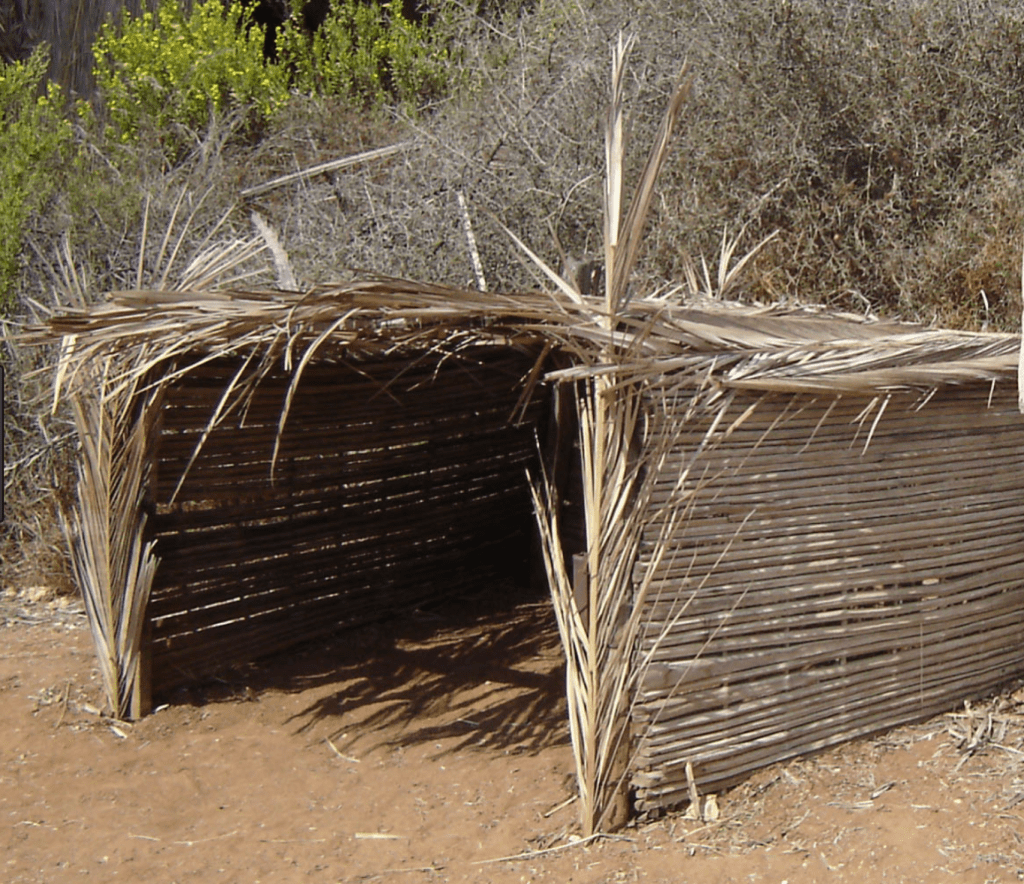
It is a harvest festival where they dwell in ‘booths.’  Here is a picture of a ‘booth’ or ‘tabernacle’ that I saw in a farmer’s field in Egypt.  It is a temporary structure built for the harvest time.  As the farmers would spend days (and perhaps nights) in their fields to harvest, these temporary structures were constructed to provide a break from the sun or minimal shelter at night.  After escaping Egypt, the Israelites dwelled in similar temporary shelters during their time in the wilderness.  And to remember that time, the Jews today still stay in temporary shelters during this week.

The ‘booth’ (Hebrew ‘sukkah’) is supposed to be a temporary shelter.   It is not that sturdy and offers little protection from the elements.   The sky should be visible through the roof.  This is to remind them that they should not depend on their own resources for protection but depend on God for their defense.  There is a message there for us:  We tend to feel protected in our homes, with cameras and security systems, and perhaps weapons to defend ourselves.  We need to remind ourselves that God is our refuge and our strength.  The Psalmist said:

Psalm 20:7  ”Some trust in chariots and some in horses, but we trust in the name of the Lord our God.”

For our protection, we don’t trust in our weapons or walls but in God, who knows us, sees us, and watches over us.

But this Sukkot, many people were looking for Jesus, and everyone had an opinion of him.

John 7:10-13   The leaders of the Jews were looking for him at the feast and saying, “Where is he?”   And there was much muttering about him among the people. While some said, “He is a good man,” others said, “No, he is leading the people astray.”   Yet for fear of the Jewish leaders, no one spoke openly of him.

But everyone was scared to speak of him.  Everyone knew the religious leaders were looking to kill him.

And Jesus shows up at the feast in Jerusalem and teaches in the temple area.  And the temple guards were told to arrest him. But they did not.

John 7:25-27   Some of the people of Jerusalem, therefore, said, “Is not this the man whom they seek to kill?   And here he is, speaking openly, and they say nothing to him! Can it be that the authorities really know that this is the Christ?   But we know where this man comes from, and when the Christ appears, no one will know where he comes from.”

Jesus showed up at the feast in Jerusalem and taught in the temple area. The temple guards were told to arrest him, but they did not.

John 7:25-26   Some of the people of Jerusalem therefore said, “Is not this the man whom they seek to kill?   And here he is, speaking openly, and they say nothing to him! Can it be that the authorities really know that this is the Christ?”

The last day of the feast of Tabernacles (the eighth day) was called ‘The Last Great Day,’ in Hebrew, ‘Hosannah Rabhah.’  Rabhah means ‘great,’ and Hosannah means ‘save us’ or ‘deliver us.’    So this is the day to ask God for deliverance.  Deliverance from hunger now and the future deliverance of the Messiah.  First, since this was a harvest festival after all the crops were in, there was a time of thanksgiving and then prayer for rain.  Following harvest, the ground needed to be plowed and broken up.   But with no heavy equipment, it was essential to have the fall rains to soften the ground so it could be tilled.  There was a ceremony where a priest would go to the Siloam pool to draw water and come and pour some around the altar as an offering.  As he did this, the people waved palm branches (praising God with the branches of trees) and shouted out these two verses:

Isaiah 12:3   With joy you will draw water from the wells of salvation. 
Isaiah 44:3   For I will pour water on the thirsty land, and streams on the dry ground; I will pour my Spirit upon your offspring, and my blessing on your descendants.

These were prayers for deliverance today and for the deliverance of the Messiah to come.  So picture it.  Thousands of people are gathered in the temple.  The priest comes to offer water on the altar as a thanksgiving offering for the harvest and for the coming rain that will soften the ground and the future hope of the spirit that will be poured out on the people. It is a grand celebration.  Everyone is singing the Hallel Psalms and waving palm branches.  This is the setting for John 7:37.

John 7:37-39  On the last day of the feast, the great day, Jesus stood up and cried out, “If anyone thirsts, let him come to me and drink.  Whoever believes in me, as the Scripture has said, ‘Out of his heart will flow rivers of living water.’”   Now this he said about the Spirit, whom those who believed in him were to receive, for as yet the Spirit had not been given, because Jesus was not yet glorified.

Jesus is saying, “I am the Great Hosannah.  I am your salvation. I am the source of living water. And I will give the holy spirit to those who believe in me.  That Messiah you are praying for right now — I am here.”  Now you know why Jesus said what he said. Jesus is the source of living water. Just as he offered it to the Samaritan women at Jacob’s well, he offers it today.  

We talked about the future fulfillment of the seven appointed times. Again, the four spring feasts were all fulfilled by Jesus about 2000 years ago with his death, resurrection, and the gift of the Holy Spirit.  The fall appointed times have yet to be fulfilled.  

One day, the final trumpet will sound, fulfilling the Day of Trumpets and announcing the Last days.  There will be a final day of judgment, and Jesus, our High Priest, will be the atonement for our sins before the Father, fulfilling the Day of Atonement.  And the Feast of Tabernacles, a harvest festival, will be fulfilled when God gathers all his family in for a time of rest, praise, and thanksgiving in His tabernacle – a harvest of souls.  One day we will enter into our final rest.  It will be a grand celebration for those who believe in Him.

1.  The Day of Trumpets is the one appointed time that no one can know the day or the hour until it happens.  According to scripture, it begins when the new moon is sighted from Jerusalem for the seventh month of the year.  If the moon is obscured, then it will be the day following.  When the moon is sighted and verified, then the trumpets are blown, and the fires are lit to spread the word (see TAY #52  https://swallownocamels.com/2024/09/24/september-21-27-a-d-yom-teruah-the-year-of-the-lords-favor-52/ )

April 11-18, 27 A.D.  Jesus and the Appointed Time of Firstfruits- The Year of the Lord’s Favor #28

Week 9 ———  Jesus and the Appointed Times – Firstfruits
John 2:18-22

Last time, we talked about how God in creation set up appointed times of meeting, the moadim.  On the 4th day of creation, God made the sun, moon, and stars —to separate day from night, to mark the days and years, for signs, and to mark specially appointed times.

But historically, we Christians haven’t spent a whole lot of time studying the Older Testament.  We don’t read Leviticus – it’s too hard. We say that, but we must understand that Leviticus is what Jesus and the other Jews in the first century used as their first-grade reader.  While all the kids in my grade were learning about Dick, Jane, and Spot, Jesus was reading Leviticus.   Because our background on these appointed times is weak, we miss much of what God is saying in Jesus.

Leviticus 23 discusses eight appointed meeting times with God.  The first one mentioned is the most important, Sabbath.  Then, there are four spring times for meetings with God and three in the fall.  The first three in the spring all happen in the same week.

This year, the time for Passover and Unleavened Bread and Firstfruits begins this week.  It starts with the day of preparation for the Passover.  Before the destruction of the temple in 70 A.D., this would be the time when the Passover lambs were slain and then taken home to roast.  Today, this preparation day is also the time to prepare the meal. The Passover would be eaten after sundown.   That day, no matter which day of the week, is a special Sabbath and the first day of the seven-day Feast of Unleavened Bread.  The regular seventh-day Sabbath would begin as usual at the twilight of our Friday evening.  The Sabbath ends at twilight on our Saturday.  After the seventh-day Sabbath has ended, the Priest would go and harvest the dedicated barley and prepare it for the firstfruits offering, which would be given on Sunday morning.  This offering of Firstfruits always happens after dawn on the first day of the week (Sunday).  Unleavened Bread continues and ends with another special Sabbath on the final day.  Note there are 3 Sabbaths in this week and three of the four spring appointed times.

Firstfruits is a dedication of the barley harvest to God.  Barley is the first harvest in the spring.  The people have been living through the winter on their stored wheat.  If the wheat harvest was not good, they may have been running out of food at this point.  But even if they were near starvation, they were not allowed to harvest any of the barley until the first fruit offering to God was made.  They were not to touch the grain until the harvest was dedicated to God.  This was in recognition that the land and the harvest were God’s.  They were just stewards of His land; so though He deserved the whole harvest,  God had required only the first of the harvest.

In his book The Temple, Alfred Edersheim says the barley for the first fruit offering was cut by the priests in a particular field on the Mount of Olives on the day of the Passover sacrifice and gathered into ten standing sheaves.  The priests then crossed back to the Temple and to their homes before twilight to eat their Passover meal.  After the Sabbath during Unleavened Bread, they would cross back over to harvest the offering at twilight and spend the night preparing it for the wave offering the following day.1  Offering the firstfruits consecrated the entire harvest to God. If God accepted the firstfruits of the harvest, it meant God would accept the whole harvest.

This offering was the first day of 50 days (this day and seven weeks of days) that they would have a similar wave offering to God, marking the days until the Feast of Shavuot (Weeks).  There were seven weeks and one day.  The book of Acts calls this appointed time “Pentecost” from the Greek for ’50’.  We will discuss this feast later and the three appointed times of the fall:  The Day of Trumpets, The Day of Atonement, and Sukkoth (The Feasts of Booths.)

What do these Old Testament feasts have to do with us?  

Passover.
 God established the Passover sacrifice and meal to remind the people of his great deliverance from Egypt.  They were slaves for 400 years.  God brought them out with power, with ten plagues or signs, the last being the death of the firstborn of Egypt.  The Passover lamb takes the place of the firstborn of Israel, and they are spared from death. For 1500 years, they celebrated Passover with the sacrifice of a lamb, recognizing the deliverance God gave them that day from death.  But they knew they needed a more complete deliverance from sin and death, and their prophets had told them that one day God would do something different. One day, a Messiah would come and be that perfect lamb of God not just to cover sin but to take it away; not just to spare them from death temporarily, but to defeat death— that it would not be a permanent separation from God.  And Jesus came to fulfill the Passover in his crucifixion. And  God arranged in his calendar to set aside Jesus to be our Passover lamb on the exact day and time that the Passover lambs were being sacrificed.  This is not a coincidence.  This is God being sovereign over time.  He didn’t want his people to miss the relevance of Jesus’ crucifixion. For thousands of years, God has painted a picture of history.  We only have to trouble ourselves to know what he has done in the past to recognize what he does in the present and what he will do in the future.

Unleavened Bread.  
God established the Feast of Unleavened Bread as a memorial to the Jews who quickly escaped from Egypt with no time for their bread to rise.  Yeast became a metaphor for corruption and sin.  They were to remove the leaven (yeast) from their homes as a reminder of their ancestors’ journey and that God had called them to live differently and not to follow the sinful ways of other nations.  Jesus comes to Jerusalem just before Passover when everyone is cleaning out their homes and removing the leaven.  Jesus sees the sin and corruption in God’s house, the Temple, and cleanses the Temple.  Jesus becomes the Bread of Life, without leaven, for us.

John 6:47-51 “Truly, truly, I say to you, whoever believes has eternal life. I am the bread of life.  Your fathers ate the manna in the wilderness, and they died.  This is the bread that comes down from heaven, so that one may eat of it and not die.  I am the living bread that came down from heaven. If anyone eats this bread, he will live forever. And the bread that I will give for the life of the world is my flesh.” 

Like the children of Israel, God has called us to live holy lives, free from sin (leaven).  We are not to be conformed to the world around us but to be transformed.

Firstfruits.  
The barley offered to God on the Sunday after the Sabbath after Passover represents the whole harvest.  If that portion is acceptable to God, the entire agricultural harvest is acceptable.  They do not touch the harvest until God receives his share first.  This is to remind them that everything they have is from God.  He is their life.   Jesus is resurrected from the dead at the same time as the firstfruits are harvested.

“But in fact Christ has been raised from the dead, the firstfruits of those who have fallen asleep.”      1 Cor 15:20

Because Jesus is resurrected, the whole world, the fields white unto spiritual harvest, are accepted.  He is our life.

John 11:25   “I am the resurrection and the life.  Whoever believes in me, though he die, yet shall he live.”

Again, look at how the spring feasts are fulfilled:
Passover –  Jesus, our Passover lamb, removes the curse of death and sin in his crucifixion.
Unleavened Bread – Jesus is the Bread of Life who took on our sin (leaven).  It is buried with him.
Firstfruits – Jesus is the firstfruits of the resurrection.  Because he has been raised, we will be raised.
Feast of Weeks – fulfilled in the Book of Acts (we will get there in just over a month).

The spring appointed times have all been fulfilled in Jesus.  The fall feasts have yet to be fulfilled.  I do not know when they will be fulfilled, this year or 100 years from now, but I have to think they will, like the spring feasts, find their fulfillment on the same day God ordained for the originally appointed times.  

Let me cover at one more aspect of Jesus’ resurrection.  On Sunday morning, Mary Magdalene comes to the tomb and sees the stone rolled away.  Then she tells Peter and John, and they all return to the tomb to see it empty. John tells us that he and Peter returned to where they had been staying, but Mary was left weeping in the tomb.  Jesus appears and reveals himself to Mary and then curiously says, “Do not touch me for I have not yet ascended to my Father…” (John 20:17).

Have you ever wondered why Mary can not touch Jesus yet? He specifically asks Thomas to touch him later. But Jesus needs to appear before the Father first. If you understand the appointed times, there is nothing surprising about this. Remember that Israel was not allowed to touch the barley harvest until the firstfruits were offered to the Father.  Jesus is not to be touched until he is presented as the firstfruit of resurrection to the Father.

“But in fact Christ has been raised from the dead, the firstfruits of those who have fallen asleep.  For as by a man came death, by a man has come also the resurrection of the dead. For as in Adam all die, so also in Christ shall all be made alive. But each in his own order: Christ the firstfruits, then at his coming those who belong to Christ.”    1 Cor. 15:20

Because Jesus’s sacrifice is acceptable to the Father as our Firstfruit, we are all eligible to be harvested in resurrection as acceptable to our God.

Let me end with one of the Psalms of Ascent that those journeying to Jerusalem for these appointed times would sing as they travel.

Psalm 126:5-6   Those who sow in tears
shall reap with shouts of joy!
  He who goes out weeping,
bearing the seed for sowing,
shall come home with shouts of joy,
bringing his sheaves with him.2

The fields are white unto harvest.  The firstfruits have been offered in Jesus, now let us seek to bring in all the harvest.

  1. Edersheim, Alfred. The Temple (1874)
  2. Remember that sheaves in the Bible can represent people (as in Joseph’s dream).  Jesus said the fields are “white unto harvest.”  

April 11-18, 27 A.D.  Jesus celebrates the Feast of Unleavened Bread- The Year of the Lord’s Favor #27

Week 9 ———  Jesus and the Appointed Times
John 2:18-22

(April 11-18: Jesus observes the Feast of Unleavened Bread in Jerusalem. The Gospels don’t mention any specifics of his activity after the discussion with Nicodemus until April 20th, when he and his disciples leave Jerusalem.  So, I will take this time to provide some background on the special appointed times in God’s calendar and then discuss the feast of Firstfruits next week. This will hopefully give you time to catch up if you have gotten behind.)

Eclipse fever is over (until the next one.)   I am sure you got your fill of the apocalyptic predictions based on that regular occurrence of the moon blocking out the sun totally for 4-5 minutes.  This is not a new thing.  Some saw some Hebrew letters in the tracks of the path of the last three solar eclipses to cross the US.  (Hey, if you want to get some revelation from Hebrew letters, I can show you 304,805 Hebrew letters in my Hebrew Scriptures.  I can promise you that you will get a lot of good information there.)  But people have forever been searching for meaning from the sun, moon, and stars.

But is that why the sun, moon, and stars exist?  God tells us exactly why he created those in Genesis 1.

Gen. 1:14-15   And God said, “Let there be lights in the expanse of the heavens to separate the day from the night. And let them be for signs and for seasons, and for days and years, and let them be lights in the expanse of the heavens to give light upon the earth.” 

So there are four reasons.  The most obvious one is “to give light upon the earth.” But their significance goes beyond mere illumination. Secondly, they are also “for days and years.”  The sun determines our days.  The sun ‘comes up’ and then the sun ‘goes down.’  Sunset is the beginning of a new day (as God defines it and the Hebrew Bible understands it — “evening and morning was the first day.”)   And how about ‘years’?   Because the Earth revolves around the sun in just over 365 days and because its axis is tilted, the sun rises and sets in a slightly different place every day.  It only sets in the due west on two days of the year, the spring and fall equinoxes.   Stonehenge in the United Kingdom, the pyramids in Egypt, and many other ancient monuments were constructed to align with the direction of the sunrise at the summer solstice.  People have forever realized how the sun marks out the years.

Thirdly, the Sun and Moon are there for signs (Hebrew ‘otom’).  Not the signs people want to see in an eclipse or a comet, but something more.  People have forever been trying to make “signs from God” out of natural occurrences (or trying to explain away the signs of God as natural occurrences.)  Comets were associated with the death of Caesar or the coming of the black plague in the Middle Ages.  During solar eclipses in ancient China, people thought an invisible dragon was eating the sun. So the Chinese would bang drums, pots, and pans and get archers to shoot arrows into the sky to scare the dragon away. Moments later, the sun would reemerge. So it must have worked! In the Middle East, in 585 BC, the Lydians and Medes were in a five-year war. A total solar eclipse occurred during the battle, and nations stopped fighting at once and forged a peace treaty.  In 1504, on Columbus’ final voyage, he got stranded in Jamaica.  He convinced the indigenous people that if they didn’t feed and take care of him, the gods would be angry.  He used an almanac to predict a lunar eclipse and told the people the gods would give them a warning and that the moon would disappear for a time that night.  The son of Columbus, Ferdinand, wrote:

“…with great howling and lamentation they came running from every direction to the ships, laden with provisions, praying the Admiral to intercede by all means with God on their behalf; that he might not visit his wrath upon them.”

What does the Bible say about people seeking signs?   Jesus said:

Matthew 12:39-40   “An evil and adulterous generation seeks for a sign, but no sign will be given to it except the sign of the prophet Jonah.  For just, as Jonah was three days and three nights in the belly of the great fish, so will the Son of Man be three days and three nights in the heart of the earth. “

We will talk much more about this sign of Jonah later.   Jesus hints at this sign in our passage today:

John 2:18-22   “So the Jews said to him, “What sign do you show us for doing these things?” Jesus answered them, “Destroy this temple, and in three days I will raise it up.” The Jews then said, “It has taken forty-six years to build this temple, and will you raise it up in three days?” But he was speaking about the temple of his body. When therefore he was raised from the dead, his disciples remembered that he had said this, and they believed the Scripture and the word that Jesus had spoken.”

But I think this verse from Jeremiah sums up the turmoil that constantly circulates during these routine celestial happenings:

Jeremiah 10:2-3  “Thus says Yehovah: “Learn not the way of the nations, nor be dismayed at the signs of the heavens because the nations are dismayed at them, for the customs of the peoples are vanity.”

Jeremiah goes on to say don’t be afraid of idols either.  Like the fear of man from routine movements of the heavens, they are only inventions of man.  They “can not do evil, nor is it in them to do good.” (Jer.10:5).  But every big astronomical event brings out the sign-seekers.  Don’t fall for that nonsense.  If you want to know about real signs, check out the otom in the Bible.

In the Bible, these signs, “otom”, refer not to natural astronomical occurrences but to something beyond the ordinary.  For example, the plagues in Egypt are called ‘otom’.  One plague was darkness, but not the darkness of a solar eclipse that affects a small area for a short time. All of Egypt (except where the Hebrews were) was in total darkness for three days.  In Joshua 10, the sun and moon stand still during a battle for the length of a day.  In 2 Kings 20 (also in Isaiah 38), the shadow of Ahaz’s sundial goes backward ten steps as a sign.  Routine visible astronomical events are a wonder of God’s creation, but not miracles or signs.

Finally, the sun and moon are there for what the ESV calls “seasons.”  This is the translation of the Hebrew “moadim” in almost every translation.  That is unfortunate, as the actual translation is “an appointed time or place for meeting with God.”   The NIV is on the money here and translates moadim as “sacred times” and the Holman likewise as “signs for festivals.”   It could refer to a season only as a ‘sacred season’ or “appointed season” to meet with God.1  The primary two things this word refers to in the Bible are 1) The “tent of meeting” — where Moses met with God outside the camp (an appointed meeting time and place with God). Or 2)  the appointed feasts in the Biblical calendar.  — Lev. 23:44   “Thus Moses declared to the people of Israel the appointed feasts [moadim] of Yehovah.”

Leviticus 23 lists eight appointed times.  There are four in the spring and three in the fall—but these are mentioned only after the most important appointed time, the Sabbath.  

Lev. 23:1-4   Yehovah spoke to Moses, saying,  “Speak to the people of Israel and say to them, These are the appointed feasts [moadim] of Yehovah that you shall proclaim as holy convocations; they are my appointed feasts [moadim].  “Six days shall work be done, but on the seventh day is a Sabbath of solemn rest, a holy convocation. You shall do no work. It is a Sabbath to Yehovah in all your dwelling places.

Again, the Sabbath is the most important appointed time for meeting with God.  We will discuss the Sabbath in Jesus’ teaching later.

We have already discussed the first of the spring appointed times, Passover (see ‘Behold the Lamb #22‘).  The Bible doesn’t call the day Passover but uses that term to refer to the sacrifice “Pesach,” which is eaten after twilight, thus the beginning of the next day, the first day of the seven days of Unleavened Bread. (We discussed unleavened bread in ‘Jesus Cleanses the Temple #25‘.)  The first day of Unleavened Bread is a special Sabbath, as well as the last day of Unleavened Bread (Lev. 23:7-8). So you can have 3 Sabbaths in the week of Unleavened Bread.2

The next feast is Firstfruits, which is on the day after the Sabbath of Unleavened Bread. Several New Testament books refer to this feast. Understanding Firstfruits will deepen your understanding of why Jesus’ resurrection opens the door for our resurrection. So that is our topic for next week.

  1. Brown-Driver-Briggs Lexicon,  article for ‘moed.’ (‘Moed’ is the singular form, and ‘moadim’ is plural.)
  2. At this point, a very wise and careful reader may think about the final week of Jesus’ life and how they had to rush his burial as the next day was the Sabbath.  That led everyone to believe that Jesus was crucified on a Friday because the Sabbath starts at twilight on our Friday night.  But, if you know about Jewish feasts, you realize that every day after the Passover lamb is slaughtered is a Sabbath, so Jesus’ death did not have to be on a Friday.  We will go into more detail about this possibility next year.