
Week 54 — Lazarus is dying
John 11:1-16
It was just 9 weeks ago that Jesus spent a week with his friend Lazarus and his sisters Martha and Mary. He stayed with them during the holidays of Hanukkah at their home in Bethany, as he often did, for Bethany is just over a mile from Jerusalem. During that visit, he again clashed with the religious leaders in Jerusalem who were already seeking to kill him. At one point, they “picked up stones to stone him” (John 10:31). So Jesus left Judea after Hanukkah and went east to Perea, the territory on the other side of the Jordan, to preach and heal there. This is the territory of Herod Antipas, and 2 weeks ago, Jesus learned that this Herod was also seeking to kill him and began to move northward, away from Herod’s palace at Macherus, back towards Judea. He is teaching as he goes. He has just told the parable of the rich man and Lazarus. It is at this point that Jesus receives the news that his friend Lazarus is very ill.
John 11:1-16 Now a man named Lazarus was sick. He was from Bethany, the village of Mary and her sister Martha. (This Mary, whose brother Lazarus now lay sick, was the same one who poured perfume on the Lord and wiped his feet with her hair.) So the sisters sent word to Jesus, “Lord, the one you love is sick.”
When he heard this, Jesus said, “This sickness will not end in death. No, it is for God’s glory so that God’s Son may be glorified through it.” Now Jesus loved Martha and her sister and Lazarus. So when he heard that Lazarus was sick, he stayed where he was two more days, and then he said to his disciples, “Let us go back to Judea.”
“But Rabbi,” they said, “a short while ago the Jews there tried to stone you, and yet you are going back?”
Jesus answered, “Are there not twelve hours of daylight? Anyone who walks in the daytime will not stumble, for they see by this world’s light. It is when a person walks at night that they stumble, for they have no light.”
After he had said this, he went on to tell them, “Our friend Lazarus has fallen asleep; but I am going there to wake him up.”
His disciples replied, “Lord, if he sleeps, he will get better.” Jesus had been speaking of his death, but his disciples thought he meant natural sleep.
So then he told them plainly, “Lazarus is dead, and for your sake I am glad I was not there, so that you may believe. But let us go to him.”
Then Thomas (also known as Didymus) said to the rest of the disciples, “Let us also go, that we may die with him.”
The Gospels repeatedly emphasize Jesus’ love for Lazarus and his sisters, including in verse 5 here. But that makes verse 6 all the more puzzling.
Now, Jesus loved Martha and her sister and Lazarus. So when he heard that Lazarus was sick, he stayed where he was two more days, and then he said to his disciples, “Let us go back to Judea.”
The reason why Jesus didn’t leave immediately to go see about his friend was “that he loved them so much”? Jesus receives a desperate plea for help and demonstrates his love by waiting 2 days before he leaves.
Let’s look at the timing here. Lazarus is ill to the point that his sisters feel the need to call their miracle-working friend to come and heal him. It would take a full day’s journey for a messenger to get the word to Jesus. It was at least 22 miles. He delays 2 days and then takes a full day to travel to Bethany. Verse 17 tells us, “On his arrival, Jesus found that Lazarus had already been in the tomb for four days.” Do the math. Lazarus must have died shortly after Mary and Martha sent the messengers off to tell Jesus of his illness. Lazarus is already in the grave before the messenger arrives and makes it to Jesus.
This is Israel 2000 years ago. There was no embalming of bodies as they did in Egypt. Oh, they used spices and perfumes to cover the smell, but they did nothing to stop the decay. And in such a climate, decomposition of the body began quickly. Except in unusual occasions, bodies were prepared for burial and placed in the tomb on the same day of death. Today, in Orthodox Jewish communities, burial is still held within 24 hours of death. (The rabbis see this as a command from Deuteronomy 21:23.) So soon after the messenger left, Lazarus died, and they closed his eyes, washed his body, anointed it with perfumes and spices, and wrapped the corpse with strips of cloth. Then, there would be a procession of family and friends to the family tomb, where the body would be placed on a slab of stone cut out of the cave’s walls. The tomb was then sealed with rocks or a rolling stone. Mourning would continue at the home for seven days. After a year, the tomb would be opened, and the bones collected and placed in a stone box called an ossuary.
So, by the time the messenger arrives to tell Jesus that Lazarus is ill, he has already died and been placed in the tomb. It is too late to prevent his death. Jesus could rush to Bethany immediately and join Mary and Martha in grieving, or he could rush back and stop their mourning by raising Lazarus the next day, but he waits two days before he leaves.
In the first century, there were no doctors to examine someone and pronounce them dead. And rarely, someone could appear dead when they were not. Their heart could be fibrillating, and their breathing so shallow that most people would not detect any signs of life. There are reports of people being carried to their tombs and rising back to life. This led to the belief that the spirit hovered over the body for three days, hoping to reenter the body, but then after 3 days, when full decomposition had begun, the spirit departed.
Had Jesus left immediately and revived Lazarus after only a day or two, it would have been impressive but not an undeniable miracle of God. Jesus wanted there to be no doubt when Lazarus was raised to life that he was dead beyond hope of resuscitation. Jesus would not let God’s victory over death be cheapened because people had these mistaken thoughts about the spirit hovering.
Jesus frankly tells the disciples that he knows that Lazarus is already dead and says something that seems really odd, “for your sake, I am glad I was not there so that you may believe.” Jesus says I am so glad I was not there to heal Lazarus before he died. What must the disciples have been thinking when Jesus said this? They didn’t know yet that Jesus would raise Lazarus from the dead. So they see Jesus doesn’t rush off to heal when he hears Lazarus is sick, and then Jesus says, “I am so glad I wasn’t there to prevent Lazarus’ death.”
I think of the many times in my career as a pediatrician that I raced to the hospital to resuscitate a newborn. Many was the night I received a phone call and drove way over the speed limit to rush up to the hospital nursery because a baby had been delivered prematurely and needed advanced resuscitation. Many times, I ran from our office across the hospital campus and up the stairs to the OB ward or nursery to prevent the death of a baby. Thankfully, most of those trips were successful, but some were not. And still today, there are some times when I still relive those moments in the early mornings, even now wondering if I could have gotten there sooner or done something more. In my job, illness and death were the enemy we all dreaded, but they were always near at hand.
But Jesus says, “I am so glad I was not there to prevent Lazarus’ death.”
What is Jesus saying?
Jesus is living out the second beatitude. The sermon on the mount begins in Matthew 5 with eight statements of the good life, descriptions of the ones living the good life, the lucky ones, the happy ones. And they are groups of people who would be least expected to be happy: the poor, the hungry, the disadvantaged, the powerless. The second beatitude is:
Matthew 5:4 Blessed are they that mourn, for they shall be comforted.
Happy are they that mourn! How lucky are the mourners, for they will find comfort!
How odd are the Beatitudes! How in the world do you expect people mourning the death of a loved one to be the fortunate people? For they will be comforted.
Some lessons you can’t learn from just hearing them. Some things can only be learned from experience. The disciples had listened to his sermon back in July, but they hadn’t lived it yet. There is a big difference between hearing the words of Jesus and experiencing the words of Jesus. They knew that Jesus said that those who mourn were the lucky ones, and some of the disciples wrote it down. But did they understand what Jesus was saying? Do we understand what Jesus was saying?
Don’t just read the words; live the words.
Can you imagine the joy that Mary and Martha felt when they realized Lazarus was alive again? Some of you can. Some of you have had news that came close. When the follow-up scan says, there is no more sign of cancer when you get news that your family member in the horrible accident that you were told would probably die is now expected to live.
I remember clearly a certain premature baby. I spent over an hour resuscitating and ventilating this baby one early morning. Born at 24 weeks, her prognosis was very poor. She needed surfactant, a medicine instilled into the lungs of premature babies to allow their stiff lungs to expand. But that is not available in any rural hospital. Nor was the high-frequency oscillating ventilator we needed to breathe for her with her premature lungs. So I breathed for her with a hand-squeezed bag for over an hour because that was the best you have in any rural hospital. And that morning, the transport team was delayed. It became harder and harder to breathe for her as her lungs became stiffer and stiffer. Despite our best efforts, her oxygen was dropping, and then her heart stopped. We continued to ventilate and do chest compressions for more than 15 minutes, giving all the code blue medications possible to attempt to revive her. One by one, the nurses and respiratory techs said we needed to stop because she was gone. But I couldn’t let go. I couldn’t stop. And then, unexplainably, her heart started beating, her oxygen came up, and just after that, the transport team arrived with the medicine needed to decrease the stiffness in her lungs. She survived that night and, after 4 months in the Neonatal Intensive Care Unit, was able to go home.
But that moment when her heart started… There is no possible way I can explain to you the joy that spread in that room. She had been given up for dead, the room was full of tears, and we were all mourning, but then she came back to life, and let me tell you, worship broke out in that nursery, praising God for the gift of life. For it was nothing we did. We had exhausted every intervention available to us. But God…
Oh, what a moment, when everything changes
Imagine the glory; imagine the praises.1
I don’t have to imagine it, for I have lived it more than once.
There is no rejoicing like the rejoicing of the victory of life over death. You can read the words of the Bible, and you can study them, but they come truly alive when we see how we have lived them out and then share them with each other. How wonderful it is for those who mourn, for they will be comforted.
This is the attitude we see in David in Psalm 30. David was sick to the point of death with no medical treatment available, and he cried out to God, and God healed him, and Psalm 30 is his response.
O Yehovah, my God, I cried to you for help, and you have healed me.
O Yehovah, you have brought up my soul from the grave; you restored me to life from among those who go down to the pit.
Sing praises to Yehovah, O you his saints, and give thanks to his holy name.
Weeping may tarry for the night, but joy comes with the morning.
You have turned for me my mourning into dancing; you have loosed my sackcloth, and clothed me with gladness, that my glory may sing your praise and not be silent.
O Yehovah my God, I will give thanks to you forever!
David thought he was going to die, but God turned his mourning into dancing. And in our passage today, Jesus knew something that the disciples didn’t realize — Lazarus’ death was only temporary. Those who now mourn will soon find comfort, and they shall rejoice.
Are you a Second Beatitude believer? Can you see tragedy, illness, and death as just another opportunity for God to reveal his glory? Can you grasp the incredible brevity of our grief compared to the eternity of our joy? The key to our passage today is verse 4:
John 11:4 Jesus said, “This sickness will not end in death. No, it is for God’s glory so that God’s Son may be glorified through it.”
“This sickness will not end in death.” Don’t miss the point that Jesus makes this statement, knowing that Lazarus is already dead. It is not a statement about the prognosis of the illness but about the temporal nature of death. Jesus says, “This sickness will not end in death” because Jesus knows that death is not the end. Death is never the end. It was not the end for Lazarus, and it is not the end for you either. The year after the dash on a headstone is not an ending date but a relocation date.
Let’s look at another Psalm. This one you know very well, Psalm 23.
Yea though I walk through the valley of the shadow of death, I will fear no evil, for you are with me.
I know you have this memorized, but look at this carefully. You walk through the valley of the shadow of death. The valley of the shadow of death is not a destination, it is not where we go to but where we go through. Death is not the end. Then, what is the destination of the journey in the 23rd Psalm? It is in the last verse:
Surely goodness and mercy shall follow me all the days of my life,
For all the days I live, God’s goodness and mercy follow. But wait, ‘follow’ is too tame a word for the Hebrew there ‘radaf.’ ‘Radaf’ doesn’t mean ‘follow,’ but ‘pursue,’ chase after with the intent to do something. ‘Radaf’ is the picture of a lion pursuing its prey. A lion doesn’t follow; a lion pursues — the lion’s intent is not just to see where it goes, not just to catch it, but to consume it. ‘Radaf’ is to chase after something with the intent to act on it. God’s mercy and goodness pursue us every day of our lives; they chase after us like a lion in order to change us, to change our hearts, and to radically alter our circumstances.
And then — and then after all the days of our lives – and then it is not the end — and then I shall dwell in the house of Yehovah forever.
Surely goodness and mercy shall pursue me all the days of my life, and I shall dwell in the house of Yehovah forever.
Death is not an end. We shall dwell in the house of Yehovah forever. This is the gospel. This is the good news. Oh, how I would like to make signs that have Jesus’ quote from John 11:4, “This sickness will not end in death” – Jesus.” I want to put them in every hospital cancer ward, in every ICU, in every hospice room. Death is not the end. Jesus has spoken.
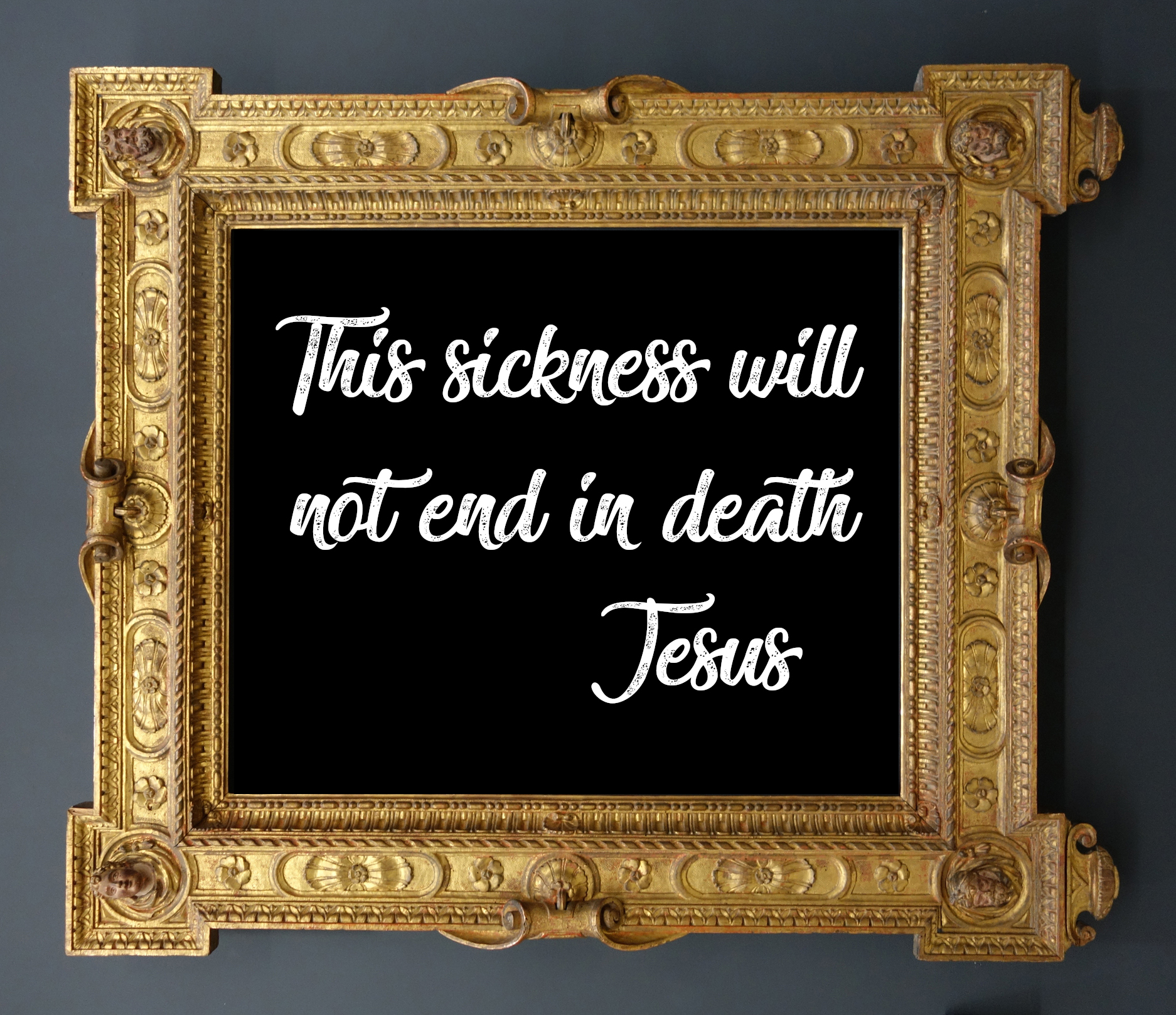
And in just a few days, after our passage this morning, those disciples heard Jesus speak, heard him say, “Lazarus, come out!” And they saw the glory of God as he defeated death. Mourning turned to joy, and grieving turned to glory.
And in just a few months later, they see Jesus alive three days after he dies, and they will again see God glorified as he pronounces the final defeat of death. Blessed are they that mourn, for they will be comforted.
It is natural to fear dying. Dying can be a painful process. But there is no need to fear death. For it is but another opportunity for God to show his glory as he brings you closer to his side. As long as we walk on this earth, we walk each day in the shadow of death, the shadow of the dying. But Jesus says none of these illnesses, none of these cancers, none of these traumas will end in death. For those we mentioned this morning who are grieving the death of their son, his story does not end in death. For death is not the end. We, like Lazarus, will be called out of the grave.
John 11:25-26 Jesus said to her [Martha], “I am the resurrection and the life. The one who believes in me will live, even though they die; and whoever lives by believing in me will never die.”
And then he asks Martha the most important question anyone will ever ask.
“Do you believe this?”
Do you believe this? Are these more than just words on a page to you? Are you living them out? If you believe these words, it changes everything. We need not fear the shadow of death or death itself. We need not fear cancer, heart problems, accidents, evil, or sin. Because none of these things will be the end. All these things we fear in life are simply opportunities for God to show his glory as he defeats illness, sin, and death. There may be times it seems the enemy is winning, that the disease has the better of you, that sin has a hold on you, but know this: Sin has no victory, Illness has no victory, and Death has no victory.
Seven hundred years before Jesus’s birth, the prophet Isaiah saw the day coming when the pursuit of God’s mercy and grace would reach its climax.
Isaiah 25:7 And Yehovah will swallow up on this mountain the covering that is cast over all peoples, the veil that is spread over all nations.
Right here, on this mountain in Jerusalem, God will destroy that shroud of death that hangs over all of us.
Isaiah 25: 8 “He will swallow up death forever; and Yehovah Elohim will wipe away tears from all faces, and the reproach of his people he will take away from all the earth, for Yehovah has spoken.”
He will remove the reproach, the shame of our sins from us, casting them off the planet. God has spoken; it will come to pass.
And they waited another 700 years for this. And then Jesus came — and this resurrection of Lazarus in the suburbs of where Isaiah was prophesying was just a small taste of what Jesus would do just a few months later on that very mountain where on the cross and from the tomb like Lazarus the stone would be rolled away, and death would yield to eternal life.
Isaiah 25:9 It will be said on that day, “Behold, this is our God; we have waited for him, that he might save us. This is Yehovah; we have waited for him; let us be glad and rejoice in his salvation.”
So we say today, this is Yehovah; this is his son Jesus. We have waited for him to turn mourning into joy. Now, let us rejoice in His salvation. Let us say as the apostle Paul said (1 Corinthians 15:54-56), quoting Isaiah, “Death is swallowed up in victory.” (Isaiah 25:8) and quoting Hosea, “Death where is your victory? Grave, where is your sting? (Hosea 13:14).
1 Corinthians 15:56 The sting of death is sin, and the power of sin is the law. But thanks be to God, who gives us the victory through our Lord Jesus Christ.
I heard an old, old story,
How a Savior came from glory,
How He gave His life on Calvary
To save a wretch like me;
I heard about His groaning,
Of His precious blood’s atoning,
Then I repented of my sins
And won the victory.
O victory in Jesus,
My Savior, forever.
He sought me and bought me
With His redeeming blood;
He loved me ere I knew Him
And all my love is due Him,
He plunged me to victory,
Beneath the cleansing flood.2
1. Lyrics from “He Welcomes the Beggar” by 11th Hour. 2016. This is the song our church trio sang on the day this message was given.
2. “Victory in Jesus.” Eugene Monroe Bartlett. 1939.
 Swallow No Camels