December 3, 2025 –  Philip follows the Holy Spirit – Shema— Acts #23

December 3, 2025 –  Philip follows the Holy Spirit – Shema— Acts #23
Acts 8:26-40

Are you ready to be a disciple?

Shema – it means “listen” in Hebrew, but it means much more than “listen”.  Because in the Jewish culture of the Old Testament, listening implies obedience.  There is no concept of listening to God without being obedient.  It is just wrong; it is a sin.

This word is so important. It is the title and the first word of the prayer every Jewish person has prayed several times a day for thousands of years.  The prayer is a collection of passages from Deuteronomy.  And this is the first prayer Mary and Joseph taught Jesus as a small boy.  And he prayed this prayer every day.  And this concept of shema is critical to a follower of Jesus. 

We continue our story of Philip in Acts 8, and in this story, Philip shows us what it looks like to listen for God’s voice and obey without delay.  Through him, God brings salvation to a man who was seeking truth but didn’t yet know where to find it.

Acts 8:26-40   Now an angel of the Lord said to Philip, “Rise and go toward the south to the road that goes down from Jerusalem to Gaza.” This is a desert place. And he rose and went. And there was an Ethiopian, a eunuch, a court official of Candace, queen of the Ethiopians, who was in charge of all her treasure. He had come to Jerusalem to worship and was returning, seated in his chariot, and he was reading the prophet Isaiah.
And the Spirit said to Philip, “Go over and join this chariot.” So Philip ran to him and heard him reading Isaiah the prophet and asked, “Do you understand what you are reading?” And he said, “How can I, unless someone guides me?” And he invited Philip to come up and sit with him.
Now the passage of the Scripture that he was reading was this: “Like a sheep he was led to the slaughter and like a lamb before its shearer is silent, so he opens not his mouth.
In his humiliation justice was denied him. Who can describe his generation? For his life is taken away from the earth.”
And the eunuch said to Philip, “About whom, I ask you, does the prophet say this, about himself or about someone else?” Then Philip opened his mouth, and beginning with this Scripture he told him the good news about Jesus. And as they were going along the road they came to some water, and the eunuch said, “See, here is water! What prevents me from being baptized?” 
And he commanded the chariot to stop, and they both went down into the water, Philip and the eunuch, and he baptized him. And when they came up out of the water, the Spirit of the Lord carried Philip away, and the eunuch saw him no more, and went on his way rejoicing. But Philip found himself at Azotus, and as he passed through he preached the gospel to all the towns until he came to Caesarea.”

Philip was in Samaria experiencing revival.  Things were going great!  People were coming to know Jesus as their Messiah.  Lives were being changed.  Miracles were happening.  People were being healed.  Crowds were eager to hear the Gospel.  It was the perfect situation for a church leader.  Then God says, “Go south to the desert road.”  Everything is going great, so go to the desert.  How does that make sense?  Leave the crowds?  Leave success?  Leave the work God is blessing? For a desert road?   No preacher today with any sense would leave a place of great success and go to a deserted land.  (You notice preachers rarely get called to leave a big, successful church and go to a tiny, struggling church in the middle of nowhere.) That desert road led to Gaza.  Now that is a place that you probably wouldn’t want to go today.  It wasn’t much better in Philip’s day.  But God had an assignment for Philip, and Philip didn’t argue… he listened and obeyed.

Many of God’s most significant assignments begin with an interruption in routine and a disruption in comfort. Abraham is minding his own business at home, and God calls him to leave everything he knows.  Moses is tending sheep, just as he has done every day for the past 40 years.  He has a good life in Midian. He has no thoughts of ever returning to the country he was kicked out of.  But God interrupts his life and gives him a difficult task. Mary is engaged to be married.  It was an exciting time in her life. She was planning a wedding, getting everything ready to set up a household with Joseph.  And then God interrupts her in a significant way.

God’s task assignments often come with few details.  Now this can be frustrating at times.  We like to know the whole plan, including all the details, before we set out on a project.  We want to know how long it will last, how much it will cost, and what equipment we will need. But God only gave Philip step 1:   Rise and go toward the south to the road that goes down from Jerusalem to Gaza.    No mention of why.  No mention of what he would do there. But this is the way God usually works.  He rarely gives anyone the big picture up front.

We often miss this when we read the scripture in the psalms:

Psalm 119:105   Your word is a lamp to my feet… 

What is a lamp to my feet?  They didn’t have flashlights in those days.  They used oil lamps held by a string near their feet.  It provided just enough light for the next step.  They couldn’t see any further ahead.  And this is typically how God reveals his plans or tasks for us.  Just one step at a time.  That requires trust.  That requires faith.  

God sends a messenger to Philip.  (That is literally what the word translated ‘angel’ in our English Bibles means.  Both ‘angelos’ in Greek and ‘malach’ in Hebrew mean messenger.)  A few verses later in this passage, it says, “And the Spirit said to Philip…”  I am not sure that there is a big difference in these two statements of the delivery of God’s message to Philip.  In Jewish thought, there is little distinction, as seen in Acts 23:9.

Acts 23:9   Then a great clamor arose, and some of the scribes of the Pharisees’ party stood up and contended sharply, “We find nothing wrong in this man. What if a spirit or an angel spoke to him?”

God very rarely speaks through messengers who take human form.  And contrary to every painting you have ever seen, angels do not have wings.   Angels in human form are the least frequent way God sends messages.  He occasionally speaks through dreams or visions, but the most common way God speaks is through scripture. When you read the Bible, it is God’s word to you.  It is God speaking to you.  And we pray to converse with God.  Mark Batterson says that God most frequently speaks in whispers.  In his book, “Whisper”, Batterson notes that to hear someone whisper, you have to draw close to them.  God speaks to those who draw close.  And God speaks to those who listen.

But the question is: Do we give God a chance to speak to us?  

Do we allow God to speak in our prayer time?  Are we listening, not just talking?  Prayer is meant to be a conversation, not a monologue.  

When we read Scripture, do we allow time for God to speak? Tim Makie of the Bible Project frequently refers to the Bible as meditation literature.  It is not meant to be read like a cookie recipe.  It is not meant to be read like a newspaper or a history book.  It is intended to be read slowly and meditated upon.  Often God has something to whisper to you when you read scripture.  (That is when I most often hear God speak to me.)

Do we make space for God to speak to us?  If every moment of our life is filled with noise, we will miss the whisper of God.  Have you ever wondered why printed books have margins?  They could save a lot of paper if they just used all the space on the page instead of leaving an inch on all sides.  But pages printed to the edge are harder to read.  Your eyes can’t track the lines as well.  The margins are necessary.   And we need margin in our lives.  We fill every moment with constant input, from others or from a television or radio.  There is no blank time, no margin.  It is in quietness that the Spirit often whispers.

God speaks — but do we pause long enough to hear Him?

God speaks to the obedient.   You may not hear God speak because you weren’t obedient to the last request.  If Philip had not been obedient to God’s order to go to the desert, He would not have been in a position for the next instruction.  Only after he has followed God to the desert can he see the chariot, the Ethiopian, and the scroll.  You have to be obedient in the small things that you may not understand to be in a position to do the task God has for you.

But Philip follows God’s instruction to travel to the desert road.  Then he sees a man from south of Egypt, the land called Cush in the Old Testament.  (Currently known as northern Sudan.  This man is an official in the court of the Kandake (the queen mother).  (“The king of Ethiopia was venerated as the child of the sun and regarded as too sacred a personage to discharge the secular functions of royalty; these were performed on his behalf by the queen-mother, who bore the dynastic title Kandakē.”  NICNT  FF Bruce 

He has apparently been to the recent Jewish festival of Pentecost.  He is what they called a God-fearer.  He believes there is a god named Yehovah, and he is convinced of His power, but he has not fully committed. Today, we would call him a seeker.   He may have witnessed, or at least heard about, the commotion in the temple courtyard at Pentecost, and may have heard some talk about Jesus.  But he is going home confused.

God’s plan is good.  His timing is flawless.  Look at this: This person, who has been seeking God but not understanding everything, is alone on the road (he has time on his hands) and trying to read scripture about the Messiah.  He wants to understand it, but he needs help.  So God arranged Philip to be there at that moment.   It is a perfect plan.  But it all hinges on one thing—the obedience of Philip.

God’s great plan will fail if Philip does not follow it.  What happens is Philip says no?  If Philip says, “No way God is calling me to go down that desert road.  That road to Gaza is dangerous.  I am needed here in Samaria.  I am leading a massive movement here.  I am too important to the work being done here to waste that time on the road.  Notice that from Samaria, Philip will travel 50-70 miles on foot.  It will be a 3-4 day journey each way.  This will take Philip away from his work in Samaria for more than a week. And why?  He does not know any details.  The only answer he has to the question of why is obedience.

So what happens to that Ethiopian if Philip is not obedient?  Even if Philip quits on God, God is not going to quit on that Ethiopian.  God is not going to abandon a seeker.  What does God do when people fail to follow and mess up his plan?  Well, fortunately, there is a book that tells us precisely what  God does and how he deals with people.  So let’s look in the Old Testament to see two ways God accomplishes his plan when we are disobedient. 

1.  He gives the disobedient person another chance to follow.  Our example is Jonah.  God had a great plan for turning Nineveh, the capital of the nation of Assyria, to him.  It was up to Jonah to go and preach.  But Jonah was disobedient and got on a boat headed in the opposite direction.  Did God give up on Ninevah?  Did God give up on Jonah?  No.  God created a storm, and God ordained the sailors’ lots to tell them Jonah was the problem.  And then God rescued Jonah from drowning with a great fish.  And then God asks Jonah again, “So how about now, Jonah?  What do you think about going to Nineveh today?

God went to a lot of trouble to encourage Jonah to be obedient, to give him another chance.  God is forgiving of Jonah’s disobedience.  He shows Jonah great mercy.  Do you remember why Jonah didn’t want to go to Nineveh in the first place?  Because he knew God was merciful and forgiving.  Jonah knew that God would give the Ninevites a chance to repent.   And Jonah didn’t really want the Ninevites to have an opportunity for repentance.  They were his enemy.  But Jonah finally obeys and goes, and God shows mercy on the people of Nineveh.  And the end of the 4-chapter book teaches much about mercy to all people. But what would God have done if Jonah had not finally decided to be obedient? 

2.  If God’s chosen person for a task refuses to be obedient, then God chooses another person to do the task.  For an example of this, we look at King Saul in the Old Testament in 1 Samuel 13-16.  God chose Saul to be king over Israel and lead his people faithfully.  But Saul repeatedly disobeyed God’s commands.  I’ll briefly mention two specific examples: He was impatient and did not wait for the priest Samuel to perform the sacrifices before battle, so he offered them himself.  He was not a priest and was not authorized to make any sacrifices.  Secondly, he refused to carry out God’s instructions concerning the Amalekites.   The Amalekites were the nation that refused the children of Israel passage through their land, forcing them to take a considerable detour.  So Saul was to conquer the Amalekites, and everything in the city belonged to God.  No man of Saul’s army was to take any plunder from the attack.  And Saul conquered the Amalekites but allowed his people to take cattle and sheep from the land, even though God had forbidden it.  So after a long history of Saul’s disobedience, God tells the prophet, Samuel, this:

1 Samuel 15:10-11   The word of Yehovah came to Samuel: “I regret that I have made Saul king, for he has turned back from following me and has not performed my commandments.

God has watched Saul, his chosen person, be disobedient so many times that God regrets giving him the job of king.  God has given him chance after chance, but Saul refuses to be obedient. So Samuel goes to Saul, who tells him, “Look, I destroyed the Amalekites just as God said to do.”  And Samuel asks Saul, “Then what are all these sheep and cattle doing here?”  “Oh,” Saul says, “we took the best of the sheep and cattle from the Amalakites to sacrifice them to God.”   So Samuel says:

1 Samuel 15:22-23   And Samuel said, “Has Yehovah as great delight in burnt offerings and sacrifices, as in obeying the voice of Yehovah? Behold, to obey is better than sacrifice, and to listen than the fat of rams.  For rebellion is as the sin of divination, and presumption is as iniquity and idolatry. Because you have rejected the word of Yehovah, he has also rejected you from being king.

In other words, “You’re fired.”  God will appoint someone else to do the job of king, because you can not be obedient.  God then sent Samuel to Bethlehem to anoint a new king, David, a young shepherd boy, whose best qualification for kingship is his obedience.

Look at what Samuel said.  Listen and obey — shema.  What Saul did would be like someone today doing something in disobedience to God to make a lot of money and then excusing their behavior by saying, “Well, I’m going to give some of that money to the church.”  God doesn’t need your money.  He wants you to obey his voice.  He wants you to listen and obey.  You can not obey if you don’t listen.

Thankfully, Philip in Acts 8 listened and was obedient.  He went without hesitation to the desert road. Had he hesitated, he would have missed that divine appointment.  But he was able to explain the scriptures of Isaiah to the Ethiopian who accepted Jesus and asked to be baptized. There are people around us who are spiritually hungry — often quietly.  Like the Ethiopian, they may have status, authority, wealth, education, or influence.  But what they really need is understanding.  There are many people you encounter who look like they have it all together, but they are quietly asking:  How do I make sense of life?  Is this Jesus stuff real?  What am I missing?  God wants to position obedient disciples alongside searching souls, but the disciples must listen and be obedient to the call.  Sometimes all you have to do is walk across the room.  

Do you hear God’s message to you?

Some people say they have never heard God speak.  Maybe you haven’t heard God’s voice, but you have seen its evidence.  God’s initial word, spoken to the cosmos in Genesis 1, is still echoing through the universe.  He said, “Let there be light”, and “let there be stars”, and in our universe, we now have evidence that stars are still being formed.  God’s word is not finished.

Does God still speak?   I can testify that God is still speaking.  You may never experience an angel, a divine messenger.  Most people in the Bible never did either.  But He speaks through his word and through others, and through whispers.   The real question is:  Are you listening? Or is God’s voice crowded out by other voices?   We also see in this passage that God honors those who seek him.  I challenge you to seek God this next week earnestly.  Spend some time in the quiet.  Spend time meditating on His word.  Listen for his whispers.  And be obedient.  As Samuel said, 

1 Samuel 3:10.  Speak, Lord, for your servant is listening.
September 28, 27 A.D.  –  Who is Jesus to You? —   The Year of the Lord’s Favor #55

Week 33 ———  An Important Question in an Unusual Place
Matthew 16:13-20      Mark 8:27-9:1    Luke 9:18-27

Matthew 16:13-20   Now, when Jesus came into the district of Caesarea Philippi, he asked his disciples, “Who do people say that the Son of Man is?”   And they said, “Some say John the Baptist, others say Elijah, and others Jeremiah or one of the prophets.”   He said to them, “But who do you say that I am?”   Simon Peter replied, “You are the Christ, the Son of the living God.”   And Jesus answered him, “Blessed are you, Simon Bar-Jonah! For flesh and blood has not revealed this to you, but my Father who is in heaven.   And I tell you, you are Peter, and on this rock I will build my church, and the gates of hell shall not prevail against it.   I will give you the keys of the kingdom of heaven, and whatever you bind on earth shall be bound in heaven, and whatever you loose on earth shall be loosed in heaven.”  Then he strictly charged the disciples to tell no one that he was the Christ.

The day of trumpets passed for Jesus in 27 AD, and they are in the ten days of Awe.  It is a time of reflecting on their lives over the past year.  A time of repentance before the Day of Atonement.  The one day of the year that the High Priest enters the Holy of Holy and makes atonement for the nation’s sins.  Today in 2024, we had the Day of Trumpets last Wednesday, and we are in the days of Awe before the Day of Atonement this year, which begins at sunset on Friday.  

In this most holy time of the year, in the days of repentance, Jesus takes his disciples to a most unusual place.  It is one of the most pagan sites in the world, a place where idol worship began in Israel in 900 BC and where idol worship was rampant in his day.  And they are there because it is time to consider who they will follow.    Jesus asks them, who am I to you?   Am I just your teacher, or am I your Messiah?  Am I your high priest who will make the ultimate sacrifice for your sins?

Jesus heads north again, this time to what was once the furthest reaches of Israel, where the tribe of Dan settled.  In Old Testament times, the northeastern area of Israel became a center for Baal worship. In the nearby city of Dan, Israelite king Jeroboam built a high place that angered God and eventually led the Israelites to worship false gods.  When the Greeks conquered the land, it was called Panius, and the worship of the baals was replaced with worship of Greek fertility gods, specifically Pan (the city named for his honor). It became the religious center for Pan worship.  The Hebrews translated that to Banius.

Years later, when the Romans conquered the territory, Herod Philip rebuilt the city and named it in honor of Caesar and after himself. But Caesarea Philippi continued to focus on the worship of Greek gods. On the cliff above the city, local people built shrines and temples to Pan.  

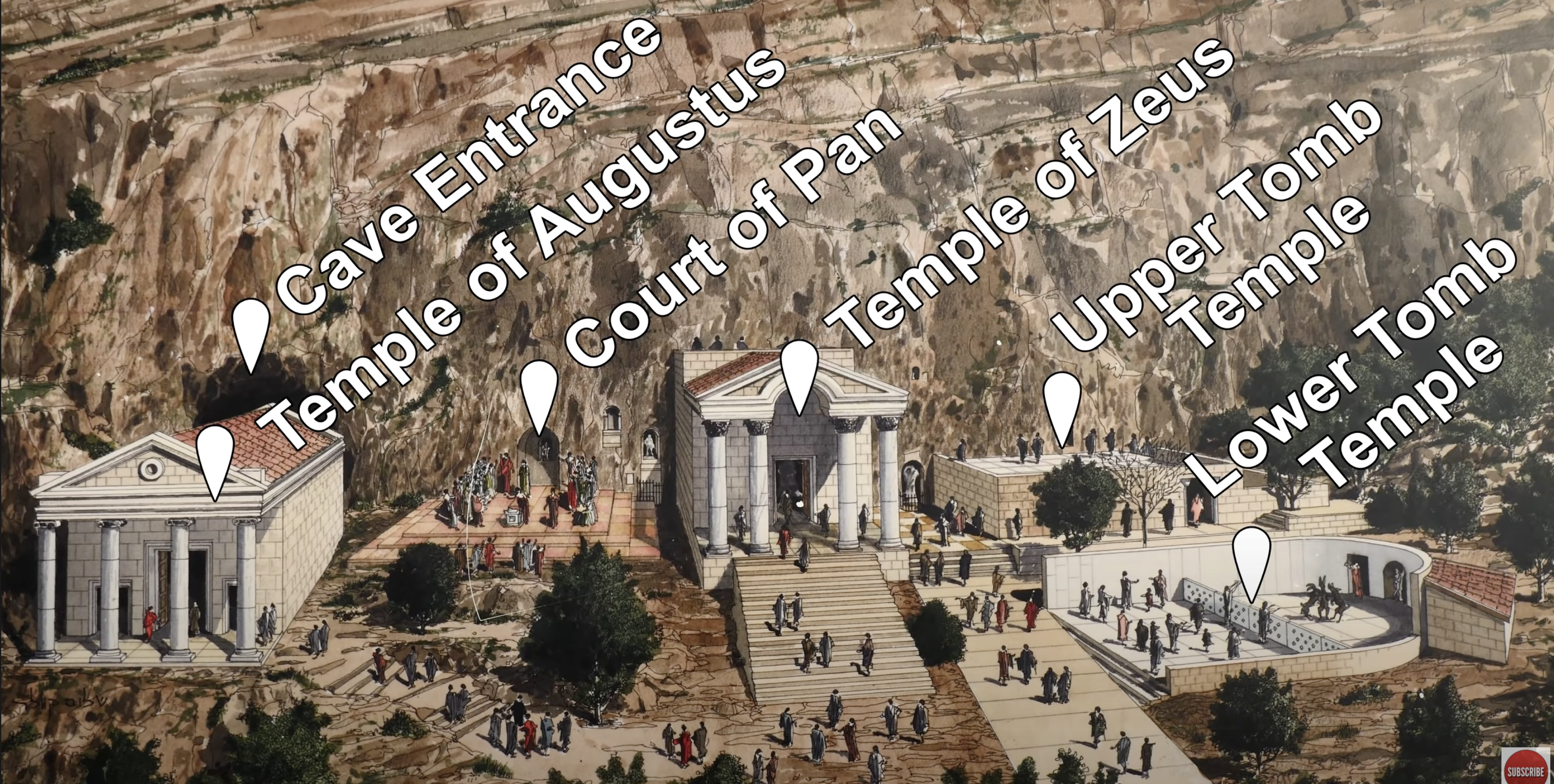
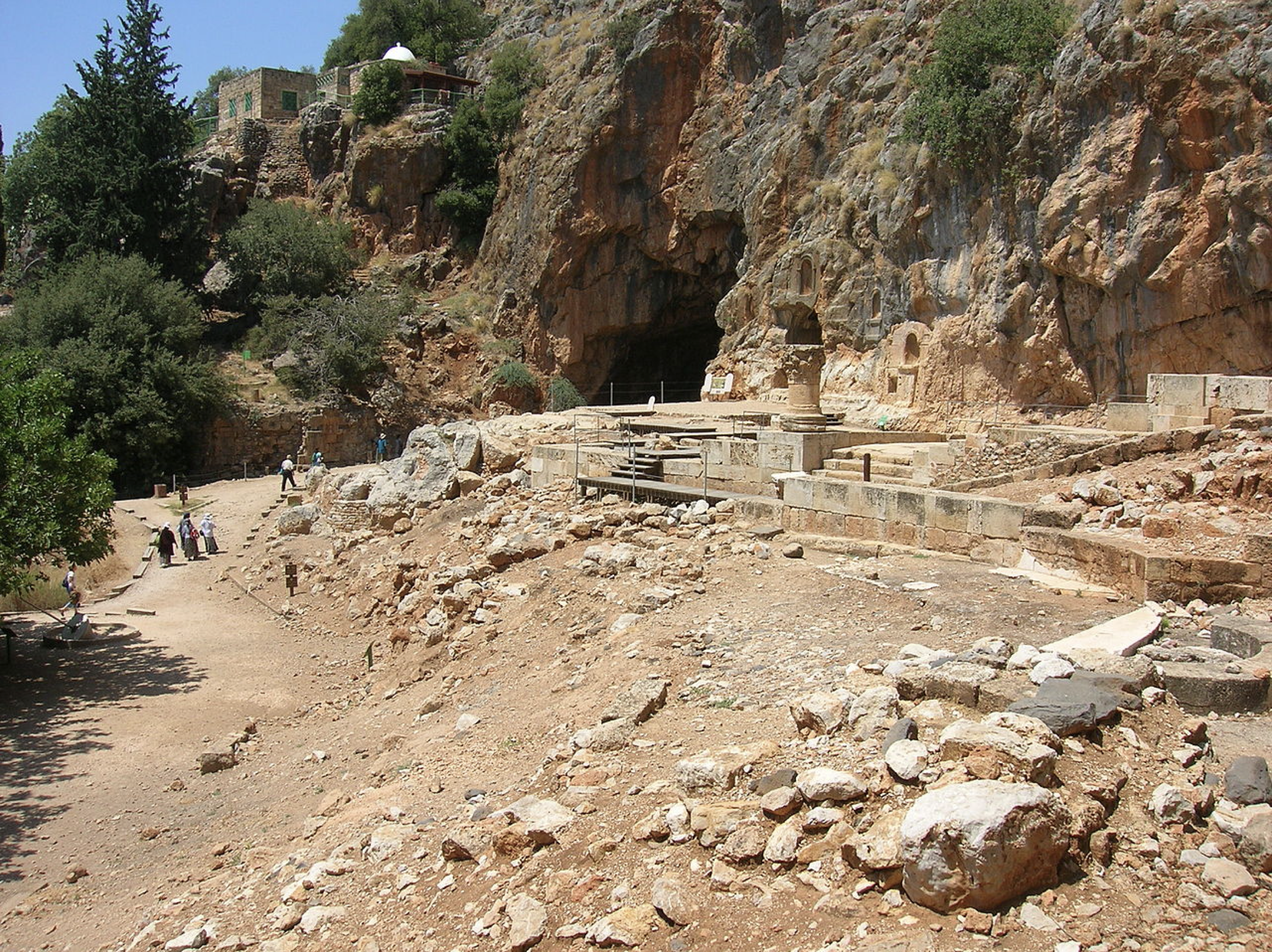
It must have been quite a sight in those days. The Banius River (one of the tributaries to the Jordan) originated from a cave carved out of a sheer cliff face. Water gushed from the mouth of the cave until an earthquake in 1202 relocated the outflow to a lower flat section, from which it flows today.  A great temple was built for Pan near the cave’s mouth, and many niches were carved in the face of the cliff for idols.

Here is what it looks like today: you can see the large cave opening and where the river would flow out.  You can see the remains of the temples of false gods that stood in Jesus’ day.

Here is an artist’s conception of what it looked like in Jesus’ day.

If you want to know the interesting story of who the false god Pan was and how the ancient portrayals of Pan became how we picture “the devil” with horns, pointed ears, and part goat, and if you want to know how we got the name Lucifer mistakenly inserted into the Bible around 300 AD, you’ll have to read my blog entry later this week.

But this was a substantial pagan center of worship.  Some say that people in that day felt the mouth of the cave was the “gates of hell” and that all the fertility gods used it as a passage to the underworld.  (I can’t find any direct sources for this.)   It is this place that Jesus chooses to go to ask this most important question.

On the way there, Jesus asks, “Who do people say that the Son of Man is?”   ‘Son of Man’ is Jesus’s most common title to refer to himself.  In Hebrew, ‘son of man’ can have two meanings.  It can just be the son of Adam, a human, a descendant of Adam, as Luke records in his genealogy of Jesus.  Or it could be a reference to the Son of Man figure in the book of Daniel.

Daniel 7:13-14   “I saw in the night visions, and behold, with the clouds of heaven there came one like a son of man, and he came to the Ancient of Days and was presented before him.  And to him was given dominion and glory and a kingdom, that all peoples, nations, and languages should serve him; his dominion is an everlasting dominion, which shall not pass away, and his kingdom one that shall not be destroyed.

So, this “son of man” comes before God to be crowned as king.  (Not coming on the clouds as in a second coming.)   

Look at the encounter Jesus has with the High Priest at his trial before some of the Sanhedrin.

Matthew 26:62-64  And the high priest stood up and said, “Have you no answer to make? What is it that these men testify against you?”  But Jesus remained silent. And the high priest said to him, “I adjure you by the living God, tell us if you are the Christ, the Son of God.” Jesus said to him, “You have said so.

Jesus wasn’t the first to claim to be the Messiah.  Josephus said there were at least a dozen before Jesus.  You could claim to be the Messiah, and the Jewish leaders would sit back and watch to see what happened.  And “son of God” can refer to an earthly king (as in David).   It was not considered blasphemy to make this claim.  But Jesus doesn’t stop there.

Matthew 26:64-66   But I tell you, from now on you will see the Son of Man seated at the right hand of Power and coming on the clouds of heaven.”   Then the high priest tore his robes and said, “He has uttered blasphemy. What further witnesses do we need? You have now heard his blasphemy.  What is your judgment?” They answered, “He deserves death.” 

Jesus has claimed to be the Son of Man from Daniel 7.  This claim to deity would be considered blasphemous because they did not recognize his deity.

But Jesus is not asking, ‘Who am I?’ but, ‘Who do people say I am?’

Am I just a man, the son of Adam (son of man), or am I Daniel’s “Son of Man” who comes on the clouds?

Some say John the Baptist…
Why would they think Jesus was John the Baptist?  Indeed, we know Herod Antipas believed that Jesus was the reincarnation of John the Baptist, whom he beheaded.  

Matthew 14:1   At that time Herod the tetrarch heard about the fame of Jesus, and he said to his servants, “This is John the Baptist. He has been raised from the dead; that is why these miraculous powers are at work in him.”

Some say, Elijah…
Why would they say that?  It is well known that before the Great Day of the Lord came, Elijah would come.  And in Jesus’ day, and still today, at every Passover seder every year in every Jewish household, they set the table with an empty chair for Elijah.  At a certain point in the meal, they ask a child present to open the door and look outside to see if Elijah is coming.  They are looking forward to the great day.

Malachi 4:5  “See, I will send you the prophet Elijah before that great and dreadful day of the Lord comes.

But Jesus has already told the disciples that John the Baptist was the one who came in the spirit of Elijah…

Matthew 11:13-14  “All the prophets and the law prophesied until John. And if you are willing to receive it, he is Elijah who is to come.”

Jeremiah or one of the prophets…

This concept is not seen in Scripture but was noted in the folklore of the day.

Interestingly, among these opinions of who people think Jesus is, “Messiah” is not one of them.

Not after the feeding of the 5000.  Remember, after the miraculous feeding, they wanted to force Jesus to be king, but he refused.  They wanted a Messiah with an earthly kingdom who would defeat the Romans, make them independent again (and feed them free bread.)  But that was not the Messiah Jesus was to be.  (This was one of the temptations in the wilderness.)  They wanted a different Jesus.  So many left him after that.   No longer would the crowds see Jesus as a potential Messiah.

“But who do you say that I am?”

This is the critical question.  It is not “Who is Jesus?”   Because no matter what you believe, Jesus is who he is.  Despite millions who may not recognize it yet, Jesus is the Son of God who came to deliver us.  And one day, every knee will bow, and every tongue will confess that Jesus is Lord of all.   The important question is:  “Who is Jesus to you?”  If you don’t have a relationship with Jesus as your Lord, if he is not the one who tells you what to do (and you are obedient), if you haven’t pledged your life to him, then Jesus is not your Messiah; he is just a Messiah.  He is not your deliverer; he is a deliverer.  

“Blessed are you, Simon Bar-Jonah! For flesh and blood has not revealed this to you, but my Father who is in heaven.

Notice that Jesus calls Peter “Simon Bar-Jonah” here? You get only the Hebrew name Simon, son of Jonah. He doesn’t use the nickname he gave him the first time Jesus met him.

John 1:42 He [Andrew] brought him to Jesus. Jesus looked at him and said, “You are Simon the son of John? You shall be called Cephas” (which means Petros). 

It is a fairly common nickname today.  Just ask Sylvester Stallone (“Rocky”) or Dwayne Johnson (“The Rock”).   Jesus calling Peter ‘the rock’ probably brought snickers from other disciples, for Simon was often not rock-like until the future.  But that is the way Biblical names frequently work.  Names usually reflect a character trait or destiny yet to be revealed.

Abram is renamed Abraham, father of many when he is 99, a year before Isaac is born.  Jesus’ name means “Yehovah saves” to tell of his future actions.  But here, Jesus uses his original Hebrew name.  Shimon is from the Hebrew ‘shema’ to hear, so the name Simon means  “the one who hears.”  Then Jesus says, “Flesh and blood have not revealed it to you.”  God gave this understanding to Simon Peter.  It was a divine gift.  Over and over in the gospels, we see people who can’t understand the things of God.  God will give the gift of understanding to those who seek him and are willing to accept gifts from him.  If you only get your knowledge about God and the things of God from a person, you are missing it.  You must study God’s words in Scripture and pray for understanding.  People may mislead you.  There are many wolves in sheep’s clothing out there.  God will never mislead you.  So Jesus is really saying, “Blessed are you, Simon, the one who hears because you have heard it from above.”

When Peter said, “You are the Messiah, the son of the living God,” what did he mean?  Did he understand what ‘Messiah’ meant, or did he accept the common belief of the time – that the Messiah would be a military/political/religious leader who would free the Jews from Roman rule and reinstate the powerful reign of David?  Check out verse 22.  Obviously, Peter didn’t understand all of what this meant.

Jesus continues:
“And I tell you, you are Peter, and on this rock I will build my church, and the gates of hell shall not prevail against it.  I will give you the keys of the kingdom of heaven, and whatever you bind on earth shall be bound in heaven, and whatever you loose on earth shall be loosed in heaven.”

There is a lot to unpack here because so many have taken this verse and made it mean what they wanted it to mean.  The Catholic Church has used this verse to say that Peter is the Rock on which the church was built, and he has the authority to govern and make theological decisions.  I can’t agree with this interpretation.  First, I don’t believe Jesus calls Peter the rock on which the church is built.  If you look at the Greek, the two words for rock in that verse are different.  Jesus says to Peter, “You are Petros.”  A petros is a small rock, a pebble.  Then Jesus says, “And on this petra, I will build…”  A petra is a massive stone formation.  (Think of the city of Petra, carved into a solid rock cliff face.)  Let’s see how the Bible uses the word ‘petra.’  

Matthew 7:24   “Everyone then who hears these words of mine and does them will be like a wise man who built his house on the rock (petra).

You build on a solid foundation on the bedrock.  No one builds anything on a pebble (petros).  

So what is this bedrock that will be built upon?   Jesus’ disciples, familiar with the Old Testament, would know the answer.  (So would we if we read the Old Testament.)  Here  is a verse you likely know:

Psalm 19:14    Let the words of my mouth and the meditation of my heart be acceptable in your sight,  O LORD, my rock and my redeemer.  

If you memorized this in the King James version (as I did), God is “my strength and my redeemer.”  That is not a bad translation because the idea of strength is what the psalmist was going for with ‘rock.’    Let’s look at some other verses:

Deuteronomy 32:4    “The Rock, his work is perfect, for all, his ways are justice.  A God of faithfulness and without iniquity, just and upright is he.
1 Samuel 2:2    “There is none holy like the LORD: for there is none besides you; there is no rock like our God.
2 Samuel 22:32    “For who is God, but the LORD?  And who is a rock, except our God?
2 Samuel 22:47    “The LORD lives, and blessed be my rock, and exalted be my God, the rock of my salvation,
Psalm 62:2 He alone is my rock and my salvation, my fortress; I shall not be greatly shaken.
Psalm 78:35 They remembered that God was their rock, the Most High God their redeemer.
1 Corinthians 3:11  For no one can lay a foundation other than that which is laid, which is Jesus Christ.

Peter was not the rock to build on.  He was but a stone (petros) built on the bedrock (petra) of the Father built on the cornerstone of Jesus, with all the prophets and apostles being part of the foundation.

“…and on this rock I will build my church, and the gates of hell shall not prevail against it.”

So upon this rock I will build what?  In your English version, it says, “church.”  But Jesus would not have said ‘church’ for many reasons.  First, he didn’t speak English.  ‘Church’ is from the German ‘Kirika’, which comes from the Greek ‘kyriakon’, an adjective that means “of the Lord.” This Greek word was used for houses of Christian worship since around 330 A.D.  (Before Constantine, there were no Christian houses of worship legally.  The first “followers of the Way” met in synagogues (for almost all were Jewish).  Later, as the synagogue congregation got tired of the talk of Jesus, they were forced to worship in homes.)  But ‘kyriakon’ is not the Greek word we find here.

“…and on this petra, I will build my ekklesia…”

An ekklesia is an assembly or gathering.  It had no religious connotation at the time Jesus used it.  In the Greek Old Testament (the Septuagint that Paul often quoted from), ekklesia was used for various assemblies.  (The group gathered at Sinai was called an ‘ekklesia’ (Deuteronomy 9:10), and Psalm 26:5 speaks of an “assembly (ekklesia) of evildoers.”)  There was a Greek word for a religious assembly — ‘synagogue’- a word for any religious assembly that, upon adoption into Latin, became used explicitly for Jewish religious assemblies.  

Our English translations are not consistent with how they translate these Greek words.  

Ekklesia’ occurs 114 times in the New Testament.  It is always translated as “church” except in these instances:

Acts 7:38 This is the one [Moses] who was in the congregation (ekklesia) in the wilderness with the angel who spoke to him at Mount Sinai, and with our fathers. He received living oracles to give to us.

Acts 19:32  Now some cried out one thing, some another, for the assembly (ekklesia) was in confusion, and most of them did not know why they had come together. [This was a town hall meeting in Ephesus.]

Heb. 2:12 [quoting Psalm 22:22]  “saying, “I will tell of your name to my brothers; in the midst of the congregation (ekklesia) I will sing your praise.”

There is a clear effort in our English translations to use “church” for ekklesia when it is only Jesus’ follower’s meeting.  ‘Synagogue’ is in the New Testament 56 times and is translated (or not translated) as ‘synagogue’ except on one occasion:

James 2:2 For if a man wearing a gold ring and fine clothing comes into your assembly (synagogue), and a poor man in shabby clothing also comes in…

Apparently, our English translators didn’t want people to think that James was writing his letter to a synagogue, even though we know that is where the believers were meeting.  (Again, we see this forced separation from anything Jewish.)

I don’t believe it was Jesus’s intention to build a church as we think of it.  What did Jesus say his primary mission was? He came to regather the lost sheep of Israel.  He was not here to make a new organization.  He is assembling a called-out community of people who recognize the living God and see Jesus as the Messiah.  Jesus’ movement is not a synagogue, nor is it a church.  It is the recovery of God’s reign and rule in the hearts and actions of men and women. as it was established at Sinai. After all, it is His assembly, the same assembly called to hear the word of God at the base of the mountain.  He is calling all to join his Kingdom.  

We get so tied up in how best to build a church.  Hundreds of books exist on the best way to build a church.  But I don’t think Jesus wanted us to build churches.  He wants us to build up the Kingdom of God.  We think too small, building our own little kingdoms, recruiting and proselytizing members.  We think the Great Commission is all about church planting, but Jesus’ Great Commission is all about making disciples.  Jesus is most concerned with pouring life into other lives so that others will experience God’s presence in their midst first-hand. This is what we should be doing.

But ‘Church’ is big business.  People love to build empires, People love to build buildings, People love to build organizations.   When we were in Egypt, our teacher showed us the magnificent temples and pyramids the pharaohs built.  Egypt was all about building huge buildings.  And he said…”The Kingdoms of this world build buildings. Our God builds people.  

Matthew 16:19-20  I will give you the keys of the kingdom of heaven, and whatever you bind on earth shall be bound in heaven, and whatever you loose on earth shall be loosed in heaven.”  Then he strictly charged the disciples to tell no one that he was the Christ.

There is so much to unpack in these verses but I’m going to be brief.  If you go to a church or museum and see statues of the apostles, it is always easy to pick out Peter.  He is the one holding a bunch of keys. (It is also from this verse we get the idea of Peter being the gatekeeper of Heaven.)   I agree with John Piper, who said the key to heaven is the knowledge of the true identity of Jesus.  That is what this whole passage is about.  Piper said, “When any faithful Christian who speaks the words with the bedrock of Jesus’s identity at the center — when you speak those words faithfully, you are using the keys of the kingdom to open the kingdom in people’s lives.”  Knowing Jesus as your Messiah is the key.

Binding and loosing are rabbinic idioms that say what is allowed and what is not.  (

think of binding an animal to a hitching post.  If you bind it there, it is restricted.  If you loose it, it is free to roam around.)  What does it mean to observe the Sabbath?  Who decides what is permitted or allowed?  The Pharisees had taken that authority and run with it (and never stopped running.)  What could you carry, how far could you walk, etc.  But Jesus said they did this poorly.

Matthew 23:4  They tie up heavy burdens, hard to bear, and lay them on people’s shoulders, but they themselves are not willing to move them with their finger.

But someone has to interpret the law.  So Jesus is passing that authority on to these disciples. It is not to Peter only, because the ‘you’ in verse 19 is plural, “I am giving y’all the keys to the kingdom….”  (Jesus restates the binding and loosing in Matthew 18:18 with the plural ‘you.’)

Jesus went on a several-day journey to the northernmost reaches of the promised land.  It was a place none of the disciples had ever been.  It was the place where things went wrong in Israel.  It was where 900 years before Jesus, King Jeroboam built altars to idols, the baals, and fertility gods, and told the people of Israel — this is your God who brought you out of Egypt. This place, where in Jesus’ day, thousands came to worship a fertility god they called Pan.  A place some called the ‘Gates of Hell.’  And Jesus brings his disciples there to ask them this question:  “Who do you say that I am?”  Because if you really understand who I am and if you follow me, you will be part of a community of believers that the Gates of Hell can not stand against.  In Jesus’ day, gates were defensive structures built to withstand the enemy.  Jesus said if you accept me as your Messiah and as your Lord (meaning you follow my orders), then you will storm the Gates of Hell.  It is not a defense against hell but an offense against it.  And there are people in your community, some of your neighbors, who are bound for hell, and we need to stop hiding in church buildings and go on the offensive.

Jesus brought them here because they have to make a choice.  When they came into this promised land, Joshua called them all together and said you have to choose

Joshua 24:14   “Now therefore fear Yehovah and serve him in sincerity and in faithfulness. Put away the gods that your fathers served beyond the river and in Egypt, and serve Yehovah.  And if it is bad in your eyes to serve Yehovah, choose this day whom you will serve, whether the gods your fathers served in the region beyond the river or the gods of the Amorites in whose land you dwell.  But as for me and my house, we will serve Yehovah.”

Years after Joshua, 10 of the 12 tribes chose to follow the idols.  Right here in this place.  In Jesus’ day, people still chose to worship Pan there and said he was the god who would make their land fertile so they could be rich.  Jesus says am I a prophet?  Am I just your teacher?  Am I just a Messiah, or am I your Messiah?  And now, you and I have to choose, and we choose every day.  I don’t have to take you to a pagan place of idols.  You walk among idols every day.   We walk among people who worship the idols of this world and say they will make them rich, healthy, and successful.  What are we building?  Are we building our own little kingdoms and buildings?  Or are we building people for the kingdom of God?  Are we making disciples?  Who is Jesus to you?