November 6, 2025 –  Temples, Monuments, and Churches— Acts #19

November 6, 2025 –  Temples, Monuments, and Churches— Acts #19
Acts 6:12 – 7:1

We continue with the story of Stephen.  He was chosen to be one of seven to oversee the distribution of resources in the growing church.  He was obedient to this and more.  The Holy Spirit began to do miracles through him.  Then some rose up against him and made accusations to the court of priests.  That’s where we pick up the story in Acts.

Acts 6:12-7:1   And they stirred up the people and the elders and the scribes, and they came upon him and seized him and brought him before the council, and they set up false witnesses who said, “This man never ceases to speak words against this holy place and the law, for we have heard him say that this Jesus of Nazareth will destroy this place and will change the customs that Moses delivered to us.” And gazing at him, all who sat in the council saw that his face was like the face of an angel.
And the high priest said, “Are these things so?”

Stephen then gives them a long lesson.  52 verses.  I won’t print it all here, but you should read it now, Acts 7:2-53.  Stephen recounts Israel’s history, but he focuses on two main themes. The first one is that God has, throughout history, raised up deliverers for the people, but they have been rejected. And just as they rejected the prophets, they rejected Jesus.   And the second one that I would like to look at primarily here is that God gave them the tabernacle and the temple as places where they may dwell with him, but they made the mistake of thinking that God actually dwelt in the temple.  They put too much emphasis on the temple and its liturgy.   By the time of Jesus, the temple had essentially lost its true function and was more of a monument than a Temple. An excellent piece of architecture —a grand building —but not a place for God.

While we were in Egypt a month ago, we saw temple after temple.  But no one worships at any of these temples any longer.  They no longer function as temples, but just monuments to long-lost Pharaohs.  And Stephen, in his speech to the Chief Priests, will tell them that they have lost the purpose of their Jerusalem temple.  It was a place to meet God in worship, but they have used it to make money and gain power for themselves.  And they revere the temple more than they revere the God they should worship there.  Their temple has become an idol.

And the question we need to ask ourselves this morning, as we consider this passage of scripture, is: do we make the same mistake?  Have we placed too much emphasis on our individual church, on this church, or on a particular denomination, or church service itself, and forgotten that it is all about God, that the church is not the style of worship we use or the church rules we follow or the denomination we belong to, or the building we worship in?  Are we in danger of making the same mistake as these religious leaders in Acts 7?  

Just over 20 years ago, our church in Alabama was having its sanctuary remodeled.  Overnight, some cleaning rags spontaneously combusted, and the sanctuary was destroyed by fire.  It was a difficult time.  Many mourned the loss of that building, as they had very fond memories of their time there.  Babies had been dedicated there, children baptized there, couples married there, and some saints’ funerals held there.  There were mothers of young girls who dreamed of their daughters being married in that sanctuary.  But it was beyond repair. 

I remember standing outside looking at the charred building and saying to the pastor, “It’s only a building.”  That may have sounded a little callous then, because it really wasn’t just any old building, like a warehouse or a store.  But it really was just a building.  There were some holy moments in that place, but it was the moments that were holy, not the place.  It’s just a building.

But sadly, there are many stories of churches that have had bitter controversies over building decisions, whether to build a new building or remodel.   At least one church split over the color of the carpet in the new sanctuary.  Half wanted blue, half wanted red. The argument became so heated that people stopped speaking to each other. Some even left.  Months later, when the church finally installed the new carpet, they had lost far more than members—they had lost their witness. 

Now perhaps one group was right.  Maybe there were experts on interior decorating and on church decor who could state as a fact that one color was better for that circumstance.  But that doesn’t matter.  Choosing to be right is not more important than choosing to be in relationship.  A church splitting over carpet color may sound ridiculous… until we realize that we all have our “carpet issues.”

As a Christian Counselor, my wife often faces this same situation in marriage counseling. Usually, the most significant conflict in marriage is over things that don’t really matter, like carpet color.  She frequently asks couples who can’t seem to agree on a particular situation this:  “Would you rather be right, or would you rather be in a good relationship with your spouse?”  This is not only an essential principle for marriage, but a fundamental part of our understanding of God.  God is always right.  He is never wrong.  But he is willing to love us despite our wrongs and to seek a relationship with us.  He is willing to suffer himself to atone for the wrongs we have done, so that he can have that relationship.  And he wants us to show that same mercy and grace to others.  

But we all fight carpet color issues at some point.  Small things are blown out of proportion, causing division.  Every church has them.  Every denomination has them.  Every heart has them.  We all have the temptation to make something secondary into something sacred.  And this time, in Acts 6 and 7, the fight was over the temple itself.  And Stephen stood before the religious leaders of Israel and dared to challenge their obsession with one sacred thing: the Temple.

The charge against Stephen was simple. 

Acts 6:13-14   They set up false witnesses who said, “This man never ceases to speak words against this holy place and the law, for we have heard him say that this Jesus of Nazareth will destroy this place and will change the customs that Moses delivered to us.

They produced false witnesses who said,  He wants to tear down our temple and the way we worship here.  He wants to demolish the center of our faith.  But Stephen’s response in Acts 7 would reveal that their love for the Temple had actually blinded them to the true center of their faith—not a building and the sacrifices offered there, but the presence of God.

When Stephen begins his 52-verse defense, he doesn’t start with the accusations against him. He begins with a history lesson.  He tells the story of Abraham, Joseph, and Moses—men who met God outside of any temple or holy site.  He wants to show them that God doesn’t have to have a Temple made with human hands to meet people.

Long before there was a temple, before there was a promised land, before there was a chosen people, God first appeared to Abraham not in this place but in a pagan land.  Stephen is saying, “You think God only works in Jerusalem? He met our father Abraham in Babylon!”

And where did God first meet Moses? In the wilderness.  God spoke to Moses from a burning bush—not in a temple, but on dusty ground on Mount Sinai.  Stephen quoted God’s words:  

Acts 7:33. “Take off your sandals, for the place where you are standing is holy ground.” 

I have been on that mountain twice. I’ve hiked up and down that mountain, and there is no place with a sign that says this is holy ground.  That was Stephen’s point: Wherever God is present, it becomes sacred ground.  Let me tell you that on that sunrise at the top of Sinai, I found holy ground.  I had a sacred moment with God up there. Because it was never the ground that was holy, it was the presence of God that was holy.  It’s not about the location—it’s about His presence.   

Then Stephen speaks of how God moved with the children of Israel on their journey.  After God delivered them from Egypt, they returned to the same mountain where God had met Moses before.   And there God told Moses, “Make me a tabernacle that I may be worshipped in it.”  No, that is not what he said.  God said:

Exodus 25:8  “Let them make me a tabernacle, that I may dwell in their midst.   

That is what God wanted.  That is what he did in creation: he built a world and made a garden there so he could dwell with us.  And ever since Adam and Eve messed up God’s perfect plan to live with us, ever since Man brought sin and death into the world to drive a wedge between us and God, ever since that moment, God has been working to make a way to reunite himself with his creation.  So that is why they built the Tabernacle so that he could move with his people on their journey, and the tent was placed right in the middle of them. 

For all of the years in the wilderness and for hundreds of years after coming into the land, God met them in a tent—the Tabernacle—because His presence moved with His people. Only later, when Israel had settled in the land, did Solomon build the Temple, and even then, Stephen told them:

Acts 7:47-50 “But it was Solomon who built a house for him.  Yet the Most High does not dwell in houses made by hands, as the prophet says,
“‘Heaven is my throne, and the earth is my footstool. What kind of house will you build for me, says the Lord, or what is the place of my rest?  Did not my hand make all these things?’”

Stephen reminds the Sanhedrin that even when Solomon built the Temple that God designed, it was not to be His house.  God made it clear then that He cannot be contained in any man-made structure.

And yet the Temple had become their idol.  The Temple was not a bad thing, nor was the Tabernacle.  They were both good.  God gave the plans for the Tabernacle to Moses and the plans for the Temple to David.  God gave these structures to be a symbol of His desire to dwell among His people.  But symbols can become substitutes.  

Remember the bronze serpent on the pole that Moses made?  The people were dying from poisonous snake bites, and God instructed Moses to make a bronze (or more likely, copper) serpent on a pole.  The people would look to it and be healed.  (Jesus mentions it in His discussion with Nicodemus in John 4.)  Did you know that this copper snake that Moses made was still around in Israel 1000 years after Moses made it?   2 Kings 18 tells us that when the good king Hezekiah was trying to destroy all the idols in Israel:

2 Kings 18:4   And he [Hezekiah] broke in pieces the bronze serpent that Moses had made, for until those days the people of Israel had made offerings to it (it was called Nehushtan).

The people had taken something good that God designed for a good purpose and turned it into an idol.  And idols must be destroyed.  This is not a new idea.  God made all the animals and all the heavenly bodies, and many false religions have turned them into idols.  And now Stephen is telling these priests that they have taken the idea of the Temple as the place where God meets men and turned it into an idol.

And for these Jewish leaders, the Temple was a status symbol: proof of their national pride.  It was a security blanket: “As long as we have the Temple, God is with us.”  And it was a source of control: it gave the priests and leaders power over who could approach God.  They believed that questioning the Temple was questioning God Himself.   But in truth, their loyalty had shifted—from the Lord to the location.  This is not a new problem.  It was the same 600 years earlier in Jeremiah’s day.

Jeremiah 7:3-4  “Thus says Yehovah of hosts, the God of Israel: Amend your ways and your deeds, and I will let you dwell in this place. Do not trust in these deceptive words: ‘This is the temple of the LORD, the temple of the LORD, the temple of the LORD.’

They had made a mantra of their claims that because the temple was there, they could not be defeated.  The Babylonians can not take our city, for the Temple of God stands here.   But Jeremiah warned them that the Temple was no protection from the punishment for abandoning their obedience to God.  And so this prophecy came true on the ninth day of the month of Av, 586 BC, the Babylonians sacked Jerusalem and destroyed the temple.

And now Stephen tells them, as Jeremiah did their predecessors, that the Temple is not God, and they have left God no choice but to destroy the object of their idolatry. Idols must be destroyed.

So again, God called up a foreign oppressor nation to do that.  And in 70 AD, Roman troops breached the city’s walls and destroyed the temple.  And it happened on the same day of the year as before, on the ninth of the month of Av.  God is trying to teach this vital lesson.  Do not take something good I have given you and make it into an idol.

It is easy to read the story and see how these priests had been deceived into thinking they were doing a great job handling religion, when all the time they were like shepherds leading their sheep to destruction, to see how they had substituted their Temple and their religious practice for God.   But now let’s bring this forward 2,000 years.   

The problem Stephen exposed still exists—the temptation is still there, just in different clothes.  There is a temptation today to take something wonderful that God has given us and turn it into an idol.  And there is a temptation to see the local church as the new Temple.  It’s easy for a congregation to fall in love with itself.   There’s nothing wrong with loving your church!  But some churches, over time, like the Temple, turn inward on themselves.  They see themselves like these priests in Stephen’s day see the Temple, as the “House of God”.

J D Greear wrote a book in 2015 called “Gaining by Losing,” in which he described the modern-day church as a cruise ship.  Initially, there were ocean liners, built to ferry people across the Atlantic.  Now, don’t be fooled by the movie about the Titanic.  For all but a few people, these were not luxury trips at all but were filled with poor immigrants or refugees seeking a new life in America.  These were destination-based trips.  You tolerated the journey to reach the destination.  That is why they were called ocean liners. They were designed to get you from point A to point B on a regular route or line, like a bus or train.

With the advent of larger airplanes, the need for ocean liners as primary transportation diminished.  And then we saw the rise of cruise ships that did go places but, over time, really became destinations in themselves, with top entertainment, restaurants, water slides, ice rinks, etc.   They mostly went in circles, delivering you back where you started.

Before the 1960s, most churches were small and community-based. They had a sanctuary, a few offices, and classrooms. The church was destination-based; a means to get you to the throne of God.  Then churches began following the cruise ship model, Greear notes, offering more and more amenities to attract members to their particular brand.  We saw churches build sports complexes, coffee shops, and bookstores, and, of course, better-decorated sanctuaries with the latest stage sound, lighting, and special effects, and padded pews for the comfort of the members: more charismatic pastors, video backdrops. 

All of this catering to a membership that chooses which church to attend based on what that church can do for me or how it meets my perceived needs.  I have heard friends say, “Well, this church has better programs,” or “that pastor didn’t meet my needs,” or “that is not my favorite kind of music.” “I didn’t enjoy the worship service.”   It is all about me and what I need.  They go somewhere, but they don’t get you to the throne of God.

Therein is the problem.   The gathering of believers is not for the purpose of getting something but giving something — giving praise to God, giving a part of your income, and giving service to others to spread the gospel.  We are there to serve, not to be served.  To give, not to get.   

You should never make your decision about church attendance based on what you get out of it.

There is the danger that the destination is our enjoyment of the worship service. Not us meeting God at his throne.  Do you see how ridiculous that sounds?   You can lose the church’s very purpose by making it all about yourself.  Then you are no longer worshipping God, but you are worshipping an idol, either the church or yourself.

The priests in Acts 7 got a lot out of the Temple.  They got power, prestige, and money.  It was not about God; it was all about them.  The temple had become their cruise ship.  We, too, must be careful not to obsess over our own institutions, for if we do, we stop moving outward and start looking inward.

Temple-thinking says: “If people want God, they’ll come to us.”  The gospel says: “Go into all the world.”  Our focus must be broader than our little corner of the world.  We need to be kingdom-minded.  Just because we have the resources to make our sanctuaries bigger or better doesn’t mean we should.  We have to consider the needs of God’s kingdom.  It is not all about us.

The religious leaders thought they were guarding holiness, but in truth, they were rejecting the Holy One Himself.  Jesus stood right before them—and they didn’t recognize Him.  Stephen’s accusation still echoes:  “You’re worshiping the symbol of God’s presence, not God’s actual presence.”

Jesus came to make a radical change in the structure of the Temple in God’s world.  The days of a physical temple as a symbol of God’s dwelling among people are no longer needed. God was never contained in a building, he told Solomon that.  It was always God’s wish to dwell with us intimately in our hearts.  But the problem was sin.  So Jesus came to bring about the final defeat of sin, so that God could take up residence in our hearts.  And 50 days after Jesus defeated sin, the Holy Spirit came in power on Pentecost.  And from that day on, the Temple building in Jerusalem lost its purpose.  Oh, they had polluted and defiled it so severely that it was no longer serving the purpose God intended anyway.  So it is no more.

  Paul said this:  

1 Corinthians 3:16  Do you not know that you are God’s temple and that God’s Spirit dwells in you?

And Paul isn’t using the generic Greek word for ‘temple’ there.  He is using the Greek ‘naos’ for the Temple.  Naos is the word for the most holy place, the holy of holies, the very place where God’s spirit dwells.  When Jesus cleanses us of sin, we become together the holy of holies.  God has accomplished his goal of communion with us again.  We are the temple.

And Stephen got a glimpse of that.  They become so angry at Stephen that they take him outside the city and stone him to death.  And as the stones began to fly, Stephen looked up and said: 

Acts 7:56   Look, I see heaven open and the Son of Man standing at the right hand of God!”

Think about that. They accused him of disrespecting the Temple—but Stephen saw the real Temple—the presence of God in heaven, with Jesus standing beside the Father.   What they were defending was a shadow.  What Stephen saw was the reality.   Through Christ, we have become God’s temple.  That means that God’s presence is not limited to one church building.   God’s Spirit is not confined to one denomination. God’s glory is not dependent on our brand.   The actual temple is wherever the people of God live, love, and carry His presence into the world.

I showed you monuments that the pharaohs in Egypt built 1000s of years ago.  Monuments to a past that is gone.  That is what man has always built – monuments.   We do that in our country also. 
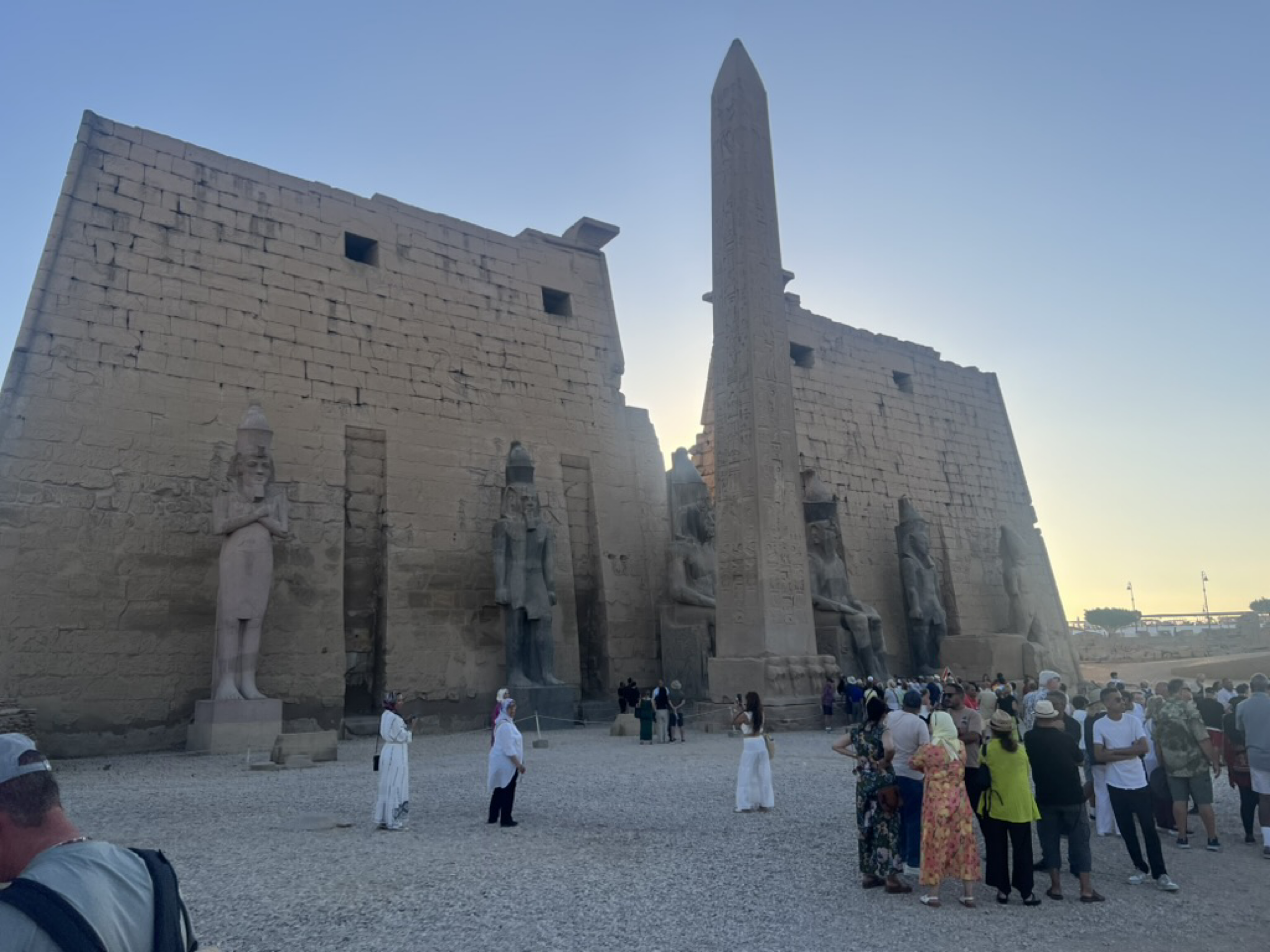
And the Temple in Jerusalem had become a monument.  It was initially built to be a place where God met people.  Where worship was centered.  But over the years, it became just a monument.  A structure that commemorates a past event.  Not only did it no longer function as God intended, but it had become an idol.  And idols must be destroyed.

God doesn’t build buildings and monuments; God builds people.

So we must not put too much importance on buildings.   Don’t call this the house of God.  God doesn’t live here.  He can’t be contained.   Don’t call it the church house either.  We don’t live here; we just meet here to worship.  I don’t even like the phrase ‘house of worship’. One, because it is not a house, and 2, because worship is something we do all day, every day, everywhere. 

We should look at our buildings as mission outposts.   A mission outpost is a small, localized base, often focused on outreach, service, and fellowship. These outposts can serve as places for evangelism and discipleship, hubs for community support — like food and clothing —or spaces for believers to be recharged and connected to go back out into the world.  I believe the current military term is Forward Operating Base or FOB.  This is a staging area to send people out to do the mission.

As Greear noted, we as a local church should not function like a cruise ship.  We are not here to serve ourselves.   Greear said we should be more like aircraft carriers.  Aircraft Carriers equip planes to go off and complete missions.  The church is not the mission. It is a staging ground for the mission of carrying the light of the gospel to the places in the world where there is darkness.  We meet here to worship God and to get our mission assignment.  Every time we walk out those doors, we should know what our specific mission is for that week.  Do you know your mission?
September 28, 27 A.D.  –  Who is Jesus to You? —   The Year of the Lord’s Favor #55

Week 33 ———  An Important Question in an Unusual Place
Matthew 16:13-20      Mark 8:27-9:1    Luke 9:18-27

Matthew 16:13-20   Now, when Jesus came into the district of Caesarea Philippi, he asked his disciples, “Who do people say that the Son of Man is?”   And they said, “Some say John the Baptist, others say Elijah, and others Jeremiah or one of the prophets.”   He said to them, “But who do you say that I am?”   Simon Peter replied, “You are the Christ, the Son of the living God.”   And Jesus answered him, “Blessed are you, Simon Bar-Jonah! For flesh and blood has not revealed this to you, but my Father who is in heaven.   And I tell you, you are Peter, and on this rock I will build my church, and the gates of hell shall not prevail against it.   I will give you the keys of the kingdom of heaven, and whatever you bind on earth shall be bound in heaven, and whatever you loose on earth shall be loosed in heaven.”  Then he strictly charged the disciples to tell no one that he was the Christ.

The day of trumpets passed for Jesus in 27 AD, and they are in the ten days of Awe.  It is a time of reflecting on their lives over the past year.  A time of repentance before the Day of Atonement.  The one day of the year that the High Priest enters the Holy of Holy and makes atonement for the nation’s sins.  Today in 2024, we had the Day of Trumpets last Wednesday, and we are in the days of Awe before the Day of Atonement this year, which begins at sunset on Friday.  

In this most holy time of the year, in the days of repentance, Jesus takes his disciples to a most unusual place.  It is one of the most pagan sites in the world, a place where idol worship began in Israel in 900 BC and where idol worship was rampant in his day.  And they are there because it is time to consider who they will follow.    Jesus asks them, who am I to you?   Am I just your teacher, or am I your Messiah?  Am I your high priest who will make the ultimate sacrifice for your sins?

Jesus heads north again, this time to what was once the furthest reaches of Israel, where the tribe of Dan settled.  In Old Testament times, the northeastern area of Israel became a center for Baal worship. In the nearby city of Dan, Israelite king Jeroboam built a high place that angered God and eventually led the Israelites to worship false gods.  When the Greeks conquered the land, it was called Panius, and the worship of the baals was replaced with worship of Greek fertility gods, specifically Pan (the city named for his honor). It became the religious center for Pan worship.  The Hebrews translated that to Banius.

Years later, when the Romans conquered the territory, Herod Philip rebuilt the city and named it in honor of Caesar and after himself. But Caesarea Philippi continued to focus on the worship of Greek gods. On the cliff above the city, local people built shrines and temples to Pan.  

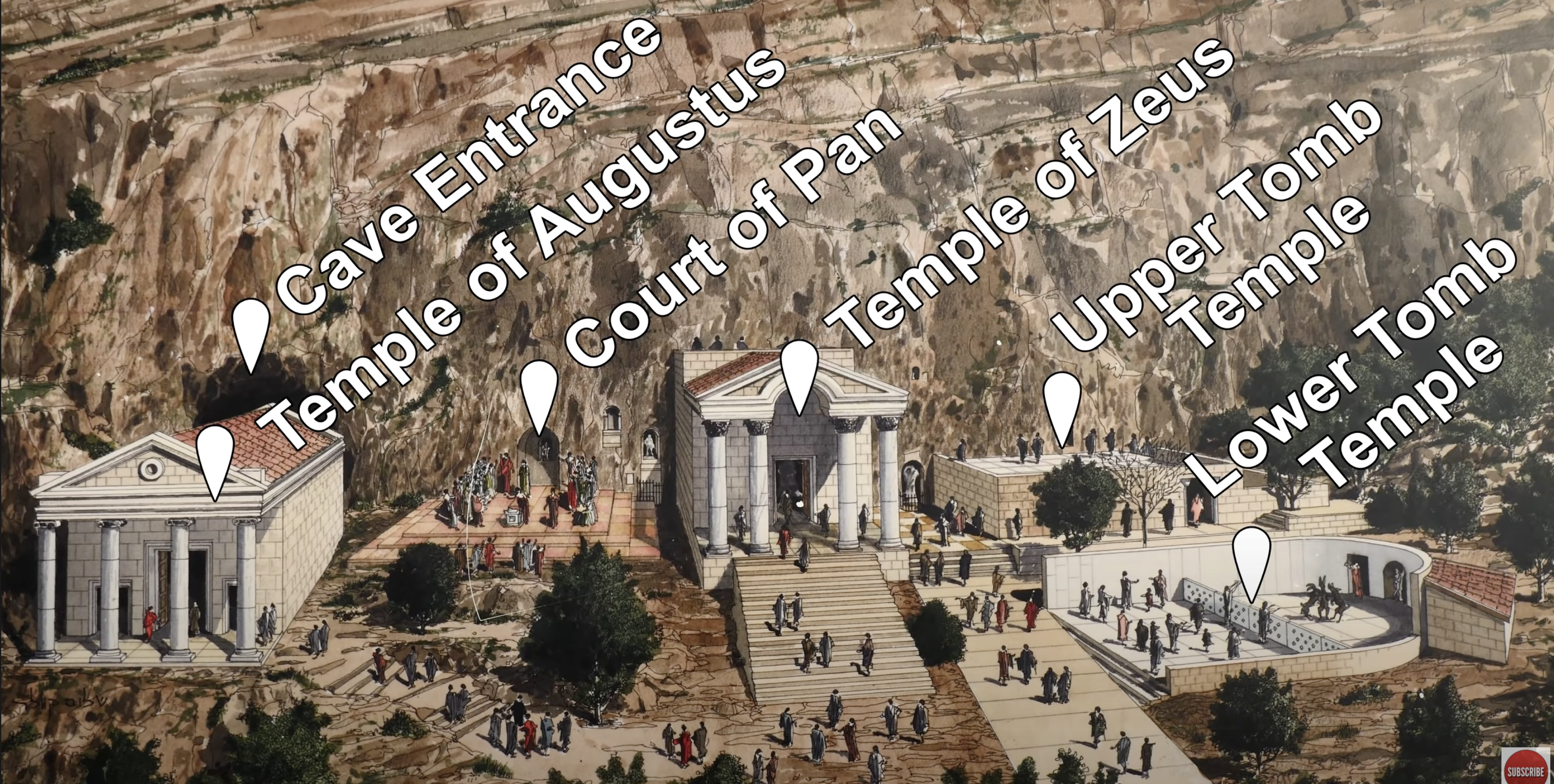
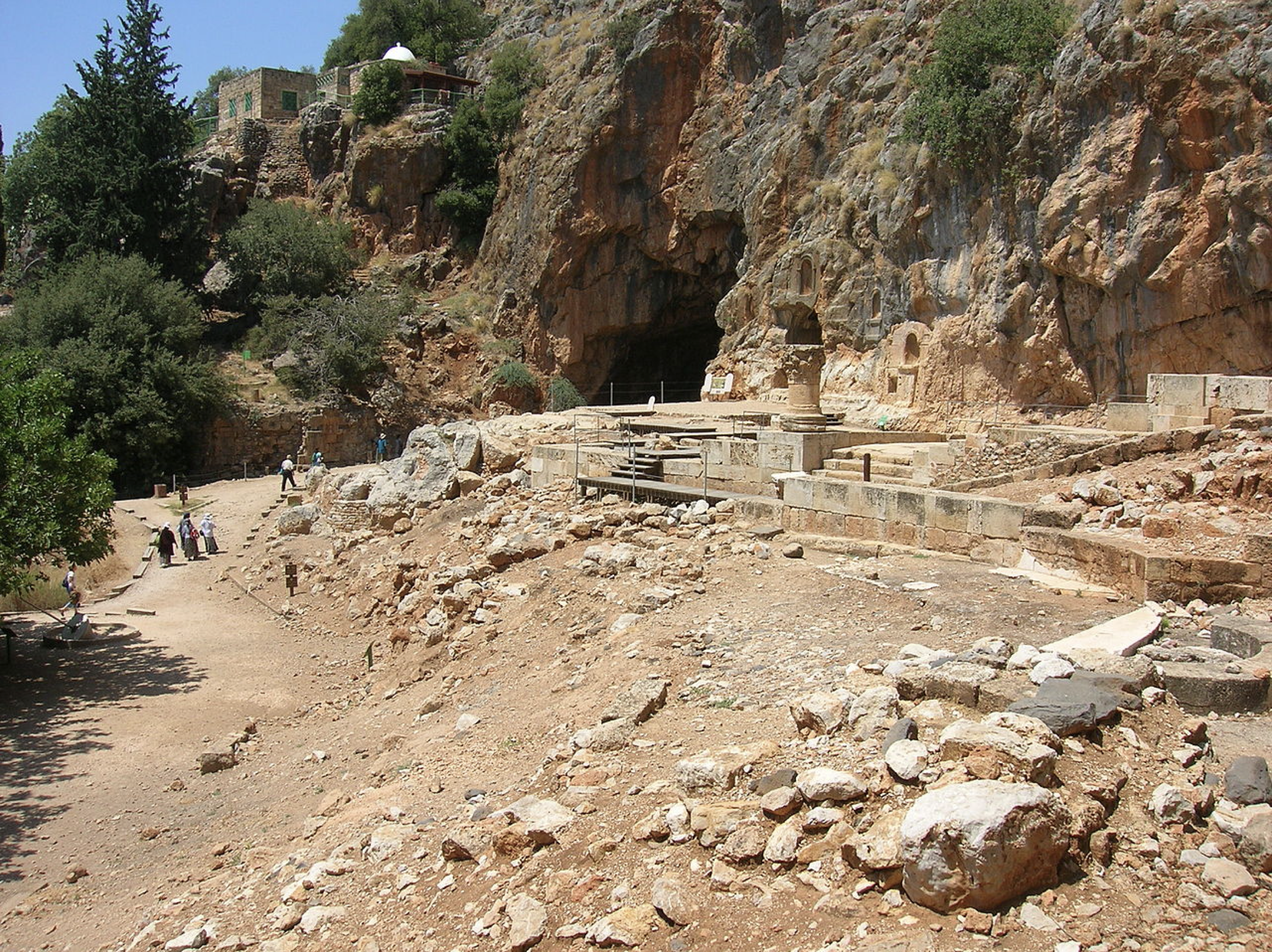
It must have been quite a sight in those days. The Banius River (one of the tributaries to the Jordan) originated from a cave carved out of a sheer cliff face. Water gushed from the mouth of the cave until an earthquake in 1202 relocated the outflow to a lower flat section, from which it flows today.  A great temple was built for Pan near the cave’s mouth, and many niches were carved in the face of the cliff for idols.

Here is what it looks like today: you can see the large cave opening and where the river would flow out.  You can see the remains of the temples of false gods that stood in Jesus’ day.

Here is an artist’s conception of what it looked like in Jesus’ day.

If you want to know the interesting story of who the false god Pan was and how the ancient portrayals of Pan became how we picture “the devil” with horns, pointed ears, and part goat, and if you want to know how we got the name Lucifer mistakenly inserted into the Bible around 300 AD, you’ll have to read my blog entry later this week.

But this was a substantial pagan center of worship.  Some say that people in that day felt the mouth of the cave was the “gates of hell” and that all the fertility gods used it as a passage to the underworld.  (I can’t find any direct sources for this.)   It is this place that Jesus chooses to go to ask this most important question.

On the way there, Jesus asks, “Who do people say that the Son of Man is?”   ‘Son of Man’ is Jesus’s most common title to refer to himself.  In Hebrew, ‘son of man’ can have two meanings.  It can just be the son of Adam, a human, a descendant of Adam, as Luke records in his genealogy of Jesus.  Or it could be a reference to the Son of Man figure in the book of Daniel.

Daniel 7:13-14   “I saw in the night visions, and behold, with the clouds of heaven there came one like a son of man, and he came to the Ancient of Days and was presented before him.  And to him was given dominion and glory and a kingdom, that all peoples, nations, and languages should serve him; his dominion is an everlasting dominion, which shall not pass away, and his kingdom one that shall not be destroyed.

So, this “son of man” comes before God to be crowned as king.  (Not coming on the clouds as in a second coming.)   

Look at the encounter Jesus has with the High Priest at his trial before some of the Sanhedrin.

Matthew 26:62-64  And the high priest stood up and said, “Have you no answer to make? What is it that these men testify against you?”  But Jesus remained silent. And the high priest said to him, “I adjure you by the living God, tell us if you are the Christ, the Son of God.” Jesus said to him, “You have said so.

Jesus wasn’t the first to claim to be the Messiah.  Josephus said there were at least a dozen before Jesus.  You could claim to be the Messiah, and the Jewish leaders would sit back and watch to see what happened.  And “son of God” can refer to an earthly king (as in David).   It was not considered blasphemy to make this claim.  But Jesus doesn’t stop there.

Matthew 26:64-66   But I tell you, from now on you will see the Son of Man seated at the right hand of Power and coming on the clouds of heaven.”   Then the high priest tore his robes and said, “He has uttered blasphemy. What further witnesses do we need? You have now heard his blasphemy.  What is your judgment?” They answered, “He deserves death.” 

Jesus has claimed to be the Son of Man from Daniel 7.  This claim to deity would be considered blasphemous because they did not recognize his deity.

But Jesus is not asking, ‘Who am I?’ but, ‘Who do people say I am?’

Am I just a man, the son of Adam (son of man), or am I Daniel’s “Son of Man” who comes on the clouds?

Some say John the Baptist…
Why would they think Jesus was John the Baptist?  Indeed, we know Herod Antipas believed that Jesus was the reincarnation of John the Baptist, whom he beheaded.  

Matthew 14:1   At that time Herod the tetrarch heard about the fame of Jesus, and he said to his servants, “This is John the Baptist. He has been raised from the dead; that is why these miraculous powers are at work in him.”

Some say, Elijah…
Why would they say that?  It is well known that before the Great Day of the Lord came, Elijah would come.  And in Jesus’ day, and still today, at every Passover seder every year in every Jewish household, they set the table with an empty chair for Elijah.  At a certain point in the meal, they ask a child present to open the door and look outside to see if Elijah is coming.  They are looking forward to the great day.

Malachi 4:5  “See, I will send you the prophet Elijah before that great and dreadful day of the Lord comes.

But Jesus has already told the disciples that John the Baptist was the one who came in the spirit of Elijah…

Matthew 11:13-14  “All the prophets and the law prophesied until John. And if you are willing to receive it, he is Elijah who is to come.”

Jeremiah or one of the prophets…

This concept is not seen in Scripture but was noted in the folklore of the day.

Interestingly, among these opinions of who people think Jesus is, “Messiah” is not one of them.

Not after the feeding of the 5000.  Remember, after the miraculous feeding, they wanted to force Jesus to be king, but he refused.  They wanted a Messiah with an earthly kingdom who would defeat the Romans, make them independent again (and feed them free bread.)  But that was not the Messiah Jesus was to be.  (This was one of the temptations in the wilderness.)  They wanted a different Jesus.  So many left him after that.   No longer would the crowds see Jesus as a potential Messiah.

“But who do you say that I am?”

This is the critical question.  It is not “Who is Jesus?”   Because no matter what you believe, Jesus is who he is.  Despite millions who may not recognize it yet, Jesus is the Son of God who came to deliver us.  And one day, every knee will bow, and every tongue will confess that Jesus is Lord of all.   The important question is:  “Who is Jesus to you?”  If you don’t have a relationship with Jesus as your Lord, if he is not the one who tells you what to do (and you are obedient), if you haven’t pledged your life to him, then Jesus is not your Messiah; he is just a Messiah.  He is not your deliverer; he is a deliverer.  

“Blessed are you, Simon Bar-Jonah! For flesh and blood has not revealed this to you, but my Father who is in heaven.

Notice that Jesus calls Peter “Simon Bar-Jonah” here? You get only the Hebrew name Simon, son of Jonah. He doesn’t use the nickname he gave him the first time Jesus met him.

John 1:42 He [Andrew] brought him to Jesus. Jesus looked at him and said, “You are Simon the son of John? You shall be called Cephas” (which means Petros). 

It is a fairly common nickname today.  Just ask Sylvester Stallone (“Rocky”) or Dwayne Johnson (“The Rock”).   Jesus calling Peter ‘the rock’ probably brought snickers from other disciples, for Simon was often not rock-like until the future.  But that is the way Biblical names frequently work.  Names usually reflect a character trait or destiny yet to be revealed.

Abram is renamed Abraham, father of many when he is 99, a year before Isaac is born.  Jesus’ name means “Yehovah saves” to tell of his future actions.  But here, Jesus uses his original Hebrew name.  Shimon is from the Hebrew ‘shema’ to hear, so the name Simon means  “the one who hears.”  Then Jesus says, “Flesh and blood have not revealed it to you.”  God gave this understanding to Simon Peter.  It was a divine gift.  Over and over in the gospels, we see people who can’t understand the things of God.  God will give the gift of understanding to those who seek him and are willing to accept gifts from him.  If you only get your knowledge about God and the things of God from a person, you are missing it.  You must study God’s words in Scripture and pray for understanding.  People may mislead you.  There are many wolves in sheep’s clothing out there.  God will never mislead you.  So Jesus is really saying, “Blessed are you, Simon, the one who hears because you have heard it from above.”

When Peter said, “You are the Messiah, the son of the living God,” what did he mean?  Did he understand what ‘Messiah’ meant, or did he accept the common belief of the time – that the Messiah would be a military/political/religious leader who would free the Jews from Roman rule and reinstate the powerful reign of David?  Check out verse 22.  Obviously, Peter didn’t understand all of what this meant.

Jesus continues:
“And I tell you, you are Peter, and on this rock I will build my church, and the gates of hell shall not prevail against it.  I will give you the keys of the kingdom of heaven, and whatever you bind on earth shall be bound in heaven, and whatever you loose on earth shall be loosed in heaven.”

There is a lot to unpack here because so many have taken this verse and made it mean what they wanted it to mean.  The Catholic Church has used this verse to say that Peter is the Rock on which the church was built, and he has the authority to govern and make theological decisions.  I can’t agree with this interpretation.  First, I don’t believe Jesus calls Peter the rock on which the church is built.  If you look at the Greek, the two words for rock in that verse are different.  Jesus says to Peter, “You are Petros.”  A petros is a small rock, a pebble.  Then Jesus says, “And on this petra, I will build…”  A petra is a massive stone formation.  (Think of the city of Petra, carved into a solid rock cliff face.)  Let’s see how the Bible uses the word ‘petra.’  

Matthew 7:24   “Everyone then who hears these words of mine and does them will be like a wise man who built his house on the rock (petra).

You build on a solid foundation on the bedrock.  No one builds anything on a pebble (petros).  

So what is this bedrock that will be built upon?   Jesus’ disciples, familiar with the Old Testament, would know the answer.  (So would we if we read the Old Testament.)  Here  is a verse you likely know:

Psalm 19:14    Let the words of my mouth and the meditation of my heart be acceptable in your sight,  O LORD, my rock and my redeemer.  

If you memorized this in the King James version (as I did), God is “my strength and my redeemer.”  That is not a bad translation because the idea of strength is what the psalmist was going for with ‘rock.’    Let’s look at some other verses:

Deuteronomy 32:4    “The Rock, his work is perfect, for all, his ways are justice.  A God of faithfulness and without iniquity, just and upright is he.
1 Samuel 2:2    “There is none holy like the LORD: for there is none besides you; there is no rock like our God.
2 Samuel 22:32    “For who is God, but the LORD?  And who is a rock, except our God?
2 Samuel 22:47    “The LORD lives, and blessed be my rock, and exalted be my God, the rock of my salvation,
Psalm 62:2 He alone is my rock and my salvation, my fortress; I shall not be greatly shaken.
Psalm 78:35 They remembered that God was their rock, the Most High God their redeemer.
1 Corinthians 3:11  For no one can lay a foundation other than that which is laid, which is Jesus Christ.

Peter was not the rock to build on.  He was but a stone (petros) built on the bedrock (petra) of the Father built on the cornerstone of Jesus, with all the prophets and apostles being part of the foundation.

“…and on this rock I will build my church, and the gates of hell shall not prevail against it.”

So upon this rock I will build what?  In your English version, it says, “church.”  But Jesus would not have said ‘church’ for many reasons.  First, he didn’t speak English.  ‘Church’ is from the German ‘Kirika’, which comes from the Greek ‘kyriakon’, an adjective that means “of the Lord.” This Greek word was used for houses of Christian worship since around 330 A.D.  (Before Constantine, there were no Christian houses of worship legally.  The first “followers of the Way” met in synagogues (for almost all were Jewish).  Later, as the synagogue congregation got tired of the talk of Jesus, they were forced to worship in homes.)  But ‘kyriakon’ is not the Greek word we find here.

“…and on this petra, I will build my ekklesia…”

An ekklesia is an assembly or gathering.  It had no religious connotation at the time Jesus used it.  In the Greek Old Testament (the Septuagint that Paul often quoted from), ekklesia was used for various assemblies.  (The group gathered at Sinai was called an ‘ekklesia’ (Deuteronomy 9:10), and Psalm 26:5 speaks of an “assembly (ekklesia) of evildoers.”)  There was a Greek word for a religious assembly — ‘synagogue’- a word for any religious assembly that, upon adoption into Latin, became used explicitly for Jewish religious assemblies.  

Our English translations are not consistent with how they translate these Greek words.  

Ekklesia’ occurs 114 times in the New Testament.  It is always translated as “church” except in these instances:

Acts 7:38 This is the one [Moses] who was in the congregation (ekklesia) in the wilderness with the angel who spoke to him at Mount Sinai, and with our fathers. He received living oracles to give to us.

Acts 19:32  Now some cried out one thing, some another, for the assembly (ekklesia) was in confusion, and most of them did not know why they had come together. [This was a town hall meeting in Ephesus.]

Heb. 2:12 [quoting Psalm 22:22]  “saying, “I will tell of your name to my brothers; in the midst of the congregation (ekklesia) I will sing your praise.”

There is a clear effort in our English translations to use “church” for ekklesia when it is only Jesus’ follower’s meeting.  ‘Synagogue’ is in the New Testament 56 times and is translated (or not translated) as ‘synagogue’ except on one occasion:

James 2:2 For if a man wearing a gold ring and fine clothing comes into your assembly (synagogue), and a poor man in shabby clothing also comes in…

Apparently, our English translators didn’t want people to think that James was writing his letter to a synagogue, even though we know that is where the believers were meeting.  (Again, we see this forced separation from anything Jewish.)

I don’t believe it was Jesus’s intention to build a church as we think of it.  What did Jesus say his primary mission was? He came to regather the lost sheep of Israel.  He was not here to make a new organization.  He is assembling a called-out community of people who recognize the living God and see Jesus as the Messiah.  Jesus’ movement is not a synagogue, nor is it a church.  It is the recovery of God’s reign and rule in the hearts and actions of men and women. as it was established at Sinai. After all, it is His assembly, the same assembly called to hear the word of God at the base of the mountain.  He is calling all to join his Kingdom.  

We get so tied up in how best to build a church.  Hundreds of books exist on the best way to build a church.  But I don’t think Jesus wanted us to build churches.  He wants us to build up the Kingdom of God.  We think too small, building our own little kingdoms, recruiting and proselytizing members.  We think the Great Commission is all about church planting, but Jesus’ Great Commission is all about making disciples.  Jesus is most concerned with pouring life into other lives so that others will experience God’s presence in their midst first-hand. This is what we should be doing.

But ‘Church’ is big business.  People love to build empires, People love to build buildings, People love to build organizations.   When we were in Egypt, our teacher showed us the magnificent temples and pyramids the pharaohs built.  Egypt was all about building huge buildings.  And he said…”The Kingdoms of this world build buildings. Our God builds people.  

Matthew 16:19-20  I will give you the keys of the kingdom of heaven, and whatever you bind on earth shall be bound in heaven, and whatever you loose on earth shall be loosed in heaven.”  Then he strictly charged the disciples to tell no one that he was the Christ.

There is so much to unpack in these verses but I’m going to be brief.  If you go to a church or museum and see statues of the apostles, it is always easy to pick out Peter.  He is the one holding a bunch of keys. (It is also from this verse we get the idea of Peter being the gatekeeper of Heaven.)   I agree with John Piper, who said the key to heaven is the knowledge of the true identity of Jesus.  That is what this whole passage is about.  Piper said, “When any faithful Christian who speaks the words with the bedrock of Jesus’s identity at the center — when you speak those words faithfully, you are using the keys of the kingdom to open the kingdom in people’s lives.”  Knowing Jesus as your Messiah is the key.

Binding and loosing are rabbinic idioms that say what is allowed and what is not.  (

think of binding an animal to a hitching post.  If you bind it there, it is restricted.  If you loose it, it is free to roam around.)  What does it mean to observe the Sabbath?  Who decides what is permitted or allowed?  The Pharisees had taken that authority and run with it (and never stopped running.)  What could you carry, how far could you walk, etc.  But Jesus said they did this poorly.

Matthew 23:4  They tie up heavy burdens, hard to bear, and lay them on people’s shoulders, but they themselves are not willing to move them with their finger.

But someone has to interpret the law.  So Jesus is passing that authority on to these disciples. It is not to Peter only, because the ‘you’ in verse 19 is plural, “I am giving y’all the keys to the kingdom….”  (Jesus restates the binding and loosing in Matthew 18:18 with the plural ‘you.’)

Jesus went on a several-day journey to the northernmost reaches of the promised land.  It was a place none of the disciples had ever been.  It was the place where things went wrong in Israel.  It was where 900 years before Jesus, King Jeroboam built altars to idols, the baals, and fertility gods, and told the people of Israel — this is your God who brought you out of Egypt. This place, where in Jesus’ day, thousands came to worship a fertility god they called Pan.  A place some called the ‘Gates of Hell.’  And Jesus brings his disciples there to ask them this question:  “Who do you say that I am?”  Because if you really understand who I am and if you follow me, you will be part of a community of believers that the Gates of Hell can not stand against.  In Jesus’ day, gates were defensive structures built to withstand the enemy.  Jesus said if you accept me as your Messiah and as your Lord (meaning you follow my orders), then you will storm the Gates of Hell.  It is not a defense against hell but an offense against it.  And there are people in your community, some of your neighbors, who are bound for hell, and we need to stop hiding in church buildings and go on the offensive.

Jesus brought them here because they have to make a choice.  When they came into this promised land, Joshua called them all together and said you have to choose

Joshua 24:14   “Now therefore fear Yehovah and serve him in sincerity and in faithfulness. Put away the gods that your fathers served beyond the river and in Egypt, and serve Yehovah.  And if it is bad in your eyes to serve Yehovah, choose this day whom you will serve, whether the gods your fathers served in the region beyond the river or the gods of the Amorites in whose land you dwell.  But as for me and my house, we will serve Yehovah.”

Years after Joshua, 10 of the 12 tribes chose to follow the idols.  Right here in this place.  In Jesus’ day, people still chose to worship Pan there and said he was the god who would make their land fertile so they could be rich.  Jesus says am I a prophet?  Am I just your teacher?  Am I just a Messiah, or am I your Messiah?  And now, you and I have to choose, and we choose every day.  I don’t have to take you to a pagan place of idols.  You walk among idols every day.   We walk among people who worship the idols of this world and say they will make them rich, healthy, and successful.  What are we building?  Are we building our own little kingdoms and buildings?  Or are we building people for the kingdom of God?  Are we making disciples?  Who is Jesus to you?