
March 20, 27 A.D.  –  Can You Drink the Cup? — The Year of the Lord’s Favor #77

Week 57 — Can You Drink the Cup?
Matthew 20:17-23

Jesus is on his final tour of Galilee and will soon be taking the long journey back to Jerusalem with all the other pilgrims headed to the Passover feast.   And our itinerant Rabbi Jesus continues to teach all along the way.

Matthew 20:17-23   And as Jesus was going up to Jerusalem, he took the twelve disciples aside, and on the way he said to them,  “See, we are going up to Jerusalem. And the Son of Man will be delivered over to the chief priests and scribes, and they will condemn him to death and deliver him over to the Gentiles to be mocked and flogged and crucified, and he will be raised on the third day.”
  Then the mother of the sons of Zebedee came up to him with her sons, and kneeling before him she asked him for something.   And he said to her, “What do you want?” She said to him, “Say that these two sons of mine are to sit, one at your right hand and one at your left, in your kingdom.”   Jesus answered, “You do not know what you are asking. Are you able to drink the cup that I am to drink?” They said to him, “We are able.” He said to them, “You will drink my cup, but to sit at my right hand and at my left is not mine to grant, but it is for those for whom it has been prepared by my Father.”

So James and John come to Jesus with their mother, who has been traveling with Jesus often.  She is specifically mentioned as being with Mary Magdalene and “many women” who were at the crucifixion, “looking on from a distance” (Matthew 27:55-56).   What are they asking Jesus?    They are seeking a prominent place of honor when Jesus comes into his kingdom.  Is that a ridiculous request?  

Jesus had just told the disciples  a few days ago: 

Matthew 19:28.  Jesus said to them, “Truly, I say to you, in the new world, when the Son of Man will sit on his glorious throne, you who have followed me will also sit on twelve thrones, judging the twelve tribes of Israel.”

Jesus had put them in the position of princes in the kingdom, sitting on thrones, so they were asking to be chief of the princes.  But their timing is horrible.   Look back at what Jesus said just before they made their request:

Matthew 20:18-19   And the Son of Man will be delivered over to the chief priests and scribes, and they will condemn him to death and deliver him over to the Gentiles to be mocked and flogged and crucified, and he will be raised on the third day.”
Then the mother of the sons of Zebedee came up to him…

This is the first time he explicitly mentions being crucified.  It is the Jewish court that will condemn him and hand him over to the Romans to be crucified.  Following what had to be an emotional revelation by Jesus about his impending torture and agonizing death, Matthew says, “Then James and John and his mother ask to have a place of honor in the kingdom.  This is horribly insensitive.  

Jesus: In just a few days, I am going to be tortured and then die the worst death imaginable: crucifixion.”
Then his disciples say,  “OK… well then, can we be in charge when you are gone?

The disciples are having trouble grasping the words they are hearing.  Perhaps it is because, throughout their lives and for hundreds of years in their culture, they have been told that the Messiah will come into power and restore the throne of David to Israel.   They are still hanging on to that traditional understanding of what the Messiah would do.  They can’t really understand Jesus’ words until they let go of the misconceptions they had held for years.  They need to become as little children and drop what they think they already know.  But they hear what they want to hear (‘Oh great! We get to sit on thrones!’) and don’t consider the hard parts.  Some things they will not understand until they face the reality of the crucifixion.

So when they asked to sit on Jesus’ right and left, Jesus answered them,  “You don’t know what you are asking.”  Jesus knew they didn’t understand, but he tried to help them understand. He said, “Are you able to drink the cup that I must drink?”

Now we have to stop. Maybe you, like me, grew up in a church where no one really taught you the actual context of the Old Testament and how the themes of the first two-thirds of the Bible were so important to understanding Jesus’ words. The metaphor of ‘the cup’ is a very important concept in Scripture, and Jesus expects us to have learned this from our study of the Scripture.  

Maybe, like me, you grew up in church and had Sunday School lessons year after year about how strong Sampson was — but no one ever told you that he is in the Bible to be an example of how not to follow God.  Or you heard stories of Noah and all the cute animals on the ark, but no one ever told you how it was a de-creation event and what we should learn from it.   Or you talked about the parting of the Red Sea in Exodus and how the Israelites walked through it but never considered how passing through waters gives you background for your baptism or how the Biblical feasts are fulfilled in Jesus and in our future.  I am afraid we have failed to teach people the importance of studying scripture.   We dilute it into cute stories for children and then never move past that point as adults. 

Jesus assumes we have been obedient and studied the book.  If we haven’t, we can’t possibly understand what he is saying.  If the God of the Universe says, ”Hey David if you want to know more about me, how I suggest you live, and how I can help you, I wrote this book for you.”  And God puts it on my table, and I say, “Well, maybe I’ll find some time to read it later.  I’m in the middle of a Netflix series right now.” or “Sorry, God, I don’t like to read.” God has put a great treasure in our field, and we won’t even go to the trouble to dig it up.

So, there are no cute Bible stories for you today because we need to understand how Jesus used the common Bible metaphor of the cup.  The cup Jesus refers to is the cup of wrath, the cup of judgment.  If we don’t understand that, we can never understand Jesus.

We talked before about how God described himself as being slow to anger.   And we see in the scriptures that God gets most angry with those he has entered into covenant with.  Israel’s covenant with God, and our covenant with God, is described as a marriage, and when we choose to disobey God and follow idols of our own making, it is seen as adultery.  (You get the most angry with the ones you love or are closest to.)  And how is God’s anger revealed in the Old Testament? How does God’s judgment come?  Moses was the first to talk about this in Deuteronomy 31.

Deuteronomy 31:16-18   And Yehovah said to Moses, “Behold, you are about to lie down with your fathers. Then this people will rise and whore after the foreign gods among them in the land that they are entering, and they will forsake me and break my covenant that I have made with them. Then my anger will be kindled against them in that day, and I will forsake them and hide my face from them, and they will be devoured. And many evils and troubles will come upon them, so that they will say in that day, ‘Have not these evils come upon us because our God is not among us?’  And I will surely hide my face in that day because of all the evil that they have done, because they have turned to other gods.

They broke the covenant by worshipping other gods.  They left God.  So God leaves them, and God hides his face.  Hiding his face means that God removes his protection from them.  Without God’s continual protection, they are forced to reap what they have sown.  An enemy, some foreign nation, comes and conquers them.  That’s how Israel ended up in slavery in Egypt, how they were defeated by armies in the conquest of the promised land, how Assyria defeated the Northern Kingdom, how Babylon defeated the Southern Kingdom, and how Israel was defeated by Rome just 40 years after Jesus’ crucifixion and resurrection.  God hides his face, and an enemy conquers Israel.

Psalm 75 adds another common Biblical metaphor for God’s anger — the cup of wrath.

Psalms 75:8  For in the hand of Yehovah, there is a cup with foaming wine, well mixed, and he pours out from it, and all the wicked of the earth shall drain it down to the dregs.

Imagine a large cup in God’s hand.   Over the years, it slowly fills up with God’s judgment for the sins of his people, Israel. It may take a century of sins, but when it is full, God will pour it out on Israel, and they will have to drink it all, all of the building judgment against them.  They will stagger and fall as they suffer his judgment, which comes in the form of defeat by foreign nations.

The prophets rise in Israel to reveal the four parts of God’s judgment on Israel for their refusal to repent.  First, they let them know judgment is coming unless they repent – their sins are filling up the cup with judgment and will be poured out on Israel unless they repent.   

Then, they are told God hides his face, and a surrounding nation, an enemy, becomes the instrument of his judgment.  And they often reveal which nation God has chosen to be his instrument of punishment.  Whether Egypt, Assyria, Babylon, or Rome, God hides his face, removes his protection, and the evil conquering nation will come in to devastate Israel. Third, After the cup has been emptied and all judgment poured out, God will restore a remnant of Israel. 

Finally, justice must be dealt to the nations that served as God’s instruments, for they are not without sin.  They arrogantly believed they were so great that they could conquer God’s people, not understanding that they were only serving as a rod in God’s hand and were only victorious because God allowed them to be.  We see this cycle repeat many times in the Scriptures.

We see this in Isaiah.  The first part of Isaiah, chapters 1-39, reveals his prophecy that Israel will suffer God’s judgment through attacks by Assyria and Babylon.  The second part of Isaiah discusses what happens when the cup has been emptied, and the nation that conquered Israel has to receive the cup.  So, in Isaiah 51, we see that the cup has been emptied on Israel.

 Isaiah 51:22-23  Thus says your Lord, Yehovah, your God who pleads the cause of his people: “Behold, I have taken from your hand the cup of staggering; the bowl of my wrath you shall drink no more; and I will put it into the hand of your tormentors, who have said to you, ‘Bow down, that we may pass over’; and you have made your back like the ground and like the street for them to pass over.”

One hundred years later, we see this happen, just as Isaiah had said. The cup was poured out during the time of the prophets Jeremiah and Ezekiel.

Jeremiah 25:15-18   Thus Yehovah, the God of Israel, said to me: “Take from my hand this cup of the wine of wrath, and make all the nations to whom I send you drink it.  They shall drink and stagger and be crazed because of the sword that I am sending among them.” So I took the cup from the LORD’S hand, and made all the nations to whom the LORD sent me drink it: Jerusalem and the cities of Judah, its kings and officials, to make them a desolation and a waste, a hissing and a curse…

Then follows a list of nations that will soon drink the cup.  

Jeremiah 25:19-26  Pharaoh king of Egypt….all the kings of the land of Uz and all the kings of the land of the Philistines,…Edom, Moab, and the sons of Ammon; Tyre, Sidon, and the kings of the coastland across the sea;….and all the kingdoms of the world that are on the face of the earth.

And that is what happened in the 6th century BC.   The nation of Babylon conquered every nation described in the Bible.  Then, after the cup has been emptied on all the kingdoms, after God has allowed Babylon to be the rod in his hand, the nation that executes his judgment, then, because Babylon is also a nation of evil, 

Jeremiah 25:26. “…And after them the king of Babylon shall drink.

So we see that Israel fell to Babylon initially around 600 BC, Babylon fell to Persia in 539 BC, and then a remnant of Israel returned home. It happened over and over again. The people abandoned God and worshipped idols. The cup of judgment filled until God turned his face, removing his protection. And the cup was poured out in the form of another nation conquering Israel.

This is why we find Jesus bitterly weeping over the city of Jerusalem.  John the Baptist was a prophet who came with the warning to repent, but they did not.   Jesus came as a prophet with a similar message.  But as with many prophets before them, they were killed by the very people they came to warn.

Matthew 23:37-38     “O Jerusalem, Jerusalem, the city that kills the prophets and stones those who are sent to it!  How often would I have gathered your children together as a hen gathers her brood under her wings, and you were not willing!  See, your house is left to you desolate.”

God’s protection will be lifted, and the Romans will decide to destroy the city and the Temple completely, killing over 600,000 and enslaving many more.  But something different is happening this time.   Jesus has come. We, like Israel in Jesus’ day, live in a world of sin.  We are all sinners.  So, our sins are slowly filling up a cup of judgment for us.  And that cup must be poured out.  But in the first century, God came to earth, took the cup of judgment in our place, and came with a cup of salvation.

John 3:17-18 For God did not send his Son into the world to condemn the world, but in order that the world might be saved through him. Whoever believes in him is not condemned, but whoever does not believe is condemned already because he has not believed in the name of the only Son of God.

 God has sent his son into the world to take the judgment for us, to drink the cup of judgment for us.  And I believe if all of Israel had accepted Jesus as God’s son, as their Messiah, then they would not have had the cup of Judgment on them and not been destroyed by Rome.  But they did not believe and thus were condemned.

But Jesus, who knew no sin, took our place on the cross and accepted the cup of judgment for all the world’s sins.  Jesus knows how horrible the cup of suffering will be.  In the garden of Gethsemane, just before he is betrayed and arrested, he prays: 

Matthew 26:39  “My Father, if it be possible, let this cup pass from me; nevertheless, not as I will, but as you will.” 

Jesus is in deep distress, knowing he will have the cup of judgment and suffering poured on him.  He is sweating drops of blood.  Twice, he asks God if there is any other way to accomplish the task.  But he is willing to take the cup of suffering if there is no other way.   

Then, when the guards who were meant to arrest him approached him, Simon rose and struck them with his sword.

John 18:10-11  Then Simon Peter, having a sword, drew it and struck the high priest’s servant and cut off his right ear. (The servant’s name was Malchus.)   So Jesus said to Peter, “Put your sword into its sheath; shall I not drink the cup that the Father has given me?”

The Father has spoken.  Jesus is to drink the cup of judgment in our place.  So when Jesus is tortured and crucified, it is the cup of wrath and judgment being poured out on Jesus.  The cup that had filled over the centuries by the sins of man, by our sins.  The accumulated wrath that should have been poured out on all humanity, for all have sinned and fallen short of the Glory of God.  All of that judgment poured out on Jesus.  

So let me ask you, was God angry at Jesus on the cross?  Did God forsake Jesus?  Did God turn his face from Jesus as he took the cup of wrath for our sins?  The Bible says he did not.  Let me show you. 

Psalm 22 tells the story of the crucifixion, which we can easily see now that we know the details in the gospels.  Jesus calls this Psalm out from the cross.  Remember that there were no chapter numbers until over a thousand years after Jesus.  The way to identify a particular passage in the Bible was by quoting the first line.

Matthew 27:46   My God, my God, why have you forsaken me?
Psalms 22:1   My God, my God, why have you forsaken me?

So, for those at the crucifixion who knew scripture, Jesus turned their minds to Psalm 22 by quoting the first line of the psalm.  Most Jews there had that Psalm memorized, and now they can see the Psalm being acted out before their eyes.  Psalm 22 mentions one who is tortured, scorned, and despised by people.  It says that people mock this man and tell him that if he trusts God, let God deliver him—just as happened to Jesus on the cross. The psalm mentions that people divide his clothes and cast lots for his garment, just as the soldiers did for Jesus’ clothing.

Psalm 22 ends with these words:

Psalm 22:30-31  “…it shall be told of the Lord to the coming generation; they shall come and proclaim his righteousness to a people yet unborn, that he has done it.”

In Hebrew, the final word is ‘עָשָֽׂה’ ‘Asah.’  It can be translated as “it is done.” or, as our English New Testaments say, “It is finished.”

John records Jesus’ last words : 

John 19:30   When Jesus had received the sour wine, he said, “It is finished,” and he bowed his head and gave up his spirit.

Jesus quotes the beginning and end of Psalm 22, and we see in that Psalm a story of the crucifixion—a story of one who was not forsaken but redeemed by the Father. We see it clearly in verse 24:

Psalm 22:24,  “For God has not despised or abhorred the affliction of the afflicted, and he had not hidden his face from him but has heard when he cried to him.

God did not turn his face from the afflicted one, Jesus.  Jesus hung on the cross in our place and received the cup of judgment, the cup of suffering for the sins of the world.  But God had no anger for Jesus, only love. 
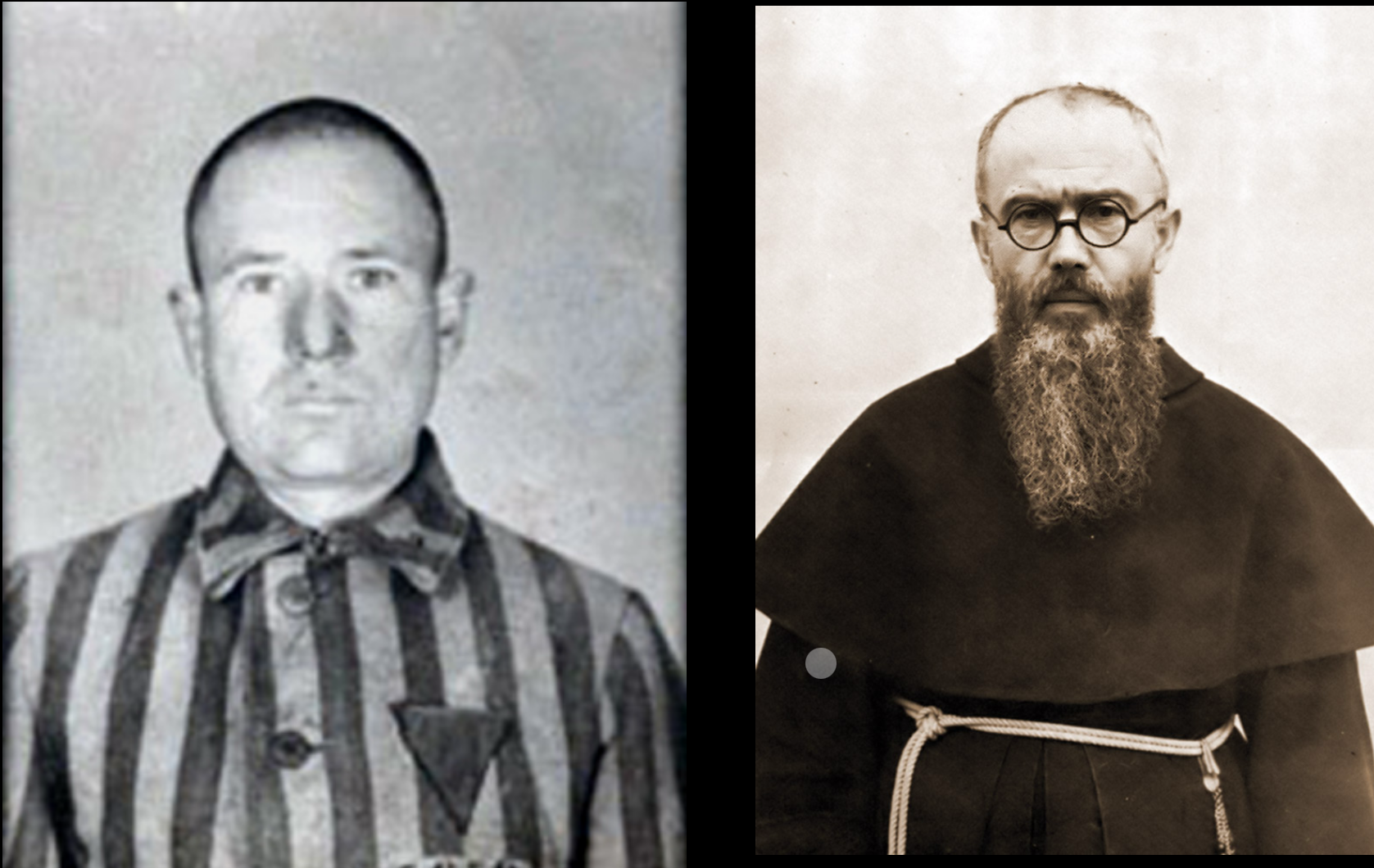
The man pictured above on the left is Franciszek Gajowniczek -He was a Polish soldier captured by Nazi troops and imprisoned in Auschwitz concentration camp.  After one prisoner managed to escape, the commander of the prison ordered that in reprisal, ten prisoners would be chosen at random to die.    Gajowniczek was one of the ten randomly chosen to die. But the man pictured on the right above, Raymund Kolbe, a Polish priest who was also a prisoner, volunteered to die in Gajowniczek’s place.   He was killed by lethal injection on August 14, 1941.   Gajowniczek survived the prison and the war and became a lay missionary. Kolbe took another’s punishment voluntarily. This is an act of love.

Jesus was the innocent one who stepped in our place to receive the cup of Judgment.  He was not guilty of the sins that filled the cup.   So, God was not angry with Jesus. In fact, God looked at Jesus on the cross with great love, that Jesus would lay down his life for the world.  

Remember when we talked about Jesus getting angry at Lazarus’ tomb?  What was Jesus angry about?  He was angry about death, and Jesus came to do battle with death and raise Lazarus from the dead.    And at the cross, Yehovah God has come to do battle with death and remove the sting of death and the victory of sin.  So while God, with one hand, pours out the cup of wrath on Jesus and Jesus suffers the judgment that should be on us, God lovingly holds Jesus close with his other hand.  The true message of the cross is not that of an angry God but that of a loving God willing to suffer in our place.

So Jesus asks James and John:

“Are you able to drink the cup that I must drink?”

They said to him, “We are able.” He said to them, “You will drink my cup, but to sit at my right hand and at my left is not mine to grant, but it is for those for whom it has been prepared by my Father.”

Who will be on Jesus’ right and left?
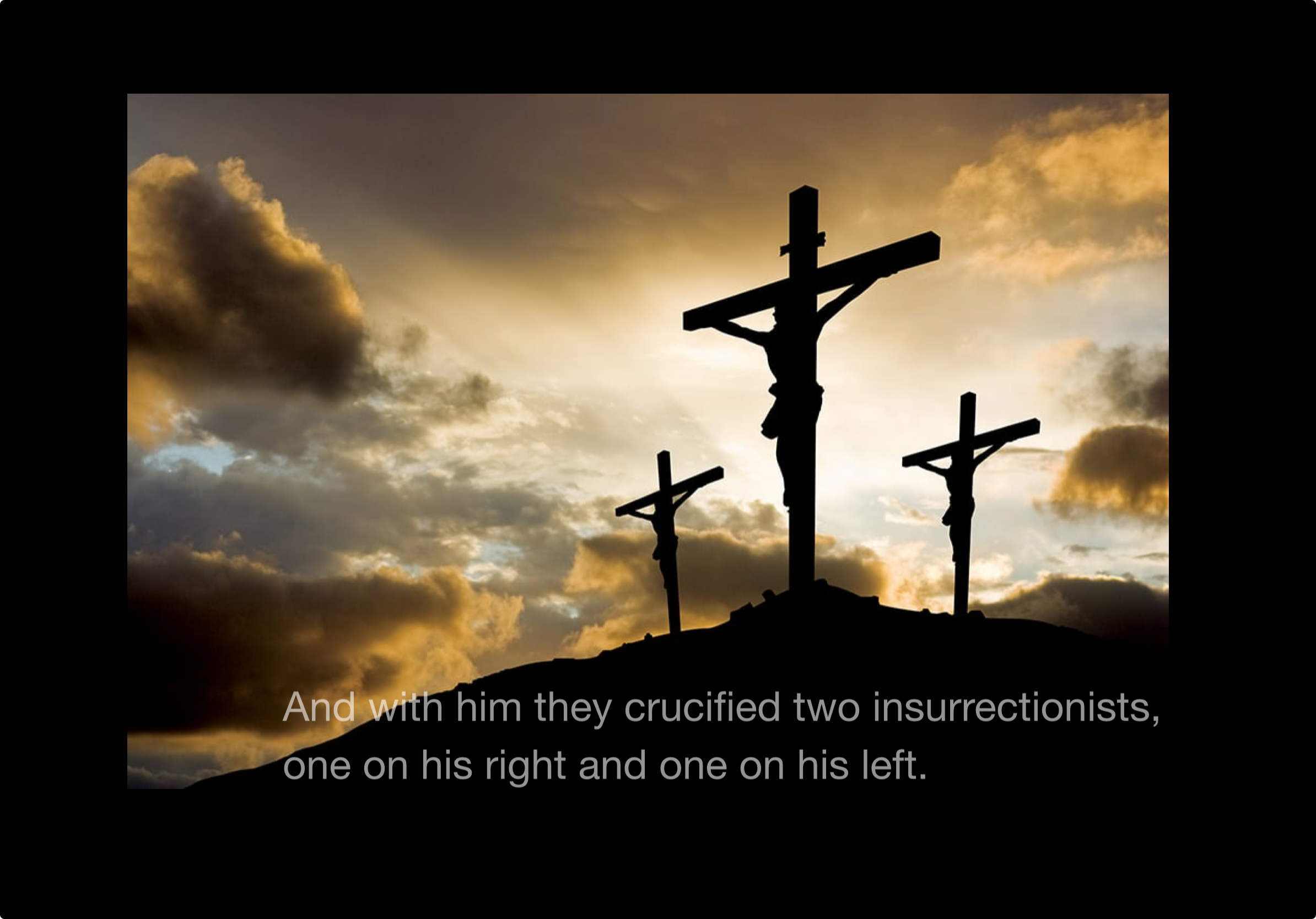
“And with him, they crucified two insurrectionists, one on his right and one on his left.”

With Jesus on his right and left are two guilty of rebellion against Rome.  That is the crime that will eventually cause Rome to destroy Jerusalem.  And they represent us all, for we are all guilty and deserve the cup of suffering and death.   And they represent mankind, for one will accept Jesus as his redeemer.  One will allow Jesus to take the cup of wrath for him.  And the other will not and will have to take the cup of wrath, the punishment for his sins himself.

But those who accept Jesus and his standing in their place do not have to take the cup of judgment.  

Romans 8:1   There is, therefore, now no condemnation for those who are in Christ Jesus.

But as Jesus told James and John, “You will drink my cup.”    You will drink this cup of suffering.  All of the disciples will drink a cup of suffering.  All of them but John will die a martyr’s death.  We learn of James’ death in Acts 12.

Acts 12:1-2   About that time, Herod the King laid violent hands on some who belonged to the church.   He killed James, the brother of John, with the sword.

His brother, John, history tells us, is thrown into a cauldron of boiling oil by Emperor Domitian.  John miraculously escapes, and the emperor exiles him to the island of Patmos.  And thousands of Christians in the first century drank the cup of suffering, tortured and killed by men.

However, the cup of suffering they drink is unlike the one Jesus consumes.  It is not the cup of God’s judgment against man’s sins, but they will take the cup of man’s wrath against God and his followers.   The suffering they receive will be from man alone.

The Greek word ‘martus,’ from which we get our word ‘martyr,’ is not one who dies but is one who is a witness.  The word is most commonly used in Greek for a witness in a trial.  Hundreds of years later, it came to mean those who died for the faith.  But the root of the word is ‘witness.’

God is not calling many of us now to be martyrs in the modern sense of dying for our faith, but he is calling every one of us to be martyrs in the New Testament sense of being a witness to the faith.  You might indeed be asked to die for your faith one day.  Or, if not you, perhaps your child. And if and when that time comes, I pray we will accept that fate joyfully.  But the bigger question today is not “What will you do if God calls you to die for your faith, but it is “What will you do if God calls you to live every day of your life in faithful service for him, never losing your hope, never lagging in your zeal, being a faithful witness to the end,” would you drink from that cup?

Living for Jesus every day means dying to oneself every day.  Jesus said, 

Luke 9:23, “If anyone wants to come after me, let him deny himself and take up his cross daily and follow me.” 

Jesus felt the words when he said take up your cross daily.  Jesus and his disciples had seen men crucified.  This is not an easy thing to hear.  Dietrich Bonhoeffer said: 

“Jesus says that every Christian has his cross waiting for him, a cross destined and appointed by God. Each must endure his allotted share of suffering and rejection. But each has a different share: some God deems worthy of the highest form of suffering, and gives them the grace of martyrdom, while others he does not allow to be tempted above that they are able to bear. But it is the one and the same cross in every case. … ”1

“When Christ calls a man, he bids him come and die.”2

And Jesus asks:  Are you willing to drink from that cup?

Paul, because of his ministry, faced death often.  But he said the only point in his living was

Philippians 3:10   — that I may know him and the power of his resurrection, and may share his sufferings, becoming like him in his death, that by any means possible I may attain the resurrection from the dead.

The King James Version poetically calls this “sharing in the fellowship of his sufferings.”

Are you willing to drink from that cup?

The communion table will soon be before us.  And we do not take it lightly.   Paul says this in 1 Corinthians:

1 Corinthians 11:27   Whoever, therefore, eats the bread or drinks the cup of the Lord in an unworthy manner will be guilty concerning the body and blood of the Lord.  Let a person examine himself, then, and so eat of the bread and drink of the cup.  For anyone who eats and drinks without discerning the body eats and drinks judgment on himself. 

When we take the bread and the cup in the Lord’s Supper, we acknowledge the depth of the sacrifice Jesus made for us, standing in our place to take on himself the cup of judgment for our sins.  And we acknowledge our willingness to join in the fellowship of his suffering, to take ourselves the cup of suffering, to come and die.

Jesus asks the question, “Can you drink the cup that I must drink?”  If we take that seriously, it will radically change our lives.  Jesus asks us if we are willing to suffer for him as he suffered for us.  We can not accept the joy of the resurrection in our lives without accepting the sorrow of his suffering and death in our lives also.  Can you say ‘yes’ to Jesus today when he asks if you are willing to take his cup, the cup of suffering, the cup of blessing, the cup of salvation?

  1. Bonhoeffer, Dietrich. The Cost of Discipleship.
  2. Ibid.

August 2, 27 A.D.  The Man with the Withered Hand #43


Mark 3:1-6   Again he entered the synagogue, and a man was there with a withered hand.  And they watched Jesus to see whether he would heal him on the Sabbath so that they might accuse him.   And he said to the man with the withered hand, “Come here.”   And he said to them, “Is it lawful on the Sabbath to do good or to do harm, to save life or to kill?” But they were silent.   And he looked around at them with anger, grieved at their hardness of heart, and said to the man, “Stretch out your hand.”  He stretched it out, and his hand was restored.   The Pharisees went out and immediately held counsel with the Herodians against him, how to destroy him.

Sometimes, when studying a passage of Scripture, you must stop and address one of the ‘big picture’ ideas found in the passage.  So we will look at this story as we primarily discuss this phrase:  “Jesus looked around at them with anger…”

Jesus…angry?  Yes.  If you thought Jesus was only meek and mild and never angry, then you had better read the Bible again.  And this word translated as anger here is the Greek ‘orge’ (pronounced ‘or-gay’).  It is not saying Jesus is irritated or mildly annoyed.  This is a word of violent passion.  Jesus is steaming mad.  He is boiling over with anger.  Does it bother you that Jesus is described with such fierce anger?  (It must bother some people, for there are many translations that ‘water down’ Jesus’ emotions.)

Some people have a problem with Jesus being angry in the New Testament and an even bigger problem with how angry God gets in the Old Testament.  I have heard people describe God as an “angry God” in the Old Testament. Just because someone gets angry occasionally, do you call them an angry person?  Now, if I see a mass shooting at a school and I get angry about someone indiscriminately killing children, you can describe me as angry, but does that make me an “angry person”?   Now, if I am in a hurry to drive somewhere all the time and the person in front of me is on their phone and not noticing the light is green and I start blowing my horn and yelling — if I do that a lot, maybe then I am an angry person.  But if I jump out of my car and attack that person…, that is another thing.  It makes a difference: 1. what situation causes the anger and 2. How do you act in your anger.

We have mentioned Exodus 36:4 several times in the past weeks, where God uses five character traits to describe himself.  “Yehovah passed before him and proclaimed, “Yehovah, Yehovah, a God merciful and gracious, slow to anger, and abounding in steadfast love and faithfulness.” “Slow to anger,” the middle description, makes it clear that God is patient. Still, his patience has a limit. (The Hebrew literal translation is “long nostrilled,” because anger is typically described in Hebrew as your ‘nose burning hot,’ so if you are ‘long of nostrils,’ it takes some time before you get your nose overheated.  If you think that is odd, remember that we do something similar in our culture.  We use the term ‘nosy’ to describe someone who is a ‘busybody,’ always ‘getting their nose in someone else’s business.’  Languages are fun.)

Now, my friends who read the Old Testament and complain that Yehovah is an ‘angry God’ talk of Sodom and Gomorrah or the flood in Genesis, or the warfare in Joshua and following.  Interestingly, there is no mention of God being angry in the book of Genesis (and only three times in Exodus.)   At the time of Noah and the flood, God is described not as angry but as grieved or hurt.   He was heartbroken that his image-bearers had abandoned his ways and descended to the depths of evil.  The flood is a necessary act of judgment but not an act of anger.

You may know someone who rarely gets angry.  That is an excellent, godly trait.  How about someone who never gets angry?  Is that a good trait?

Think about the time you got the most angry in your life.  What did you get angry about?

Let me tell you about the most angry I have ever been.  My 5-year-old daughter had the day off from Kindergarten.  I took the day off to spend the day with her.  She first requested to have breakfast at McDonald’s and to play on the playground.  While I was paying for the meal and waiting for the order, she wanted to get her drink, and I let her.  Apparently, it took her a while, and she kept the next person waiting a bit to get his drink.  I hear him huffing behind me and see him force his way beside her as she finishes so he can fill his drink in the dispenser.  I hear him say, “Damn half-breed,” and something else I won’t even repeat.  I ask my precious bi-racial child to go out to the playground.  After she gets outside, I have a ‘discussion’ with this man.  In Hebrew terms, my nose was a blazing inferno.  I really wanted to slug him, but I instead corrected him with a not-so-gentle spirit.  God forgive me.  The lesson to learn from this is, first, that it matters what you get angry about.  Getting angry because your child is treated wrongly, bullied, or abused is expected.  If a parent watched another adult abuse a child and didn’t get angry about it, then something is wrong with that person.  Secondly, anger rises up much faster when it involves someone in relation to you, someone you love.

What kind of God would Yehovah be if he had no emotional reaction when one of his children was mistreated or abused?  Would you really want to have a God who never got angry?  Some anger is not only justified but is necessary.  The Bible gives three primary reasons for God’s anger:  human suffering, evil, and betrayal of a covenant.

The first time God is described as angry in the Bible is when God meets Moses at the burning bush on Mt Sinai.  

Exodus 2:23: “The people of Israel groaned because of their slavery and cried out for help. Their cry for rescue from slavery came up to God. And God heard their groaning…”

Things had gone from bad to worse for the Hebrew slaves to the point that the Egyptians were committing genocide, drowning their babies.  Egypt is abusing God’s children.  God then comes to Moses and says, “I have surely seen the affliction of my people who are in Egypt and have heard their cry because of their taskmasters. I know their sufferings.” (Exodus 3:7)  God asks Moses to go back to Egypt and lead his people out of bondage.  But five times, Moses refuses to go, giving excuse after excuse, and when he runs out of excuses, he tells God, “Just send someone else.”  At this point, Exodus 4:13 tells us, “The anger of Yehovah was kindled against Moses.”  Why was God angry?  It was not just because Moses was refusing to obey, but because Moses was refusing to care enough for his own people, his own family, to do anything.   His people were being tortured, and their babies drowned, and Moses didn’t want to become involved.  God may be patient with disobedience, but a frank disregard for people who are suffering will arouse God’s anger much faster.  Human suffering is one of the three primary reasons God gets angry.   The Bible is full of God’s reprimands to Israel for failing to care for those who can not care for themselves, especially widows, orphans, and strangers in the land. If you ignore the suffering of others, God will get angry.

That is the reason for Jesus’ anger in our story today.  This man has a ‘withered hand.’  He is not able to work and provide for his family.  It likely resulted in him becoming a beggar.  Jesus can restore him.  But some in the synagogue don’t see this man as someone desperate for healing.  They see a chance to further their agenda to trap Jesus.  If Jesus heals on the Sabbath, they can accuse him of breaking the Sabbath rules.  But God never said that healing was not allowed on the Sabbath1, and Jesus makes it clear that God would never say that.  That was a rule the Pharisees added themselves.  Notice that Jesus calls the man up in front of everyone.  He tries to point out to these ‘religious leaders’ that he is a child of God who is in desperate need.  But their agenda to trap Jesus prevents them from having compassion and requires them to ignore his suffering.  After he is healed, they should be celebrating the miracle with him.  But what do they do?  Just as God became angry with Moses for his lack of care for those suffering in Egypt, Jesus became angry with these Pharisees for their refusal to care about this man.  Do not miss this lesson. If we have the means to prevent suffering and choose not to get involved, we make God angry.  Even today, some people don’t have compassion for others; instead, they see all people as pawns to further their agenda.  We call these people politicians.  How do we view people who are in need?  Are they inconvenient burdens that interrupt our day?  Or are they opportunities to minister and show the love and mercy of God?  We should thank God every time we cross paths with someone in need because God has given us another opportunity to be compassionate and obedient.

The second time we see God described as angry is due to evil.  Just a few chapters later in Exodus, God’s anger is due to the evil of Pharaoh.  Even after the ten plagues, including the death of the firstborn of Egypt, Pharaoh is too hard-hearted to let the Hebrew slaves go, and he pursues them into the parted waters of the sea.  God has had enough of this evil leader, and he and his ‘chosen officers’ suffer the fury of God’s anger and are drowned (ironically, just as they were drowning the Hebrew male children.)  No one can argue that God wasn’t patient (slow to anger) with Pharaoh, but evil will always eventually be dealt with.  Jesus created this world, and evil was never meant to be a part of it.  Death and illness were also not supposed to be part of this world.  Several times in the gospels, we see Jesus react with deep emotion when facing the death or illness of others.  For example, when Jesus is faced with the death of his friend, Lazarus, the ESV translates that Jesus was “deeply moved,” but the Greek word used is one of anger and rebuke.  We see this again when Jesus is faced with illness.  It is okay to be angry when someone dies, or someone gets a horrible diagnosis.  But don’t be angry at God; be angry at death and disease.  Just as God became angry at evil in the world, Jesus is angry at death and illness, two things that should not exist in God’s creation but are the result of a world fallen in sin.

The third time God is described as angry in the Bible is at the incident of the Golden Calf. God had just established a covenant at Mount Sinai with the nation. As we discussed last time (#42), the covenant at Sinai was like a marriage. Both parties promised to be faithful to each other. They are expected to act with chesed towards each other, faithful covenant love and mercy.  Then Moses ascends the mountain, and while he is up there with God, Israel builds a golden calf and worships it.

Exodus 32:7-10   And Yehovah said to Moses, “Go down, for your people, whom you brought up out of the land of Egypt, have corrupted themselves.   They have turned aside quickly out of the way that I commanded them. They have made for themselves a golden calf and have worshiped it and sacrificed to it and said, ‘These are your gods, O Israel, who brought you up out of the land of Egypt!’”   And Yehovah said to Moses, “I have seen this people, and behold, it is a stiff-necked people.   Now, therefore, let me alone, that my wrath may burn hot against them and I may consume them, in order that I may make a great nation of you.”

Can you imagine someone committing adultery six weeks after the marriage?  Israel made this covenant with God; they exchanged vows and made a commitment.  And just six weeks later, they break the covenant and worship other gods. God calls this adultery, and they have done it on the honeymoon.   Betrayal of a covenant leads to anger.

God takes commitment very seriously.  Betrayal of the expected loyal covenant love (chesed) is the third reason for God’s anger in the Bible.  We see this happen repeatedly in the Old Testament and the New Testament.  Israel betrays God and worships the idols of other nations.   The Bible has three important recurring phrases seen in God’s reaction to Israel’s betrayal: God “hiding his face,” “handing them over,” and “drinking the cup” of wrath. Pay attention when you see these phrases as you read your Bible.

Deuteronomy 31:16-18   And Yehovah said to Moses, “Behold, you are about to lie down with your fathers. Then these people will rise and whore after the foreign gods among them in the land that they are entering, and they will forsake me and break my covenant that I have made with them. Then my anger will be kindled against them in that day, and I will forsake them and hide my face from them, and they will be devoured. And many evils and troubles will come upon them, so that they will say in that day, ‘Have not these evils come upon us because our God is not among us?’ And I will surely hide my face in that day because of all the evil that they have done, because they have turned to other gods.

God “hiding his face” represents God withdrawing his sustaining power over his people.  In the beginning, God’s act of creation was to make order out of chaos. And God did not create the world and then walk away to let it run on its own.  Without God’s continual intervention in this fallen world, things return to disorder. (In Physics, you may have learned this concept as the 2nd law of thermodynamics.)  The Bible makes it clear that without God’s sustaining efforts in our lives, we would all perish.  Who knows how many catastrophes God prevented this past week that we never knew about?  When God ‘hides his face,’ he stops intervening and allows us to reap the consequences of our poor choices.  Paul in Romans describes this action of God removing his protection and allowing people to suffer the natural consequences of their sins, God ‘handing them over.’

Over and over, Israel sins by worshiping the gods of another country or (against God’s plan) involving themselves with another country politically or by taking wives from that country.  Eventually, God’s anger is aroused, and he ‘hides his face.’  Typically, then, Israel is attacked by that very country.  God allows this country to invade as the natural consequence of their unholy alliance with that country.  We see this with many nations in the Bible, but the classic example is Babylon, which invaded Israel, destroyed the temple and took away a large percentage of the population in 586 BC.  Isaiah and Jeremiah had warned the people that this would happen.

Jeremiah introduces another important symbol relating to God’s wrath:

Jeremiah 25:15-16   Thus Yehovah, the God of Israel, said to me: “Take from my hand this cup of the wine of wrath, and make all the nations to whom I send you drink it.   They shall drink and stagger and be crazed because of the sword that I am sending among them.”

We will discuss the importance of this symbol of the cup of wrath when we look at Jesus’ final days. He repeatedly mentioned the cup he must drink, and in his prayer in Gethsemane, he asked if the cup could not be taken from him. Jesus is not making this symbol up but using a well-known Old Testament phrase.  If we don’t understand how Jesus uses it, we miss some of the richness of his message.  We see the cups of wrath again poured out in the book of Revelation.  Again, if you don’t understand Jeremiah, you can’t understand Revelation.

For those who believe the Old Testament is about wrath and the New Testament is all about grace, you might want to read the last 1/3 of the Bible again.  The first three books all begin with John the Baptist warning people that the wrath of God is coming and they need to repent.  He is preaching the same message as Old Testament prophets Isaiah or Jeremiah: change your ways, or God will bring destruction.  He says the one coming after him (Jesus) has a winnowing fork in his hand and will separate the wheat from the chaff and burn the chaff in the fire.  He says the ax is already at the tree.  John expects you to know the story of how this has happened many times before in Israel.  And how does God bring destruction in the Old Testament?  He hands them over to some foreign nation.  Assyria, for example, is called the rod [of correction] of God’s anger.  (Isaiah 10:5). 

In Jesus’ day, things haven’t changed.  Israel is still being disobedient, and God’s anger is coming to a point where he will hide his face as he did so many times in the Old Testament.  As before, a foreign nation will come in and bring destruction. But it doesn’t have to be that way.  As in Old Testament times, the prophet’s (John the Baptist and Jesus) attempts to convince the nation to turn and repent are largely ignored.

And as you know, Rome is waiting in the wings to be the latest rod of God’s anger.  In 70 AD, Rome destroyed the Temple and, according to Josephus, killed 1.1 million Jews, and 97,000 were enslaved.  We have drawn too thick of a line separating the “Old Testament” from the “New Testament.”  God has not changed.  What he does in Jesus is the continuation and completion of what he has been doing with his image-bearers all along. 

God does indeed get angry.  As God in the flesh, Jesus gets angry at the same things.  But God is ‘slow to anger,’ which tells us he is not only patient to a point but also very strategic in his response.  It is not a response of rage and rash action (though it appears God considered that response in the Golden Calf incident.)  But God’s action from his anger is measured and productive.  When God’s wrath is poured out on Israel, a remnant is always preserved, and the nation is never completely destroyed.  So Paul tells us:  “Go ahead, Be angry…” as we said, sometimes anger is not only justified but is necessary.

Be angry about what Jesus is angry about.   I told you that Bob Pierce (founder of World Vision) famously prayed, “Let my heart be broken with the things that break the heart of God,”   Similarly, we need to pray, “Let us become angry at the things that make God angry.”  What made Jesus angry?

Jesus got angry when the disciples wanted to keep children away from him.  He got angry when he saw the money changers taking advantage of the poor in the temple. He got angry when he saw people caring more about religious traditions than a beggar’s needs.  Notice that he didn’t get angry when someone personally attacked him.  He wasn’t angry when someone’s donkey was going too slow in the left lane or not moving fast enough at a traffic light.  He didn’t get mad at the tax collectors or the prostitutes.

So be like Jesus. Be angry when the poor are taken advantage of.  Be angry at payday loan companies.  Be angry when children are abused or neglected or when unborn children are slaughtered.  Be angry at death; be angry at cancer.  Jesus hates cancer…it was not supposed to be part of the world he created.  Don’t be angry about a scene on television at the Olympics.  It is okay to be grieved about it but not angry.  Be angry about ethnic and economic injustice, abuse of any kind, sex trafficking, human slavery, adultery, refugee plight, or persecution.

But look at the rest of Paul’s verse in Ephesians:

Ephesians 4:26-27  Be angry and do not sin; do not let the sun go down on your anger, and give no opportunity to the devil. 

Be angry, but do not sin.  Respond strategically and measured. So much of our anger is rooted in our prideful, selfish, sinful nature.  Do not act in rage or retribution.  Vengeance is not ours to take.  If you feel the need to become angry at someone else’s sin.  First, you better look in the mirror.  Be angry at your own sin first.  Too many people walk around with logs in their eyes, yelling about splinters in other people’s eyes.  You can’t press God for mercy for your sins while at the same time yelling for judgment for their sins.  God is just.  Sin must be dealt with.  But Jesus was willing to drink the cup of God’s wrath for us. So we can be part of the remnant that escapes from the final cups of wrath poured out in Revelation if we are willing to covenant with Jesus and join his kingdom.

  1. There are 39 types of work that are forbidden on the Sabbath in the Bible.  Healing is not one of them.


    We will discuss the importance of this symbol of the cup of wrath when we look at Jesus’ final days. He repeatedly mentioned the cup he must drink, and in his prayer in Gethsemane, he asked if the cup could not be taken from him. Jesus is not making this symbol up but using a well-known Old Testament phrase.  If we don’t understand how Jesus uses it, we miss some of the richness of his message.  We see the cups of wrath again poured out in the book of Revelation.  Again, if you don’t understand Jeremiah, you can’t understand Revelation.


    For those who believe the Old Testament is about wrath and the New Testament is all about grace, you might want to read the last 1/3 of the Bible again.  The first three books all begin with John the Baptist warning people that the wrath of God is coming and they need to repent.  He is preaching the same message as Old Testament prophets Isaiah or Jeremiah: change your ways, or God will bring destruction.  He says the one coming after him (Jesus) has a winnowing fork in his hand and will separate the wheat from the chaff and burn the chaff in the fire.  He says the ax is already at the tree.  John expects you to know the story of how this has happened many times before in Israel.  And how does God bring destruction in the Old Testament?  He hands them over to some foreign nation.  Assyria, for example, is called the rod [of correction] of God’s anger.  (Isaiah 10:5). 


    In Jesus’ day, things haven’t changed.  Israel is still being disobedient, and God’s anger is coming to a point where he will hide his face as he did so many times in the Old Testament.  As before, a foreign nation will come in and bring destruction. But it doesn’t have to be that way.  As in Old Testament times, the prophet’s (John the Baptist and Jesus) attempts to convince the nation to turn and repent are largely ignored.


    And as you know, Rome is waiting in the wings to be the latest rod of God’s anger.  In 70 AD, Rome destroyed the Temple and, according to Josephus, killed 1.1 million Jews, and 97,000 were enslaved.  We have drawn too thick of a line separating the “Old Testament” from the “New Testament.”  God has not changed.  What he does in Jesus is the continuation and completion of what he has been doing with his image-bearers all along. 


    God does indeed get angry.  As God in the flesh, Jesus gets angry at the same things.  But God is ‘slow to anger,’ which tells us he is not only patient to a point but also very strategic in his response.  It is not a response of rage and rash action (though it appears God considered that response in the Golden Calf incident.)  But God’s action from his anger is measured and productive.  When God’s wrath is poured out on Israel, a remnant is always preserved, and the nation is never completely destroyed.  So Paul tells us:  “Go ahead, Be angry…” as we said, sometimes anger is not only justified but is necessary.


    Be angry about what Jesus is angry about.   I told you that Bob Pierce (founder of World Vision) famously prayed, “Let my heart be broken with the things that break the heart of God,”   Similarly, we need to pray, “Let us become angry at the things that make God angry.”  What made Jesus angry?


    Jesus got angry when the disciples wanted to keep children away from him.  He got angry when he saw the money changers taking advantage of the poor in the temple. He got angry when he saw people caring more about religious traditions than a beggar’s needs.  Notice that he didn’t get angry when someone personally attacked him.  He wasn’t angry when someone’s donkey was going too slow in the left lane or not moving fast enough at a traffic light.  He didn’t get mad at the tax collectors or the prostitutes.


    So be like Jesus. Be angry when the poor are taken advantage of.  Be angry at payday loan companies.  Be angry when children are abused or neglected or when unborn children are slaughtered.  Be angry at death; be angry at cancer.  Jesus hates cancer…it was not supposed to be part of the world he created.  Don’t be angry about a scene on television at the Olympics.  It is okay to be grieved about it but not angry.  Be angry about ethnic and economic injustice, abuse of any kind, sex trafficking, human slavery, adultery, refugee plight, or persecution.


    But look at the rest of Paul’s verse in Ephesians:


    Ephesians 4:26-27  Be angry and do not sin; do not let the sun go down on your anger, and give no opportunity to the devil. 


    Be angry, but do not sin.  Respond strategically and measured. So much of our anger is rooted in our prideful, selfish, sinful nature.  Do not act in rage or retribution.  Vengeance is not ours to take.  If you feel the need to become angry at someone else’s sin.  First, you better look in the mirror.  Be angry at your own sin first.  Too many people walk around with logs in their eyes, yelling about splinters in other people’s eyes.  You can’t press God for mercy for your sins while at the same time yelling for judgment for their sins.  God is just.  Sin must be dealt with.  But Jesus was willing to drink the cup of God’s wrath for us. So we can be part of the remnant that escapes from the final cups of wrath poured out in Revelation if we are willing to covenant with Jesus and join his kingdom.


    1. There are 39 types of work that are forbidden on the Sabbath in the Bible.  Healing is not one of them.