March 4, 27 A.D.  –  Jesus Wept — The Year of the Lord’s Favor #74

Week 55 — Jesus Wept
John 11:17-39

Last week, we saw how a messenger found Jesus in Perea and informed him that his friend Lazarus was ill. We then began our discussion of Lazarus’s resurrection. We discussed how Jesus used this time to teach the second Beatitude: Blessed are they that mourn, for they will be comforted. We also discussed Jesus’ statement that Lazarus’ sickness would not end in death because death is never the end for any of us. Today, we continue the story.

John 11:17-39    On his arrival, Jesus found that Lazarus had already been in the tomb for four days.  Now Bethany was less than two miles from Jerusalem, and many Jews had come to Martha and Mary to comfort them in the loss of their brother.  When Martha heard that Jesus was coming, she went out to meet him, but Mary stayed at home.
    “Lord,” Martha said to Jesus, “if you had been here, my brother would not have died.  But I know that even now God will give you whatever you ask.” 
   Jesus said to her, “Your brother will rise again.”
Martha answered, “I know he will rise again in the resurrection at the last day.”
Jesus said to her, “I am the resurrection and the life.  The one who believes in me will live, even though they die; and whoever lives by believing in me will never die.  Do you believe this?”
“Yes, Lord,” she replied, “I believe that you are the Messiah, the Son of God, who is to come into the world.”
After she had said this, she went back and called her sister Mary aside. “The Teacher is here,” she said, “and is asking for you.”   When Mary heard this, she got up quickly and went to him.  Now Jesus had not yet entered the village, but was still at the place where Martha had met him.  When the Jews who had been with Mary in the house, comforting her, noticed how quickly she got up and went out, they followed her, supposing she was going to the tomb to mourn there.
When Mary reached the place where Jesus was and saw him, she fell at his feet and said, “Lord, if you had been here, my brother would not have died.”
When Jesus saw her weeping, and the Jews who had come along with her also weeping, he was deeply moved in spirit and troubled.
“Where have you laid him?” he asked.
“Come and see, Lord,” they replied.
Jesus wept.
Then the Jews said, “See how he loved him!”
But some of them said, “Could not he who opened the eyes of the blind man have kept this man from dying?”
Jesus, once more deeply moved, came to the tomb. It was a cave with a stone laid across the entrance.
“Take away the stone,” he said.

Jesus wept. 

It is often referred to as the shortest verse in the Bible, and it is in many of our modern translations, but not the shortest in the original Greek, where it has 16 letters.  (The shortest verse in the oldest Greek texts is Luke 20:30, with 12 letters.  Remember that verse divisions were not added to the text until the 1500s.)   Nevertheless, this short verse portrays an important picture.  Please close your eyes briefly and try to picture what it says in this verse.  Whether we realize it or not, we all form these pictures as we read. Jesus wept.   What is Jesus doing in your picture?  Did he break down and collapse to the ground?  Did he weep bitter tears?  Did he wail and moan?  Did he sob?  Did anyone rush to comfort him?  Did he have to wipe the tears from his eyes with the corners of his robe?

Mourning differs from culture to culture.  We have talked before about how the Jewish practice was to hire professional mourners at the time of death.  They would ”lead” the family in their weeping by making sharp, ear-piercing cries of grief and playing the flute.   The prophet Jeremiah spoke of them, saying, 

Jeremiah 9:17-18  “Consider and call for the mourning women, that they may come; and send for skillful wailing women, that they may come. Let them make haste and take up a wailing for us, that our eyes may run with tears, and our eyelids gush with water.” 

We see the professional mourners also in Mark:

Mark 5:38-40   They came to the house of the ruler of the synagogue, and Jesus saw a commotion, people weeping and wailing loudly.   And when he had entered, he said to them, “Why are you making a commotion and weeping? The child is not dead but sleeping.”   And they laughed at him. But he put them all outside and took the child’s father and mother and those who were with him and went in where the child was.

You can see the professional mourners at Jairus’s home in The Chosen, Season 3, episode 5.  This was an important part of mourning in Judaism in Jesus’ day.  Professional mourning is still practiced in China and some Asian countries today.

Sometimes, I read a scripture and just want to know more.  Jesus wept.  Did he break down sobbing, did he wail, did he weep bitter tears, or did he just ‘tear up’?  And in this instance, more information is available if you dig deeper.  There are two Greek words for weeping in the New Testament, which differ by large degrees:  klaio, and dakruo. Both of these words, translated as weeping, appeared in our text this morning.

John 11:33-35   When Jesus saw her weeping (klaio), and the Jews who had come along with her also weeping (klaio), he was deeply moved in spirit and troubled.
“Where have you laid him?” he asked.
 “Come and see, Lord,” they replied.
Jesus wept (dakruo).

The word used to describe Jesus’ emotional display is totally different from the one used to describe Mary and the other Jews who wept with her. “Klaio,” the word used for Mary’s weeping and the weeping of the other Jews, means to lament, wail, or weep with deep emotion.  “Dakruo” – the word used in the verse “Jesus wept” means to ‘shed a tear’ or to ‘tear up’  There is a big difference between these two words that both are translated as weep in our English Bibles.

So, if you pictured Jesus falling to the ground and weeping bitter tears, it is because you don’t speak Greek, and our friendly neighborhood translators didn’t bother to distinguish between these different Greek words.

But just because Jesus doesn’t collapse weeping is not to say that Jesus was not profoundly moved by the moment.  In fact, verse 33, preceding, clearly says Jesus was deeply moved in spirit and troubled.  And then, in the verse following Jesus wept, we see it was clear to everyone there that Jesus was emotionally affected:

John 11:36    Then the Jews said, “See how he loved him!”

It is evident to everyone there that Jesus grieved with everyone else at the tomb.  It was clear to them that he must have loved Lazarus, but he did not weep bitterly like the others.  He is described as “deeply moved,” which likely led us to assume his response in tears was to weep bitterly like the others.  Yet the Greek tells us his response is not extreme.  How do we reconcile our Bible telling us Jesus was deeply moved and yet just shed a tear?  Is it because Jesus is not capable of showing intense emotion?   We will see that he certainly can in just a bit.  But we need to look further at what “deeply moved” means.

Twice in this passage, in verse 33 and verse 38, Jesus is described as “deeply moved.”  “Deeply moved” is translated from one Greek word, ‘embrimaomai,’ which means “intense anger.”  It comes from the Greek word that describes the snorting of war horses before a battle. 

 Since most of us have no experience with angry snorting war horses, here is the picture that comes to my mind.  This is a painting I saw in the Palace of Versailles in France of Napoleon on his war horse.
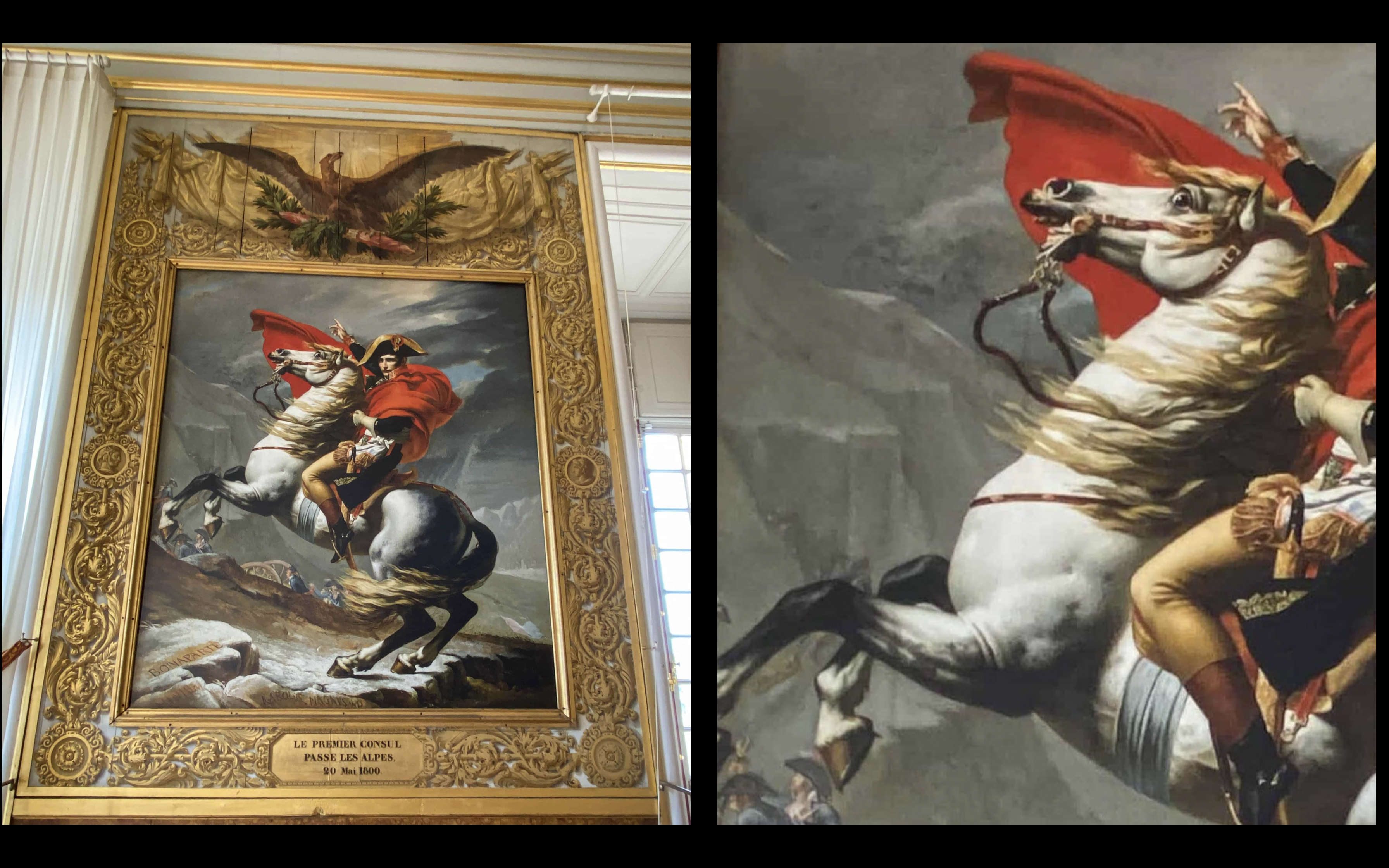
This is embrimaomai.  A warhorse, snorting mad, going into battle.  This is Jesus, deeply moved; he is angry.

I am somewhat frustrated that I looked through over 60 modern translations and couldn’t find one that translated “deeply moved” with the idea of anger.  Yet many commentaries firmly state that Jesus is angry here. (I finally found it in the German Luther translation (redone in 2017), where it said Jesus “was angry in his spirit and shook.”  It is as if our English translators are afraid to show Jesus as being angry.  Well…they need to get over that — Jesus was angry, shaking mad.  And what is Jesus angry about?  He is warhorse-snorting, fighting angry about death.

It was Elisabeth Kübler-Ross, in her 1969 book “On Death and Dying,” who first described what she called the five stages of grief over death.  They describe peoples’ common reactions to death in an attempt to normalize those feelings in a time of emotional upheaval.  They were never meant to be sequential, and many people don’t experience all of these feelings.   In her follow-up book in 2004, she tried to clarify that they are not steps that all go through or should go through.  Indeed, they describe many responses we have to death: denial, anger, bargaining, depression, and acceptance.
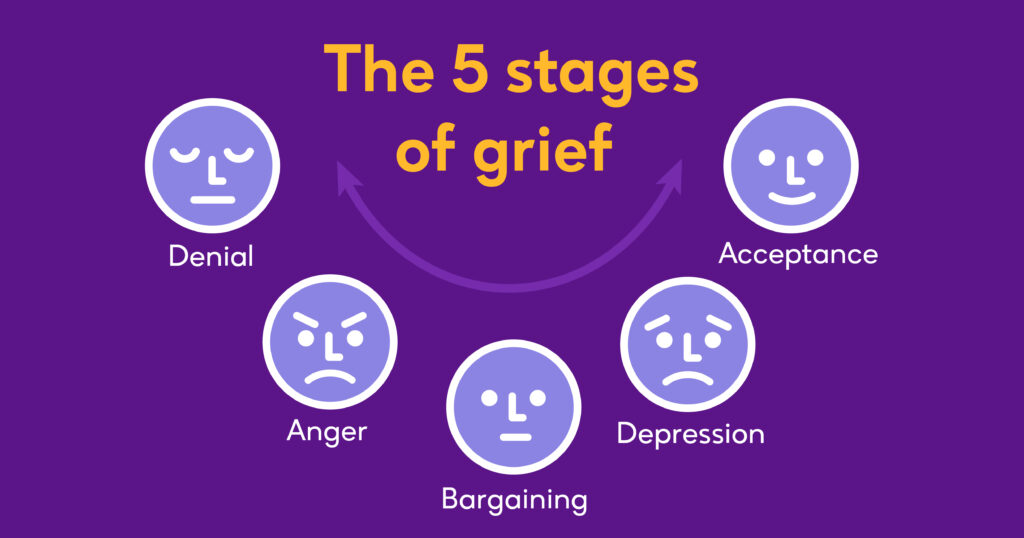
But let me tell you, Jesus is at the stage of anger.  Jesus is angry at death because when he created the world, death was not to be a part of it.  Life in the garden was designed to be without death.  Humans were designed to care for the world, walk with God as obedient followers, and have eternal life.  But then Genesis 3 happened.  Man chose to be disobedient, and sin came into the world, and with it, death came into the world.   Jesus looks at sin and death and gets angry because this is not what he intended for his creation. 

Death was not part of God’s plan.  Sin was not part of God’s plan.   But all of us have sinned, and all of us, by sinning, have welcomed death into the world.

 Let me show you how Jesus reacts to death.  Let’s look at Jesus’ stages of grief about death.  

Jesus doesn’t deny death.  He doesn’t get depressed about death.  Oh, he is saddened about the grief of others for sure, but not depressed about death.  And Jesus refuses to bargain with death.   And when Lazarus dies, Jesus doesn’t accept death.  Jesus gets war-horse snorting, angry at the death of Lazarus, and then does battle with death.  Jesus came to the Lazarus’ tomb angry enough to fight a war with death.  And Jesus has victory over death.
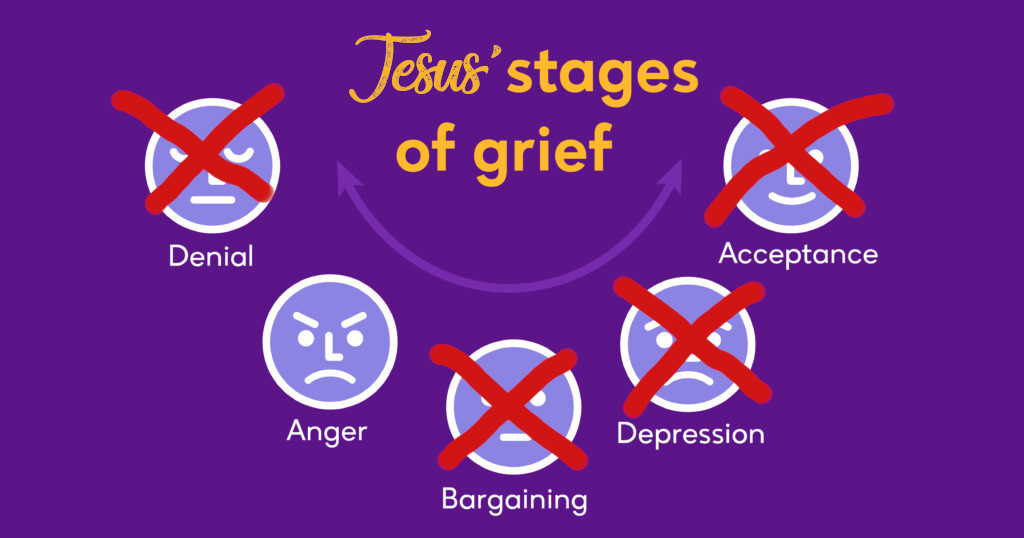
These are Jesus’ stages, straight from anger to victory.

Every time in the New Testament, Jesus encounters a corpse, it comes back to life.  He always defeats death.  Death cannot exist in his presence.

Jesus said, “I am the resurrection and the life.”  Note that resurrection is not what Jesus does; it is who he is.   He is the resurrection.  So death can not hold him.  

Now, you and I are not Jesus.  We will have emotional responses to death that may fall into any of these categories.  And sometimes, grief takes a very long time to process.  But you don’t have to live forever in these stages.  You don’t have to dwell in them forever because you know Jesus, the resurrection, and the life.  You know the one who has defeated death.  You don’t have to accept death as final because we know death is not the end.

Paul said it this way:
1 Thessalonians 4:13-14   But we do not want you to be uninformed, brothers, about those who are asleep, that you may not grieve as others do who have no hope.   Since we believe that Jesus died and rose again, even so, through Jesus, God will bring with him those who have fallen asleep.

Because of Jesus, we do not grieve like those without hope.  Everything is different when you realize death it is not the end.  But we all will grieve because knowing the end of the story doesn’t mean you won’t cry at the sad parts.

So Jesus shows intense emotion here, but his emotion is not weeping from grief but intense anger at death.  His tears shed here in sympathy to the grief of his friends are very subdued.

 Contrast that to a time in Jesus’ life, just a few weeks after Lazarus was raised, when he did cry with the intense emotion of klaio, weeping with deep emotion.  And what was the reason that Jesus wept bitterly then?  

It is on the first Palm Sunday, and Jesus is sitting atop a donkey’s colt; people are shouting, “Blessed is the King who comes in the name of the Lord! Peace in heaven and glory in the highest!.” He is riding down the Mount of Olives toward the city.  It is a celebration that is unparalleled in the gospel accounts.  Thousands are waving palm branches and shouting, “Hosannah!”  Amid this celebration, as the crowds descend the Mount of Olives and look across the Kidron valley to see the magnificent walls of Jerusalem and, just beyond them, the Temple, the place where Yehovah said he would place his name forever, Jesus interrupts the celebration.

While the crowd shouting praises, Jesus looks at the city and weeps over it.  And it is not the Greek dakruo, not simply the shedding of a tear, but the agonizing wailing and sobbing of the Greek klaio.

Luke 19:41-42   And when he drew near and saw the city, he wept (klaio) over it, saying, “Would that you, even you, had known on this day the things that make for peace! But now they are hidden from your eyes.”

This Jesus, who teared up when grieving the death of a good friend and seeing his friends grieving over Lazarus, is now moved to wail and weep bitter tears over what?  

Jesus knows that the praise and affirmation He is currently experiencing is short-lived.  In just a few days, another crowd will gather to shout out in his presence.  But it will not be shouts of praise but shouts of condemnation.  “Crucify Him!” they will shout to Pilate.  Just a few days after thousands entering Jerusalem proclaim his as their King, “Blessed is the King who comes in the name of the Lord!”  there will be another crowd shouting.  Pilate will present this same Jesus and say, “Behold your king!” to which the chief priests will answer, and the very authorities responsible for maintaining true worship will answer, “Crucify him; we have no king but Caesar.”

Jesus cries because, as John said, “He was in the world, and the world was made through him, yet the world did not know him.  He came to his own, and his own people did not receive him.  (John 1:10-11) 

Rejection always hurts.  But if it is someone you love, someone you have trusted, someone close to you, it always hurts you much more.  Jesus was rejected by the very people he loved so much that he left heaven to come and suffer and die for.

That is what Jesus says as he enters Jerusalem on Palm Sunday: “Because you did not know the time of your visitation.”  Jesus’ heart is broken, and he weeps, sobbing tears because they rejected him.  Because they refused his offer to repent and enter the kingdom of God.  

Luke 13:34-35   O Jerusalem, Jerusalem, the city that kills the prophets and stones those who are sent to it!  How often would I have gathered your children together as a hen gathers her brood under her wings, and you were not willing!  Behold, your house is forsaken. 

Jesus wanted everyone to accept him and his gift of forgiveness, repentance, and salvation, but most rejected him.

And Jesus knows the horrible consequences of their rejection of him.  The result is condemnation.  As Jesus told Nicodemus, “whoever does not believe is condemned already, because he has not believed in the name of the only Son of God.”  (John 3:18).  

And not only are the individuals condemned, but the entire city of Jerusalem stands condemned.  Let’s look again at Jesus response on that Palm Sunday, 

Luke 19:41-44   And when he drew near and saw the city, he wept (klaio) over it, saying, “Would that you, even you, had known on this day the things that make for peace! But now they are hidden from your eyes. For the days will come upon you, when your enemies will set up a barricade around you and surround you and hem you in on every side and tear you down to the ground, you and your children within you. And they will not leave one stone upon another in you, because you did not know the time of your visitation.”

Jesus knows that it is happening again.
Throughout the Bible, we see the same thing happen repeatedly.  God calls out a covenant people.  He rescues and redeems them. He brings them through the waters. He saves them from their enemies.  He teaches them from the mountain.  He showers love on them.  He asks them to live by the rules of His covenant.  He asks them to have no other Gods.  They must not follow their way but follow him as their king.  And over and over God’s covenant people turn to other Gods and worship idols of their own making: Baal, Astoreth, money, power, prestige, and the greatest idol of all, self.  They crossed the line, and God turned his face from them and let them reap the consequences of their actions.  So they were conquered by foreign countries, be it the Philistines, the Assyrians, the Babylonians, or the Romans.

And Jesus, the prophet, sees it happening again.

And it happens just as he said, for about 40 years after that Palm Sunday, Titus led an army of 50,000 Roman soldiers to encircle Jerusalem.  The siege began at the exact same time of year as Jesus’ entry into Jerusalem, the time of Passover, when thousands of pilgrims entered the city.  The siege lasted 143 days, cutting off supplies and leading to 4 months of mass starvation and death. 

The historian Josephus writes: 
“All hope of escaping was now cut off from the Jews, together with their liberty of going out of the city. Then did the famine widen its progress, and devour the people by whole houses and families; the upper rooms of women and infants that were dying by famine, and the lanes of the city were full of the dead bodies of the elderly; the children also, and the young men wandered about the market places like shadows, all swelled with the famine, and fell down dead wheresoever their misery seized them.”1

Then, the Romans broke through the walls and, killed over 600,000 Jews and took thousands more captive to be sold into slavery in Egypt or used as sport for the lions in the arenas.  And for the city itself, as Jesus predicted, not one stone would be left on another…

Josephus again:
“The Emperor ordered the entire city and the temple to be razed to the ground, leaving only the loftiest of the towers…and the portion of the wall enclosing the city on the west…all the rest of the wall that surrounded the city was so completely razed to the ground as to leave future visitors to the spot no reason to believe that the city had ever been inhabited.”2

And I have seen those massive stones, some the size of large trucks tumbled down on each other lying where the Romans pushed them down.   I have stood at the remaining western wall, praying with those who gather every day, mourning the devastation of that day, and praying for God’s return to this place where he put His name forever.

What drives Jesus to weep bitter tears?  Not for the death of a righteous man, Lazarus.  Not for death does he weep, for he is the victor over death, but he weeps for the unrepentant and for the result of their failure to repent — destruction.  

For thousands of years, the Jewish people had looked forward to the coming of the Messiah.  Prophets had predicted the glory of that time, the time of the visitation when the Messiah finally appeared.  This was supposed to be the most significant moment in Jewish history. But instead, it brought unimaginable judgment and suffering. And THIS is why Jesus wept over Jerusalem.  

What drives Jesus to weep bitter sobbing tears is not illness or death.  It is a lack of belief and a lack of repentance. It is the necessary judgment of a just God on those who refuse his gift of love, who refuse his gift of repentance, who refuse his gift of forgiveness, and who refuse to live under the covenant God established with them.  Oh, but Jesus knew that God would someday redeem this place. He knew God would return to the place where he had placed his name forever. The heavenly city would descend and be God’s city on earth forever. But on that Palm Sunday, Jesus wept because knowing the end of the story doesn’t mean you won’t cry at the sad parts.

And when God turns his face from Israel in the Old Testament and removes his protection from them, and then they are devastated by enemy nations, we may tend to see this as punishment by God.  But this should not be seen as punishment.  It is more like in a marriage relationship where one partner is abusive or sexually unfaithful.  At some point, the relationship is so broken that the other partner decides the only recourse is separation because the marriage covenant is broken. When Israel continues to be unfaithful to God and refuses to change (repent), then their covenant with God is broken, and there is separation.  God turns his face.  And separation from God is destruction.

What does this mean for us today?

We have been grafted into God’s covenant people through the blood of Jesus.  Like his covenant people of old, we have been rescued and redeemed from our enemy of sin and death.    God has showered his love and blessings on us.  As God’s covenant people, we enjoy this closeness to God.  Let us not forget who we are and what God has done for us. We must not follow after other Gods of greed, power, prestige, or self.

 Let us not break God’s heart by breaking our covenant with him.  

 Let us heed the warnings of the prophets.  Let us heed the warnings of Jesus.  He says at the very end of the sermon on the mount, we have to do more than just listen to his words. We have to follow them — obey them.  If we listen and do not do what he says, we are like the man who built his house on the sand.  We are doomed to destruction.  

Jesus shed a few tears, sympathizing with his friend’s grief over death.  But he wept bitter tears over his people who rejected him.  We will all weep bitterly as we face the loss of our loved ones.  But do we share Jesus’ sadness and grief over those who are turning away from God?  Do we weep for those who have wandered from God?  

James 5:19-20   My brothers, if anyone among you wanders from the truth and someone brings him back, let him know that whoever brings back a sinner from his wandering will save his soul from death and will cover a multitude of sins.

This is the work of the church.  As long as someone has breath in their lungs, they have an opportunity to repent. For these people, we join with Jesus and weep.   May our hearts be broken with the things that break the heart of God.

  1. The Works of Flavius Josephus. Translated by. William Whiston, A.M. Auburn and Buffalo. John E. Beardsley. 1895.
  2. Ibid.

February 25, 27 A.D.  –  Lazarus is dying — The Year of the Lord’s Favor #73

Week 54 — Lazarus is dying
John 11:1-16

It was just 9 weeks ago that Jesus spent a week with his friend Lazarus and his sisters Martha and Mary.  He stayed with them during the holidays of Hanukkah at their home in Bethany, as he often did, for Bethany is just over a mile from Jerusalem.  During that visit, he again clashed with the religious leaders in Jerusalem who were already seeking to kill him. At one point, they “picked up stones to stone him” (John 10:31).  So Jesus left Judea after Hanukkah and went east to Perea, the territory on the other side of the Jordan, to preach and heal there.  This is the territory of Herod Antipas, and 2 weeks ago, Jesus learned that this Herod was also seeking to kill him and began to move northward, away from Herod’s palace at Macherus, back towards Judea.  He is teaching as he goes.  He has just told the parable of the rich man and Lazarus.  It is at this point that Jesus receives the news that his friend Lazarus is very ill.

John 11:1-16   Now a man named Lazarus was sick. He was from Bethany, the village of Mary and her sister Martha.  (This Mary, whose brother Lazarus now lay sick, was the same one who poured perfume on the Lord and wiped his feet with her hair.)  So the sisters sent word to Jesus, “Lord, the one you love is sick.”
When he heard this, Jesus said, “This sickness will not end in death. No, it is for God’s glory so that God’s Son may be glorified through it.”  Now Jesus loved Martha and her sister and Lazarus.   So when he heard that Lazarus was sick, he stayed where he was two more days,   and then he said to his disciples, “Let us go back to Judea.”
“But Rabbi,” they said, “a short while ago the Jews there tried to stone you, and yet you are going back?”
Jesus answered, “Are there not twelve hours of daylight? Anyone who walks in the daytime will not stumble, for they see by this world’s light.  It is when a person walks at night that they stumble, for they have no light.”
After he had said this, he went on to tell them, “Our friend Lazarus has fallen asleep; but I am going there to wake him up.”
His disciples replied, “Lord, if he sleeps, he will get better.”   Jesus had been speaking of his death, but his disciples thought he meant natural sleep.
So then he told them plainly, “Lazarus is dead, and for your sake I am glad I was not there, so that you may believe. But let us go to him.”
Then Thomas (also known as Didymus) said to the rest of the disciples, “Let us also go, that we may die with him.”

The Gospels repeatedly emphasize Jesus’ love for Lazarus and his sisters, including in verse 5 here. But that makes verse 6 all the more puzzling. 

Now, Jesus loved Martha and her sister and Lazarus.   So when he heard that Lazarus was sick, he stayed where he was two more days,   and then he said to his disciples, “Let us go back to Judea.”

The reason why Jesus didn’t leave immediately to go see about his friend was “that he loved them so much”?  Jesus receives a desperate plea for help and demonstrates his love by waiting 2 days before he leaves.

Let’s look at the timing here.  Lazarus is ill to the point that his sisters feel the need to call their miracle-working friend to come and heal him.  It would take a full day’s journey for a messenger to get the word to Jesus. It was at least 22 miles.  He delays 2 days and then takes a full day to travel to Bethany. Verse 17 tells us, “On his arrival, Jesus found that Lazarus had already been in the tomb for four days.” Do the math.   Lazarus must have died shortly after Mary and Martha sent the messengers off to tell Jesus of his illness.   Lazarus is already in the grave before the messenger arrives and makes it to Jesus.

This is Israel 2000 years ago.  There was no embalming of bodies as they did in Egypt. Oh, they used spices and perfumes to cover the smell, but they did nothing to stop the decay.  And in such a climate, decomposition of the body began quickly.  Except in unusual occasions, bodies were prepared for burial and placed in the tomb on the same day of death.  Today, in Orthodox Jewish communities, burial is still held within 24 hours of death.  (The rabbis see this as a command from Deuteronomy 21:23.)   So soon after the messenger left, Lazarus died, and they closed his eyes, washed his body, anointed it with perfumes and spices, and wrapped the corpse with strips of cloth.  Then, there would be a procession of family and friends to the family tomb, where the body would be placed on a slab of stone cut out of the cave’s walls.  The tomb was then sealed with rocks or a rolling stone.  Mourning would continue at the home for seven days.  After a year, the tomb would be opened, and the bones collected and placed in a stone box called an ossuary.

So, by the time the messenger arrives to tell Jesus that Lazarus is ill, he has already died and been placed in the tomb. It is too late to prevent his death. Jesus could rush to Bethany immediately and join Mary and Martha in grieving, or he could rush back and stop their mourning by raising Lazarus the next day, but he waits two days before he leaves.  

In the first century, there were no doctors to examine someone and pronounce them dead.  And rarely, someone could appear dead when they were not.  Their heart could be fibrillating, and their breathing so shallow that most people would not detect any signs of life.  There are reports of people being carried to their tombs and rising back to life.  This led to the belief that the spirit hovered over the body for three days, hoping to reenter the body, but then after 3 days, when full decomposition had begun, the spirit departed.

Had Jesus left immediately and revived Lazarus after only a day or two, it would have been impressive but not an undeniable miracle of God.  Jesus wanted there to be no doubt when Lazarus was raised to life that he was dead beyond hope of resuscitation.  Jesus would not let God’s victory over death be cheapened because people had these mistaken thoughts about the spirit hovering.

Jesus frankly tells the disciples that he knows that Lazarus is already dead and says something that seems really odd, “for your sake, I am glad I was not there so that you may believe.”   Jesus says I am so glad I was not there to heal Lazarus before he died.  What must the disciples have been thinking when Jesus said this?  They didn’t know yet that Jesus would raise Lazarus from the dead.  So they see Jesus doesn’t rush off to heal when he hears Lazarus is sick, and then Jesus says, “I am so glad I wasn’t there to prevent Lazarus’ death.” 

I think of the many times in my career as a pediatrician that I raced to the hospital to resuscitate a newborn.  Many was the night I received a phone call and drove way over the speed limit to rush up to the hospital nursery because a baby had been delivered prematurely and needed advanced resuscitation.  Many times, I ran from our office across the hospital campus and up the stairs to the OB ward or nursery to prevent the death of a baby.   Thankfully, most of those trips were successful, but some were not.  And still today, there are some times when I still relive those moments in the early mornings, even now wondering if I could have gotten there sooner or done something more.  In my job, illness and death were the enemy we all dreaded, but they were always near at hand.  

But Jesus says, “I am so glad I was not there to prevent Lazarus’ death.”

What is Jesus saying?

Jesus is living out the second beatitude.   The sermon on the mount begins in Matthew 5 with eight statements of the good life, descriptions of the ones living the good life, the lucky ones, the happy ones.  And they are groups of people who would be least expected to be happy:  the poor, the hungry, the disadvantaged, the powerless.   The second beatitude is:

Matthew 5:4  Blessed are they that mourn, for they shall be comforted.

Happy are they that mourn!  How lucky are the mourners, for they will find comfort!  
How odd are the Beatitudes!  How in the world do you expect people mourning the death of a loved one to be the fortunate people?  For they will be comforted.

Some lessons you can’t learn from just hearing them.  Some things can only be learned from experience.  The disciples had listened to his sermon back in July, but they hadn’t lived it yet.  There is a big difference between hearing the words of Jesus and experiencing the words of Jesus.   They knew that Jesus said that those who mourn were the lucky ones, and some of the disciples wrote it down.  But did they understand what Jesus was saying?  Do we understand what Jesus was saying?

Don’t just read the words; live the words.

Can you imagine the joy that Mary and Martha felt when they realized Lazarus was alive again?  Some of you can.  Some of you have had news that came close.  When the follow-up scan says, there is no more sign of cancer when you get news that your family member in the horrible accident that you were told would probably die is now expected to live.  

I remember clearly a certain premature baby.  I spent over an hour resuscitating and ventilating this baby one early morning.  Born at 24 weeks, her prognosis was very poor.  She needed surfactant, a medicine instilled into the lungs of premature babies to allow their stiff lungs to expand.  But that is not available in any rural hospital.  Nor was the high-frequency oscillating ventilator we needed to breathe for her with her premature lungs.  So I breathed for her with a hand-squeezed bag for over an hour because that was the best you have in any rural hospital.  And that morning, the transport team was delayed.  It became harder and harder to breathe for her as her lungs became stiffer and stiffer.   Despite our best efforts, her oxygen was dropping, and then her heart stopped.  We continued to ventilate and do chest compressions for more than 15 minutes, giving all the code blue medications possible to attempt to revive her.  One by one, the nurses and respiratory techs said we needed to stop because she was gone.  But I couldn’t let go.  I couldn’t stop.  And then, unexplainably, her heart started beating, her oxygen came up, and just after that, the transport team arrived with the medicine needed to decrease the stiffness in her lungs.  She survived that night and, after 4 months in the Neonatal Intensive Care Unit, was able to go home.

But that moment when her heart started… There is no possible way I can explain to you the joy that spread in that room.  She had been given up for dead, the room was full of tears, and we were all mourning, but then she came back to life, and let me tell you, worship broke out in that nursery, praising God for the gift of life.  For it was nothing we did.  We had exhausted every intervention available to us.       But God…

Oh, what a moment, when everything changes
Imagine the glory; imagine the praises.1

I don’t have to imagine it, for I have lived it more than once.

There is no rejoicing like the rejoicing of the victory of life over death.  You can read the words of the Bible, and you can study them, but they come truly alive when we see how we have lived them out and then share them with each other.  How wonderful it is for those who mourn, for they will be comforted.

This is the attitude we see in David in Psalm 30.   David was sick to the point of death with no medical treatment available, and he cried out to God, and God healed him, and Psalm 30 is his response.

O Yehovah, my God, I cried to you for help, and you have healed me.
O Yehovah, you have brought up my soul from the grave; you restored me to life from among those who go down to the pit.
Sing praises to Yehovah, O you his saints, and give thanks to his holy name.
Weeping may tarry for the night, but joy comes with the morning.
You have turned for me my mourning into dancing; you have loosed my sackcloth, and clothed me with gladness, that my glory may sing your praise and not be silent.
O Yehovah my God, I will give thanks to you forever!

David thought he was going to die, but God turned his mourning into dancing.  And in our passage today, Jesus knew something that the disciples didn’t realize — Lazarus’ death was only temporary.  Those who now mourn will soon find comfort, and they shall rejoice.

Are you a Second Beatitude believer?  Can you see tragedy, illness, and death as just another opportunity for God to reveal his glory? Can you grasp the incredible brevity of our grief compared to the eternity of our joy?  The key to our passage today is verse 4:

John 11:4  Jesus said, “This sickness will not end in death. No, it is for God’s glory so that God’s Son may be glorified through it.”

“This sickness will not end in death.”  Don’t miss the point that Jesus makes this statement, knowing that Lazarus is already dead.  It is not a statement about the prognosis of the illness but about the temporal nature of death.   Jesus says, “This sickness will not end in death” because Jesus knows that death is not the end.  Death is never the end.  It was not the end for Lazarus, and it is not the end for you either.   The year after the dash on a headstone is not an ending date but a relocation date.

Let’s look at another Psalm.  This one you know very well, Psalm 23.  

Yea though I walk through the valley of the shadow of death, I will fear no evil, for you are with me.  

I know you have this memorized, but look at this carefully.  You walk through the valley of the shadow of death.  The valley of the shadow of death is not a destination, it is not where we go to but where we go through.  Death is not the end.  Then, what is the destination of the journey in the 23rd Psalm?  It is in the last verse:

Surely goodness and mercy shall follow me all the days of my life,

For all the days I live, God’s goodness and mercy follow.  But wait, ‘follow’ is too tame a word for the Hebrew there ‘radaf.’  ‘Radaf’ doesn’t mean ‘follow,’ but ‘pursue,’ chase after with the intent to do something.  ‘Radaf’ is the picture of a lion pursuing its prey.  A lion doesn’t follow; a lion pursues — the lion’s intent is not just to see where it goes, not just to catch it, but to consume it.  ‘Radaf’ is to chase after something with the intent to act on it.  God’s mercy and goodness pursue us every day of our lives; they chase after us like a lion in order to change us, to change our hearts, and to radically alter our circumstances.

And then — and then after all the days of our lives – and then it is not the end — and then I shall dwell in the house of Yehovah forever.

Surely goodness and mercy shall pursue me all the days of my life, and I shall dwell in the house of Yehovah forever.

Death is not an end.  We shall dwell in the house of Yehovah forever.  This is the gospel. This is the good news.  Oh, how I would like to make signs that have Jesus’ quote from John 11:4, “This sickness will not end in death” – Jesus.”   I want to put them in every hospital cancer ward, in every ICU, in every hospice room.  Death is not the end.  Jesus has spoken.

And in just a few days, after our passage this morning, those disciples heard Jesus speak, heard him say,  “Lazarus, come out!”  And they saw the glory of God as he defeated death.  Mourning turned to joy, and grieving turned to glory. 

And in just a few months later, they see Jesus alive three days after he dies, and they will again see God glorified as he pronounces the final defeat of death.  Blessed are they that mourn, for they will be comforted.

It is natural to fear dying.  Dying can be a painful process.  But there is no need to fear death.  For it is but another opportunity for God to show his glory as he brings you closer to his side.  As long as we walk on this earth, we walk each day in the shadow of death, the shadow of the dying.  But Jesus says none of these illnesses, none of these cancers, none of these traumas will end in death.  For those we mentioned this morning who are grieving the death of their son, his story does not end in death.  For death is not the end.  We, like Lazarus, will be called out of the grave.  

John 11:25-26  Jesus said to her [Martha], “I am the resurrection and the life. The one who believes in me will live, even though they die; and whoever lives by believing in me will never die.” 

And then he asks Martha the most important question anyone will ever ask.  

“Do you believe this?”

Do you believe this?  Are these more than just words on a page to you?  Are you living them out?  If you believe these words, it changes everything.  We need not fear the shadow of death or death itself.  We need not fear cancer, heart problems, accidents, evil, or sin.  Because none of these things will be the end.  All these things we fear in life are simply opportunities for God to show his glory as he defeats illness, sin, and death.  There may be times it seems the enemy is winning, that the disease has the better of you, that sin has a hold on you, but know this:  Sin has no victory, Illness has no victory, and Death has no victory.  

Seven hundred years before Jesus’s birth, the prophet Isaiah saw the day coming when the pursuit of God’s mercy and grace would reach its climax. 

Isaiah 25:7   And Yehovah will swallow up on this mountain the covering that is cast over all peoples, the veil that is spread over all nations.

Right here, on this mountain in Jerusalem, God will destroy that shroud of death that hangs over all of us.

Isaiah 25: 8 “He will swallow up death forever; and Yehovah Elohim will wipe away tears from all faces, and the reproach of his people he will take away from all the earth, for Yehovah has spoken.”

He will remove the reproach, the shame of our sins from us, casting them off the planet. God has spoken; it will come to pass.

And they waited another 700 years for this.  And then Jesus came — and this resurrection of Lazarus in the suburbs of where Isaiah was prophesying was just a small taste of what Jesus would do just a few months later on that very mountain where on the cross and from the tomb like Lazarus the stone would be rolled away, and death would yield to eternal life.

Isaiah 25:9 It will be said on that day, “Behold, this is our God; we have waited for him, that he might save us.  This is Yehovah; we have waited for him; let us be glad and rejoice in his salvation.”

So we say today, this is Yehovah; this is his son Jesus.  We have waited for him to turn mourning into joy.  Now, let us rejoice in His salvation.  Let us say as the apostle Paul said (1 Corinthians 15:54-56), quoting Isaiah, “Death is swallowed up in victory.” (Isaiah 25:8)  and quoting Hosea, “Death where is your victory? Grave, where is your sting? (Hosea 13:14).

1 Corinthians 15:56 The sting of death is sin, and the power of sin is the law. But thanks be to God, who gives us the victory through our Lord Jesus Christ.

I heard an old, old story,
How a Savior came from glory,
How He gave His life on Calvary
To save a wretch like me;
I heard about His groaning,
Of His precious blood’s atoning,
Then I repented of my sins
And won the victory.

O victory in Jesus,
My Savior, forever.
He sought me and bought me
With His redeeming blood;
He loved me ere I knew Him
And all my love is due Him,
He plunged me to victory,
Beneath the cleansing flood.2

1.  Lyrics from “He Welcomes the Beggar” by 11th Hour. 2016.  This is the song our church trio sang on the day this message was given.
2. “Victory in Jesus.” Eugene Monroe Bartlett. 1939.

August 24, 27 A.D.  Do not be Afraid Any Longer #48

Week 28 ———  Do not be Afraid Any Longer
Matthew 8:18 – 9:26  — Mark 4:35-5:43 — Luke 8:22-8:56

(**Note: Portions of the following are from a sermon done on 9/1/2024.  Some material is repeated from #47, “Jesus Calms the Storm.”)

Last week, we discussed the woman with the issue of blood that touched Jesus.  We talked about what a busy week that was for Jesus.  He calmed the storm on the Sea of Galilee; he cast demons from a man on the Gentile side of the Sea.  He was teaching in Capernaum when he was interrupted by a man whose daughter was dying, and on the way to heal his daughter, he was touched by a woman who had been bleeding for 12 years. 

This week, Jesus sent the disciples on a three-week mission trip to the Galilee. We know that during those three weeks, Jesus spent time teaching and healing near Capernaum, but because none of the disciples were around, we don’t have any specific accounts of that time. Next week, we will talk about Jesus sending out the 12, but today, I want to go back and look at some of the previous week’s events that we didn’t cover.  

Mark 4:35-41   On that day, when evening had come, he said to them, “Let us go across to the other side.”…  And a great windstorm arose, and the waves were breaking into the boat, so that the boat was already filling.   But he was in the stern, asleep on the cushion. And they woke him and said to him, “Teacher, do you not care that we are perishing?”   And he awoke and rebuked the wind and said to the sea, “Peace! Be still!” And the wind ceased, and there was a great calm.  He said to them, “Why are you so afraid? Have you still no faith?”  And they were filled with great fear and said to one another, “Who then is this, that even the wind and the sea obey him?”

The Sea of Galilee is not actually a sea but a lake.  It is about 8 miles wide and 13 miles long.  But the area’s unusual geography can cause this small lake to have waves that were measured at 10 feet in 1992. Shirley and I had a chance to witness 4-5 feet waves on our first trip to Israel.  Our boat trip was canceled, and looking at those waves, I didn’t want to be out there.   Here is a picture of waves on the sea looking from the eastern side to the west.   The steep northern slope of Mt. Arbel is visible on the other side of the sea.

The boats used on the Sea of Galilee in Jesus’ day were not large.  A drought in 1982 exposed the hull of a first-century fishing boat that had sunk and was covered in mud.  It is in a museum on the shore now.  This is what it would have originally looked like:

It was 27 feet long, 7.5 feet wide, and only 4 feet high. It could carry 13-15 people. Its very shallow draft allowed it to get very close to shore, but this also made it susceptible to taking on water from wind and waves. 

So, the 13 of them are in a small boat in a storm with large waves.  Some of these men with Jesus were professional fishermen.  They were very familiar with this boat and this lake.  But the storm that blew up that night was especially violent.  Mark tells us that the boat was filling with water, and Jesus was sleeping in the stern.  They wake Jesus, saying, “Teacher, do you not care that we are perishing?” Or “How can you possibly be sleeping when we are all about to die?”  They were scared to the point of death.  They were scared of death.

Have you ever been scared of death?  I have.

We were on a flight, and the turbulence got bad. The plane was bouncing all over and, at one point, dropped straight down about 10 feet. Many were getting sick and using those bags in the seat back pocket. And everyone, if they would admit it, was scared.

One winter night, we were on our way to Memphis on a two-lane road and hit a patch of black ice. Our vehicle began spinning round and round, and an oncoming car was heading toward us. We had no control of the car. We were all scared.

I was lying on a stretcher one morning alone in a room before a major surgery.  As a medical student and resident, I saw many things go wrong in the Operating Room.  I had seen very healthy people not wake up after simple surgeries. I saw a young man have a severe reaction other than anesthesia and never make it to the first incision.  And for a few minutes, fear swept over me to the point I broke out in a cold sweat.  

But I would bet that everyone here in this room has had a few times in their life that they were scared they were about to die.

These disciples thought they were about to die.   And what was Jesus doing while they were scared to death?  Jesus was sleeping in the back of the boat.  They couldn’t imagine how Jesus could be sleeping when they were scared to the point of death.  But Jesus couldn’t imagine how they could be so concerned about a storm when they were in the boat with God.

He asks them, “Why are you afraid?”   What kind of question is that? Are you kidding?  As Max Lucado says, it is like one swimmer asking another, “Why are you wet?”1  

“And Matthew records that he said to them, “Why are you afraid, O you of little faith?”  In Matthew 17:20, Jesus describes ’little faith’ as faith less than the smallest thing he can show them, a mustard seed, so ‘little faith’ means no faith at all.  That is how Mark said it in the passage we just read: “Why are you so afraid? Have you still no faith?”  They had “no” faith.

 Why did Jesus say they had ‘no faith’?  Because, at this point, they really don’t understand who Jesus is.   Oh, they have seen him perform miracles and heal people.  But they knew the stories of prophets in the Bible who had done such things.  They thought he was a great prophet, perhaps even the Messiah.  But they didn’t have the full knowledge of who Jesus was.

God spoke the sea into existence. They are in the boat with the creator of the sea, and they don’t know it.  They don’t yet have that understanding, or, more importantly, they don’t have that relationship. Remember that understanding or knowledge in the Bible means relationship.  You don’t know something until you experience it for yourself.  They knew a lot about Jesus.  Some of them have been with him for months. They know him as a great teacher, prophet, and healer.  They know him as a great man of God — but they don’t yet know him as the man who is God.  And that is all the difference.  

There are a lot of people today who are, well, in the same boat.  They know Jesus as the man in the New Testament who did miracles and taught.  They may have sat in church for years and heard stories after stories of what Jesus did.  They may be church members, give money to the church, or hold office there.  But none of that will help when the time comes when you are scared to death.  You must have knowledge through a relationship with Jesus as the Son of God.  Unless you know him as your personal savior, then you have no faith.  As Billy Graham often said, there will be a lot of surprises on the day of judgment for people who thought they were good with God because they did all the right things, but then Jesus said, “Depart from me.” And why does Jesus tell these people to leave?  “For I never knew you.”  On the day of judgment, either you have a personal relationship with Jesus or you don’t.

But at this point, these disciples have zero faith.  But this week, Jesus is going to challenge their thinking. If they thought of him as just a prophet, he will show them how he calms a storm and later raises the dead. 

For you see, faith is trust built up through experience.  Our faith grows as we witness God’s trustworthiness.  God sees us through something, and our faith grows.  God keeps his promise, and our faith grows. This is one reason it is so important to study the Scriptures.  In them, we see the long history of God being faithful to his promises.  We learn more about God’s trustworthiness through the people’s experiences with God in history.  Perhaps we won’t have to learn every lesson for ourselves the hard way.  This is why sharing our walk with God with the people around us is so important.  Our faith can grow through each other’s experiences by telling the stories of God’s faithfulness.  We don’t spend enough time telling each other our stories.  With whom are you sharing your stories of your walk with God?

But these disciples are not there yet.  They have no faith so they are scared to death in a storm.

Then Jesus, who in the beginning, spoke the water into existence, calms the storm with a word.  The storm is over; the waters are calm, and the danger has passed.  So now the disciples should be relieved. But Luke tells us that they are afraid.

Luke 8:25  And they were afraid, and they marveled, saying to one another, “Who then is this, that he commands even winds and water, and they obey him?”

What are the disciples afraid of now?  They had seen Jesus do miracles before, but he just turned off the forces of nature like we would flip a light switch. They were amazed and confused after this awesome display of power.   Who is this guy?  I imagine the rest of that boat trip was really quiet.   There were prophets of old who could heal or do miracles, but this controlling nature is God-stuff.  Whatever they thought of Jesus before has been challenged.  Just who is this man that speaks and the world obeys him?  Who is this guy who has the power of God himself?  And honestly, they are scared of the answers to those questions.

But the boat arrives safely, and we continue:

Mark 5:1-20   They came to the other side of the sea, to the country of the Gerasenes.  And when Jesus had stepped out of the boat, immediately there met him out of the tombs a man with an unclean spirit.   He lived among the tombs. And no one could bind him anymore, not even with a chain, for he had often been bound with shackles and chains, but he wrenched the chains apart, and he broke the shackles in pieces. No one had the strength to subdue him.   Night and day among the tombs and on the mountains, he was always crying out and cutting himself with stones.   And when he saw Jesus from afar, he ran and fell down before him.  

 The Bible doesn’t tell us how the disciples reacted to this, but don’t just read the words; picture them in your mind.  This man who is so strong no one can subdue him, strong enough to break chains and shackles, sees Jesus from afar and comes running out of a graveyard towards them, and he is naked.  Imagine how the disciples felt.  How do you think they reacted?  Were they afraid?  Did some of them start running toward the boat?

 “And crying out with a loud voice, he said, “What have you to do with me, Jesus, son of the Most High God? I adjure you by God, do not torment me.”  

The demons know something the disciples haven’t figured out yet: Jesus is the son of the most high God.  And they are terrified of Jesus.   They should be afraid, for they stand in opposition to God. James, in his discussion about belief without the obedience of good works, said it well: (James 2:19) “The demons believe [there is one God] and they tremble.”  

“For he was saying to him, “Come out of the man, you unclean spirit!”   And Jesus asked him, “What is your name?” He replied, “My name is Legion, for we are many.”   And he begged him earnestly not to send them out of the country.   Now a great herd of pigs was feeding there on the hillside,  and they begged him, saying, “Send us to the pigs; let us enter them.”   So he gave them permission. And the unclean spirits came out and entered the pigs, and the herd, numbering about two thousand, rushed down the steep bank into the sea and drowned in the sea.

“The herdsmen fled and told it in the city and in the country. And people came to see what it was that had happened.   And they came to Jesus and saw the demon-possessed man, the one who had had the legion, sitting there, clothed and in his right mind, and they were afraid.   And those who had seen it described to them what had happened to the demon-possessed man and to the pigs.   And they began to beg Jesus to depart from their region.”

This man was possessed by many demons.  This whole area lived in fear of him.  But Jesus comes and heals the man; he casts out the demons, and then we see him clothed and in his right mind, sitting at the feet of Jesus.  So, how do the villagers respond?  Well, of course, they throw a big party.  They celebrate that this scary man is not scary anymore.  They celebrate that Jesus has healed one of their own.  Nope.  “They began to beg Jesus to depart from their region.”  They were no longer scared of the man; they were now afraid of Jesus.  Just like the disciples in the boat, they went from fear of a situation to fear of Jesus because they, too, didn’t understand who he was.

As he was getting into the boat, the man who had been possessed by demons begged him that he might be with him.  And he did not permit him…

Notice the difference between the villagers’ and the healed man’s reactions.  The villagers beg Jesus to leave.  The man who was healed begged to stay with Jesus.  What is the difference?  It is faith built on experience.  This man has seen firsthand what Jesus can do.  He has experienced the power of God.   And this experience is the difference.   He is the only one in these two stories that gets it.   So, he wants to stay with Jesus.  But Jesus refuses to let this man stay.  Is it because he is not Jewish?  No.  Jesus has a mission: 

“Go home to your friends and tell them how much the Lord has done for you, and how he has had mercy on you.”  And he went away and began to proclaim in the Decapolis how much Jesus had done for him, and everyone marveled.

Jesus just sent this man, the former crazy, naked, strong man living in a graveyard, to be his witness in the Gentile area of the Decapolis.  And in about three weeks, Jesus will return to the same area that he was asked to leave. And you can’t believe how different the people will react to Jesus.  He will be welcomed, and thousands will stay for days to hear him teach and be healed.  And how in the world is it possible for things to change so much so quickly?  Who or what made these people change their minds about Jesus?  We’ll talk about that in 3 weeks.

But for now, they were asked to leave, so they headed back in the boat to Capernaum.

Jesus is then teaching in Capernaum, but he gets interrupted by one of the synagogue leaders, Jairus, whose daughter is dying.  Jarius is afraid.  He fears for his daughter’s life.  Nothing strikes fear in the heart of a parent or grandparent than a child who is sick or in danger.  On the way to Jairus’ house, Jesus is interrupted by the woman we talked about last week who is healed by touching the tassel on his garment.  While Jesus is talking to her, a man comes to Jairus and says, “Your daughter is dead. Why trouble the Teacher any further?”  Jairus’ heart sank.  His worst fears are realized.  His daughter has died—a parent’s worst moment.

But then Jesus interrupts:

But overhearing what they said, Jesus said to the ruler of the synagogue, “Do not fear, only believe.”

And Jairus stands in the middle between these two. Between horror on one side and hope on the other.   Between disaster and diety.   Between fear and faith.  Have you lived in that moment between the two?  That’s why Matthew is telling these stories.  In this troubled world, we are often thrust into the middle between fear and faith.  What are you afraid of?

The Greek word for fear in the New Testament is ‘phobos,’ the base for our word phobia.  There are currently more than 550 named phobias.  The four most common are: 1. Social Phobias (fear of crowds, social situations, speaking, etc.)   2. Fear of Animals (dogs, snakes, insects, or mice), 3. Claustrophobia (fear of closed-in spaces), and 4. Acrophobia (fear of heights).   However, how words are used changes over time, and this can cause confusion when reading what the Bible says about fear.  For example, if I asked you to quote a Bible verse about fear, you might say:

Proverbs 9:10   The fear of the LORD [Yehovah] is the beginning of wisdom.

And then I might ask you, “Are you afraid of God?”  Does that seem like an odd question?  These days, when God is pictured as a ‘kind old man’ or ‘your best buddy,’ it may seem strange.  But I remember hearing many “fire and brimstone” sermons as a child that made me very scared of what God might do.

The Bible is not telling us to be afraid of God.  As a matter of fact, the most common command in the Bible is “Do not be afraid.”  So what is Proverbs 9:10 saying?  Remember that the way words are used changes over time.  Think back to the days when people were ruled by kings who held absolute power over their subjects.  To ‘fear the king’ did not mean the same thing as to ‘be afraid of the king.’  To fear the king meant to be utterly loyal to the king, carrying the idea of awe and respect in the realization that this king has absolute power over you.  In contrast, to be afraid of the king was to be scared of what the king might do.  So “the fear of Yehovah” in this verse is about having absolute loyalty and obedience to God, with awe and respect.  

There can, however, be a good reason to be afraid of God, as Jesus implies:

Matthew 10:28-31 And do not fear those who kill the body but cannot kill the soul.

For those who oppose God (like the demons we talked about earlier), fear of God’s justice is warranted. This fear can lead some to repentance. However, contrary to my childhood experience of scary sermons, this should not be our primary tool for evangelism.

Now, we can see how the disciples’ reaction to Jesus in the boat differs from that of the people across the lake.  The disciples witnessed Jesus do more than any prophet had ever done before.  They have awe and respect after that display of power.  After learning that Jesus had cast out the demons from the man into the pigs, who ran into the sea, the villagers were scared of what Jesus might do next.  They were already missing 2000 pigs and weren’t happy about that.  These are two different displays of fear.

The difference in these reactions is significant.  This is the place Jairus was standing, between fear and faith. The difference is your worldview.  What kind of world do you live in?  

Skip Moen said it this way:

“There are two different worldviews competing for your allegiance.  The first is the world of constant familiarity.  It is a world of risk and fear.   It is the world of the nightly news where tragedy, risk and trauma are given prime importance.  This world is the world of security concerns, insurance protection, hedge funds and hurricane warnings.  It is the world of the terrorist, the thief, the con man and the kidnapper.  In this world, being afraid is an important component of capitalism.  We are taught to be afraid of bad breath, crooked teeth, wrinkles and out-of-fashion clothes.  This kind of fear produces all sorts of actions in attempt to reduce risk.  But in the end, this world is unpredictable, hostile and dangerous.  When I believe that the world is ultimately fearful, nothing I can do will actually overcome my dread of the future.  I will always confront “but what if”.

The second paradigm is God’s view of the world.  It is not based on fear.  It is based on the fact that God loves what He creates and that He can be trusted to manage His creation.  From God’s perspective, the only proper fear is the fear of Who He is.  That fear is designed to bring me to repentance and seek Him.  That fear produces faith in His grace and trustworthiness.  When I believe that the world is actually in the hands of an almighty God Who loves me and has my best interests at heart, I no longer dread the future.  In fact, I can give up trying to manage the consequences of my life.  I stop living with the myth of control and start living with the reality of submission.”2

One view says God is irrelevant and that we should all live scared to death of many things. The other says God is sovereign—in complete control of everything—and we need not be afraid of anything or anyone, but we are to be loyal, obey, awe, and respect God alone.

The airplane drops 10 feet, and  I get scared.  Oh, me of ‘little faith.’  
The car spins on the ice, and I am afraid.  Oh, me of ‘little faith.’
I imagine everything that can go wrong as I enter surgery, and I become frightened. Oh, me of ‘little faith.’   

Moen said, “Fear produces faith.”  How does that work?   

The airplane drops, but we are all okay. The car spins, and through a miracle of God, the ongoing vehicle doesn’t hit us. On the day of my pre-surgical fear, God’s voice comes to me as clear as you hear me now and says, “Don’t worry; I’ve got this. ” Though I could look at my previous fears as failings, God used them as experiences where my faith could grow.  

Aristotle said the thing to be feared most is death because it appeared to be the end of everything.3

Mark 5:36  (NASB)  But Jesus, overhearing what was being spoken, said to the synagogue official, “Do not be afraid any longer, only believe.”

Hear the good news as Jairus did!  You do not need to be afraid any longer!   You do not need to fear storms, weird people in the graveyard, or even death.  (Aristotle was wrong about this and pretty much everything he ever said.)  Jesus said, “Fear not anything that can kill the body.”  You aren’t leaving this earth until Jesus says so.  This past week, my friend Danny died.  He was a wonderful man of God who spent his whole life as a teacher and coach, influencing young people for Jesus.  Let me tell you, Danny did not fear death because Danny knew Jesus, not just knew of him, but had an active relationship with him. 

The most common command in the Bible:  “Do not be afraid!”
The most common promise in the Bible:  “I will be with you.”

Do you see how these fit together?  We do not need to be afraid because God is with us.  This is the message of the Bible from beginning to end.

Psalm 23:4   “Even though I walk through the valley of the shadow of death, I will fear no evil for you are with me.”

John 14:1-2  (NLT)  “Don’t let your hearts be troubled. Trust in God, and trust also in me.  There is more than enough room in my Father’s home.  If this were not so, would I have told you that I am going to prepare a place for you? When everything is ready, I will come and get you so that you will always be with me where I am.

God has promised to always be with us.  We need not fear the storms because Jesus is in the boat with us.  We need not fear death because when we leave this world, God does not abandon us – He will be with us forever.  

Hebrews 12:1-2  Therefore, since we are surrounded by such a great cloud of witnesses, let us throw off everything that hinders and the sin that so easily entangles. And let us run with perseverance the race marked out for us, fixing our eyes on Jesus, the pioneer and perfecter of faith.

Danny outran me to the Father’s house.  I will see him soon.  There is plenty of room.  I look forward to seeing you there also.

  1. Lucado, Max.  Fearless.  Page 6.
  2. Moen, Skip.  “Do Not Fear”  February 9, 2005
  3. King, R.A.H. Aristotle on Life and Death. 2001.

March 29, 27 A.D.  Behold the Lamb – The Year of the Lord’s Favor #22

Week 7 ———- John 1:35-42

It was on the first day of the Hebrew month of Aviv, 14 days before Passover in 27 A.D.  That corresponds to our March 29, 1997 years ago. John the Baptist looked at Jesus who had just come from his time in the wilderness, a time of testing and temptation and said ‘Behold the Lamb of God that takes away the sin of the world.”  

I will take you on a journey through the Bible so you will know what John knew.  We are familiar with his words, but do we know why he said them?

We have to go back to the beginning when God created everything.  He made this world and created a special place where he could dwell with us.  It was a garden in Eden.  And it was wonderful.  Adam walked in the garden with God. God loved the man and the woman. And there was no sickness, and there was no death.  But there was a tree.   And God told Adam to be obedient to me about the tree.  That fruit is not for you.  If you eat it, there will be death.

Genesis 2:17  “but you must not eat from the tree of the knowledge of good and evil, for when you eat from it you will certainly die.

But Adam and Eve were tempted to eat of that tree, to disobey God’s rules, and when they did, everything changed.  Sin drove a wedge between man and God.  They had to leave the garden, and death did come.  One day, they would die.  And they did die.  The Bible tells us Adam lived for so many years and then died.  Seth lived for so many years, and he died, and Enosh lived for so many years, and then he died.  Please don’t get all caught up in how many years they lived.  The big thing is that they all died.  That was not what God intended. Death was not supposed to be a part of the world. Death was a final separation from God.  There needed to be an answer for sin and death.

Romans 5:12   “Therefore, just as sin came into the world through one man, and death through sin, and so death spread to all men because all sinned

Death began when Adam and Eve sinned. Death entered the world then and became a part of it. But death did not spread to all because one man sinned, but because we all sin. You will die because you have sinned.  

Romans 6.23 For the wages of sin is death 

And I said that everything changed, but not everything changed. God still, despite sin, loved his children deeply and longed to be reunited with them. So, after these first three chapters of the Bible, the following 1186 chapters are all about how God pursues mankind and how God manages to destroy the barriers of sin and death so that God and man can dwell together again.

God calls Abraham and tells him to obey me, and I will build a great nation from you.  And that nation will be a nation of priests who will carry my message to the whole world.  But Abraham says My wife and I are very old and have no children.  How can we have descendants?  But God says, “I’ve got that.”

But Abraham is not always obedient; he gives up on God’s promise and has a child with his wife’s maid.  But God says no, I will give you and Sarah a child.  And Isaac is born… the child of promise.  

God says, ‘ If I am to build a nation from Abraham, from this one man, I have to know, and he has to know: ‘Is he faithful now?’  So there is a test. God asks Abraham to sacrifice his beloved son on a mountain. Will Abraham believe that God can fulfill his promise even if Isaac dies? Will Abraham believe God can conquer death?

Abraham and Isaac set out.  Abraham is about 100 years old, and Isaac is about 30.  And they came to Mt Moriah.

Genesis 22:6  And Abraham took the wood of the burnt offering and laid it on Isaac, his son. 

It is a heavy load. This is to be a whole burnt offering and must be completely consumed. It will take a lot of wood. So Isaac struggles up the mountain carrying the wood, and Abraham carries the fire and the knife.

Isaac asks, “Behold, the fire and the wood, but where is the lamb for a burnt offering?” (Genesis 22:7).  Abraham replies, “God will provide for himself the lamb” (Genesis 22:8).

At the top of Mount Moriah, Isaac realizes that he is the sacrifice. 

Genesis 22:9  And they came to the place which God had told him of; and Abraham built an altar there, and laid the wood in order, and bound Isaac his son, and laid him on the altar upon the wood.

I had always missed something important here. My Jewish friend taught me that the heading for this story in his Bible is “The Binding of Isaac.”  In Hebrew, it is the Akedah. They emphasize the binding because Isaac, as a young man of 30, could have resisted. He could have overpowered his father. But he submits voluntarily to be tied up with ropes and placed on the altar—a willing sacrifice.

Abraham raises the knife. When it seems all is lost for Isaac, God provides a substitute: a male lamb appears. There is a lamb to take the place of sacrifice for Isaac.

Fast forward to when Abraham’s descendants end up in Egypt, and they become slaves for 400 years.  And they are harshly treated.  And they cry out to God for help.

Exodus 3:7-8   Then the LORD said, “I have surely seen the affliction of my people who are in Egypt and have heard their cry because of their taskmasters. I know their sufferings, and I have come down to deliver them out of the hand of the Egyptians and to bring them up out of that land to a good and bropiad land, a land flowing with milk and honey

So God sent Moses, and there were nine horrible plagues, but the pharaoh would not let God’s people go.  So, there is one more plague.   

Exodus 11:4-5   So Moses said, “Thus says the LORD: ‘About midnight I will go out in the midst of Egypt, and every firstborn in the land of Egypt shall die, from the firstborn of Pharaoh who sits on his throne, even to the firstborn of the slave girl who is behind the handmill, and all the firstborn of the cattle.

Someone must pay the price for sin.  The wages of sin is death.  The firstborn must die.

But God will spare the firstborn of the Israelites.  There will be a substitute as there was for Isaac.  There will be a lamb. And Exodus 12:5 says, “Your lamb shall be without blemish, a male a year old.” Every family will take a lamb, slaughter it, cook it, and eat it.

Exodus 12:13  But the blood on your doorposts will serve as a sign, marking the houses where you are staying. When I see the blood, I will pass over you. This plague of death will not touch you when I strike the land of Egypt.

This is not an offering for sin; it is a substitution for death.  A family eats it, and none is left.

So they escape Egypt and come to Mount Sinai, where God gives them instructions for a tabernacle so that he can dwell with them. Again, after the first three chapters of the Bible, God is working to restore the relationship with man that he had in the garden. But they are still sinning, so God gives them a means to atone for their sins.  Because their sins are continual, they need a continual sacrifice of sin. So, God establishes the tamid sacrifice.  (Tamid is Hebrew for ‘continual.’)    Again, it is a one-year-old lamb without blemish or spot, 

The tamid lamb would be placed on the altar at 9:00 in the morning, and it will burn on the altar along with all the other sacrifices until 3:00 pm when it is completely consumed.  And so that there be a lamb there continually, another lamb shall be sacrificed and placed on the altar at 3:00 pm and burn until the next morning, when it will start over.

Ever-present sacrificial lamb before the father. for sin

And so it was, every day.   A lamb was placed at 9:00 am and 3:00 pm.  And the people would gather at 9 and 3 for the sacrifice.  They would say the Shmah prayer and the 18 benedictions.

This happened every day for over a thousand years, so there was an ever-present sacrifice before the Father for sins.

In addition to this twice-a-day tamid offering for sin, once a year, at the time of the Passover celebration, beginning at 9 a.m. until 3 p.m., every family would bring a lamb to the temple, slaughter it, take it home, and roast it. It was to be eaten to remember the Passover when a lamb was slain as a substitute for death.  

Because there had to be a solution to the problems of sin and death

But the prophet Isaiah foresaw a time that God would do something different:

Isaiah 43:18-19 “Remember not the former things, nor consider the things of old.
Behold, I am doing a new thing; now it springs forth, do you not perceive it?
I will make a way in the wilderness and rivers in the desert.

And Isaiah tells us that this one would be the new Passover and the new sacrifice:

Isaiah 53:3,5-6       He was despised and rejected by men, a man of sorrows, and acquainted with grief;
But he was pierced for our transgressions; he was crushed for our iniquities;
upon him was the chastisement that brought us peace, and with his wounds, we are healed.
All we like sheep have gone astray; we have turned—every one—to his own way;
and the LORD has laid on him the iniquity of us all.


There is one coming, this new Passover, this new sacrifice. God will provide the lamb.

But after Isaiah predicted this new thing God would do, for the next 600 years, the people of Israel said, as Isaac had said, “Where is the Lamb?” 

The nation hits its lowest point, and Babylon attacks them.  The city and the temple are destroyed, and they are taken into captivity for 70 years.  And the people ask, “Where is the lamb that will bring us redemption?”

They finally return and rebuild the temple, but it is only a shadow of its former self. They make an offering, but God does not show up. And the people ask, “Where is the lamb who will do this new thing?”

They are conquered by the nations who burn their bible scrolls, desecrate their temple, and refuse to let them say the name of their God. And the people ask, “Where is the lamb that will restore us?”

Then they are conquered by the Romans, who are brutal, bring more persecution, bring more death, and crucify whole villages of their neighbors. And the people ask, “Where is the lamb?  Where is the way in the wilderness?”

  They rebuild the temple, and it is beautiful on the outside, but inside, it is corrupt and controlled by priests who swindle money from the poor to gain personal power and wealth. And the people ask, “Where is the lamb?”

And Jesus walked out of the wilderness, back to where John the Baptist was preaching near the Jordan River.  John looked at Jesus, who had just come from his time in the wilderness, a time of testing and temptation, and said, ‘Behold the Lamb of God that takes away the sin of the world.‘   God has provided the lamb.

Jesus spends the next year teaching and demonstrating how to live as a member of the Kingdom of God. When his year is up, he heads to Jerusalem to fulfill his role as the Lamb who takes away the sins of the world. It is the time of the Passover celebration when everyone comes to Jerusalem to sacrifice a spotless lamb to celebrate God’s delivery from death. And he gives himself up.  And as Isaiah foresaw, He is beaten repeatedly, scourged, abused, and he did not say a word.

Is. 53:7    He was oppressed, and he was afflicted, yet he opened not his mouth;
like a lamb that is led to the slaughter, and like a sheep that before its shearers is silent,
so he opened not his mouth.

After his beating, Pilate presented Jesus and said, “Behold the man!” (John 19:5). Pilate did not know what John the Baptist knew.

And Abraham took the wood of the burnt offering and laid it on Isaac his son.  
And Yehovah took the wood of the cross and laid it on Jesus his Son.

And Isaac carried the wood for the sacrifice up the hill.
And Jesus carried the wood for the cross up the hill.

And Isaac was bound by ropes and laid on the wood.
And Jesus was bound by nails, laid on the wood.

And the innocent lamb took Isaac’s place.
And the innocent lamb took our place.

We stood guilty before God of sins, knowing that the wages of our sins were death.  We deserved the penalty of death.  But Jesus is the innocent, spotless lamb who takes our place, 

It was our sin he took on; it was our punishment of death. He deserved none of it.  But he did it because he loves us.  He would do anything for us.  He would do anything to be able to reunite us – to restore the fellowship of man with God in the garden as he first designed it.

And in the very spot on the same mountain where Abraham laid Isaac on the altar, God provided the lamb. On that very same spot, at 9 a.m., the people gather and pray, and as they have done every year for over 1000 years, the yearling lamb without blemish is being placed on the altar, where it will be until 3 p.m.

But this day is different because it is the day of Passover, and after the 9 am lamb is placed, they begin the slaughter of the Passover lambs. Each family brings a 1-year-old lamb to the temple to that spot on the mountain where God provided the lamb and the sacrifice of the Passover lambs begins.  But this day is very different Because at that same time, 9 am when the Tamid is offered for sin, when the Passover lambs are being slain to remember the salvation from death,  Jesus is placed on the cross, where he stays until 3 pm. 

And John the Baptist points from the grave and shouts, “Behold the Lamb of God who takes away the sins of the world.”

At 3 pm, the Tamid lamb for sin has been consumed, and the last Passover lamb has been slain, 

And Jesus says, “It is finished.” In Hebrew, that is one word, “Asah.” That is the last word of Psalm 22, the Psalm that tells the story of the crucifixion.  “Asah” means “I have done it.”

At the exact moment when Jesus’ work is complete on the cross, He says, “It is finished,” and the veil of the temple is torn.  The curtain that separates God’s presence from the people is ripped from top to bottom. There is no longer a dividing wall between us and God’s presence. The barrier was sin. Jesus conquered sin on the cross.  Now, there is a way for God to be reunited with man.  And for the first time since God commanded the continual sacrifice in Leviticus — for the first time in over a thousand years, there is no need for the twice-a-day tamid sacrifice of the lambs because Jesus’ sacrifice is the perfect sacrifice. 

Sin has been defeated once and for all.

Sin is defeated, but what about death?   Death, that final separation, must be addressed.

And Jesus, who did not deserve to die, is placed in the Grave.  But the prophets had also predicted the defeat of death.

Isaiah 25:8  He will swallow up death forever; and Yehovah God will wipe away tears from all faces, and the reproach of his people he will take away from all the earth, for Yehovah has spoken.

Hosea 13:14   I shall ransom them from the power of the grave; I shall redeem them from Death.  Oh, death, where is your victory? Oh, grave, where is your sting? 

Three days later, the stone rolled away from where he was buried to reveal an empty tomb. The angel tells Mary, “He is not here, for he has risen.” The news spreads.

And I can almost see old Nicodemus when someone tells him that Jesus’ grave is empty

and he finally understands what Jesus was trying to say to him.

Nicodemus, For God, so loved the world… This is how much God loved the world. This is how much God wanted to restore the relationship with mankind that was tarnished by separation by sin and death. This is what God was willing to do.

For God so loved the world that he gave his only Son, that whoever believes in him should not perish but have everlasting life.

So when we hear John the Baptist’s words, ”Behold the Lamb of God that takes away the sin of the world,” we remember that Jesus is the Lamb of God who conquered both sin and death.

1 Peter 1:18-19  But you were ransomed with the precious blood of Christ, like that of a lamb without blemish or spot.

1 Corinthians 5:7   For Christ, our Passover lamb, has been sacrificed.

This explains our communion, our Lord’s Supper.  Why do we remember what Jesus did by eating bread that represents his body and juice that represents his blood?  Because the Passover lamb was eaten, and his blood is our ransom from sin.  Because sin and death are both defeated 

1 Cor. 15:57   But thanks be to God, who gives us the victory through our Lord Jesus Christ.