October 23, 2025 –  Time to Serve— Acts #17

October 23, 2025 –  Time to Serve— Acts #17
Acts 6:1–7

Acts 6:1-7   Now in these days, when the disciples were increasing in number, a complaint by the Hellenists arose against the Hebrews because their widows were being neglected in the daily distribution. And the twelve summoned the full number of the disciples and said, “It is not right that we should give up preaching the word of God to serve tables. Therefore, brothers, pick out from among you seven men of good repute, full of the Spirit and of wisdom, whom we will appoint to this duty. But we will devote ourselves to prayer and to the ministry of the word.” And what they said pleased the whole gathering, and they chose Stephen, a man full of faith and of the Holy Spirit, and Philip, and Prochorus, and Nicanor, and Timon, and Parmenas, and Nicolaus, a proselyte of Antioch. These they set before the apostles, and they prayed and laid their hands on them.

And the word of God continued to increase, and the number of the disciples multiplied greatly in Jerusalem, and a great many of the priests became obedient to the faith.

As we have seen so far in Acts, the early church was known for many things — bold preaching, miracles of healing, and rapid growth — but one of its most beautiful qualities was its heart to serve.  They didn’t just preach the gospel; they lived it.  They didn’t just talk about love; they showed it in action.  When widows were hungry, they fed them.  When needs arose, they met them, giving of what they had and, if necessary, selling land they owned to provide for those in need.

But we read in Acts 6 today about that spirit of service being tested.  As the church grew, some widows — the Greek-speaking Hellenists — were being overlooked in the daily distribution of food.  It wasn’t intentional. There are natural divisions in the church at this point based on their language.  Most in the Jerusalem area spoke Aramaic or Hebrew and used the Hebrew Scriptures in their synagogues.  Others were from regions outside Judea and in their community spoke Greek, like most of the rest of the world.  They would typically use the Septuagint in their synagogues, the Greek translation of the Old Testament done by Jewish scholars in the 2nd and 3rd centuries BC. 

There was a natural division, of course, based on language.  And the needs of those in your same-language community would be more well-known than the needs of others you have less contact with.  So some of the Greek-speaking widows were not receiving the help they needed.  Once the need was made known, the church rushed to fill it.  Before the apostles in the book of Acts ever said a word about serving widows, the call to serve had already been written into the story of God’s people in the Bible.  From the beginning, God’s law commanded care for the poor, the widow, the orphan, and the foreigner:

Deuteronomy 10:17-19  For Yehovah your God is God of gods and Lord of lords, the great, the mighty, and the awesome God, who is not partial and takes no bribe. He executes justice for the fatherless and the widow, and loves the sojourner, giving him food and clothing. Love the sojourner, therefore, for you were sojourners in the land of Egypt.

Since their departure from Egypt, God has been teaching the children of Israel who He is and how He wants them to behave.   In fact, if you want to know how God wants you to act, then study God’s character, for we are to imitate Him.  The more we understand who God is, the better we know how God wants us to act.  Yehovah says, “This is who I am.  You see how I act.  If I am your Father, then grow up and act like me.”   He tells them, “Look, I am not like the gods of Egypt, where you were slaves.  You could bribe those gods; they didn’t care about justice.  They cared only for themselves.  Do not imitate them, but imitate me.

This is the heart of the God we serve — a God who stoops low to care for the vulnerable.  And they specifically list three sets of people here.  The fatherless and the widow, you understand.   Orphaned children obviously need the care of the community. So too did widows, for in their culture the widow had no means of support.  And then the sojourner.  That Hebrew word, ‘ger,’ meant the “newcomer, the foreigner, the alien, or the immigrant.”  These people, just joining them, had no land and thus no means to care for themselves.  Like the widow and the orphan, they needed the community’s love and support.

This is the Abu Simbel temple near the southern border of Egypt, carved into the side of a mountain just beside the Nile.  These four colossal statues are of Ramses II. They are over 70 feet tall.  Every depiction of Pharaoh and their gods is huge.  Why are they so big? 
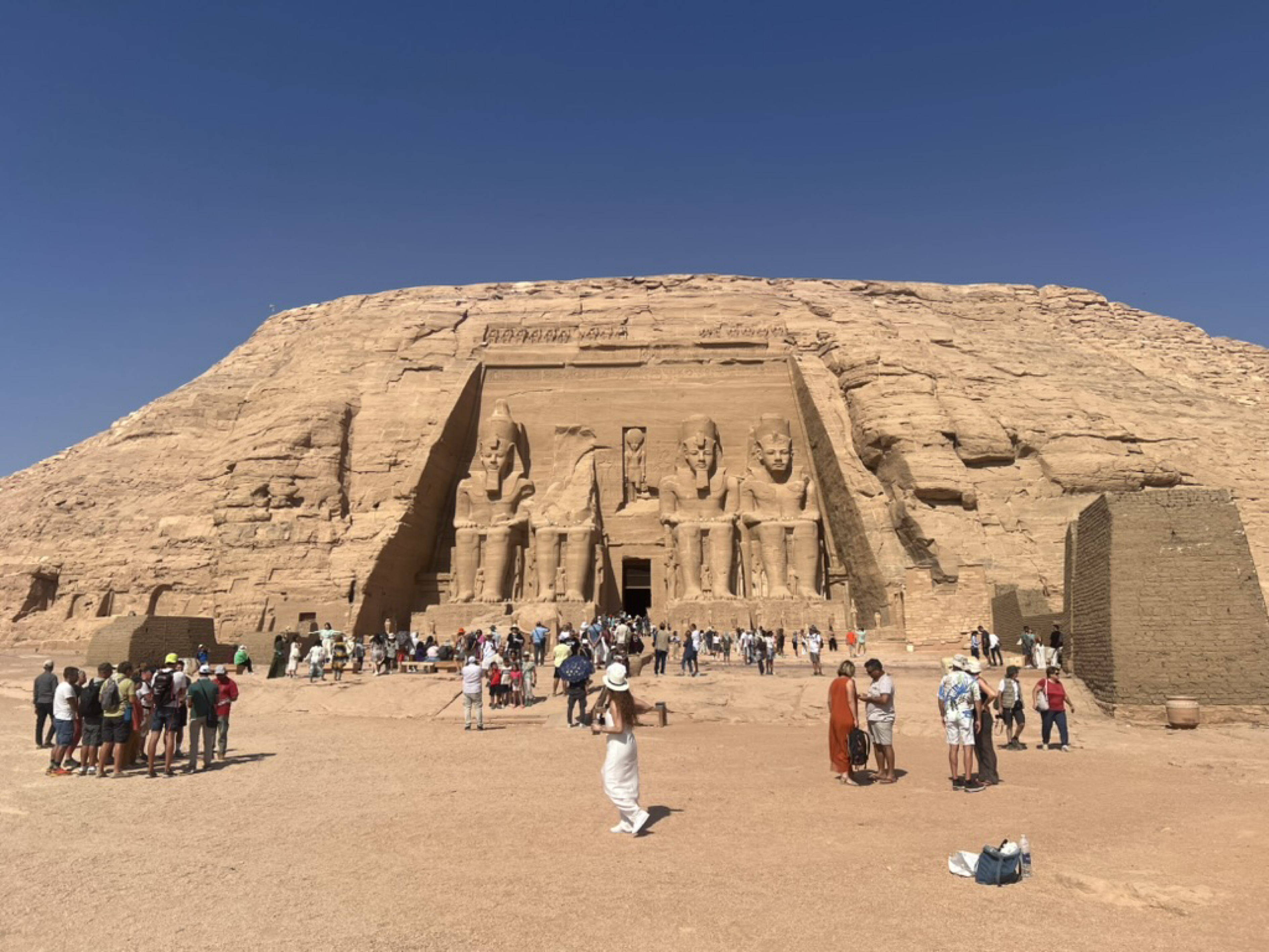
Look here at the base of one of these statues of Ramses.  The person standing there gives you an idea of the proportions.  Now look at the figures carved under the feet of Ramses.
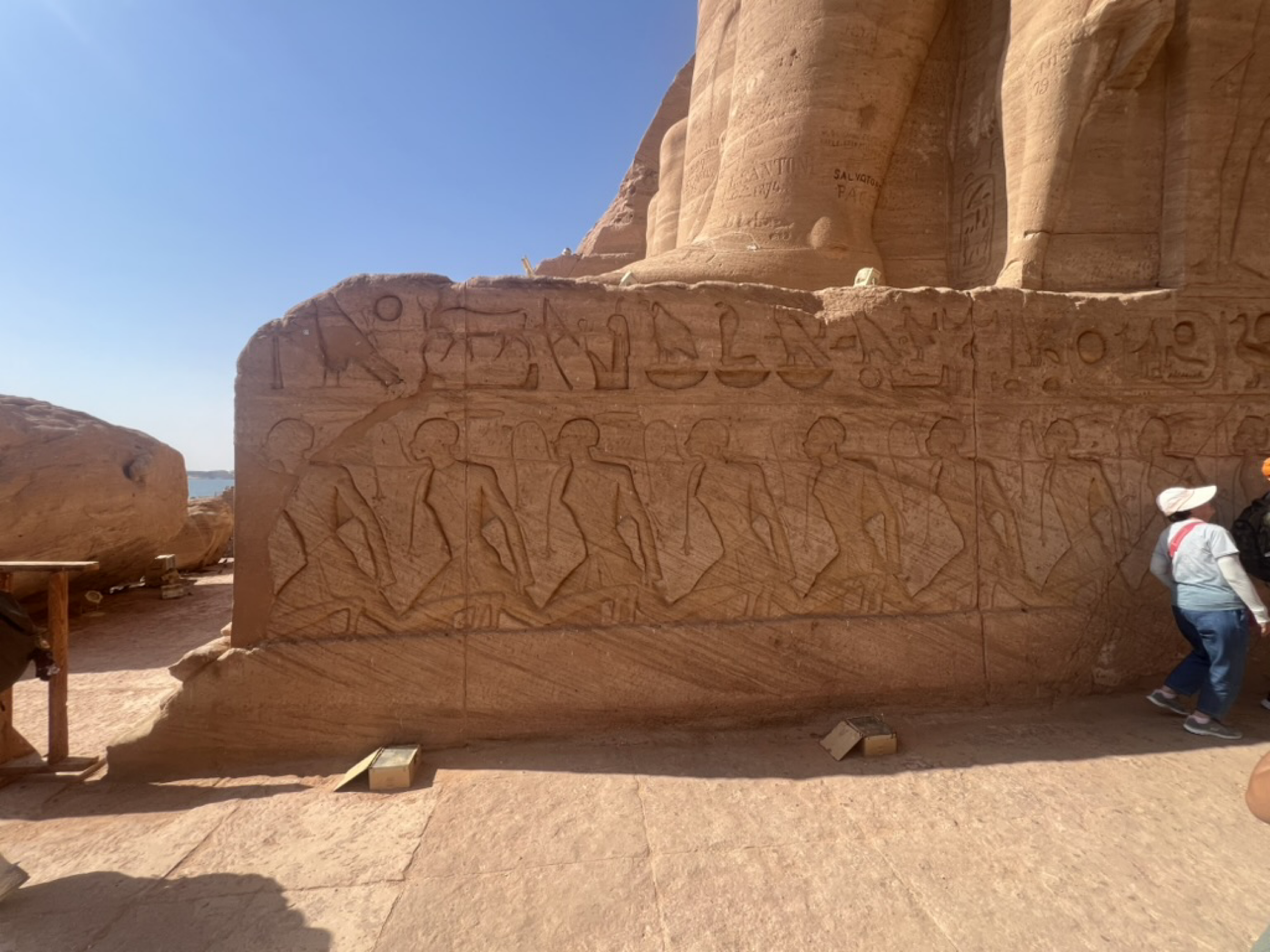
These are the people whom he has conquered and enslaved.  They are on their knees with their hands bound behind their back, humbled in submission to the great Ramses.  They are literally under his feet.  His enemy has been trampled and subjugated.   And they are tiny compared to the pharaoh, just as you are when you pass by under Pharaoh’s feet. 

The reason that all of the depictions of gods in Egypt were big was to make you look small.  You are nothing compared to them.   You are like a pitiful slave.  But Yehovah says that He is not like these gods of Egypt.  He stoops low to care for the most vulnerable of his people.  And He is trying to teach this lesson to the children of Israel.  He says, “You were immigrants in Egypt. You spoke a different language and worshiped a different God.  And they treated you poorly.  You were slaves there.  Don’t let me find you treating others like this.   Don’t imitate the pharaoh and the gods of Egypt.  Imitate me.  You are my children.”

Exodus 22:22-24  You shall not mistreat any widow or fatherless child. If you do mistreat them, and they cry out to me, I will surely hear their cry, and my wrath will burn, and I will kill you with the sword, and your wives shall become widows and your children fatherless.

This is the lesson they are taught just after escaping from Egypt.  God is serious about how widows, orphans, and immigrants are treated.  God says, ‘If you mistreat them, I will destroy you.’  But Israel doesn’t learn this lesson very well.  Here are the words of Isaiah  7-800 years later:

Isaiah 10:1-3  (Message)  Doom to you who legislate evil, who make laws that make victims—
 Laws that make misery for the poor, that rob my destitute people of dignity, exploiting defenseless widows, taking advantage of homeless children.
 What will you have to say on Judgment Day, when Doomsday arrives out of the blue? Who will you get to help you?

God cares for those that society abuses and tosses aside. This is the heart of the God we serve — a God who stoops low to care for the vulnerable.  He hears the cry of the oppressed, He defends the weak, and He calls His people to do the same.

The mistreatment of these poor is listed as a primary reason that God called down the enemy to destroy them, just as he told them he would in Exodus.  First, Assyria came from the north and wiped out the Northern tribes.  Then, Babylon came as an instrument of God to destroy their country and take the southern tribes into exile for 70 years.    God is so serious about this that he brought destruction on his chosen people. 

Pharaoh would never humble himself to help an ordinary person.  However, in contrast, our God did this:

Philippians 2:6-7  Jesus, though he was in the form of God, did not count equality with God a thing to be grasped, but emptied himself, by taking the form of a servant, being born in the likeness of men.

Jesus left his throne in God’s heaven, where there was no pain or hunger or sickness.  A place where he was worshipped constantly.  And he left all that behind to enter our cruel world and take the form of a servant.  No idol god of any nation would ever do that.   No other king would give up his throne to come to take on the task that Jesus did.

And Jesus spent his entire ministry serving others.  And he tried to teach his disciples that whoever would be greatest must be the servant of all.  They were slow to grasp this lesson, so on the night before he went to the cross, at his final meal with them.  He takes on the task of the lowest servant and washes their feet.

Matthew 20:28  The Son of Man came not to be served but to serve, and to give his life as a ransom for many.

So the passage we just read in Philippians continues with this verse. 

Philippians 2:8  And being found in human form, he humbled himself by becoming obedient to the point of death, even death on a cross.

He humbled himself.  He lowered himself to the point of suffering and death for us.  You see, Pharaoh made himself look big so he could make everyone else look small.  Our God became small, to make us big.   He came to lift us up and make us bigger—more than we were.  And Paul says this is the lesson that Israel had trouble learning and that we must learn.  The verse that precedes this passage :

Philippians 2:4-5  Let each of you look not only to his own interests, but also to the interests of others. Have this mind among yourselves, which is yours in Christ Jesus,

Have this mind in you.  This is the mind of Christ.  Think like Jesus.  See others the way Jesus sees them.  And be willing to lower yourself, to humble yourself, to make yourself small, to lift others up.  This is who God is. This is the gospel message.

Now back to our story…

Acts 6:2   And the twelve summoned the full number of the disciples and said, “It is not right that we should give up preaching the word of God to serve tables.

Now, don’t read this wrong.  They weren’t saying serving tables was unimportant — they were saying it was so important that it needed to be done by people called and equipped by God, especially for this job.  Look at the qualifications for this position.  They aren’t looking for good businessmen, strong backs, or good organizational skills.

Acts 6:3  “Therefore, brothers, pick out from among you seven men of good repute, full of the Spirit and of wisdom, whom we will appoint to this duty.”

They looked for people full of the Holy Spirit.  Why? Because even simple acts of service are sacred work when done in Jesus’ name.  Every meal served, every visit made, every hand extended in compassion is more than just a good deed.  Because God, through the Holy Spirit, is present in those acts of mercy and love, they carry much more meaning.

What we learn from this passage is this:  Serving others isn’t a distraction from the gospel — it’s a demonstration of it.  Every time we love someone in need, we preach a silent sermon about who Jesus is.  The Holy Spirit in us makes an impact in our service way beyond any physical act we can do.  

Stephen was one of the seven chosen.  We will talk about him next week.  He didn’t see himself as “just serving tables.”  He saw himself as serving Christ. And we will see how God used him mightily, both as a servant and a powerful witness. When you serve others, you are not doing small work — you are doing kingdom work. You’re showing the world what the love of Christ looks like in action.

So what is the most important job in the Kingdom of God?  Is it the prophet – the preacher?  Is it the administrator?  Is it the worker of miracles, the healer?  How about the teacher?  What is the highest calling in the Kingdom of God?  Paul answered that question in 1 Corinthians 12.

1 Corinthians 12:27-31 “Now you are the body of Christ and individually members of it. And God has appointed in the church first apostles, second prophets, third teachers, then miracles, then gifts of healing, helping, administrating, and various kinds of tongues. Are all apostles? Are all prophets? Are all teachers? Do all work miracles? Do all possess gifts of healing? Do all speak with tongues? Do all interpret? But earnestly desire the higher gifts.”

Earnestly desire the higher gifts.   But what are the higher gifts?   Don’t misunderstand his statement about “first apostles, second prophets, third teachers….”  Theologians will be quick to say that this is not a listing of importance.   So what are the higher gifts that we are to desire?  The next verse says: 

1 Corinthians 12:31  And I will show you a still more excellent way.

And what does Paul show us next?  That is the last verse of the twelfth chapter.  So the more excellent way is found in the thirteenth chapter of Corinthians. 

1 Corinthians 13:1-2  If I speak in the tongues of men and of angels, but have not love, I am a noisy gong or a clanging cymbal. And if I have prophetic powers, and understand all mysteries and all knowledge, and if I have all faith, so as to remove mountains, but have not love, I am nothing.

This is the Love chapter.   The more excellent way is the way of love.  

1 Corinthians 13:8  Love never ends. As for prophecies, they will pass away; as for tongues, they will cease; as for knowledge, it will pass away. 

Prophecy or knowledge or tongues or any gift or ministry without love is empty.  All the other gifts and ministries will come to an end.  But the love that is behind them, the love that comes to us from God and flows out of us through God, will never cease.  All gifts and all work done in the kingdom are essential, but the most important job is to love. 

1 Corinthians 13:13  So now faith, hope, and love abide, these three; but the greatest of these is love.

It is greater than faith. It is greater than hope.  Again, if we understand who God is, then we know how God wants us to behave.  God is love.  His love is limitless and is for all people. So that should be who we are, people who love others radically.  People who like their God are willing to sacrifice themselves to love others.  But again, back to our story.

Once the seven men were chosen, the apostles prayed over them and set them apart for service.  And look at what happened next: 

Acts 6:7 “ And the word of God continued to increase, and the number of the disciples multiplied greatly in Jerusalem, and a great many of the priests became obedient to the faith.”

That’s not a coincidence.  When the church began serving one another well, the gospel began to spread further.  Why? Because the love of God is powerful, spreading like a wildfire.  When people see the church caring for each other — across cultural lines, across differences — it gives credibility to the message we preach.  Do we want our church to grow?  Then we must learn this lesson.  Service in love, across cultural and language differences.  Jesus said,

John 13:35   By this all people will know that you are my disciples, if you have love for one another.

The church grew not just through preaching, but through serving.   If we want to see revival in our day, it won’t come just through louder preaching —it will come through deeper compassion.  It’s often the acts of love that open the door for the words of truth.  When a church rolls up its sleeves, when believers feed the hungry, comfort the hurting, and serve the forgotten — that’s when the light of Christ shines the brightest.

Acts 6 shows us what happens when a church takes service seriously: needs are met, unity is restored, and the gospel moves forward.  Serving others is not optional for a follower of Christ — it’s the very heartbeat of our faith.  It’s how the world sees Jesus in us.   So, ask yourself today: How can I serve others in Jesus’ name?  How can I reach out to those in our community who are forgotten, who suffer from injustice, who are poor and needy, who are the sojourners?

1 John 3:16-18   This is how we know what love is: Jesus Christ laid down his life for us. And we ought to lay down our lives for our brothers and sisters. If anyone has material possessions and sees a brother or sister in need but has no pity on them, how can the love of God be in that person? Dear children, let us not love with words or speech but with actions and in truth.
August 19 –  Arm Wrestling and Cornerstones — Acts #9

August 19 –  Arm Wrestling and Cornerstones — Acts #9
Acts 4:1-12

So, ‘cornerstone’ you can see in the Bible, but ‘arm wrestling’?  We are going to look at two common visual concepts that run as themes throughout the Bible.  If you understand where these themes come from, it will make it more meaningful for you when you encounter cornerstones in the Bible, or a contest to see whose arm is the mightiest. 

One of my goals in this blog is not just to share what God is teaching me from the scriptures, but also to help you read and understand the Bible better yourself. When you are reading the Bible, you need to pay attention to references from the Old Testament.  If you don’t know the context for the Old Testament verse being quoted in the New Testament, then you should stop reading and go back and read the Old Testament passage that the verse comes from.  Because the writers of the New Testament assume you already know this.  And with over 300 direct quotes of the Old Testament in the New Testament and over 1000 allusions to Old Testament characters and events, you can’t read a chapter in the New Testament without running into 3-4 OT verses or allusions.  Today, we are going to look at two examples of this as we see Peter’s response to the court.

To recap where we were in Acts, Peter and John encounter a paralyzed man, and Jesus heals him.  It causes a commotion in the temple courtyard, prompting Peter to preach and explain that Jesus is the Messiah.  And we pick up the story there:

Acts 4:1-4   And as they were speaking to the people, the priests and the captain of the temple and the Sadducees came upon them, greatly annoyed because they were teaching the people and proclaiming in Jesus the resurrection from the dead. And they arrested them and put them in custody until the next day, for it was already evening. But many of those who had heard the word believed, and the number of the men came to about five thousand.

Peter and John are preaching and are interrupted by the temple officials, who are all “greatly annoyed”.  Who is ”greatly annoyed” and why?  The captain of the temple is the number two man in charge of the temple (behind the High Priest). He is the commander of the temple police and is responsible for maintaining order in the temple.  He sees this crowd gathering and considers a potential riot. That is why he is annoyed.

The Sadducees, a group of wealthy priests, are upset because Peter and John are preaching about resurrection.  They don’t believe in a resurrection from the dead, and you would think they were living in the US in our day, because they have no tolerance for anyone who has an opinion that is different from theirs. These Sadducees see Peter and John as heretics.   So they will do everything they can to silence them, berate them, vilify them, and probably unfriend them and block them on Facebook.  (Don’t be a Sadducee.  It’s okay for people to have different opinions and still be friends, even if they’re on the same team.  We talked about this last week.  Remember, Peter is dead wrong on his theology about the Gentiles, but that doesn’t mean God can’t use him in a mighty way.)

The other priests are annoyed because these disciples keep talking about Jesus.  They thought they had put an end to Jesus a month ago, but these guys just won’t shut up.  

None of these people has a problem with the paralyzed man being healed.  Another beggar off the Temple gates is a good thing, but don’t give credit to that Jesus.  They have to do something.  So they arrested Peter and John and put them in custody.  Our culture sees incarceration as a form of punishment for a crime.  But historians tell us that neither the Jews nor the Romans at this time officially used imprisonment as punishment for a crime.  It was merely a place to hold someone until the time of the trial.  (Though the holding period could become extended and be an ‘unofficial punishment’ — ask Paul or John the Baptist).

Luke tells us it was already evening, so it was too late for a trial that day; it would have to wait until tomorrow.  Do you remember when this story began?  It was approaching 3 in the afternoon, for Peter and John were heading into the temple for the afternoon service.  It is now 6 pm.  These officials interrupted Peter and John after 2-3 hours of preaching.  (And you thought a 30-minute sermon was a long one.)  

Acts 4:5-7   On the next day, their rulers and elders and scribes gathered together in Jerusalem, with Annas the high priest and Caiaphas and John and Alexander, and all who were of the high-priestly family. And when they had set them in the midst, they inquired, “By what power or by what name did you do this?” 

So they all gathered the next morning to question Peter and John.  Again, what they are really concerned about is the message they were preaching and giving Jesus credit for the healing. 

Acts 4:8-10   Then Peter, filled with the Holy Spirit, said to them, “Rulers of the people and elders, if we are being examined today concerning a good deed done to a crippled man, by what means this man has been healed, let it be known to all of you and to all the people of Israel that by the name of Jesus Christ of Nazareth, whom you crucified, whom God raised from the dead—by him this man is standing before you well. 

Did you notice?  The paralyzed man is “standing” before them.  The authorities had brought him in as a witness to what Peter and John were preaching, but Peter used him as a witness to their “good deed.”  So if you want to know who is responsible for doing this great deed, know that it is Jesus who you crucified.  Peter knows they can’t refute the fact that this man was healed, so he uses the opportunity to give Jesus credit again.  But Peter doesn’t stop there:

Acts 4:11-12   This Jesus is the stone that was rejected by you, the builders, which has become the cornerstone. And there is salvation in no one else, for there is no other name under heaven given among men by which we must be saved.

Peter brings in an Old Testament illustration everyone there would recognize – the cornerstone.  Now, if you are reading this scripture at home, you can keep reading and have a pretty good idea of what Peter is talking about.  But Peter is speaking under the direction of the Holy Spirit, and there is a lot more there, so we need to stop and figure it out.

This was a point these religious leaders would not have missed.  They knew the scripture Peter was referring to.  It was a psalm that every devout Jew would know.  This psalm is one of the Hallel Psalms (113-118), sung by pilgrims on their way to Jerusalem for the annual festivals.  This particular psalm was quoted as part of a liturgy on entering the temple gates, and it was sung at the end of the Passover meal every year.  Every Jewish child in Peter’s day knew this psalm just as every child today knows the words to “Jingle Bells” that they sing one season every year.  But do you know the psalm he is quoting?  This Psalm is quoted 24 times in the New Testament.  So let’s take a good look at Psalm 118.

Again, one of my goals today is to help you know how to read and understand the Bible. So I want to show you two things in Psalm 118 that are themes all through the Bible. Understanding the source of the theme will also help you grasp the verses that use it.  So we will look at ‘God’s mighty right hand’ and then the idea of the cornerstone.

Psalm 118 begins and ends with the same statement:

Psalm 118:1  Oh give thanks to Yehovah, for he is good; for his steadfast love endures forever! 
Psalm 118:29  Oh give thanks to Yehovah, for he is good; for his steadfast love endures forever!

The psalm begins by recounting times of trouble and then celebrates God’s deliverance from them.

Psalm 118:13-16  I was pushed back and about to fall, but Yehovah helped me.  Yehovah is my strength and my defense; he has become my salvation.  Shouts of joy and victory resound in the tents of the righteous: “Yehovah’s right hand has done mighty things!
Yehovah’s right hand is lifted high; 
Yehovah’s right hand has done mighty things!”

Things were looking bad for the nation, but God stepped in and delivered them.  So there is celebration in the dwellings of the righteous, and the celebration is about what God’s right hand has done.  What is this emphasis on God’s right hand?  All through the Old Testament, you will read about God’s strong arm or mighty right hand.  Do you know where that comes from?  If you have been to Egypt, you would know.

In September, I will be back in Egypt for my fourth trip there.  When people ask me why I want to go to Egypt, I could talk about the incredible pyramids and temples there, the thousands of years of history you can see there, or the great food.  But the main reason I want to go to Egypt is to help me understand the Bible.  

When God’s chosen people, Israel, were not yet a nation, when they were just a family, just 70 of them went down to Egypt during a famine, and they ended up staying there for 400 years.  And it was in those 400 years that they grew into a nation of hundreds of thousands.  In Egypt, they were constantly exposed to cultural and religious motifs that ended up being used in their own Bible.  They used visual imagery and concepts about the world and God that everyone had learned from 400 years in Egypt.  Since most of us don’t come from families that spent 400 years in Egypt, we didn’t grow up knowing these things.

Egyptians carved their history and religious beliefs into the walls of their temples. Their temples are covered with engravings top to bottom. They didn’t have books, so their temples were their Bibles.  The Israelites knew of the many gods of Egypt inscribed on those walls.  They saw how the leader of their country, Pharaoh, was depicted as a god.  And when they were enslaved, they would have been commanded to attend the festivals and stand outside the Temple as the Egyptian Gods were paraded into the Temple.  All they knew about organized religion came from Egypt.

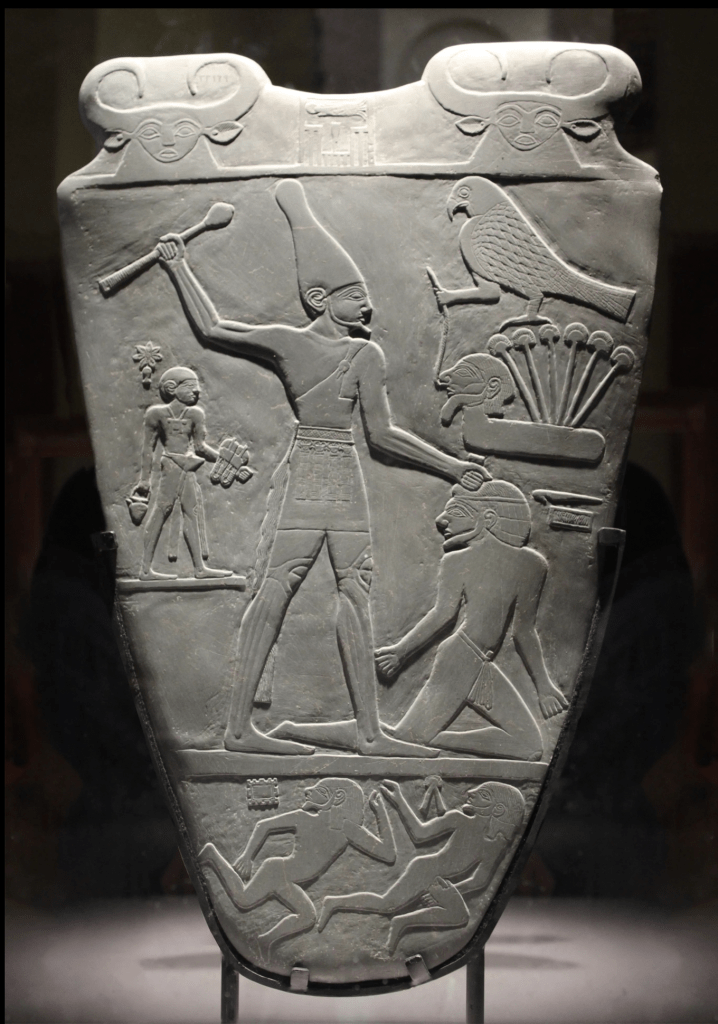
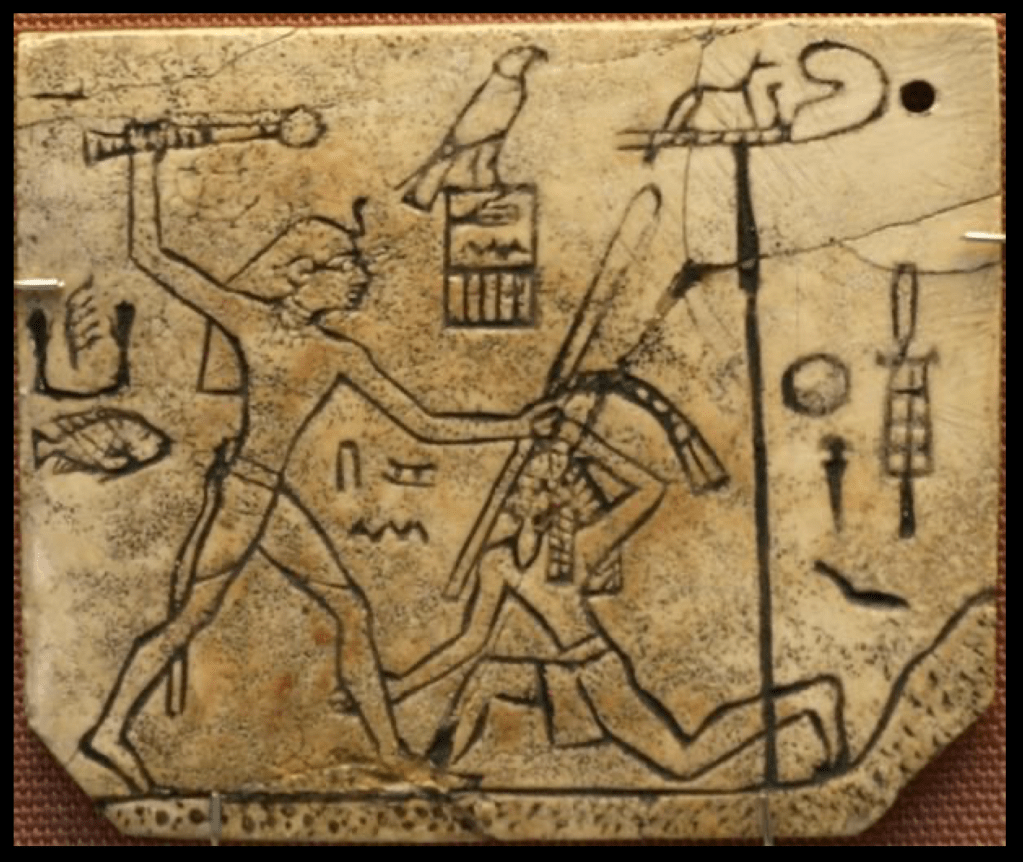
Looking at these texts and carved temples, we see that Egyptian pharaohs were frequently depicted in the same pose.  Back in the 1980s, a group called the Bangles told us how to “Walk like an Egyptian,” but if you want to look like a pharaoh, here is how you do it.  Left foot out, left arm outstretched, right arm ready to strike down your enemies. This iconic pose symbolized the pharaoh’s role as the supreme, divine ruler of Egypt.  This is the god pose.  We still have this picture in our mind of a mighty hero in this exact pose today.

Football season has begun.  You will see this pose a lot.

This is the Narmer Tablet that dates to 3100 BC.  For 400 years, Egypt held the children of Israel in slavery and told them that Pharaoh was the most powerful god.  Everywhere they look, they see images of Pharaoh as the greatest.  So when God sends Moses to speak to this person who proclaims himself the most powerful person in the world, this is what God says:

Exodus 6:1  Then Yehovah said to Moses, “Now you will see what I will do to Pharaoh: Because of my mighty hand he will let them go; because of my mighty hand he will drive them out of his country.”
Exodus 6:6  Say therefore to the people of Israel, ‘I am Yehovah, and I will bring you out from under the burdens of the Egyptians, and I will deliver you from slavery to them, and I will redeem you with an outstretched arm and with great acts of judgment.

God says, “Hey Pharaoh, you think you are something with your outstretched arm and your mighty right hand?  Just wait until you see what I do with my outstretched arm and my mighty right hand.”

Thus began a contest between the God of the Israelites and the gods of Egypt.  Whose god will be victorious?  All the Egyptians knew that Pharaoh was the greatest.  They thought this God of the Israelites couldn’t be much of a god, for he was God only of a bunch of slaves. But you know how that story ends.  God rains down 10 plagues, each one targeting a specific god of Egypt, the last one targeting the family of Pharaoh himself.  And then the final victory comes when Pharaoh and his army drown in the sea.

Following Pharaoh and Egypt’s defeat, numerous references in the Old Testament emerge, describing God as having a strong hand and outstretched arm.  Almost all of these refer to God’s deliverance of His people from Egypt or his future deliverance from another enemy.   For thousands of years, Egypt was the most powerful nation in the world.  And every time you see this description of God’s arm and hand, God is reminding them that He is greater.

Here are a few examples:

Deuteronomy 4:33-34  Did any people ever hear the voice of a god speaking out of the midst of the fire, as you have heard, and still live? Or has any god ever attempted to go and take a nation for himself from the midst of another nation, by trials, by signs, by wonders, and by war, by a mighty hand and an outstretched arm, and by great deeds of terror, all of which the LORD your God did for you in Egypt before your eyes?

Deuteronomy 5:15   You shall remember that you were a slave in the land of Egypt, and Yehovah your God brought you out from there with a mighty hand and an outstretched arm. Therefore, Yehovah your God commanded you to keep the Sabbath day.

Deuteronomy 11:1-2   You shall therefore love Yehovah your God and keep his charge, his statutes, his rules, and his commandments always. And consider today (since I am not speaking to your children who have not known or seen it), consider the discipline of Yehovah your God, his greatness, his mighty hand and his outstretched arm.

Jeremiah 32:21  You brought your people Israel out of the land of Egypt with signs and wonders, with a strong hand and outstretched arm, and with great terror.

And then, when the people in Isaiah’s day were under attack by a foreign nation and they were questioning why God hadn’t delivered them, they were told:

Isaiah 59:1-2  Surely the arm of Yehovah is not too short to save, nor his ear too dull to hear.  But your iniquities have separated you from your God; your sins have hidden his face from you, so that he will not hear.

God’s arm is not too short to save.  That is not the problem.  He is still God with the outstretched arm and the mighty right hand.  The problem is you.  God can not hear your requests for help because your sins have “hidden His face”.  Your sins have come between you and God.

And then, in the New Testament, when Mary is pregnant with Jesus, she sings a song of praise to God. She praises him for his deliverance of her people in the past, as she looks to the coming deliverance through Jesus. She says:

Luke 1:49-55   For he who is mighty has done great things for me, and holy is his name.  And his mercy is for those who fear him from generation to generation.  He has shown strength with his arm; he has scattered the proud in the thoughts of their hearts;  He has brought down the mighty from their thrones and exalted those of humble estate; He has filled the hungry with good things, and the rich he has sent away empty.  He has helped his servant Israel, in remembrance of his mercy, as he spoke to our fathers, to Abraham and to his offspring forever.

The God of the Bible has not changed.  The God of the Old Testament is still the God of the New Testament.  His arm has not shortened.  His strength has not faded.  He has saved his people in the past; he continues to save his people.   But those who stand against God will find the same fate as Pharaoh, the man who thought he was God.

Back to Psalm 118.  It continues with the portion sung as the pilgrims headed to Jerusalem for Passover approach the city and God’s Temple. You can see their progression in the psalm.  As they near the gates of the city:

Psalm 118:19-20  Open to me the gates of righteousness, that I may enter through them and give thanks to Yehovah. This is the gate of Yehovah; the righteous shall enter through it.

As they see the great stones of the temple:

Psalm 118:21-22  I thank you that you have answered me and have become my salvation.  The stone that the builders rejected has become the cornerstone.

As they enter the temple, there is a very familiar verse.

Psalm 118:25-26   Save us, [Hosannah] we pray, Yehovah, Yehovah, we pray, give us success! Blessed is he who comes in the name of Yehovah! We bless you from the house of Yehovah.

And finally, they arrive at the altar for the festival sacrifice:

Psalm 118:27  Bind the festival sacrifice with cords, up to the horns of the altar!

And then the psalm ends as it started:

Psalm 118:29  Oh give thanks to Yehovah, for he is good; for his steadfast love endures forever!

But let’s back up to verses 21-22 about the cornerstone.

Psalm 118:21-22  I thank you that you have answered me and have become my salvation.  The stone that the builders rejected has become the cornerstone.

We all know what a cornerstone is. However, most of the ones we see today are decorative.  But when a foundation is being laid, you have to get that first corner block laid straight.  It determines how the rest of the building will be.  How did people before the days of Jesus interpret this?  Who did they see as this cornerstone?

Because the people sing this psalm during the festivals to celebrate God delivering them from Egypt or later from other enemies, some see the nation of Israel as the one rejected by the other nations, but chosen by God. And some say it is David himself. He was chosen to be the king, even though others, including his father, would not have chosen him.  He was rejected by the current king, Saul, and Saul tried to kill him.  But God delivered David from Saul and his other enemies.  Then David becomes the first king of an everlasting dynasty.  He becomes the cornerstone of the kingdom.  For 1000 years, this Psalm was interpreted as talking about Israel or David as the cornerstone.

Then Jesus comes and applies this psalm to his day.  In the week of Jesus’ crucifixion, Psalm 118 is on everyone’s mind.  They have sung it as they traveled on the way to Jerusalem for Passover.  They sang it to Jesus as he entered the city on the donkey, “Hosannah!  Blessed is He who comes in the name of the Lord!” (Psalm 118:25-26).   And then Jesus in the temple that week tells the story of a vineyard owner who leased his farm to others.  He sent servants to collect his payment, and they refused to pay what they owed, and they abused them or killed them.  So the vineyard owner sent his son, thinking they would respect his son.  But they kill him.  And then Jesus asks the priests and scribes:

Mark 12:10-11  Have you not read this Scripture: ‘The stone that the builders rejected has become the cornerstone; this was the Lord’s doing, and it is marvelous in our eyes’?’

Jesus asks the religious leaders in the Temple if they have ever read Psalm 118.  (Of course, they had.  Every child had this memorized and had been singing it all week.)  But they understood what Jesus was saying.  Jesus claimed to be the son of the vineyard owner in his parable and the cornerstone of the Temple from Psalm 118.  The scribes and the priests are the builders who rejected him.  Jesus is adding a new layer of interpretation to Psalm 118.  He would be the cornerstone of a new Temple of followers.  

Then in Acts 4, Peter picks up this same Psalm to let the religious leaders know that this Jesus, who brought healing to this paralyzed man, is the cornerstone that they rejected, but chosen by God to be the beginning of a new deliverance, a new salvation.  

So who is the cornerstone of Psalm 118?  Is it Israel, is it David, or is it Jesus?  The answer is yes, and this is an important concept.  God is consistent in how he deals with his people.  His character does not change.  That is just who God is.  So you will see him do that over and over again.  So you see multiple layers of meaning.  Israel was seen to be a type of cornerstone, upon which God would build his kingdom.  But Israel didn’t fulfill his plan to take his message to the nations.  David was seen to be a type of cornerstone, as the beginning of a line of kings.  But David could not be the messiah.  He, like us, was a man of many sins.  But Jesus comes as a descendant in the line of David to be the true cornerstone.  

Israel was a type of cornerstone.  David was a type of cornerstone.  Jesus is the cornerstone.

So Paul tells the Gentiles in Ephesus:

Ephesians 2:19-22  So then you are … built on the foundation of the apostles and prophets, Christ Jesus himself being the cornerstone, in whom the whole structure, being joined together, grows into a holy temple in the Lord. In him you also are being built together into a dwelling place for God by the Spirit.”

God is making a new temple with Jesus as the cornerstone, and you are a stone in that temple, a dwelling place for God’s Holy Spirit.  And we know this is the meaning Peter intended when he spoke to these religious leaders in Acts 4, because Peter comes back to this same scripture when he is writing his first letter from Rome to the churches in Asia Minor.  

1 Peter 2:4-6  As you come to Jesus, a living stone rejected by men but in the sight of God chosen and precious, you yourselves like living stones are being built up as a spiritual house, to be a holy priesthood, to offer spiritual sacrifices acceptable to God through Jesus Christ.
For it stands in Scripture: “Behold, I am laying in Zion a stone, a cornerstone chosen and precious, and whoever believes in him will not be put to shame.

Jesus is the cornerstone.   But Peter is not through with the imagery.  There is one more aspect of the cornerstone imagery that we must discuss, and Peter has picked up this other aspect of the Biblical cornerstone motif that he got from the prophet Isaiah.  So Peter continues:

1 Peter 2:7-8  So the honor is for you who believe. But for those who do not believe, “The stone that the builders rejected has become the cornerstone,” and “A stone of stumbling, and a rock of offense.” They stumble because they disobey the word, as they were destined to do.

Peter is quoting Isaiah 8:14, where God says he can also be a “stone of stumbling.”  

Isaiah 8:14-15  And he will become a sanctuary and a stone of offense and a rock of stumbling to both houses of Israel, a trap and a snare to the inhabitants of Jerusalem. And many shall stumble on it. They shall fall and be broken; they shall be snared and taken.

The Bible says the stone God has placed for us can be either a cornerstone that we may build upon or a rock that we will stumble over and fall. Isaiah comes back to this in chapter 28, speaking against the leaders of Israel who, in times of threat of war, turned to Egypt for help instead of turning to God:

Isaiah 28:16-18  “So this is what the Sovereign Yehovah says: 
“See, I lay a stone in Zion, a tested stone, a precious cornerstone for a sure foundation; the one who relies on it will never be stricken with panic.” …“Your covenant with death [Egypt] will be annulled; your agreement with the realm of the dead will not stand.”

They abandoned God as their refuge in a time of need.  Instead of having faith that God would deliver them as he said, and depending on him as their cornerstone, they panicked and sought help from Egypt.  God tells them a deal with Egypt is a deal with death and the grave.  God is the only one who can deliver them.  There is no other god, there is no other with a mighty right hand and outstretched arm.  There are no other gods. That is why Peter, after mentioning the cornerstone, says this:

Acts 4:12  And there is salvation in no one else, for there is no other name under heaven given among men by which we must be saved.

There is no other.  Jesus is a stone in your path.  Either He can be the cornerstone on which you build a good faith, upon which you are built as part of the Temple of God, or He can be the stone upon which you stumble.  The point is that everyone has to decide what they are going to do with Jesus.  He will not be ignored.  You either accept the gospel, accept Jesus, or you reject him.  This is the message for us also.  Will we humble ourselves and worship the only God who delivers us with an outstretched arm and a mighty right hand?   

Bottom Line:  There are some important themes and motifs that are used in our Scriptures.  You can’t read a several-thousand-year-old document and be lazy.  It won’t work.  And this document, our Bible, is inspired by the Holy Spirit of God.  Its treasures are deep and profound.  You need to go slowly and research the context and culture.  You need to know it well enough, through years of study, that you begin to recognize these recurrent themes.  I beg you to study it to understand better how God would have us live.