July 15 –  Pentecost! So What Shall We Do? — Acts #5

July 15 –  Pentecost! So What Shall We Do? — Acts #5
Acts 2:37-41

Pentecost.  The Holy Spirit comes in wind and fire.  There is a miracle of understanding languages that is a reversal of God’s intervention at the Tower of Babel.  Last week, we examined the response of those who asked the question, “What does this mean?”  Peter answers with a sermon that reveals God’s plan for redemption and the gift of the Holy Spirit through Jesus.  He tells them that prophecy has been fulfilled in the past year and even that very morning.  Today, we examine the response of the people to Peter’s message as they pose another critical question.

A huge crowd from all over the world has gathered for Shavuot, one of the three festivals in Jerusalem that everyone must attend.  So, most of these people are the same ones who attended the required Passover feast 50 days ago.  It was the same crowd in the city almost two months ago, during Jesus’ final week.  Many of them were there when Jesus rode into the city on a donkey, when he overturned the tables of the money changers, when he challenged the religious leaders, and when he was crucified.  

Peter summarizes the story of Jesus, then tells those assembled at the Temple for Shavuot that this Jesus, whom you crucified, has been raised to life by God and is your Messiah.  And they were there for this.  These were the very same people who had either shouted “Crucify Him!” to Pilate or had kept silent as the disciples did. So, how did they respond to Peter’s sermon?

Acts 2:37-41   Now when they heard this they were cut to the heart, and said to Peter and the rest of the apostles, “Brothers, what shall we do?” And Peter said to them, “Repent and be baptized every one of you in the name of Jesus Christ for the forgiveness of your sins, and you will receive the gift of the Holy Spirit. For the promise is for you and for your children and for all who are far off, everyone whom the Lord our God calls to himself.” And with many other words he bore witness and continued to exhort them, saying, “Save yourselves from this crooked generation.” So those who received his word were baptized, and there were added that day about three thousand souls.

These 3000 people were “cut to the heart,” which means they were deeply emotionally moved.  The Greek phrase here, “katanyssomai kardia,” literally means “stabbed in the heart.”  That is a picturesque way of stating an intense emotional response.  Obviously, the Holy Spirit did not stop moving after the miracle of the languages.  He is moving in the hearts of these people, giving them the gift of remorse that leads to repentance.  

There are two other instances where the phrase “cut to the heart” appears in some English translations.  One example is found in Acts 5. This is a great story that we will explore in a few months.  The apostles are preaching in the outer courts of the Temple, and the High Priest has them put into prison.  An angel of the Lord comes at night and opens the prison door for them, telling them to return to the Temple in the morning and continue preaching.  Unaware of the escape, the next morning, the High Priest gathers a council of judgment and sends someone to bring the apostles from prison.  It is then discovered that they escaped during the night. Then someone comes and tells the High Priest, “Hey! You know those men you put in prison yesterday for preaching in the Temple?  Guess where they are?  They’re back in the temple, preaching again this morning.”

The High Priest is not amused.  So they bring the apostles to the council, and Peter says, Thanks for the hospitality yesterday, but ‘We should obey God and not men.”  (Acts 5:29).  Peter presents the gospel to these religious leaders and says, “The God of our fathers raised Jesus, whom you killed by hanging him on a tree.”  This is the same message that drove 3000 to repentance on Pentecost: ‘You killed Jesus, but God raised him from the dead, and he is on a throne by the Father now.’  And how do you think these religious leaders responded?

Acts 5:33  (KJV)  “When they heard that, they were cut to the heart, and took counsel to slay them.”

There is our phrase again, “cut to the heart.”  They were deeply emotionally moved, but the emotion is different here.  It is not remorse but anger and rage.  We see this same reaction again in Acts 7 after Stephen delivers a sermon to this same council.

Acts 7:54  (KJV)  “When they heard these things, they were cut to the heart.”

They are enraged to the point that they want to kill Stephen.  And this time they do.  They take Stephen outside the city and stone him to death.  

In these two verses, “cut to the heart” is translated from a different Greek phrase, “diapriō kardia autos”, which means literally ‘to saw your own heart in two pieces.’  (Greek is indeed a very picturesque language.)  Metaphorically, it means being filled with murderous rage.  Our English biblical phrase, ‘Cut to the heart,’ can be derived from one of two Greek phrases that express two different extreme emotional responses.:
Stabbed in the heart – which is a response of remorse, I’m sorry, what can I do?
Saw your own heart in two, which is an intense negative emotion — rage –  I will kill you.1

Last week, we explored how we perceive events in the world and the importance of asking, “What does this mean?” to ensure we understand how God is at work in the world around us.  So Peter preached a gospel sermon, and 3000 were cut to the heart and believed and were baptized.  And then they ask an even more critical question:  “What shall we do?” It is not enough to understand what God is doing in the world.  Our reaction to God must include action.  We must do something. As James said:

James 1:22“  But be doers of the word, and not hearers only, deceiving yourselves.”

Remember that the Hebrew word to hear, “shema,” includes the idea of obedience. (James is Jewish.)  It means hear and obey.  There is no such thing as hearing that is not followed by action.  We must always ask both questions: “What does this mean?” and “What should we do?”  We must not only understand, but also react.  Jesus did not call anyone to be a passive follower.  It is inherent in the word ‘follow’ that there is action.  If I teach you about scripture, if I share what God has taught and is teaching me, and if I somehow, through the grace of God, do a good job of teaching, but you are not encouraged and incited to do something for the Kingdom of God, then I am a complete failure.  To be confronted with the gospel, there are only three ways to react:
1.  Cut to the heart and spurred to action for Jesus.
2.  Cut to the heart and be enraged at Jesus.
3.  Be indifferent about Jesus.

Now let me ask you….Which of the last two bothers Jesus the most?  To answer that, we need to take a detour into the book of Revelation.  (If you have a red-letter Bible, you will note that this letter to the assembly in Laodicea is the words of Jesus.)

Revelation 3:14-22   And to the angel of the church in Laodicea write: ‘The words of the Amen, the faithful and true witness, the beginning of God’s creation. ‘I know your works: you are neither cold nor hot. Would that you were either cold or hot! So, because you are lukewarm, and neither hot nor cold, I will spit you out of my mouth.

“Because you are lukewarm…I will spit you out of my mouth.”  The ESV, like most other versions, has toned this down somewhat to avoid offending anyone, but here, Jesus means to offend.  The word for ‘spit’ is ‘emeō,’ from which we get our medical word ‘emesis’, which means vomit.  What is going on in Laodicea makes Jesus sick and want to throw up.  Of the seven churches listed here, this is the only one for which Jesus has nothing good to say.  To understand this reference to hot, cold, or lukewarm, you need to know a little about this area of Asia Minor.  
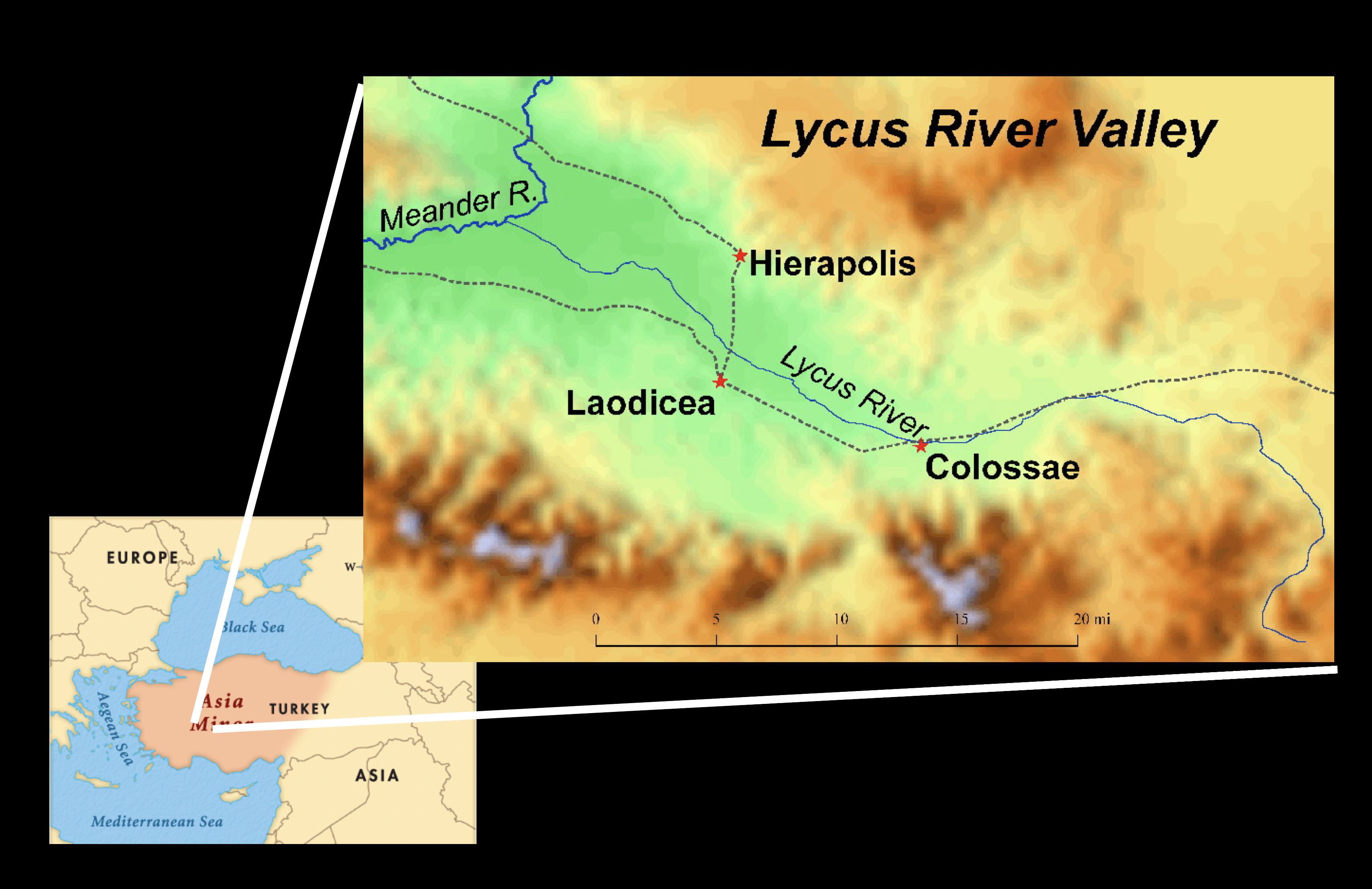
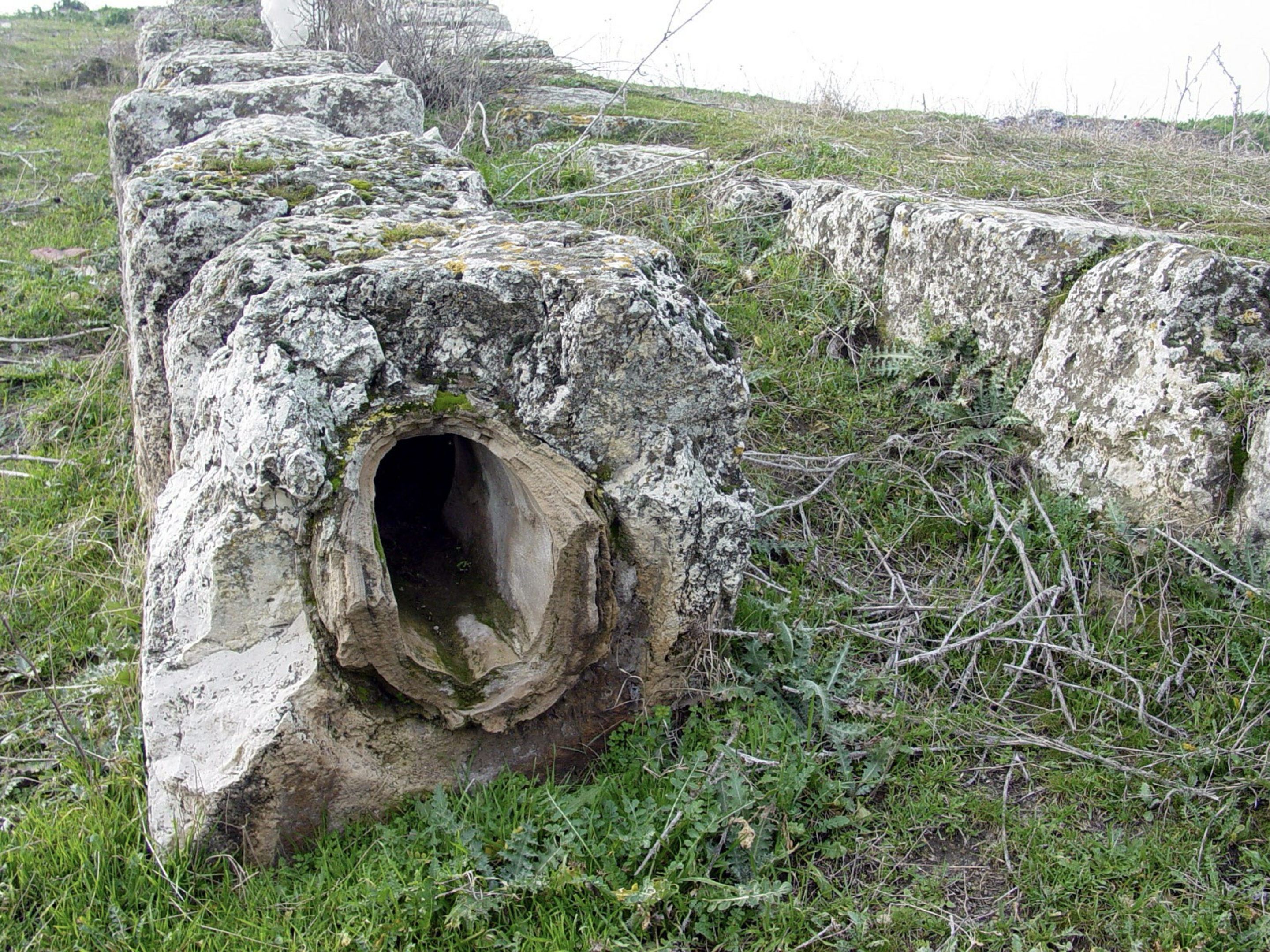
Laodicea is situated in the fertile Lycus River valley, in our modern-day Turkey.  Six miles to the north lies the city of Hieropolis, renowned for its medicinal hot springs, which feature a spa dating back to around 200 BC.  Eight miles to the east lies Colossae, famous for its refreshing, pure, and cold natural spring water.  In contrast, Laodicea had no water source in the city.  An aqueduct, cut from stone, transported water from Denizli, 5 miles south. 

Here is a section of that 5-mile-long aqueduct. Each stone is hollowed out, cut, and fitted together to pipe the water to the city.  
By the time the water arrived at Laodicea, it had become lukewarm and had also absorbed a high mineral content from the stone, making it unappealing.  It did not have the refreshing quality of the waters of Colossae nor the healing properties of the waters of Hieropolis.   It was neither cold nor hot, but lukewarm.  Robert Mounce, in the NICNT, “Thus the church in Laodicea was providing neither refreshment for the spiritually weary, nor healing for the spiritually sick. It was totally ineffective, and thus distasteful to its Lord.”2  This group heard the gospel, but they did not do the gospel.

Revelation 3:17  For you say, I am rich, I have prospered, and I need nothing, not realizing that you are wretched, pitiable, poor, blind, and naked.”

Laodicea was a very wealthy city.  They were known for their medical school, prosperous banking establishments, the production of an eye salve that was exported worldwide, and a thriving textile industry.  Knowing this, now look at what else Jesus says….not realizing that instead of healthy, you are wretched & pitiable, you think you are rich but you are poor, you are known for healing eyes, but you are blind, and you say you produce finest clothes, but you are naked.

They think they have it all.  They think they don’t need any help from anyone.  A massive earthquake devastated Laodicea in 60 AD. The government of Rome offered to help them rebuild, but they refused the help.  They are proud, self-sufficient people.  They didn’t need Nero’s help then, and this “church” apparently didn’t need Jesus’ help either. They think they have it all, but they have abandoned Jesus to get it.  So they have nothing.

They are a church that neither provided healing nor spiritual refreshment.  They had heard the gospel, but how did they react?  They were not cut to the heart in a good way or a bad way.  They were able to hear a story that should cut you to the heart, and remain unaffected.

Revelation 3:18-19   I counsel you to buy from me gold refined by fire, so that you may be rich, and white garments so that you may clothe yourself and the shame of your nakedness may not be seen, and salve to anoint your eyes, so that you may see. Those whom I love, I reprove and discipline, so be zealous and repent.”

Then we have that verse you have heard so many times before:

Revelation 3:20   Behold, I stand at the door and knock. If anyone hears my voice and opens the door, I will come in to him and eat with him, and he with me.

You probably have a picture in your mind of that verse that may look something like this: Jesus is knocking on the door and asking to come into the ‘door of your heart.’  Salvation awaits the one who opens the door to Jesus.  Did you realize this verse was explicitly written to these self-sufficient, wretched, pitiful, naked, poor, blind people in Laodicea?  But wait a minute?  Are the people in this church in Laodicea unsaved?  They can’t all be lost, can they? Didn’t Jesus call them a church?

Well, not exactly…… We have a translation problem.  The term Jesus uses for the “church at Laodicea” is the Greek word ‘ekklesia.’  It comes from the Greek root verb ‘kaléō’, which means “to call.”   So ‘ekklesia’ means “those called out”.   As followers of Jesus, we believe he has called us out. (See Paul’s explanation in 2 Corinthians 6:17-7:1).  So an ekklesia can be a church.  But it is not always a church.  

In Acts 19, Paul got into trouble with the local silversmiths in Ephesus.  Paul was preaching that idols made of metal were not gods, and this hurt the silversmiths’ business.  So they want to throw Paul and his bunch out of town.  There is a great disturbance in the city.  Now look for the word we translate as ‘church’ as seen in Acts 19.

Acts 19:32-35  Now some cried out one thing, some another, for the ekklesia was in confusion, and most of them did not know why they had come together. Some of the crowd prompted Alexander, whom the Jews had put forward. And Alexander, motioning with his hand, wanted to make a defense to the crowd. But when they recognized that he was a Jew, for about two hours they all cried out with one voice, “Great is Artemis of the Ephesians!”
And when the town clerk had quieted the crowd, he said, “Men of Ephesus, who is there who does not know that the city of the Ephesians is temple keeper of the great Artemis, and of the sacred stone that fell from the sky?”

The Bible refers to this gathering as an ekklesia.  But this is not a church.  This is a town hall meeting. (It is a very rowdy one, as when a Jewish man tried to speak, he was shouted down for two hours, the crowd chanting “Great is Artemis of the Ephesians!”.  But this assembly is run by the local town clerk, who concludes the meeting this way:

Acts 19:38-39   If therefore Demetrius and the craftsmen with him have a complaint against anyone, the courts are open, and there are proconsuls. Let them bring charges against one another. But if you seek anything further, it shall be settled in the regular ekklesia.

If the silversmiths have a legal complaint against Paul, then they can use the courts.  If there is anything else, we will address it at the next regular town meeting.   

So in the Bible, ekklesia doesn’t have to mean church.  It is any gathering of people.  When Jesus dictates a letter to the ekklesia at Laodicea, he is writing to a gathering of people.  He is not necessarily saying they are a church.  I think that Jesus says they are pretending to be a church but are lost and in need of repentance. This is one of 7 letters Jesus dictates to gatherings in this section of Revelation.   This one to Laodicea is the only one where he has nothing good to say.  They are “wretched, pitiable, poor, blind, and naked.”  Jesus wants them to be clothed in the white garments of his righteousness.  So he stands at the door and knocks.

We took this detour into Revelation because we are looking at the ways people respond to the gospel.

Peter preaches, and some are “cut to the heart”.  Others respond to preaching and are “cut to the heart”. Then you have this group in Laodicea.  They call themselves a ‘church’ and claim to be following Jesus, but they have heard the gospel message and were not ‘cut to the heart’.  They were unaffected.  They are apathetic.  They are going about their lives, enjoying their health and wealth, unaware that they are bound for destruction.  They are living in a prosperous city.  They have it all. They are so satisfied that they have no real need for Jesus.  But Jesus tells them they are poor.  That is the Greek ‘ptochos.’  They are wretched beggars with no resources.

We see these same three reactions today.  Some hear the gospel and are convicted.  They realize they are spiritually and morally bankrupt without Jesus.  They need Jesus, and they respond with remorse that leads to repentance and salvation.  Some hear and have other emotions.  They may mock and poke fun like the people at Pentecost who said the disciples were just drunk.  They may relentlessly poke fun at Christians and the gospel in public on TV or social media.  In some countries today,  People get angry and kill those spreading the gospel message.  It is hard to know the exact numbers, but even the most conservative sources say that at least 10,000 Christians are killed every year for their faith – over 25 martyred a day.

And then some respond with apathy.    They react to the gospel with no intense emotion at all.  They are unaffected.  And this is becoming the largest group of people.  God is meaningless to them.  They don’t care.  They are doing just fine without God, thank you.  Oh, they may want the name of God.  They may even call themselves a Christian and their gathering a church.  But they are so unaffected by the gospel that they meet and never do the gospel.

Our country just celebrated its 249th birthday this month.  We are blessed to live in this land.  2/3 of the people living in the US claim to be Christians.  However, I am concerned that many who make that claim do so in the same manner as the Laodiceans.  They want the title of Christian, but not the job.  They want to be in God’s kingdom, but they don’t want to live by the King’s rules. They mistreat people whom the King loves. They disregard his precepts.  They say they can make their own decisions about right and wrong.  And they make Jesus want to throw up.  They are resistant to the truth of the gospel and resistant to the influence of the Holy Spirit.  They think they have it all, but they don’t realize that they are spiritually and morally bankrupt.   

Jesus said, “Blessed are the poor in spirit, for theirs is the kingdom of heaven.”  (Matthew 5:3). He uses the same word for poor as he did for the Laodiceans.  He said that the fortunate ones are those who realize their own spiritual poverty.  To humble yourself before God and ask for forgiveness, you first have to admit your problem, that you are a sinner, and you can not atone for your sins yourself.  You have to realize that you are bankrupt, that you have zero resources to alleviate your spiritual need before you can acknowledge your desperate need for Jesus.  Only those who recognize this can enter the kingdom of heaven.

This is why it is hard for a rich man to enter the kingdom of heaven.  Like the rich Laodiceans, they don’t see the need.  They are comfortable as they are.  If they need anything, they will buy it themselves.  And many today, like the Laodiceans, claim to be part of the church, but have never opened the door to Jesus.  They hear the Word, but they do not do the Word.

We all live in Laodicea.  Compared to the rest of the world, the people in the US are wealthy.  Over half of the people in the world live on less per day than each of us spends on gas to drive to our church this week.  We live in the land of the self-sufficient.  There is a mission field in our backyard.  And while you are very unlikely to experience a violent response to the gospel, you are likely to get what Jesus said was a worse response – apathy. This is the reaction of the comfortable.  And the Gospel is meant to comfort the afflicted and afflict the comfortable.

From Pentecost, we learn that it is essential to examine the world around us and ask, “What does this mean?”  And then we look at ourselves and ask, “What should we do?”  We should ask ourselves these two questions every day.  Now that we have examined the possible responses to Pentecost, next time we will explore the details of what they did and how they lived.

1.   Interestingly, we still use a similar metaphor today.  Some of you may have heard it in a hit song from 1986 by Jon Bon Jovi, which begins with the lyrics: “Shot through the heart and you’re to blame.  Darling, you give love a bad name.”   Shot through the heart = Deeply hurt in a relationship.
2.   Mounce, Robert.  New International Commentary of the New Testament. “Revelations”.
September 28, 27 A.D.  –  Who is Jesus to You? —   The Year of the Lord’s Favor #55

Week 33 ———  An Important Question in an Unusual Place
Matthew 16:13-20      Mark 8:27-9:1    Luke 9:18-27

Matthew 16:13-20   Now, when Jesus came into the district of Caesarea Philippi, he asked his disciples, “Who do people say that the Son of Man is?”   And they said, “Some say John the Baptist, others say Elijah, and others Jeremiah or one of the prophets.”   He said to them, “But who do you say that I am?”   Simon Peter replied, “You are the Christ, the Son of the living God.”   And Jesus answered him, “Blessed are you, Simon Bar-Jonah! For flesh and blood has not revealed this to you, but my Father who is in heaven.   And I tell you, you are Peter, and on this rock I will build my church, and the gates of hell shall not prevail against it.   I will give you the keys of the kingdom of heaven, and whatever you bind on earth shall be bound in heaven, and whatever you loose on earth shall be loosed in heaven.”  Then he strictly charged the disciples to tell no one that he was the Christ.

The day of trumpets passed for Jesus in 27 AD, and they are in the ten days of Awe.  It is a time of reflecting on their lives over the past year.  A time of repentance before the Day of Atonement.  The one day of the year that the High Priest enters the Holy of Holy and makes atonement for the nation’s sins.  Today in 2024, we had the Day of Trumpets last Wednesday, and we are in the days of Awe before the Day of Atonement this year, which begins at sunset on Friday.  

In this most holy time of the year, in the days of repentance, Jesus takes his disciples to a most unusual place.  It is one of the most pagan sites in the world, a place where idol worship began in Israel in 900 BC and where idol worship was rampant in his day.  And they are there because it is time to consider who they will follow.    Jesus asks them, who am I to you?   Am I just your teacher, or am I your Messiah?  Am I your high priest who will make the ultimate sacrifice for your sins?

Jesus heads north again, this time to what was once the furthest reaches of Israel, where the tribe of Dan settled.  In Old Testament times, the northeastern area of Israel became a center for Baal worship. In the nearby city of Dan, Israelite king Jeroboam built a high place that angered God and eventually led the Israelites to worship false gods.  When the Greeks conquered the land, it was called Panius, and the worship of the baals was replaced with worship of Greek fertility gods, specifically Pan (the city named for his honor). It became the religious center for Pan worship.  The Hebrews translated that to Banius.

Years later, when the Romans conquered the territory, Herod Philip rebuilt the city and named it in honor of Caesar and after himself. But Caesarea Philippi continued to focus on the worship of Greek gods. On the cliff above the city, local people built shrines and temples to Pan.  

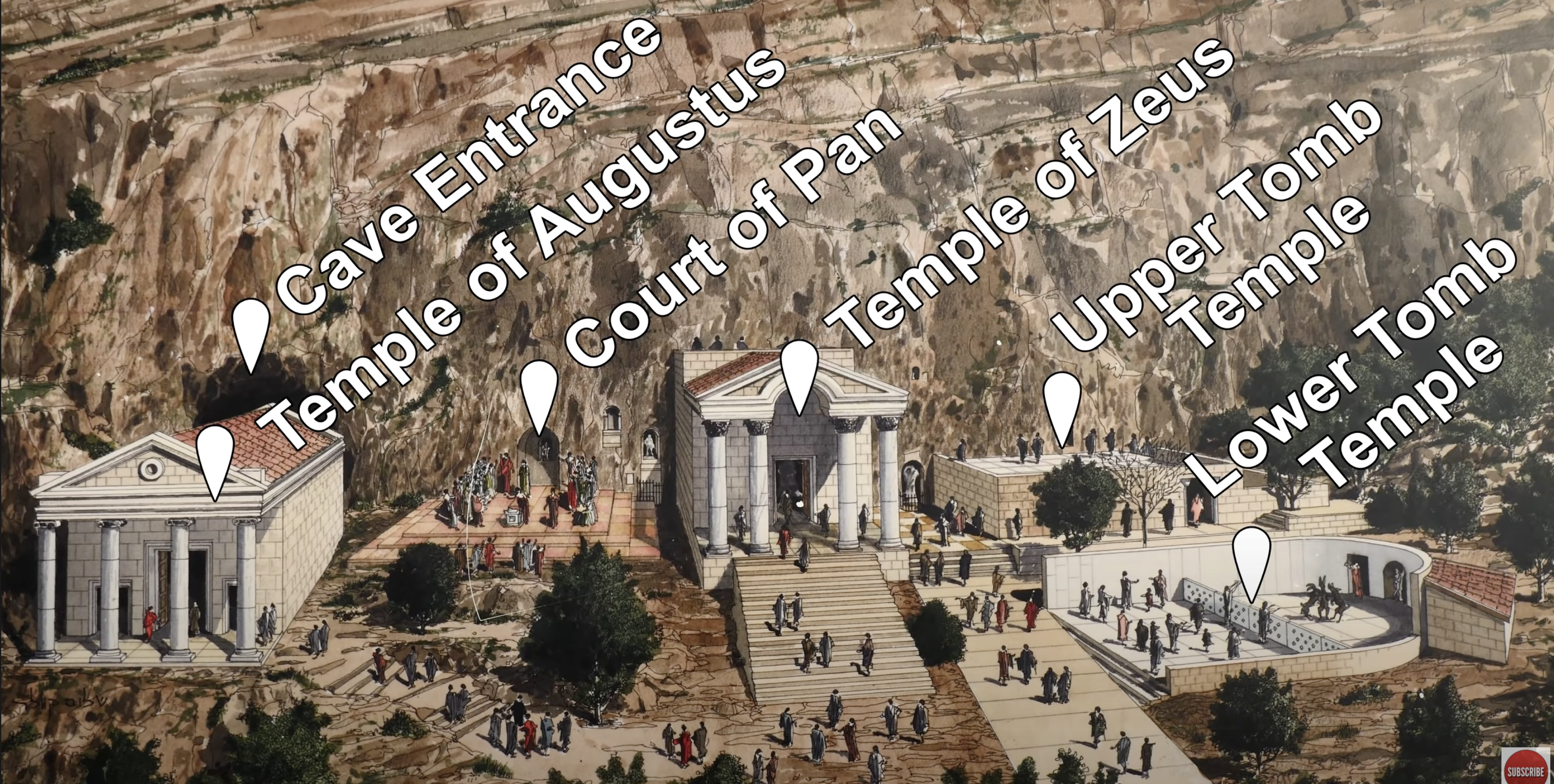
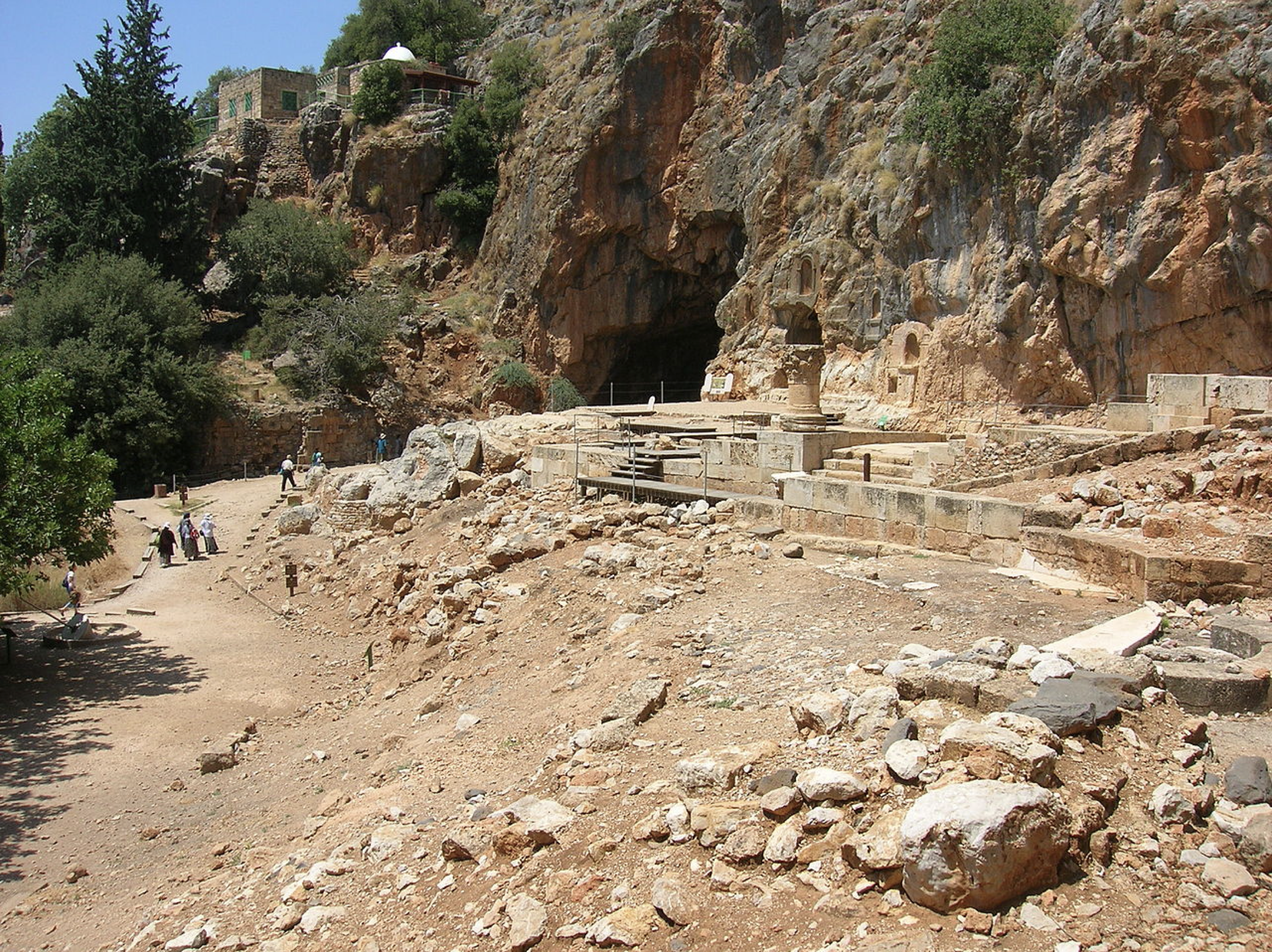
It must have been quite a sight in those days. The Banius River (one of the tributaries to the Jordan) originated from a cave carved out of a sheer cliff face. Water gushed from the mouth of the cave until an earthquake in 1202 relocated the outflow to a lower flat section, from which it flows today.  A great temple was built for Pan near the cave’s mouth, and many niches were carved in the face of the cliff for idols.

Here is what it looks like today: you can see the large cave opening and where the river would flow out.  You can see the remains of the temples of false gods that stood in Jesus’ day.

Here is an artist’s conception of what it looked like in Jesus’ day.

If you want to know the interesting story of who the false god Pan was and how the ancient portrayals of Pan became how we picture “the devil” with horns, pointed ears, and part goat, and if you want to know how we got the name Lucifer mistakenly inserted into the Bible around 300 AD, you’ll have to read my blog entry later this week.

But this was a substantial pagan center of worship.  Some say that people in that day felt the mouth of the cave was the “gates of hell” and that all the fertility gods used it as a passage to the underworld.  (I can’t find any direct sources for this.)   It is this place that Jesus chooses to go to ask this most important question.

On the way there, Jesus asks, “Who do people say that the Son of Man is?”   ‘Son of Man’ is Jesus’s most common title to refer to himself.  In Hebrew, ‘son of man’ can have two meanings.  It can just be the son of Adam, a human, a descendant of Adam, as Luke records in his genealogy of Jesus.  Or it could be a reference to the Son of Man figure in the book of Daniel.

Daniel 7:13-14   “I saw in the night visions, and behold, with the clouds of heaven there came one like a son of man, and he came to the Ancient of Days and was presented before him.  And to him was given dominion and glory and a kingdom, that all peoples, nations, and languages should serve him; his dominion is an everlasting dominion, which shall not pass away, and his kingdom one that shall not be destroyed.

So, this “son of man” comes before God to be crowned as king.  (Not coming on the clouds as in a second coming.)   

Look at the encounter Jesus has with the High Priest at his trial before some of the Sanhedrin.

Matthew 26:62-64  And the high priest stood up and said, “Have you no answer to make? What is it that these men testify against you?”  But Jesus remained silent. And the high priest said to him, “I adjure you by the living God, tell us if you are the Christ, the Son of God.” Jesus said to him, “You have said so.

Jesus wasn’t the first to claim to be the Messiah.  Josephus said there were at least a dozen before Jesus.  You could claim to be the Messiah, and the Jewish leaders would sit back and watch to see what happened.  And “son of God” can refer to an earthly king (as in David).   It was not considered blasphemy to make this claim.  But Jesus doesn’t stop there.

Matthew 26:64-66   But I tell you, from now on you will see the Son of Man seated at the right hand of Power and coming on the clouds of heaven.”   Then the high priest tore his robes and said, “He has uttered blasphemy. What further witnesses do we need? You have now heard his blasphemy.  What is your judgment?” They answered, “He deserves death.” 

Jesus has claimed to be the Son of Man from Daniel 7.  This claim to deity would be considered blasphemous because they did not recognize his deity.

But Jesus is not asking, ‘Who am I?’ but, ‘Who do people say I am?’

Am I just a man, the son of Adam (son of man), or am I Daniel’s “Son of Man” who comes on the clouds?

Some say John the Baptist…
Why would they think Jesus was John the Baptist?  Indeed, we know Herod Antipas believed that Jesus was the reincarnation of John the Baptist, whom he beheaded.  

Matthew 14:1   At that time Herod the tetrarch heard about the fame of Jesus, and he said to his servants, “This is John the Baptist. He has been raised from the dead; that is why these miraculous powers are at work in him.”

Some say, Elijah…
Why would they say that?  It is well known that before the Great Day of the Lord came, Elijah would come.  And in Jesus’ day, and still today, at every Passover seder every year in every Jewish household, they set the table with an empty chair for Elijah.  At a certain point in the meal, they ask a child present to open the door and look outside to see if Elijah is coming.  They are looking forward to the great day.

Malachi 4:5  “See, I will send you the prophet Elijah before that great and dreadful day of the Lord comes.

But Jesus has already told the disciples that John the Baptist was the one who came in the spirit of Elijah…

Matthew 11:13-14  “All the prophets and the law prophesied until John. And if you are willing to receive it, he is Elijah who is to come.”

Jeremiah or one of the prophets…

This concept is not seen in Scripture but was noted in the folklore of the day.

Interestingly, among these opinions of who people think Jesus is, “Messiah” is not one of them.

Not after the feeding of the 5000.  Remember, after the miraculous feeding, they wanted to force Jesus to be king, but he refused.  They wanted a Messiah with an earthly kingdom who would defeat the Romans, make them independent again (and feed them free bread.)  But that was not the Messiah Jesus was to be.  (This was one of the temptations in the wilderness.)  They wanted a different Jesus.  So many left him after that.   No longer would the crowds see Jesus as a potential Messiah.

“But who do you say that I am?”

This is the critical question.  It is not “Who is Jesus?”   Because no matter what you believe, Jesus is who he is.  Despite millions who may not recognize it yet, Jesus is the Son of God who came to deliver us.  And one day, every knee will bow, and every tongue will confess that Jesus is Lord of all.   The important question is:  “Who is Jesus to you?”  If you don’t have a relationship with Jesus as your Lord, if he is not the one who tells you what to do (and you are obedient), if you haven’t pledged your life to him, then Jesus is not your Messiah; he is just a Messiah.  He is not your deliverer; he is a deliverer.  

“Blessed are you, Simon Bar-Jonah! For flesh and blood has not revealed this to you, but my Father who is in heaven.

Notice that Jesus calls Peter “Simon Bar-Jonah” here? You get only the Hebrew name Simon, son of Jonah. He doesn’t use the nickname he gave him the first time Jesus met him.

John 1:42 He [Andrew] brought him to Jesus. Jesus looked at him and said, “You are Simon the son of John? You shall be called Cephas” (which means Petros). 

It is a fairly common nickname today.  Just ask Sylvester Stallone (“Rocky”) or Dwayne Johnson (“The Rock”).   Jesus calling Peter ‘the rock’ probably brought snickers from other disciples, for Simon was often not rock-like until the future.  But that is the way Biblical names frequently work.  Names usually reflect a character trait or destiny yet to be revealed.

Abram is renamed Abraham, father of many when he is 99, a year before Isaac is born.  Jesus’ name means “Yehovah saves” to tell of his future actions.  But here, Jesus uses his original Hebrew name.  Shimon is from the Hebrew ‘shema’ to hear, so the name Simon means  “the one who hears.”  Then Jesus says, “Flesh and blood have not revealed it to you.”  God gave this understanding to Simon Peter.  It was a divine gift.  Over and over in the gospels, we see people who can’t understand the things of God.  God will give the gift of understanding to those who seek him and are willing to accept gifts from him.  If you only get your knowledge about God and the things of God from a person, you are missing it.  You must study God’s words in Scripture and pray for understanding.  People may mislead you.  There are many wolves in sheep’s clothing out there.  God will never mislead you.  So Jesus is really saying, “Blessed are you, Simon, the one who hears because you have heard it from above.”

When Peter said, “You are the Messiah, the son of the living God,” what did he mean?  Did he understand what ‘Messiah’ meant, or did he accept the common belief of the time – that the Messiah would be a military/political/religious leader who would free the Jews from Roman rule and reinstate the powerful reign of David?  Check out verse 22.  Obviously, Peter didn’t understand all of what this meant.

Jesus continues:
“And I tell you, you are Peter, and on this rock I will build my church, and the gates of hell shall not prevail against it.  I will give you the keys of the kingdom of heaven, and whatever you bind on earth shall be bound in heaven, and whatever you loose on earth shall be loosed in heaven.”

There is a lot to unpack here because so many have taken this verse and made it mean what they wanted it to mean.  The Catholic Church has used this verse to say that Peter is the Rock on which the church was built, and he has the authority to govern and make theological decisions.  I can’t agree with this interpretation.  First, I don’t believe Jesus calls Peter the rock on which the church is built.  If you look at the Greek, the two words for rock in that verse are different.  Jesus says to Peter, “You are Petros.”  A petros is a small rock, a pebble.  Then Jesus says, “And on this petra, I will build…”  A petra is a massive stone formation.  (Think of the city of Petra, carved into a solid rock cliff face.)  Let’s see how the Bible uses the word ‘petra.’  

Matthew 7:24   “Everyone then who hears these words of mine and does them will be like a wise man who built his house on the rock (petra).

You build on a solid foundation on the bedrock.  No one builds anything on a pebble (petros).  

So what is this bedrock that will be built upon?   Jesus’ disciples, familiar with the Old Testament, would know the answer.  (So would we if we read the Old Testament.)  Here  is a verse you likely know:

Psalm 19:14    Let the words of my mouth and the meditation of my heart be acceptable in your sight,  O LORD, my rock and my redeemer.  

If you memorized this in the King James version (as I did), God is “my strength and my redeemer.”  That is not a bad translation because the idea of strength is what the psalmist was going for with ‘rock.’    Let’s look at some other verses:

Deuteronomy 32:4    “The Rock, his work is perfect, for all, his ways are justice.  A God of faithfulness and without iniquity, just and upright is he.
1 Samuel 2:2    “There is none holy like the LORD: for there is none besides you; there is no rock like our God.
2 Samuel 22:32    “For who is God, but the LORD?  And who is a rock, except our God?
2 Samuel 22:47    “The LORD lives, and blessed be my rock, and exalted be my God, the rock of my salvation,
Psalm 62:2 He alone is my rock and my salvation, my fortress; I shall not be greatly shaken.
Psalm 78:35 They remembered that God was their rock, the Most High God their redeemer.
1 Corinthians 3:11  For no one can lay a foundation other than that which is laid, which is Jesus Christ.

Peter was not the rock to build on.  He was but a stone (petros) built on the bedrock (petra) of the Father built on the cornerstone of Jesus, with all the prophets and apostles being part of the foundation.

“…and on this rock I will build my church, and the gates of hell shall not prevail against it.”

So upon this rock I will build what?  In your English version, it says, “church.”  But Jesus would not have said ‘church’ for many reasons.  First, he didn’t speak English.  ‘Church’ is from the German ‘Kirika’, which comes from the Greek ‘kyriakon’, an adjective that means “of the Lord.” This Greek word was used for houses of Christian worship since around 330 A.D.  (Before Constantine, there were no Christian houses of worship legally.  The first “followers of the Way” met in synagogues (for almost all were Jewish).  Later, as the synagogue congregation got tired of the talk of Jesus, they were forced to worship in homes.)  But ‘kyriakon’ is not the Greek word we find here.

“…and on this petra, I will build my ekklesia…”

An ekklesia is an assembly or gathering.  It had no religious connotation at the time Jesus used it.  In the Greek Old Testament (the Septuagint that Paul often quoted from), ekklesia was used for various assemblies.  (The group gathered at Sinai was called an ‘ekklesia’ (Deuteronomy 9:10), and Psalm 26:5 speaks of an “assembly (ekklesia) of evildoers.”)  There was a Greek word for a religious assembly — ‘synagogue’- a word for any religious assembly that, upon adoption into Latin, became used explicitly for Jewish religious assemblies.  

Our English translations are not consistent with how they translate these Greek words.  

Ekklesia’ occurs 114 times in the New Testament.  It is always translated as “church” except in these instances:

Acts 7:38 This is the one [Moses] who was in the congregation (ekklesia) in the wilderness with the angel who spoke to him at Mount Sinai, and with our fathers. He received living oracles to give to us.

Acts 19:32  Now some cried out one thing, some another, for the assembly (ekklesia) was in confusion, and most of them did not know why they had come together. [This was a town hall meeting in Ephesus.]

Heb. 2:12 [quoting Psalm 22:22]  “saying, “I will tell of your name to my brothers; in the midst of the congregation (ekklesia) I will sing your praise.”

There is a clear effort in our English translations to use “church” for ekklesia when it is only Jesus’ follower’s meeting.  ‘Synagogue’ is in the New Testament 56 times and is translated (or not translated) as ‘synagogue’ except on one occasion:

James 2:2 For if a man wearing a gold ring and fine clothing comes into your assembly (synagogue), and a poor man in shabby clothing also comes in…

Apparently, our English translators didn’t want people to think that James was writing his letter to a synagogue, even though we know that is where the believers were meeting.  (Again, we see this forced separation from anything Jewish.)

I don’t believe it was Jesus’s intention to build a church as we think of it.  What did Jesus say his primary mission was? He came to regather the lost sheep of Israel.  He was not here to make a new organization.  He is assembling a called-out community of people who recognize the living God and see Jesus as the Messiah.  Jesus’ movement is not a synagogue, nor is it a church.  It is the recovery of God’s reign and rule in the hearts and actions of men and women. as it was established at Sinai. After all, it is His assembly, the same assembly called to hear the word of God at the base of the mountain.  He is calling all to join his Kingdom.  

We get so tied up in how best to build a church.  Hundreds of books exist on the best way to build a church.  But I don’t think Jesus wanted us to build churches.  He wants us to build up the Kingdom of God.  We think too small, building our own little kingdoms, recruiting and proselytizing members.  We think the Great Commission is all about church planting, but Jesus’ Great Commission is all about making disciples.  Jesus is most concerned with pouring life into other lives so that others will experience God’s presence in their midst first-hand. This is what we should be doing.

But ‘Church’ is big business.  People love to build empires, People love to build buildings, People love to build organizations.   When we were in Egypt, our teacher showed us the magnificent temples and pyramids the pharaohs built.  Egypt was all about building huge buildings.  And he said…”The Kingdoms of this world build buildings. Our God builds people.  

Matthew 16:19-20  I will give you the keys of the kingdom of heaven, and whatever you bind on earth shall be bound in heaven, and whatever you loose on earth shall be loosed in heaven.”  Then he strictly charged the disciples to tell no one that he was the Christ.

There is so much to unpack in these verses but I’m going to be brief.  If you go to a church or museum and see statues of the apostles, it is always easy to pick out Peter.  He is the one holding a bunch of keys. (It is also from this verse we get the idea of Peter being the gatekeeper of Heaven.)   I agree with John Piper, who said the key to heaven is the knowledge of the true identity of Jesus.  That is what this whole passage is about.  Piper said, “When any faithful Christian who speaks the words with the bedrock of Jesus’s identity at the center — when you speak those words faithfully, you are using the keys of the kingdom to open the kingdom in people’s lives.”  Knowing Jesus as your Messiah is the key.

Binding and loosing are rabbinic idioms that say what is allowed and what is not.  (

think of binding an animal to a hitching post.  If you bind it there, it is restricted.  If you loose it, it is free to roam around.)  What does it mean to observe the Sabbath?  Who decides what is permitted or allowed?  The Pharisees had taken that authority and run with it (and never stopped running.)  What could you carry, how far could you walk, etc.  But Jesus said they did this poorly.

Matthew 23:4  They tie up heavy burdens, hard to bear, and lay them on people’s shoulders, but they themselves are not willing to move them with their finger.

But someone has to interpret the law.  So Jesus is passing that authority on to these disciples. It is not to Peter only, because the ‘you’ in verse 19 is plural, “I am giving y’all the keys to the kingdom….”  (Jesus restates the binding and loosing in Matthew 18:18 with the plural ‘you.’)

Jesus went on a several-day journey to the northernmost reaches of the promised land.  It was a place none of the disciples had ever been.  It was the place where things went wrong in Israel.  It was where 900 years before Jesus, King Jeroboam built altars to idols, the baals, and fertility gods, and told the people of Israel — this is your God who brought you out of Egypt. This place, where in Jesus’ day, thousands came to worship a fertility god they called Pan.  A place some called the ‘Gates of Hell.’  And Jesus brings his disciples there to ask them this question:  “Who do you say that I am?”  Because if you really understand who I am and if you follow me, you will be part of a community of believers that the Gates of Hell can not stand against.  In Jesus’ day, gates were defensive structures built to withstand the enemy.  Jesus said if you accept me as your Messiah and as your Lord (meaning you follow my orders), then you will storm the Gates of Hell.  It is not a defense against hell but an offense against it.  And there are people in your community, some of your neighbors, who are bound for hell, and we need to stop hiding in church buildings and go on the offensive.

Jesus brought them here because they have to make a choice.  When they came into this promised land, Joshua called them all together and said you have to choose

Joshua 24:14   “Now therefore fear Yehovah and serve him in sincerity and in faithfulness. Put away the gods that your fathers served beyond the river and in Egypt, and serve Yehovah.  And if it is bad in your eyes to serve Yehovah, choose this day whom you will serve, whether the gods your fathers served in the region beyond the river or the gods of the Amorites in whose land you dwell.  But as for me and my house, we will serve Yehovah.”

Years after Joshua, 10 of the 12 tribes chose to follow the idols.  Right here in this place.  In Jesus’ day, people still chose to worship Pan there and said he was the god who would make their land fertile so they could be rich.  Jesus says am I a prophet?  Am I just your teacher?  Am I just a Messiah, or am I your Messiah?  And now, you and I have to choose, and we choose every day.  I don’t have to take you to a pagan place of idols.  You walk among idols every day.   We walk among people who worship the idols of this world and say they will make them rich, healthy, and successful.  What are we building?  Are we building our own little kingdoms and buildings?  Or are we building people for the kingdom of God?  Are we making disciples?  Who is Jesus to you?