
February 16 – March 27, 27 A.D.  Jesus in the Wilderness – The Year of the Lord’s Favor #15

Week 3 What did Jesus do in the Wilderness?  (Part 2)

Matthew 4:1,2  —  Luke 4:1-2

Last time, we introduced the idea of fasting and how it demonstrates our desperate need for God and how we desire God more than even the basic human needs.   Don’t forget that in the Hebrew culture, all verbs are action verbs; for example, love is an action, not a feeling.  James said show me your faith by your deeds.  Fasting is an action we can do to learn our desperation for God and to show our desperation for God. 

Other than this 40-day fast associated with the beginning of Jesus’ mission1, we don’t see Jesus fasting.  In fact, John the Baptist’s disciples ask Jesus why his disciples don’t fast.  Jesus tells them this is the time for a feast because the bridegroom (Jesus) is here.  There will come a time when the bridegroom is gone, and fasting will be appropriate.2  Apparently, Jesus had quite the reputation for feasts and not fasts, and he later tells a group of Pharisees:

“For John the Baptist has come eating no bread and drinking no wine, and you say, ‘He has a demon.’ The Son of Man has come eating and drinking, and you say, ‘Look at him! A glutton and a drunkard, a friend of tax collectors and sinners!’”  Luke 7:33-35

After Jesus has ascended to heaven, we see the church resume fasting (Acts 13:1-3, Acts 14:21-23, and 1 Cor. 7:5).  The Didache (the 1st Century ‘church handbook’) says Christians are to fast twice weekly, specifically Wednesdays and Fridays.3  Jesus gave instructions for our fasting:

“And when you fast, do not look gloomy like the hypocrites, for they disfigure their faces that their fasting may be seen by others. Truly, I say to you, they have received their reward. But when you fast, anoint your head and wash your face, that your fasting may not be seen by others but by your Father who is in secret. And your Father who sees in secret will reward you.  Mathew. 6:16-18

Jesus’ emphasis is not so much that you fast in secret but that you do not do it for the reward of others.

Should we fast?  There is plenty of evidence for fasting throughout the Bible. The only time it was put on hold was the year that Jesus spent with his disciples. Notice that in the passage above from Matthew 6, Jesus says, “when you fast,” not “if you fast.”  In Acts and Paul’s letters, the early church seems to have practiced fasting.  Let me ask you some personal questions.  Do you crave time with God?  Do you hunger for time in prayer when you miss a day of prayer?  Do you look forward with anticipation to your time alone with Jesus, studying the Word? Do you do these things with such fervor that you let nothing stand in your way?  For me, the distractions of this world tend to fill me at times to the point my desire for Godly things is numbed.  That is why I need to fast.  I must remind myself that my Creator is everything, and this world and its pleasures are just part of the creation, like me.  I need to, as Paul said, “discipline my body and keep it under control (1 Cor. 9:27), and fasting is a way to remind myself physically.  Finally, the Spirit drove Jesus to fast.  If Jesus needed to fast, how much more do I?

Last time, I mentioned the more than 20,000 people who have completed a 40-day fast in South Korea.  In Piper’s book on fasting, he attributes the fantastic growth of the churches there to their strong emphasis on prayer and fasting.  

“The first Protestant church was planted in Korea in 1884. One hundred years later, there were 30,000 churches. That’s an average of 300 new churches a year for 100 years. At the end of the twentieth century, evangelicals comprise about 30% of the population.”4

That kind of growth while our U.S. churches are stagnant or decreasing in numbers.  It is time for us to learn a new desperation for God, and fasting is a means to do it.

So then, how should we fast?  This is between you and God.  Seek His input, for, after all, submission to his will makes it a fast.  By the original definition, a fast was abstaining from food, but it has become very popular for Lenten fasts to be from certain other pleasures like the internet, social media, television, or a particular food like chocolate, meat, etc.  That may be an excellent place to start, but I only learned that desperation for God by fasting from some of the more basic physiological needs like food, sleep, or shelter. How do you fast from shelter?  I am glad you asked.  Contact your local homeless ministry and find out if you can volunteer to stay overnight with some people who have no homes in their shelter.  I have spent a few nights sleeping on a 4-inch mat on the floor with some of our “neighbors without homes” in our local Room in the Inn program.  You are putting your service to God ahead of and in place of your love for a comfortable bed and home for a night.   It is a fast if done with the proper attitude and as a way of seeking God.  If you aren’t seeking God, then you missed the point. 

You must also be in obedience to God in other areas, or your fast will not be beneficial.  

Look at Isaiah 58.  God instructs Isaiah to scream at the top of his lungs:

“Declare to my people their transgression, to the house of Jacob their sins. Yet they seek me daily and delight to know my ways as if they were a nation that did righteousness and did not forsake the judgment of their God;”  Isaiah 58:1-2.

Many are living in disobedience, yet they pray daily for God’s help and go to worship “as if they were a nation that did righteousness.”  Ouch!   They were going through the motions of ‘church’ but were living lives of sinfulness.  They were even fasting for God to answer them, but God did not answer despite their fasting.  So they ask God,

“‘Why have we fasted, and you see it not?  Why have we humbled ourselves, and you take no knowledge of it?’”  Isaiah 58:3a.

So God answers and tells them fasting is useless if they are living lives of disobedience. 

“Behold, in the day of your fast you seek your own pleasure, and oppress all your workers. Behold, you fast only to quarrel and to fight and to hit with a wicked fist.  Fasting like yours this day will not make your voice to be heard on high.” Isaiah 58:3b,4.

God says, “You call that a fast?  You think that is acceptable to me?” (Is 58:5 my paraphrase). So then God tells them what kind of fast he wants from them:

“Is not this the fast that I choose: to loose the bonds of wickedness, to undo the straps of the yoke, to let the oppressed go free, and to break every yoke?  Is it not to share your bread with the hungry and bring the homeless poor into your house; when you see the naked, to cover him, and not to hide yourself from your own flesh [people]?”  (Is. 58:6-7)

God wants them to fast from wickedness.  Let me paraphrase it: ’Take a break from sinning, stop oppressing and exploiting people; it is worthless for you to deny yourselves food and not even share the food you have not eaten while fasting with the hungry around you. You have an extra bedroom and a closet full of clothes, and yet your neighbor is homeless and poorly clothed while you hide out from your suffering neighbor in your fancy house.’

God makes it clear that he could care less for our fasting if we aren’t living according to his precepts.  But then Isaiah has good news for them if they will repent and do what he asks (and I’ll let Eugene Peterson paraphrase this time):

“Then when you pray, GOD will answer.  You’ll call out for help and I’ll say, ‘Here I am.’  “If you get rid of unfair practices, quit blaming victims, quit gossiping about other people’s sins,  If you are generous with the hungry and start giving yourselves to the down-and-out, Your lives will begin to glow in the darkness, your shadowed lives will be bathed in sunlight.  I will always show you where to go. I’ll give you a full life in the emptiest of places—firm muscles, strong bones. You’ll be like a well-watered garden, a gurgling spring that never runs dry.  You’ll use the old rubble of past lives to build anew, rebuild the foundations from out of your past.  You’ll be known as those who can fix anything, restore old ruins, rebuild and renovate, make the community livable again.”  Isaiah 58:9-12 The Message.

Have you ever felt like your prayers were bouncing off the ceiling?  Have you ever fasted and wondered why God wouldn’t respond?  Have you ever felt like your ‘worship’ was empty?  Then Isaiah says that it is time to check your obedience meter.  As Malachi noted, you can’t buy off God with money or impress him with your fasting or singing if you ignore everything he asked you to do.  Take a fast from disobedience first.  The waters of repentance are still flowing, and Jesus and John the Baptist are still calling.

Jesus is fasting in the wilderness. Have you taken the time to journey outside by yourself this week?  Let’s skip a meal, take a hike, and commune with our Creator.  Food is good!  But God is better!!!

Please see my Bibliography for recommended books and links to obtain them.

  1. In Acts 13:1–2, we see another example where fasting is associated with discernment for mission.
  2. Matthew 9:14-16.  This also suggests that when we are present with Jesus after that day, there will be no more fasting.
  3. Didache, 8:1, in Apostolic Fathers English
  4. Piper, John, “A Hunger for God: Desiring God through Fasting and Prayer” (2013) Location 1088, Kindle Version.
February 16 – March 27, 27 A.D.  Jesus in the Wilderness – The Year of the Lord’s Favor #14

Week 3 What did Jesus do in the Wilderness?  (Part 1)

Matthew 4:1,2  —  Luke 4:1-2

And after fasting forty days and forty nights, he was ________.  Mathew 4:2

This is not a challenging crossword puzzle clue.  Sometimes, I think I am hungry if I miss one meal.  Sometimes, I think I am hungry right after a meal.  But fasting for 40 days is another level.  Some people want to point out that the 40 days is more of a symbolic time in the Bible.  But you must pay attention when the Bible says, “40 days and 40 nights.”  Using the ‘days and nights’ terminology denotes a specific time.  (This will become important when we discuss the sign of Jonah in 2025.)  

In his book on fasting, A Hunger for God: Desiring God through Fasting and Prayer, John Piper begins his preface, “Beware of books on fasting.”1 While this may not be the best book marketing slogan, I have to agree.  There are thousands of books on fasting.  Pretty much every religion has a form of fasting.  Then there are political fasts (as in Ghandi’s) and medical fasts.  Medical fasting has become much more popular in the past several years, with intermittent fasting for weight control and general health.  What happens medically in a fast is much more complicated than we first realized.  The interplay of a host of hormones (especially ghrelin and leptin) is beyond our current understanding, as the reactions of those hormones to fasting are not always predictable and are influenced by many other factors, for example, sleep.  And while we are talking medicine, despite what the internet says, a 40-day food fast (still consuming water) is not impossible for a healthy person.  In South Korea, over 20,000 people have completed a 40-day fasting prayer retreat.2   (That said, consult your physician before doing extreme fasting or any fasting if you have any medical problems.)

But we are talking about religious fasting, as seen in the Old and New Testaments. What does fasting accomplish?  How does not eating make a difference from God’s perspective?  After Jesus fasts for 40 days, he is tempted by the accuser to use his power to turn stones into bread, and he answers with a verse from Deuteronomy 8:3: “Man shall not live by bread alone but by every word that comes from the mouth of God.” But you can’t eat the Bible like bread if you are hungry.  So, how are we to understand this?  The idea is that there are more important things in life than material provision, and that includes food.  That goes against everything I learned in my college Sociology class.

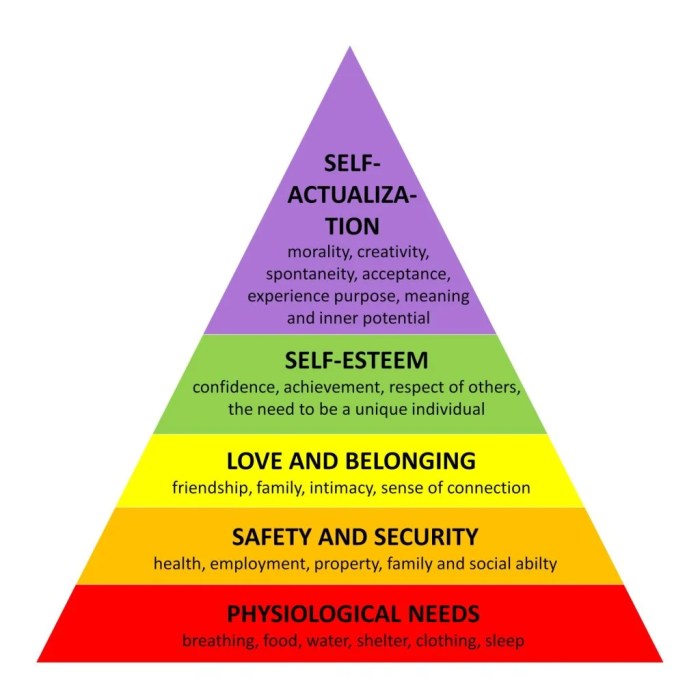
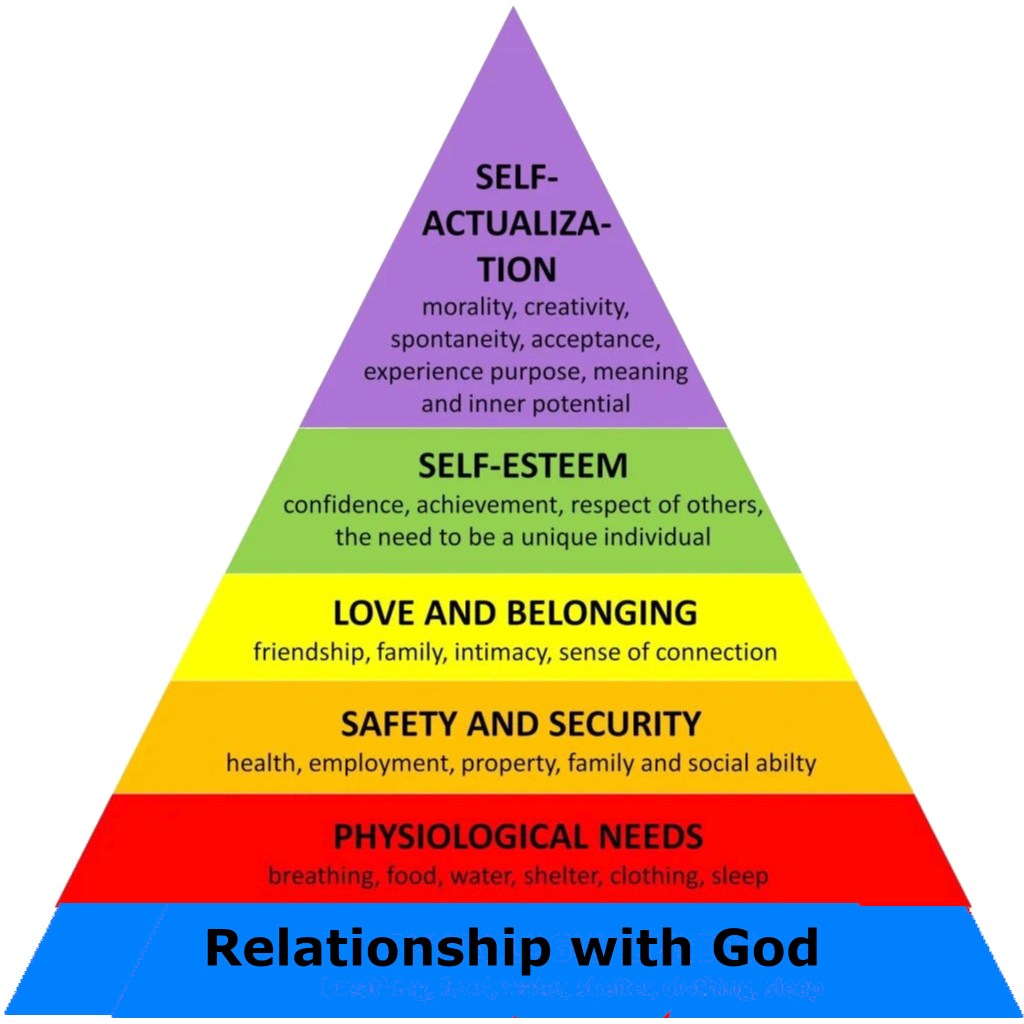
Abraham Maslow is a humanistic psychologist who is most famous for his “Hierarchy of Needs,” which is frequently pictured as a pyramid in which the base physiological needs (food, water, air, shelter, clothing, sleep, etc.) must be met before a human can consider meeting any other needs (Safety, then Love/Belonging, then Esteem, and finally Self-actualization).  According to Maslow, it isn’t easy to consider any relationships or intellectual/occupational achievement until you satisfy your basic physiological needs.3   For example, it is hard to think about doing better at your job if you are homeless or hungry.  That makes a lot of sense and is something we see frequently in our homeless ministry.  But followers of Jesus need to add a new level to Maslow’s pyramid to make it consistent with the Bible.


To Maslow, the physical preservation of life is the most critical need (air, food, water, shelter, clothing, sleep).  The Bible is very clear that these things should not be our highest priority, as evidenced by these scriptures:

“Therefore I tell you, do not be anxious about your life, what you will eat or what you will drink, nor about your body, what you will put on. Is not life more than food, and the body more than clothing?…  Therefore do not be anxious, saying, ‘What shall we eat?’ or ‘What shall we drink?’ or ‘What shall we wear?’   For the Gentiles seek after all these things, and your heavenly Father knows that you need them all.   But seek first the kingdom of God and his righteousness, and all these things will be added to you.   Matt. 6:25, 31-33

But I do not account my life of any value nor as precious to myself, if only I may finish my course and the ministry that I received from the Lord Jesus, to testify to the gospel of the grace of God. Acts 20:24

O God, You are my God;  Earnestly I seek You;
My soul thirsts for You;     My body longs for You
In a dry and weary land    Where there is no water. 
I have seen You in the sanctuary,   Beheld Your power and Your glory. 
Because Your love is better than life,   My lips will glorify You. 
And in your name, I will lift up my hands.   Psalm 63:1-4

Jesus is very clear about what we are to seek first, and it is not food or drink or clothing.  Paul said life had no value aside from the ministry he had.  Even though the psalmist of Psalm 63 is in the wilderness (“a dry and weary land where there is no water”), he said that rather than water, what he thirsts for is God’s covenantal love, which is better than life itself.

What about breathing?  Breathing is a particular case.  You can’t fast from breathing (not for long).  What does the Bible say about breathing?

Genesis tells us that “God formed the man of dust from the ground and breathed into his nostrils the breath of life, and the man became a living creature”  (Genesis 2:7).  We are just dirt until God breathes life into us.  We are lifeless without God’s breath/spirit within us. The Hebrew word ‘ruach’ means ‘spirit,’ ‘ breath,’ or ‘wind.’ See how the Scriptures discuss this presence of God’s Spirit that gives us our life:

…as long as my breath is in me, and the spirit of God is in my nostrils…   Job 27:3

Thus says God, the LORD, who created the heavens and stretched them out, who spread out the earth and what comes from it, who gives breath to the people on it and spirit to those who walk in it:    Isaiah 42:5   

Remember, on that resurrection Sunday evening, Jesus suddenly appears in the room with the disciples and tells them:

“Peace to you! As the Father has sent Me, I also send you.” And when He had said this, He breathed on them, and said to them, “Receive the Holy Spirit.  John 20:21-22

If you don’t understand the significance of ‘the breath of God’ in the Bible, you might have found it odd that John mentions Jesus breathing on them.  But this breath of God brings life from death and new life to all as in creation, as in Ezekiel 37:9, where the prophet is told to speak, “breathe into these slain [the dry bones] that they may live,” and at Pentecost when the ‘ruach’ (Spirit) comes in like a ‘mighty rushing wind’ (Acts 2:2).

God’s presence is the very air I breathe.  I may not live long without air, but I am not genuinely alive without God’s Spirit within me.  Several old hymns contain this concept (“Breathe on Me” and “Breathe on me Breath of God”).  Michael W. Smith wrote a song in 2001 that you have probably sung many times without realizing it was about the idea of fasting.   

This is the air I breathe.
Your holy presence
Living in me.
This is my daily bread.
Your very word
Spoken to me
And I… I’m desperate for you
And I… I’m lost without you.4

This is more reflective of our hierarchy of needs.

Are you desperate for God?  Do you hunger for him?  Do you thirst for him?  Is your need for God greater than your need for food, water, shelter, clothing, sleep, or air?  Maybe you don’t feel that desperation for God right now.  This is something I didn’t understand for a long time. And perhaps that’s where you are today.  I want to challenge you today to realize that deep need for God more than anything else.  It will change your life.  How do you begin to understand this?  I discovered my desperate need for God only when I began to decide to give up some of these ‘basic needs’ for a time and seek God instead.  And this is what I learned by fasting.

Have you ever been at a restaurant, looking forward to that great dish you ordered, and realized that you stuffed yourself so much on the salad and appetizers that you had no hunger for that wonderful main dish?  Piper says our hunger for God is underdeveloped because we fill ourselves with desires for other things.5  Mark’s Gospel tells us about Jesus’ explanation of the parable of the seeds scattered among thorns that “the desires for other things enter in and choke the word.”

“It is not the banquet of the wicked that dulls our appetite for heaven, but endless nibbling at the table of the world. It is not the X-rated video, but the prime-time dribble of triviality we drink in every night. For all the ill that Satan can do, when God describes what keeps us from the banquet table of his love, it is a piece of land, a yoke of oxen, and a wife (Luke 14:18-20). The greatest adversary of love to God is not his enemies but his gifts. And the most deadly appetites are not for the poison of evil, but for the simple pleasures of earth. For when these replace an appetite for God himself, the idolatry is scarcely recognizable, and almost incurable. Jesus said some people hear the word of God, and a desire for God is awakened in their hearts. But then, “as they go on their way they are choked with worries and riches and pleasures of this life” (Luke 8: 14).”6

Fasting is a test to help us see which desire controls us and what is more important to us, the Creator or the Creation.  We have already noted the parallel between Jesus’ 40-day testing in the wilderness and Israel’s 40-year testing in the wilderness.  They both were led there by God and were led to hunger.  Israel fails the test by doubting God and even assigning evil motives to God.  Jesus passed the test, refusing to go outside God’s will and breaking his fast ahead of God’s plan.  How about you?  Jesus is in the wilderness.  I pray that the Spirit will drive you there for a time to fast, pray, and better know yourself and your Creator.

We will continue this overview of fasting next time.

Please see my Bibliography for recommended books and links to obtain them.

  1. Piper, John, A Hunger for God: Desiring God through Fasting and Prayer (2013) preface, Kindle Edition.
  2. Wesley Duewel, Mighty Prevailing Prayer Grand Rapids: (1990), p. 192.
  3. Maslow later restated his theory and accounted that people did not necessarily move strictly from one tier to another and could simultaneously work on aspects of multiple tiers of the pyramid.  
  4. Smith, Michael W. “Breathe” 2001.  Another popular chorus exhibiting this idea of fasting is “As the Deer” by Martin Nystrom in 1984. (Based on Psalm 42).
  5. Piper. Loc 660, Kindle Edition.
  6. Ibid. Loc 67.