
November 18, 2025 –  The Turning Point in Acts— Acts #21

November 18, 2025 –  The Turning Point in Acts— Acts #21
Acts 8:1-8

Today, we come to a significant turning point in the book of Acts.  

Acts 8:1-3  And there arose on that day a great persecution against the church in Jerusalem, and they were all scattered throughout the regions of Judea and Samaria, except the apostles. Devout men buried Stephen and made great lamentation over him. But Saul was ravaging the church, and entering house after house, he dragged off men and women and committed them to prison.

Have you ever been in an earthquake?  Now I have felt some tremors a few times, but I have never been where the ground is actually shaking.  I remember watching a man being interviewed on a newscast years ago after a large quake in California.  He had recently moved there, and it was his first major quake.  He said, “I had no idea what to do.  My first instinct was to run back inside my house.  Your home is supposed to be your safe place.  But everything in the house was shaking, and pictures were falling off the walls.  I just froze.

You may have never been in an earthquake, but you know that feeling.  When things are uncertain, you want to return home, to your safe place.  We humans love our comfort zones, familiar routines, stable jobs, and predictable communities because what is familiar feels secure.  We like to know what’s happening in advance.  We want to do things we know we are successful at.  We prefer doing things we have done before instead of trying something new.  

Max Lucado wrote a book entitled “A Heart Like Jesus.” In that book, Lucado asks us to imagine what it would be like if, for one day, Jesus became you.  He wakes up in your bed, wears your clothes, and takes on your schedule, responsibilities, and friends.  “Jesus lives your life with his heart. His priorities govern your actions.  His passions drive your decisions.  His love directs your behavior.”  Lucado asks, “Would your friends notice the difference?  Would your schedule change?    What if you lived by Jesus’ heart and not your own?”1

Lucado says,  “God loves you just the way you are, but He refuses to leave you that way.  He wants you to be just like Jesus.”   We sing that song, “Just As I Am,” and that is how we come to God.  But Lucado is right, God has no intention of letting us stay the way we were.  

And I see this throughout the Bible; I see God constantly calling people to go to places they have never been before, to do things they have never done before, and to strive to become more than they were.  He told a man who had never seen an ocean or felt a raindrop to build a giant boat.  He told Abraham to leave his homeplace and go to a land he had never seen before.  He told Moses to return to the country he had fled in fear and to tell the most powerful ruler in the world to set all his slaves free.

God told prophet after prophet to deliver bad news to a king.  Jesus told a group of young men to leave their jobs and follow him, and then later said to them that people would hate them and persecute them.   You can not read the Bible and come away with the idea that God wants us to be safe and comfortable, or that it is okay to do nothing and remain the same person you were.

God’s primary interest is not your comfort and safety.   Oh, He believes in a time of rest.  He built a whole day of it into a week, and he is serious about it.  He wants us to rest in Him, not in ourselves.  We like our lives to be calm, peaceful, easy-going, and free from disruption.   But we live in a world that is not calm, peaceful, or easygoing.  It is often more like an earthquake.

And so it happens to all of us sometimes, the ground shakes beneath us. Life is a series of disruptions.   Something happens to upset our safe, calm existence.  It could be a death in the family, a sudden or chronic illness, the loss of a job, or a change in the world.  And all of a sudden, our life is filled with uncertainty and fear.

That’s precisely what happens to the early church in Acts 8. Up until this point, everything in Acts has been happening in Jerusalem, this small city on the map below.  It is so small that the dot on the map is too small to see. 

There in Jerusalem, there is powerful preaching, miracles, generosity, and a caring community.  Thousands are being saved.   Imagine, for a moment, you are a leader in a church like that: thousands of people joining and coming to Jesus in a few months, everyone being cared for, miracles happening.   It’s everything a pastor or church leader dreams of.   If you have all that, you may feel that it is enough.  Things are going well. We just need to keep doing what we are doing.

But in God’s eyes, the tremendous growth in Jerusalem was great, but it wasn’t enough because it was just a tiny dot.   A little bit that you can barely see in a world full of people who need the Gospel.   God sees a bigger picture than we do.  We look at our corner of the county.  See your tiny dot on the map, and then see the whole world like God sees it. 

John 3:16   For  God so loved the world, that he gave his only Son, that whoever believes in him should not perish but have eternal life.

God so loved the world.  It is not, “God so loved our tiny dot…” Not just the people in Jerusalem, Jesus also taught the disciples that He came because God loved the Samaritans.  And later the church in Acts would realize that God so loved not just the Jews, but the people in Asia Minor, and Greece, and even those horrible Romans.  God loves the world, and he wanted the early church to love the world too.  It was not enough that they loved the other Jews in Jerusalem who were just like them.  Things were good there, a growing, caring church.   But God wanted more.  He wants us not just to love each other and the people around us who are mostly like us.   God wants us to love the whole world, not just the small corner we can see.

To really appreciate Acts 8, we need to remember what’s come before. The story of Acts so far has been a spiritual rollercoaster — full of ups and downs, triumphs and trials, good news and bad news.  So let’s recap the Book of Acts.  

Jesus had died on a cross, which looked bad, but 3 days later he rose from the dead, which was really good. Jesus stayed 40 days teaching his disciples, and then left them, going up to heaven, which was kind of sad. But it was good because He said the Holy Spirit would come.  And that day the Spirit came was a really good day.   And then the day that Peter and John healed the lame man in the Temple was great, until they were arrested and put in jail.  That was bad.  But they were released, and that was good, but they threatened them not to speak anymore about Jesus, which was bad.  Then we read about everyone sharing with those who had needs.   That was good.  But then the story of Ananias and Sapphira, which wasn’t good.  

Then miracles were being done, and over 5000 followers had joined the disciples.  Things were going good…until the apostles were arrested (that was bad).  But it was good because an angel set them free, though then, after the court hearing, they were beaten with whips.  Then we read of Stephen, full of the Holy Spirit, preaching and doing miracles.   That was good, until he was killed.  And after that, things got really bad.
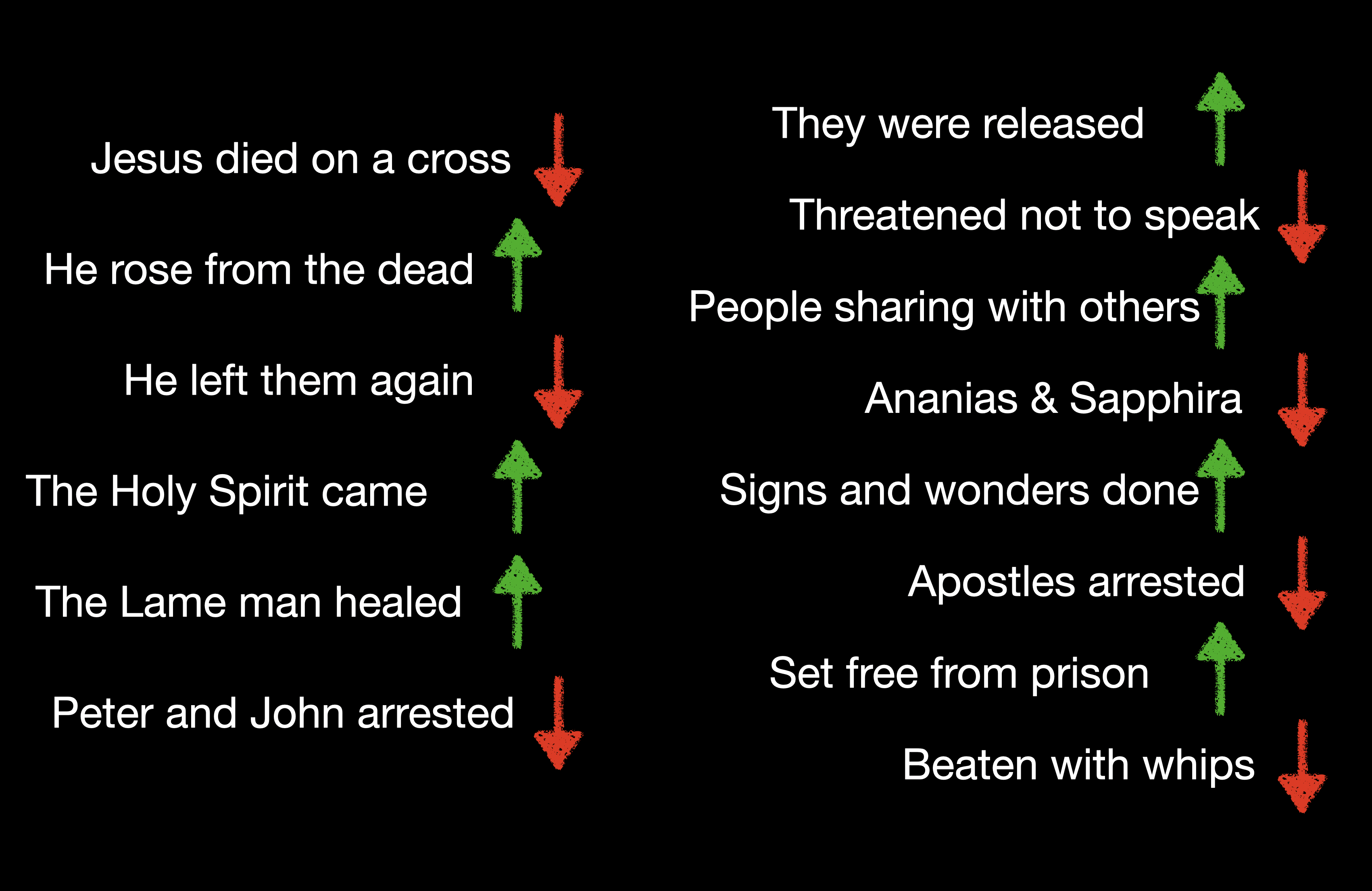
  This is a defining moment. For the first time, the church experiences organized, targeted persecution. The honeymoon period is over for these early followers of Jesus.  This is bad.   

Acts 8:1,3  And Saul approved of his execution.   And there arose on that day a great persecution against the church in Jerusalem, and they were all scattered throughout the regions of Judea and Samaria, except the apostles. …But Saul was ravaging the church, and entering house after house, he dragged off men and women and committed them to prison.

This is not just a young man who just watched the clothes while others stoned Stephen.  This zealous rabbi voted in the council to kill Stephen and then went on a rampage, going into homes and dragging off men and women.  Imagine the fear and confusion. Families are split apart. Homes raided. The fellowship they’ve built in Jerusalem — shattered.   They are scared to do or say anything.  They are scared to death.  This is bad news.
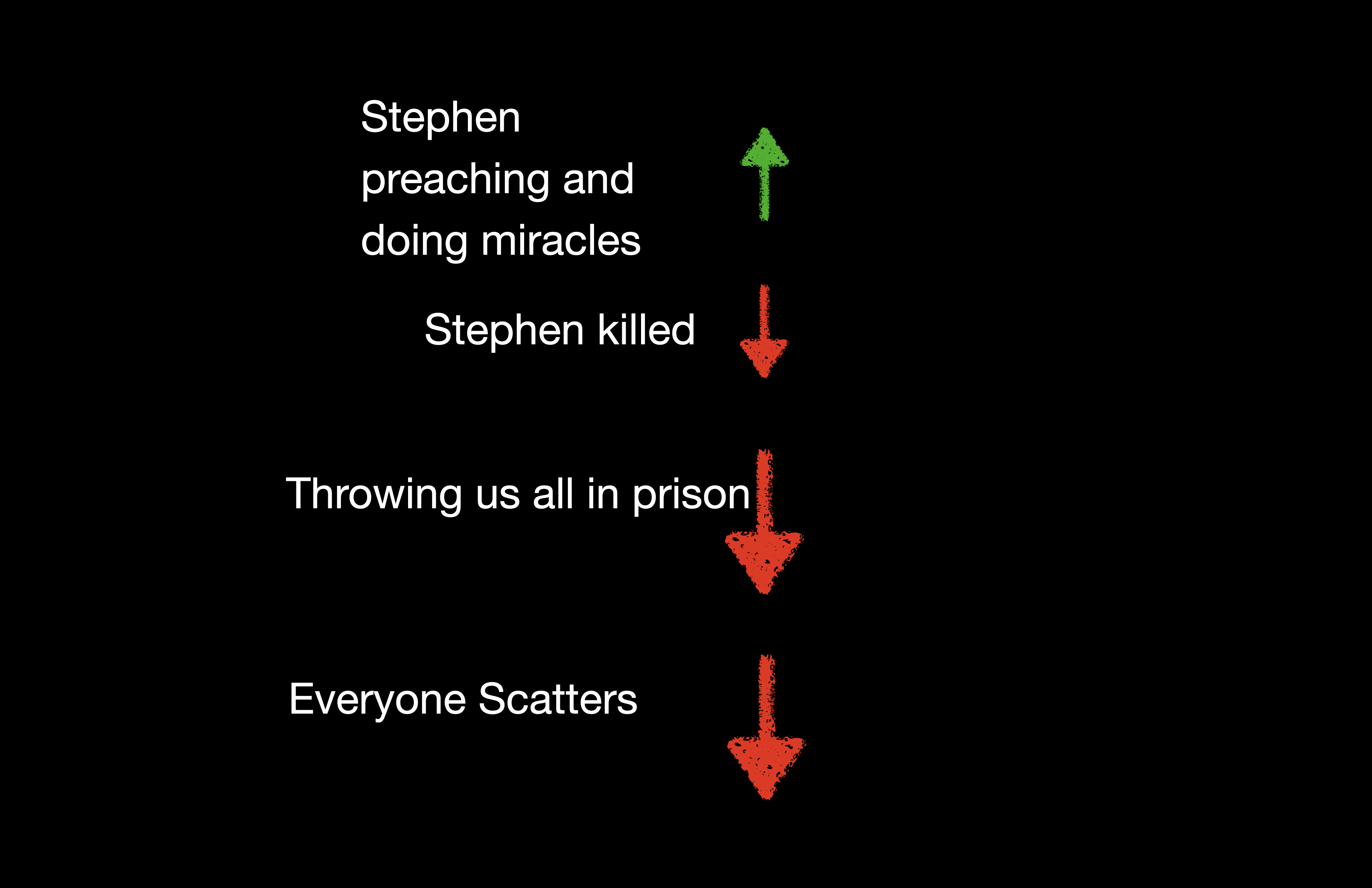
By the time we reach Acts 8, the church has experienced incredible highs and devastating lows.   Every time there’s a victory, opposition follows.  Just when things seem to be going good, here comes trouble.  The book of Acts has so far been a rollercoaster of highs and lows, but now, in Acts 8, it seems to be plummeting toward destruction.

Do you see this in your life also?  A rollercoaster of highs and lows, good and bad?  Just when things seem to be going good, here comes trouble.  How do you respond when things go wrong?  Disappointment?  Depression?  Fear?  Hopelessness?  Do you want to question God?  Why did you let them put the apostles in prison?  Why did you let them kill Stephen?  Why did my friend get cancer?  Why do evil people prosper?  Why is there so much trouble in the world?

This persecution should not have been surprising to them or us.  Jesus said:

John 15:18, 20   If the world hates you, know that it has hated me before it hated you…
If they persecuted me, they will also persecute you.”

And remember, He also said this:

Matthew 5:11-12   Blessed are you when others revile you and persecute you and utter all kinds of evil against you …

Oh, but as we discussed before, “Blessed” is the Greek “makarios,” which really means “happy are you” or “how fortunate you are,” so let’s read it that way…

Matthew 5:11-12   How wonderful it is for you when others revile you and persecute you and utter all kinds of evil against you falsely on my account. Rejoice and be glad, for your reward is great in heaven, for so they persecuted the prophets who were before you.

Jesus says that when you are persecuted, you are the lucky ones!  Do you think the followers in Jerusalem saw it that way?  Saul is dragging them out of their houses and throwing them in prison.  And do you think they are celebrating their good fortune?  How does this make sense?

To understand how you are lucky or happy when persecuted, you have to be able to see things from God’s view and not your own.  We need to look through God’s eyes.  We need to see the bigger picture again.   There are three reasons that persecution is good. 

1.  Persecution helps the believer mature and grow in Christ.

Romans 5:3-5   Not only that, but we rejoice in our sufferings, knowing that suffering produces endurance, and endurance produces character, and character produces hope, and hope does not put us to shame, because God’s love has been poured into our hearts through the Holy Spirit who has been given to us.

We need suffering to grow.  It is only when we experience failure, disappointment, persecution, and defeat that we are able to understand that we are not enough.  We learn to depend on our Father instead of ourselves.  We mature as followers of Jesus.

2.  Persecution purifies the church.

It is sad, but there are always those in the church who are not faithful followers but wolves in sheep’s clothing.  But when trouble comes, when persecution comes, their truth is revealed.   We see this in 1 John, and Jesus speaks of it in his parable of the soils.  

Matthew 13:20-21   As for what was sown on rocky ground, this is the one who hears the word and immediately receives it with joy, yet he has no root in himself, but endures for a while, and when tribulation or persecution arises on account of the word, immediately he falls away.

When persecution comes, some will leave the church.  They were never really a member anyway.  We have not had persecution in our time.  So, from what Jesus said, you would expect the church to have a lot of people who aren’t really committed to Jesus.  They are there with joy, but have never given their life to Christ.  And if persecution does come, they will fall away.

3.  Persecution causes the church to grow

Now this doesn’t seem to make a lot of sense.  If Paul is going from house to house in Acts 8, dragging people out to put them in prison, that seems it would have a negative effect on the group of followers in Jerusalem.  But look what happens:

Acts 8:4   Now those who were scattered went about preaching the word.

Verse 4 is a hinge in the book of Acts.  The word “scattered” here — diaspeirō in Greek — is the same word used for scattering seed. It’s not a random dispersal; it’s purposeful planting.  The devil tried to stamp out the fire in Jerusalem, but all he did was scatter the embers — and they caught flame in new places.  Everywhere these believers went, they carried the gospel. They didn’t have a denomination, a mission-sending agency, a church building, a program, or a budget. What they had was the message of Jesus, and that was enough.

Acts 8:5    Philip went down to the city of Samaria and proclaimed to them the Christ.

Philip, one of the seven deacons appointed back in Acts 6, goes to Samaria! Remember how the disciples first responded when Jesus took them through Samaria? They couldn’t believe he was actually going there.   They hated the Samaritans.  They called them half-breed Jews.  They wouldn’t even talk to them.  Jews and Samaritans had centuries of hostility, but the gospel breaks that barrier wide open.  That’s a remarkable scene,  See how the Holy Spirit has changed these followers to be more like Jesus?

Philip is crossing cultural and religious boundaries.   What began with Stephen’s death in Jerusalem leads to joy in Samaria.  The chapter that opened with mourning ends with rejoicing.
The story that began with persecution ends with proclamation.  The bad news becomes the vehicle for the good news.  This is the power of the gospel. And they went further…

Acts 11:19   Now those who were scattered because of the persecution that arose over Stephen traveled as far as Phoenicia and Cyprus and Antioch, speaking the word to no one except Jews.

At the beginning of Acts 4, the entire church, the gathering of followers of Jesus, is all in one city.  All in that one little dot.  But because of the persecution, they scatter like seed and are planted here.

So what is the lesson we learn from this passage in Acts 8?

Application 1: God’s Good News Often Moves Through Bad News
This is a pattern we see all through Scripture. Joseph was sold into slavery so he could save his family. Moses fled Egypt before leading God’s people out of it. The cross looked like defeat until resurrection morning.  Acts 8 continues that pattern — what looks like a disaster becomes divine strategy.  Maybe you’ve seen that in your own life. You lose a job and end up finding a deeper purpose. A relationship breaks down, and you discover how faithful God really is. A closed door becomes the very thing that pushes you toward your calling.

Romans 8:28  And we know that for those who love God all things work together for good, for those who are called according to his purpose.

Listen, God did not want this persecution.  God loved Stephen.  He did not want Stephen to be stoned.  But God gave men free will, and men choose evil.  But God takes the evil that man has done and makes it work for good.  God has a way of turning scattering into sowing — pain into purpose, loss into mission.  So when you get bad news, a bad diagnosis, a financial bad turn, or some tragedy, if you are a follower of Jesus, know that God, who loves you, will take that tragedy and work it for good.

Application 2: Comfort Can Become the Enemy of God’s Purpose

The church in Jerusalem had everything — community, teaching, worship, generosity, and miracles. But all of that was happening inside one city.  And we have to admit, many of our churches today fall into the same pattern. We have programs, fellowship, music, structure — often much more of these than mission. We love being together, but we can easily become so inward-focused that we forget why we exist.

Sometimes, God allows discomfort — in a church, in a ministry, even in a nation — to push His people outward again.  The early church didn’t plan a missions strategy.  Persecution became their mission strategy. God used shaking to send them out.

Application 3: Wherever God Scatters You, Carry the Gospel

Acts 8:4   Now those who were scattered went about preaching the word.

Notice that Acts 8:4 doesn’t say “the apostles” went preaching — it says “those who were scattered.” Ordinary believers. Shopkeepers, craftsmen, mothers, widows, servants. They didn’t have seminary training, but they had stories of grace.  They didn’t have pulpits, but they had conversations.  They didn’t have missionary boards, but they had neighbors. Every believer was a messenger. And wherever they went, the gospel went too.

Maybe God has “scattered” you in a way you didn’t expect — a new job, a new city, a new season of life. Don’t see it as random. See it as God planting you where the gospel can take root.  If you find yourself in an oncology waiting room, find a way to be the gospel there, and maybe even use words.  Stuck in an elevator, waiting in a long line, wherever.  And if you are somewhere uncomfortable, be alert for opportunities to share.  Sometimes God shakes our comfort so He can share His comfort through us.

I don’t go to the movie theater much anymore.  (Even though I love paying $25 for some popcorn and a soda.)  But at a movie, I sit in my seat and watch, and when it is over, then I walk out of the theater and go about my life as if nothing has happened.  Once a week, we come to our seats at church and watch.  And when it’s over, then what?  Is this like a movie, or have we had an encounter with the God of the Universe who wants us to leave this place changed, to leave this place with a mission?  We are not saved to sit.  We are saved to serve.  We can’t fulfill God’s plan for our lives in this building.  

Jesus’ great commission was not “Go to church on Sunday and then go home (after you go out and eat lunch).   It was “Go into all the world and do something that will likely make you uncomfortable.”   

The passage ends in verse 8: “So there was much joy in that city.”   The church’s pain became someone else’s joy.  Their scattering became someone else’s salvation.   That’s the rhythm of the gospel — out of suffering comes life, out of loss comes joy, out of persecution comes expansion.  So when life shakes beneath your feet — when bad news comes — don’t assume God has abandoned you. He might take this opportunity to move you into the next chapter of His plan.  The ground may be shaking, but God is sowing.  What feels like bad news may be the start of very good news indeed.

  1. Lucado, Max. A Heart Like Jesus: Lessons for Living a Christ-Like Life. Kindle Edition. Location 33.

June 3, 28 A.D.  –   The Great Commission — The Year of the Lord’s Favor #85

Week 68 — The Great Commission
Matthew 28:16-20

We are almost to the end of our study, which began last January, going through the four Gospel accounts of Jesus’ ministry week by week. This week, we will discuss Jesus’ final teaching before his ascension.  Our scripture is found in Matthew 28.

Matthew 28:16-20   “Now the eleven disciples went to Galilee, to the mountain to which Jesus had directed them. And when they saw him, they worshiped him, but some doubted. And Jesus came and said to them, “All authority in heaven and on earth has been given to me. Go therefore and make disciples of all nations, baptizing them in the name of the Father and of the Son and of the Holy Spirit, teaching them to observe all that I have commanded you. And behold, I am with you always, to the end of the age.”

Look at verse 17: “They worshiped him, but some doubted.“  Does this verse bother you?  

It sure seems to bother a lot of Bible commentators.  Some feel uncomfortable attributing this ‘doubt’ to any of the eleven.   After all, this is not the first time they had encountered the risen Jesus.  He appeared on the evening of resurrection day to all but Thomas, and then all of them with Thomas 8 days later, specifically to solve Thomas’s issue of doubt.  They have had several weeks to get used to the idea of Jesus being alive again. So, some theologians have trouble attributing doubt to the eleven at this point.  Some are so troubled that they even try to force this appearance to be the one Paul referred to in 1 Corinthians 15:6, where he tells us Jesus appears to 500 people, just so someone besides the eleven could be the doubters. There is no evidence for that, and Matthew has specifically limited this encounter to the eleven.  So let’s ask the question that bothers them.  Why, at this point, would some of the 11 disciples have doubts?

We discussed doubt several weeks ago (if you missed it, check out “Doubting Thomas” — The Year of the Lord’s Favor #82).   But let me review:  Jesus is not bothered by the mental uncertainty we today describe as ‘doubt’.  He deals with uncertainty, like Thomas, by coming to him to resolve it.  To understand what bothers Jesus and what he defines as doubt, look again at his response to Peter’s episode of walking on the water and sinking in the waves in Matthew 14.  Jesus asks Peter, “Why did you doubt?”  But Jesus is really asking, “Why did you stop walking?”  For Jesus, the only problem with uncertainty is if it leads to a lack of obedience.   For the word our English Bibles translate as ‘doubt’ actually means to ‘hesitate or waver.”  Jesus is only concerned with mental uncertainty if it causes us to hesitate or waver in our obedience. 

Eleven disciples are worshipping Jesus.  They know he is alive and worthy of worship.  They have no uncertainty about this.  But some are hesitant or still wavering about what they should do now.  So, how does Jesus respond to this? The scripture says next:   And Jesus came and said to them….

Why does it say “Jesus came” if he is already standing before them being worshipped?

Jesus is drawing close to them.  This is my Jesus, responding in love and concern.   For those who feel that their doubts, wavering, or hesitation to act drives Jesus away, look closely.  Jesus is not offended by their doubt; he is compassionate and draws close to help them resolve their concerns.  When you have a problem, even if it is of your own making, Jesus will respond in love.  If we could only grasp how much he loves us and wants to help us with every part of our lives, even (as we discussed the past few weeks) in our doubts and failures.   Thomas is uncertain, Jesus comes to him in love and says, “Hey, if you need to see my hands and side, look here”.  Peter is at his lowest of lows, having failed miserably as a disciple and denied Jesus in his hour of need.  And how does Jesus respond?  He doesn’t come to chastise him; he comes to cook him breakfast and let him know he is forgiven and loved.  But these disciples have been through a lot.  Everything has changed for them after the crucifixion and resurrection, and they don’t know what they are supposed to do next.

“Oh, you have doubts?   You are not sure what you should do?  Let me tell you…..”

So Jesus comes and gives them directions.  We call those directions the Great Commission.

The disciples worshiped and doubted.  This describes a large percentage of the modern church.  They come to church once a week and worship Jesus.  They have no uncertainty about who Jesus is, and they are clear about what they believe. But no action follows the worship. They sing praises in the church on Sunday but have no idea what to do when they walk out the door.  They leave their churches the same way they walked in.  They have no clear plan for what to do next.  So they don’t do anything.  And like Peter, when he stopped obeying Jesus’ command to walk on the water, they sink.  They have heard Jesus’ command to be at work in the world, but they waver because they are unsure how to fulfill it.   And like he treated Peter after his denial, Jesus doesn’t come to punish them for their lack of obedience; He sticks out his hand to help.  Jesus wants to solve this hesitation and wavering, so like these disciples, He gives a task.  And that task, in general terms, is what we call the ‘Great Commission’. 

I am sure you have heard many sermons on the Great Commission.  I have listened to quite a few.  They are usually accompanied by a call for people to consider becoming a missionary to some foreign land.  I really wanted to become a foreign missionary.  I always thought that was what I would do.  I have done many short-term mission trips in Central America, South America, and Africa, but God never opened the door for me to become a foreign missionary full-time…yet.  (As my friend George says, “We’ll see what God gives.”)  As I study this scripture in Matthew 28, I have come to realize that it is not simply a call to me to go to the whole world.  The eleven disciples will indeed go to most of the known world then.  As we said last week, Thomas went as far as India (and perhaps China).  But some of them never left Israel.  And yet those who never left Israel fulfilled this verse right where they were.

Skip Moen says of this verse:
“The Evangelical world has enshrined this verse as Jesus’ Great Commission.  Over and over, we hear these words as a command to spread the good news.  So, we mount our campaigns, run our revivals, and make sure that there is an altar call at the end of every service, just in case someone in the audience hasn’t yet proclaimed faith.  From D. L. Moody to Billy Graham, we have become so accustomed to evangelism by appeal that we no longer read this verse the way it was written.”1

Apparently, Dr. Moen thinks that our traditional reading of these verses may be off base.  Let’s take a look.

Go make disciples.    One of these three words is an imperative.  A command.  Can you guess which one?  … I’ll wait… Did you guess “Go”?  Then you are wrong.  “Go” is not an imperative.  It is not a command. In Greek, it is an aorist passive participle.   Now I know nothing is more boring than talking about Grammar.  But when you are translating, it is essential to understand verb tenses.  It makes a difference whether something has already happened, is happening, or will happen.  You may remember participles from your high school grammar class.  A participle is a verb turned into an adjective by adding the suffix “ing.”  For example, you take the verb “work” and add an “ing” suffix to make it “working,” and it then is an adjective that describes the noun “man.”  Working man — the participle ‘working’ modifies the noun “man”.    So, in this commission, it is not ‘go’ as a verb, but ‘going’ or ‘as you are going.’   But this is in the passive voice, not the active, which means someone else caused your going.  And for these disciples, it is God who caused them to be going people. (The primary action is also past tense, so God did something in the past that has caused you to now be going.).  So this word “Go” could be more clearly translated as “As God has led you to be going.”

Remember what is happening here.  They see Jesus and consider him worthy of worship. They worship him.  But they hesitate to do anything because they don’t know what to do.  So Jesus tells them,  Because you recognize me as worthy of worship, I have the authority to tell you how to walk in this world.  I write the rules for your life.

You don’t just go and live any old way you want to live.  You are expected to walk as Jesus walked.  And you don’t just go wherever you want to go.   You listen for your King to give directions, then go to that place.  But it doesn’t make sense if I say I will follow someone and then take off in a different direction without them.   Say I invite you to lunch at a new restaurant after church today.  I tell you to follow me in the car and I’ll lead you there.  But then you pull out in front of my car, even though you don’t know where we are going.  You are no longer following me.  We often say we will follow Jesus, but we don’t stop to see where Jesus is going before we start off to a different place.  If we are going to live life as Jesus asks us to, then we have to go the way he is going.  So the command is not the word go. 

Is “make” the command?  No, “make” is not the command either.  In fact, the word “make,” which you see in your English version, is not present in the Greek.  Our translators inserted this word so the sentence would make sense to them.  Unfortunately, however, it just clouded the issue.  We can’t ‘make’ disciples.  We can’t force someone to become a disciple, and we can’t produce disciples.  We can only be obedient in how we live our lives, and we have to trust Jesus for the results.  

So the command has to be the word ‘disciple.’  It is a noun in our English version, but in the original Greek, ‘disciple’ is not a noun but a verb. It is the Greek word, mathēteuō, which is the word for a disciple, but changed to be a verb.  The action in the sentence, the command, is to “Disciple!”  So we better translate the command, “As you are going through life, disciple!”  Go about your daily life, living as God commands, and you will disciple others.

So let me get this straight.  To help us understand the Greek phrase, our translators took a Greek participle and turned it into a verb, took a Greek verb and made it into a noun, and then added another verb that wasn’t even in the Greek.  Hmmm… I’ll give them credit, their “Go and make disciples” is much simpler than “As you are going through life, disciple!”  But I think they have missed Jesus’ meaning.

Discipling is not the same as teaching.  It is not about gathering information.  It is more like an apprenticeship.   An apprentice joins up with a master of a craft and learns to do everything by closely watching and imitating the master.  He spends many hours with the master.  He might even live with him for a time.  He watches closely every move and later tries to imitate what he has seen.  That is the way people learned trades for thousands of years.  And that is the way these eleven were discipled by Jesus.  The goal of a disciple is not to know everything the Rabbi knows but to be who the Rabbi is.  It is not informational, but transformational.  

Our command is to disciple as we walk through life.  Some will be called to go to foreign lands like the disciples, but not many.  Most of us will live life where we are, but live it in such a way that as we go about our daily lives, what we do disciples others.  Jesus chose 12 people to follow him for a year.  He poured into their life, and they watched him as he walked through life, following his every move. How does Jesus deal with frustration?  How does he deal with trouble?  How does he deal with sorrow?  What does he do at a party?  Jesus taught much more by how he lived life and how he dealt with people than how he preached.   On his last night with them before his crucifixion, he demonstrated an important aspect of how they should act as he took on the role of a servant and washed their feet.  He was discipling until the end.  

Paul said:         1 Corinthians 11:1. Be imitators of me, as I am of Christ. 

Paul says this is discipling.   Obviously, you cannot disciple others unless you are a disciple yourself.   We are all still in the process of being disciples of Jesus.  So we study the scripture to see how Jesus acted in situations and how he treated people.  And we then try to imitate Jesus’ behavior.   I know “What would Jesus do?” became a trite saying because someone sold a bunch of plastic bracelets, but the idea is a valid one.`  We would all be better disciples if we asked ourselves that question a hundred times daily.

 If we recognize that Jesus is worthy of worship, we must acknowledge that he has the authority to tell us how to live. Then, we must be obedient to live that way.  Once we have truly become disciples, we must disciple others.  And Jesus says we do that simply by living as he taught us.  We have to be intentional about this discipling, though.  Like Jesus, we need to seek out people to share our lives with whom we can positively influence. We need to make time to be with them and have meaningful conversations.  We have to spend enough time with them so they can see how we live, as it reflects how Jesus taught us to live.  

Who have you sought out to have a positive influence on?  You have done it, but may not think of it this way.  The process of discipleship is demonstrated well with parenting.  You already know that your children learned more from watching how you lived life than they learned from your teaching or lectures.  You disciple your children.  If you are like me, you look back and want to apologize for those times you didn’t act in a way that reflected Jesus, and you taught the wrong lesson.  We have all failed at times, but the lesson of learning from your failures is an important one. They can learn that from us, also.  Even after your children have left your house, you still have opportunities to disciple.  They are still watching.  And then you have the blessing of grandchildren.   Another great opportunity to disciple.  What amazing benefits to the kingdom of God from just living life as God has told us to live.  You have already been discipling.  But don’t stop there.  You have friends and co-workers.  Have you considered that you might have a responsibility to disciple them?  They are already sharing part of your life.  They are already watching how you live life.  

Finally, don’t underestimate the effect you can have on people you happen to encounter every day. If we believe that God is sovereign, in charge of this world, and is active and working in our lives, then we have to realize that our lives are not a series of random events. We will discuss this more in a few weeks, but (spoiler alert) I will show you in scripture how God is arranging our encounters with others with much more intent than we realize.  

As you go about your daily life, see each person entering your life as if they were ushered into your presence by God Himself.  What would you say to someone, and how would you act differently if you knew God had specifically arranged for them to meet you that day? 

Think about it.  What if that person who happened to bump into you was put in that place by God so that you could have a moment of influence on them?  Would you act differently?  Would your conversation be different?   God is more intentional in the details of our lives than we often recognize.  I think most of what we see as “chance meetings” are divine appointments.   So, how can you demonstrate Jesus to that person God just dropped in your life today?   Every interaction we have is a chance to disciple, to reveal God to someone, as you just go about your life.  So as you live daily, live in a way that people will want to know the God you know, and demonstrate life lived the way Jesus demonstrated it to us.

Skip Moen was right about this.  We have focused too much on what he calls “evangelism by appeal” (Stadium Revivals, Crusades, Altar Calls, Witnessing programs).  We already know that most people who come to a church for the first time don’t come because the pastor invited them; they come because someone they know invited them.  Someone watched them live their life—someone who, by living life like Jesus, has been discipling them.  Many people make decisions at mass events, but never really commit to Jesus and never follow through.  

There is a place for “evangelism by appeal” in soul-winning campaigns, mass revivals, and door-to-door witnessing.  They can be important.   But they are not what Jesus is talking about in the Great Commission.   Jesus is talking about evangelism by discipleship..

As you are going through life, disciple!  Or as Eugene Peterson translates the Great Commission in The Message:

Matthew 28:19 Go out and train everyone you meet, far and near, in this way of life,

99% of Jesus’ followers today will never preach a sermon to thousands in a stadium.  But more people will enter the Kingdom of God because those 99 discipled their children, families, neighbors, or co-workers than will enter because of mass revivals.

You may be reading this, but not knowing how you should personally respond to Jesus’ command to disciple.  You may feel you are totally inadequate to disciple someone else.  But remember that Jesus is giving this instruction to a bunch of very young men, some teenagers.  We tend to think of the disciples as later in their lives, boldly ministering to everyone in the Book of Acts.  But when Jesus gave this command, they weren’t there yet.  They were young kids.  You have seen in the Gospels their immaturity in the faith, just a few months ago arguing over who gets to sit where in the kingdom of Heaven, having trouble understanding the simplest teachings, and then just a few weeks ago scattering and hiding, abandoning Jesus when things got hard.   If you feel inadequate and are unsure how or if you should be discipling anyone, then congratulations.  You are in the very same state of mind as these 11 young men.   They worshiped, but they doubted.

You don’t know how to disciple someone?  No problem, says Jesus.  Just go out the door and live life like I told you to.  Love your neighbor as yourself, follow me when you walk out that door.  I heard a preacher say the other day that too often we forget that we are the temple of the Holy Spirit and that we take God everywhere we go.  And he was right.  But I’ll add that we aren’t supposed to take God anywhere.  We aren’t the leaders, we are the followers.  We shouldn’t take God places; we should follow God to the places he wants us to go together.

Look again at what is happening in Matthew 28. Jesus tells these young men they are responsible for disciplining the whole world. These 11 very young men have only had a year with Jesus, and it has not been an easy year for them.  And now Jesus is turning over the responsibility of spreading the Gospel to these guys?  Is that crazy or what?  It would be crazy except for two things. First, they. go under His authority. Look at the verse in the middle of the passage that we haven’t discussed yet.  Right before he gives the Great Commission, he says this:

Matthew 28:18. All authority in heaven and on earth has been given to me. 

Why is that important?    God the Father has granted to Jesus all authority.  How much?  All.  The disciples are not their own authority; Jesus is.  They don’t have to decide on the best plan.  That is Jesus’ job.  He will make the decisions.  All they have to do is follow.  They don’t have to figure it out.  The pressure is off them to decide the best path.  They just need to be obedient to the path Jesus places them on.  In the military, there is a strict chain of command.  There are specified ranks that say who is in authority over whom.  Now, if someone is in authority over you, and they give you an order, then you don’t question it, you do it.   In case you haven’t figured it out yet, Jesus outranks you.  All we have to do is follow directions.  And because he is the supreme authority, he can grant us authority as needed.

Look at what Jesus is doing here. He did this several months ago when he sent the 12 out on a mission without him.

Matthew 10:1   And he called to him his twelve disciples and gave them authority over unclean spirits, to cast them out, and to heal every disease and every affliction.

He gave them authority and sent them out.    He did it again later, sending out 72.  The scripture tells us they returned with great joy, reporting the great things they had seen done, healings, casting out demons, etc.  He is about to send them out again, reminding them of their previous “practice missions.”   I have all the authority, and  I am sending you out again.  

Not only do they go with his authority, but they go in His power.  In just a few days, Jesus leaves the eleven and ascends to heaven.  And he will tell them to sit and wait for 10 days. These are his last words:

Acts 1:8   But you will receive power when the Holy Spirit has come upon you, and you will be my witnesses in Jerusalem and in all Judea and Samaria, and to the end of the earth.

He just gave them this impossible task of changing the world. But they go under his authority—they don’t have to decide how to do it, they aren’t responsible for figuring it out, and they go in His Power—more about that in a few weeks.

The Great Commission:  As you are going through life, disciple!

It applies to us also.   When you stop reading this and stand up, you walk into a world desperately needing Jesus.   It is our job to disciple others.  We do it simply by living life the way Jesus instructed us to.  By following Him wherever he leads us.   And we can go confidently, because we go in His authority and His power.

  1. Moen, Skip. “Osmosis Evangelism.” at skipmoen.com. February 15, 2008.