
Week 62 — Will the Real Zacchaeus Stand Up?
Luke 19:1-10
The date of Passover and Easter varies every year. In 2025 it falls on April 20th, but in 28 AD, on that first Easter morning, it would have been a bit later, April 28. So on April 20, in Jesus’ day, he had almost completed his final journey to Jerusalem. He and all the other religious pilgrims from Galilee would have crossed the Jordan River and walked a short 5 miles into the city of Jericho, one of the oldest cities in the world. There, he would have had a rather odd introduction to a man and then spent some time in his home. You know the song….
“Zacchaeus was a wee little man, and a wee little man was he. He climbed up in a sycamore tree for the Lord he wanted to see. And as the Saviour passed that way he looked up in the tree, and he said,”Zacchaeus, you come down, for I’m going to your house today, for I’m going to your house today.”
The story of Zacchaeus is typically told as the story of a height-challenged, wealthy, and wicked chief of the tax collectors who meets Jesus, repents, and is saved. But as I looked hard at the context of the story in Luke, I began to realize that there is much more to this story than what I learned in that little song in Sunday School.
The story of Zacchaeus is found at the very end of the long travel narrative that Luke has for Jesus on his journey to Jerusalem. This section of Luke runs for ten chapters, beginning in Luke 9:51.
Luke 9:51 When the days drew near for him to be taken up, he set his face to go to Jerusalem.
Along his final journey to Jerusalem, Jesus had encounters and told many well-recognized parables, including the Parable of the Good Samaritan, the Parable of the Rich Fool, the Parable of the Lost Coin, the Lost Sheep and the Lost Son, the Rich Man and Lazarus, the Pharisee and the Tax Collector, and the Rich Young Ruler. The section concludes with the Zacchaeus story and its accompanying parable.
Luke 19:1-6 He entered Jericho and was passing through. And behold, there was a man named Zacchaeus. He was a chief tax collector and was rich. And he was seeking to see who Jesus was, but on account of the crowd, he could not, because he was small in stature. So he ran on ahead and climbed up into a sycamore tree to see him, for he was about to pass that way. And when Jesus came to the place, he looked up and said to him, “Zacchaeus, hurry and come down, for I must stay at your house today.” So he hurried and came down and received him joyfully.
Zacchaeus is the Greek version of the Jewish name ‘Zaccai’ found in Ezra and Nehemiah. It is from the Hebrew root (‘tzaddiq’) meaning “righteous.” Was Zacchaeus a righteous man? Many commentaries say this is just ironic that they would give this wicked man the name ‘righteous’.
What else do we know about him? He is a chief tax collector, in charge of other tax collectors, overseeing them. And no surprise, he was rich. Rome paid these people well. Many tax collectors were richer than they should have been, as it was not hard to fix the books and pocket extra money. To the Jews, they were the most hated people in the land. Tax-collector equates with ‘sinner’ in the eyes of most people in Jesus’ day. It was a job they thought no ethical person would do. But let’s read the rest of the story….
Luke 19:7-10 “All the people saw this and began to mutter, “He has gone to be the guest of a sinner. But Zacchaeus stood up and said to the Lord, “Look, Lord! Here and now I give half of my possessions to the poor, and if I have cheated anybody out of anything, I will pay back four times the amount.” Jesus said to him, “Today salvation has come to this house, because this man, too, is a son of Abraham. For the Son of Man came to seek and to save the lost.”
So Zacchaeus comes to a moment of repentance and decides to no longer cheat people. He will now give away half of his wealth to the poor and repay anyone he has cheated four times what he took from them. What a great story! But is this really the story? Is this the message Jesus wanted to teach with this encounter? When I started studying this passage last week, I had some problems. So welcome to my world of Bible Study.
The New International Version we just read, makes it clear that Zacchaeus has just now made a decision to change his ways. “Here and now I give half my possessions…” I found other translations that are similar:
The Holman Christian Standard Bible “Look, I’ll give half of my possessions to the poor, Lord!”
Contemporary English Version. “I will give half of my property to the poor.”
New Living Translation.“I will give half my wealth to the poor, Lord…”
These are all consistent with the idea that Zacchaeus heard the crowd’s grumbling, met Jesus, and decided to change his ways. But look at the difference of these translations with the following:
Amplified Bible – “See, Lord, I am [now] giving half of my possessions to the poor
English Standard Version – “Behold, Lord, the half of my goods I give to the poor.”
New King James Version – “Look, Lord, I give half of my goods to the poor…”
These are not “I will in the future give” but “I am already giving”. Read this way, Zacchaeus is telling Jesus what he has already been doing, defending himself against the crowds who are calling out his unrighteousness…. So, which is it?
Then I found this: The first edition of the New American Standard Bible (1977) said it this way: “Behold, Lord, half of my possessions I will give to the poor.” Ok, that is the traditional reading, with Zacchaeus telling Jesus he is making a new decision. The New American Standard Bible released a revised version in 2020 based on “improved scholarship and accuracy in translation.” One of the verses changed was this verse that now reads: “But Zaccheus stopped and said to the Lord, ‘Behold, Lord, half of my possessions I am giving to the poor…”
So I had to go to the original Greek and multiple scholars’ journal articles on this verse. (If you want to nerd out with me on all the Greek verb discussion, let me know. I will refrain from boring the rest of you with this.) But here is the bottom line: The Greek supports the idea that Zacchaeus has already been, for some time, giving away half of his income, and if he finds that one of the tax collectors that he supervises has cheated someone, he makes sure they are paid back four times the amount.
So it is not a story of a horrible, sinful tax collector who encounters Jesus and finds repentance and then salvation. It is the story of a man who was trying his best to live a righteous life. At some point, he had found repentance and was living very differently than other tax collectors, resisting the temptation to cheat people and being generous with the wealth he had earned. But he is not running around bragging about his generosity, but just quietly doing the right thing. Then he hears Jesus is coming by, and he wants to not just ‘see him’ but “see who he was.” He wants to encounter Jesus. And Jesus calls him by name — he sees him as an individual, not just as a tax collector. But the crowd was grumbling because they judged this man based on his occupation.1 So he defends himself to Jesus: “But I am not the man they think I am. I am giving away half of what I earn and repaying anyone one of my people has cheated.”
He had already found repentance. Now he finds Jesus. And that is what we need for salvation – There is a reason John the Baptist comes before Jesus. You must repent before you meet Jesus.
But does it really make a big difference in which way you read the story? I believe it does. Jesus has been trying to teach a very important lesson through the past 10 chapters of Luke, and that lesson reaches its climax in this story of Zacchaeus. And I think it all hinges on this point in the story when the crowd grumbles because Jesus is going to the home of a wicked tax collector. Again, tax collectors were the most hated people in the land. They were dishonest and traitors to their people. They became rich by cheating the poor. So this man Zacchaeus was assumed to be wicked because of his occupation.
Well, it is a good thing we don’t judge people in our day by their occupations — or do we?
Gallup polls have for years tracked the public’s perception of the ethical standards of various occupations. The results will probably not surprise you. The jobs with the highest ratings are pretty consistent. The only ones that were rated by more than 50% of the people as having high ethics are Nurses, Veterinarians, Engineers, Medical Doctors, and Pharmacists. The occupations with the lowest ratings are also consistent. At the very bottom were Politicians, followed by Car Salespeople, then Advertising firms, Stockbrokers, and Insurance Salespeople.
Sadly, the last poll showed that public perceptions of ethical standards in almost all professions have dropped significantly in the past five years. There is some good news for the politicians and car dealers: they are being challenged for the position of the worst perceived ethics by Payday loan businesses, Congressional lobbyists, and telemarketers.
But are all car dealers and politicians unethical? No. I can personally vouch for one car dealer who is one of the most giving people I know and a serious Bible student and follower of Jesus. And I can equally vouch for a friend who is a current state attorney general who has the highest standards and is also a serious Bible student and follower of Jesus. But the fact remains, we tend to judge people in groups.
So, were 100% of the tax collectors in Jesus’ day unethical? No. Sure, it was an occupation that tempted people to cheat others. But Rome paid these people very well, and you could be very well off financially without being dishonest. Jesus calls one tax collector to be a disciple, tells a parable of one who is shown to be more righteous than a Pharisee, and then we have Zacchaeus.
In the beginning of the Gospel accounts we see tax collectors coming to John the Baptist seeking repentance.
Luke 3:10-14 And the crowds asked him [John the Baptist], “What then shall we do?” And he answered them, “Whoever has two tunics is to share with him who has none, and whoever has food is to do likewise.” Tax collectors also came to be baptized and said to him, “Teacher, what shall we do?” And he said to them, “Collect no more than you are authorized to do.” Soldiers also asked him, “And we, what shall we do?” And he said to them, “Do not extort money from anyone by threats or by false accusation, and be content with your wages.”
Notice that John does not ask the tax collectors or the soldiers to quit their jobs, just to do their jobs ethically. Nevertheless, the public perception of tax collectors is what it is. So when Jesus looks up in the tree and greets Zacchaeus and then invites himself over to Zacchaeus’ house, the crowd grumbles. And as we discussed before, this isn’t the soft murmuring under your breath, this is the shouting-out-loud grumbling. We see the word for this type of grumbling used only twice in the entire New Testament. And these two passages are linked together. The other time is Luke 15:
Luke 15:1-2 Now the tax collectors and sinners were all drawing near to hear him. And the Pharisees and the scribes grumbled, saying, “This man receives sinners and eats with them.”
This is the same type of grumbling Moses heard when people complained about a lack of water or food. Remember, these same Israelites had just seen the waters of the sea part so they could walk through on dry land. And here they are grumbling because they didn’t believe God could deliver a 2-liter of water to quench their thirst. In the Bible, grumbling reveals the peoples’ lack of faith in God’s ability to deliver. For Israel in the wilderness grumbled because they had no faith that God could deliver them from thirst. They think it is impossible for God to do. And it is the same idea in Luke 15 when the people grumble. They just don’t believe God can deliver these people. It’s impossible!
But Jesus doesn’t look at tax collectors the way the people do. God counts no group of people as hopelessly lost, and Jesus is trying to teach this lesson that it is not impossible.
People see sinners who are hopelessly lost. Jesus sees an individual he loves, a person created in his image, someone who can repent and bring great glory to the Father. And he calls them by name.
This is such an important lesson that Jesus keeps returning to it over and over again. Why?
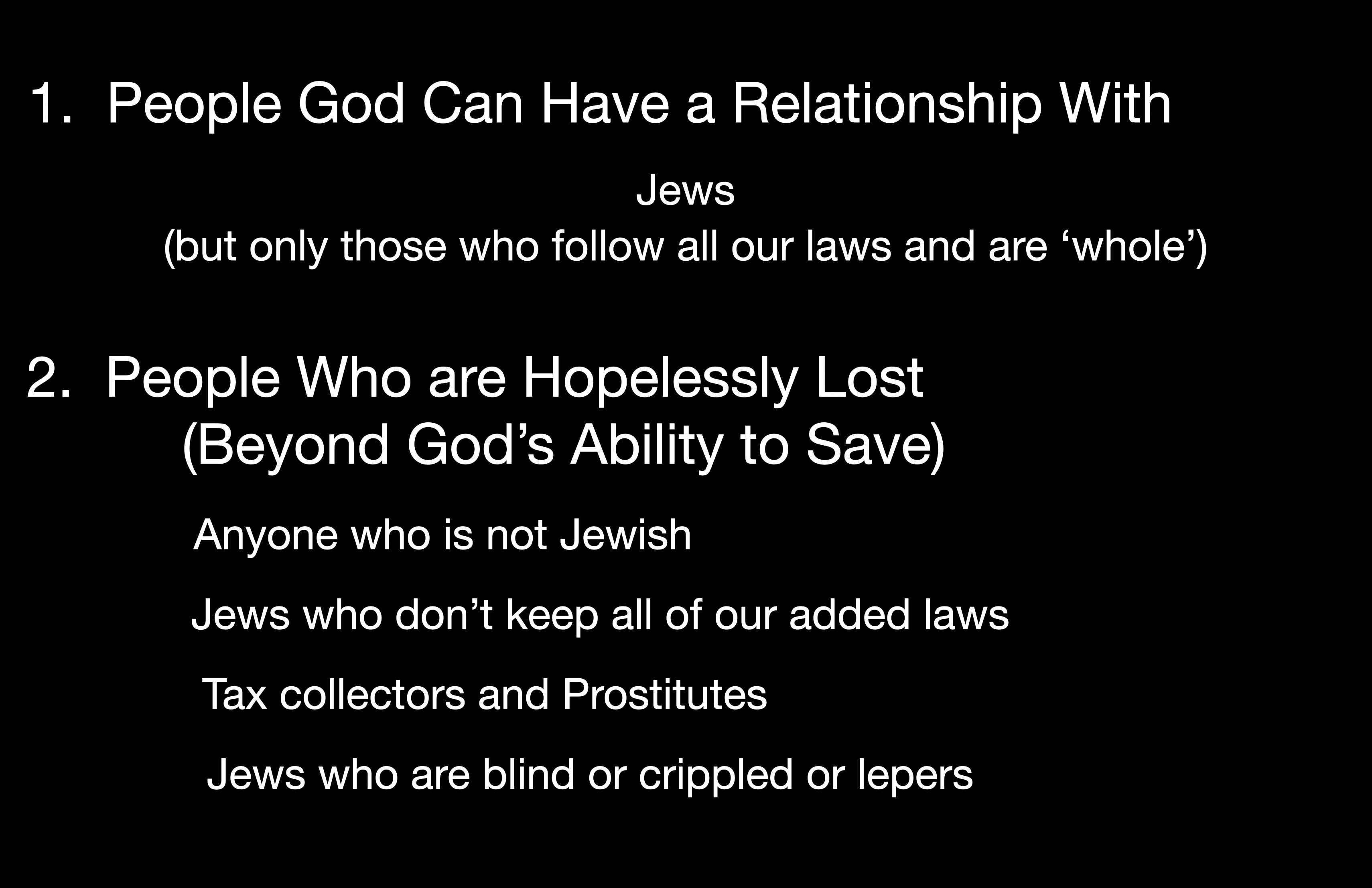
Because Israel in this day had drawn firm lines in who God could deliver and who was hopelessly lost, beyond God’s ability to save. So they had two categories: People God can have a relationship with, and People who are hopelessly lost and beyond God’s ability to save. And in the list of people who God will relate to is, of course, Jews.
But the Pharisees had created this rigid system of laws that were impossible for people to keep. Oh, you might could if you were wealthy and didn’t have to work for a living. But really, no one but the Pharisees could keep them. So a lot of people who couldn’t keep the commandments were just written off as hopeless. So add to the ‘hopeless category’ those Jews who don’t keep all the added laws
Then, of course, there were the tax collectors and prostitutes; they were just called ‘sinners’. There was no hope for them. And how about those who were crippled or blind or had the disease they called leprosy? They felt that physical diseases were caused by sin. These people had gotten what they deserved. They had no place around God’s table. Put them on the ‘hopeless’ list.
And then the big elephant in the room. How about the rest of the world? If you weren’t Jewish, you couldn’t even enter the temple. Other nations were just pagans. They were beyond hope. God had written them all off. So, who’s on the list of People God can have a relationship with? Jews … (but only those who keep all those tedious laws the Pharisees had added.)
Do you see why Jesus had to come and fix this mess? He chose Israel to be a kingdom of priests to all the nations, but they instead built walls to keep others away from God. Jesus had to come to try to show them that every person mattered. And they still didn’t really understand it even after the crucifixion. It would take God striking a man blind on the road to Damascus to finally convince one person that Jesus’ message of grace, love, and hope was for everyone, every nation. And Paul had to work hard to get the other apostles to understand.
But Jesus had been trying to teach this lesson all through his ministry, and we see it especially emphasized in these 10 chapters in Luke.2 He tells parables and interacts with people to try to demonstrate God’s love for all and how we can not judge other people based on race, occupation, or our cultural rules. Look back again at some of the stories in this section of Luke. I’ll mention a few of them:
Why did Jesus tell the story of the Good Samaritan? He was asked the question, “Who is my neighbor?” And his parable answers the question, every man is your neighbor that you should love as yourself, even the one that others tell you to hate. Even the one from the race you have written off as hopeless.
Why did Jesus tell the three parables of the lost coin, lost sheep, and lost son? Look back at the verse we read earlier:
Luke 15:1-2 Now the tax collectors and sinners were all drawing near to hear him. And the Pharisees and the scribes grumbled, saying, “This man receives sinners and eats with them.”
Luke 15:3 So he told them these parables…
God counts no one as hopelessly lost. The minute that you identify a group of people as undeserving of grace, as beyond God’s ability to save, then you have become the older son in the prodigal parable
Then in chapter 18, the chapter just before the encounter with Zacchaeus, we have this story….
Luke 18:10-14 “Two men went up into the temple to pray, one a Pharisee and the other a tax collector. The Pharisee, standing by himself, prayed thus: ‘God, I thank you that I am not like other men, extortioners, unjust, adulterers, or even like this tax collector. I fast twice a week; I give tithes of all that I get.’ But the tax collector, standing far off, would not even lift up his eyes to heaven, but beat his breast, saying, ‘God, be merciful to me, a sinner!’ I tell you, this man went down to his house justified, rather than the other. For everyone who exalts himself will be humbled, but the one who humbles himself will be exalted.”
Who is the righteous one in this parable? The tax collector. Tax collectors, the group that the Jews feel are the least righteous people in the land, can be found righteous by God if they confess their sins. Again, why did he tell this parable? Look at the verse I skipped:
Luke 18:9 “He also told this parable to some who trusted in themselves that they were righteous and treated others with contempt.”
God does not see as man sees. Do you see how Jesus was trying to teach this same lesson over and over again? Do not judge a group of people by your prejudice. No one is beyond the grace of God.
So this could be called “The parable of the righteous tax collector.” And little do his listeners know that in just a few days they will see Jesus encounter a tax collector whose very name is righteous.
Then in that same chapter, you have the story of the rich young ruler.
Luke 18:18-27 And a ruler asked him, “Good Teacher, what must I do to inherit eternal life?” And Jesus said to him, “Why do you call me good? No one is good except God alone. You know the commandments: ‘Do not commit adultery, Do not murder, Do not steal, Do not bear false witness, Honor your father and mother.’” And he said, “All these I have kept from my youth.” When Jesus heard this, he said to him, “One thing you still lack. Sell all that you have and distribute to the poor, and you will have treasure in heaven; and come, follow me.”
But when he heard these things, he became very sad, for he was extremely rich. Jesus, seeing that he had become sad, said, “How difficult it is for those who have wealth to enter the kingdom of God! For it is easier for a camel to go through the eye of a needle than for a rich person to enter the kingdom of God.” Those who heard it said, “Then who can be saved?” But he said, “What is impossible with man is possible with God.”
The wealthy man becomes very sad when Jesus asks him to give up his riches.3 It is easier for a camel to go through the eye of a needle than for a rich person to enter the kingdom of God.
So the disciples ask, “Then it is impossible for rich people to enter the kingdom? And Jesus says, No, it is not impossible. With God, anything is possible. Remember, the Pharisees had that list of those beyond God’s ability to save? And here is Jesus plainly stating that, yeah, it is hard for a rich man to trust in something other than riches, but not impossible with God’s help.
No one is beyond God’s ability to forgive, God’s ability to save. No one is beyond the grace of Yehovah. Jesus is trying desperately to hammer this point home.4
Then, a few days later in Jericho, Jesus finds a righteous tax collector—one who has already repented. He just needs to meet Jesus, and Jesus calls him by name. Though the crowd shouts out their disapproval, as they can only see the vile tax collector-sinner, Jesus sees a man who is repentant and only needs Jesus’ forgiveness and mercy.
Before this week, I had always believed the traditional telling of the Zacchaeus story: that before meeting Jesus, he was a vile tax-collector sinner. But when I really studied the passage and looked at the context of what Jesus was teaching, I came to the conclusion that it can’t possibly be how it was. The message Jesus is teaching in Luke culminates in this story of the crowd wrongly judging a righteous man. They thought he had no business talking to Jesus and certainly not eating with him. This man was a chief tax collector.
In fact, if we read the story the traditional way, we have been tricked into committing the very sin that this story condemns. We, too, have assumed the tax collector is a hopeless sinner.5
Jesus has to teach this lesson. No one is beyond the grace of God. No one.
Let me point out one more thing. I can’t tell you if this is true or not, but if I were writing a screenplay or movie about Zacchaeus, this would be there. Jericho is only 5 miles from the Jordan River. It is a short 2-hour walk downhill to the very spot where we are told John the Baptist was preaching repentance just a year before this Zacchaeus story. Is it hard to imagine that this man Zacchaeus, who was so curious to see Jesus that he climbed a tree, would make that short walk one day to hear John the Baptist preach? Is it possible he heard John tell the crowd they were sons of snakes and not Sons of Abraham because they were acting more like the snake in the Garden than their ‘father Abraham’?
Luke 3:7-8 John said therefore to the crowds that came out to be baptized by him, “You sons of snakes! Who warned you to flee from the wrath to come? Bear fruits fin keeping with repentance. And do not begin to say to yourselves, ‘We have Abraham as our father.’ For I tell you, God is able from these stones to raise up children for Abraham.
Could it be that Zacchaeus heard John’s preaching and decided to repent? Was he among the tax collectors who repented and asked John what they should do?
Luke 3:12-13. Tax collectors also came to be baptized and said to him, “Teacher, what shall we do?” And he said to them, “Collect no more than you are authorized to do.”
And then Zacchaeus becomes very generous and gives away 1/2 his salary and makes sure none of the tax collectors under him cheat anyone. Then a year later, Jesus sees him not as another tax-collector but as a repentant child of God, and Jesus calls him by name.
After Zacchaeus defends himself to Jesus, proclaiming that he has already repented, Jesus says:
Luke 19:9. “Today salvation has come to this house, because this man, too, is a son of Abraham.”6
“Son of Abraham” — In using this phrase, Jesus, like John the Baptist, isn’t commenting on Zacchaeus’ heritage but on his character. Zacchaeus was not a ‘son of a snake’ but a ‘son of Abraham,’ because he was repentant and trying to live a life of righteousness as his father, Abraham, did.
One day, I found myself seated in a small room in a maximum security prison in Alabama. My head bowed, my eyes closed. And the man laying hands on me, praying over me before I went in the other room to speak to the inmates gathered, was a convicted murderer who had committed horrible acts. He was in for life. He had come up for parole but had refused to enter the process because he had a ministry in that prison. He was where God wanted him to be. There are some moments in life you never forget. I remember his name, but I think of him, this convicted murderer, as ‘Zaccai.’ Righteous. I can’t read the Zacchaeus story without thinking of him. And because of him, I can never pass prison inmates on a work detail without thinking, “Which ones of these has God already called? They are all created in God’s image, and the Father is just waiting for that moment of repentance to come for them.
The resurrection message for us today is that the resurrection is for everyone. No one is beyond the grace of God. Even this “wee little man.”7 We can not judge any group of people as hopelessly lost. As Jesus told his disciples, “With men this is impossible, but with God all things are possible.”
We must avoid making the same mistake that the religious leaders in Jesus’ day made. Remember, they said there were two groups of people: People who could have a relationship with God and People who could not have a relationship with God. But they were so wrong about the requirements. The difference is repentance. There are only two groups of people: those who sin and repent, and those who sin and don’t repent. Jesus came to seek and save the lost. But God can not have a relationship with someone who is unwilling to repent. We must learn the lesson. The only thing standing in the way of you having a better relationship with Jesus is you, your pride, and your lack of repentance. And the Bible is clear:
2 Peter 3:9. God is not willing that any should perish but that all should come to repentance.
I have become convinced that I do not spend enough time in prayer for those whom I know need to repent. Paul counseled Timothy to teach and pray this way, especially for those who oppose the gospel or are enemies.
2 Timothy 3:25-26. …God may perhaps grant them repentance leading to a knowledge of the truth, and they may come to their senses and escape from the snare of the devil, after being captured by him to do his will
- The people of Jericho knew Jesus was coming. Jesus was a very big personality in the country, and they likely had made some preparations for his arrival. Perhaps several of the important people in the town, either politically important or the religious authorities, had prepared their homes for a possible visit by this famous rabbi. Imagine how they felt when they were passed up for a man in a tree, a wicked tax collector.
- You may also note Luke’s emphasis on riches and wealth. The Greek word for ‘rich’ or ‘wealthy’, is found 28 times in the entire New Testament, but 1/3 of the instances of this word are in these 10 chapters of Luke.
- Contrast the rich man who went away sad, and Zacchaeus, who came ‘joyfully’ to Jesus.
- It is interesting that just before entering Jericho, just outside the town, Jesus heals a blind man who wants to be able to see. Then Zacchaeus can’t see Jesus because of the crowd and was desperately “seeking to see who Jesus was.” Then Jesus sees Zacchaeus, but he sees him not as the crowd sees him.
- Kaeton, Elizabeth. From “Trick or Treating with Zacchaeus”. October 31, 2010.
- “Salvation has come to this house.” Jesus name in Hebrew means “Yehovah’s salvation.” Indeed, He has come.
- The scripture says Zacchaeus was ‘small in stature.’ The Greek for ‘stature’ (‘helikia’) can mean small of ‘age’ (young – doubtful as Zacchaeus had achieved an advanced position of overseer of tax collectors with Rome), or small of ‘height’, or small of ‘status’. Certainly, the crowd’s reaction to Zacchaeus reveals his lack of status with them. Perhaps he wasn’t short, but he was so hated by the crowd that there was no way he could mix in with them to get a look at Jesus, and that is why he climbed the tree. I found this explanation in several commentaries, but I am not ready to give up my ‘wee little man’ picture yet.
 Swallow No Camels