
Week 46 ——— Teach Us To Pray Again
Luke 11:1-13 John 10:40-42
John 10:40-42 He went away again across the Jordan to the place where John had been baptizing at first, and there he remained. And many came to him. And they said, “John did no sign, but everything that John said about this man was true.” And many believed in him there.
For Jesus, in 27 AD, Hanukkah has ended, and winter has begun. So Jesus leaves Jerusalem and his friends’ home in Bethany. He will return to Mary and Martha’s house in a few months when he hears of Lazarus’ death. He heads east along the Jericho road past the town of Jericho and across the Jordan to where John the Baptist did most of his ministry. This is where John baptized Jesus and began Jesus’ ministry back in February. John had many followers in the area who now came to Jesus. John had told them he was not the Messiah and didn’t perform miracles. Instead, he pointed to Jesus. Herod killed John only four months ago, so Jesus attracted a crowd of many followers and stayed there for the winter.
I won’t forget the day my wife and I made this journey from Jerusalem to the area east of the Jordan River in 1981. It was snowing that morning in Jerusalem, and two hours later, we passed through this place where, just a few miles south, people were sunbathing at the Dead Sea. Good choice, Jesus. This is a much better place to winter than in Jerusalem or Galilee.
Jesus will preach some of the same messages he taught in Galilee. Today’s passage is very similar to passages in the Sermon on the Mount that Jesus gave five and a half months before. He was found praying, and when he finished, the people asked him to teach them how to pray. Jesus gives them a prayer to pray (“The Lord’s Prayer”), and then he teaches them more about prayer.
Luke 11:1-4 Now Jesus was praying in a certain place, and when he finished, one of his disciples said to him, “Lord, teach us to pray, as John taught his disciples.” 2 And he said to them, “When you pray, say:/
“Father, hallowed be your name.
Your kingdom come.
Give us each day our daily bread,
and forgive us our sins,
for we ourselves forgive everyone who is indebted to us.
And lead us not into temptation.”
There was something about the way Jesus prayed. Remember, these people were all Jewish. A practicing Jewish person in Jesus’ day prayed a lot. They prayed specific prayers, the Amidah and the Shema, several times daily. However, there was something about how Jesus prayed that was very different. I think we get a glimpse of it in the garden. He knows what lies ahead for him, the pain and the suffering, and asks God if there is any other way. This is not a reverent prayer carefully crafted to impress a listener. He isn’t praying formally in the King James language. He prays with intense emotion. He sweats drops of blood. He is pouring his heart out to his father. He prays, “Father, I know your plan and don’t like it. If there is any other way, then let this cup of suffering pass from me.”
But this kind of praying is not new. It is similar to the emotional prayers in the Psalms. Let’s examine a few passages in the book of Psalms and pay attention to the emotion in the prayers.
Psalm 13 How long, Yehovah? How long will you forget about me while I drown in sadness. You have forgotten me…..
Psalm 22:1-2 My God, my God, why have you forsaken me? Why are you so far from saving me, from the words of my groaning? O my God, I cry by day, but you do not answer, and by night, but I find no rest.
Psalm 88:13-18 (Message) I’m standing my ground, GOD, shouting for help, at my prayers every morning, on my knees each daybreak. Why, GOD, do you turn a deaf ear? Why do you make yourself scarce? For as long as I remember I’ve been hurting; I’ve taken the worst you can hand out, and I’ve had it. Your wildfire anger has blazed through my life; I’m bleeding, black and blue. You’ve attacked me fiercely from every side, raining down blows till I’m nearly dead. You made lover and neighbor alike dump me; the only friend I have left is Darkness.
Psalm 6 (The Passion Translation) Please deal gently with me; show me mercy, for I’m sick and frail. I’m fading away with weakness. Heal me, for I’m falling apart. How long until you take away this pain in my body and in my soul? Lord, I’m trembling in fear! Turn to me and deliver my life because I know you love and desire to have me as your very own. I’m exhausted and worn-out with my weeping. I endure weary, sleepless nights filled with moaning, soaking my pillow with my tears. My eyes of faith won’t focus anymore, for sorrow fills my heart. There are so many enemies who come against me! Go away! Leave me, all you workers of wickedness! For the Lord has turned to listen to my thunderous cry. Yes! The Lord my healer has heard all my pleading and has taken hold of my prayers and answered them all.
Do you pray to God from your honest emotions as the psalmists did? I think Jesus prayed the same way. These disciples in Luke 11 heard Jesus’ praying and saw his connection to God, and they wanted that same relationship. Perhaps their prayer life had devolved into rote repetition of prescribed prayers. Possibly, they had lost their passion for God, their love for life. Maybe they had forgotten how to be honest with God. They see something in Jesus they want in their life, something in the way he prays, revealing a closeness to the Father they desire.
My wife and I attended an Amy Grant / Vince Gill Christmas Concert a few weeks ago. Let me tell you, I wore out an Amy Grant Christmas Cassette Tape back in the day, so to me, her music stirs a lot of memories. I have never been a country music fan, so most of what I knew of Vince Gill was him being on tour with the Eagles. But I heard a song at that concert that I had never heard before. You’ve probably heard it because it won a Grammy award 3 years ago. Vince Gill wrote that song about his wife, Amy, expressing this same feeling of watching someone pray.
All my life I’ve known of Jesus
But that connection never came
And when my world was torn to pieces
I still couldn’t call his name
But when my Amy prays
When my Amy prays
That’s when I see his face
In an interview, Vince Gill said this was the most honest song he had ever written. He talked freely about leaving the church for years after his brother died. He saw that his relationship with God was nothing like his wife’s. He feels closest to God, not in church, not hearing beautiful praise music, not seeing a fantastic sunset, but when he hears Amy pray.
That is what these people experienced in Luke 11 when they heard Jesus pray. So they say, “We want what you have; please teach us how to pray like that.” Who is that person for you? Is there someone that when you hear them pray, you feel close to God, and you want that same thing? Do people look at your life or listen to your prayers and see the closeness of your relation to God?”
So Jesus teaches them the same prayer he taught his disciples in Galilee earlier, and then he gives them further instructions about prayer in a short parable.
Luke 11:5-13 And he said to them, “Which of you who has a friend will go to him at midnight and say to him, ‘Friend, lend me three loaves, for a friend of mine has arrived on a journey, and I have nothing to set before him’; and he will answer from within, ‘Do not bother me; the door is now shut, and my children are with me in bed. I cannot get up and give you anything’?
Jesus’ short parable begins, “Which of you?” — It could be translated as, “Can you imagine this situation?” So, put yourself in the story:
A visitor has shown up at your house very late, near midnight. The visitor has had an unexpectedly prolonged trip. No one plans to travel after dark in this land. This is not the desert where people travel at night to avoid the heat. This is winter in Israel. There were no streetlights or headlights on the donkeys or flashlights. They carried oil lamps hung by strings and carried out in front of them, hanging down near their feet. But not much light would be put out by these lamps, only enough to see one foot in front of you. There is only enough light to see the next step. (That reminds me of a verse: Psalm 119:105 Thy word is a lamp unto my feet and a light unto my path. This is how God’s word leads us, one step at a time. You can’t see far ahead. But that’s a message for another time.)
So, no one traveled after dark on purpose. This must have been an arduous journey, perhaps with some unexpected problems that caused delays. The traveler arrives very late, exhausted and hungry. He comes to your small Middle Eastern village, where hospitality is a form of righteousness. By arriving at your home, he has become the guest of the whole community. It would shame the entire village if a visitor were not cared for in the best manner. It is hard for us to understand that sense of community responsibility like they had in these tiny villages where the houses are all adjoining.1
You have a few scraps of bread left over, but it would be an insult to a guest to offer him scraps, anything less than an unbroken loaf. But your village, like most small villages in the first century, has one central oven where everyone worked together to bake their bread, typically in large batches. So everyone knew who had just baked a supply of bread and would have enough for guests.
Those of you who have traveled in the Middle East have experienced this kind of meal. They typically have round, flat loaves of bread the size of a dinner plate or larger. The bread is not your meal but is the fork or spoon for your meal. Bread is never served alone but always dipped in something. With the bread, you will have dishes of various dips, vegetables, oils, and olives, and you will use the bread as your utensil to eat.
Let me show you. This picture shows a baker at a restaurant near Jerash in Jordan. He is outside baking bread the way it has been done for thousands of years—in a clay oven. He forms the dough into a round disc, much like in a pizza kitchen. He then places the dough on a dome-shaped animal skin and presses it into the sides of the clay oven, where it sticks until it is baked.
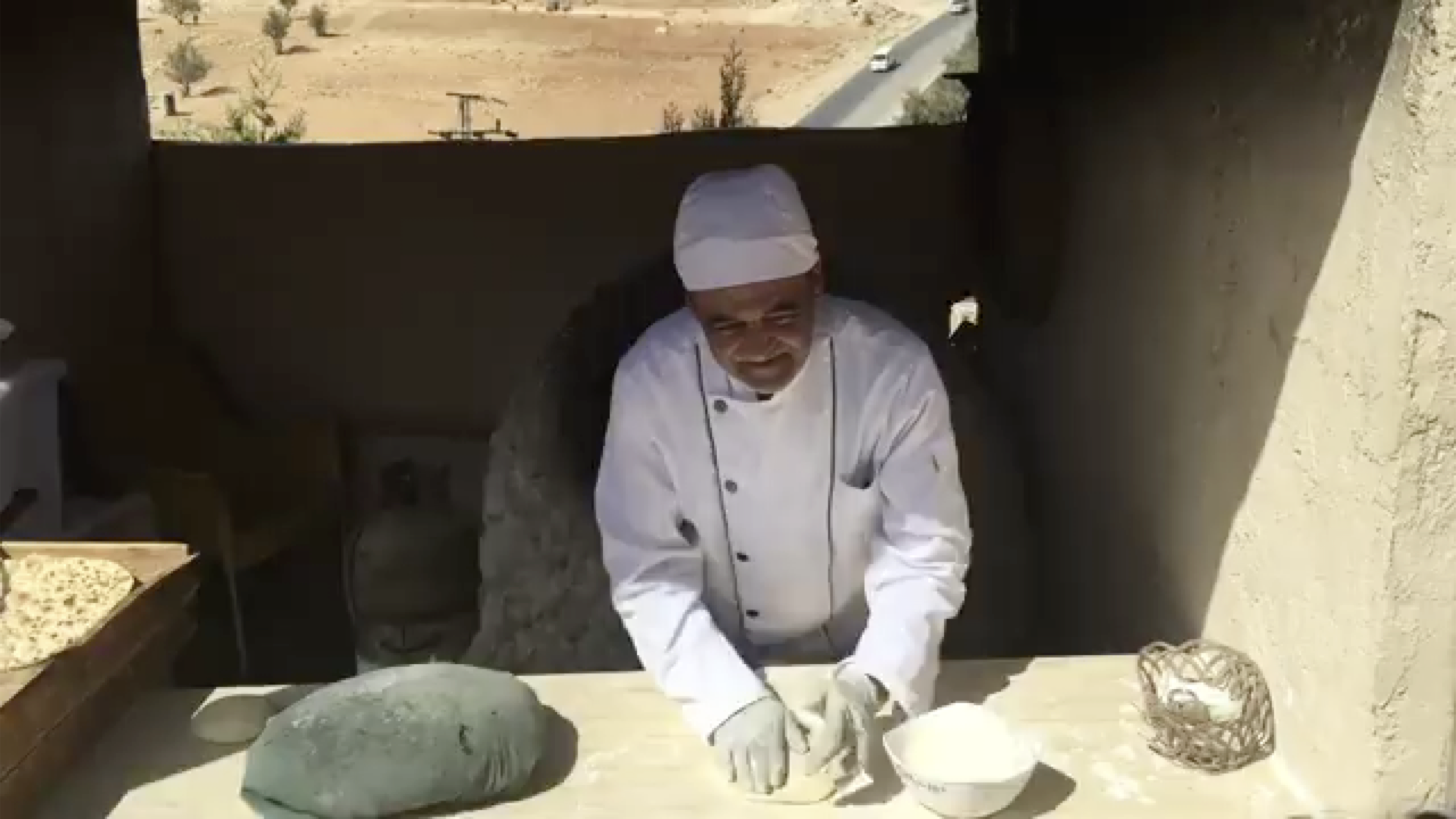
So your guest arrives hungry from his long journey, and you know who has bread you can serve him. You knock on his door and keep knocking until he awakens. The whole family typically slept in the same room. And Jesus, in his parable, asks you, “Can you imagine that a friend in this situation would say, “‘Do not bother me; the door is now shut, and my children are with me in bed. I cannot get up and give you anything. Of course, the answer is “No.” No one could ever imagine a friend unwilling to help. The door being shut and the children asleep are ridiculous excuses that no one would ever use. It is unthinkable that anyone in Jesus’ day would refuse to share what they have with a neighbor, especially for a visitor. It would bring shame not only to the neighbor but also to the whole community.
So Jesus continues:
Luke 11:8 I tell you, though he will not get up and give him anything because he is his friend, yet because of his impudence, he will rise and give him whatever he needs.
I don’t like the ESV’s choice of the word ‘impudence.’ It’s not much better than the KJV’s choice of “because of his importunity.” I don’t know about you, but I have never heard anyone use either of those words. I want you not just to read the words of the Bible but to study the message of the Bible. So you can’t just skip over words that aren’t clear or things you don’t understand. So, how can you best understand what Jesus is saying here? I can point you to a reference with a 22-page discussion of this Greek word, but you won’t read that. So what do you do? You could look up the word in the dictionary, and that may help some, but there is another helpful way.
Take out your internet browser and search for “Luke 11:8 Bible Hub”. The search will suggest biblehub.com as one of the top results.
Click on the link to biblehub.com, and you will get that verse in about 25 translations. And you will see that some say “because of his persistence,” or “boldness,” or “shameless persistence,” and my favorite, “shameless audacity” (thanks, NIV). If you don’t know the original languages, you must learn to do this as you study the Bible. Looking at these multiple translations gives you a better idea of the flavor and scope of that Greek word. It is more than just persistence, but ‘shameless persistence.’ Do you see what Jesus is saying? This is not some half-hearted request. This is someone not afraid to bang on the door at midnight until he gets an answer. This is someone who won’t stop knocking. And because he won’t stop, he gets an answer. You see this same idea in Jesus’ story of the persistent widow. This is how you pray.
Jesus continues his teaching on prayer:
Luke 11:9 And I tell you, ask, and it will be given to you; seek and you will find; knock, and it will be opened to you.
He continues the idea of persistence, but unfortunately, many translations don’t make that clear. So go back to biblehub.com and look at verse 9 in some different translations.
Luke 11:9 (New Living Translation) And so I tell you, keep on asking, and you will receive what you ask for. Keep on seeking, and you will find. Keep on knocking, and the door will be opened to you.
Luke 11:9 (Amplified Bible) So I say to you, ask and keep on asking, and it will be given to you; seek and keep on seeking, and you will find; knock and keep on knocking, and the door will be opened to you.
Luke 11:9 (Holman Christian Standard Bible) So I say to you, keep asking, and it will be given to you. Keep searching, and you will find. Keep knocking, and the door will be opened to you.
These three are much more faithful to the Greek form of the verb. This verb is not about a one-time action but a continuing action. Is this how we pray? Are we persistent? Do we keep asking? Do we keep seeking? A friend told me, “Well, I prayed about it twice, and God didn’t answer.” Really. The Bible is full of examples of persistent prayer. Daniel prayed 3 times daily for 21 days before he got an answer. Hannah prayed for years to have a son, as did Zechariah and his wife.
Our prayers are weak and anemic compared to this standard. We must pray persistently and boldly.
The writer of Hebrews says it this way:
Hebrews 4.16 Let us therefore come boldly unto the throne of grace, that we may obtain mercy, and find grace to help in time of need.
Come to God’s throne with shameless audacity — Jesus says to bang on God’s door at midnight.
Luke 11:10-12 For everyone who keeps on asking receives, and the one who keeps on seeking finds, and to the one who keeps on knocking it will be opened. What father among you, if his son asks for a fish, will instead of a fish give him a serpent; or if he asks for an egg, will give him a scorpion?
No earthly father will give his son something that will cause him harm. How much more so that your heavenly father will only give gifts that will benefit us? So pray boldly and persistently for what you need.
Now, what if the son asks the father for a snake? (I’m not sure about your kids, but I had one that asked for a snake. She didn’t get it, by the way.) The assumption is that the serpent would not be a good gift – the son is not asking for a pet but for food, and being Jewish can’t eat a snake. Sometimes, we pray for things that might not be good for us. I believe the great theologian Garth Brooks said something about that in the song “Unanswered Prayers,” with the lyrics, “Sometimes I thank God for unanswered prayers. Remember when you’re talkin’ to the man upstairs. And just because He doesn’t answer, doesn’t mean He don’t care. ‘Cause some of God’s greatest gifts are unanswered prayers. God loves us, and our heavenly Father will not give us something that will harm us. Now, he may give us gifts we don’t want. There will be times of trial and testing, but this is for our good, not for our harm.
When Jesus teaches the Lord’s prayer in the sermon on the mount, he precedes it with this:
Matthew 6:7 And when you pray, do not heap up empty phrases as the Gentiles do, for they think that they will be heard for their many words. Do not be like them, for your Father knows what you need before you ask him.
What are those “empty phrases?” The prayers prayed by the non-Jewish religions often involved strict formal invocations and magical incantations where the correct repetition of words mattered more than the heart of the one who prayed. Roman prayers to their gods had to have exactly the right words with the proper pronunciation, rhythm, and inflection, or they didn’t count. Sometimes, our prayers are just empty phrases. Do you say the Lord’s Prayer, or do you pray the Lord’s Prayer? Those phrases are all important. Each time you repeat them, they should be a cry from your heart. You won’t fool God. Don’t speak it to him if you don’t mean it.
But if God knows what we need before we ask, then why do we ask? Let me tell you a story. You know the story of blind Bartimaeus. (Of course, ‘Bartimaeus’ is not his name. ‘Bar’ in Hebrew means “son of,” so Bar-Timeaus is the “son of Timaeus.”)
Mark 10:46-52 And they came to Jericho. As he was leaving Jericho with his disciples and a great crowd, Bartimaeus, a blind beggar, the son of Timaeus, was sitting by the roadside. And when he heard that it was Jesus of Nazareth, he began to cry out and say, “Jesus, Son of David, have mercy on me!” And many rebuked him, telling him to be silent. But he cried out all the more, “Son of David, have mercy on me!” And Jesus stopped and said, “Call him.” And they called the blind man, saying to him, “Take heart. Get up; he is calling you.” And throwing off his cloak, he sprang up and came to Jesus. And Jesus said to him, “What do you want me to do for you?” And the blind man said to him, “Rabbi, let me recover my sight.” And Jesus said to him, “Go your way; your faith has made you well.” And immediately he recovered his sight and followed him on the way.
This is how prayer works. Jesus knew this man was blind. It was no secret. Everyone there knew him. They didn’t know his name, for he was just a beggar, but everyone knew he was the ‘son of Timaeus;’ everyone knew he was blind. Jesus heard him the first time, but he waited to respond. Why does Jesus wait? Because he wanted to teach a lesson about faith. Because he wanted to give him more than his sight. Jesus knew what he wanted, but he also knew what he needed. The man wanted to be able to see. Jesus knew he needed more than that. He needed a faith lesson, as did the crowd around him. So he lets him ask; he lets him shout it out over the protests of the others; he lets him be bold and persistent.
Sometimes, we are like the lame beggar at the temple gate in Acts 3, begging for a few coins. Why is he begging for coins? Can’t you see? He needs them to buy food. And he can’t work because he can’t even stand up or walk. He thinks he needs coins because he can’t even imagine God can do so much more – completely heal him. And Peter tells this lame beggar (in his best King James English), “Silver and gold have I none, but such as I have give I thee.” Or, in today’s English: ‘I don’t have any money, but I’ve got something better. In the name of Jesus, get up and walk!’ Sometimes, our prayers to God are too small.
This son of Timaeus comes boldly with his requests. He is persistent – he won’t quit even when the crowd rebukes him. And Jesus gives him more than he asks for — he becomes a follower of Jesus.
But don’t think you can pray for whatever you want, and God will deliver it to you. That is never promised in the Bible. Some people read the Bible and understand that it promises to give us whatever we desire. Isn’t that what is said in Psalms?
Psalm 37:4 Delight yourself in Yehovah and he will give you the desires of your heart.
This does not mean God will give you whatever you desire. If your joy comes from God, you will desire what God desires. This is a prayer asking God to change your desires. “God, please place in my heart the desires you want me to have. Help me to desire the things you desire.”
People have forever read the Bible and made it say what they wanted it to say. They remember John 15:7 as saying, “Ask whatever you wish, and it will be done for you.” This makes it sound like God is some genie in a lamp. But there is more in that verse; there is a caveat. “If you abide in me, and my words abide in you, then you can ask whatever you wish, and it will be done for you.” If you are living in Christ and by the Word of God, then you will ask for things that are in keeping with the character of Christ.
John 14:14 If you ask me anything in my name, I will do it. That doesn’t mean adding the phrase “in Jesus’ name I pray.” It is not a magic incantation like the Romans used, where you say the proper words and force God to do what you want. Praying in Jesus’ name means praying in his character, praying for what Jesus would pray for.
James sums it up this way:
James 4:2-3 You do not have, because you do not ask. You ask and do not receive because you ask wrongly to spend it on your passions.
So ask, and keep on asking, keep on seeking, keep on knocking. But desire what God desires; form your wants to be God’s wants for you. Your loving heavenly Father desires to give you good gifts. Many verses say God will provide us with what we need—yes, what we need, not what we want. Jesus tells us what we need at the end of this passage in Luke 11, which is not what they expected.
Luke 11:11-13 What father among you, if his son asks for a fish, will instead of a fish give him a serpent; or if he asks for an egg, will give him a scorpion? If you then, who are evil, know how to give good gifts to your children, how much more will the heavenly Father give the Holy Spirit to those who ask him!”
There are many things we may think we need. What Jesus says we need is the Holy Spirit within us. The Spirit enables us to know the truth, avoid sin, pray as we should, and love others. We need to pray for an outpouring of the Holy Spirit. We need to pray for God to help us listen to His Spirit, not our thoughts. Jesus tells us, this is how we pray; this is what we pray for
So, do what the people in Luke 11 did. Study Jesus’ prayers and pray as Jesus did. Again, look back at Jesus’ prayer in the garden. Pray boldly, pray with shameless audacity, but pray with Jesus, “Nevertheless, not my will, God, but your will be done.”
 Swallow No Camels