
September 21, 2025 –  It’s Just Another Miracle— Acts #14

September 21, 2025 –  It’s Just Another Miracle— Acts #14
Acts 5:12-16

As we continue our study of Acts, we last saw the early church get its first threat from the Temple leaders.  They were told to stop talking about Jesus or there would be consequences.  But this didn’t slow down most of them.  They went right back to the temple, preaching Jesus and healing people.   We pick up the story in Acts 5:12

Acts 5:12-16  Now many signs and wonders were regularly done among the people by the hands of the apostles. And they were all together in Solomon’s Portico. None of the rest dared join them, but the people held them in high esteem. And more than ever, believers were added to the Lord, multitudes of both men and women, so that they even carried out the sick into the streets and laid them on cots and mats, that as Peter came by, at least his shadow might fall on some of them. The people also gathered from the towns around Jerusalem, bringing the sick and those afflicted with unclean spirits, and they were all healed.

Picture the scene: people are milling around the temple area when a few of the apostles walk in.  Someone cries out, “Hey, there they are!” and the crowd rushes over.  People want to see the miracle workers.  They have come from all around Jerusalem just to have a chance to see this.  They have brought their sick to be healed.  And this is not just a one-time thing.  Luke tells us, “signs and wonders were regularly done.  This is the natural rhythm of the early church, overflowing with the power of God.   So let me ask you, “Is this the world you live in?”

You may ask yourself, “Why don’t we see signs and wonders regularly done?”  If you are walking down Broad Street and see someone suddenly stand up from their wheelchair and start jumping up and down, what would you do?   Would you be skeptical?  What if you then saw this same person walk over to someone you recognize, a blind girl you have seen many times downtown?  And suddenly she drops her cane, exclaiming that she can see?  You know this girl.  She was blind, but now she can see.  Miracles of healing are happening around you.  What would you do next?  You would likely pull out your phone and call someone to tell them about it because signs and wonders are not “regularly done” in your world every day.   So, you may ask, why aren’t they done now as they were then?

At this particular time, the apostles and the early followers of Jesus experienced miracles that were commonplace.  However, there is a misconception that frequent miracles occurred throughout the Bible, but that is not the case.  There are many miracles, but they are concentrated in a few pockets of time.  We can see this in the words of Asaph the psalmist in Psalm 77:11

Psalm 77:11-12  I will remember the deeds of Yehovah; yes, I will remember your wonders of old.  I will ponder all your work, and meditate on your mighty deeds.”

Asaph sounds like us, looking back at the good old days when all the miracles were done.  He would have asked the same question we ask, “Why were there so many miracles back in the days of Moses, or Elijah, and not today?   And miracles are indeed concentrated in specific periods of time.   Fast forward to the New Testament times, and numerous miracles are occurring.

Matthew 9:35   And Jesus went throughout all the cities and villages, teaching in their synagogues and proclaiming the gospel of the kingdom and healing every disease and every affliction.

Jesus certainly performed frequent and regular miracles.  However, it’s worth noting that all the miracles of Jesus occurred within a remarkably short period of his ministry, spanning just over a year. And the miracles in the rest of the New Testament took place over the lifetimes of the disciples and Paul.   This explosion of miracles was for a specific purpose and was predicted by the scripture.  We need to be careful to understand why all of these healing miracles happened at this time.

Think back to when Jesus had just started his ministry, and John the Baptist was sitting in prison.  John had proclaimed that Jesus was the coming Messiah.  He pointed out to his disciples that Jesus was the Lamb of God who would take away the sins of the world.  But in Herod’s prison in Macherus, John keeps hearing how Jesus is hanging out with sinners and having parties with tax collectors, and he starts having second thoughts.  “That doesn’t sound like things I thought the Messiah would be doing.  Could I have misunderstood God about this guy?”   Remember what John had said about these days of the Messiah:

Matthew 3:7  You brood of vipers! Who warned you to flee from the wrath to come?
Matthew 3:12  His winnowing fork is in his hand, and he will clear his threshing floor and gather his wheat into the barn, but the chaff he will burn with unquenchable fire.
Matthew 3:10  Even now the axe is laid to the root of the trees. Every tree therefore that does not bear good fruit is cut down and thrown into the fire.

Wrath — Unquenchable fire — an ax to the tree — throwing in the fire.   John was expecting Jesus to show up in this sinful world with a chainsaw and a flamethrower.  John saw a Messiah who would clean house, like Jean-Claude Van Damme or Chuck Norris.  To kick butt and take names.  But that was not the report he was getting about Jesus.  So he sends his disciples to ask Jesus if he is the Messiah.

Matthew 11:2-3   Now when John heard in prison about the deeds of the Christ, he sent word by his disciples and said to him, “Are you the one who is to come, or shall we look for another?

John was having a real problem.  He told everyone that Jesus was the Messiah, but he doesn’t think Jesus looks very Messiah-like.  What do you do when the Messiah doesn’t look like what you’d thought he’d look like?  Or for us today, what do you do when God doesn’t do what you thought He would? How do you respond when you read all about God healing all these people in the Gospels and in Acts, and then God doesn’t heal you, or your loved one?   Ask John.  The Messiah is here to fix everything. Finally, the good guys should be winning.  And Jesus is out partying while John is chained to the wall of a prison. You do what John did.  You seek Him out.  So John sends his disciples to ask Jesus.

Matthew 11:4-6 “And Jesus answered them, ‘Go and tell John what you hear and see: the blind receive their sight and the lame walk, lepers are cleansed and the deaf hear, and the dead are raised up, and the poor have good news preached to them. And blessed is the one who is not offended by me.’

Jesus is directing John back to the scriptures to understand what the Messiah was really all about.  In other words, Jesus says, “Here is how you know that the messiah has come: the blind are receiving their sight, the lame are walking, and people are being healed.

Now, there are some healings in the Old Testament, but did you realize that nowhere in the Old Testament was there someone born blind who was healed? Nor was there anyone born mute who was healed.   This type of healing Jesus was doing was different.   Now, you may not have known this, but everyone in Jesus’ day knew this, because they knew their Scripture.  And Isaiah was a favorite book among many people.

The book of Isaiah is a book of both bad news/good news.  Half of it is Isaiah telling the people that they are about to be judged for their sins.  God is going to let the nation be destroyed by Assyria, and later by Babylon.  Devastation is coming.  But then he gives them the good news.  There is hope.  Yes, your city will be destroyed, but God will give you a new city, a new Jerusalem, where everyone prospers, and there is no danger from enemies anymore.    And guess which sections of Isaiah were read the most?   The good news parts. 

It is harder to read about the harvests failing, the crops all dying, the vines withering, the cities laid waste and becoming deserted, the enemies at the door.  Let’s skip all that judgment, fury, wrath, and destruction and go right to the good part when God’s mercy breaks forth.  Let’s focus on the love, grace, and compassion, rather than the warnings of destruction.  (They are a lot like us today in what we want to read and talk about in the Bible.  Let’s sing about heaven, not about the judgment here on earth.  There aren’t too many hymns about God’s punishment on us.)    So, guess which parts of Isaiah they knew the best?    Let’s skip to the good stuff. Let’s re-read chapter 35.   

Isaiah 35:1-6  The wilderness and the dry land shall be glad; the desert shall rejoice and blossom like the crocus; It shall blossom abundantly and rejoice with joy and singing. The glory of Lebanon shall be given to it, the majesty of Carmel and Sharon. They shall see the glory of Yehovah, the majesty of our God.
Strengthen the weak hands, and make firm the feeble knees. Say to those who have an anxious heart, “Be strong; fear not! Behold, your God will come with vengeance, with the recompense of God. He will come and save you.”
Then the eyes of the blind shall be opened, and the ears of the deaf unstopped;  Then shall the lame man leap like a deer, and the tongue of the mute sing for joy.”

And the people say, “Yeah, that’s what I’m talking about.  Even the desert lands grow crops.  The days of living in fear are over.  And the blind see and the mute talk.”  This is what will happen when God brings his Messiah.

Well, if you were living in Jesus’ day, you would have had access to 39 scrolls of Scripture.  Thirty-nine books in our Old Testament, and not once do you have someone born blind regaining sight or someone born mute being able to talk.  It has never happened.  But God promises here in Isaiah 35 and elsewhere that these things will happen when his kingdom breaks forth on the earth and the Messiah arrives.   

That is why Jesus answered John that way.  Jesus says, “Tell John that the blind see, the lame walk, and the mute talk.” Tell John that Isaiah 35 is happening right now.    These healings are the sign of the Kingdom of God busting out. So John has to accept that his view of what precisely the messiah would do —the view that most of the people had then — was wrong.  

When we don’t understand what God is doing, we need to seek God out and ask Him about it.  We don’t just say, “Well, God didn’t do what I thought he would, so there must not be a God.  I have seen people have a major faith crisis and quit on God when a family member is not healed.  They, like John the Baptist, had a misconception about how things would be when Jesus came.  Some preacher (probably on TV) told them that God would heal everyone if they prayed hard enough, had enough faith, or sent them money.  Like John, they misunderstood the Bible, and when it didn’t work the way they understood it, they quit.

God didn’t heal my friend, so I am leaving the church.”  No, if God is not doing everything the way you think He should, then guess who is wrong?  Not God.  You don’t throw your beliefs out the window; you go back to the scriptures and see where you misunderstood.  John the Baptist had it wrong; it is okay if you are sometimes mistaken about what God is doing, also.

So these healings that Jesus was doing were not just compassionate deeds, but proof that the Kingdom of God was breaking forth just as John said.  And these healings that Jesus does and the disciples do here in Acts, and the healings we see today, are just a taste of what is coming.  They are like the first buds of spring.  When those daffodils bloom in early spring.  They are nice, but they get me excited because they are just the heralds of hundreds of flowers of all kinds that will soon bloom in my yard.  Jesus’ healings and sermons preached the same sermon: The Kingdom of God is among you.  Each of these healings here in Acts shouts out the same message.  The Kingdom of God is here, now.  Each healing we see today is another whisper to the hearts of those who have ears to hear.   See, God’s Kingdom is still breaking forth in this sinful world and is a promise of a future with no sickness and no death.

But throughout history, God has only done a few large-scale interventions.   Creation, the deliverance of the children of Israel from slavery, and the conquering of the land, as well as the ministry of Elijah/Elisha.  The ministry of Jesus and the apostles.  Other than these few times, large groupings of miracles are rare. And even though 1 Corinthians talks about believers with gifts of healing, they weren’t doing miracles to the same degree as Jesus and the apostles.  

So while I think we overestimate the frequency of miracles in the Bible, I think we underestimate the number of miracles happening today.  I stand before you as a witness today that God is still in the miracle business..

I have told you before of some of the miracles I have seen — of medicine multiplied, appearing where it didn’t exist, of rain that started and stopped at the moment of prayer, of God placing a very rare but desperately needed item in a cigar box in a mud house in Mexico, or in a box of medical junk in Ghana.  I have seen children with rampant cancer be told there was nothing the doctors could do, only to see their following scan be clear of any disease.  I have seen lives turn around from the brink of disaster.  There is no way anyone could ever convince me that God is not doing miracles all around us.  I have seen them with my own eyes.

But some people would say they haven’t seen any miracles.    Perhaps they are from Nazareth.
Why do I say that?

Mark 6:1-6  “He went away from there and came to his hometown, and his disciples followed him. And on the Sabbath he began to teach in the synagogue, and many who heard him were astonished, saying, “Where did this man get these things? What is the wisdom given to him? How are such mighty works done by his hands?

Most of the people in Jesus’ hometown didn’t see many miracles either.   Mark is clear that their lack of belief prevented Jesus from doing many mighty works there.  That fits well with the gospel emphasis on faith for healing.   You remember Jesus saying several times, “Your faith has made you well.”  What he is saying is that because you have faith in me, I am able to do miracles for you.  No faith, no miracles.

The Greek word for unbelief (apistia) is used in the Gospels for people who totally reject Jesus, like these people in Nazareth, who don’t believe who he is.  A similar Greek word, oligopistia, is usually translated as “little faith,” and it refers to people who accept Jesus, but their faith is so small that they do nothing with it.  They don’t act on their faith.  We see this in the story of the disciples in the boat in the storm.  They were scared because they had no faith that Jesus would protect them.  They accepted who Jesus was, but that didn’t make a difference when they thought their boat would sink.  They were ruled by fear, not by faith.  So Jesus says, “Oh, you of oligopistia.  You of little faith.” A faith that just sits there and doesn’t do anything, that makes no difference – that is “little faith.”

It says that Jesus marveled at their unbelief,  their rejection of him.  “Marveled” means astonished or surprised, taken aback.  You see that word 43 times in the New Testament.  Most of the time, it is about people who are shocked when Jesus does something.    Jesus calms the sea, and the disciples marvelled.  The mute man speaks, and they marvel.   The crippled man walks, the fig tree withers, and the disciples marvel.  Twice, it is Jesus who marvels.  Two times, Jesus is surprised by others.  What astonishes Jesus?

The first instance occurs when the centurion requests Jesus to heal his paralyzed servant, stating that he doesn’t need to be present for the healing.  

Matthew 8:10   When Jesus heard this, he marveled and said to those who followed him, “Truly, I tell you, with no one in Israel have I found such faith.

The second time is in the passage we just read, he is astonished by the unbelief of the people in Nazareth.

So what astonishes Jesus?  Jesus is shocked by one Gentile man’s unexpected deep faith and by the lack of faith of his Jewish hometown people.  Jesus couldn’t do many of the things he hoped to do in Nazareth because of the unbelief he encountered in that place.   This is our story.  Jesus hopes to do many incredible, miraculous things in our lives.  But he can not do them because we prevent him.  Oh, we say we believe.  But belief is not what you think in your head, but what you do.  Belief is how you act.  You can have all the Bible knowledge in the world, but what you know does not matter unless it changes how you act.   Again, it is like the disciples in the boat in the storm.  They believed who Jesus was, but that didn’t change their reaction to a storm.  If they had faith and trusted in Jesus to protect them, then there would be no fear.  Their fear revealed their lack of faith.  And if you surrender your life to Jesus and don’t give it all to him, if you keep parts of your life under your control instead of His, then you don’t believe.

I marvel at a lot of things.   I am overwhelmed by the beauty of the clouds at sunrise, by the immensity of the ocean.  I am at times surprised and taken aback by the majesty of nature, of glaciers calving, of waterfalls, and mountain views.  I am astonished at times by how mean some people can be, and how some devote their whole lives to taking advantage of others. I marvel at a lot of things.

But Jesus in Nazareth is only surprised by one thing: that God himself would come and give his life as a ransom for people who did not deserve any mercy. He would die to remove our sin burden and grant us forgiveness that we could not otherwise obtain. Despite this, many people would choose not to follow Him or do what He says.  That leaves Jesus astonished.

The God who spoke this entire universe into existence says, “Do you want to join my family and come live with me in this incredible place where no one ever gets sick or dies?”  And people say, “No, I don’t think so.”  That astonishes Jesus.  This God who says, “Hey, I can work all things so they turn out the very best for you if you follow my ways.”  And People say, “Nah, I think I know better than you, I’ll do it my way.”  That astonishes Jesus.  Jesus offers life instead of death, forgiveness instead of condemnation, and eternal joy instead of eternal misery.  And still some reject him.  That blows my mind, too, Jesus.

That is the situation in Nazareth in Jesus’ day, and that is the situation that we live in today. We may go further than the people in Nazareth and believe that Jesus is who he says he is.  That is good.  But that is not faith.  It is only faith when we step out in obedience, trusting Him to lead us and equip us for any task He calls us to.  It is faith when we are not afraid of any storms of life because we trust in him.  It is faith when we aren’t scared of disease or cancer or natural disasters because we have complete trust in him.

And when I look at the miracles I have witnessed in my life, Most have happened when I stepped out in faith, being obedient to whatever he calls me to do.  Most of the miracles I have seen happened when I was doing something out of my usual routine or schedule.  Many on mission trips.

Following his call one summer, I found myself again working in a hospital in Ghana, Africa.   I saw a man in the clinic who had a horrible infection in his hand.  It had been going on for weeks and was getting worse. He had been treated by some person in his tribe whose position was translated to me as a ‘witch doctor.’  And his hand was horribly swollen and red and hot and draining.  He could not move a finger.   When I saw him, he needed immediate surgery so he wouldn’t lose his hand.   He needed an orthopedic specialist, a hand surgeon.  

What he got was me.  Both of the Family physicians who performed all the surgeries in that mission hospital were involved in a lengthy case.  I was it.  I have never felt so underqualified in my life.

I remembered from anatomy class many years ago that there were 10 or 11 potential spaces in the hand that would all have to be drained. And if they weren’t all drained appropriately, then the infection would worsen.  The anatomy is very complex there.  That’s why hand surgery is a specialty and should never be attempted by any other surgeon, and certainly not by a pediatrician.  So I prayed and said, “God, you put me here, and you gave me this to do, so I am going to trust you to empower me to do it.   So I found the surgical anatomy book and had a nurse hold it and turn pages for me as I did the procedure.  And God guided my eyes and my hands. And the man recovered with full use of his hand.  God did that because I couldn’t have done it without Him.  

I am convinced that God is waiting to do many miracles if only we would let him.  But we have to be obedient enough to step out and follow him.  If we don’t display that kind of faith, then we will see no miracles.  He often leads us into situations where we lack the proper resources or feel we lack the right skills.  If we only attempt to do things that we can do without God, we never leave room for Him to show out.  

This should be our prayer:  God, please call us to do things that we can’t do.  Please call us to do things that are impossible.  Please lead us to the uncomfortable places.  Give us goals that we can’t possibly reach.  Put us in situations where we will fail without your help.  We must follow Him and attempt things that are impossible for us to do without Him.  Only then can He step in and do the impossible for us and with us.
February 4, 27 A.D.  –  Many or Few? —   The Year of the Lord’s Favor #70

Week 51 — Many or Few?
Luke 13:22-31

Luke 13:22-30   He went on his way through towns and villages, teaching and journeying toward Jerusalem.   And someone said to him, “Lord, will those who are saved be few?” And he said to them, “Strive to enter through the narrow door. For many, I tell you, will seek to enter and will not be able. 

For the past four weeks, Jesus has been traveling in Perea, the land east of the Jordan River. His time is getting shorter. In this chapter of Luke, we learn that Herod is out to get Jesus.

Luke 13:31   At that very hour, some Pharisees came and said to him, “Get away from here, for Herod wants to kill you.”

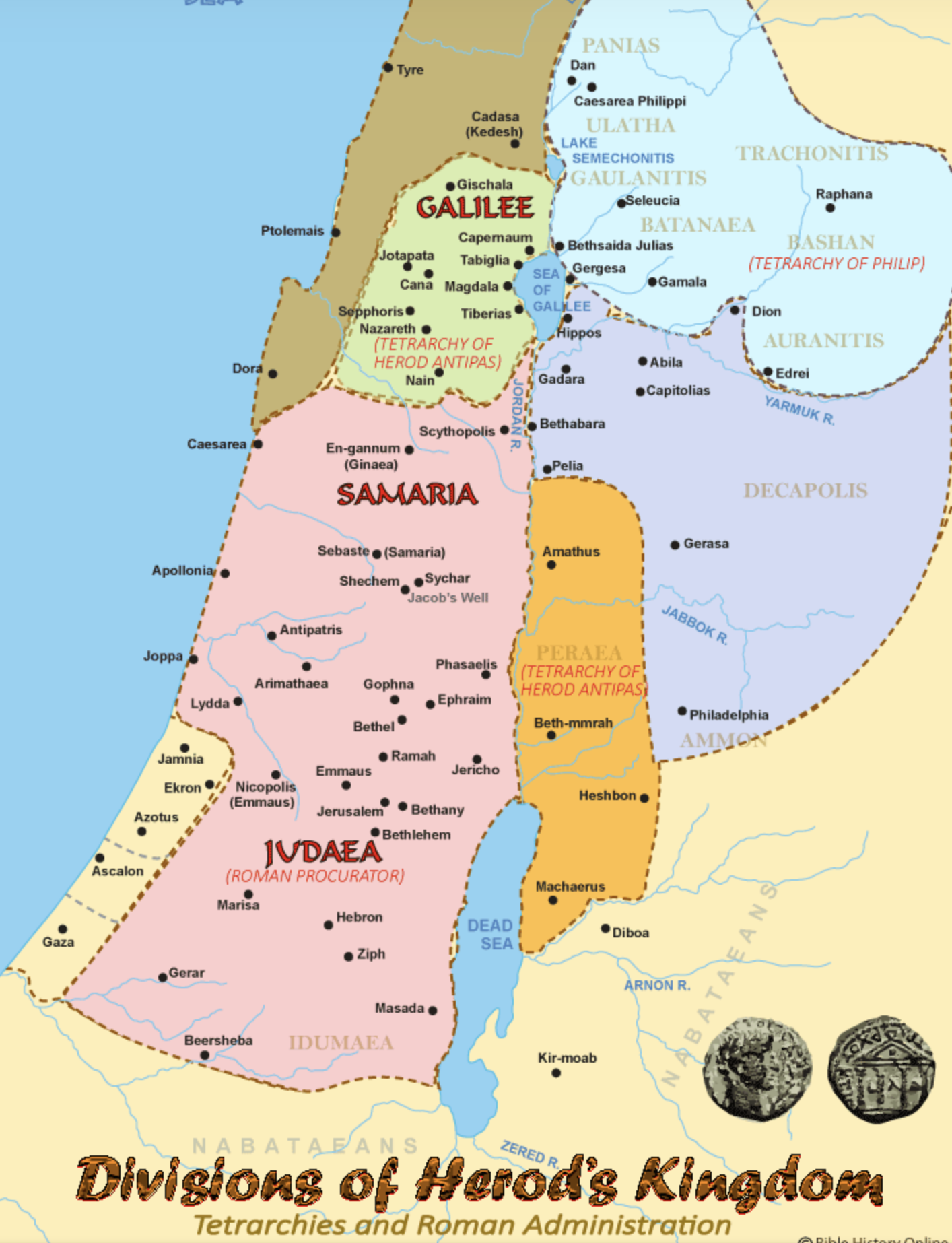
Which Herod are they talking about?  There is Herod “the Great,” the king who tried to kill Jesus after his birth, but that Herod died shortly after this event.  His kingdom was then divided among his sons, who rather confusingly also called themselves ‘Herod.’  (‘Herod’ in Greek is ‘hero.’)   Herod Philip got the territory in blue on the map below, which includes the towns of Bethsaida and Caesarea Philippi.  Herod Archelaus got the territory of Judea and Samaria in the pink, but he only ruled for 9 years.  Caesar deposed him, and the territory was made a Roman Province, with Pontius Pilate in charge of this area.   Herod Antipas (half-brother of Philip) got Galilee and Perea.  This is the Herod that was called out by John the Baptist for marrying his brother Phillip’s wife.  Herod Antipas had John the Baptist imprisoned in his fortress in Macherus in Perea and then had him beheaded.  When Herod Antipas learned of Jesus, some told him that Jesus was John the Baptist, who had been raised from the dead.  

So Jesus has been traveling and teaching for over a month in Herod Antipas’ territory in Perea.  Jesus had likely come further south, closer to Herod’s palace in Macherus, so Jesus was warned to leave the area.  Now, Jesus begins to journey back through Perea, eventually passing through Jericho and returning to Jerusalem.  On his way, someone asked Jesus a question:

“Lord, will those who are saved be few?”

“Will many be saved or few?”     It is a good question.  Jesus began with a very small following, and sometimes crowds of thousands followed him.  Then Jesus will say something the crowds don’t like, and many of them will leave.  Then he will do miracles, and the crowds will gather again.  Will there be many saved or few?  It is an interesting question today.

Remember, in the Bible’s first book, God promised Abraham that his offspring would be as countless as the stars.  

Genesis 15:5  “…number the stars, if you are able to number them.” Then he said to him, “So shall your offspring be.”

In the last book, Revelation, we read this:

Revelation 7:9-10  After this I looked, and behold, a great multitude that no one could number, from every nation, from all tribes and peoples and languages, standing before the throne and before the Lamb, clothed in white robes, with palm branches in their hands, and crying out with a loud voice, “Salvation belongs to our God who sits on the throne, and to the Lamb!” 

A multitude that no one can number- the promise to Abraham being fulfilled.

In the days of the early church, a tiny fraction of the Earth’s population were followers of Jesus.  Today, about one-third of the world’s population, 2.7 billion people, claim the Christian faith. If only 1% of the world’s current population were saved, the resulting assembly of 82 million people would look like an uncountable multitude. Still, compared to all the people who have ever lived (109 billion by some estimates), it would seem to be few.  

So, will it be many or few?  What is the answer?

Or, as some have suggested, will everyone be saved?  Will all 109 billion enter heaven?  In 2011, Rob Bell published a book entitled Love Wins, the premise being that, eventually, everyone will be saved.  He quoted 2 Peter 3:9, that God is not willing that any perish but that all should come to repentance, and interprets that to mean that one day all will repent.  He says that if God wills it, then it must happen. 

Bell refers to Revelation 21:25, which says that the gates of Heaven are never shut. Bell applies that verse to Jesus’ teaching in Matthew 7 about entering through the narrow gate.  However, city gates were closed in those days to keep out an enemy or to be shut at night for safety.  But the point in Revelation is that in the world to come, there is no enemy, and there is no night.  So, gates never have to be closed.  Bell stretches this to say that, eventually, everyone, even if after spending time in hell, will decide to enter those always open gates. 

This is not a new idea.  Theologians, as early as Origen, in the third century, promoted this idea of universalism, that everyone would be saved.  ‘Love Wins.’  It is a pleasant thought, but does this fit with what Jesus said in our passage today?

Luke 13:23-28   And he said to them, “Strive to enter through the narrow door. For many, I tell you, will seek to enter and will not be able.  

Jesus said, “Many will seek to enter and not be able.” And he said that we must ‘strive’ to enter…”  The Greek word for ‘strive’ is ‘agonizomai.’  We are much more Greek than we realize.   Isn’t it interesting how we can see many English words in these Greek words?  There, you see our word ‘agonize.’   Jesus says it is a struggle; it takes tremendous effort.  The only other time we see that same word on Jesus’ lips is in John 18.  There it is translated as ‘fighting.’

John 18:36  Jesus answered, “My kingdom is not of this world. If my kingdom were of this world, my servants would have been fighting, that I might not be delivered over to the Jews. But my kingdom is not from the world.”

We must strive to enter; it is agonizing, a struggle, a battle.

What is this agonizing that Jesus says we must do to enter this narrow door?  And if it is a battle, who is the enemy?  And are we saying this is righteousness by works?   Are we striving to earn our salvation?  Definitely not!  You probably know this verse:   

Romans 6:23   For the wages of sin is death, but the free gift of God is eternal life in Christ Jesus our Lord.

But did you know the word ‘free’ is not in the Greek there?   The Greek word for ‘gift’ is ‘charisma,’ a gift given not on merit but by undeserved favor.  So, the gift is given out of grace.  It is undeserved.  It cannot be earned.  But unfortunately, when we read the word ‘free’, some get the idea that there are no requirements to accept it. But there is a requirement.

To illustrate this in church, I held up a $5 bill and told the congregation I would give it away to anyone who asked. It was free and available to anyone, but accepting it required action.

‘Eternal life in Christ’ is an unearned gift of grace, but to accept it, there is a harsh requirement.  You have to die.  Paul said it this way:

Galatians 2:20  “I have been crucified with Christ.  It is no longer I who live, but Christ who lives in me.”  

You must die to yourself.  You have to decide that you are not the best to make decisions for yourself.  You have to decide that you should not follow your own rules.  You have to determine that you can not be the ruler of your life.  You have to choose to change the way you live by changing who makes your decisions.   We call that repentance.  So you die to your selfishness and turn over your life to God instead, agreeing to live by his rules and follow his ways.  Jesus called this ‘denying yourself.’

Matthew 16:24  “Whoever wants to be my disciple must deny themselves and take up their cross and follow me.” 

The gift of forgiveness and salvation is free, but it is very costly to accept it and become a disciple.

Some people do this when they walk down an aisle and get baptized.  At that moment, they decide to die to themselves and live with a different king over their life, a king they will obey no matter what he asks.  But some people walk down an aisle and want to be saved. They don’t want to go to hell; they want to be in heaven when they die.  They are willing to say that in front of a church and are willing to get sprinkled or dunked in water publicly.  But they may not have understood that there is a prerequisite.  

The prerequisite for accepting the gift is repentance, not just a repentance of specific sins, but a complete change in how you decide your life.   You must repent of the sin of making yourself the God and the King of your life.  There can only be one God, one King, and that is not you. That is the repentance that matters.

And the gift we get differs significantly from the $5 bill I gave away.   Because this is not a gift you can hold in your hand and decide to spend whenever you want; it is not a ticket to a place called heaven that you can redeem when you die.  The gift is ‘eternal life in Christ Jesus our Lord.’  The gift is a relationship, life in Christ.  It is a relationship with Jesus that begins today.  But the relationship is that of a king to his subject.  If Jesus is not your king, then you have no relationship with him.  

Repentance is a struggle, not just a one-time decision.  Oh, one day, you decide to put Jesus in charge of your life.  You repent of trying to run your life your own way.    And God grants forgiveness.  But then your old self that you tried to kill — you find out that the old man dies hard.  So you find yourself ignoring God’s leadership in your life, and you are back to being your own boss and king.  Instead of doing what God wants you to do, you do what you want.  (Paul admits to having this same struggle also.)  And then you have to repent of those things, but more importantly, repent of kicking God off the throne of your life.

That is the struggle; that is where we strive.  And the enemy we strive against is our self, our sins, and our desire to make our own decisions.  This is the same struggle we see in Genesis 3.  Adam and Eve have to decide who gets to make the rules, who decides what is good and what is not good, and who is the king of their life, God or themselves?

That is not us working for our salvation; it is us doing the work that results from our salvation.  For you see, we have no hope of being successful in this without God’s help.  That is why God sent his holy spirit to dwell in us so that we would have his presence with us to enable and empower us to win this battle with ourselves.

Let’s look at the rest of our passage this morning.  

Luke 13:23-28   And he said to them, “Strive to enter through the narrow door. For many, I tell you, will seek to enter and will not be able.  When once the master of the house has risen and shut the door, and you begin to stand outside and to knock at the door, saying, ‘Lord, open to us,’ then he will answer you, ‘I do not know where you come from.’   Then you will begin to say, ‘We ate and drank in your presence, and you taught in our streets.’   But he will say, ‘I tell you, I do not know where you come from.  Depart from me, all you workers of evil!’  In that place, there will be weeping and gnashing of teeth when you see Abraham and Isaac and Jacob and all the prophets in the kingdom of God, but you yourselves cast out.

Sadly, many will want to enter into God’s salvation but will not be able to because they are not willing to repent.  They want to be in heaven with Jesus, but they refuse to let God be king.  They have to be their own king.   If you do not know God as your king, then you don’t know him at all.

Look at the parallel passage in Matthew 7:

Matthew 7:21-23   “Not everyone who says to me, ‘Lord, Lord,’ will enter the kingdom of heaven, but the one who does the will of my Father who is in heaven.  On that day many will say to me, ‘Lord, Lord, did we not prophesy in your name, and cast out demons in your name, and do many mighty works in your name?’   And then will I declare to them, ‘I never knew you; depart from me, you workers of lawlessness.’

Who enters the kingdom of heaven?  Only the ones who do the will of the Father in Heaven.    

Jesus divides all people into one of two groups.  And it is not those who did bad things and those who did good things.  It is not those who were kind and those who were mean.  It is not those who went to church and those who did not.  It is those who do their own will and those who do God’s will.

Again, Jesus tells us that many will not enter the kingdom of heaven.   And look at this group who doesn’t enter.  They prophesied in Jesus’ name.  They spoke inspired words in the name of Jesus.  They cast out demons.  They did mighty, powerful works in the name of Jesus.  

They did many good things, but Jesus said he never knew them.

Doing great things will not impress God.  Doing obedient things will.   If the good things you do are not God’s will, if they are your idea instead of HIs, it doesn’t matter how good you think they are.  

Not everyone who says to me, ‘Lord, Lord,’ will enter the kingdom of heaven, but the one who does the will of my Father who is in heaven.

Do you see why Jesus talked about the kingdom of God more than anything else?  Do you see why the first word he publicly speaks is ‘Repent’?

Repent for the Kingdom of Heaven is at hand.

The only way to enter the kingdom is to repent.  Repent of your rebellion against the king.  Turn your life around and decide to be obedient to the king.  You must place yourself under the king’s reign to be in the kingdom.  If you don’t accept God’s rule over your life, then you have no relation to God.  Either God is your king, or he is a stranger.   There is no in-between.

You see, you can not earn your way into the kingdom with good works.  The people in this scripture passage did powerful, wonderful things but were turned away.  “Depart, for I never knew you.”

God, through the sacrifice of Jesus, can forgive your sins and redeem you from your slavery to sin.  We are raised to new life, a life of continual surrender of our will to Him.  We don’t submit our will to God in order to do exactly what we want to do anyway. We submit to do his will.  And you can’t expect to surrender your life to God and make him king of your life and then not expect him to give you things to do.  Paul has told us that God has prepared a list of things for us to do ahead of time:

Ephesians 2:10   For we are his workmanship, created in Christ Jesus for good works, which God prepared beforehand, that we should walk in them.

So there will be things God wills for us to do.  And if indeed you did submit to the king, you will be obedient to all he asks of you.

You know the parable of the two builders in Matthew 7.   One built his house on the rock, and when the rain, wind, and flood came, it stood.  The other built his house on the sand, and when the storm came, the house fell apart.  This story comes right after this scripture we just read.  It begins in verse 24.  Jesus concludes his most famous sermon with this story.  He tells those listening to him that they are either the ones building off the rock or the ones building on the sand.  What is the difference?

Matthew 7:24-27     “Everyone then who hears these words of mine and does them will be like a wise man who built his house on the rock.   And the rain fell, and the floods came, and the winds blew and beat on that house, but it did not fall, because it had been founded on the rock.   And everyone who hears these words of mine and does not do them will be like a foolish man who built his house on the sand.   And the rain fell, and the floods came, and the winds blew and beat against that house, and it fell, and great was the fall of it.”

They were all hearing Jesus speak on that mountain.  But only some would do what he said.  And that makes all the difference. Hearing without doing so leads to destruction.  

Rob Bell is wrong.  Sadly, not everyone will be saved.  One day, the door will close, people will knock to enter, and God will say, “I never knew you.  I never had a relationship with you.”  One day, God will separate all humanity that has ever lived into a group on the right and a group on the left.  (See Matthew 25:31-46.)  And what does he say the difference will be?

One group gave food to the hungry, drink to the thirsty, welcomed the stranger, clothed the naked, and visited the sick and imprisoned.  The other group did not do these things. And Jesus told them that these things they did for “the least of these” they actually did for him.  Jesus notes that both groups are surprised.  Neither group had any idea that what they were doing was for Jesus. All they had done was to be obedient to share what they had with others who were needy, because that was the will of their King.  

Look back at the passage from Luke 13 above.  Does this sound like the gates or doors of heaven are always open?  No.  There comes a time when the master of the house shuts the door.  And then many people will want to enter but will not be able to enter.

Jesus never answered the question, “Lord, will those who are saved be few?”

He answers this question about the number by saying: Be sure you’re in the number.  The important question is not: How many will be saved?  The critical question is, will you be saved?  Will your family be saved?  Will your friends be saved?  It is too important to make assumptions, for as Jesus has told us, many will be surprised.  I beg you to make sure you know where you and your friends stand.

That narrow door is open.  One day, the door will close.  Whatever the number, be sure you are in that number.

Oh, when the saints go marching in.  Oh, when the saints go marching in.
Oh Lord, I want to be in that number when the saints go marching in.

The months before Jesus’ ministry begins.  Winter, 27 AD #5

John’s message:  “Repent for the Kingdom of Heaven is at hand.”  Matthew 3:2

So we have discussed the idea of repentance from John’s perspective.  So what does he mean by “the Kingdom of Heaven is at hand”?1

The idea of the ‘Kingdom of Heaven’ is central to the gospel.  You could say the coming of the kingdom is the gospel (good news).  Indeed, that is what Jesus said in Luke 4:43  “I must preach the good news of the kingdom of God to the other towns as well; for I was sent for this purpose.” Do we understand the idea of the kingdom?  Do we emphasize it as we should?

Krister Stendahl, in Meanings: The Bible as Document and as Guide, states “But it remains a fact worth pondering that Jesus had preached the kingdom, while the church preached Jesus.  And thus we are faced with a danger: we may so preach Jesus that we lose the vision of the kingdom, the mended creation.”  I fear we have done just that.  As Tim Mackie says, “The church has done a pretty good job of teaching about Jesus, but an incredibly poor job of teaching what Jesus taught.”2

.

Part of the problem is that the idea of a ‘kingdom’ itself is not a common concept today.  In the time when the Bible was written, kingdoms were the usual method of governing a nation.  But kingdoms are a rarity today.   Most people immediately think of the United Kingdom,  though the power of the king there is very limited as it is a ‘constitutional monarchy’.  The only absolute monarchies today are in some Muslim countries (Brunei, Oman, Jordan, Saudi Arabia, Bahrain, Kuwait, Qatar and the United Arab Emirates).  Though these do have a representative body of some kind, the king retains most of the power.  

The monarchies of the Bible times were mostly absolute.  The king holds all the power and can not be questioned.  If you think Jesus came to establish a democracy where we all vote on what is right and what is wrong then you have bought the serpent’s lie in Genesis 3.  But there are some other differences between the idea of ‘kingdom’ that we hold and the idea in the Bible.

The English word, ‘kingdom’, is defined as ‘a territory ruled by a king or queen.’3  So we define the geographic limits of a Kingdom by setting land boundaries.  If you cross the English Channel and step on land then you are in the Kingdom of Great Britain. If you cross the Jordan River today from Jericho you will enter the Hashemite Kingdom of Jordan. The extent of the kingdom is defined by lines on a map. If you use that definition with ‘Kingdom of Heaven’ in Matthew you miss the meaning.  And many people do.  They think of the Kingdom of Heaven as a place outside of time and space where God lives “up there” and their goal is to get to the Kingdom of Heaven someday in the ‘sweet by and by.’  And, for them, John the Baptist’s message and Jesus’ message is all about how to get to heaven.  This is not exactly what Jesus was preaching.  The Greek and Hebrew views of ‘kingdom’ define the geographic limits of a kingdom by the area where the king reigns.4  If a group of people places themselves under the rule of a king, they are part of his kingdom.  If they refuse to follow the edicts of a king, then the king does not reign over them so they are not part of the kingdom.  Dallas Willard, in The Divine Conspiracy, said, “Now God’s own ‘kingdom,’ or ‘rule,’ is the range of his effective will, where what he wants done is done. The person of God himself and the action of his will are the organizing principles of his kingdom, but everything that obeys those principles, whether by nature of by choice is within his kingdom.”  We only are part of the kingdom if we submit ourselves to the rule of the king.

God’s kingdom is wherever God’s will is done.

This is why Jesus can say the kingdom is already here.

Luke 17:20-21   Being asked by the Pharisees when the kingdom of God would come, he answered them, “The kingdom of God is not coming in ways that can be observed, nor will they say, ‘Look, here it is!’ or ‘There!’ for behold, the kingdom of God is in the midst of you.”  “In the midst” could also be translated as “within you” or “inside you”.  The kingdom is where Jesus is because Jesus always obeys the will of the king.  Are you part of the kingdom?  Do you follow the will of the king without question?

Understanding this concept of the kingdom makes it easier to understand what Jesus was praying for in the Lord’s prayer.  

“Thy Kingdom come,”

Jesus wants us to pray for the kingdom to come.  Do you know what that means?  Jesus defines it in the next part of the prayer —“thy will be done, on Earth as it is in Heaven.”  In God’s space, God’s will is followed perfectly.  There is no rebellion.  Jesus wants us to pray for the complete coming of God’s kingdom when all evil will be destroyed, all rebellion quashed, and everyone will follow the will of the king always.  That day is coming and Jesus wants us to pray for that day to come.

If you have 5 minutes this week, I highly recommend watching this wonderful Bible Project video, “The Gospel of the Kingdom”.  https://bibleproject.com/explore/video/gospel-kingdom/#fn-13

David

  1. Matthew says “Kingdom of Heaven” while John says “Kingdom of God”.  What is the difference?  Metonymy, according to Merriam-Webster, is a figure of speech consisting of the use of the name of one thing for that of another of which it is an attribute or with which it is associated.” We use this also.  It is understood to be the same thing when we say, “The Federal Government has issued a mask update.” or “Washington has issued a mask update.”  Some scholars.
  2. Tim Mackie, Bible Project Podcast,  “The Kingdom”
  3. The Oxford Dictionary
  4. Mounce Greek Dictionary