
February 4, 27 A.D.  –  Many or Few? —   The Year of the Lord’s Favor #70

Week 51 — Many or Few?
Luke 13:22-31

Luke 13:22-30   He went on his way through towns and villages, teaching and journeying toward Jerusalem.   And someone said to him, “Lord, will those who are saved be few?” And he said to them, “Strive to enter through the narrow door. For many, I tell you, will seek to enter and will not be able. 

For the past four weeks, Jesus has been traveling in Perea, the land east of the Jordan River. His time is getting shorter. In this chapter of Luke, we learn that Herod is out to get Jesus.

Luke 13:31   At that very hour, some Pharisees came and said to him, “Get away from here, for Herod wants to kill you.”

Which Herod are they talking about?  There is Herod “the Great,” the king who tried to kill Jesus after his birth, but that Herod died shortly after this event.  His kingdom was then divided among his sons, who rather confusingly also called themselves ‘Herod.’  (‘Herod’ in Greek is ‘hero.’)   Herod Philip got the territory in blue on the map below, which includes the towns of Bethsaida and Caesarea Philippi.  Herod Archelaus got the territory of Judea and Samaria in the pink, but he only ruled for 9 years.  Caesar deposed him, and the territory was made a Roman Province, with Pontius Pilate in charge of this area.   Herod Antipas (half-brother of Philip) got Galilee and Perea.  This is the Herod that was called out by John the Baptist for marrying his brother Phillip’s wife.  Herod Antipas had John the Baptist imprisoned in his fortress in Macherus in Perea and then had him beheaded.  When Herod Antipas learned of Jesus, some told him that Jesus was John the Baptist, who had been raised from the dead.  
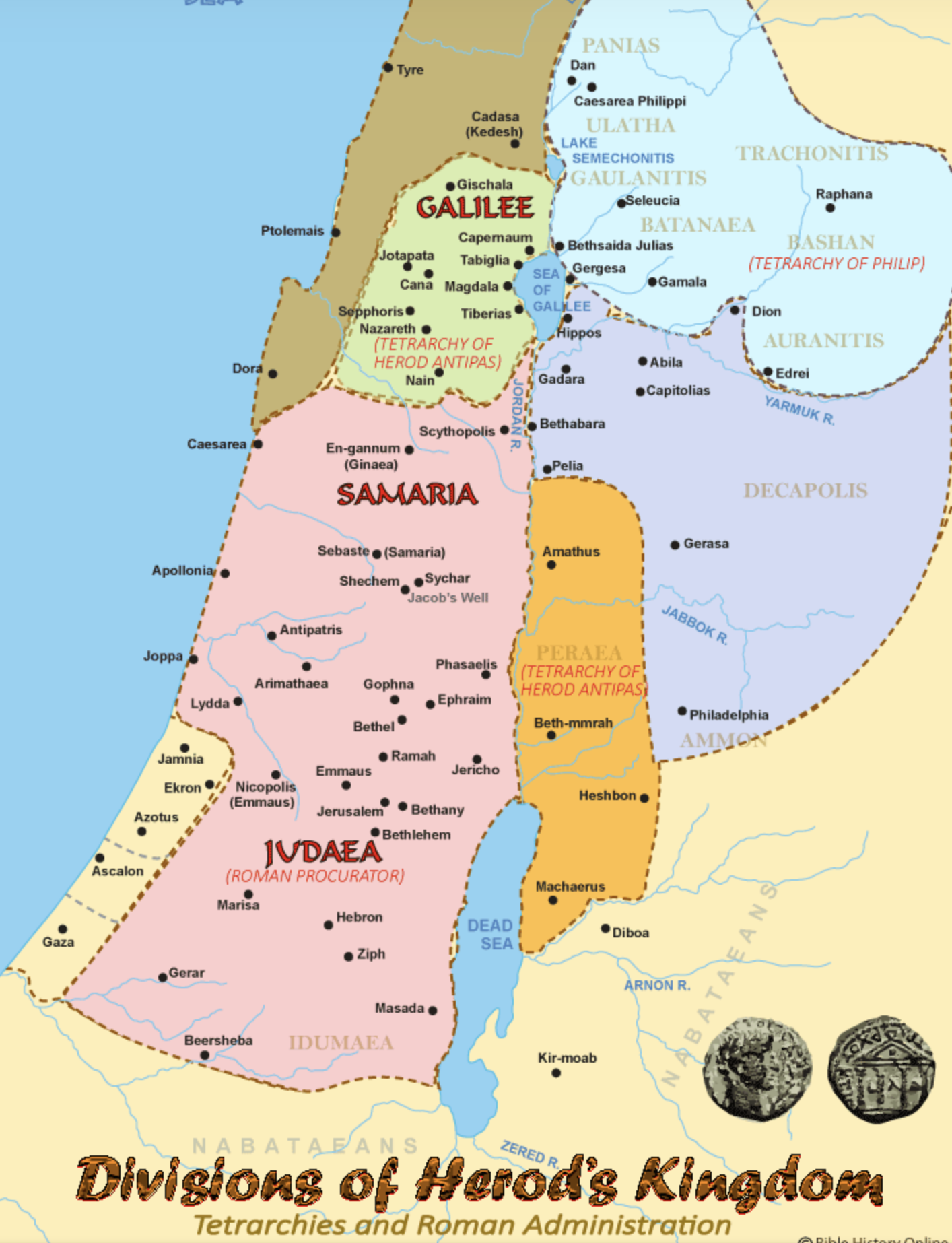
So Jesus has been traveling and teaching for over a month in Herod Antipas’ territory in Perea.  Jesus had likely come further south, closer to Herod’s palace in Macherus, so Jesus was warned to leave the area.  Now, Jesus begins to journey back through Perea, eventually passing through Jericho and returning to Jerusalem.  On his way, someone asked Jesus a question:

“Lord, will those who are saved be few?”

“Will many be saved or few?”     It is a good question.  Jesus began with a very small following, and sometimes crowds of thousands followed him.  Then Jesus will say something the crowds don’t like, and many of them will leave.  Then he will do miracles, and the crowds will gather again.  Will there be many saved or few?  It is an interesting question today.

Remember, in the Bible’s first book, God promised Abraham that his offspring would be as countless as the stars.  

Genesis 15:5  “…number the stars, if you are able to number them.” Then he said to him, “So shall your offspring be.”

In the last book, Revelation, we read this:

Revelation 7:9-10  After this I looked, and behold, a great multitude that no one could number, from every nation, from all tribes and peoples and languages, standing before the throne and before the Lamb, clothed in white robes, with palm branches in their hands, and crying out with a loud voice, “Salvation belongs to our God who sits on the throne, and to the Lamb!” 

A multitude that no one can number- the promise to Abraham being fulfilled.

In the days of the early church, a tiny fraction of the Earth’s population were followers of Jesus.  Today, about one-third of the world’s population, 2.7 billion people, claim the Christian faith. If only 1% of the world’s current population were saved, the resulting assembly of 82 million people would look like an uncountable multitude. Still, compared to all the people who have ever lived (109 billion by some estimates), it would seem to be few.  

So, will it be many or few?  What is the answer?

Or, as some have suggested, will everyone be saved?  Will all 109 billion enter heaven?  In 2011, Rob Bell published a book entitled Love Wins, the premise being that, eventually, everyone will be saved.  He quoted 2 Peter 3:9, that God is not willing that any perish but that all should come to repentance, and interprets that to mean that one day all will repent.  He says that if God wills it, then it must happen. 

Bell refers to Revelation 21:25, which says that the gates of Heaven are never shut. Bell applies that verse to Jesus’ teaching in Matthew 7 about entering through the narrow gate.  However, city gates were closed in those days to keep out an enemy or to be shut at night for safety.  But the point in Revelation is that in the world to come, there is no enemy, and there is no night.  So, gates never have to be closed.  Bell stretches this to say that, eventually, everyone, even if after spending time in hell, will decide to enter those always open gates. 

This is not a new idea.  Theologians, as early as Origen, in the third century, promoted this idea of universalism, that everyone would be saved.  ‘Love Wins.’  It is a pleasant thought, but does this fit with what Jesus said in our passage today?

Luke 13:23-28   And he said to them, “Strive to enter through the narrow door. For many, I tell you, will seek to enter and will not be able.  

Jesus said, “Many will seek to enter and not be able.” And he said that we must ‘strive’ to enter…”  The Greek word for ‘strive’ is ‘agonizomai.’  We are much more Greek than we realize.   Isn’t it interesting how we can see many English words in these Greek words?  There, you see our word ‘agonize.’   Jesus says it is a struggle; it takes tremendous effort.  The only other time we see that same word on Jesus’ lips is in John 18.  There it is translated as ‘fighting.’

John 18:36  Jesus answered, “My kingdom is not of this world. If my kingdom were of this world, my servants would have been fighting, that I might not be delivered over to the Jews. But my kingdom is not from the world.”

We must strive to enter; it is agonizing, a struggle, a battle.

What is this agonizing that Jesus says we must do to enter this narrow door?  And if it is a battle, who is the enemy?  And are we saying this is righteousness by works?   Are we striving to earn our salvation?  Definitely not!  You probably know this verse:   

Romans 6:23   For the wages of sin is death, but the free gift of God is eternal life in Christ Jesus our Lord.

But did you know the word ‘free’ is not in the Greek there?   The Greek word for ‘gift’ is ‘charisma,’ a gift given not on merit but by undeserved favor.  So, the gift is given out of grace.  It is undeserved.  It cannot be earned.  But unfortunately, when we read the word ‘free’, some get the idea that there are no requirements to accept it. But there is a requirement.

To illustrate this in church, I held up a $5 bill and told the congregation I would give it away to anyone who asked. It was free and available to anyone, but accepting it required action.

‘Eternal life in Christ’ is an unearned gift of grace, but to accept it, there is a harsh requirement.  You have to die.  Paul said it this way:

Galatians 2:20  “I have been crucified with Christ.  It is no longer I who live, but Christ who lives in me.”  

You must die to yourself.  You have to decide that you are not the best to make decisions for yourself.  You have to decide that you should not follow your own rules.  You have to determine that you can not be the ruler of your life.  You have to choose to change the way you live by changing who makes your decisions.   We call that repentance.  So you die to your selfishness and turn over your life to God instead, agreeing to live by his rules and follow his ways.  Jesus called this ‘denying yourself.’

Matthew 16:24  “Whoever wants to be my disciple must deny themselves and take up their cross and follow me.” 

The gift of forgiveness and salvation is free, but it is very costly to accept it and become a disciple.

Some people do this when they walk down an aisle and get baptized.  At that moment, they decide to die to themselves and live with a different king over their life, a king they will obey no matter what he asks.  But some people walk down an aisle and want to be saved. They don’t want to go to hell; they want to be in heaven when they die.  They are willing to say that in front of a church and are willing to get sprinkled or dunked in water publicly.  But they may not have understood that there is a prerequisite.  

The prerequisite for accepting the gift is repentance, not just a repentance of specific sins, but a complete change in how you decide your life.   You must repent of the sin of making yourself the God and the King of your life.  There can only be one God, one King, and that is not you. That is the repentance that matters.

And the gift we get differs significantly from the $5 bill I gave away.   Because this is not a gift you can hold in your hand and decide to spend whenever you want; it is not a ticket to a place called heaven that you can redeem when you die.  The gift is ‘eternal life in Christ Jesus our Lord.’  The gift is a relationship, life in Christ.  It is a relationship with Jesus that begins today.  But the relationship is that of a king to his subject.  If Jesus is not your king, then you have no relationship with him.  

Repentance is a struggle, not just a one-time decision.  Oh, one day, you decide to put Jesus in charge of your life.  You repent of trying to run your life your own way.    And God grants forgiveness.  But then your old self that you tried to kill — you find out that the old man dies hard.  So you find yourself ignoring God’s leadership in your life, and you are back to being your own boss and king.  Instead of doing what God wants you to do, you do what you want.  (Paul admits to having this same struggle also.)  And then you have to repent of those things, but more importantly, repent of kicking God off the throne of your life.

That is the struggle; that is where we strive.  And the enemy we strive against is our self, our sins, and our desire to make our own decisions.  This is the same struggle we see in Genesis 3.  Adam and Eve have to decide who gets to make the rules, who decides what is good and what is not good, and who is the king of their life, God or themselves?

That is not us working for our salvation; it is us doing the work that results from our salvation.  For you see, we have no hope of being successful in this without God’s help.  That is why God sent his holy spirit to dwell in us so that we would have his presence with us to enable and empower us to win this battle with ourselves.

Let’s look at the rest of our passage this morning.  

Luke 13:23-28   And he said to them, “Strive to enter through the narrow door. For many, I tell you, will seek to enter and will not be able.  When once the master of the house has risen and shut the door, and you begin to stand outside and to knock at the door, saying, ‘Lord, open to us,’ then he will answer you, ‘I do not know where you come from.’   Then you will begin to say, ‘We ate and drank in your presence, and you taught in our streets.’   But he will say, ‘I tell you, I do not know where you come from.  Depart from me, all you workers of evil!’  In that place, there will be weeping and gnashing of teeth when you see Abraham and Isaac and Jacob and all the prophets in the kingdom of God, but you yourselves cast out.

Sadly, many will want to enter into God’s salvation but will not be able to because they are not willing to repent.  They want to be in heaven with Jesus, but they refuse to let God be king.  They have to be their own king.   If you do not know God as your king, then you don’t know him at all.

Look at the parallel passage in Matthew 7:

Matthew 7:21-23   “Not everyone who says to me, ‘Lord, Lord,’ will enter the kingdom of heaven, but the one who does the will of my Father who is in heaven.  On that day many will say to me, ‘Lord, Lord, did we not prophesy in your name, and cast out demons in your name, and do many mighty works in your name?’   And then will I declare to them, ‘I never knew you; depart from me, you workers of lawlessness.’

Who enters the kingdom of heaven?  Only the ones who do the will of the Father in Heaven.    

Jesus divides all people into one of two groups.  And it is not those who did bad things and those who did good things.  It is not those who were kind and those who were mean.  It is not those who went to church and those who did not.  It is those who do their own will and those who do God’s will.

Again, Jesus tells us that many will not enter the kingdom of heaven.   And look at this group who doesn’t enter.  They prophesied in Jesus’ name.  They spoke inspired words in the name of Jesus.  They cast out demons.  They did mighty, powerful works in the name of Jesus.  

They did many good things, but Jesus said he never knew them.

Doing great things will not impress God.  Doing obedient things will.   If the good things you do are not God’s will, if they are your idea instead of HIs, it doesn’t matter how good you think they are.  

Not everyone who says to me, ‘Lord, Lord,’ will enter the kingdom of heaven, but the one who does the will of my Father who is in heaven.

Do you see why Jesus talked about the kingdom of God more than anything else?  Do you see why the first word he publicly speaks is ‘Repent’?

Repent for the Kingdom of Heaven is at hand.

The only way to enter the kingdom is to repent.  Repent of your rebellion against the king.  Turn your life around and decide to be obedient to the king.  You must place yourself under the king’s reign to be in the kingdom.  If you don’t accept God’s rule over your life, then you have no relation to God.  Either God is your king, or he is a stranger.   There is no in-between.

You see, you can not earn your way into the kingdom with good works.  The people in this scripture passage did powerful, wonderful things but were turned away.  “Depart, for I never knew you.”

God, through the sacrifice of Jesus, can forgive your sins and redeem you from your slavery to sin.  We are raised to new life, a life of continual surrender of our will to Him.  We don’t submit our will to God in order to do exactly what we want to do anyway. We submit to do his will.  And you can’t expect to surrender your life to God and make him king of your life and then not expect him to give you things to do.  Paul has told us that God has prepared a list of things for us to do ahead of time:

Ephesians 2:10   For we are his workmanship, created in Christ Jesus for good works, which God prepared beforehand, that we should walk in them.

So there will be things God wills for us to do.  And if indeed you did submit to the king, you will be obedient to all he asks of you.

You know the parable of the two builders in Matthew 7.   One built his house on the rock, and when the rain, wind, and flood came, it stood.  The other built his house on the sand, and when the storm came, the house fell apart.  This story comes right after this scripture we just read.  It begins in verse 24.  Jesus concludes his most famous sermon with this story.  He tells those listening to him that they are either the ones building off the rock or the ones building on the sand.  What is the difference?

Matthew 7:24-27     “Everyone then who hears these words of mine and does them will be like a wise man who built his house on the rock.   And the rain fell, and the floods came, and the winds blew and beat on that house, but it did not fall, because it had been founded on the rock.   And everyone who hears these words of mine and does not do them will be like a foolish man who built his house on the sand.   And the rain fell, and the floods came, and the winds blew and beat against that house, and it fell, and great was the fall of it.”

They were all hearing Jesus speak on that mountain.  But only some would do what he said.  And that makes all the difference. Hearing without doing so leads to destruction.  

Rob Bell is wrong.  Sadly, not everyone will be saved.  One day, the door will close, people will knock to enter, and God will say, “I never knew you.  I never had a relationship with you.”  One day, God will separate all humanity that has ever lived into a group on the right and a group on the left.  (See Matthew 25:31-46.)  And what does he say the difference will be?

One group gave food to the hungry, drink to the thirsty, welcomed the stranger, clothed the naked, and visited the sick and imprisoned.  The other group did not do these things. And Jesus told them that these things they did for “the least of these” they actually did for him.  Jesus notes that both groups are surprised.  Neither group had any idea that what they were doing was for Jesus. All they had done was to be obedient to share what they had with others who were needy, because that was the will of their King.  

Look back at the passage from Luke 13 above.  Does this sound like the gates or doors of heaven are always open?  No.  There comes a time when the master of the house shuts the door.  And then many people will want to enter but will not be able to enter.

Jesus never answered the question, “Lord, will those who are saved be few?”

He answers this question about the number by saying: Be sure you’re in the number.  The important question is not: How many will be saved?  The critical question is, will you be saved?  Will your family be saved?  Will your friends be saved?  It is too important to make assumptions, for as Jesus has told us, many will be surprised.  I beg you to make sure you know where you and your friends stand.

That narrow door is open.  One day, the door will close.  Whatever the number, be sure you are in that number.

Oh, when the saints go marching in.  Oh, when the saints go marching in.
Oh Lord, I want to be in that number when the saints go marching in.

January 7, 27 A.D.  –  Payroll Accounting —   The Year of the Lord’s Favor #66

Week 47 ——— Payroll Accounting
Matthew 20:1-16 

The holidays are over.  In 27 AD, when the holidays of Hanukkah had ended, Jesus went to the area east of the Jordan, where he spent the winter.  He is teaching to the people there, many of whom had been John the Baptist’s followers.  While there, he tells this story:

Matthew 20:1-16  “For the kingdom of heaven is like a master of a house who went out early in the morning to hire laborers for his vineyard.  After agreeing with the laborers for a denarius a day, he sent them into his vineyard.  And going out about the third hour he saw others standing idle in the marketplace,  and to them he said, ‘You go into the vineyard too, and whatever is right I will give you.’  So they went. Going out again about the sixth hour and the ninth hour, he did the same.  And about the eleventh hour he went out and found others standing. And he said to them, ‘Why do you stand here idle all day?’  They said to him, ‘Because no one has hired us.’ He said to them, ‘You go into the vineyard too.’  And when evening came, the owner of the vineyard said to his foreman, ‘Call the laborers and pay them their wages, beginning with the last, up to the first.’  And when those hired about the eleventh hour came, each of them received a denarius.   Now when those hired first came, they thought they would receive more, but each of them also received a denarius.   And on receiving it they grumbled at the master of the house,   saying, ‘These last worked only one hour, and you have made them equal to us who have borne the burden of the day and the scorching heat.’   But he replied to one of them, ‘Friend, I am doing you no wrong. Did you not agree with me for a denarius?   Take what belongs to you and go. I choose to give to this last worker as I give to you.  Am I not allowed to do what I choose with what belongs to me? Or do you begrudge my generosity?’

Most people in Jesus’ day were self-employed.  They were paid daily for their work, the items they made, or the crops they sold.  But those who had no land to farm owned no flocks of sheep, or didn’t own a boat or nets to fish were day laborers.  They would gather in the town square and hope that someone came by to hire them for the day.  Most lived day-to-day.  If they found no work for a few days, they didn’t eat.

Often, slaves had it better than day laborers.  Slaves didn’t have to worry if they would have consistent work.  They had guaranteed housing and food.  Day laborers had no job security and lived on the edge of poverty daily.  Slaves were treated better because their owners had a financial investment to care for.  In contrast, day laborers were sometimes overworked or abused.  The Old Testament has several verses that protect the rights of day laborers.1

Leviticus 19:13   “You shall not oppress your neighbor or rob him.  The wages of a hired worker shall not remain with you all night until the morning.

Deuteronomy 24:14-15   “You shall not oppress a hired worker who is poor and needy, whether he is one of your brothers or one of the sojourners who are in your land within your towns.  You shall give him his wages on the same day, before the sun sets (for he is poor and counts on it), lest he cry against you to Yehovah, and you be guilty of sin.

So a man goes out to hire workers at 6:00 am and agrees to pay a day’s wages for a day’s work.  A day’s wage then was a denarius, a silver coin about the size of our dime.  A routine day’s work was 12 hours, from 6 am to 6 pm.  He then goes out again at 9 am, at noon, at 3 pm, and then at 5 pm and hires additional workers.  At 6 pm, quitting time, he has his manager pay the workers.  The ones last hired got a denarius, a full day’s wage, even though they only worked an hour.  The others waiting in line to get paid see this and expect to get more since they worked more hours.  But the ones hired at 6 am, who worked 12 hours, got the same pay as the ones who worked one hour.  They worked 12 times as long but received the same pay.

That’s not fair!

Those of you who have raised small children read the above sentence in the voice of an irate screaming child.  It is a common complaint.  But as adults, we also constantly compare ourselves with others, looking at the level of accomplishment and fairness, what we ‘deserve.’  We cry injustice if we get less than we think we deserve.  Equal pay for equal work is a part of our labor justice system.  This vineyard owner would find himself in court in our day of labor unions and employment laws.  Jesus’ parable is hard to reconcile.  This story used to bother me.  Does it bother you?   Put yourself in the story and imagine how you would feel.  

Jesus’ story begins:
Matthew 20:1  “For the kingdom of heaven is like a master of a house who went out early in the morning to hire laborers for his vineyard.

This story is about the kingdom of heaven.  If you believe the kingdom of heaven is all about going to heaven when you die, that will affect how you understand this parable.  Then the vineyard owner is God, and the pay, the denarius, is salvation.  And everyone who accepts the vineyard owner’s invitation receives the same reward – salvation.

Except, that is not how Jesus talks about the kingdom of God.  We looked at this last January (See #5).   We tend to define kingdoms by geographic boundaries.  But in Jesus’ day, kingdoms were determined by the area where the king reigns.  If a group of people places themselves under the rule of a king, they are part of his kingdom.  If they refuse to follow the edicts of a king, then the king does not reign over them, so they are not part of the kingdom. Or as Dallas Williard states: “The Kingdom of God is the range of God’s effective will, where what he wants done is done.”2  That is why Jesus can say the kingdom is already here.  If you decide to follow the rules of the king, not some other leader, and not your own rules, then you are part of the kingdom.  You are not part of the kingdom if you rebel against the king by refusing to follow his edicts.

This parable is not about going to heaven but about being part of God’s kingdom, following God’s will, and doing things His way. Jesus is trying to show the disciples how to follow God’s will in how they treat others. It is not an allegory of future hope but a story of how real people treat each other now.

The disciples needed to hear this parable.  Just before this parable in Matthew, Jesus had talked about how hard it was for a rich person to enter the kingdom of heaven.   So Peter says, “Well, we gave up everything to follow you, so what do we get?”  Later, the disciples are debating who gets the best seat in the world to come and who gets the best reward.  They are thinking, “What’s in it for me?”  They need to hear this message.

We must address the critical question: “Why does the owner pay everyone the same?”  He says, “Am I not allowed to do what I choose with what belongs to me? Or do you begrudge my generosity?”

“Or do you begrudge my generosity?” is an interesting translation.  The literal translation from the Greek is, “Or is your eye bad because I am generous?”  Does that make sense to you?  We will need some cultural context to understand the concluding statement of the parable.  Let’s look at another teaching of Jesus that uses this same context:

Luke 11:34-36   Your eye is the lamp of your body. When your eye is healthy, your whole body is full of light, but when it is bad, your body is full of darkness.  Therefore be careful lest the light in you be darkness.   If then your whole body is full of light, having no part dark, it will be wholly bright, as when a lamp with its rays gives you light.”

“The eye is the lamp of the body.”  Well, of course, Jesus assumes everyone knows this.   Everyone in Jesus’ day knew this, but we don’t know what he is saying.

This requires some context.  This is the way our vision works.  Photons reflecting off an object from a light source enter the pupil, and our lens focuses that image on our retina.  Nerve impulses from the retina go to the brain, where we interpret the image.  This is a relatively new science because until only 600 years ago, it was commonly thought that it happened just the opposite way.  They thought rays exited your eye to settle on an object.  These rays enable vision and can affect the object, much like the sun’s rays affect objects.  Touch some black metal left out in the sun on a hot day.  Just as the sun’s rays make the metal hot, rays from our eyes were felt to affect things we see.   Again, this was common knowledge for over a thousand years before Jesus was born and continued to be over 1000 years after Jesus.

This idea that we can affect an object that we look at led to the concept of the “Evil Eye” — what you focus your vision on, and thereby emit rays upon, can affect the person you view.  If you look at someone with hostility — we have a word for that — glare — at someone, you could hurt them.   Fear of the evil eye and measures to ward off its harmful glance are well documented throughout the ancient world.

The eye was also thought to be directly linked to your mind, the place of thought, desire, and emotion. They thought your eyes expressed the innermost feelings and desires of your heart.  They assumed you could judge someone’s character by looking at their eyes.  We still use this language.  We talk about someone with ‘kind eyes,’ or we are suspicious of someone with ‘beady eyes.’  Therefore, a ‘good eye’ revealed morally good and generous intentions, while an ‘evil eye’ exposed an evil heart with wicked intentions of envy, greed, and jealousy. Envy, in turn, was associated with unwillingness to share one’s possessions with others.  Don’t miss this connection of a ‘bad’ or ‘evil eye’ with greed and envy.

Plutarch, a Greek philosopher and historian who lived just after Jesus (46 AD – 119 AD), wrote:
“When those possessed by envy … let their gaze fall upon a person, their eyes, which are close to the mind and draw from it the evil influence of the passion, then assail that person with poisoned arrows”1

In Roman times, to give the evil eye was in Latin ‘Invidia’ (from which we get our word envy).  It meant to look too closely or in a hostile manner to cause harm.  The way to prevent these ill effects from others looking at you was to wear some amulet or charm.  These were called ‘fascinum’  (from which we get our word ‘fascinate,’ which means to draw someone’s attention, enchant or bewitch).  These charms were first worn to distract someone.  They would look at the charm instead of you, and thus, you avoid harm.  Later, the charms were felt to have some magic power to combat the evil eye.

Babies were especially susceptible to the effects of the evil eye, and so many babies wore necklaces with these charms.  If you ever go to Greece, the market will be full of charms for sale to ward off the evil eye.  In Greece, where blue eyes are rare, blue-eyed people were most thought to be able to give the evil eye.  So blue became the color of resistance to the evil eye.

While at the market in Greece, do not stare at people. They will get very uncomfortable. I made the mistake of looking at a cute baby too long. The mother became upset about my blue eyes on her baby, and she spat three times, which I later learned was a way of protecting her baby from the evil eye.

We also see some remnants of that in the southeastern US.  Many porches and doors are painted a shade of ‘haint blue’.  This originates from the Gullah in Georgia and South Carolina, who brought the idea from Africa that this color might ward off evil spirits.

So now that we know the context of the bad eye or evil eye, we can better understand the words of the vineyard owner in the parable:  “Or is your eye bad because I am generous?”

Just because I am generous, are you envious of what your neighbors received and now wish them harm?

But the question remains: Why did the owner choose to pay them the same? This bothered me for years. Then, God arranged a situation to teach me the answer.

We met a young man through our homeless ministry, who I’ll call Tom.  Tom came to us in bad shape.  He had a problem with alcohol and drugs, couldn’t hold a job, and lost everything.  He worked hard to put his life back together, had a steady job, and finally got his driver’s license back.  Tom came to my wife and asked her if she knew anyone who needed some work done.  He needed $60 to pay for car insurance.  We had just moved our camper to a different lot, which needed some work, perhaps a few hours.  My first thought was, “We don’t have enough work for him to do for $60?  I have enough work to pay him $30 or $40.” And my wife responds, “But $60 is what he needs”. 

She understood the parable that I was having trouble with.  I wondered how I could find enough work to pay Tom the $60 so I could pay him what it was worth.  The vineyard owner didn’t pay people what they earned; he paid them what they needed.

All of the workers in the vineyard had the same need — a day’s wage to feed their families. The owner paid the men not what they earned but what they needed.  Isn’t that what God does?  He lavishes generous grace on us.  He does not give us what we deserve but what we need.  None of us will ever do enough to earn the salvation we need.

This final statement in this parable is really about the 10th commandment.
Just because I am generous, are you envious of what your neighbors received and now wish them harm?

“Exodus 20:17  “You shall not covet your neighbor’s house; you shall not covet your neighbor’s wife, or his male servant, or his female servant, or his ox, or his donkey, or anything that is your neighbor’s.”

Thou shalt not covet.  This is very different than the other nine of the Ten Commandments.  You won’t find it in any other legal system because it is not enforceable.  No legal system can enforce a law about what you are thinking unless that system is governed by a God who knows your thoughts.   And envy is a real temptation for everyone.  You see someone with nicer clothes, a nicer car, or a bigger house.  Your friend who takes better vacations.  Their gardens are more productive, and their children are better behaved.  Things seem to come easy for them.

Our entire marketing system is built on the idea of coveting, jealousy, and envy, which has flourished exponentially in social media marketing. If you want to sell clothing, find beautiful people to wear your clothes. We call them influencers.  

Luke 12:15  “Take care, and be on your guard against all covetousness, for one’s life does not consist in the abundance of his possessions.”

We learn from this parable that the opposite of coveting and envy is generosity.  “Or is your eye bad because I am generous?”  The vineyard owner is generous.  He could have paid the one-hour workers what they earned, but he gave them 12 times more.  He gave them what they needed.  The 12-hour workers were jealous.  They envied the one-hour workers who didn’t have to work all day and received the same as them. 

We fight this battle constantly with envy, jealousy, and desire.  If you watch an hour of television, you will see 10-20 minutes of marketing designed to make you want something you do not have, to entice you to covet.  You can’t go online without some influencer doing the same.   How do you combat these feelings?  Let me give you four things to consider to help you avoid the temptation to covet.

  1. Know the danger of coveting and its relation to jealousy and envy.
          The Bible is very clear: Coveting is idolatry.

.Ephesians 5:5 For you may be sure of this, that everyone who is sexually immoral or impure, or who is covetous (that is, an idolater), has no inheritance in the kingdom of Christ and God.

Colossians 3:5  Put to death therefore what is earthly in you: sexual immorality, impurity, passion, evil desire, and covetousness, which is idolatry.

How is coveting idolatry?  You want something more than you want God.  You set something material above God.  Paul said this:

Colossians 3:2 Set your minds on things that are above, not on things that are on earth. For you have died, and your life is hidden with Christ in God.

People who covet often find themselves willing to break any of God’s rules to obtain the object of their deisire. It is the oldest sin.    Eve sees the fruit on the tree.  She desires it.  Her desire overwhelms her obedience to God’s law.  She takes it.  David sees Bathsheba.  He desires her.  His desire overwhelms his obedience to God’s law.  He takes her. See —Desire — Take    That sequence of coveting tracks throughout the Bible and human history. We must understand the danger.

2. Count your blessings

We talked recently about the Jewish habit of saying 100 blessings a day.  Keep your mind on what God has given you, not what you do not have.  There were hundreds of trees with fruit in the garden.  Adam and Eve could eat from any of them.  Instead of enjoying what they had, they desired the forbidden one.  And remember, that tree was in the middle of the Garden. They passed by it every day.  They couldn’t avoid it.   So we, too, can not avoid seeing those things we are tempted to covet.  But as Paul said, don’t set your mind on those things.  Take your eyes off that tree and enjoy all the others.  Walk around the garden, thanking God for all of the other trees.   Thank you, God, for the pear trees.  Thank you for the orange trees.  Thank you for the peach trees. Count your blessings.

Gratitude is counting your blessings.  Envy is counting someone else’s blessings.

3.  Be content with what you already have.  

1 Timothy 6:6-10   But godliness with contentment is great gain, for we brought nothing into the world, and we cannot take anything out of the world.   But if we have food and clothing, with these we will be content.   But those who desire to be rich fall into temptation, into a snare, into many senseless and harmful desires that plunge people into ruin and destruction.   For the love of money is a root of all kinds of evils. It is through this craving that some have wandered away from the faith and pierced themselves with many pangs.

The wealthiest people in the world are not the happiest.  History shows us that many of them are the most miserable.  The apostle Paul said he had learned the secret of enjoying life.

Philippians 4:11-13  …for I have learned in whatever situation I am to be content.  I know how to be brought low, and I know how to abound. In any and every circumstance, I have learned the secret of facing plenty and hunger, abundance and need.   I can do all things through him who strengthens me.

This is the most misquoted verse in the New Testament, “I can do all things through him who strengthens me.” This verse is often the mantra of athletes trying to win a competition.  I can make that field goal.  I can run faster than these guys. But the ‘all things’ Paul says he can do is be content in any circumstance.  I can be happy if I’m rich or even if I am poor.  I am fine if the bank account is full or empty.  I can be ok with winning or losing (are you listening Mr. Athlete?)  I can do all things. Be content with what you have.

4.   Love your neighbor as yourself. 

If you admire something someone else has, don’t rush to envy and jealousy; rush to prayer, thanking God for blessing the neighbor you love.  If you love your neighbor, you are as grateful for the blessings God has given them as you are for the blessings He has given you. Thank you, Yehovah, for blessing my neighbor.  You are a good God who gives generously.  Don’t be like the 12-hour workers in the parable.  Rejoice in your neighbor’s good fortune.   Life is not a competition.  The one who dies with the most toys is not the winner.  

 Love you, neighbor; rejoice with those who rejoice.  

Jesus told this parable for a reason. The disciples asked Jesus, “What’s in it for me?”  and “Can I sit on your right hand in glory?”  They needed to start thinking differently if they were going to be in Jesus’ kingdom. We also need to change our way of thinking. We are surrounded daily by pressure to desire what is not ours. We must see that danger and avoid the ancient sin of seeing, desiring, and taking.  

God, I ask your Holy Spirit to speak loudly when we are faced with desire for things of the world.  Instill in us a desire for you, Yehovah, above anything else.  And may we treat others as you treat us, with generosity, giving to all what they need and not what they deserve.

  1. Bailey, Kenneth E.  Poet and Peasant and Through Peasant Eyes.  
  2. Willard, Dallas.  The Divine Conspiracy: Rediscovering Our Hidden Life In God.