
February 25, 27 A.D.  –  Lazarus is dying — The Year of the Lord’s Favor #73

Week 54 — Lazarus is dying
John 11:1-16

It was just 9 weeks ago that Jesus spent a week with his friend Lazarus and his sisters Martha and Mary.  He stayed with them during the holidays of Hanukkah at their home in Bethany, as he often did, for Bethany is just over a mile from Jerusalem.  During that visit, he again clashed with the religious leaders in Jerusalem who were already seeking to kill him. At one point, they “picked up stones to stone him” (John 10:31).  So Jesus left Judea after Hanukkah and went east to Perea, the territory on the other side of the Jordan, to preach and heal there.  This is the territory of Herod Antipas, and 2 weeks ago, Jesus learned that this Herod was also seeking to kill him and began to move northward, away from Herod’s palace at Macherus, back towards Judea.  He is teaching as he goes.  He has just told the parable of the rich man and Lazarus.  It is at this point that Jesus receives the news that his friend Lazarus is very ill.

John 11:1-16   Now a man named Lazarus was sick. He was from Bethany, the village of Mary and her sister Martha.  (This Mary, whose brother Lazarus now lay sick, was the same one who poured perfume on the Lord and wiped his feet with her hair.)  So the sisters sent word to Jesus, “Lord, the one you love is sick.”
When he heard this, Jesus said, “This sickness will not end in death. No, it is for God’s glory so that God’s Son may be glorified through it.”  Now Jesus loved Martha and her sister and Lazarus.   So when he heard that Lazarus was sick, he stayed where he was two more days,   and then he said to his disciples, “Let us go back to Judea.”
“But Rabbi,” they said, “a short while ago the Jews there tried to stone you, and yet you are going back?”
Jesus answered, “Are there not twelve hours of daylight? Anyone who walks in the daytime will not stumble, for they see by this world’s light.  It is when a person walks at night that they stumble, for they have no light.”
After he had said this, he went on to tell them, “Our friend Lazarus has fallen asleep; but I am going there to wake him up.”
His disciples replied, “Lord, if he sleeps, he will get better.”   Jesus had been speaking of his death, but his disciples thought he meant natural sleep.
So then he told them plainly, “Lazarus is dead, and for your sake I am glad I was not there, so that you may believe. But let us go to him.”
Then Thomas (also known as Didymus) said to the rest of the disciples, “Let us also go, that we may die with him.”

The Gospels repeatedly emphasize Jesus’ love for Lazarus and his sisters, including in verse 5 here. But that makes verse 6 all the more puzzling. 

Now, Jesus loved Martha and her sister and Lazarus.   So when he heard that Lazarus was sick, he stayed where he was two more days,   and then he said to his disciples, “Let us go back to Judea.”

The reason why Jesus didn’t leave immediately to go see about his friend was “that he loved them so much”?  Jesus receives a desperate plea for help and demonstrates his love by waiting 2 days before he leaves.

Let’s look at the timing here.  Lazarus is ill to the point that his sisters feel the need to call their miracle-working friend to come and heal him.  It would take a full day’s journey for a messenger to get the word to Jesus. It was at least 22 miles.  He delays 2 days and then takes a full day to travel to Bethany. Verse 17 tells us, “On his arrival, Jesus found that Lazarus had already been in the tomb for four days.” Do the math.   Lazarus must have died shortly after Mary and Martha sent the messengers off to tell Jesus of his illness.   Lazarus is already in the grave before the messenger arrives and makes it to Jesus.

This is Israel 2000 years ago.  There was no embalming of bodies as they did in Egypt. Oh, they used spices and perfumes to cover the smell, but they did nothing to stop the decay.  And in such a climate, decomposition of the body began quickly.  Except in unusual occasions, bodies were prepared for burial and placed in the tomb on the same day of death.  Today, in Orthodox Jewish communities, burial is still held within 24 hours of death.  (The rabbis see this as a command from Deuteronomy 21:23.)   So soon after the messenger left, Lazarus died, and they closed his eyes, washed his body, anointed it with perfumes and spices, and wrapped the corpse with strips of cloth.  Then, there would be a procession of family and friends to the family tomb, where the body would be placed on a slab of stone cut out of the cave’s walls.  The tomb was then sealed with rocks or a rolling stone.  Mourning would continue at the home for seven days.  After a year, the tomb would be opened, and the bones collected and placed in a stone box called an ossuary.

So, by the time the messenger arrives to tell Jesus that Lazarus is ill, he has already died and been placed in the tomb. It is too late to prevent his death. Jesus could rush to Bethany immediately and join Mary and Martha in grieving, or he could rush back and stop their mourning by raising Lazarus the next day, but he waits two days before he leaves.  

In the first century, there were no doctors to examine someone and pronounce them dead.  And rarely, someone could appear dead when they were not.  Their heart could be fibrillating, and their breathing so shallow that most people would not detect any signs of life.  There are reports of people being carried to their tombs and rising back to life.  This led to the belief that the spirit hovered over the body for three days, hoping to reenter the body, but then after 3 days, when full decomposition had begun, the spirit departed.

Had Jesus left immediately and revived Lazarus after only a day or two, it would have been impressive but not an undeniable miracle of God.  Jesus wanted there to be no doubt when Lazarus was raised to life that he was dead beyond hope of resuscitation.  Jesus would not let God’s victory over death be cheapened because people had these mistaken thoughts about the spirit hovering.

Jesus frankly tells the disciples that he knows that Lazarus is already dead and says something that seems really odd, “for your sake, I am glad I was not there so that you may believe.”   Jesus says I am so glad I was not there to heal Lazarus before he died.  What must the disciples have been thinking when Jesus said this?  They didn’t know yet that Jesus would raise Lazarus from the dead.  So they see Jesus doesn’t rush off to heal when he hears Lazarus is sick, and then Jesus says, “I am so glad I wasn’t there to prevent Lazarus’ death.” 

I think of the many times in my career as a pediatrician that I raced to the hospital to resuscitate a newborn.  Many was the night I received a phone call and drove way over the speed limit to rush up to the hospital nursery because a baby had been delivered prematurely and needed advanced resuscitation.  Many times, I ran from our office across the hospital campus and up the stairs to the OB ward or nursery to prevent the death of a baby.   Thankfully, most of those trips were successful, but some were not.  And still today, there are some times when I still relive those moments in the early mornings, even now wondering if I could have gotten there sooner or done something more.  In my job, illness and death were the enemy we all dreaded, but they were always near at hand.  

But Jesus says, “I am so glad I was not there to prevent Lazarus’ death.”

What is Jesus saying?

Jesus is living out the second beatitude.   The sermon on the mount begins in Matthew 5 with eight statements of the good life, descriptions of the ones living the good life, the lucky ones, the happy ones.  And they are groups of people who would be least expected to be happy:  the poor, the hungry, the disadvantaged, the powerless.   The second beatitude is:

Matthew 5:4  Blessed are they that mourn, for they shall be comforted.

Happy are they that mourn!  How lucky are the mourners, for they will find comfort!  
How odd are the Beatitudes!  How in the world do you expect people mourning the death of a loved one to be the fortunate people?  For they will be comforted.

Some lessons you can’t learn from just hearing them.  Some things can only be learned from experience.  The disciples had listened to his sermon back in July, but they hadn’t lived it yet.  There is a big difference between hearing the words of Jesus and experiencing the words of Jesus.   They knew that Jesus said that those who mourn were the lucky ones, and some of the disciples wrote it down.  But did they understand what Jesus was saying?  Do we understand what Jesus was saying?

Don’t just read the words; live the words.

Can you imagine the joy that Mary and Martha felt when they realized Lazarus was alive again?  Some of you can.  Some of you have had news that came close.  When the follow-up scan says, there is no more sign of cancer when you get news that your family member in the horrible accident that you were told would probably die is now expected to live.  

I remember clearly a certain premature baby.  I spent over an hour resuscitating and ventilating this baby one early morning.  Born at 24 weeks, her prognosis was very poor.  She needed surfactant, a medicine instilled into the lungs of premature babies to allow their stiff lungs to expand.  But that is not available in any rural hospital.  Nor was the high-frequency oscillating ventilator we needed to breathe for her with her premature lungs.  So I breathed for her with a hand-squeezed bag for over an hour because that was the best you have in any rural hospital.  And that morning, the transport team was delayed.  It became harder and harder to breathe for her as her lungs became stiffer and stiffer.   Despite our best efforts, her oxygen was dropping, and then her heart stopped.  We continued to ventilate and do chest compressions for more than 15 minutes, giving all the code blue medications possible to attempt to revive her.  One by one, the nurses and respiratory techs said we needed to stop because she was gone.  But I couldn’t let go.  I couldn’t stop.  And then, unexplainably, her heart started beating, her oxygen came up, and just after that, the transport team arrived with the medicine needed to decrease the stiffness in her lungs.  She survived that night and, after 4 months in the Neonatal Intensive Care Unit, was able to go home.

But that moment when her heart started… There is no possible way I can explain to you the joy that spread in that room.  She had been given up for dead, the room was full of tears, and we were all mourning, but then she came back to life, and let me tell you, worship broke out in that nursery, praising God for the gift of life.  For it was nothing we did.  We had exhausted every intervention available to us.       But God…

Oh, what a moment, when everything changes
Imagine the glory; imagine the praises.1

I don’t have to imagine it, for I have lived it more than once.

There is no rejoicing like the rejoicing of the victory of life over death.  You can read the words of the Bible, and you can study them, but they come truly alive when we see how we have lived them out and then share them with each other.  How wonderful it is for those who mourn, for they will be comforted.

This is the attitude we see in David in Psalm 30.   David was sick to the point of death with no medical treatment available, and he cried out to God, and God healed him, and Psalm 30 is his response.

O Yehovah, my God, I cried to you for help, and you have healed me.
O Yehovah, you have brought up my soul from the grave; you restored me to life from among those who go down to the pit.
Sing praises to Yehovah, O you his saints, and give thanks to his holy name.
Weeping may tarry for the night, but joy comes with the morning.
You have turned for me my mourning into dancing; you have loosed my sackcloth, and clothed me with gladness, that my glory may sing your praise and not be silent.
O Yehovah my God, I will give thanks to you forever!

David thought he was going to die, but God turned his mourning into dancing.  And in our passage today, Jesus knew something that the disciples didn’t realize — Lazarus’ death was only temporary.  Those who now mourn will soon find comfort, and they shall rejoice.

Are you a Second Beatitude believer?  Can you see tragedy, illness, and death as just another opportunity for God to reveal his glory? Can you grasp the incredible brevity of our grief compared to the eternity of our joy?  The key to our passage today is verse 4:

John 11:4  Jesus said, “This sickness will not end in death. No, it is for God’s glory so that God’s Son may be glorified through it.”

“This sickness will not end in death.”  Don’t miss the point that Jesus makes this statement, knowing that Lazarus is already dead.  It is not a statement about the prognosis of the illness but about the temporal nature of death.   Jesus says, “This sickness will not end in death” because Jesus knows that death is not the end.  Death is never the end.  It was not the end for Lazarus, and it is not the end for you either.   The year after the dash on a headstone is not an ending date but a relocation date.

Let’s look at another Psalm.  This one you know very well, Psalm 23.  

Yea though I walk through the valley of the shadow of death, I will fear no evil, for you are with me.  

I know you have this memorized, but look at this carefully.  You walk through the valley of the shadow of death.  The valley of the shadow of death is not a destination, it is not where we go to but where we go through.  Death is not the end.  Then, what is the destination of the journey in the 23rd Psalm?  It is in the last verse:

Surely goodness and mercy shall follow me all the days of my life,

For all the days I live, God’s goodness and mercy follow.  But wait, ‘follow’ is too tame a word for the Hebrew there ‘radaf.’  ‘Radaf’ doesn’t mean ‘follow,’ but ‘pursue,’ chase after with the intent to do something.  ‘Radaf’ is the picture of a lion pursuing its prey.  A lion doesn’t follow; a lion pursues — the lion’s intent is not just to see where it goes, not just to catch it, but to consume it.  ‘Radaf’ is to chase after something with the intent to act on it.  God’s mercy and goodness pursue us every day of our lives; they chase after us like a lion in order to change us, to change our hearts, and to radically alter our circumstances.

And then — and then after all the days of our lives – and then it is not the end — and then I shall dwell in the house of Yehovah forever.

Surely goodness and mercy shall pursue me all the days of my life, and I shall dwell in the house of Yehovah forever.

Death is not an end.  We shall dwell in the house of Yehovah forever.  This is the gospel. This is the good news.  Oh, how I would like to make signs that have Jesus’ quote from John 11:4, “This sickness will not end in death” – Jesus.”   I want to put them in every hospital cancer ward, in every ICU, in every hospice room.  Death is not the end.  Jesus has spoken.
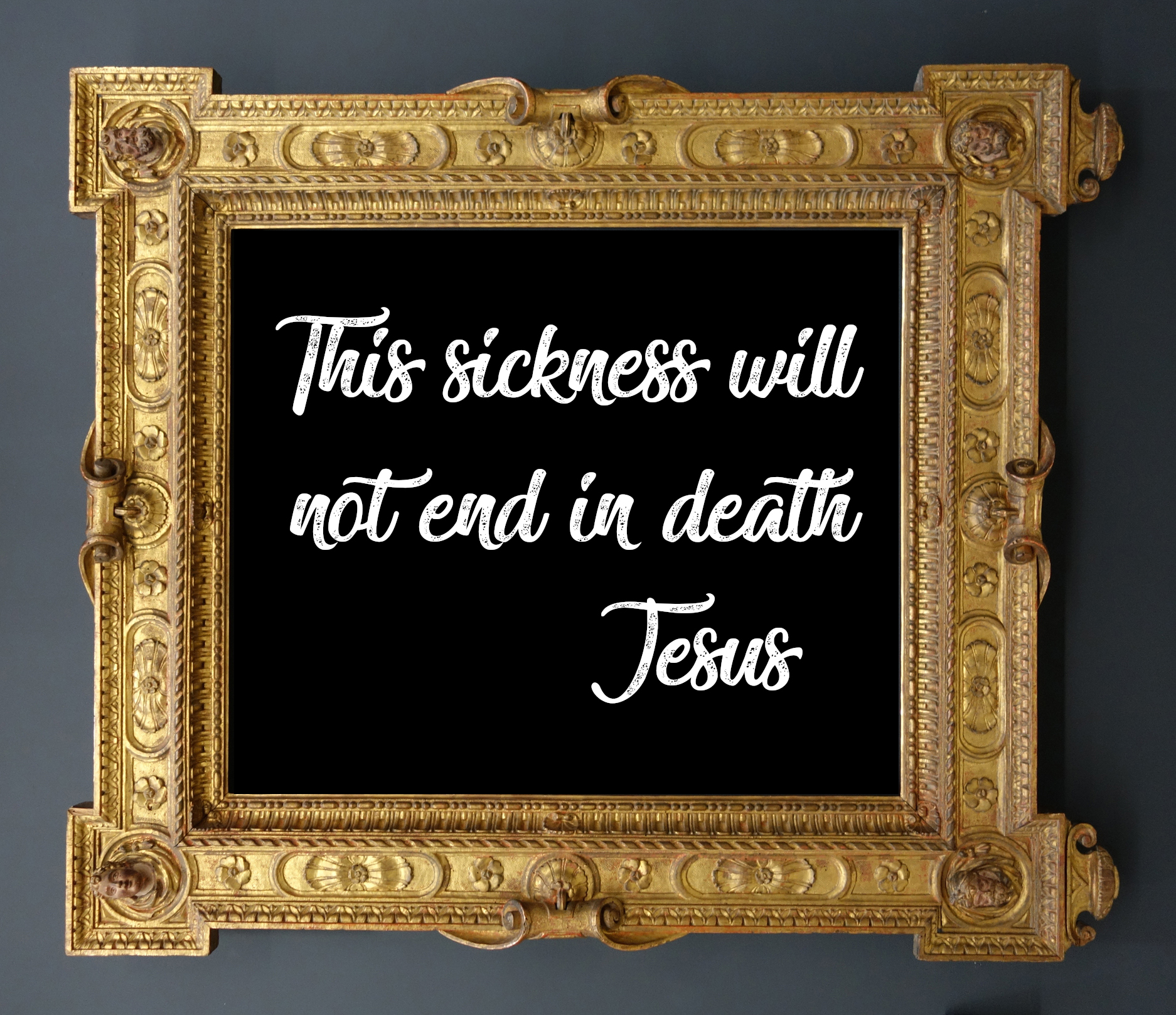
And in just a few days, after our passage this morning, those disciples heard Jesus speak, heard him say,  “Lazarus, come out!”  And they saw the glory of God as he defeated death.  Mourning turned to joy, and grieving turned to glory. 

And in just a few months later, they see Jesus alive three days after he dies, and they will again see God glorified as he pronounces the final defeat of death.  Blessed are they that mourn, for they will be comforted.

It is natural to fear dying.  Dying can be a painful process.  But there is no need to fear death.  For it is but another opportunity for God to show his glory as he brings you closer to his side.  As long as we walk on this earth, we walk each day in the shadow of death, the shadow of the dying.  But Jesus says none of these illnesses, none of these cancers, none of these traumas will end in death.  For those we mentioned this morning who are grieving the death of their son, his story does not end in death.  For death is not the end.  We, like Lazarus, will be called out of the grave.  

John 11:25-26  Jesus said to her [Martha], “I am the resurrection and the life. The one who believes in me will live, even though they die; and whoever lives by believing in me will never die.” 

And then he asks Martha the most important question anyone will ever ask.  

“Do you believe this?”

Do you believe this?  Are these more than just words on a page to you?  Are you living them out?  If you believe these words, it changes everything.  We need not fear the shadow of death or death itself.  We need not fear cancer, heart problems, accidents, evil, or sin.  Because none of these things will be the end.  All these things we fear in life are simply opportunities for God to show his glory as he defeats illness, sin, and death.  There may be times it seems the enemy is winning, that the disease has the better of you, that sin has a hold on you, but know this:  Sin has no victory, Illness has no victory, and Death has no victory.  

Seven hundred years before Jesus’s birth, the prophet Isaiah saw the day coming when the pursuit of God’s mercy and grace would reach its climax. 

Isaiah 25:7   And Yehovah will swallow up on this mountain the covering that is cast over all peoples, the veil that is spread over all nations.

Right here, on this mountain in Jerusalem, God will destroy that shroud of death that hangs over all of us.

Isaiah 25: 8 “He will swallow up death forever; and Yehovah Elohim will wipe away tears from all faces, and the reproach of his people he will take away from all the earth, for Yehovah has spoken.”

He will remove the reproach, the shame of our sins from us, casting them off the planet. God has spoken; it will come to pass.

And they waited another 700 years for this.  And then Jesus came — and this resurrection of Lazarus in the suburbs of where Isaiah was prophesying was just a small taste of what Jesus would do just a few months later on that very mountain where on the cross and from the tomb like Lazarus the stone would be rolled away, and death would yield to eternal life.

Isaiah 25:9 It will be said on that day, “Behold, this is our God; we have waited for him, that he might save us.  This is Yehovah; we have waited for him; let us be glad and rejoice in his salvation.”

So we say today, this is Yehovah; this is his son Jesus.  We have waited for him to turn mourning into joy.  Now, let us rejoice in His salvation.  Let us say as the apostle Paul said (1 Corinthians 15:54-56), quoting Isaiah, “Death is swallowed up in victory.” (Isaiah 25:8)  and quoting Hosea, “Death where is your victory? Grave, where is your sting? (Hosea 13:14).

1 Corinthians 15:56 The sting of death is sin, and the power of sin is the law. But thanks be to God, who gives us the victory through our Lord Jesus Christ.

I heard an old, old story,
How a Savior came from glory,
How He gave His life on Calvary
To save a wretch like me;
I heard about His groaning,
Of His precious blood’s atoning,
Then I repented of my sins
And won the victory.

O victory in Jesus,
My Savior, forever.
He sought me and bought me
With His redeeming blood;
He loved me ere I knew Him
And all my love is due Him,
He plunged me to victory,
Beneath the cleansing flood.2

1.  Lyrics from “He Welcomes the Beggar” by 11th Hour. 2016.  This is the song our church trio sang on the day this message was given.
2. “Victory in Jesus.” Eugene Monroe Bartlett. 1939.

February 14, 27 A.D. —   The Unjust Steward #71

Week 52 — The Unjust Steward
Luke 16:1-13

We are in week 52/70 of the appointed year of the Lord. We are walking week by week through Jesus’ ministry. Today, we will cover what many say is the most challenging parable Jesus told. It is found in Luke 16.

Luke 16:1-8   He also said to the disciples, “There was a rich man who had a manager, and charges were brought to him that this man was wasting his possessions.   And he called him and said to him, ‘What is this that I hear about you? Turn in the account of your management, for you can no longer be manager.’   And the manager said to himself, ‘What shall I do, since my master is taking the management away from me? I am not strong enough to dig, and I am ashamed to beg.   I have decided what to do, so that when I am removed from management, people may receive me into their houses.’   So, summoning his master’s debtors one by one, he said to the first, ‘How much do you owe my master?’   He said, ‘A hundred measures of oil.’ He said to him, ‘Take your bill, and sit down quickly and write fifty.’   Then he said to another, ‘And how much do you owe?’ He said, ‘A hundred measures of wheat.’ He said to him, ‘Take your bill, and write eighty.’   The master commended the dishonest manager for his shrewdness. 

Let me see if I have this straight.  A landowner finds out that the person managing his land was cheating him.  So he fires the manager and tells him to turn in his books.  But before word gets out about his being fired, he calls in the renters one at a time and quickly changes the books so they will owe much less, hoping to gain friends and influence by being generous with his ex-boss’s money and cheating his boss even more.  Surprisingly, his former boss commends him for his ‘shrewdness.’  This is a tough one.

First, does it bother you that Jesus used a dishonest manager to make a point? It didn’t bother Jesus, for he tells several stories that use characters who act unrighteously to teach lessons in righteousness.  Jesus tells stories that include righteous and unrighteous people, for the world these disciples live in has both.  

For example, there is the short parable of the man who accidentally discovers that his neighbor’s field has buried treasure in it.   He doesn’t tell his neighbor but deceives his neighbor into selling him the field.  Is that good business practice?   It certainly isn’t righteous, but Jesus uses this real-life example to say that the kingdom of heaven is like that treasure you give up everything to obtain.  He says nothing about the man’s behavior; the parable is about the treasure, the kingdom.

Then there is the unneighborly neighbor in Luke 11 who doesn’t want to be bothered by his neighbor who needs food at night.  This man is not loving his neighbor as himself.  This is followed by Jesus asking What kind of father would give his child a scorpion if he asked for food?   This is a “how much more” parable, as seen in the explanation:

Luke 11:13  If you then, who are evil, know how to give good gifts to your children, how much more will the heavenly Father give the Holy Spirit to those who ask him!”  

Jesus says if an unrighteous neighbor will eventually help, how much more will righteous God help you?  Finally, there is the unrighteous judge in Luke 18:

Luke 18:1-5  He said, “In a certain city there was a judge who neither feared God nor respected man. And there was a widow in that city who kept coming to him and saying, ‘Give me justice against my adversary.’  For a while he refused, but afterward he said to himself, ‘Though I neither fear God nor respect man, yet because this widow keeps bothering me, I will give her justice so that she will not beat me down by her continual coming.’”

Again, this is a ‘how much more’ parable.  If even this unrighteous judge will eventually give in and give justice, how much more will a righteous God give justice to his people who cry out to him?  So don’t get hung up on the idea that Jesus uses unsavory characters in his parables.  Let’s see what Jesus is teaching using this story.

In Jesus’ day, the way to gain wealth was to play the game.  That is just the way the economy was set up. There were some honest jobs, such as fishing and being a craftsman.  But the way to get ahead financially was land ownership.  Since much of Israel in this day was occupied by the Romans, many wealthy Romans bought up land in Israel and then hired managers to collect their profits while they lived back in Rome.  This is much like many vacation towns in the US now, where wealthy people buy up many of the hotels and Airbnb’s and then hire locals to manage their property.  So, it is a story we can all identify with.  But this manager was doing a poor job, so he was fired.  The manager then acts dishonestly, cheating the owner even more by adjusting the books to gain favor with the renters.  

Then, something completely unexpected happens in the story.

Luke 16:8   The master commended the dishonest manager for his shrewdness.

You would expect the landowner to be angry and perhaps have the manager arrested.   The story has jumped the rails.  That is not a reasonable way for the rich land-owner to act.  The story no longer makes sense in our world.  This wealthy landowner is nothing like a typical landowner, as they know.  This parable has to be an allegory to make sense.  Jesus never explains the allegory (as he did with the parable of the four soils), but he does clarify the lesson from the parable:

And I tell you, make friends for yourselves by means of unrighteous wealth, so that when it fails they may receive you into the eternal dwellings.

Here is where we know without a doubt that the story is an allegorical parable.  Who could possibly reward you with “eternal dwellings?”  This only works if the wealthy landowner is God, for he is the only one in charge of ‘eternal dwellings.’  He owns all of the riches and all of the land.  The manager is one of God’s people who was placed in charge of managing some of God’s resources.  (Recall that Adam in Genesis was placed in the garden in Eden to manage it.)   But this manager was doing a poor job of managing God’s resources.  Such a poor job that God decided to fire him and take away his resources.  But then the manager completely changes his way of dealing with people and acts in such a way that makes God commend him.  He takes God’s resources and deals them out with extravagant grace and mercy.  And God is pleased with him.  By treating all the people living on God’s land with grace and mercy and freely dispersing God’s resources, the manager has made a friend using wealth as a tool and is received into the eternal dwelling.

Jesus goes on:

Luke 16:10   “One who is faithful in a very little is also faithful in much, and one who is dishonest in a very little is also dishonest in much.  If then you have not been faithful in the unrighteous wealth, who will entrust to you the true riches?   And if you have not been faithful in that which is another’s, who will give you that which is your own?   

We put a lot of emphasis on ownership.  I paid off my truck last month and got the title in the mail this week.  It says that I own that truck.  But the Biblical view is that God owns this world, and we are his stewards, managing portions of God’s property.  That rancher in Yellowstone may think he owns the cattle on a thousand hills, but the Bible says differently.

Deuteronomy 10:14    To Yehovah your God belong the heavens, even the highest heavens, the earth and everything in it.
Psalm 24:1    The earth is Yehovah’s and everything in it, the world, and all who live in it;

Jesus ends his teaching on this parable with this verse:

No servant can serve two masters, for either he will hate the one and love the other, or he will be devoted to the one and despise the other. You cannot serve God and money.”

Something interesting happens in the Greek in this verse.  The final word, ‘money,’ is not translated into Greek but left as a Semitic word, ‘mammon.’  So this is a Hebrew or Aramaic word spelled with Greek letters.  When the Bible was translated from Greek to Latin in the 4th century, it was again not translated but left as a Semitic word.  When the King James Bible was translated in 1611, it also kept the Hebrew word, Mammon in the verse.

Luke 16:13   “…Ye cannot serve God and mammon.”

Jesus has personified “mammon” in his statement, which led many in the Middle Ages to falsely believe there was a demon of greed and money named ‘Mammon,’ as seen in John Milton’s Paradise Lost.  But this was not what Jesus meant.

So what is the meaning of this Hebrew word, “mammon?”   It developed as a Hebrew word about 200 years after the last book of the Old Testament was written, so you won’t find it in the Old Testament.  It is, however, frequently seen in Hebrew documents in the Dead Sea Scrolls, so we know it was a commonly used word in Jesus’s day.  It was derived from a root word frequently used in the Old Testament.  It is a Hebrew word that you know: ‘Amen.’  It is another word the Bible doesn’t translate but leaves as a Hebrew word (like Hallelujah, Hosannah, Jubilee).   When we end a prayer, we say this Hebrew word, amen.  It is spelled in Hebrew with the letters, aleph, mem, nun (A, M, N).  We must understand the root word ‘amen’ to understand what mammon means.

This root carries the ideas of stability, reliability, and truth; various forms of the word are found throughout the Scriptures.  

A form of this word is found in one of the most important verses in the Old Testament.  It is in the two verses in the Old Testament that the writers of the books of the Old Testament quote more often than any other verses, Exodus 34:6,7.

These verses are the John 3:16 of the Old Testament. They are the most important verses of the Old Testament.  Let me give you the context.  In this section of Exodus, the children of Israel have left Egypt, passed through the parted waters of the sea, and camped at the base of Mount Sinai.  Moses has been up on the mountain, brought down the 10 commandments on stone tablets, and found his people worshipping a golden calf.  Moses returned to the mountain to intercede for the people and remake the stone tablets.  And Moses asks to see God’s glory.  God says, You can’t see my face, but I will show you part of my glory.  So God places Moses in a cleft in the rock, and God passes before him.  And when God is revealing himself to Moses, this is how God describes himself:

Exodus 34:6-7  Yehovah passed before him and proclaimed, “Yehovah, Yehovah, a God merciful and gracious, slow to anger, and abounding in steadfast love and faithfulness, keeping steadfast love for thousands, forgiving iniquity and transgression and sin, but who will by no means clear the guilty…”

If you want to understand who God is, then study how God describes himself.  In a job interview, you are often asked to give several adjectives to describe yourself.  God does just that with Moses on the mountain.  It is no wonder this is the most quoted verse by the writers of the Old Testament.  See the balance of love, mercy, grace, truth, and justice in God’s self-description.  We could spend weeks and weeks on understanding these verses.  The Bible Project has a 14-week series on this; you should check it out.  That is where I learned much of what you hear now. But we are just looking at the word ‘amen’ and its variants to understand this word, mammon.  

God is abounding in steadfast (covenantal) love and faithfulness.  What we translate as ‘faithfulness’ is ‘emet,’ a form of our word, amen.  Tim Mackie from The Bible Project said ‘amen’ has to do with stableness and reliability.  When Moses had to hold up his hands for hours for the Israelites to defeat the Amalekites, they put a rock under his arms so they would be stable or steady.  When emet is used for people, it describes reliable and stable character or trustworthiness. For example, when Moses appointed leaders in Israel, they were to be “people of emet,” trustworthy people who wouldn’t take bribes or distort justice.  God is stable and reliable, and his character is unchanging. he is dependable and worthy of trust because he is faithful. This is why Moses describes God as a rock.  

Jesus often said, “Verily, Verily, I say to you….

John 3:3 Jesus answered and said unto him, Verily, verily, I say unto thee, except a man be born again, he cannot see the kingdom of God.

Or in the ESV:

John 3:3 Jesus answered him, “Truly, truly, I say to you, unless one is born again he cannot see the kingdom of God.”

Verily is an English word from the Latin ‘Veritas,’ which means ‘truth.’  But again, in the Greek New Testament, this is our untranslated Hebrew word ‘amen.’  So Jesus literally says,

 “Amen, amen, I say to you….” Jesus says, “This is the truth; you can count on this.   I stand as a witness that this is true.”  Jesus says this over 100 times in the gospels.  

In the Old Testament, prayers, blessings, and curses were often concluded with “amen.” Paul does the same in his letters, concluding his prayers or blessings with “amen.” 

1 Chronicles 16:36 Blessed be Yehovah, the God of Israel, from everlasting to everlasting!”  Then all the people said, “Amen!” and praised Yehovah.
Romans 15:33 May the God of peace be with you all. Amen.
Philippians 4:20 To our God and Father be glory forever and ever. Amen.

 By saying ‘amen,’ you say, “This is true, and I stand witness to it.”  

When Jesus is talking with Pilate before he is sentenced to die, Jesus tells Pilate his purpose in coming:

John 18:37-38 Then Pilate said to him, “So you are a king?” Jesus answered, “You say that I am a king. For this purpose I was born and for this purpose I have come into the world—to bear witness to the truth.

Jesus came to be God’s witness to the truth.

Rev. 3:14   “And to the angel of the church in Laodicea write: ‘The words of the Amen, the faithful and true witness, the beginning of God’s creation.

Jesus is God’s  ‘Amen’ – his life is a witness to who God is and what God has said all along.

2 Corinthians 3:20  For no matter how many promises God has made, they are “Yes” in Christ. And so through him the “Amen” is spoken by us to the glory of God.  

Jesus is the amen.  He is the fulfillment of the promise of God given thousands of years before. He is the witness that all God said is true.

Amen is spelled a m n. (Hebrew is written right to left, typically with no vowels אמן ).  Mammon is the noun form of the verb amen.    In Hebrew, you often make a noun out of a verb or other word by adding the letter ‘mem’ (our ‘m’) to the front of it.  So we take the verb ‘amen’ and add a preceding mem and get mammon (מאמן).  Amen, the verb, means to affirm or testify as true or trustworthy.  So the noun form (mammon) is“the thing in which you put your trust.”  It came to be a word for wealth or riches because many people who have riches have put their trust in their riches instead of God.

In our scripture today, Jesus says you can’t serve both God and mammon.  It has to be one or the other.  You can’t put your trust in God and also put your trust in wealth.  Where do you place your trust?  

I have a friend who is a ‘prepper.’  He has an entire room of his house filled with food and supplies and equipment he feels he will need one day when the world system collapses.  He has spent thousands of hours researching and a small fortune and feels sure he will be ready to survive almost any catastrophe. Now, don’t get me wrong.  I was a Boy Scout, and the scouts’ motto was “Be prepared.”  There is nothing wrong with being prepared. But this friend has gone way overboard.   He has placed his hope in the future in the contents of that room.  Where do you place your trust?  Let’s see what the First Testament says:  

Proverbs 11:28   Whoever trusts in his riches will fall, but the righteous will flourish like a green leaf.
Proverbs 18:11   The wealth of the rich is their fortified city; they imagine it a wall too high to scale.

And one from the Psalms:

Psalm 20:7    Some trust in chariots and some in horses, but we trust in the name of the Yehovah, our God.

The Bible tells the king of Israel never to build an enormous army or purchase horses and chariots from Egypt.  They should not trust their army for protection but trust God to be their defender.   If they build a vast army, they say they don’t trust God to protect them.  This is why David got in so much trouble for taking a census in 2 Samuel.  Remember, an enemy was threatening them, and David decided to take a census to see how many soldiers they had to fight.   The reason the Bible shows this as a terrible sin is that David showed his lack of trust in God by putting his trust in the number of his soldiers.

Mammon is something that you put your trust in instead of God.

Look at a coin or the back of some US currency.   You will find the phrase “In God We Trust.” Since 1864, this has been on coins and paper currency since 1957.  This motto was adapted from a line in Francis Scott Key’s “Star-Spangled Banner”  (though you probably only know the first verse).   Here is the fourth verse:

O thus be it ever when freemen shall stand
Between their lov’d home and the war’s desolation!
Blest with vict’ry and peace may the heav’n rescued land
Praise the power that hath made and preserv’d us a nation!
Then conquer we must, when our cause it is just,
And this be our motto – “In God is our trust,”
O’er the land of the free and the home of the brave.

“In God we trust” became the official motto of the US in 1956.

Knowing this, you may find it ironic that Jesus said, “You can’t put your trust in both God and money,” and then we go and place “In God we trust” directly on that other thing we can’t put our trust in.  Theodore Roosevelt thought it was more than a little ironic to put “In God we trust” on mammon, the very thing Jesus singled out as something you can not place trust in.  Roosevelt, in fact, said to put the phrase on money would be “dangerously close to sacrilege” and ordered it removed from new coinage in 1907.But the people of the US wanted it there, and there was such a public outcry that Congress passed an act in 1908 reinstating the motto on coinage.

I don’t have a problem with the motto being on our money. I only wish the people in charge of the money really meant it.   Perhaps we can use that to our advantage.  Every time you start to spend money on something, look at the motto and ask yourself, “Am I putting my trust in God or in mammon (money or wealth)?  (Maybe I need to have it printed on my bank card.)

When talking with a friend a few years ago about my upcoming retirement, he asked me if I felt I had enough money set aside to “feel secure.”  The answer was no.  I did not, and I do not have enough money set aside to feel secure.  And I never will.  What I have learned from the Word of God is that there is no security in money.  I have read the parable of the man who had so many possessions that he had to rent bigger storage units, excuse me, build bigger barns.  I read what God said to that man,

Luke 12:20-21 But God said to him, ‘Fool! This night your soul is required of you, and the things you have prepared, whose will they be?’  So is the one who lays up treasure for himself and is not rich toward God.”

I heard Jesus say the birds of the air don’t store food in barns. They aren’t preppers, but God feeds them. I remember Jesus saying we should store up treasures in heaven, where neither moth nor rust destroys and where thieves don’t break in and steal. There is no security in money or things.

But we are tempted to put our trust in money.  How do we combat that temptation?  One day, Jesus told a young man how to deal with this.  He came to Jesus saying he had kept the commandments, but what more did he lack?  What did he need to inherit eternal life?  And Jesus saw that he was a man of great possessions and prescribed the cure for putting his faith in his wealth.  Jesus told him to give it away.  Jesus told him, “If you would be perfect, go, sell what you possess and give to the poor, and you will have treasure in heaven; and come, follow me.”

The cure for the temptation to put trust in money and possessions instead of God:  generosity.

Jesus didn’t ask anyone else in the Bible to give it all away.  He didn’t ask that of another man who came to him with the same problem, Zacchaeus.  Zacchaeus was a man who had put all of his trust in money and put aside following God. As a tax collector, he cheated his way into as much money as possible.  Until he met Jesus.  When he meets Jesus, he decides to put his trust in God and starts giving that money away.

Jesus’ message to the rich young ruler was the same as the message he gives in our parable today:

And I tell you, make friends for yourselves by means of unrighteous wealth, so that when it fails they may receive you into the eternal dwellings.

We don’t own anything.  We are given stewardship of God’s resources.  God will commend us if we resist the temptation to keep those resources to ourselves and, like the manager in the parable, be extravagantly generous in passing along the master’s resources to those around us in need.  

This parable of the unjust steward is challenging. We worked through a Hebrew grammar lesson and an American History lesson to understand it. However, applying Jesus’ words to our lives requires more work. As discussed last week, Jesus said, “Many people will hear what I am saying, but only a few will do these words.”

Randy Alcorn said it this way:

“When I grasp that I’m a steward, not an owner, it totally changes my perspective. Suddenly, I’m not asking, “How much of my money shall I, out of the goodness of my heart, give to God?” Rather, I’m asking, “Since all of ‘my’ money is really yours, Lord, how would you like me to invest your money today?”
As long as I hold tightly to something, I believe I own it. But when I give it away, I relinquish control, power, and prestige. When I realize that God has a claim not merely on the few dollars I might choose to throw in an offering plate, not simply on 10 percent or even 50 percent, but on 100 percent of “my” money, it’s revolutionary. If I’m God’s money manager, I’m not God. Money isn’t God. God is God. So God, money, and I are each put in our rightful place.”

  1. President Theodore Roosevelt, 13 November 1907  from The New York Times 11/14/1907.
  2. Randy Alcorn, in an interview with Joshua Becker, posted on Alcorn’s website (https://www.epm.org/resources/2017/Jul/5/christ-centered-stewardship/)

December 24, 27 A.D.  –  One Thing is Necessary —   The Year of the Lord’s Favor #64

For the past year, we have been tracing the gospel story of Jesus week by week as it happened 1997 years ago. It is midwinter in 27 AD, the 45th week of Jesus’ 70-week ministry. Our passage for today comes from Luke 10,

Luke 10:38-42   Now as they went on their way, Jesus entered a village. And a woman named Martha welcomed him into her house.   And she had a sister called Mary, who sat at the Lord’s feet and listened to his teaching.   But Martha was distracted with much serving. And she went up to him and said, “Lord, do you not care that my sister has left me to serve alone? Tell her then to help me.”   But the Lord answered her, “Martha, Martha, you are anxious and troubled about many things, but one thing is necessary.  Mary has chosen the good portion, which will not be taken away from her.”

This is a familiar story, Martha is busy preparing and serving food while Mary sits with the others, talking to Jesus.  You’ve probably heard several sermons about this passage.   But do you know the context of this passage?  Do you know the setting?  It is important.

The Gospel of John tells us Jesus is in Jerusalem to celebrate the festival of Hanukkah. Hanukkah celebrates the deliverance of the Jews in 165 BC.  Just over 150 years before Jesus’ birth, the Jews were under the rule of the Seleucid Empire, which had tried to eliminate Jewish culture and insisted they worship the emperor and Zeus.  They burned their Bible scrolls; they refused to let them go to their synagogues or even say God’s name out loud.  They tortured and killed tens of thousands of Jews. But the Jews refused to bow down to idols and revolted.  Against unbelievable odds, the Jews prevailed and restored true worship.  Every year, they celebrate their deliverance from this evil kingdom, much like we celebrate July 4th.  So Jesus is in Jerusalem to celebrate the 8-day holiday of Hanukkah.  During the day, Jesus taught in the Temple courtyard using the themes of Hanukkah.  He explained how he is the Good Shepherd and the Light of the World.  In the evenings, since he has no home, he stays with friends in the nearby town of Bethany.

So this passage is very timely for us.  It is a scene we will all recreate in the next 24 hours.  Friends and family have gathered in the winter for a big holiday dinner. So welcome to Hanukkah dinner at the house of Lazarus.

Holiday dinners are special.  Like our holiday dinners, the meals on Jewish holidays are often elaborate.  A Jewish friend of mine joked that almost all Jewish celebrations, whether Passover, Purim, or Hanukkah, follow the same 3-part description.  “These people tried to wipe the Jews from the face of the earth.  God delivered us.  Let’s eat!”  You probably have certain food traditions for your Christmas Eve or Christmas meals.  At Hanukkah, the classic food today is potato latkes (fried potato cakes) and fried doughnuts (typically jelly filled.)   Lots of fried food, in keeping with the Hanukkah theme of the miracle of the oil.  The first night of Hanukkah is tomorrow night, by the way.  Light a candle, fry some potatoes and doughnuts, and take a moment to thank God for rescuing our Jewish ancestors and Jesus’ great-great-great-great grandparents from another holocaust.

Holiday dinners can be stressful.  You want everything just right.  After all, the holiday only comes once a year, and getting the whole family together seems harder and harder.   Just imagine how stressful it would be to host a holiday dinner and find out Jesus is on the guest list.  Now you have some idea what Martha felt in this story in Luke.  Martha wants everything to be perfect.  She wants to be the perfect hostess with the perfect meal in the perfect home.

I am reminded of the story of the family who had invited the new pastor over for dinner.  Of course, they wanted to make a good impression and wanted everything to be just right.  So they work hard to clean the house and prepare the perfect meal.  But everything goes wrong.  The plumbing backs up, and the house smells awful. The vacuum cleaner explodes, sending dust all over everything.  In their rush to clean that up, the rolls burn to a crisp.  Then the doorbell rings.  They finally sit down for dinner with the pastor, and the mother asks little Johnny to say the blessing.  He looks panicked like he has never prayed before.  She quickly says, “Just pray like you have heard Daddy and Mommy pray.”  So little Johnny closes his eyes, bows his head, and says, “Dear Lord, why in Heaven did we ever invite these people over for dinner?”

Martha’s sister Mary is sitting listening to Jesus teach and enjoying the fellowship of Jesus and the disciples while Martha does a lot of work.  However, Mary is not chided for her laziness; in fact, Jesus says Mary has chosen the good portion.  What is the good portion Mary chose?   What was Mary doing that Jesus said was more important than helping Martha?

Martha is anxious and troubled over many things, but one thing is necessary.  What were the many things that caused Martha distress? The passage tells us that Martha was distracted by “much serving.”  Now, don’t get the idea that the Bible speaks against hospitality.  On the contrary, hospitality in the Bible is a form of righteousness. If anything, we underestimate the importance of hospitality in scripture.  Martha is serving; she is doing a good thing,   But she is distracted.   The Greek word we translate as ‘distracted’ comes from two root words that literally mean ‘pulled’ ‘in every direction.’  Have you ever felt that way in the holidays? Martha is anxious and troubled, pulled in many directions, but one thing is necessary.

What is the one thing?   Mary is sitting down with her family and friends, listening to Jesus’ teaching.  Picture the story in your mind.  She is at the table, in her home, with friends and family, talking about scripture and the teaching of God.  She is fulfilling what Jesus said was the greatest commandment, Deuteronomy 6:4 and following — the Schema.

Shema Israel, Adonai elohenu, Adonai echad,    Ve’ahavta et Adonai eloeikah,
b’khol levavkah,     uve’khol naphshekah,     uve’khol m’odekah.

“Hear, O Israel: The LORD our God, the LORD is one.  You shall love the LORD your God with all your heart and with all your soul and with all your might.  And these words that I command you today shall be on your heart.   You shall teach them diligently to your children, and shall talk of them when you sit in your house, and when you walk by the way, and when you lie down, and when you rise.

I’m afraid we remember the first sentence of that passage but not the rest.  Jesus only quoted the first verse to the rich young ruler because he knew that any Jewish child could quote the whole passage.  We know that this is the first scripture Jesus and any other Jewish child would memorize, the scripture Jesus and every other Jew would have quoted at least twice every day in prayer to His Father.

But we stop with the first verse and ignore the rest.  “And these words that I command you today shall be on your heart.”  We should memorize them and take them to heart.  “You shall teach them diligently to your children and shall talk of them when you sit in your house, and when you walk by the way, and when you lie down, and when you rise.”  I am afraid we have become distracted by many things and neglected this one thing that is necessary.  I fear the conversation of God is not frequently heard in our homes, at our tables, or in the education of our children.

But Martha was pulled in many directions, handling all the details of the perfect meal and doing many things but not the “one thing.”  She didn’t notice that the important thing was not what was on the table but who was around the table. The “one thing” is following the greatest commandment and spending time with Jesus, discussing His word in your home with your family and friends, teaching it to your children.  

Have you noticed who is not mentioned in this story?  It is Mary and Martha’s brother Lazarus.   John 11:5 says, “Now Jesus loved Martha and her sister and Lazarus.”  We know something about this dinner that  Martha didn’t know.  In just over 2 months, Lazarus will be dead.  In just over 4 months, Jesus will be crucified.  If Martha had known this, would it have changed how she behaved that day?  You never know if this is your last holiday dinner with a friend or family member.  

The holidays are here.  We will all recreate this scene in our homes in the coming days.  Will we find time to do the one thing Jesus said was the best portion?  The first and greatest commandment — the one thing.  Love God with all that is within you and gather people in your home to teach the Word; discuss them when you sit in your house, when you walk by the way, and when you lie down, and when you rise.  Oh, Martha, you are doing many good things, but one thing is necessary.

Today we celebrate that over 2000 years ago, Jesus left the splendor of Heaven to be born into a poor family in a borrowed cave.  He came to show us how to live, and he came to show us how to die, giving up his very life for our salvation.   Our love for God should be so central to who we are that our conversations in our homes are centered on the word of God. As we gather in our homes in the next few days and the days to come, let’s ensure we don’t leave out the one thing.