
March 20, 27 A.D.  –  The “Other” Good Samaritan — The Year of the Lord’s Favor #76

Week 56 — The “Other” Good Samaritan
Luke 17:12-19

After raising Lazarus from the dead, we discussed last week how the Sanhedrin met, and the high priest Caiaphus concluded that Jesus must die.  But Jesus was on God’s schedule, not Caiaphus’.  Caiaphus would rather arrest Jesus and kill him right now.  Passover is coming up, and it is a time when the population of Jerusalem in Jesus’ day would swell from around 125,000 to over 600,000 as pilgrims came from everywhere for this required feast.  From Caiaphus’ perspective, that would be the absolute worst time to do away with Jesus when all of his followers from Galilee are there.  He is trying to avoid the possible riot that would cause Rome to intervene.    He would rather kill Jesus quietly.

But God determined long ago the day and the hour Jesus would die on the cross. The same day and hour as the final Passover lamb was killed.  God wanted to ensure we don’t miss the picture he is painting in history.  Jesus will be killed as a Passover lamb to defeat the enemy of death, just as the blood of the first Passover lamb prevented the death of the firstborn in Egypt.  That is God’s timing.  That is Jesus’ kairos.

Since it is not quite time for Jesus to die,  he has time to make one last tour to teach and preach in Samaria and Galilee.  John 11:54 tells us that after raising Lazarus, due to the increased pressure on Jesus, he withdraws to a small Village, Ephraim, for a few weeks.  Jesus will then head through Samaria and then through Galilee one last time.  There, he will join the people from Galilee on their pilgrimage to Jerusalem for Passover.

So, at the time of our scripture this morning, Jesus has spent time in Ephraim and passed through the region of Samaria to arrive at the northernmost part of Samaria.  It is just outside a small village near the border with Galilee where our story this morning takes place.  We have talked previously about the racial conflict between the Samaritans and the Jews.  By Jesus’ day, it was 600 years in the making.  J. Daniel Hays, in his book “From Every People and Nation: A Biblical Theory of Race,” said, “The ethnic and cultural boundary between the Jews and the Samaritans was every bit as hostile as the current boundary between Blacks and Whites in the most racist areas of the United States.1. It was as ugly and as frequently violent as the worst times of racial problems in our country.

The first time Jesus passed through Samaria was in May. Most Jews avoided traveling through Samaria altogether, so Jesus shocked his disciples by choosing this route. They would never consider going there. But it is there, on his first journey through Samaria, that Jesus met the Samaritan woman at the well. Remember, Jesus asked her for a drink of water.  

John 4:9   The Samaritan woman said to him, “How is it that you, a Jew, ask for a drink from me, a woman of Samaria?” (For Jews have no dealings with Samaritans.) 

She is shocked that this Jew would even be in Samaria, much less speak to her.  But she is most surprised that he would drink from her vessel.  Can you imagine someone refusing to give water to someone in the heat of the day?  Can you imagine people refusing to drink water from the same vessel as another just because they are a different race?  For those of us in the US who remember the 1960s, it is not hard to imagine.

Jesus traveled through Samaria again in October when they went to Jerusalem for the Feast of Tabernacles. On this second trip through the region, he sent some disciples ahead of him to arrange a place to stay in a village of Samaria. But the Samaritans there refused to let Jews stay. This, too, is not hard for Americans to imagine.  The disciples were angry at being turned away by the Samaritans, and James and John asked Jesus if they could retaliate:

Luke 9:54  And when his disciples James and John saw it, they said, “Lord, do you want us to tell fire to come down from heaven and consume them?”

And how does Jesus react?  

Luke 9:55-56   But he turned and rebuked them.  And they went on to another village.

I wish I knew what Jesus said in his rebuke of them. Did he just give them a look or roll his eyes, or did he launch into a fiery sermon? We don’t know, but we do know that six weeks later, Jesus tells a parable to combat these racist attitudes further.

We all know the parable of the Good Samaritan.  The story is told in answer to the law expert’s two questions, “How can I make sure I get eternal life?” and “Who is my neighbor?”  The story’s surprise is how the Samaritan shows love to people that the current culture says he is supposed to hate. The Samaritan, not the priest or the Levite, is righteous in the story. Jesus tells the law expert if he wants to live life God’s way, he will have to drop any racism and treat those he viewed as enemies as a neighbor to love.  

And now, in Jesus’ last few weeks before his crucifixion, we find him purposely teaching in Samaria for a third time, demonstrating the same lesson.  Jesus is trying to undo 600 years of racial tensions between the Jews and Samaritans.  And later, in the Book of Acts, we discover that the disciples finally understood.   In Acts chapter 8, right after the stoning of Stephen, the persecution of the Christians by Saul and the Jews increased, and Jesus’ followers fled Judea.

Acts 8:4-8   Now those who were scattered went about preaching the word.  Philip went down to the city of Samaria and proclaimed to them the Christ.  And the crowds with one accord paid attention to what was being said by Philip, when they heard him and saw the signs that he did.  For unclean spirits, crying out with a loud voice, came out of many who had them, and many who were paralyzed or lame were healed.  So there was much joy in that city.

And here, near the border of Samaria and Galilee, just outside a village, Jesus meets 10 lepers.

Luke 17:12   And as he entered a village, he was met by ten lepers, who stood at a distance and lifted up their voices, saying, “Jesus, Master, have mercy on us.”

We have discussed before what your English translations say is leprosy.  Remember that the Greek ‘lepra’ is not the disease we identify as leprosy today.  Lepra was a collection of skin diseases that were not medically harmful but did lead to social isolation due to the Levitical purity laws.  A person with lepra was ritually impure.  They were required to live outside the camp or village.  There was no known medical treatment.

So these 10 stayed together outside this small village on the northern border of Samaria and Galilee.  They call out to Jesus from a distance, asking him to have mercy on them.  Jesus doesn’t tell them they are healed but tells them to go and show themselves to the priests.  If a person with lepra was healed, then under Levitical law, they were not allowed to reenter the city until they completed an 8-day process. First, they had to appear at the gates and ask for a priest to inspect them.  If the priest pronounces them healed, they would make the prescribed sacrifices and, after a 7-day waiting period, Would do a ritual bath, or mikvah, in the chamber of lepers in the temple.  Finally, they would present a sacrifice again at the Nicanor Gate in the Temple.  Again, Jesus does not say they are healed, but by telling them to show themselves to the priests, he is letting them know they will be healed and asking them to act in faith like they are already healed. Though they can see nothing has happened, they do as he said.  

Perhaps they had read their Bible. There was precedent for this.  They knew the story of Naaman.

So go back to 2 Kings chapter 5, 850 years before Jesus, when Israel was at war with Syria.  Namaan was a commander in the army of Syria who had contracted lepra.  There was an Israelite girl who had been captured and was one of his wife’s servants.  She told them of a prophet in Israel, Elisha, who could heal him.  So Naaman loaded up a caravan with 75 pounds of silver, 15 pounds of gold, and a rack of nice clothes.  In today’s valuation, that is $500,000 of precious metals.  This man is willing to travel into enemy territory and pay any amount of money to be cured.  So he makes his way to Samaria, very near where Jesus is in our story today, finds Elisha, and knocks on the door.

2 Kings 5:9-10    So Naaman came with his horses and chariots and stood at the door of Elisha’s house.  And Elisha sent a messenger to him, saying, “Go and wash in the Jordan seven times, and your flesh shall be restored, and you shall be clean.”

Elisha doesn’t even come to the door himself but sends a messenger to tell Naaman to go wash in the Jordan. How does Naaman react?   Naaman is beside himself.  Doesn’t Elisha know who he is and how wealthy he is?  He is fit to be tied.

2 Kings 5:11-12   But Naaman was angry and went away, saying, “Behold, I thought that he would surely come out to me and stand and call upon the name of Yehovah his God, and wave his hand over the place and cure the leper.  Are not Abana and Pharpar, the rivers of Damascus, better than all the waters of Israel?  Could I not wash in them and be clean?”  So he turned and went away in a rage.

He was expecting a grand display from the prophet, but all he got was a messenger who told him to jump in the river seven times.  Fortunately, Naaman’s servant persuaded him to try it anyway.  He does, and he is healed.  Then Naaman returns to Elisha’s home to try to persuade him to take some payment, but Elisha refuses.  (Read 2 Kings 5 for the rest of the story.)

This story of Naaman has several similarities to our story of Jesus and the 10 lepers.   They both involve lepers being healed in the same area of Samaria.  In both stories, the healing is not spectacular.  There is no prayer, waving of arms, unique words, or actions.  In both stories, the lepers are not healed instantly, but only when they do as they were told.  So perhaps the ten lepers were aware of this story of Naaman’s healing.

And as they go, they are healed.

Luke 17:15-16   Then one of them, when he saw that he was healed, turned back, praising God with a loud voice; and he fell on his face at Jesus’ feet, giving him thanks. Now he was a Samaritan.   Then Jesus answered, “Were not ten cleansed? Where are the nine?   Was no one found to return and give praise to God except this foreigner?”

One of them, on recognizing that he was healed, like Naaman in 2 Kings, turned around and headed back to the prophet who healed him.  And he, like Naaman, begins praising God.  And then we learn that he, like Naaman, is called a foreigner.   He is a Samaritan.  He, too, is seen by the Jews as the enemy.  

And like Jesus’ parable of the good Samaritan, this Samaritan is the one who acted righteously.  He is the other ‘good Samaritan.’  The Greek word Jesus used here for ‘foreigner’ is ‘allogenes.’   ‘Allo’ means ‘different,’ and ‘genes’ means ‘family group.’  That is where our words ‘genes’ and ‘genetics’ come from.  So it means ‘born to another family’ or born with different genetics.  In Jesus’ day, for many, it had the racist cultural connotation of being ‘born to the wrong family.’   That is the attitude that Jesus came to change. 

Though the word’ allogenes’ is not found anywhere else in the Greek New Testament, everyone in Jesus’ day knew it. It was used in the wording of the barrier placed around the Temple that forbade non-Jews from entering the temple area in Jerusalem.

This is a rendering of Herod’s Temple.  A wall about 4.5 feet tall separated the court of the Gentiles from the main temple area. Only Jews were allowed to pass through the openings in that wall.  No Gentiles could enter the actual temple.  There were signs all along the wall, warning that any Gentile passing through would be killed.  Note also the Chamber of Lepers in the temple where the former lepers who passed inspection by the priests would wait 7 days for their mikvah and final offering.

Here is one of the actual warning signs from that dividing wall, which was found intact in 1871 and is now on display in a museum in Istanbul.  Another partial sign is housed in the Israel Museum.
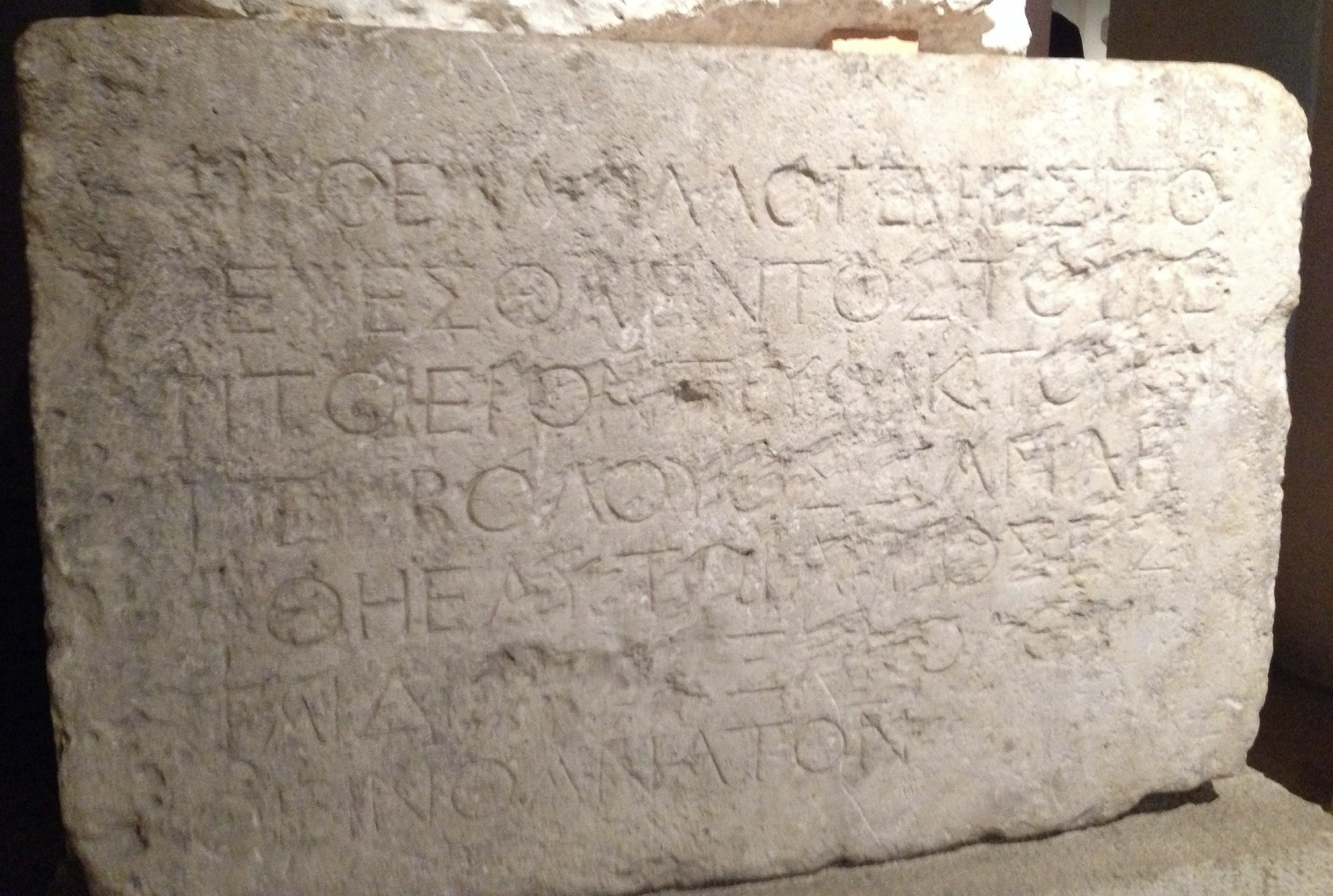
It says, “No foreigner is to enter within this balustrade round the temple and enclosure.  Whoever is caught will be responsible for his ensuing death.”

No foreigner, no allogenes.  This is the word that Jesus uses to describe the Samaritan leper.   Someone born of a different family (than the Jews.)

So you see, this Samaritan could not go with the other 9 to the Temple in Jerusalem to be pronounced clean, for he would not be allowed to enter the area to complete his cleansing.   

This over 4 feet tall dividing wall kept this man and other Samaritans from God.  They could not worship in the place where Yehovah said he would place his name forever because the Priests and Rabbis said they were of the wrong race.  Presumably, he could visit the Samaritan’s temple on Mt Gerazim to see a priest.  But it was not the true temple of God. So he elected instead to show himself to a different priest, Jesus, who would become our high priest.  This is Jesus’ third trip to minister to Samaritans, and he came to break down barriers between people.

And we see this temple barrier wall become a big issue in the Book of Acts.   In Acts chapter 21, some Jews from Asia were in Jerusalem for Pentecost and wanted to attack Paul because he was ministering to ‘foreigners.’ They drag Paul out of the temple and are going to kill him right there, but the Roman troops intervene. They then make some false charges against Paul and manage to have him arrested.  Paul ends up imprisoned for 2 years and then sent to Rome to be judged by Caesar.

 And what was the false charge they brought against Paul that led to all this? They said he brought foreigners past the dividing wall into the temple.  Paul spoke about this wall in his letter to the Ephesians. 

Ephesians 2:11-14   Therefore remember that at one time you Gentiles in the flesh… remember that you were at that time separated from Christ, alienated from the commonwealth of Israel and strangers to the covenants of promise, having no hope and without God in the world.  But now in Christ Jesus you who once were far off have been brought near by the blood of Christ.  For he himself is our peace, who has made us both one and has broken down in his flesh the dividing wall of hostility

Don’t miss that Paul is talking about everyone in this room.  Before Jesus came, we were all allogenes.  We would not have been allowed to enter the Temple.   That was never what God intended.  The Jews were supposed to take God’s message to the nations, but they built a wall to keep everyone else out.  Jesus came to break down these racial barriers, and because of Jesus, anyone can be grafted into God’s family. 

Galatians 3:26-29   For in Christ Jesus you are all sons of God, through faith.  For as many of you as were baptized into Christ have put on Christ.  There is neither Jew nor Greek, there is neither slave nor free, there is no male and female, for you are all one in Christ Jesus.  And if you are Christ’s, then you are Abraham’s offspring, heirs according to promise.

We are adopted into His family.  And once again, in our story today, Jesus has shown a Samaritan, one born of the wrong race, is the one who is righteous in Jesus’ eyes.

Luke 17:15-16   Then one of them, when he saw that he was healed, turned back, npraising God with a loud voice; 16 and ohe fell on his face at Jesus’ feet, giving him thanks. Now he was a Samaritan.   Then Jesus answered, “Were not ten cleansed? Where are the nine?   Was no one found to return and give praise to God except this foreigner?”

While the nine were on their way to Jerusalem, rejoicing over the gift, this Samaritan was praising and thanking the giver. He fell down in worship at Jesus’ feet.

There is a difference between being thankful for the gift and giving thanks and praise to the Giver.

How do you feel when you look at the beauty of creation, when you see a fantastic sunset, a waterfall, or majestic mountains like we saw this past fall in Glacier Bay, Alaska?  Many people were on that ship’s deck with us, looking at the beauty of the mountains and glaciers. Many were just admiring the view. But to some, it was much more; they were moved to admire not just the creation but the creator, the one who made the mountains.  Is it the gift of the giver you admire?

How do you enjoy the great things in life?  How do you appreciate a beautiful view, a great meal, or music?  Do you only see the gift and neglect to thank the giver?  How do you appreciate your health? All 10 men were glad they were healed, but only one was moved beyond appreciation of good health to worship the giver of life.   We don’t worship creation; we worship the creator.  We don’t worship the gift; we worship the giver.

Then Jesus says something very interesting to the Samaritan who used to have a skin disease.

Luke 17:19. And he told him, “Get up and go on your way. Your faith has saved you.”

Now, your version may say:

Luke 17:19. And he said to him, “Rise and go your way; your faith has made you well.”

Well, which is it?  Was he healed from lepra, or was he also saved from sin?  The word translated as “saved you” or “made you well” is ‘sozo.’

Sozo is found in the New Testament 106 times.  Let’s look at the first two instances:

When the angel tells Joseph what to name Jesus:

Matthew 1:21.  She will bear a son, and you shall call his name Jesus, for he will save his people from their sins.”

When the disciples are scared they will die in the boat in a storm:

Matthew 8:25.  And they went and woke him, saying, “Save us, Lord; we are perishing.”

Sozo is the idea of deliverance — from disease, from danger, and from sin.

So, in verse 19, is Jesus talking about physical deliverance from disease or spiritual deliverance from sin and death? Jesus is speaking of spiritual salvation here. As told in verse 14, all 10 have been healed. They all have had physical deliverance from disease. But this Samaritan’s second encounter with Jesus brings more.

This former leper turned back and praised God. He fell on his face before Jesus and thanked him. Like Naaman in the Old Testament, he recognized Yehovah as the source of healing and the one true God.  

Naaman said:
2 Kings 5:11-17  “Behold, I know that there is no God in all the earth but in Israel…from now on your servant will not offer burnt offering or sacrifice to any god but Yehovah.`

This Samaritan praised God for his healing.  He acknowledged his unworthiness by falling on his face at Jesus’ feet.  His actions were that of a repentant heart.  He recognizes Jesus as the source of his healing.  He thanks the giver of the gift.  He didn’t need to raise a hand, walk an aisle, or repeat a sinner’s prayer.  He demonstrated all of that in what he said and did.  And he received much more than physical healing; he received a relationship with the Son of God, the Messiah, that day.  But the nine.  They left jumping for joy and grateful for the gift of healing.  But their happiness was only for the gift, not for the giver. 

We can go through life being joyful for the good times, the beauty, the food, health, and the air we breathe.  Or we can see all of these things and return to Jesus, the creator and sustainer of all, bow down and give him thanks.  In Jesus’ day, children were taught to be thankful for everything.  There were over 100 Jewish blessings a day.  “Blessed are you, Yehovah, king of the universe, who gave me breath this morning.  Blessed are you, Lord our God, who gave me eyes to see today.  Blessed is He who has allowed me to live to this day and see His faithfulness displayed in this answered prayer.  Blessed are you, Yehovah, who have given us food to eat.”

One hundred blessings a day is not a lot.  Your heart will beat over 100,000 times a day.  And each one is a gift from God.  The psalmist said, “How shall I make a return to the Lord for all the good he has done for me?”(Psalm 116:12).  How can we ever thank God enough for how he sustains us and provides for us every minute of every day?  It is that awareness of how much we have received that changes our focus from what we lack to the great abundance we have. 

The LORD is my shepherd I shall not want.

In Ephesians 5:20, Paul says we should ” give thanks always and for everything to God the Father in the name of our Lord Jesus Christ.” Television and social media push us into an endless cycle of discontent, constantly reminding us of what we lack. This attitude of gratitude to God for every gift combats the world’s negativity by recognizing the Giver of the gift. It is a demonstration of faith.  

Have you ever considered how thanking God is related to faith?  

Colossians 2:7 “Let your roots grow down into him, and let your lives be built on him. Then your faith will grow strong in the truth you were taught, and you will overflow with thankfulness.”

When we live in the mode of thankfulness, when we feel the 100 blessings a day in our hearts, then we are keeping our eyes on God.  Then we are worshiping our creator, not the creation, the giver, not the gift.  Remember when Peter was walking on the water and took his eyes off Jesus and looked at the storm with the angry waves? He began to sink. Gratitude keeps our eyes focused on the one who calms us in the storm and increases our faith.  

Thanksgiving is the voice of faith.  Notice what Jesus has done here.  Jesus is so good.  He is determined to strike against hundreds of years of racist attitudes by showing that Samaritans are God’s people, too.  He tells us the story of a ‘Good Samaritan,’ and then he has an actual encounter with a ‘Good Samaritan.’   And he uses these two ‘Good Samaritans’ to teach what he said were the two Greatest Commandments.

The story of the Good Samaritan teaches us the second greatest commandment: “Love your neighbor as yourself.”  The actions of this former leper, this other Good Samaritan, teach us about the greatest commandment –  Jesus quoted it from 

Deuteronomy 6:4-5 Hear, O Israel: Yehovah is our God, Yehovah alone.  You shall love Yehovah, your God, with all your heart, and with all your soul, and with all your might.

Yehovah is God alone; don’t worship anything else. We don’t worship the sun, moon, or stars.  We don’t worship idols.  We don’t worship the beauty of creation, and we don’t worship our health.  We don’t worship the creation; we worship the creator.  Yehovah is God alone.  Like the other Good Samaritan, for every blessing we receive, let us return to Jesus.   Let us bow down before our Creator and thank him constantly for every good gift.

1.  Hays, J. Daniel.  From Every People and Nation: A Biblical Theory of Race. p. 63.

July 15, 27 A.D.  Jesus Cleanses a Leper #40

Week 22 ———  Jesus Cleanses Someone You Thought Had Leprosy
Matthew 8:1-4,  Mark 1:40-45,  Luke 5:12-15

This entry is the text of a sermon I gave this past week at the first meeting of an annual Camp Meeting we have attended for many years. (It is my favorite ten days of the year.)  It will read a little differently than my usual blog (including an invitation.)  

Jesus just finished the sermon on the Mount on this day, 1997 years ago. What does he do next?

In the sermon, he describes just who will be the initial people of his kingdom—and they are the people no one would expect. He explains God’s heart behind the Old Testament law, teaches them to pray, and tells them how to be members of God’s kingdom and how to act in God’s kingdom. 

Now, he will demonstrate what he just taught them because actions speak louder than words.   Actions teach better than words. Sunday school teachers, are you listening? Small group leaders, did you hear that?   Pastors?   You can give a well-crafted lesson or sermon, but people will learn more from watching how you live your life than they will ever learn from what you say.  Sometimes, we who preach spend too much time talking and not enough time letting people see how we live it out.  If we aren’t demonstrating what we are saying, then why would anyone listen?  Matthew reports what Jesus taught in chapters 5-7. The following two chapters will be about how Jesus lives it out — demonstrating his teaching by action.

So, let’s join the crowd following Jesus down the mountain.  His first encounter after the sermon is an important one, where Jesus will first put his words into practice.  So walk down the mountain with me, and let’s see who Jesus first meets after he preaches these messages:

Matthew 8:1-4
When he came down from the mountain, great crowds followed him. And behold, a leper came to him and knelt before him, saying, “Lord, if you will, you can make me clean.” And Jesus stretched out his hand and touched him, saying, “I will; be clean.” And immediately his leprosy was cleansed. And Jesus said to him, “See that you say nothing to anyone, but go, show yourself to the priest and offer the gift that Moses commanded, for a proof to them.”

Okay, Jesus heals a leper. It’s a great story. I’ve heard it a hundred times. Let’s sing a song and eat some ice cream. Not so fast, my friends. I want to give you some context. I want you to see this story like Andrew, Simon, and the crowds saw it.

First, I must put my doctor’s hat on for just a minute.  Matthew tells us a man with leprosy comes to Jesus.  Well, that is not exactly what Matthew said.  You can read much about leprosy in the Old Testament — except it is not leprosy.  When the Hebrew Bible was translated into Greek about 250-200 BC (the Septuagint or LXX), the Hebrew word ‘Tsa’arat’ was translated as ‘lepra.’   That was a good word choice because ‘lepra’ was the Greek word Hippocrates used to describe a variety of relatively minor skin disorders (eczema, psoriasis, vitiligo, scurvy), all of which involved flaking skin or whitening of the skin. Now, fast forward to 383 AD, and Jerome, a Bible scholar, is translating the Bible into Latin. He translated the Greek word ‘lepra’ into ‘leprosy,’ the Latin word for a very different disease.  It was an honest mistake.  ‘lepra’ and ‘leprosy’ sound similar. 

But Tsa’arat or lepra has nothing to do with what we call leprosy or Hansen’s Disease today.   Hansen’s disease did not exist in the Middle East until over 1000 years after the time of Leviticus and Moses.  Tsa’arat in the Bible is described as white, flaky skin, occasionally with white hair within it.  Modern leprosy lesions are always dark, never white.  Tsa’arat in the Bible can affect buildings and clothing.  Hansen’s Disease is caused by a bacteria.  It cannot affect inanimate objects.  They are entirely different diseases.

So, Jerome’s simple mistake in 383 AD led to a tremendous misidentification. Jerome’s Latin Vulgate became the primary Bible for over 1,000 years and is still used today in the Catholic Church. This incorrect translation persists today, even in modern biblical translations done in the past ten years.  Even though we know better now, they still keep the mistranslation going.  Tradition wins over correctness again.

So, the man Jesus encounters in Matthew 8 coming down from the mountain does not have the contagious, disfiguring disease we know today as leprosy. He had tsa’arat, or lepra, a skin disease with white, flaky skin that was not contagious.  Yes, the skin lesions were not contagious.   You could not catch it from touching someone.2

Why, then, do we have all these Bible stories of people with tsa’arat having to live outside the camps if it is not contagious?  Why were they avoided as if they had the plague?  Why couldn’t they go into the Temple?  Why is it such a big deal for Jesus to touch this man in Matthew 8?

Because it is not about a contagious medical problem; it is all about ritual purity.   Now, bear with me a bit here because ritual purity is something we poorly understand. If you want to understand anything in the Bible, you have to go back to the beginning. 

God designed a world where he could dwell with us.  The Garden was made for man to dwell with God.  But man chose to sin, and the earth became a place of sin and death — no longer a place where man could dwell with God.  So, the Garden was shut down.  The rest of the Bible after Genesis 3 is the story of God’s plan to return the world to a place where he could dwell with mankind.  God chose one man, Abraham, to build a nation that would be a nation of priests to teach all the other nations about God.  They end up as enslaved people in Egypt.  God rescues them and leads them to a mountain. (I’ll bet you saw that movie.)  There, God enters into a covenant with them.  He wants to restore that Eden relationship with man.  So God tells Moses on Mount Sinai, “Build me a tabernacle that I may dwell…in it”…. No! Not that God may dwell ‘in it’… but God says, “Build me a tabernacle that I may dwell with you.” (Exodus 25:8). God wants to dwell with man.

But there must be some rules if God is going to dwell with man. To see those rules, we go back to your favorite book of the Bible, Leviticus:

Leviticus 11:44-45   For I am Yehovah your God. Consecrate yourselves, therefore, and be holy, for I am holy. You shall not make yourselves unclean with any defiling things.  For I am Yehovah who brought you up out of the land of Egypt to be your God. You shall therefore be holy, for I am holy.”

The key word in this passage: ‘holy.’   And in this passage, we see that the opposite of holy is ‘unclean.’  God is holy and will place himself in the middle of Israel, so they must be holy, too.  We think of holiness more in terms of morality, and that is a part of it.  But ‘holiness’ carries more of an idea of being unique, set apart, and pure.

There are two types of impurity in the Bible, and if you don’t understand this, then you will misunderstand a lot of what Jesus says because he talks about impurity a lot.  There is moral impurity and ritual impurity.

Moral impurity is the result of sin. If you never sin, you are morally pure; if you sin, you become morally impure. We understand this. Moral impurity is not contagious. The person sitting beside you can’t spread their sin to you by touching you.  Moral impurity is cured by punishment or atonement. The wages of sin is death.  

Ritual impurity is very different.  First of all, ritual impurity is not sinful.  You don’t become ritually impure by sinning, and it is not sinful to be ritually impure.  Ritual impurity is unavoidable.  Everyone who lives life will become ritually unclean.

Numbers 5:1  Yehovah spoke to Moses, saying, “Command the people of Israel that they put out of the camp everyone who is leprous or has a discharge and everyone who is unclean through contact with the dead.” 

You can become ritually impure by touching a dead body, touching bodily fluids, and tsa’arat.  All these things represent corruption or death.1  And death is foreign to God.  He created a world without death.  Death was not to be a part of the world he made.  Death is not part of who God is.  So you don’t bring death or the forces of death into God’s presence. To enter the temple in an impure state was a sin.  Again, it is not sinful to be ritually impure unless you go in that state into the temple.   And unlike moral impurity, ritual impurity is spread by contact.  If you touch the fluids, if you touch a corpse, if you touch someone with tsa’arat, then you become ritually impure.  

  The cure for ritual impurity was simple:  washing with water and a time of waiting.  However, everyday activities in life would routinely cause people to become ritually impure again.  So they set up these pools to immerse themselves (mikveh) all around the temple, so everyone would ritually wash before entering the temple, in case they had become ritually impure.  Unless you had tsa’arat, the skin disease.  You couldn’t be clean as long as you had the skin lesions.  So, people with tsa’arat could never enter the temple.  They could never go in and sing the psalms of praise.  They couldn’t make an offering to atone for their sin.  They were banned from God’s presence.  And no one would touch them.

Now, that all sounds a little weird to us.  But you need to realize that every time you open your Bible to read, you are traveling to a foreign country with a different culture.  Now if I travel to Boston and make fun of them and call them ignorant because they don’t have sweet iced tea or grits, and they talk funny, then you call me a dumb intolerant hick from Alabama.  Just because a culture is different doesn’t mean it’s wrong.  Every culture has standards of purity and defilement.   The Hindu will not touch people of lower caste.  Certain sicknesses are taboo to touch in many societies.  Come on, it hasn’t been that long since COVID-19.  “Keep 6 feet away from people.”  “Wear masks.” “Don’t breathe their air.  “Don’t touch them.”  I half expected to see people out in public ringing a bell, “Unclean, Unclean!”   We became very good at fearing medical impurity.  (If only we feared moral impurity with such commitment.)

I have seen people afraid to touch some of our homeless people. I understand. Several times, I picked up homeless hitchhikers, and about 30 seconds later, I realized that I was going to be reminded of their journey with me every time I got in my truck for the next several months. Some odors really linger. 

You may think you have trouble grasping the concept of a holy set aside place where you must be clean to enter.   But there is a unique set-aside place in my hospital.  We call it the operating room.  And it is a place to promote life.  It is a place where the forces of death are defeated, and life is brought into the world.  But not just anyone can go walking in there. There are barriers.  You have to wear special clothes (scrubs), special head coverings, masks, and gloves, and everyone must wash away all uncleanness thoroughly before entering.  It is a unique set-aside place.  Maybe it is not so strange a concept.

When the Israelites were taken captive in Babylon for 70 years and the temple was destroyed, there became much more focus on ritual impurity over moral impurity.  After all, they couldn’t deal with any moral impurity (sin) because there was no temple at which to sacrifice.  But they could still concentrate on the ritual impurity because there was water to cleanse in Babylon.  When they returned and rebuilt the temple, then sin sacrifices could resume, but the focus on ritual impurity remained through the days of Jesus.  But the biggest deal for God was always moral impurity.  It was sin that caused death and the separation of men from God.  

So God wants to dwell among Israel in the Tabernacle.  But there were barriers— fabric walls around the tabernacle with only one opening.  You had to be ritually pure to enter.  Then, there was a holy place where only the priest could go after they washed in the bronze basin.  A barrier of thick curtain, a veil, separated the holy place from the most sacred place that contained the ‘mercy seat’ for the presence of God.  

The religious leaders liked these barriers.  They liked them so much that they created more when they built the temple.  They constructed a five-foot-high wall to keep Gentiles from coming too close to the temple, under threat of death.  (One of the signs listing the threat of death to Gentiles that entered was recently found by archeologists.)   Women could go a little further, but not where the men could go, not where the ‘real worship business,’ the sacrifices were made.  Men can go where the offerings were made, but only priests can go further, and then, as in the Tabernacle, only the high priest can enter the holiest place through the veil.   

There were barriers.  (By the way, ladies, that whole ‘court of women’ thing was not God’s idea.  God never prescribes it in the Bible. It is the creation of man. (So don’t blame God for that.)

Enter Jesus.  Throughout the Gospels, we see Jesus breaking down barriers of anything that separated people from God.  Jesus goes charging down the mountain after the sermon on the mount, and the first person he runs into has a skin disease; he is unclean.  He has not been able to go to the temple for a long time, and unless his skin disease is cured, he never will again.  He is an outcast by the religious leaders. He is outcast by the people, but he is not outcast by Jesus.   What does he say to Jesus, “If you are able, you can make me clean.”  No, that is not what he says.  He says, “If you are willing, you can make me clean.”  See, this man has no doubt that Jesus has the power to make him clean.  He is just not sure Jesus is willing to do it.  His past experience with holy men was that they walked a wide berth around him.  They give him the Covid 6 feet.  They don’t give him the time of day.  They ignore him.   If robbers beat him up and he was lying half-dead on the side of the road to Jericho and these holy men came by, they would just leave him there on the side of the road because they didn’t want to become ritually impure.  (That would make a good story.)

I see this in some of our neighbors without homes today—they know the church can help them; they know the church is able to help them, but they have had some past experiences with church people who ignored them and were afraid to touch them.  They are not sure if the church is willing to help them, so they stay away.  They are like the man in Matthew 8 who is wondering, ‘Does Jesus care about me? ‘Is he willing to cleanse me?’

Let me make this easy for you. Jesus is always willing to help you. I don’t care how unclean you think you are or how much sin you have committed.  Jesus is always willing.

He runs down that mountain. He can’t wait until he finds a man with tsa’arat so he can show the people the power of the Gospel.  Jesus is not afraid of this man.  And Jesus doesn’t stop there.  The next thing he does is offer to go to a Gentile Roman soldier’s house to heal his servant.  The crowd gasps.  ‘Go to a Gentile’s house?  No way, Jesus, they are so unclean!’  And then, in the next chapter of Matthew, Jesus is on his way to a dead girl’s room — What?  That is the worst form of uncleanness!   But on his way, the woman with the issue of blood touches the tassel on his garment. 

Do you see what Matthew is doing here?  He has shown Jesus face down all the causes of uncleanness known in the two chapters following the sermon on the mount.  Jesus is breaking down all the barriers that keep people from God.  He is not just talking about it; he is doing it.  

Now, don’t get from this that Jesus is throwing away the purity laws.  Jesus doesn’t think the laws from Leviticus were wrong or bad.   He wrote the laws; he gave Moses the purity laws. He tells the man who is unclean from skin disease to obey the law of Moses and show himself to the priest. This is important: Jesus doesn’t do away with the laws of impurity; he does away with impurity itself.  

When Jesus reaches out and touches the man with the skin disease, you can almost hear the crowd gasp.  Because they thought the man’s uncleanness would make Jesus unclean.  But it didn’t.  Because when Jesus touched the man, his skin disease was gone.  Jesus didn’t touch a man with tsa’arat.  He touched a man who had been cleansed of tsa’arat.  Jesus didn’t get contaminated by the woman with the issue of blood.  Because that is not who grabbed his tassel; it was a woman who had been healed, a woman who used to have a problem that Jesus took care of.  Jesus didn’t touch a corpse; he touched a girl who was dead but was now alive. Every time Jesus encounters a corpse, it comes to life.  Jesus was not afraid of ritual impurity because he took away the cause of the impurity.  

And we need not fear ritual impurity today; that same power of Jesus, the same power that took away uncleanness, the same power that raised Jesus from the grave, lives in us.  Jesus overcomes all uncleanness.  And this should not have surprised anyone. The prophets had predicted a time when all uncleanness would be dealt with: 

Ezekiel 36:25-29    I will sprinkle clean water on you, and you shall be clean from fall your uncleannesses, and from all your idols I will cleanse you. (moral and ritual impurity)  And I will give you a new heart, and a new spirit I will put within you. And I will remove the heart of stone from your flesh and give you a heart of flesh. And I will put my Spirit within you, and cause you to walk in my statutes and be careful to obey my rules. .. And I will deliver you from all your uncleannesses. 

It is the same way with moral impurity.   Jesus is not scared of sin.  You may have heard before, “God can not stand sin in his presence.”  That is not Biblical.  You may have heard that God turned his back on Jesus when Jesus took on our sins on the cross.  Jesus shouted, “My God, my God, why have you forsaken me?”   Jesus wasn’t saying God forsook him.  He was quoting Psalm 22.  (Remember, they didn’t have chapter numbers in Jesus’ day.  He couldn’t say, “Hey, remember Psalm 22.”  So their method of pointing someone to a particular passage of the Bible was to quote the first line.)  Look it up.  Psalm 22 is the story of the crucifixion.  The Psalm says, “For God has not despised or abhorred the affliction of the afflicted one and he has not hidden his face from him, [he has not turned his back on him.] but had heard when he cried to him.”  The Psalm tells us Jesus was not forsaken but would be vindicated, and all the nations will come and praise the Lord because God has done this great thing.  The Psalm ends with this one Hebrew word, ‘Asah,’ which can be translated: ‘He has done this,’ or as Jesus said, “It has been done (finished).”

How can you say God cannot stand sin in his presence?  God put his Tabernacle right in the middle of the children of Israel.  Do you think they were without sin?   God looked at this sinful, lost world.  He didn’t stay away from this world of sin; he chose to enter it himself as a baby.  Jesus is not scared of sin.  He runs down the mountain, looking for the worst sinners he can find to build his kingdom.  He is walking through Jericho and finds the most wicked cheating businessman he can.  He invites himself over to Zacchaeus’ house.  The crowd grumbles, but Zacchaeus repents of cheating people and vows to repay them plus more.  And then Jesus says, “The son of man has come to seek and to save that which was lost.”  Jesus came seeking out sin.  Jesus doesn’t avoid sinners because he conquers sin.  Jesus doesn’t avoid touching corpses because he conquers death.  

Do you sometimes feel distant from God?  Do you feel like some sin you have committed makes God want to be distanced from you?  What is it that separates us from God?  Sin?  God says no, I have that covered.  What keeps God out of my life is not my sin.  What keeps God out of my life is I don’t make space for him.  If we make space for God, he will fill it.  God told the Israelites, “Build me a tabernacle that I may dwell with you.”  If they don’t build a space for God, then he can’t dwell with them.  If you don’t make room for Jesus in your heart, he can’t dwell with you.  If you don’t make room for God in your life, then he cannot be a part of your life. From the beginning of time, God’s desire was to live with his children and walk with them as he did in the Garden.  

Jesus came to break down those barriers.  On the cross, he broke the last one, the biggest one.  When he died, that last barrier, that thick veil in the temple that separated all people from the place reserved for God the holy of holy place, That veil tore in two top to bottom, letting you know that the barriers are all down. 

 Being a Gentile will not keep you from God, being unclean will not keep you from God, and being a woman will not keep you further away than men.  The veil is torn.  God has left the building.  His presence will not be contained in a small room that only the high priest can enter.   Sin will not keep you from God. Death will not keep you from God. God will live with you, within you, if only you will make a place.

Jesus gave the Sermon on the Mount over several days. The sermon begins with Jesus teaching his disciples, but as he teaches, the crowds gather.  People gather from all over, coming together to hear messages from God.   And here we are today, 1997 years later, gathered from all over.  We will listen to messages from God this week.  When this week is over, we will leave here.  This week comes and goes — as the sermon on the mount did almost 2000 years ago last week.

We can leave this place in 10 days, as some left the sermon on the mount.  Some left saying, “I like that line about the ‘do unto others as you would have them do unto you.’”   “And that prayer he taught was nice.  Short and sweet.  Yeah, Jesus did a good job; let’s invite him back and do this again next year.” You can leave this meeting like that, saying it was a good meeting with some good sermons.  It was hot as Hades, but the music was good.  You can leave here feeling good but not be changed.  Or you can be like that crowd after the sermon on the mount who decided they needed more Jesus; like them, you can follow Jesus down the mountain to see what he will do next.  When we leave here in 10 days, and you are traveling down from this mountaintop experience, I will pray that God puts somebody right in front of you that the world thinks is unclean.  I’m praying that God stops you in your tracks so you have an opportunity to live out your faith.

For so many years, I think we have left this place and left blessings on the table. There is so much God wants to give us, but we come and listen and go. You can leave this meeting in 10 days just exactly as you came, or you can leave with a renewed spirit, a renewed energy to live as Jesus wants you to live, a renewed knowledge of scripture, a renewed heart for people, and a renewed dedication to do life differently. Jesus would call it doing life abundantly.

Right now you can decide how you will leave in 10 days.  You can make the most out of this time with Jesus or let it pass by.  We are going to sing, and our altar is open.  Maybe you have never made space in your life for Jesus.  Perhaps today is the day you open your heart to the one who can cleanse you.  Maybe you just want to come and say to God and everyone that you want to dedicate this time to God as a time for you to grow as a disciple.  Whatever God has laid on your heart, you are welcome. 

Jesus is always willing, are you?

  1.   Why these three things?  They all represent corruption or death.  Touching a corpse is self-explanatory, but bodily fluids?  These are particular bodily fluids that are a part of the formation of life (semen, menstrual flow, etc.)  Tim Mackie of the Bible Project explained it as well as I have heard, and I paraphrase:  ‘If you and another person both spit on the ground, then new humans don’t spring up there.  So saliva is not a special fluid and will not make you unclean.  But bodily fluids that are involved in the production of life are included.  Life is sacred, and there is something unclean with encountering these fluids outside the place where they are involved in creating life.’  Tsa’arat represents a corruption of normal skin and is included for that reason.  I don’t expect you to understand exactly how that works, for this concept was formed in a completely different culture, and we will likely never understand.  (And that is okay.  I also don’t know why a “thumbs up” sign is seen as a positive response in the US but interpreted differently in parts of Africa.)
  2. One of the diseases Hippocrates included in his ‘lepra’ category of skin diseases that whitened skin was fungal diseases.  Some of these can occasionally spread from person to person, but never by incidental contact, only by prolonged, close contact.