
September 21, 2025 –  It’s Just Another Miracle— Acts #14

September 21, 2025 –  It’s Just Another Miracle— Acts #14
Acts 5:12-16

As we continue our study of Acts, we last saw the early church get its first threat from the Temple leaders.  They were told to stop talking about Jesus or there would be consequences.  But this didn’t slow down most of them.  They went right back to the temple, preaching Jesus and healing people.   We pick up the story in Acts 5:12

Acts 5:12-16  Now many signs and wonders were regularly done among the people by the hands of the apostles. And they were all together in Solomon’s Portico. None of the rest dared join them, but the people held them in high esteem. And more than ever, believers were added to the Lord, multitudes of both men and women, so that they even carried out the sick into the streets and laid them on cots and mats, that as Peter came by, at least his shadow might fall on some of them. The people also gathered from the towns around Jerusalem, bringing the sick and those afflicted with unclean spirits, and they were all healed.

Picture the scene: people are milling around the temple area when a few of the apostles walk in.  Someone cries out, “Hey, there they are!” and the crowd rushes over.  People want to see the miracle workers.  They have come from all around Jerusalem just to have a chance to see this.  They have brought their sick to be healed.  And this is not just a one-time thing.  Luke tells us, “signs and wonders were regularly done.  This is the natural rhythm of the early church, overflowing with the power of God.   So let me ask you, “Is this the world you live in?”

You may ask yourself, “Why don’t we see signs and wonders regularly done?”  If you are walking down Broad Street and see someone suddenly stand up from their wheelchair and start jumping up and down, what would you do?   Would you be skeptical?  What if you then saw this same person walk over to someone you recognize, a blind girl you have seen many times downtown?  And suddenly she drops her cane, exclaiming that she can see?  You know this girl.  She was blind, but now she can see.  Miracles of healing are happening around you.  What would you do next?  You would likely pull out your phone and call someone to tell them about it because signs and wonders are not “regularly done” in your world every day.   So, you may ask, why aren’t they done now as they were then?

At this particular time, the apostles and the early followers of Jesus experienced miracles that were commonplace.  However, there is a misconception that frequent miracles occurred throughout the Bible, but that is not the case.  There are many miracles, but they are concentrated in a few pockets of time.  We can see this in the words of Asaph the psalmist in Psalm 77:11

Psalm 77:11-12  I will remember the deeds of Yehovah; yes, I will remember your wonders of old.  I will ponder all your work, and meditate on your mighty deeds.”

Asaph sounds like us, looking back at the good old days when all the miracles were done.  He would have asked the same question we ask, “Why were there so many miracles back in the days of Moses, or Elijah, and not today?   And miracles are indeed concentrated in specific periods of time.   Fast forward to the New Testament times, and numerous miracles are occurring.

Matthew 9:35   And Jesus went throughout all the cities and villages, teaching in their synagogues and proclaiming the gospel of the kingdom and healing every disease and every affliction.

Jesus certainly performed frequent and regular miracles.  However, it’s worth noting that all the miracles of Jesus occurred within a remarkably short period of his ministry, spanning just over a year. And the miracles in the rest of the New Testament took place over the lifetimes of the disciples and Paul.   This explosion of miracles was for a specific purpose and was predicted by the scripture.  We need to be careful to understand why all of these healing miracles happened at this time.

Think back to when Jesus had just started his ministry, and John the Baptist was sitting in prison.  John had proclaimed that Jesus was the coming Messiah.  He pointed out to his disciples that Jesus was the Lamb of God who would take away the sins of the world.  But in Herod’s prison in Macherus, John keeps hearing how Jesus is hanging out with sinners and having parties with tax collectors, and he starts having second thoughts.  “That doesn’t sound like things I thought the Messiah would be doing.  Could I have misunderstood God about this guy?”   Remember what John had said about these days of the Messiah:

Matthew 3:7  You brood of vipers! Who warned you to flee from the wrath to come?
Matthew 3:12  His winnowing fork is in his hand, and he will clear his threshing floor and gather his wheat into the barn, but the chaff he will burn with unquenchable fire.
Matthew 3:10  Even now the axe is laid to the root of the trees. Every tree therefore that does not bear good fruit is cut down and thrown into the fire.

Wrath — Unquenchable fire — an ax to the tree — throwing in the fire.   John was expecting Jesus to show up in this sinful world with a chainsaw and a flamethrower.  John saw a Messiah who would clean house, like Jean-Claude Van Damme or Chuck Norris.  To kick butt and take names.  But that was not the report he was getting about Jesus.  So he sends his disciples to ask Jesus if he is the Messiah.

Matthew 11:2-3   Now when John heard in prison about the deeds of the Christ, he sent word by his disciples and said to him, “Are you the one who is to come, or shall we look for another?

John was having a real problem.  He told everyone that Jesus was the Messiah, but he doesn’t think Jesus looks very Messiah-like.  What do you do when the Messiah doesn’t look like what you’d thought he’d look like?  Or for us today, what do you do when God doesn’t do what you thought He would? How do you respond when you read all about God healing all these people in the Gospels and in Acts, and then God doesn’t heal you, or your loved one?   Ask John.  The Messiah is here to fix everything. Finally, the good guys should be winning.  And Jesus is out partying while John is chained to the wall of a prison. You do what John did.  You seek Him out.  So John sends his disciples to ask Jesus.

Matthew 11:4-6 “And Jesus answered them, ‘Go and tell John what you hear and see: the blind receive their sight and the lame walk, lepers are cleansed and the deaf hear, and the dead are raised up, and the poor have good news preached to them. And blessed is the one who is not offended by me.’

Jesus is directing John back to the scriptures to understand what the Messiah was really all about.  In other words, Jesus says, “Here is how you know that the messiah has come: the blind are receiving their sight, the lame are walking, and people are being healed.

Now, there are some healings in the Old Testament, but did you realize that nowhere in the Old Testament was there someone born blind who was healed? Nor was there anyone born mute who was healed.   This type of healing Jesus was doing was different.   Now, you may not have known this, but everyone in Jesus’ day knew this, because they knew their Scripture.  And Isaiah was a favorite book among many people.

The book of Isaiah is a book of both bad news/good news.  Half of it is Isaiah telling the people that they are about to be judged for their sins.  God is going to let the nation be destroyed by Assyria, and later by Babylon.  Devastation is coming.  But then he gives them the good news.  There is hope.  Yes, your city will be destroyed, but God will give you a new city, a new Jerusalem, where everyone prospers, and there is no danger from enemies anymore.    And guess which sections of Isaiah were read the most?   The good news parts. 

It is harder to read about the harvests failing, the crops all dying, the vines withering, the cities laid waste and becoming deserted, the enemies at the door.  Let’s skip all that judgment, fury, wrath, and destruction and go right to the good part when God’s mercy breaks forth.  Let’s focus on the love, grace, and compassion, rather than the warnings of destruction.  (They are a lot like us today in what we want to read and talk about in the Bible.  Let’s sing about heaven, not about the judgment here on earth.  There aren’t too many hymns about God’s punishment on us.)    So, guess which parts of Isaiah they knew the best?    Let’s skip to the good stuff. Let’s re-read chapter 35.   

Isaiah 35:1-6  The wilderness and the dry land shall be glad; the desert shall rejoice and blossom like the crocus; It shall blossom abundantly and rejoice with joy and singing. The glory of Lebanon shall be given to it, the majesty of Carmel and Sharon. They shall see the glory of Yehovah, the majesty of our God.
Strengthen the weak hands, and make firm the feeble knees. Say to those who have an anxious heart, “Be strong; fear not! Behold, your God will come with vengeance, with the recompense of God. He will come and save you.”
Then the eyes of the blind shall be opened, and the ears of the deaf unstopped;  Then shall the lame man leap like a deer, and the tongue of the mute sing for joy.”

And the people say, “Yeah, that’s what I’m talking about.  Even the desert lands grow crops.  The days of living in fear are over.  And the blind see and the mute talk.”  This is what will happen when God brings his Messiah.

Well, if you were living in Jesus’ day, you would have had access to 39 scrolls of Scripture.  Thirty-nine books in our Old Testament, and not once do you have someone born blind regaining sight or someone born mute being able to talk.  It has never happened.  But God promises here in Isaiah 35 and elsewhere that these things will happen when his kingdom breaks forth on the earth and the Messiah arrives.   

That is why Jesus answered John that way.  Jesus says, “Tell John that the blind see, the lame walk, and the mute talk.” Tell John that Isaiah 35 is happening right now.    These healings are the sign of the Kingdom of God busting out. So John has to accept that his view of what precisely the messiah would do —the view that most of the people had then — was wrong.  

When we don’t understand what God is doing, we need to seek God out and ask Him about it.  We don’t just say, “Well, God didn’t do what I thought he would, so there must not be a God.  I have seen people have a major faith crisis and quit on God when a family member is not healed.  They, like John the Baptist, had a misconception about how things would be when Jesus came.  Some preacher (probably on TV) told them that God would heal everyone if they prayed hard enough, had enough faith, or sent them money.  Like John, they misunderstood the Bible, and when it didn’t work the way they understood it, they quit.

God didn’t heal my friend, so I am leaving the church.”  No, if God is not doing everything the way you think He should, then guess who is wrong?  Not God.  You don’t throw your beliefs out the window; you go back to the scriptures and see where you misunderstood.  John the Baptist had it wrong; it is okay if you are sometimes mistaken about what God is doing, also.

So these healings that Jesus was doing were not just compassionate deeds, but proof that the Kingdom of God was breaking forth just as John said.  And these healings that Jesus does and the disciples do here in Acts, and the healings we see today, are just a taste of what is coming.  They are like the first buds of spring.  When those daffodils bloom in early spring.  They are nice, but they get me excited because they are just the heralds of hundreds of flowers of all kinds that will soon bloom in my yard.  Jesus’ healings and sermons preached the same sermon: The Kingdom of God is among you.  Each of these healings here in Acts shouts out the same message.  The Kingdom of God is here, now.  Each healing we see today is another whisper to the hearts of those who have ears to hear.   See, God’s Kingdom is still breaking forth in this sinful world and is a promise of a future with no sickness and no death.

But throughout history, God has only done a few large-scale interventions.   Creation, the deliverance of the children of Israel from slavery, and the conquering of the land, as well as the ministry of Elijah/Elisha.  The ministry of Jesus and the apostles.  Other than these few times, large groupings of miracles are rare. And even though 1 Corinthians talks about believers with gifts of healing, they weren’t doing miracles to the same degree as Jesus and the apostles.  

So while I think we overestimate the frequency of miracles in the Bible, I think we underestimate the number of miracles happening today.  I stand before you as a witness today that God is still in the miracle business..

I have told you before of some of the miracles I have seen — of medicine multiplied, appearing where it didn’t exist, of rain that started and stopped at the moment of prayer, of God placing a very rare but desperately needed item in a cigar box in a mud house in Mexico, or in a box of medical junk in Ghana.  I have seen children with rampant cancer be told there was nothing the doctors could do, only to see their following scan be clear of any disease.  I have seen lives turn around from the brink of disaster.  There is no way anyone could ever convince me that God is not doing miracles all around us.  I have seen them with my own eyes.

But some people would say they haven’t seen any miracles.    Perhaps they are from Nazareth.
Why do I say that?

Mark 6:1-6  “He went away from there and came to his hometown, and his disciples followed him. And on the Sabbath he began to teach in the synagogue, and many who heard him were astonished, saying, “Where did this man get these things? What is the wisdom given to him? How are such mighty works done by his hands?

Most of the people in Jesus’ hometown didn’t see many miracles either.   Mark is clear that their lack of belief prevented Jesus from doing many mighty works there.  That fits well with the gospel emphasis on faith for healing.   You remember Jesus saying several times, “Your faith has made you well.”  What he is saying is that because you have faith in me, I am able to do miracles for you.  No faith, no miracles.

The Greek word for unbelief (apistia) is used in the Gospels for people who totally reject Jesus, like these people in Nazareth, who don’t believe who he is.  A similar Greek word, oligopistia, is usually translated as “little faith,” and it refers to people who accept Jesus, but their faith is so small that they do nothing with it.  They don’t act on their faith.  We see this in the story of the disciples in the boat in the storm.  They were scared because they had no faith that Jesus would protect them.  They accepted who Jesus was, but that didn’t make a difference when they thought their boat would sink.  They were ruled by fear, not by faith.  So Jesus says, “Oh, you of oligopistia.  You of little faith.” A faith that just sits there and doesn’t do anything, that makes no difference – that is “little faith.”

It says that Jesus marveled at their unbelief,  their rejection of him.  “Marveled” means astonished or surprised, taken aback.  You see that word 43 times in the New Testament.  Most of the time, it is about people who are shocked when Jesus does something.    Jesus calms the sea, and the disciples marvelled.  The mute man speaks, and they marvel.   The crippled man walks, the fig tree withers, and the disciples marvel.  Twice, it is Jesus who marvels.  Two times, Jesus is surprised by others.  What astonishes Jesus?

The first instance occurs when the centurion requests Jesus to heal his paralyzed servant, stating that he doesn’t need to be present for the healing.  

Matthew 8:10   When Jesus heard this, he marveled and said to those who followed him, “Truly, I tell you, with no one in Israel have I found such faith.

The second time is in the passage we just read, he is astonished by the unbelief of the people in Nazareth.

So what astonishes Jesus?  Jesus is shocked by one Gentile man’s unexpected deep faith and by the lack of faith of his Jewish hometown people.  Jesus couldn’t do many of the things he hoped to do in Nazareth because of the unbelief he encountered in that place.   This is our story.  Jesus hopes to do many incredible, miraculous things in our lives.  But he can not do them because we prevent him.  Oh, we say we believe.  But belief is not what you think in your head, but what you do.  Belief is how you act.  You can have all the Bible knowledge in the world, but what you know does not matter unless it changes how you act.   Again, it is like the disciples in the boat in the storm.  They believed who Jesus was, but that didn’t change their reaction to a storm.  If they had faith and trusted in Jesus to protect them, then there would be no fear.  Their fear revealed their lack of faith.  And if you surrender your life to Jesus and don’t give it all to him, if you keep parts of your life under your control instead of His, then you don’t believe.

I marvel at a lot of things.   I am overwhelmed by the beauty of the clouds at sunrise, by the immensity of the ocean.  I am at times surprised and taken aback by the majesty of nature, of glaciers calving, of waterfalls, and mountain views.  I am astonished at times by how mean some people can be, and how some devote their whole lives to taking advantage of others. I marvel at a lot of things.

But Jesus in Nazareth is only surprised by one thing: that God himself would come and give his life as a ransom for people who did not deserve any mercy. He would die to remove our sin burden and grant us forgiveness that we could not otherwise obtain. Despite this, many people would choose not to follow Him or do what He says.  That leaves Jesus astonished.

The God who spoke this entire universe into existence says, “Do you want to join my family and come live with me in this incredible place where no one ever gets sick or dies?”  And people say, “No, I don’t think so.”  That astonishes Jesus.  This God who says, “Hey, I can work all things so they turn out the very best for you if you follow my ways.”  And People say, “Nah, I think I know better than you, I’ll do it my way.”  That astonishes Jesus.  Jesus offers life instead of death, forgiveness instead of condemnation, and eternal joy instead of eternal misery.  And still some reject him.  That blows my mind, too, Jesus.

That is the situation in Nazareth in Jesus’ day, and that is the situation that we live in today. We may go further than the people in Nazareth and believe that Jesus is who he says he is.  That is good.  But that is not faith.  It is only faith when we step out in obedience, trusting Him to lead us and equip us for any task He calls us to.  It is faith when we are not afraid of any storms of life because we trust in him.  It is faith when we aren’t scared of disease or cancer or natural disasters because we have complete trust in him.

And when I look at the miracles I have witnessed in my life, Most have happened when I stepped out in faith, being obedient to whatever he calls me to do.  Most of the miracles I have seen happened when I was doing something out of my usual routine or schedule.  Many on mission trips.

Following his call one summer, I found myself again working in a hospital in Ghana, Africa.   I saw a man in the clinic who had a horrible infection in his hand.  It had been going on for weeks and was getting worse. He had been treated by some person in his tribe whose position was translated to me as a ‘witch doctor.’  And his hand was horribly swollen and red and hot and draining.  He could not move a finger.   When I saw him, he needed immediate surgery so he wouldn’t lose his hand.   He needed an orthopedic specialist, a hand surgeon.  

What he got was me.  Both of the Family physicians who performed all the surgeries in that mission hospital were involved in a lengthy case.  I was it.  I have never felt so underqualified in my life.

I remembered from anatomy class many years ago that there were 10 or 11 potential spaces in the hand that would all have to be drained. And if they weren’t all drained appropriately, then the infection would worsen.  The anatomy is very complex there.  That’s why hand surgery is a specialty and should never be attempted by any other surgeon, and certainly not by a pediatrician.  So I prayed and said, “God, you put me here, and you gave me this to do, so I am going to trust you to empower me to do it.   So I found the surgical anatomy book and had a nurse hold it and turn pages for me as I did the procedure.  And God guided my eyes and my hands. And the man recovered with full use of his hand.  God did that because I couldn’t have done it without Him.  

I am convinced that God is waiting to do many miracles if only we would let him.  But we have to be obedient enough to step out and follow him.  If we don’t display that kind of faith, then we will see no miracles.  He often leads us into situations where we lack the proper resources or feel we lack the right skills.  If we only attempt to do things that we can do without God, we never leave room for Him to show out.  

This should be our prayer:  God, please call us to do things that we can’t do.  Please call us to do things that are impossible.  Please lead us to the uncomfortable places.  Give us goals that we can’t possibly reach.  Put us in situations where we will fail without your help.  We must follow Him and attempt things that are impossible for us to do without Him.  Only then can He step in and do the impossible for us and with us.
July 9, 27 A.D.  A Miraculous Catch of Fish #39

Week 21 ———  A Miraculous Catch of Fish
Luke 5:1-11

Luke 5:1-11   On one occasion, while the crowd was pressing in on him to hear the word of God, he was standing by the lake of Gennesaret1, and he saw two boats by the lake, but the fishermen had gone out of them and were washing their nets.  Getting into one of the boats, which was Simon’s, he asked him to put out a little from the land. And he sat down and taught the people from the boat. And when he had finished speaking, he said to Simon, “Put out into the deep and let down your nets for a catch.” And Simon answered, “Master, we toiled all night and took nothing! But at your word, I will let down the nets.” And when they had done this, they enclosed a large number of fish, and their nets were breaking.  They signaled to their partners in the other boat to come and help them. And they came and filled both the boats, so that they began to sink.  But when Simon Peter saw it, he fell down at Jesus’ knees, saying, “Depart from me, for I am a sinful man, O Lord.”  For he and all who were with him were astonished at the catch of fish that they had taken, and so also were James and John, sons of Zebedee, who were partners with Simon. And Jesus said to Simon, “Do not be afraid; from now on you will be catching men.”  And when they had brought their boats to land, they left everything and followed him.

Because we don’t read the gospels chronologically, we often miss that this particular miracle of the massive catch of fish happened twice.  And it was no accident that the setting of these two miracles was the same.  In the story we read just now, Jesus asked the four fishermen who had been with him on and off for several months to go all in.  He asked them to leave their boats and become full-time disciples.  The other occasion for this miracle is in John 21.  Jesus has been resurrected, and he is to meet them in Galilee.

John 21:1-12   After this, Jesus revealed himself again to the disciples by the Sea of Tiberias2, and he revealed himself in this way.   Simon Peter, Thomas (called the Twin), Nathanael of Cana in Galilee, the sons of Zebedee, and two others of his disciples were together.   Simon Peter said to them, “I am going fishing.” They said to him, “We will go with you.” They went out and got into the boat, but that night, they caught nothing.

Just as day was breaking, Jesus stood on the shore, yet the disciples did not know that it was Jesus.  Jesus said to them, “Children, do you have any fish?” They answered him, “No.”   He said to them, “Cast the net on the right side of the boat, and you will find some.” So they cast it, and now they were not able to haul it in because of the quantity of fish.   That disciple whom Jesus loved therefore said to Peter, “It is the Lord!” When Simon Peter heard that it was the Lord, he put on his outer garment, for he was stripped for work, and threw himself into the sea. The other disciples came in the boat, dragging the net full of fish, for they were not far from the land, but about a hundred yards off.

When they got out on land, they saw a charcoal fire in place, with fish laid out on it, and bread.   Jesus said to them, “Bring some of the fish that you have just caught.”   So Simon Peter went aboard and hauled the net ashore, full of large fish, 153 of them. And although there were so many, the net was not torn.   Jesus said to them, “Come and have breakfast.”

So, the disciples have seen Jesus several times since his resurrection.  He told them to go to the Galilee to meet him.  They are waiting around, and Peter decides it is time to go fishing.  I have heard people say Peter is returning to his old business.  He was a disciple, but now that has changed.  He saw himself as a colossal failure as a disciple.  The worst thing a disciple could do is betray their rabbi.  And he did three times. It is not a stretch to think Peter is returning to being a fisherman.  Or maybe he is just fishing while he is waiting on Jesus.  But like our other story in Luke, they catch nothing all night.  Then Jesus showed up, and there was a miraculous catch of fish.  By the way, isn’t it a coincidence that these professional fishermen had a bad night in both stories?  Not a single fish.  Who do you think kept their nets empty all night so He could miraculously fill it the next day?  Maybe there is a lesson for us there.  The next time you find yourself having an incredibly unproductive day, it might be Jesus prepping you for a miracle.  But you know what happens next.  Jesus forgives Peter and has him recommit to do the work of a disciple, or now an apostle. 

So you have these two stories of miraculous catches of fish, and both are followed by Jesus’ call to these men to be fishers of men.  The next time one of you catches a whole lot of fish, you had better listen up.  God may be calling.

But what I want to talk about is the miracle.  God is at work in so many ways: the birth of a baby, the wondrous workings of our complex bodies, and the incredible immense universe we live in.  But some things happen constantly, so we often begin to think of them as ordinary.   Do not forget that God is at work in all of it. There is nothing ordinary about the birth of a baby.  Every baby is a gift straight from God.  We shouldn’t take these everyday works of God for granted.

But God acts in extraordinary ways also.  The Bible calls these “signs and wonders”.  They are signs in that they point to something.  When you read about a sign or miracle in the Bible, you should always ask what the sign is meant to highlight or reveal.   What is the message of the miraculous catches of fish on these two occasions?  Both times, Jesus is inviting Peter and the disciples to join the work of fishing for men.  The catch of fish lets them know that he will be the power behind their efforts.  On their own, without him, they can’t even be successful as fishers of fish. What they will accomplish in their ministry will not be due to their abilities. It is God who will provide the catch.  And with these miracles, they can never forget this lesson— boy, does Jesus know how to teach a point!

You can read the Bible and get the idea that God “used to do miracles all the time.”  But the miracles in the Bible are primarily centered around certain people or times (Moses and the Exodus, Joshua, Elijah and Elisha, Jesus and his apostles.)  There are hundreds of years between times of miracles.  These disciples of Jesus saw a lot of miracles.  But what of the hundreds of thousands of other people living in the world in Jesus’ day?   In perhaps the largest-viewed miracle, over 5 thousand were fed with five loaves and two fish.  But there were (according to the Museum of Natural History) 170 million people living in Jesus’ day.  That’s only 0.006% of people who saw a miracle.   Only a tiny percentage of people living in the days of Jesus saw a miracle.   Why?  They weren’t where Jesus was.  They weren’t following Jesus.  You see, the closer you follow Jesus, the more miracles you will see.  Want to see more miracles?  Follow Jesus closely.

I want to be careful about not calling everything a miracle (A parking spot opened right in front of the store for me. “It’s a miracle.”)   I also want to be careful not to dismiss miracles, seeking to explain everything away as a scientific occurrence or as coincidence, for I know miracles still happen.  I find no evidence in scripture that God drew a line in time and stopped doing what he had always done.  Instead, I see more and more miracles after Jesus comes, all through the New Testament.  And I have seen signs and wonders more than a few times with my own eyes.  I’ll tell you a few of my stories today.

My wife was on a committee with some ministers in our county to see if there was a homeless problem that we could help with.    Some people told us there were no homeless people in Marshall County.  They didn’t see them on the streets with signs.  So they did some research and found there was indeed a large number of homeless, including many children in our schools who did not have homes.  So, about ten people met around a table one night and decided we had to do something about it.  We were about six weeks away from cold weather hitting, and we felt we needed some plan to help those without homes before the cold weather arrived.  But how could these few make the need known, raise money, and assemble a program to house the homeless in 6 weeks?  Someone said it would take a miracle to do that.  But we had prayed and asked God to break our hearts with the things that broke his heart.  So we jumped in.   6 weeks later, we organized ten churches, had a benefit that raised $30,000, and started housing people in an emergency cold weather shelter.  Was that a miracle, or just people responding quickly to a need?  You decide.  That ministry began with ten people and no money 12 years ago, and this year, we own two buildings that can house 40 people with over 30 acres of land (with no debt). It has served hundreds of people yearly and changed hundreds of lives.  Last year, it provided shelter and fed our neighbors without homes with the equivalent of over $750,000 in services.  Lives have been put back together, and people have come to Jesus.  God is doing a great thing.  Would you call this a miracle?  Or would you call it God just doing what God does through his people?  I’ll let you decide.

Let me tell you about a mission hospital in Ghana, Africa, where we have worked.  Our friends were big supporters of the ministry in the hospital.  Every year, they would gather supplies to support the missionaries.  They would spend months filling a large shipping container with donated bed linens, bandages, and other supplies.  They packed the container in February, and there was a little space left.  A local hospital had a baby incubator they were willing to donate so they went to pick it up.   When they arrived to pick up the incubator, there was a box of other old medical equipment.  The hospital said they were welcome to it.  It was all used and outdated, but they would throw it out if the mission couldn’t use it.  They had room in the truck, so they took it.  And there was enough room in the shipping container, so they threw the box in.   It takes months for a shipping container to be shipped from Cartersville, Georgia, to Nalerigu, Ghana.  Amazingly, it arrived in Ghana at the same time we did that summer.  So, our friends who had packed the container in February got to unload it in June.  The first thing off the container was that box of medical junk they threw on at the last minute.  They told my friend Tommy to carry the box to the supply room and that they would sort it out later.

Now, while my friends were unloading the shipping container, I had finished rounds in the Pediatric ward and was about to start seeing patients in the walk-in clinic.  I had just met an OB/GYN surgeon who had come in that week to work with the resident missionary doctors.  He was there to teach them a new procedure to help women who were having bladder problems after having difficult deliveries.  It was a common problem there where many women deliver babies outside the hospital.  They had 35 women set up to have that surgery that week while the visiting surgeon was there so he could give the missionary doctors good experience in the procedure while he helped refine their skills. He brought his equipment to do the procedures, including a special endoscope and planned to leave it with them when he returned home.  But his endoscope was damaged during the trip.  The light was broken, making it unusable.  They had searched for something they could use to replace it, but it was a specialized device.  Nothing else would work.  He was frustrated because now, they could not help those 35 women that week, and he would not be able to teach the procedure to the doctors there to help others.  He was walking back to help see patients in the clinic since they would have to cancel the surgeries. That is when he passed my friend Tommy in the hall carrying the box of junk.

He stopped Tommy.  “Hey, what’s in that box?” he asked.  “Just some medical junk,” Tommy replied.  He asked to take a look.  Guess what was in the top of the box.  The same brand of endoscope our surgeon had.  It’s not the same device he used, but one made by the same company.  Do you think there was any possibility the light would fit his broken device?  Of course, it did.  He could do the surgeries that had been arranged and train the local doctors to help countless more women.  Was that a miracle or a coincidence?  The very light device he needed just happened to be placed in a box of junk that would have been thrown away, but there just happened to be enough room in a shipping container that was packed in February, that just happened to arrive five months later at the same time as the surgeon whose device happened to get broken.  And they just happened to pass in the hall that day.  Was it a miracle, or was it God just doing God things?  It enabled the healing of many people and brought praise to Yehovah, so call it a sign, a wonder, or a miracle.  Every time I think about this story, I think about how good God is.

Look back at Peter’s reaction in our first story in Luke.

Luke 5:8-9  But when Simon Peter saw it, he fell down at Jesus’ knees, saying, “Depart from me, for I am a sinful man, O Lord.”  For he and all who were with him were astonished at the catch of fish that they had taken, and so also were James and John, sons of Zebedee, who were partners with Simon.

   He reminds me of Isaiah, when he was in the temple and got a vision of God.  He falls down and exclaims, “Woe is me, for I am lost.  I am a man of unclean lips…”3  There is no other appropriate reaction when you see God move.   The ESV says they were “astonished.”   The NASB gives a more thorough translation of the Greek:  “For amazement had seized him and all his companions because of the catch of fish which they had taken.”   The Greek for ‘seized’ is  ‘periecho’ which means ‘wrapped up in’, ‘gripped by’, or ‘surrounded by’ amazement.  Seeing God act is overwhelming, and you are ‘wrapped up in emotion.’

Some other day, I will tell you other stories, of prayed-for rain that ended a drought, of a hole that opened in the sky to allow an evangelistic gathering to take place in Mexico, of a miracle spark plug in a cardboard box, and of an empty plastic pharmacy bin in Guatemala that kept supplying medicine for children for days of clinics.   And then there are the medical miracles I have seen.  Stage 4 cancer in a child that disappeared with no treatment (other than prayer), children born with large portions of their brain missing that should have died after birth, running down the hall years later shouting my name and giving me a hug.   I have not seen the dead raised to life.  Oh, I have seen people who flatlined their EKG come back.  But more impressively, I have seen the spiritually dead brought back to life.  I will never forget the night we left the house at 2 am to go pick up a young man who was determined to commit suicide.  He had a long road through returning to Jesus, defeating his drug addictions, working his way out of homelessness, and regaining custody of his young son.  Seeing him now, he is very successful in his job, happily married and raising his boy, owns his own home, is active in his church, and volunteers in the homeless ministry.  He is a picture of redemption and grace, God’s goodness.  Is that a miracle, or is it just what God does?

You will never see a miracle if you don’t throw out your net.  It made no sense for those disciples to fish when they had gone all night with nothing.  Galilean fishermen did not fish in the daytime.  They didn’t have the transparent plastic nets we have today.  They used linen nets.  They fished at night because, in the dark, the fish couldn’t see the nets.  In the daytime, they had no chance of catching fish.  Jesus asked them to do something impossible.  They could have thought Jesus was joking.  They could have said, “Jesus is a nice guy, but he’s no fisherman.”   But they said, “At your word, I will.”  What are you willing to try for Jesus?  Maybe you would be willing to try something easy.  Jesus might ask you to call a friend to encourage them.  Maybe you would be willing to do that.  Or perhaps He will ask you to do something harder.  Maybe he will ask you to talk to a stranger. Perhaps he will ask you to speak to a neighbor you’ve never met.  Maybe he will ask you to talk to a homeless person.  Maybe he will ask you to get them help.  Maybe he will ask you to bring them home to live in your house for a while.  (If this sounds wild to you, clearly, none of you have ever been married to my dear wife.  Yeah, it happened more than a few times.)   Maybe God will ask you to do something you think is pointless, difficult, or impossible.

Perhaps we don’t see miracles because we aren’t willing to throw out the net.  We live lives of relative calm.   Calm and peaceful lives.  That is what everybody wants, right?    Let me tell you one more story.  I love reading missionary biographies, and one reason is that you keep running into stories of miracles. This is one of my favorites. The Story of John G. Paton Or Thirty Years Among South Sea Cannibals.  Paton felt called to the South Sea Islands, where, in the 1800s, no one wanted to go. Today, these islands are highly sought-after vacation spots: Tahiti, Fiji, and Vanuatu.  But in John Paton’s day, the natives were all cannibals.  Talk about going into the deep waters.

He eventually established preaching outposts on several of the tiny islands there and other missionaries joined him there.  He tells of a time when he was seeking to replace the small sailing boat missionaries used to travel between the islands and distribute food and supplies.       

“The Missionaries on the spot had long felt this, and had loudly and earnestly pled for a new and larger Vessel, or a Vessel with Steam Auxiliary power, or some arrangement whereby the work of God on these Islands might be overtaken, without unnecessary exposure of life, and without the dreaded perils that accrue to a small sailing boat from deadly calms and from treacherous gales.”4

That phrase struck me – “deadly calms” and “treacherous gales.”   Now, I can certainly understand “treacherous gales,” but what about the “deadly calm”?  I’m not a sailor, so I didn’t realize what was deadly about the calm.  A sailboat, dependent on the wind for propulsion, becomes “dead in the water” when the wind is calm.  It falls victim to the mercy of the waves and may capsize, or you may be stuck in the middle of the ocean for days.  I think I need to learn to recognize the danger of the “deadly calm” in my life.  In my effort to control my schedule tightly, I may keep my life too calm.  Now, I am not talking about not being busy, for I am guilty of over-committing myself and leaving no empty space on the calendar. Instead, I am talking about only planning activities and projects that fall within my comfort zone.  I am only attempting things I know I can do.  When I read the Bible, I see that God continually calls people to leave their comfort zones and go places they have never been before —Abraham to “the land I will show you,” Israel to the promised land, or the disciples to Samaria.  God continually calls people to do things they have no experience with — Noah building an ark, Moses leading a people, or fishermen becoming preachers. God constantly calls people to do impossible or very unlikely things — conquering giants, fishing in the daytime, or walking on water.  If we choose to remain in our ‘calm’ lives, then we choose a life of disobedience, a life of missed opportunities, a life that is less than the abundant life Jesus promised each of us.

Jesus asked these fishermen to leave the shallow water and go out into the deep.  We won’t see miracles if we are fishing in the kiddie pool.  It is through experiencing God that our faith grows.  If we never put ourselves in situations where we must depend on Him, then we will never see His power come through.   I have most experienced this on medical mission trips to other countries. In my medical practice in Alabama, I am very careful only to see patients for whom I have the proper training and experience to help.  If someone would be better served seeing a surgeon or a psychiatrist, I refer them there.  I carefully control my schedule. That is good practice for a doctor.   But many times on these trips, I have found myself in situations where I had absolutely no control over the situation, as helpless as a boat with no oars. I have seen authorities confiscate all of our medicine at the border, leaving us without any means to treat the patients.   I have seen a large evangelistic event threatened to cancel in a storm.  I have faced medical situations that required my actions but were way beyond anything I had ever been trained to do.   But in these (and many other) situations, I saw God take charge and make things happen.  He miraculously provided; He swept back the clouds; He enabled me through His power.  Praise His name!  Through these experiences, my faith grew in leaps and bounds.   Where would my faith be if I had not left the ‘deadly calm’? 

God is still in the miracle business today — only if we allow him to be.  Jesus was rejected at Nazareth.  Mark tells us Jesus was shocked at their unbelief and relates a very sad scripture:  “And he could do no mighty work there, except that he laid his hands on a few sick people and healed them” (Mark 6:5).    Jesus wanted to heal more and perform more miracles. But they were not interested because they had no faith in him.  We can be the limiting factor that keeps God from doing the good works He wants to do.

What about you?  I don’t know if you call these things that I’ve talked about miracles or not.  But I know God is still doing God things.  Things only God can do.  Do you want to see God do these kinds of things?

First, you must be a follower of Jesus.   You have to be with Jesus to see what Jesus does.  You have to have a relationship with God to have your eyes opened to see the wonders of the spiritual world.  Second, you must be willing to go where he asks you.   You must be willing to leave the shallow waters and go out into the deep, leaving the deadly calm of your neat, scheduled existence.  You must be willing to leave your comfort zone.  Finally, you must be willing to do what he asks you to do.  You must be willing to throw out the net.   It doesn’t matter if you’ve been throwing it all night with no results.  It doesn’t matter if it seems impossible.  Just be obedient.  If we only attempt to do things we can without divine help, then we don’t need God.  We must attempt God-sized tasks to leave room for God to do God things. 

  1. That is the Sea of Galilee.
  2. Again, the Sea of Galilee.
  3. Isaiah 6:5.
  4. The Story of John G. Paton Or Thirty Years Among South Sea Cannibals.  Paton, John Gibson and Paton, James.  Kindle Edition loc 2330.

April 1, 27 A.D.  The Wedding at Cana – The Year of the Lord’s Favor #24

Week 7 ———  The Wedding at Cana

John 2:1-11

John 2:1-11   “On the third day, there was a wedding at Cana in Galilee, and the mother of Jesus was there. Jesus also was invited to the wedding with his disciples. When the wine ran out, the mother of Jesus said to him, “They have no wine.” And Jesus said to her, “Woman, what does this have to do with me? My hour has not yet come.” His mother said to the servants, “Do whatever he tells you.”

 Now there were six stone water jars there for the Jewish rites of purification, each holding twenty or thirty gallons.  Jesus said to the servants, “Fill the jars with water.” And they filled them up to the brim.   And he said to them, “Now draw some out and take it to the master of the feast.” So they took it.   When the master of the feast tasted the water now become wine and did not know where it came from (though the servants who had drawn the water knew), the master of the feast called the bridegroom and said to him, “Everyone serves the good wine first, and when people have drunk freely, then the poor wine. But you have kept the good wine until now.” This, the first of his signs, Jesus did at Cana in Galilee and manifested his glory. And his disciples believed in him.”

“And the third day” is a puzzling phrase unless you understand how the Israelites named the days of the week.  Only the 7th day got a name, ‘Shabbat’ (Sabbath), which means “come to a stop, cease, rest.”  The other days of the week are just named after their order.  The first day is our Sunday; the second day is Monday.  So the “third day” is Tuesday.   According to Jewish tradition, Tuesday is the best day for a wedding.  The reason is that Tuesday is ‘doubly blest’ — the only day of creation in which the Bible states “and God saw that it was good” twice.  (Seriously, that is the reason.)  So we know the wedding was most likely on a Monday night.  Wait a minute,” you say, “didn’t you just say the third day was Tuesday?”  Ah, but this is a Jewish marriage.  And Jewish culture counts the days beginning at sunset, so our Monday night is the beginning of their third day.  Why do they count the day starting at sunset?  It all goes back to Genesis (doesn’t most everything?).  “And there was evening and there was morning, the first day” (Genesis 1:5).  So Jesus is there for the Monday night wedding. Wedding celebrations usually lasted seven days, but Jesus didn’t hang around for the entire celebration.

How long did he stay?  Long enough for them to run out of wine.  Jesus departs the wedding with his family (mother and brothers) sometime between Tuesday morning and Thursday morning.  It is about 32 miles from Cana to Capernaum and “down” to Capernaum, a drop of about 700 feet.  The journey would take two days, and they would want to arrive in Capernaum early enough on Friday to have time to prepare for the Sabbath.  They are returning to Jesus’ home base of Capernaum (likely staying at Peter’s house [or Peter’s mother-in-law’s house]) before they undertake the long journey to Jerusalem for Passover on the day after Shabbat.  So they likely left Cana either Tuesday or Wednesday morning.

Running out of wine at a wedding celebration is a major social faux pas by the bride’s family. People will be coming and going for the seven-day celebration, and in this culture, you do not have a joyful celebration without wine.  We can only guess why Mary relates this information to Jesus.  Has he been in a habit of performing miracles for social reasons before?  I doubt it.  Is Jesus’ family part of hosting this wedding?  Possibly.  We just don’t know.  But Jesus’ response to Mary makes it clear he feels like she has asked for his help.  In English, Jesus’ reply to Mary sounds harsh, but it is not.  He uses the same term when he tells Mary, “Woman, behold your son,” about John at the crucifixion. 

Jesus says, “My hour has not yet come.”  You will see this phrase several more times in John’s Gospel.  (John 7:6, 7:30, and 8:20). when the time has come for Jesus to go to the cross, Jesus says, “The hour has come for the Son of Man to be glorified.”  Jesus is on a schedule. He has tasks to complete before he allows the Jewish authorities to put him to death.  There is a plan, and it is the Father’s plan. 

As I have said before, whenever the Bible gives you an unexpected detail, it is almost always very important to the message.  Why do we get so much information about the water jars?  They were the expensive kind, stone, not clay.  Stone has to be carved from a solid piece of rock.  And they were big and heavy.  These are not jars you carry around with you.  They would have been 26-32 inches high and 16-20 inches in diameter.  Stone jars were used for ritual purification as they were non-porous and could be cleaned well.  A clay vessel that became contaminated (unclean) would be shattered and thrown away.  Why would one home have so many of these jars?  Some have suggested that it could be the home of a priest or pharisee, who would be more interested in ritual purification.  We do know that some priestly families lived in Cana.

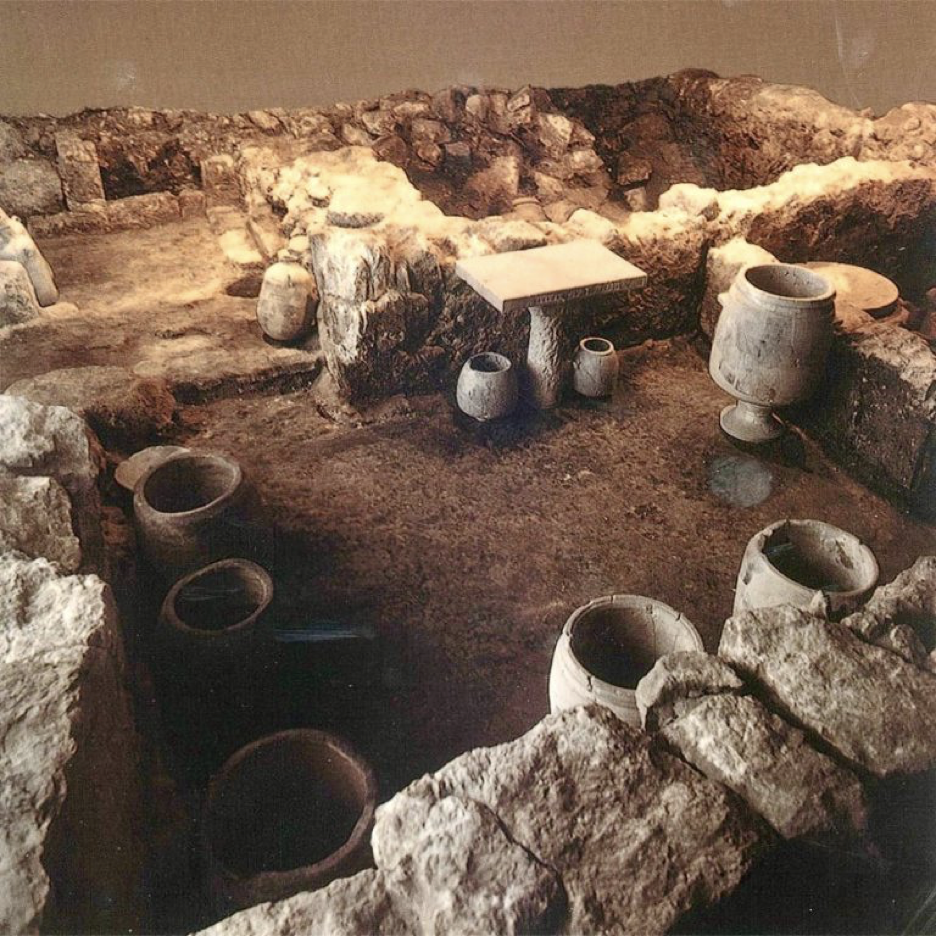
Some people make a lot about the number of jars.  Six can be a significant number. As seven is seen as the number of completion, six can be seen as the number of incompletion or imperfectness.1 If that were the case when Jesus performed his miracle, it wouldn’t have remained six.  Sometimes, the number is six because there were six stone jars.  And we presume John is present here as an eye-witness.  (We are told that disciples were present.  Andrew, John, and Peter have been with Jesus for a few days, though he won’t officially call them as disciples for a while. Perhaps Philip and Nathaniel are also here, but none are mentioned by name.)  Exactly six stone jars of this size were found in the remains of the kitchen of a first-century house in the Jewish quarter of Jerusalem that was excavated in 1970.  The house was burned in the fire started by the Romans during the siege of Jerusalem in 70 A.D.  It was located in the section of Jerusalem where the priests lived.  It is now a museum called ‘The Burnt House Museum’ (pictures below.)

So what is the significance of Jesus using water jars that were for ritual purification?  These would be for ‘netilat yadayim’ or ‘washing hands with a cup.’2  Halakha required hand washing before and after meals, before prayers, upon waking in the morning, and after using the toilet.  Note that this was for ritual purity (though there was obviously some benefit we now realize for germ control.)  As we move through the gospel, Jesus will have much to say about ritual purity.  He will also demonstrate his ability to overcome ritual impurity through his contagious holiness.  Two types of impurity are discussed in the Bible: ritual and moral.  We understand moral impurity, which is sin.  Ritual impurity was unavoidable and was not sinful (unless you came into the tabernacle/temple without going through the purity procedures.)  Jesus will show that he is the answer for both ritual impurity and moral impurity.  Here, he replaces the waters of ritual purification with wine.  In his last supper, he reveals that his wine represents his blood. He is foreshadowing a new method for complete purification through his blood.  Revelation 7:14 says, “They have washed their robes and made them white in the blood of the Lamb.”

The author says in 2:11 that “this is the first of his signs.”  This gospel has seven signs that climax in the raising of Lazarus from the dead.3 The purpose of the signs is to reveal his glory, which is in keeping with the prologue to the gospel in chapter 1:14

“And the Word became flesh and dwelt among us, and we have seen his glory, glory as of the only Son from the Father, full of grace and truth.”

May we seek this day to glorify our God.  There are a lot of empty jars out there.

Six stone jars as used for purification (and two smaller jars), as found in first century house of a priest (from the “Burnt House Museum” Jerusalem).

  1. Saint Augustine of Hippo (354-430 A.D.), who was never known to miss a chance to see ‘deeper meanings,’ said the six jars represented the six ages.  (From Augustine’s “Tractates on John (9.6)”)  If I were to go down a rabbit hole on this (and yes, I have been known to do just this), I would say there were six disciples there (though I am not sure who the sixth would be) and that filling the six vessels with Jesus’ new wine would be symbolic of filling the disciples with the new wine of the gospel.  I would contrast that to Jeremiah 13:12-14, where people are visualized as jars being filled with wine and sentenced to destruction.  Jesus is filling the disciples with his gospel of the kingdom that, instead of destruction, leads to blessing.  But I will resist the urge to go down that rabbit hole, so pretend you didn’t just read this (But do read the Jeremiah passage and tell me what you think.)
  2. The other form of ritual washing is ‘tevilah,’ which is total body immersion in a mikvah.
  3. Here are the seven signs in John:  water into wine (John 2:1–11), healing a royal official’s son (John 4:46–54), healing a disabled man (John 5:1–15), feeding 5,000 (John 6:1–14), walking on water (John 6:16–21), healing a man born blind (John 9:1–12), and raising Lazarus from the dead (John 11:1–43).