
November 18, 2025 –  The Turning Point in Acts— Acts #21

November 18, 2025 –  The Turning Point in Acts— Acts #21
Acts 8:1-8

Today, we come to a significant turning point in the book of Acts.  

Acts 8:1-3  And there arose on that day a great persecution against the church in Jerusalem, and they were all scattered throughout the regions of Judea and Samaria, except the apostles. Devout men buried Stephen and made great lamentation over him. But Saul was ravaging the church, and entering house after house, he dragged off men and women and committed them to prison.

Have you ever been in an earthquake?  Now I have felt some tremors a few times, but I have never been where the ground is actually shaking.  I remember watching a man being interviewed on a newscast years ago after a large quake in California.  He had recently moved there, and it was his first major quake.  He said, “I had no idea what to do.  My first instinct was to run back inside my house.  Your home is supposed to be your safe place.  But everything in the house was shaking, and pictures were falling off the walls.  I just froze.

You may have never been in an earthquake, but you know that feeling.  When things are uncertain, you want to return home, to your safe place.  We humans love our comfort zones, familiar routines, stable jobs, and predictable communities because what is familiar feels secure.  We like to know what’s happening in advance.  We want to do things we know we are successful at.  We prefer doing things we have done before instead of trying something new.  

Max Lucado wrote a book entitled “A Heart Like Jesus.” In that book, Lucado asks us to imagine what it would be like if, for one day, Jesus became you.  He wakes up in your bed, wears your clothes, and takes on your schedule, responsibilities, and friends.  “Jesus lives your life with his heart. His priorities govern your actions.  His passions drive your decisions.  His love directs your behavior.”  Lucado asks, “Would your friends notice the difference?  Would your schedule change?    What if you lived by Jesus’ heart and not your own?”1

Lucado says,  “God loves you just the way you are, but He refuses to leave you that way.  He wants you to be just like Jesus.”   We sing that song, “Just As I Am,” and that is how we come to God.  But Lucado is right, God has no intention of letting us stay the way we were.  

And I see this throughout the Bible; I see God constantly calling people to go to places they have never been before, to do things they have never done before, and to strive to become more than they were.  He told a man who had never seen an ocean or felt a raindrop to build a giant boat.  He told Abraham to leave his homeplace and go to a land he had never seen before.  He told Moses to return to the country he had fled in fear and to tell the most powerful ruler in the world to set all his slaves free.

God told prophet after prophet to deliver bad news to a king.  Jesus told a group of young men to leave their jobs and follow him, and then later said to them that people would hate them and persecute them.   You can not read the Bible and come away with the idea that God wants us to be safe and comfortable, or that it is okay to do nothing and remain the same person you were.

God’s primary interest is not your comfort and safety.   Oh, He believes in a time of rest.  He built a whole day of it into a week, and he is serious about it.  He wants us to rest in Him, not in ourselves.  We like our lives to be calm, peaceful, easy-going, and free from disruption.   But we live in a world that is not calm, peaceful, or easygoing.  It is often more like an earthquake.

And so it happens to all of us sometimes, the ground shakes beneath us. Life is a series of disruptions.   Something happens to upset our safe, calm existence.  It could be a death in the family, a sudden or chronic illness, the loss of a job, or a change in the world.  And all of a sudden, our life is filled with uncertainty and fear.

That’s precisely what happens to the early church in Acts 8. Up until this point, everything in Acts has been happening in Jerusalem, this small city on the map below.  It is so small that the dot on the map is too small to see. 

There in Jerusalem, there is powerful preaching, miracles, generosity, and a caring community.  Thousands are being saved.   Imagine, for a moment, you are a leader in a church like that: thousands of people joining and coming to Jesus in a few months, everyone being cared for, miracles happening.   It’s everything a pastor or church leader dreams of.   If you have all that, you may feel that it is enough.  Things are going well. We just need to keep doing what we are doing.

But in God’s eyes, the tremendous growth in Jerusalem was great, but it wasn’t enough because it was just a tiny dot.   A little bit that you can barely see in a world full of people who need the Gospel.   God sees a bigger picture than we do.  We look at our corner of the county.  See your tiny dot on the map, and then see the whole world like God sees it. 

John 3:16   For  God so loved the world, that he gave his only Son, that whoever believes in him should not perish but have eternal life.

God so loved the world.  It is not, “God so loved our tiny dot…” Not just the people in Jerusalem, Jesus also taught the disciples that He came because God loved the Samaritans.  And later the church in Acts would realize that God so loved not just the Jews, but the people in Asia Minor, and Greece, and even those horrible Romans.  God loves the world, and he wanted the early church to love the world too.  It was not enough that they loved the other Jews in Jerusalem who were just like them.  Things were good there, a growing, caring church.   But God wanted more.  He wants us not just to love each other and the people around us who are mostly like us.   God wants us to love the whole world, not just the small corner we can see.

To really appreciate Acts 8, we need to remember what’s come before. The story of Acts so far has been a spiritual rollercoaster — full of ups and downs, triumphs and trials, good news and bad news.  So let’s recap the Book of Acts.  

Jesus had died on a cross, which looked bad, but 3 days later he rose from the dead, which was really good. Jesus stayed 40 days teaching his disciples, and then left them, going up to heaven, which was kind of sad. But it was good because He said the Holy Spirit would come.  And that day the Spirit came was a really good day.   And then the day that Peter and John healed the lame man in the Temple was great, until they were arrested and put in jail.  That was bad.  But they were released, and that was good, but they threatened them not to speak anymore about Jesus, which was bad.  Then we read about everyone sharing with those who had needs.   That was good.  But then the story of Ananias and Sapphira, which wasn’t good.  

Then miracles were being done, and over 5000 followers had joined the disciples.  Things were going good…until the apostles were arrested (that was bad).  But it was good because an angel set them free, though then, after the court hearing, they were beaten with whips.  Then we read of Stephen, full of the Holy Spirit, preaching and doing miracles.   That was good, until he was killed.  And after that, things got really bad.
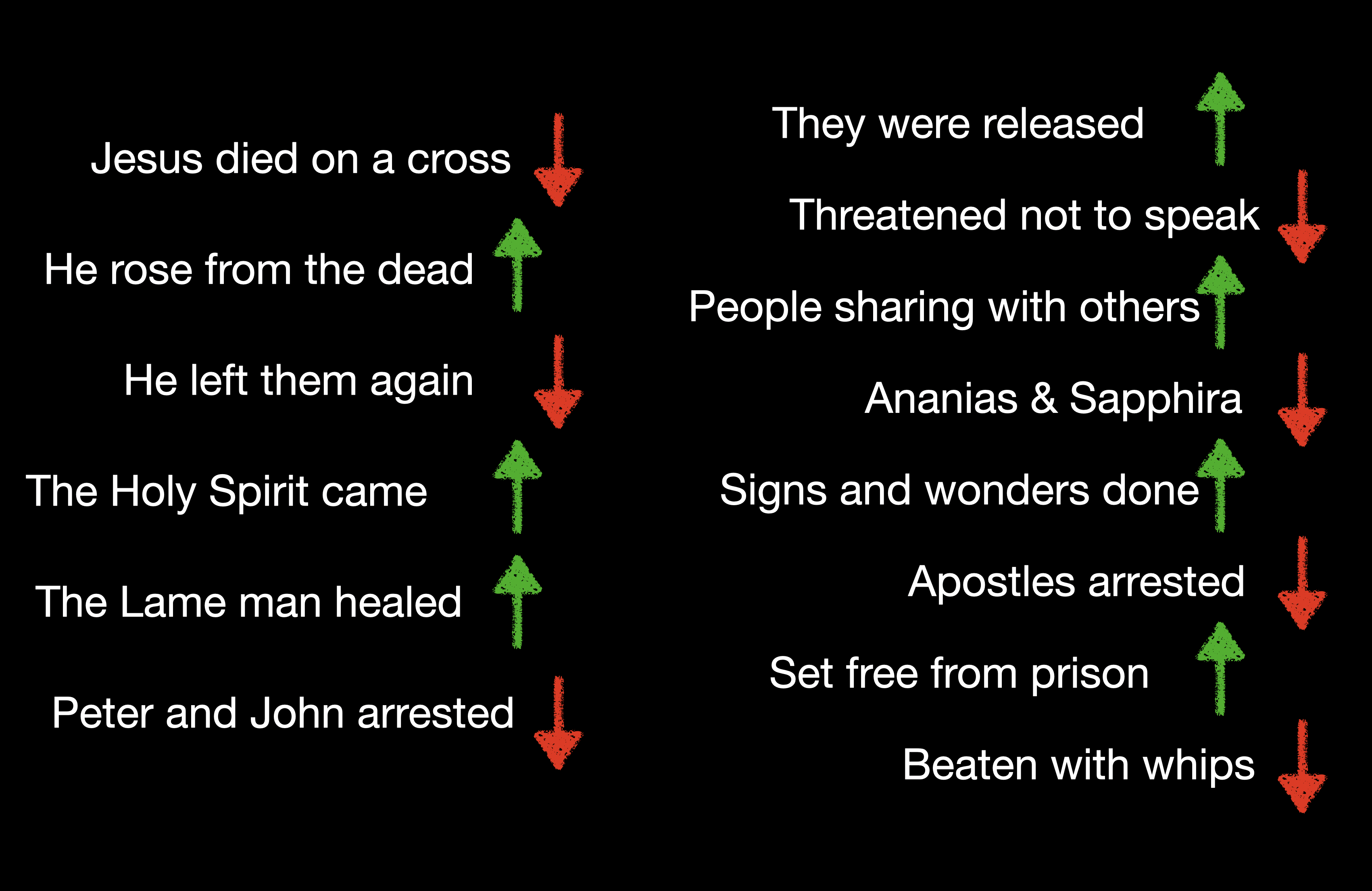
  This is a defining moment. For the first time, the church experiences organized, targeted persecution. The honeymoon period is over for these early followers of Jesus.  This is bad.   

Acts 8:1,3  And Saul approved of his execution.   And there arose on that day a great persecution against the church in Jerusalem, and they were all scattered throughout the regions of Judea and Samaria, except the apostles. …But Saul was ravaging the church, and entering house after house, he dragged off men and women and committed them to prison.

This is not just a young man who just watched the clothes while others stoned Stephen.  This zealous rabbi voted in the council to kill Stephen and then went on a rampage, going into homes and dragging off men and women.  Imagine the fear and confusion. Families are split apart. Homes raided. The fellowship they’ve built in Jerusalem — shattered.   They are scared to do or say anything.  They are scared to death.  This is bad news.
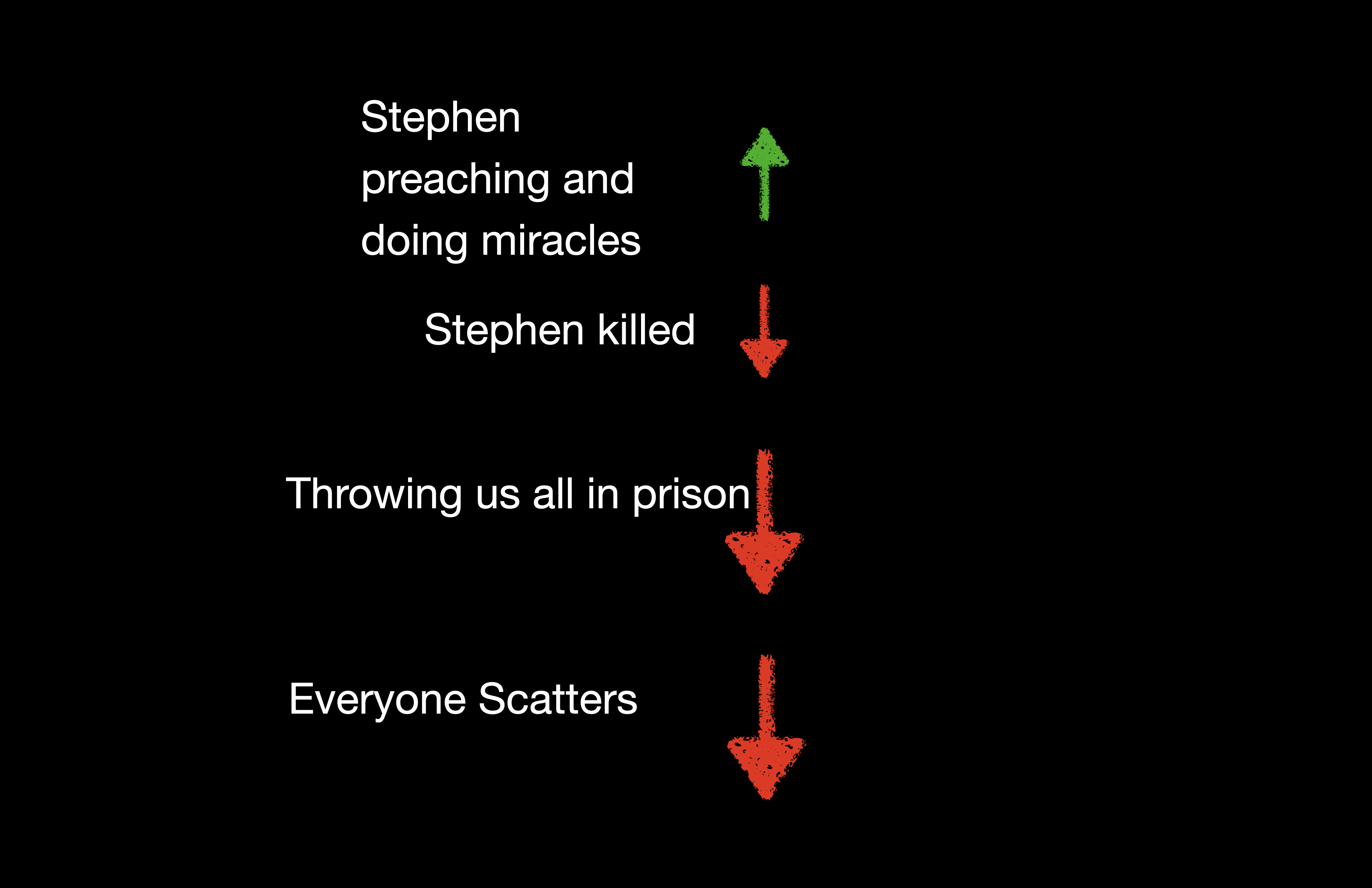
By the time we reach Acts 8, the church has experienced incredible highs and devastating lows.   Every time there’s a victory, opposition follows.  Just when things seem to be going good, here comes trouble.  The book of Acts has so far been a rollercoaster of highs and lows, but now, in Acts 8, it seems to be plummeting toward destruction.

Do you see this in your life also?  A rollercoaster of highs and lows, good and bad?  Just when things seem to be going good, here comes trouble.  How do you respond when things go wrong?  Disappointment?  Depression?  Fear?  Hopelessness?  Do you want to question God?  Why did you let them put the apostles in prison?  Why did you let them kill Stephen?  Why did my friend get cancer?  Why do evil people prosper?  Why is there so much trouble in the world?

This persecution should not have been surprising to them or us.  Jesus said:

John 15:18, 20   If the world hates you, know that it has hated me before it hated you…
If they persecuted me, they will also persecute you.”

And remember, He also said this:

Matthew 5:11-12   Blessed are you when others revile you and persecute you and utter all kinds of evil against you …

Oh, but as we discussed before, “Blessed” is the Greek “makarios,” which really means “happy are you” or “how fortunate you are,” so let’s read it that way…

Matthew 5:11-12   How wonderful it is for you when others revile you and persecute you and utter all kinds of evil against you falsely on my account. Rejoice and be glad, for your reward is great in heaven, for so they persecuted the prophets who were before you.

Jesus says that when you are persecuted, you are the lucky ones!  Do you think the followers in Jerusalem saw it that way?  Saul is dragging them out of their houses and throwing them in prison.  And do you think they are celebrating their good fortune?  How does this make sense?

To understand how you are lucky or happy when persecuted, you have to be able to see things from God’s view and not your own.  We need to look through God’s eyes.  We need to see the bigger picture again.   There are three reasons that persecution is good. 

1.  Persecution helps the believer mature and grow in Christ.

Romans 5:3-5   Not only that, but we rejoice in our sufferings, knowing that suffering produces endurance, and endurance produces character, and character produces hope, and hope does not put us to shame, because God’s love has been poured into our hearts through the Holy Spirit who has been given to us.

We need suffering to grow.  It is only when we experience failure, disappointment, persecution, and defeat that we are able to understand that we are not enough.  We learn to depend on our Father instead of ourselves.  We mature as followers of Jesus.

2.  Persecution purifies the church.

It is sad, but there are always those in the church who are not faithful followers but wolves in sheep’s clothing.  But when trouble comes, when persecution comes, their truth is revealed.   We see this in 1 John, and Jesus speaks of it in his parable of the soils.  

Matthew 13:20-21   As for what was sown on rocky ground, this is the one who hears the word and immediately receives it with joy, yet he has no root in himself, but endures for a while, and when tribulation or persecution arises on account of the word, immediately he falls away.

When persecution comes, some will leave the church.  They were never really a member anyway.  We have not had persecution in our time.  So, from what Jesus said, you would expect the church to have a lot of people who aren’t really committed to Jesus.  They are there with joy, but have never given their life to Christ.  And if persecution does come, they will fall away.

3.  Persecution causes the church to grow

Now this doesn’t seem to make a lot of sense.  If Paul is going from house to house in Acts 8, dragging people out to put them in prison, that seems it would have a negative effect on the group of followers in Jerusalem.  But look what happens:

Acts 8:4   Now those who were scattered went about preaching the word.

Verse 4 is a hinge in the book of Acts.  The word “scattered” here — diaspeirō in Greek — is the same word used for scattering seed. It’s not a random dispersal; it’s purposeful planting.  The devil tried to stamp out the fire in Jerusalem, but all he did was scatter the embers — and they caught flame in new places.  Everywhere these believers went, they carried the gospel. They didn’t have a denomination, a mission-sending agency, a church building, a program, or a budget. What they had was the message of Jesus, and that was enough.

Acts 8:5    Philip went down to the city of Samaria and proclaimed to them the Christ.

Philip, one of the seven deacons appointed back in Acts 6, goes to Samaria! Remember how the disciples first responded when Jesus took them through Samaria? They couldn’t believe he was actually going there.   They hated the Samaritans.  They called them half-breed Jews.  They wouldn’t even talk to them.  Jews and Samaritans had centuries of hostility, but the gospel breaks that barrier wide open.  That’s a remarkable scene,  See how the Holy Spirit has changed these followers to be more like Jesus?

Philip is crossing cultural and religious boundaries.   What began with Stephen’s death in Jerusalem leads to joy in Samaria.  The chapter that opened with mourning ends with rejoicing.
The story that began with persecution ends with proclamation.  The bad news becomes the vehicle for the good news.  This is the power of the gospel. And they went further…

Acts 11:19   Now those who were scattered because of the persecution that arose over Stephen traveled as far as Phoenicia and Cyprus and Antioch, speaking the word to no one except Jews.

At the beginning of Acts 4, the entire church, the gathering of followers of Jesus, is all in one city.  All in that one little dot.  But because of the persecution, they scatter like seed and are planted here.

So what is the lesson we learn from this passage in Acts 8?

Application 1: God’s Good News Often Moves Through Bad News
This is a pattern we see all through Scripture. Joseph was sold into slavery so he could save his family. Moses fled Egypt before leading God’s people out of it. The cross looked like defeat until resurrection morning.  Acts 8 continues that pattern — what looks like a disaster becomes divine strategy.  Maybe you’ve seen that in your own life. You lose a job and end up finding a deeper purpose. A relationship breaks down, and you discover how faithful God really is. A closed door becomes the very thing that pushes you toward your calling.

Romans 8:28  And we know that for those who love God all things work together for good, for those who are called according to his purpose.

Listen, God did not want this persecution.  God loved Stephen.  He did not want Stephen to be stoned.  But God gave men free will, and men choose evil.  But God takes the evil that man has done and makes it work for good.  God has a way of turning scattering into sowing — pain into purpose, loss into mission.  So when you get bad news, a bad diagnosis, a financial bad turn, or some tragedy, if you are a follower of Jesus, know that God, who loves you, will take that tragedy and work it for good.

Application 2: Comfort Can Become the Enemy of God’s Purpose

The church in Jerusalem had everything — community, teaching, worship, generosity, and miracles. But all of that was happening inside one city.  And we have to admit, many of our churches today fall into the same pattern. We have programs, fellowship, music, structure — often much more of these than mission. We love being together, but we can easily become so inward-focused that we forget why we exist.

Sometimes, God allows discomfort — in a church, in a ministry, even in a nation — to push His people outward again.  The early church didn’t plan a missions strategy.  Persecution became their mission strategy. God used shaking to send them out.

Application 3: Wherever God Scatters You, Carry the Gospel

Acts 8:4   Now those who were scattered went about preaching the word.

Notice that Acts 8:4 doesn’t say “the apostles” went preaching — it says “those who were scattered.” Ordinary believers. Shopkeepers, craftsmen, mothers, widows, servants. They didn’t have seminary training, but they had stories of grace.  They didn’t have pulpits, but they had conversations.  They didn’t have missionary boards, but they had neighbors. Every believer was a messenger. And wherever they went, the gospel went too.

Maybe God has “scattered” you in a way you didn’t expect — a new job, a new city, a new season of life. Don’t see it as random. See it as God planting you where the gospel can take root.  If you find yourself in an oncology waiting room, find a way to be the gospel there, and maybe even use words.  Stuck in an elevator, waiting in a long line, wherever.  And if you are somewhere uncomfortable, be alert for opportunities to share.  Sometimes God shakes our comfort so He can share His comfort through us.

I don’t go to the movie theater much anymore.  (Even though I love paying $25 for some popcorn and a soda.)  But at a movie, I sit in my seat and watch, and when it is over, then I walk out of the theater and go about my life as if nothing has happened.  Once a week, we come to our seats at church and watch.  And when it’s over, then what?  Is this like a movie, or have we had an encounter with the God of the Universe who wants us to leave this place changed, to leave this place with a mission?  We are not saved to sit.  We are saved to serve.  We can’t fulfill God’s plan for our lives in this building.  

Jesus’ great commission was not “Go to church on Sunday and then go home (after you go out and eat lunch).   It was “Go into all the world and do something that will likely make you uncomfortable.”   

The passage ends in verse 8: “So there was much joy in that city.”   The church’s pain became someone else’s joy.  Their scattering became someone else’s salvation.   That’s the rhythm of the gospel — out of suffering comes life, out of loss comes joy, out of persecution comes expansion.  So when life shakes beneath your feet — when bad news comes — don’t assume God has abandoned you. He might take this opportunity to move you into the next chapter of His plan.  The ground may be shaking, but God is sowing.  What feels like bad news may be the start of very good news indeed.

  1. Lucado, Max. A Heart Like Jesus: Lessons for Living a Christ-Like Life. Kindle Edition. Location 33.

September 8, 27 A.D.  Jesus Sends Out the Twelve #49

Week 30 ———  Jesus Sends Out the Twelve
Matthew 10:1 – 11:1 — Mark 6:7-13 — Luke 9:1-6

Mark 6:7-13   And he called the twelve and began to send them out two by two, and gave them authority over the unclean spirits.   He charged them to take nothing for their journey except a staff—no bread, no bag, no money in their belts—    but to wear sandals and not put on two tunics.   And he said to them, “Whenever you enter a house, stay there until you depart from there.  And if any place will not receive you and they will not listen to you, when you leave, shake off the dust that is on your feet as a testimony against them.”  So they went out and proclaimed that people should repent.  And they cast out many demons and anointed with oil many who were sick and healed them.

Jesus is busy. There are crowds all around him, and he can’t minister to them all. A few weeks ago, Jesus stayed up all night praying. The next day, he appointed these 12 guys to be his core group. Mark tells us, “And he appointed twelve (whom he also named apostles) so that they might be with him and he might send them out to preach” (Mark 3:14). Apostles, from the Greek ‘Apostolos,’ which means one who is set apart and sent out.

Jesus realizes he has limited time left with these men.  The religious leaders are already plotting to kill him.  He will be leaving these disciples in about seven months, and they will be the ones to continue the ministry he started.  He has to get them ready to move from students to teachers, from the ones who watch and learn to the ones who do the work and teach.   These young men (all but Peter are less than 21) will need to become the core of his movement, the missionaries of his gospel.  And again, this will all happen in just seven months.   

Are they ready to be sent?   If you asked them, I’m sure they would say, “No way!” There is still so much they don’t understand.  As we saw last week, they still don’t understand that Jesus is God in the flesh, though he began to make that evident last week.  But Jesus sends them out on a mission.

When I say the word ‘missions,’ what do you think about? We think of sending missionaries or someone going to Africa or Asia.  The word ‘mission’ is from the Latin ‘missionem’ which is from the Greek ‘apostolos’ so it is also defined as the act of sending or being sent.   Isn’t it interesting that we immediately focus on sending others and supporting missionaries overseas rather than seeing ourselves as being sent?  Our default way of thinking is to consider missions someone else’s job. 

Jesus is asking them to fulfill the role of disciple. Being sent out is the next step in being a disciple.  Remember that we talked about a disciple as an apprentice.  An apprentice watches everything his mentor does; he listens to every word, and when he is ready, he begins to imitate his mentor.  Under the mentor’s close supervision, he begins to do what the master does: act like the master acts.  Then, one day, the training is over.  The master determines that the apprentice is ready to go out on his own and one day have his own apprentices.  So it is with discipleship.

We all know of someone or have heard of someone who seems to be a perpetual or career student.  They are always in school, degree after degree, but they never do much with them.  One of the most famous I’ve read about is Michael Nicholson.  As of 2016, he was 75 years old and held one bachelor’s degree, two associate degrees, three specialist degrees, 23 Masters degrees, and one doctorate.  At that time, he was still in school and took a part-time parking attendant job to get a tuition discount.  Or there is Benjamin Bolger, who is 49 years old and as of 2024 has degrees from Yale, Harvard, Stanford, Brown, Boston College, Dartmouth, the University of Georgia, William and Mary, George Washington University,  Ithaca, Cornell, Georgetown, Oxford, University of Tampa, Ashland University, Brandeis, Columbia, Skidmore College, University of Michigan, West Virginia Wesleyan College, University of Pennsylvania, University of Cambridge, and Muskegon Community College.  That is a lot of degrees— but Mr. Bolger, what are you doing with them?

A professional student becomes full of knowledge but is empty of wisdom.  What are we after, knowledge or wisdom?  There is a big difference between those two things.  Knowledge is the facts and information you have accumulated.  Wisdom is an action.  It is the ability to put knowledge into action in a practical way.  Knowledge is what you know.   Wisdom is what you do based on that knowledge.  Charles Spurgeon once wrote:  “Wisdom is the right use of knowledge. To know is not to be wise. Many men know a great deal and are all the greater fools for it. There is no fool so great a fool as a knowing fool. But to know how to use knowledge is to have wisdom.”1

Biblical knowledge is obtained over time through the study of the Scriptures. Through this study, I hope to increase your Biblical knowledge.  But that is only the beginning.  What I really want is for you is not just to increase your knowledge but to increase your wisdom.  I want you to take this knowledge and do something with it. This is why I often end my teaching with some action step you can take or a challenge. Knowledge understands that the red light means stop; wisdom applies the brakes. Knowledge sees the patch of ice on the walkway; wisdom walks around it. Knowledge memorizes the Ten Commandments; wisdom obeys them. Knowledge learns of God; wisdom loves Him.  But there is this great disconnect we see in the church. Listening to someone teach about the scriptures is good—it increases knowledge. But if we don’t ever make a decision to change something in how we live because of what we have learned, then we fail to obtain wisdom.

Proverbs 2:6  ‘For Yehovah gives wisdom; from his mouth come knowledge and understanding.’

The four years of medical school are a great demonstration of the difference between knowledge and wisdom.   The first two years of medical school are all in the classrooms and labs.  It is hard, and there is a lot of material thrown at you at a rapid pace.  Those two years are all about gaining knowledge.  But then the third year comes.  And suddenly, you aren’t just a student sitting and learning.  You are expected to apply the knowledge gained during the first two years to practical use in treating actual patients.

 As a medical student or resident, someone is usually looking over your shoulder, making sure you do the right thing, but you are doing the work.  The mantra in that part of med school is “See one, do one, teach one.”2  This phase originates with William Stewart Halsted, one of the four founding doctors at Johns Hopkins Hospital.  Halsted firmly believed that you don’t understand something until you have experienced it and then done it yourself.  This is the core of the Hebrew meaning of knowing.  You don’t know something until you have experienced and participated in it. 

The first few years in the classroom in medical school are filled with anxiety.  There is a lot of pressure to do well, and examinations are often brutal.  But when you enter the hospital, the hands-on portion of medical school, the anxiety level dramatically increases.  You are assigned a number of patients.  You are the first to talk to them, examine them, and try to find out what is going on to make a diagnosis. You must order the proper tests and labs to confirm your diagnosis.  You report to your resident, the more experienced doctor overseeing you, and they either agree with you or tell you that you are missing something important and ask you why you are trying to kill this patient.

It was my first night in the surgery rotation at Grady Hospital in Atlanta.  We finished all the work and did our evening rounds on patients, where each student and resident on your small team would discuss each patient and how they were doing, what the plans were for them, and what to watch for during the night (so no one would die on your watch.)  It was about seven pm, and everyone would go home and be back at four or five the following morning to check on their patients and be ready to present them for morning rounds.  Everyone went home except the designated students and residents to stay overnight on-call.  And I had the first night on call.  Usually, there would be some surgeries to do overnight, emergency appendectomies, or some major trauma.  But on my first night in the hospital, there were no surgeries.  So, after we ate a quick dinner in the cafeteria, we went to the ER to learn how to sew up wounds.  In those first two years of medical school, we studied all the processes involved in wound healing.  I had the knowledge.   I have heard about some medical training programs where you learn to suture wounds by practicing on pigs’ feet, which you get from the grocery store.   Later, you practice more delicate work by skinning grapes and sewing the skin back on.  But no pig’s feet or grapes for us that night. 

 My supervising resident introduced me to Frank, a man who had gotten into a drunken brawl at a bar the night before and had been waiting in the ER for about 20 hours to be sewn up.  He had been beaten all about the head with a pipe but had been cleared of any other injuries, so he was put in the row of people waiting for stitches.  So, the resident set me up with the tools I needed and taught me about sterile procedures.  Then he put in a couple of stitches while I watched.  He then stood up and said, “You finish.”  He stayed and watched me struggle through the first two sutures, and then he was off to teach someone else.  182 sutures later (and 4 hours later), I was done.  Let me tell you, the last ten went in much better than the first ten (and looked better, too.)   There was much trial and error as I moved from knowledge to wisdom.  And that was the theme for the next five years through residency.

So, let’s bring this home.  Months ago, we talked about discipleship.  We are all called to be disciples, and we discussed the idea of discipleship like an apprenticeship.  Somehow, in the modern church, many people have gotten the idea that some people are called to be ministers, and some are called to be ministered to.  But God never intended anyone to sit in the pew and learn their whole life.   There are no professional students at the University of Jesus.  We should always be learning, but practical application begins quickly.  We are called for a purpose. 

Ephesians 2:10   For we are his workmanship, created in Christ Jesus for good works, which God prepared beforehand, that we should walk in them.

We are his workmanship; we are his creation.  And what did he create us for?  Not to sit, but to do good works.  Now, you don’t have to go out and find your purpose.  God already decided it.  He has prepared some works for you to do ahead of time.  Like the resident who found the patient, and laid out all the tools and sterile equipment that I would need, God has put you in the place where you have works to do.   It is all ready for us to begin.

God made us do these works and set them up for us.  It may be uncomfortable to leave the classroom and begin to apply what you have learned, but that is what you were created to do.  We can’t just sit here learning. We need to step out of the classroom into the world and begin the work. We already know what God wants us to do.

What is the first great commandment, Jesus?
“Love the lord with all your heart, soul, and strength.   Love your neighbor as yourself.”

Let me remind you that love is an action word.  Sorry, Hallmark, it is primarily something you do, not something you feel.  Our mission begins with loving our neighbor.  Jesus insisted on this mission they stay with their own people, their immediate neighbors.  So, I want to challenge you to go on mission to your neighbors.  Now, I will leave you to decide who your neighbors are, but Jesus said it is anyone you happen to encounter.  And the mission is to love them.  The small church I attend is very good at loving each other.  That is so important.  Jesus said, “By this all people will know that you are my disciples, if you have love for one another”  (John 13:35).   The next step is to take that into our greater community.  And it must be a personal ministry.  As important as it is to donate money, supplies, clothes, or coffee, that can’t be the extent of our mission work.

Shane Claiborne, in his book The Irresistible Revolution, said:

“When we get to heaven, we will be separated into those sheep and goats Jesus talks about in Matthew 25 based on how we cared for the least among us. I’m just not convinced that Jesus is going to say, “When I was hungry, you gave a check to the United Way and they fed me,” or, “When I was naked, you donated clothes to the Salvation Army and they clothed me.” Jesus is not seeking distant acts of charity. He seeks concrete acts of love: “you fed me…you visited me in prison…you welcomed me into your home…you clothed me.”

We think of the church as a ministry, but often it is just “a distribution center, a place where the poor come to get stuff and the rich come to dump stuff. Both go away satisfied (the rich feel good, the poor get clothed and fed), but no one leaves transformed. No radical new community is formed. And Jesus did not set up a program but modeled a way of living that incarnated the reign of God, a community in which people are reconciled and our debts are forgiven just as we forgive our debtors”3

It is essential to support missionaries financially and with prayer. It is very important to support our local ministries, like the Salvation Army, that reach people we don’t know. But Jesus is a very personal savior. He didn’t just send a donation of grace and mercy from heaven; he left his throne in heaven and came here to interact with his people personally.  

I will give you two steps:

The first step is to reach out to your neighbors.   Invite neighbors over for a meal. Now, if you don’t cook, you can go out to eat with them. You could spend time with these neighbors in other ways, but sharing a meal is easy because everyone eats. And there is something special Biblically about sharing a meal with others.  You could call them random acts of kindness; while they might seem random to others, they should be intentional to you. The object is to show your neighbors love by showing hospitality. 

If you trace the theme of hospitality through the Bible, you will see how important it is. God commends Abraham for his hospitality to strangers.  One of the main reasons the Bible says God allowed Babylon to conquer Judah was that they didn’t care for the widows and orphans and didn’t show hospitality to strangers in the land.  

In 1 Peter 4:7, Peter says, “The end of all things is at hand…”  If you thought the world was about to end, what would be at the top of your ‘to do list’?

1 Peter 4:7-10  “The end of all things is at hand, therefore, be self-controlled and sober-minded for the sake of your prayers.   Above all, keep loving one another earnestly since love covers a multitude of sins.  Show hospitality to one another without grumbling.

The world is about to end so “above all” (most importantly) love one another and show hospitality.  Hospitality builds friendships and relations.   It is a demonstration of the gospel.

The next step:   Invite neighbors or friends to discuss the Bible together.  Now, you may feel like you are not ready to do this.  You may not feel like you are equipped to do this.  Congratulations! Jesus’ disciples felt the same way.  You may not feel you know enough about scripture.  Remember that the disciples didn’t even realize exactly who Jesus was at this point.  You know more now than they did then.  But he equipped them, and he will equip you.

.Why do you think Jesus told them to take no money, extra tunic, or food?  He didn’t want them to depend on their own resources but learn to depend on him.  If they went out totally prepared, they wouldn’t learn the lesson that He would provide for them.  Similarly, if you feel like you aren’t fully prepared to do what God is asking you to do, then perfect.  Now, you will have an opportunity to see God work.  There are many excellent books and materials for group Bible studies. You don’t have to be the expert teacher. The group will study together, and everyone will teach each other.

We all have visions of what our life would be like.  These disciples did. And we make decisions every day in ways to make life the best we think it can be for us.  But God has a different vision of what life is, of what the good life is.  Jesus said, “I came that they may have life and have it abundantly” (John 10:10).  Your creator has a bigger dream for your life than you do.

The Bible has a story of a very religious man who thought he was living life to its fullest.  But then God came and challenged his vision for his life.  God asked Jonah to preach to his people’s enemies in Nineveh.  But Jonah takes off in the opposite direction on a boat. And Jonah thinks he is running for his life, but he is running from the abundant life God wanted for him.  God wanted Jonah to be part of the greatest outpouring of grace in the largest city in the world, the biggest revival ever.  But Jonah doesn’t want to give up on his own vision of his life.  Some disciples were fishermen and dreamed of big fish catches and better boats.  But Jesus had a bigger dream for them: to change the world.  

You may think a great evening this week would be to sit in your recliner with some snacks and watch a good football game or sit on the sofa with some popcorn and watch a good movie.  But God has a bigger vision for you.  He wants you to be an influencer for him with your neighbors.  If you have ever thought your life was boring or stuck in a rut, I have good news for you: God wants abundance in your life.  He wants you to have a hand in bringing people into His kingdom, bringing joy to someone who needs it, and living your life like you are the very image of God, demonstrating His love and grace as you live day to day. 

Jesus says, “Follow Me.”  He is asking these young men to take the next step.  Jesus is asking us today to take the next step.  Begin by showing hospitality to those around you.  Find a neighbor you don’t know well, or that person you always run into somewhere, or that person you used to be close to but haven’t talked to in a while, or the neighbor you don’t know, or the grumpy old guy you know who has no friends because, well, he is a cranky old guy.  Then, consider if God is calling you to begin a group of people who can look at the Bible together.  

Jesus is sending us out into the world.  It is time to take our knowledge and turn it into wisdom.  I challenge you to take that step this week.

  1. Spurgeon, C. H.  From the sermon “Christ and the power of God and the wisdom of God.”  Delivered 5/17/1857 at the Music Hall, Royal Surrey Gardens.
  2. Cameron, J. L.  “William Stewart Halsted, Our surgical heritage.”  Annals of Surgery, 1997;225:445-8.
  3. Claiborne, Shane.  The Irresistible Revolution.  Kindle Edition. Location 1320.