
Week 55 — Jesus Wept
John 11:17-39
Last week, we saw how a messenger found Jesus in Perea and informed him that his friend Lazarus was ill. We then began our discussion of Lazarus’s resurrection. We discussed how Jesus used this time to teach the second Beatitude: Blessed are they that mourn, for they will be comforted. We also discussed Jesus’ statement that Lazarus’ sickness would not end in death because death is never the end for any of us. Today, we continue the story.
John 11:17-39 On his arrival, Jesus found that Lazarus had already been in the tomb for four days. Now Bethany was less than two miles from Jerusalem, and many Jews had come to Martha and Mary to comfort them in the loss of their brother. When Martha heard that Jesus was coming, she went out to meet him, but Mary stayed at home.
“Lord,” Martha said to Jesus, “if you had been here, my brother would not have died. But I know that even now God will give you whatever you ask.”
Jesus said to her, “Your brother will rise again.”
Martha answered, “I know he will rise again in the resurrection at the last day.”
Jesus said to her, “I am the resurrection and the life. The one who believes in me will live, even though they die; and whoever lives by believing in me will never die. Do you believe this?”
“Yes, Lord,” she replied, “I believe that you are the Messiah, the Son of God, who is to come into the world.”
After she had said this, she went back and called her sister Mary aside. “The Teacher is here,” she said, “and is asking for you.” When Mary heard this, she got up quickly and went to him. Now Jesus had not yet entered the village, but was still at the place where Martha had met him. When the Jews who had been with Mary in the house, comforting her, noticed how quickly she got up and went out, they followed her, supposing she was going to the tomb to mourn there.
When Mary reached the place where Jesus was and saw him, she fell at his feet and said, “Lord, if you had been here, my brother would not have died.”
When Jesus saw her weeping, and the Jews who had come along with her also weeping, he was deeply moved in spirit and troubled.
“Where have you laid him?” he asked.
“Come and see, Lord,” they replied.
Jesus wept.
Then the Jews said, “See how he loved him!”
But some of them said, “Could not he who opened the eyes of the blind man have kept this man from dying?”
Jesus, once more deeply moved, came to the tomb. It was a cave with a stone laid across the entrance.
“Take away the stone,” he said.
Jesus wept.
It is often referred to as the shortest verse in the Bible, and it is in many of our modern translations, but not the shortest in the original Greek, where it has 16 letters. (The shortest verse in the oldest Greek texts is Luke 20:30, with 12 letters. Remember that verse divisions were not added to the text until the 1500s.) Nevertheless, this short verse portrays an important picture. Please close your eyes briefly and try to picture what it says in this verse. Whether we realize it or not, we all form these pictures as we read. Jesus wept. What is Jesus doing in your picture? Did he break down and collapse to the ground? Did he weep bitter tears? Did he wail and moan? Did he sob? Did anyone rush to comfort him? Did he have to wipe the tears from his eyes with the corners of his robe?
Mourning differs from culture to culture. We have talked before about how the Jewish practice was to hire professional mourners at the time of death. They would ”lead” the family in their weeping by making sharp, ear-piercing cries of grief and playing the flute. The prophet Jeremiah spoke of them, saying,
Jeremiah 9:17-18 “Consider and call for the mourning women, that they may come; and send for skillful wailing women, that they may come. Let them make haste and take up a wailing for us, that our eyes may run with tears, and our eyelids gush with water.”
We see the professional mourners also in Mark:
Mark 5:38-40 They came to the house of the ruler of the synagogue, and Jesus saw a commotion, people weeping and wailing loudly. And when he had entered, he said to them, “Why are you making a commotion and weeping? The child is not dead but sleeping.” And they laughed at him. But he put them all outside and took the child’s father and mother and those who were with him and went in where the child was.
You can see the professional mourners at Jairus’s home in The Chosen, Season 3, episode 5. This was an important part of mourning in Judaism in Jesus’ day. Professional mourning is still practiced in China and some Asian countries today.
Sometimes, I read a scripture and just want to know more. Jesus wept. Did he break down sobbing, did he wail, did he weep bitter tears, or did he just ‘tear up’? And in this instance, more information is available if you dig deeper. There are two Greek words for weeping in the New Testament, which differ by large degrees: klaio, and dakruo. Both of these words, translated as weeping, appeared in our text this morning.
John 11:33-35 When Jesus saw her weeping (klaio), and the Jews who had come along with her also weeping (klaio), he was deeply moved in spirit and troubled.
“Where have you laid him?” he asked.
“Come and see, Lord,” they replied.
Jesus wept (dakruo).
The word used to describe Jesus’ emotional display is totally different from the one used to describe Mary and the other Jews who wept with her. “Klaio,” the word used for Mary’s weeping and the weeping of the other Jews, means to lament, wail, or weep with deep emotion. “Dakruo” – the word used in the verse “Jesus wept” means to ‘shed a tear’ or to ‘tear up’ There is a big difference between these two words that both are translated as weep in our English Bibles.
So, if you pictured Jesus falling to the ground and weeping bitter tears, it is because you don’t speak Greek, and our friendly neighborhood translators didn’t bother to distinguish between these different Greek words.
But just because Jesus doesn’t collapse weeping is not to say that Jesus was not profoundly moved by the moment. In fact, verse 33, preceding, clearly says Jesus was deeply moved in spirit and troubled. And then, in the verse following Jesus wept, we see it was clear to everyone there that Jesus was emotionally affected:
John 11:36 Then the Jews said, “See how he loved him!”
It is evident to everyone there that Jesus grieved with everyone else at the tomb. It was clear to them that he must have loved Lazarus, but he did not weep bitterly like the others. He is described as “deeply moved,” which likely led us to assume his response in tears was to weep bitterly like the others. Yet the Greek tells us his response is not extreme. How do we reconcile our Bible telling us Jesus was deeply moved and yet just shed a tear? Is it because Jesus is not capable of showing intense emotion? We will see that he certainly can in just a bit. But we need to look further at what “deeply moved” means.
Twice in this passage, in verse 33 and verse 38, Jesus is described as “deeply moved.” “Deeply moved” is translated from one Greek word, ‘embrimaomai,’ which means “intense anger.” It comes from the Greek word that describes the snorting of war horses before a battle.
Since most of us have no experience with angry snorting war horses, here is the picture that comes to my mind. This is a painting I saw in the Palace of Versailles in France of Napoleon on his war horse.

This is embrimaomai. A warhorse, snorting mad, going into battle. This is Jesus, deeply moved; he is angry.
I am somewhat frustrated that I looked through over 60 modern translations and couldn’t find one that translated “deeply moved” with the idea of anger. Yet many commentaries firmly state that Jesus is angry here. (I finally found it in the German Luther translation (redone in 2017), where it said Jesus “was angry in his spirit and shook.” It is as if our English translators are afraid to show Jesus as being angry. Well…they need to get over that — Jesus was angry, shaking mad. And what is Jesus angry about? He is warhorse-snorting, fighting angry about death.
It was Elisabeth Kübler-Ross, in her 1969 book “On Death and Dying,” who first described what she called the five stages of grief over death. They describe peoples’ common reactions to death in an attempt to normalize those feelings in a time of emotional upheaval. They were never meant to be sequential, and many people don’t experience all of these feelings. In her follow-up book in 2004, she tried to clarify that they are not steps that all go through or should go through. Indeed, they describe many responses we have to death: denial, anger, bargaining, depression, and acceptance.

But let me tell you, Jesus is at the stage of anger. Jesus is angry at death because when he created the world, death was not to be a part of it. Life in the garden was designed to be without death. Humans were designed to care for the world, walk with God as obedient followers, and have eternal life. But then Genesis 3 happened. Man chose to be disobedient, and sin came into the world, and with it, death came into the world. Jesus looks at sin and death and gets angry because this is not what he intended for his creation.
Death was not part of God’s plan. Sin was not part of God’s plan. But all of us have sinned, and all of us, by sinning, have welcomed death into the world.
Let me show you how Jesus reacts to death. Let’s look at Jesus’ stages of grief about death.
Jesus doesn’t deny death. He doesn’t get depressed about death. Oh, he is saddened about the grief of others for sure, but not depressed about death. And Jesus refuses to bargain with death. And when Lazarus dies, Jesus doesn’t accept death. Jesus gets war-horse snorting, angry at the death of Lazarus, and then does battle with death. Jesus came to the Lazarus’ tomb angry enough to fight a war with death. And Jesus has victory over death.
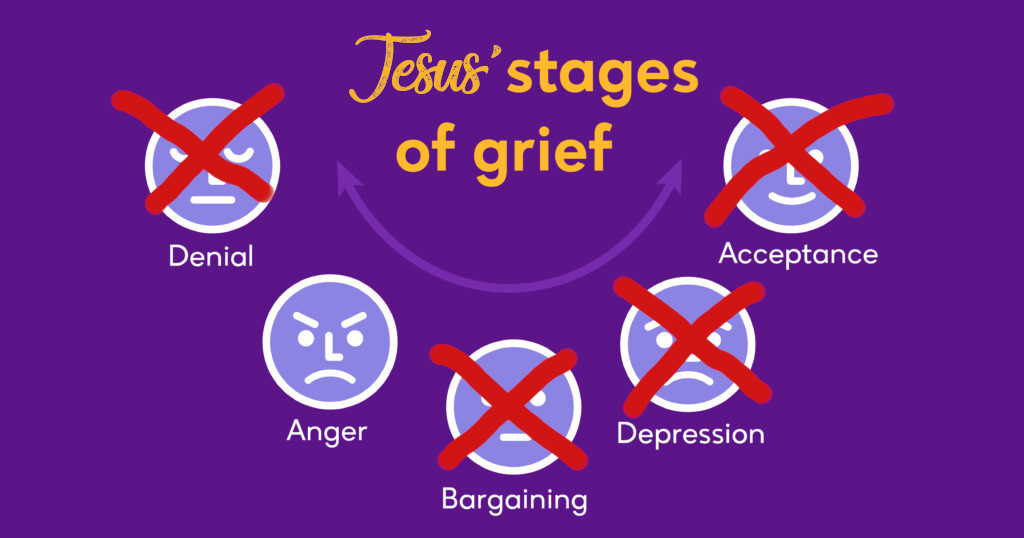
These are Jesus’ stages, straight from anger to victory.
Every time in the New Testament, Jesus encounters a corpse, it comes back to life. He always defeats death. Death cannot exist in his presence.
Jesus said, “I am the resurrection and the life.” Note that resurrection is not what Jesus does; it is who he is. He is the resurrection. So death can not hold him.
Now, you and I are not Jesus. We will have emotional responses to death that may fall into any of these categories. And sometimes, grief takes a very long time to process. But you don’t have to live forever in these stages. You don’t have to dwell in them forever because you know Jesus, the resurrection, and the life. You know the one who has defeated death. You don’t have to accept death as final because we know death is not the end.
Paul said it this way:
1 Thessalonians 4:13-14 But we do not want you to be uninformed, brothers, about those who are asleep, that you may not grieve as others do who have no hope. Since we believe that Jesus died and rose again, even so, through Jesus, God will bring with him those who have fallen asleep.
Because of Jesus, we do not grieve like those without hope. Everything is different when you realize death it is not the end. But we all will grieve because knowing the end of the story doesn’t mean you won’t cry at the sad parts.
So Jesus shows intense emotion here, but his emotion is not weeping from grief but intense anger at death. His tears shed here in sympathy to the grief of his friends are very subdued.
Contrast that to a time in Jesus’ life, just a few weeks after Lazarus was raised, when he did cry with the intense emotion of klaio, weeping with deep emotion. And what was the reason that Jesus wept bitterly then?
It is on the first Palm Sunday, and Jesus is sitting atop a donkey’s colt; people are shouting, “Blessed is the King who comes in the name of the Lord! Peace in heaven and glory in the highest!.” He is riding down the Mount of Olives toward the city. It is a celebration that is unparalleled in the gospel accounts. Thousands are waving palm branches and shouting, “Hosannah!” Amid this celebration, as the crowds descend the Mount of Olives and look across the Kidron valley to see the magnificent walls of Jerusalem and, just beyond them, the Temple, the place where Yehovah said he would place his name forever, Jesus interrupts the celebration.
While the crowd shouting praises, Jesus looks at the city and weeps over it. And it is not the Greek dakruo, not simply the shedding of a tear, but the agonizing wailing and sobbing of the Greek klaio.
Luke 19:41-42 And when he drew near and saw the city, he wept (klaio) over it, saying, “Would that you, even you, had known on this day the things that make for peace! But now they are hidden from your eyes.”
This Jesus, who teared up when grieving the death of a good friend and seeing his friends grieving over Lazarus, is now moved to wail and weep bitter tears over what?
Jesus knows that the praise and affirmation He is currently experiencing is short-lived. In just a few days, another crowd will gather to shout out in his presence. But it will not be shouts of praise but shouts of condemnation. “Crucify Him!” they will shout to Pilate. Just a few days after thousands entering Jerusalem proclaim his as their King, “Blessed is the King who comes in the name of the Lord!” there will be another crowd shouting. Pilate will present this same Jesus and say, “Behold your king!” to which the chief priests will answer, and the very authorities responsible for maintaining true worship will answer, “Crucify him; we have no king but Caesar.”
Jesus cries because, as John said, “He was in the world, and the world was made through him, yet the world did not know him. He came to his own, and his own people did not receive him. (John 1:10-11)
Rejection always hurts. But if it is someone you love, someone you have trusted, someone close to you, it always hurts you much more. Jesus was rejected by the very people he loved so much that he left heaven to come and suffer and die for.
That is what Jesus says as he enters Jerusalem on Palm Sunday: “Because you did not know the time of your visitation.” Jesus’ heart is broken, and he weeps, sobbing tears because they rejected him. Because they refused his offer to repent and enter the kingdom of God.
Luke 13:34-35 O Jerusalem, Jerusalem, the city that kills the prophets and stones those who are sent to it! How often would I have gathered your children together as a hen gathers her brood under her wings, and you were not willing! Behold, your house is forsaken.
Jesus wanted everyone to accept him and his gift of forgiveness, repentance, and salvation, but most rejected him.
And Jesus knows the horrible consequences of their rejection of him. The result is condemnation. As Jesus told Nicodemus, “whoever does not believe is condemned already, because he has not believed in the name of the only Son of God.” (John 3:18).
And not only are the individuals condemned, but the entire city of Jerusalem stands condemned. Let’s look again at Jesus response on that Palm Sunday,
Luke 19:41-44 And when he drew near and saw the city, he wept (klaio) over it, saying, “Would that you, even you, had known on this day the things that make for peace! But now they are hidden from your eyes. For the days will come upon you, when your enemies will set up a barricade around you and surround you and hem you in on every side and tear you down to the ground, you and your children within you. And they will not leave one stone upon another in you, because you did not know the time of your visitation.”
Jesus knows that it is happening again.
Throughout the Bible, we see the same thing happen repeatedly. God calls out a covenant people. He rescues and redeems them. He brings them through the waters. He saves them from their enemies. He teaches them from the mountain. He showers love on them. He asks them to live by the rules of His covenant. He asks them to have no other Gods. They must not follow their way but follow him as their king. And over and over God’s covenant people turn to other Gods and worship idols of their own making: Baal, Astoreth, money, power, prestige, and the greatest idol of all, self. They crossed the line, and God turned his face from them and let them reap the consequences of their actions. So they were conquered by foreign countries, be it the Philistines, the Assyrians, the Babylonians, or the Romans.
And Jesus, the prophet, sees it happening again.
And it happens just as he said, for about 40 years after that Palm Sunday, Titus led an army of 50,000 Roman soldiers to encircle Jerusalem. The siege began at the exact same time of year as Jesus’ entry into Jerusalem, the time of Passover, when thousands of pilgrims entered the city. The siege lasted 143 days, cutting off supplies and leading to 4 months of mass starvation and death.
The historian Josephus writes:
“All hope of escaping was now cut off from the Jews, together with their liberty of going out of the city. Then did the famine widen its progress, and devour the people by whole houses and families; the upper rooms of women and infants that were dying by famine, and the lanes of the city were full of the dead bodies of the elderly; the children also, and the young men wandered about the market places like shadows, all swelled with the famine, and fell down dead wheresoever their misery seized them.”1
Then, the Romans broke through the walls and, killed over 600,000 Jews and took thousands more captive to be sold into slavery in Egypt or used as sport for the lions in the arenas. And for the city itself, as Jesus predicted, not one stone would be left on another…
Josephus again:
“The Emperor ordered the entire city and the temple to be razed to the ground, leaving only the loftiest of the towers…and the portion of the wall enclosing the city on the west…all the rest of the wall that surrounded the city was so completely razed to the ground as to leave future visitors to the spot no reason to believe that the city had ever been inhabited.”2
And I have seen those massive stones, some the size of large trucks tumbled down on each other lying where the Romans pushed them down. I have stood at the remaining western wall, praying with those who gather every day, mourning the devastation of that day, and praying for God’s return to this place where he put His name forever.
What drives Jesus to weep bitter tears? Not for the death of a righteous man, Lazarus. Not for death does he weep, for he is the victor over death, but he weeps for the unrepentant and for the result of their failure to repent — destruction.
For thousands of years, the Jewish people had looked forward to the coming of the Messiah. Prophets had predicted the glory of that time, the time of the visitation when the Messiah finally appeared. This was supposed to be the most significant moment in Jewish history. But instead, it brought unimaginable judgment and suffering. And THIS is why Jesus wept over Jerusalem.
What drives Jesus to weep bitter sobbing tears is not illness or death. It is a lack of belief and a lack of repentance. It is the necessary judgment of a just God on those who refuse his gift of love, who refuse his gift of repentance, who refuse his gift of forgiveness, and who refuse to live under the covenant God established with them. Oh, but Jesus knew that God would someday redeem this place. He knew God would return to the place where he had placed his name forever. The heavenly city would descend and be God’s city on earth forever. But on that Palm Sunday, Jesus wept because knowing the end of the story doesn’t mean you won’t cry at the sad parts.
And when God turns his face from Israel in the Old Testament and removes his protection from them, and then they are devastated by enemy nations, we may tend to see this as punishment by God. But this should not be seen as punishment. It is more like in a marriage relationship where one partner is abusive or sexually unfaithful. At some point, the relationship is so broken that the other partner decides the only recourse is separation because the marriage covenant is broken. When Israel continues to be unfaithful to God and refuses to change (repent), then their covenant with God is broken, and there is separation. God turns his face. And separation from God is destruction.
What does this mean for us today?
We have been grafted into God’s covenant people through the blood of Jesus. Like his covenant people of old, we have been rescued and redeemed from our enemy of sin and death. God has showered his love and blessings on us. As God’s covenant people, we enjoy this closeness to God. Let us not forget who we are and what God has done for us. We must not follow after other Gods of greed, power, prestige, or self.
Let us not break God’s heart by breaking our covenant with him.
Let us heed the warnings of the prophets. Let us heed the warnings of Jesus. He says at the very end of the sermon on the mount, we have to do more than just listen to his words. We have to follow them — obey them. If we listen and do not do what he says, we are like the man who built his house on the sand. We are doomed to destruction.
Jesus shed a few tears, sympathizing with his friend’s grief over death. But he wept bitter tears over his people who rejected him. We will all weep bitterly as we face the loss of our loved ones. But do we share Jesus’ sadness and grief over those who are turning away from God? Do we weep for those who have wandered from God?
James 5:19-20 My brothers, if anyone among you wanders from the truth and someone brings him back, let him know that whoever brings back a sinner from his wandering will save his soul from death and will cover a multitude of sins.
This is the work of the church. As long as someone has breath in their lungs, they have an opportunity to repent. For these people, we join with Jesus and weep. May our hearts be broken with the things that break the heart of God.
- The Works of Flavius Josephus. Translated by. William Whiston, A.M. Auburn and Buffalo. John E. Beardsley. 1895.
- Ibid.
 Swallow No Camels