
Week 49 —Fruitless
Matthew 20:1-16, Luke 13:1-9
Jesus is still teaching in the area east of the Jordan, and in our passage today, someone interrupted him to tell him some bad news.
Luke 13:1-6 There were some present at that very time who told him about the Galileans whose blood Pilate had mingled with their sacrifices. And he answered them, “Do you think that these Galileans were worse sinners than all the other Galileans because they suffered in this way? No, I tell you; but unless you repent, you will all likewise perish. Or those eighteen on whom the tower in Siloam fell and killed them: do you think that they were worse offenders than all the others who lived in Jerusalem? No, I tell you, but unless you repent, you will all likewise perish.”
Sometimes, you read something in the Bible and ask yourself, “Why is that in there?”
But you can’t get away from it — the news is full of stories of natural disasters of fire and flood or news of senseless beatings and horrible murders by evil people. The people in Jesus’ day didn’t have to deal with our 24-hour news networks or a phone that interrupted their day with ‘breaking news.’ But bad news has always traveled fast. In this passage, someone tells Jesus about Pontius Pilate ordering his soldiers to attack some Jews from Galilee.
How do you react to bad news? How does Jesus respond?
We don’t know precisely what the situation was about this slaughter of these people. Apparently, Pilate ordered his soldiers to kill some people from Galilee while they were performing sacrifices, so this would have happened in the Temple courtyard. We don’t have any other confirmation of this account, but the historian Josephus records several incidents in which Pilate put down potential rebellions with overwhelming force. Let me tell you just a couple. Jerusalem was growing in population and faced a water shortage. Pilate had an aqueduct constructed to bring water into Jerusalem, but he took money from the temple treasury to build it. Money that had been dedicated to God. A large crowd of people gathered to protest the misappropriation of God’s money, and Pilate had his soldiers dress in Jewish clothing, blend in with the crowd, and, at his signal, begin beating them to death. Josephus records a similar incident when Pilate brought Roman standards with the likeness of Caesar into Jerusalem, which the Jewish law did not allow. Again, the people protested, and Pilate had many of them killed. Pilate was finally removed from office by the emperor when he overreacted to another disturbance and slaughtered a group of Samaritans. So, this account is certainly consistent with Pilate’s previous actions.
But why did Luke include this story in his account of the gospel?
First, what was the person’s motive for bringing this account to Jesus? How did they hope Jesus would react? I can see the fellow now. “Look, Jesus, Pilate killed all these people who were from where you grew up! He slaughtered them while they were worshipping in the Temple! Can you believe it? He is so evil.” He is certainly expecting Jesus to agree with him that Pilate is an evil man and deserves God’s wrath. “See, the Roman Empire is evil. Perhaps we should rebel.”
But how does Jesus reply?
And he answered them, “Do you think that these Galileans were worse sinners than all the other Galileans because they suffered in this way?
Remember that people in Jesus’ day believed that misfortune was due to sin. If bad things happen to you, then it is likely that you have some sin you need to confess. Some people still believe that today. Obviously, these people have not read the Book of Job. When the disciples see a man who was born blind in John 9, they ask Jesus a question.
John 9:1-3 As he passed by, he saw a man blind from birth. And his disciples asked him, “Rabbi, who sinned, this man or his parents, that he was born blind?” Jesus answered, “It was not that this man sinned, or his parents, but that the works of God might be displayed in him.
Jesus refutes the idea that misfortune is due to sin. And he says God didn’t allow these Galieans to be killed by Pilate because they were sinners.
And he answered them, “Do you think that these Galileans were worse sinners than all the other Galileans because they suffered in this way? No, I tell you; but unless you repent, you will all likewise perish.
Then he gives them another example:
Or those eighteen on whom the tower in Siloam fell and killed them: do you think that they were worse offenders than all the others who lived in Jerusalem? No, I tell you, but unless you repent, you will all likewise perish.”
This is not at all the expected response. Jesus contradicts the current idea that misfortune is due to sin. He ignores the perfect opportunity to talk about how evil Pilate is. Instead of condemning Pilate or the Roman Empire, he calls on everyone standing there with him to repent of their sins, or they will perish.
You can’t watch 30 minutes of news without being horrified. Just this week, a gang member of MS-13 got a plea deal to avoid maximum punishment for killing at least seven people, including two teenage girls who were beaten with baseball bats and machetes. When you hear news like this, how do you respond? You want those people to be punished. You are sickened by the magnitude of their sin. So why doesn’t Jesus jump on the anti-Pilate bandwagon?
It is easy to join everyone else in condemning someone for an evil act. But Jesus doesn’t go there. He has more important things to discuss. He realizes that he only has 12 weeks left to teach everything he needs to, for in three months, he will be killed. He can’t waste any time.
These people want him to condemn Pilate. Jesus will talk to Pilate on the day he is crucified. But Pilate is not here now. But there are people in front of him now that he can teach. There is no sense in wasting time fussing about Pilate. That doesn’t help Pilate or these people. But it is a chance to tell the people before him that they also need repentance. Jesus is still preaching the same message he started with. The same message John the Baptist preached. “Repent, for the kingdom of heaven is at hand.”
Then Jesus tells us this parable:
Luke 13:6-9 And he told this parable: “A man had a fig tree planted in his vineyard, and he came seeking fruit on it and found none. And he said to the vinedresser, ‘Look, for three years now, I have come seeking fruit on this fig tree, and I find none. Cut it down. Why should it use up the ground?’ And he answered him, ‘Sir, let it alone this year also until I dig around it and put on manure. Then, if it should bear fruit next year, well and good; but if not, you can cut it down.’”
Wait a minute, what does this have to do with what we were talking about?
We have horrible news about an evil politician murdering innocents and an awful accident in which a building fell on people, and then Jesus tells us we need to repent or we will perish. Then he jumps to a story about a fig tree not bearing fruit. Are you having trouble following this conversation?
It makes sense if you realize that repentance and bearing fruit are closely related in Jesus’ mind. Don’t miss this critical connection. It goes back to John the Baptist. John’s message became Jesus’ message:
Matthew 3:1-2 In those days John the Baptist came preaching in the wilderness of Judea, “Repent, for the kingdom of heaven is at hand.”
And the second part of John’s message:
Matthew 3:8 Bear fruit in keeping with repentance.
John said that the decision to repent was not enough. You had to bring fruits worthy of repentance. By this, he meant living in a way that demonstrates a change of heart and a decision to turn away from sin. It’s a way of showing that you have repented of your sins and are living a life consistent with that repentance. This is an idea we see all through the prophets. Repentance must be associated with a change in the way you live. Repentance must be accompanied by fruit.
Jesus tells them to repent, which means they must bear fruit worthy of their repentance. Now, do you see why he tells this story? The fig tree is not bearing fruit as it should. What do we do? What should God do with these people who say they have repented but have not changed how they live?
In this parable, we see a debate between mercy and judgment. Both are attributes of God’s character. He is a God of justice and judgment. He is also a God of mercy. Here, those attributes meet.
This fig tree should be bearing fruit, but it is not. It is a waste of the owner’s resources. But the vinedresser, who had planted and cared for the tree for these years, asks for mercy. Mercy is granted, even to the point of showing the tree special care with fertilizer and soil preparation. But note that mercy has a limit. Justice must come. Judgment must come. In a year, if the tree is not fruitful, it will be taken away. Jesus must convince these people before him that they have to repent and bear fruit worthy of repentance. Their life must change. God is granting them mercy, giving them another year to bear fruit, but mercy has a limit.
Now, I want to contrast that with another parable Jesus tells in John 15 about producing fruit.
John 15:1 “I am the true vine, and my Father is the vinedresser. Every branch in me that does not bear fruit he takes away, and every branch that does bear fruit he prunes that it may bear more fruit. Already you are clean because of the word that I have spoken to you. Abide in me, and I in you. As the branch cannot bear fruit by itself unless it abides in the vine, neither can you unless you abide in me. I am the vine; you are the branches. Whoever abides in me and I in him, he it is that bears much fruit, for apart from me, you can do nothing. If anyone does not abide in me, he is thrown away like a branch and withers, and the branches are gathered, thrown into the fire, and burned. If you abide in me, and my words abide in you, ask whatever you wish, and it will be done for you. By this, my Father is glorified, that you bear much fruit and so prove to be my disciples. As the Father has loved me, so have I loved you. Abide in my love. If you keep my commandments, you will abide in my love, just as I have kept my Father’s commandments and abide in his love. These things I have spoken to you, that my joy may be in you, and that your joy may be full.”
You have heard this before. But there are a whole lot of branches and fruit and abiding and not abiding there. If you slow down, pay attention, and read the words, it may bother you a bit…..It bothered me a lot. Let’s take a close look at this parable. First, it is a stated allegory. Jesus is the vine, and the Father is the vinedresser, the gardener.1. People are the branches on the vine. Now that we know the players let’s see what happens to whom.
The branches represent people divided into two groups: those who abide in Jesus and those who do not. To ‘abide’ means ‘to live in.’ If you abide in Jesus, He is your source of life; you get your life from him, so you stay connected to him. You get 100% of your nourishment from him. If you tear off a branch from a plant, will it produce fruit? If taken off the plant, the branch can never bear fruit; it will wither and die. Remember, the branches are people who either remain in Jesus and live or who are cut off from Jesus and die.
So now, let’s examine the branches that stay, those who abide in Jesus and are not torn off.
Some produce fruit, and some do not. What does the Gardener (God the Father) do to those who produce fruit? He prunes them. He removes those things in them that make them less fruitful.
Do you have a garden? If you grow tomato plants, you are familiar with the idea of suckers. Tomato suckers are small shoots or leaves that grow from the junction of a tomato plant’s stem and branch. Gardeners debate removing these. But a plant has only so much energy to grow. If you leave the suckers, they will grow into another branch, and you will have a bushier plant. But the energy used to grow more branches will not be used to grow tomatoes, so you get a bushier plant with fewer tomatoes.
Pruning is cutting off the parts of a plant that make it less productive, sometimes the old parts to stimulate new growth. You always prune during the dormant season. I will never forget when we hired someone to help with our yard. There was a wonderful camellia bush that we loved, and this particular year, it had tons of buds on it… until our hired person decided it was time to prune it. You never prune a plant in that stage. He cut every bud off. Not only were there no blooms that year, but it was several years until the bush recovered enough to produce them again. When the plant is dormant and not doing anything, you prune it. I think that applies to us also. If we become dormant in our Christian walk, we need pruning and removal of those things that make us less fruitful…. but let’s move on.
So, there are two types of branches that abide in Jesus. Those who do produce fruit and those who do not. Those that bear fruit are pruned to produce more fruit. What about those that do not produce fruit.?
John 15:2 Every branch in me [Jesus] that does not bear fruit he [The Father] takes away.
So let me put this on a flow chart for you:
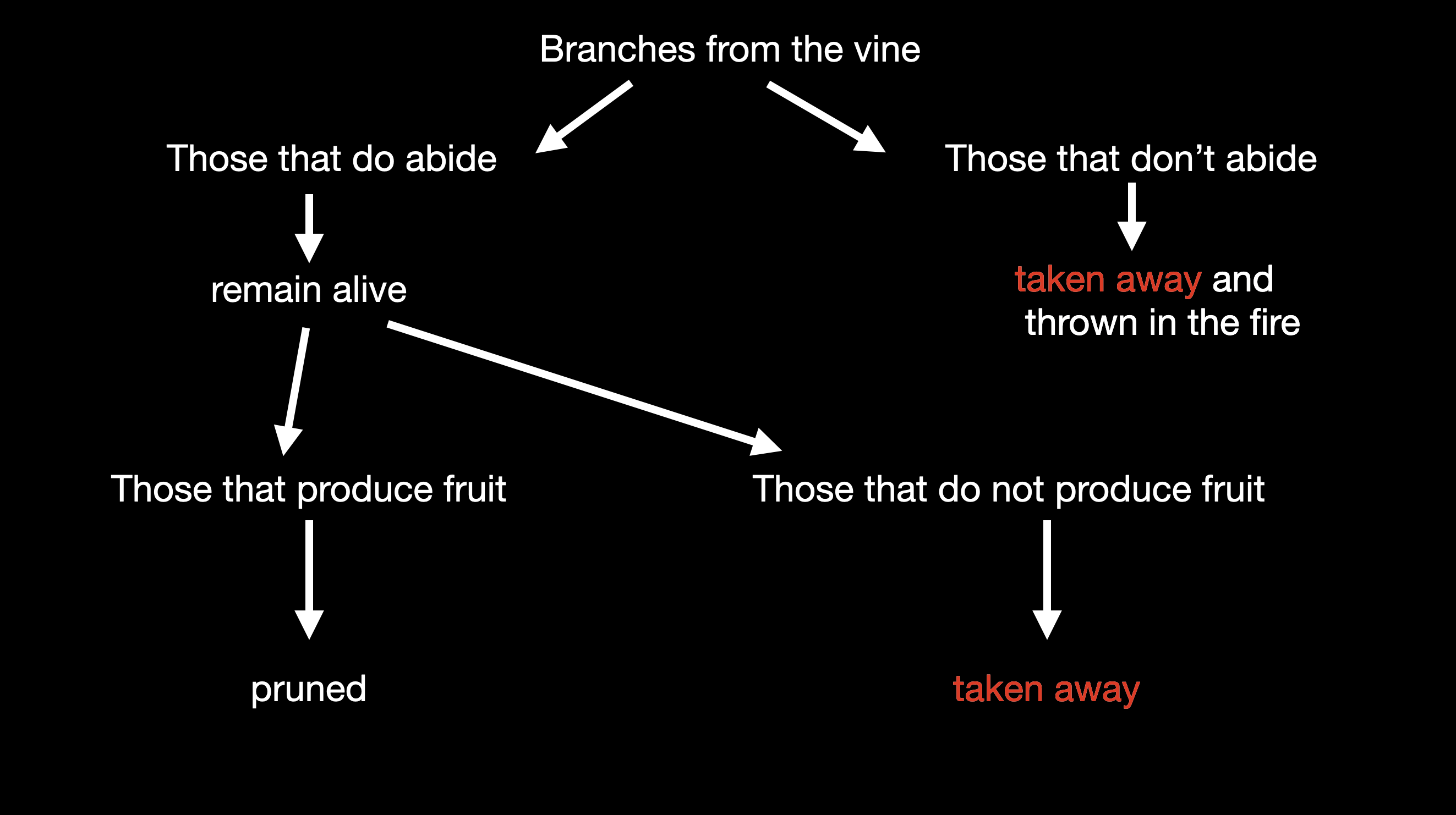
Now you can see what bothers me about this parable. Those who do abide in Christ but are not producing fruit get the same treatment as those who do not abide in Jesus. They are both taken away. That doesn’t seem to fit with the previous parable of the Fig tree. The owner would have the tree dug up, but a grace period was given. The tree would be shown extra care for a year. If it then didn’t produce, then it would be removed. There seems to be no grace or mercy in this vine parable. If you see a fruitless branch, you take it away. Are we missing something?
Let’s look at that verse more closely. The “takes away” is translated from the Greek “airo”. Strong’s Dictionary of the Bible has this entry for ‘airo’.
142. airo, ah´-ee-ro; a primary root; to lift up; by implication, to take up or away;
This Greek word is where we get the word “air,” which is also used in many English words, such as aerobatics, aerodynamics, and aeroplane (British spelling). All these words have the concept of “lifting up.”
So, the primary definition is to lift up. The gardener ‘lifts up’ the unfruitful vine. Does that make any sense to you? Well, it didn’t to the translators, so instead of putting ‘lift up,’ they decided to use the secondary definition of ‘lift up and take away.’ These translators had never been to a small farm in the Middle East and saw how they grew grapes in Jesus’ day.
You know what modern vineyards look like. The vines are carefully set on elevated supports. This makes them more fruitful and also easier to harvest. This is a grapevine from my trip to Jordan last year. Many farmers there still grow grapes as they did 2000 years ago, not on elevated trellises but on the ground.
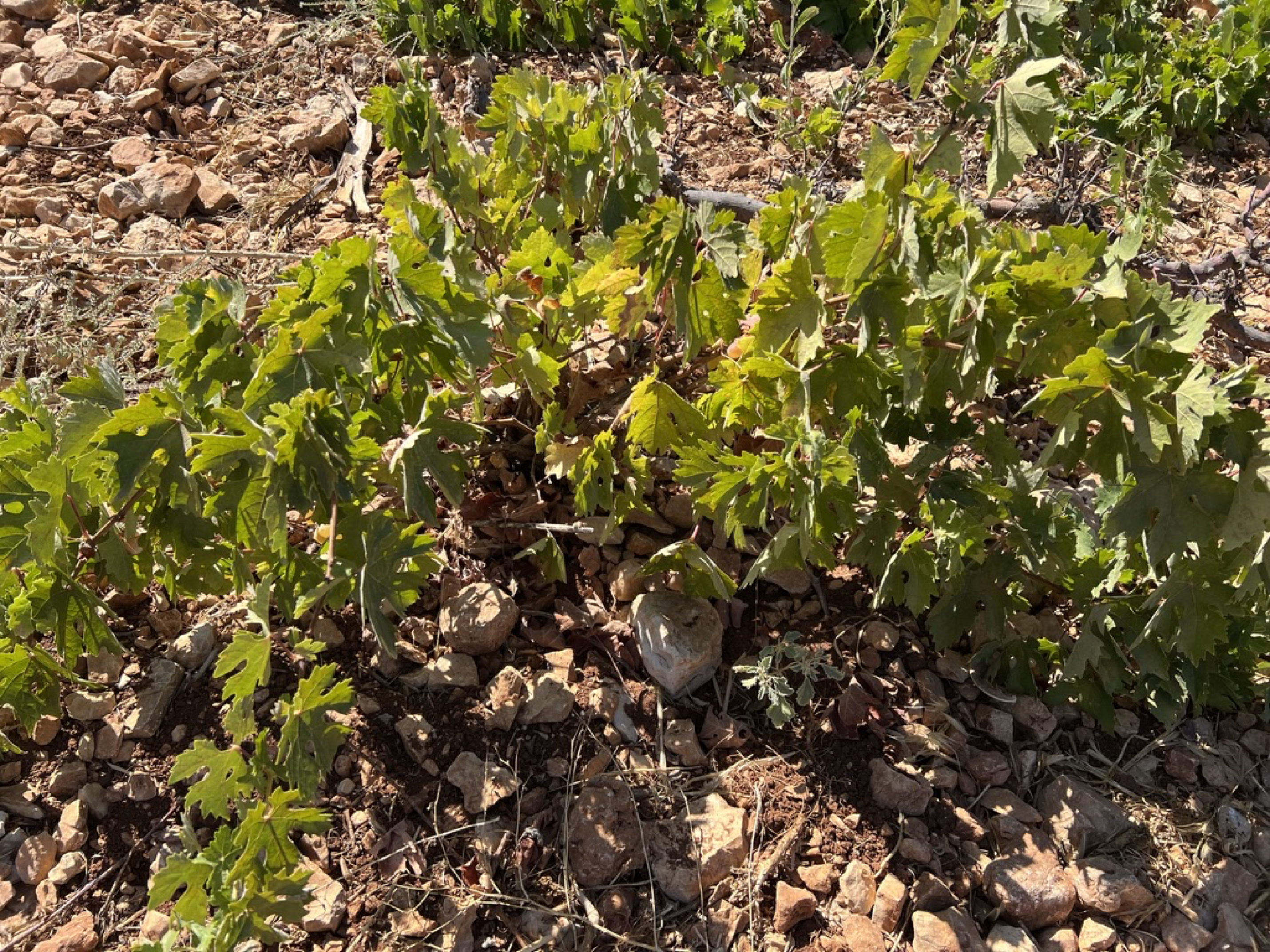
There is one problem with growing grapes on the ground. The vine tends to put down more roots where it touches the soil. If the plant puts down roots, it is not spending its energy producing grapes but producing roots. This makes the branch unproductive. So when the gardener in Jordan sees this happening, he does exactly what they would have done in Jesus’ day. They lift up the vine off the ground and put a rock under it. Then, it will not produce roots but produce fruit.
John 15:2 Every branch in me that does not bear fruit he lifts up.
Remember, in the unfruitful fig tree parable, the owner would dig it up, but the vinedresser, who had cared for that plant for years, wanted to give it another chance. He would show it special care and see if he can get it to produce. There is grace. There is mercy. If we correctly translate the parable of the vine, we see the same care and mercy. If the Father sees you are unfaithful, he doesn’t take you away; He lifts you up.
This has implications for how we treat each other. Someone leaves the fellowship; they stop coming to church and start putting down roots elsewhere. The last thing we should do is cut them off or remove them. We should lift them up. Lift them up in prayer, lift them up with encouragement, and lift up their spirits with kindness and love. When our friends stumble in their faith, we should lift them up.
God is looking for fruit. John the Baptist said, Repent and bring forth fruits worthy of repentance. What are these fruits we should be producing? The crowds before John the Baptist asked the same question.
Luke 3:10-14 And the crowds asked him, “What then shall we do?” And he answered them, “Whoever has two tunics is to share with him who has none, and whoever has food is to do likewise.” Tax collectors also came to be baptized and said to him, “Teacher, what shall we do?” And he said to them, “Collect no more than you are authorized to do.” Soldiers also asked him, “And we, what shall we do?” And he said to them, “Do not extort money from anyone by threats or by false accusation, and be content with your wages.”
Share from your abundance. Do the right thing. If you are a child of God, then act like it. Imitate your father. Paul gave us a list to go along with this:
Galatians 5:22-23 But the fruit of the Spirit is love, joy, peace, patience, kindness, goodness, faithfulness, gentleness, self-control;
Jesus wants us to produce fruit, and he will show us grace if we fail to do so. But as in the fig tree parable, a limit is imposed. The fig tree has one more year to produce fruit. If it didn’t, then it would be dug up.
Believing in Jesus and trusting in him is the starting point, not the ending point. If the privilege of being God’s people does not lead to productivity, it leads to judgment.
Jesus realizes his time is short. He will be crucified in 12 weeks. So, every moment, he finds ways to teach, encourage people, spread the word of the kingdom, and live his life producing as much fruit as he can.
I want to close by leaving you with a quote from an excellent book by John Piper that had a significant impact on me. The book is titled “Don’t Waste Your Life,” I first read it 30 years ago, but it is still timely. Much like Jesus being told of Pilate’s horrible attack on the Galileans, John Piper tells of two women, both about 80 years old, who were serving as missionaries in Africa. The brakes failed in their car, and they went over a cliff and died instantly. Piper asked, “Was that a tragedy?“ “No,” he says,
“I will tell you what a tragedy is. I will show you how to waste your life. Consider a story from the February 1998 edition of Reader’s Digest, which tells about a couple who “took early retirement from their jobs in the Northeast five years ago when he was 59 and she was 51. Now they live in Punta Gorda, Florida, where they cruise on their 30 foot trawler, play softball and collect shells.” [Piper says,] At first, when I read it I thought it might be a joke. A spoof on the American Dream. But it wasn’t. Tragically, this was the dream: Come to the end of your life—your one and only precious, God-given life—and let the last great work of your life, before you give an account to your Creator, be this: playing softball and collecting shells. Picture them before Christ at the great day of judgment: “Look, Lord. See my shells.” That is a tragedy. And people today are spending billions of dollars to persuade you to embrace that tragic dream. Over against that, I put my protest: Don’t buy it. Don’t waste your life.”2
Jesus had only three months before his crucifixion. He couldn’t waste time complaining about politics or current events; he had fruit to produce. None of us knows how much time we have left. Every day is a chance to repent of yesterday’s mistakes and bring fruit worthy of that repentance. In a world filled with bad news, I have good news today. This day, God has given us a gift. He has granted us the grace and mercy of another day of life. As Piper says, please don’t waste it. Make this day fruitful, lifting up praise to Jesus, lifting up our friends, and lifting up the Kingdom of God.
- Not all parables are allegories. An early church father, Origen of Alexandria, who lived around 200 AD, is called the “father of allegorical interpretation.” He felt all parables were allegories and had secret allegorical meanings. Augustine, who lived 200 years later, is also known for making almost every story in the Bible an allegory. Augustine said the Samaritan in the story of the Good Samaritan is Jesus; the thieves are the devil, the priest and the Levite are the Old Testament, the inn is the church, the innkeeper is Paul, and the money he is given is Paul’s counsel of celibacy. Sometimes, when viewing all of Jesus’ stories as allegories, we may lose Jesus’ intended meaning. In this instance, the story loses the purpose Jesus told it for — to answer the question of, “Who is my neighbor?”
- Piper, John. Don’t Waste Your Life . 1994. Crossway. Location 546, Kindle Edition.



 Swallow No Camels