February 10, 2026 –  Persecution and Peace — Acts #29

February 10, 2026 –  Persecution and Peace — Acts #29
Acts 9:26–30 

So let’s review where we are in Acts 9:  Saul was persecuting the followers of Jesus until he encountered Jesus himself on the road to Damascus.  Then he spends 3 years in Arabia to hear the word from God and to practice sharing Jesus with others.  He returns to Damascus, but the Jewish leaders and the governor seek to kill him, and he escapes being lowered in a basket out of the city.  He returns to Jerusalem, but the Jesus followers there are scared of him.  Barnabas serves as a mediator to bring Saul to the apostles, and Saul is welcomed.  That leads us to our scripture this morning:

Acts 9:28-30   So he [Saul] went in and out among them at Jerusalem, preaching boldly in the name of the Lord. And he spoke and disputed against the Hellenists. But they were seeking to kill him. And when the brothers learned this, they brought him down to Caesarea and sent him off to Tarsus.”

So Barnabas got the Jesus followers and Saul together, but it didn’t take long for Saul to get in trouble with the “Helenists” in the city.  Why did they get so upset with Saul?  These “Helenists” are Jews who grew up outside of Israel in the Greek/Roman culture and speak Greek.1  This is the same group that Stephen was speaking to in Acts 6.  This is the group that went to the Sanhedrin and accused Stephen of blasphemy, which led to his stoning.  And once again, they get angry.  Imagine how they feel.  Here is Saul, one of the members of that Sanhedrin who voted to stone Stephen, now saying the very things to them that Stephen said about Jesus.  They see this as ultimate betrayal.  So now they are seeking to kill Saul.  Notice it is the Greek-speaking Jews who are after Paul and not the Jewish leaders, not the Temple authorities.   But Jerusalem is too hot for Saul, so the apostles arrange to send him to the coastal city of Caesarea to catch a boat to his hometown of Tarsus

And this is where we will leave Saul for a bit, after once again having to flee for his life.  Then Acts continues with a surprising verse:

Acts 9:31  So the church throughout all Judea and Galilee and Samaria had peace and was being built up. And walking in the fear of the Lord and in the comfort of the Holy Spirit, it multiplied.

Slow down a minute. After this death threat and yet another escape for Saul, you don’t expect the next verse to talk about a time of peace. But now, there was a time of relative peace for the followers of Jesus, and their number multiplied.  Why had the persecution from the Jewish leaders died down at this time?

I think there are 3 primary reasons. First, because the followers of Jesus were scattered.   

They had all been centered in Jerusalem since the miracle at Pentecost.  They had grown to such a large number (at least 8-10,000) that the Jewish rulers felt threatened.  They were all gathering in the Temple grounds to meet, and there they were preaching about Jesus.  They were right in the faces of these Jewish leaders and were seen as a threat.

When Stephen was stoned to death for blasphemy, they all feared for their lives, and most of them left Jerusalem.  Once the crowd was gone and the rest into hiding, the pressure was relieved.  Those in charge of the temple no longer saw them, so they no longer felt threatened.  Less visibility equals less friction.  Out of sight, out of mind.  They didn’t care so much about small gatherings of believers in the countryside.  Well, there was one in their group who cared very much.

Saul still cared.  He asked for letters to hunt them down all over and have them bound and carried back to Jerusalem for punishment.  So the second reason that persecution died down was what happened to Saul.  When Saul met Jesus and discontinued his attack on Jesus’ followers and then disappeared, the persecution died down.  When he returns three years later, His trouble comes not from the Jewish leaders but from Greek-speaking Jews in Jerusalem.  Without Saul’s driving force on the persecution of Jesus’ followers, the religious authorities in Jerusalem just didn’t seem nearly as concerned about it.

We see what a lightning rod Saul was, first against Jesus, and now for Jesus.  Saul was the powerful driving force behind the persecution. Now you can better understand what Jesus did on the road to Damascus.   With this change, Jesus brought the persecution of his followers to a standstill and, at the same time, created the most dynamic missionary for his movement.  One man coming to Jesus makes a world of difference.

Finally, the third reason for the pause in persecution is that Jewish leaders had other problems brewing.   Something happened in Rome around that time that had a significant effect on matters.  Caligula became emperor of Rome in 37 AD and began a reign marked by cruelty, megalomania, and insanity.  He declared himself god above all other gods. In 40 AD, Caligula issued an order to place a statue of himself in the Jewish Temple’s Holy of Holies.

As you would expect, resistance by the Jews was swift and intense, with mass protests, strikes, and other forms of passive resistance. At one point, the historian Josephus notes that “tens of thousands” of Jews gathered in Tiberias for a 40-day protest.2 The governor of Judea at the time, knowing it would cause war, deliberately delayed the placement of Caligula’s statue.  He was successful in postponing the placement until Caligula was assassinated in Rome in 41 AD, killed by members of his own Senate who judged him to be insane.   

This immediate threat from Rome far overshadowed the troubles of the Jesus followers, so there was a pause in the persecution.  It would, however, soon be back.  In 44 AD, James, one of Jesus’ twelve disciples, was beheaded by Herod Agrippa I.  Peter will be back in prison again, and Saul will suffer all kinds of persecution.   This is but a brief, temporary time of peace. But I want you to consider how this ebb and flow of persecution affected Jesus’ movement.  

After Stephen was stoned, persecution ramped up tremendously.  Under Saul’s leadership, followers of Jesus were being taken bound to the temple courts to be whipped, beaten, and imprisoned.  Their homes were raided.  And so many fled to other parts of the country.

But when they fled, they took Jesus with them.  The towns they settled in became new centers for the Jesus movement to spread.  And their numbers increased dramatically.  Persecution, meant to destroy the movement, actually had the opposite effect, causing it to spread throughout the country and grow tremendously.   

God did not cause the persecution of the early followers.  He did not want his people to be terrorized, beaten, and imprisoned.  Evil men in high places made that decision.  God did not cause it, but he used it.  He took a bad situation, persecution, and made it work for good.

We see this pattern all through the Bible.  Take, for example, the story of Joseph.  You know the story of Joseph and his 11 brothers.   They were all jealous of Joseph.  It seemed their father showed more favor to Joseph than to any of them.  And their jealousy led to the day when they considered killing him, but instead sold their brother into slavery.  And you know how he ended up in Egypt and, through a series of amazing events, came to hold a position of authority, second only to the Pharaoh.  And you know how his brothers, because of the famine, came to Egypt for grain.  And you know the end of the story, in the final chapter of the book of Genesis.  Joseph’s father dies, and his brothers fear that Joseph, the second most powerful man in the most powerful country in the world, will finally seek his revenge on them for selling him into slavery.  And what does Joseph say?

Genesis 50:20   As for you, you meant evil against me, but God meant it for good, to bring it about that many people should be kept alive, as they are today.

Or:  What you intended for evil, God intended for good.  

But let me ask you, when Joseph was thrown into a pit and sold into slavery, did he think that was good?  When he was falsely accused and thrown in prison, did he think that was good?  And let me ask you a better question.  Did God think those things were good?

God by no means wanted Joseph’s brothers to treat him poorly.  God did not want Joseph’s brothers to succumb to sin.   He didn’t want Potiphar’s wife to entice Joseph and then falsely accuse him and have him thrown in prison.  God didn’t do that or approve of it. But hear this:  In the end, the circumstances don’t matter.  No matter what evil threw at Joseph, evil didn’t have the last word.  God did not stop people from doing evil; he rarely does that.  But what He always does is to take the evil meant against his people and turn it to good.  

It is the same in our passage in Acts.  What these evil men (including Saul) meant for evil purposes, this persecution of the followers of Jesus, God turns it around and causes the persecution not to diminish the group, but to cause it to spread and increase.  God was saddened by the response of those who would persecute his people.   It breaks his heart when his people turn against each other.  But again, the circumstances do not matter, because God always has the last word.   His will will be done.  He will work it all out to accomplish His purposes.  That brings us back to our scripture this morning.

Acts 9:31  So the church throughout all Judea and Galilee and Samaria had peace and was being built up. And walking in the fear of the Lord and in the comfort of the Holy Spirit, it multiplied.

So we come to this time of peace in our scripture this morning, when the followers of Jesus are not under persecution, and they can worship freely.  It was the storm of persecution that led to the church’s spread and growth.  So what happens during this time of peace?  Again, the church grows. 

The circumstances are irrelevant.  Whether it is persecution or peace, God’s people grow.   This world is full of evil people doing evil things.  The Scriptures say that the whole earth is being defiled by sin.  Look at how Isaiah describes it:

Isaiah 24:4-6   The earth mourns and withers; the world languishes and withers; the highest people of the earth languish. The earth lies defiled under its inhabitants, for they have transgressed the laws, violated the statutes, broken the everlasting covenant. Therefore, a curse devours the earth….

Isaiah says that our entire planet, which God created as good, suffers and mourns under the weight of sin.  It is full of evil and evil people.  Sin has cursed our world.  So it does not operate as God created it.  There were no natural disasters in the Garden of Eden.  There were no tornadoes, no tsunamis, no hurricanes.  But our world today is not like the garden God made for us.  It is broken.  So you have to expect what we call “natural disasters” to happen. 

Jesus spoke of 2 disasters that had recently occurred.  We find that in Luke 13:

Luke 13:1-5   There were some present at that very time who told him about the Galileans whose blood Pilate had mingled with their sacrifices. And he answered them, “Do you think that these Galileans were worse sinners than all the other Galileans, because they suffered in this way? No, I tell you, but unless you repent, you will all likewise perish. Or those eighteen on whom the tower in Siloam fell and killed them: do you think that they were worse offenders than all the others who lived in Jerusalem? No, I tell you; but unless you repent, you will all likewise perish.

Jesus tells of 2 disasters.  Evil Pilate killing people on the very grounds of the Temple, and a tower that fell in Siloam and killed 18 people.  And for both, he asks them if those who suffered did so because they were worse sinners.  Because people in Jesus’ day felt that God caused or allowed bad things to happen to bad people.  If something bad happened, then you must have sinned.  Remember Job?  Remember the disciples asking Jesus whose sin caused the man to be born blind?    

Sadly, people still think this way.  I have heard people say that if they follow God’s commandments, then God will protect them from disaster.  But Jesus tells us that is not the way God works.  Evil and disaster happen because God gave humanity free choice, and all of us chose sin.  And what is really important is not the disaster of the tower nor Pilate’s slaughter.  What is really important is that we choose to repent of the disaster that we have all brought on our own lives, the disaster of our own sin.   But who the tower falls on is not determined by who is good and who is bad – because we are all bad.  None of us is good.  We all sin and fall short.

Isaiah tells us that natural disasters are only natural in that they are the natural result of sin on the earth.  So don’t blame God when storms or tornadoes or floods come, when towers fall, or evil men commit murder.  That is not the way He meant for the world to be.  And praise Him, one day He will redeem and restore this world to the way He meant for it to be.  But until then, we have to understand that we live in a defiled world full of catastrophes.  And it is the fault of humanity, not God.

But again, hear the good news:  If you belong to Jesus, then learn the lesson of Acts 9.  Learn the lesson of Joseph: Again, the circumstances are irrelevant.   Because each of us lives in a broken world, we all have to expect some bad things to happen.  Things that God never intended to exist in this world.  Things like car accidents, sickness, cancer, theft, child abuse, and murder.  That is not the world God created, but the one we defiled.   But none of those things matter in the long run.  As we see in Joseph’s life and in Acts here, when bad times come, God works them for good.  When peaceful times come, God works for good as well.  God uses times of storm and times of calm.  What sinful people and this defiled world intend for evil, God intends for good.  

And we need that ebb and flow in our own lives.  There are seasons of pressure when we are moved, and there are seasons of calm when we are allowed to grow.  

Anyone doing bodybuilding or weight training will tell you that this is the cornerstone of resistance training.  You push a muscle to its limits, increase the weight, and apply pressure to it. Then you rest it, and it grows.  We now know that what is happening in the muscle is the formation of microtears in the muscle fibers, which the body recognizes as a signal to rebuild stronger to protect against further tears.  You can not achieve results if you don’t put stress on the muscle.  Working out with light weights that do not stress the muscle will not give results.  Similarly, you also can’t see results unless you allow the muscle to recover.  Overtraining, by not allowing time to rest, will also lead to poor results.   You need times of pressure and times of rest.

We need this similar ebb and flow of pressure and peace to develop into the people God wants us to be.  Situations of pressure lead us to see the need for growth, and times of peace give us time to grow.  We see this in the life of Jesus.  There were times when he was in the midst of crowds and times of confrontation.  And he often retreated and withdrew from the crowds for times of peace, for times of prayer.  Times of intense teaching and healing were often followed by times of solitude.  

Even creation echoes this pattern.  There is the growing season, and there is time to let the ground rest.   There is spring, and there is winter.   And God established this pattern for us to live with 6 days to work and one day to rest, to Sabbath. We need both times.  Too much pressure can crush us. Too much peace can soften us.  We will experience times of pressure and times of peace in our lives, and God will use both for our good.

So what season are you in?  A time of testing or pressure, or a time of peace and rest?  If you are in a season of pressure, God may be refining you, pruning some aspect of your life.  Or he may be redirecting you. It may be time for some change.  If you are in a season of peace, that is not the time to coast.  It is the time to deepen your prayer life, redouble your efforts to study the word, and strengthen your faith.  

Whether life comes at you with times of pressure or times of peace, the question to ask is not “Why is this happening?” but instead, “How, Jesus, do you want to refine me in this season?”   

Again, the circumstances life throws at us can be very difficult, but know this: your circumstances do not get the last word; God does.   Or as our friend, whom we left in Tarsus, would say, 

Romans 8:28 “And we know that for those who love God all things work together for good, for those who are called according to his purpose.”

Or as Joseph would say, “What you intended for evil, God intended for good.”

God is at work in your life every day, taking whatever circumstances life gives you and ultimately causing them to work for your good.  We rejoice today, knowing we have a good, good Father who only gives us good gifts. 

1.  Please see note regarding the term “Helenists” in Acts #28.
2.  Josephus, Antiquities of the Jews 18.1.1.

November 18, 2025 –  The Turning Point in Acts— Acts #21

November 18, 2025 –  The Turning Point in Acts— Acts #21
Acts 8:1-8

Today, we come to a significant turning point in the book of Acts.  

Acts 8:1-3  And there arose on that day a great persecution against the church in Jerusalem, and they were all scattered throughout the regions of Judea and Samaria, except the apostles. Devout men buried Stephen and made great lamentation over him. But Saul was ravaging the church, and entering house after house, he dragged off men and women and committed them to prison.

Have you ever been in an earthquake?  Now I have felt some tremors a few times, but I have never been where the ground is actually shaking.  I remember watching a man being interviewed on a newscast years ago after a large quake in California.  He had recently moved there, and it was his first major quake.  He said, “I had no idea what to do.  My first instinct was to run back inside my house.  Your home is supposed to be your safe place.  But everything in the house was shaking, and pictures were falling off the walls.  I just froze.

You may have never been in an earthquake, but you know that feeling.  When things are uncertain, you want to return home, to your safe place.  We humans love our comfort zones, familiar routines, stable jobs, and predictable communities because what is familiar feels secure.  We like to know what’s happening in advance.  We want to do things we know we are successful at.  We prefer doing things we have done before instead of trying something new.  

Max Lucado wrote a book entitled “A Heart Like Jesus.” In that book, Lucado asks us to imagine what it would be like if, for one day, Jesus became you.  He wakes up in your bed, wears your clothes, and takes on your schedule, responsibilities, and friends.  “Jesus lives your life with his heart. His priorities govern your actions.  His passions drive your decisions.  His love directs your behavior.”  Lucado asks, “Would your friends notice the difference?  Would your schedule change?    What if you lived by Jesus’ heart and not your own?”1

Lucado says,  “God loves you just the way you are, but He refuses to leave you that way.  He wants you to be just like Jesus.”   We sing that song, “Just As I Am,” and that is how we come to God.  But Lucado is right, God has no intention of letting us stay the way we were.  

And I see this throughout the Bible; I see God constantly calling people to go to places they have never been before, to do things they have never done before, and to strive to become more than they were.  He told a man who had never seen an ocean or felt a raindrop to build a giant boat.  He told Abraham to leave his homeplace and go to a land he had never seen before.  He told Moses to return to the country he had fled in fear and to tell the most powerful ruler in the world to set all his slaves free.

God told prophet after prophet to deliver bad news to a king.  Jesus told a group of young men to leave their jobs and follow him, and then later said to them that people would hate them and persecute them.   You can not read the Bible and come away with the idea that God wants us to be safe and comfortable, or that it is okay to do nothing and remain the same person you were.

God’s primary interest is not your comfort and safety.   Oh, He believes in a time of rest.  He built a whole day of it into a week, and he is serious about it.  He wants us to rest in Him, not in ourselves.  We like our lives to be calm, peaceful, easy-going, and free from disruption.   But we live in a world that is not calm, peaceful, or easygoing.  It is often more like an earthquake.

And so it happens to all of us sometimes, the ground shakes beneath us. Life is a series of disruptions.   Something happens to upset our safe, calm existence.  It could be a death in the family, a sudden or chronic illness, the loss of a job, or a change in the world.  And all of a sudden, our life is filled with uncertainty and fear.

That’s precisely what happens to the early church in Acts 8. Up until this point, everything in Acts has been happening in Jerusalem, this small city on the map below.  It is so small that the dot on the map is too small to see. 

There in Jerusalem, there is powerful preaching, miracles, generosity, and a caring community.  Thousands are being saved.   Imagine, for a moment, you are a leader in a church like that: thousands of people joining and coming to Jesus in a few months, everyone being cared for, miracles happening.   It’s everything a pastor or church leader dreams of.   If you have all that, you may feel that it is enough.  Things are going well. We just need to keep doing what we are doing.

But in God’s eyes, the tremendous growth in Jerusalem was great, but it wasn’t enough because it was just a tiny dot.   A little bit that you can barely see in a world full of people who need the Gospel.   God sees a bigger picture than we do.  We look at our corner of the county.  See your tiny dot on the map, and then see the whole world like God sees it. 

John 3:16   For  God so loved the world, that he gave his only Son, that whoever believes in him should not perish but have eternal life.

God so loved the world.  It is not, “God so loved our tiny dot…” Not just the people in Jerusalem, Jesus also taught the disciples that He came because God loved the Samaritans.  And later the church in Acts would realize that God so loved not just the Jews, but the people in Asia Minor, and Greece, and even those horrible Romans.  God loves the world, and he wanted the early church to love the world too.  It was not enough that they loved the other Jews in Jerusalem who were just like them.  Things were good there, a growing, caring church.   But God wanted more.  He wants us not just to love each other and the people around us who are mostly like us.   God wants us to love the whole world, not just the small corner we can see.

To really appreciate Acts 8, we need to remember what’s come before. The story of Acts so far has been a spiritual rollercoaster — full of ups and downs, triumphs and trials, good news and bad news.  So let’s recap the Book of Acts.  

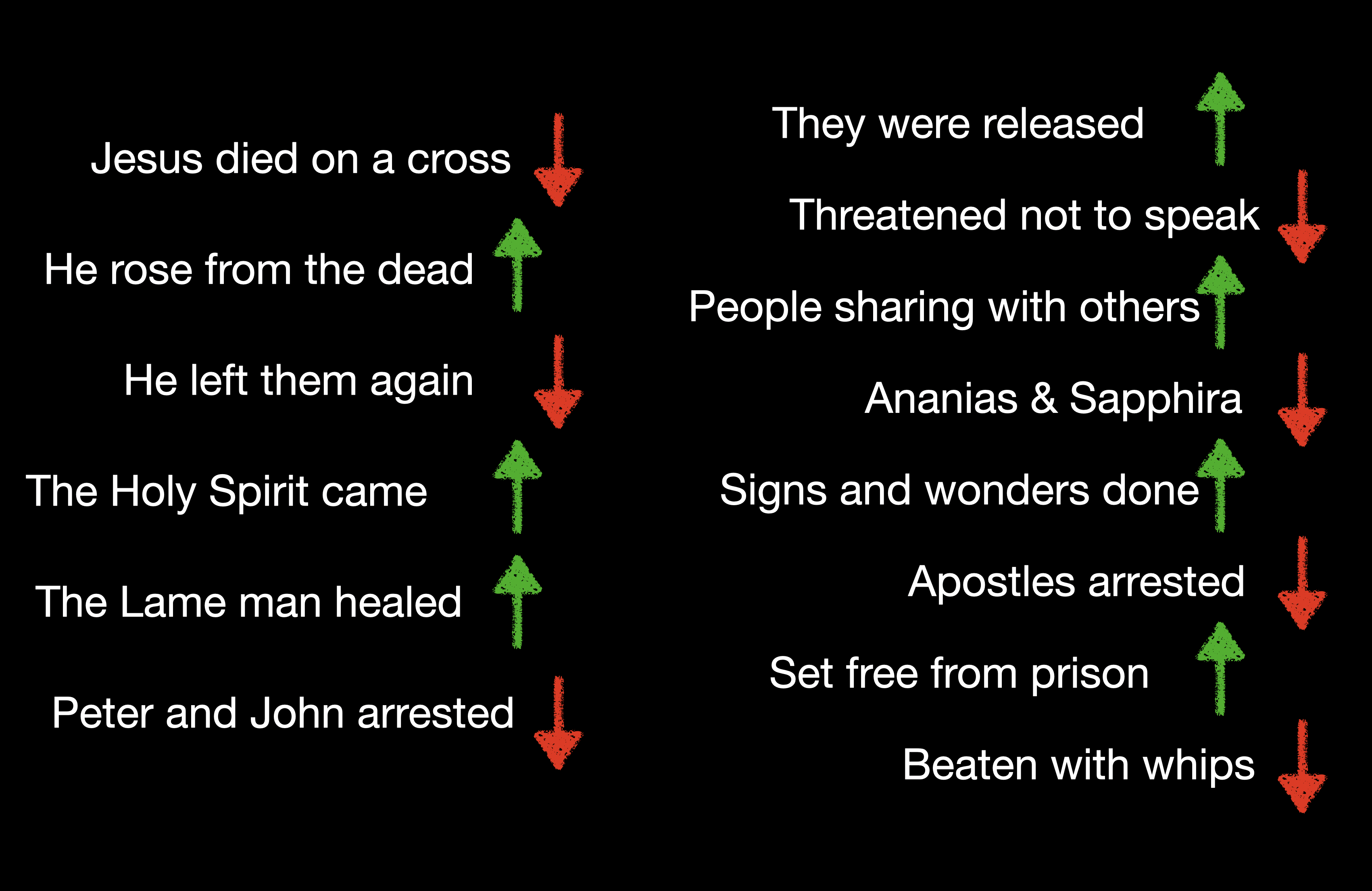
Jesus had died on a cross, which looked bad, but 3 days later he rose from the dead, which was really good. Jesus stayed 40 days teaching his disciples, and then left them, going up to heaven, which was kind of sad. But it was good because He said the Holy Spirit would come.  And that day the Spirit came was a really good day.   And then the day that Peter and John healed the lame man in the Temple was great, until they were arrested and put in jail.  That was bad.  But they were released, and that was good, but they threatened them not to speak anymore about Jesus, which was bad.  Then we read about everyone sharing with those who had needs.   That was good.  But then the story of Ananias and Sapphira, which wasn’t good.  

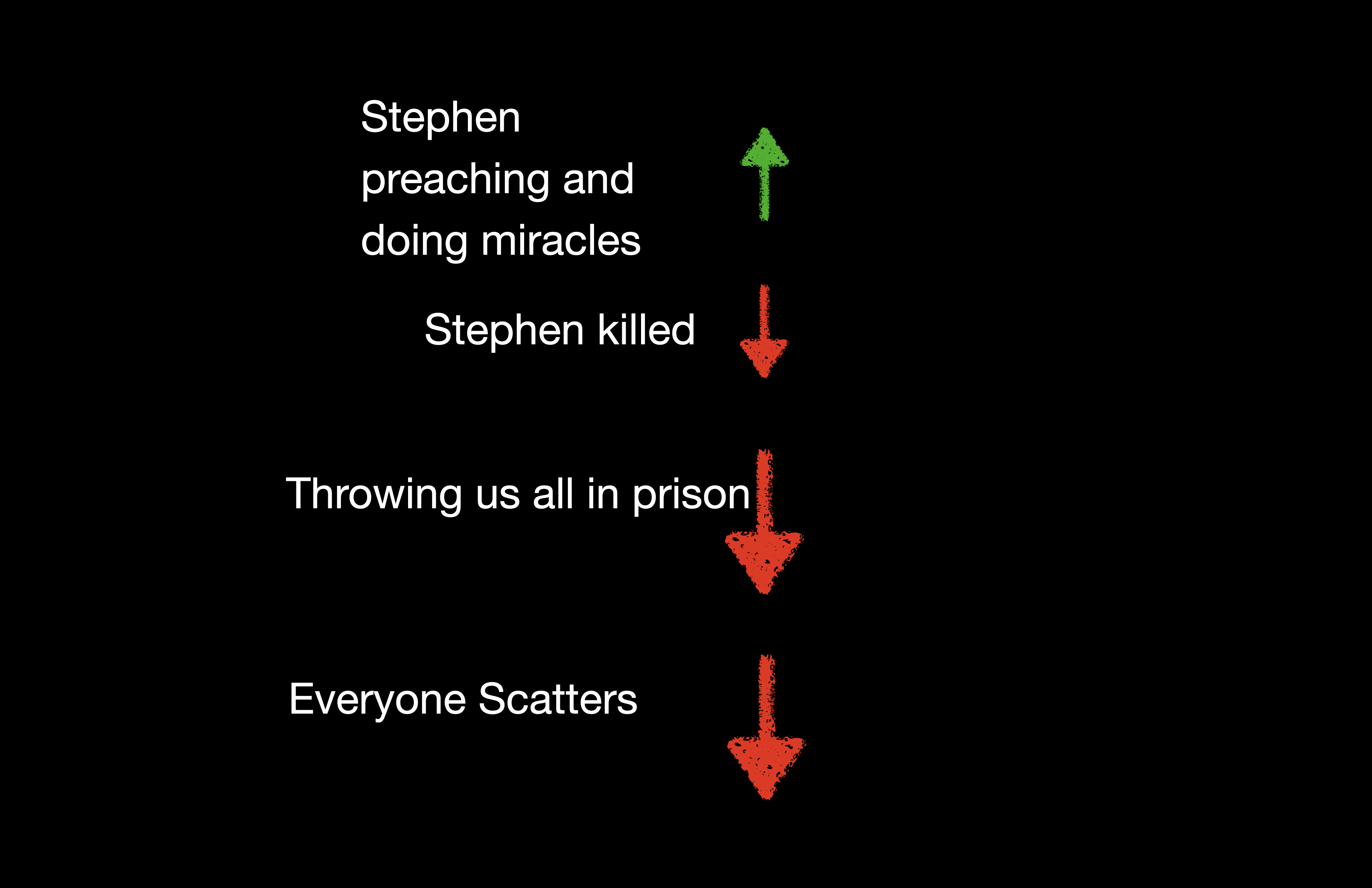
Then miracles were being done, and over 5000 followers had joined the disciples.  Things were going good…until the apostles were arrested (that was bad).  But it was good because an angel set them free, though then, after the court hearing, they were beaten with whips.  Then we read of Stephen, full of the Holy Spirit, preaching and doing miracles.   That was good, until he was killed.  And after that, things got really bad.

  This is a defining moment. For the first time, the church experiences organized, targeted persecution. The honeymoon period is over for these early followers of Jesus.  This is bad.   

Acts 8:1,3  And Saul approved of his execution.   And there arose on that day a great persecution against the church in Jerusalem, and they were all scattered throughout the regions of Judea and Samaria, except the apostles. …But Saul was ravaging the church, and entering house after house, he dragged off men and women and committed them to prison.

This is not just a young man who just watched the clothes while others stoned Stephen.  This zealous rabbi voted in the council to kill Stephen and then went on a rampage, going into homes and dragging off men and women.  Imagine the fear and confusion. Families are split apart. Homes raided. The fellowship they’ve built in Jerusalem — shattered.   They are scared to do or say anything.  They are scared to death.  This is bad news.

By the time we reach Acts 8, the church has experienced incredible highs and devastating lows.   Every time there’s a victory, opposition follows.  Just when things seem to be going good, here comes trouble.  The book of Acts has so far been a rollercoaster of highs and lows, but now, in Acts 8, it seems to be plummeting toward destruction.

Do you see this in your life also?  A rollercoaster of highs and lows, good and bad?  Just when things seem to be going good, here comes trouble.  How do you respond when things go wrong?  Disappointment?  Depression?  Fear?  Hopelessness?  Do you want to question God?  Why did you let them put the apostles in prison?  Why did you let them kill Stephen?  Why did my friend get cancer?  Why do evil people prosper?  Why is there so much trouble in the world?

This persecution should not have been surprising to them or us.  Jesus said:

John 15:18, 20   If the world hates you, know that it has hated me before it hated you…
If they persecuted me, they will also persecute you.”

And remember, He also said this:

Matthew 5:11-12   Blessed are you when others revile you and persecute you and utter all kinds of evil against you …

Oh, but as we discussed before, “Blessed” is the Greek “makarios,” which really means “happy are you” or “how fortunate you are,” so let’s read it that way…

Matthew 5:11-12   How wonderful it is for you when others revile you and persecute you and utter all kinds of evil against you falsely on my account. Rejoice and be glad, for your reward is great in heaven, for so they persecuted the prophets who were before you.

Jesus says that when you are persecuted, you are the lucky ones!  Do you think the followers in Jerusalem saw it that way?  Saul is dragging them out of their houses and throwing them in prison.  And do you think they are celebrating their good fortune?  How does this make sense?

To understand how you are lucky or happy when persecuted, you have to be able to see things from God’s view and not your own.  We need to look through God’s eyes.  We need to see the bigger picture again.   There are three reasons that persecution is good. 

1.  Persecution helps the believer mature and grow in Christ.

Romans 5:3-5   Not only that, but we rejoice in our sufferings, knowing that suffering produces endurance, and endurance produces character, and character produces hope, and hope does not put us to shame, because God’s love has been poured into our hearts through the Holy Spirit who has been given to us.

We need suffering to grow.  It is only when we experience failure, disappointment, persecution, and defeat that we are able to understand that we are not enough.  We learn to depend on our Father instead of ourselves.  We mature as followers of Jesus.

2.  Persecution purifies the church.

It is sad, but there are always those in the church who are not faithful followers but wolves in sheep’s clothing.  But when trouble comes, when persecution comes, their truth is revealed.   We see this in 1 John, and Jesus speaks of it in his parable of the soils.  

Matthew 13:20-21   As for what was sown on rocky ground, this is the one who hears the word and immediately receives it with joy, yet he has no root in himself, but endures for a while, and when tribulation or persecution arises on account of the word, immediately he falls away.

When persecution comes, some will leave the church.  They were never really a member anyway.  We have not had persecution in our time.  So, from what Jesus said, you would expect the church to have a lot of people who aren’t really committed to Jesus.  They are there with joy, but have never given their life to Christ.  And if persecution does come, they will fall away.

3.  Persecution causes the church to grow

Now this doesn’t seem to make a lot of sense.  If Paul is going from house to house in Acts 8, dragging people out to put them in prison, that seems it would have a negative effect on the group of followers in Jerusalem.  But look what happens:

Acts 8:4   Now those who were scattered went about preaching the word.

Verse 4 is a hinge in the book of Acts.  The word “scattered” here — diaspeirō in Greek — is the same word used for scattering seed. It’s not a random dispersal; it’s purposeful planting.  The devil tried to stamp out the fire in Jerusalem, but all he did was scatter the embers — and they caught flame in new places.  Everywhere these believers went, they carried the gospel. They didn’t have a denomination, a mission-sending agency, a church building, a program, or a budget. What they had was the message of Jesus, and that was enough.

Acts 8:5    Philip went down to the city of Samaria and proclaimed to them the Christ.

Philip, one of the seven deacons appointed back in Acts 6, goes to Samaria! Remember how the disciples first responded when Jesus took them through Samaria? They couldn’t believe he was actually going there.   They hated the Samaritans.  They called them half-breed Jews.  They wouldn’t even talk to them.  Jews and Samaritans had centuries of hostility, but the gospel breaks that barrier wide open.  That’s a remarkable scene,  See how the Holy Spirit has changed these followers to be more like Jesus?

Philip is crossing cultural and religious boundaries.   What began with Stephen’s death in Jerusalem leads to joy in Samaria.  The chapter that opened with mourning ends with rejoicing.
The story that began with persecution ends with proclamation.  The bad news becomes the vehicle for the good news.  This is the power of the gospel. And they went further…

Acts 11:19   Now those who were scattered because of the persecution that arose over Stephen traveled as far as Phoenicia and Cyprus and Antioch, speaking the word to no one except Jews.

At the beginning of Acts 4, the entire church, the gathering of followers of Jesus, is all in one city.  All in that one little dot.  But because of the persecution, they scatter like seed and are planted here.

So what is the lesson we learn from this passage in Acts 8?

Application 1: God’s Good News Often Moves Through Bad News
This is a pattern we see all through Scripture. Joseph was sold into slavery so he could save his family. Moses fled Egypt before leading God’s people out of it. The cross looked like defeat until resurrection morning.  Acts 8 continues that pattern — what looks like a disaster becomes divine strategy.  Maybe you’ve seen that in your own life. You lose a job and end up finding a deeper purpose. A relationship breaks down, and you discover how faithful God really is. A closed door becomes the very thing that pushes you toward your calling.

Romans 8:28  And we know that for those who love God all things work together for good, for those who are called according to his purpose.

Listen, God did not want this persecution.  God loved Stephen.  He did not want Stephen to be stoned.  But God gave men free will, and men choose evil.  But God takes the evil that man has done and makes it work for good.  God has a way of turning scattering into sowing — pain into purpose, loss into mission.  So when you get bad news, a bad diagnosis, a financial bad turn, or some tragedy, if you are a follower of Jesus, know that God, who loves you, will take that tragedy and work it for good.

Application 2: Comfort Can Become the Enemy of God’s Purpose

The church in Jerusalem had everything — community, teaching, worship, generosity, and miracles. But all of that was happening inside one city.  And we have to admit, many of our churches today fall into the same pattern. We have programs, fellowship, music, structure — often much more of these than mission. We love being together, but we can easily become so inward-focused that we forget why we exist.

Sometimes, God allows discomfort — in a church, in a ministry, even in a nation — to push His people outward again.  The early church didn’t plan a missions strategy.  Persecution became their mission strategy. God used shaking to send them out.

Application 3: Wherever God Scatters You, Carry the Gospel

Acts 8:4   Now those who were scattered went about preaching the word.

Notice that Acts 8:4 doesn’t say “the apostles” went preaching — it says “those who were scattered.” Ordinary believers. Shopkeepers, craftsmen, mothers, widows, servants. They didn’t have seminary training, but they had stories of grace.  They didn’t have pulpits, but they had conversations.  They didn’t have missionary boards, but they had neighbors. Every believer was a messenger. And wherever they went, the gospel went too.

Maybe God has “scattered” you in a way you didn’t expect — a new job, a new city, a new season of life. Don’t see it as random. See it as God planting you where the gospel can take root.  If you find yourself in an oncology waiting room, find a way to be the gospel there, and maybe even use words.  Stuck in an elevator, waiting in a long line, wherever.  And if you are somewhere uncomfortable, be alert for opportunities to share.  Sometimes God shakes our comfort so He can share His comfort through us.

I don’t go to the movie theater much anymore.  (Even though I love paying $25 for some popcorn and a soda.)  But at a movie, I sit in my seat and watch, and when it is over, then I walk out of the theater and go about my life as if nothing has happened.  Once a week, we come to our seats at church and watch.  And when it’s over, then what?  Is this like a movie, or have we had an encounter with the God of the Universe who wants us to leave this place changed, to leave this place with a mission?  We are not saved to sit.  We are saved to serve.  We can’t fulfill God’s plan for our lives in this building.  

Jesus’ great commission was not “Go to church on Sunday and then go home (after you go out and eat lunch).   It was “Go into all the world and do something that will likely make you uncomfortable.”   

The passage ends in verse 8: “So there was much joy in that city.”   The church’s pain became someone else’s joy.  Their scattering became someone else’s salvation.   That’s the rhythm of the gospel — out of suffering comes life, out of loss comes joy, out of persecution comes expansion.  So when life shakes beneath your feet — when bad news comes — don’t assume God has abandoned you. He might take this opportunity to move you into the next chapter of His plan.  The ground may be shaking, but God is sowing.  What feels like bad news may be the start of very good news indeed.

  1. Lucado, Max. A Heart Like Jesus: Lessons for Living a Christ-Like Life. Kindle Edition. Location 33.