April 27, 28 A.D.  – Jesus rides in a parade, rearranges furniture, and kills a tree.— The Year of the Lord’s Favor #80

Week 63 — Jesus rides in a parade, rearranges furniture, and kills a tree.
Matthew 21:18-19

As we follow Jesus’ ministry day by day, in 28 AD, this is the week of Passover, the week between Palm Sunday and the Resurrection.  At times over the past year, I had only had one short scripture passage to cover the events of that week in Jesus’ ministry.  But the week between the triumphal entry and the resurrection is so important to the story of Jesus that there is a lot of material: Seven chapters of Matthew, five chapters of Mark and Luke, and eight chapters of John.   Almost one-fourth of the material in the four gospels is about this final week.

There is no way to cover the material in those 20 chapters.   So I want to step back this week and get one aspect of the big picture of what is going on in the story of the Bible in that week.  The Bible is one cohesive story of how God is working to reestablish his relationship with his creation, and the key to that plan is what happens in this week and 50 days later.  Jesus does three symbolic acts at the beginning of that week.  We have already discussed two of them, so today, we will look at the third one and see how these fit into that big picture.

Matthew 21:18-19   In the morning, as he was returning to the city, he became hungry.  And seeing a fig tree by the wayside, he went to it and found nothing on it but only leaves. And he said to it, “May no fruit ever come from you again!” And the fig tree withered at once.  

I know what you’re thinking.  “So, out of 20 chapters of Gospel Material from Jesus’ final week, this is what you pick as a focal passage?  And why is Jesus hating on a fig tree? “

At the beginning of Jesus’ passion week, he performs three significant symbolic acts, which carry a lot of meaning to his followers who are familiar with the scriptures. He rides a donkey into the city (the Palm Sunday triumphal entry that we discussed two weeks ago). He drives the money changers and animal salespeople out of the temple area (which we discussed last year), and then he curses a fig tree.

These may seem out of character for the Jesus we have seen this past year—that meek and mild Jesus who told people not to talk about his miracles, who was leaving town when he gathered crowds to try to fly under the radar, and who mostly avoided confrontation. Here, we see him in a big parade entering the capital city, jumping into the middle of a confrontation in the temple, and then performing a miracle of destruction. What has changed? Let’s look at these events.

The cleansing of the Temple happens twice in Jesus’ ministry.  Both at the same time of the year, just before Passover..  Every Jewish person at that same time every year would, in preparation for the feast of Unleavened Bread, go to great lengths to remove every bit of yeast from their homes.  This is to commemorate the exodus from Egypt when they left after Passover and ate only unleavened bread, because they didn’t have time to let the bread rise as they hurried out of Egypt.  Yeast came to represent sin and corruption.  So every home would be cleansed to remove any traces of yeast every year.  Walls would be scrubbed, and cooking utensils boiled in water.  This still happens in Orthodox Jewish homes today.  Jesus enters the Temple and sees that the House of God is full of corruption and takes it upon himself to do some spring cleaning in preparation for the festival.  This has great symbolic meaning to the people of Jesus’ day.  (You can go back to my blog entry of April 10 last year to review.)

Then there is this episode about the fig tree, which seems odd to us.  Again, these are very symbolic acts.  To understand what is really going on in these events, you have to have a good working knowledge of the first 2/3 of the Bible.  But most people don’t spend much time in the ‘First Testament.’  We call it the ‘Old Testament.’   Why study something old when you have something newer?   I really don’t like the ‘old/new’ nomenclature.  Jesus just called the Old Testament ‘the Scriptures.’  The only Bible that Jesus and the disciples ever read is the one that very few people now ever read.

But the Old Testament is the context for the New Testament. Jesus assumes you have a working knowledge of the Scriptures when he talks. Ten percent of his teachings are quotes from the Old Testament.  If you don’t understand his quotes, then you misunderstand what Jesus is saying.  These acts are a good example.  We miss what God is communicating if we are ignorant of the context and connection to the Scriptures.  So bear with me while I go way back to give you the big picture you need to understand the fig tree.

The key to these incidents is found in Malachi, the last book of the Old Testament.  

Malachi 3:1-2a “And the Lord whom you seek will suddenly come to his temple; and the messenger of the covenant in whom you delight, behold, he is coming, says Yehovah Tzavaot. But who can endure the day of his coming, and who can stand when he appears?”

Let me put this verse in its historical context for you.  The Jews were conquered by Babylon in 586 BC.  The Babylonians destroyed the city and the temple. Most of the Jews were taken to Babylon, where they lived in exile for 70 years.  When they finally returned, they rebuilt the wall around the city and the temple.  But they didn’t have the riches of Solomon to build the temple this time, and this temple they built was a sad imitation of the grand structure that had been.  The people came back from Babylon expecting to have all the promises of the prophets come true, that the Messiah would come and set up God’s kingdom over Israel and restore the nation with a time of prosperity, justice, and peace.

But the people don’t see that, so in Malachi, they complain to God, 

“Hey God, things are going very well.”  

And God could answer, 

“You’re telling me, I allowed your country to be conquered because of your sins, hoping that the time of exile would lead to repentance and that you would come back ready to truly follow me and my commandments and abandon your idols.  But you have not repented.  You are committing the same sins as your ancestors did, which got them exiled.”

The people keep complaining to God. (The book has six disputes between the people and God), And he says, 

“You are on my last nerve with all this griping and complaining and bad behavior.”  

(Or maybe that was my wife talking to one of my sons in the backseat of the car one day.)  But Malachi says it this way:

Malachi 2:17  “You have wearied Yehovah with your words.”    [He is tired of your griping.]

They are asking, “Where are you, God?”   Why are they asking this?  They have been back in the land for almost 100 years.  They had rebuilt the temple, and everyone came to the grand opening except God.   He didn’t show up.  To understand this, we have to go back even further.

Remember when Israel first encountered Yehovah in the wilderness of Sinai.  They had escaped from Egypt, and 50 days later came to Mt Sinai.  God invited them to come up on the mountain with him, but on that day, God came on the mountain with a great cloud of smoke, and with fire and the sound of a loud shofar, like a roaring wind.  And it scared the people so that they would not go up on the mountain to meet God.   So Moses goes for them, and while up on Mount Sinai, God gives him instructions to build a tabernacle, a tent of meeting.  God told Moses, 

Exodus 25:8  “Have them build me a tabernacle, a holy place so that I might dwell with them.”

God wants to dwell with his people.  He wants to walk with us like he did with Adam and Eve in the Garden.  Sin destroyed the fellowship between humans and God in the Garden, and the whole story of the Bible is God working a way to restore that fellowship so that he may dwell with his people again.

So they built the tabernacle, and when they dedicated it:

Exodus 40:34-38   Then the cloud covered the tent of meeting, and the glory of Yehovah filled the tabernacle. And Moses was not able to enter the tent of meeting because the cloud settled on it, and the glory of Yehovah filled the tabernacle.

Leviticus 9:23-24  And Moses and Aaron went into the tent of meeting, and when they came out, they blessed the people, and the glory of Yehovah appeared to all the people. And fire came out from before Yehovah and consumed the burnt offering and the pieces of fat on the altar, and when all the people saw it, they shouted and fell on their faces.

Just like on Mount Sinai, God comes in a cloud with fire.  Since they wouldn’t come up on the mountain, God comes to dwell with them in the cloud and fire and leads them with a pillar of cloud by day and a pillar of fire by night.

 And 400 years later, Solomon builds a more permanent structure. And the nation of Israel was at the pinnacle of its wealth.  So this temple was very impressive.  And when it is time to dedicate the temple:

2 Chronicles 7:1-3    As soon as Solomon finished his prayer, fire came down from heaven and consumed the burnt offering and the sacrifices, and the glory of Yehovah filled the temple. And the priests could not enter the house of Yehovah, because the glory of Yehovah filled Yehovah’s house. When all the people of Israel saw the fire come down and the glory of the Yehovah on the temple, they bowed down with their faces to the ground on the pavement and worshiped and gave thanks to Yehovah, saying, “For he is good, for his steadfast love endures forever.”

First at Sinai, then at the tabernacle, and now at Solomon’s temple, God’s presence comes in mighty fashion.  Have you ever been in a church service where you wondered if God was present?  No one left these dedication services wondering if God showed up.  

But things go downhill in Israel, and God punishes the Northern and Southern Kingdoms by allowing them to be conquered by a foreign nation.  Four hundred years after Solomon’s Temple was built, the Jews were conquered by Babylon in 586 BC.  The Babylonians destroyed the city and this wonderful Temple. Most of the Jews were taken to Babylon, where they lived in exile for 70 years.  And that horrible day of destruction is still mourned by Israel today on their calendar on the ninth day of their month of Av.

But the worst part of this tragedy is seen in a vision by the prophet Ezekiel.  Now, most people reading the Bible miss this because Ezekiel is not exactly an easy book to read.  In his vision in Ezekiel 10, he sees God on His throne leave the temple in Jerusalem.  This is that odd vision of the throne chariot with the cherubim and the ‘wheels within wheels.’  God abandoned his temple and allowed the temple to be destroyed.  

Ezekiel 11:23. And the glory of Yehovah went up from the midst of the city and stood on the mountain that is on the east side of the city.   

(What mountain is on the east?  The Mount of Olives.)

But in Ezekiel, there is hope.  God abandoned the temple, but he didn’t abandon his people, and Ezekiel talked about God preserving a remnant and that God will one day take away the heart of stone and give them a new heart.   And in Ezekiel, we have the vision of the restoration, the valley of dry bones brought back to life.  And finally, in Ezekiel, there is a vision of God’s presence returning to the temple. Ezekiel sees God coming back from the East

Ezekiel 43:1-2   Then he led me to the gate, the gate facing east.  And behold, the glory of the God of Israel was coming from the east. 

And 70 years later, Ezekiel’s prophecies started coming true.  A remnant of the people returned from Babylon to Jerusalem and rebuilt the city and the temple, though as I said, it was nowhere near as grand a structure.  And as before, they held a dedication service:

Ezra 6:16-18   And the people of Israel, the priests and the Levites, and the rest of the returned exiles, celebrated the dedication of this house of God with joy.  They offered at the dedication of this house of God 100 bulls, 200 rams, 400 lambs, and as a sin offering for all Israel 12 male goats, according to the number of the tribes of Israel. And they set the priests in their divisions and the Levites in their divisions, for the service of God at Jerusalem, as it is written in the Book of Moses.

It was a grand service, and huge numbers of people crowded in to see the spectacle. But something was missing.  God was missing.  There is no great storm of wind, thunder, clouds, and fire that shows God’s presence in the temple.  They set up the altar, but this time, fire didn’t come from heaven to consume the sacrifice.  They have to light the fire themselves, because God doesn’t show up.

That is why the people of Malachi’s day asked, “Where is God? We rebuilt the temple, but he didn’t show up.”

They knew Zechariah had prophesied of the time when God would return.

Zechariah 8:3  Thus says Yehovah: I have returned to Zion and will dwell in the midst of Jerusalem, and Jerusalem shall be called the faithful city, and the mountain of the Yehovah Tzavaot, the holy mountain.

So we see in Malachi that they complain that God has not returned as he promised. They had conveniently forgotten the first part of Zechariah, which made it clear to them that this was a conditional promise.  

Zechariah 1:3  Therefore, say to them, Thus declares Yehovah Tzavaot: Return to me, and I will return to you, says Yehovah Tzavaot.

But God explains, “You returned to the land, you returned to the city, but you didn’t return to me.  You haven’t repented.   You are still committing the same sins your fathers did that got them exiled.  So I have not returned to you. 

But when the people complain, Malachi answers, “Oh, God is going to come back to his Temple…”

Malachi 3:1 “Behold, I send my messenger, and he will prepare the way before me. And the Lord whom you seek will suddenly come to his temple; and the messenger of the covenant in whom you delight, behold, he is coming, says the Yehovah Tzavaot.”

Malachi says that a messenger of the covenant will come, and then God is coming back to his temple, but he may not come exactly like you want him to come.  The next verse, Malachi 3:2a

“But who can endure the day of his coming and who can stand when he appears?”   

Uh-oh… he is coming in judgment.  Malachi is the last prophet in the Old Testament. There would be 400 years of waiting until another prophet comes, until the time Malachi predicted.  And the Gospels tell us the messenger did come, John the Baptist, preaching repentance, and after that, God returns to the temple 

So in his final week, Jesus is again staying at the home of Lazarus, Martha, and Mary in Bethany.  He has his disciples get a donkey from the nearby town of Bethphage.  And Jesus rides into Jerusalem on the colt of a donkey, with people shouting praise and proclaiming him as king, and he enters the temple. This is the first of those three symbolic acts Jesus did this past week. People of his time easily recognized the symbol of the king being coronated and triumphantly entering the city just as David and Solomon did.  But more than that, God, in the form of Jesus, is coming back to the temple as Zechariah and Malachi prophesied.  And he is coming just as Ezekiel predicted, from the east, from the Mount of Olives.
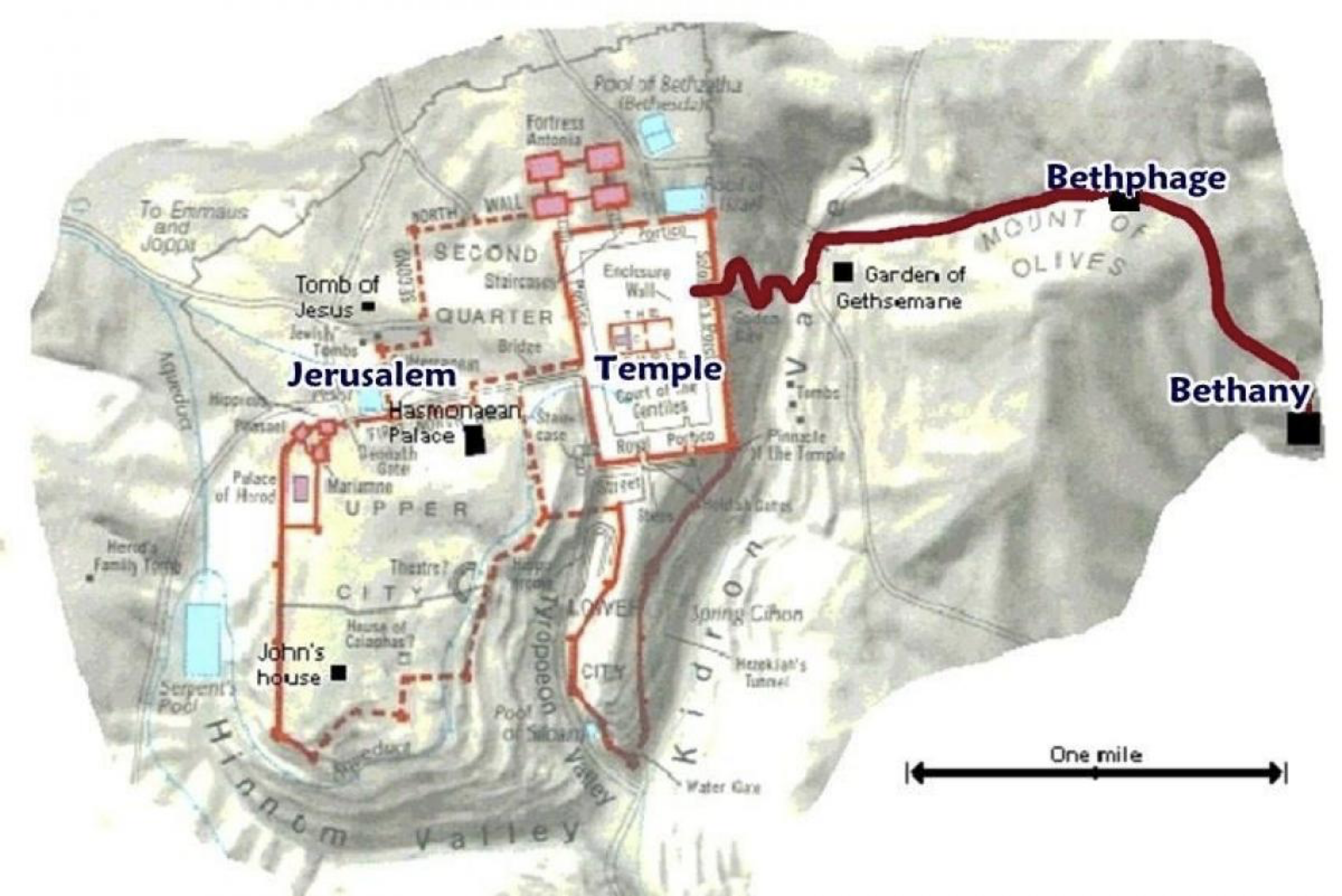
Ezekiel said, “Behold, the glory of the God of Israel was coming from the east.”  The Triumphal Procession on Palm Sunday – God returning to his temple.

And how does Jesus enter the temple?  As Malachi said, He comes not in peace but in judgment.  God’s presence will eventually come, never to depart again.  And it will come with a great sound of rushing and with fire.  But first, God has to deal with the problem of sin.  There has to be a cleansing of the temple first.  Jesus enters the Temple and sees that the House of God is full of corruption, and begins the process of cleaning it out.

Matthew 21:12-13   And Jesus entered the temple and drove out all who sold and bought in the temple, and he overturned the tables of the money-changers and the seats of those who sold pigeons.   He said to them, “It is written, ‘My house shall be called a house of prayer,’ but you make it a den of robbers.”

He drives out the money changers who are charging exorbitant fees for the special coin that could be used to pay the temple tax. Then he turns over the seats of those selling animals and taking advantage of people who have to purchase animals to sacrifice.  And which animals does Matthew specifically note? The pigeons. They were the sacrifices of the poor who could not afford a sheep or goat.  Religion for profit, stealing money from the poor.

He is coming to judge.  As Malachi asked, “Who can endure the day of his coming, and who can stand when he appears?”  But Jesus is just getting started with the cleansing.  Every time he comes back into the temple, the next week he is coming with his gloves off, he speaks in judgment, especially of the Scribes and Pharisees.  Matthew chapter 23 has 7 statements of woe on these leaders because they are ‘hypocrites,’ ‘false teachers,’ ‘blind guides,’ ‘all show and no substance,’ ‘dead on the inside,’ ‘sons of snakes,’ ‘people who will not enter the kingdom of God.’

This is the same Judgment God had passed on Israel in the past.  Look at the similarities from the prophet Jeremiah:

Jeremiah 7:2-11   Hear the word of Yehovah, all you people of Judah who come through these gates to worship Yehovah.  This is what the Yehovah Almighty, the God of Israel, says: Reform your ways and your actions, and I will let you live in this place.  Do not trust in deceptive words and say, “This is the temple of the LORD, the temple of the LORD, the temple of the LORD!”   If you really change your ways and your actions and deal with each other justly, if you do not oppress the foreigner, the fatherless or the widow and do not shed innocent blood in this place, and if you do not follow other gods to your own harm, then I will let you live in this place, in the land I gave your ancestors for ever and ever.

But look, you are trusting in deceptive words that are worthless.  Will you steal and murder, commit adultery and perjury, burn incense to Baal and follow other gods you have not known, and then come and stand before me in this house, which bears my Name, and say, “We are safe”—safe to do all these detestable things?   Has this house, which bears my Name, become a den of robbers to you?  But I have been watching! declares Yehovah.”

And the third symbolic act we find in Matthew 21:

Matthew 21:18-19   In the morning, as he was returning to the city, he became hungry.  And seeing a fig tree by the wayside, he went to it and found nothing on it but only leaves. And he said to it, “May no fruit ever come from you again!” And the fig tree withered at once.  

He sees this fig tree full of leaves.  And these fig trees produce an early fruit that comes when the leaves appear.  It is not as big as the later harvest of figs in the summer.  This fruit is not as good or mature, but these early figs bring the promise of more mature fruit later.   Early figs in Hebrew are ‘phage.’  And this happened in a town called Bethphage, which is in Hebrew, the house of early figs.

If you know the scriptures (the Old Testament), you know the prophets frequently used this symbol of early figs. I could give a bunch of examples, but we only have time for one.

Micah 3:9-12   Hear this, you leaders of Jacob, you rulers of Israel, who despise justice and distort all that is right; who build Zion with bloodshed, and Jerusalem with wickedness.  Her leaders judge for a bribe, her priests teach for a price, and her prophets tell fortunes for money.

Yet they look for Yehovah’s support and say, “Is not Yehovah among us? No disaster will come upon us.”  Therefore, because of you, Zion will be plowed like a field, Jerusalem will become a heap of rubble, the temple hill a mound overgrown with thickets.

Micah 7:1-4  What misery is mine!  There is no cluster of grapes to eat, none of the early figs that I crave.  The faithful have been swept from the land;  not one upright person remains.…

Now is the time of your judgment.

You are wicked and producing no fruit.  You will be judged.

So, as Malachi predicted, God would come back to his Temple, but in judgment. This condemnation of this fruit tree that was all leaves and no fruit is a symbol of Jerusalem. Its leadership is all leaves and no fruit, all show and no substance.  

You have to bear fruit.  This is the message of the messenger that Malachi predicted would come before God came back to the temple.  That messenger was John the Baptist, and he had a 2-part message.

First, “Repent for the kingdom of heaven is at hand.”  — Clean your house, God is coming back.  So all these people were coming to repent, and John said, “Hey, that’s great that you want to repent, but you can’t just say ‘I repent ‘ and then get baptized.  Your life has to change.  

Repentance is not something you say; it is something you do.

So the second part of the message is “You have to bring fruits worthy of repentance.”  You have to perform acts that are consistent with the life you have decided to live.  Don’t tell God you are going to change — show God how you have changed.  Then he warns them that a time of judgment is coming— either bear fruit or perish. And Jesus shows that symbolically with the fig tree.

Remember the reason God didn’t come back to the Temple they built in Malachi’s day?  They didn’t repent.  There is a reason Malachi saw the messenger coming before God came back to his Temple.  There is a reason John comes before Jesus.  The Messenger has to preach repentance before God returns. 

 And John told them it is judgment time, either bear fruit or perish.  Because the Kingdom of God is near.  God it about to return to his temple.  And we are in week 63 of this 70-week study.  You don’t want to miss week 70.  Because that is when God returns in power to his temple, as he did before with fire and the sound of a rushing windstorm.  But first, the temple must be cleansed.   First, there must be repentance.

Repentance is the necessary step everyone must take before establishing a relationship with God, and it is a step we must all continue to take as we walk with Jesus.  The old man dies hard.  We want to make our own rules.  We want to go the way that seems right to us, even though we are warned it leads to destruction.

Don’t miss the story of the fig tree.   But I can’t finish this morning without looking at Jesus’ other story of the fig tree Jesus tells in Luke:

Luke 13:6-9   And he told this parable: “A man had a fig tree planted in his vineyard, and he came seeking fruit on it and found none.  And he said to the vinedresser, ‘Look, for three years now I have come seeking fruit on this fig tree, and I find none. Cut it down. Why should it use up the ground?’  And he answered him, ‘Sir, let it alone this year also, until I dig around it and put on manure.  Then if it should bear fruit next year, well and good; but if not, you can cut it down.’”

Why does this tree get a second chance when the other fig tree is condemned immediately? This Fig tree has been barren for years.  It is just taking up space in the vineyard.  How do we reconcile these two stories?   What is the difference?

This tree has an advocate—a vinedresser who intervenes and asks for mercy on its behalf. Someone who will show this tree more care and love in an effort to encourage it to produce fruit.  Thanks be to God that we have an advocate.

Romans 8:34. Christ Jesus is the one who died—more than that, who was raised—who is at the right hand of God, who indeed is interceding for us.

1 John 2:1  We have an advocate with the Father—Jesus Christ, the Righteous One.

We have a loving, merciful Father who remembers his children not for the day of their trouble, but the day of their salvation.  He remembers us not for our worst day but for our best day.

And Jesus and the Spirit within us are interceding for us.   And we can intercede for each other.  We can go before the Father asking God to be merciful just as this vinedresser interceded for this tree.  We can then, as the vinedresser did for the tree, show these people love and encourage them to produce more fruit.

Time is short.  Spend time in prayer before the Father on behalf of your friends and family.  And each day, seize the opportunity to produce fruit.
February 4, 27 A.D.  –  Many or Few? —   The Year of the Lord’s Favor #70

Week 51 — Many or Few?
Luke 13:22-31

Luke 13:22-30   He went on his way through towns and villages, teaching and journeying toward Jerusalem.   And someone said to him, “Lord, will those who are saved be few?” And he said to them, “Strive to enter through the narrow door. For many, I tell you, will seek to enter and will not be able. 

For the past four weeks, Jesus has been traveling in Perea, the land east of the Jordan River. His time is getting shorter. In this chapter of Luke, we learn that Herod is out to get Jesus.

Luke 13:31   At that very hour, some Pharisees came and said to him, “Get away from here, for Herod wants to kill you.”

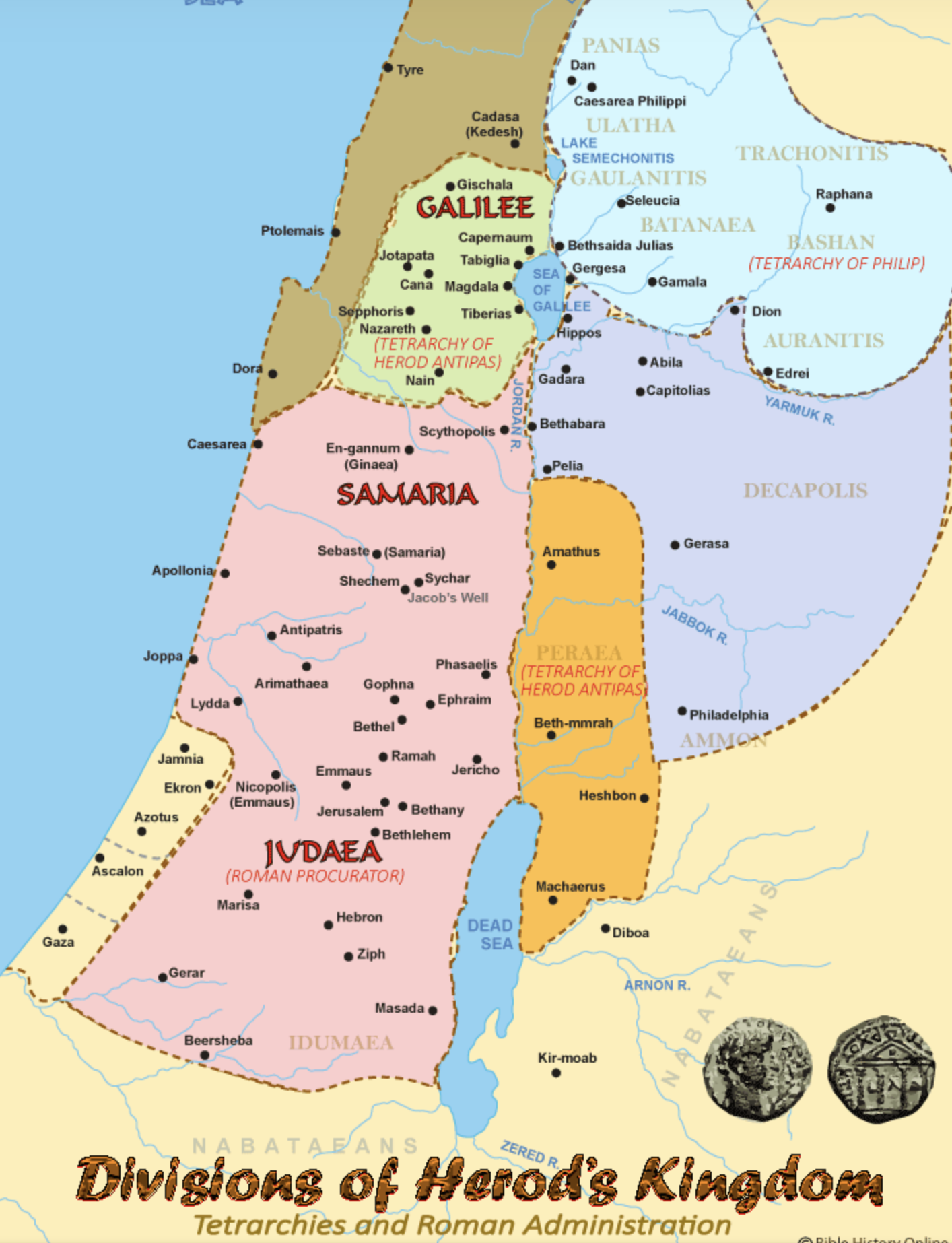
Which Herod are they talking about?  There is Herod “the Great,” the king who tried to kill Jesus after his birth, but that Herod died shortly after this event.  His kingdom was then divided among his sons, who rather confusingly also called themselves ‘Herod.’  (‘Herod’ in Greek is ‘hero.’)   Herod Philip got the territory in blue on the map below, which includes the towns of Bethsaida and Caesarea Philippi.  Herod Archelaus got the territory of Judea and Samaria in the pink, but he only ruled for 9 years.  Caesar deposed him, and the territory was made a Roman Province, with Pontius Pilate in charge of this area.   Herod Antipas (half-brother of Philip) got Galilee and Perea.  This is the Herod that was called out by John the Baptist for marrying his brother Phillip’s wife.  Herod Antipas had John the Baptist imprisoned in his fortress in Macherus in Perea and then had him beheaded.  When Herod Antipas learned of Jesus, some told him that Jesus was John the Baptist, who had been raised from the dead.  

So Jesus has been traveling and teaching for over a month in Herod Antipas’ territory in Perea.  Jesus had likely come further south, closer to Herod’s palace in Macherus, so Jesus was warned to leave the area.  Now, Jesus begins to journey back through Perea, eventually passing through Jericho and returning to Jerusalem.  On his way, someone asked Jesus a question:

“Lord, will those who are saved be few?”

“Will many be saved or few?”     It is a good question.  Jesus began with a very small following, and sometimes crowds of thousands followed him.  Then Jesus will say something the crowds don’t like, and many of them will leave.  Then he will do miracles, and the crowds will gather again.  Will there be many saved or few?  It is an interesting question today.

Remember, in the Bible’s first book, God promised Abraham that his offspring would be as countless as the stars.  

Genesis 15:5  “…number the stars, if you are able to number them.” Then he said to him, “So shall your offspring be.”

In the last book, Revelation, we read this:

Revelation 7:9-10  After this I looked, and behold, a great multitude that no one could number, from every nation, from all tribes and peoples and languages, standing before the throne and before the Lamb, clothed in white robes, with palm branches in their hands, and crying out with a loud voice, “Salvation belongs to our God who sits on the throne, and to the Lamb!” 

A multitude that no one can number- the promise to Abraham being fulfilled.

In the days of the early church, a tiny fraction of the Earth’s population were followers of Jesus.  Today, about one-third of the world’s population, 2.7 billion people, claim the Christian faith. If only 1% of the world’s current population were saved, the resulting assembly of 82 million people would look like an uncountable multitude. Still, compared to all the people who have ever lived (109 billion by some estimates), it would seem to be few.  

So, will it be many or few?  What is the answer?

Or, as some have suggested, will everyone be saved?  Will all 109 billion enter heaven?  In 2011, Rob Bell published a book entitled Love Wins, the premise being that, eventually, everyone will be saved.  He quoted 2 Peter 3:9, that God is not willing that any perish but that all should come to repentance, and interprets that to mean that one day all will repent.  He says that if God wills it, then it must happen. 

Bell refers to Revelation 21:25, which says that the gates of Heaven are never shut. Bell applies that verse to Jesus’ teaching in Matthew 7 about entering through the narrow gate.  However, city gates were closed in those days to keep out an enemy or to be shut at night for safety.  But the point in Revelation is that in the world to come, there is no enemy, and there is no night.  So, gates never have to be closed.  Bell stretches this to say that, eventually, everyone, even if after spending time in hell, will decide to enter those always open gates. 

This is not a new idea.  Theologians, as early as Origen, in the third century, promoted this idea of universalism, that everyone would be saved.  ‘Love Wins.’  It is a pleasant thought, but does this fit with what Jesus said in our passage today?

Luke 13:23-28   And he said to them, “Strive to enter through the narrow door. For many, I tell you, will seek to enter and will not be able.  

Jesus said, “Many will seek to enter and not be able.” And he said that we must ‘strive’ to enter…”  The Greek word for ‘strive’ is ‘agonizomai.’  We are much more Greek than we realize.   Isn’t it interesting how we can see many English words in these Greek words?  There, you see our word ‘agonize.’   Jesus says it is a struggle; it takes tremendous effort.  The only other time we see that same word on Jesus’ lips is in John 18.  There it is translated as ‘fighting.’

John 18:36  Jesus answered, “My kingdom is not of this world. If my kingdom were of this world, my servants would have been fighting, that I might not be delivered over to the Jews. But my kingdom is not from the world.”

We must strive to enter; it is agonizing, a struggle, a battle.

What is this agonizing that Jesus says we must do to enter this narrow door?  And if it is a battle, who is the enemy?  And are we saying this is righteousness by works?   Are we striving to earn our salvation?  Definitely not!  You probably know this verse:   

Romans 6:23   For the wages of sin is death, but the free gift of God is eternal life in Christ Jesus our Lord.

But did you know the word ‘free’ is not in the Greek there?   The Greek word for ‘gift’ is ‘charisma,’ a gift given not on merit but by undeserved favor.  So, the gift is given out of grace.  It is undeserved.  It cannot be earned.  But unfortunately, when we read the word ‘free’, some get the idea that there are no requirements to accept it. But there is a requirement.

To illustrate this in church, I held up a $5 bill and told the congregation I would give it away to anyone who asked. It was free and available to anyone, but accepting it required action.

‘Eternal life in Christ’ is an unearned gift of grace, but to accept it, there is a harsh requirement.  You have to die.  Paul said it this way:

Galatians 2:20  “I have been crucified with Christ.  It is no longer I who live, but Christ who lives in me.”  

You must die to yourself.  You have to decide that you are not the best to make decisions for yourself.  You have to decide that you should not follow your own rules.  You have to determine that you can not be the ruler of your life.  You have to choose to change the way you live by changing who makes your decisions.   We call that repentance.  So you die to your selfishness and turn over your life to God instead, agreeing to live by his rules and follow his ways.  Jesus called this ‘denying yourself.’

Matthew 16:24  “Whoever wants to be my disciple must deny themselves and take up their cross and follow me.” 

The gift of forgiveness and salvation is free, but it is very costly to accept it and become a disciple.

Some people do this when they walk down an aisle and get baptized.  At that moment, they decide to die to themselves and live with a different king over their life, a king they will obey no matter what he asks.  But some people walk down an aisle and want to be saved. They don’t want to go to hell; they want to be in heaven when they die.  They are willing to say that in front of a church and are willing to get sprinkled or dunked in water publicly.  But they may not have understood that there is a prerequisite.  

The prerequisite for accepting the gift is repentance, not just a repentance of specific sins, but a complete change in how you decide your life.   You must repent of the sin of making yourself the God and the King of your life.  There can only be one God, one King, and that is not you. That is the repentance that matters.

And the gift we get differs significantly from the $5 bill I gave away.   Because this is not a gift you can hold in your hand and decide to spend whenever you want; it is not a ticket to a place called heaven that you can redeem when you die.  The gift is ‘eternal life in Christ Jesus our Lord.’  The gift is a relationship, life in Christ.  It is a relationship with Jesus that begins today.  But the relationship is that of a king to his subject.  If Jesus is not your king, then you have no relationship with him.  

Repentance is a struggle, not just a one-time decision.  Oh, one day, you decide to put Jesus in charge of your life.  You repent of trying to run your life your own way.    And God grants forgiveness.  But then your old self that you tried to kill — you find out that the old man dies hard.  So you find yourself ignoring God’s leadership in your life, and you are back to being your own boss and king.  Instead of doing what God wants you to do, you do what you want.  (Paul admits to having this same struggle also.)  And then you have to repent of those things, but more importantly, repent of kicking God off the throne of your life.

That is the struggle; that is where we strive.  And the enemy we strive against is our self, our sins, and our desire to make our own decisions.  This is the same struggle we see in Genesis 3.  Adam and Eve have to decide who gets to make the rules, who decides what is good and what is not good, and who is the king of their life, God or themselves?

That is not us working for our salvation; it is us doing the work that results from our salvation.  For you see, we have no hope of being successful in this without God’s help.  That is why God sent his holy spirit to dwell in us so that we would have his presence with us to enable and empower us to win this battle with ourselves.

Let’s look at the rest of our passage this morning.  

Luke 13:23-28   And he said to them, “Strive to enter through the narrow door. For many, I tell you, will seek to enter and will not be able.  When once the master of the house has risen and shut the door, and you begin to stand outside and to knock at the door, saying, ‘Lord, open to us,’ then he will answer you, ‘I do not know where you come from.’   Then you will begin to say, ‘We ate and drank in your presence, and you taught in our streets.’   But he will say, ‘I tell you, I do not know where you come from.  Depart from me, all you workers of evil!’  In that place, there will be weeping and gnashing of teeth when you see Abraham and Isaac and Jacob and all the prophets in the kingdom of God, but you yourselves cast out.

Sadly, many will want to enter into God’s salvation but will not be able to because they are not willing to repent.  They want to be in heaven with Jesus, but they refuse to let God be king.  They have to be their own king.   If you do not know God as your king, then you don’t know him at all.

Look at the parallel passage in Matthew 7:

Matthew 7:21-23   “Not everyone who says to me, ‘Lord, Lord,’ will enter the kingdom of heaven, but the one who does the will of my Father who is in heaven.  On that day many will say to me, ‘Lord, Lord, did we not prophesy in your name, and cast out demons in your name, and do many mighty works in your name?’   And then will I declare to them, ‘I never knew you; depart from me, you workers of lawlessness.’

Who enters the kingdom of heaven?  Only the ones who do the will of the Father in Heaven.    

Jesus divides all people into one of two groups.  And it is not those who did bad things and those who did good things.  It is not those who were kind and those who were mean.  It is not those who went to church and those who did not.  It is those who do their own will and those who do God’s will.

Again, Jesus tells us that many will not enter the kingdom of heaven.   And look at this group who doesn’t enter.  They prophesied in Jesus’ name.  They spoke inspired words in the name of Jesus.  They cast out demons.  They did mighty, powerful works in the name of Jesus.  

They did many good things, but Jesus said he never knew them.

Doing great things will not impress God.  Doing obedient things will.   If the good things you do are not God’s will, if they are your idea instead of HIs, it doesn’t matter how good you think they are.  

Not everyone who says to me, ‘Lord, Lord,’ will enter the kingdom of heaven, but the one who does the will of my Father who is in heaven.

Do you see why Jesus talked about the kingdom of God more than anything else?  Do you see why the first word he publicly speaks is ‘Repent’?

Repent for the Kingdom of Heaven is at hand.

The only way to enter the kingdom is to repent.  Repent of your rebellion against the king.  Turn your life around and decide to be obedient to the king.  You must place yourself under the king’s reign to be in the kingdom.  If you don’t accept God’s rule over your life, then you have no relation to God.  Either God is your king, or he is a stranger.   There is no in-between.

You see, you can not earn your way into the kingdom with good works.  The people in this scripture passage did powerful, wonderful things but were turned away.  “Depart, for I never knew you.”

God, through the sacrifice of Jesus, can forgive your sins and redeem you from your slavery to sin.  We are raised to new life, a life of continual surrender of our will to Him.  We don’t submit our will to God in order to do exactly what we want to do anyway. We submit to do his will.  And you can’t expect to surrender your life to God and make him king of your life and then not expect him to give you things to do.  Paul has told us that God has prepared a list of things for us to do ahead of time:

Ephesians 2:10   For we are his workmanship, created in Christ Jesus for good works, which God prepared beforehand, that we should walk in them.

So there will be things God wills for us to do.  And if indeed you did submit to the king, you will be obedient to all he asks of you.

You know the parable of the two builders in Matthew 7.   One built his house on the rock, and when the rain, wind, and flood came, it stood.  The other built his house on the sand, and when the storm came, the house fell apart.  This story comes right after this scripture we just read.  It begins in verse 24.  Jesus concludes his most famous sermon with this story.  He tells those listening to him that they are either the ones building off the rock or the ones building on the sand.  What is the difference?

Matthew 7:24-27     “Everyone then who hears these words of mine and does them will be like a wise man who built his house on the rock.   And the rain fell, and the floods came, and the winds blew and beat on that house, but it did not fall, because it had been founded on the rock.   And everyone who hears these words of mine and does not do them will be like a foolish man who built his house on the sand.   And the rain fell, and the floods came, and the winds blew and beat against that house, and it fell, and great was the fall of it.”

They were all hearing Jesus speak on that mountain.  But only some would do what he said.  And that makes all the difference. Hearing without doing so leads to destruction.  

Rob Bell is wrong.  Sadly, not everyone will be saved.  One day, the door will close, people will knock to enter, and God will say, “I never knew you.  I never had a relationship with you.”  One day, God will separate all humanity that has ever lived into a group on the right and a group on the left.  (See Matthew 25:31-46.)  And what does he say the difference will be?

One group gave food to the hungry, drink to the thirsty, welcomed the stranger, clothed the naked, and visited the sick and imprisoned.  The other group did not do these things. And Jesus told them that these things they did for “the least of these” they actually did for him.  Jesus notes that both groups are surprised.  Neither group had any idea that what they were doing was for Jesus. All they had done was to be obedient to share what they had with others who were needy, because that was the will of their King.  

Look back at the passage from Luke 13 above.  Does this sound like the gates or doors of heaven are always open?  No.  There comes a time when the master of the house shuts the door.  And then many people will want to enter but will not be able to enter.

Jesus never answered the question, “Lord, will those who are saved be few?”

He answers this question about the number by saying: Be sure you’re in the number.  The important question is not: How many will be saved?  The critical question is, will you be saved?  Will your family be saved?  Will your friends be saved?  It is too important to make assumptions, for as Jesus has told us, many will be surprised.  I beg you to make sure you know where you and your friends stand.

That narrow door is open.  One day, the door will close.  Whatever the number, be sure you are in that number.

Oh, when the saints go marching in.  Oh, when the saints go marching in.
Oh Lord, I want to be in that number when the saints go marching in.

January 20, 27 A.D.  –  The Bad News First, then the Good —   The Year of the Lord’s Favor #68

Week 49 —Fruitless
Matthew 20:1-16, Luke 13:1-9 

Jesus is still teaching in the area east of the Jordan, and in our passage today, someone interrupted him to tell him some bad news.

Luke 13:1-6   There were some present at that very time who told him about the Galileans whose blood Pilate had mingled with their sacrifices.  And he answered them, “Do you think that these Galileans were worse sinners than all the other Galileans because they suffered in this way?   No, I tell you; but unless you repent, you will all likewise perish.   Or those eighteen on whom the tower in Siloam fell and killed them: do you think that they were worse offenders than all the others who lived in Jerusalem?   No, I tell you, but unless you repent, you will all likewise perish.”

Sometimes, you read something in the Bible and ask yourself, “Why is that in there?”

But you can’t get away from it — the news is full of stories of natural disasters of fire and flood or news of senseless beatings and horrible murders by evil people.  The people in Jesus’ day didn’t have to deal with our 24-hour news networks or a phone that interrupted their day with ‘breaking news.’  But bad news has always traveled fast.  In this passage, someone tells Jesus about Pontius Pilate ordering his soldiers to attack some Jews from Galilee.  

How do you react to bad news?  How does Jesus respond?

We don’t know precisely what the situation was about this slaughter of these people.  Apparently, Pilate ordered his soldiers to kill some people from Galilee while they were performing sacrifices, so this would have happened in the Temple courtyard.  We don’t have any other confirmation of this account, but the historian Josephus records several incidents in which Pilate put down potential rebellions with overwhelming force.  Let me tell you just a couple.  Jerusalem was growing in population and faced a water shortage.  Pilate had an aqueduct constructed to bring water into Jerusalem, but he took money from the temple treasury to build it.  Money that had been dedicated to God.  A large crowd of people gathered to protest the misappropriation of God’s money, and Pilate had his soldiers dress in Jewish clothing, blend in with the crowd, and, at his signal, begin beating them to death.  Josephus records a similar incident when Pilate brought Roman standards with the likeness of Caesar into Jerusalem, which the Jewish law did not allow.  Again, the people protested, and Pilate had many of them killed.  Pilate was finally removed from office by the emperor when he overreacted to another disturbance and slaughtered a group of Samaritans.  So, this account is certainly consistent with Pilate’s previous actions.  

But why did Luke include this story in his account of the gospel?

First, what was the person’s motive for bringing this account to Jesus?  How did they hope Jesus would react?  I can see the fellow now.  “Look, Jesus, Pilate killed all these people who were from where you grew up!  He slaughtered them while they were worshipping in the Temple!  Can you believe it?  He is so evil.”  He is certainly expecting Jesus to agree with him that Pilate is an evil man and deserves God’s wrath.  “See, the Roman Empire is evil.  Perhaps we should rebel.”

But how does Jesus reply? 

And he answered them, “Do you think that these Galileans were worse sinners than all the other Galileans because they suffered in this way?

Remember that people in Jesus’ day believed that misfortune was due to sin.  If bad things happen to you, then it is likely that you have some sin you need to confess.  Some people still believe that today.  Obviously, these people have not read the Book of Job.  When the disciples see a man who was born blind in John 9, they ask Jesus a question.

John 9:1-3   As he passed by, he saw a man blind from birth.  And his disciples asked him, “Rabbi, who sinned, this man or his parents, that he was born blind?”  Jesus answered, “It was not that this man sinned, or his parents, but that the works of God might be displayed in him. 

Jesus refutes the idea that misfortune is due to sin.  And he says God didn’t allow these Galieans to be killed by Pilate because they were sinners.

And he answered them, “Do you think that these Galileans were worse sinners than all the other Galileans because they suffered in this way?   No, I tell you; but unless you repent, you will all likewise perish.

Then he gives them another example:

Or those eighteen on whom the tower in Siloam fell and killed them: do you think that they were worse offenders than all the others who lived in Jerusalem?   No, I tell you, but unless you repent, you will all likewise perish.”

This is not at all the expected response. Jesus contradicts the current idea that misfortune is due to sin. He ignores the perfect opportunity to talk about how evil Pilate is. Instead of condemning Pilate or the Roman Empire, he calls on everyone standing there with him to repent of their sins, or they will perish.

You can’t watch 30 minutes of news without being horrified.  Just this week, a gang member of MS-13 got a plea deal to avoid maximum punishment for killing at least seven people, including two teenage girls who were beaten with baseball bats and machetes.  When you hear news like this, how do you respond?    You want those people to be punished.  You are sickened by the magnitude of their sin.  So why doesn’t Jesus jump on the anti-Pilate bandwagon?

It is easy to join everyone else in condemning someone for an evil act. But Jesus doesn’t go there. He has more important things to discuss. He realizes that he only has 12 weeks left to teach everything he needs to, for in three months, he will be killed.  He can’t waste any time.

These people want him to condemn Pilate.  Jesus will talk to Pilate on the day he is crucified.  But Pilate is not here now.  But there are people in front of him now that he can teach.  There is no sense in wasting time fussing about Pilate.  That doesn’t help Pilate or these people.  But it is a chance to tell the people before him that they also need repentance.   Jesus is still preaching the same message he started with.  The same message John the Baptist preached.  “Repent, for the kingdom of heaven is at hand.”  

Then Jesus tells us this parable:

Luke 13:6-9   And he told this parable: “A man had a fig tree planted in his vineyard, and he came seeking fruit on it and found none.   And he said to the vinedresser, ‘Look, for three years now, I have come seeking fruit on this fig tree, and I find none.  Cut it down. Why should it use up the ground?’   And he answered him, ‘Sir, let it alone this year also until I dig around it and put on manure.   Then, if it should bear fruit next year, well and good; but if not, you can cut it down.’”

Wait a minute, what does this have to do with what we were talking about?

We have horrible news about an evil politician murdering innocents and an awful accident in which a building fell on people, and then Jesus tells us we need to repent or we will perish.  Then he jumps to a story about a fig tree not bearing fruit.    Are you having trouble following this conversation?

It makes sense if you realize that repentance and bearing fruit are closely related in Jesus’ mind.  Don’t miss this critical connection.   It goes back to John the Baptist.   John’s message became Jesus’ message: 

Matthew 3:1-2     In those days John the Baptist came preaching in the wilderness of Judea, “Repent, for the kingdom of heaven is at hand.”

And the second part of John’s message:

Matthew 3:8   Bear fruit in keeping with repentance.

John said that the decision to repent was not enough.  You had to bring fruits worthy of repentance.  By this, he meant living in a way that demonstrates a change of heart and a decision to turn away from sin. It’s a way of showing that you have repented of your sins and are living a life consistent with that repentance.   This is an idea we see all through the prophets.  Repentance must be associated with a change in the way you live.  Repentance must be accompanied by fruit.

Jesus tells them to repent, which means they must bear fruit worthy of their repentance. Now, do you see why he tells this story?  The fig tree is not bearing fruit as it should. What do we do?  What should God do with these people who say they have repented but have not changed how they live?

In this parable, we see a debate between mercy and judgment.  Both are attributes of God’s character.  He is a God of justice and judgment.  He is also a God of mercy.  Here, those attributes meet.  

This fig tree should be bearing fruit, but it is not.  It is a waste of the owner’s resources.  But the vinedresser, who had planted and cared for the tree for these years, asks for mercy.   Mercy is granted, even to the point of showing the tree special care with fertilizer and soil preparation.  But note that mercy has a limit.  Justice must come.  Judgment must come.  In a year, if the tree is not fruitful, it will be taken away.   Jesus must convince these people before him that they have to repent and bear fruit worthy of repentance.  Their life must change.  God is granting them mercy, giving them another year to bear fruit, but mercy has a limit.

Now, I want to contrast that with another parable Jesus tells in John 15 about producing fruit.

John 15:1 “I am the true vine, and my Father is the vinedresser.  Every branch in me that does not bear fruit he takes away, and every branch that does bear fruit he prunes that it may bear more fruit.  Already you are clean because of the word that I have spoken to you.   Abide in me, and I in you. As the branch cannot bear fruit by itself unless it abides in the vine, neither can you unless you abide in me.   I am the vine; you are the branches. Whoever abides in me and I in him, he it is that bears much fruit, for apart from me, you can do nothing.   If anyone does not abide in me, he is thrown away like a branch and withers, and the branches are gathered, thrown into the fire, and burned.   If you abide in me, and my words abide in you, ask whatever you wish, and it will be done for you.  By this, my Father is glorified, that you bear much fruit and so prove to be my disciples.  As the Father has loved me, so have I loved you. Abide in my love.   If you keep my commandments, you will abide in my love, just as I have kept my Father’s commandments and abide in his love.   These things I have spoken to you, that my joy may be in you, and that your joy may be full.”

You have heard this before.  But there are a whole lot of branches and fruit and abiding and not abiding there.   If you slow down, pay attention, and read the words, it may bother you a bit…..It bothered me a lot.  Let’s take a close look at this parable.  First, it is a stated allegory. Jesus is the vine, and the Father is the vinedresser, the gardener.1. People are the branches on the vine. Now that we know the players let’s see what happens to whom.

The branches represent people divided into two groups: those who abide in Jesus and those who do not.  To ‘abide’ means ‘to live in.’  If you abide in Jesus, He is your source of life; you get your life from him, so you stay connected to him.  You get 100% of your nourishment from him. If you tear off a branch from a plant, will it produce fruit?  If taken off the plant, the branch can never bear fruit; it will wither and die.  Remember, the branches are people who either remain in Jesus and live or who are cut off from Jesus and die.

So now, let’s examine the branches that stay, those who abide in Jesus and are not torn off.    

Some produce fruit, and some do not.  What does the Gardener (God the Father) do to those who produce fruit?  He prunes them.  He removes those things in them that make them less fruitful.

Do you have a garden?  If you grow tomato plants, you are familiar with the idea of suckers.  Tomato suckers are small shoots or leaves that grow from the junction of a tomato plant’s stem and branch.   Gardeners debate removing these.  But a plant has only so much energy to grow.  If you leave the suckers, they will grow into another branch, and you will have a bushier plant.  But the energy used to grow more branches will not be used to grow tomatoes, so you get a bushier plant with fewer tomatoes.  

Pruning is cutting off the parts of a plant that make it less productive, sometimes the old parts to stimulate new growth.  You always prune during the dormant season.  I will never forget when we hired someone to help with our yard.  There was a wonderful camellia bush that we loved, and this particular year, it had tons of buds on it… until our hired person decided it was time to prune it.  You never prune a plant in that stage.  He cut every bud off.  Not only were there no blooms that year, but it was several years until the bush recovered enough to produce them again.   When the plant is dormant and not doing anything, you prune it.  I think that applies to us also.  If we become dormant in our Christian walk, we need pruning and removal of those things that make us less fruitful…. but let’s move on.

So, there are two types of branches that abide in Jesus.  Those who do produce fruit and those who do not.  Those that bear fruit are pruned to produce more fruit.  What about those that do not produce fruit.?

John 15:2  Every branch in me [Jesus] that does not bear fruit he [The Father] takes away.

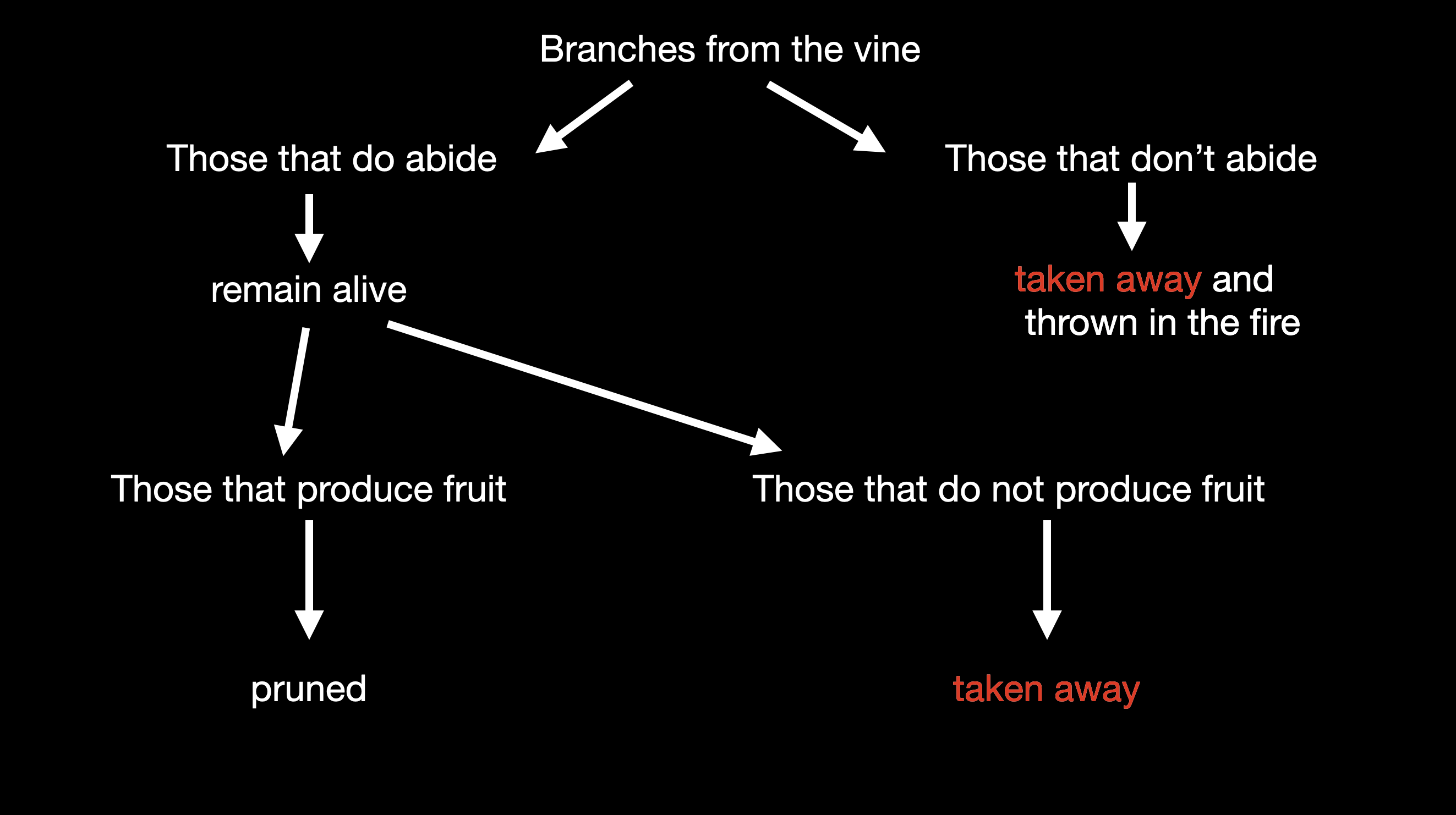
So let me put this on a flow chart for you:

Now you can see what bothers me about this parable.  Those who do abide in Christ but are not producing fruit get the same treatment as those who do not abide in Jesus.  They are both taken away.  That doesn’t seem to fit with the previous parable of the Fig tree.  The owner would have the tree dug up, but a grace period was given.  The tree would be shown extra care for a year.  If it then didn’t produce, then it would be removed.  There seems to be no grace or mercy in this vine parable.  If you see a fruitless branch, you take it away.  Are we missing something?

Let’s look at that verse more closely.  The “takes away” is translated from the Greek “airo”.   Strong’s Dictionary of the Bible has this entry for ‘airo’.  

142. airo, ah´-ee-ro; a primary root; to lift up; by implication, to take up or away; 

This Greek word is where we get the word “air,” which is also used in many English words, such as aerobatics, aerodynamics, and aeroplane (British spelling). All these words have the concept of “lifting up.”

So, the primary definition is to lift up.  The gardener ‘lifts up’ the unfruitful vine.  Does that make any sense to you?   Well, it didn’t to the translators, so instead of putting ‘lift up,’ they decided to use the secondary definition of ‘lift up and take away.’  These translators had never been to a small farm in the Middle East and saw how they grew grapes in Jesus’ day.

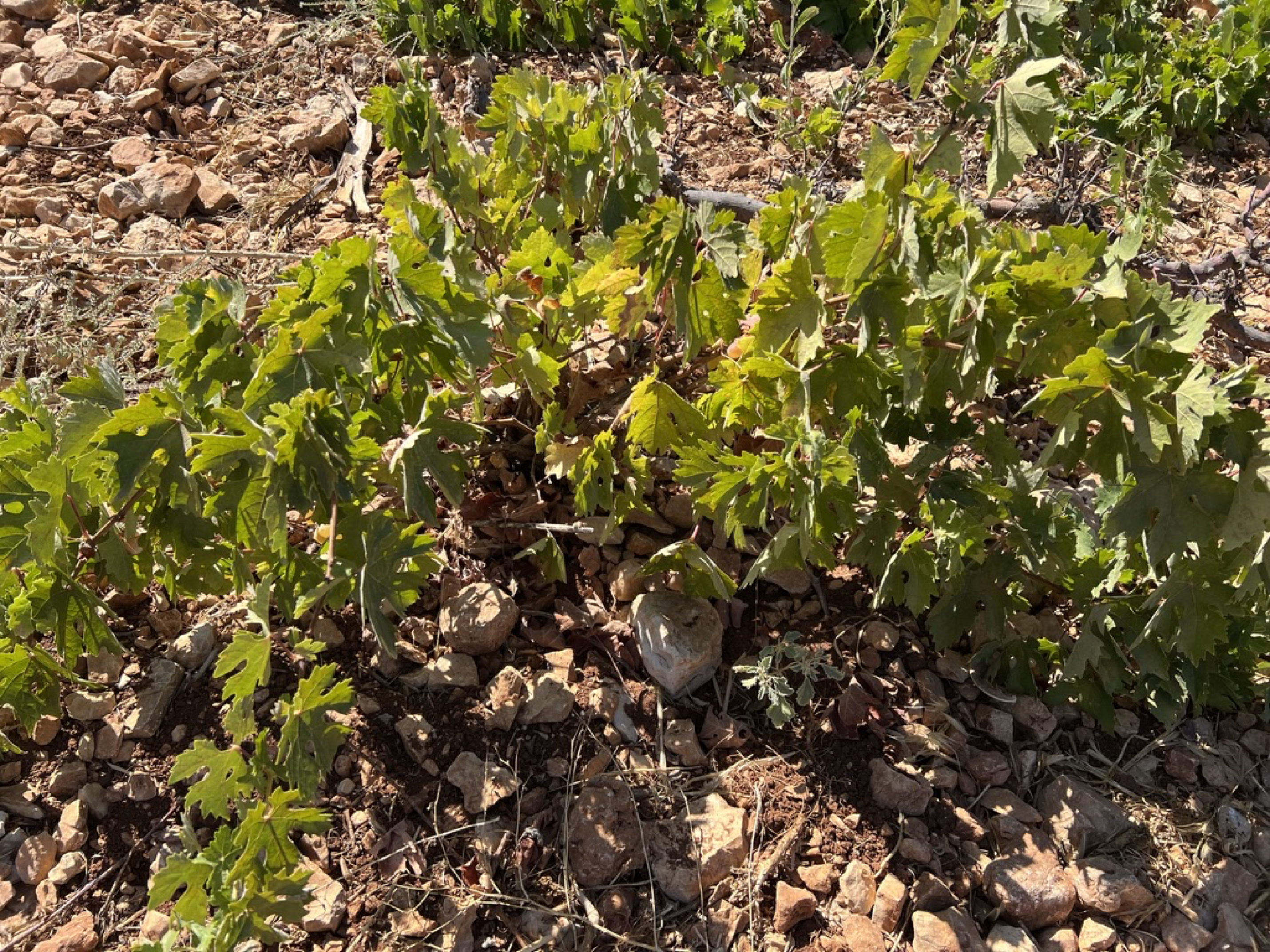
You know what modern vineyards look like. The vines are carefully set on elevated supports.   This makes them more fruitful and also easier to harvest. This is a grapevine from my trip to Jordan last year. Many farmers there still grow grapes as they did 2000 years ago, not on elevated trellises but on the ground.

There is one problem with growing grapes on the ground.  The vine tends to put down more roots where it touches the soil.  If the plant puts down roots, it is not spending its energy producing grapes but producing roots.  This makes the branch unproductive.  So when the gardener in Jordan sees this happening, he does exactly what they would have done in Jesus’ day.  They lift up the vine off the ground and put a rock under it.  Then, it will not produce roots but produce fruit.

John 15:2  Every branch in me that does not bear fruit he lifts up.

Remember, in the unfruitful fig tree parable, the owner would dig it up, but the vinedresser, who had cared for that plant for years, wanted to give it another chance.  He would show it special care and see if he can get it to produce.  There is grace.  There is mercy.  If we correctly translate the parable of the vine, we see the same care and mercy.  If the Father sees you are unfaithful, he doesn’t take you away; He lifts you up. 

This has implications for how we treat each other.  Someone leaves the fellowship; they stop coming to church and start putting down roots elsewhere.  The last thing we should do is cut them off or remove them.  We should lift them up.  Lift them up in prayer, lift them up with encouragement, and lift up their spirits with kindness and love.  When our friends stumble in their faith, we should lift them up.

God is looking for fruit.  John the Baptist said,  Repent and bring forth fruits worthy of repentance.  What are these fruits we should be producing?  The crowds before John the Baptist asked the same question.  

Luke 3:10-14   And the crowds asked him, “What then shall we do?” And he answered them, “Whoever has two tunics is to share with him who has none, and whoever has food is to do likewise.”  Tax collectors also came to be baptized and said to him, “Teacher, what shall we do?”   And he said to them, “Collect no more than you are authorized to do.”   Soldiers also asked him, “And we, what shall we do?” And he said to them, “Do not extort money from anyone by threats or by false accusation, and be content with your wages.”

Share from your abundance.  Do the right thing.  If you are a child of God, then act like it.  Imitate your father.  Paul gave us a list to go along with this:

Galatians 5:22-23   But the fruit of the Spirit is love, joy, peace, patience, kindness, goodness, faithfulness, gentleness, self-control;

Jesus wants us to produce fruit, and he will show us grace if we fail to do so.  But as in the fig tree parable, a limit is imposed.  The fig tree has one more year to produce fruit.  If it didn’t, then it would be dug up.

Believing in Jesus and trusting in him is the starting point, not the ending point. If the privilege of being God’s people does not lead to productivity, it leads to judgment. 

Jesus realizes his time is short. He will be crucified in 12 weeks. So, every moment, he finds ways to teach, encourage people, spread the word of the kingdom, and live his life producing as much fruit as he can. 

I want to close by leaving you with a quote from an excellent book by John Piper that had a significant impact on me.  The book is titled “Don’t Waste Your Life,” I first read it 30 years ago, but it is still timely.  Much like Jesus being told of Pilate’s horrible attack on the Galileans, John Piper tells of two women, both about 80 years old, who were serving as missionaries in Africa.  The brakes failed in their car, and they went over a cliff and died instantly.   Piper asked,  “Was that a tragedy?“  “No,” he says, 

“I will tell you what a tragedy is. I will show you how to waste your life. Consider a story from the February 1998 edition of Reader’s Digest, which tells about a couple who “took early retirement from their jobs in the Northeast five years ago when he was 59 and she was 51. Now they live in Punta Gorda, Florida, where they cruise on their 30 foot trawler, play softball and collect shells.” [Piper says,] At first, when I read it I thought it might be a joke. A spoof on the American Dream. But it wasn’t. Tragically, this was the dream: Come to the end of your life—your one and only precious, God-given life—and let the last great work of your life, before you give an account to your Creator, be this: playing softball and collecting shells. Picture them before Christ at the great day of judgment: “Look, Lord. See my shells.” That is a tragedy. And people today are spending billions of dollars to persuade you to embrace that tragic dream. Over against that, I put my protest: Don’t buy it. Don’t waste your life.”2

Jesus had only three months before his crucifixion. He couldn’t waste time complaining about politics or current events; he had fruit to produce.  None of us knows how much time we have left.   Every day is a chance to repent of yesterday’s mistakes and bring fruit worthy of that repentance. In a world filled with bad news, I have good news today.   This day, God has given us a gift.  He has granted us the grace and mercy of another day of life.   As Piper says, please don’t waste it.  Make this day fruitful, lifting up praise to Jesus, lifting up our friends, and lifting up the Kingdom of God.

  1. Not all parables are allegories.  An early church father, Origen of Alexandria, who lived around 200 AD, is called the “father of allegorical interpretation.”  He felt all parables were allegories and had secret allegorical meanings.  Augustine, who lived 200 years later, is also known for making almost every story in the Bible an allegory.  Augustine said the Samaritan in the story of the Good Samaritan is Jesus; the thieves are the devil, the priest and the Levite are the Old Testament, the inn is the church, the innkeeper is Paul, and the money he is given is Paul’s counsel of celibacy.   Sometimes, when viewing all of Jesus’ stories as allegories, we may lose Jesus’ intended meaning.  In this instance, the story loses the purpose Jesus told it for — to answer the question of, “Who is my neighbor?”
  2. Piper, John. Don’t Waste Your Life . 1994.  Crossway.  Location 546, Kindle Edition.

February 16, 27 A.D.  Sabbath (Saturday)  In the Jordan River- The Year of the Lord’s Favor #10

Week 1 The Baptism of Jesus

Matthew 3:13-15   Then Jesus came from Galilee to the Jordan to John, to be baptized by him.  John would have prevented him, saying, “I need to be baptized by you, and do you come to me?” But Jesus answered him, “Let it be so now, for thus it is fitting for us to fulfill all righteousness.” Then he consented. 

John said his baptism was for repentance.  People were baptized “confessing their sins” (Matthew 3:6).  So why was Jesus baptized by John?  We know he did not need to confess his sins, for the author of Hebrews tells us that Jesus “in every respect has been tempted as we are, yet without sin.”  No one was more surprised at this request than John himself.  John made very clear that he was subordinate to Jesus, saying that he was not even worthy to untie Jesus’ shoes (the job of a slave).  John tells Jesus, “No way, you be the rabbi, I’ll be your disciple.” But Jesus tells John to accept it that way for now, that he can “fulfill all righteousness”.

I have read many explanations of why Jesus was baptized by John.  Some say it was just for Jesus to give his stamp of approval on John’s ministry and message.  This could be part of it, for Jesus preached the same message as John preached.  Some say it was Jesus being humble, and certainly, Jesus’ humility shows throughout his ministry, even to the point of the humiliation of death on the cross (Phil. 2:8).  Some say he was baptized as a model for us, and certainly Jesus’ way of living is our model of how to follow God. Still, others say that John was calling a nation to repentance, and Jesus was born a Jew, a member of that nation and thus in need of repentance for the corporate sins of his forefathers.1  But John asked Jesus this very question, and how does Jesus answer?

But Jesus answered him, “Let it be so now, for thus it is fitting for us to fulfill all righteousness.”

What righteousness is Jesus fulfilling by being baptized by John?

I think Jesus is doing here what he will do on the cross.  He takes responsibility for sins that he didn’t commit.  Jesus was innocent.  He had no sin, but Paul says in 2 Corinthians 5:21, “God made him who had no sin to be sin for us, so that in him we might become the righteousness of God.  The righteousness Jesus is fulfilling is ours, because we can’t fulfill it on our own.  He has no personal need to repent, but he enters the waters of repentance with us.  Isn’t that what Isaiah predicted he would do?  “Behold, the virgin shall conceive and bear a son, and shall call his name Immanuel” (Is. 7:14).  Immanuel means “God with us”.  We celebrate each year that Jesus came from his place at God’s right hand to be one of us.  He came to experience humanity that he could identify with us.  He came to know our hunger, to know our pain, to know our temptations, to know rejection, to know abuse, to know suffering.  And by becoming a human like us, he shows us how to be a human like God intended us to be.  

“I will be with you.” It it the most common promise in the Bible.  It is the way Matthew begins his gospel, quoting Isaiah.  It is the way Matthew ends his gospel, “And behold, I am with you always, to the end of the age.” (Matthew 28:20).  It is only fitting that this is the way Jesus begins his ministry.  He enters the river with us.  He awaits his turn with those repenting of their sins and being immersed.  He rises up out of the water and looks out at those who have not yet been baptized.  You can almost hear the words now that Jesus will say many times in the coming year.  “Follow me.”   Follow me in repentance.  Follow me in the waters.  Follow me as I rise to minister.  If we follow him, he promises to always be with us.

But Jesus answered him, “Let it be so now, for thus it is fitting for us to fulfill all righteousness.”

Jesus is fulfilling my righteousness, he is fulfilling your righteousness. Hallelujah! What a Savior! Thank you, Jesus.  Let us all now follow him into the waters of repentance as we enter this journey with Jesus.

1. We don’t talk a lot about corporate sins, but recently there has been a movement to accept the guilt of our forefathers for their mistreatment of people groups in the past (specifically the issues of the treatment of Native Americans, slaves, and minorities.)  The Bible is very clear that each person accepts the punishment only for his own sin, not that of his fathers (Deut. 24:16, Jer. 31:29-30).  Children are only guilty of the sins of their fathers if they imitate their fathers, though sometimes we reap the consequences of what was sown in previous generations.  Yet the sins of the past are relevant.  We should acknowledge them and renounce them. But there is no need to repent of sins we didn’t personally commit.  Kevin DeYoung, in his short book (with a long title) Impossible Christianity: Why Following Jesus Does Not Mean You Have to Change the World, Be an Expert in Everything, Accept Spiritual Failure, and Feel Miserable Pretty Much All the Time  said it this way:

“We are not meant to live with a sense of corporate guilt for an ethnic, racial, or biological identity we did not choose and from which we cannot be free. Self-flagellation is not a requirement for spiritual maturity. It is one thing for us to love God and love our neighbors; it is quite another if the call of Christian discipleship means we must, on account of the failures of others, hate ourselves.”

If you have ever felt like it is impossible to measure up as a Christian, read this book.  There is no need to live with constant guilt and remorse.  (That’s part of what makes the baptism that Jesus will bring different than the baptism that John does.) 

The months before Jesus’ ministry begins.  Winter, 27 AD – The Year of the Lord’s Favor #7

Hey John, is this good news or bad news?   

We have been talking about the message of John the Baptist, which is also the message of Jesus.  “Repent, for the Kingdom of Heaven is at hand.”  Jesus said his purpose was to “preach the good news of the kingdom of God” (Luke 4:43).  But as we saw last time when the religious leaders came to John, the news was not all good.  John challenged their belief that their physical relationship to Abraham guaranteed their standing with God.  He called them ‘sons of a serpent’.1  John continues in Matthew 3:10

Even now the axe is laid to the root of the trees. Every tree therefore that does not bear good fruit is cut down and thrown into the fire.

The removal of trees is a common Old Testament metaphor for God’s judgment on other nations (See Isaiah 10:33-34, and Ezekiel 31).  Jesus will use this same metaphor along with John’s idea of fruit-bearing in Matthew 7:19

Every tree that does not bear good fruit is cut down and thrown into the fire.

John will next describe Jesus as one who is separating people, using another common Old Testament metaphor of separating the wheat from the chaff (See Isaiah 41:15-16, Psalm 1:4, Psalm 35:5).  The wheat is taken into the barn, the chaff is burned with “unquenchable fire” (Matthew 3:12). We have moved beyond a regular farmers fire to the eternal fire, or punishment of the wicked that Jesus mentions three times in Matthew (18:8, 25:41, and 25:46).

What is all of the wrath talk?  Didn’t someone tell John and Jesus that they were in the New Testament?  I was always told that the Old Testament is full of wrath and judgment and the New Testament is full of mercy and grace.  But John speaks wrath much like the prophets of old.  And Jesus, as we have just seen, also does not ignore the wrath of God.  And if you don’t like that ‘wrath-talk’ don’t read the last book in the New Testament.

But in the beginning of Jesus’ ministry, he does focus more on the mercy, love, and grace of God.  For example, when he reads from the Isaiah scroll in his hometown, Nazareth, he intentionally stops in the middle of a verse to leave out the section on wrath.  He reads from the Isaiah scroll (61:1-2) as this is recorded in Luke 4:18-19.

“The Spirit of the Lord is upon me, because he has anointed me to proclaim good news to the poor.  He has sent me to proclaim liberty to the captives and recovering of sight to the blind, to set at liberty those who are oppressed, to proclaim the year of the Lord’s favor.”

But in the scroll that Jesus is reading, in Isaiah 61, verse 2 says:

to proclaim the year of the LORD’S favor, and the day of vengeance of our God;

Jesus stops reading in the middle of a sentence, in the middle of a passage that everyone in the synagogue is familiar with, and just sits down. Everyone is surprised by his faux pas.  Jesus then really shocks them as he tells them:

“Today this Scripture has been fulfilled in your hearing.”

I think this is very significant.  Jesus is announcing this messianic prophecy is coming true…to a point.  Remember that the first-century Jews expected the Messiah to come in with righteousness and vengeance, to overthrow the oppressive government and restore the kingdom to Israel.  Jesus is claiming that the days of the Messiah are here.  This is the “year of the Lord’s favor.”2  This year of the Messiah is all about God’s favor.  Jesus leaves the vengeance out because it is not the time for the wrath of God to be manifest.  That time will come with the Messiah, but not with this coming of the Messiah.

Nevertheless, Jesus does not ignore the wrath of God.  We see it again in the Sermon on the Mount with the house built on the sand. We see it in the woes on Chorazin and Bethsaida in Matthew 11:21-24.  In Luke 19:41-44 he weeps over Jerusalem, knowing that the wrath of God is coming on them in the classic Old Testament method — destruction by a foreign pagan army.  (And Rome did destroy Jerusalem and the temple 40 years later.)

John gives wrath as a warning.  It doesn’t have to be that way.  You could repent.  But if you do not, God’s wrath will come.  So is that bad news?

If you are in a building and someone shouts out a warning to you because the building is on fire, is that bad news?  If you plan on listening to them and leaving the building, then you would gladly thank them for delivering the news.  It is bad news only if you don’t heed the warning and run to the exit.

The Gospel is the good news of the Kingdom of God (unless you decide to ignore it.)

David

  1. This leans heavily on information I learned from Tim Mackie in a Bible Project podcast, “God’s Wrath in the Teaching of Jesus”
  2. The year of the Lord’s favor, the time of the Messiah, I believe to be the year of Jesus’ ministry that we will follow this year in this 70-week study.  Feel free to disagree with me.  If you do, you will be in agreement with almost everyone who went to seminary and was taught his ministry lasted 3 1/2 years.  This is a not new concept, however, as all the church leaders prior to 300 A.D. said his ministry was about a year.  Whether it was a year or three years of ministry, it will be good to go through the time in order, putting the gospels together.  So stay with me and please voice your opinion, especially if it is different.  That is how we learn.

The months before Jesus’ ministry begins.  Winter, 27 AD —The Year of the Lords’ Favor #6

We have discussed the message of John the Baptist, “Repent, for the Kingdom of Heaven is at hand.”  But we are not finished with the message.  There is more.  Before Jesus comes to be baptized by John in a few days (Feb 16), first he has some other visitors.

John was at the Jordan for months in the winter of 27 AD.  And he was attracting crowds.  So some of the religious leaders in the area came to see what was going on.  They felt a responsibility to make sure he was not someone just misleading the people.  So they traveled the 20 miles to where John was baptizing.  They did not exactly get a warm welcome from John.  

Matt. 3:7-10   But when he saw many of the Pharisees and Sadducees coming to his baptism, he said to them, “You brood of vipers! Who warned you to flee from the wrath to come? Bear fruit in keeping with repentance. And do not presume to say to yourselves, ‘We have Abraham as our father,’ for I tell you, God is able from these stones to raise up children for Abraham. Even now the axe is laid to the root of the trees. Every tree therefore that does not bear good fruit is cut down and thrown into the fire.

“You brood of vipers”  Why this greeting?  A brood is the young of a species, and vipers are poisonous snakes.  So ‘You snake babies!’, or ‘You son of a snake!’.  As you read on, you discover that John is saying that they are not ‘sons of Abraham’, but instead ‘sons of a serpent’.  They had the idea that God’s promise to the heirs of Abraham guaranteed their relationship with God.  Today, we look at someone who is acting just like their father and say, “That apple didn’t fall far from the tree”.  John is telling them that their ancestry does not make them a ‘son of Abraham’.   

Romans 9:6-7 For not all who are descended from Israel belong to Israel, and not all are children of Abraham because they are his offspring 

 Not every physical descendant of Abraham is a ‘son of Abraham’.  Abraham’s first two sons were Ishmael and Isaac.  Isaac was a son of the promise, but Ishmael was not. Isaac had twin boys, Jacob and Esau.  Jacob was the son to carry the promise of God, not Esau.  

Galatians 3:7 The real children of Abraham, then, are those who put their faith in God.  

Now according to my genetic analysis from Ancestry.com, I have no Jewish roots.  But Biblically speaking, I am a son of Abraham adopted in, or as Paul says in Romans 11 grafted in.  So John tells these religious leaders that they are not sons of Abraham, but instead sons of a serpent.  It doesn’t take much thinking to figure out which serpent he was referring to.  Anytime you see snakes or serpents in the Bible you must ask yourself if there is a reference to the serpent in Genesis 3.1  

Jesus has a similar encounter with religious authorities in John 8:39 and challenges them in the same way John the Baptist did: “They answered him, “Abraham is our father.” Jesus said to them, “If you were Abraham’s children, you would be doing the works Abraham did,”.  Jesus then tells them who he thinks their father is in John 8:44 “ You are of your father the devil, and your will is to do your father’s desires.”   To Jesus, like John, they are sons of the devil (the Genesis 3 serpent).  

Don’t you find it interesting that the Bible is chiming in on the nature vs nurture debate?  Are we more a product of our nature (our genetics), or are we more a product of our environment (how we were raised)?  I will let you draw your own conclusions, but I think the Bible is clear, when we become adults, we are not a product of where we come from genetically, nor of where we come from environmentally.  We are not a product of where we come from at all, but of where we are going.  We are a product of our actions — We are a product of the path we choose.  In other words, your actions speak louder than your chromosomes.

But John is not done with the religious leaders.  He felt they needed further explanation of his message.  They shouldn’t have.  They spoke Hebrew and understood the full concept of ‘shuv’ — that repentance involved a change of mind and a change of action.  But John felt their actions were lacking, and so he adds, “Bear fruit in keeping with repentance.”  ‘In keeping with’ from the Greek ‘axios’. ‘Axios’ means ‘bringing into balance’ from the Greek root ‘ago’ (to weigh).  Think of a balance scale.  On one side of the scale is repentance. On the other side is a person’s actions, the fruit of their life.  It should balance.2  

This is not works-based righteousness.  This is a life changed by the grace of God that produces fruit.  Jesus tried to explain this to Simon the Pharisee in Luke 7.  Remember the story?  Jesus had been invited to Simon’s home and the meal was interrupted by a woman “who was a sinner” who anointed him with ointment and her tears.  Jesus tells Simon the story of two people who had debts canceled by a lender.  Simon agreed that the one who had the greatest debt canceled would love the lender more.  Jesus explains that because this woman had been forgiven much, she loved much.  (Jesus knows that “love” as a Hebrew verb is emotion and action.)  Lest anyone think this concept of your actions being in measure with your repentance is outdated after the cross, let’s look at Paul describing his message to Agrippa in Acts 26:19-20

“Therefore, O King Agrippa, I was not disobedient to the heavenly vision, but declared first to those in Damascus, then in Jerusalem and throughout all the region of Judea, and also to the Gentiles, that they should repent and turn to God, performing deeds in keeping with their repentance.

“So how do you practically live so that your deeds are in balance with your repentance?”  I’m so glad you asked.  The people listening to this in John’s day wanted to know also.

Luke 3:10-14      And the crowds asked him, “What then shall we do?” And he answered them, “Whoever has two tunics is to share with him who has none, and whoever has food is to do likewise.” Tax collectors also came to be baptized and said to him, “Teacher, what shall we do?”  And he said to them, “Collect no more than you are authorized to do.”  Soldiers also asked him, “And we, what shall we do?” And he said to them, “Do not extort money from anyone by threats or by false accusation, and be content with your wages.”

There is a lot to unpack here, but notice there are three very different groups of people asking him the same question.  But his suggestions of how to respond to each of them deal with money and possessions.  For you see, people in the first century were very different than us.  Back then, in Jesus’ day, people had a problem that we may not understand. They loved money and possessions.  They were a very materialistic culture.  They had to have the latest name-brand tunics, shoes, and insulated drinking mugs.  Okay, maybe they weren’t so different.

If you need further explanation, Jesus will go on a mountain and preach a whole sermon on this (see Matthew 5-7).  Here is an excerpt:

You will recognize them by their fruits. Are grapes gathered from thorn bushes, or figs from thistles? So, every healthy tree bears good fruit, but the diseased tree bears bad fruit.  A healthy tree cannot bear bad fruit, nor can a diseased tree bear good fruit.  Mt 7:16-18

Let me challenge you today to ask God, what one thing can I do this week to help balance my repentance?  Maybe it’s sharing clothing, food, or money.  Maybe it’s being a friend to someone, maybe it’s sharing the good news of the kingdom with someone.   Do not let this week go by without your repentance being an action. Be a son of Abraham.

1. An exception to this is the sea serpent/dragon (Hebrew ‘tannin’) which is a special case with its own symbolism.  The Bible Project has a 22-episode podcast series on the symbolism of the sea dragon in the Bible.  (And you had no idea there was that much about sea/land serpents/dragons/monsters in the Bible. Now say it in your best “pirate” voice, “There be dragons!”)

2. Balance scales were very common in Jesus’ day.  Every vendor in the market had them to weigh out whatever you bought and to weigh out your payment.  Before coins were used,  you weighed out your silver or gold on a scale to balance the known weight. A ‘shekel’ was initially a measure of weight, and then later a coin. 

The months before Jesus’ ministry begins.  Winter, 27 AD #4

Further notes on repentance— through Peter’s eyes.

God is not surprised when we sin.  He knows we are prone to sin.  The Bible specifically tells us that, and many of you have memorized Romans 3:23, “For all have sinned and fallen short of the glory of God”. (But have you memorized Romans 3:24? – more on that later).  

Imagine you are sitting around a table eating dinner with some friends and Jesus.  And Jesus leans over and says to you, “Hey, [your name],  Satan demanded to put you through a trial,  but I prayed for you.  And you say, “Thank you, Jesus.  Thanks for blocking that old devil for me.  Trials are no fun.  I appreciate your prayers.”  But wait a minute, this actually happened in the Bible.  Jesus is having dinner with his friends, his disciples.  It is the last supper he will have with them.  And he leans over to Simon Peter and says, 

“Simon, Simon, behold, Satan demanded to have you,that he might sift you like wheat,  but I have prayed for you” Luke 22:31-2   

But Jesus is not praying for Simon to avoid the trial, and surprisingly, Jesus is not praying that he would pass the trial.  What is Jesus praying for? 

“that your faith may not fail” Luke 22:32a

Jesus is not praying for Simon to pass the trial, because he is already sure that Simon Peter will fail the trial, and will tell him that specifically.  Jesus is praying that he will survive the failed trial with his faith intact. What does Jesus say next?

And when you have turned again, strengthen your brothers. Luke 22:32b

“Turned again” there is our Greek word for repent, ‘strepho’.  “When you have repented for failing the test, Simon, then strengthen your brothers.”1   Jesus then tells him specifically what will happen.  Peter will deny him three times before the rooster crows.  You see, Jesus expects failure. And whether you pass or fail is not the most important thing about a trial.  The most important thing is whether you will repent of your failures. 

So let’s follow Peter a little further.  Jesus is arrested that night and all the disciples run and hide.  Peter and John follow Jesus (at a distance) into the courtyard of the high priest.

Simon Peter followed Jesus, and so did another disciple. … The servant girl at the door said to Peter, “You also are not one of this man’s disciples, are you?” He said, “I am not.” Now the servants and officers had made a charcoal fire, because it was cold, and they were standing and warming themselves. Peter also was with them, standing and warming himself.  Now Simon Peter was standing and warming himself. So they said to him, “You also are not one of his disciples, are you?” He denied it and said, “I am not.” One of the servants of the high priest, a relative of the man whose ear Peter had cut off, asked, “Did I not see you in the garden with him?” Peter again denied it, and pat once a rooster crowed.  John 18:15,17-18, 25-27.

Now it is April 28 of 28 AD, it is early spring in Jerusalem and it can get very chilly at night.

And John throws a few interesting details that they were warming themselves by the fire.

He doesn’t want you to miss this… he says it 3 times!  He even tells you what kind of fire this was, a charcoal fire (always pay attention when the Bible gives you little details.)  Then Peter denies Jesus 3 times and then the rooster crows, just as Jesus predicted.

 I once heard a preacher say, “Every time Peter heard the rooster he remembered his failure. And this is important. Don’t forget your failures.” And I get that. It is only when we remember our failures that we can appreciate what God has done to forgive us.

Remember the story when Jesus had been invited to Simon the Pharisee’s home, and the meal was interrupted by a woman “who was a sinner” who anointed him with ointment and her tears.  Jesus tells Simon the story of two people who had debts canceled by a lender.  Simon agreed that the one who had the greatest debt canceled would love the lender more.  Jesus explains that because this woman had been forgiven much, she loved much.  

Only when we consider the depth of our failures can we understand the depth of his mercy.

(I think Ignatius said this first.)  I can agree with that preacher up to a point about the importance of remembering your failures.  But we are not finished with Peter.

Now we skip forward to after Jesus has been resurrected; he is to meet the disciples in the Galilee, up north.  They went fishing all night and caught nothing. 

Just as day was breaking, Jesus stood on the shore; yet the disciples did not know that it was Jesus.  John 21:4

You know the story:  They are about to quit when they see a guy on the shore. Jesus asks, “Catch anything?”  “No,” they answer.  Jesus then tells them to fish on the right side of the boat and the net is full of fish, and they realize it’s Jesus.

When they got out on land, they saw a charcoal fire in place, with fish laid out on it, and bread. Jesus said to them, “Bring some of the fish that you have just caught.” So Simon Peter went aboard and hauled the net ashore, full of large fish, 153 of them. And although there were so many, the net was not torn. Jesus said to them, “Come and have breakfast.”  John 21:9-12

Nice, fish tacos for breakfast.  Then Jesus has a conversation with Peter.  He asks him 3 times Peter, do you love me?  And Peter affirms his love. Why 3 times?  3 times he denied Jesus, so Jesus makes sure to give him 3 times to affirm him.  Then Jesus tells Peter “Follow me.”   Jesus is rebooting their relationship.  Yes, I know you failed the test, Peter, but I still love you, it doesn’t change our relationship, I am asking you to do exactly what I asked you to do before, follow me.

But notice the details….What kind of fire was Jesus cooking on?  A charcoal fire (that detail is only given these 2 times in the New Testament.)  What time of day was it? John says “Just as day was breaking”.  He doesn’t specifically mention it, but what happens at dawn? The rooster crows.  Peter, standing by a charcoal fire, denies Jesus 3 times and the rooster crows. That was the lowest moment of his life. So Jesus gives Peter a chance to say he loves him 3 times, and Jesus doesn’t want Peter to forget this, so he recreates the scene. The same sound of the rooster, the same feeling and smell of the charcoal fire.  

Yes, it is important to remember your failures, but it is more important to see how your failures make you stronger through repentance and the resultant actions of repentance. For the rest of his life, every time Peter heard the rooster crow or smelled a charcoal fire, his mind went right back to what could have been a moment of great sorrow that Jesus turned into a moment of great redemption.  So yes, preacher from my past, we need to embrace our failures —-and then fall into the embrace of the God who loves us enough to forgive us when we repent.

1997 years ago, on this day we call January 23.  John the Baptist was preaching a message of repentance.  It is a message we need to hear today We all fail.  All of us. But who did the Bible call “a man after God’s own heart”?  David.  And he spectacularly had failures, breaking 5 of the 10 commandments in a few days (including those about adultery and murder). How could the Bible call him a man after God’s own heart?   Because it isn’t the failure that matters, it is the repentance  — he failed but he didn’t fall.

Have you failed?  God isn’t angry with you; he knew you were going to fail that test. He was not surprised when you chose the wrong path,  He is just standing there with open arms waiting for you to turn around.  Repentance is a story of good news, not bad news.  Maybe it’s time to memorize Romans 3:24 to go with 3:23.

Rom 3:23 For all have sinned and fall short of the glory of God, 

Rom 3:24 and all are justified freely by his grace through the redemption that came by Christ Jesus. 

We all need to repent.  We all have friends who live in opposition to God, and Paul in 2 Timothy 2 tells us we need to pray for them that God might “grant them repentance, leading to a knowledge of the truth, and that they may come to their senses.”  Paul had lived this himself.  We all have friends who may be facing trials.  Jesus is praying for them.  Should we not also?  Finally, we may be about to face a trial that we would never have considered.   Peter had no idea and didn’t understand even after Jesus told him.  Be alert and “be careful when you stand lest you fall” (1 Cor. 10:12)  

Happy repenting!

1. There is one more important thing that is hard for us to see in these verses — because in English “you” looks the same in singular or plural.  But all of these ‘you’s in verses 31 and 32 are plural.  So if Jesus was speaking very Southern English, he would have said, “Satan demanded to have you all, so that he might sift y’all like wheat, but I have prayed for y’all that you alls faith may not fail. And when y’all have turned again, strengthen y’alls brothers.” There is no doubt in Jesus’ mind that they all (and we all) would fail.

The months before Jesus’ ministry begins.  Winter, 27 AD #3

John’s message:  “Repent for the Kingdom of Heaven is at hand.”  Matthew 3:2

Two words get translated as repent in our English translations: metanoeo and strepho.  Metanoeo means to think differently or to reconsider (a mental process).  Strepho means to make a change in direction or to turn back (a physical process).  But John spoke Hebrew, not Greek so he would not have used either word.  Instead, he would have used the Hebrew word ‘shuv’.  Shuv carries the idea of both a change in the way you think and a change in behavior or direction.  

Let me expand on this lesson on Hebrew verb usage.  Hebrew does not use ‘thinking only’ verbs.  All verbs imply action. For example ‘shema’ means to hear, but it carries the idea of obedience to the hearer.  There is no concept of hearing what your rabbi says and then not being obedient to it. If you hear (pay attention and consider and understand) then you will of course act on what you have heard.1  Another example is the Hebrew word for ‘remember’.  ‘Zakhar’ is the word translated ‘remember’ in Genesis 8:1.  “But God remembered Noah and all the beasts and all the livestock that were with him in the ark.”  If you use our English definition of remember (a thought process), then you can imagine God sitting up in heaven playing dominos with the angels and suddenly he jumps up and says, “Oh no, I forgot about Noah and the critters in that boat. I turned off the rain…let’s see… oh, about 150 days ago.”  Then an angel replies, “150 days!  Well I am glad you remembered them today!”  Of course that is not what happened.  Zakhar is translated as ‘remember’ for us, but it is not simply a verb about thinking.  When the Bible says “God remembered” it means God knew about something and then acted on it.  When the psalmist asks God to “remember your mercy” (Psalm 25:6), he is not asking God to recall a list of his attributes but to act mercifully.  

The oldest copies of the New Testament we currently have are in Greek, though we know many times people spoke Hebrew and it was translated to Greek.  Now that you know the difference between the two Greek words for repentance and the single Hebrew word, you will be able to tell me what language Peter was speaking in Acts 3:19

“Repent therefore, and turn back, that your sins may be blotted out”  Our Greek New Testaments have Peter saying, “Metanoeo, therefore and strepho, that your sins may be blotted out.  Peter has to be speaking Greek to this crowd that had gathered from all over, because to describe the full process of repentance, he has to use both words.  Contrast this with John the Baptist who, like Jesus, uses the single word for repentance which must be the Hebrew word ‘shuv’ that incorporates both thought and action.

 John the Baptist was asking people to change their minds and then change their behavior.  Repentance is not merely regret.  Repentance is not complete if you only have a change “in heart”.  A famous 12th-century Rabbi, Maimonides, said “Complete repentance is when you have the opportunity to do the same hurtful thing, harmful thing again, and you make a different choice.”2

Matthew summarizes Jesus teaching in Matthew 4:17

From that time Jesus began to preach, saying, “Repent, for the kingdom of heaven is at hand.” 

And as we saw above, it is the same idea Peter preaches in Acts.  But repentance is not a new message but is seen throughout the Old Testament, as seen in the repentance of the entire city of Nineveh or the repentance of King David.It is a message for all time because God is well aware of our tendency to wander off of his path (to sin), and we will hear more about that on Friday.

After more than 400 years, in 26 AD, the long-awaited messenger has arrived.  His message is to prepare for the coming Kingdom of Heaven.  Get ready because it is at hand.   The anticipation for the return of God to his temple is building every day. 

Get excited! Jesus will appear on the scene with John on Feb 16th!

David

1. In Biblical Hebrew there is no specific word for someone who thinks one way but acts another.  But we see that concept in Isaiah 29:13 ““These people come near to me with their mouth and honor me with their lips,but their hearts are far from me.Their worship of me is based on merely human rules they have been taught” In the Old Testament the only word for this type of person is “godless”. The KJV actually translates the Hebrew word ‘godless’ as ‘hypocrite’ in Job 8:13.)   There is a word in Greek that describes someone whose actions are not equal to their thinking.  The Greek word is ‘hypokrites’ which is the Greek word for an actor in a play.  (The Greek is 2 words that mean ‘an interpreter from underneath’ because Greek actors interpreted the story from beneath the masks they wore on stage.)  We have imported this word into English as someone who puts on the appearance of being something they are not.  The Greek word ‘hypokrites’ is seen 17 times in the Gospels.

2. Maimonides, Mishneh Torah, Hilkhot Teshuvah 2:1

3. See Psalm 6, Psalm 51