
July 29 –  Pentecost! Then What Did They Do? — Acts #6

July 29 –  Pentecost! Then What Did They Do? — Acts #6
Acts 2:42-47

At Pentecost, after the presence of God descended on the people and Peter preached a sermon, the people reacted and asked a question:  What should we do?  Peter tells them to “Repent, be baptized, and receive the Holy Spirit.”   3000 people responded and were baptized in the mikveh pools at the Temple entrance.  What happened with those 3000 new followers of Jesus and the 120 disciples?  Then what did they do?

Acts 2:42-47   And they devoted themselves to the apostles’ teaching and the fellowship, to the breaking of bread and the prayers. And awe came upon every soul, and many wonders and signs were being done through the apostles. And all who believed were together and had all things in common. And they were selling their possessions and belongings and distributing the proceeds to all, as any had need. And day by day, attending the temple together and breaking bread in their homes, they received their food with glad and generous hearts, praising God and having favor with all the people. And the Lord added to their number day by day those who were being saved.

“They devoted themselves to the apostle’s teaching.” Now we understand the concept of devotion, but this is actually something more than that.  Let’s look at that verse in several different translations.  You can do this easily on the internet. Just type in the verse, “Acts 2:42” and the words “bible hub”. 

And they continued stedfastly in the apostles’ doctrine and fellowship, and in breaking of bread, and in prayers.  (KJV)
And they were continually devoting themselves to the apostles’ teaching and to fellowship, to the breaking of bread and to prayer.  (NASB)

The Greek word here is ‘proskartereō’, which is the word ‘kartereo’, which means ‘to be devoted’, but it adds the prefix ‘pros’, which means ‘going toward.’  This is above-and-beyond dedication that makes other devotions look half-hearted.  Literally, they pushed themselves toward a firm devotion to the apostle’s teaching.

They were on the edge of their seats.  They were hungry to know more.  Remember that all of these people were devout Jews who had gathered in Jerusalem for the one-day religious festival of Pentecost.   They had come from all over the known world.  Most of them knew very little to nothing about Jesus except what they heard from this one sermon of Peter.  Jesus spent almost all of his ministry outside of Jerusalem.  Very few outside of Galilee had heard his teaching.  They had a life-changing experience that day.  They were told the messiah they and their ancestors had prayed for for hundreds of years had arrived.  They needed to know more before they went home.  So many of those 3000, if possible, would have remained in Jerusalem to learn more about this Messiah.

So they hung on every word the disciples said.  They didn’t want to miss a moment of teaching.  How does this compare to people today?  Do we see that hunger for the knowledge of Jesus today?  Are we on the edge of our seats in church, eagerly listening for more information about Jesus? Do we get excited about our personal daily study of the Bible?  Or do we feel like we know all we need to know?  Have we had enough Jesus?

Do you remember when you first came to Jesus?  Were you excited to know more then?  Did that excitement fade, and if so, why?   I remember hearing two deacons in a church talking about a young man who had just come to Christ and was constantly asking questions about he church and scripture.  And one man tells the other, “Oh, don’t worry, he’s a new Christian, he will get over it.”

Have you gotten over it?  I have been in church all my life.  I have heard thousands of Sunday School lessons and sermons.  But I haven’t always had this hunger to know more as I do today.  I believe that a person’s desire to pray and study the scripture is a measure of how their relationship with Jesus is going.  The closer we are to God, the more we want to spend time with him in prayer and the more we want to know His word.  So let’s all do a little self-inventory this morning.  How is our personal relationship with God right now?  Is it where you want it to be?  Do you have that hunger to know Him more and know more of HIm?  Or have you gotten over it?

Back to our scripture:   “And they devoted themselves to the apostles’ teaching and the fellowship… What is “the fellowship”?  ‘Fellowship’ is a very ‘churchy’ word.  It is not the word you choose to describe the crowd at a baseball game or a party.  Churches talk about having ‘fellowship’ after the service.  They have a “fellowship hall”.  Our minds go instantly to having a meal.   And a meal can be part of the fellowship, but that is not all of what it means to Luke.

The Greek word there is ‘koinōnia,’ which is only sometimes translated ‘fellowship.’  Koinōnia describes a participation with others, sharing the work with them, and sharing the fruits of their labors together.  Look at how this word is translated in other verses:

Philippians 1:3-5  I thank my God in all my remembrance of you, always in every prayer of mine for you all making my prayer with joy, because of your partnership in the gospel from the first day until now.
Romans 15:26  For Macedonia and Achaia have been pleased to make some contribution for the poor among the saints at Jerusalem.
Philippians 3:10  that I may know him and the power of his resurrection, and may share his sufferings, becoming like him in his death

We see koinōnia translated as a ‘partnership’, a monetary donation to the poor, and a participation with Jesus in his suffering.  

Some look at this passage in Acts 2 and get hung up on the idea that they had everything in common and sold land if others needed help, as if they gave no thought to the idea of personal property.1  They did share their food, prayers, and resources.  Remember that some of these were just visitors to Jerusalem for the festival from other countries who had stayed in Jerusalem longer than they had anticipated, in order to learn more about Jesus.  They needed a place to stay and resources while they were there until they returned home.   So the followers from Jerusalem made room in their homes. If someone was in need, the others gave them what they needed and sold some of their possessions or land if necessary to raise the money.   They joined together as partners in worship, in witnessing, in prayer, and in sharing meals together.  They became family.  Koinonia, fellowship.  Jesus said, “By this, people will know that you are my disciples.  If you love one another.” (John 13:35).

So ‘fellowship’ is not just eating and having a good time.  It is joining with others as partners to share the work of the gospel, with each contributing as they are able, suffering together, and enjoying the fruits of their labor together.  We need to grasp this concept within our local congregations and beyond.  One example above of koinonia was Paul collecting money for the people in Jerusalem.  There was a famine affecting them, and other groups of followers gave Paul money to deliver to them to help buy food.   And these other house churches in Asia Minor were happy to contribute to the needs of these followers in Judea, because they were all part of the same family.  This is how we should view our sister churches that exist all around us.  We are partners in the Gospel.

The small church I attend is blessed to have several large, strong congregations in our community.  Two of them are doing an incredible job of reaching out to young people and young families in this community.  I had the opportunity last week to thank both of those pastors for what their church is doing that our small congregation could never do.  We don’t have the staff or facilities to do those things, but we need to reach out and seek ways we can partner with those sister churches and use our resources to assist them in some way, because all of these churches are on the same team.  We all wear the same color jerseys.   I have seen places where churches seem to be in competition with one another, trying to outdo each other as if we are on opposing teams.  We need to encourage koinonia – partnership in the gospel.  

In Acts 2:42, Luke specifies one aspect of their fellowship as the “breaking of bread”. They came and ate together, sharing their food so that no one would go hungry.  There is something special about eating a meal with someone to create a bond.  Now, this is the part of the fellowship we understand — the meal.  However, we need to expand our horizons a bit again. You realize that these over 3000 people are not meeting together in a building.  They didn’t have a building.  They met in each other’s homes, using their house as a tool for the gospel.  You can use your home and your dinner table as a tool to connect to people.  Invite people into your home to build relationships.  Do not underestimate the importance of hospitality as a ministry.  (In a few weeks, we will walk you through the Bible and see how much God values hospitality.)  There are enough unchurched people in your community to fill up every pew in every church in your community many times.  I challenge you to invite someone to your home or out to eat a meal.  Show them what koinonia is all about.  Show them you are a disciple by your love for them, simply by sharing a meal.2

The other specific aspect of ‘fellowship’ that Luke mentions is “the prayers.”  What prayers?  They were taught to pray as Jesus taught the disciples to pray.  The prayer that we call the “Lord’s Prayer” or the “Our Father” prayer.   And they continued to pray the prayers they had been praying all their lives.  There were two prayers (the Shema and the Amidah) that every devout Jew (including Jesus and the disciples) would pray several times a day. 

We are told in Acts 2:46 that they were attending temple services every day.  And Luke in the next chapter tells us about an incident that happened with Peter and John as they were going to the 3:00 pm prayer service in the Temple. 

Acts 3:1  Now Peter and John were going up to the temple at the hour of prayer, the ninth hour.

Does it surprise you that they are still praying these Jewish prayers and are still attending worship in the Temple?  Wait!  Aren’t they Christians now?  Why are they worshipping in the Jewish Temple?

They are Jews.  They have not changed religions.  They have not abandoned the God they worshiped all their lives.  The only scripture they have to read is the one they have always had, the Tanakh (what we call the Old Testament).  All their life, they had kept the Torah.  Throughout their lives, they had praised God in the temple and brought sacrifices.  All their life, they had prayed for the time when their Jewish Messiah would come.  The only difference now is that they have found the Messiah they had been waiting for so long. If you asked any one of these 3120 what their religion was, they would say ‘Jewish.’  They are Jewish people who are excited to tell others that they have found the Messiah they have long-awaited.  So how does this change things for them? 

First, understand that this coming of the Messiah was not exactly as they had been told.  They had been taught that he would come as a military leader and conquer their enemies.  However, the Messiah that Peter preached about, Jesus, was quite different from what they had expected.  He did not come as a king to conquer Rome, but as the King to conquer a much more deadly enemy than Rome: the enemy of sin and death.  And he conquered death by dying and rising again.  Paul would later say it this way:

 1 Corinthians 15:57. But thanks be to God, who gives us the victory [over death] through our Lord Jesus Christ.

How much of this did these first followers of Jesus understand at this point?  Remember that Jesus’ original disciples were often slow to understand what he was teaching.  But now they have the Holy Spirit to guide them in understanding.  But did they understand already at this point that Jesus’ death on the cross ended the need for animal sacrifices?  Certainly, by the time Paul is writing letters 10-20 years later, that was well understood.  However, we are unsure how much this early group understood.  

And perhaps a better question is, do we understand what the sacrifices meant in Old Testament times and what Jesus’ sacrifices mean for us?   There is considerable confusion about this, so let’s try to clarify.

When God created the world, his perfect plan did not include sacrifices.  There was no death in the good world God created.  He didn’t want sacrifices; he desired obedience.   And that is still God’s preference, as Samuel explained to Saul:

1 Samuel 15:22   And Samuel said, “Has Yehovah as great delight in burnt offerings and sacrifices, as in obeying the voice of Yehovah? Behold, to obey is better than sacrifice, and to listen than the fat of rams.

So we need to understand what King Saul forgot:  What does God really want from us?  Obedience.

God’s plan was obedience.  But Adam and Eve would not choose obedience.  They had been warned that taking the forbidden fruit would cause death.  So when they brought sin and rebellion into the world, they brought death into the world.   Sin began its reign on the world, and with it the penalty of death.  Animal sacrifices would be instituted as part of a way to temporarily atone for the people’s sins.  Adam and Eve deserved death for their rebellion.  But look what happened in Genesis 3.  They sin and hide from God.  They make coverings out of fig leaves.  Because of their sin, the ground is cursed, their relationship with each other is cursed, and they are told they will die. “Dust to dust.”  But they do not die immediately.  A very important thing that happens is in verse 21:

Genesis 3:21   And Yehovah God made for Adam and his wife garments of skins and clothed them.

Think about this.  Where did the animal skins for garments come from?  God Himself sacrifices one or two of the animals that He so lovingly made and makes coverings for them.  Now we don’t have time to go into all the interesting symbolism of nakedness and sin and the covering of sin, but see that their sin is covered by the shedding of blood of animals, and then their nakedness is covered by the hides of the innocent animals whose blood was shed. They deserved death.  They were told that was the penalty.  Why would God postpone the penalty on Adam and Eve and instead temporarily place it on these animals?

 Because He is full of grace and mercy.  Grace is not a New Testament concept.  Grace is part of God’s character, and it is seen on every page of the Bible.  They needed forgiveness for this sin.  And God took measures he didn’t really want to take.  He didn’t really want to kill one of his own animals.  He didn’t want a sacrifice.  What did God really want?  Obedience.  Despite their disobedience, God acts in mercy to grant forgiveness so they avoid instant death.

Hebrews 9:22  Without the shedding of blood there is no forgiveness of sins.  

“The wages of sin is death.” (Romans 6:23)  The wages must be paid.

In the Old Testament, how do you get from Sin to Forgiveness?  So many people look at the laws of sacrifice in Leviticus and see this is the path to forgiveness.
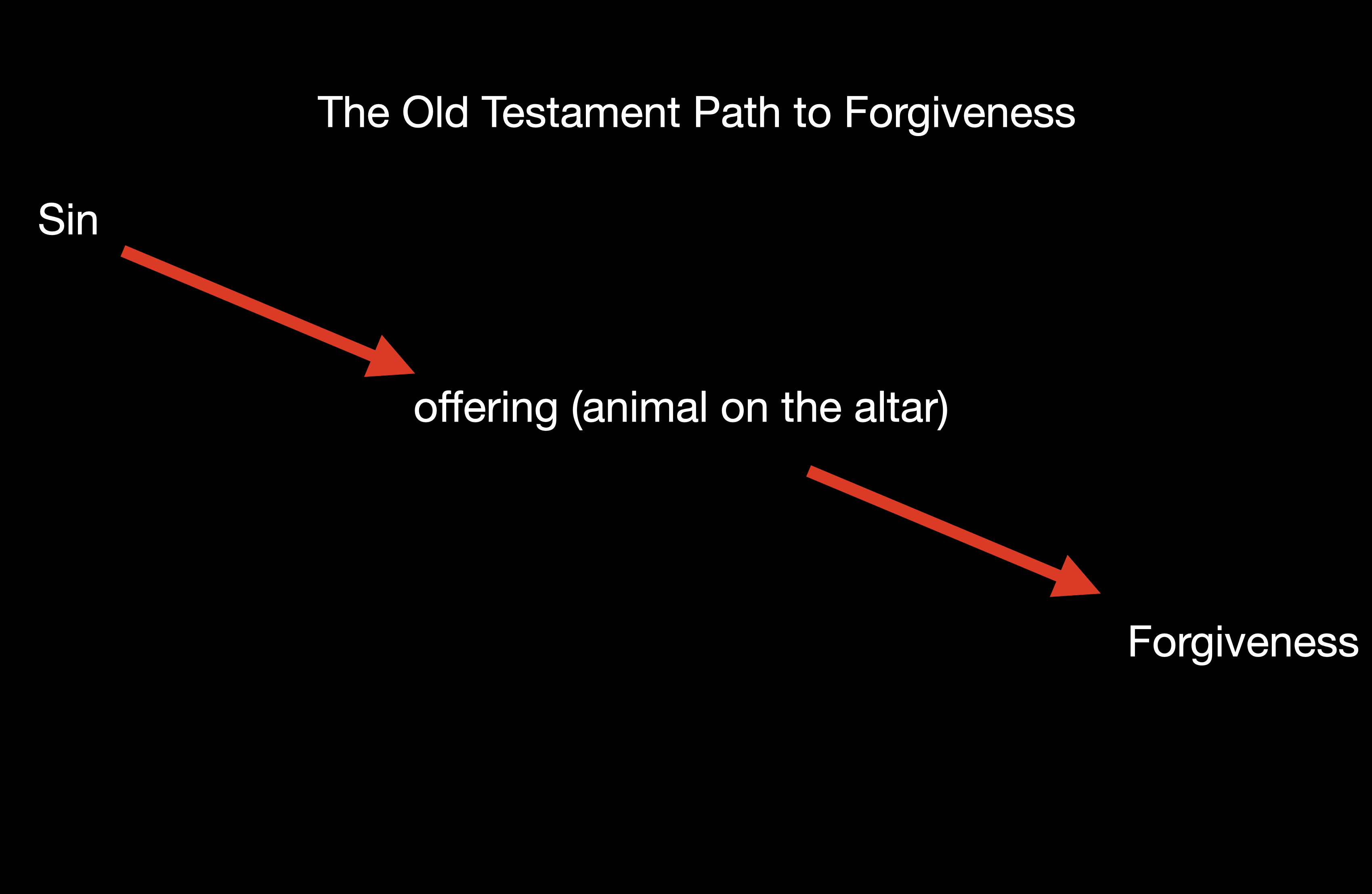
if a sin is committed, then to be forgiven, one had to make an animal sacrifice to atone for their sin.   But that is not at all what the Old Testament says.  Look at this passage in Leviticus:

Leviticus 6:1-7   Yehovah said to Moses: “If anyone sins and is unfaithful to Yehovah by deceiving a neighbor about something entrusted to them or left in their care or about something stolen, or if they cheat their neighbor, or if they find lost property and lie about it, or if they swear falsely about any such sin that people may commit— when they sin in any of these ways and realize their guilt, they must return what they have stolen or taken by extortion, or what was entrusted to them, or the lost property they found, or whatever it was they swore falsely about. They must make restitution in full, add a fifth of the value to it, and give it all to the owner on the day they present their guilt offering. 
And as an offering they must bring to the priest, that is, to Yehovah, their guilt offering, a ram from the flock, one without defect and of the proper value. In this way, the priest will make atonement for them before Yehovah, and they will be forgiven for any of the things they did that made them guilty.

To be forgiven, there must be first recognition of the sin, a confession and repentance, a restitution as possible, and then an offering.  Restitution is made to any people you have cheated, robbed, or hurt by your sin. Then restitution to God is through the animal sacrifice.  Again, the penalty for sin is death.  The wages of Sin has always been death.  But God is full of grace and mercy and love, so he allows us to avoid instant death (as He did Adam and Eve) by accepting a sacrifice.
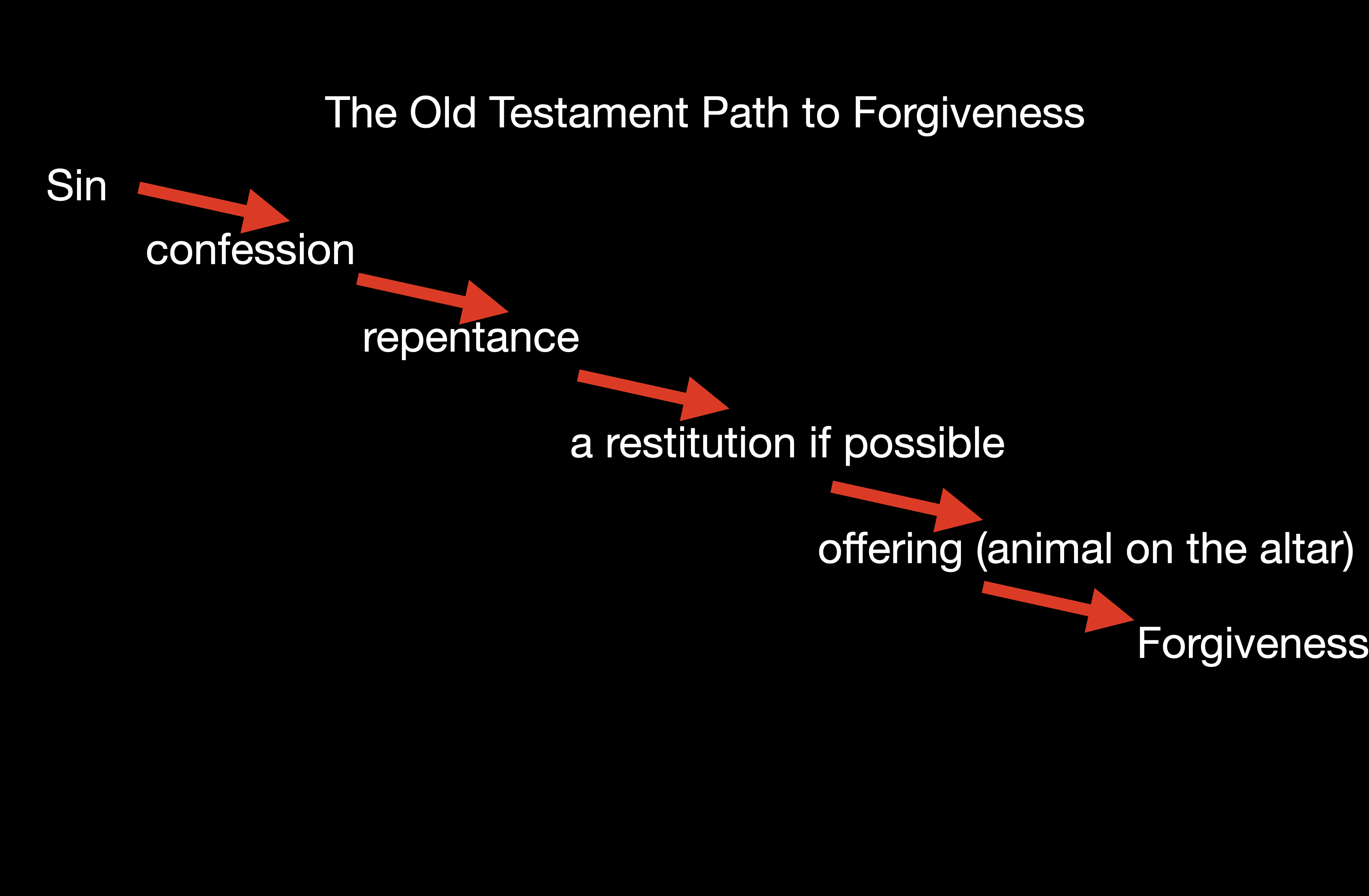
Forgiveness is granted out of God’s heart of mercy and out of his grace.  The death of the blameless animal is accepted as a temporary substitute for the penalty of sin, death.  But it was an imperfect sacrifice.  It was as the author of Hebrews stated just a shadow of what was to come.  

Hebrews 10:1-4   The law is only a shadow of the good things that are coming—not the realities themselves. For this reason, it can never, by the same sacrifices repeated endlessly year after year, make perfect those who draw near to worship. Otherwise, would they not have stopped being offered? For the worshipers would have been cleansed once for all, and would no longer have felt guilty for their sins. However, those sacrifices serve as a reminder of sins. It is impossible for the blood of bulls and goats to take away sins.

For thousands of years, every day at 9 am and at 3 pm, a lamb was sacrificed on the altar of the Temple for the sins of the people.  The first sacrifice of the day was the lamb, and all other offerings were placed on top of that lamb, which burned for 6 hours.  Then, at 3 pm, another lamb was sacrificed and was left to be burned on the altar all night, ensuring that there was always a sacrifice being offered at all hours to atone for sins. Every hour of every day of the year. Year after year.  In addition, once a year, on the Day of Atonement, special sacrifices were made for the sins of the people.   But everyone knew that the blood of animals alone could not atone for sins. 

We see this clearly in Psalm 51, which we discussed a few weeks ago.  Again, this is the psalm David wrote after the prophet Nathan confronted him about his sin with Bathsheeba.  What is David’s response when confronted with his sins of adultery and murder? 

Psalm 51:10  Create in me a clean heart, O God, and renew a right spirit within me.
Psalm 51:16  For you will not delight in sacrifice, or I would give it;  You will not be pleased with a burnt offering

David is well aware that God doesn’t really want a sacrifice for his sin.   What God really wanted was what?  David’s obedience.  But that ship has sailed.  Now what does God want?   Not a sacrifice.  

Psalm 51:16  The sacrifices of God are a broken spirit.  A broken and contrite heart, O God, you will not despise.

What God wants is a broken spirit and a repentant heart.  Confession and Repentance.   Sacrifices are a mere outward expression of what should be going on in a sinner’s heart.  No sacrifice was ever effective in atonement if the one offering the sacrifice was not repentant. 

But what about the path from sin to forgiveness in the New Testament?  How did the coming of Jesus change the way God forgives sin?
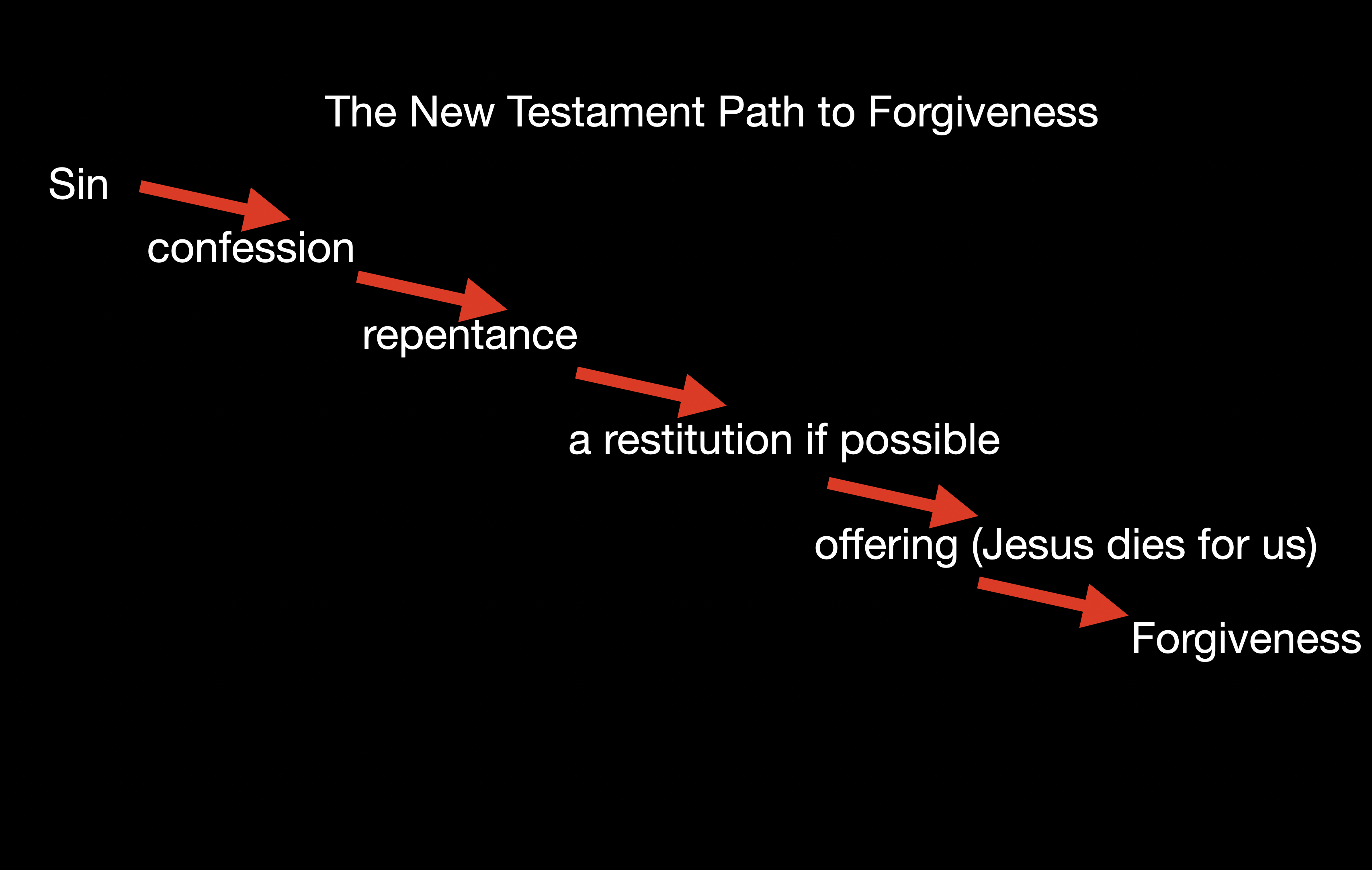
There is confession, repentance, restitution, and then the offering.  But not an imperfect animal sacrifice, but Jesus, the perfect, sinless only son of God.  He is our sacrificial offering.  He takes our place.  He pays the wages of our sins.  He takes our punishment of death.  However, note that this is the only change.  The path to forgiveness is unchanged.  God has not changed.  The grace by which God forgives in the Old Testament is the same grace God dispenses in the New Testament. The only difference is the sacrifice.

But, oh, what a difference Jesus makes.   A perfect sinless sacrifice.  

Hebrews 10:11-14   And every priest stands daily at his service, offering repeatedly the same sacrifices, which can never take away sins. But when Christ had offered for all time a single sacrifice for sins, he sat down at the right hand of God, waiting from that time until his enemies should be made a footstool for his feet. For by a single offering he has perfected for all time those who are being sanctified.

“For all time a single sacrifice for sin,”  One and Done.  It is finished.  And thus, there is no need for any more sacrifices.  What does God really want from us?  Obedience.  But no human ever gave God total obedience except for Jesus.  So Jesus can be that perfect, blameless sacrifice and accomplish what no animal sacrifice ever could—a permanent atonement for sin.

But we can’t forget the steps of confession, repentance, and restitution.  They are still essential.  David in Psalm 51 knew that.  What God really wants is obedience, but when we sin, what God really wants is our hearts to break for our own sins.  (not the sins of others.). Confession and repentance.  Paul was concerned that, since continual sacrifices for sin were no longer required, people would forget the importance of remaining obedient and the importance of the steps to forgiveness.  But we see those steps throughout both Testaments.

1 John 1:9   If we confess our sins, he is faithful and just to forgive us our sins and to cleanse us from all unrighteousness.

If we confess…. Confession is a necessary step in the process.

Romans 2:4   God’s kindness is meant to lead you to repentance.

Paul tells Timothy in 2 Timothy that repentance is a gift from God. Restitution is best seen in the New Testament in the actions of Zacchaeus.

Luke 19:8 And if I have defrauded anyone of anything, I restore it fourfold.

However, we don’t know if these early followers of Jesus understood the sufficiency of Jesus’ sacrifice or if they continued to offer sacrifices in the Temple.  Certainly, by the time of Paul’s letters, this concept was fully understood, and there was no need for animal sacrifices for those who followed Jesus.  However, it is essential for us to understand the concept of sacrifice for sins and the process of forgiveness.

While Jesus’ sacrifice is complete and sufficient for the forgiveness of all sins, we are still called to make a sacrifice.

Romans 12:1  I appeal to you therefore, brothers, by the mercies of God, to present your bodies as a living sacrifice, holy and acceptable to God, which is your spiritual worship.

We present ourselves as a sacrifice to God. This is not a sacrifice for forgiveness of sins; Jesus has taken care of that.  We sacrifice as an act of worship.  The people in the Old Testament brought a lamb, which was then killed.  It was a costly sacrifice for most people who had little.  When we present ourselves to Jesus as a living sacrifice in worship, it will cost us something.  As with all sacrifices, a death is involved.  We must die to self.

Listen to what RC Sproul said about this verse:
“God does not ask us to bring in our livestock and burn it on the altar; he asks us to give ourselves, to put ourselves alive on the altar. To be a Christian means to live a life of sacrifice, a life of presentation, making a gift of ourselves to God. Some people think that all it takes to be a Christian is to scribble a cheque or to give a few hours of service here and there on special projects for the church. But that’s not what believers are called to. My life is to be set apart and consecrated to God. That is what is acceptable to him; that is what delights him; that is what pleases him; that is the appropriate response to him and for him.” 3

What does God really want from us?  Obedience.  But all have been disobedient and fallen short of God’s plan.  And the wages of sin is death.  So God wants us to recognize our sins, confess, repent, make restitution as possible, and then thank him for the gift of his son, who paid the price for our sins.  And then what does God want from us after that?  Obedience.  The living sacrifice of obedience.

So spend some time in God’s word this week.  Study to see what God is asking you to be obedient to this week.  How will you sacrifice this week to be obedient?   Pray and discover what God is asking you to do this week.  And be obedient to it.

1.  It appears that these followers understood that if everything indeed belongs to God, then ‘personal property’ is interpreted differently.  The Bible looks at the things we ‘own’ as just being on loan to us from God, and we are just stewards of certain properties he has assigned us.
2.  These new followers were likely incorporating in their meals the celebration of the Lord’s Supper together in remembrance of what Jesus did for them.  Typically, what we call communion or the Lord’s Supper was held as part of a full meal at this time, as evidenced in Paul’s letter to the Corinthians.
3.  Sproul, R.C.  The Gospel of God: An Exposition of Romans.  Christian Focus Publications, 1994.  Page 195.
April 20, 28 A.D. — Will the Real Zacchaeus Stand Up? —  The Year of the Lord’s Favor #79

Week 62 — Will the Real Zacchaeus Stand Up?
Luke 19:1-10

The date of Passover and Easter varies every year.  In 2025 it falls on April 20th, but in 28 AD, on that first Easter morning, it would have been a bit later, April 28.   So on April 20, in Jesus’ day, he had almost completed his final journey to Jerusalem.  He and all the other religious pilgrims from Galilee would have crossed the Jordan River and walked a short 5 miles into the city of Jericho, one of the oldest cities in the world.  There, he would have had a rather odd introduction to a man and then spent some time in his home.  You know the song….

“Zacchaeus was a wee little man, and a wee little man was he.  He climbed up in a sycamore tree for the Lord he wanted to see.  And as the Saviour passed that way he looked up in the tree, and he said,”Zacchaeus, you come down, for I’m going to your house today, for I’m going to your house today.”

The story of Zacchaeus is typically told as the story of a height-challenged, wealthy, and wicked chief of the tax collectors who meets Jesus, repents, and is saved. But as I looked hard at the context of the story in Luke, I began to realize that there is much more to this story than what I learned in that little song in Sunday School. 

The story of Zacchaeus is found at the very end of the long travel narrative that Luke has for Jesus on his journey to Jerusalem.   This section of Luke runs for ten chapters, beginning in Luke 9:51.

Luke 9:51   When the days drew near for him to be taken up, he set his face to go to Jerusalem.

Along his final journey to Jerusalem, Jesus had encounters and told many well-recognized parables, including the Parable of the Good Samaritan, the Parable of the Rich Fool, the Parable of the Lost Coin, the Lost Sheep and the Lost Son, the Rich Man and Lazarus, the Pharisee and the Tax Collector, and the Rich Young Ruler.  The section concludes with the Zacchaeus story and its accompanying parable.

Luke 19:1-6   He entered Jericho and was passing through.  And behold, there was a man named Zacchaeus. He was a chief tax collector and was rich.  And he was seeking to see who Jesus was, but on account of the crowd, he could not, because he was small in stature.  So he ran on ahead and climbed up into a sycamore tree to see him, for he was about to pass that way.  And when Jesus came to the place, he looked up and said to him, “Zacchaeus, hurry and come down, for I must stay at your house today.”  So he hurried and came down and received him joyfully.

Zacchaeus is the Greek version of the Jewish name ‘Zaccai’ found in Ezra and Nehemiah.  It is from the Hebrew root (‘tzaddiq’) meaning  “righteous.”  Was Zacchaeus a righteous man?  Many commentaries say this is just ironic that they would give this wicked man the name ‘righteous’.

What else do we know about him?  He is a chief tax collector, in charge of other tax collectors, overseeing them.   And no surprise, he was rich.  Rome paid these people well.  Many tax collectors were richer than they should have been, as it was not hard to fix the books and pocket extra money.  To the Jews, they were the most hated people in the land.   Tax-collector equates with ‘sinner’ in the eyes of most people in Jesus’ day.  It was a job they thought no ethical person would do.  But let’s read the rest of the story….

Luke 19:7-10  “All the people saw this and began to mutter, “He has gone to be the guest of a sinner.  But Zacchaeus stood up and said to the Lord, “Look, Lord! Here and now I give half of my possessions to the poor, and if I have cheated anybody out of anything, I will pay back four times the amount.”  Jesus said to him, “Today salvation has come to this house, because this man, too, is a son of Abraham.  For the Son of Man came to seek and to save the lost.”

So Zacchaeus comes to a moment of repentance and decides to no longer cheat people. He will now give away half of his wealth to the poor and repay anyone he has cheated four times what he took from them.  What a great story!  But is this really the story?  Is this the message Jesus wanted to teach with this encounter?  When I started studying this passage last week, I had some problems. So welcome to my world of Bible Study.

The New International Version we just read, makes it clear that Zacchaeus has just now made a decision to change his ways.  “Here and now I give half my possessions…”   I found other translations that are similar:

The Holman Christian Standard Bible  “Look, I’ll give half of my possessions to the poor, Lord!”
Contemporary English Version. “I will give half of my property to the poor.”
New Living Translation.“I will give half my wealth to the poor, Lord…”

These are all consistent with the idea that Zacchaeus heard the crowd’s grumbling, met Jesus, and decided to change his ways.  But look at the difference of these translations with the following:

Amplified Bible – “See, Lord, I am [now] giving half of my possessions to the poor
English Standard Version – “Behold, Lord, the half of my goods I give to the poor.”
New King James Version – “Look, Lord, I give half of my goods to the poor…”

These are not “I will in the future give” but “I am already giving”.  Read this way, Zacchaeus is telling Jesus what he has already been doing, defending himself against the crowds who are calling out his unrighteousness…. So, which is it?

Then I found this: The first edition of the New American Standard Bible (1977) said it this way: “Behold, Lord, half of my possessions I will give to the poor.”  Ok, that is the traditional reading, with Zacchaeus telling Jesus he is making a new decision.  The New American Standard Bible released a revised version in 2020 based on “improved scholarship and accuracy in translation.”  One of the verses changed was this verse that now reads:  “But Zaccheus stopped and said to the Lord, ‘Behold, Lord, half of my possessions I am giving to the poor…”

So I had to go to the original Greek and multiple scholars’ journal articles on this verse.  (If you want to nerd out with me on all the Greek verb discussion, let me know.  I will refrain from boring the rest of you with this.)  But here is the bottom line:  The Greek supports the idea that Zacchaeus has already been, for some time, giving away half of his income, and if he finds that one of the tax collectors that he supervises has cheated someone, he makes sure they are paid back four times the amount.

So it is not a story of a horrible, sinful tax collector who encounters Jesus and finds repentance and then salvation.  It is the story of a man who was trying his best to live a righteous life.  At some point, he had found repentance and was living very differently than other tax collectors, resisting the temptation to cheat people and being generous with the wealth he had earned.  But he is not running around bragging about his generosity, but just quietly doing the right thing.  Then he hears Jesus is coming by, and he wants to not just ‘see him’ but “see who he was.”  He wants to encounter Jesus.  And Jesus calls him by name — he sees him as an individual, not just as a tax collector.   But the crowd was grumbling because they judged this man based on his occupation.1  So he defends himself to Jesus:  “But I am not the man they think I am.  I am giving away half of what I earn and repaying anyone one of my people has cheated.” 

 He had already found repentance.  Now he finds Jesus.  And that is what we need for salvation – There is a reason John the Baptist comes before Jesus.  You must repent before you meet Jesus.

But does it really make a big difference in which way you read the story?  I believe it does.  Jesus has been trying to teach a very important lesson through the past 10 chapters of Luke, and that lesson reaches its climax in this story of Zacchaeus.  And I think it all hinges on this point in the story when the crowd grumbles because Jesus is going to the home of a wicked tax collector.  Again, tax collectors were the most hated people in the land.  They were dishonest and traitors to their people.  They became rich by cheating the poor.  So this man Zacchaeus was assumed to be wicked because of his occupation.

Well, it is a good thing we don’t judge people in our day by their occupations — or do we?

Gallup polls have for years tracked the public’s perception of the ethical standards of various occupations. The results will probably not surprise you. The jobs with the highest ratings are pretty consistent. The only ones that were rated by more than 50% of the people as having high ethics are Nurses, Veterinarians, Engineers, Medical Doctors, and Pharmacists.  The occupations with the lowest ratings are also consistent.  At the very bottom were Politicians, followed by Car Salespeople, then Advertising firms, Stockbrokers, and Insurance Salespeople.

Sadly, the last poll showed that public perceptions of ethical standards in almost all professions have dropped significantly in the past five years.  There is some good news for the politicians and car dealers: they are being challenged for the position of the worst perceived ethics by Payday loan businesses, Congressional lobbyists, and telemarketers.

But are all car dealers and politicians unethical?  No.  I can personally vouch for one car dealer who is one of the most giving people I know and a serious Bible student and follower of Jesus.  And I can equally vouch for a friend who is a current state attorney general who has the highest standards and is also a serious Bible student and follower of Jesus.  But the fact remains, we tend to judge people in groups.

So, were 100% of the tax collectors in Jesus’ day unethical?  No.  Sure, it was an occupation that tempted people to cheat others.  But Rome paid these people very well, and you could be very well off financially without being dishonest.  Jesus calls one tax collector to be a disciple, tells a parable of one who is shown to be more righteous than a Pharisee, and then we have Zacchaeus.

In the beginning of the Gospel accounts we see tax collectors coming to John the Baptist seeking repentance. 

Luke 3:10-14   And the crowds asked him [John the Baptist], “What then shall we do?”  And he answered them, “Whoever has two tunics is to share with him who has none, and whoever has food is to do likewise.”   Tax collectors also came to be baptized and said to him, “Teacher, what shall we do?”  And he said to them, “Collect no more than you are authorized to do.”  Soldiers also asked him, “And we, what shall we do?” And he said to them, “Do not extort money from anyone by threats or by false accusation, and be content with your wages.”

Notice that John does not ask the tax collectors or the soldiers to quit their jobs, just to do their jobs ethically.  Nevertheless, the public perception of tax collectors is what it is.  So when Jesus looks up in the tree and greets Zacchaeus and then invites himself over to Zacchaeus’ house, the crowd grumbles.  And as we discussed before, this isn’t the soft murmuring under your breath, this is the shouting-out-loud grumbling.   We see the word for this type of grumbling used only twice in the entire New Testament.  And these two passages are linked together.   The other time is Luke 15:

Luke 15:1-2   Now the tax collectors and sinners were all drawing near to hear him.  And the Pharisees and the scribes grumbled, saying, “This man receives sinners and eats with them.”

This is the same type of grumbling Moses heard when people complained about a lack of water or food.  Remember, these same Israelites had just seen the waters of the sea part so they could walk through on dry land.  And here they are grumbling because they didn’t believe God could deliver a 2-liter of water to quench their thirst. In the Bible, grumbling reveals the peoples’ lack of faith in God’s ability to deliver.  For Israel in the wilderness grumbled because they had no faith that God could deliver them from thirst.  They think it is impossible for God to do.  And it is the same idea in Luke 15 when the people grumble.  They just don’t believe God can deliver these people.  It’s impossible!

But Jesus doesn’t look at tax collectors the way the people do.  God counts no group of people as hopelessly lost, and Jesus is trying to teach this lesson that it is not impossible.

People see sinners who are hopelessly lost.  Jesus sees an individual he loves, a person created in his image, someone who can repent and bring great glory to the Father.  And he calls them by name.

This is such an important lesson that Jesus keeps returning to it over and over again.  Why?  

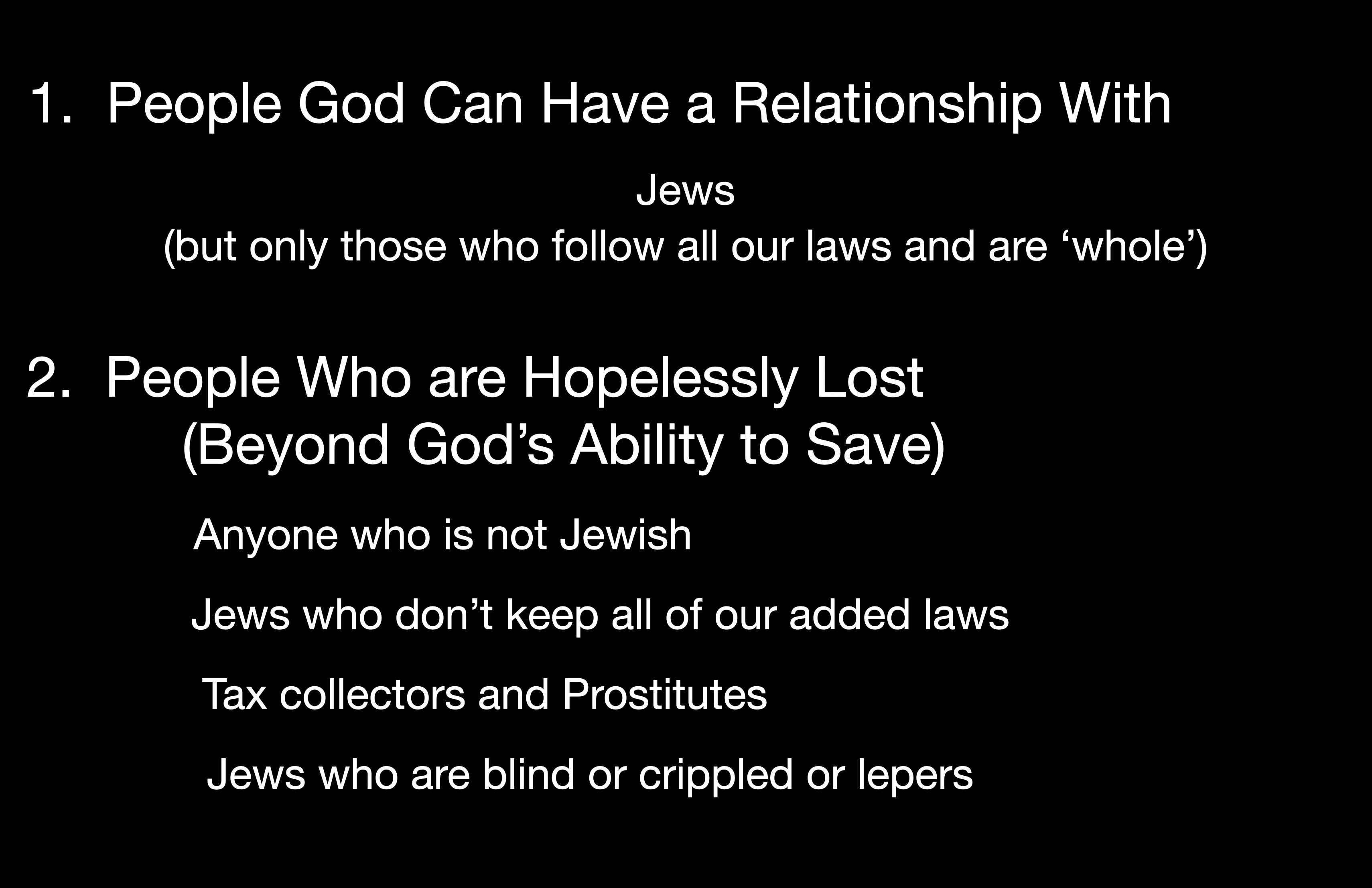
Because Israel in this day had drawn firm lines in who God could deliver and who was hopelessly lost, beyond God’s ability to save.  So they had two categories: People God can have a relationship with, and People who are hopelessly lost and beyond God’s ability to save.   And in the list of people who God will relate to is, of course, Jews.

But the Pharisees had created this rigid system of laws that were impossible for people to keep.  Oh, you might could if you were wealthy and didn’t have to work for a living.  But really, no one but the Pharisees could keep them. So a lot of people who couldn’t keep the commandments were just written off as hopeless.  So add to the ‘hopeless category’ those Jews who don’t keep all the added laws

Then, of course, there were the tax collectors and prostitutes; they were just called ‘sinners’. There was no hope for them.  And how about those who were crippled or blind or had the disease they called leprosy?  They felt that physical diseases were caused by sin.  These people had gotten what they deserved.  They had no place around God’s table.  Put them on the ‘hopeless’ list.

And then the big elephant in the room.  How about the rest of the world?  If you weren’t Jewish, you couldn’t even enter the temple.  Other nations were just pagans.  They were beyond hope.  God had written them all off.   So, who’s on the list of People God can have a relationship with?   Jews … (but only those who keep all those tedious laws the Pharisees had added.)

Do you see why Jesus had to come and fix this mess?  He chose Israel to be a kingdom of priests to all the nations, but they instead built walls to keep others away from God.  Jesus had to come to try to show them that every person mattered.  And they still didn’t really understand it even after the crucifixion.   It would take God striking a man blind on the road to Damascus to finally convince one person that Jesus’ message of grace, love, and hope was for everyone, every nation.   And Paul had to work hard to get the other apostles to understand.

But Jesus had been trying to teach this lesson all through his ministry, and we see it especially emphasized in these 10 chapters in Luke.2  He tells parables and interacts with people to try to demonstrate God’s love for all and how we can not judge other people based on race, occupation, or our cultural rules.    Look back again at some of the stories in this section of Luke.  I’ll mention a few of them:

Why did Jesus tell the story of the Good Samaritan?  He was asked the question, “Who is my neighbor?”  And his parable answers the question, every man is your neighbor that you should love as yourself, even the one that others tell you to hate.  Even the one from the race you have written off as hopeless.

Why did Jesus tell the three parables of the lost coin, lost sheep, and lost son?  Look back at the verse we read earlier:

Luke 15:1-2   Now the tax collectors and sinners were all drawing near to hear him.  And the Pharisees and the scribes grumbled, saying, “This man receives sinners and eats with them.”
Luke 15:3  So he told them these parables…

God counts no one as hopelessly lost.  The minute that you identify a group of people as undeserving of grace, as beyond God’s ability to save, then you have become the older son in the prodigal parable

Then in chapter 18, the chapter just before the encounter with Zacchaeus, we have this story….

Luke 18:10-14   “Two men went up into the temple to pray, one a Pharisee and the other a tax collector.  The Pharisee, standing by himself, prayed thus: ‘God, I thank you that I am not like other men, extortioners, unjust, adulterers, or even like this tax collector.  I fast twice a week; I give tithes of all that I get.’  But the tax collector, standing far off, would not even lift up his eyes to heaven, but beat his breast, saying, ‘God, be merciful to me, a sinner!’   I tell you, this man went down to his house justified, rather than the other. For everyone who exalts himself will be humbled, but the one who humbles himself will be exalted.”

Who is the righteous one in this parable?  The tax collector.  Tax collectors, the group that the Jews feel are the least righteous people in the land, can be found righteous by God if they confess their sins.  Again, why did he tell this parable?  Look at the verse I skipped:  

Luke 18:9  “He also told this parable to some who trusted in themselves that they were righteous and treated others with contempt.”  

God does not see as man sees.  Do you see how Jesus was trying to teach this same lesson over and over again?  Do not judge a group of people by your prejudice.  No one is beyond the grace of God.

So this could be called “The parable of the righteous tax collector.”  And little do his listeners know that in just a few days they will see Jesus encounter a tax collector whose very name is righteous.

Then in that same chapter, you have the story of the rich young ruler.

Luke 18:18-27   And a ruler asked him, “Good Teacher, what must I do to inherit eternal life?”  And Jesus said to him, “Why do you call me good? No one is good except God alone.   You know the commandments: ‘Do not commit adultery, Do not murder, Do not steal, Do not bear false witness, Honor your father and mother.’”   And he said, “All these I have kept from my youth.”   When Jesus heard this, he said to him, “One thing you still lack. Sell all that you have and distribute to the poor, and you will have treasure in heaven; and come, follow me.” 
But when he heard these things, he became very sad, for he was extremely rich.  Jesus, seeing that he had become sad, said, “How difficult it is for those who have wealth to enter the kingdom of God!  For it is easier for a camel to go through the eye of a needle than for a rich person to enter the kingdom of God.”   Those who heard it said, “Then who can be saved?”  But he said, “What is impossible with man is possible with God.”

The wealthy man becomes very sad when Jesus asks him to give up his riches.3   It is easier for a camel to go through the eye of a needle than for a rich person to enter the kingdom of God.  

So the disciples ask, “Then it is impossible for rich people to enter the kingdom?  And Jesus says, No, it is not impossible.  With God, anything is possible.  Remember, the Pharisees had that list of those beyond God’s ability to save? And here is Jesus plainly stating that, yeah, it is hard for a rich man to trust in something other than riches, but not impossible with God’s help.

No one is beyond God’s ability to forgive, God’s ability to save.  No one is beyond the grace of Yehovah. Jesus is trying desperately to hammer this point home.4

Then, a few days later in Jericho, Jesus finds a righteous tax collector—one who has already repented. He just needs to meet Jesus, and Jesus calls him by name. Though the crowd shouts out their disapproval, as they can only see the vile tax collector-sinner, Jesus sees a man who is repentant and only needs Jesus’ forgiveness and mercy.

Before this week, I had always believed the traditional telling of the Zacchaeus story: that before meeting Jesus, he was a vile tax-collector sinner.  But when I really studied the passage and looked at the context of what Jesus was teaching, I came to the conclusion that it can’t possibly be how it was.  The message Jesus is teaching in Luke culminates in this story of the crowd wrongly judging a righteous man. They thought he had no business talking to Jesus and certainly not eating with him. This man was a chief tax collector.  

In fact, if we read the story the traditional way, we have been tricked into committing the very sin that this story condemns. We, too, have assumed the tax collector is a hopeless sinner.5

Jesus has to teach this lesson.  No one is beyond the grace of God.  No one.

Let me point out one more thing.  I can’t tell you if this is true or not, but if I were writing a screenplay or movie about Zacchaeus, this would be there.  Jericho is only 5 miles from the Jordan River.  It is a short 2-hour walk downhill to the very spot where we are told John the Baptist was preaching repentance just a year before this Zacchaeus story.  Is it hard to imagine that this man Zacchaeus, who was so curious to see Jesus that he climbed a tree, would make that short walk one day to hear John the Baptist preach?  Is it possible he heard John tell the crowd they were sons of snakes and not Sons of Abraham because they were acting more like the snake in the Garden than their ‘father Abraham’?

Luke 3:7-8   John said therefore to the crowds that came out to be baptized by him, “You sons of snakes! Who warned you to flee from the wrath to come?  Bear fruits fin keeping with repentance. And do not begin to say to yourselves, ‘We have Abraham as our father.’ For I tell you, God is able from these stones to raise up children for Abraham.

Could it be that Zacchaeus heard John’s preaching and decided to repent?  Was he among the tax collectors who repented and asked John what they should do? 

Luke 3:12-13. Tax collectors also came to be baptized and said to him, “Teacher, what shall we do?”  And he said to them, “Collect no more than you are authorized to do.”

And then Zacchaeus becomes very generous and gives away 1/2 his salary and makes sure none of the tax collectors under him cheat anyone.  Then a year later, Jesus sees him not as another tax-collector but as a repentant child of God, and Jesus calls him by name.

After Zacchaeus defends himself to Jesus, proclaiming that he has already repented, Jesus says: 

Luke 19:9. “Today salvation has come to this house, because this man, too, is a son of Abraham.”6

“Son of Abraham” — In using this phrase, Jesus, like John the Baptist, isn’t commenting on Zacchaeus’ heritage but on his character.  Zacchaeus was not a ‘son of a snake’ but a ‘son of Abraham,’ because he was repentant and trying to live a life of righteousness as his father, Abraham, did.

One day, I found myself seated in a small room in a maximum security prison in Alabama.  My head bowed, my eyes closed.  And the man laying hands on me, praying over me before I went in the other room to speak to the inmates gathered, was a convicted murderer who had committed horrible acts.  He was in for life.  He had come up for parole but had refused to enter the process because he had a ministry in that prison.  He was where God wanted him to be.  There are some moments in life you never forget.  I remember his name, but I think of him, this convicted murderer, as ‘Zaccai.’  Righteous.  I can’t read the Zacchaeus story without thinking of him. And because of him, I can never pass prison inmates on a work detail without thinking, “Which ones of these has God already called?  They are all created in God’s image, and the Father is just waiting for that moment of repentance to come for them.  

The resurrection message for us today is that the resurrection is for everyone.  No one is beyond the grace of God.  Even this “wee little man.”7 We can not judge any group of people as hopelessly lost.  As Jesus told his disciples, “With men this is impossible, but with God all things are possible.”  

We must avoid making the same mistake that the religious leaders in Jesus’ day made. Remember, they said there were two groups of people: People who could have a relationship with God and People who could not have a relationship with God.  But they were so wrong about the requirements. The difference is repentance. There are only two groups of people: those who sin and repent, and those who sin and don’t repent.  Jesus came to seek and save the lost.  But God can not have a relationship with someone who is unwilling to repent.  We must learn the lesson. The only thing standing in the way of you having a better relationship with Jesus is you, your pride, and your lack of repentance.   And the Bible is clear:

2 Peter 3:9.   God is not willing that any should perish but that all should come to repentance.

I have become convinced that I do not spend enough time in prayer for those whom I know need to repent.   Paul counseled Timothy to teach and pray this way, especially for those who oppose the gospel or are enemies.  

2 Timothy 3:25-26. …God may perhaps grant them repentance leading to a knowledge of the truth, and they may come to their senses and escape from the snare of the devil, after being captured by him to do his will

  1. The people of Jericho knew Jesus was coming.  Jesus was a very big personality in the country, and they likely had made some preparations for his arrival.  Perhaps several of the important people in the town, either politically important or the religious authorities, had prepared their homes for a possible visit by this famous rabbi.  Imagine how they felt when they were passed up for a man in a tree, a wicked tax collector.
  2. You may also note Luke’s emphasis on riches and wealth.  The Greek word for ‘rich’ or ‘wealthy’, is found 28 times in the entire New Testament, but 1/3 of the instances of this word are in these 10 chapters of Luke.
  3. Contrast the rich man who went away sad, and Zacchaeus, who came ‘joyfully’ to Jesus.
  4. It is interesting that just before entering Jericho, just outside the town, Jesus heals a blind man who wants to be able to see.  Then Zacchaeus can’t see Jesus because of the crowd and was desperately “seeking to see who Jesus was.”  Then Jesus sees Zacchaeus, but he sees him not as the crowd sees him.  
  5. Kaeton, Elizabeth.  From “Trick or Treating with Zacchaeus”.  October 31, 2010.
  6. “Salvation has come to this house.”  Jesus name in Hebrew means “Yehovah’s salvation.”  Indeed, He has come.
  7. The scripture says Zacchaeus was ‘small in stature.’  The Greek for ‘stature’ (‘helikia’) can mean small of ‘age’ (young – doubtful as Zacchaeus had achieved an advanced position of overseer of tax collectors with Rome), or small of ‘height’, or small of ‘status’.  Certainly, the crowd’s reaction to Zacchaeus reveals his lack of status with them.  Perhaps he wasn’t short, but he was so hated by the crowd that there was no way he could mix in with them to get a look at Jesus, and that is why he climbed the tree. I found this explanation in several commentaries, but I am not ready to give up my ‘wee little man’ picture yet.

February 18, 27 A.D.  –  The Rich Man and Lazarus #72


Week 53 – The Rich Man and Lazarus
Luke 16:1-13

Last week, we discussed the parable of the unjust steward in Luke 16 and Jesus’ statement that “You can not serve God and mammon.”  Mammon is anything besides God that you put your trust in, especially wealth and possessions. Today, we will discuss the next parable in Luke 16, in which the primary character is an example of a man who has done just that—put all of his trust in money and not in God.

Luke 16:19   “There was a rich man who was clothed in purple and fine linen and who feasted sumptuously every day.   And at his gate was laid a poor man named Lazarus, covered with sores, who desired to be fed with what fell from the rich man’s table. Moreover, even the dogs came and licked his sores.   The poor man died and was carried by the angels to Abraham’s side.  The rich man also died and was buried, and in Hades, being in torment, he lifted up his eyes and saw Abraham far off and Lazarus at his side.   And he called out, ‘Father Abraham, have mercy on me, and send Lazarus to dip the end of his finger in water and cool my tongue, for I am in anguish in this flame.’   But Abraham said, ‘Child, remember that you in your lifetime received your good things, and Lazarus in like manner bad things; but now he is comforted here, and you are in anguish.   And besides all this, between us and you a great chasm has been fixed, in order that those who would pass from here to you may not be able, and none may cross from there to us.’   And he said, ‘Then I beg you, father, to send him to my father’s house— for I have five brothers—so that he may warn them, lest they also come into this place of torment.’   But Abraham said, ‘They have Moses and the Prophets; let them hear them.’   And he said, ‘No, father Abraham, but if someone goes to them from the dead, they will repent.’   He said to him, ‘If they do not hear Moses and the Prophets, neither will they be convinced if someone should rise from the dead.’”

There are two scenes in this parable:

There is life now and the life to come.  We must first recognize that the purpose of this parable is not to describe the life to come.  This is not a lecture on the afterlife. This parable is no more a description of what the life to come will look like than our previous parable is a lesson from Jesus for how to be a good land real estate management company.  Jesus is not giving business advice, and he is not giving a lecture on what heaven looks like.  So, we will not spend time discussing a description of the afterlife in this story.  If we were to spend what time we have with this parable debating if this is an accurate picture of the afterlife, then we would miss the entire point of the parable.   It is what you do in this life that matters. Concern yourself with how you live today.  It is what you do in this life that determines your placement in the afterlife.  So we see the two characters in life now and then in the life to come, and they are separated in both scenes.

And in the life to come, there is a “great chasm” between them that “none may cross.”  And the uncrossable canyon is the result of sin.  The only way to cross the chasm is by repenting, accepting Jesus as the King of your life, and living as the king would have you live.  As the wealthy man learned too late, repentance is only possible in this life.  You see, in this life, they were also separated by a wall.  But there was a gate.   There was an opportunity to cross from one side to the other.  But the rich man would not allow Lazarus to enter.   If he had repented of his worship of the idol of wealth and had shared, loving his neighbor as his self, he could have opened the gate to Lazarus.   This would be his repentance, a change in the direction of his life, a change in who directed his life, and thus a change in how he lived.  But the separation in the life to come has no gate.  The chance for repentance is past.  So,  we must not spend too much time focusing on how we will live after we die when our purpose on this earth is to live for Jesus now.  As the rich man learned, we can’t change how we live after we die.  But today, we can search God’s word and learn how he wants us to live.  Today, we can repent and live differently.  And we can then trust Yehovah, the God who loves us and has gone to prepare a place for us.   So, let’s look closely at this parable.

The rich man-  Notice that he is the character who does not have a name.  This is a reversal of what was expected.   Undoubtedly, in this life, everyone would have known the rich man’s name, but no one would know that the poor man had a name.  We are told that he is not just rich but also extremely wealthy, for he is clothed in purple and fine linen, the clothing of kings.  He feasted spectacularly every day.  Again, this identifies him as being in the place of kings.  But if you read carefully, you will find something about his character.  He is not righteous.  And we know this before we ever read about the poor man at his gate.  How?  He feasts every day.  This means he is not righteous.   God designed several feasts in the Biblical Calendar.  Feasts and celebrations are important to God.  We have discussed before the great Messianic Feast in the world to come.  God loves a good party.  God is all about celebrations.  But every day in this life is not a feast.  In God’s calendar, every day is not the same.  For the Jews in Jesus’ day, the seventh day, the Sabbath, is different.  It is special.  You do not do work on the Sabbath.  Nor do you ask any of your workers or slaves in your home to work.  But this man feasts every day.  So he is forcing his staff to work on the Sabbath.  By Biblical definition, we know he is not a righteous man.

We also learn he is a man who can’t see very well.  There is a poor man at his gate.  In this life, the rich man does not see Lazarus.  Oh, he may know that the poor man is at his gate.  “What an inconvenience!  How sad that all the guests coming to my sumptuous feast must pass by such a sight.  How disgusting that they have to pass by this horrible man covered in sores on their way to my beautiful party.”  The poor man’s dream is to have a few crumbs that fall from his table, but can you imagine what would happen if he gave this poor man food?  “Why, then,” the rich man would say, “he would never leave. And worse yet, even more poor, miserable people might be encouraged to come to get my scraps.  So I give the crumbs to the household dogs.  Perhaps the poor man will leave or just go ahead and die and stop ruining the curb appeal of my mansion.”

He doesn’t really see Lazarus in the parable until verse 23:

Luke 16:23  and in Hades, being in torment, he lifted up his eyes and saw Abraham far off and Lazarus at his side.

Now he sees him.  But still, the rich man does not see.  He may have noticed Lazarus in life, but he didn’t truly see him.  He didn’t see him as a human like him, created in the image of God as he was, in desperate need of love and care, starving while he feasted, suffering while he celebrated.  Now, he only sees Lazarus as just another servant who might increase his comfort, just like his servants in his prior life.

Luke 16:24  (my paraphrase)  Father Abraham, send Lazarus like a slave to comfort me, have him bring me some cold water.  Oh, Lazarus won’t mind walking through the flames to come serve me.  He won’t care; he is just a slave. 

And when told that it is impossible for Lazarus to go where he is, the rich man asks Abraham to send him back to warn his brothers to repent.  “Oh, Lazarus won’t mind leaving heaven to go back and do some service for me.”   Notice that he never directly addresses Lazarus.  In his mind, Lazarus is still someone beneath him.  Just another person to do his bidding.   He says, “Father Abraham…  Come on, Abraham, we are family.”  But He fails to see Lazarus as part of the family.  He is just a lowly servant, someone to bring him comfort.

Even in the flames of torment, he is unrepentant, for there can be no repentance after you die.

In 2 Timothy 2, Paul instructs Timothy on how to deal with opponents of the gospel.  

2 Timothy 2:25-26   Opponents must be gently instructed, in the hope that God will grant them repentance leading them to a knowledge of the truth, and that they will come to their senses and escape from the trap of the devil, who has taken them captive to do his will.

We pray that God will grant repentance. “Grant” means to bestow as a gift.  Jesus told us in John 16:8 that it is the Holy Spirit’s job to convict people of sin.  Repentance is a gift from God that, unfortunately, not all choose to accept.  On our own, none of us would ever repent.  And we see this rich man is now beyond repentance and beyond salvation.

And then there is Lazarus.

This is the only one of Jesus’ parables in which a character is named. He is Lazarus, the Greek form of the name Elazar, a common name in the Old Testament that means ‘God is my help.’  Jesus chose this name because this is a man who does not receive help from those around him; his only help comes from God.

 He is described as a “poor man.”  There are two Greek words for poor.  Penes and ptochos.  The penes are the working poor.  Those who are surviving day to day.  They are living in a shelter or a run-down shack.  They never have enough to eat, but they aren’t starving yet.  Their clothes are worn out, but they are not naked.  They have little hope that things will ever improve, but they are surviving.  This is the majority of the poor in Jesus’ day.  They lived in a foreign occupied country where work was scarce and taxes were oppressive.  These were hard times for the poor.  They were barely surviving.

But that is not who Jesus is talking about in this parable.  Jesus doesn’t use the word ‘penes’ but the other Greek word for the poor, the ‘ptochoi’ (singular ‘ptochos.’)  They are the completely destitute who own only the ragged clothes on their back and have no other possessions.  This Greek word comes from a root meaning “to cower in fear or cringe.”  They are not the working poor.  Due to physical problems, they can not work.  They can only beg.  They are not surviving.  They are dying in front of your eyes.  They have no hope.  Life will never get better.  For them, there is only suffering and then death.  

The New York Times published a picture in 1993 that I think best illustrates one who is ptochos, the hopeless poor.  It is a difficult picture to look at.  We instinctively do not want to look at the ptochoi.  But we must look.  This is a picture of a little boy in Sudan, Africa, who was one of many who was starving to death and attempting to walk to a UN feeding station.  Kevin Carter, a photojournalist, caught this picture of the child after he had collapsed on the way.  Just steps away is a hooded vulture, waiting on the child to die for its next meal.

This is the ptochoi.  This is the poor man at the gate in Jesus’ parable.  Starving, hopeless,  dying.  

Kevin Carter said he scared the vulture away before he left, but he did not know if the child ever made it to the feeding station.  [We later learned the child did make it and lived that day but died as a teenager of “fevers.”]  Kevin Carter committed suicide 4 months after he took this photo.  His suicide note said: “…I am haunted by the vivid memories of killings & corpses & anger & pain … of starving or wounded children, of trigger-happy madmen, often police, of killer executioners…”

This is a difficult picture to look at.  How are we supposed to respond when we lift up our eyes and see a child like this?  Are we supposed to be sad?  Should we mourn?

In the Old Testament book of Joel, the people had suffered a terrible tragedy.  A swarm of locusts devastated the land, destroying most crops.  Many would be hungry due to the resulting famine.  It was terrible.  And Joel said, because of your sin, Israel, even more devastation is coming.  An army will come to conquer you.  It will be an even more terrible time.  How should people react to such news?

People in those days usually reacted to terrible news by mourning and tearing their clothes, as Jacob did when he was told Joseph was dead, or as David tore his clothes when he heard of the deaths of Saul and Jonathan. But Joel tells them the proper response is not simply tearing their clothes and mourning.

Joel 2:12-13    “Yet even now,” declares Yehovah, “return to me with all your heart,
with fasting, with weeping, and with mourning, and rend your hearts and not your garments.
Return to Yehovah your God, for he is gracious and merciful
slow to anger, and abounding in steadfast love and he relents over disaster.

Fasting, weeping, and mourning are all appropriate responses to disaster. But Joel says the outward show of mourning, which was common in their day, tearing their garments, was not the most important response.

Rend your hearts and not your garments.

Yes, be sad at the terrible plight of the poor, mourn that children are dying, and shed a tear when you see a child in such a state. But don’t just tear your clothes.  Tear your heart.  He says, “Return to me with all your heart.”  Return – the Hebrew shuv, which we translate as repent.  Your heart should change.  You should make a decision to repent when you see such a disaster.   Return to God for his patience, grace, and mercy are stronger than his justice.   (Notice that Joel is quoting the passage we looked at last week in Exodus 34, where God describes himself.)

The appropriate response to seeing this horrible picture of poverty and famine is not just mourning or crying.  Rend your hearts.  God expects us to react with broken hearts that lead to repentance.  Our hearts should be broken by the things that break God’s heart.  And broken hearts should lead us to return to his ways.  As he is a God of grace and mercy, he expects his children to act like their father and respond to disaster with grace and mercy.  Broken hearts that lead to actions of mercy through repentance.  But our rich man in this parable does not really see Lazarus.  His heart is hard.  He does not repent and give Lazarus mercy and grace.

They both died.  Death is the great leveler.  

Ecclesiastes 9:2  All share a common destiny—the righteous and the wicked, the good and the bad, the clean and the unclean,
Hebrews 9:27   People are destined to die once, and after that to face judgment,

Luke 16:22 The poor man died and was carried by the angels to Abraham’s side.  The rich man also died and was buried,

Is there any significance that the poor man dies first?  It was no surprise that this starving man covered in sores died soon.   A 2016 study by the National Institutes of Health showed that the extremely poor in the US died on average 15 years sooner than the average wealthy person.  The gap is even wider in third-world countries.   If a celebrity dies, it makes the news.  But the news is silent on the 20 homeless people who die in our country, on our doorstep, on average every day, most of them early, preventable deaths.  And notice this detail in the parable: Words are added to note that the rich man was buried.  Those words are missing when Lazarus dies.  The rich man likely had a magnificent funeral with a beautiful silk-lined coffin, the best vault, and a lovely granite marker.  There is no mention of even a burial of Lazarus.  He dies and is forgotten.  He was unnoticed in death as he was in life.  Not even a statistic.  

Now look at the rich man’s last request.  He asks Abraham to send Lazarus back to convince his five brothers to repent before it is too late.  Abraham tells him that all they need to know is written in the books of Moses and the Prophets.  But the rich man is convinced that if only Lazarus would return from the dead and warn them.  Then they would repent and not discover the truth too late as he did.  Abraham responds:  

Luke 16:31  “If they do not hear Moses and the Prophets, neither will they be convinced if someone should rise from the dead.”

When Jesus is teaching this parable in 27 AD, it will be just a few days before he will be informed that his real-life friend Lazarus is ill.  Lazarus will die, and Jesus, 4 days later, will bring him back from the dead.  Just as the rich man in the parable asked, a man named Lazarus will come back from the dead.  And you think that would be enough to convince every person in Israel that Jesus was indeed who he said he was.  But Abraham in the parable was correct.  Even when the actual Lazarus returned from the dead, some refused to believe.  And just a few months later, when Jesus was crucified and after three days rose from the dead.  There were still those who refused to believe, refused to repent.  And there are people today who still refuse to believe, still those who refuse to repent.

This is a story of two people who lived extremely different lives in this world and then, in a great reversal, were placed in very different positions in the afterlife.  This is not about the “Haves” and the “Have Nots,” but rather the “Have more than they could possibly ever need” and The “Have Nothing, Need Everything”.   And the sad truth is that this happens every day in our time.  There are millions of the extremely poor, the ptochoi.  Some right at our doorstep.  Some are dying or starving while others feast sumptuously.    Like Lazarus in the parable, they are unseen.

When we began a program for the homeless in Alabama, many of those we first approached were resistant to starting services for the homeless in our county.  They said we don’t have any homeless people in Marshall County.  There is just no need.  But we had already identified hundreds of homeless people in our town and homeless children in our schools.  They were there, but no one wanted to see them. They could not see that they were already at their doorstep.  (There are entire webpages dedicated to educating tourists on how to avoid the homeless people in San Francisco, New York and other cities.)

After showing people in our county the data on our homeless population, they said if we were to begin to offer services to people without homes, it would just encourage more homeless to come to our town.  We will attract more homeless people and just have a bigger problem.  All they could see was the bigger potential problem for themselves.  They could not understand the need.  Like the rich man who refused to give crumbs from the table to Lazarus, they didn’t want to encourage the homeless to stay by giving them shelter or food or comfort.

We serve a God who sees.  When Abraham and Sarah horribly mistreat Hagar, their Egyptian slave, first sexually abusing her and then, after she was pregnant, treating her harshly, she flees to the wilderness.  In her despair, when she feels she has no hope, God comes to her and promises to care for her.  She calls God “ElRoi” the God who sees me.  God sees affliction, and he responds.  He sees the affliction of the children of Israel in Egypt.

Exodus 3:7   Then the LORD said, “I have surely seen the affliction of my people who are in Egypt and have heard their cry because of their taskmasters.

I have a friend who suffered many years under an emotionally abusive husband.  She prayed for decades that he would come to repentance.   No one, other than her children and closest family, had any idea what she had endured.  But God saw her affliction and came to her and clearly told her that he saw her.  He was Yehovah El Roi to her.  This was the month before she was diagnosed with terminal cancer that was supposed to have ended her life several months ago.  She is still very much alive and has been delivered from the man who abused her.  When others could not see her in her distress, God saw her.  

Know that whatever you face in this life that God sees you.  He sees your affliction, he sees your sadness, he sees your family trouble, he sees your despair, he sees your grief, he sees you troubled by the same temptations.  The rich man did not see Lazarus in this life, but God saw the poor man.  And the God who sees is the God who heals, Yehovah El Roi is Yehovah rapha (Exodus 15:26.).  He is the God who provides Yehovah yireh (Genesis 22:14.)  And as the rich man in the story discovered and as many will discover one day, he is Yehovah Tzidkenu the God of righteousness, the God who judges. (Jeremiah 22:6, Jeremiah 33:16)

God sees us, and God cares for us.  This is certain.  The big question for us is, do we see as God sees?  Do we see the forgotten people on our doorstep?  Do we lift up our eyes now and see the needs around us? Do we really see them as created in the image of God, as members of the family, as brothers?  Do we see ourselves as we are, and do we repent while there is still time to repent?

In Luke 7, Jesus is dining at the home of a Pharisee named Simon.  The dinner is interrupted by a woman, a known sinner, who comes in and breaks an alabaster flask of ointment and anoints Jesus, and washes his feet.  Jesus takes that opportunity to tell the parable of the debtors.  One owed 50 and the other 500.  Neither could afford to pay, so both debts were written off.  Jesus asked Simon, “Which will love him more?”  

Luke 7:43-44   Simon answered, “The one, I suppose, for whom he cancelled the larger debt.” And he said to him, “You have judged rightly.” Then turning toward the woman he [Jesus] said to Simon, “Do you see this woman?

Well, of course, he saw her, Jesus.  She caused a big commotion, upsetting his dinner party.  But he did not see the same woman Jesus saw.  He saw a sinner.  Someone less righteous than him.  Someone who would never be invited to his home.  Someone who was unclean.  

Jesus recognized that she was a sinner; he later tells Simon, “her sins, which are many…”  But who Jesus saw was not simply a sinner, but a repentant sinner who acted out her repentance.   And he tells her she is forgiven.  She is a sinner who has repented, acted out her repentance, been forgiven, saved by her faith, and will depart in peace. “Do you see this woman?”

Matt. 7:3 Why do you see the speck that is in your brother’s eye, but do not notice the log that is in your own eye?

Klyne Snodgrass, in his excellent book, Stories with Intent: A Comprehensive Guide to the Parables of Jesus, says it well:  

“The ability to see is the mark of Christian discipleship.”1

This parable of Jesus is, in some ways, the story of the blind man who was never healed.

If only we can look at others and ourselves with our Father’s eyes.  If only we could see our own sins instead of focusing on the sins of others.  If only we could see the needs at our doorstep,  If only we can see how loving, how forgiving, how patient, and how merciful our Father is to his children.  Then perhaps we would be swift to repent, swift to forgive, swift to share, and swift to worship.  Like the man in John 9, there are lots of things I do not know or understand, but this I know.  Once I was blind, now I can see, and Jesus made all the difference.

Let us not spend our time in this world talking about heaven and the life to come.  It will come, and your destination in the world to come will be determined by your repentance or your lack of repentance today, by how you treat others, and by how you treat the poor.  Everyone reading these words is in the same situation.  We are all sinners, every one of us.  We may have different sins, but we all fall short of the glory of God.  I fall short daily.  As long as we breathe, we have another God-given opportunity to repent of whatever stands between us and God and to live today more closely following our Savior.  This is the day Yehovah has made.  Let us repent and be glad in it. 

1.  Snodgrass, Klyne R.. Stories with Intent: A Comprehensive Guide to the Parables of Jesus (p. 434). Kindle Edition. 

February 16, 27 A.D.  Sabbath (Saturday)  In the Jordan River- The Year of the Lord’s Favor #10

Week 1 The Baptism of Jesus

Matthew 3:13-15   Then Jesus came from Galilee to the Jordan to John, to be baptized by him.  John would have prevented him, saying, “I need to be baptized by you, and do you come to me?” But Jesus answered him, “Let it be so now, for thus it is fitting for us to fulfill all righteousness.” Then he consented. 

John said his baptism was for repentance.  People were baptized “confessing their sins” (Matthew 3:6).  So why was Jesus baptized by John?  We know he did not need to confess his sins, for the author of Hebrews tells us that Jesus “in every respect has been tempted as we are, yet without sin.”  No one was more surprised at this request than John himself.  John made very clear that he was subordinate to Jesus, saying that he was not even worthy to untie Jesus’ shoes (the job of a slave).  John tells Jesus, “No way, you be the rabbi, I’ll be your disciple.” But Jesus tells John to accept it that way for now, that he can “fulfill all righteousness”.

I have read many explanations of why Jesus was baptized by John.  Some say it was just for Jesus to give his stamp of approval on John’s ministry and message.  This could be part of it, for Jesus preached the same message as John preached.  Some say it was Jesus being humble, and certainly, Jesus’ humility shows throughout his ministry, even to the point of the humiliation of death on the cross (Phil. 2:8).  Some say he was baptized as a model for us, and certainly Jesus’ way of living is our model of how to follow God. Still, others say that John was calling a nation to repentance, and Jesus was born a Jew, a member of that nation and thus in need of repentance for the corporate sins of his forefathers.1  But John asked Jesus this very question, and how does Jesus answer?

But Jesus answered him, “Let it be so now, for thus it is fitting for us to fulfill all righteousness.”

What righteousness is Jesus fulfilling by being baptized by John?

I think Jesus is doing here what he will do on the cross.  He takes responsibility for sins that he didn’t commit.  Jesus was innocent.  He had no sin, but Paul says in 2 Corinthians 5:21, “God made him who had no sin to be sin for us, so that in him we might become the righteousness of God.  The righteousness Jesus is fulfilling is ours, because we can’t fulfill it on our own.  He has no personal need to repent, but he enters the waters of repentance with us.  Isn’t that what Isaiah predicted he would do?  “Behold, the virgin shall conceive and bear a son, and shall call his name Immanuel” (Is. 7:14).  Immanuel means “God with us”.  We celebrate each year that Jesus came from his place at God’s right hand to be one of us.  He came to experience humanity that he could identify with us.  He came to know our hunger, to know our pain, to know our temptations, to know rejection, to know abuse, to know suffering.  And by becoming a human like us, he shows us how to be a human like God intended us to be.  

“I will be with you.” It it the most common promise in the Bible.  It is the way Matthew begins his gospel, quoting Isaiah.  It is the way Matthew ends his gospel, “And behold, I am with you always, to the end of the age.” (Matthew 28:20).  It is only fitting that this is the way Jesus begins his ministry.  He enters the river with us.  He awaits his turn with those repenting of their sins and being immersed.  He rises up out of the water and looks out at those who have not yet been baptized.  You can almost hear the words now that Jesus will say many times in the coming year.  “Follow me.”   Follow me in repentance.  Follow me in the waters.  Follow me as I rise to minister.  If we follow him, he promises to always be with us.

But Jesus answered him, “Let it be so now, for thus it is fitting for us to fulfill all righteousness.”

Jesus is fulfilling my righteousness, he is fulfilling your righteousness. Hallelujah! What a Savior! Thank you, Jesus.  Let us all now follow him into the waters of repentance as we enter this journey with Jesus.

1. We don’t talk a lot about corporate sins, but recently there has been a movement to accept the guilt of our forefathers for their mistreatment of people groups in the past (specifically the issues of the treatment of Native Americans, slaves, and minorities.)  The Bible is very clear that each person accepts the punishment only for his own sin, not that of his fathers (Deut. 24:16, Jer. 31:29-30).  Children are only guilty of the sins of their fathers if they imitate their fathers, though sometimes we reap the consequences of what was sown in previous generations.  Yet the sins of the past are relevant.  We should acknowledge them and renounce them. But there is no need to repent of sins we didn’t personally commit.  Kevin DeYoung, in his short book (with a long title) Impossible Christianity: Why Following Jesus Does Not Mean You Have to Change the World, Be an Expert in Everything, Accept Spiritual Failure, and Feel Miserable Pretty Much All the Time  said it this way:

“We are not meant to live with a sense of corporate guilt for an ethnic, racial, or biological identity we did not choose and from which we cannot be free. Self-flagellation is not a requirement for spiritual maturity. It is one thing for us to love God and love our neighbors; it is quite another if the call of Christian discipleship means we must, on account of the failures of others, hate ourselves.”

If you have ever felt like it is impossible to measure up as a Christian, read this book.  There is no need to live with constant guilt and remorse.  (That’s part of what makes the baptism that Jesus will bring different than the baptism that John does.) 

The months before Jesus’ ministry begins.  Winter, 27 AD – The Year of the Lord’s Favor #7

Hey John, is this good news or bad news?   

We have been talking about the message of John the Baptist, which is also the message of Jesus.  “Repent, for the Kingdom of Heaven is at hand.”  Jesus said his purpose was to “preach the good news of the kingdom of God” (Luke 4:43).  But as we saw last time when the religious leaders came to John, the news was not all good.  John challenged their belief that their physical relationship to Abraham guaranteed their standing with God.  He called them ‘sons of a serpent’.1  John continues in Matthew 3:10

Even now the axe is laid to the root of the trees. Every tree therefore that does not bear good fruit is cut down and thrown into the fire.

The removal of trees is a common Old Testament metaphor for God’s judgment on other nations (See Isaiah 10:33-34, and Ezekiel 31).  Jesus will use this same metaphor along with John’s idea of fruit-bearing in Matthew 7:19

Every tree that does not bear good fruit is cut down and thrown into the fire.

John will next describe Jesus as one who is separating people, using another common Old Testament metaphor of separating the wheat from the chaff (See Isaiah 41:15-16, Psalm 1:4, Psalm 35:5).  The wheat is taken into the barn, the chaff is burned with “unquenchable fire” (Matthew 3:12). We have moved beyond a regular farmers fire to the eternal fire, or punishment of the wicked that Jesus mentions three times in Matthew (18:8, 25:41, and 25:46).

What is all of the wrath talk?  Didn’t someone tell John and Jesus that they were in the New Testament?  I was always told that the Old Testament is full of wrath and judgment and the New Testament is full of mercy and grace.  But John speaks wrath much like the prophets of old.  And Jesus, as we have just seen, also does not ignore the wrath of God.  And if you don’t like that ‘wrath-talk’ don’t read the last book in the New Testament.

But in the beginning of Jesus’ ministry, he does focus more on the mercy, love, and grace of God.  For example, when he reads from the Isaiah scroll in his hometown, Nazareth, he intentionally stops in the middle of a verse to leave out the section on wrath.  He reads from the Isaiah scroll (61:1-2) as this is recorded in Luke 4:18-19.

“The Spirit of the Lord is upon me, because he has anointed me to proclaim good news to the poor.  He has sent me to proclaim liberty to the captives and recovering of sight to the blind, to set at liberty those who are oppressed, to proclaim the year of the Lord’s favor.”

But in the scroll that Jesus is reading, in Isaiah 61, verse 2 says:

to proclaim the year of the LORD’S favor, and the day of vengeance of our God;

Jesus stops reading in the middle of a sentence, in the middle of a passage that everyone in the synagogue is familiar with, and just sits down. Everyone is surprised by his faux pas.  Jesus then really shocks them as he tells them:

“Today this Scripture has been fulfilled in your hearing.”

I think this is very significant.  Jesus is announcing this messianic prophecy is coming true…to a point.  Remember that the first-century Jews expected the Messiah to come in with righteousness and vengeance, to overthrow the oppressive government and restore the kingdom to Israel.  Jesus is claiming that the days of the Messiah are here.  This is the “year of the Lord’s favor.”2  This year of the Messiah is all about God’s favor.  Jesus leaves the vengeance out because it is not the time for the wrath of God to be manifest.  That time will come with the Messiah, but not with this coming of the Messiah.

Nevertheless, Jesus does not ignore the wrath of God.  We see it again in the Sermon on the Mount with the house built on the sand. We see it in the woes on Chorazin and Bethsaida in Matthew 11:21-24.  In Luke 19:41-44 he weeps over Jerusalem, knowing that the wrath of God is coming on them in the classic Old Testament method — destruction by a foreign pagan army.  (And Rome did destroy Jerusalem and the temple 40 years later.)

John gives wrath as a warning.  It doesn’t have to be that way.  You could repent.  But if you do not, God’s wrath will come.  So is that bad news?

If you are in a building and someone shouts out a warning to you because the building is on fire, is that bad news?  If you plan on listening to them and leaving the building, then you would gladly thank them for delivering the news.  It is bad news only if you don’t heed the warning and run to the exit.

The Gospel is the good news of the Kingdom of God (unless you decide to ignore it.)

David

  1. This leans heavily on information I learned from Tim Mackie in a Bible Project podcast, “God’s Wrath in the Teaching of Jesus”
  2. The year of the Lord’s favor, the time of the Messiah, I believe to be the year of Jesus’ ministry that we will follow this year in this 70-week study.  Feel free to disagree with me.  If you do, you will be in agreement with almost everyone who went to seminary and was taught his ministry lasted 3 1/2 years.  This is a not new concept, however, as all the church leaders prior to 300 A.D. said his ministry was about a year.  Whether it was a year or three years of ministry, it will be good to go through the time in order, putting the gospels together.  So stay with me and please voice your opinion, especially if it is different.  That is how we learn.

The months before Jesus’ ministry begins.  Winter, 27 AD —The Year of the Lords’ Favor #6

We have discussed the message of John the Baptist, “Repent, for the Kingdom of Heaven is at hand.”  But we are not finished with the message.  There is more.  Before Jesus comes to be baptized by John in a few days (Feb 16), first he has some other visitors.

John was at the Jordan for months in the winter of 27 AD.  And he was attracting crowds.  So some of the religious leaders in the area came to see what was going on.  They felt a responsibility to make sure he was not someone just misleading the people.  So they traveled the 20 miles to where John was baptizing.  They did not exactly get a warm welcome from John.  

Matt. 3:7-10   But when he saw many of the Pharisees and Sadducees coming to his baptism, he said to them, “You brood of vipers! Who warned you to flee from the wrath to come? Bear fruit in keeping with repentance. And do not presume to say to yourselves, ‘We have Abraham as our father,’ for I tell you, God is able from these stones to raise up children for Abraham. Even now the axe is laid to the root of the trees. Every tree therefore that does not bear good fruit is cut down and thrown into the fire.

“You brood of vipers”  Why this greeting?  A brood is the young of a species, and vipers are poisonous snakes.  So ‘You snake babies!’, or ‘You son of a snake!’.  As you read on, you discover that John is saying that they are not ‘sons of Abraham’, but instead ‘sons of a serpent’.  They had the idea that God’s promise to the heirs of Abraham guaranteed their relationship with God.  Today, we look at someone who is acting just like their father and say, “That apple didn’t fall far from the tree”.  John is telling them that their ancestry does not make them a ‘son of Abraham’.   

Romans 9:6-7 For not all who are descended from Israel belong to Israel, and not all are children of Abraham because they are his offspring 

 Not every physical descendant of Abraham is a ‘son of Abraham’.  Abraham’s first two sons were Ishmael and Isaac.  Isaac was a son of the promise, but Ishmael was not. Isaac had twin boys, Jacob and Esau.  Jacob was the son to carry the promise of God, not Esau.  

Galatians 3:7 The real children of Abraham, then, are those who put their faith in God.  

Now according to my genetic analysis from Ancestry.com, I have no Jewish roots.  But Biblically speaking, I am a son of Abraham adopted in, or as Paul says in Romans 11 grafted in.  So John tells these religious leaders that they are not sons of Abraham, but instead sons of a serpent.  It doesn’t take much thinking to figure out which serpent he was referring to.  Anytime you see snakes or serpents in the Bible you must ask yourself if there is a reference to the serpent in Genesis 3.1  

Jesus has a similar encounter with religious authorities in John 8:39 and challenges them in the same way John the Baptist did: “They answered him, “Abraham is our father.” Jesus said to them, “If you were Abraham’s children, you would be doing the works Abraham did,”.  Jesus then tells them who he thinks their father is in John 8:44 “ You are of your father the devil, and your will is to do your father’s desires.”   To Jesus, like John, they are sons of the devil (the Genesis 3 serpent).  

Don’t you find it interesting that the Bible is chiming in on the nature vs nurture debate?  Are we more a product of our nature (our genetics), or are we more a product of our environment (how we were raised)?  I will let you draw your own conclusions, but I think the Bible is clear, when we become adults, we are not a product of where we come from genetically, nor of where we come from environmentally.  We are not a product of where we come from at all, but of where we are going.  We are a product of our actions — We are a product of the path we choose.  In other words, your actions speak louder than your chromosomes.

But John is not done with the religious leaders.  He felt they needed further explanation of his message.  They shouldn’t have.  They spoke Hebrew and understood the full concept of ‘shuv’ — that repentance involved a change of mind and a change of action.  But John felt their actions were lacking, and so he adds, “Bear fruit in keeping with repentance.”  ‘In keeping with’ from the Greek ‘axios’. ‘Axios’ means ‘bringing into balance’ from the Greek root ‘ago’ (to weigh).  Think of a balance scale.  On one side of the scale is repentance. On the other side is a person’s actions, the fruit of their life.  It should balance.2  

This is not works-based righteousness.  This is a life changed by the grace of God that produces fruit.  Jesus tried to explain this to Simon the Pharisee in Luke 7.  Remember the story?  Jesus had been invited to Simon’s home and the meal was interrupted by a woman “who was a sinner” who anointed him with ointment and her tears.  Jesus tells Simon the story of two people who had debts canceled by a lender.  Simon agreed that the one who had the greatest debt canceled would love the lender more.  Jesus explains that because this woman had been forgiven much, she loved much.  (Jesus knows that “love” as a Hebrew verb is emotion and action.)  Lest anyone think this concept of your actions being in measure with your repentance is outdated after the cross, let’s look at Paul describing his message to Agrippa in Acts 26:19-20

“Therefore, O King Agrippa, I was not disobedient to the heavenly vision, but declared first to those in Damascus, then in Jerusalem and throughout all the region of Judea, and also to the Gentiles, that they should repent and turn to God, performing deeds in keeping with their repentance.

“So how do you practically live so that your deeds are in balance with your repentance?”  I’m so glad you asked.  The people listening to this in John’s day wanted to know also.

Luke 3:10-14      And the crowds asked him, “What then shall we do?” And he answered them, “Whoever has two tunics is to share with him who has none, and whoever has food is to do likewise.” Tax collectors also came to be baptized and said to him, “Teacher, what shall we do?”  And he said to them, “Collect no more than you are authorized to do.”  Soldiers also asked him, “And we, what shall we do?” And he said to them, “Do not extort money from anyone by threats or by false accusation, and be content with your wages.”

There is a lot to unpack here, but notice there are three very different groups of people asking him the same question.  But his suggestions of how to respond to each of them deal with money and possessions.  For you see, people in the first century were very different than us.  Back then, in Jesus’ day, people had a problem that we may not understand. They loved money and possessions.  They were a very materialistic culture.  They had to have the latest name-brand tunics, shoes, and insulated drinking mugs.  Okay, maybe they weren’t so different.

If you need further explanation, Jesus will go on a mountain and preach a whole sermon on this (see Matthew 5-7).  Here is an excerpt:

You will recognize them by their fruits. Are grapes gathered from thorn bushes, or figs from thistles? So, every healthy tree bears good fruit, but the diseased tree bears bad fruit.  A healthy tree cannot bear bad fruit, nor can a diseased tree bear good fruit.  Mt 7:16-18

Let me challenge you today to ask God, what one thing can I do this week to help balance my repentance?  Maybe it’s sharing clothing, food, or money.  Maybe it’s being a friend to someone, maybe it’s sharing the good news of the kingdom with someone.   Do not let this week go by without your repentance being an action. Be a son of Abraham.

1. An exception to this is the sea serpent/dragon (Hebrew ‘tannin’) which is a special case with its own symbolism.  The Bible Project has a 22-episode podcast series on the symbolism of the sea dragon in the Bible.  (And you had no idea there was that much about sea/land serpents/dragons/monsters in the Bible. Now say it in your best “pirate” voice, “There be dragons!”)

2. Balance scales were very common in Jesus’ day.  Every vendor in the market had them to weigh out whatever you bought and to weigh out your payment.  Before coins were used,  you weighed out your silver or gold on a scale to balance the known weight. A ‘shekel’ was initially a measure of weight, and then later a coin. 

The months before Jesus’ ministry begins.  Winter, 27 AD #4

Further notes on repentance— through Peter’s eyes.

God is not surprised when we sin.  He knows we are prone to sin.  The Bible specifically tells us that, and many of you have memorized Romans 3:23, “For all have sinned and fallen short of the glory of God”. (But have you memorized Romans 3:24? – more on that later).  

Imagine you are sitting around a table eating dinner with some friends and Jesus.  And Jesus leans over and says to you, “Hey, [your name],  Satan demanded to put you through a trial,  but I prayed for you.  And you say, “Thank you, Jesus.  Thanks for blocking that old devil for me.  Trials are no fun.  I appreciate your prayers.”  But wait a minute, this actually happened in the Bible.  Jesus is having dinner with his friends, his disciples.  It is the last supper he will have with them.  And he leans over to Simon Peter and says, 

“Simon, Simon, behold, Satan demanded to have you,that he might sift you like wheat,  but I have prayed for you” Luke 22:31-2   

But Jesus is not praying for Simon to avoid the trial, and surprisingly, Jesus is not praying that he would pass the trial.  What is Jesus praying for? 

“that your faith may not fail” Luke 22:32a

Jesus is not praying for Simon to pass the trial, because he is already sure that Simon Peter will fail the trial, and will tell him that specifically.  Jesus is praying that he will survive the failed trial with his faith intact. What does Jesus say next?

And when you have turned again, strengthen your brothers. Luke 22:32b

“Turned again” there is our Greek word for repent, ‘strepho’.  “When you have repented for failing the test, Simon, then strengthen your brothers.”1   Jesus then tells him specifically what will happen.  Peter will deny him three times before the rooster crows.  You see, Jesus expects failure. And whether you pass or fail is not the most important thing about a trial.  The most important thing is whether you will repent of your failures. 

So let’s follow Peter a little further.  Jesus is arrested that night and all the disciples run and hide.  Peter and John follow Jesus (at a distance) into the courtyard of the high priest.

Simon Peter followed Jesus, and so did another disciple. … The servant girl at the door said to Peter, “You also are not one of this man’s disciples, are you?” He said, “I am not.” Now the servants and officers had made a charcoal fire, because it was cold, and they were standing and warming themselves. Peter also was with them, standing and warming himself.  Now Simon Peter was standing and warming himself. So they said to him, “You also are not one of his disciples, are you?” He denied it and said, “I am not.” One of the servants of the high priest, a relative of the man whose ear Peter had cut off, asked, “Did I not see you in the garden with him?” Peter again denied it, and pat once a rooster crowed.  John 18:15,17-18, 25-27.

Now it is April 28 of 28 AD, it is early spring in Jerusalem and it can get very chilly at night.

And John throws a few interesting details that they were warming themselves by the fire.

He doesn’t want you to miss this… he says it 3 times!  He even tells you what kind of fire this was, a charcoal fire (always pay attention when the Bible gives you little details.)  Then Peter denies Jesus 3 times and then the rooster crows, just as Jesus predicted.

 I once heard a preacher say, “Every time Peter heard the rooster he remembered his failure. And this is important. Don’t forget your failures.” And I get that. It is only when we remember our failures that we can appreciate what God has done to forgive us.

Remember the story when Jesus had been invited to Simon the Pharisee’s home, and the meal was interrupted by a woman “who was a sinner” who anointed him with ointment and her tears.  Jesus tells Simon the story of two people who had debts canceled by a lender.  Simon agreed that the one who had the greatest debt canceled would love the lender more.  Jesus explains that because this woman had been forgiven much, she loved much.  

Only when we consider the depth of our failures can we understand the depth of his mercy.

(I think Ignatius said this first.)  I can agree with that preacher up to a point about the importance of remembering your failures.  But we are not finished with Peter.

Now we skip forward to after Jesus has been resurrected; he is to meet the disciples in the Galilee, up north.  They went fishing all night and caught nothing. 

Just as day was breaking, Jesus stood on the shore; yet the disciples did not know that it was Jesus.  John 21:4

You know the story:  They are about to quit when they see a guy on the shore. Jesus asks, “Catch anything?”  “No,” they answer.  Jesus then tells them to fish on the right side of the boat and the net is full of fish, and they realize it’s Jesus.

When they got out on land, they saw a charcoal fire in place, with fish laid out on it, and bread. Jesus said to them, “Bring some of the fish that you have just caught.” So Simon Peter went aboard and hauled the net ashore, full of large fish, 153 of them. And although there were so many, the net was not torn. Jesus said to them, “Come and have breakfast.”  John 21:9-12

Nice, fish tacos for breakfast.  Then Jesus has a conversation with Peter.  He asks him 3 times Peter, do you love me?  And Peter affirms his love. Why 3 times?  3 times he denied Jesus, so Jesus makes sure to give him 3 times to affirm him.  Then Jesus tells Peter “Follow me.”   Jesus is rebooting their relationship.  Yes, I know you failed the test, Peter, but I still love you, it doesn’t change our relationship, I am asking you to do exactly what I asked you to do before, follow me.

But notice the details….What kind of fire was Jesus cooking on?  A charcoal fire (that detail is only given these 2 times in the New Testament.)  What time of day was it? John says “Just as day was breaking”.  He doesn’t specifically mention it, but what happens at dawn? The rooster crows.  Peter, standing by a charcoal fire, denies Jesus 3 times and the rooster crows. That was the lowest moment of his life. So Jesus gives Peter a chance to say he loves him 3 times, and Jesus doesn’t want Peter to forget this, so he recreates the scene. The same sound of the rooster, the same feeling and smell of the charcoal fire.  

Yes, it is important to remember your failures, but it is more important to see how your failures make you stronger through repentance and the resultant actions of repentance. For the rest of his life, every time Peter heard the rooster crow or smelled a charcoal fire, his mind went right back to what could have been a moment of great sorrow that Jesus turned into a moment of great redemption.  So yes, preacher from my past, we need to embrace our failures —-and then fall into the embrace of the God who loves us enough to forgive us when we repent.

1997 years ago, on this day we call January 23.  John the Baptist was preaching a message of repentance.  It is a message we need to hear today We all fail.  All of us. But who did the Bible call “a man after God’s own heart”?  David.  And he spectacularly had failures, breaking 5 of the 10 commandments in a few days (including those about adultery and murder). How could the Bible call him a man after God’s own heart?   Because it isn’t the failure that matters, it is the repentance  — he failed but he didn’t fall.

Have you failed?  God isn’t angry with you; he knew you were going to fail that test. He was not surprised when you chose the wrong path,  He is just standing there with open arms waiting for you to turn around.  Repentance is a story of good news, not bad news.  Maybe it’s time to memorize Romans 3:24 to go with 3:23.

Rom 3:23 For all have sinned and fall short of the glory of God, 

Rom 3:24 and all are justified freely by his grace through the redemption that came by Christ Jesus. 

We all need to repent.  We all have friends who live in opposition to God, and Paul in 2 Timothy 2 tells us we need to pray for them that God might “grant them repentance, leading to a knowledge of the truth, and that they may come to their senses.”  Paul had lived this himself.  We all have friends who may be facing trials.  Jesus is praying for them.  Should we not also?  Finally, we may be about to face a trial that we would never have considered.   Peter had no idea and didn’t understand even after Jesus told him.  Be alert and “be careful when you stand lest you fall” (1 Cor. 10:12)  

Happy repenting!

1. There is one more important thing that is hard for us to see in these verses — because in English “you” looks the same in singular or plural.  But all of these ‘you’s in verses 31 and 32 are plural.  So if Jesus was speaking very Southern English, he would have said, “Satan demanded to have you all, so that he might sift y’all like wheat, but I have prayed for y’all that you alls faith may not fail. And when y’all have turned again, strengthen y’alls brothers.” There is no doubt in Jesus’ mind that they all (and we all) would fail.

The months before Jesus’ ministry begins.  Winter, 27 AD #3

John’s message:  “Repent for the Kingdom of Heaven is at hand.”  Matthew 3:2

Two words get translated as repent in our English translations: metanoeo and strepho.  Metanoeo means to think differently or to reconsider (a mental process).  Strepho means to make a change in direction or to turn back (a physical process).  But John spoke Hebrew, not Greek so he would not have used either word.  Instead, he would have used the Hebrew word ‘shuv’.  Shuv carries the idea of both a change in the way you think and a change in behavior or direction.  

Let me expand on this lesson on Hebrew verb usage.  Hebrew does not use ‘thinking only’ verbs.  All verbs imply action. For example ‘shema’ means to hear, but it carries the idea of obedience to the hearer.  There is no concept of hearing what your rabbi says and then not being obedient to it. If you hear (pay attention and consider and understand) then you will of course act on what you have heard.1  Another example is the Hebrew word for ‘remember’.  ‘Zakhar’ is the word translated ‘remember’ in Genesis 8:1.  “But God remembered Noah and all the beasts and all the livestock that were with him in the ark.”  If you use our English definition of remember (a thought process), then you can imagine God sitting up in heaven playing dominos with the angels and suddenly he jumps up and says, “Oh no, I forgot about Noah and the critters in that boat. I turned off the rain…let’s see… oh, about 150 days ago.”  Then an angel replies, “150 days!  Well I am glad you remembered them today!”  Of course that is not what happened.  Zakhar is translated as ‘remember’ for us, but it is not simply a verb about thinking.  When the Bible says “God remembered” it means God knew about something and then acted on it.  When the psalmist asks God to “remember your mercy” (Psalm 25:6), he is not asking God to recall a list of his attributes but to act mercifully.  

The oldest copies of the New Testament we currently have are in Greek, though we know many times people spoke Hebrew and it was translated to Greek.  Now that you know the difference between the two Greek words for repentance and the single Hebrew word, you will be able to tell me what language Peter was speaking in Acts 3:19

“Repent therefore, and turn back, that your sins may be blotted out”  Our Greek New Testaments have Peter saying, “Metanoeo, therefore and strepho, that your sins may be blotted out.  Peter has to be speaking Greek to this crowd that had gathered from all over, because to describe the full process of repentance, he has to use both words.  Contrast this with John the Baptist who, like Jesus, uses the single word for repentance which must be the Hebrew word ‘shuv’ that incorporates both thought and action.

 John the Baptist was asking people to change their minds and then change their behavior.  Repentance is not merely regret.  Repentance is not complete if you only have a change “in heart”.  A famous 12th-century Rabbi, Maimonides, said “Complete repentance is when you have the opportunity to do the same hurtful thing, harmful thing again, and you make a different choice.”2

Matthew summarizes Jesus teaching in Matthew 4:17

From that time Jesus began to preach, saying, “Repent, for the kingdom of heaven is at hand.” 

And as we saw above, it is the same idea Peter preaches in Acts.  But repentance is not a new message but is seen throughout the Old Testament, as seen in the repentance of the entire city of Nineveh or the repentance of King David.It is a message for all time because God is well aware of our tendency to wander off of his path (to sin), and we will hear more about that on Friday.

After more than 400 years, in 26 AD, the long-awaited messenger has arrived.  His message is to prepare for the coming Kingdom of Heaven.  Get ready because it is at hand.   The anticipation for the return of God to his temple is building every day. 

Get excited! Jesus will appear on the scene with John on Feb 16th!

David

1. In Biblical Hebrew there is no specific word for someone who thinks one way but acts another.  But we see that concept in Isaiah 29:13 ““These people come near to me with their mouth and honor me with their lips,but their hearts are far from me.Their worship of me is based on merely human rules they have been taught” In the Old Testament the only word for this type of person is “godless”. The KJV actually translates the Hebrew word ‘godless’ as ‘hypocrite’ in Job 8:13.)   There is a word in Greek that describes someone whose actions are not equal to their thinking.  The Greek word is ‘hypokrites’ which is the Greek word for an actor in a play.  (The Greek is 2 words that mean ‘an interpreter from underneath’ because Greek actors interpreted the story from beneath the masks they wore on stage.)  We have imported this word into English as someone who puts on the appearance of being something they are not.  The Greek word ‘hypokrites’ is seen 17 times in the Gospels.

2. Maimonides, Mishneh Torah, Hilkhot Teshuvah 2:1

3. See Psalm 6, Psalm 51