
November 25, 2025 –  Responses to the Gospel — “Thanks” & “No Thanks” — Acts #22

November 25, 2025 –  Responses to the Gospel — “Thanks” & “No Thanks” — Acts #22
Acts 8:9-24

One problem when you are going through a book of the Bible in a class or a sermon series is that you come to a time in the calendar when you want to cover a particular topic, like this week.  All of our thoughts turn to Thanksgiving.  And since you all are already thinking in that direction, it is important to discuss what the scripture says about what is already on our minds.  But we are slowly working through the Book of Acts, so let’s see what God gives.

Acts 8:9-24   But there was a man named Simon, who had previously practiced magic in the city and amazed the people of Samaria, saying that he himself was somebody great. They all paid attention to him, from the least to the greatest, saying, “This man is the power of God that is called Great.” And they paid attention to him because for a long time he had amazed them with his magic. But when they believed Philip as he preached good news about the kingdom of God and the name of Jesus Christ, they were baptized, both men and women. Even Simon himself believed, and after being baptized he continued with Philip. And seeing signs and great miracles performed, he was amazed.

Now when the apostles at Jerusalem heard that Samaria had received the word of God, they sent to them Peter and John, who came down and prayed for them that they might receive the Holy Spirit, for he had not yet fallen on any of them, but they had only been baptized in the name of the Lord Jesus. Then they laid their hands on them and they received the Holy Spirit. Now when Simon saw that the Spirit was given through the laying on of the apostles’ hands, he offered them money, saying, “Give me this power also, so that anyone on whom I lay my hands may receive the Holy Spirit.” But Peter said to him, “May your silver perish with you, because you thought you could obtain the gift of God with money! You have neither part nor lot in this matter, for your heart is not right before God. Repent, therefore, of this wickedness of yours, and pray to the Lord that, if possible, the intent of your heart may be forgiven you. For I see that you are in the gall of bitterness and in the bond of iniquity.” And Simon answered, “Pray for me to the Lord, that nothing of what you have said may come upon me.

Well, we have this fascinating story about a man named Simon, a magician who tried to buy the Holy Spirit from the apostles. …Happy Thanksgiving!

Remember that it was the persecution of the followers of Jesus in Jerusalem that led them to leave Jerusalem and scatter to other places.   And last week, we discussed Philip, one of the seven men chosen, along with Stephen, to help disperse the church’s funds to widows and those in need.  He flees persecution in Jerusalem and ends up in Samaria, a place Jesus’ disciples didn’t want to go.  But Jesus had predicted that his followers would take the gospel to Jerusalem, Samaria, and the ends of the earth.

Acts 1:8   But you will receive power when the Holy Spirit has come upon you, and you will be my witnesses in Jerusalem and in all Judea and Samaria, and to the end of the earth.

They reach Samaria here in Acts chapter 8.  The ends of the earth would have to wait.  Now they kept spreading in Acts, to Asia Minor, Greece, Italy, and Spain.  But Jesus’ prediction about the spread of the gospel to the ends of the earth?  To this day, it has not yet been fulfilled.  A month ago, I mentioned some villages in Sierra Leone that still don’t have any idea who Jesus is.  There, where the gospel has not yet reached, evil prevails, and child sacrifice continues.  But the gospel is now reaching those villages, and Jesus’ prophecy that the ends of the earth would be reached draws closer to its final fulfillment.

But here is Philip in Samaria, and we discussed last week that the people there were very receptive to the gospel.  Luke tells us:

Acts 8:8   So there was much joy in that city.

The gospel brings joy… to those who accept it.    And they did

Acts 8:12   But when they believed Philip as he preached good news about the kingdom of God and the name of Jesus Christ, they were baptized, both men and women.

Now, when the apostles in Jerusalem hear that Philip is baptizing Samaritans, Peter and John go to investigate.  

Acts 8:14-17   Now when the apostles at Jerusalem heard that Samaria had received the word of God, they sent to them Peter and John, who came down and prayed for them that they might receive the Holy Spirit, for he had not yet fallen on any of them, but they had only been baptized in the name of the Lord Jesus. Then they laid their hands on them and they received the Holy Spirit.

Don’t get too caught up in this particular example: they were first baptized in the name of Jesus, then the apostles prayed and laid hands on them, and they received the Spirit.  In the Bible, the spirit comes sometimes with laying on of hands, sometimes not, sometimes close to water baptism, sometimes not. There are several different ways it happens in the New Testament.  What we need to remember is that the Holy Spirit is God’s gift to us under God’s control.  God is sovereign; he gives it in His time.

And in Luke 8, he sets up a contrast in how people responded to the gospel.  Luke contrasts the reactions of the Samaritans to the gospel with those of a man named Simon.  

What do we know of this Simon?

Acts 8:9-11   But there was a man named Simon, who had previously practiced magic in the city and amazed the people of Samaria, saying that he himself was somebody great. They all paid attention to him, from the least to the greatest, saying, “This man is the power of God that is called Great.” And they paid attention to him because for a long time he had amazed them with his magic.

He practiced magic.  The Greek word is ‘mageuo’, from which we get our word ‘magic’,  but it is not magic as we think of it today.  We think of magicians like David Copperfield or other modern magicians who are, in reality, illusionists.  They perform things that trick your eyes and mind, like sawing someone in half or making things disappear.  They use elaborate props to trick you into thinking they have performed the impossible.

But a better English translation of ‘mageuo’ is ‘sorcerer’.  (And we see that word used in many English translations, KJV and NIV included.)  Throughout the Bible, sorcery is recognized not as illusion, but as a genuine power.  We know that God has miraculous power, but the Bible also recognises other supernatural powers at work in our world. Sorcery or magic in the Bible is always an actual power that is in opposition to God’s power.

This Simon in Acts 8 makes use of some supernatural power from evil spirits.  The Bible is clear that there are powers of evil at work in the world.  We too often downplay the work of evil spirits in our world, relegating this to horror movies.  But Scripture speaks of the danger of powers and principalities.  This is not something to laugh at or to toy with.  So this Simon performed some miracles with his sorcery and deceived the people into thinking he was a man of God; perhaps they even thought he was the Messiah.  The Scriptures warn us to test the spirits.  Do not believe someone is from God just because they can do amazing miracles.  The book of Revelation speaks of this as a problem in the last days.  

But now Simon encounters the true power of God, the Holy Spirit, through his indwelling presence in Philip, a follower of Jesus.  Simon recognizes that this power in Philip is greater than the power he uses.  So Simon believes what Philip is preaching, and he is baptized and stays close to Philip.   That phrase “continued with Philip” carries an intensity greater than our English words present.   Other translations note “He followed Philip everywhere.”  He wants to know more.  But what exactly does he want?

He sees signs and miracles and is amazed.  There is a difference between being amazed by a miracle or a power and being humbled by grace.   As the story goes on, we realize that Simon didn’t really become a full-fledged follower of Jesus.  And Luke drops some clues in the story.

But then Peter and John arrive. They came from Jerusalem to see what was going on with these Samaritans.  And Simon sees that Peter and John:

Acts 8:13    Even Simon himself believed, and after being baptized he continued with Philip. And seeing signs and great miracles performed, he was amazed.

For example, we read that Luke said the Samaritans “believed the good news about the kingdom of God and Jesus Christ.” (Acts 8:12)  But about Simon, he says, “Even Simon himself believed,”  but he doesn’t state exactly what Simon believes.  Sometimes it is essential to note what is not said.  That’s just a hint.  Luke makes it clear here.

Acts 8:18-19   Now when Simon saw that the Spirit was given through the laying on of the apostles’ hands, he offered them money, saying, “Give me this power also, so that anyone on whom I lay my hands may receive the Holy Spirit.” 

Simon didn’t believe the gospel message of Jesus.  He wasn’t interested in the truth of the Gospel; he was just amazed by the power.    He had made himself very popular by using the power of evil, impressing the people.  Now Peter and John come in with a greater power, and he wants to purchase it.  He thinks God works like a magician’s guild — you pay to learn the secret, the new trick.  

Now look at Peter’s response to Simon:

Acts 8:20-21  “But Peter said to him, “May your silver perish with you, because you thought you could obtain the gift of God with money!   You have neither part nor lot in this matter, for your heart is not right before God.”

Does that seem harsh to you?  Let me put this in a situation you might understand better. 

Imagine that you have a spouse who is a great cook, and one day you meet someone who is wowed by your spouse’s cooking, and they say, “Wow, she is a great cook.  How much do you want for her?  That is just not right.  But Simon’s sin is even worse than that. The Holy Spirit isn’t merely another person—He is God Himself. Simon has offered to buy God himself, as if God were something you purchased at a store!

Simon is trying to use the ways of the world to control the things of God.   So Peter reacts strongly:

Acts 8:22-23  “Repent, therefore, of this wickedness of yours, and pray to the Lord that, if possible, the intent of your heart may be forgiven you. For I see that you are in the gall of bitterness and in the bond of iniquity.

Peter says, You are still in your sins.  You have not given your heart to Jesus.    You are in the bond of iniquity — in bondage to sin — a slave to sin.   You need to repent.

And how does Simon answer?

Acts 8:24   And Simon answered, “Pray for me to the Lord, that nothing of what you have said may come upon me.”

There is fear in Simon’s response, but no repentance.  He wants to be relieved of any consequences.  He does not ask for forgiveness or cleansing.  He does not commit to changing his ways.  He wants protection, not transformation.  He still does not understand the gospel.  Repentance is not being sorry you got caught — It’s being broken because you have offended God.

Now there are a lot of lessons from this passage.  We could talk about how Simon was all about the power, all about the show.  He was drawn to the people preaching the gospel because of their powerful display.  People today are still captivated by the spectacular — they attend a church based on celebrity pastors,  or incredible music, great programs, or impressive buildings.  Unfortunately, some are like Simon the Sorcerer.  It’s all about the show.  But fascination is not faith.   

We could talk about how Simon was amazed by power—but not humbled by grace.  Simon only came to God for what he might get out of Him.  He understood nothing about the gospel. It’s possible to get close to God’s movement, to belong to a body of believers, to be baptized, and yet still not be transformed.

But I am supposed to be headed to a Thanksgiving message, so let me focus on this:Simon thought he could purchase the power of God.   If you are wealthy enough, then you can buy your way into a political office. You can buy power, prestige, and titles, but you cannot buy the Holy Spirit.  Your money will not influence God.  You can’t purchase salvation.  You can’t buy forgiveness.  These are gifts God gives freely to surrendered hearts.

It’s a good thing that God’s grace is not for sale.  There is no way any of us could ever afford it.  The price is too high.  Only Jesus could pay that price.  We should live lives of continual thanksgiving to God who gives us every breath we take.

Psalm 100:4  “Enter his gates with Thanksgiving…”
1 Thessalonians 5:18  “…give thanks in all circumstances.”
Ephesians 5:20  “…always giving thanks to God the Father for everything.”
Philippians 4:6  “…in everything, by prayer and petition, with thanksgiving, let your requests be made known to God.”

We should not come into God’s presence without a voice of gratitude.  We should always enter into prayer with an attitude of thanksgiving.  Thanksgiving is rooted in joyful repentance.  We need to check our motivation.  Are we seeking Jesus for His blessings or because He is Lord?

We need to watch our hearts.  God doesn’t just want our worship songs.  He wants our surrender.  We need to reject any attitude of entitlement. We do not give thanks because we have everything we want;  We give thanks because God has given us everything we need in Christ.  We must guard against a consumer Christianity.  We don’t make deals with God.  We can’t purchase financial success by tithing.  We can’t earn extra blessings from God by doing good deeds.  Faith isn’t a spiritual marketplace.

We do these things, we obey God because we love him.  They are acts of gratitude.  Thanksgiving is often not what you say, but what you do.

Simon shows us the danger of a heart not right with God —a faith without surrender, a belief without gratitude.  But Samaria shows us what happens when the gospel takes root —joy erupts, worship spreads, and lives are transformed.  This Thanksgiving —let us not be like Simon, pursuing what God gives.  Let us seek God Himself, the source of every good and perfect gift.

2 Corinthians 9:15   Thanks be to God for His indescribable gift!
May 17-24, 27 A.D.  Jesus must go through Samaria- The Year of the Lord’s Favor #31

Week 14 ———  Jesus had to pass through Samaria
John 4:1-4

Recap:
Jesus was baptized on Feb 16 and spent 40 days in the wilderness.  The satan tempted him on March 28.  Then he returned to the area where John was baptizing, and John said, “Behold the Lamb of God that takes away the sins of the world.”  They travel north to Galilee, where he turns the water into wine at Cana.  Then he travels south to Jerusalem for the feast of Passover.  He throws the money changers out of the temple on April 10, has Passover on April 11, and then speaks with Nicodemus on April 12.  He leaves after the week of Unleavened Bread, and his disciples are baptizing in Judea.  When he begins to be noticed by the Pharisees, he decides to head north back to Galilee. 

Why did Jesus have to pass through Samaria?

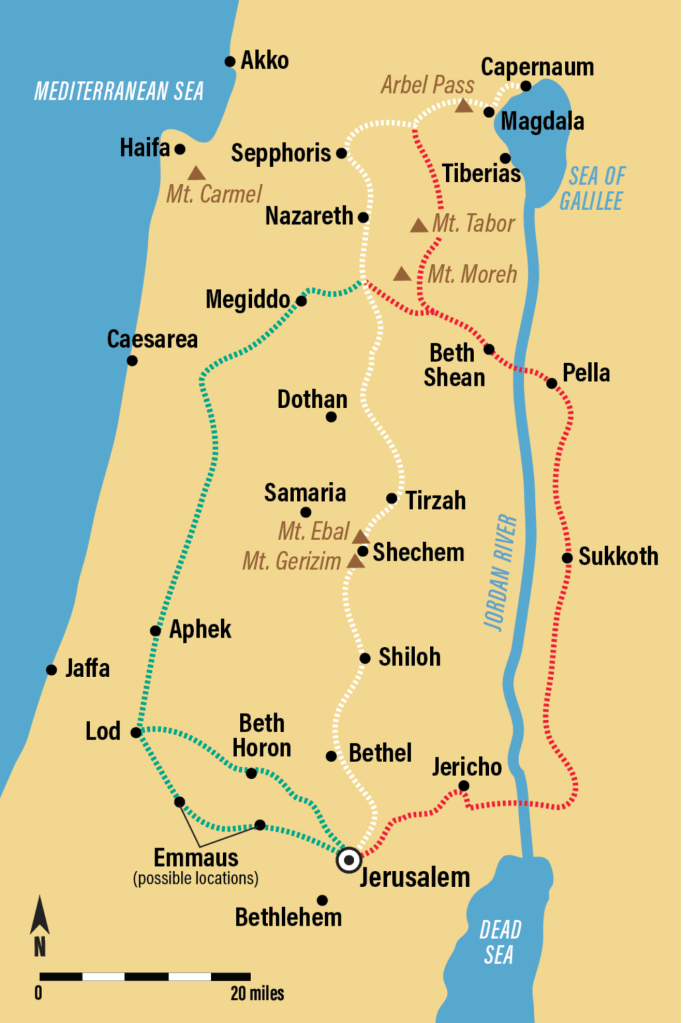
If you were going north to Galilee in Jesus’s day, you had three choices: The most direct route was to head north and go through Samaria. This is the fastest way, but the Jews rarely used it because travel through Samaria was dangerous. So most chose to go east across the Jordan and then north before crossing the Jordan again near Beth Shean or Jezreel.  The western route was even more difficult.

I want you to take two minutes to watch this clip from “The Chosen.”  I am usually impressed at the series’s effort to try to be culturally and historically accurate.  They portray Jesus’ journey with the disciples as he decides to go through Samaria (much to their surprise.)  There are two minor disagreements with the Scripture in this episode.  First, they have somewhat placed this story out of order — note in the clip that Jesus has already called most of the disciples.  Secondly, they are traveling in the opposite direction from the Biblical account (north from Judea to Galilee in Bible and south from Galilee in the clip).  Nevertheless, I feel that the disciples’ response to Jesus’ decision to take the journey through Samaria is so well done that this has become one of my favorite scenes in the series.

John tells us “he had to pass through Samaria”  without explaining why. We only have one story on this journey: the encounter between Jesus and the Samaritan woman at the well. So, we must assume this is his divine appointment. Next week, we will look at that encounter, but to understand this story, we must understand the conflict between the Jews and the Samaritans. Where did they come from?

The History Lesson

Around 1000 BC, David became king over all of Israel, and when he died, his son, Solomon, became king, and the land reached the peak of its prosperity.  Solomon dies in 931 BC, and there is a struggle for control. His son, Rehoboam, makes very poor decisions, and the kingdom splits.  Ten tribes in the North became known as ‘Israel’ (yes, a little confusing, sorry).  The capital of Israel was established in Samaria, with Jeroboam as their king.  The tribes of Judah and Benjamin in the South became known as ‘Judah’ with their capital remaining in Jerusalem and Rehoboam as their king.  Jeroboam’s first act in the North was establishing areas for worship in Bethel and Dan (so Israel wouldn’t have to travel back to Jerusalem to worship.)

1 Kings 12:26-29    And Jeroboam said in his heart, “Now the kingdom will turn back to the house of David.   If this people go up to offer sacrifices in the temple of the LORD at Jerusalem, then the heart of this people will turn again to their lord, to Rehoboam king of Judah, and they will kill me and return to Rehoboam king of Judah.”   So the king took counsel and made two calves of gold. And he said to the people, “You have gone up to Jerusalem long enough. Behold your gods, O Israel, who brought you up out of the land of Egypt.”    And he set one in Bethel, and the other he put in Dan.

Things started badly for the Northern Kingdom of Israel, and they got worse until God sent Assyria to sack Israel in 722 BC. Assyria’s method of controlling its conquered countries was to export the leaders and a percentage of the population and then bring in people from other conquered nations to cause the people to lose their distinctiveness and be less likely to rebel.

2 Kings 17:24   And the king of Assyria brought people from Babylon, Cuthah, Avva, Hamath, and Sepharvaim, and placed them in the cities of Samaria instead of the people of Israel. And they took possession of Samaria and lived in its cities. 

The Assyrians (in the Annals of Sargon II) claimed to have deported 27,290 people, but it is currently thought that only about 10% of the population of the northern kingdom was deported, and only about 1000 people were brought into the country from beyond.  So, there was less of an influx of foreign people than previously thought.  This is important because one of the reasons the Jews in Judah disliked the Samaritans was that they maintained the Samaritans were people who broke God’s laws about intermarriage; they called them half-breeds. The Samaritans maintained they were descendants from the tribes of Levi, Ephraim, and Manasseh (Joseph), who were not deported to Assyria.  While the Bible mentions the influx of foreigners, I can’t find any Biblical reference to their intermarriage.1  2 Kings 17:29ff discusses the foreign idols placed in the land, but the transplanted people place these, not the people originally from the Northern Kingdom who the Assyrians did not carry away.  “But every nation still made gods of its own and put them in the shrines of the high places that the Samaritans had made, every nation in the cities in which they lived.” (2 Kings 17:29).  There are around 900 Samaritans today, with most living in Nablus which is in the location of the ancient city of Samaria.  Interestingly, genetic studies were done in the past 25 years that support the Samaritans’ claim of their pure ancestry, refuting the once-held claims of the Jews in the Southern Kingdom.  

One hundred thirty-six years after the Northern Kingdom was decimated, Babylon conquered Judah, and Jerusalem and the temple were destroyed. Babylon had a different policy of controlling conquered nations. They exported most people from the land, leaving only a few very poor.  So Judah was exiled in Babylon for 70 years.  Persia conquered Babylon and allowed all those captives to return to their homes.  

When the exiles returned, they began rebuilding the temple. Some of the people who had already lived in the land offered to help, but they were refused.

Ezra 4:1   Now when the adversaries of Judah and Benjamin heard that the returned exiles were building a temple to the LORD, the God of Israel,  they approached Zerubbabel and the heads of fathers’ houses and said to them, “Let us build with you, for we worship your God as you do, and we have been sacrificing to him ever since the days of Esarhaddon king of Assyria who brought us here.”  But Zerubbabel, Jeshua, and the rest of the heads of fathers’ houses in Israel said to them, “You have nothing to do with us in building a house to our God; but we alone will build to the LORD, the God of Israel, las King Cyrus the king of Persia has commanded us.” 

These were likely not Samaritans, as these people say the king of Assyria ‘brought them here.’  They are the imported people from the nations listed in 2 Kings 17:24.  But at this point, the people of Judah have refused to see any difference between the Jews who were not taken and the Gentiles who were brought in.  They lump them all together. (As do many people who discuss this time in history.)

The final separation between the Jews of Judah and the Samaritans comes when Nehemiah discovers that a grandson of the high priest, Eliashib, had married a daughter of Sanballat, the governor of the province of Samaria.  Since Nehemiah saw her as ‘non-Jewish,’ he felt the priesthood had been defiled and drove the high priest out of Jerusalem (Nehemiah 13:28-29). According to the historian Josephus, Sanballat then built a temple on Mount Gerizim where this exiled priest could function.

And then things get even worse.

After Alexander the Great died, his kingdom was divided among three generals.  The Seleucid leader Antiochus Epiphanes persecuted the Jews. He desecrated the temple and altar, leading to a rebellion and the Maccabean Wars in the 2nd century BC. The Jews in Judah asked the Samaritans for help fighting off the Selucids. However, they refused and aligned with the Selucids fighting against Judah. After Judah prevailed, in 108 BC, they went to Mt Gerizim and destroyed the Samaritan’s temple in retribution.  The Samaritans finally struck back in 6 AD and sneaked into the Jerusalem temple at night and scattered human bones around, defiling the temple and ruining the Passover celebration.

A few quotes from literature from that time further reveal the animosity:

The Wisdom of Ben Sirach 50:25-26  (ca. 200 BC)  “There are two nations my soul detests, the third is not a nation at all; the inhabitants of Mt Seir (the Edomites), the Philistines, and the stupid people living at Shechem.

Mishna Shebiith 8:10  “He that eats the bread of the Samaritans is like to one that eats the flesh of swine.”

Finally, there is the story in Luke 9:51-56 where Jesus is again traveling through Samaria to the Feast of Tabernacles.  One of the Samaritan villages would not receive him, because he was a Jew headed to Jerusalem, so James and John ask Jesus “Lord, do you want us to tell fire to come down from heaven and consume them?” (Luke 9:54).  Jesus rebuked them and traveled on.2  The Hatfields and the McCoys had nothing on the Jews and the Samaritans.  

Samaritans were not just social outcasts — they were the enemy, the most hated people on the planet by Jews in Jesus’ day.  When Jesus said, “Love your enemies,” the people they would have pictured as enemies were Samaritans.  (Incidentally, who do you think about if you hear “Love your enemies”?)

Jesus had to pass through Samaria. He had a divine appointment. He will not miss this appointment, even if it means taking a more difficult journey that no one wants to take. He takes the path less taken only to have a meeting with this one woman. The woman we will see next week was isolated, lonely, and ignored by her community. In all of Samaria, he considers this one woman. And that conversation with one woman will lead to many believing in him.

Jesus had the ability to see the one among the many. In the Gospels, he saw a funeral procession with many mourners, yet he focused on one grieving woman. Amidst a crowd, he noticed the one woman in need who touched the hem of his garment. Walking through a busy market, he saw one tax collector and stopped to invite Matthew to follow him. Jesus saw the one who needed him most.  

“The God who sees”

Hagar is an Egyptian who is given to Abraham’s wife, Sarah, as a handmaiden.  She is mistreated and forced into the wilderness.  There, God finds her and gives her comfort and encouragement.  She calls him ‘El Roi’, the God who sees.   If you have ever felt lonely in a crowd, hopeless, or isolated, if you think the whole world is against you — God sees you, loves you, and looks out for you.  Like Hagar, he may not change your circumstances but will change you so you can bear them.

Sometimes, it is easier to see the many instead of the one.

It is easy to see the many and say they need help. It is easy to see the TV advertisement with starving children and say, “Let’s donate to help the children in Africa.”  It is not difficult to drop off some food at the local food pantry to help the hungry in our town, take some clothes to the Salvation Army, or go to a charity dinner to help single mothers. These are all good things, but that is not how Jesus did ministry.  Jesus spent more time talking to individuals than he did preaching to crowds.

Jesus was all about reaching out and making relationships, especially with those left out by society — look at who he worked with:  the hated people like Samaritans, tax collectors, prostitutes, zealots, the poor, and lepers — people no one would put on their dinner invitation list.   Can we just for a moment think about who Jesus ministered to and then look at our lives and see if we are following Jesus?

Did you notice in the clip that the disciples were ahead of Jesus, looking at a map? It is hard to follow someone if you are walking in front of them. The disciples were goal-oriented. They knew their final destination and were headed there with blinders on. They would never consider going to Samaria, calling a tax collector, touching a leper, or making a prostitute a disciple. At the end of the clip, Jesus steps ahead and says again, “Follow me.”

There are so many people left out—so many needs.  And again, we need to, like Jesus, focus on not the many but the one.

Mother Teresa worked for six decades among the desperate and hopeless streets of the extremely poor in Calcutta, India. When asked how she was not overwhelmed by the crowds in need around her, she said,  “I don’t see crowds; I see individuals.”

On my first trip to Guatemala to do medical missions, we woke up early and drove up the side of a volcano to a village where the missionary told people to gather for free medical care. As we wound up that road, we began to pass people standing in a line that stretched for what seemed like miles. I asked our missionary, “What are those people in line for?”  He turned around and grinned and replied, “To see you.”  That day, I was overwhelmed by the crowd of sick children.  Then, I got some of the best advice I had ever received in my medical career.  “You will see hundreds of children today.  The needs will be great, and you will not be able to meet them all.  Do not see the hundreds. See the one.  The only one that matters is the one in front of you at the moment.  Give your all to that one.”  

There is a well-known parable I like to share with people as we depart for mission trips.  A man was walking on the beach early one morning.  He was the only one out that early, except for a boy he could see far in the distance.  As he walked further, he saw the little boy throwing something into the ocean.  As he got closer, he saw that the tide had washed up thousands of starfish on the beach.  They were drying out in the morning sun, but the little boy threw one after another back into the water.  The man said, “Hey, kid, there are thousands of starfish washed up.  Stop wasting your time.   You can’t possibly make a difference.  The little boy picked up another starfish and threw it as far as he could into the ocean and then replied to the man, “It made a difference to that one.”

Do you see the many, or do you see the one?

Later in his ministry, a Bible scholar will ask Jesus a question that Jesus answers by telling the parable of the Good Samaritan. The question was, “Who is my neighbor?”  The answer was “The one who saw to the needs of another.”  It is easy to say everyone is my neighbor.  But you can’t meet “everyone’s” needs.  Who is your neighbor?  Do you know the people who live around you?  Do they have needs?  You can’t meet everyone’s needs, but you can meet someone’s needs.  We need to follow Jesus’ lead and see the one, make relationships, and share the love of God. There are divine appointments out there for each of us.

Let me close this by sharing one of my divine appointments.

It had been a tough week.  That Monday, I saw a very sick 10-day-old baby and sent her by ambulance to Children’s Hospital.  She ended up that evening in the ICU, and I was told she was stable.  She died the following day.  I had tried to reach out to the family and share my condolences and offer support, but the phone number and address we had were not good.  I was on-call that weekend and had finished my hospital rounds on the babies and sick kids by noon.  I was just ready to go home and forget the week.  I stopped for gas on the way home and was headed in to pay (because, of course, the pay-at-the-pump was broken.)  A rough-looking man was sitting on the curb near the door, and I got the message from God that I needed to talk to him.  Begrudgingly, I did.  We talked a bit, and I discovered he had hitchhiked over 400 miles in the past several days.  He was headed to Guntersville, where I was headed.  I offered to take him there.  On the way, I asked him what brought him to our little town.  He teared up and said he was coming for the funeral of his 2-week-old granddaughter, whom he never got to see.  Sure enough, it was the baby I had seen.  So, God enabled me to reach out to this family in a way I could not have imagined.  After leaving their house, I had to repent of my poor attitude, my reluctance to listen, and all the other times I had ignored the Holy Spirit when I was so focused on going where I wanted to go.

Let me challenge you this week to see beyond the many and see the one.  God has a divine appointment for you.  Don’t miss it.

And let me ask you to do one more thing: Please share your own story of your divine appointment. I would love it if several of you posted your story as a comment on this blog. It will bless us all.  

Thanks.  

  1. I could not find any scriptural evidence for the common belief that there was a large amount of intermarriage between the Israelites not taken by Assyria and the imported people. If you know if a reference, please let me know.
  2. Jesus rebukes James and John for their continued animosity towards the Samaritans. Perhaps this is part of the reason Jesus tells the parable of the Good Samaritan in the following chapter in Luke.